
Antique Mantel and Shelf Clock Identification Guide
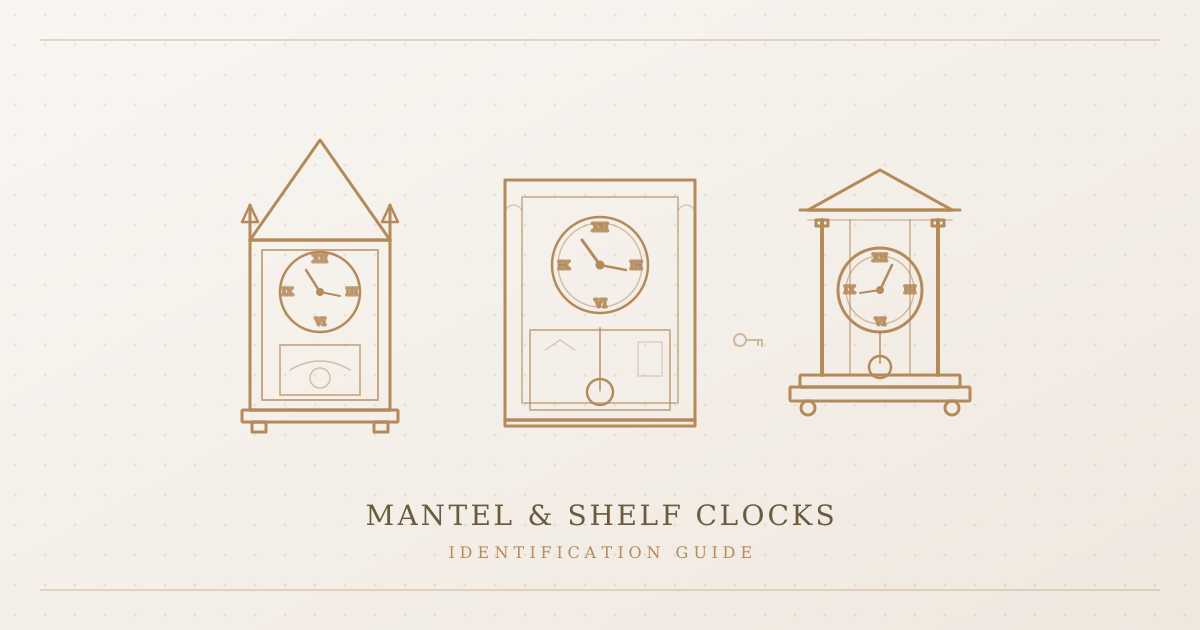
The mantel clock is the quiet anchor of countless old parlors — a wood or marble case sitting between candlesticks on a shelf, ticking through generations. As a collecting category it is enormous: more antique shelf and mantel clocks survive than almost any other type of timepiece, because the great American factories of the nineteenth century turned them out by the hundreds of thousands and households kept them long after they stopped running. That abundance is both the opportunity and the trap. A common oak gingerbread clock and a rare early pillar-and-scroll can look superficially alike to a beginner, yet sit decades and a wide value gap apart.
Identifying a mantel or shelf clock means reading four things together: the case style, the movement inside, the dial and hands, and any paper label, stamp, or signature. No single clue settles it. A French marble case might hold a replaced movement; an American label might survive in a case that has lost its original tablet. The skill is cross-checking the evidence so the parts tell a consistent story — the same disciplined looking that underlies antique clock identification as a whole.
This guide walks through what a mantel clock is and how it differs from its cousins, the major American and French case styles, the movements and how they date a clock, dials and hands, the all-important paper labels and maker marks, the leading manufacturers, reproductions and married clocks, condition, and value. Whether you inherited a black-cased clock with gilt columns or are weighing a steeple clock at a flea market, the framework below lets you place it in time and judge what it is worth.
Table of Contents
- What Counts as a Mantel or Shelf Clock
- American Shelf Clock Case Styles
- French & European Mantel Clocks
- Reading the Movement
- Dials, Hands & Tablets
- Paper Labels, Stamps & Signatures
- Major American Makers
- Putting It Together: Dating a Clock
- Reproductions & Married Clocks
- Condition & Originality
- Value Factors and Price Ranges
- Care, Running & Display
- Frequently Asked Questions
What Counts as a Mantel or Shelf Clock
A mantel clock (British usage often says "mantel" or "bracket-style") and an American "shelf clock" describe the same broad idea: a spring- or weight-driven clock designed to stand on a flat surface — a mantelpiece, shelf, sideboard, or table — rather than hang on a wall or stand on the floor. They are smaller than a tall-case (grandfather) clock and larger than a carriage clock, the small brass travel timepiece with a top handle. They are also distinct from cuckoo clocks and banjo clocks and other wall clocks, which are built to hang.
American "Shelf" vs. European "Mantel"
The terminology splits along national lines. In the United States, the factory-made clocks of Connecticut and New England are almost always called shelf clocks — pillar-and-scroll, ogee, steeple, and so on. In Britain and on the Continent, comparable clocks are mantel clocks, and the finest French examples (often called pendules) sit in marble, bronze, or porcelain cases. Collectors use both words loosely, and "mantel clock" has become the catch-all retail term. For identification it does not matter which label you use; what matters is recognizing the case family and origin.
Why the Category Is So Large
From roughly the 1820s, American clockmakers pioneered mass production of inexpensive brass and wooden movements, and by the late nineteenth century firms like Seth Thomas, Ansonia, Ingraham, Gilbert, and the New Haven Clock Company were exporting shelf clocks worldwide. The result is that ordinary nineteenth- and early twentieth-century shelf clocks are genuinely common — which keeps prices for run-of-the-mill examples modest while reserving real value for early, rare, or exceptionally preserved pieces.
American Shelf Clock Case Styles
Case style is your fastest dating tool for American clocks, because the major forms appeared and faded in a fairly well-documented sequence. Learn these silhouettes and you can usually bracket a clock to within a few decades before you even open the case.
Pillar-and-Scroll (c. 1815–1830)
The earliest and most prized factory shelf form, associated with Eli Terry, is the pillar-and-scroll: a delicate case with slender turned columns flanking the door, a scrolled "broken-arch" top with three brass finials, and French (bracket) feet. These house wooden movements and have painted wooden or paper dials. Genuine pillar-and-scroll clocks are early, scarce, and valuable; the form was widely reproduced later, so authentication matters.
Box / Column Clocks (c. 1830–1845)
As wooden movements gave way to stamped brass, makers produced simpler rectangular cases with full or half columns at the sides and a stenciled or carved splat across the top — often called stencil-column or carved-column clocks. The lower glass tablet typically carries a reverse-painted or stenciled scene. These are more common than pillar-and-scrolls and a good entry point for collectors.
Ogee ("OG") Clocks (c. 1840–1915)
The ogee is the workhorse of American shelf clocks: a rectangular case whose frame is molded in a continuous S-shaped (ogee) curve, with a large upper glass over the dial and a decorative lower tablet. Ogees were made for some seventy-five years in huge numbers by nearly every Connecticut maker, usually with 30-hour or 8-day weight or spring movements. Because production ran so long, the movement, label, and tablet — not the case shape — date a given OG.
Steeple (Gothic) Clocks (c. 1845–1900s)
The steeple clock has a pointed Gothic-arch top flanked by two slender turned finials ("steeples"), giving it a little-church silhouette. Compact and popular, it was made for decades; sharp-Gothic and round-Gothic ("beehive") variants exist. Most carry spring-driven movements and a reverse-painted lower tablet. Steeples remain among the most recognizable and collectible American shelf forms.
Cottage, Beehive & Round-Gothic (mid-late 1800s)
Smaller decorative forms proliferated mid-century: the plain "cottage" clock, the rounded-top "beehive," and various small Gothic cases. These compact spring-driven clocks were affordable bedroom and kitchen pieces and survive in quantity.
Gingerbread / Kitchen Clocks (c. 1880–1915)
The late-Victorian "gingerbread" or "kitchen" clock is an upright walnut or oak case stamped with elaborate pressed (machine-carved) ornament, usually with a paper dial, a pendulum visible through a glass door, and frequently an alarm. Mass-produced and inexpensive in their day, they are the single most common antique American shelf clock and a familiar attic find. Condition of the pressed wood and originality of the glass drive their modest values.
Black Mantel ("Blacks") & Adamantine (c. 1880–1920)
Imitating costly French black-marble clocks, American makers produced heavy "black mantel" clocks of cast iron, enameled wood, or wood faced with Adamantine — Seth Thomas's patented celluloid veneer that mimicked marble and exotic stone. These broad, low cases often have gilt columns, lion-head side handles, and an 8-day striking movement. The Adamantine finish and patent dates on the movement help date them.
Tambour ("Camelback" / Napoleon's Hat, c. 1900–1940)
The early twentieth century brought the low, wide tambour clock with its humped "camelback" or "Napoleon's hat" profile, usually in mahogany veneer with brass feet. Inexpensive and produced into the Art Deco era, tambours are very common and generally modest in value unless by a premium maker or in pristine condition.
French & European Mantel Clocks
French mantel clocks occupy the high end of the category. From the late eighteenth through the nineteenth century, Paris was the center of luxury clockmaking, and French pendules set the aesthetic standard that American "black mantel" clocks later imitated in cheaper materials.
Black Marble & Slate "Pendules" (c. 1860–1900)
The classic French mantel clock of the later nineteenth century is a substantial case of black Belgian marble or slate, often with incised gilt decoration, classical columns, and a round brass-bezel dial. Inside is typically a high-quality round French movement with a count-wheel or rack strike on a bell or gong. These are weighty, well-made, and far superior mechanically to their American black-cased imitations.
Gilt Bronze & Ormolu Figural Clocks
The most valuable French mantel clocks are figural garniture pieces in gilt bronze (ormolu): allegorical figures, cherubs, or classical scenes surrounding the dial, frequently sold as a three-piece set with matching candelabra. Quality of casting and gilding, the maker's signature on the movement, and an intact original garniture push these into serious money. The same gilt-bronze artistry appears across French decorative objets d'art.
Porcelain & Sèvres-Style Cases
Some French mantel clocks sit in porcelain cases — hand-painted panels, floral mounts, and gilt detailing in the Sèvres manner. Condition of the fragile porcelain and the authenticity of any factory marks are critical to value here.
The Round French Movement
What unites most quality French mantel clocks is the round, drum-shaped brass movement, typically stamped with the maker's or retailer's name and often a serial number and medal marks. These eight-day movements with silk-suspension or later Brocot pendulums are robust and accurate, and an original signed French movement is itself a strong value indicator regardless of case material.

Reading the Movement
Open the back or hinged door and the movement often tells you more than the case. The mechanism's material, construction, and any stamps narrow the date and confirm the maker — and reveal whether the clock is "married" (a movement and case that did not start life together).
Wooden vs. Brass Movements
The single most important early distinction is material. Wooden movements — gears and plates cut from seasoned hardwood — were used in American shelf clocks roughly from the 1810s into the 1840s, when cheap stamped brass displaced them. A wooden movement almost always signals an early, more desirable clock. Brass movements dominate from the 1840s onward and are the norm for every later style from ogees to gingerbreads.
Weight-Driven vs. Spring-Driven
Early shelf clocks (and many ogees) are weight-driven: cast-iron weights hang inside the case on cords or chains, so the case must be tall enough to let them fall. From the 1840s, coiled mainsprings allowed shorter, lighter cases — steeples, cottages, and the compact forms that followed. Seeing weights versus a spring barrel immediately tells you which technology you are looking at and roughly when.
Duration: 30-Hour vs. 8-Day
Movements run either about 30 hours (wound daily) or eight days (wound weekly). Eight-day movements are more complex and were generally a step up in price; 30-hour movements are common in inexpensive clocks. The winding-arbor count on the dial helps: one arbor usually means time-only; two means time and strike; three can mean an added alarm or chime.
Strike, Chime & Alarm
Most mantel clocks strike the hours (and often the half-hours) on a bell, coiled gong, or rod gong — a coiled-wire gong points to later nineteenth-century work, while early clocks strike on a cast bell. Count-wheel (locking-plate) striking is older and can strike "out of sync" with the hands; rack-and-snail striking, common on French and better American movements, always strikes the correct hour. Twentieth-century clocks may add Westminster chimes on rod gongs.
Platform Escapements and Later Mechanisms
Higher-grade clocks — and most carriage clocks — use a lever platform escapement rather than a swinging pendulum. In mantel clocks a platform escapement usually signals a better French or English movement. By the 1930s, plug-in electric and battery movements appeared; an original electric cord or battery housing dates a clock firmly to the twentieth century, the same boundary that separates antique from modern across watches and timepieces.
Dials, Hands & Tablets
The face of a mantel clock is rich with dating clues, but it is also the part most often replaced or "restored," so weigh it alongside the movement and case rather than on its own.
Dial Materials Over Time
Early American shelf clocks have painted wooden or zinc dials, often with floral spandrels in the corners. By the late nineteenth century, inexpensive paper dials (printed and glued to a metal or wood base) became standard on gingerbread and kitchen clocks — a torn or water-stained paper dial is a hallmark of these. French clocks favor white enamel (porcelain) dials with crisp black numerals, sometimes in separate enamel cartouches mounted on a gilt center. The dial material alone often places a clock in its era.
Roman vs. Arabic Numerals
Roman numerals dominate through the nineteenth century, with the "four" usually shown as IIII rather than IV — a long-standing horological convention, not an error. Arabic numerals become more common in the twentieth century, and bold Arabic figures are typical of Art Deco tambours. Numeral style is a soft clue, helpful in combination with other evidence.
Hands
Hand styles evolved from simple early "spade" and "moon" hands to ornate pierced Victorian patterns and elegant French "Breguet" (moon-tipped) hands. Mismatched hands, or hands too plain for an ornate dial, suggest replacements. Original hands appropriate to the period add to a clock's integrity even though they are easily swapped.
Glass Tablets (Reverse Paintings)
The lower glass panel on ogee, steeple, and column clocks is the tablet, often a reverse-painted (églomisé) or stenciled scene — landscapes, buildings, patriotic motifs, or florals. Original tablets are fragile and frequently lost or replaced with plain glass or modern reproductions; an original, intact tablet meaningfully raises value and authenticity. A suspiciously bright, crisp tablet on an otherwise worn clock is usually a replacement.
Paper Labels, Stamps & Signatures
For American shelf clocks, the printed paper label glued inside the case is the single best identification tool — when it survives. For French clocks, look instead to stamps on the movement. Together these are the closest thing to a clock's birth certificate.
The American Paper Label
From the 1820s, Connecticut makers pasted a printed label inside the back or on the backboard, listing the maker's name and town, often with winding and care instructions and sometimes patent dates. The maker's name and address let you identify the firm; because companies changed names, partners, and addresses over time, the exact wording can date a clock to a span of years. A label naming "Seth Thomas, Plymouth Hollow" predates the town's 1865 renaming to Thomaston, for example — a single line that brackets the clock.
Reading Wear and Authenticity in Labels
An original label shows age-appropriate toning, foxing, and wear consistent with the case; a pristine white label in a worn clock is suspect. Multiple overlapping labels can indicate a repair history or a later "improvement." Photograph the label in good light and transcribe every line — the address, any patent dates, and the printer's imprint all help. Genuine maker marks are central to authentication across antiques, the same principle laid out in our authentication and provenance research guide.
Movement Stamps and Serial Numbers
Brass movements are frequently stamped with the maker's name, a model designation, and patent dates on the backplate. Patent dates set a clear earliest possible date (the clock cannot predate the patent, though it may be later). French movements carry the maker's or retailer's name, a serial number, and often round medal stamps from exhibitions — useful both for attribution and dating.
Retailer vs. Maker Names
A name on the dial is not always the maker. Many clocks were sold by jewelers and department stores that put their own name on the face while a factory supplied the movement. Treat a dial signature as the seller until the movement or label confirms the actual manufacturer — a distinction that also separates true makers from retailers in pocket watch identification.
Major American Makers
A handful of Connecticut and New England firms made the overwhelming majority of antique American shelf clocks. Recognizing their names on a label or movement is often all it takes to attribute a clock.
Seth Thomas
Founded by Seth Thomas in Plymouth, Connecticut, and producing clocks from the 1810s, this is the most famous American clock name. The town was renamed Thomaston in his honor in 1865, so "Plymouth Hollow" versus "Thomaston" on a label is a clean dating divider. Seth Thomas made everything from pillar-and-scrolls to Adamantine black mantels and is known for solid quality; many later movements carry a stamped date code.
Ansonia Clock Company
Ansonia, based in Connecticut and later Brooklyn, New York, is celebrated for ornate cast-metal and "crystal regulator" clocks as well as figural and black-mantel models. Ansonia clocks tend toward decorative flair, and the better figural pieces are sought after. The company ceased U.S. production in the late 1920s.
William L. Gilbert Clock Company
Gilbert, of Winsted, Connecticut, produced large quantities of shelf clocks including gingerbreads, steeples, and black mantels. Gilbert clocks are generally affordable and a common find, making them good starter pieces.
E. Ingraham Company
Elias Ingraham of Bristol, Connecticut, is credited with refining the steeple ("sharp Gothic") case and produced a long line of well-designed shelf clocks. Ingraham black-mantel and kitchen clocks are widely collected, and the firm's cases are noted for good proportions.
New Haven Clock Company
The New Haven Clock Company made and distributed an enormous range of shelf clocks, often supplying movements to other sellers. New Haven clocks span the gamut from inexpensive kitchen models to better mantel pieces.
Waterbury and Others
The Waterbury Clock Company, Sessions (successor to E. N. Welch), and several smaller Bristol and Connecticut firms round out the field. Many of these makers later consolidated; Sessions and others continued into the twentieth century making tambour and electric mantel clocks.
Putting It Together: Dating a Clock
No single feature dates a mantel clock; you triangulate. Here is the practical sequence experienced collectors follow.
Step 1: Identify the Case Style
Place the case in its family — pillar-and-scroll, ogee, steeple, gingerbread, black mantel, tambour, or French marble/bronze. This gives a broad date range and an origin (American vs. European). Remember that long-lived forms like the ogee need the movement and label to narrow the date.
Step 2: Examine the Movement
Wood or brass? Weight- or spring-driven? 30-hour or 8-day? Count-wheel or rack strike? Each answer tightens the window. A wooden weight-driven movement pushes you toward the 1820s–1830s; a spring-driven brass movement with a coiled gong points to the later nineteenth century.
Step 3: Read the Label and Stamps
Transcribe the paper label (maker, town, patent dates) and any movement stamps. Use town-name changes and patent dates to bracket the clock. The latest patent date on the movement is a firm "no earlier than" anchor.
Step 4: Cross-Check the Dial, Hands, and Tablet
Confirm the dial material, numerals, hands, and tablet are consistent with the date the case, movement, and label suggest. Inconsistencies flag replacements or a married clock rather than disproving the date outright.
Step 5: Reconcile Conflicts
If the case says 1830 but the movement says 1890, you likely have a married clock — an old case fitted with a later movement, or vice versa. Decide which element is original and value accordingly. This patient reconciliation is the same logic that anchors a formal antique valuation and appraisal.
Reproductions & Married Clocks
Two issues dominate authentication of mantel clocks: outright reproductions and "married" clocks assembled from mismatched parts. Both are common and both can trap the unwary.
Reproductions and Reissues
Desirable early forms — especially pillar-and-scroll and steeple clocks — have been reproduced for over a century, from honest twentieth-century reissues to deliberate fakes. Tell-tales include modern screws (uniform machine threads, Phillips heads), plywood or particleboard in a "period" case, synthetic finishes that fluoresce under UV light, artificially aged labels, and movements that postdate the supposed case. New Old-Stock and reproduction movements are widely available, so a perfect movement in a worn case warrants scrutiny — the same UV-and-hardware checks used when assessing reproductions of Victorian furniture.
Married Clocks
A married clock combines a case and movement that did not originate together — often an old case fitted with a replacement movement after the original failed, or a good movement rehoused in a better case to raise its price. Signs include extra screw holes or filled mortises where a different movement once sat, a movement that does not align with the dial feet or winding holes, and a case and mechanism of obviously different eras. A married clock is not worthless, but it should be priced as the sum of compromised parts, not as an original.
Replaced Components
Even an authentic, unmarried clock may have replaced tablets, dials, hands, or finials. Replacement is normal in clocks that have run for a century, but each substitution reduces originality and value. The goal is an honest inventory: which parts are original, which are period-appropriate replacements, and which are modern.
Condition & Originality
Condition governs value as much as rarity does, and for clocks "originality" — how much of the clock is as-made — is a distinct axis from cosmetic condition.
Case Condition
Examine the veneer for lifting, chips, and losses; gingerbread cases for cracked or missing pressed ornament; black mantels for chipped Adamantine or flaking enamel; and French marble for cracks and missing gilt. Original surface and finish are prized — an over-aggressive refinish that strips age and stencil work lowers value, a recurring theme in antique restoration and conservation.
Mechanical Condition
Does the movement run, strike correctly, and keep reasonable time? Worn pivots, broken mainsprings, and bent teeth are common and repairable by a clocksmith, but repair cost matters for inexpensive clocks. A clock that "has not run in years" may need only cleaning and oiling — or a costly overhaul. Never force a stuck movement or over-wind a spring while testing.
Completeness
Original pendulum, weights, key, finials, glass, and tablet all count. Missing weights or pendulums are replaceable but reduce originality; a complete clock with its original key and intact tablet is markedly more desirable than a stripped one.
Originality vs. Restoration
Collectors generally prize honest original condition over heavy restoration. Sympathetic conservation — cleaning, stabilizing veneer, a proper movement service — preserves value; replacing original tablets, refinishing out the patina, or swapping the movement diminishes it. When in doubt, do less.
Value Factors and Price Ranges
Mantel and shelf clock values span an enormous range, from a few tens of dollars for a common kitchen clock to five and six figures for an important French ormolu garniture. Several factors drive where a given clock lands.
What Drives Value
- Rarity and age: Early forms (pillar-and-scroll, early steeples) and short-production models command premiums; common ogees and gingerbreads do not.
- Maker: A premium French signature or a sought-after Ansonia figural model far outvalues a generic clock of the same age.
- Originality: Original label, dial, tablet, hands, pendulum, and finish all add up; replacements subtract.
- Condition: Running order, intact case and glass, and undamaged finish.
- Case material: Gilt bronze and marble outrank veneered wood; Adamantine outranks plain pine.
- Complications: Calendar, chime, or unusual functions add interest — see our perpetual calendar clock guide for the most collectible of these.
Approximate Ranges
As a broad orientation only, common gingerbread, cottage, and tambour clocks in average running condition typically trade in the low tens to low hundreds of dollars; good ogees, steeples, and black-mantel clocks span roughly the low hundreds; exceptional early American forms and quality French marble clocks reach the high hundreds to low thousands; and fine signed French ormolu garnitures and rare early pieces run into the many thousands and beyond. These ranges shift with condition, region, and market, so confirm against recent comparable sales.
Where to Verify Prices
Check completed-sale records on major auction platforms and at horological auctions, not asking prices. For anything potentially valuable — a signed French clock, an early American form, or a complex movement — a specialist appraisal is worth the cost, following the disciplined approach in our valuation and appraisal guide.
Care, Running & Display
An antique mantel clock is a working machine and a piece of furniture at once, and a little routine care keeps both sides healthy.
Running and Winding
Wind gently and stop at the first firm resistance — never force a spring. Use the correct key size; a too-small key rounds the winding arbor. Let a pendulum clock find its "beat" (an even tick-tock) by leveling the case or adjusting the crutch; an uneven beat will stop the clock. If a clock has not run in years, have it cleaned and oiled before regular use rather than running it dry.
Moving a Clock Safely
Before moving, stop the pendulum and secure or remove it, and immobilize hanging weights. Transport the case upright and cushioned. Reinstall the pendulum and weights only after the clock is in its final, level position.
Environment and Cleaning
Keep clocks away from radiators, direct sun, fireplaces in use, and damp — heat and humidity swings craze finishes, lift veneer, and rust steel parts. Dust the case with a soft dry cloth; avoid silicone polishes on original finishes. Never spray lubricant into a movement; proper clock oil applied sparingly to the right points is a job for a clocksmith. These same climate-control principles protect clocks the way they protect a wider collection, as covered in our guide to storage, care, and preservation.
Frequently Asked Questions
What is the difference between a mantel clock and a shelf clock?
They are essentially the same thing — a tabletop clock meant to stand on a flat surface. "Shelf clock" is the American term for the factory-made Connecticut clocks (ogee, steeple, gingerbread), while "mantel clock" is the British and Continental term and the common retail catch-all today. The words are interchangeable for identification.
How do I tell how old my mantel clock is?
Triangulate: identify the case style for a broad range, examine the movement (wood vs. brass, weight vs. spring, strike type), and read the paper label or movement stamps for the maker, town, and patent dates. Town-name changes (like Seth Thomas's "Plymouth Hollow" before 1865) and the latest patent date are precise anchors.
Are old mantel clocks worth anything?
It varies enormously. Common gingerbread, cottage, and tambour clocks are modest (tens to low hundreds of dollars), while early American forms, quality French marble clocks, and signed French ormolu garnitures can reach thousands. Maker, rarity, originality, and condition decide where a clock lands.
What is an "OG" or ogee clock?
An ogee clock is a rectangular American shelf clock whose case frame is molded in a continuous S-shaped (ogee) curve, with a large glass over the dial and a decorative lower tablet. Made for about seventy-five years by nearly every Connecticut maker, ogees are common, so the movement, label, and tablet — not the case shape — date a given example.
Should I clean or restore an old clock myself?
Dust and gentle surface care are fine, but leave the movement to a clocksmith — never spray lubricant inside or force a stuck mechanism. Avoid refinishing original cases or replacing original tablets and dials, as these reduce value. Sympathetic conservation preserves worth; heavy "restoration" usually destroys it.
Is the name on the dial always the maker?
No. Many clocks were retailed by jewelers and stores that printed their own name on the dial while a factory supplied the movement. Treat a dial signature as the seller and confirm the true maker from the paper label or the stamps on the movement.