
Cuckoo Clocks Identification Guide: Black Forest Cases, Movements & Makers
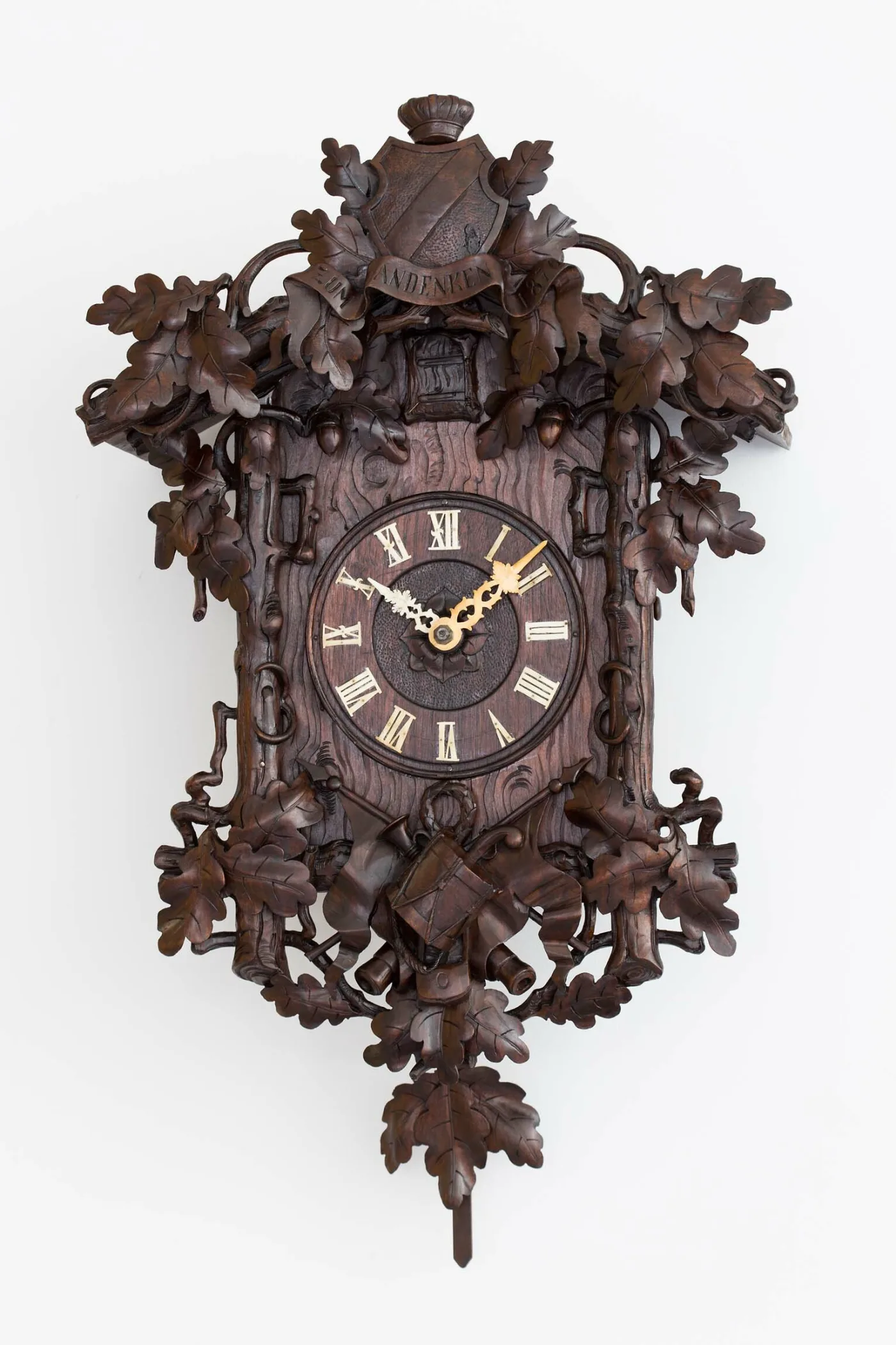
The cuckoo clock is one of the few decorative objects whose silhouette is instantly recognisable across cultures: a steep-pitched chalet roof, carved oak leaves trailing across the case, a bird that pops from a tiny gabled door on the hour, and two pine-cone weights drifting slowly down their brass chains. Yet behind that single iconic image lies a hundred and seventy years of regional industry, dynastic clockmaking families, and a surprising range of case forms — shield-dial, railway-house, chalet, hunter, trumpeter, musical — each with its own period, makers, and value structure.
Almost every authentic antique cuckoo clock comes from one small region: the Black Forest (Schwarzwald) of south-western Germany, between Freiburg, Triberg, Furtwangen, and Neustadt. From cottage workshops in the 1740s through the great Friedrich Eisenlohr railway-house design of 1851 to the consolidated VdS-certified makers of the twentieth century, the Black Forest has produced perhaps ninety-five per cent of all genuine cuckoo clocks ever made. Swiss chalet variants, a small American production, and twentieth-century Japanese imitations make up the balance. This guide reads the case forms, movements, bellows mechanisms, dials, carving, and maker marks that allow a collector to date a cuckoo clock to within a decade and identify its origin with confidence. It complements the broader framework of our antique clock identification guide and our coverage of related horological forms such as carriage clocks and mantel and shelf clocks.
By the end you will be able to recognise the four principal case forms, distinguish a one-day from an eight-day movement at a glance, read the carved decoration to date a piece within its production period, identify the marks of the major Black Forest makers (Beha, Schneider, Hubert Herr, Kammerer, Camerer Kuss), tell genuine Black Forest production from later Far-Eastern reproductions, and apply realistic value ranges to anything from a £150 mid-century chalet to a five-figure Beha trumpeter clock.
Table of Contents
- A Brief History of Cuckoo Clocks
- The Shield-Dial Period (1740–1850)
- Bahnhausle: The Railway-House Form (1851–1880)
- The Chalet Style (1880–present)
- The Hunter (Jagdstück) Case
- One-Day vs. Eight-Day Movements
- The Cuckoo Bellows Mechanism
- Trumpeter, Quail, and Musical Cuckoos
- Dials, Hands, and Numerals
- Carved Decoration and Case Materials
- Pine-Cone Weights, Chains, and Pendulums
- The Great Black Forest Makers
- The VdS Certificate and Modern Authenticity
- Swiss, American, and Japanese Variants
- Reproductions and Reproductions Marketing
- Authentication Workflow
- Condition and Restoration
- Value Factors and Price Ranges
- Building a Cuckoo Clock Collection
- Care, Display & Preservation
A Brief History of Cuckoo Clocks
The cuckoo clock began as a winter side-line for Black Forest farmers in the early eighteenth century. Snow-bound smallholders carved wooden gears, made glass bells from local sand, and developed mechanical curiosities to sell at the spring fairs. The cuckoo bird call — produced by two small bellows blowing into a pair of tuned wooden pipes — was probably introduced in the 1730s; tradition credits Franz Anton Ketterer of Schönwald around 1738, although the documentary record is thin.
Cottage Industry, 1740–1850
Through the first century of production cuckoo clocks were made almost entirely by farm households. Wooden plates, wooden gears, brass hand-cut wheels, and case panels painted in tempera on board: this is the "shield dial" or Schilduhr form that defines the early period. Clocks travelled to market on the backs of itinerant pedlars — the famous Schwarzwälder Uhrenträger figures of nineteenth-century prints — who carried them as far as London, Vienna, and Paris.
Industrialisation and the Furtwangen School
The founding of the Grand Ducal Clockmaking School at Furtwangen in 1850, under Robert Gerwig, transformed the trade. Standardised movements, brass plates, training in precision finishing, and a national design competition for a more "architectural" case all date from this moment. Gerwig's competition produced Friedrich Eisenlohr's 1851 railway-house design — the prototype of every chalet cuckoo since.
The Chalet Era and Export Boom
From the 1880s to the 1914 outbreak of war, Black Forest workshops shipped enormous quantities of carved-chalet cuckoo clocks worldwide. London department stores stocked them; American mail-order catalogues offered them; Swiss border traders rebranded German clocks for the tourist trade. Production was reorganised under factory conditions by Beha, Camerer Kuss, and similar firms while many smaller workshops continued hand assembly.
Twentieth-Century Consolidation
Two world wars and the Depression reduced the trade, but the post-war American occupation and German economic miracle restored it. The Verein die Schwarzwalduhr (VdS) was founded in 1992 to certify genuine Black Forest production against rising Chinese imitation; their hologram label on the case back is now the definitive modern authentication. Today perhaps a dozen Black Forest firms continue traditional production alongside hundreds of reproductions made in Asia.
Cultural Position
The cuckoo clock occupies an unusual cultural place: simultaneously a serious antique horological form, a folk-craft tradition, and a kitsch tourist souvenir. Collectors must distinguish all three. A 1880s Beha quail-trumpeter is a serious antique; a 1960s Hubert Herr chalet is a fine craft object; a 2010 mass-produced Chinese "Black Forest style" piece is neither, and trades at a tenth of the cost of equivalent German work.
The Shield-Dial Period (1740–1850)
The earliest cuckoo clocks bear no resemblance to the carved chalet that defines the modern image. They are flat painted-wood panels — the Schilduhr, literally "shield clock" — with a wooden hood, a hand-painted dial, and a movement of wooden gears hanging behind. Authentic shield-dial cuckoos are rare and important.
Form and Construction
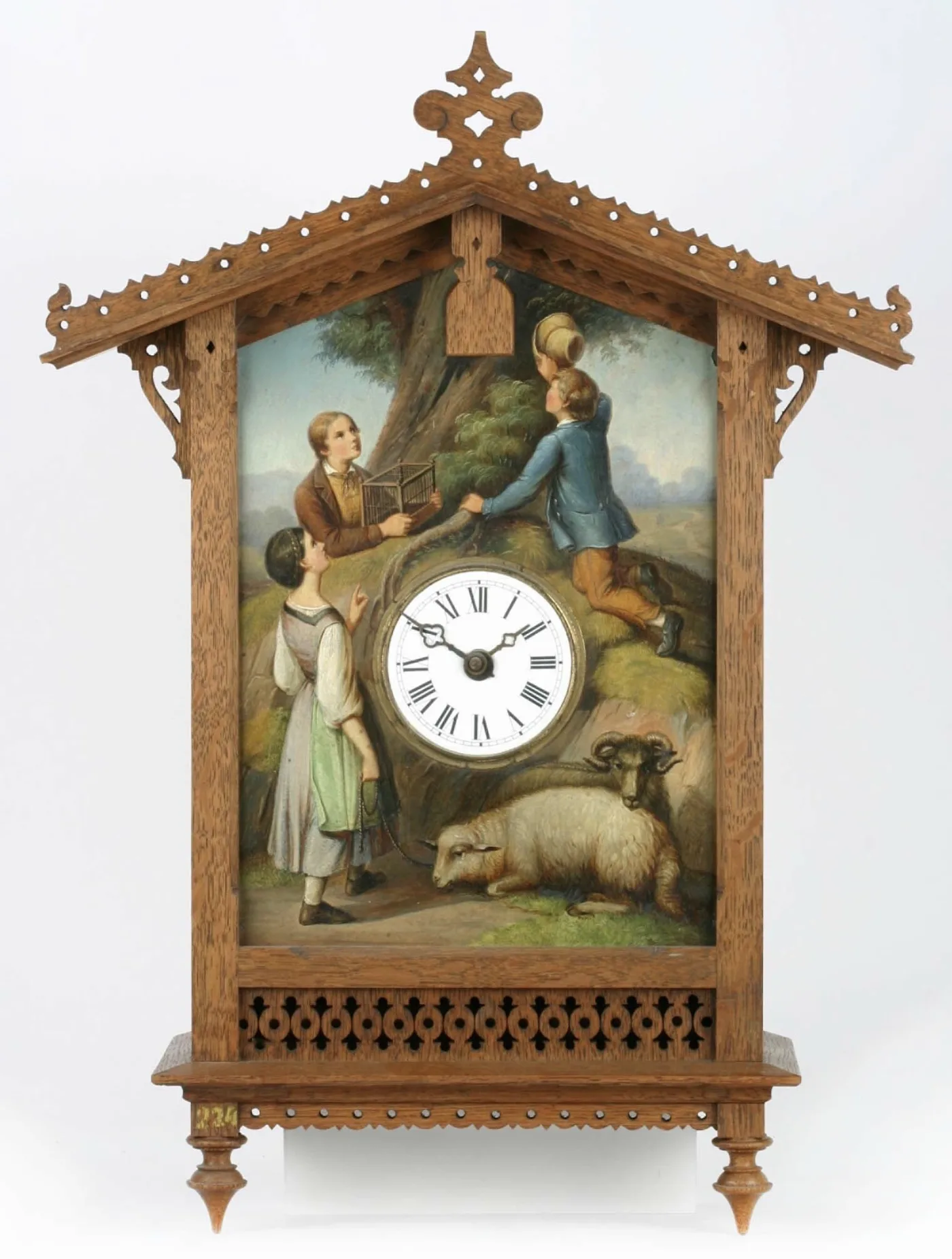
A shield-dial case is essentially a flat wooden board, usually 30–50 cm tall, with a curved or arched top and floral or scenic tempera decoration around a central painted dial. The cuckoo door is set within the painted dial itself or just above it. Weights hang below the board on visible cords — no enclosed pendulum or weights compartment.
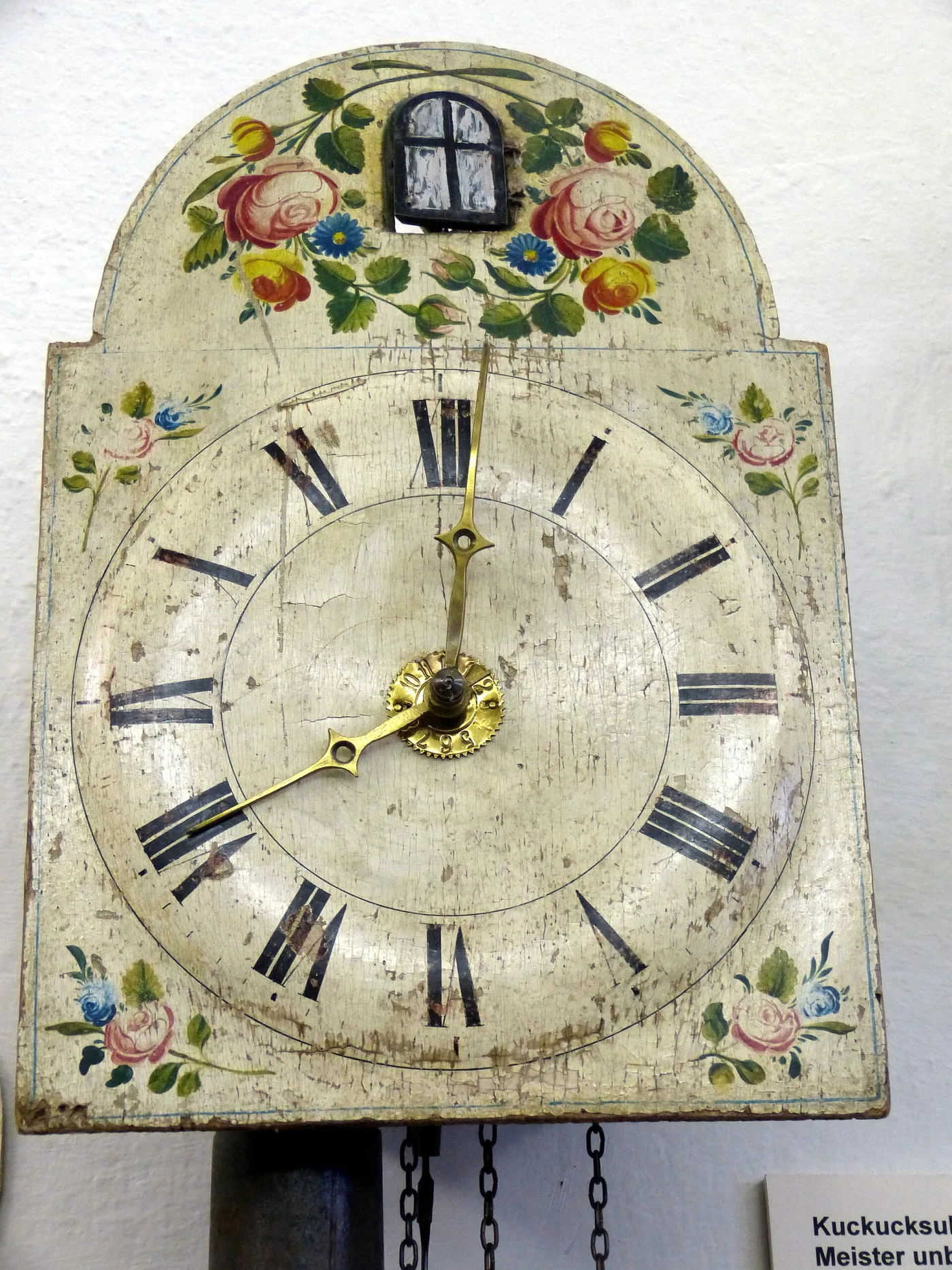
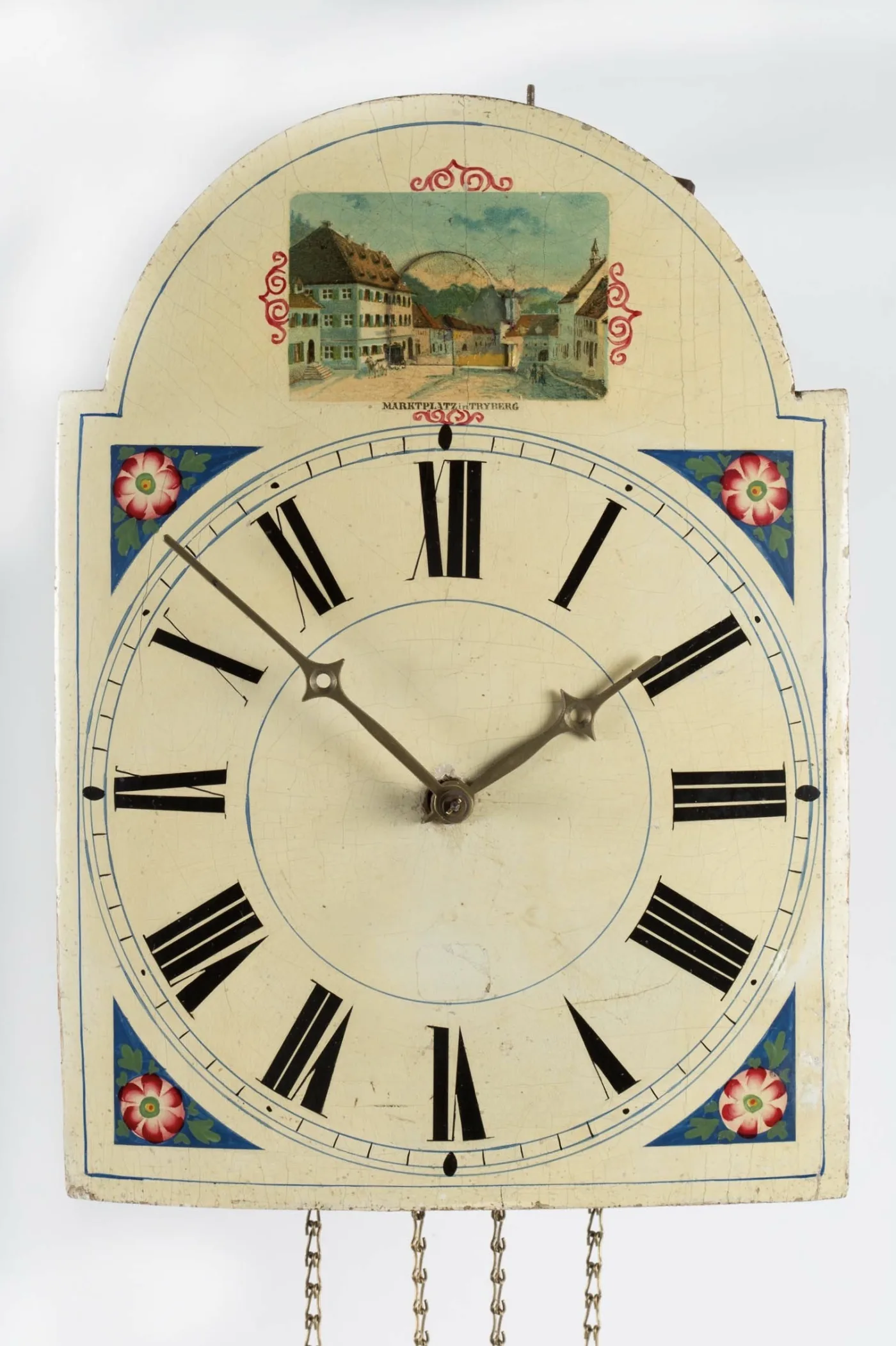
Seventy years separate these two and the format has not moved: a flat lacquered board with an arched top, a painted chapter ring, and the movement hanging behind it against the wall. What changes is the painting — free-hand tempera roses and a hand-painted cuckoo window on the earlier board, a topographical view of Triberg on the later one, sold into the tourist trade the new Baden railway had just created. Paint is most of the value of a shield clock, and both of these carry the losses and craquelure that a repaint would have covered.
Wooden Movements
Early shield-dial movements are made of cherry, oak, or maple, with hand-cut wooden wheels and brass bushings. Wooden lantern pinions, wooden plates, and a single wooden bell or pair of bellows make up the strike. The movement is open behind the painted shield — there is no case to enclose it.
Painted Decoration
Tempera painting on the dial board typically features tulips, roses, peasant scenes, hunters, or village views. The dial itself shows hand-painted Roman numerals on a creamy ground. Paint condition is the principal value driver: well-preserved original paint commands a 5–10x premium over repainted or rubbed examples.
Identifying Authentic Shield-Dials
Pre-1850 shield-dials are scarce and frequently reproduced. Authentic examples show hand-cut wooden gears (often with irregular tooth profiles), iron handwound springs or simple weight drives, original tempera paint with characteristic age crackle, and back boards of unfinished pine or fir. Look for old worm holes, period nails (hand-forged or early machine-cut square nails), and oxidation patterns consistent with a century and a half of attic storage.
Values
Genuine eighteenth-century shield-dials, when they appear at specialist auction, bring £2,000–£8,000 depending on condition, decoration quality, and provenance. Early nineteenth-century examples trade in the £800–£3,000 range. Twentieth-century reproductions in shield-dial form are common and worth £100–£300.
Bahnhausle: The Railway-House Form (1851–1880)
The single most important design moment in cuckoo clock history was Friedrich Eisenlohr's Bahnhausle ("little railway house") design, submitted to Robert Gerwig's Furtwangen design competition in 1851. Eisenlohr was an architect responsible for railway buildings on the Baden line; he applied the same vocabulary of pitched gable roofs, deep overhangs, and carved bargeboards to a small clock case.
Why It Matters
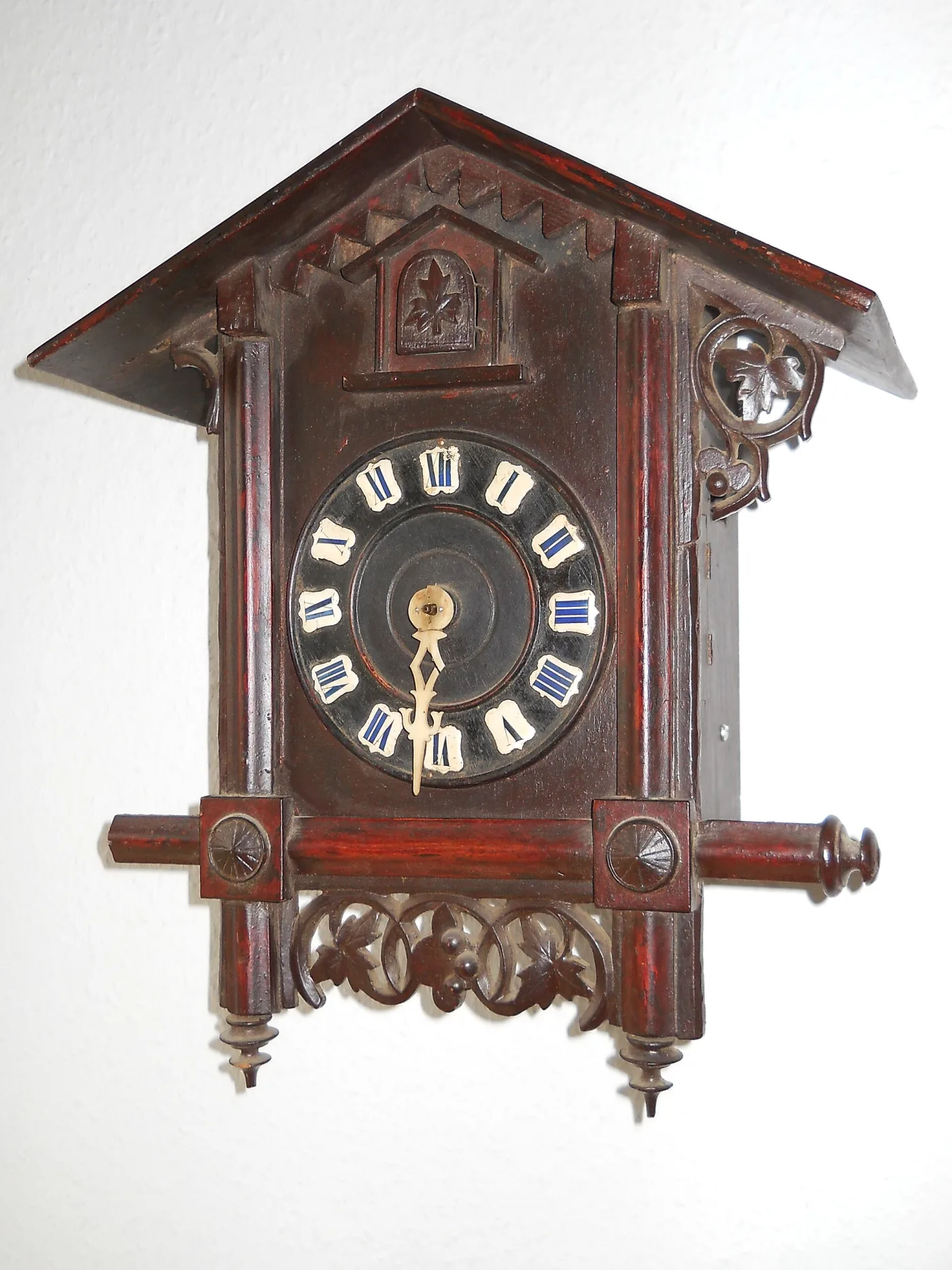
Almost every cuckoo clock made since 1851 descends from this case. The pitched roof, carved gable, central round dial, side panels of carved foliage, and lower pendulum opening are all Eisenlohr elements. He took a flat painted board and turned it into a miniature building.
Identifying Bahnhausle Cases
True 1851–1880 Bahnhausle cases are flatter and more architectural than later chalets. The roof pitch is steeper, the carved decoration is restrained (vine and oak-leaf scrollwork in low relief rather than full three-dimensional foliage), and the dial is usually 8–11 cm in diameter set within a plain square or arched dial surround. The base often shows a simple scrolled apron rather than a heavy carved underline.
Materials and Finish
Walnut and linden are the principal woods. Finish is usually a clear oil or shellac that lets the dark grain show; full polychrome decoration is rare in this period. Movements are brass with steel pivots — the wooden movement disappeared during the 1850s as the Furtwangen school standardised metal construction.
Bahnhausle Subforms
Plain Bahnhausle, Bahnhausle with bird-and-foliage gable, Bahnhausle with deer trophy (the earliest "hunter" form), and Bahnhausle with side figures (drinkers, peasants) are all documented. Larger versions exceed 60 cm tall; smaller travel sizes around 25 cm are more uncommon.
Values
A documented mid-Victorian Bahnhausle cuckoo in good condition trades at £600–£2,000 depending on size and decoration. Exceptional period examples with original paintwork or unusual subforms reach £3,000–£6,000.
The Chalet Style (1880–present)
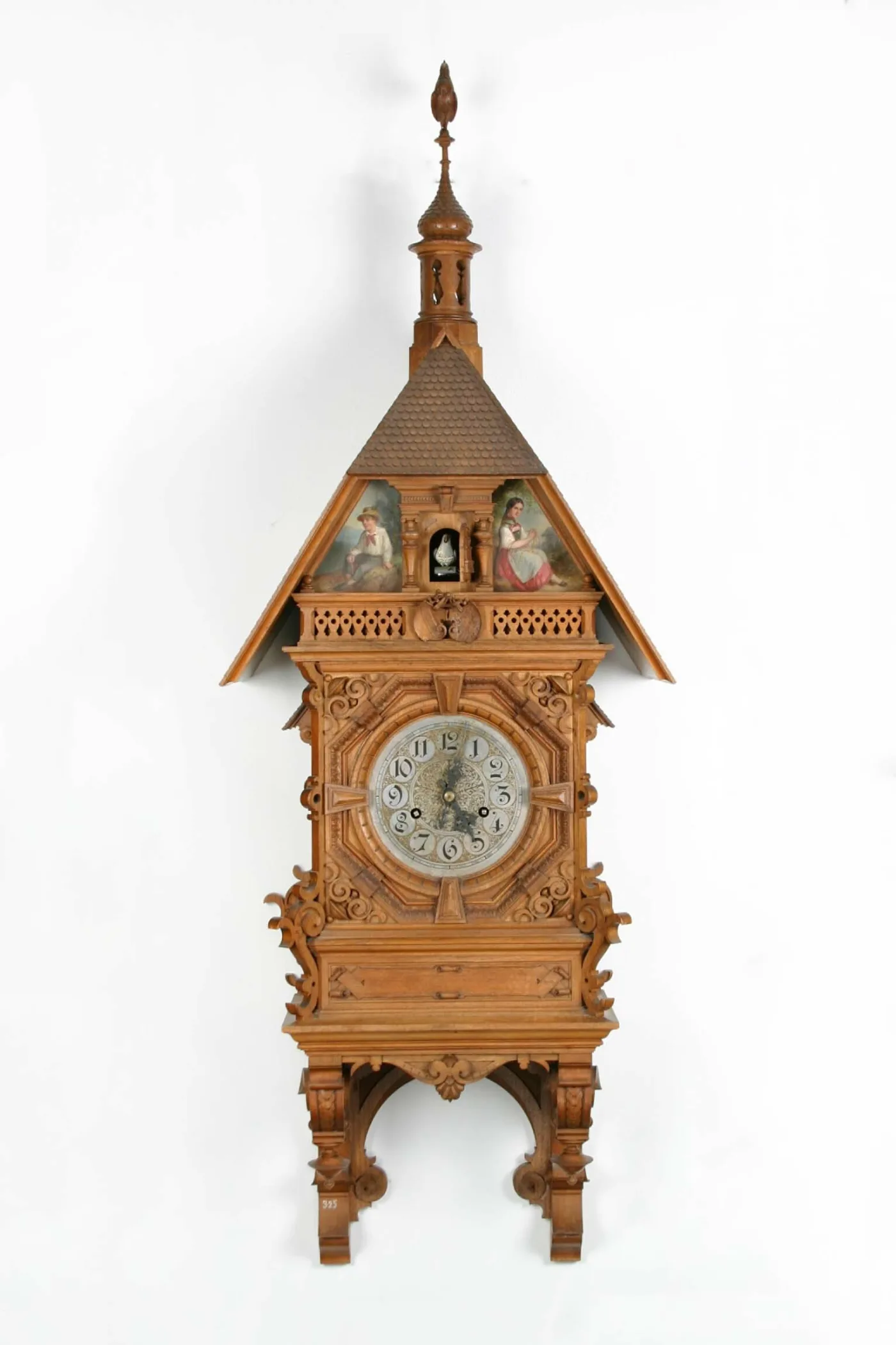
From the 1880s the Bahnhausle gave way to the fully three-dimensional carved Chalet. The flat panel became a miniature Swiss chalet building: deep overhanging eaves, balcony rails, carved shingles, sometimes with a moving figure (woodchopper, beer-drinker, dancing couple) on the balcony.
The Carved Chalet Form
Chalet cases are typically 30–50 cm tall and carved from linden (basswood) — soft, fine-grained, and ideal for the deep relief carving the form demands. The roof is heavily overhanging, often with carved purlins and shingled board. The body is decorated with carved oak leaves, acorns, vine garlands, and trophy elements (dead birds, deer heads, hunting horns).
Edelweiss and Swiss Chalet
The "Edelweiss" or "Swiss Chalet" subform features additional carved alpine motifs (edelweiss flowers, gentian, mountain goats) and is associated with chalet cuckoo clocks sold in Swiss tourist resorts. These are sometimes German-made and Swiss-marketed; sometimes genuinely Swiss-made by Loetscher, Reuge, or smaller Lucerne workshops.
Carved Figural Chalets
The most elaborate chalets feature animated figures — a woodchopper who swings his axe on the hour, a beer-drinker who raises his stein, a dancing couple on the balcony, a miller who works at his mill wheel. These animations are driven by the cuckoo strike train and add significant value. Look at the figural carving quality and the smoothness of the animation when evaluating these clocks.
Dating Chalet Production
Pre-1914 chalets show finer hand carving, better-quality movements, and original gilded or polychrome detailing. Inter-war chalets often have machine-roughed carving with hand finishing. Post-1945 production through the 1960s used factory-cut blanks with hand-finished detail; the carving is competent but visibly less individual. Modern certified VdS production from the 1990s onward returns to higher standards.
Values
A standard mid-twentieth century chalet cuckoo in working condition trades at £150–£500. Pre-war chalets in good condition reach £500–£2,000. Exceptional figural chalets with multiple animations and original finish can bring £3,000–£8,000.
The Hunter (Jagdstück) Case
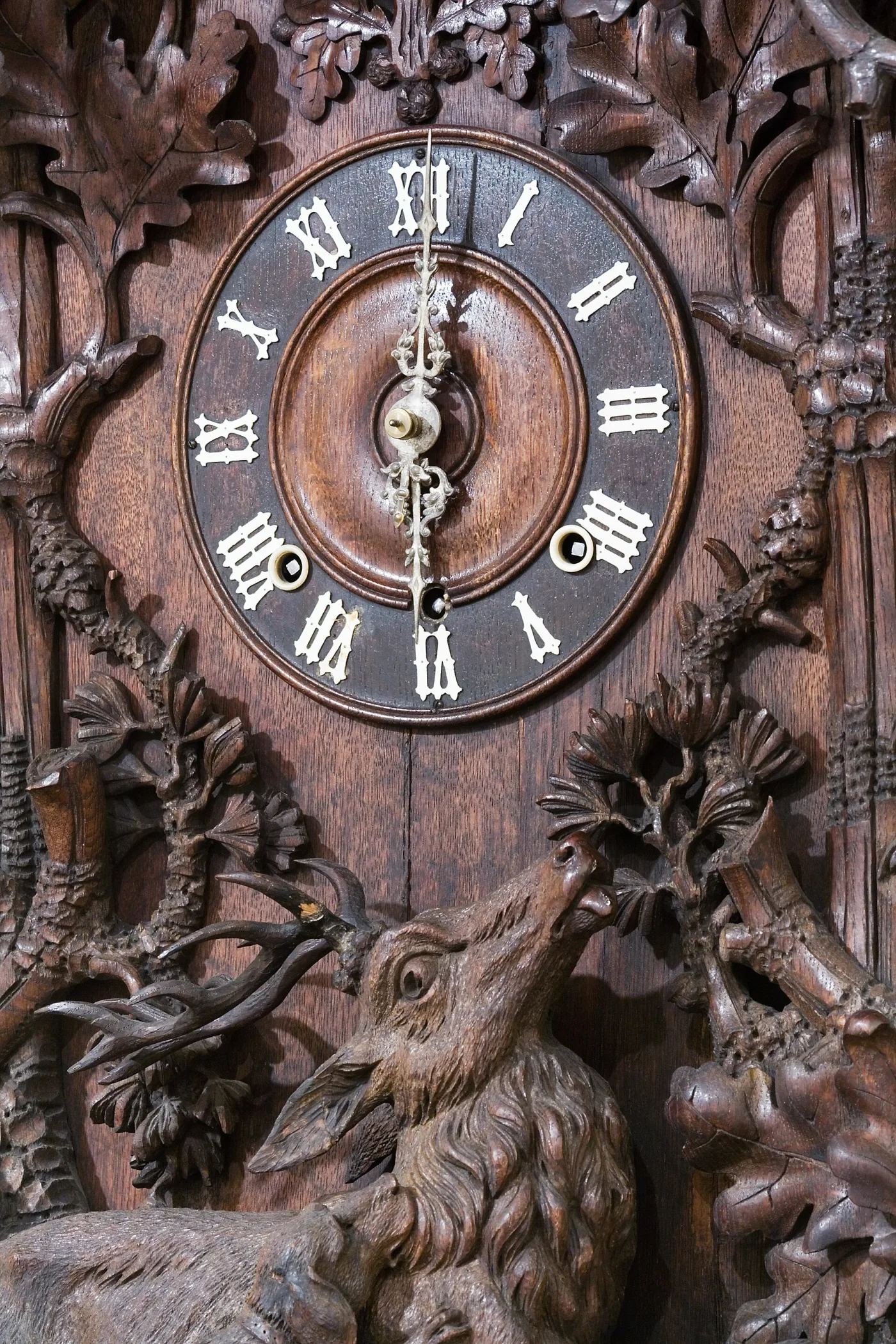
The hunter or Jagdstück cuckoo clock — sometimes called a "trophy" or "Jagduhr" — emerged as a distinct subform in the 1880s and became one of the two principal chalet variants. It is recognisable by its trophy decoration: a stag's head crowning the case, a rifle and powder horn crossed beneath, dead game birds and rabbits draped on either side.
Trophy Carving
The full carved stag head with antlers is the central element. Top-quality hunter clocks have antlers carved from a single block of wood (often pear or fruitwood for harder grain); cheaper examples use multiple jointed pieces or composition antlers. The carving quality of the stag head is the principal value indicator.
Additional Game Elements
Carved game birds — pheasants, partridges, ducks — hang on either side of the case, sometimes upside down by their feet. A crossed rifle and powder horn, hunting bag, dagger, and hunting bugle appear in various combinations. The arrangement is symmetrical around the central stag head.
Powder Horns and Weapons
The crossed rifle is usually a stylised flintlock or percussion-cap form, often paired with a carved powder horn or game pouch. Period accuracy varies; the form was largely decorative by the time it appeared on cuckoo clocks.
Hunter Movements
Hunter cuckoos generally use the same one-day or eight-day movements as standard chalets. Larger examples carry musical movements that play hunting calls on a comb-and-cylinder mechanism in addition to the cuckoo strike — these are documented as the "trumpeter-hunter" subform.
Values
Standard hunter cuckoos trade at £200–£700 in good working order. Pre-war hunters with superior antler carving and full trophy programmes reach £800–£2,500. Exceptional examples with musical movements and complete original finish can bring £3,000–£6,000.
One-Day vs. Eight-Day Movements
The most fundamental distinction in cuckoo clock movements is between one-day (24-hour) and eight-day (192-hour) trains. The two movements differ in size, weight drop, gearing, and value.
One-Day Movements
One-day movements are smaller (typically 7–9 cm wide brass plates), with smaller weights that drop perhaps 1.5 metres over 24 hours. They are wound daily by pulling the chains. One-day movements are the standard form found in mid-range chalets and account for perhaps two-thirds of the surviving market. Reliability is excellent when properly maintained.
Eight-Day Movements
Eight-day movements are larger (typically 11–13 cm wide), with heavier weights and longer drops. They are wound weekly. The longer running time required heavier weights and a slightly different gear ratio. Eight-day movements typically command a 50–100% premium over comparable one-day clocks of the same maker and period.
Identifying the Movement
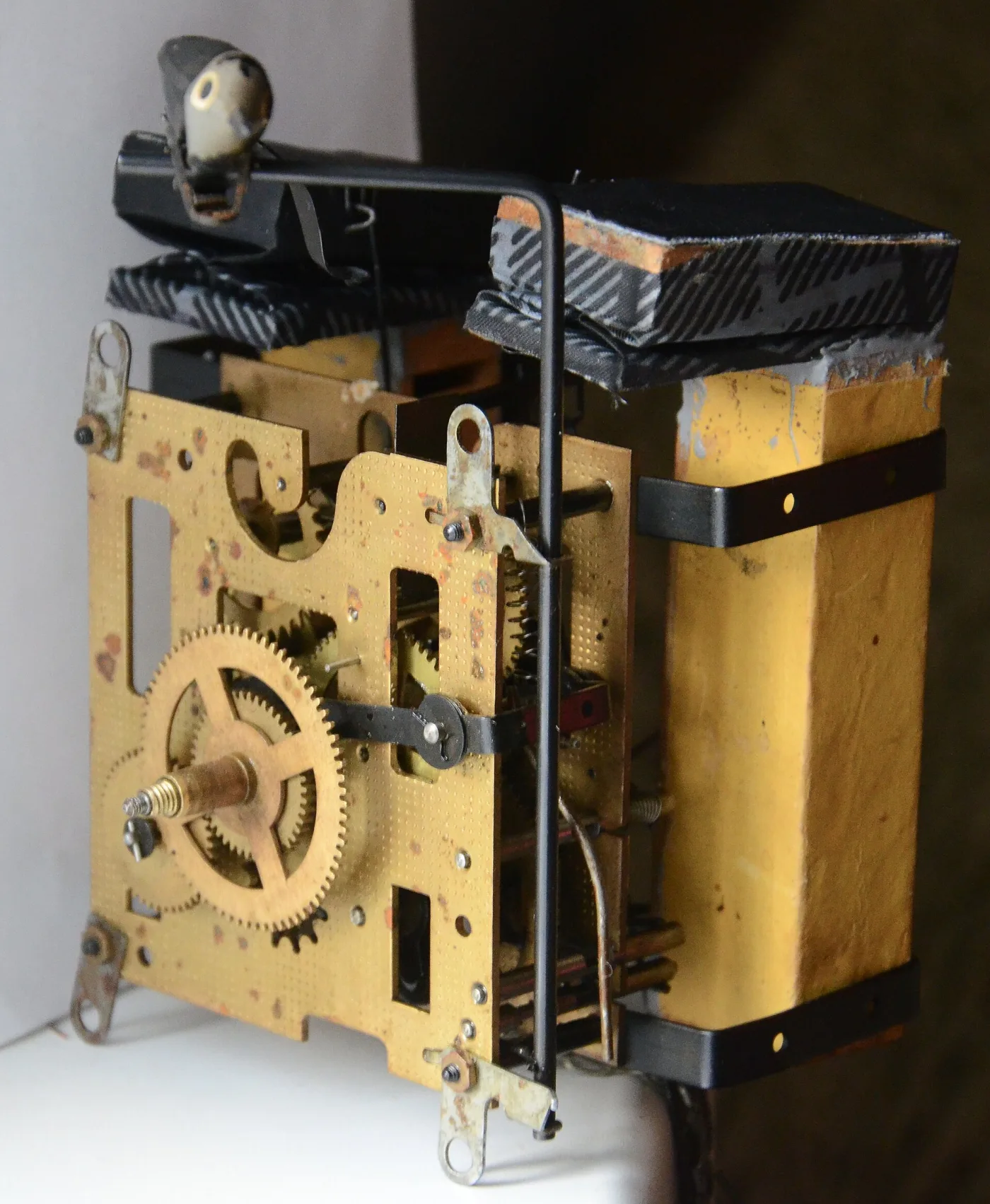
Open the case back and examine the brass plates. One-day movements show smaller plates and lighter weights; eight-day show larger plates, deeper weight cans, and a more substantial winding mechanism. Most movements bear a stamp on the back plate — Regula, GHS, SBS Feintechnik, or a maker's monogram — that identifies the supplier.
Movement Manufacturers
Few cuckoo clock case makers produced their own movements. Most cases use bought-in movements from specialised Black Forest movement firms: Regula (still operating today), SBS Feintechnik, Hermle (better known for chime clocks but also cuckoo movements), and GHS. Identifying the movement maker can help date and authenticate a clock independently of the case marks.
Movement Dating
Movement plates often carry small date stamps — usually a two-digit year on the back plate or a wheel. Cross-reference movement-stamped date with case-style dating to confirm authenticity: a case style that should be 1890s with a movement stamped "57" indicates a later replacement or marriage and significantly affects value.
The Cuckoo Bellows Mechanism
The cuckoo call itself is mechanically simple but acoustically clever. Two small wooden bellows are connected to two wooden pipes tuned a minor third apart (typically F and A flat). The strike train operates a lever that opens the cuckoo door, lifts the bird forward, and squeezes the bellows in alternation — producing the characteristic two-note "cu-ckoo" call.
Bellows Construction
The bellows are made of two thin wooden plates hinged with leather or rubberised cloth gussets. The gusset material is the principal wear point in old cuckoo clocks; original sheepskin gussets typically last 50–80 years before requiring releathering, modern synthetic gussets longer. Identifying original bellows leather is often a key step in dating.
Wooden Pipes
The two pipes are simple cylindrical wooden tubes, usually pear or maple, with a fipple block creating the whistle. Pipe length determines pitch; the standard pair is tuned to a minor third interval. Pipe condition is generally good in surviving clocks — the wood is sheltered inside the case and rarely damaged unless the bellows fail and pull on the pipe mountings.
The Cuckoo Bird
The carved wooden bird perches inside the case behind a small gabled door. On the hour, the door opens, the bird tilts forward, and the bellows operate. Bird carving quality varies enormously — basic clocks have a simple stylised silhouette, top-quality clocks have a fully detailed bird with painted feathers and beak articulation. Many birds bear the maker's mark on the underside.
Door and Linkage
The door linkage uses fine wire arms from the strike train. Original doors are pinned with brass wire; replacements often use steel wire that corrodes over time. The door surround is usually carved as a small porch with miniature roof and pilasters matching the main case.
Identifying Mechanism Age
Inspect the bellows gussets: original sheepskin shows characteristic age crackle and slight stiffening; modern releathering shows pliable, flat new leather without crackle. The wooden pipe interiors should show period darkening; freshly replaced pipes show light interior wood. The bird itself should match the case period in carving quality.

Trumpeter, Quail, and Musical Cuckoos
Beyond the standard two-note cuckoo, several extended-call variants exist. These are higher-status pieces with more complex strike trains and command significant premiums.
Trumpeter Clocks
The trumpeter clock replaces (or supplements) the cuckoo with a small trumpeter figure who emerges on the hour and "blows" a brief fanfare on a real trumpet. The mechanism uses bellows blowing through a thin brass or copper pipe rather than wooden whistles. Authentic trumpeters are usually documented to Johann Baptist Beha of Eisenbach, who developed the mechanism around 1857. Genuine Beha trumpeters reach five figures at specialist auction.
Quail Cuckoos
The quail cuckoo adds a quail call (a rapid descending series of three or four notes) to the standard two-note cuckoo. Typically the quail sounds on the half-hour while the cuckoo marks the hour. Quail cuckoos use an additional small bellows and pipe set; the mechanism is documented from the 1850s onward. Quail cuckoos command perhaps 40–80% premium over comparable plain cuckoos.
Musical Cuckoos
Musical cuckoos add a comb-and-cylinder music box mechanism that plays a short tune (typically a Swiss or Bavarian folk melody) after the cuckoo call on the hour. The musical movement is mounted in the lower case behind the pendulum. Quality varies: the best use Swiss Reuge or Thorens musical movements, lesser examples Japanese or modern Sankyo movements. The presence of a music box typically doubles the value of an otherwise equivalent cuckoo clock.
Animated Figures
The most elaborate cuckoos add multiple animated figures — woodchoppers, beer-drinkers, dancing couples, mill wheels — driven by the strike train. The "Bavarian beer-drinker" animation is the most common; the dancing couple (often six pairs of dancers on a rotating disc) appears on premium musical chalets. Animation quality and original condition drive value.
Combination Pieces
The top-tier piece combines trumpeter or quail call, musical movement, and animated figures in a single elaborate chalet. These were the cuckoo industry's flagship products — typically commissioned or special-ordered, signed by the maker, and dated. Combination pieces from documented makers (Beha, Camerer Kuss, Kammerer) trade in the £5,000–£25,000 range depending on complexity and condition.
Dials, Hands, and Numerals
The dial is a small but reliable dating element. Materials, numeral style, and hand construction shifted across the periods and provide cross-checks against case and movement evidence.
Dial Materials
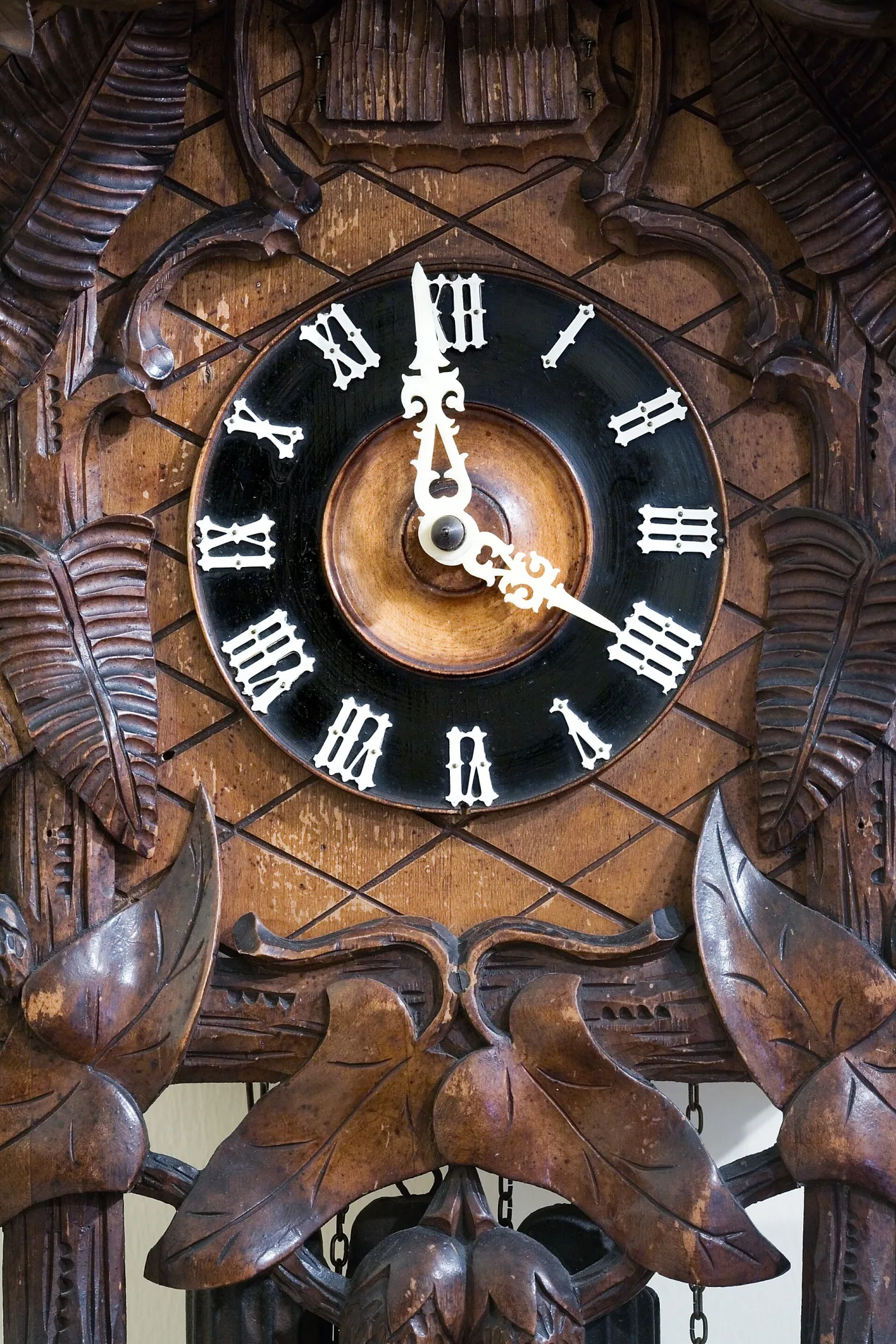
Shield-dial period: hand-painted wooden dial integrated into the case board. Bahnhausle period: painted wood dial mounted in a separate dial ring, typically with raised wooden numerals. Chalet period from the 1880s: bone or ivory dial with carved or painted Roman numerals, mounted in a turned wooden dial ring. Modern (post-1960): plastic, resin, or printed metal dial with applied bone-coloured numerals.
Numeral Style
Roman numerals are nearly universal on antique cuckoos. Numeral height, spacing, and the use of IIII versus IV for the four o'clock position can help date a piece (IIII is older and persisted on cuckoo clocks longer than on other forms). Arabic numerals appear occasionally on shield-dials and on twentieth-century reproductions but are uncommon on quality production.
Bone and Ivory Dials
Genuine antique bone numerals are carved from cow or pig bone, hand-shaped and applied to the dial ring with pins or glue. They show fine age cracks, slight cream-yellow patination, and irregular hand-carving. Modern plastic substitutes are flat, uniform, and white. Identifying genuine bone dials is one of the surest indicators of pre-war manufacture.
Hands
Cuckoo clock hands are typically carved from bone, ivory, or thin sheet brass. Bone hands show the same patination as the numerals. Brass hands are usually pierced in foliate or scroll patterns. Hand pairs should match in material and style; mismatched hands indicate replacement and reduce value.
Dial Centre Decoration
The central dial often carries a small painted or applied decorative element — an oak leaf, edelweiss, or carved rosette. Original decoration matches the case carving in style and condition. Post-restoration dials sometimes have replacement central elements in obviously different finish or material.
Carved Decoration and Case Materials
The carved decoration is the chief artistic interest of most cuckoo clocks. Reading carving quality and identifying wood type provides strong dating and authentication evidence.
Linden (Basswood)
Linden — known in Germany as Linde, in America as basswood — is the standard wood for chalet cuckoo carving. It is soft, fine-grained, takes deep carving without splintering, and stains evenly. Most chalet cuckoos from 1880 onward use linden bodies, often with walnut or oak structural elements. Linden's pale, uniform colour darkens to a warm honey tone with age.
Walnut and Oak
Bahnhausle-period cases often use walnut with its dark figured grain visible through clear finish. Oak appears on heavier hunter cases. Both woods are harder than linden and carry shallower carved decoration; they were preferred when grain pattern was a design feature.
Pear and Fruitwoods
Antlers, fine bird and animal carving, and small detailed elements are often made from pear, apple, or cherry. These dense fruitwoods take fine detail and resist breakage on slender carvings. Original fruitwood antlers show fine surface grain when examined under magnification.
Carving Quality Levels
Premium hand carving: each leaf and detail individually shaped, no two identical, with controlled tool marks visible. Machine-roughed/hand-finished: blank shape cut by mill, individual leaves and details refined by hand. Fully machine-carved: uniform tool marks, identical repeating elements, common on mid-twentieth-century production. Cast resin or pressed: smooth surface with no tool marks, used on cheap modern reproductions.
Finish
Antique cuckoo finishes are clear oil, shellac, or wax. Originally these finishes ranged from pale honey to dark walnut tones. Post-war refinishing often used dark stain to hide age damage, sometimes obscuring carved detail. Original finish in clean condition adds 30–50% to value over refinished examples.
Pine-Cone Weights, Chains, and Pendulums
The weights and pendulum are functional but also decorative. Period weights and pendulums match the case in material and style and provide additional dating evidence.
Pine-Cone Weights
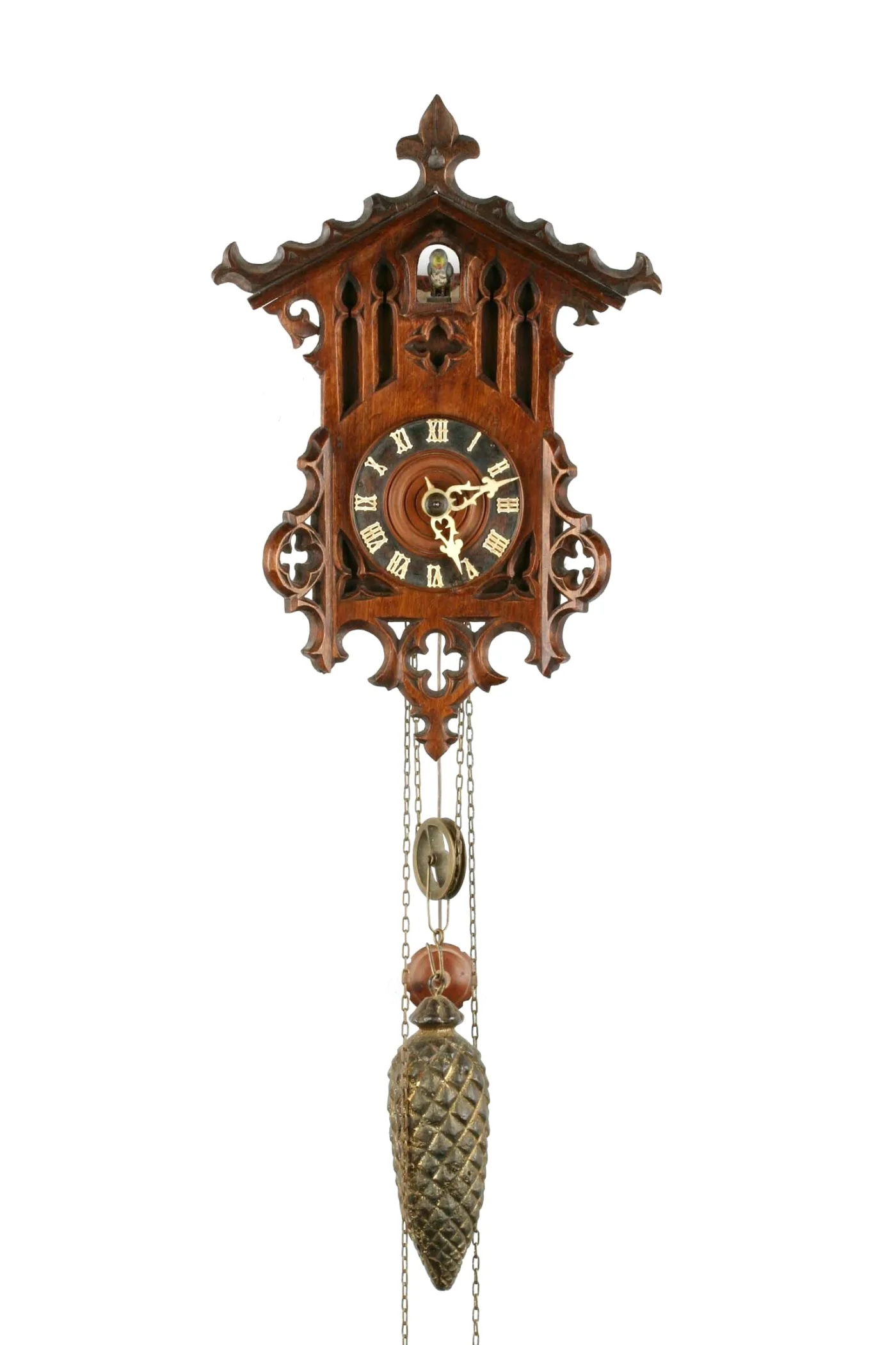
The standard weight form is a cast metal pine cone, typically iron or zinc inside, with applied brass or copper scales. Pre-war weights are usually cast iron with applied brass shells; post-war weights more often cast zinc alloy. Weight pairs should be identical in form and finish; mismatched weights indicate replacement.
Weight Sizes
One-day movement weights typically weigh 300–500 grams each. Eight-day weights are larger and heavier, 700–1,500 grams. Musical cuckoos have three weights instead of two (one extra for the music train) and are correspondingly heavier overall.
Chains and Hooks
Chains are usually steel or brass, with characteristic small oval links. The chain hook at the top is a simple S-hook. Examine for original tool marks at the hook and consistent chain wear. Replaced chains show different link size or no period patination on the metal.
Pendulums
The standard cuckoo pendulum is a wooden rod with a carved oak-leaf bob — pendulum length determining beat rate. Pre-war pendulums use individual hand-carved oak-leaf bobs in linden or pear; post-war pendulums use machine-stamped or pressed-pulp bobs. Bob material and carving quality cross-check case period.
Beat and Regulation
The pendulum bob is threaded onto the rod and can be screwed up or down to regulate timekeeping. Most cuckoo clocks run a 0.78–0.88 second beat. Identifying original pendulum length (often marked on the case interior) helps confirm period and assists regulation.
The Great Black Forest Makers
Several dozen Black Forest firms produced cuckoo clocks across the nineteenth and twentieth centuries. The major names — those whose marked work commands premium prices — are a smaller group with documented histories and recognisable styles.
Johann Baptist Beha (1815–1898)
Of Eisenbach in the southern Black Forest. The greatest mid-Victorian cuckoo maker, credited with developing the trumpeter mechanism around 1857, with introducing high-quality production methods, and with raising the cuckoo clock to a serious horological form. Beha movements are marked with his name or initials on the back plate. The firm continued under his sons after 1898. Documented Beha trumpeters reach £15,000–£60,000 at specialist auction.
Anton Schneider (founded 1848)
Of Schonach im Schwarzwald. Founded by Anton Schneider in 1848 and still operating today as Anton Schneider Söhne, the firm produces traditional carved chalet and shield clocks. Schneider movements often carry a stylised AS monogram. Pre-war Schneider work trades at £400–£1,500; modern certified production £300–£800.
Hubert Herr (founded 1840)
Of Triberg. One of the longest-established Black Forest firms, still producing today. Hubert Herr clocks span the full range from simple chalets to elaborate animated musical pieces. The firm marks back plates and case interiors with "Hubert Herr Triberg" stamps. Pre-war Herr work trades £300–£1,200; better musical and animated pieces £1,500–£5,000.
Kammerer Uhren (1925–present)
Founded by August Kammerer in Schonach, the firm produced high-quality chalets and animated pieces through the twentieth century. Kammerer work is identifiable by case-interior labels and movement stamps. Period Kammerer chalets in good condition reach £600–£2,500.
Camerer Kuss & Co.
An Anglo-German firm — German manufacturer with London retail premises in High Holborn from 1789 — that sold a particularly fine grade of cuckoo clock to the British market. Camerer Kuss clocks carry the firm's English-language paper label inside the case and are usually larger and more elaborate than typical export production. Documented Camerer Kuss pieces command 50–100% premium over equivalent unmarked Black Forest work.
Smaller Makers and Unattributed Work
The bulk of antique cuckoo clocks carry no maker mark — they were produced in cottage workshops or by small firms that did not consistently mark their work. Unmarked Black Forest pieces are evaluated entirely on case quality, carving, movement quality, and condition. Many of the finest individual carvers were anonymous.
The VdS Certificate and Modern Authenticity
Since 1992 the Verein die Schwarzwalduhr (VdS), or "Black Forest Clock Association," has issued certificates of authenticity for genuine Black Forest cuckoo clocks. This certificate is the single most important modern authentication device.
What the VdS Certifies
To bear the VdS certificate, a cuckoo clock must be made entirely within the geographic Black Forest region, use a mechanical (not quartz) movement of Black Forest manufacture, have hand-carved (not machine-pressed) case decoration where claimed as hand-carved, and meet specified quality standards for movement, bellows, and carving. The certificate accompanies a numbered hologram label affixed to the case back.
Identifying the Certificate
The VdS certificate is a printed booklet or card describing the specific clock, signed by the maker, with a serial number matching the hologram label. The hologram is small (about 2 cm diameter), holographic gold-on-black with the VdS logo. Both certificate and hologram should be present on certified clocks.
Limitations
The VdS certificate dates only from 1992. Genuine pre-1992 Black Forest cuckoo clocks naturally have no certificate. Absence of certificate on a pre-war clock is normal; absence on a clock claimed as new-manufactured Black Forest is suspicious.
Counterfeit Certificates
VdS holograms have been counterfeited on Chinese imitation cuckoo clocks. Genuine holograms have a specific multi-layer holographic effect; counterfeits are usually flat printed simulations. The accompanying certificate booklet is harder to fake convincingly. When in doubt, contact the VdS directly with the serial number for verification.
Use in Valuation
Modern Black Forest production with full VdS certification commands a 50–100% premium over uncertified modern production of equivalent quality. For pre-1992 pieces, the question is moot; case quality, maker mark, and condition drive value entirely.
Swiss, American, and Japanese Variants
Although the Black Forest dominates production, cuckoo clocks have been made in several other regions. Identifying non-German production is occasionally important — particularly with the Swiss tourist trade and twentieth-century Far Eastern imitations.
Swiss Production
Genuine Swiss-made cuckoo clocks come principally from Loetscher (Brienz, founded 1920) and from various small Lucerne and Brienz workshops serving the tourist trade. Swiss chalets often feature edelweiss and gentian carving, Brienz-style Swiss alpine motifs, and Reuge musical movements. Some clocks sold as "Swiss" in nineteenth and twentieth century tourist markets were actually German cases rebadged at the border; genuine Swiss-made pieces show domestic markings and Swiss movement components.
American Cuckoo Clocks
A small American cuckoo industry operated through the late nineteenth and early twentieth centuries, principally in Connecticut. Firms including the New Haven Clock Company and others produced cuckoo clocks for the American market with American spring-driven movements (rather than weight-driven) and lighter cases. American cuckoos are uncommon collectibles and trade in the £200–£800 range depending on condition.
Japanese and Asian Production
From the 1960s Japanese factories produced cuckoo clocks for export, using quartz movements with electronic cuckoo sounds rather than mechanical bellows. These are not antiques and have minimal collector value. From the 1990s Chinese production expanded enormously, often imitating Black Forest styles and occasionally counterfeit-marked. Authentication against this background is the primary modern collector concern.
Identifying Far Eastern Reproductions
Look for: quartz movement with battery compartment (no genuine Black Forest cuckoo is quartz); pressed-resin "carving" with smooth uniform surface; light plastic dial and bird; missing or counterfeit VdS hologram; printed paper labels with vague "Black Forest style" wording. Genuine Black Forest mechanical cuckoos always run on weights, always have bellows, and always show genuine wood carving.
Eastern European Production
Some twentieth-century cuckoo clocks were produced in former East Germany, Czechoslovakia, and Yugoslavia, often using German-pattern movements and case designs. These pieces are competent but trade at significantly lower prices than Black Forest production of equivalent quality and date.
Reproductions and Reproductions Marketing
Cuckoo clocks have been among the most heavily reproduced antique objects of the past fifty years. Understanding the reproduction market protects collectors from mistaken purchases.
Quartz Reproductions
Battery-powered quartz cuckoo clocks with electronic bird calls became common from the 1980s. They mimic the chalet form but with plastic dials, quartz movements, and recorded sound chips. They are decorative but not antiques; resale value is essentially nil.
Pressed and Cast Decoration
Mid-range reproductions use pressed wood-fibre or cast polyurethane decoration moulded to imitate hand carving. Examined closely the surface is smooth and uniform, with no tool marks. These reproductions often weigh noticeably less than genuine hand-carved chalets of the same size.
Marriage Pieces
A "marriage" combines a genuine antique case with a replacement movement, or a genuine movement in a modern case. These pieces are misleading and command lower prices than honest single-period work. Examine movement-to-case fit, date stamps, and wear patterns for consistency.
Restoration vs. Reproduction
A heavily restored antique cuckoo (releathered bellows, replacement pendulum bob, refinished case, new dial) remains a restored antique and commands antique-grade prices proportional to how much original material survives. A wholly new clock styled as antique is a reproduction regardless of how convincing the styling. The line between heavily restored and reproduction is sometimes contested and requires careful examination.
Marketing Language Red Flags
"Black Forest style," "in the tradition of," "inspired by," and "antique reproduction" are all reproductions, not antiques. "Hand-carved" without specifying the maker and date often indicates modern Asian hand-carving rather than period Black Forest work. Reliable antique descriptions specify maker (where known), case style, movement type, and approximate period.
Authentication Workflow
Putting it all together: a systematic workflow for evaluating a cuckoo clock combines external case examination, movement inspection, and bellows assessment. The same methodical approach applies as in any clock evaluation — see our authentication and provenance research guide for the general framework.
Step 1: Form Identification
Identify the case style: shield-dial, Bahnhausle, chalet, hunter, or other. This places the piece in a broad period (pre-1850, 1851–1880, 1880–present). Note the carved decoration, animated figures, and any maker marks visible externally.
Step 2: Carving Examination
Examine carving quality under magnification: hand carving shows individual tool marks; machine carving is uniform; pressed material has no tool marks at all. Identify wood type from carved surface and unfinished interior areas. Match carving quality to expected period.
Step 3: Dial and Hands
Identify dial material (painted wood, bone, ivory, plastic), numeral style, and hand material. Bone numerals and hands indicate pre-1960 manufacture in nearly all cases. Plastic indicates post-1960 production.
Step 4: Open the Case
Carefully open the case back. Examine movement plates for maker stamps (Regula, GHS, Hermle, Beha, Schneider, etc.) and date stamps. Identify one-day vs. eight-day construction. Note any case-interior paper labels with maker names, retailer names, or service records.
Step 5: Bellows Inspection
Examine bellows gussets for original sheepskin or modern releathering. Original sheepskin has fine crackle and characteristic age stiffening; modern releathering is pliable and flat. Inspect wooden pipe interior darkness for period evidence.
Step 6: Weights, Chains, Pendulum
Confirm weights match (same form, finish, weight) and are consistent with movement type (one-day or eight-day). Check chains for period wear and original hook construction. Identify pendulum bob material and carving quality.
Step 7: Maker Verification
Cross-reference any maker marks against published maker reference works (Schaaf's "Cuckoo Clocks" remains the standard English-language reference). Confirm maker dates match case style dates. Note that many fine clocks are unmarked and must be evaluated on quality alone.
Step 8: Document and Photograph
Photograph the clock from multiple angles, including dial close-up, all carved decoration, movement plates, bellows, weights, and any marks. Record dimensions, weight, movement type, and condition observations. This documentation supports future valuation and insurance claims.
Condition and Restoration
Cuckoo clock condition has more variables than most antiques because the form combines wood case, movement, bellows, dial, hands, weights, and pendulum — any of which may have failed or been replaced. Condition grading takes practice. The general principles outlined in our antique restoration and conservation guide all apply, with the additional considerations specific to cuckoo construction.
Case Condition
Examine case for missing carved elements (vines, leaves, antlers, gun barrels), splits and cracks in panels, evidence of refinishing, and structural integrity. Missing applied carvings are sometimes restorable but reduce value 20–40% even after restoration.
Movement Condition
The movement should run reliably with appropriate weight drop. Symptoms of trouble: stopping after short runs, irregular cuckoo strike, weights drop too fast (worn gear teeth) or too slowly (binding). Professional clockmakers can typically restore antique cuckoo movements to running condition; expect £150–£400 for a competent overhaul.
Bellows Condition
Bellows leather is consumable. Releathering with appropriate sheepskin gussets is a standard restoration; expect £80–£150 for both bellows. Original bellows leather in good condition is preferable to releathered for collector value, but a non-functioning original is no advantage.
Dial Restoration
Missing or damaged dial numerals can be replaced with new bone or appropriate substitute. Hand replacement is similar. Replaced dial elements reduce value 10–20% but restore the clock to usability.
Refinishing
Refinishing a cuckoo case is generally destructive to value. Original oil or shellac finish in clean condition is preferable to refinished work even if the original is moderately worn. Light cleaning and wax polish are appropriate; stripping and refinishing should be avoided.
Marriages and Replacements
Document any known replacements: movement, dial, hands, bellows, weights, pendulum, applied carvings. A clock with documented partial replacements is more honest (and easier to value) than one whose history is concealed. Marriages of different-period elements significantly reduce value.
Value Factors and Price Ranges
Cuckoo clock values span more than three orders of magnitude — from tens of pounds for damaged twentieth-century reproductions to tens of thousands for documented Beha trumpeters. The principal value drivers are period, maker, complexity, condition, and provenance. The same approach to evaluation applies as in our general antique valuation guide.
Period
Earlier is generally more valuable. Eighteenth-century shield-dial: £2,000–£8,000. Bahnhausle 1851–1880: £600–£3,000. Pre-war chalet (1880–1939): £400–£3,000. Post-war chalet (1945–1980): £150–£800. Modern certified Black Forest (1992–present): £300–£1,200. Modern reproductions: £20–£200.
Maker
Documented Beha pieces command the strongest premium — 3–10x equivalent unmarked work. Other named makers (Schneider, Herr, Kammerer, Camerer Kuss) command 30–80% premium. Unmarked Black Forest work is valued on quality alone but typically trades at base market prices.
Complexity
Plain cuckoo: base value. Quail cuckoo: +40–80%. Trumpeter: +200–500%. Musical cuckoo: +80–150%. Animated figures: +50–100% depending on number and complexity. Combination pieces (trumpeter + musical + animated): top of market.
Condition
Working with original finish and intact carving: 100% of market. Restored to working with releathered bellows and refinished case: 60–80%. Non-running with cosmetic issues: 30–50%. Damaged or with major replacements: 10–30%.
Size
Standard size (30–45 cm tall): base value. Large display pieces (50–70 cm): 30–60% premium. Small travel sizes (20–30 cm): often command a premium for compactness, particularly in pre-war work. Oversize exhibition pieces (90+ cm): special-order or factory show pieces, top of market.
Provenance
Documented Belleek-style mark periods don't apply here; cuckoo clock provenance comes from maker labels, retailer paper labels (Camerer Kuss London, etc.), period photographs, family records, or auction history. Strong provenance adds 20–50% over comparable undocumented work.
Building a Cuckoo Clock Collection
A coherent cuckoo clock collection benefits from a defined focus. Generic collecting — buying interesting pieces as they appear — produces an attractive but unsystematic display. Themed collecting builds depth and intellectual interest. Our antique collecting strategies guide covers the general approach to focused collecting.
Maker-Based Collecting
Focusing on one maker (Beha, Schneider, Hubert Herr) produces a deep collection of stylistic evolution within a single workshop. This is the most systematic approach but requires patience to acquire marked examples.
Period-Based Collecting
A "nineteenth-century cuckoo" collection across multiple makers, or a "shield-dial only" focus, builds horizontal breadth within a defined period. Period-based collecting is well-served by the documented evolution from shield to Bahnhausle to chalet.
Form-Based Collecting
Hunter cuckoos, trumpeter cuckoos, musical cuckoos, or shield-dial cuckoos make rich form-based collections. Each form has its own makers and period evolution, providing focus while permitting variety within the chosen form.
Regional Collecting
Black Forest only, Swiss only, or a comparative European collection (German + Swiss + Eastern European) builds geographic perspective on the form.
Where to Buy
Specialist horological auctions (Bonhams, Schmitt-Horan, Cottone, Fellows) handle the upper end. Black Forest auction houses (Henry's, Auctionata) handle German-market material. Antique fairs in Germany and Switzerland produce frequent fresh material. Online platforms (Catawiki, LiveAuctioneers) cover the broad middle market. Avoid eBay and general-marketplace for serious purchases — the reproduction noise is too high.
Care, Display & Preservation
Cuckoo clocks have several specific care requirements relating to wood, bellows, and mechanical movement. The general principles in our antique storage and preservation guide apply across the cuckoo collection.
Hanging and Wall Mounting
Cuckoo clocks must be hung properly to run. Use a substantial screw or hook into a wall stud; the clock should hang absolutely vertical for correct pendulum beat. Out-of-beat clocks tick irregularly and stop quickly. Adjust by levelling the case or by very slightly bending the pendulum suspension wire.
Climate
Wood cases respond to humidity changes. Aim for stable 40–55% relative humidity; rapid changes cause case panel cracking. Avoid hanging cuckoos near radiators, fireplaces, kitchen steam, or external walls in cold climates. Constant moderate humidity protects bellows leather and case integrity.
Winding and Operation
Wind one-day cuckoos daily, eight-day cuckoos weekly. Pull chains evenly to lift weights; never force a chain that snags. If the clock stops between windings, the cause is usually beat error or accumulated dust in the movement, not under-winding.
Movement Service
Antique cuckoo movements should be cleaned and oiled by a competent clockmaker every 8–12 years. Symptoms requiring service: slowing, stopping, irregular strike, weak cuckoo call. Cost £150–£400 depending on movement complexity. Resist the temptation to oil the movement yourself with general lubricants; only proper clock oils should touch antique movements.
Cleaning
Dust the case gently with a soft brush. Avoid wet cleaning, polish, or solvents on antique finishes. Carved decoration accumulates dust between leaves — a soft brush and very low-suction vacuum (with brush attachment) reaches difficult areas. Never water-clean dial bone or ivory.
Storage and Transport
If storing or shipping, remove the pendulum, weights, and chains. Stabilise the bird inside the door with soft padding. Pack carved elements with bubble wrap protecting projecting decorations. Store flat or front-up, never face-down on carving.
Insurance and Documentation
Photograph each piece comprehensively. Maintain a written inventory with maker, period, dimensions, condition, restoration history, purchase price, and current valuation. Update valuations every 3–5 years for insurance purposes. Specialist horological insurance is available for serious collections.