
Antique Grandfather Clock Identification Guide
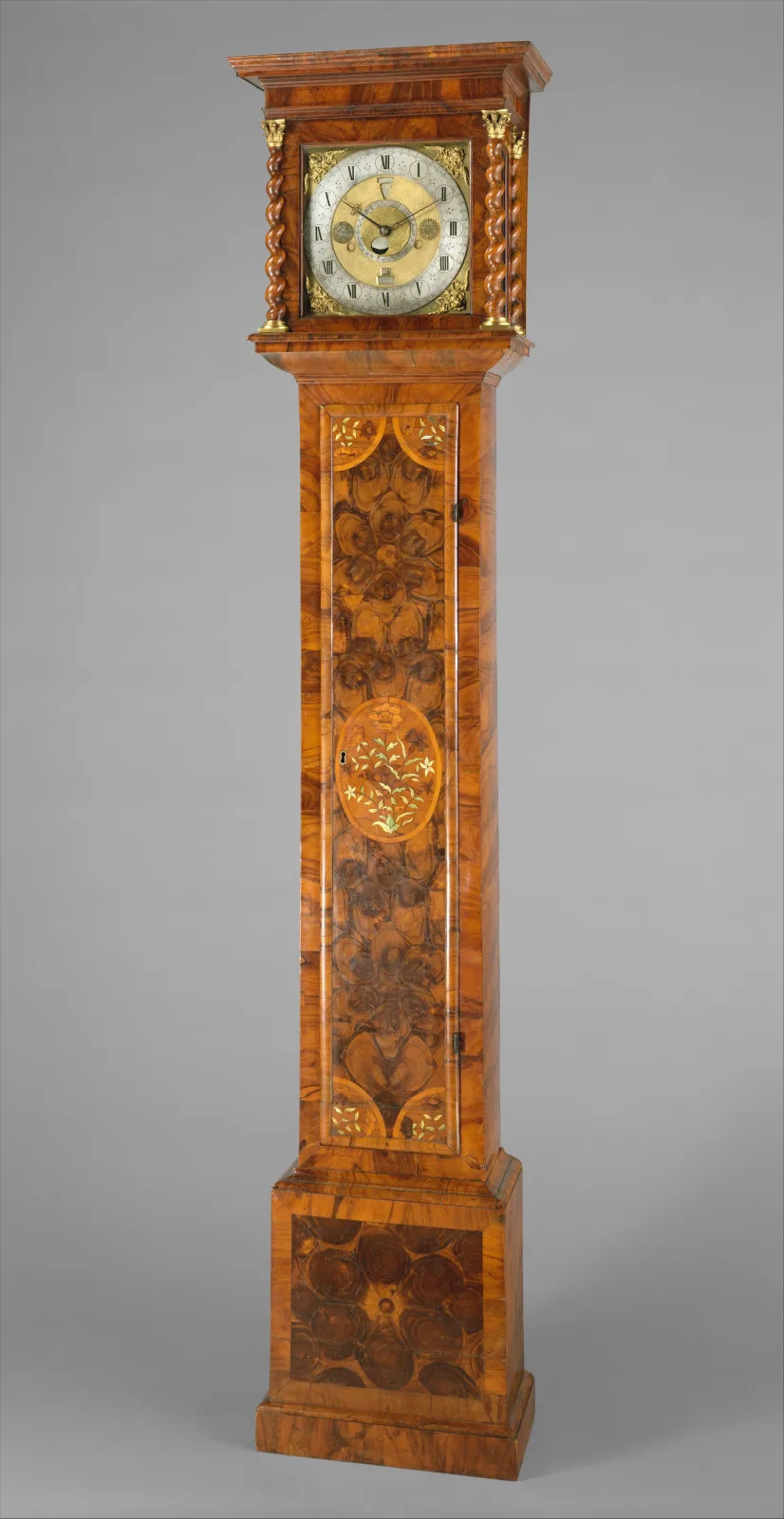
Few antiques carry as much presence as a grandfather clock. Standing six or seven feet tall in a hallway or against a parlor wall, the longcase clock has measured out family life for three centuries, its slow pendulum and deep strike as familiar as a heartbeat. To a collector, that imposing case is also a layered document: the hood, the dial, the trunk, the movement, and the maker's signature each record when and where the clock was built. Read them together and a tall-case clock will tell you its age within a decade or two, name the region or even the town that produced it, and reveal whether it is the honest original it appears to be.
The terminology can confuse newcomers. Grandfather clock, longcase clock, and tall-case clock all describe the same thing — a weight-driven, pendulum-regulated clock housed in a tall freestanding wooden case. "Longcase" is the British term, "tall-case" the American, and "grandfather" the affectionate name popularized by an 1876 song. Shorter versions earned their own nicknames: a grandmother clock stands roughly five to six feet, and the diminutive granddaughter clock shorter still. All share the same anatomy and the same identification logic.
This guide walks through that logic step by step: the anatomy of a longcase clock, how the case styles evolved from the slim early forms to the broad Victorian giants, how to read brass and painted dials, what the movement and strike reveal, the all-important maker's signature, and the regional schools of British and American clockmaking. It then covers reproductions and "marriages," condition and originality, value, and care — so that whether you inherited a clock from a grandparent or are weighing one at auction, you can place it in time and judge what it is worth.
Table of Contents
- Anatomy of a Longcase Clock
- Case Styles & How They Evolved
- Reading the Dial: Brass vs. Painted
- The Movement, Strike & Duration
- Maker's Names & Signatures
- Regional & National Schools
- Putting It Together: Dating a Clock
- Reproductions, Marriages & Fakes
- Condition & Originality
- Value Factors and Price Ranges
- Care, Setup & Moving
- Frequently Asked Questions
Anatomy of a Longcase Clock
Before you can date a grandfather clock you need to name its parts, because nearly every dating clue lives in one of them. A longcase clock divides into three sections stacked vertically, plus the works inside.
The Hood (Bonnet)
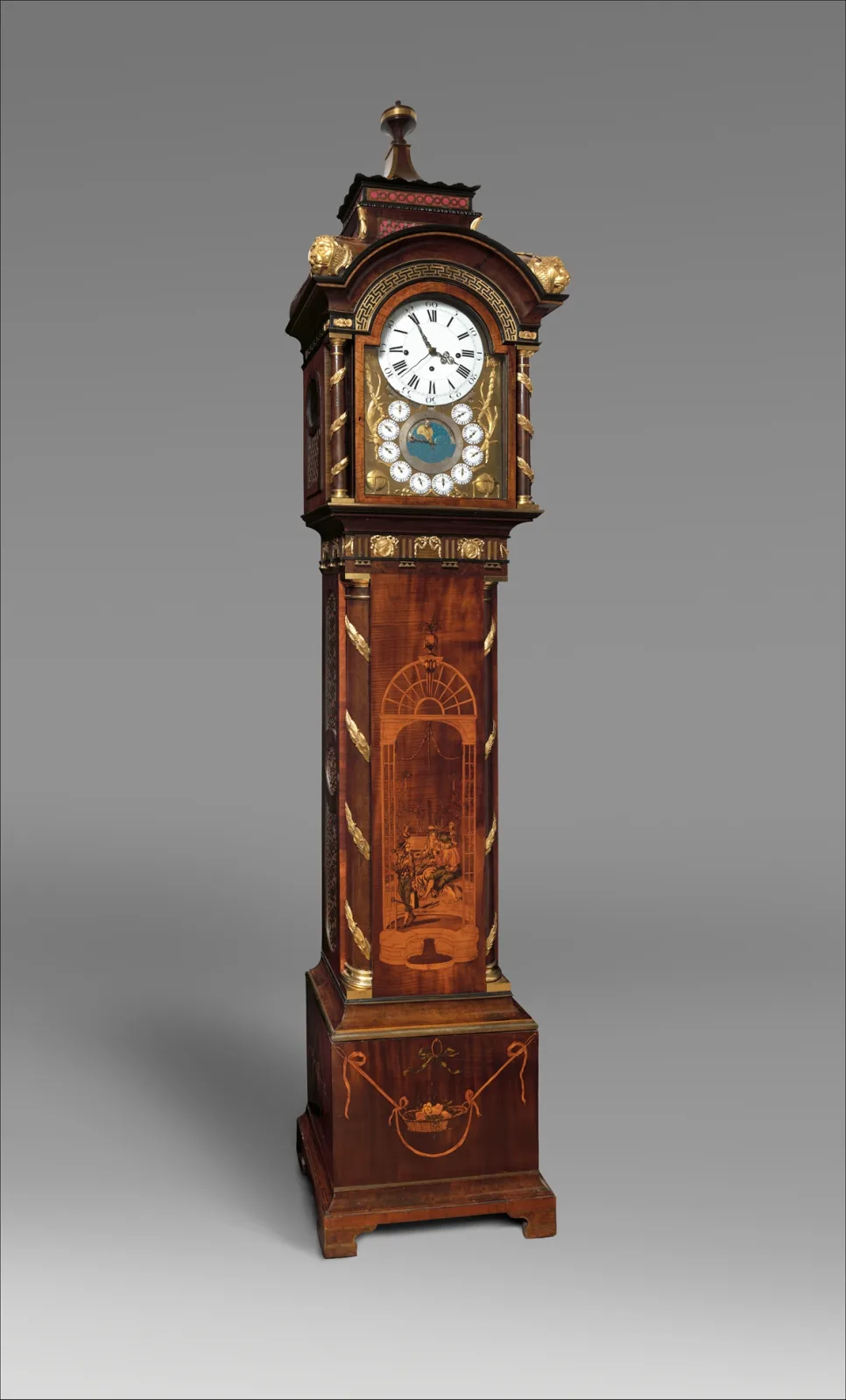
The hood — also called the bonnet — is the upper section that frames and protects the dial. It usually slides forward or lifts off to give access to the movement. Its top, or pediment, is one of the most style-sensitive features of the whole clock: flat tops, domed "caddy" tops, arched tops, broken-arch (swan-neck) pediments, and pagoda tops each belong to particular periods and regions. Columns flank the dial opening, and a glazed door lets you see the face.
The Trunk and Waist Door
The trunk is the long central body that hides the pendulum and the falling weights. Its hinged waist door opens for winding access on some clocks and to hang the pendulum. The width and shape of the trunk, the form of the door (flat, arched, or with a glazed "bull's-eye" lenticle showing the swinging pendulum bob), and the quality of the veneer all carry dating information.
The Base (Plinth)
The base or plinth is the lowest section, resting on bracket feet, ogee (ogee-bracket) feet, or a simple skirting. Bases grew taller and more architectural over time, and the foot style is a useful secondary clue. A clock that has lost height at the base — cut down to fit a low-ceilinged room — is common and affects both proportion and value.
The Movement and Weights
Inside sits the brass movement, driven by one or two cast-iron or brass-cased weights hanging on gut lines or chains, and regulated by a long seconds-beating pendulum (about 39 inches, the classic "royal" pendulum). One weight means a timepiece-only (non-striking) clock; two weights mean time and strike; three can indicate an added chime train. The relationship between movement, dial, and case is the heart of authentication — the same disciplined cross-checking that underlies antique clock identification in general.
Case Styles & How They Evolved
Case style is your fastest dating tool, because longcase clocks followed the broad furniture fashions of their day. Learn the silhouette and you can usually bracket a clock to a 30- to 50-year window before you open the hood.
Early Longcase (c. 1660–1700)
The first English longcase clocks, emerging after the anchor escapement made the long pendulum practical around 1670, are tall, slim, and narrow — often only 10 inches wide. Cases are typically of ebonized wood or rich walnut, sometimes decorated with floral marquetry or "oyster" veneers, with a flat top or a small caddy. Dials are square, small (often 8 to 10 inches), and brass. Genuine examples are scarce, valuable, and heavily reproduced, so they demand expert scrutiny.
Walnut and Marquetry (c. 1690–1730)
The late seventeenth and early eighteenth century is the great age of walnut and elaborate marquetry — intricate inlaid panels of flowers, birds, and arabesques in contrasting woods. Cases remain relatively slender, hoods often have twist (barley-sugar) columns early on, and the convex throat moulding under the hood is a period marker. These are among the most beautiful and sought-after longcase clocks.
Mahogany and the Georgian Peak (c. 1730–1800)
As mahogany became fashionable from the 1730s, longcase clocks grew taller, broader, and more architectural. The broken-arch (swan-neck) pediment, brass finials, fluted and reeded columns, and arched dials become standard. Provincial makers across Britain produced enormous numbers of well-made eight-day mahogany and oak clocks. This Georgian period is the classic "grandfather clock" most people picture, and it is also the most commonly encountered antique longcase.
Oak and Country Clocks (18th–19th century)
Alongside the polished town clocks, country makers built honest oak cases, often with mahogany crossbanding, for farmhouses and modest homes. These thirty-hour and eight-day clocks are plainer, frequently with painted dials, and survive in large numbers. They are the practical entry point for most collectors and share the country-furniture character explored in our pine and country furniture guide.
Regency, Victorian and the Heavy Late Cases (c. 1800–1880)
Into the nineteenth century cases became heavier and wider, especially in the north of England and Scotland, with broad trunks, deep bases, and large painted dials. Late Victorian clocks can look ponderous compared with the slim early forms. By the 1870s the factory-made German and American shelf and wall clock had undercut the longcase trade, and traditional production declined.
The Revival and Tube-Chime Era (c. 1890–1930)
A revival around 1900 produced grand "Edwardian" longcase clocks with elaborate carved cases and quarter-chiming movements — Westminster, Whittington, or St. Michael chimes — often sounding on tuned tubular bells or rod gongs. These impressive but later clocks are frequently mistaken for earlier pieces; the chiming movement and the case construction give them away. Grandmother clocks (a shorter five-to-six-foot form) are largely a twentieth-century fashion.
Reading the Dial: Brass vs. Painted
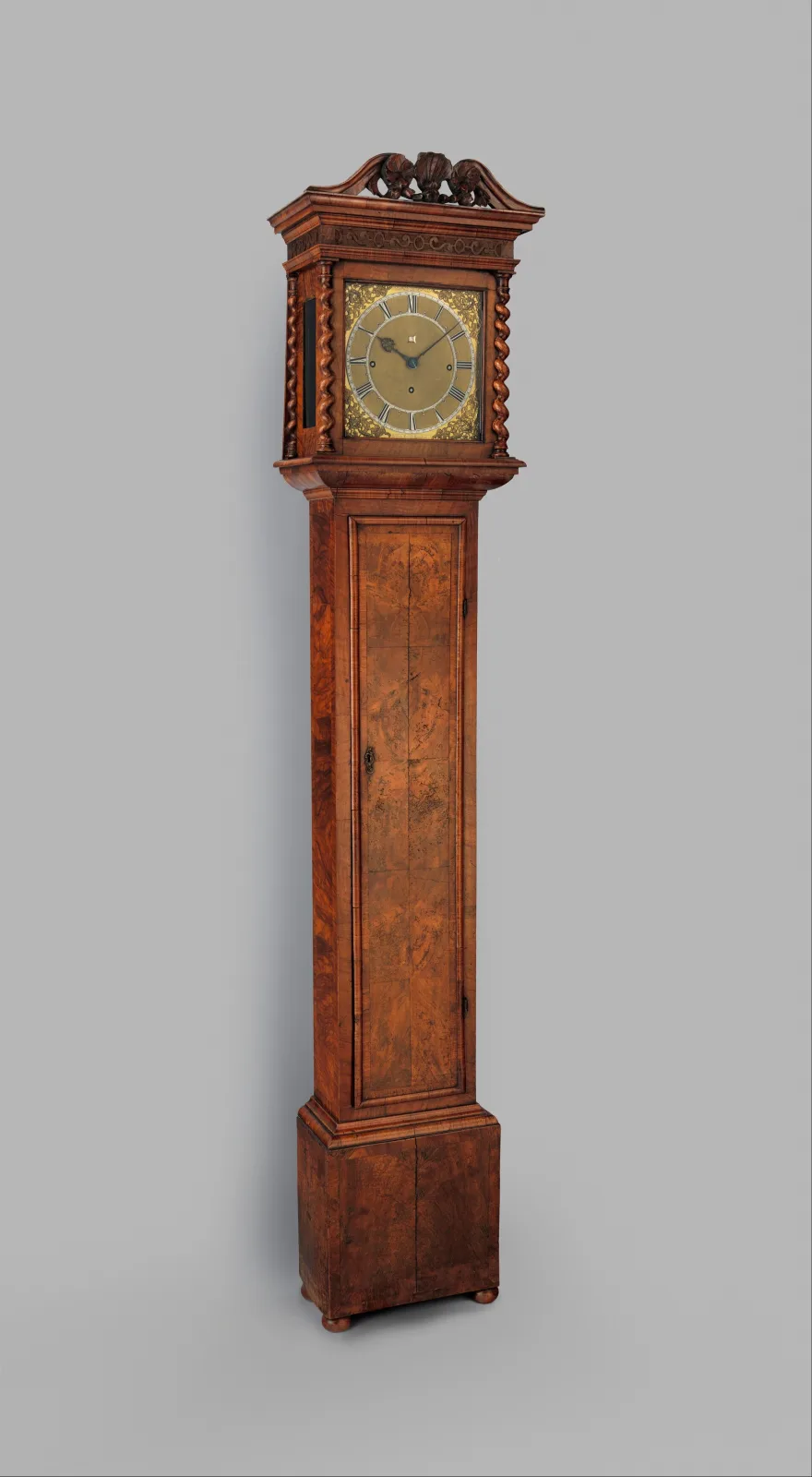
The dial is the single most reliable indicator of a longcase clock's age, because dial fashion changed in a well-documented sequence. The first question is always: brass or painted?
Brass Dials (c. 1660–1770)
Early longcase clocks have brass dials built up from separate components: a silvered or matted brass dial plate, a separate applied chapter ring (the engraved ring carrying the numerals), cast brass spandrels in the corners, and often a silvered boss for the maker's name. The shape and decoration of the spandrels and the style of the chapter ring evolve steadily — cherub-head spandrels early, more elaborate foliate and "female mask" patterns later — giving experts a fine-grained dating scale.
Square to Arched Dials
Dials began square and small (8–10 inches). Around the 1710s–1720s an arched top was added, growing larger (12–14 inches) through the century. The arch often houses a feature: a moon-phase dial, a strike/silent lever, a maker's name boss, or a painted scene. A square brass dial suggests an earlier clock; a large arched dial points later.
Painted (White) Dials (c. 1770 onward)
From about 1770, cheaper and easier-to-read painted dials — sheet-iron faces japanned white with black numerals and painted decoration — rapidly displaced brass. Early painted dials are restrained with simple corner motifs; later Victorian dials grow colorful, with painted scenes, flowers, birds, or moon phases in the arch. A painted dial almost always means a clock made after roughly 1770, and its decorative style narrows the date further.
Moon Phases, Calendars & Seconds
Many longcase dials carry useful complications: a seconds subdial below the XII, a small date aperture showing the day of the month, and a rolling moon-phase disc in the arch (often painted with two hemispheres and a ship or landscape). High-style clocks may add automata — a rocking ship or a Father Time figure. These features add charm and value and, in combination with the dial type, sharpen dating.
Roman Numerals and the "IIII"
Hour numerals are almost always Roman through the antique period, with the four shown as IIII rather than IV — a long-standing horological convention, not a mistake. Minute numbers around the outer track, and the style of the hands (simple early hands giving way to ornate pierced and later "spade" patterns), are supporting clues best read alongside the dial type.

The Movement, Strike & Duration
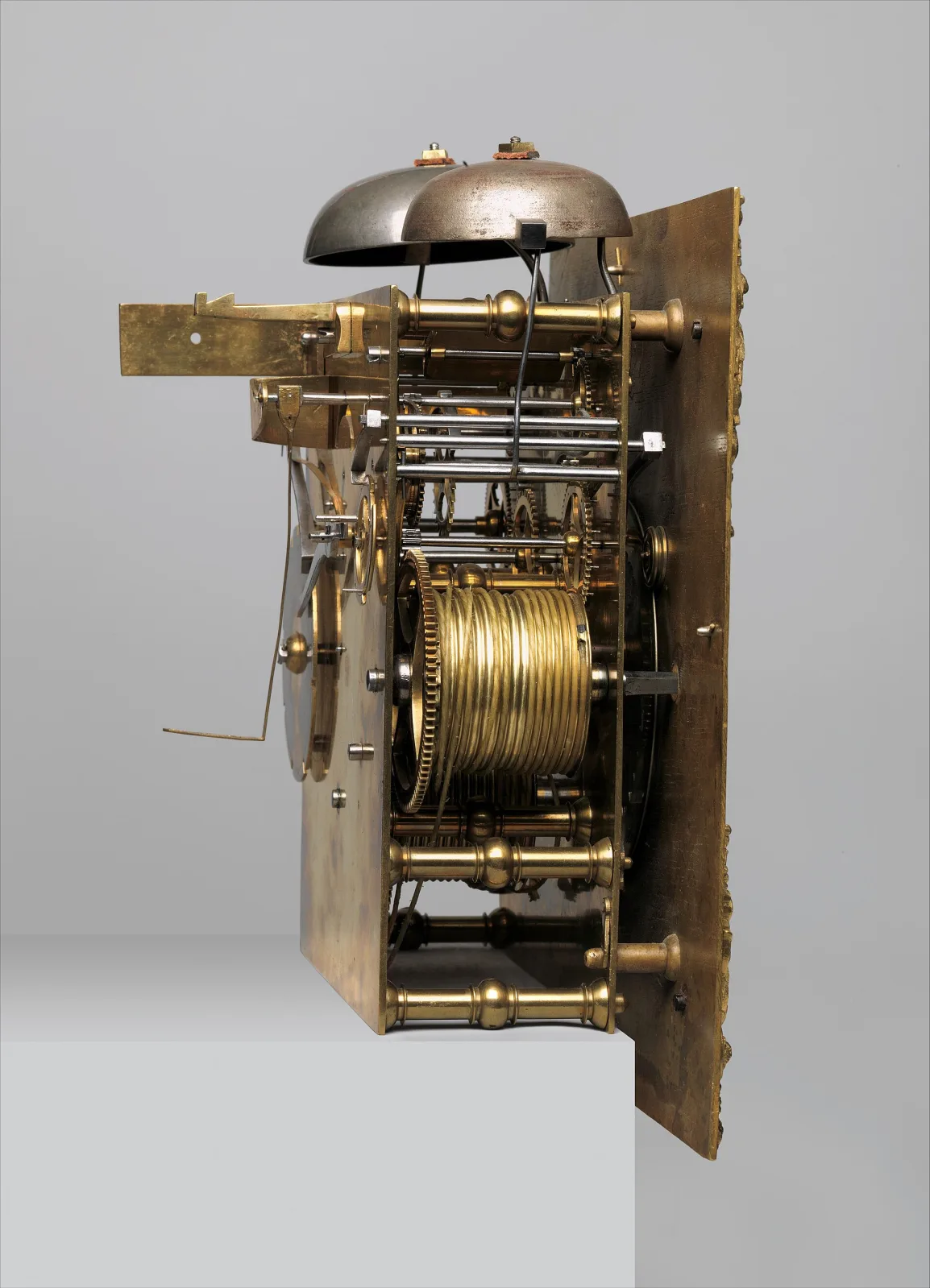
Open the hood and the brass movement confirms — or contradicts — what the case and dial suggest. Its construction, duration, and strike narrow the date and, crucially, reveal whether the clock is "married."
Thirty-Hour vs. Eight-Day
The most important mechanical distinction is duration. A thirty-hour clock runs about a day and must be wound daily, usually by pulling a single chain or rope (no winding holes in the dial). An eight-day clock runs a week and is wound through two square holes in the dial with a key, driven by two separate weights. Eight-day movements were more expensive and are generally the better clocks; thirty-hour movements are common in plainer oak country cases. A dial with no winding holes is a quick giveaway of a thirty-hour clock — and a dial with winding holes married into a thirty-hour case is a classic warning sign.
The Pendulum and Escapement
The defining technology of the longcase clock is the seconds-beating "royal" pendulum roughly 39 inches long, swinging in the trunk and regulated by the anchor escapement (invented around 1670, which made the tall case possible in the first place). The pendulum bob can be raised or lowered by a rating nut to adjust timekeeping. A few precision regulators used the dead-beat escapement and temperature-compensated pendulums; these are specialist, high-value pieces.
Striking the Hours
Almost all eight-day longcase clocks strike the hours on a bell (and some on a coiled gong in later examples). Two systems exist: the older count-wheel (locking-plate) strike, which can fall out of sequence with the hands, and the rack-and-snail strike, which always strikes the correct hour and became standard from the early eighteenth century. The strike system is both a dating and a quality indicator.
Chiming Movements
Quarter-chiming movements — playing Westminster or similar tunes on a nest of bells, rod gongs, or tubular tubes every quarter hour — are largely a late-Victorian and Edwardian feature (c. 1890–1930). An ornate longcase with a chiming movement is almost certainly from this revival period, not the eighteenth century, regardless of how "old" the case looks.
Plates, Pillars and Maker's Marks
The brass plates are held apart by turned pillars, whose shape evolved over time (early "finned" and baluster pillars give way to plainer turned ones). Some movements carry a maker's stamp, a series number, or a "false plate" (a cast-iron intermediate plate behind painted dials, often bearing the dial-maker's name — Wilson, Osborne, Walker & Hughes — which itself helps date the clock after about 1772). The same principle of distinguishing maker from supplier runs through pocket watch identification.
Maker's Names & Signatures
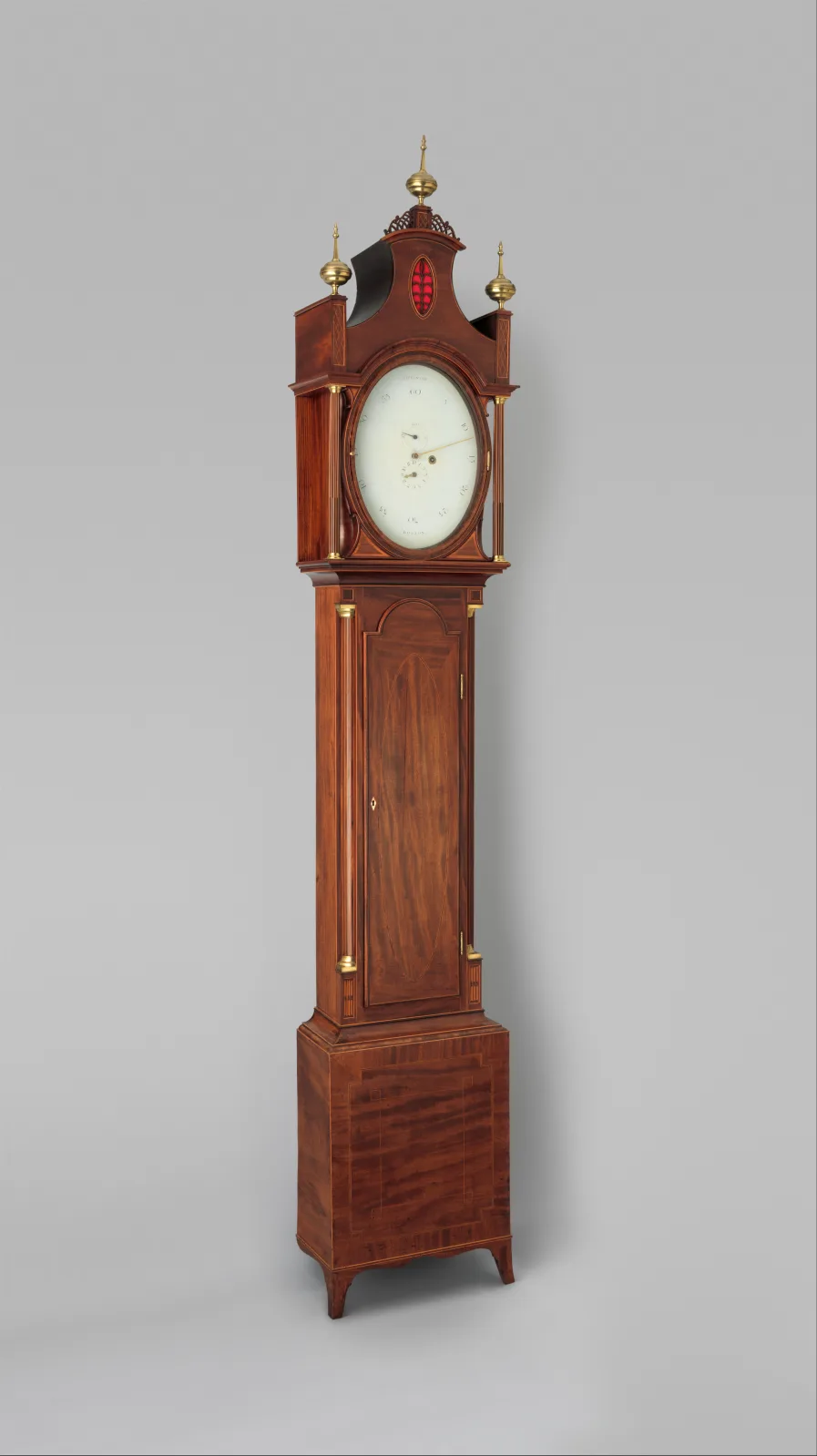
Unlike mass-produced shelf clocks, most antique longcase clocks carry the name of the clockmaker — and that signature is often the key to both attribution and date. It usually appears on the chapter ring, on a silvered boss in the arch, or painted across the dial.
Where the Name Appears
On brass dials, look for an engraved signature along the bottom of the chapter ring ("John Smith, London") or on a boss in the arch. On painted dials, the maker or retailer's name is usually painted in an arc below the center or along the bottom edge. The name typically gives the maker and the town, which immediately localizes the clock and lets you research the maker's working dates.
Maker vs. Retailer
As with other clocks, the name on the dial is not always the person who made the movement. By the nineteenth century many longcase clocks were assembled from bought-in movements and dials and signed by the retailer — a local jeweler or "clockmaker" who finished and sold the clock. The name still localizes and dates the clock, but treat it as the seller unless the movement confirms an actual maker. This maker-versus-seller distinction is central to careful attribution, as set out in our guide to authentication and provenance research.
Researching the Name
Once you have a name and town, reference works on clockmakers (such as Baillie's Watchmakers and Clockmakers of the World or Loomes's volumes on British clockmakers) list working dates for tens of thousands of makers. Matching the recorded dates of "Thomas Wright, Nottingham" to the style of the case and dial either confirms the clock's age or exposes an inconsistency. Local directories and guild records add further precision.
Unsigned Clocks
Plenty of country thirty-hour clocks are unsigned, especially plain oak examples. These are dated entirely on style — case, dial, movement — and judged on their own merits. An unsigned clock is not necessarily inferior, but a documented signature by a known maker adds both certainty and value.
Regional & National Schools
Longcase clocks were made across Britain, Europe, and America, and each region developed recognizable traits. Placing a clock's "school" both confirms origin and assists dating.
London Clocks
London was the center of the finest English clockmaking, home to makers such as Thomas Tompion, George Graham, and Daniel Quare. London cases tend to be restrained and architectural, the movements superbly finished, and the names highly collectable. A genuine London clock by a recognized maker sits at the top of the market — and is correspondingly faked.
Provincial English Clocks
Outside London, thriving clockmaking centers in Lancashire, Yorkshire, the Midlands, and the West Country produced robust, handsome clocks. Northern clocks, especially Victorian ones, are known for their broad cases and large painted dials. Provincial clocks make up the bulk of the surviving market and offer excellent quality for the money.
Scottish and Welsh Clocks
Scotland produced distinctively broad, heavy late cases (the "Scottish drumhead" with a round-topped hood is one recognizable form). Welsh clocks have their own regional character. Both are well-documented schools that collectors actively pursue.
American Tall-Case Clocks
American tall-case clocks followed English models but developed regional schools in Pennsylvania, New England, and the mid-Atlantic. Many early American clocks used imported English brass dials and movements in locally made cases of cherry, walnut, maple, or pine. Later, Connecticut makers like Eli Terry pioneered cheaper wooden movements, paving the way for the mass-produced shelf clocks that eventually displaced the tall case — a story continued in our mantel and shelf clock guide.
Continental and Other Forms
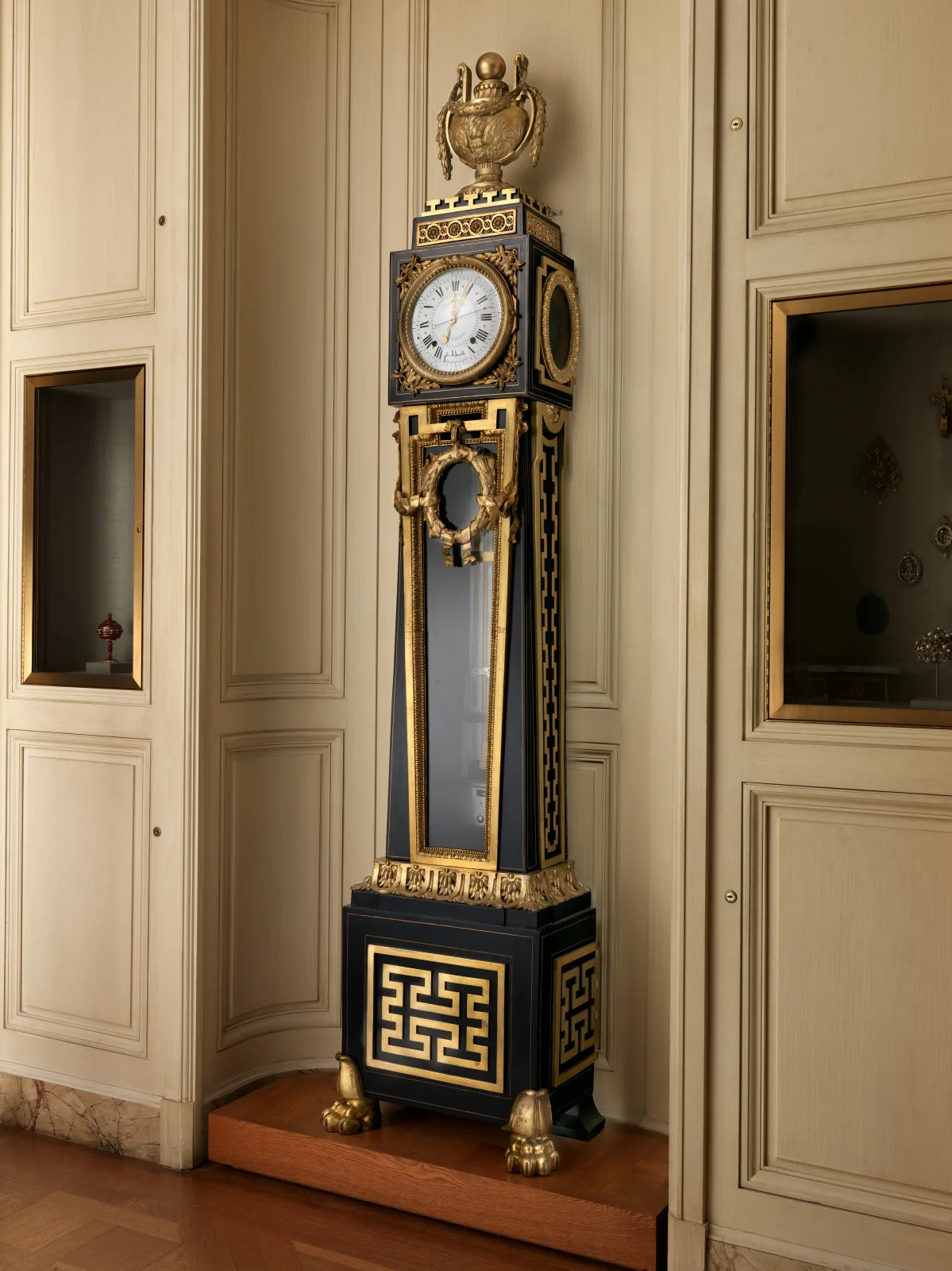
Dutch longcase clocks are often elaborately bombé-shaped with rich marquetry and automata; French and German tall clocks exist but are less common. The Black Forest cuckoo clock tradition and the small brass carriage clock represent entirely separate branches of the horological family, useful to know so you can rule them out when classifying a tall clock.
Putting It Together: Dating a Clock
No single feature dates a longcase clock; experienced collectors triangulate. Here is the practical sequence.
Step 1: Read the Case Style
Place the case in its broad period — slim early walnut/marquetry, broad Georgian mahogany with a swan-neck pediment, plain country oak, or heavy Victorian. This gives a 30- to 50-year window and a likely origin. Note the pediment, columns, trunk width, and base.
Step 2: Classify the Dial
Brass or painted? Square or arched? A square brass dial points before about 1720; an arched brass dial roughly 1720–1770; a painted dial after about 1770. The spandrel pattern (brass) or decorative style (painted) refines the estimate considerably.
Step 3: Examine the Movement
Thirty-hour or eight-day? Count-wheel or rack strike? Chiming? A chiming movement signals the 1890–1930 revival; a count-wheel strike leans earlier. Check that winding holes (or their absence) match the duration the dial implies.
Step 4: Read the Signature
Transcribe the maker or retailer name and town, then look up the recorded working dates. A "false plate" name behind a painted dial gives a firm "no earlier than" anchor (painted dials postdate roughly 1772). The signature should agree with the style evidence.
Step 5: Reconcile Conflicts
If the case says 1700 but the dial is painted and the movement chimes, the parts do not belong together — you likely have a married or revival clock. Decide which elements are original and value accordingly. This patient reconciliation is the same logic that anchors a formal antique valuation and appraisal.
Reproductions, Marriages & Fakes
Three issues dominate longcase authentication: outright reproductions, "married" clocks assembled from mismatched parts, and "improved" clocks doctored to seem older or finer. All are common, and all can fool the unwary.
The "Married" Clock
A marriage combines a movement and dial that did not start life in the case they now occupy — typically a good movement rehoused in a better or older case, or an empty case fitted with bought-in works. Tell-tales include a dial that does not fit the hood opening cleanly (gaps, packing pieces, or filed-down edges), seatboard packing or extra screw holes where a different movement once sat, winding holes that do not align with the movement's arbors, and a hood that fits the dial poorly. A married clock is not worthless, but it should be priced as compromised parts, not as an original.
Reproductions and Revivals
Honest reproductions have been made for over a century, and twentieth-century "antique-style" longcase and grandmother clocks are everywhere. Modern machine-cut screws (uniform threads, Phillips heads), plywood or particleboard hidden in a "period" case, synthetic finishes that fluoresce under UV light, and crisp modern brass castings all betray later work. A perfect, unworn movement inside a genuinely worn case warrants scrutiny — the same UV-and-hardware checks used when assessing reproductions of Victorian furniture.
"Improved" and Composite Clocks
Some clocks have been embellished to raise their price: a plain dial re-engraved with a fashionable name, spandrels added, a moon-phase let into the arch, marquetry inlaid into a once-plain case, or a London signature applied to a provincial clock. Engraving that looks too crisp or that cuts through old silvering, inlay that interrupts rather than respects the case design, and signatures that do not match the clock's documented style are red flags. When the name seems too good for the clock, be skeptical.
Cut-Down and Altered Cases
Tall clocks were frequently shortened to fit lower ceilings, losing height from the base or hood. Look for awkward proportions, a base that seems too short for the trunk, or fresh-cut, unweathered wood at a join. Reduction harms both proportion and value but is so common that it is more a condition issue than outright fakery.
Condition & Originality
For longcase clocks, "originality" — how much of the clock is as-made and belongs together — is as important as cosmetic condition, and often more so.
Case Condition
Examine the veneer and marquetry for lifting, losses, and old repairs; check feet and base for replacement or reduction; and look at the hood for replaced columns, finials, or glass. Original surface and color are prized. An over-aggressive refinish that strips age, or replaced mouldings and feet, lowers value — a recurring theme in antique restoration and conservation.
Mechanical Condition
Does the movement run, strike correctly, and keep reasonable time? Worn pivots, broken suspension springs, and damaged gut lines are common and repairable by a clocksmith, but a full overhaul has a cost. A clock that "has not run in years" may need only cleaning and a new line — or a substantial service. Never force a stuck movement or hang weights on frayed lines.
Completeness
Original weights, pendulum, winding key (or crank), hands, finials, and glass all count toward originality. Mismatched or replacement weights are common; a clock with its matched original weights, pendulum, and key is markedly more desirable than a stripped one.
Originality vs. Restoration
Collectors prize honest original condition over heavy restoration. Sympathetic conservation — cleaning, stabilizing veneer, a proper movement service, replacing a worn gut line — preserves value; re-engraving a dial, refinishing out the patina, or marrying in a "better" movement diminishes it. When in doubt, do less, and document what is original versus replaced.
Value Factors and Price Ranges
Longcase clock values span an enormous range, from a few hundred dollars for a plain Victorian oak clock to six figures and beyond for an important early London piece. Several factors decide where a given clock lands.
What Drives Value
- Maker and rarity: A documented clock by a celebrated London maker, or a rare early form, commands a vast premium over an unsigned country clock.
- Age and form: Early walnut and marquetry clocks and fine Georgian mahogany pieces outrank heavy late-Victorian cases.
- Originality: An unmarried clock with its original dial, movement, weights, pendulum, finials, and surface is worth far more than a composite.
- Dial and complications: An attractive arched brass dial, a moon phase, automata, or unusual functions add interest and value.
- Case quality: Fine figured mahogany, crisp marquetry, and good proportions outrank plain or cut-down cases.
- Condition: Running order, intact case and glass, and undisturbed original finish.
Approximate Ranges
As a broad orientation only: plain Victorian oak and mahogany eight-day clocks and twentieth-century revival pieces commonly trade in the low-to-mid hundreds of dollars; good Georgian provincial mahogany and oak clocks with painted or brass dials span roughly the mid-hundreds to low thousands; fine eighteenth-century arched-brass-dial clocks and attractive marquetry examples reach several thousand; and important early London clocks by celebrated makers run well into five and six figures. Counterintuitively, the sheer abundance of ordinary Victorian longcase clocks — and the difficulty of housing a seven-foot clock — keeps prices for common examples modest. These ranges shift with condition, region, and market, so confirm against recent comparable sales.
Where to Verify Prices
Check completed-sale records at horological and general auction houses, not asking prices. For anything potentially important — a signed London clock, an early marquetry case, a precision regulator — a specialist appraisal is well worth the cost, following the disciplined approach in our valuation and appraisal guide.
Care, Setup & Moving
A grandfather clock is both a working machine and a substantial piece of furniture, and it is also the antique most often damaged in transit. A little care protects both the case and the movement.
Setting Up and Leveling
A longcase clock must stand level and stable, ideally screwed or secured to the wall so it cannot topple — a top-heavy seven-foot case is a genuine hazard, especially with children about. The pendulum must swing freely and find an even "beat" (a regular tick-tock); a clock out of beat will stop. Adjust by leveling the case or, if fitted, the beat-setting at the crutch. Set the weights on their correct sides (the strike weight is often heavier).
Winding and Running
Wind eight-day clocks weekly through the dial holes with the correct key or crank, stopping at firm resistance — never over-wind. For thirty-hour clocks, pull the chain or rope daily. Let the bob settle and the beat even out before expecting accurate time, and adjust the rating nut on the pendulum (up to speed up, down to slow down) in small increments.
Moving a Longcase Clock
Always dismantle before moving: stop the pendulum and lift it out, remove the weights (label which is which), slide off or lift away the hood, and carefully detach the movement from its seatboard if transporting any distance. Move the case and movement separately, padded and upright. Reassemble only once the case is in its final position, level, and secure. Forcing a fully assembled clock through a doorway is the classic way to crack a hood or bend an arbor.
Environment and Cleaning
Keep clocks away from radiators, direct sun, fireplaces in use, and damp — heat and humidity swings craze finishes, lift veneer and marquetry, and rust steel parts. Dust the case with a soft dry cloth and avoid silicone polishes on original surfaces. Never spray lubricant into the movement; proper clock oil applied sparingly by a clocksmith is the only correct service. These same climate-control principles protect a clock the way they protect a wider collection, as covered in our guide to storage, care, and preservation.
Frequently Asked Questions
What is the difference between a grandfather, grandmother, and longcase clock?
"Longcase" (British) and "tall-case" (American) are the formal terms for a weight-driven, pendulum clock in a tall freestanding case; "grandfather clock" is the popular name for the same thing. A "grandmother clock" is simply a shorter version (roughly five to six feet), and a "granddaughter clock" shorter still. They share the same anatomy and identification logic.
How can I tell how old my grandfather clock is?
Triangulate four things: the case style (slim early walnut vs. broad Georgian mahogany vs. heavy Victorian), the dial (square brass before ~1720, arched brass ~1720–1770, painted after ~1770), the movement (thirty-hour vs. eight-day, count-wheel vs. rack strike, chiming = 1890–1930 revival), and the maker's signature and town, whose recorded working dates you can look up. The dial type and a painted-dial maker's "false plate" name are especially firm anchors.
Are old grandfather clocks valuable?
It varies enormously. Common Victorian oak and mahogany clocks and twentieth-century revival pieces are modest (often low-to-mid hundreds of dollars), partly because they are abundant and hard to house. Fine Georgian, early marquetry, and signed London clocks reach thousands, and important early makers command five and six figures. Maker, age, originality, and condition decide where a clock lands.
What is a "married" grandfather clock?
A married clock is one whose movement and dial did not originally belong in its case — often a good movement rehoused in a better or older case, or a case fitted with bought-in works. Signs include a dial that fits the hood poorly, packing pieces or extra screw holes on the seatboard, and winding holes that do not align with the movement. A marriage reduces value, so it should be priced as compromised parts rather than as an original.
Why do longcase clock dials show IIII instead of IV?
Using IIII for four is a long-standing horological convention seen on most antique clock and watch dials, valued for visual balance with the VIII opposite it. It is normal and not a sign of error or fakery; in fact a clock showing IV would be slightly unusual.
Can I clean or restore my grandfather clock myself?
Dust and gentle surface care are fine, but leave the movement to a clocksmith — never spray lubricant inside or force a stuck mechanism, and never run the clock on frayed gut lines. Avoid refinishing original cases or re-engraving dials, as these destroy value. Sympathetic conservation preserves worth; heavy "restoration" usually erases it. When moving the clock, always remove the pendulum and weights first.