
Antique Carriage Clocks Identification Guide: French Pendules de Voyage, Cases, and Strikes
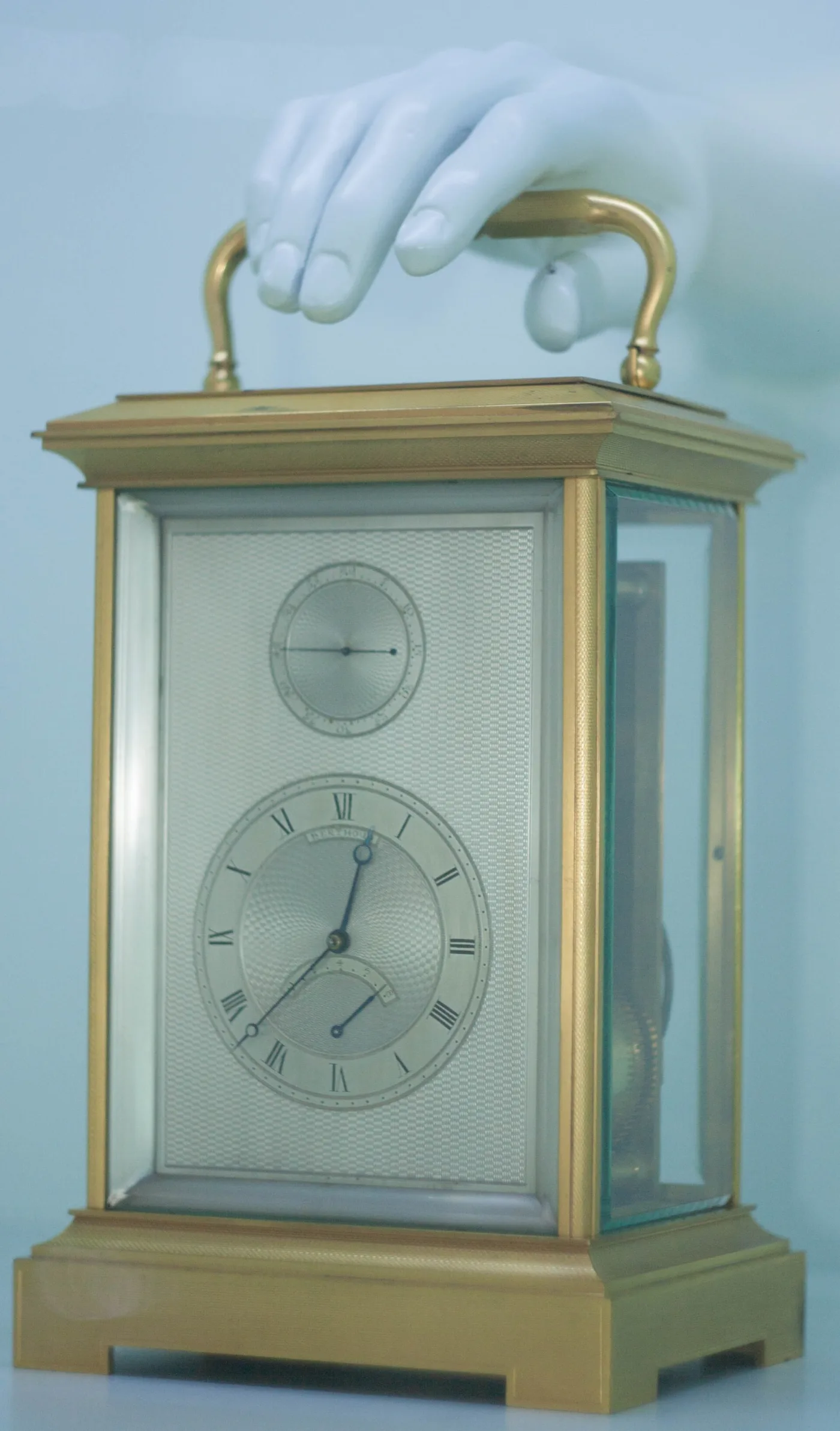
The carriage clock — known to the French as the pendule de voyage or pendule d'officier — is one of the most precisely defined object categories in horology. Small, rectangular, with a brass case and glass panels on every side, a carrying handle on top, and a platform escapement visible through the glazed top, it was invented in early-nineteenth-century Paris as a portable spring-driven clock that could be packed into a leather travelling case and carried on the postilion-driven coaches of the period. By 1850 it had become a standard luxury gift, and between roughly 1860 and 1900 several hundred Parisian workshops turned out an enormous and finely graded production — from plain timepieces costing a working week's wages to grande-sonnerie repeating clocks signed by the great retailers of London and Geneva costing several years' income.
Identifying a carriage clock means working through a fixed sequence of questions. What is the case style — corniche, anglaise, gorge, oval, cannelée, one-piece — and what does the case tell you about period and price grade? What is the movement: a simple timepiece, an alarm, a striking clock, a petite sonnerie, a grande sonnerie, a repeater? What escapement is on the platform — cylinder, jeweled lever, lever with chronometer detent? Who made the movement and who retailed the clock — these are usually different people, and reading both sets of marks is essential? What is the country of origin — Parisian production accounts for the great majority but English, Austrian, and (later) Swiss makers all worked in the form?
This guide covers the origin and development of the carriage clock from Abraham-Louis Breguet's pendule d'officier of about 1798 through the high Parisian production of 1860–1900 to the late English and Swiss continuations. It treats the major case forms with their dating, the movement complications, the escapement types, the leading makers and their stamps, the trade structure of the Paris industry (établisseurs versus retailers), the major reproduction and fake categories, condition assessment, the working valuation framework, and care of running and non-running examples. By the end you should be able to pick up an unknown carriage clock at an estate sale and quickly place it by case style, complication, and likely workshop within five to ten minutes.
Table of Contents
- A Short History of the Carriage Clock
- Anatomy and Vocabulary
- Case Styles and Dating
- Movement Complications
- Platform Escapements
- Strike, Repeat, and Sonnerie
- Dials, Hands, and Numerals
- Engraving, Enamel, and Porcelain Panels
- French Makers and Stamps
- English Carriage Clocks
- Retailers vs. Movement Makers
- The Paris Trade Structure
- Dating by Construction
- Reproductions, Marriages, and Fakes
- Condition Assessment
- What Drives Value
- Care, Service, and Winding
- Common Beginner Mistakes
- Frequently Asked Questions
A Short History of the Carriage Clock
The story begins with Abraham-Louis Breguet, the dominant clockmaker of late-eighteenth and early-nineteenth-century Paris. About 1798 Breguet developed for Napoleon's officers a portable, spring-driven, fully glazed clock with a carrying handle — a form he called the pendule d'officier. The earliest surviving examples are by Breguet himself and a small handful of his contemporaries; they are extraordinarily rare and command six-figure prices when they appear. The form was promptly imitated, simplified, and standardized, and by the 1820s a recognizable carriage clock case had emerged in Parisian workshops.
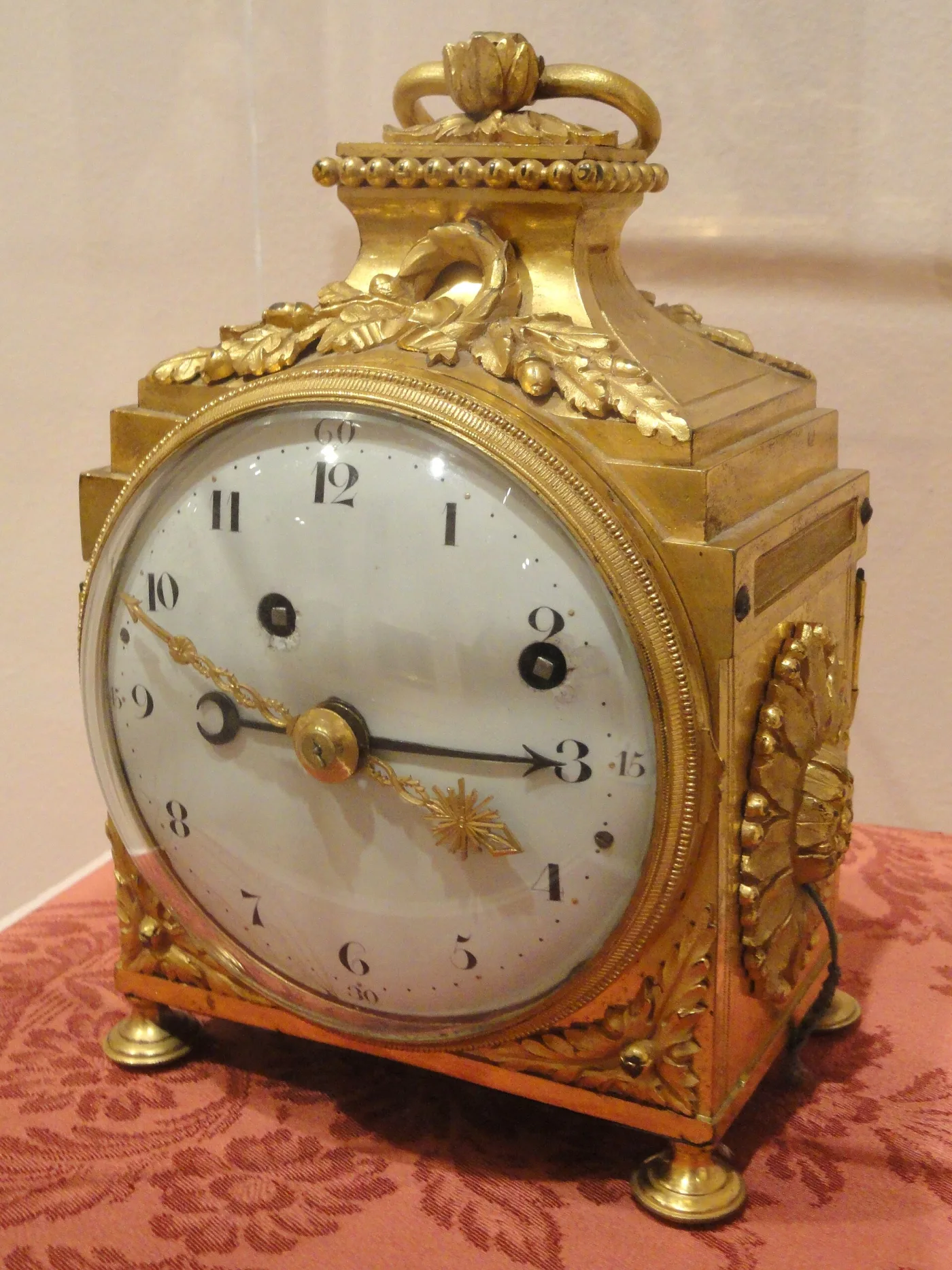
Two technical advances drove the form's commercial expansion. First, the perfection of the platform lever escapement — small, robust, and capable of being mounted horizontally on a brass plate at the top of the movement — made the clock travel-stable in a way the pendulum movements of a longcase clock never could. Second, the development of a standardized rectangular brass case with bevelled glass panels meant cases could be made in volume by case-maker workshops separately from movements. The trade divided into établisseurs (movement makers and finishers), case makers, dial enamellers, and retailers, and the resulting modular industry could turn out clocks across a very wide quality range.
The Golden Age (1860–1900)
By 1860 Paris was producing carriage clocks in numbers that astonished contemporary observers. Paul Garnier, Henri Jacot, Drocourt, Margaine, Japy Frères, and dozens of smaller établisseurs were turning out movements; the Faubourg du Temple and Marais quarters were dense with case-makers and finishers. London retailers such as Dent, Frodsham, James McCabe, and Hunt & Roskell sold these French clocks under their own engraved names, often with English-style dials. Geneva and Vienna also sold Parisian clocks under local retailer names. The 1855 and 1867 Paris expositions cemented the carriage clock as the standard high-end portable timepiece of the European bourgeoisie.
The English Tradition
Although Paris dominated production, several English makers built their own carriage clocks in the late nineteenth century — most famously the firm of Charles Frodsham and the workshops of Dent and James McCabe. English-made carriage clocks (as opposed to French clocks retailed by English firms) are heavier, more robust, often with chronometer-style escapements and fusee winding, and typically command a substantial premium over equivalent French work.
Decline and Continuation
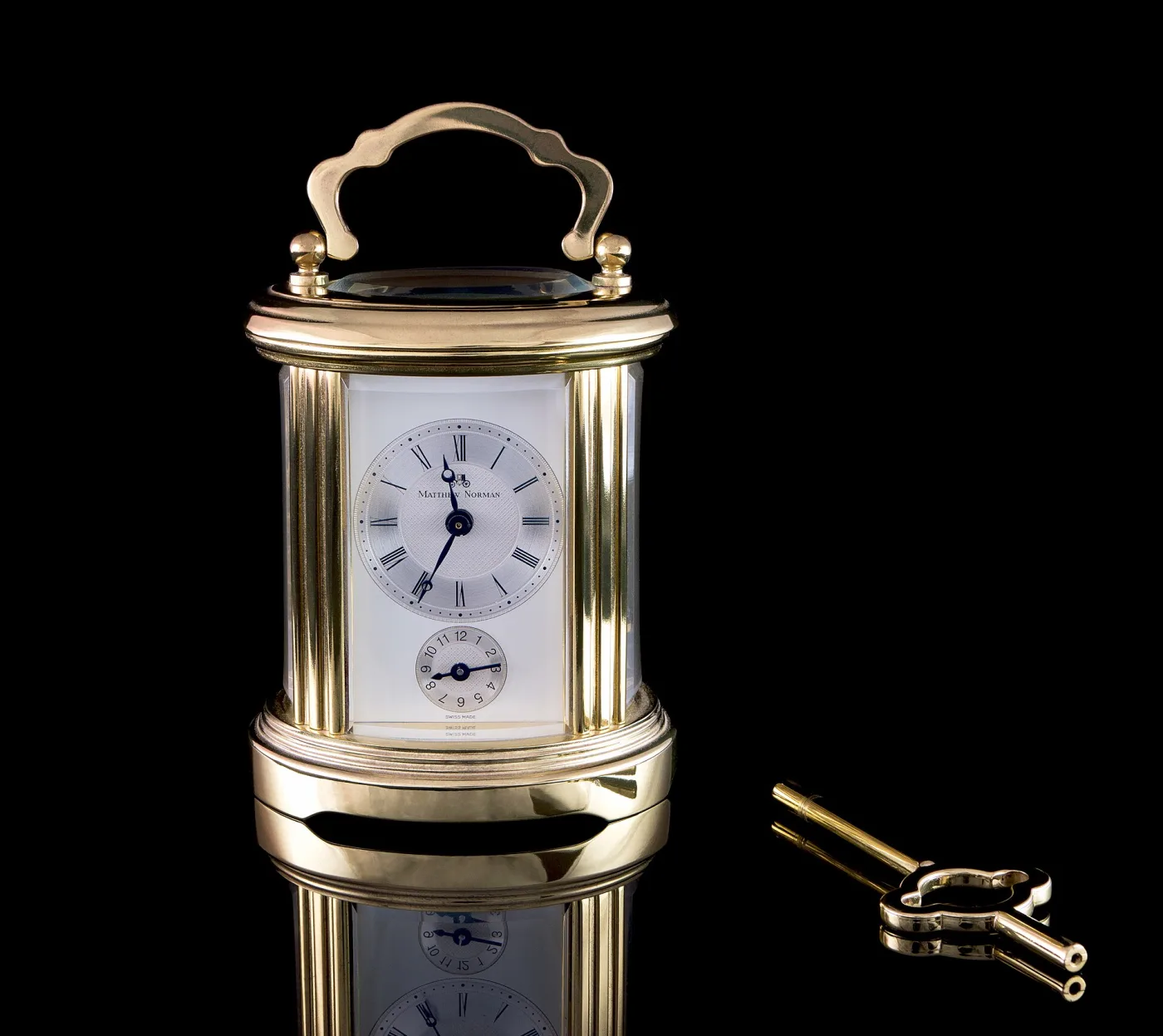
The carriage clock's commercial decline was gradual. The wristwatch displaced the travelling clock for personal portable timekeeping in the 1910s; the railway and automobile eliminated the slow coach journey for which the original case had been designed. Production continued at reduced scale through the 1920s and 1930s, mostly Swiss after the First World War, and modern revivals (notably by Charles Frodsham & Co. in London and Matthew Norman in Switzerland) carry the form forward as a traditional luxury product. For the broader chronological arc of mechanical clockmaking, see our antique clock identification guide, and for the contemporaneous Black Forest tradition see our cuckoo clocks identification guide.
Anatomy and Vocabulary
Carriage clock terminology is dense and specific. Knowing the names accelerates catalogue and auction reading immediately.
Case
The brass shell, normally rectangular, sometimes oval. The case is composed of a top plate, four pillars at the corners, a base, and four bevelled glass panels (front, back, two sides) plus a glazed top through which the platform escapement is visible.
Handle
The folding or fixed handle on top of the case, used to carry the clock. The handle profile is one of the strongest case-style dating clues — a flat sweeping handle with a heart-shaped cutout dates differently from a thin folding loop.
Platform
The horizontal brass plate at the top of the movement that carries the escapement, balance wheel, and balance spring. The platform is normally visible through the glazed top of the case. Removing the platform for service is the standard maintenance operation.
Movement
The going train, striking train (if any), and barrels, between two vertical brass plates inside the case. The movement is held by four pillars and accessed by removing the back glass and the back panel.
Mainspring Barrel
The drum holding the mainspring. A timepiece has one barrel; an alarm clock two; a striking clock two (going and strike); a grande-sonnerie clock typically three.
Bezel
The rim around the dial, often engraved or fluted depending on case style.
Subsidiary Dial
A smaller dial below the main dial, used for alarm setting, seconds, calendar, or strike-silent indication.
Repeating Push-Piece
The button on top of the case (usually beside or behind the handle) that, when pressed, causes the clock to strike the last hour and quarter on demand. Standard on repeater clocks.
Strike-Silent Lever
A small lever on the back of the movement that selects between striking and silent operation, or between grande and petite sonnerie, depending on the complication.
Case Styles and Dating
Case style is the single fastest dating clue for a French carriage clock. Six major styles cover the great majority of production.
One-Piece Case (c. 1820–1850)
The earliest standard form: case sides cut from a single sheet of brass, bent and soldered, with a simple sweeping handle. One-piece cases predate the modular pillar-and-panel construction and are diagnostic of pre-1850 work. Surviving examples are scarce and command premium prices.
Corniche Case (c. 1840–1900)
The classic carriage clock case: rectangular, with a moulded cornice (a stepped projecting top edge) and matching plinth at the base. Corner pillars are plain or fluted. The corniche case is the volume product of the great Parisian period, made by every major établisseur in tens of thousands of examples. Plain corniche cases are the entry-grade carriage clock; gilt-bronze corniche cases with engraved bezels are mid-grade.
Anglaise Case (c. 1855–1910)
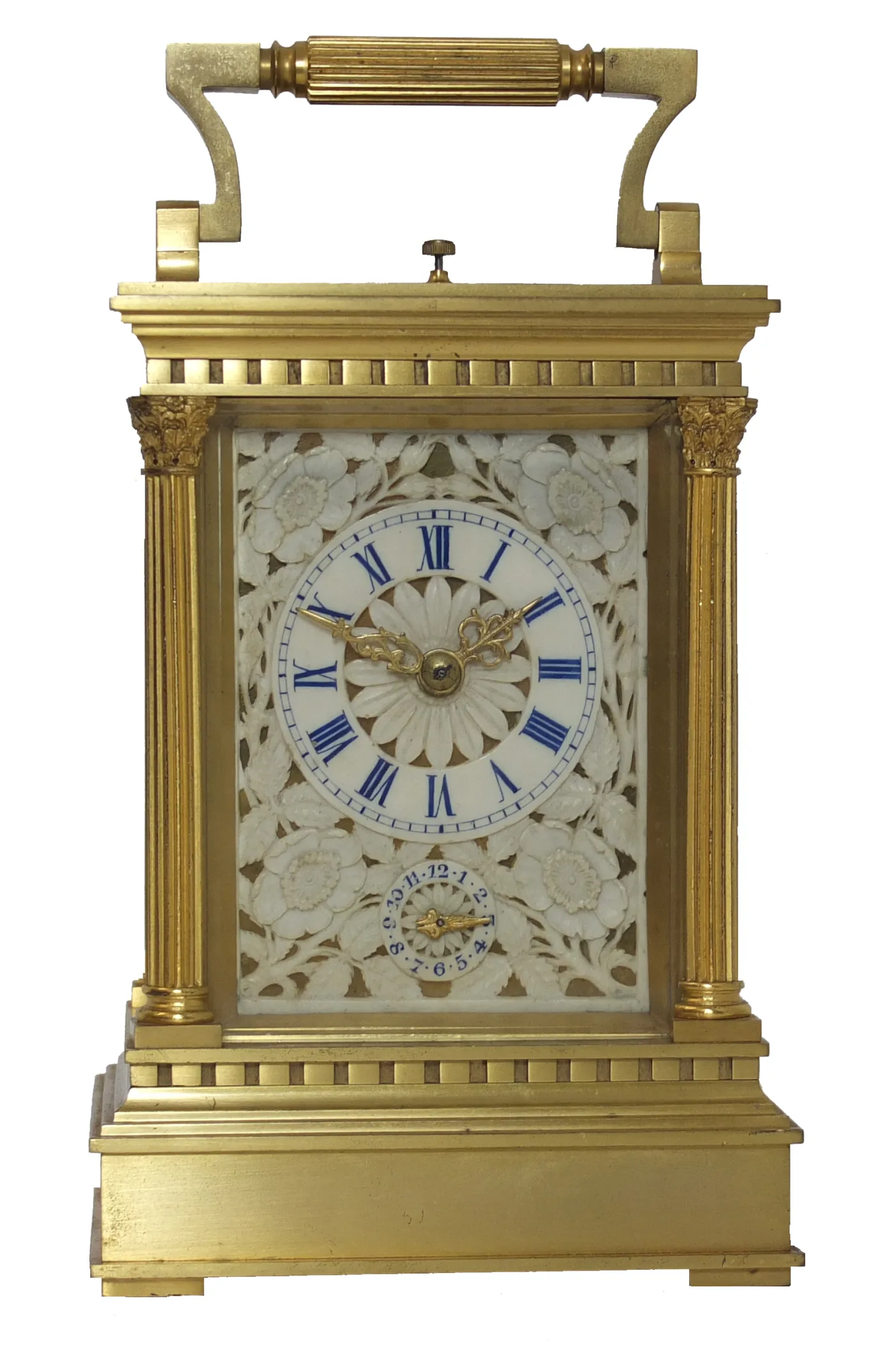
Taller and more architectural, with reeded or fluted columns at the corners and a heavier top moulding. The anglaise ("English-style") case was developed for the English retail market and is associated with high-quality movements — it is rarely fitted to cheap movements. Anglaise cases often house grande-sonnerie or fine repeater complications.
Gorge Case (c. 1850–1900)
Distinctive case with a distinct concave moulding (the "gorge," meaning throat or neck) running around the top and bottom edges. Often heavily engraved across the brass surfaces. The gorge case is associated with high-quality movements and is one of the most desirable French carriage clock case forms for collectors.
Cannelée Case
Cannelée means "fluted." The case has fluted (vertically grooved) corner pillars or fluting on the cornice. A mid-grade decorative variant, often encountered.
Oval Case (c. 1855–1900)
The case is oval rather than rectangular, with curved glass panels (more expensive to make than flat panels). Oval cases typically house high-grade movements and are scarcer than rectangular forms; they command a 30–60 percent premium over equivalent rectangular cases.
Bamboo and Other Naturalistic Cases
Case pillars cast or chased to imitate bamboo stems, with matching handle. Bamboo carriage clocks were a fashionable variant from about 1880, often associated with the broader Japonisme decorative movement. They are a distinct collector subcategory.
Porcelain-Panel and Champlevé Cases
Cases with hand-painted porcelain panels (Limoges, Sèvres-style) set into the sides instead of glass, or with champlevé enamel decoration on the brass. These are luxury-grade clocks; pristine porcelain panels are fragile and often cracked or restored.
Movement Complications
The complication — the additional functions beyond simple time-telling — is the second major value driver after maker. The standard hierarchy runs from plain timepiece to grande sonnerie repeater.
Timepiece (Time Only)
The simplest carriage clock: a single mainspring barrel driving a going train and a platform escapement. No striking. No alarm. Plain timepieces are the most common surviving form and the entry into the market.
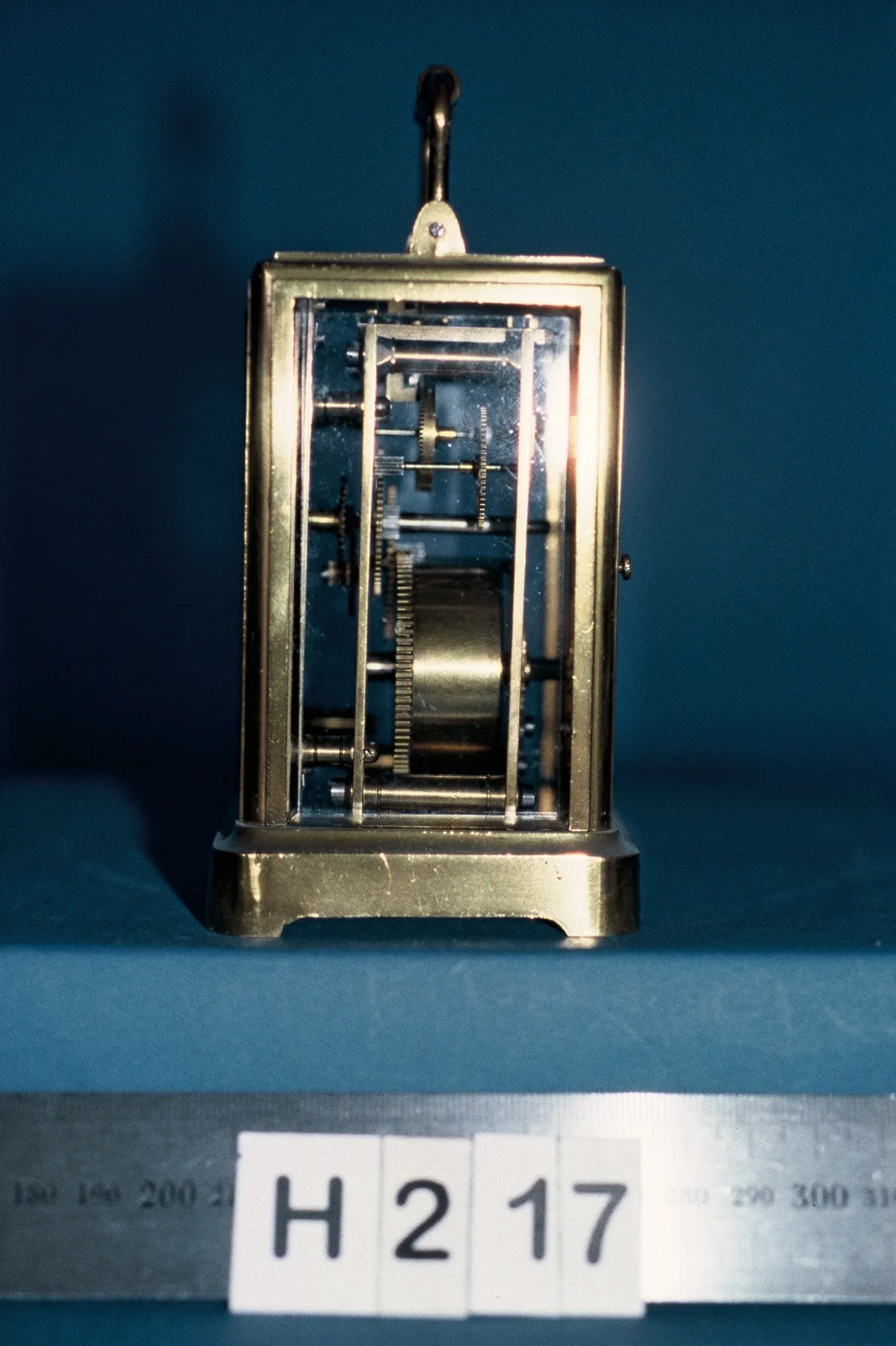
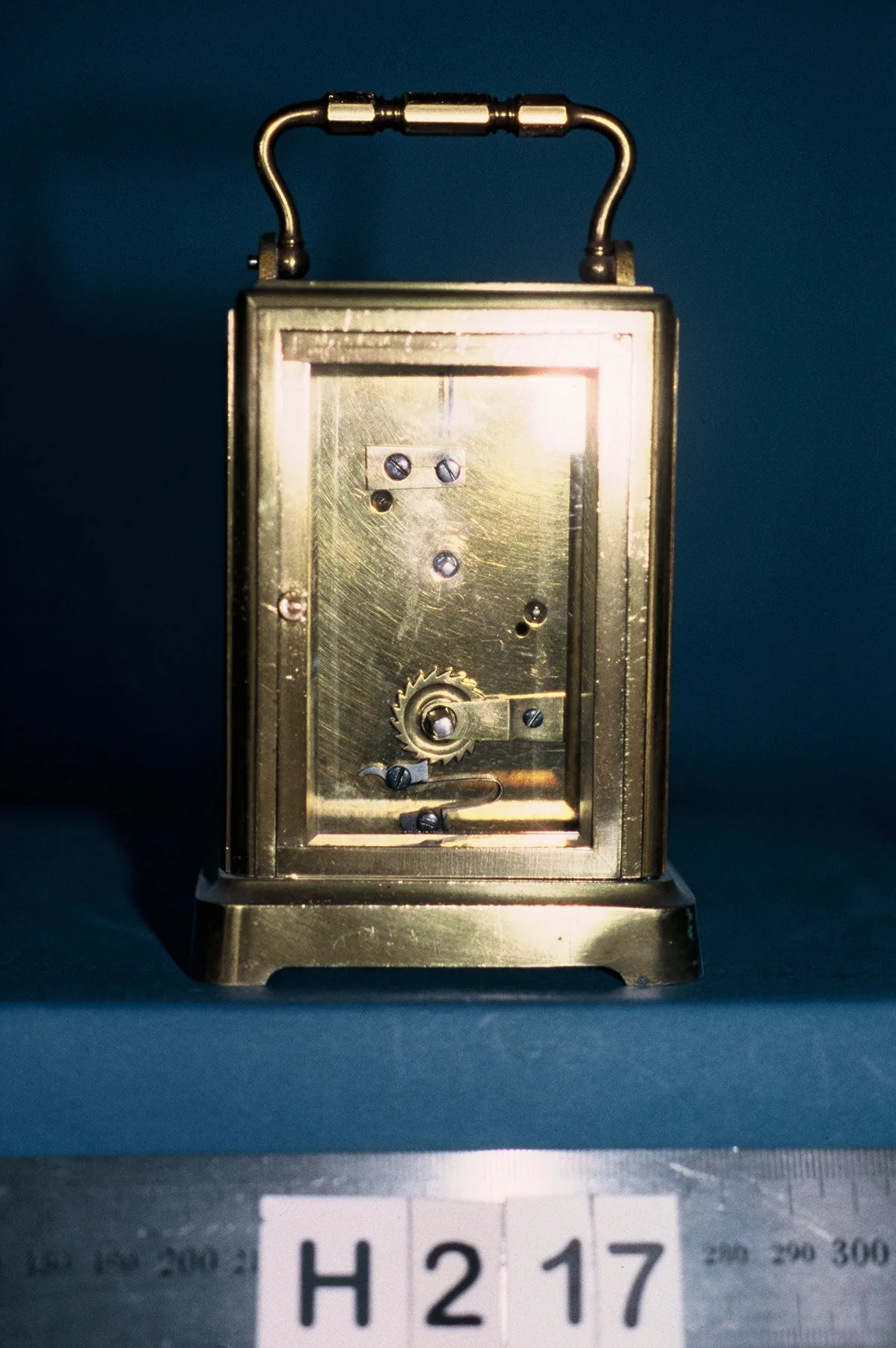
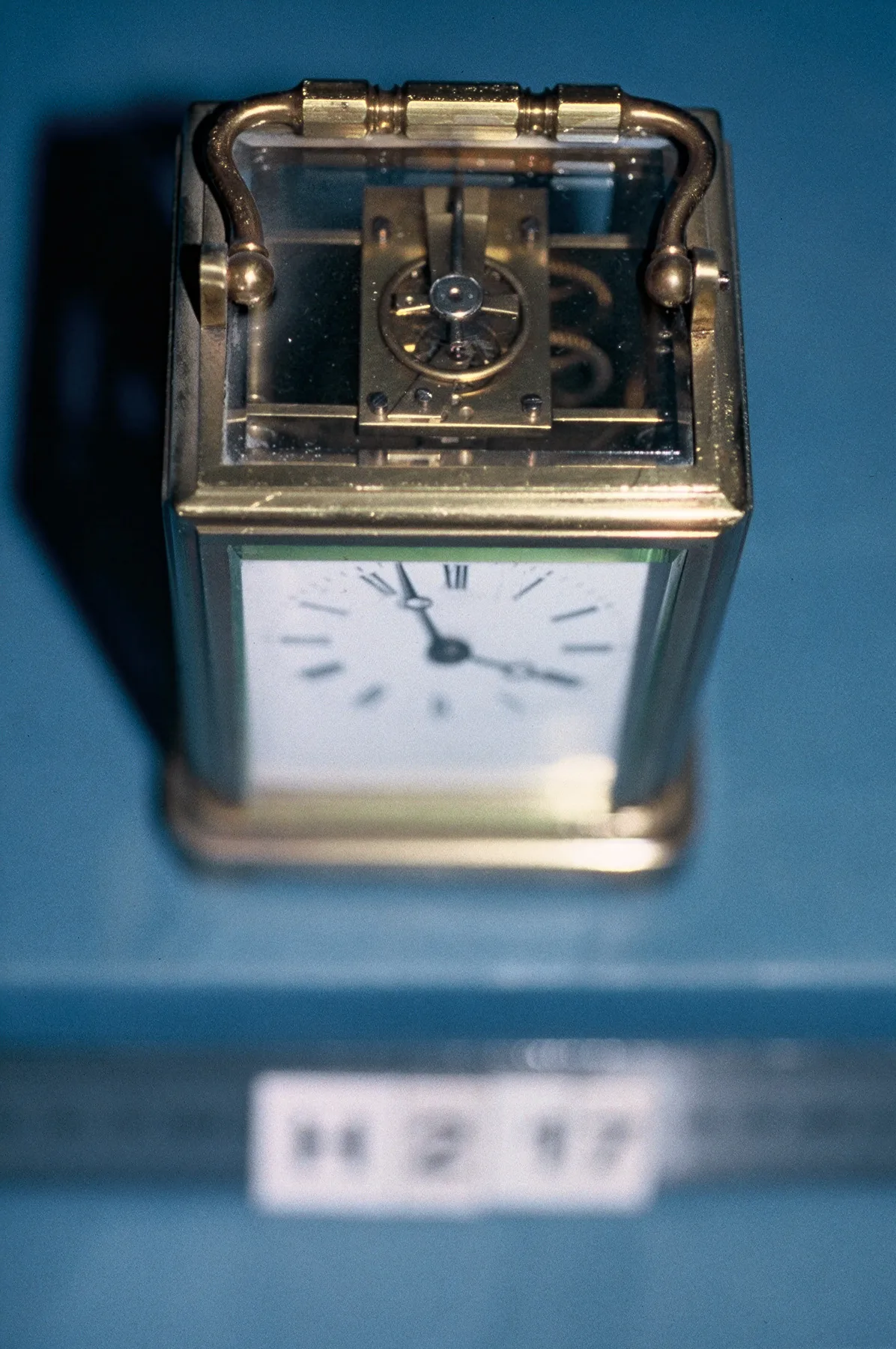
These are the two views to ask a seller for, and between them they settle the complication before anyone opens anything. The side glass counts barrels — one for a timepiece, two for an alarm or an hour strike, usually three for a grande sonnerie — and the back shows whether the strike and repeat work that should accompany extra barrels is actually present. Auckland Museum catalogues this clock as a late-nineteenth-century French timepiece with a cylinder escapement and case corners formed in one piece with the top: a correct-looking clock that is still entry grade, which is exactly the combination a case-first identification misses.
Timepiece with Alarm
A second mainspring barrel powers a small alarm hammer and bell mounted under the case base. The alarm time is set on a subsidiary dial below the main dial. Alarm carriage clocks are common; the alarm mechanism is mechanically simple and usually robust.
Striking Carriage Clock (Hour Strike)
A second train and barrel strike the hour on a bell or coiled-wire gong mounted under the base. Strike on the half-hour is a single blow on most French carriage clocks (a "pip").
Repeater (Hour Repeat)
Pressing the push-piece on top of the case causes the clock to repeat the last full hour on the bell or gong. Used to read the time at night without a light. Adds a substantial mechanical complication.
Quarter Repeater
The push-piece causes the clock to strike the last hour, then the last quarter (one to three blows on a higher-pitched gong or different bell). The standard high-grade complication for fine carriage clocks.
Petite Sonnerie
The clock strikes the quarters automatically (one, two, or three blows on a high-pitched gong) and the hours on the hour on a low-pitched gong. Different from grande sonnerie in that the quarters do not repeat the preceding hours.
Grande Sonnerie
The most complex standard complication: the clock strikes the hours and quarters at every quarter — at, say, 3:45 it strikes three (hours), then three (the three quarters past). Grande sonnerie clocks usually have a strike-silent or grande/petite selector lever on the back. They use three barrels and considerably more complex movement work, and command a serious premium.
Calendar and Other Subsidiary Functions
Date, day of week, and moon-phase indications appear on some high-grade clocks, on subsidiary dials below the main dial. A carriage clock with a calendar is rarer than a standard clock of the same maker and period.
Tourbillon and Other Rare Complications
A handful of very high-grade carriage clocks have tourbillon escapements or chronometer detent escapements. These are signed work by makers including Breguet successors and the finest English chronometer makers and are five-to-six-figure pieces.
Platform Escapements
The escapement on the platform is the second technical detail (after complication) that grades the movement. Three types dominate, with several rare variants.
Cylinder Escapement
An older type, used on cheaper carriage clocks especially through about 1880. The escape wheel teeth pass through a slotted cylinder forming the balance staff. Cylinder escapements wear faster than levers and are less accurate; their presence on a clock indicates lower-grade work.
Lever Escapement (Jeweled or Unjeweled)
The standard escapement of mid- and high-grade carriage clocks. A pivoted lever transfers impulse from the escape wheel to the balance wheel. Jeweled lever escapements (with ruby pallets and roller jewels) are the high-grade form; unjeweled steel-pallet levers are mid-grade. The platform should be marked with the number of jewels in fine work.
Chronometer Detent Escapement
Rare on French carriage clocks but common on English work — particularly Frodsham, Dent, and McCabe. Chronometer detent escapements are extraordinarily accurate but more delicate than lever escapements and require expert servicing. A chronometer-escapement carriage clock is a high-grade piece.
Visible Escapement
Some clocks have the escapement visible through a glazed front (rather than only through the top), as a deliberate showpiece feature. These are a luxury variant.
Replacement Platforms
Many carriage clocks have had their original platforms replaced during service in the twentieth century — a Swiss Pesseux or similar replacement platform is common. Original platforms add value; replacements are functional but reduce collector grade. Original platforms usually carry the maker's stamp and a serial number that should match the movement plates.

Strike, Repeat, and Sonnerie
The strike sound is one of the most direct identification clues for a carriage clock buyer. Three main sound sources exist.
Bell
An open metal bell mounted under the base. Bell-strike carriage clocks (early to mid-nineteenth century) sound brighter and more bell-like than later coiled-gong clocks. A bell can be inspected by removing the base; cracked or replaced bells reduce value.
Coiled Wire Gong
A coiled steel wire mounted under the base, struck by the hammer. The standard high-grade strike from about 1860 onward. Two-gong clocks (for hour and quarter, in different pitches) are the petite-sonnerie and grande-sonnerie standard. The gong should ring clearly when tapped; a dull or buzzing gong indicates a broken or improperly mounted spring.
Bell-and-Hammer Repeating Chains
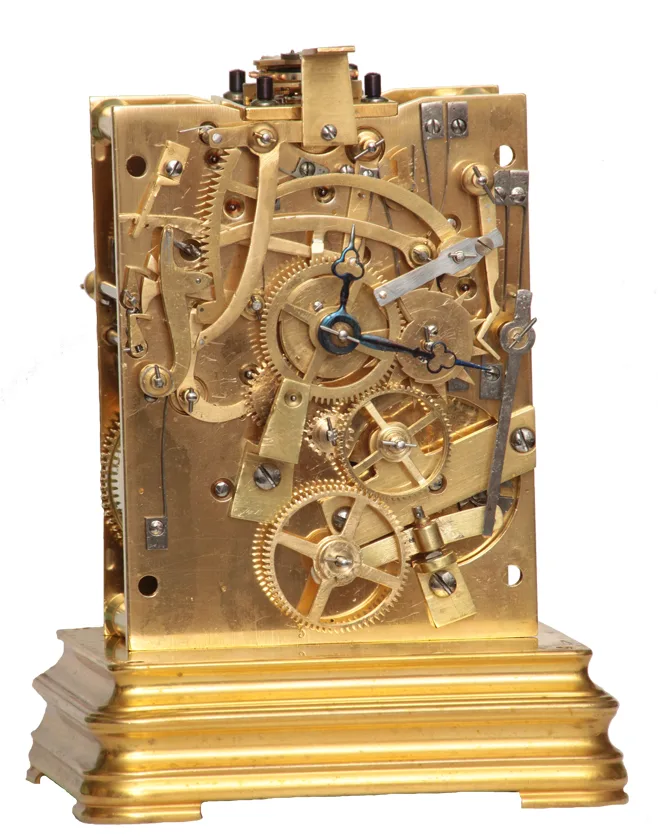
The repeating mechanism — push-piece and chain to the strike train — is mechanically intricate and a frequent source of service problems. A repeater that fails to repeat (or repeats out of sequence) needs professional service.
Strike Patterns
French striking convention: hour-strike on the hour, single "ting" on the half-hour. Petite sonnerie: hour on the hour, quarter on the quarter (one, two, or three blows). Grande sonnerie: full hour-and-quarter at every quarter. Listening to a clock strike for several cycles reveals the complication immediately — without opening the case.
Strike-Silent Mechanisms
Most striking carriage clocks have a small lever on the back of the movement — accessible by removing the back panel — that selects between strike and silent, or between grande and petite sonnerie. A clock that should strike but does not may simply have its lever in the silent position; check before assuming damage.
Dials, Hands, and Numerals
Carriage clock dials carry significant dating and attribution information.
White Enamel Dials
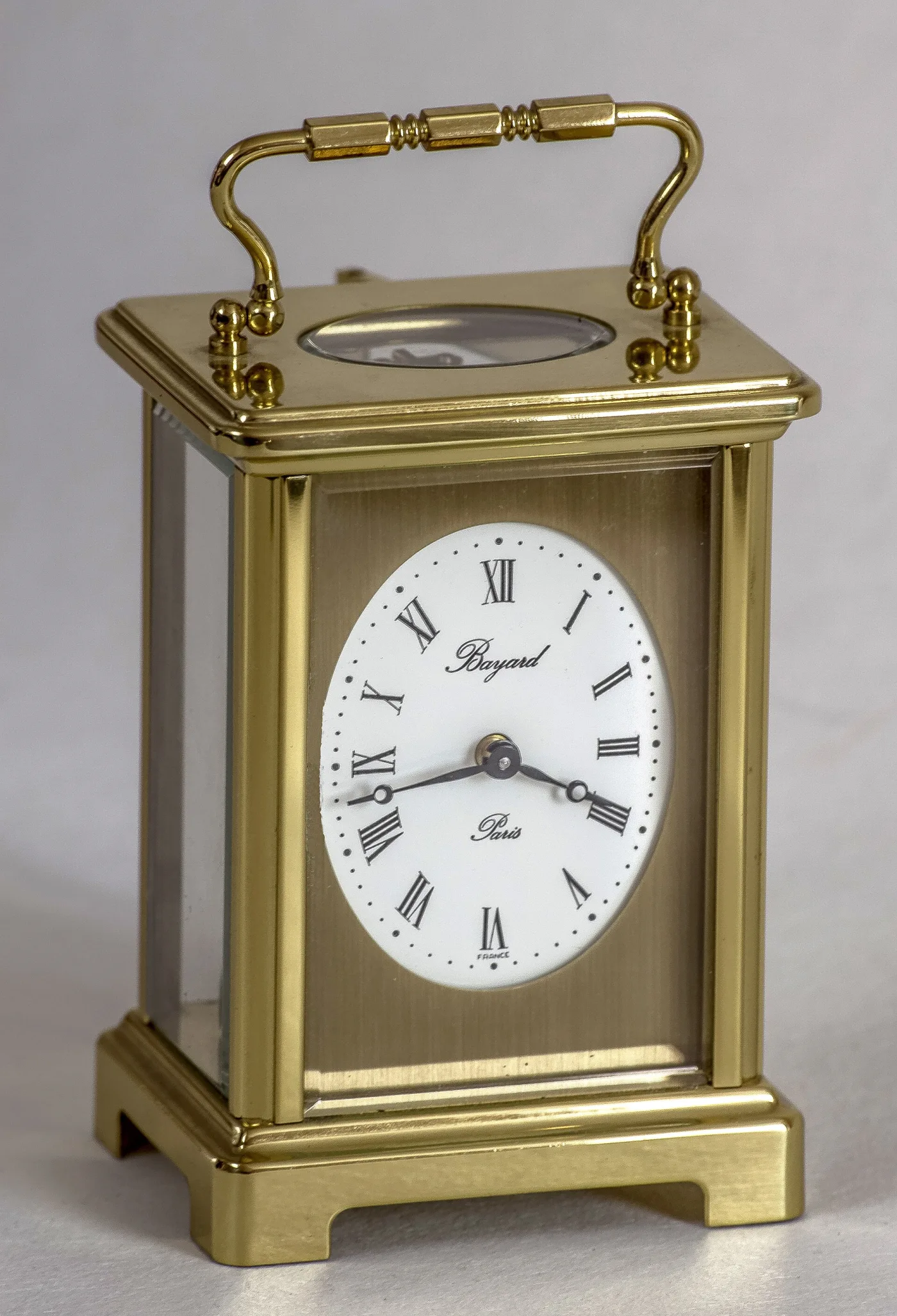
The standard French dial: vitreous white enamel on a copper base, with black Roman numerals and minute track. Original enamel dials have a slightly translucent depth; modern replacements are flatter and whiter. Hairline cracks ("lines") in the enamel are common and acceptable; large chips reduce value sharply. The dial is normally signed by the retailer at the centre or below the centre — "Dent à Paris," "Tiffany & Co.," "Frodsham London," or simply with no signature on the cheaper grades.
Engine-Turned Silver and Gilt Dials
High-grade clocks may have engine-turned silver, gilt, or two-tone metal dials with applied numerals. These are luxury features and indicate quality movements behind them.
Roman vs. Arabic Numerals
Roman numerals are the French standard. Arabic numerals on a French dial (with the four written as "IIII" in the Roman convention but sometimes Arabic on later or specifically English-market clocks) suggest English retail or post-1900 work.
Hands
Blued steel Breguet hands (sun-and-moon shapes) are the high-grade standard. Cathedral and trefoil hands appear on mid-grade work. Plain spade or pointer hands are entry-grade. Replacement hands are a common modification — original hands match the maker's style for the period, and brand-new bright steel hands on an old clock indicate replacement.
Subsidiary Dials
Alarm-set dial, day or date dial, strike-silent indicator. The subsidiary dial layout is style-specific to maker and period — Drocourt favoured certain layouts, Jacot others. Reference books document the standard layouts for the major établisseurs.
Engraving, Enamel, and Porcelain Panels
Surface decoration is a major value component on luxury-grade carriage clocks.
Engraved Cases
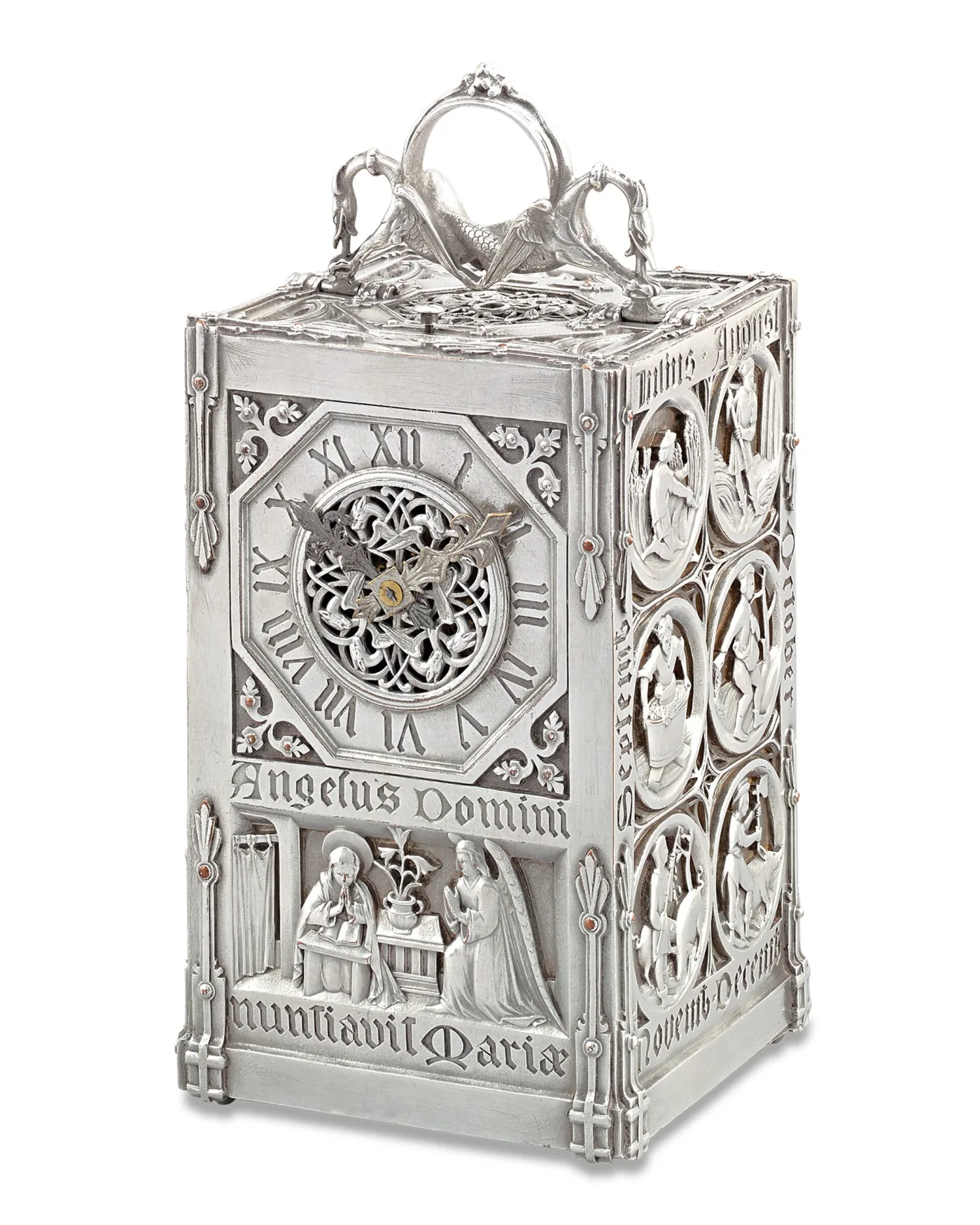
Hand-engraved foliate, scrollwork, or floral decoration on the case mouldings, bezels, and corners. Period engraving is crisp and varied; later mechanical engraving is more uniform and shallower. An original engraved case in good condition is a substantial value addition.
Champlevé Enamel
Recessed cells in the brass case filled with coloured vitreous enamel — usually deep blue, red, green, and white in geometric or arabesque designs. Champlevé carriage clocks were a luxury speciality of the 1880s and 1890s; pristine examples are highly sought.
Cloisonné Enamel
Wire-bordered cells of enamel, technically distinct from champlevé and visually busier. Less common on carriage clocks than champlevé. For broader enamel context see our antique cloisonné and enamelware identification guide.
Porcelain Panels
Hand-painted porcelain panels (Limoges enamel-style or Sèvres-style overglaze painting) set into the case sides. Subjects are usually classical: cherubs, courting couples, pastoral scenes, flower bouquets. Original signed porcelain panels are a major value addition; cracked or repainted panels are common and reduce value materially. For broader Limoges context see our Limoges porcelain identification guide.
Gilt-Bronze and Silver-Plate Cases
Most carriage clocks are brass with a gilt finish (gold-coloured lacquer or fire-gilding). True fire-gilt cases are rare and expensive; lacquered brass is the volume product. Silver and silver-plated cases are unusual but exist, particularly on English or English-retailed clocks. For the gilt-bronze tradition see our bronze, brass, and spelter identification guide.
French Makers and Stamps
Several dozen French établisseurs account for most surviving carriage clocks. Recognizing the top-tier stamps accelerates attribution.
Paul Garnier (Paris, c. 1825–1900)
One of the earliest and most prolific Paris carriage clock makers. Garnier developed his own "chaff cutter" escapement and produced clocks across the entire grade range. Stamps include "Paul Garnier Hger de la Marine Paris" with serial numbers; the stamp evolved across several generations of the firm. Early Garnier one-piece cases are highly collectable.
Henri Jacot (Paris, c. 1850–1900)
Major établisseur, prolific producer of mid-to-high-grade clocks. Jacot used a distinctive parrot logo (a small parrot stamped on the back plate) along with the name "Henri Jacot Paris" and a serial number. The parrot stamp is one of the most recognizable French carriage clock makers' marks.
Drocourt (Paris, c. 1853–1890s)
One of the highest-grade French makers. Drocourt clocks frequently win medals at the Paris expositions and command serious prices. The stamp is "Drocourt" with a serial number, often along with a small logo. Drocourt produced grande-sonnerie repeaters in fine cases for the highest end of the market.
Margaine (Paris, c. 1840–1900)
Major établisseur known particularly for high-quality strike and repeater movements. Stamp "A. Margaine" or simply "Margaine" with serial. Margaine movements are mechanically excellent and frequently appear inside cases retailed by London and Paris luxury firms.
Achille Brocot (Paris, c. 1850–1875)
Inventor of the Brocot suspension and Brocot escapement (used in mantel and shelf clocks but also some carriage clocks). Brocot stamps are a quality marker.
Japy Frères (Beaucourt, c. 1820–1900)
Volume producer of carriage clock movements at the cheaper end of the market — the Japy stamp on a movement places it in the entry-to-mid-grade range. Japy supplied movements to many smaller cabinets that finished and retailed clocks under their own names.
Pierre Soldano (Paris)
Smaller but high-grade établisseur, known for fine repeater work.
Aiguilles (Maker Stamps)
Maker stamps are usually on the back plate of the movement (not on the dial — that is the retailer). A clock with a clear maker's stamp on the back plate and a separate retailer's name on the dial is the normal arrangement; the two together attribute the clock fully.
English Carriage Clocks
English-made carriage clocks (as distinguished from French clocks retailed by English firms) are heavier, more robust, and substantially more expensive than French equivalents. The leading makers were:
Charles Frodsham (London, c. 1840 onward)
The premier English carriage clock maker. Frodsham's carriage clocks have chronometer or fine-lever escapements, fusee winding (rare on French clocks), and very robust English-style cases. Stamps include "Chas Frodsham London" with serial numbers and the "AD" date code (Frodsham used letters of "AD FmsZ" mapped to digits 1234567890 to date pieces; an experienced collector reads these instantly).
Dent (London, c. 1840 onward)
E. Dent & Co. — the firm that also made the Westminster Big Ben — produced high-grade carriage clocks with chronometer escapements and English-style heavy cases. Stamped "Dent London" with serial; Dent also retailed many French movements under the Dent name, so the back-plate stamp must be checked against case and movement style to distinguish English-made from French-retailed Dent clocks.
James McCabe (London)
Famous chronometer maker; carriage clocks bearing the McCabe name are usually high-grade chronometer-escapement work.
Hunt & Roskell, Hancocks, Asprey
Major London retailers who sold both French and English carriage clocks under their names. The retailer name on the dial does not by itself indicate English manufacture.
For broader English clockmaking context including the long tradition of London horology, see our antique watches and timepieces identification guide.
Retailers vs. Movement Makers
The single most important conceptual distinction in carriage clock identification: the name on the dial is usually the retailer, not the maker. The actual movement maker is stamped on the back plate of the movement, behind the back glass panel. Both should be read.
Reading Two Sets of Marks
Open the back of the case. The movement back plate normally carries: the établisseur stamp (Garnier, Jacot, Drocourt, Margaine, Japy, etc.), a serial number, sometimes a model or grade letter, and occasionally the platform-maker's mark on the platform itself. The dial usually carries only the retailer signature.
French Maker, French Retailer
Common: a Drocourt or Margaine movement in a Paris-retailed case, dial signed by the Paris retailer. Both names attribute the piece.
French Maker, English Retailer
Very common in the 1860s–1900s: a Jacot or Drocourt movement, English-style dial signed "Dent London," "Frodsham London," or "Hunt & Roskell." The London retailer's name on the dial is genuine; the clock is genuinely Dent-retailed; but the movement is French. Auction descriptions should note both maker and retailer.
French Maker, American Retailer
Tiffany & Co., Bigelow Kennard, Black Starr & Frost — major American retailers sold French carriage clocks under their names from about 1870. The American retailer signature on the dial adds collector interest in the American market; the underlying clock is normally Parisian.
Genuine English Manufacture
Distinguished by: heavier case construction, fusee winding (a chain-and-cone power-equalizing mechanism rare on French clocks), chronometer-style escapements, and English-style movement layout. A clock with Frodsham's name on both the dial and the back-plate movement, plus fusee winding, is a genuine English Frodsham — and worth multiples of an equivalent French Frodsham-retailed piece.
The Paris Trade Structure
Understanding the Paris trade structure makes the maker/retailer distinction concrete.
Établisseurs
The clockmaking firms that designed, assembled, and finished movements. They bought rough movement parts (ébauches) from specialist suppliers, finished them, fitted platforms, regulated them, and stamped them with their own marks. Garnier, Jacot, Drocourt, Margaine were établisseurs.
Ébauche Makers
Specialist firms that produced rough movement plates, wheels, and barrels — the unfinished "greys" of the movement. Japy Frères was the dominant ébauche maker for entry-grade work; smaller specialists supplied higher grades.
Case Makers
Independent workshops that produced brass cases in standard styles, sold to établisseurs or to retailers. A "standard corniche case" was a stock product; case style does not by itself identify a single maker.
Platform Makers
Specialist firms that produced platform escapements as a finished sub-assembly. Many platforms carry their own makers' stamps separate from the movement plates — particularly Swiss platform makers supplying French establissement.
Dial Enamellers
Specialist enamel firms produced dials to order; the retailer or établisseur ordered the dial signed with the retailer's name. The same enameller might supply "Dent à Paris," "Frodsham London," and "Tiffany & Co." signed dials in the same week.
Retailers
The shops that sold the finished clock to the public — Paris, London, Geneva, New York. Retailers commissioned cases and dials, bought movements, and assembled to order. A high-grade retailer like Dent or Tiffany would specify quality grade and complications.
The result: a single carriage clock can carry a retailer's name on the dial, an établisseur stamp on the back plate, a separate platform maker's mark on the platform, and an ébauche maker's mark hidden between the plates. All four are useful for full attribution.
Dating by Construction
Construction details often date a carriage clock more reliably than style alone.
Case Construction
One-piece cases predate about 1850. Pillar-and-panel construction (four corner pillars holding glass panels) is the standard from about 1840 onward. Screw types — slot-head before about 1880, Phillips-head never on antique work — flag major reproductions or service replacements.
Glass
Bevelled glass panels (with chamfered edges) are standard from about 1850. Earlier cases had plain flat glass. Modern replacement glass is sometimes too thick, too even in bevel, and lacks the slight optical irregularity of period glass.
Movement Plate Construction
Brass plates with hand-finished edges (slight file marks, individual finishing) indicate quality work; machine-finished perfectly even plates indicate later or cheaper work.
Serial Numbers
Major établisseurs used sequential serial numbers from which approximate production dates can be inferred. Drocourt serials, for example, run from a few thousand in the 1850s to over thirty thousand by 1890. Reference books (notably Allix and Bonnert's Carriage Clocks: Their History and Development, and Roberts' Carriage and Other Travelling Clocks) tabulate the serial sequences for the major makers.
Hallmarks (Where Present)
Silver-cased or silver-mounted carriage clocks carry hallmarks dating them to within a year for English work. English silver-cased carriage clocks are uncommon but very desirable.
Strike Sound
Bell-strike clocks are largely pre-1860. Coiled-gong strike is post-1860. The transition is gradual but the sound is diagnostic.
Reproductions, Marriages, and Fakes
The carriage clock market has several well-known fake categories.
Modern Reproductions
Twentieth-century Swiss and Asian carriage clocks in "antique" styles. These are honestly made decorative items, sometimes with fake aged finishes, sometimes with fake stamps. The movements are visually different — modern jeweled lever platforms, modern screws, often quartz movements. A glance at the platform usually settles the question.
Marriages
Period movement in a later case, or period case fitted with a later movement. Marriages are often functional and attractive but are not period clocks. Detection: the case-pillar holes should match the movement-plate fixing screws exactly; loose or re-drilled holes flag a marriage. Stamps on case and movement should be consistent with the same maker or sensible retailer/établisseur pairing.
Fake Stamps
Forged Drocourt or Frodsham stamps on lesser movements. Genuine Drocourt and Frodsham stamps are crisp and well-positioned; fakes are often shallow, off-center, or at unexpected positions. Reference books illustrate genuine stamps for direct comparison.
Replated Cases and Re-Engraved Decoration
Heavily worn cases sometimes replated or re-engraved during twentieth-century restoration. New plating looks too uniformly bright; re-engraving lacks the slightly varied depth and hand of period work. Some restoration is acceptable; aggressive restoration reduces collector value.
Replacement Platforms
Platforms regularly fail or wear out and have been replaced during service. A clock with a non-original platform is fully functional but commands less than a complete-original example. Original platforms carry maker's stamps; replacements are usually unmarked Swiss platforms.
Replaced Dials and Hands
Cracked enamel dials and worn hands are often replaced. Replacement dials are flatter and whiter than period enamel; replacement hands are bright and uniform where period hands have a slight blueing variation. Both reduce value but rarely catastrophically. For broader fake-detection methodology see our antique authentication and provenance research guide.
Condition Assessment
Condition assessment for a carriage clock requires checking case, movement, dial, and complication function separately.
Case Condition
- Gilding: wear to high points is acceptable; large bare areas reduce value materially. Replating reduces collector value but improves appearance.
- Glass panels: cracks or chips on bevels reduce value; replacement glass is acceptable but loses originality.
- Handle: bent or repaired handles are common; a straight original handle adds value.
- Engraving: crisp engraving is preferable to worn or re-cut engraving.
Movement Condition
- Running: a clock that runs and keeps time is worth substantially more than a non-running example. A clean, recently-serviced movement is the ideal.
- Pivots and bushings: worn pivot holes (visible as oval or scored holes around the wheel arbors) require professional re-bushing.
- Mainspring: broken mainsprings are common after long disuse. Replacement is straightforward but adds to service cost.
- Platform: original platform with maker's stamp adds value; replacement Swiss platform is functional but reduces collector grade.
Dial and Hands
- Hairline cracks: thin lines in the enamel are common and acceptable.
- Chips: small chips at the winding holes are common; large chips reduce value.
- Replacement dials: flatter, whiter than period enamel; reduces value substantially.
- Hands: original blued or gilt hands matter; bright replacement hands flag service.
Complication Function
- Strike: should strike the correct number of blows in synchronization with the time. Strikes that lag or are out of sequence indicate strike-train problems.
- Repeat: push-piece should produce a clean repeat of hour and (if quarter-repeater) quarter. A repeater that fails or doubles indicates a service issue.
- Sonnerie: grande sonnerie should strike at every quarter; petite sonnerie should strike quarters and hours. Test through several quarter-cycles to confirm.
- Alarm: alarm should sound at the set time and run until the second-barrel mainspring runs down.
What Drives Value
The carriage clock market spans more than three orders of magnitude — common French timepieces at $200 to $400, mid-grade strikes at $500 to $1,500, fine quarter-repeaters at $2,000 to $5,000, grande-sonnerie clocks by major makers at $5,000 to $20,000, and exceptional Frodsham or Breguet pieces well into six figures. The value drivers in rough order of importance:
Maker
Drocourt, Frodsham, Dent, McCabe, Margaine — top-tier signed work commands multiples over equivalent unsigned or lower-tier work.
Complication
Plain timepiece < alarm < striking < quarter-repeater < petite sonnerie < grande sonnerie. Each step roughly doubles or triples value at equivalent maker grade.
Case Style and Decoration
Plain corniche < gilt corniche < engraved corniche < gorge < oval < champlevé < porcelain-paneled. Decoration adds substantially to value when in good condition.
Escapement
Cylinder < unjeweled lever < jeweled lever < chronometer detent. Chronometer-escapement clocks are a premium subcategory.
Originality
Original platform, original dial, original hands, original glass — each preserves value. Each replacement reduces value modestly. A fully original clock with all matching parts is worth substantially more than a service-restored equivalent.
Condition
Running and recently serviced > running but tired > non-running but complete > non-running with damage. Service costs are substantial (often $400 to $1,500), so a non-running clock is discounted by approximately the service cost.
Provenance
Original travelling case (a leather-covered fitted box for the clock), original key, family or institutional provenance. The fitted travelling case alone adds $200 to $500 to most clocks. For valuation methodology see our antique valuation and appraisal guide.
Care, Service, and Winding
Carriage clocks need careful handling because the platform escapement is delicate and the strike-train mechanism is complex.
Winding
Use the original key (or a correctly-sized replacement) and wind smoothly until firm resistance. Do not force the winding past resistance — the mainspring is fully wound. Wind the going barrel and the strike barrel separately (and the alarm or third barrel if present). Wind weekly for an eight-day clock, daily for a thirty-hour movement.
Setting the Time
Use the rear setting square (a small square on the back of the movement, accessed through a hole in the back panel) and turn gently with the key. Some clocks set from the front; check the standard for the specific maker. Always advance the hands; never turn backward through a striking train, which can damage the strike snail.
Setting the Alarm
The subsidiary alarm dial below the main dial sets the alarm time. Pull or push a separate setting square on the back to wind the alarm spring.
Service Frequency
A working antique carriage clock should be professionally serviced every 5 to 10 years. Service includes complete disassembly, ultrasonic cleaning, lubrication, regulation, and (if needed) re-bushing of worn pivots. Costs run $400 to $1,500 depending on complication and condition. Grande-sonnerie clocks cost more; chronometer-escapement clocks cost more again.
Storage
Store wound or unwound — both are fine, though unwound is gentler on the mainsprings during long storage. Keep the clock in a dry environment; humidity tarnishes the case and can rust steel parts inside the movement. The original travelling case (leather-covered fitted box) is the ideal storage; a soft cloth bag is acceptable.
Cleaning the Case
Clean the case with a soft dry cloth only. Do not use brass polish on antique gilt — it strips the gilding. Glass panels can be cleaned with a damp cloth. Never disassemble the clock for cleaning unless qualified; the strike train in particular can be quickly disordered. For long-term preservation principles see our antique storage, care, and preservation guide.
Common Beginner Mistakes
Confusing Retailer with Maker
The name on the dial is the shop that sold the clock, not (usually) the maker of the movement. A "Dent London" carriage clock with a Jacot stamp on the back plate is a French Jacot movement retailed by Dent — not an English Dent-made clock. Both names matter for attribution but the distinction is decisive for valuation.
Assuming Plain Timepieces Are Cheap
A plain timepiece by Drocourt in fine original condition can be worth more than an alarm clock by a lesser maker. Maker grade beats complication.
Buying Non-Running Clocks Without Service Estimate
A non-running carriage clock may need $400 to $1,500 of service. Get an estimate from a qualified clockmaker before assuming a non-running bargain is actually a bargain.
Ignoring the Platform
The platform escapement is visible through the top glass and is the single most informative single component to inspect. Unjeweled cylinder platforms are entry-grade; jeweled lever or chronometer platforms grade up sharply.
Over-Polishing the Case
Brass polish strips antique gilt finishes. The slightly worn original gilding is preferable to a freshly bright surface — and is what collectors pay for.
Forcing a Stuck Mechanism
A stuck striking train or repeater push-piece should never be forced. Forcing damages the strike snail or rack and converts a service problem into a parts-replacement problem. Take a stuck clock to a clockmaker.
Missing the Travelling Case
The original leather-covered fitted travelling case is often separated from the clock. If you find a clock with its original case at an estate sale, the case alone adds substantial value — and case-and-clock pairs are sought by collectors.
Not Listening to the Strike
Listening to the strike for several minutes reveals the complication (timepiece, strike, repeater, petite sonnerie, grande sonnerie) without opening the case. This is the fastest first-pass classification.
Frequently Asked Questions
What is a carriage clock?
A small, rectangular, spring-driven clock with a brass case, glass panels, a carrying handle on top, and a platform escapement visible through the glazed top. Designed in early-nineteenth-century Paris as a portable travelling clock; produced in enormous numbers between roughly 1850 and 1900.
Are carriage clocks French or English?
Mostly French. Paris dominated production from about 1820 to 1900. English firms (Frodsham, Dent, McCabe) produced their own carriage clocks but in smaller numbers and at higher prices. Many English-named carriage clocks (those with English retailer names on the dial) are French-made movements retailed by English shops.
How do I tell if my carriage clock is French or English-made?
Open the back. The movement back plate carries the maker's stamp. French names (Garnier, Jacot, Drocourt, Margaine, Japy) indicate French manufacture. English-made clocks have English makers' stamps (Frodsham, Dent, McCabe) on the back plate, are heavier, and often have fusee winding (a chain-and-cone power equalizer) — rare on French movements.
What does "grande sonnerie" mean?
The clock strikes both the hour and the quarter at every quarter — at 3:45, three blows for the hour and three blows for the three quarters past. Distinguished from petite sonnerie (which strikes only the quarters at the quarter, not the preceding hours) and from a simple striking clock (which strikes only at the hour).
How often should I have my carriage clock serviced?
Every 5 to 10 years for a regularly running clock. Service includes complete disassembly, cleaning, lubrication, regulation, and bushing as needed. A clock that has not been serviced in 20 or 30 years usually has gummed lubricants and worn pivots and will run poorly until properly serviced.
What is the difference between a corniche and an anglaise case?
The corniche case is rectangular with a moulded cornice (stepped projecting top edge) and matching plinth — the volume product of the great Parisian period. The anglaise case is taller, with reeded or fluted columns at the corners and a heavier top moulding, developed for the English market and usually fitted to higher-grade movements.
How do I identify a Drocourt or Henri Jacot clock?
Open the back panel and examine the movement back plate. Drocourt stamped "Drocourt" with a serial number; Henri Jacot used a small parrot logo plus the name "Henri Jacot Paris" with a serial. The reference books by Allix and Bonnert and by Roberts illustrate genuine stamps for direct comparison.
How much is my carriage clock worth?
A plain French timepiece in good condition is typically $200 to $500. A striking or alarm clock by a recognizable maker is $500 to $1,500. A quarter-repeater by a top-tier maker is $2,000 to $5,000. Grande-sonnerie clocks by major makers run $5,000 to $20,000. Exceptional pieces (Drocourt grande sonnerie in original case with original travelling box, signed Frodsham chronometer-escapement clocks) reach five and six figures. A photograph of the back-plate stamp is the fastest way to a preliminary estimate.
My carriage clock has stopped — should I have it repaired?
Almost always yes. A non-running antique carriage clock loses substantial value relative to a running one, and the service cost ($400 to $1,500) is usually a fraction of the value gain. Have a qualified clockmaker estimate the service cost before deciding. Avoid clockmakers who do not specialize in carriage clocks — the platform escapement and strike train require specific expertise.
What references should I read?
Charles Allix and Peter Bonnert, Carriage Clocks: Their History and Development (the standard reference); Derek Roberts, Carriage and Other Travelling Clocks; Joseph Fanelli and Paul Belmonte, A Century of Fine Carriage Clocks. The catalogues of major auction houses (Sotheby's, Christie's, Bonhams) document realized prices and provide attribution discussion for the higher-grade pieces.