
Antique Yellow Ware Pottery Identification Guide: Bodies, Bands, Mocha, and Dating
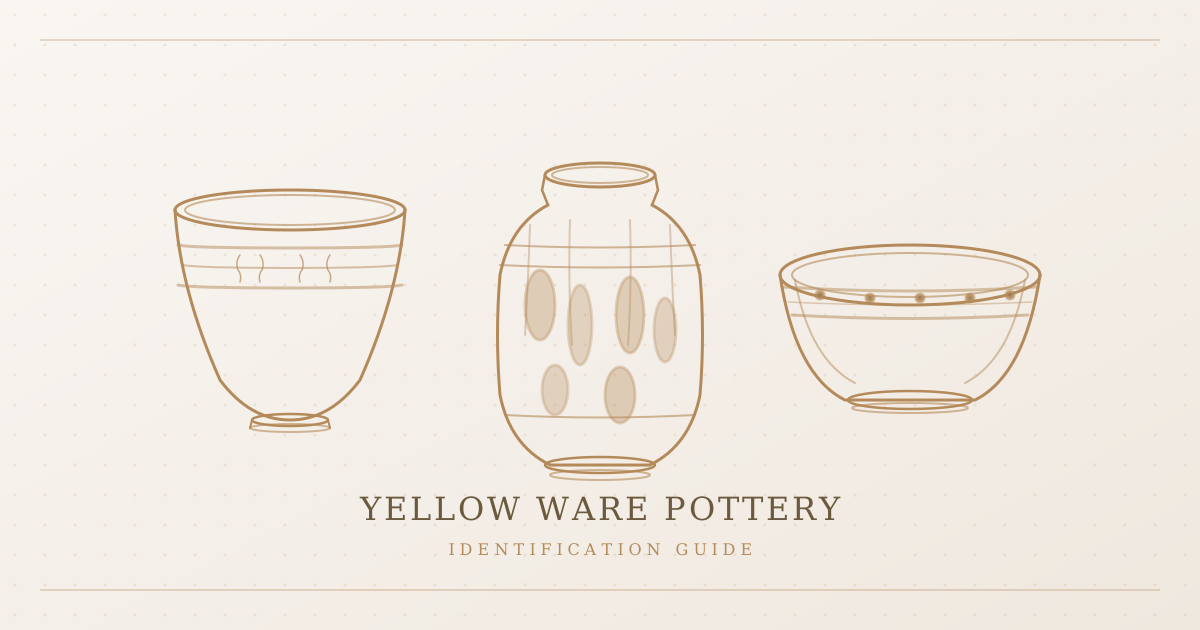
Yellow ware is the workhorse kitchen pottery of the nineteenth and early twentieth centuries — a buff-bodied refined earthenware coated with a clear lead or alkaline glaze that fires the white-to-cream clay to its characteristic warm yellow tone. From roughly 1830 to 1940, yellow ware mixing bowls sat on every American sideboard, yellow ware nappies and pie plates lived in every wood-stove oven, and yellow ware spittoons squatted beside every parlor stove. Made by the millions in Ohio, New Jersey, Pennsylvania, and the English Midlands, it was inexpensive, durable, and so ubiquitous that nineteenth-century housekeepers rarely thought of it as anything but the cheapest reliable kitchenware. Today it occupies a beloved corner of the American country collectibles market, prized for its honest utility, its warm color against painted cupboards, and the surprising sophistication of its mocha and slip-band decoration.
For collectors, the appeal is partly aesthetic and partly archaeological. A stack of nesting yellow ware bowls in graduated sizes is a complete object lesson in nineteenth-century domestic life — they hold the marks of long use, the chips that came from generations of bread dough and biscuit making, and often the survival of decorative techniques (cat's eye mocha, earthworm slip, dendritic tobacco-spit trees) that vanished from cheaper later production. The very best decorated pieces — mocha pitchers with elaborate dendritic decoration, blue-banded bowls in rare sizes, embossed presentation pitchers, or Rockingham-glazed figural pieces from the Bennett or Bennington factories — bring four-figure prices at major sales. Plain bowls with a few white slip bands can still be bought for $30–$80 at country auctions, which makes yellow ware one of the more accessible entries into nineteenth-century American ceramics.
This guide covers yellow ware identification across its full range: the body and glaze chemistry that distinguish it from creamware, ironstone, and stoneware; the principal forms and what each was used for; the decoration techniques (white slip bands, mocha dendritic, cat's eye, earthworm, embossing, sponging, Rockingham mottling); the main American and English producing regions; the named makers whose marked or attributable work commands premium prices; the dating clues from form, body, and decoration; the reproductions and contemporary mocha that the market now contains in quantity; condition assessment; and a working valuation framework. By the end you should be able to tell yellow ware from its near cousins, distinguish nineteenth-century from twentieth-century production, and recognize the decoration patterns that move a piece from $50 to $5,000.
Table of Contents
- What Is Yellow Ware?
- Body, Glaze, and the Yellow Color
- Yellow Ware vs. Other Pottery
- Forms and Their Functions
- Decoration Techniques
- Mocha Decoration in Detail
- Rockingham Glaze on Yellow Ware
- American Makers and Regions
- English Yellow Ware
- Marks, Stamps, and Attributions
- Dating Yellow Ware
- Reproductions and Contemporary Mocha
- Condition Assessment
- Values and Market
- Building a Yellow Ware Collection
- Care and Display
What Is Yellow Ware?
Yellow ware is a refined earthenware made from naturally yellow-firing clays — typically a buff-to-cream-colored body high in iron oxide impurities but lower in iron than the red-firing clays that produce redware. When glazed with a clear lead or alkaline glaze, the body shows through as a warm yellow ranging from pale straw to deep mustard, depending on the clay deposit and the firing temperature. The category sits between the coarse red earthenware tradition and the white refined earthenwares like creamware, pearlware, and ironstone — fired hotter and harder than redware, but not as hard or as white as semi-vitreous ironstone.
The basic recipe
The defining ingredients are: a buff-firing clay (the producing regions in eastern Ohio and northern New Jersey sat on huge beds of suitable clay), ground flint or sand for body fillers, and a lead-flux clear glaze applied after a biscuit firing. The result is a body that rings dull when struck (not the bell-tone of porcelain or hard stoneware), is impermeable to liquids when glazed, and resists thermal shock well enough to sit in a wood-stove oven without cracking. This last property is why yellow ware so dominated nineteenth-century baking forms — pie plates, deep dish nappies, Turk's head molds, and pudding molds.
Why "yellow"?
The yellow color is not added — it is the natural fired color of the body seen through a transparent glaze. The same clay fired in an oxidizing atmosphere will look pale yellow; fired hotter or under different atmosphere conditions it leans toward buff, tan, or even a pinkish-cream. Variations in yellow tone are useful identification clues: deep mustard suggests Ohio production; pale straw is more typical of New Jersey or English Midlands; greenish-yellow undertones often indicate higher firing temperatures.
Body, Glaze, and the Yellow Color
Identifying the body
Always examine the foot ring, the underside of handles, or any unglazed area where the bare body shows. A true yellow ware body is buff, cream, or pale yellow — never white, never brick-red, never gray. If the unglazed body looks chalky white, you are probably looking at creamware or a later white-bodied piece with a yellow glaze on top. If the body is brick-red or terracotta, it is redware. If the body is gray and dense, it is stoneware with a yellow slip surface — a different category altogether.
Glaze characteristics
Original lead glazes show a slight greenish-yellow tint, occasional crawling or pinholes where the glaze pulled away during firing, and a soft gloss rather than the glassy hardness of later harder-fired glazes. Crazing — the fine cobweb network of cracks in the glaze surface — is almost universal on nineteenth-century pieces; absence of crazing on a "Victorian" piece is suspicious. The interior of bowls and the base around the foot ring often show pooling where the glaze ran during firing — a soft amber pool at the bottom of a bowl is a strong sign of period production.
Banding the yellow
Yellow ware tone is not uniform within a single piece. Look at how the glaze pools and runs — thicker glaze appears more amber, thinner glaze appears paler. This variation is character, not a defect, and is part of what gives nineteenth-century yellow ware its visual warmth on a cupboard shelf.
Yellow Ware vs. Other Pottery
Yellow ware vs. creamware
The distinction is fundamental: creamware and pearlware have a white-to-cream body covered with a clear or bluish glaze. Cut into a chip and the creamware body is chalky white; cut into a yellow ware chip and the body is buff or yellow. Creamware is also typically thinner-walled and more refined; yellow ware is robust, utilitarian, and made for daily abuse.
Yellow ware vs. Rockingham ware
This one trips collectors because the bodies overlap. Rockingham glaze — a mottled brown manganese-iron glaze that imitates tortoiseshell — is applied to yellow ware bodies at many of the same factories that produced plain yellow ware. So a Bennett or Croxall Rockingham teapot has the same buff body as their banded yellow ware bowl. The category name "yellow ware" usually refers to pieces where the yellow body shows; the same body wearing a full Rockingham coat is called Rockingham ware, even though it is chemically the same pottery.
Yellow ware vs. mocha ware
Mocha is a decoration technique, not a separate body type. Most American mocha sits on a yellow ware body; most English mocha sits on a pearlware or whiteware body. So American mocha mixing bowls and English mocha tankards may look very different even when decorated identically — the body color is the cleaner clue. Our dedicated antique mochaware identification guide covers the dendritic, cat's eye, and earthworm patterns and their dating in full detail.
Yellow ware vs. ironstone
Ironstone is harder, whiter, and rings clearly when struck. Yellow ware rings dull. Ironstone is typically tableware (plates, platters, tureens); yellow ware is typically kitchenware (mixing bowls, molds, pie plates). The two categories sometimes coexist in the same household and even the same factory output, but the wares served different rooms.
Forms and Their Functions
Mixing bowls
The single most common surviving form. Made in nested graduated sets — typically four to twelve sizes from a small 5-inch bowl up to a massive 16- or 18-inch bread mixer. The largest sizes are scarce because they were heavily used and easily broken; complete nested sets are uncommon. Mixing bowls usually have white slip bands; deluxe versions add mocha decoration or blue bands. A graduated nest of six matching banded bowls is a centerpiece of any serious collection.
Nappies and pie plates
Shallow round or oval baking dishes. The deep nappie was used for stews, cobblers, and baked beans; the flat pie plate held its eponymous pie. Pie plates frequently survive because they were stored flat in stacks rather than handled daily. Many show heavy bottom wear from years on cast-iron stove tops.
Food molds
Turk's head molds (with the spiral fluting that produces a turban-like cake), pudding molds, jelly molds, and ice cream molds in figural shapes. The Turk's head is the iconic yellow ware mold form — a swirled, deep, central-tubed mold typically 8 to 12 inches across. Smaller individual jelly molds in fruit, fish, or animal shapes are highly collected. See our butter molds and stamps guide for related dairy forms.
Pitchers and jugs
Batter pitchers (with wide lip for pouring pancake batter), milk pitchers, and water pitchers. Often have molded decoration in relief — embossed Rebecca-at-the-well scenes, hunting motifs, Gothic arches, or grapevine borders. Mocha-decorated pitchers are the aristocrats of the form.
Crocks and storage jars
Yellow ware butter crocks, salt crocks, lard crocks, and preserve jars with lids. Butter crocks in cylindrical form with simple white bands are the most common; larger straight-sided crocks for lard or salt pork are scarcer. Compare with stoneware crocks, which served similar functions in heavier-duty storage.
Spittoons and cuspidors
The squat shouldered form with central hole for tobacco juice. Almost universally Rockingham-glazed when made in yellow ware, sometimes with embossed shell or scroll decoration. A perfect Bennett-style Rockingham spittoon is a desirable Americana piece for the country-decor collector.
Specialty kitchen forms
Colanders, milk pans, butter churns (rare), bedpans, foot warmers, washboards (the working area), and small individual ramekin-style baking dishes. Each form has its own collecting subset.
Decoration Techniques
White slip bands
The simplest and most common decoration: bands of liquid white kaolin slip applied with a slip cup while the bowl turned on a wheel or jolly. Typical patterns include a single wide band, two narrow flanking bands around a wide middle band, or evenly spaced narrow bands. The bands sit physically below the glaze surface — run your fingernail over a true period band and you feel a slight depression. Painted-on bands sit on top of the glaze and feel flat or raised.
Blue and brown bands
Cobalt-blue and manganese-brown slips were used alongside white. Blue-banded yellow ware is significantly scarcer and more valuable than white-banded; a piece with combination blue, white, and brown bands is a premium piece. Blue band intensity varies — strong sapphire blues bring the highest premium, washed-out grayish blues less so.
Sponging
Brown or green slip dabbed on with a natural sponge to produce a mottled overall pattern. Less common on American yellow ware than on English; more typical of late-nineteenth-century English imports and closely related to the broader spongeware pottery tradition. Compare with flow blue china for a different blue-decorated tradition.
Embossing
Press-molded relief patterns produced in plaster molds. Common motifs include Gothic arches, grapevines, acorns, Rebecca-at-the-well, hunting scenes (dog and stag), and lodge or fraternal emblems. Embossed pitchers are particularly desirable and were often made for presentation.
Slip-trailed decoration
Liquid slip drawn from a slip cup in lines, dots, or simple patterns — a technique shared with redware and English slipware. Less common on American yellow ware than the simpler banding.
Mocha Decoration in Detail
Mocha is the most beloved decoration on yellow ware and deserves its own discussion. The technique uses a "tobacco juice" — an acidic solution (originally urine and tobacco, later chemical mixes) dropped onto a wet alkaline slip band. The acid causes the slip to recoil and spread in branching, treelike patterns called dendrites. The result, when fired, is captured in soft brown or blue-gray trees on a white or blue band background. Each application is unique — no two mocha decorations are identical.
Pattern names
Mocha collectors use specific names for pattern types:
Seaweed / dendritic / tree: the classic branching tree pattern, the most common and oldest form. Made by dropping a single drop of tobacco juice onto wet slip and letting it spread.
Cat's eye: circular concentric eye patterns made by dropping a colored slip from a multi-quill brush. A row of cat's eyes ringing a bowl is highly desirable.
Earthworm: wavy looping lines applied with a slip cup, often combined with cat's eyes to make the "common cable" pattern.
Tobacco leaf / feather: elongated leaflike forms drawn with a single application.
Twig / branched coral: finer, more delicate dendritic patterns characteristic of better-quality English production.
American vs. English mocha
The vast majority of nineteenth-century mocha was made in the English Midlands (Burslem, Hanley, and surrounding Staffordshire potteries) on a pearlware or whiteware body and exported in huge quantities. American mocha is much rarer; it was made primarily at a few East Liverpool, Ohio factories and in Trenton, New Jersey, from the 1850s through 1900s, almost always on a yellow ware body. Telling them apart matters because American pieces command a significant premium with American buyers. The yellow body is the cleanest indicator — English mocha bodies are typically white or pale cream; American mocha bodies are buff to deep yellow.
Mocha values
An ordinary white-banded yellow ware bowl might be $50. The same bowl with a mocha seaweed band might be $200. With a cat's eye band, $500. A rare American mocha pitcher with multiple patterns can exceed $5,000. Document each piece carefully — bring out the mocha in raking light and photograph the decoration carefully. See our antique photography documentation techniques for tips.

Rockingham Glaze on Yellow Ware
Rockingham glaze is the brown mottled tortoiseshell finish that dominates the second great category of yellow-bodied ware. Originally developed at the Rockingham Pottery in Yorkshire (England) in the early nineteenth century, the technique was widely copied in American factories from about 1840 onward. The glaze contains manganese and iron oxides that produce a deep brown-to-black mottled surface, applied either as a sponged-on irregular mottle or in deliberate streaked patterns.
Bennington vs. Bennett vs. Bennington-type
This is where buyers go wrong. Bennington (United States Pottery Co. of Bennington, Vermont, 1849–1858) produced fine Rockingham-glazed yellow ware, parian, and flint enamel ware that bears the famous "Lyman, Fenton & Co." or "U.S.P." marks. Bennett Pottery (Edwin Bennett, Baltimore, 1846–1936) was the major Baltimore producer of Rockingham yellow ware and is often confused with Bennington. Bennington-type is a generic catalog descriptor used for any unmarked Rockingham-glazed yellow ware, the vast majority of which was not made in Bennington at all but in East Liverpool, Ohio, or New Jersey. Always check for marks before paying a Bennington price.
Flint enamel
A Bennington specialty: Rockingham glaze with metallic oxide powders (cobalt, copper, manganese) dusted on top to produce streaks of blue, green, orange, and brown over the brown base. Patented by Lyman, Fenton & Co. in 1849 and made only at Bennington in significant quantity. A marked flint enamel piece is a flagship Americana ceramic.
Common Rockingham forms
Teapots (especially the Rebecca-at-the-well pattern), spittoons, cuspidors, pitchers, mixing bowls, foot baths, and bedpans. Toby and character jugs were also produced in Rockingham — see our Toby and character jugs guide for the broader figural-jug context.
American Makers and Regions
East Liverpool, Ohio
The dominant center of American yellow ware production from about 1840 through 1900. The town sat on excellent buff clay deposits, had river transport, and developed an enormous concentration of potteries — at peak there were over forty factories operating simultaneously. Major names include the Croxall family (multiple generations of potters), Goodwin, Vodrey, Brunt, Cartwright, and dozens of smaller works. Most production was unmarked; attribution often depends on form, body, and decoration characteristics documented by collectors and the Museum of Ceramics.
Trenton and northern New Jersey
The other great American region. Trenton developed a parallel pottery industry serving the East Coast market, with names including the American Pottery Co. (the first major U.S. firm), Mercer, and various smaller works. New Jersey yellow ware tends to have a slightly paler body and a thinner walled construction than Ohio production.
Pennsylvania
Pennsylvania produced yellow ware at scattered factories, including some Pittsburgh works and minor East Liverpool spillover potteries on the Pennsylvania side of the river. Pennsylvania yellow ware is harder to attribute than the Pennsylvania German redware tradition for which the state is more famous.
Baltimore and the Mid-Atlantic
Edwin Bennett's Baltimore factory dominated Maryland Rockingham and yellow ware production. Maryland yellow ware tends to be heavier-walled and often Rockingham-glazed rather than banded.
Bennington, Vermont
Short-lived but extremely important. The United States Pottery Co. operated from 1849 to 1858 and produced the highest-quality American Rockingham and flint enamel ware. Marked Bennington pieces are the aristocrats of American yellow-body production.
Twentieth-century continuation
Yellow ware production continued at simplified factories like Watt Pottery (Crooksville, Ohio, 1922–1965), Robinson Ransbottom Pottery (Roseville, Ohio), and Western Stoneware (Monmouth, Illinois) into the mid-twentieth century. These twentieth-century pieces are heavier, more uniform, and often marked. They are collectible in their own right but should never be confused with nineteenth-century production.
English Yellow Ware
The English yellow ware tradition is older and broader than the American — it descends from a pre-1800 buff-bodied utility pottery made in Staffordshire, Yorkshire, Sunderland, and the Welsh Border. Most mocha decoration originated in English factories and was exported in huge volume to America, Canada, the Caribbean, and Australia from about 1790 through 1900. English bodies tend toward pale cream rather than the deep mustard yellow of Ohio production, and many English pieces shade into pearlware (whiter body with bluish glaze).
Recognizing English imports
Look for: paler body color; finer, more controlled mocha decoration; impressed maker's marks (rare on American yellow ware); pub measure marks (the seal of the Excise office in England); and the distinctive blue-banded "common cable" pattern that was an English specialty. English yellow ware was also commonly made in graduated pub measure tankards (gill, half-pint, pint, quart) with applied excise seals; these are highly collected.
Major English producers
Staffordshire factories like Wedgwood (made some yellow ware), Adams, Davenport, and many smaller works. Yorkshire's Don Pottery, Leeds Pottery, and Rockingham itself. Sunderland and Newcastle produced quantities of luster-decorated and mocha pieces. Wedgwood production in yellow ware is rare and command premium prices when marked.
Marks, Stamps, and Attributions
The frustrating truth: most American yellow ware is unmarked. Factories produced for the cheap kitchenware market and didn't bother with maker's marks on most output. When marks do appear, they are gold.
Common marks to know
"Lyman, Fenton & Co." / "Fenton's Patent" / "U.S.P." 1849: Bennington marks. These three impressed marks identify Bennington production from the 1849–1858 era.
"E. & W. Bennett" / "E. Bennett & Co.": Edwin Bennett Baltimore Rockingham and yellow ware.
"American Pottery Manufacturing Co." / "A.P.M.Co.": Jersey City, the first major American whiteware producer; some yellow ware.
"D. & J. Henderson": Jersey City Pottery, important early producer of Rockingham ware.
"Mercer Pottery": Trenton, New Jersey.
"Watt Ware" / acorn stamp: twentieth-century Watt Pottery, Crooksville, Ohio.
"R.R.P. Co.": Robinson Ransbottom, twentieth century.
English impressed marks: "WEDGWOOD," "DAVENPORT," "ADAMS" — usually small impressed in the body, on the underside near the foot ring.
Attribution without marks
When unmarked (the usual case), attribution depends on body color, glaze quality, form, decoration pattern, and any documented match with marked examples. Books like Joan Leibowitz's Yellow Ware, Lisa S. McAllister's The Collector's Guide to Yellow Ware, and Don Carpentier's Mocha and Related Dipped Wares are essential references. Compare unmarked pieces with known marked exemplars in museum collections (Bennington Museum, Henry Ford Museum, Smithsonian). See our authentication and provenance research guide for general methodology.
Dating Yellow Ware
Early period (1820–1850)
The earliest American yellow ware shows English influence in form and decoration. Bodies are often thicker and less refined; glazes pool more heavily; decoration leans toward simple white bands or modest mocha. Forms include the early straight-sided mug, the simple cylindrical bowl, and basic pitchers. Marks are rare.
Mature period (1850–1880)
The golden age of American yellow ware. Production volume explodes, the East Liverpool factories proliferate, decoration peaks in sophistication, and Rockingham glaze comes into wide use. Most surviving high-quality mocha and Rockingham pieces date from this period.
Late nineteenth century (1880–1900)
Mass production refines: bodies become more uniform, walls thinner, decoration simpler. Mocha begins to disappear in favor of plain white bands. The factories pivot toward harder semi-vitreous bodies and lighter colors, anticipating the white-bodied kitchenware that dominated the early twentieth century.
Twentieth-century production (1900–1960)
Watt, Robinson Ransbottom, and a few others continue yellow ware production but with thicker walls, harder glazes, decal-printed decoration (not slip), and consistent factory marks. Color tones often shift toward orange or buff rather than the deep yellow of nineteenth-century production. These pieces are honest twentieth-century kitchenware but should not be confused with the earlier tradition.
Dating clues by form
Pre-1850 pitchers often show a slightly pulled spout and applied handle; later pitchers have molded spouts. Pre-1860 bowls often have a more pronounced foot ring; later ones have a simple thrown base. Twentieth-century pieces show machine-applied glaze and uniform body thickness throughout. Foot wear is also a useful indicator: nineteenth-century pieces show deep wear rings on the foot from years of sliding across wooden shelves; twentieth-century pieces show light or no wear.
Reproductions and Contemporary Mocha
Yellow ware reproductions have proliferated since the 1970s American country-collectibles boom. Most are honestly marked or signed by contemporary potters; some are not and have entered the market as deceptive copies.
Don Carpentier and the Eastfield Village tradition
Don Carpentier (1949–2014) was the leading American maker of accurate mocha ware in the late twentieth century, producing studio pieces at Eastfield Village in New York. His work is meticulously researched and beautifully made; it is signed and dated and is collected in its own right. Carpentier pieces should never be sold as antique but are valuable contemporary works.
Other contemporary makers
Greg Shooner (Ohio), Michelle Erickson, and a number of working potters produce mocha and slip-decorated yellow ware in the traditional manner. All sign their work. Care must be taken because surface wear and faked dirt can disguise a recent piece as nineteenth-century; check for kiln-mark consistency, signature, and the telltale evenness of contemporary clay bodies.
Deceptive reproductions
The market also contains unsigned reproductions made for the country-decor trade — often imports from Asia or Eastern Europe. Warning signs include: too-perfect dendrite patterns (period mocha is irregular); machine-applied uniform white slip bands; absence of any kiln stilts marks on the foot; bodies that ring high rather than dull when struck; uniform color and no glaze pooling. When in doubt, compare side by side with a documented period piece in a museum or major dealer's stock.
Watt Pottery as "antique"
Twentieth-century Watt Pottery (1922–1965, Crooksville Ohio) is honest pottery but is now eighty years old and is sometimes sold as "antique yellow ware" at country shows. Watt has its own collector base and value structure; do not pay nineteenth-century prices for clearly twentieth-century Watt Apple, Pansy, Rooster, or Starflower pattern bowls.
Condition Assessment
Yellow ware lived hard lives, and condition expectations differ from finer china. The category tolerates honest wear better than it tolerates damage, and the market price scales sharply with condition.
Acceptable wear
Foot ring wear from shelf sliding; minor utensil marks inside mixing bowls; light crazing of the glaze; soft pooling of glaze at the base; minor color variation in the yellow body. All of these are signs of authenticity, not defects.
Reducing flaws
Hairline cracks (especially in mixing bowls where heat stress was common), chips to the rim or foot, glaze loss exposing the body, glued repairs, and overpainted decoration. Each of these reduces value by roughly 30–60% depending on severity and visibility. A hairline that runs through a mocha band cuts value more sharply than the same hairline in an undecorated area.
Major damage
Broken-and-repaired pieces are essentially decorator items unless extraordinarily rare. Heavy chips, bowl-rim flakes, and missing pieces reduce value to the decorator level even for otherwise desirable forms.
Testing for repairs
Use a strong magnifying glass and raking light; check the body color carefully where repairs are likely (rim chips, handle joins); tap gently with a fingernail — a repair often sounds different from the surrounding body. UV light can sometimes reveal glue lines under modern repairs. See our antique restoration and conservation guide for a deeper treatment of damage assessment.
Values and Market
The yellow ware market is steady rather than rapidly appreciating. The 1980s–1990s American country decor boom drove peak prices; the market softened through the 2000s and has held in a stable plateau since. Quality and rarity now sort prices sharply.
Common pieces
Plain white-banded mixing bowls (8–10 inch): $30–$100 each, depending on quality and size. Twentieth-century pieces at the low end; nineteenth-century at the high end. Sets of three or four matching nested bowls bring better than individual pricing.
Better pieces
Blue-banded mixing bowls: $150–$400. Yellow ware Turk's head molds: $80–$200. Embossed pitchers: $200–$600. Plain Rockingham spittoons: $100–$300. Marked twentieth-century factory pieces (Watt, Robinson Ransbottom) follow their own collector markets and trade $40–$200 typically.
Premium pieces
Mocha-decorated bowls and pitchers: $300–$3,000 depending on pattern and rarity. Marked Bennington Rockingham or flint enamel: $500–$5,000+. Rare forms (large mixing bowls in 16-inch sizes, complete nested sets in good condition, blue-banded pitchers): $500–$2,000.
Auction records
Top-end American mocha pitchers have reached $10,000–$25,000 at specialist sales. Marked Bennington flint enamel forms have reached $20,000+. These are exceptional pieces; the bread-and-butter of the market remains in the low hundreds. See our valuation and appraisal guide for valuation methodology.
Building a Yellow Ware Collection
Start with bowls
The most affordable and visually rewarding entry. Buy mixing bowls one at a time at country auctions, building toward a nested set of four to six matching sizes. Look for consistent banding patterns, deep yellow color, and reasonable condition. Expect to invest $200–$800 to assemble a respectable nest.
Specialize early
Yellow ware is broad enough that focused collections work better than generalist ones. Consider specializing in: mocha decoration only; pitchers in all forms; Rockingham glazed pieces; food molds; one regional output (East Liverpool only, say, or Bennington); or one factory's marked production.
Learn the references
Joan Leibowitz, Lisa McAllister, Don Carpentier's writing on mocha, and the Museum of Ceramics in East Liverpool's collection are essential. Handle as many marked pieces in museum displays as access permits to build a tactile memory of period bodies and glazes.
Document everything
Keep a photographic record of each acquisition, with provenance, purchase source, price, and any attribution notes. Mocha and Rockingham pieces especially benefit from careful documentation — provenance from a documented private collection adds resale value. See our collecting strategies guide for broader principles of collection building.
Care and Display
Cleaning
Wash by hand with mild soap and warm (not hot) water. Avoid dishwashers, which thermal-shock crazed pieces and lift loose glaze. Avoid soaking pieces with active crazing — water enters the crazes and discolors the body. Dry promptly with a soft cloth.
Display
Yellow ware looks best against painted backgrounds — green-painted cupboards, blue-painted shelves, or simple whitewashed boards. Stagger sizes and combine bowls with pitchers, molds, and a spittoon or two for visual variety. Avoid direct sunlight, which can fade slip decoration over decades, and avoid kitchen displays near steam or grease.
Using vs. preserving
Plain twentieth-century pieces (Watt, Robinson Ransbottom) can still serve in the kitchen for dry storage and decorative use. Nineteenth-century pieces should be retired from active service — the thermal shock of modern ovens and dishwashers is fatal to old crazed glazes. Decorative use only for any nineteenth-century mocha, Rockingham, or marked piece.
Storage
Stack bowls with a thin layer of acid-free tissue or felt between each one. Never stack mocha or Rockingham pieces in direct contact — surface decoration can transfer or scratch. Store away from heating vents and exterior walls where temperature swings cause additional crazing. See our storage, care, and preservation guide for comprehensive long-term care recommendations.