Antique Redware Pottery Identification Guide: Slip, Sgraffito, Glazes, and Dating
Redware is the oldest and most widespread pottery tradition in colonial and early American life — a low-fired earthenware made from common iron-rich clays that fire to an orange, brick-red, or warm brown body. Almost every town in the eastern United States from 1620 to about 1880 had a redware potter producing the daily wares that filled the kitchen: milk pans for setting cream, pie plates for the brick oven, crocks for pickling and preserving, jugs for vinegar and cider, mugs for table use, churns, colanders, bean pots, and chamber pots. The same red-bodied lead-glazed tradition flourished in Europe long before — in southern Germany, the Rhineland, Alsace, England, Spain, and Portugal — and arrived in America with the first potters in the seventeenth century.
Because redware was the everyday pottery of preindustrial households, it survives in huge quantities, ranging from utterly plain utilitarian forms (worth $25 at a country auction) to elaborately decorated Pennsylvania German sgraffito chargers and slip-trailed presentation pieces (worth $20,000–$200,000 at major sales). The gap between common and exceptional pieces is enormous, and the identification challenge is partly about knowing which features push a piece up the scale and which keep it at the bottom. A slip-decorated Pennsylvania pie plate by John Neis or Georg Hubener may be the most valuable American pottery you ever handle; a plain Connecticut milk pan of similar age may be worth less than dinner for two.
This guide covers redware identification across its full range: the body, glazes, and decoration techniques that distinguish it from stoneware and other earthenwares; the principal American regional traditions (Pennsylvania German, New England, Mid-Atlantic, Moravian North Carolina, Shenandoah Valley); the named potter families whose marked or attributable work commands premium prices (Bell, Spinner, Hubener, Neis, Leidy, Headman, Roudebuth); European redware traditions for context; the dating clues from form, decoration, and wear; the principal reproductions and twentieth-century revivalists you will encounter (Breininger, Shooner, Stahl, Eldreth); condition assessment; and a working valuation framework. By the end you should be able to walk through a country auction and reliably distinguish a $40 milk pan from a $4,000 charger, and know what makes the difference.
Table of Contents
- What Is Redware?
- The Body and the Lead Glaze
- Standard Redware Forms
- Slip, Sgraffito, and Surface Decoration
- Pennsylvania German Redware
- New England Redware
- Mid-Atlantic and Shenandoah Valley
- Moravian Redware in North Carolina
- European Redware Traditions
- Named Potters and How to Identify Them
- Dating Clues Beyond Marks
- Reproductions and Twentieth-Century Revivalists
- Condition Assessment
- What Drives Value
- Care and Display
- Common Beginner Mistakes
- Frequently Asked Questions
What Is Redware?
Redware is the broad category of earthenware made from iron-bearing surface clays and fired at relatively low temperatures (about 1,800°F to 2,000°F / 980°C to 1,100°C), producing a porous body in shades from orange-buff to deep brick red to almost chocolate brown. Because the body is porous and would not hold liquid on its own, redware is almost always glazed on at least the interior with a clear or colored lead glaze that vitrifies during firing to create a glassy, waterproof surface.
Redware vs. Stoneware
The most common identification confusion is between redware and stoneware. Stoneware uses a different, more refractory clay fired at much higher temperatures (about 2,300°F / 1,260°C), producing a dense, gray-bodied, virtually nonporous body that does not require glaze to hold liquid (though it usually has salt glaze on the exterior and Albany slip inside). If you break a piece, redware shows an orange/red porous body that absorbs water immediately; stoneware shows a gray/buff dense body that does not. The two traditions overlapped chronologically — stoneware became dominant for utility wares from about 1820–1850 onward — but the bodies are unmistakably different. For a parallel guide see our antique stoneware crocks identification guide.
Redware vs. Terracotta and Other Earthenwares
Terracotta is essentially the same material as the redware body, but the term is usually reserved for unglazed flower pots, architectural ornament, and garden sculpture. Creamware and pearlware are refined English earthenwares with a white body and clear glaze — chemically related to redware but visually entirely different. Yellowware is a buff-bodied utility earthenware (often with mocha or banded decoration) made from the 1830s onward. Each has its own collecting category and price structure.
The Chronology in America
Redware was the dominant American pottery from the first colonial settlement (Virginia and Massachusetts in the 1620s and 1630s) until roughly 1860–1880, when industrial stoneware, white-bodied refined earthenwares, and pressed glass displaced it from most of its functions. Production continued in rural pockets (especially the Shenandoah Valley and certain Pennsylvania communities) into the early twentieth century, and the late-twentieth-century revival has produced new redware in the colonial style that is now itself collectible.
The Body and the Lead Glaze
Understanding redware glazes is the single most important identification skill, because the glaze chemistry, color, and surface character carry most of the information about origin and date.
The Clear Lead Glaze
The standard redware glaze is a clear lead silicate — galena (lead sulfide) ground with silica and a small amount of clay, sieved, suspended in water, brushed or dipped onto the leather-hard pot, and fired. The glaze itself is transparent and colorless; the orange or red color you see is the underlying clay body showing through. Clear-glazed redware was the workhorse finish — interior of milk pans, all surfaces of mugs and small forms — because it was waterproof, food-safe (within the limits of period understanding), and cheap. The lead, of course, is now recognized as a serious hazard, and redware should never be used for food today.
Manganese — The Brown and Black Decoration
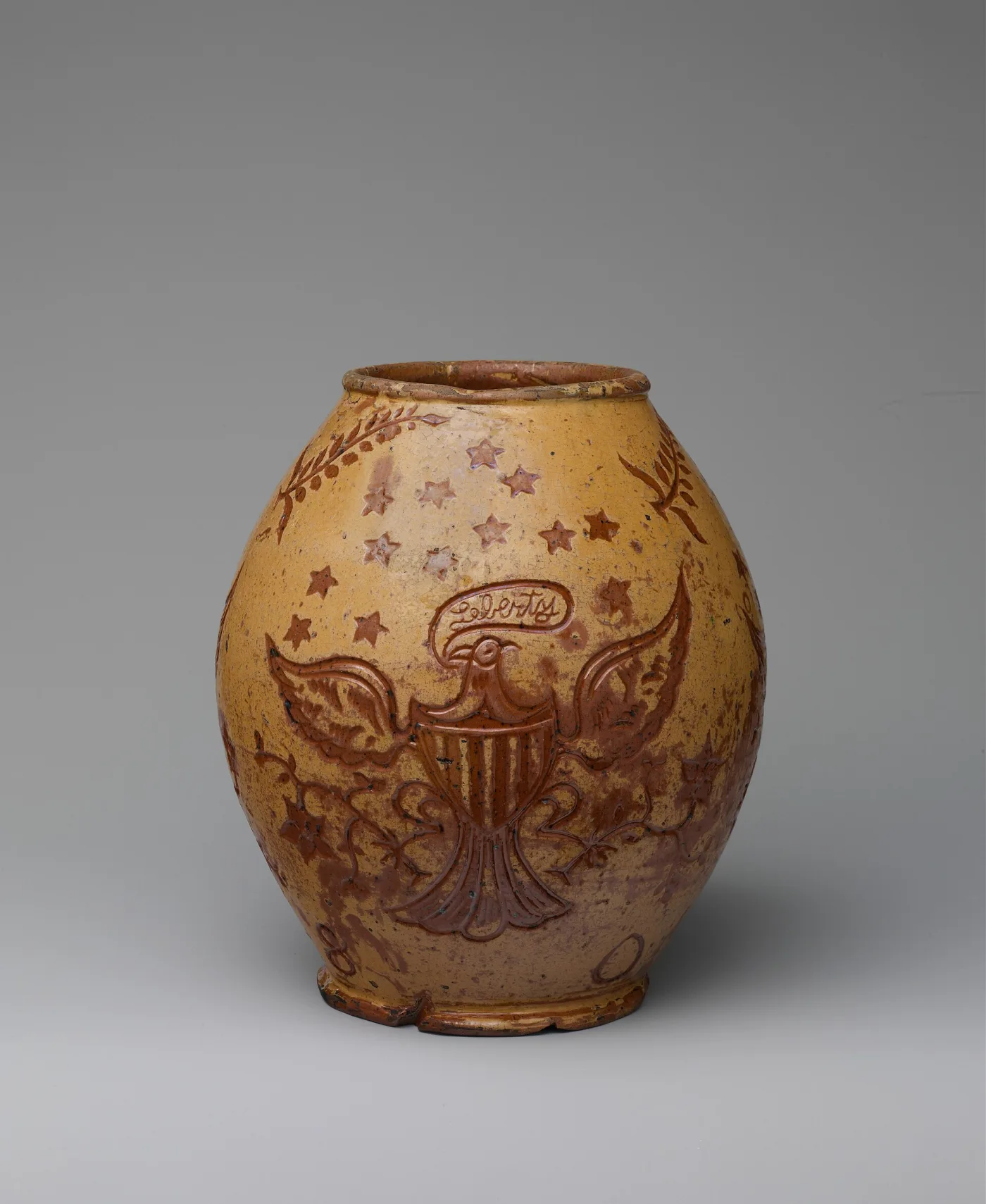
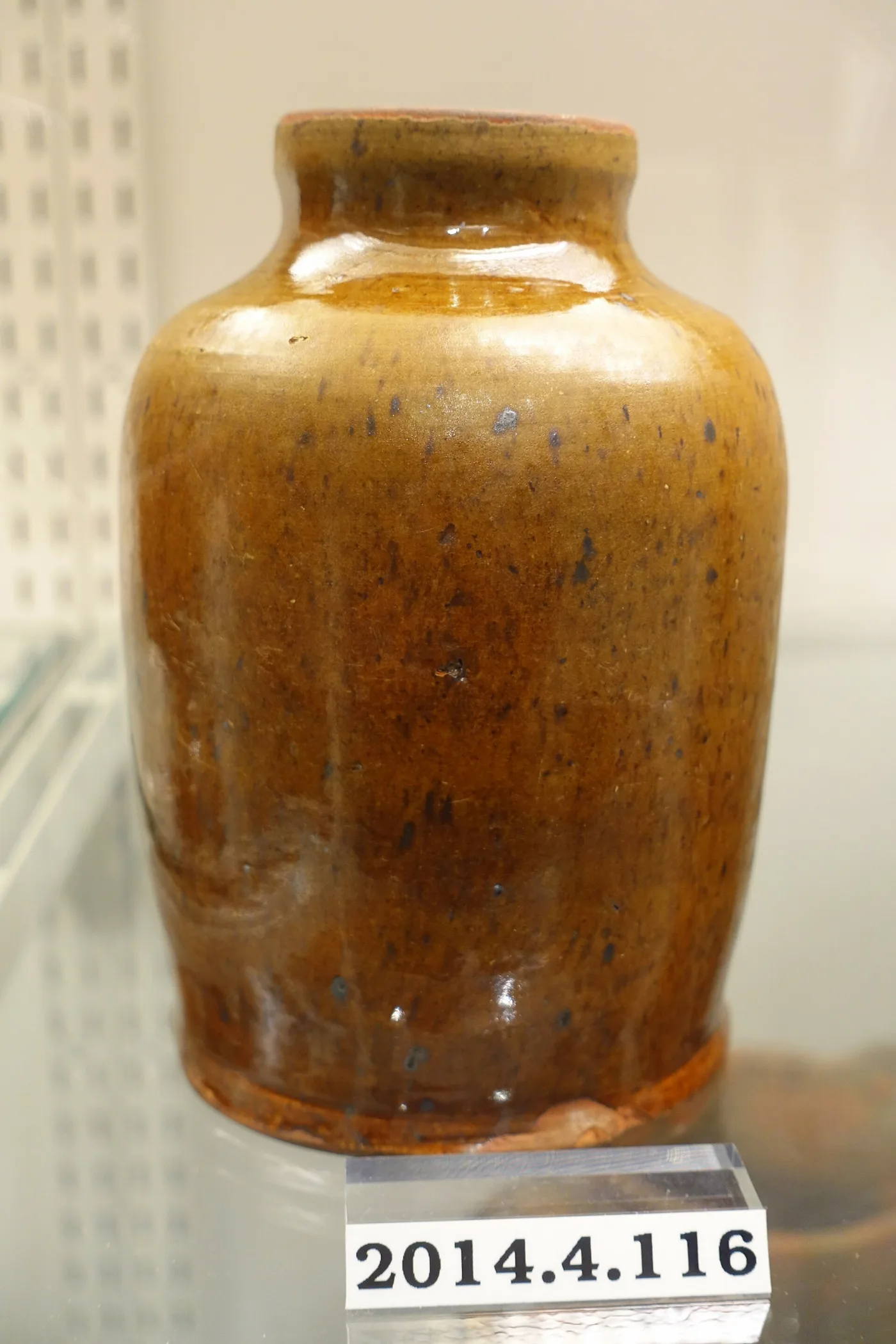
The most common colored glaze additive is manganese dioxide, which produces shades from honey brown through chocolate to nearly black depending on concentration. Manganese can be added to the entire glaze for an overall brown finish, splashed or sponged on for mottled decoration, or trailed in lines and dots for graphic effect. The "tortoiseshell" mottled glaze of much New England redware is a manganese-and-clear lead glaze sponged on the leather-hard body. Manganese-decorated redware was made throughout the redware era and the technique is not a tight dating clue on its own.
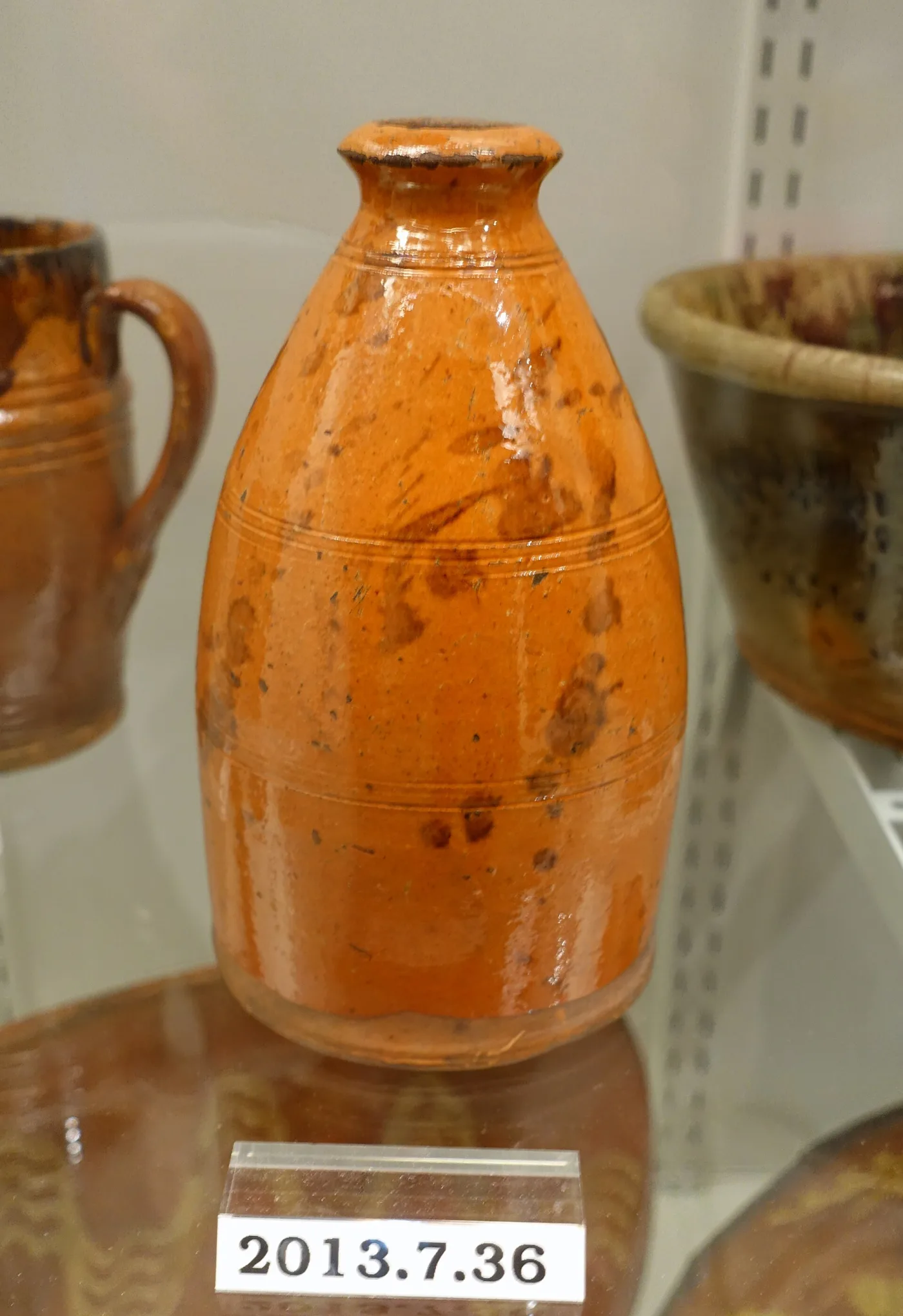
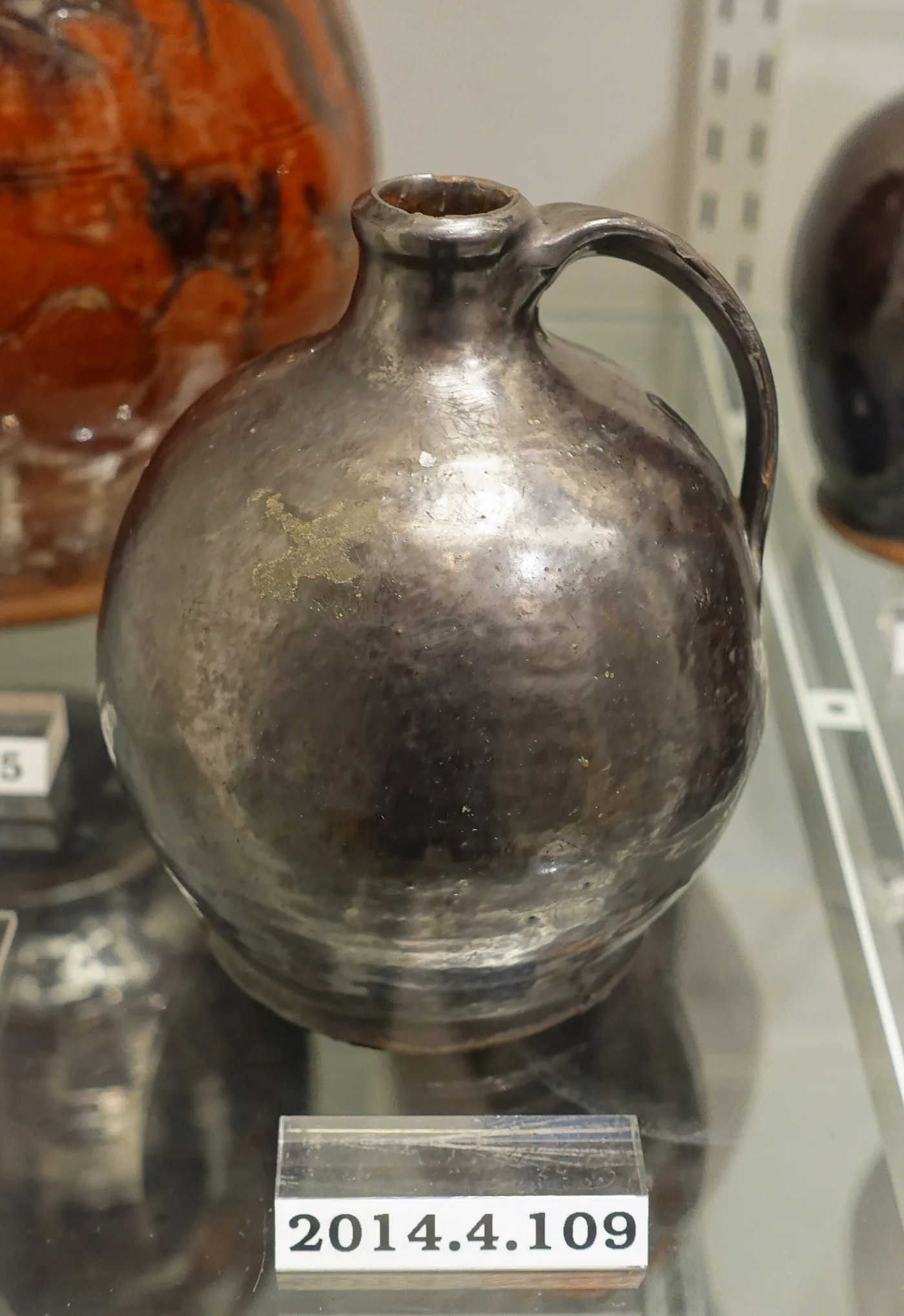
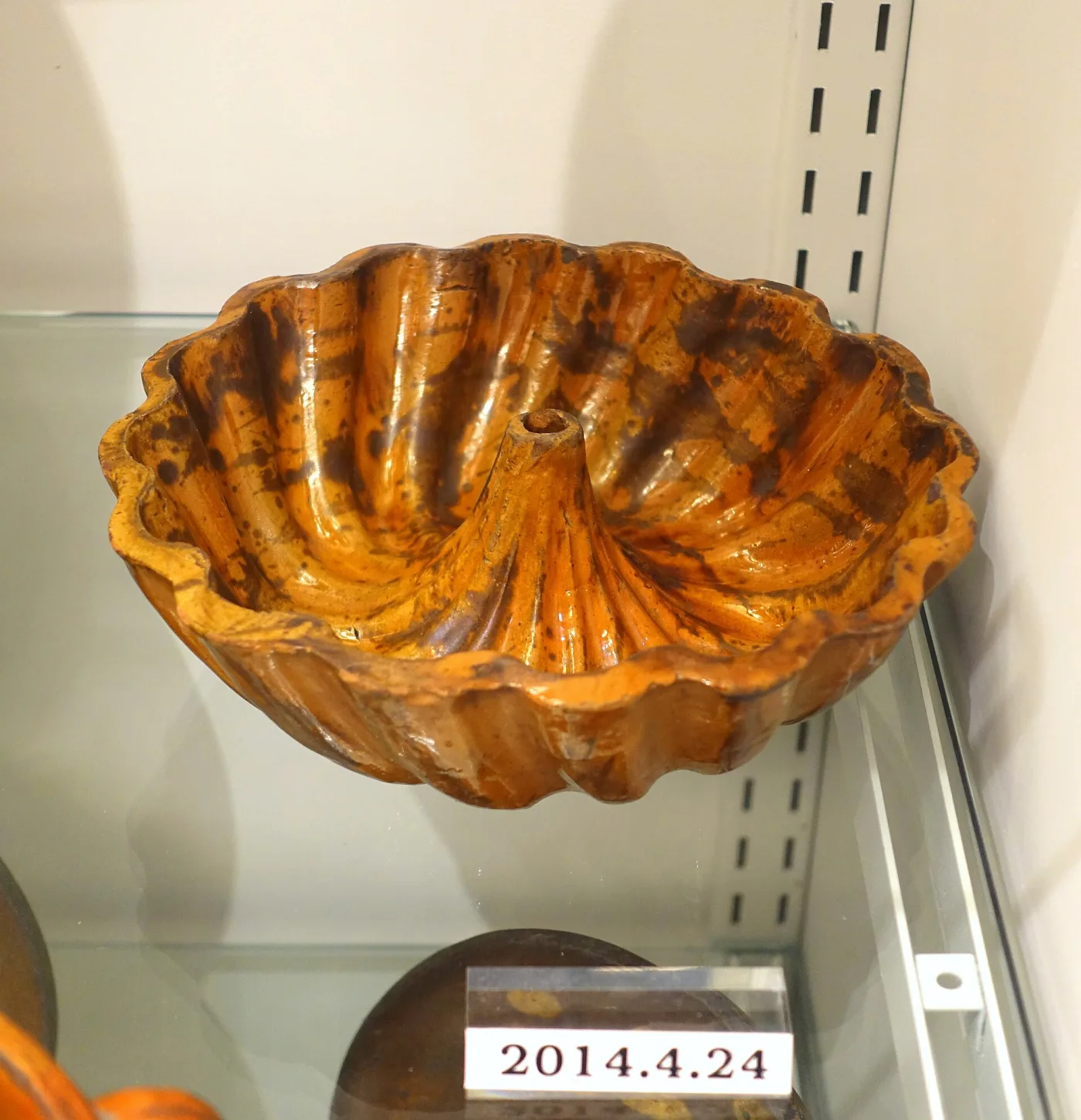
Nothing separates these two pots except how much manganese went into the glaze bucket. That is worth settling early, because "brown ware" and "black ware" describe a glaze and not a body: both of these are redware, and on the jug you can watch the colour fall back towards the red of the clay at the lip, where the glaze thins.
Copper Green
Copper oxide added to the lead glaze produces a distinctive bright green, ranging from grass-green to deep emerald. Green-glazed redware is less common than brown and tends to be associated with specific traditions — Pennsylvania German pieces in particular use copper green as accents in slip decoration. Wholly green-glazed forms (often candlesticks, banks, and figural pieces) are a recognized subcategory.
Slip — The White or Cream Decorating Clay
Slip is liquid white-firing clay (usually a refined ball clay from a different source than the body) applied for decoration. Under a clear lead glaze, slip appears creamy white to yellow against the red body. Slip is the primary decorative medium of the most ambitious redware tradition (Pennsylvania German), used both for trailed line decoration and for sgraffito carving.
The Spangle, Splash, and Dribble
Many redware pieces show random splashes, drips, or splotches of manganese or copper-green glaze over a clear-glazed body. These are not always decorative intent — sometimes they are the accidental result of glaze running in the kiln — but they are now read as period authenticity markers. Modern reproductions often have too-deliberate decoration without the casual unevenness of period work.
Standard Redware Forms
The redware shape vocabulary maps closely to the work of a preindustrial household kitchen. Recognizing the form is the first identification step and helps narrow the regional tradition.
Milk Pans
Wide, shallow, flaring bowls 12 to 16 inches across and 3 to 5 inches deep, used to set fresh milk so the cream could rise and be skimmed. The most common surviving redware form. Almost always clear-glazed inside, often unglazed outside or with manganese splashes. A plain milk pan is the entry-level redware piece — $40 to $150 typically — but milk pans by named potters or with slip decoration command much more.
Pie Plates
Round dishes 8 to 12 inches across with a slightly raised rim, often coggle-wheel decorated around the edge. Pie plates were used as both bakeware and serving dishes, and the decorated examples were sometimes presentation pieces — given as gifts and never used. Slip-decorated Pennsylvania pie plates are the most ambitious and valuable redware form, with sgraffito examples by named potters reaching five and six figures.
Crocks and Jars
Cylindrical or slightly tapered storage vessels with lugs or strap handles, used for pickling, preserving, butter storage, and dry goods. Sizes range from pint to multi-gallon. Redware crocks were largely displaced by stoneware crocks after 1820–1840 because stoneware was more durable; surviving redware crocks tend to be earlier than their stoneware counterparts.
Jugs and Pitchers
Bulbous-bodied forms with strap or rod handles and pouring spouts, ranging from small cream pitchers to multi-gallon cider jugs. Decorated examples are particularly attractive — slip-trailed jugs from Pennsylvania, marbled jugs from New England, and the distinctive bulbous "ovoid" jugs of the early nineteenth century.
Mugs and Cups
Small drinking vessels, usually 3 to 5 inches tall, often manganese-glazed or with trailed slip bands. Redware mugs were the everyday tableware of farm households.
Plates, Chargers, and Dishes
Flat or shallow-domed plates from 6 inches (small plates) to 16+ inches (chargers). Pennsylvania German sgraffito chargers — large platters with elaborately incised decoration through a slip ground — are the apex of the American redware tradition.
Figural and Specialty Forms
Banks (especially the pierced "puzzle jugs" and "money jugs"), whistles, figural bottles, candlesticks, inkwells, flowerpots, and toys. Pennsylvania potters in particular made elaborate figural pieces — apple bank, pig bank, lion figures — often as test pieces, presentation gifts, or sale items. The same Pennsylvania German communities also bought hand-painted plaster chalkware animals and fruit compotes as inexpensive mantel ornaments alongside their redware.
Architectural and Garden Wares
Flowerpots, garden urns, finials, and roofing tiles. Most are unglazed or thinly glazed and were utilitarian rather than decorative.
Slip, Sgraffito, and Surface Decoration
Redware decoration techniques are limited (the firing range and the lead-glaze chemistry constrain the options) but the small toolkit was used with enormous inventiveness. Recognizing the technique narrows both region and value range.
Slip-Trailing
White (or sometimes yellow or green) slip is loaded into a "slip cup" — a small clay vessel with one to seven quill spouts — and trailed in lines, dots, waves, or written script across the leather-hard body. After drying, the piece is dipped in clear lead glaze and fired. The slip remains creamy white or yellow against the red ground. Slip-trailing is the dominant decoration of Pennsylvania pie plates and many New England and Mid-Atlantic pieces.
Sgraffito (Scratched Decoration)
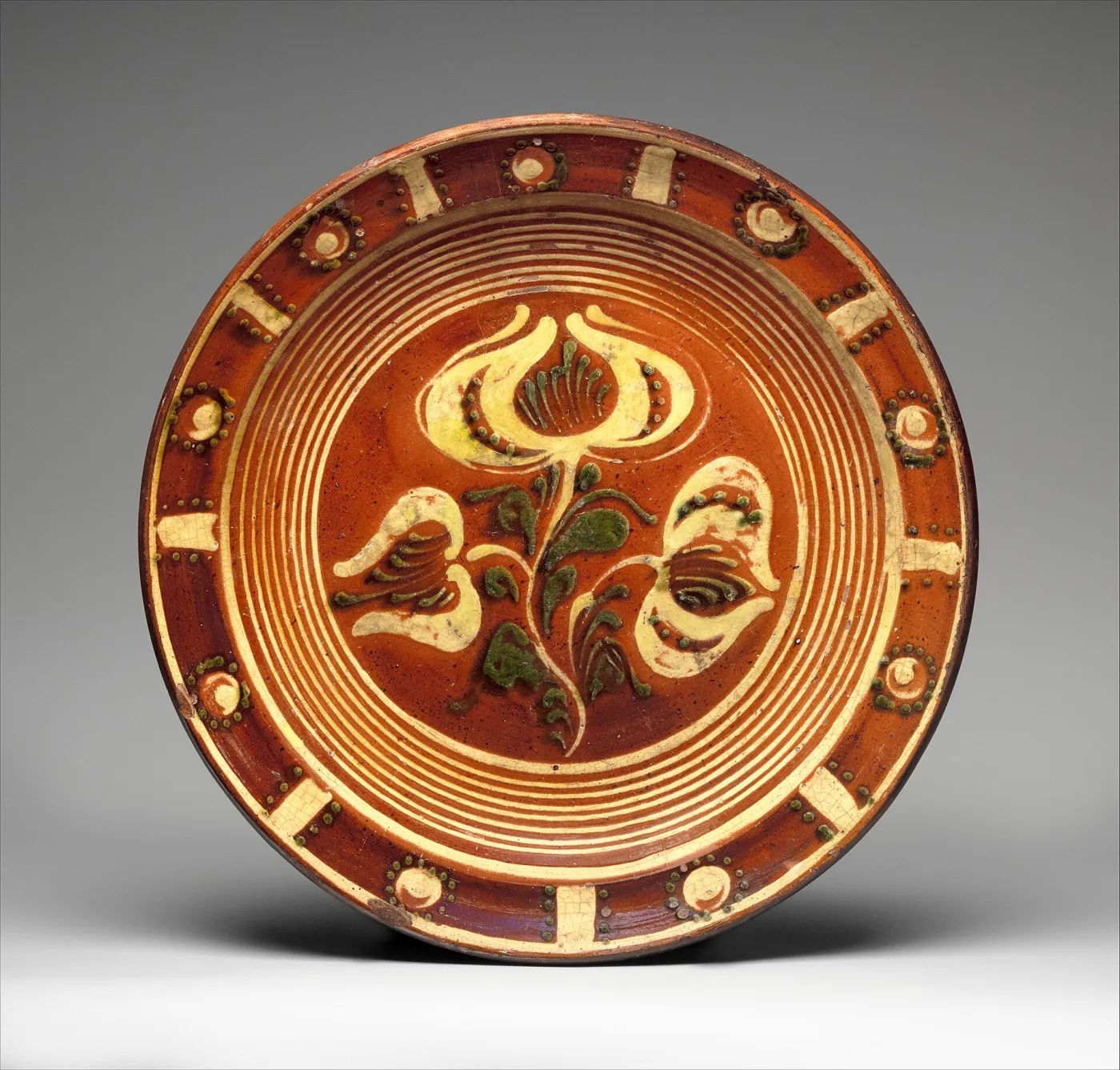
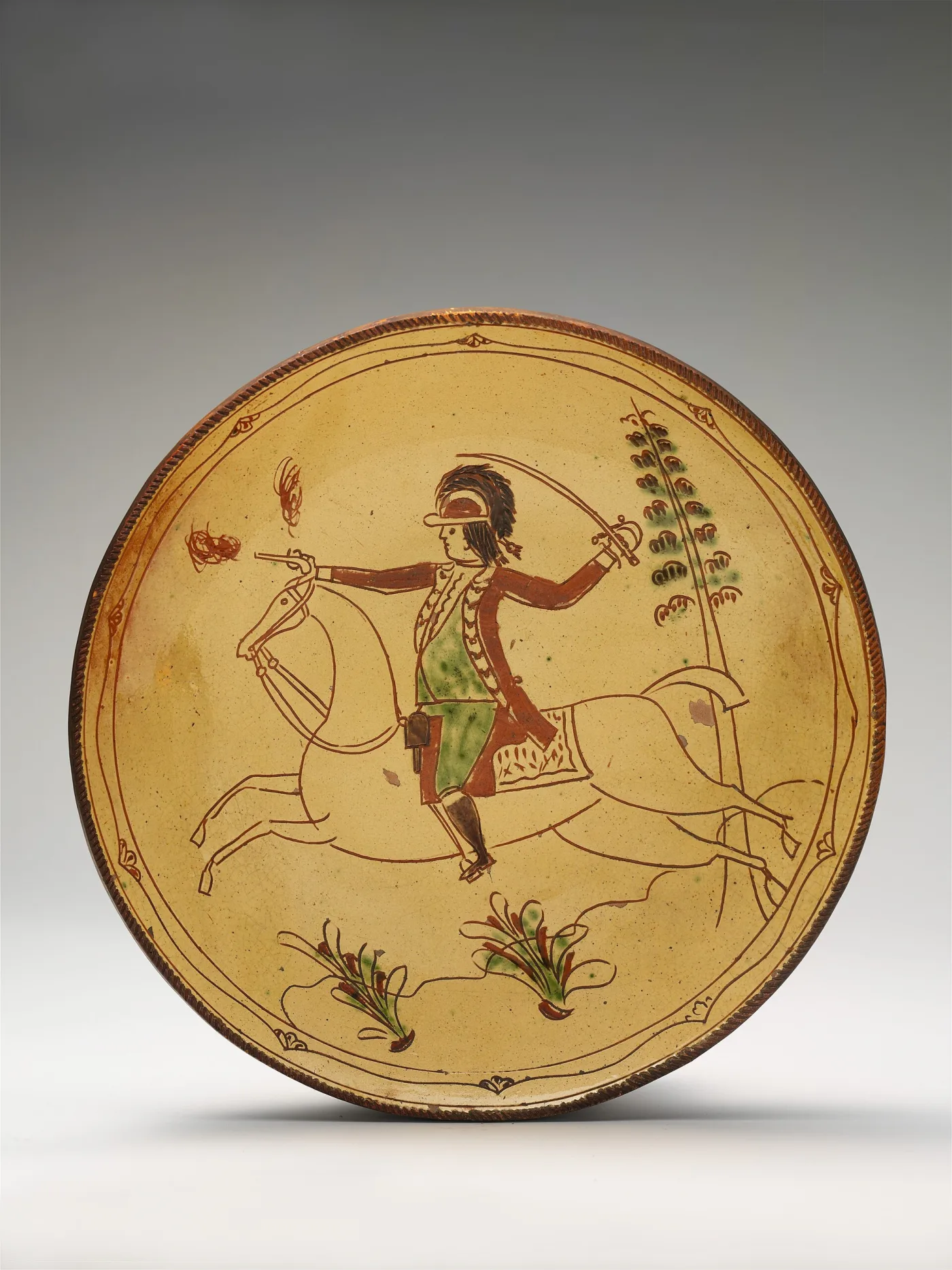
The body is dipped or brushed with a uniform layer of white slip while still leather-hard. The potter then scratches a design through the slip with a stylus, exposing the red body in lines. Color accents may be added (copper green leaves, manganese brown stems). After drying, the piece is glazed and fired. Sgraffito is technically demanding and was used mostly for ambitious presentation pieces. Eighteenth-century Pennsylvania German sgraffito chargers by named potters are the most valuable American pottery in any tradition.
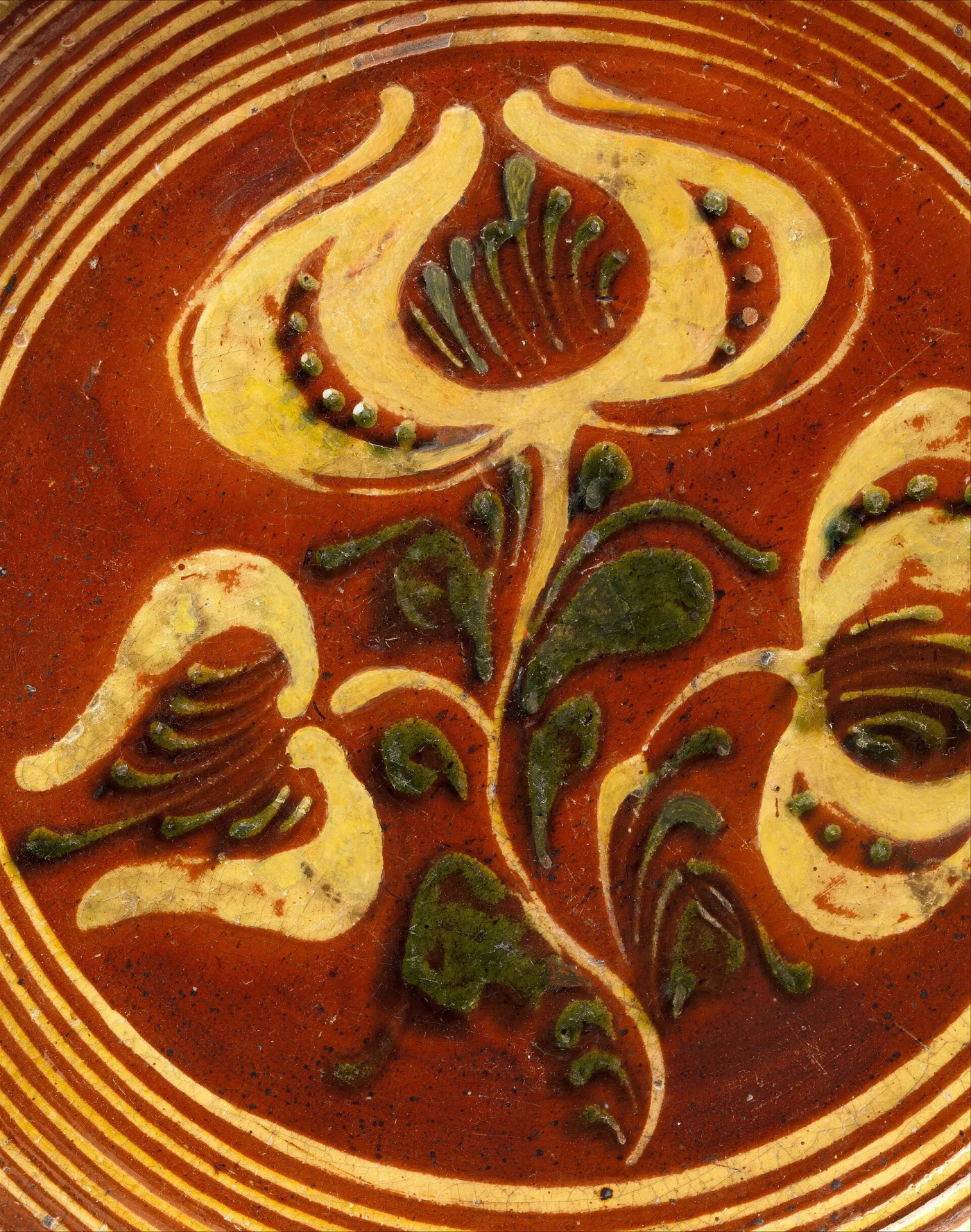
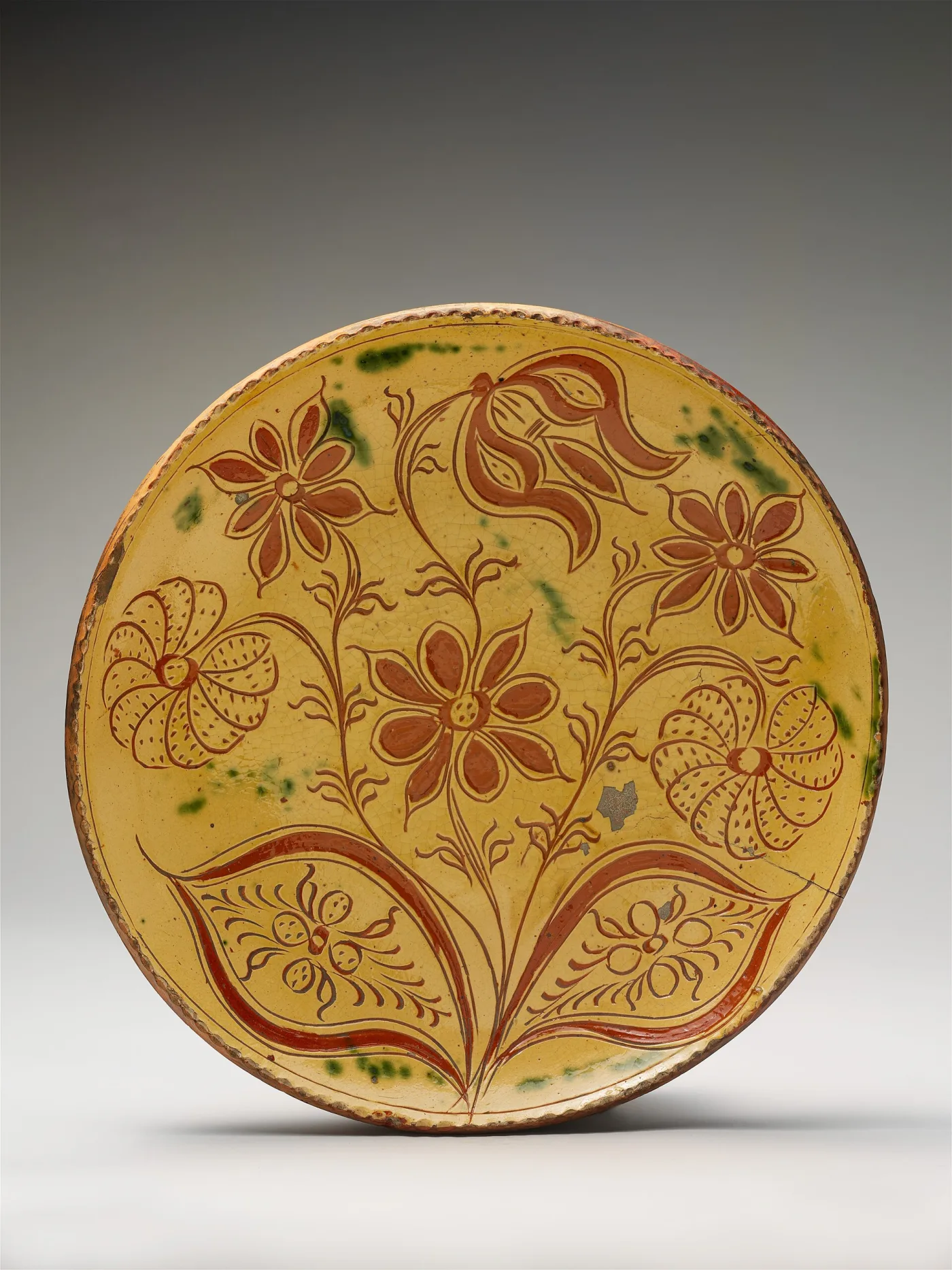
The two techniques are opposite operations and they survive photography: trailing casts a small shadow along the outside of each line, while sgraffito darkens inside it, and a raking light makes trailed work glitter along its ridges. The chipped rim on the sgraffito plate is the free lesson — the damage cuts through the cream layer and shows the orange-red clay the whole plate is made of. If a chip on a cream-surfaced plate exposes white or grey underneath, you are not looking at redware at all.
Coggle Wheel
A small wooden or metal wheel with a notched or patterned rim is rolled around the edge of a leather-hard piece (especially pie plates) to leave a continuous decorative band of impressions. Coggle wheels were standard potter's equipment; the specific notch pattern can sometimes be matched to particular shop traditions.
Marbleizing and Combing
White and colored slips are applied in adjacent bands or dots, then drawn through with a comb or stick while still wet to create swirled or feathered patterns. Marbled redware is most associated with English Staffordshire tradition and with New England potters who learned from English-trained immigrants.
Splash and Spatter
Manganese or copper-green glaze is splattered, sponged, or flicked onto a clear-glazed body, producing mottled and tortoiseshell effects. Common throughout the redware era and across regions, and a technical cousin of the cut-sponge work catalogued in our spongeware pottery identification guide.
Inscription and Date
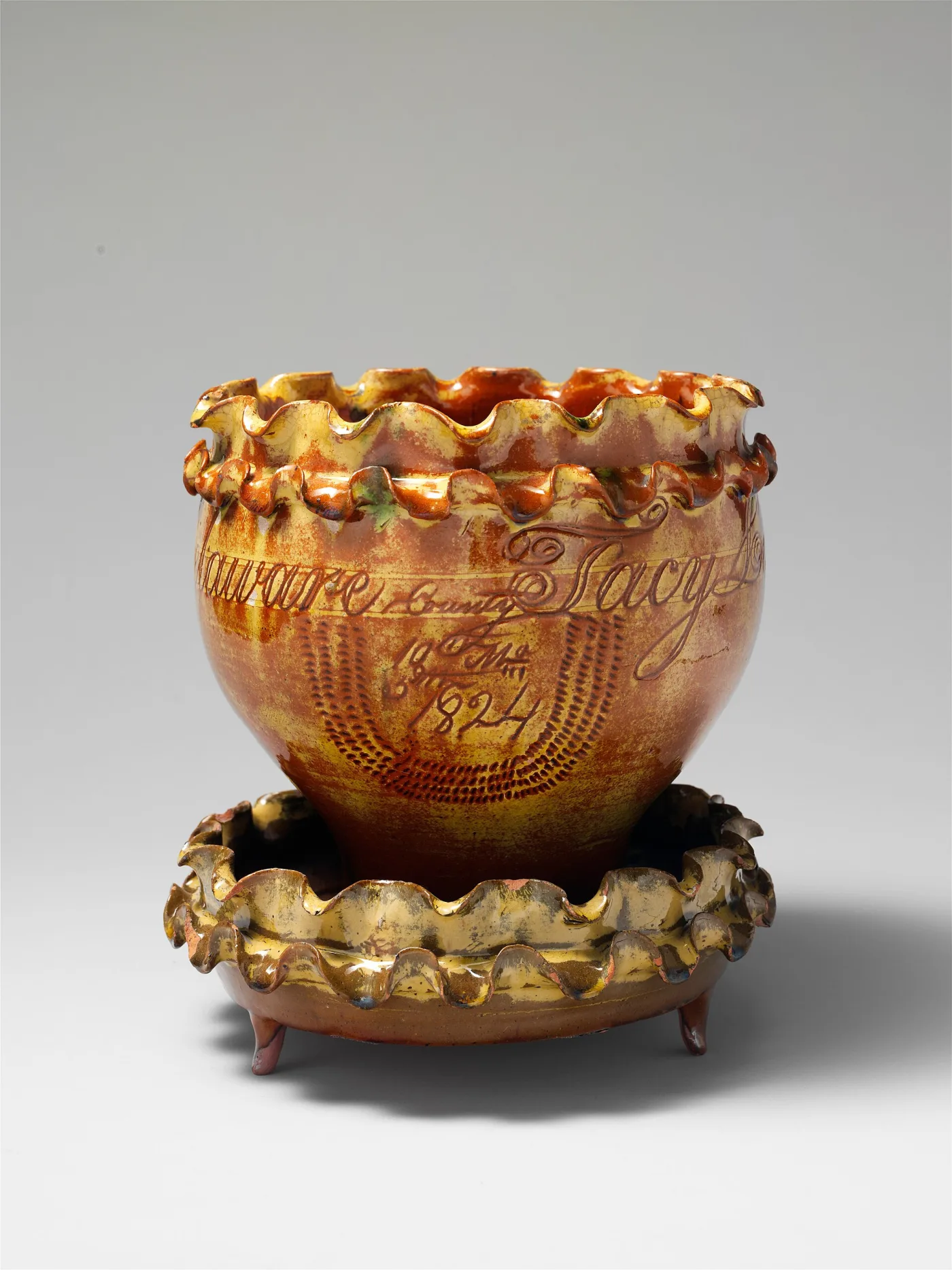
Some Pennsylvania German pieces carry slip-trailed or sgraffito inscriptions in German script — owners' names, dates, religious texts, fraktur-style verses. These are the most prized and valuable category; a dated and signed sgraffito charger can reach $50,000+ at auction. For the broader German-American decorative tradition see our antique folk art identification guide.
Lead-Glaze Drips and Spangles
Not really decoration but the result of glaze movement in the kiln — drips and spangles are now read as authenticity markers and add to the visual character of period pieces.
Pennsylvania German Redware
The most distinguished American redware tradition emerged in the German-speaking communities of southeastern Pennsylvania — Bucks, Montgomery, Berks, Lehigh, Northampton, and surrounding counties — from about 1750 to about 1850. Pennsylvania German potters drew on the southern German and Rhineland Hafner traditions their families had brought from Europe, and produced the most ambitiously decorated American earthenware.
The Pennsylvania Vocabulary
Pennsylvania German redware features a recognizable design language: tulips, hearts, doves, peacocks, distelfink birds, the tree of life, mounted horsemen, geometric stars, German-script inscriptions, dates, and owners' names. The decoration is overwhelmingly slip-trailed or sgraffito on flat forms (pie plates, chargers, plates) and on jugs and pitchers. Bodies fire to a warm orange-red, slip is creamy white to yellow, copper-green accents appear in foliage, manganese in line work.
The Eighteenth-Century Masters
The named eighteenth-century Pennsylvania German potters — Georg Hubener (active c. 1785–1798), Andrew Headman (active c. 1808–1840), Johannes Neesz (Neis, active c. 1810–1830), David Spinner (active c. 1800–1811), Henry Roudebuth (active c. 1810–1816), John Leidy (active c. 1801–1835) — produced sgraffito chargers and dishes that are now the apex of American pottery collecting. Signed examples with strong, intact decoration sell into six figures at major auctions; unsigned but confidently attributable examples reach mid-five figures.
The Nineteenth-Century Continuation
Throughout the nineteenth century Pennsylvania German potters continued to produce slip-decorated everyday wares — pie plates, mugs, jugs, jars — at a more modest level of ambition than the eighteenth-century chargers but still distinctly Pennsylvanian in vocabulary. Slip-decorated pie plates by mid-nineteenth-century potters typically sell in the $400–$2,500 range depending on decoration and condition.
The Schoolmaster and Presentation Pieces
A subcategory of Pennsylvania redware is the schoolmaster's reward and presentation piece — slip-inscribed plates and plaques given as gifts, prizes, or commemoratives. These are usually dated and inscribed with German-script verses or names.
The Distelfink and the Tulip
The distelfink (a goldfinch-like bird) and the tulip are the most characteristic Pennsylvania German motifs and appear constantly in both slip and sgraffito work. The tulip in particular descends from Ottoman and Persian decorative tradition through European folk art and arrived in Pennsylvania as both a religious symbol (the Trinity in the three-petal form) and a decorative cliché.
New England Redware
The New England redware tradition is older than the Pennsylvania one — Massachusetts and Connecticut potters were working by the 1640s — but generally less ambitiously decorated. The New England aesthetic favored plain forms with restrained surface treatment: clear or manganese-mottled glazes, occasional slip bands, and minimal pictorial decoration. The result is a body of beautiful, sober, utilitarian pottery that lacks the fireworks of Pennsylvania work but rewards close looking.
Massachusetts
Charlestown, Boston, Danvers, Peabody, and the towns of Essex County had active potteries from the 1640s onward. Massachusetts redware is typically plain forms with clear or mottled-manganese glaze; the most distinctive Massachusetts product is the "Charlestown" style jug with a strap handle and bulbous body.
Connecticut
Hartford, Norwalk, Goshen, and Litchfield County were the principal Connecticut centers. Connecticut redware includes some of the most refined American slip-decoration outside Pennsylvania — Norwalk in particular produced slip-trailed pie plates and chargers in the early nineteenth century that rival modest Pennsylvania work. Hervey Brooks (Goshen, active 1802–1864) is the best-documented Connecticut potter, with surviving daybooks and a substantial corpus of attributable work.
New Hampshire and Vermont
Smaller and later potteries; New Hampshire and Vermont redware tends to be plain utilitarian forms in clear or manganese glaze, produced for local consumption.
Maine
Portland, Gorham, and Bangor had active potteries through the early nineteenth century, producing typical New England utility wares. Maine redware is uncommon but not particularly distinguished.
The New England Aesthetic
The general New England preference was for what we now call understated good design — clean forms, evenly applied glaze, restrained decoration. The flashier slip-trailing and sgraffito of Pennsylvania did not find favor in Puritan New England, with the partial exception of Norwalk and a few other Connecticut shops. The result is a quieter tradition that is consistently undervalued relative to Pennsylvania work.

Mid-Atlantic and Shenandoah Valley
Between Pennsylvania and the South a distinct Mid-Atlantic redware tradition developed in Maryland, Virginia, and the Shenandoah Valley, often with potters who descended from or trained with Pennsylvania German shops but who developed their own regional vocabulary.
The Bell Family of Waynesboro and Strasburg
The Bell pottery dynasty is the most important Mid-Atlantic redware lineage. Peter Bell Jr. established the family pottery in Hagerstown, Maryland around 1800; his sons John Bell (Waynesboro, Pennsylvania, active 1833–1880), Samuel Bell (Strasburg, Virginia, active 1843–1882), and Solomon Bell (Strasburg, active 1843–1882) ran related but distinct shops. Bell pottery is distinguished by high technical quality, ambitious figural work (especially lions, dogs, and architectural figures), and clear marks: "John Bell, Waynesboro," "S. Bell & Sons, Strasburg," or "Solomon Bell, Strasburg" impressed in the body or marked in slip. Bell figural pieces (especially the Bell lions) regularly reach $5,000–$30,000.
Maryland
Baltimore and the surrounding counties had a substantial redware industry through the nineteenth century, with the Maulden Perine pottery (Baltimore, active 1820s–1850s) producing distinctive marked utilitarian wares. Maryland redware tends to plainer forms than Pennsylvania but with high-quality bodies and glazes.
Shenandoah Valley, Virginia
The Shenandoah Valley redware tradition is distinctive and increasingly collected. Beyond the Bell shops at Strasburg, potteries at Winchester, Harrisonburg, and Rockingham County produced both utility wares and ambitious decorated pieces. The Eberly pottery (Strasburg, active 1880s–1906) is a documented late example; Eberly mottled-glaze pitchers and pie plates in copper green and manganese over yellow slip are sought-after.
The Late Shenandoah Tradition
Shenandoah Valley redware production continued later than most American regions — into the early twentieth century — partly because the rural agricultural economy continued to demand utility pottery longer than urban areas. Late Shenandoah pieces are sometimes mistaken for earlier work because the tradition continued unchanged.
Moravian Redware in North Carolina
The Moravian religious community at Bethabara (founded 1753) and later Salem (now Winston-Salem, founded 1766) in North Carolina established a distinct redware tradition that is increasingly recognized as one of the most distinguished in American pottery.
Gottfried Aust and Rudolf Christ
Gottfried Aust (active at Bethabara 1755–1771, then Salem 1771–1788) was the founding master of the Moravian pottery tradition, trained in Saxony before emigration. His apprentice Rudolf Christ (active 1786–1821) succeeded him and led the most productive Salem period. Both produced an extraordinary range — slip-decorated dishes in the Pennsylvania German manner, copper-green and manganese mottled wares, marbleized pieces, and a remarkable series of cast-mold figural pieces (squirrels, lions, fish bottles) that are unique in American pottery.
The Salem Body and Glazes
Moravian redware bodies fire to a slightly paler orange than Pennsylvania work, and the glaze technology — apparently transmitted from Saxon training — produces particularly clear, even glazes. Decoration is more disciplined than Pennsylvania work, with finer slip-trailing and more controlled coloration.
The Old Salem Record
The Moravian community kept exceptionally detailed records and many pieces survive in the Old Salem collection and at Wachovia, providing reference comparisons that are rare elsewhere in American redware. The published record allows confident attribution of unmarked pieces in a way that is difficult for most American redware.
Values
Moravian pottery is increasingly recognized in the market. Aust- or Christ-attributed pieces reach into high four and five figures; lesser Moravian pieces are still under-priced relative to their quality.
European Redware Traditions
American redware is an offshoot of much older European traditions, and pieces from these traditions appear regularly in American markets — sometimes mistaken for American work, sometimes correctly identified.
Southern Germany and Alsace — Hafnerware
The Hafner tradition of southern Germany, Alsace, and Switzerland produced lead-glazed earthenware with green, brown, and yellow glazes — often architectural tiles for stoves (Kachelöfen), but also vessels. The German tradition was the parent of Pennsylvania German redware; the iconography (tulips, peacocks, hearts) is directly traceable.
The Pre-Industrial English Tradition
English redware — slip-decorated Staffordshire dishes from the late seventeenth and early eighteenth century by makers like Thomas Toft and Ralph Toft, North Devon sgraffito harvest jugs, and Sussex pottery — overlaps with American work in technique and sometimes in form. English pieces are often more elaborately decorated than American utility work and are securely identified by form, body color (English bodies often more brick-red than American orange), and the specific slip patterns. For broader English ceramic context see our antique ceramics and pottery identification guide.
French and Iberian Traditions
French Pré-d'Auge and Vallauris redware, Spanish Andalusian wares, and Portuguese pieces appear occasionally in American markets, especially since the mid-twentieth century. Iberian pieces often show distinctive forms (specific bowl shapes, handle profiles) and slips in colors that do not appear in northern European or American traditions.
The Mediterranean Tin-Glazed Confusion
Italian majolica and Spanish lustre wares are sometimes confused with redware because they share an earthenware body. The distinguishing feature is the glaze — majolica is tin-glazed (opaque white) while redware is lead-glazed (transparent). If the glaze is opaque white, it is not redware regardless of body color.
Named Potters and How to Identify Them
Most American redware is unmarked, and even when marks exist they may be simple impressed names or initials without further information. The named-potter premium is substantial — a marked piece by a known maker can be worth ten or twenty times an unmarked comparable — so learning the principal names is the highest-value identification skill in redware collecting.
The Bell Family Marks
"JOHN BELL, WAYNESBORO" or "JOHN BELL" impressed; "S. BELL & SONS, STRASBURG, VA" impressed; "SOLOMON BELL" impressed. Bell marks are usually deeply impressed in a single block on the body near the foot or under the handle. The marks are well-documented and reasonably easy to authenticate.
Pennsylvania Slip and Sgraffito Signatures
The eighteenth-century Pennsylvania masters sometimes signed their work in slip-trailed or sgraffito script, in German or English: "Georg Hubener," "Johannes Neesz," "David Spinner," "Henry Roudebuth." The signatures are part of the decoration rather than a backstamp, and authenticity assessment requires comparison with documented examples in major museum collections (Philadelphia, Winterthur, Pennsylvania Farm Museum).
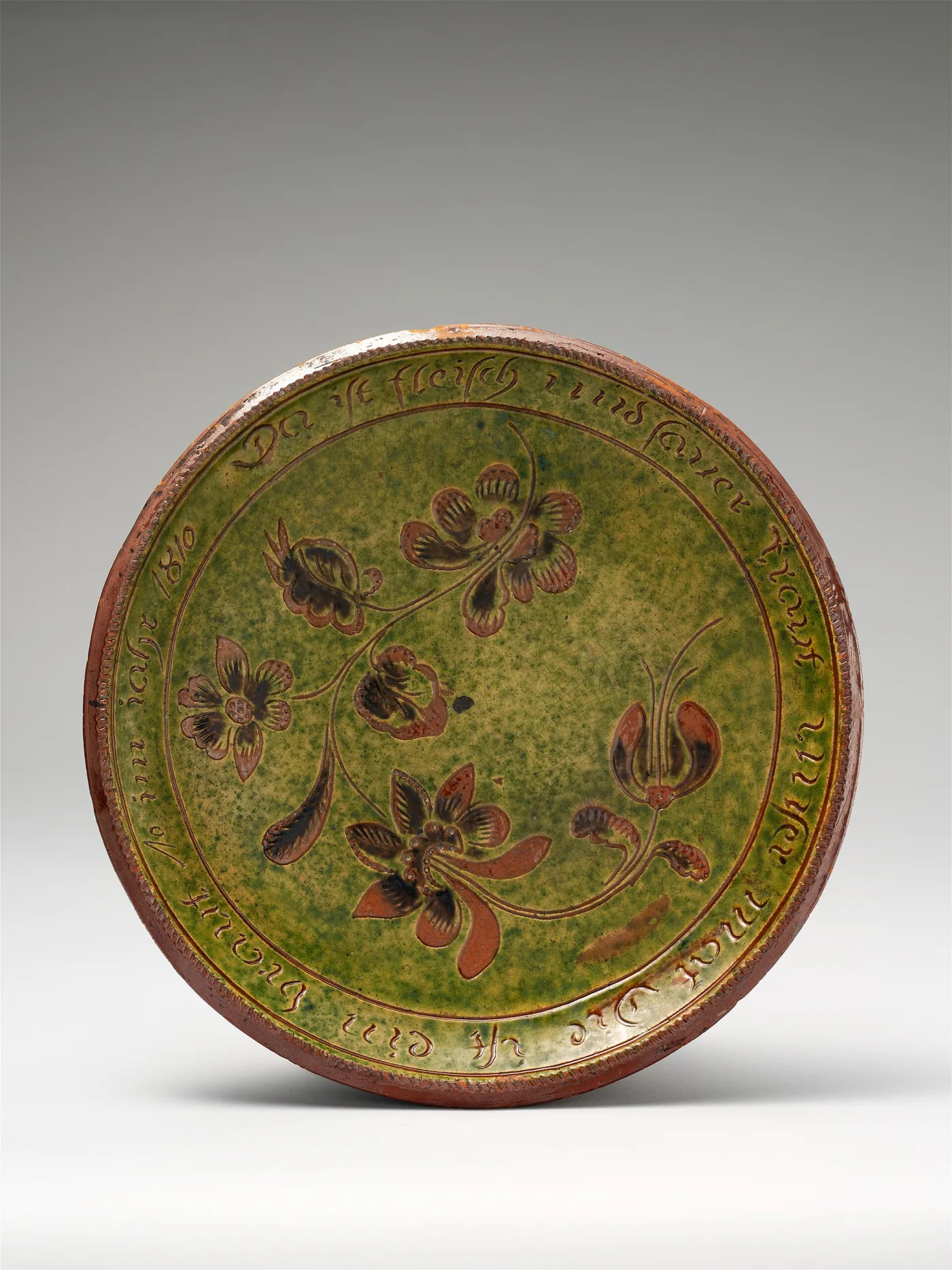
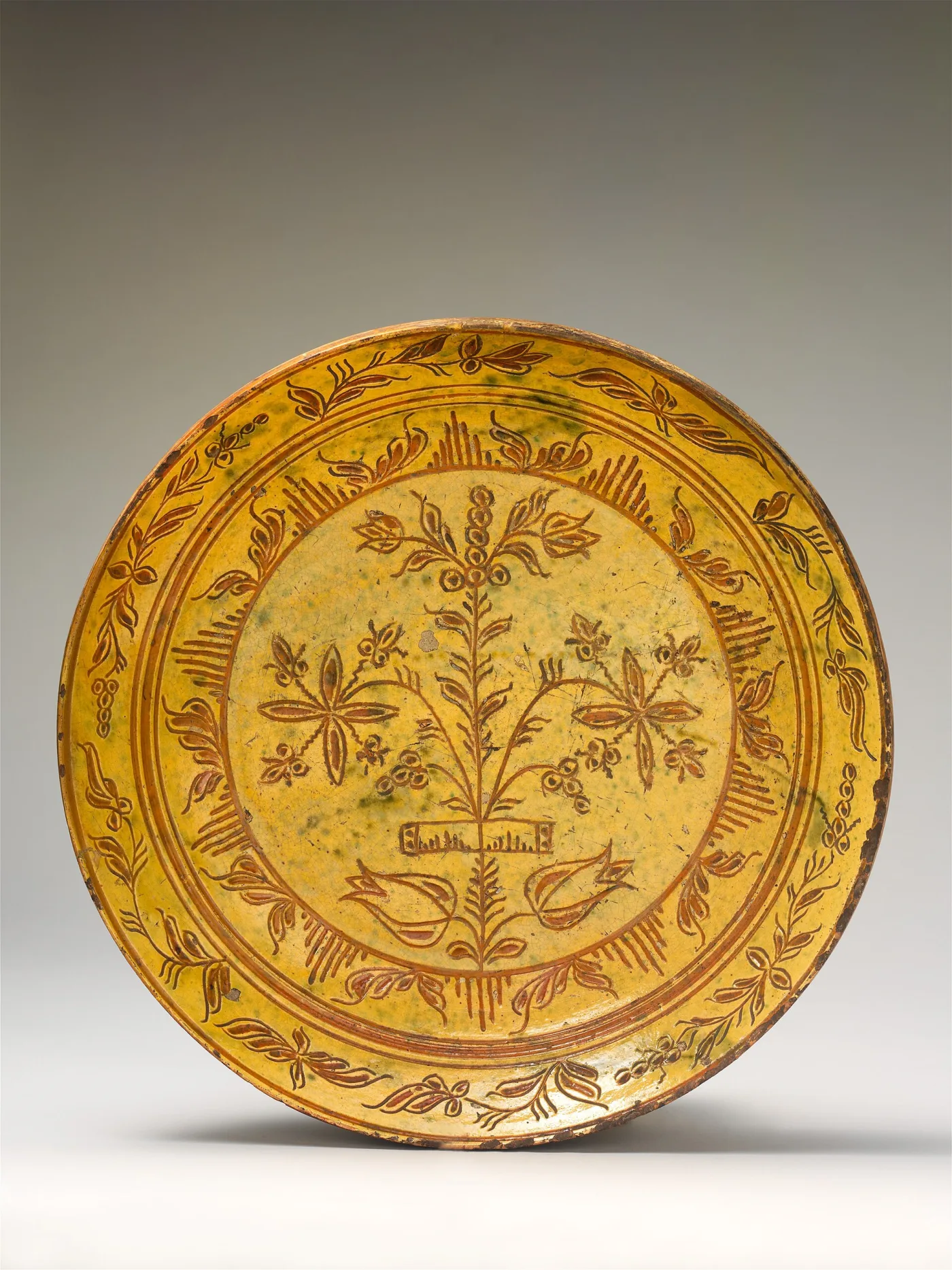
Neither plate carries a stamp anywhere on it. Both are attributed on handling alone, and the differences are the whole evidence: Neis works wide and wet, letting the copper green flood the ground and using the rim as a line of text, while Leidy keeps the green as an occasional wash and spends his effort on an even, tightly spaced border. That is the normal situation for Pennsylvania German sgraffito, and it is why the price gap between "attributed to" and "in the manner of" is measured in multiples rather than percentages.
Moravian Documentation
Most Moravian pieces are unmarked, but the survival of Salem records allows attribution by comparison with documented examples. Old Salem and the Museum of Early Southern Decorative Arts (MESDA) hold the reference collections.
Hervey Brooks of Goshen, Connecticut
Brooks's surviving daybooks (now at Old Sturbridge Village) document his production for sixty-plus years, allowing matching of surviving pieces to his shop. Some of his pieces are marked "H. BROOKS / GOSHEN" but most are not.
The Late Shenandoah Marks
Eberly, Suter, and other late Shenandoah potters sometimes marked their pieces with impressed or printed marks. Late-nineteenth-century Shenandoah work is the most consistently marked of all American redware traditions.
Unmarked Attribution
For most American redware, attribution depends on stylistic features — body color, glaze recipe, slip color, decoration vocabulary, form profile, foot treatment, handle type — compared against the limited corpus of documented marked or excavated examples from each region. Major reference works (Lasansky, Schaltenbrand, Comstock) are essential.
Dating Clues Beyond Marks
With few marks and even fewer dates, redware dating depends on accumulating multiple small clues. The most useful are below.
Wheel and Tooling Marks
Eighteenth-century wheels were treadle or hand-cranked, producing slightly irregular thrown forms with characteristic finger marks on the interior. Nineteenth-century steam- or water-powered wheels produced more uniform forms. Twentieth-century revivalist pieces often show too-clean thrown profiles or, in worst cases, the spiral marks of an electric wheel.
Foot and Base Treatment
The foot is often the most diagnostic part of a redware piece. Eighteenth-century feet are usually cut or trimmed with a wire while still on the wheel, leaving characteristic wire marks across the base. Nineteenth-century feet are more often turned (a tool cuts a chamfer or foot ring), and the bases are more uniform. The wear pattern on the foot — actual use abrasion from decades or centuries of sliding on shelves and tables — is one of the strongest authenticity markers; reproductions almost never have convincing foot wear.
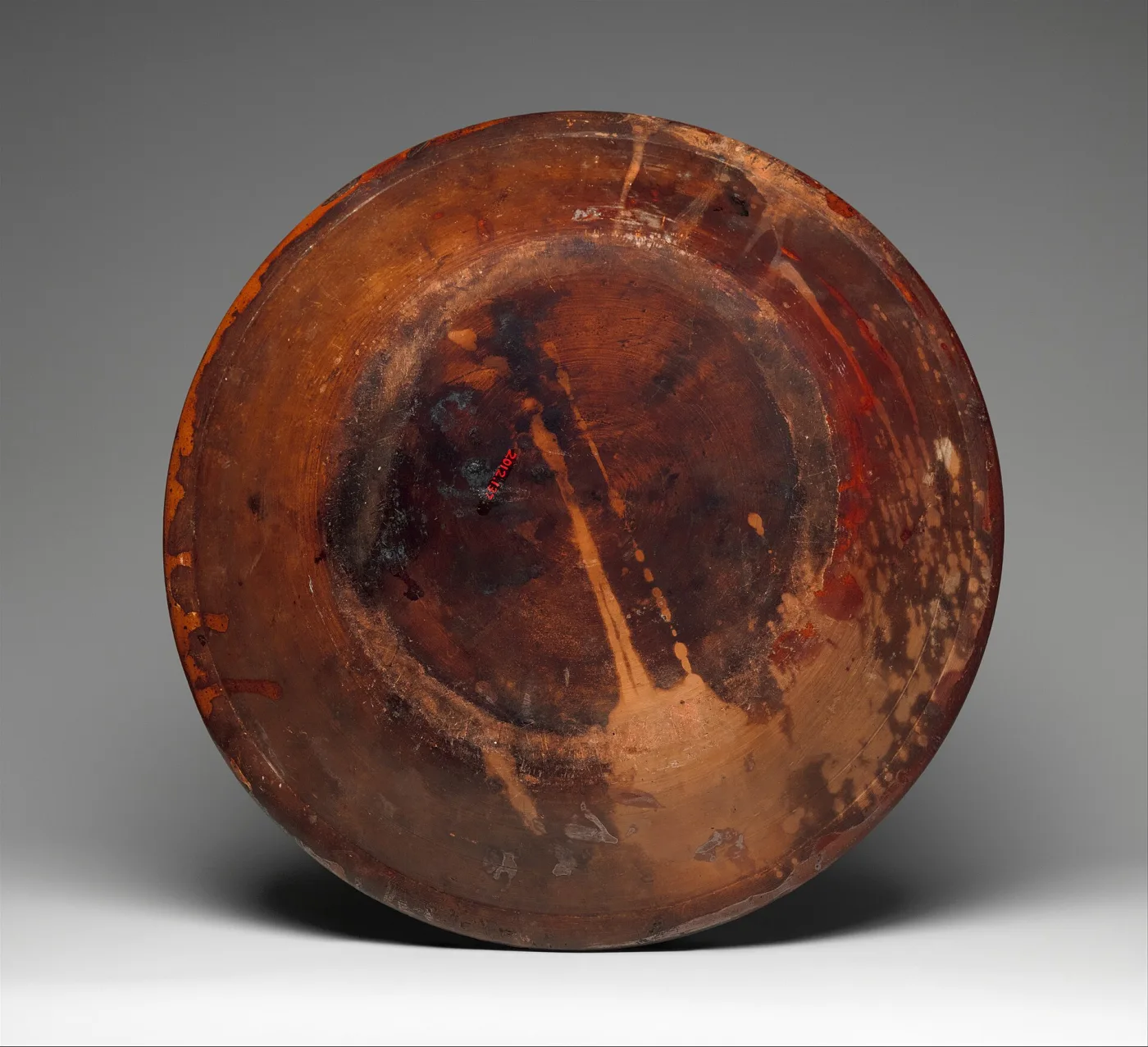
Glaze Crazing
Lead-glazed redware develops a fine network of crazing (hairline cracks in the glaze) over decades of thermal cycling and aging. The crazing pattern, often with dirt or staining trapped in the cracks, is hard to fake convincingly. Brand-new reproductions have either no crazing or artificially induced crazing that lacks the dirt-filling and the gradient of crazing density across the piece.
The Body Color Gradient
Authentic period redware often shows color variation across the body — slightly darker near the foot where firing reduction was greater, lighter in protected areas. The variation is subtle but consistent. Even-colored modern pieces (uniform red across the whole body) are often reproductions.
Decoration Vocabulary as Dating
Specific motifs and decoration types fall into period ranges. The German-script inscriptions of Pennsylvania peak 1780–1820. The bold tulip-and-bird sgraffito work is largely 1780–1840. Coggle-wheel rims appear from the 1770s. Marbled and combed decoration peaks 1810–1850. Late-nineteenth-century work tends to plainer slip bands and decorative simplification.
The Provenance Question
For higher-value pieces, documented provenance — earlier ownership, exhibition history, publication in references — adds substantially to value and to authentication confidence. Major auction houses now require some provenance for high-value redware. For approaches to provenance research see our antique authentication and provenance research guide.
Reproductions and Twentieth-Century Revivalists
Redware has been continuously reproduced since the late nineteenth century, and the twentieth-century revival has produced large quantities of new redware in the period style. Distinguishing period work from revival is a core identification challenge.
The Early Revival (1900–1940)
Around 1900 the Arts and Crafts movement and the colonial revival generated a market for handmade pottery in the colonial style. Potters like Paul Cushman (active early nineteenth century but reproduced from the 1920s) and various early revivalists produced work that is now itself collectible. Early revival pieces (1900–1940) tend to be heavier-bodied, more deliberately decorated, and lack the casual unevenness of true period work.
The Stahl Pottery (Powder Valley, Pennsylvania)
The Stahl family pottery (active 1934–1956 in the colonial revival style, descended from a longer family tradition) produced large quantities of slip-decorated Pennsylvania German redware in the traditional manner. Stahl pieces are usually signed in slip on the back ("Stahl 1947" or similar) and are now collectible in their own right. They are not period pieces but legitimately handmade in the tradition.
Lester Breininger (Robesonia, Pennsylvania, 1935–2011)
Breininger produced ambitious sgraffito and slip-decorated Pennsylvania German redware from the 1960s through the 2000s, often deliberately in the eighteenth-century manner. Breininger pieces are signed and dated in slip and are now collected at strong prices ($300–$3,000+) on their own merits. They have been confused with period work by inexperienced buyers; the Breininger signature is the easy giveaway.
Greg Shooner (Loveland, Ohio)
Contemporary potter producing redware in colonial American style; pieces are signed and dated.
Eldreth Pottery (Oxford, Pennsylvania)
Production-line redware in colonial styles; clearly marked and sold as new pottery, not antique. Eldreth pieces sometimes turn up at flea markets misrepresented as period work.
The Late-Twentieth-Century Faker
Outright fakes — pieces deliberately made to deceive as period work — exist but are less common than misidentified revival work. The standard fake gives itself away through perfect uniformity (no kiln variation), artificially aged glaze (uneven distressing that does not match natural wear patterns), and decoration that copies a published photograph too literally. When in doubt with a high-value piece, thermoluminescence testing can establish a firing date within a generation.
Pennsylvania German Sgraffito — Special Caution
Because eighteenth-century Pennsylvania German sgraffito chargers reach six figures, the reproduction and faking pressure on this category is intense. Any unprovenanced sgraffito charger attributed to Hubener, Spinner, Neesz, or other named eighteenth-century masters requires professional authentication before purchase. The major auction houses and dealers have established networks of authentication; do not rely on flea-market judgment for pieces in this category.
Condition Assessment
Redware condition standards are unusual: because the material is fragile and was used hard, perfect survival is rare and a degree of wear and damage is normal. The condition assessment is not "is it perfect" but "is the damage appropriate to the age and type."
Chips and Flakes
Rim chips, foot chips, and small glaze flakes are nearly universal on period redware and are considered normal. Major auction descriptions will note them but they affect value less than for porcelain or refined earthenware. A pie plate with three small rim chips may sell for 80% of a perfect example; a piece with a major chip into the body may drop to 50%.
Cracks and Repairs
Hairline cracks (stable, not progressing) reduce value moderately; through-cracks reduce more substantially. Old repairs (lead staples, early adhesives) sometimes add character if visible and stable; modern invisible repairs can be a problem if undisclosed — they restore visual condition but mask structural weakness.
Glaze Loss
The lead glaze is the thinnest and most vulnerable layer. Glaze loss from age, use, or refiring on the kiln can leave bare body showing. Small areas of glaze loss are acceptable; large areas substantially reduce value.
Crazing and Staining
Fine network crazing in the glaze is normal and not a defect. Staining from use (food, oil, mineral deposits) is also normal and sometimes adds to the period character. Heavy staining from poor storage (mildew, rust marks) is a defect.
Burst Bubbles and Kiln Defects
Original firing defects — burst glaze bubbles, kiln scars, glaze drips — are not damage but part of the period character. They are sometimes deliberately featured in dealer descriptions as authenticity markers.
The Wear Pattern
Actual use wear — abrasion on the foot, utensil marks in the well, fading in high-touch areas — is the strongest authenticity marker and should not be "restored." Stripped or refinished pieces often lose 30–50% of their value relative to unrestored equivalents.
What Drives Value
Redware values span four orders of magnitude — from $25 to $250,000 — so understanding which features drive value is essential.
Attribution and Marks
The single biggest value driver. A confidently attributed Bell, Spinner, or Hubener piece is worth ten to twenty times an unmarked comparable. The named-potter premium is the dominant value factor in American redware.
Decoration Quality and Type
Sgraffito beats slip-trailing beats manganese decoration beats plain. Within each category, decoration that fills the visual field with disciplined, accomplished work beats sparse or careless decoration.
Region
Pennsylvania German > Moravian > Bell-tradition Shenandoah > Connecticut Norwalk > other regions. The hierarchy is partly aesthetic, partly historical accident — Pennsylvania was studied earliest and most thoroughly, generating reference literature that supports premium prices.
Date and Inscription
A dated piece is always more valuable than an undated one because the date secures both attribution and period. An inscribed piece (with owner's name or text) is more valuable still. A dated and inscribed presentation piece is the top of the market.
Form
Ambitious forms (figurines, banks, presentation chargers, large pitchers) beat utility forms (milk pans, plain crocks, mugs) at the same level of decoration. A decorated figural piece is always worth more than a decorated utilitarian one.
Condition
Within the redware norm — chips, crazing, use wear — condition affects value moderately. Major damage (large chips, through-cracks, glaze loss, restoration) affects value more.
Provenance
Documented earlier ownership, exhibition history, and publication add 10–30% at the top of the market and are often required for high-value pieces. For valuation framework see our antique valuation and appraisal guide.
Indicative Price Ranges (2025–2026)
- Plain utility piece (milk pan, simple crock, jug): $25–$200
- Manganese-decorated utility piece: $50–$400
- Slip-banded plate or jug: $150–$800
- Slip-trailed pie plate, unattributed Pennsylvania: $300–$2,500
- Bell-attributed utility ware: $400–$3,000
- Bell-attributed figural (lion, dog): $5,000–$30,000
- Moravian attributed work: $1,000–$25,000
- Named Pennsylvania sgraffito charger (Spinner, Hubener, Neesz): $20,000–$200,000+
- Twentieth-century revival (Stahl, Breininger): $100–$3,000
Care and Display
Redware care is more demanding than refined ceramic care because the body is porous, the glaze is fragile, and the lead content presents handling considerations.
Never Use for Food
Lead-glazed redware is not food-safe by modern standards. Display only. Do not store food, beverages, or even decorative fruit in redware pieces. Wash hands after handling and especially after handling pieces with damaged glaze.
Cleaning
Use only a soft dry brush or barely damp cloth. Do not soak — the porous body absorbs water and can drive soluble salts to the surface as the piece dries, causing glaze damage. Do not use detergents, acids, or solvents.
Display
Plates and chargers should be displayed in proper plate stands or wall hangers that distribute weight evenly. Avoid wire hangers that concentrate stress at the rim. Three-dimensional forms should sit on stable surfaces with felt or padding underneath to prevent foot abrasion.
Environment
Stable temperature and humidity — ideally 65–75°F and 40–55% relative humidity. Avoid kitchens (cooking moisture and temperature swings), bathrooms (humidity), and direct sunlight (UV degradation of any organic restoration materials). For broader environmental guidance see our antique storage care and preservation guide.
Handling
Lift by the body with two hands rather than by handles, rims, or spouts. Redware handles in particular were often the weakest part of the piece and are common break points. Do not stack pieces.
Restoration
Avoid all but the most necessary structural restoration on important pieces. Cosmetic restoration (overpainting glaze loss, filling chips with colored fillers) substantially reduces market value when discovered, and is now reliably detected with UV light. Stable cracks should be left alone unless they threaten the integrity of the piece. For broader restoration philosophy see our antique restoration and conservation guide.
Common Beginner Mistakes
Calling Everything Red "Redware"
Red-bodied modern pieces — twentieth-century Mexican terra cotta, Italian tourist pottery, contemporary studio work — are not redware in the collecting sense. Redware refers specifically to the colonial and early American (and parallel European) tradition. Calling a contemporary Mexican planter "redware" will mark you as inexperienced.
Confusing Bell with Earlier Pennsylvania Work
John Bell pieces are sometimes assumed to be eighteenth-century Pennsylvania German simply because Waynesboro is in Pennsylvania. Bell worked 1833–1880 and his pieces are distinctly nineteenth-century in form and aesthetic. The marks make the attribution clear when present.
Buying Unsigned Sgraffito at Top Prices
Unprovenanced sgraffito chargers at flea-market or estate-sale prices that are too good to be true usually are. The eighteenth-century named Pennsylvania masters have been thoroughly studied, and authentic discoveries appear through reputable channels with documentation. A "Spinner" charger for $500 at a country auction is almost certainly a reproduction or fake.
Refinishing or Stripping
Some inheritors have stripped or refinished redware pieces, believing they were cleaning them up. This destroys value irreversibly. If you inherit dirty redware, do nothing more than dust it until an appraiser has seen it.
Mistaking Coggle Marks for Damage
The regular notched pattern around the rim of a pie plate is intentional coggle-wheel decoration, not damage or wear. Some buyers have actually tried to "smooth out" coggle decoration believing it was a defect.
Underestimating New England Work
Because New England redware is plainer than Pennsylvania, beginners often dismiss it as not worth attention. Good Norwalk slip-decorated work and high-quality Connecticut utility pieces are increasingly recognized and undervalued; this is a current opportunity area.
Ignoring the Foot
The foot is the most diagnostic part of the piece for both attribution and authenticity. Always examine the foot — wire marks, wear pattern, color gradient, any impressed marks — before forming an opinion.
Believing All "Old" Means Period
Stahl, Breininger, and other twentieth-century revivalist work is genuinely old by now (Stahl pieces are 70–90 years old) and genuinely handmade in the tradition, but they are not period pieces and command much lower prices than eighteenth- or nineteenth-century work. The signature on the back is the giveaway.
Frequently Asked Questions
Is redware safe to use for food today?
No. The lead glaze leaches lead into acidic foods and beverages at unacceptable levels by modern food-safety standards. Display only. Even ostensibly food-safe modern lead-glazed reproductions should be treated as decorative only.
How can I tell American from European redware?
Body color is the first clue — American redware tends to a warmer orange-red, while English and German bodies are often a deeper brick-red. Decoration vocabulary is the second clue — Pennsylvania German motifs (tulip, distelfink, German script) are distinctively American despite their German origin; English slip-decoration tends to different motif vocabularies; Continental wares often have specific form profiles that do not appear in American work. For uncertain pieces, body color, glaze chemistry, and provenance together resolve most cases.
Can damaged redware be restored?
Structurally yes — broken pieces can be reassembled with conservation-grade adhesives by a trained ceramic conservator. Cosmetically, glaze loss can be filled and overpainted. But cosmetic restoration substantially reduces value when disclosed (and ethical sellers must disclose it). Stable damage is usually better left alone.
How do I authenticate a possibly important piece?
For high-value attributions (named Pennsylvania masters, important Bell pieces, Moravian work), consult an established specialist dealer or auction house with redware expertise. The major institutions (Winterthur, Philadelphia Museum of Art, MESDA, Pennsylvania State Museum) hold reference collections; some offer informal opinion services. For pieces above $5,000–$10,000, professional authentication is essential before purchase.
What's the difference between slip-trailing and sgraffito?
Slip-trailing applies white slip in lines or dots onto the red body (white decoration on red ground). Sgraffito coats the entire body with slip and then scratches the design through the slip layer, exposing the red body in lines (red decoration on white ground). Sgraffito is more technically demanding and generally more valuable.
What is "tortoiseshell" redware?
A decorative finish where manganese and copper-green glazes are sponged or splashed over a clear-glazed body to produce mottled brown-and-green effects suggestive of tortoiseshell. Used throughout the redware era; not a tight dating clue.
Why are Pennsylvania pieces worth more than New England?
Partly aesthetic — Pennsylvania German decoration is more ambitious and visually dramatic. Partly historical — Pennsylvania pieces were studied first and have the deepest reference literature, named masters, and museum infrastructure. Partly market — collector interest in Pennsylvania German folk art has been intense for over a century, supporting premium prices. New England work is undervalued in comparison and remains a collecting opportunity.
Are unmarked pieces worth anything?
Yes. Most redware is unmarked, and unmarked pieces with strong decoration and good condition can reach four and five figures. The named-potter premium is real but you do not need a mark to have a valuable piece — you need quality, attribution by stylistic comparison, condition, and ideally provenance.
How does redware fit with broader American folk art?
Redware is part of the broader American folk art tradition that includes painted furniture, fraktur (illuminated manuscripts), weather vanes, scrimshaw, and folk painting. The collector base overlaps substantially. For broader context see our antique folk art identification guide and antique Americana and patriotic collectibles identification guide.
Where should I learn more?
The standard references are Susan Myers's Handcraft to Industry (Smithsonian), Lisa Lasansky's various Pennsylvania German studies, the Schaltenbrand and Comstock Pennsylvania references, and the MESDA journal articles on Moravian pottery. Museum collections at Winterthur, the Philadelphia Museum of Art, MESDA (Old Salem), and the Pennsylvania State Museum provide comparison examples. The annual Pook & Pook and Conestoga Auction Company sales are the principal high-end market for American redware.