
Antique Butter Molds & Stamps Identification Guide: Patterns, Makers & Value
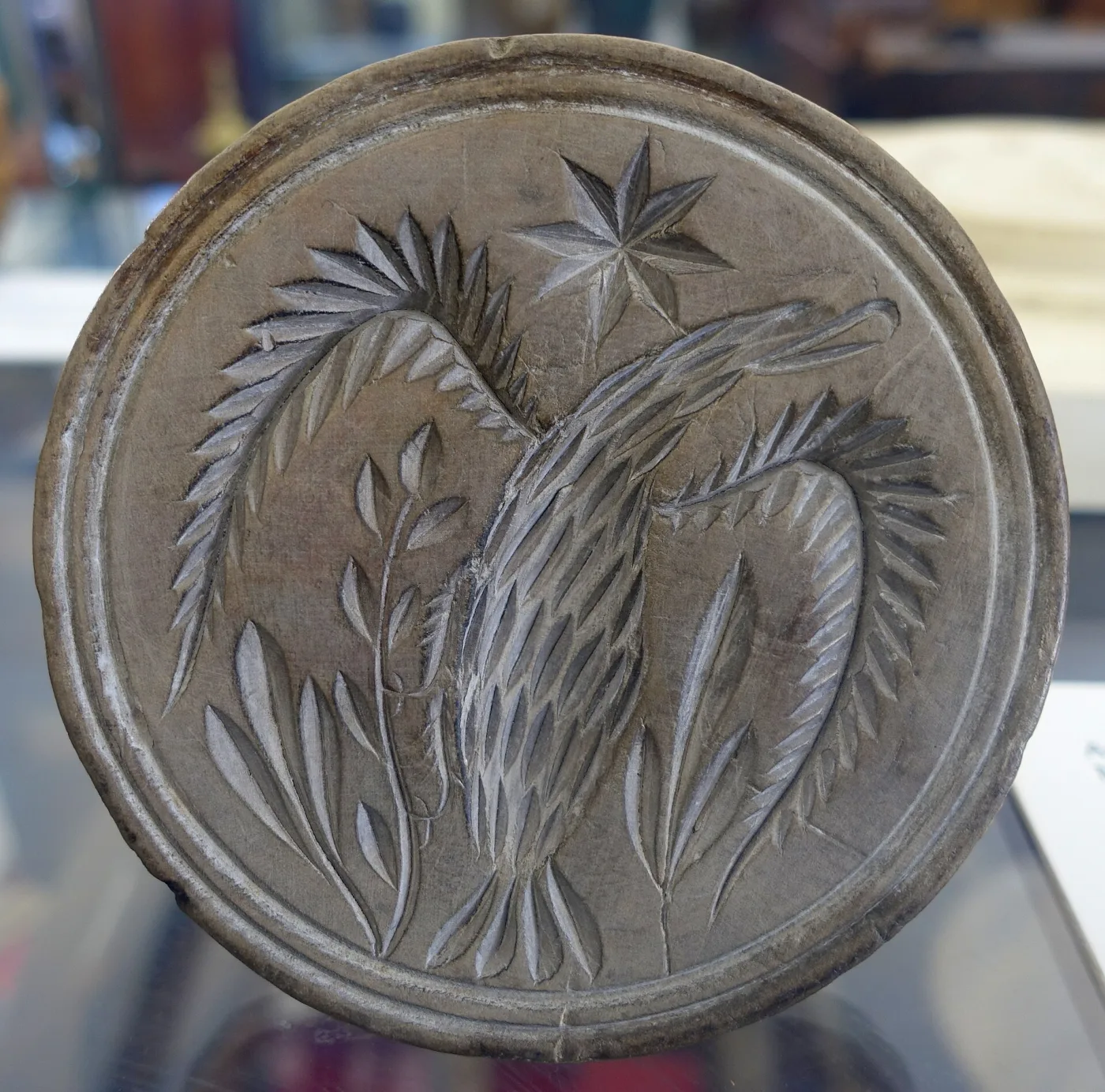
Antique butter molds and stamps represent one of the most charming and collectible categories of early American and European folk art. These functional dairy tools, used from the 17th through early 20th centuries, transformed simple butter into beautifully decorated presentations for market sale and home use. Each mold tells a story through its carved designs, wood selection, and construction methods, offering collectors a tangible connection to agricultural traditions and artisan craftsmanship.
From the deeply carved wheat sheaves of Pennsylvania Dutch farmhouses to the delicate thistle patterns of Scottish dairies, butter molds reflect the cultural heritage and artistic sensibilities of their makers. Understanding how to identify, date, and authenticate these pieces is essential for collectors navigating a market where genuine 19th-century examples command prices from $50 to over $5,000, depending on rarity, condition, and artistic merit.
This guide covers the major types of butter molds and stamps, key identification features, regional styles, common patterns and their meanings, dating techniques, and current market values to help you build a knowledgeable collection of these beloved folk art treasures.
Table of Contents
- History of Butter Molds & Stamps
- Types of Butter Molds & Stamps
- Common Patterns & Their Meanings
- Wood Types & Material Identification
- Regional Styles & Traditions
- Dating Antique Butter Molds
- Notable Makers & Manufacturers
- Construction Methods & Techniques
- Authentication & Detecting Reproductions
- Condition Assessment & Grading
- Current Market Values
- Care & Preservation
- Building Your Collection
History of Butter Molds & Stamps
The practice of decorating butter with carved molds dates back centuries in European dairy traditions. In medieval England and continental Europe, dairy maids used simple wooden stamps to mark butter with a farm's distinctive symbol, serving as both decoration and a form of branding at local markets. This tradition traveled to the American colonies in the 17th and 18th centuries, where it flourished and evolved into a rich folk art tradition.
European Origins
The earliest known butter molds originated in Scandinavia and the British Isles during the 16th century. These early examples were typically round or rectangular blocks of hardwood with simple geometric designs carved in intaglio (recessed) so the pattern would appear raised on the butter surface. Scandinavian examples often featured interlocking geometric patterns influenced by Viking decorative traditions, while British molds commonly displayed wheat sheaves, thistles, and family crests.
In Switzerland and the German-speaking regions, butter molds became increasingly elaborate during the 17th and 18th centuries. Carved by skilled woodworkers, these molds depicted pastoral scenes, religious symbols, and intricate floral compositions. The tradition of giving carved butter molds as wedding gifts became widespread in Alpine communities, with some examples featuring the bride and groom's initials alongside symbolic motifs of fertility and prosperity.
American Development
Butter mold production in America reached its zenith during the 19th century, particularly in Pennsylvania, Ohio, and the Mid-Atlantic states. German and Swiss immigrants brought their carving traditions to the New World, creating distinctive regional styles that blended Old World craftsmanship with American folk art sensibilities — the same communities that produced celebrated painted spice boxes and cabinets. By the 1830s and 1840s, commercial butter mold manufacturers emerged, producing machine-assisted designs alongside handcrafted examples.
The rise of creameries and commercial butter production in the late 19th century gradually diminished the need for individual farm butter molds. By the early 1900s, most butter was factory-produced and sold in standardized packages. This transition marked the end of widespread butter mold use but also sparked early collector interest in these increasingly obsolete dairy implements.
Decline and Collector Revival
The 1920s and 1930s saw the first wave of antique butter mold collecting, driven by the Colonial Revival movement and growing interest in American folk art. Museums began acquiring significant examples, and publications on early American crafts highlighted butter molds as important artifacts of rural material culture. Today, antique butter molds remain among the most sought-after categories of folk art, with strong collector communities in the United States, Britain, Canada, and continental Europe.
Types of Butter Molds & Stamps
Understanding the different forms of butter molds is fundamental to identification and valuation. Each type served a specific purpose and was produced during particular periods, making form an important dating clue.
Plunger-Style Molds
The most common and widely collected form, plunger molds consist of a cylindrical cup with a carved plunger that presses the design into butter packed inside. The cup shapes the butter into a round pat, while the plunger stamps the decorative pattern. Most plunger molds produce one-pound butter rounds, though half-pound and two-pound sizes exist. The plunger handle may be a simple turned knob, a mushroom shape, or a longer spindle design depending on the maker and period.
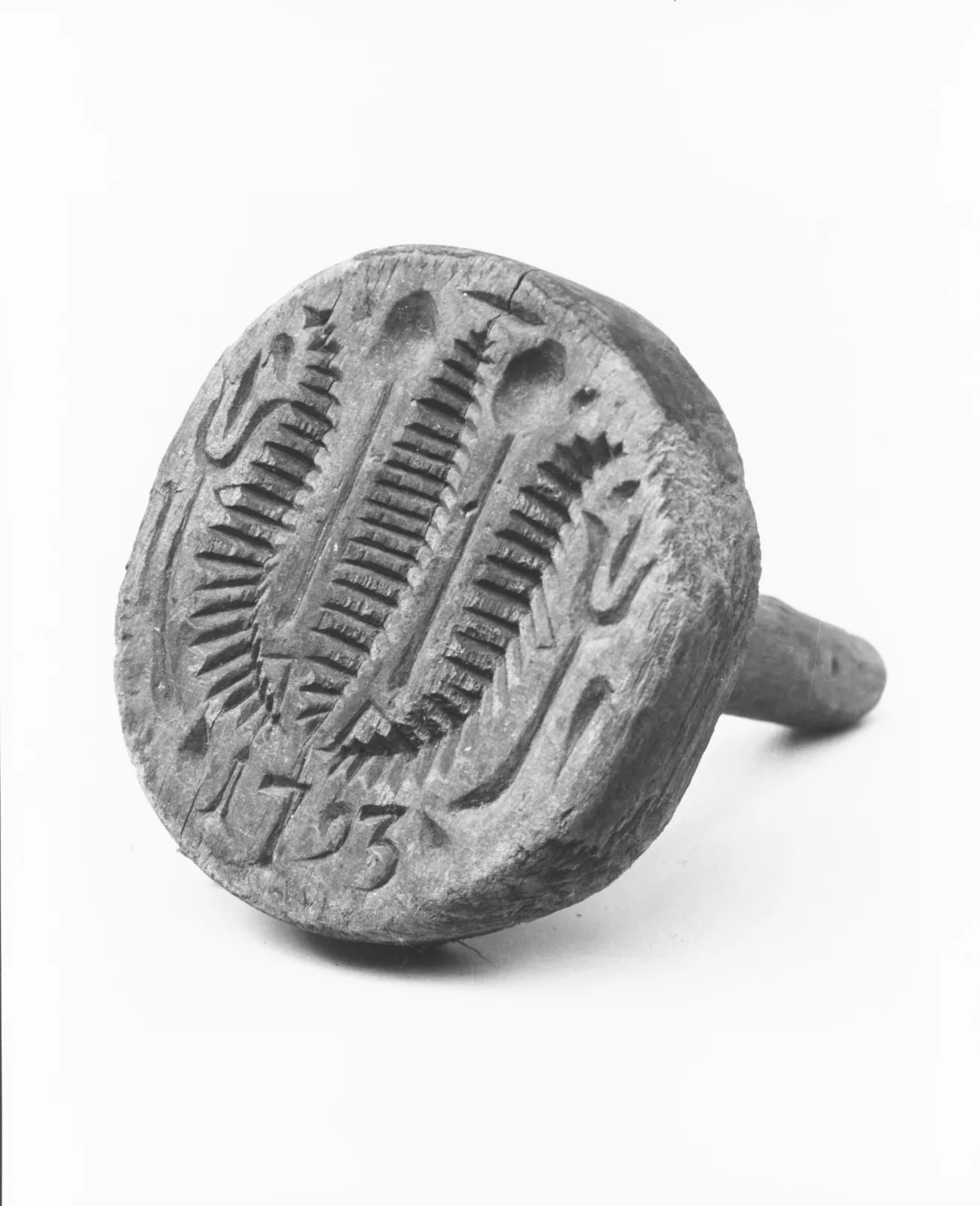
Early handcrafted plunger molds typically have slightly irregular cylindrical cups with visible tool marks on the interior. Factory-produced examples from the 1860s onward feature more uniform cups turned on a lathe, with smoother interior surfaces and more standardized dimensions.
Flat Butter Stamps
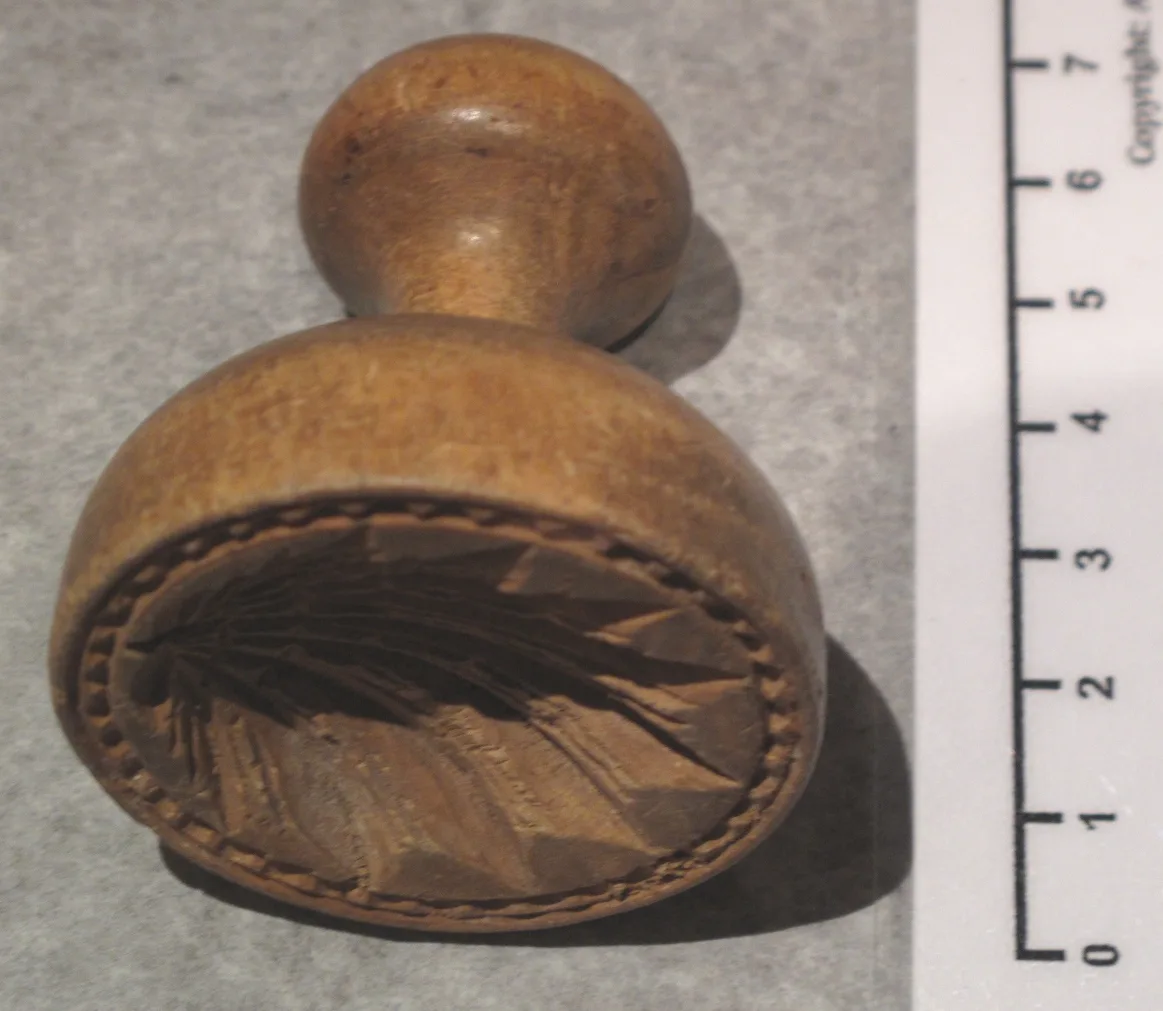
Butter stamps, also called butter prints, are flat circular or rectangular pieces of wood with a carved design on one face and a handle on the reverse. Unlike plunger molds, stamps do not shape the butter but simply impress a decorative pattern onto a pre-formed surface. These were often used for marking butter at market, allowing buyers to identify their preferred dairy's product. Stamps range from simple palm-sized rounds to large rectangular pieces designed for commercial butter blocks.
Case Molds (Box Molds)
Case molds or box molds are rectangular wooden boxes, typically dovetailed at the corners, with a removable carved insert in the bottom. Butter was pressed into the box, and the insert's carved design would appear on the top surface when the block was removed. These molds were especially popular in the northeastern United States and produced decorative one-pound butter blocks for market sale. Case molds from the 18th century are relatively rare and command premium prices.
Roller Molds
Roller molds feature a cylindrical barrel carved with a repeating pattern mounted on an axle with handles at each end. When rolled across a flat surface of butter, the roller impresses a continuous decorative band. These were primarily used for decorating large quantities of butter for commercial sale or hotel dining rooms. Roller molds are less common than plunger styles and are particularly prized by collectors for their elaborate continuous designs.
Lollipop Stamps
Named for their resemblance to a lollipop, these stamps feature a flat, circular carved disk mounted on a long turned handle. The extended handle made them practical for reaching into deep butter crocks or churns. Lollipop stamps are among the earliest American forms, with examples dating to the late 18th century. Their simple construction and distinctive profile make them popular display pieces.
Multi-Impression Molds
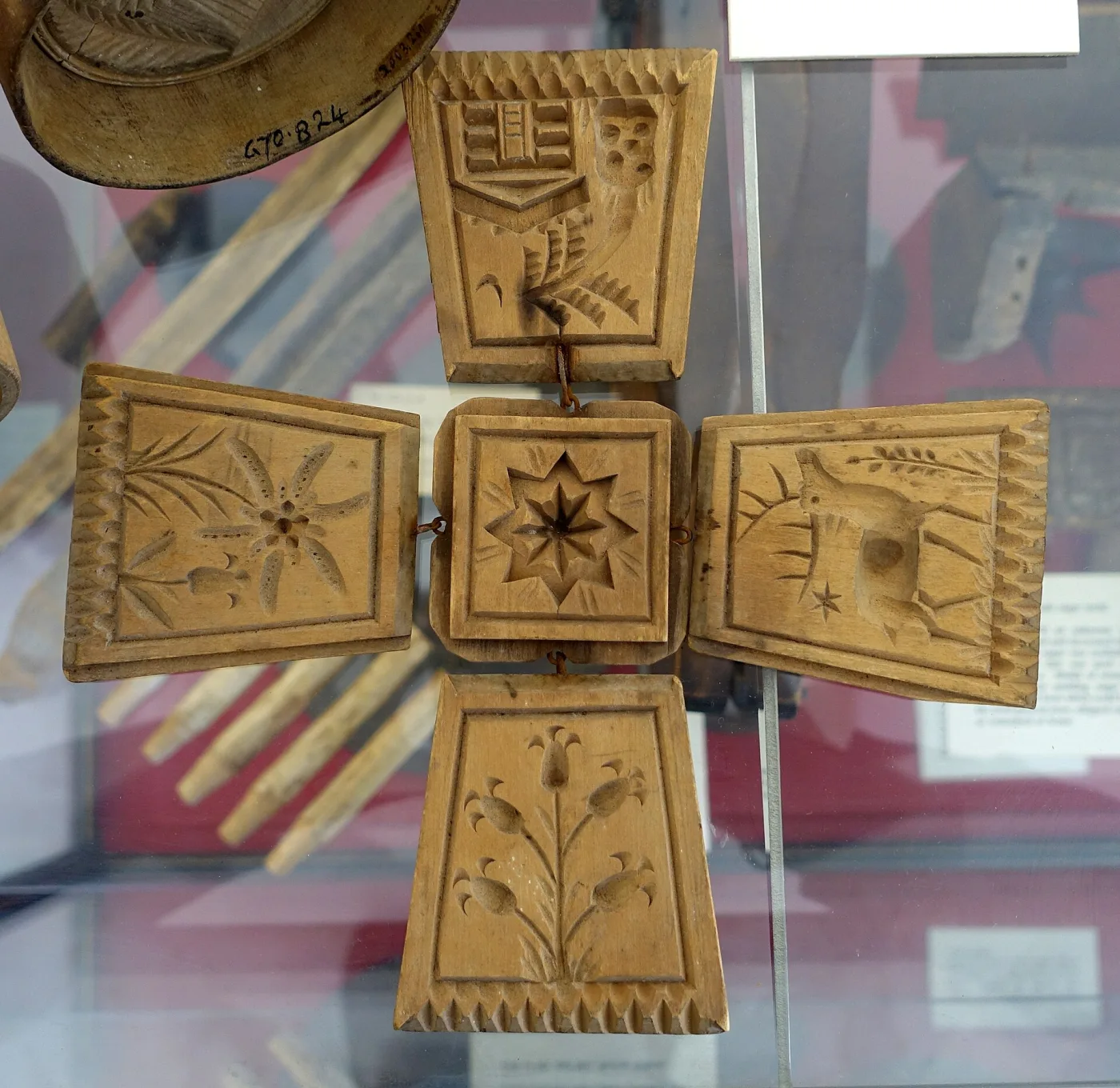
Some molds were designed to produce multiple butter pats at once, featuring several small carved designs arranged in a grid on a single large board or in a partitioned tray. These commercial-grade molds were used in hotels, restaurants, and large dairy operations during the late 19th century. While less common in collections, they represent an interesting transitional form between artisan and industrial butter production.
Common Patterns & Their Meanings
The carved designs on butter molds constitute a rich visual vocabulary with deep symbolic roots. Understanding these patterns helps collectors identify regional origins, estimate dates, and appreciate the cultural significance of individual pieces.
Botanical Designs
Floral and plant motifs are the most prevalent category of butter mold designs. The wheat sheaf, representing abundance and harvest prosperity, appears on more antique butter molds than any other single motif. Tulips, particularly the stylized Pennsylvania Dutch tulip, signify faith and happiness. Pineapples represent hospitality and welcome, while acorns and oak leaves symbolize strength and endurance. Clover designs denote good luck, and fern fronds, popular in Victorian-era molds, reflect the period's fascination with natural forms.
Roses appear frequently on European and American molds, often carved with remarkable botanical accuracy. Wild rose designs are associated with English and Scottish traditions, while more stylized rose patterns point to Germanic influences. Sunflowers, thistles, and grapevines each carry their own symbolic weight and regional associations.
Animal Motifs
Cows are a natural choice for dairy-related implements, and both realistic and stylized bovine portraits appear on many molds. Eagles, especially the American spread-wing eagle, became popular following the Revolution and remained a common motif throughout the 19th century. Roosters represent vigilance and dawn, swans suggest grace and fidelity, and fish denote Christianity or abundance depending on the cultural context.
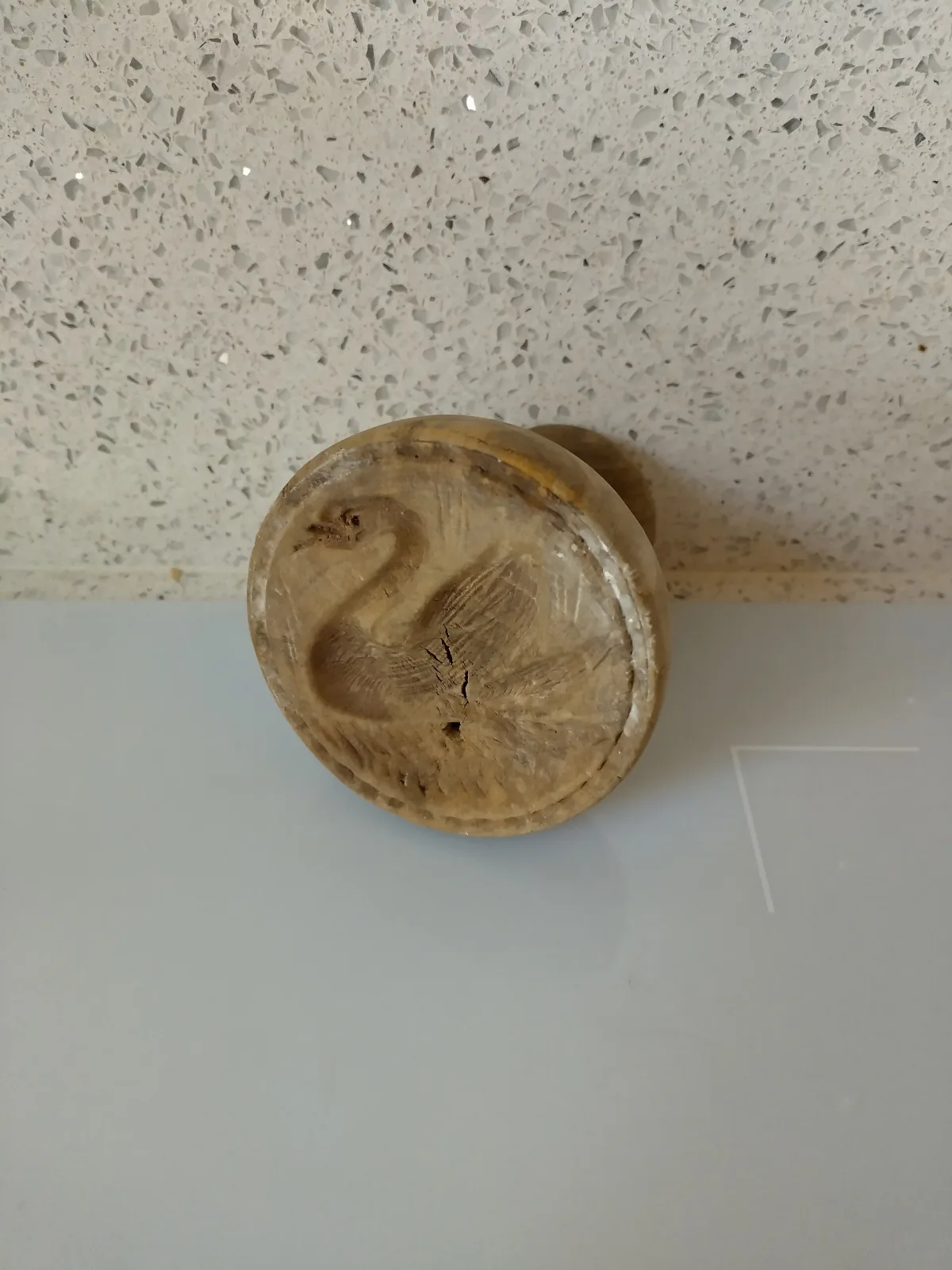
Deer and stag designs are particularly associated with Germanic and Alpine traditions, while sheep and lambs appear on pastoral-themed molds from English and Welsh dairying communities. Birds, especially paired doves, frequently appear on molds intended as wedding or engagement gifts.
Geometric Patterns
Stars, particularly six-pointed hex stars, are strongly associated with the Pennsylvania Dutch tradition and carry protective symbolic meaning. Compass roses, pinwheels, and radiating sunburst patterns also appear frequently. Simple crosshatch patterns and concentric ring designs are characteristic of earlier, more utilitarian molds where the primary goal was grip and identification rather than decorative impact.
Symbolic and Fraternal Designs
Hearts symbolize love and appear on molds associated with courtship and marriage. Anchors represent hope and are common in coastal communities. Masonic symbols, including the square and compass, appear on molds made by or for lodge members. Patriotic symbols such as shields, flags, and liberty caps became popular during periods of national celebration and were especially common during centennial observances.
Wood Types & Material Identification
The wood species used in a butter mold provides important clues about its origin, age, and intended use. Because butter molds had direct contact with food, certain woods were preferred for their neutral taste, resistance to splitting, and fine grain that allowed detailed carving.
Maple
Hard maple (sugar maple) is the most common wood used in American butter molds, prized for its tight, even grain, hardness, and neutral flavor. Maple accepts fine carving detail well and resists warping when properly seasoned. Over time, maple butter molds develop a warm honey-gold patina from butter oils and handling. The majority of Pennsylvania and Ohio butter molds are carved from maple.
Walnut
Black walnut was a popular choice for butter molds in the Mid-Atlantic and Southern states. Its rich dark color provided a striking contrast to pale butter, and its close grain allowed for crisp carving detail. Walnut molds are generally considered more desirable than maple examples of comparable design quality, as walnut was sometimes reserved for presentation-grade pieces.
Fruitwoods
Cherry, apple, and pear wood were commonly used for European butter molds and occasionally for American examples. Fruitwoods are dense, fine-grained, and impart no flavor to butter. Cherry wood molds develop a beautiful deep reddish-brown patina over time. European butter molds from Switzerland, Germany, and France frequently employ fruitwoods, making wood species an important indicator of origin.
Other Woods
Birch was commonly used in Scandinavian butter molds and occasionally in New England examples. Boxwood, extremely dense and fine-grained, was used for the most detailed miniature carvings, particularly on European stamp molds. Pine and poplar appear in some utilitarian molds, though their softer grain limits carving detail and durability. Teak and other tropical hardwoods are generally indicators of later commercial production or non-Western origins.

Regional Styles & Traditions
Butter mold designs and construction methods varied significantly by region, reflecting local carving traditions, cultural heritage, and market preferences. Regional identification is one of the most valuable skills a collector can develop.
Pennsylvania Dutch
Pennsylvania Dutch (German) butter molds are the most celebrated and widely collected American regional style. Characterized by bold, deeply carved designs with strong folk art influences, these molds typically feature tulips, hex stars, eagles, hearts, and stylized floral arrangements. The carving style tends toward flat, graphic compositions with clear outlines and moderate depth. Pennsylvania Dutch molds were often made from maple or walnut and are most commonly found in plunger and case mold forms.
Key identifiers include the distinctive "flat chip carving" technique where designs are composed of shallow, flat-bottomed cuts rather than deeply sculpted forms. Borders of geometric chip-carved patterns often surround the central motif. The finest examples display a sophisticated understanding of positive and negative space that gives the butter impression a striking graphic quality.
New England
New England butter molds tend toward more restrained, naturalistic designs compared to their Pennsylvania counterparts. Common motifs include realistic wheat sheaves, single flowers, pineapples, and simple geometric patterns. The carving is typically deeper and more three-dimensional, with rounded forms and careful attention to botanical accuracy. Birch and maple are the most common woods, and case molds are proportionally more common in New England collections than in other regions.
Midwestern
Ohio, Indiana, and Wisconsin butter molds reflect the mixed cultural heritage of settlers from New England, the Mid-Atlantic states, and Europe. Designs range from conservative geometric patterns to elaborate figurative scenes. The Midwest produced a large quantity of commercially manufactured molds during the late 19th century, many featuring machine-turned cups with hand-carved plunger designs. Cow and dairy scene motifs are particularly associated with Midwestern production.
British and Scottish
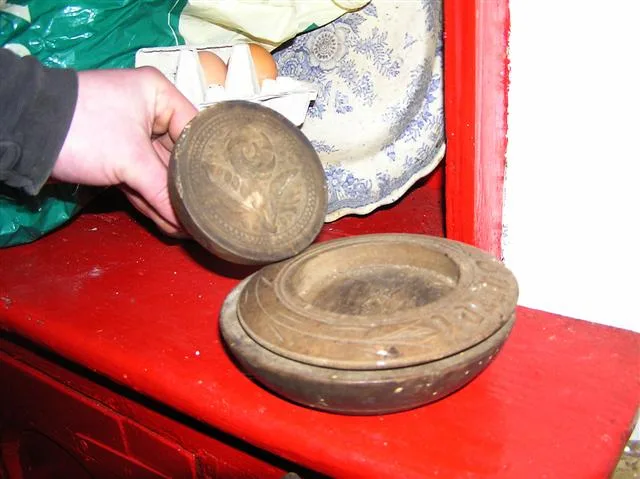
British butter molds are distinguished by their use of sycamore wood (known as "butter wood" in Britain), thistle patterns for Scottish examples, rose designs for English pieces, and leek or daffodil motifs for Welsh molds. British molds tend to be smaller than American examples, reflecting different standard butter weights. Scottish shortbread molds, while not technically butter molds, are closely related and sometimes confused with them in the market.
Scandinavian
Norwegian, Swedish, and Finnish butter molds feature distinctive interlaced geometric designs, stylized animal forms, and occasionally runic-inspired patterns. Birch is the predominant wood, and many Scandinavian molds have flat rectangular forms rather than the circular shapes common in American and British traditions. The carving tends to be shallow and precise, with designs that echo the region's broader decorative arts traditions.
Dating Antique Butter Molds
Establishing the approximate age of a butter mold requires examining multiple physical characteristics and contextual clues. No single feature provides a definitive date, but the combined evidence from construction, design, wear, and patina allows experienced collectors to estimate age within a reasonable range.
Construction Indicators
Hand-carved molds with visible tool marks, slightly irregular forms, and individual character generally predate 1860. The transition from entirely handcrafted production to partially mechanized manufacturing occurred gradually from the 1850s through 1880s. Lathe-turned cups with perfectly cylindrical interiors indicate post-1850 production, though the plunger designs on these later molds were still frequently hand-carved.
Dovetail joints on case molds provide useful dating evidence. Hand-cut dovetails with irregular spacing and pin sizes suggest pre-1870 construction, while machine-cut dovetails with uniform dimensions indicate later manufacture. The number and size of dovetails also evolved over time, with earlier examples typically featuring fewer, larger dovetails.
Design Evolution
Patriotic motifs like eagles and shields became common after the Revolutionary War period and experienced resurgences during the War of 1812, the Centennial of 1876, and other national celebrations. The complexity and naturalism of carved designs generally increased throughout the 19th century, with later molds often displaying more detailed and realistic carving compared to the bold, graphic style of earlier examples.
Victorian-era molds (1860s-1890s) often feature naturalistic floral arrangements, fern fronds, and pastoral scenes with greater depth and detail than earlier folk art styles. Art Nouveau influences occasionally appear on molds from the 1890s-1910s, while the simplest geometric designs can be the earliest or the most utilitarian examples from any period.
Patina and Wear
Genuine age-related patina on butter molds results from decades of contact with butter fat, handling, and exposure to air. Authentic patina appears as a warm, golden-amber tone that penetrates the wood surface rather than sitting on top. The carved recesses should show darker accumulation of butter residue that has oxidized over time. Wear patterns should be consistent with use: the plunger handle should show smooth wear from gripping, the cup rim should show slight rounding from butter packing, and the carved design should show subtle softening of sharp edges.
Notable Makers & Manufacturers
While most antique butter molds are anonymous folk art creations, several individual carvers and commercial manufacturers have been identified through research, marks, and documented provenance.
Individual Carvers
A small number of skilled butter mold carvers have been identified by name through family records, inscriptions, and stylistic analysis. John Bell of Waynesboro, Pennsylvania is among the most recognized, known for his distinctive deeply carved eagle and floral designs produced in the mid-19th century. Other documented carvers include members of the Seltzer family in the Mahantongo Valley of Pennsylvania, whose bold geometric designs are highly sought after.
Attribution to specific carvers remains challenging, as butter mold production was rarely a full-time profession. Most carvers were farmers, woodworkers, or craftsmen who produced molds as a sideline. Regional carving traditions, rather than individual makers, typically provide the most useful framework for identification and classification.
Commercial Manufacturers
By the 1860s, several firms were producing butter molds on a commercial scale. The Porter Blanchard Company of Nashua, New Hampshire manufactured a wide range of dairy implements including standardized butter molds with both machine-turned and hand-carved components. Their products were sold through agricultural supply catalogs and general stores throughout New England and the Midwest.
The Arcade Manufacturing Company of Freeport, Illinois produced cast iron and wooden dairy equipment including butter molds in the late 19th century. Other notable manufacturers include the Reid Company of Philadelphia and various smaller regional producers whose products can sometimes be identified through catalog illustrations and period advertising.
Maker's Marks
Marked butter molds are uncommon but not unknown. Some commercial manufacturers stamped their products with brand names or patent dates, and a few individual carvers inscribed their initials or names on their work. Patent dates, when present, provide valuable terminus post quem dating evidence. Always examine the handle, the cup exterior, and the bottom of case molds for any inscriptions, stamps, or branded marks.
Construction Methods & Techniques
Understanding how butter molds were made helps collectors distinguish between different periods and origins, and is essential for separating genuine antiques from modern reproductions.
Carving Techniques
The carved designs on butter molds were produced using a combination of gouges, chisels, and knives. Intaglio carving, where the design is cut into the wood surface so it appears raised on the butter, is the standard technique. The depth, precision, and style of carving reflect both the skill of the carver and the tools available. Hand-carved designs show subtle irregularities, slightly varying depths, and individual character that distinguish them from machine-produced work.
Chip carving, a technique where small triangular or geometric chips are removed from the wood surface, was commonly used for borders and geometric patterns, particularly in the Pennsylvania Dutch tradition. Relief carving, where the background is removed to leave the design standing proud, was used for the most elaborate pictorial compositions and is characteristic of higher-quality molds.
Turning and Assembly
Plunger-style molds require careful turning on a lathe to create the cup and plunger components that fit together precisely. Early examples show evidence of hand-powered lathe work, while later 19th-century pieces display the smoother, more uniform results of powered machinery. The fit between plunger and cup should allow easy insertion while maintaining close enough tolerances to produce clean butter edges. Loose or overly tight fits may indicate mismatched components or later modifications.
Joinery in Case Molds
Case molds employ traditional woodworking joinery, most commonly dovetails, to construct the rectangular box form. The quality of joinery reflects both the maker's skill and the intended market. Fine, closely spaced dovetails suggest a skilled craftsman and a presentation-grade piece, while crude or widely spaced joints indicate a more utilitarian purpose. Some later case molds use simple butt joints reinforced with nails, indicating commercial production where speed was prioritized over craftsmanship.
Authentication & Detecting Reproductions
The popularity of antique butter molds has inevitably led to the production of reproductions and outright fakes. Developing the ability to distinguish genuine antiques from modern copies is essential for any serious collector.
Signs of Authenticity
Genuine antique butter molds display a constellation of age-related characteristics that are difficult to convincingly replicate. Authentic patina develops gradually over decades, creating a warm amber tone with deeper coloring in recessed areas where butter residue has accumulated and oxidized. The wood surface should show micro-cracking consistent with age-related drying, and any exposed end grain should display characteristic shrinkage patterns.
Wear patterns on authentic molds are consistent and logical. Handles show smooth wear from repeated gripping, cup rims display slight rounding from butter packing, and the carved design shows gradual softening of originally sharp edges. The underside and interior surfaces often retain traces of dried butter residue that fluoresces differently under ultraviolet light compared to modern wax or oil treatments used to fake patina.
Red Flags for Reproductions
Modern reproductions often fail in several characteristic ways. Artificially aged surfaces frequently display uniform staining that lacks the natural variation of genuine patina. Machine-carved designs, even when deliberately roughened, typically show a mechanical regularity absent in handwork. New wood that has been artificially darkened with stain or chemical treatments often shows inconsistent color at joints, end grain, and areas of later handling.
Suspiciously pristine carving on supposedly old molds is a significant warning sign, as genuine 19th-century molds should show at least subtle softening of design edges from use and cleaning. Conversely, artificially distressed molds may show wear in illogical locations, such as heavy abrasion on protected interior surfaces that would not normally experience contact.
Scientific Testing
For high-value purchases, scientific analysis can provide additional authentication evidence. Wood identification through microscopic examination can confirm species consistency with claimed origin. Ultraviolet light examination reveals differences between natural patina and applied stains. Carbon-14 dating, while expensive, can definitively establish the age of the wood, though it cannot determine when the mold was carved from that wood.
Condition Assessment & Grading
The condition of a butter mold significantly impacts its market value, and understanding the factors that affect condition grading helps collectors make informed purchasing decisions.
Excellent Condition
Molds in excellent condition retain sharp, well-defined carving detail with only minimal softening from normal use. The wood is sound with no cracks, splits, or insect damage. Original components are complete and properly fitted. Patina is consistent and attractive, with natural color variation reflecting decades of use. Excellent condition molds command premium prices, typically 2-3 times the value of comparable examples in average condition.
Good Condition
Good condition molds show moderate wear to the carved design with some loss of fine detail, but the overall pattern remains clearly readable. Minor age-related cracks that do not affect structural integrity are acceptable. Slight warping, small chips to cup rims, and evidence of old minor repairs are consistent with good condition. Most collectible butter molds fall into this category.
Fair to Poor Condition
Molds in fair condition may have significant design wear, noticeable cracks or splits, missing components (such as a lost plunger from a cup), insect damage, or evidence of substantial later repairs. While fair condition molds may still be worthwhile acquisitions if the design is rare or the provenance significant, they typically sell for 50-75% below comparable examples in excellent condition.
Current Market Values
The market for antique butter molds spans a wide price range, from affordable entry-level pieces to museum-quality examples commanding thousands of dollars. Understanding the factors that drive value helps collectors set realistic budgets and recognize opportunities.
Value Factors
Design quality is the single most important value determinant. Deeply carved, detailed, and artistically sophisticated designs command significantly higher prices than simple geometric patterns. Unusual or rare motifs, such as detailed figural scenes, portraits, or complex multi-element compositions, are especially desirable. The type of mold also matters: lollipop stamps and early case molds typically command higher prices than standard plunger molds of comparable quality.
Regional attribution to desirable collecting areas, particularly the Pennsylvania Dutch region, adds value. Documented provenance to specific farms, families, or carvers increases value substantially. Size matters as well: oversized molds and miniatures both tend to command premiums over standard-sized examples.
Price Ranges
Simple geometric design plunger molds in good condition typically sell for $50-$150. Well-carved floral or botanical designs range from $150-$500. Elaborate figural designs, eagles, and complex multi-motif compositions command $500-$2,000. Exceptional museum-quality examples with documented provenance, rare forms, or masterful carving can exceed $3,000-$5,000 at major auction houses. Early case molds from the 18th century, regardless of design complexity, generally start at $300 and can reach $2,000 or more for fine examples.
Market Trends
The butter mold market has shown steady appreciation over the past decade, driven by growing interest in American folk art and farmhouse decorating trends. Pennsylvania Dutch examples and pieces with strong graphic designs suitable for display have seen the most significant price increases. Simple utilitarian molds have remained relatively stable in value, making them accessible entry points for new collectors.
Care & Preservation
Proper care ensures that antique butter molds retain their beauty and value for future generations. Because these are wooden objects that were designed for contact with food and moisture, they have specific preservation needs.
Storage and Display
Store butter molds in a stable environment with moderate temperature and humidity, avoiding attics, basements, and areas subject to extreme fluctuations. Direct sunlight will bleach the patina and cause wood to crack, so display locations should be out of prolonged direct sun exposure. Museum wax or small easels work well for secure display of individual pieces, while shadow boxes protect collections from dust and handling while allowing visual appreciation.
Cleaning
Clean butter molds gently with a soft, dry brush to remove loose dust and debris from carved recesses. Avoid water, which can raise the wood grain, cause swelling, and damage patina. Never use household cleaning products, bleach, or solvents on antique butter molds. If deeper cleaning is needed, a barely damp cloth followed by immediate thorough drying is the maximum intervention that should be attempted without professional conservation guidance.
Preservation
Do not oil, wax, or apply any surface treatment to antique butter molds without expert advice. Modern finishes can trap moisture, alter patina, and decrease both historical integrity and market value. If a mold shows active insect damage (fresh frass or exit holes), isolate it immediately and consult a conservator. Freezing treatment at -20°F for 72 hours can eliminate active infestations without chemical treatments.
Building Your Collection
Starting a butter mold collection is an accessible and rewarding pursuit that can be tailored to almost any budget and interest level.
Getting Started
Begin by handling as many authentic examples as possible at antiques shows, shops, and museum collections. Developing a tactile and visual familiarity with genuine patina, carving quality, and construction methods is the most effective way to build authentication skills. Purchase a few reference books on butter molds and folk art to build your knowledge base before making significant purchases.
Collecting Strategies
Many collectors focus on specific themes: a particular motif (such as eagles or wheat sheaves), a regional style (Pennsylvania Dutch, New England, Scandinavian), a mold form (all lollipop stamps or all case molds), or a time period. Thematic collecting provides focus and helps develop deep expertise in a specific area. Others build more eclectic collections that showcase the breadth and diversity of butter mold traditions.
Where to Buy
Country auctions in rural areas of the northeastern and midwestern United States remain productive hunting grounds for butter molds. Online auction platforms have expanded access to the market but require extra caution regarding authentication. Established antiques dealers who specialize in folk art or Americana are reliable sources for quality examples with accurate attributions. Antiques shows, particularly those focused on Americana and folk art, offer opportunities to examine pieces in person and build relationships with knowledgeable dealers.
Estate sales in dairy farming regions often produce butter molds that have remained in families for generations, sometimes at below-market prices. Joining collector organizations and online forums provides access to private sales, educational resources, and mentorship from experienced collectors.