Spongeware Pottery Identification Guide: Sponging, Origin & Dating
Spongeware is the broad family of nineteenth- and early twentieth-century pottery decorated by dabbing or stamping colour onto the body with a natural sponge or a cut-sponge stamp. Cheap to produce, cheerfully colourful, and made for everyday use rather than display, it furnished farmhouse dressers and emigrant kitchens from rural Ireland to the American frontier. Today the same qualities that once made spongeware ordinary — bold informal pattern, soft handling of colour, honest utility forms — drive a focused collectors' market that prizes early Scottish cut-sponge plates, Staffordshire export bowls, and American blue-on-white pantry pieces. Reading a sponged surface correctly means understanding the technique, the body beneath it, and the regional traditions that produced it.
The word "spongeware" has been used loosely for almost two centuries, often interchangeably with "spatterware," "stick spatter," and "sponged ware." Each label points to a different application method: a torn natural sea-sponge dabbed by hand, a sponge cut into a geometric or floral stamp, a brush flicked through a stencil, or paint blown through a tube. The visual results overlap, which is why so much spongeware is misattributed. This guide separates the techniques, walks through the principal production centres in Scotland, England, Wales, Ireland, and the United States, and explains how to date a sponged piece by its body, its mark (when present), and the character of the sponging itself. It builds on the broader framework set out in our antique ceramics and pottery identification guide.
By the end you will be able to distinguish a cut-sponge Scottish dairy bowl from a Staffordshire stick-spatter export plate, place a piece within a thirty-year window using body type and palette, recognise modern reproductions, and apply realistic value expectations to anything from a £15 chipped saucer to a four-figure rare cut-sponge platter.
Table of Contents
- A Brief History of Spongeware
- Sponging Techniques: Cut, Free-Hand & Stick
- The Body Beneath the Sponge
- Colour Palette and Dating Clues
- Scottish Spongeware
- Staffordshire and English Spongeware
- Welsh and Irish Production
- American Spongeware
- Forms and Functional Categories
- Backstamps, Pattern Numbers & Unmarked Pieces
- Common Cut-Sponge Patterns
- Spongeware vs. Spatterware vs. Stick Spatter
- Export Markets and Emigrant Trade
- Reproductions and Modern Spongeware
- Condition, Damage & Restoration
- Value Factors and Price Ranges
- Building a Spongeware Collection
- Care, Display & Preservation
A Brief History of Spongeware
Spongeware grew out of the search for cheap, decorative tableware that ordinary households could afford. By the 1820s Staffordshire potters were experimenting with rapid decoration techniques to compete with the cost of hand-painted and even transfer-printed wares, and the natural sea-sponge — pliant, absorbent, leaves a soft mottled mark — was an obvious tool.
Origins in the 1820s
The earliest sponged decoration appears on Staffordshire pearlware in the 1820s. Loose dabs of cobalt blue around rims gave finished plates a decorative border at a fraction of the cost of hand-painted or transferred designs. The technique remained marginal until the cut-sponge stamp was developed.
The Cut-Sponge Innovation (1840s)
Cutting a natural sponge into a geometric or floral shape — typically by trimming it with shears, then pressing it onto an iron block — produced a reusable stamp that could be inked and applied repeatedly. The technique is widely credited to Scottish potters in Bo'ness and Glasgow in the 1840s, although Staffordshire workshops adopted it almost simultaneously. The result revolutionised cheap pottery decoration and gave spongeware its characteristic repeating-motif look.
Golden Age (1850–1900)
From the mid-nineteenth century through to the turn of the twentieth, spongeware was produced in vast quantities for domestic use and export. Scottish potteries shipped to North America, Canada, and the colonies. Staffordshire factories supplied tropical markets in the Caribbean, West Africa, and South-East Asia, where bright sponged decoration suited local taste. American potters in Ohio, Pennsylvania, and New Jersey produced their own utilitarian spongeware for the domestic market.
Decline and Survival (1900–1930)
The early twentieth century brought a slow decline. Cheaper transfer-printed tableware, then mass-produced industrial whiteware, replaced spongeware on most tables. Scottish production continued at a reduced scale until the 1930s; Bo'ness ware was still being made into the 1920s. American utilitarian spongeware persisted longer in pantry crock forms before fading after the Depression.
Revival and Studio Production
From the 1970s onward, studio potters and country-style décor manufacturers have produced new sponged pottery in nineteenth-century styles. Modern Henn pottery, Polish Bolesławiec stoneware, and various craft revivals all use sponging techniques. Distinguishing period spongeware from modern revival pieces is the central authentication problem in the field.
Sponging Techniques: Cut, Free-Hand & Stick
The application method is the first thing to read on any sponged piece. Each technique leaves a characteristic mark and points to a different production tradition.
Free-Hand Sponging
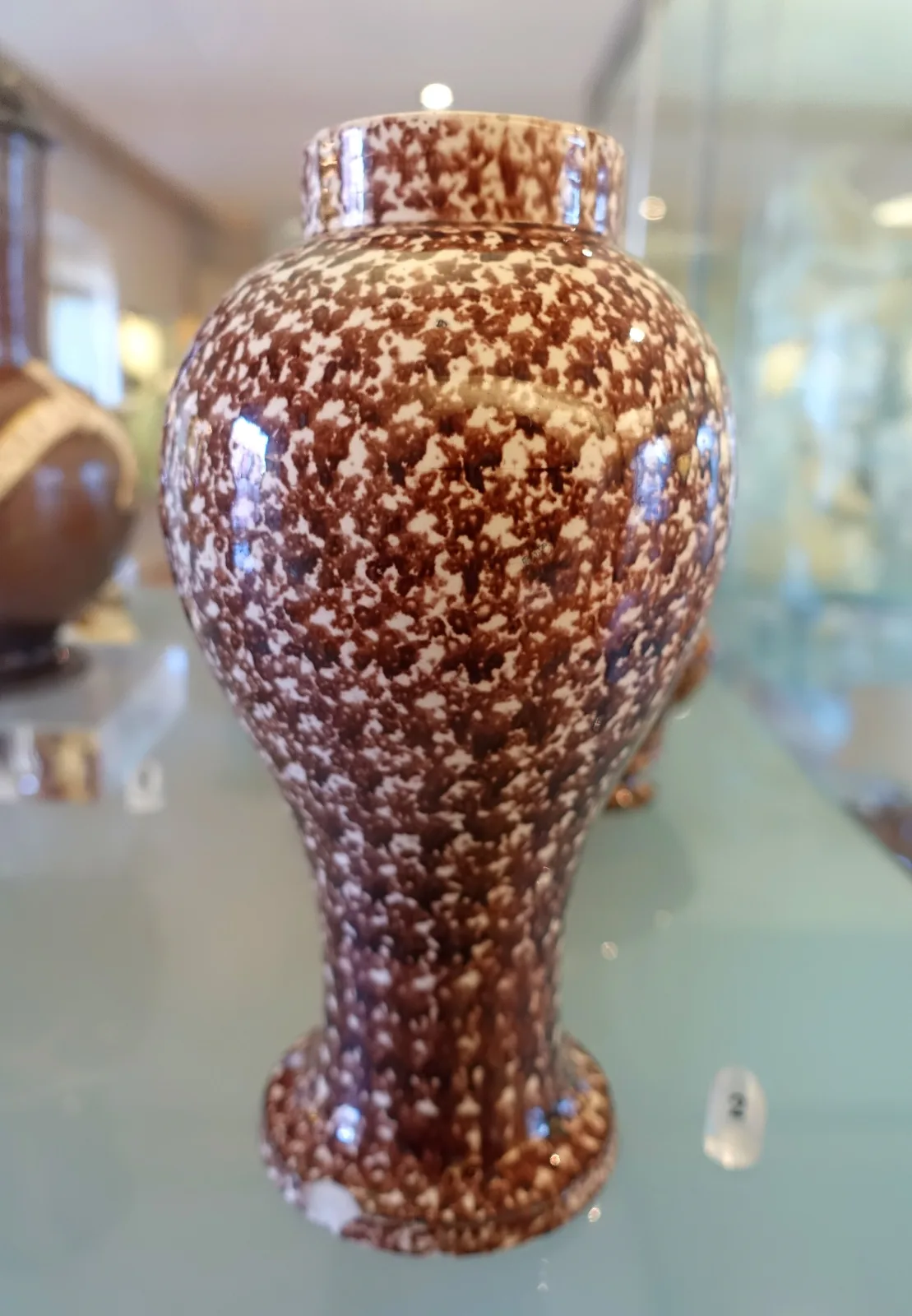
The simplest method: a torn or naturally-shaped piece of sea sponge is dipped in colour and dabbed onto the pottery surface. The result is an irregular, organic mottled pattern with soft edges and visible sponge pore texture. Free-hand sponging covers rims, borders, or sometimes entire bodies in a single colour. Most American utilitarian spongeware uses this method.
Cut-Sponge Stamping
A natural sponge is cut into a defined shape — a four-petal flower, an eight-pointed star, a leaf, a geometric rosette — and used as a stamp. The cut sponge holds colour like a brush and prints a recognisable repeating motif when applied to the body. Cut-sponge decoration is the hallmark of Scottish and Welsh spongeware and the most artistically sophisticated form of the technique. Look for slightly soft, ragged edges that distinguish a sponge print from a sharp printed or stencilled mark.
Stick Spatter
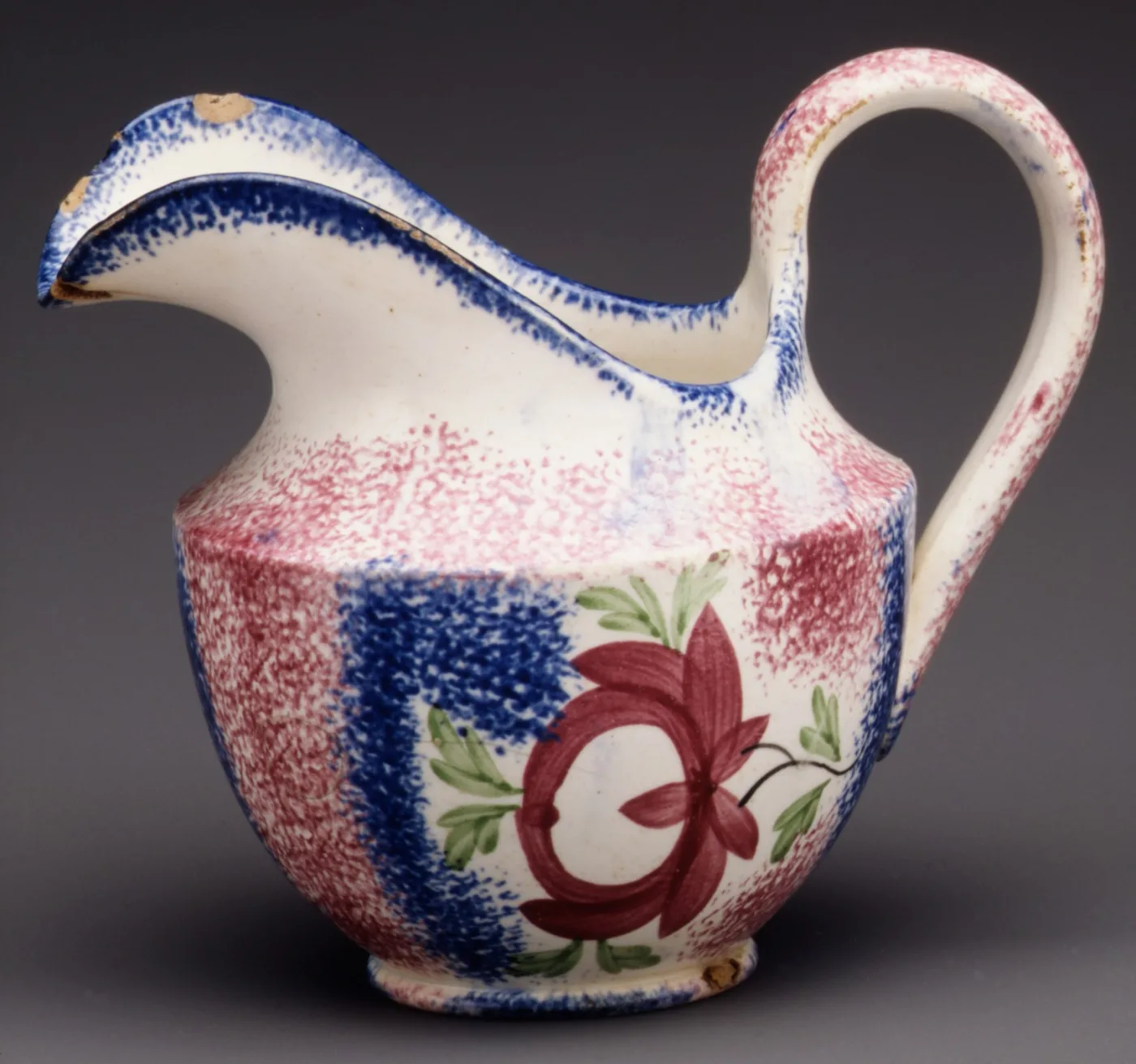
Colour is loaded onto a stick or brush, then flicked or tapped against the rim to produce a spray of fine droplets. Stick spatter often appears as a border framing transfer-printed centres. The Staffordshire export trade to Latin America used the technique extensively. Stick spatter is finer-grained and more random than sponging proper.
Combined Techniques
Many pieces combine methods: a cut-sponge border with a hand-painted central motif, free-hand sponging on a rim with a transfer-printed scene at the centre, or stick spatter with cut-sponge accents. Reading a piece means identifying every technique present and not stopping at the first one you see.
Underglaze vs. Overglaze
Most period spongeware is underglaze-decorated — the colour was applied to the bisque body and then sealed under a clear glaze. Underglaze sponging is permanent and shows no surface wear over time. Overglaze sponging (rare) sits on top of the glaze and shows abrasion at handling points. Most overglaze "spongeware" is twentieth-century revival or studio work.
The Body Beneath the Sponge
Strip the decoration mentally and look at the unglazed foot ring: the body itself tells you almost as much as the sponging. Cross-reference this section with the broader treatment in our creamware and pearlware identification guide.
Pearlware Bodies (1820s–1840s)
The earliest sponged Staffordshire is pearlware — a fine creamy earthenware with a faintly bluish glaze produced by cobalt added to the lead glaze. Pearlware bodies are thin, light in the hand, and show bluish pooling in recesses and around foot rings. Pearlware spongeware is the rarest and most desirable substrate.
Whiteware (1840s–1900)
From the 1840s onward, whiter and harder pottery bodies replaced pearlware. Mid-nineteenth-century spongeware sits on whiteware — true white earthenware without the cobalt-tinted glaze. The body is slightly heavier than pearlware, ringing dully when tapped. This is the most common spongeware body.
Ironstone and Granite Ware (1850–1900)
Heavier ironstone bodies were used for export and utility spongeware where durability mattered. Ironstone spongeware is noticeably thicker and harder-ringing than whiteware. Compare the body characteristics described in our ironstone china identification guide.
Yellow Ware Bodies
American utilitarian spongeware was sometimes built on a yellow ware body — a buff-yellow stoneware-like earthenware. Look for the buff tone at the foot ring beneath a clear or coloured glaze. Sponged yellow ware bowls and crocks are documented in our yellow ware identification guide.
Stoneware Bodies
Large American pantry spongeware crocks and jugs were sometimes thrown in salt-glazed or Bristol-glazed stoneware. The body is grey or buff under the glaze, dense, and rings hard. The crossover with utilitarian stoneware crocks is substantial.
Reading the Foot Ring
Always examine the unglazed foot ring. Body colour, grain density, and any kiln-stilt marks reveal the substrate beneath the glaze and place the piece in its correct ceramic family.
Colour Palette and Dating Clues
Spongeware palettes shifted decade by decade as new pigments became available and as fashion changed. The colours present on a piece are a strong dating indicator.
Cobalt Blue (Throughout)
Cobalt blue is the most enduring spongeware colour, used from the earliest pearlware pieces in the 1820s through to twentieth-century production. Cobalt alone does not date a piece, but the shade does — early cobalt tends to be deeper and more variable, later cobalt more uniform.
Red and Pink (1840s onward)
Iron-based reds and chromium pinks appear from the 1840s onward. Bright "tomato" reds were popular on Scottish cut-sponge plates from the 1850s. The presence of red without cobalt blue is unusual in the early period — most pieces combine red with at least one other colour.
Green (1850s onward)
Chrome-based greens entered the palette in the 1840s and became common from the 1850s. Bright spring greens identify mid-Victorian production.
Yellow (1860s onward)
Antimony yellow and uranium yellow appear later, mainly from the 1860s onward. Bright clear yellows on cut-sponge work indicate a piece from the second half of the nineteenth century. Uranium yellow fluoresces under UV and is a useful authentication tell.
Black, Brown, and Manganese Purple
Manganese-based purples and browns appear on Scottish and Staffordshire export work. Black sponging is uncommon and tends to indicate Welsh or specific commemorative work.
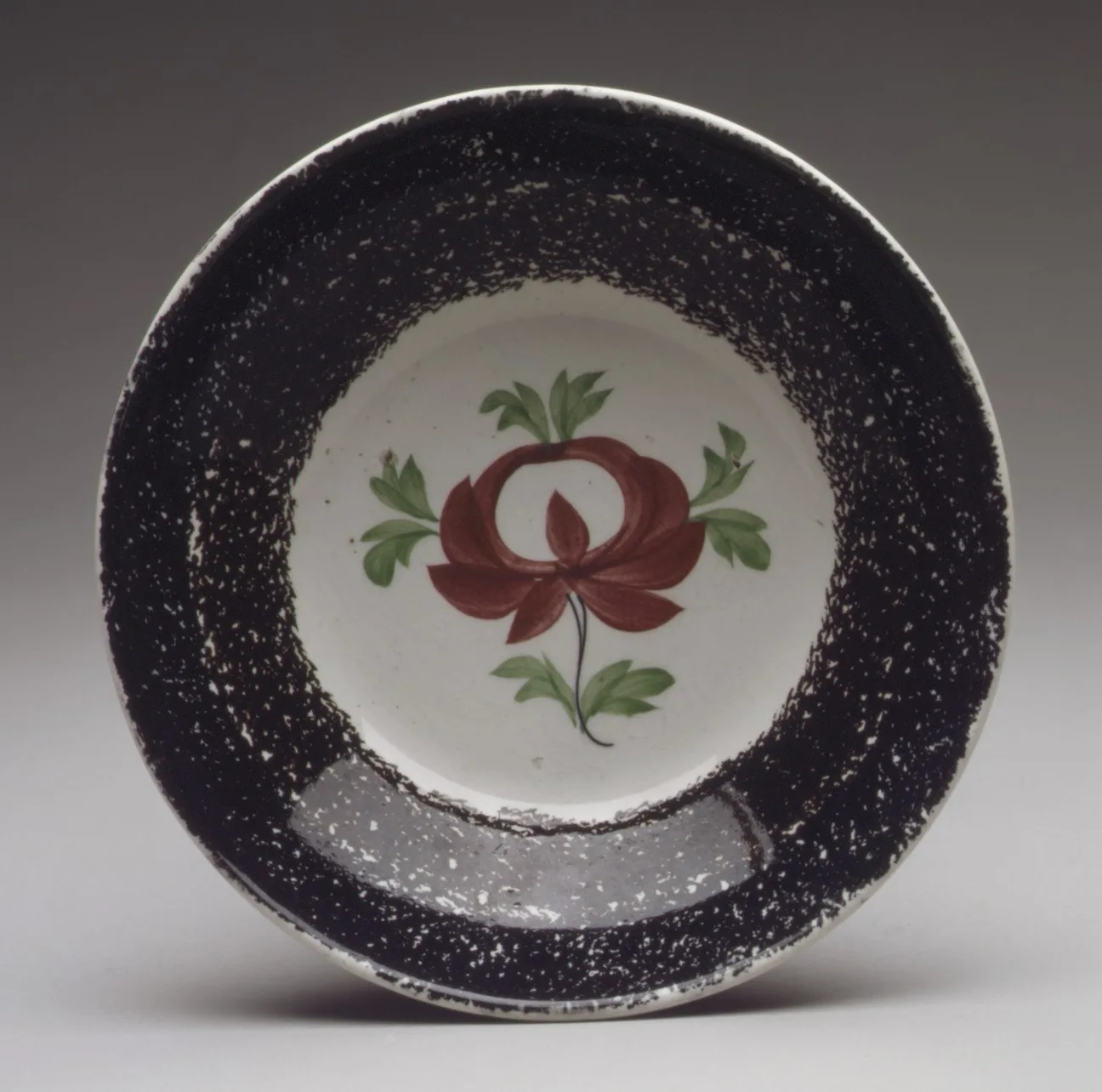
Multi-Colour Combinations
A piece with three or more sponged colours is almost always post-1860 and typically Scottish or Welsh export work. Simple two-colour palettes (cobalt with one accent) are characteristic of earlier and American production.
Scottish Spongeware
Scotland is the spiritual home of cut-sponge ware. From the 1840s into the 1920s, more than a dozen Scottish potteries produced cut-sponge decorated tableware for domestic use and a vast emigrant export trade.
Bo'ness Pottery
The Bo'ness potteries on the Firth of Forth produced cut-sponge ware from the 1830s through to the 1920s. Bo'ness pieces typically combine bold cut-sponge motifs with bright multi-colour palettes — cobalt, red, green, yellow — on whiteware plates and bowls. The factory continued cut-sponge production after most Scottish rivals had moved to printed wares, and Bo'ness output dominates the late nineteenth-century market.
Glasgow Potteries
Britannia Pottery, Possil Pottery, and the Saracen Pottery at Possilpark all produced cut-sponge ware from Glasgow. Britannia and Saracen pieces are often marked with the factory name; Possil pieces are typically unmarked. Glasgow output reached vast volumes for the Canadian and Australian emigrant market.
Kirkcaldy Potteries
The Methven, Heron, and Links potteries at Kirkcaldy in Fife produced distinguished cut-sponge ware from the 1840s through to the 1900s. Methven pieces are particularly valued for their crisp cut-sponge stamps and balanced palettes. Late Kirkcaldy work crosses into Wemyss Ware territory and includes some of the most artistically refined Scottish sponging.
Other Scottish Centres
Smaller production centres included Greenock, Portobello (Edinburgh), Dundee, and several Ayrshire potteries. Output from these smaller works is harder to attribute confidently and often passes simply as "Scottish spongeware."
Identifying Scottish Cut-Sponge
Crisp, well-defined cut-sponge stamps in three or more colours; whiteware body of moderate weight; rims often bordered with banded lines; central motifs sometimes hand-painted in addition to the sponged borders. The combination of multiple colours, crisp cut-sponge work, and good body quality is the Scottish signature.
Staffordshire and English Spongeware
Staffordshire was the largest producer of sponged decoration overall, though much of the output was destined for export rather than the British home market.
Early Staffordshire Sponged Pearlware
The earliest known sponged pieces — loose cobalt dabs around plate rims on pearlware — were produced in Staffordshire from the 1820s. These early pearlware pieces are scarce and command premium prices when authenticated.
Mid-Century Export Wares
From the 1840s Staffordshire potteries shipped sponged and stick-spattered tableware in vast quantities to Latin America, the Caribbean, West Africa, India, and South-East Asia. Bright multi-colour decoration suited tropical markets. The same potteries that produced fine bone china for the home market produced cheap sponged earthenware for export — often with no factory mark.
Major Staffordshire Producers
Adams, Cochran, Davenport, Furnival, Powell & Bishop, Edge Malkin, and many smaller Burslem and Hanley workshops produced spongeware. Identification often depends on impressed marks or registry numbers rather than the decoration itself. Many of these same firms produced the transferware documented in our dedicated guide.
Identifying Staffordshire Spongeware
Heavier whiteware or ironstone body; sponging often combined with transfer-printed centres; stick-spatter borders rather than pure cut-sponge work; backstamps if present typically include "ENGLAND" (1891 onwards) or "MADE IN ENGLAND" (1921 onwards) under the McKinley Tariff Act and subsequent customs requirements.
Welsh and Irish Production
Wales and Ireland both produced small but distinctive bodies of sponged pottery for domestic markets.
Welsh Spongeware
The Llanelly Pottery (sometimes spelled Llanelli) in Carmarthenshire produced cut-sponge ware from the mid-nineteenth century through the early twentieth. Llanelly pieces often combine cut-sponge borders with hand-painted central cockerel, bird, or floral motifs. The cockerel pattern is the most recognisable Welsh decoration. Welsh cut-sponge is regional rather than mass-export and tends to be smaller-scale than Scottish output.
Cambrian Pottery and Swansea
The Cambrian Pottery at Swansea produced sponged decoration alongside its better-known fine wares. Sponged pieces from Swansea are scarce and typically older (1820s–1840s).
Irish Spongeware
Belleek (better known for parian china), Belfast, and Dublin potteries all produced sponged earthenware for the Irish domestic market. Most Irish spongeware was actually made in Scotland or Staffordshire for the Irish trade rather than in Ireland itself. Genuine Irish-made spongeware is scarce and primarily found in Ulster.
Folk Pottery Crossover
The sponged decoration on Welsh and Irish pieces overlaps stylistically with broader European folk pottery traditions and with the country-pottery aesthetic catalogued in our folk art identification guide.
American Spongeware
American spongeware developed largely independently of the British tradition and uses different techniques, palettes, and forms.
Early American Production (1830s–1860s)
American potteries in Bennington (Vermont), East Liverpool (Ohio), Trenton (New Jersey), and the Pennsylvania German region produced sponged wares from the 1830s. Early American spongeware uses primarily free-hand sponging on whiteware or yellow ware bodies, with cobalt blue dominating the palette.
Ohio Valley Production (1860s–1900)
The Ohio River valley became the centre of American spongeware production after the Civil War. Potteries in Roseville, Zanesville, East Liverpool, and dozens of smaller works produced utilitarian sponged crocks, pitchers, mixing bowls, and pantry storage forms. Brush-McCoy, Burley-Winter, Red Wing, and Western Stoneware are well-known Ohio Valley producers whose sponged work occasionally appears alongside the better-known plain stoneware. Some American sponged pieces are catalogued under the broader McCoy pottery heritage.
Pantry and Kitchen Forms
American spongeware is heavily weighted toward functional kitchen forms: mixing bowls, batter jugs, milk pitchers, salt crocks, butter jars, washbowls. Decorative tableware (plates, teapots, saucers) is rarer than in British production. This functional emphasis reflects the practical American market for spongeware as a working kitchen utility rather than as decorative dressware.
The Blue-Sponged Bowl
The classic American spongeware piece is a white or yellow ware mixing bowl decorated with free-hand cobalt blue sponging around the exterior. These bowls were produced in vast quantities from the 1880s to the 1920s and form the backbone of American spongeware collecting today.
Red Wing and Western Stoneware
Twentieth-century Red Wing and Western Stoneware spongeware represents the late evolution of the tradition. Red Wing's brown-on-yellow spongeware crocks from the 1900s–1920s and Western Stoneware's blue-sponged pantry crocks from the same period are both collected in their own right.
Identifying American Spongeware
Heavier body (often stoneware or yellow ware); free-hand rather than cut-sponge decoration; predominantly cobalt blue palette; utilitarian kitchen forms rather than tableware; usually unmarked or marked with stoneware factory backstamps.
Forms and Functional Categories
Spongeware was made in virtually every domestic form. The specific form often points to origin and date as clearly as the decoration.
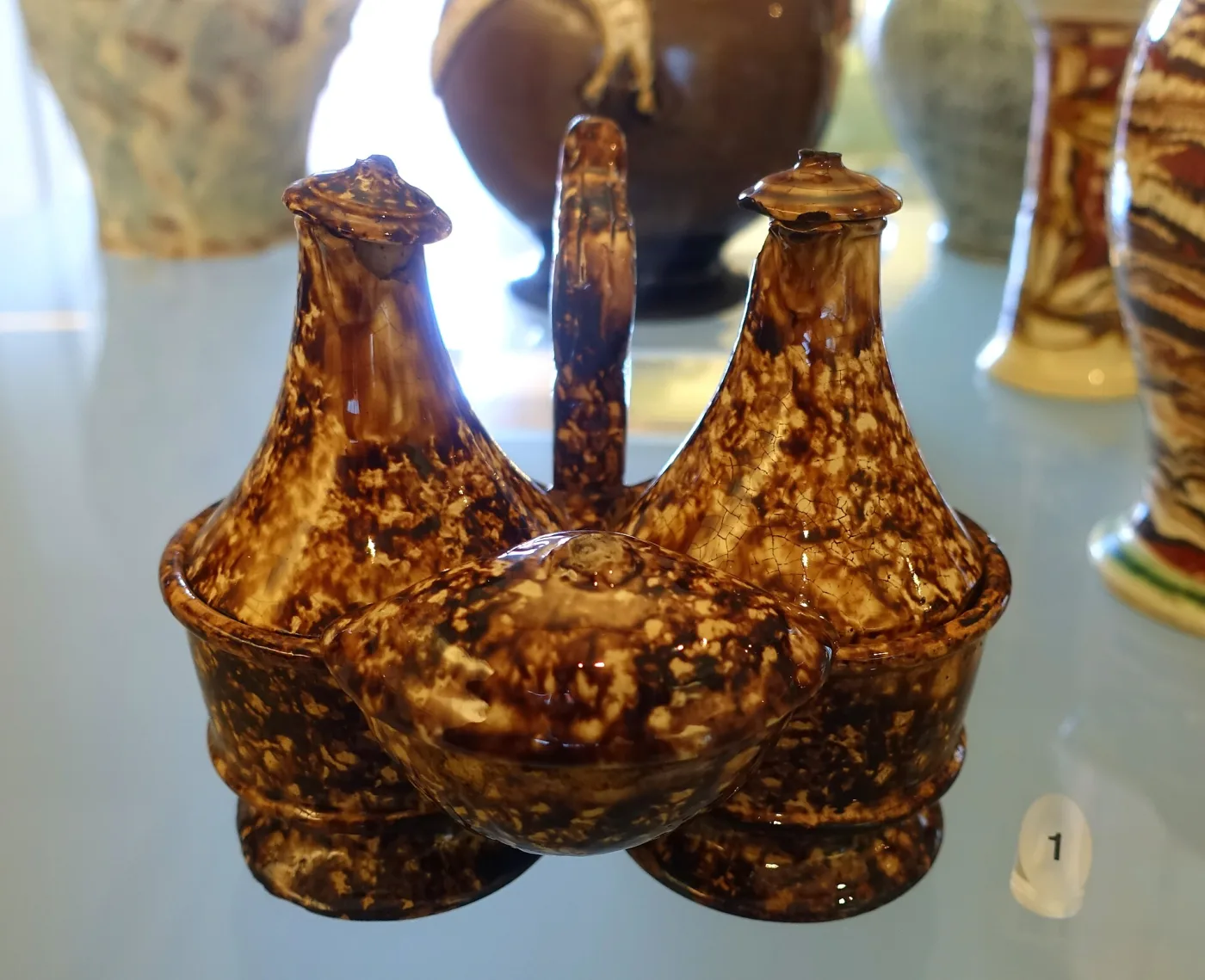
Plates and Saucers
Cut-sponge plates with banded rims and central motifs are the classic Scottish form. Sizes range from 6" tea plates to 14" platters. Scottish plates dominate; American plate spongeware is uncommon.
Bowls and Pitchers
Mixing bowls and water pitchers are the classic American utilitarian forms. Sponged bowls in graduated nests of three to six pieces are widely collected. Pitcher-and-bowl wash sets occur in both British and American production.
Teapots and Coffee Pots
Cut-sponge teapots are uncommon and prized. The complex form requires skilled sponging around the spout and handle without smearing. Welsh and Scottish teapots are the best-documented examples.
Children's and Miniature Wares
Doll-sized tea sets and children's nursery wares were produced in sponged decoration from the 1850s onward. Children's spongeware is a focused collecting subcategory with strong American interest.
Pantry Storage
American salt crocks, butter jars, cracker jars, and storage jars in spongeware are abundant and form the most affordable entry point to the field.
Wash and Toilet Sets
Pitcher-and-bowl washing sets, chamber pots, and matching toiletries appear in sponged decoration from the 1860s onward in both British and American production. Complete matching sets are scarce; single pieces are common.
Cuspidors and Spittoons
Sponged cuspidors were common saloon and household items in late nineteenth-century America. Their utilitarian (and unsavoury) function means surviving examples are usually well-used.

Backstamps, Pattern Numbers & Unmarked Pieces
Most spongeware is unmarked. The decoration was applied to inexpensive utility ware and many factories saw no commercial reason to brand the output. When marks do appear, they need to be read carefully.
Impressed Factory Marks
Major Scottish factories — Britannia, Saracen, Methven, Bo'ness — used impressed text marks giving the factory name. These appear on the base, often partly obscured by glaze. An impressed "BRITANNIA POTTERY GLASGOW" or "METHVEN KIRKCALDY" is the most reliable identification.
Printed Backstamps
Late nineteenth-century Staffordshire export pieces sometimes carry printed backstamps with the factory name and "ENGLAND" or "MADE IN ENGLAND." The country-of-origin requirement under the 1891 McKinley Tariff Act and subsequent updates gives a useful dating anchor.
Pattern Numbers
Some Scottish potteries assigned pattern numbers to their cut-sponge designs. Numbers appearing on the base — often in the same colour as the decoration — cross-reference to factory pattern books where these survive. The Britannia Pottery and Methven pattern records have been partly published.
Registry Marks (Rd)
British registration diamonds (used 1842–1883) and "Rd. No." numbers (used 1884 onward) appear on registered Staffordshire patterns. A registered pattern can be dated within a year via published registry concordances.
American Pottery Marks
American spongeware factory marks are uncommon but informative when present. Red Wing's wing logo, Western Stoneware's leaf mark, and Brush-McCoy backstamps all confirm attribution. Most American utilitarian spongeware is entirely unmarked.
Reading the Unmarked Piece
For unmarked spongeware, identification depends on body, palette, technique, form, and provenance. Build the attribution from multiple converging clues rather than any single feature — the same disciplined approach laid out in our antique authentication and provenance research guide.
Common Cut-Sponge Patterns
Cut-sponge designs fall into a relatively small repertoire of recurring motifs. Learning these patterns speeds identification and helps separate genuine period work from modern reproductions.
Four-Petal Flower
The simplest and most common cut-sponge motif: a four-petal stylised flower printed in cobalt blue or red. Appears across all Scottish factories and on Staffordshire export wares. Easy to recognise but difficult to attribute to a specific factory.
Eight-Pointed Star
A radial eight-pointed star is characteristic of Bo'ness and Glasgow production. Often combined with banded rims in contrasting colours.
Thistle
Stylised thistle motifs are characteristic of Scottish production and appear particularly on pieces destined for emigrant export markets where Scottish identity was a selling point.
Rose and Tulip
Cut-sponge roses and tulips are more elaborate motifs requiring more skilled cutting. Welsh Llanelly work and late Methven pieces include sophisticated floral cut-sponge designs.
Geometric Borders
Repeating geometric cut-sponge borders — diamonds, lozenges, dots, crosses — frame plate rims. These borders are often combined with central motifs in different techniques (hand-painted, transfer-printed, or stick-spattered).
Combined Motifs
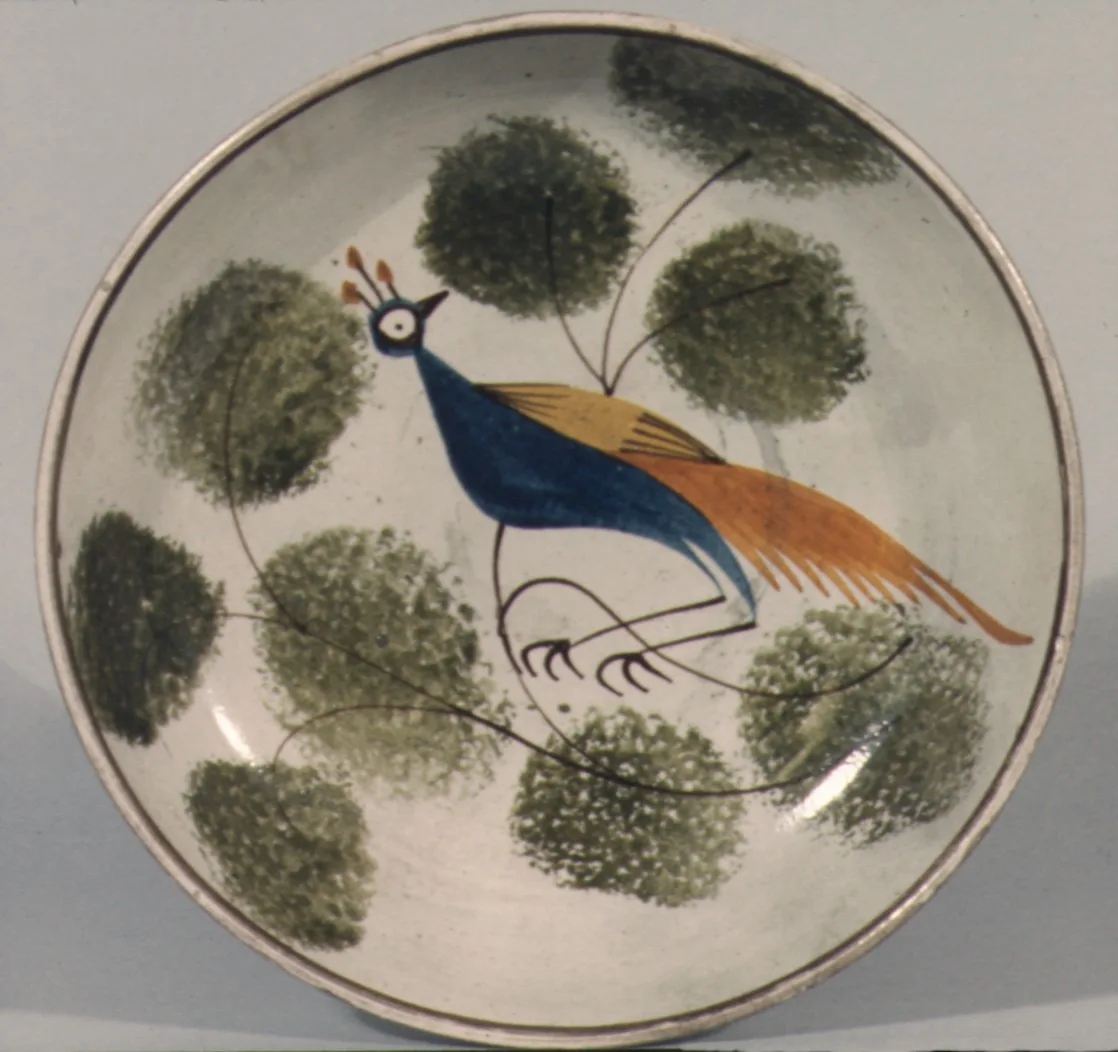
A typical Scottish cut-sponge plate combines a stamped border with a central motif: a cockerel, a peacock, a pair of birds, or a hand-painted floral. The combination of cut-sponge surround and painted centre is the classic Scottish cut-sponge composition.
Spongeware vs. Spatterware vs. Stick Spatter
These three terms are often used interchangeably but refer to distinct techniques. Confusing them is the most common spongeware misidentification.
Spatterware (Strict Sense)
Pure spatterware uses paint applied through a stencil or blown from a tube to create dense, fine-grained colour fields. The Pennsylvania German "spatterware" of the 1820s–1860s was hand-painted with central motifs (tulip, peafowl, rose) on stencil-spattered grounds. Spatterware is older, finer, and substantially more valuable than ordinary spongeware. Authentic Pennsylvania German spatter peafowl plates can reach four figures at auction.
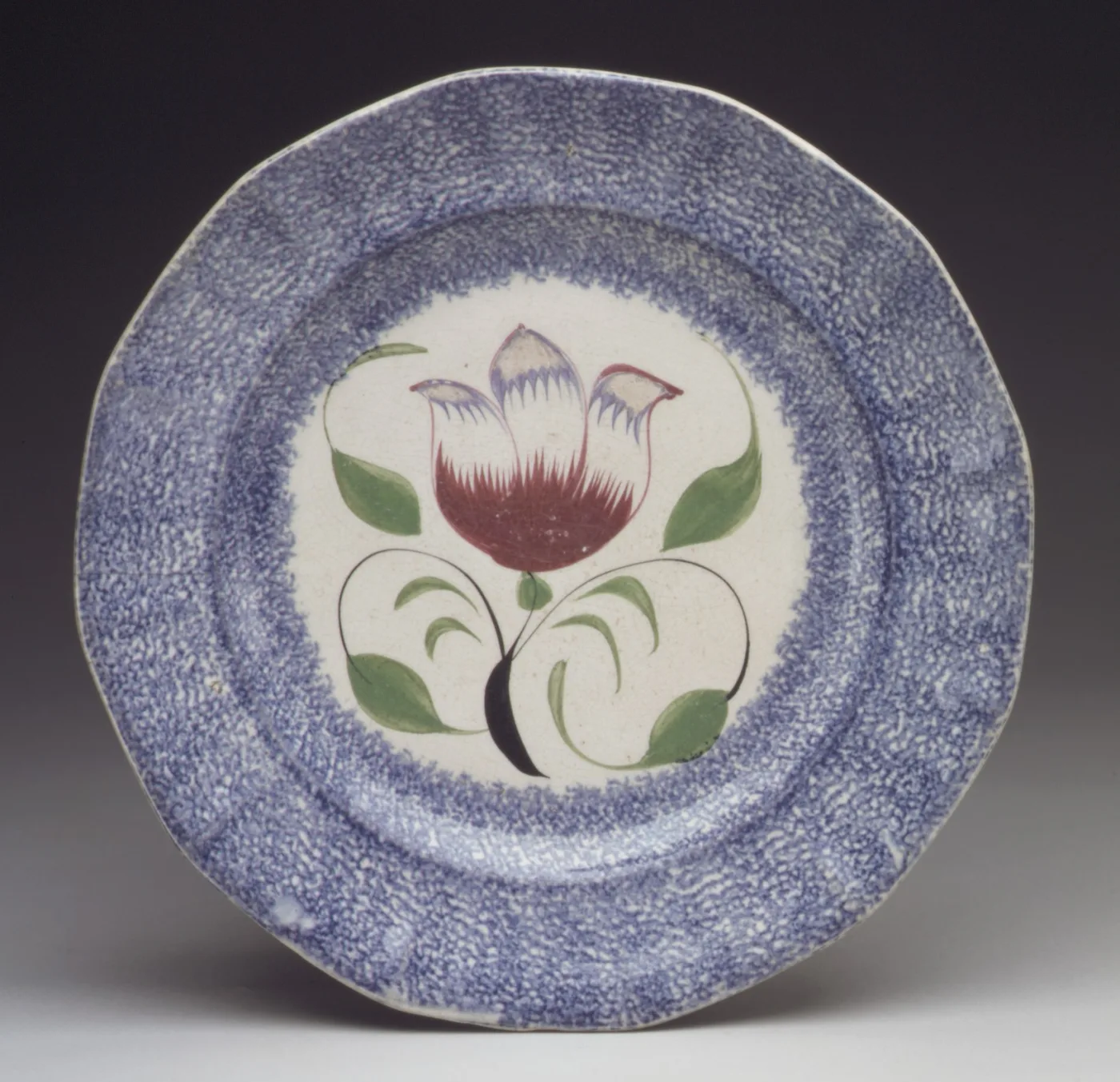
Stick Spatter
Stick spatter is the flicking or tapping technique that produces a spray of paint droplets, typically used as a border decoration. It is the dominant technique on Staffordshire export wares for Latin America and West Africa from the 1840s onward.
Spongeware (Strict Sense)
True spongeware uses a sponge — natural or cut — to apply colour by dabbing or stamping. The visible sponge pore texture or the recognisable cut-stamp shape distinguishes spongeware from spatterware.
Sponged Spatter / Mixed Pieces
Many pieces combine techniques and any single piece may include all three. Always describe pieces by the specific technique present rather than relying on the catch-all "spongeware" label.
Value Implications
Genuine Pennsylvania German spatterware is the most valuable category. Scottish cut-sponge ware is the next tier. Stick spatter export wares trade at modest prices. Free-hand sponged American utilitarian ware is the most affordable. Mislabelling a piece can mean tenfold price errors in either direction.
Export Markets and Emigrant Trade
Spongeware travelled. Understanding the export trade illuminates where a piece is likely to have come from and where it ended up.
The Scottish Emigrant Trade
Scottish potteries shipped vast quantities of cut-sponge ware to Canada, the United States, and Australia from the 1850s through the early 1900s. Emigrating Scottish families bought familiar dressware before departure and the same patterns sold throughout Scottish-settled North American communities. Today this geographical pattern explains why so much Scottish spongeware turns up in Nova Scotia, Ontario, and the Australian gold-rush states.
The Latin American Trade
Staffordshire potteries shipped stick-spattered and sponged tableware to Mexico, Central America, and South America from the 1840s. Bright colour combinations and bold floral motifs suited Latin American taste. Specialist collectors of the trade refer to it as "Mexicanware" and prices have risen sharply since the 1990s.
West African and South-East Asian Markets
Staffordshire potteries also shipped sponged decoration to trading posts in West Africa, the Caribbean, and Singapore. Specific patterns were designed for these markets; pieces with West African provenance documentation command premiums.
Domestic British Markets
Sponged ware sold in Britain itself was concentrated in Scotland, Wales, the north of England, and Ireland — rural and working-class markets rather than middle-class English homes. Surviving British-domestic spongeware tends to be Scottish or Welsh.
Provenance Documentation
A documented emigrant provenance — "brought from Scotland in 1872" or "purchased in Bahia in 1885" — adds substantially to value and historical interest. Even informal family histories should be recorded with pieces wherever possible.
Reproductions and Modern Spongeware
Sponging is easy to imitate and modern revival production has been continuous since the 1970s. Distinguishing period spongeware from modern reproductions is the central authentication problem.
Modern Country-Style Revival
Country-style décor manufacturers — Henn Pottery, Roseville Pottery (modern reissue), various Asian importers — have produced sponged stoneware in nineteenth-century styles since the 1970s. These pieces are typically marked with modern manufacturer logos but the marks are sometimes removed or worn.
Polish Bolesławiec Stoneware
Polish Bolesławiec ("Boleslawiec") pottery uses cut-sponge stamping on stoneware blanks in traditional Central European patterns. The body is heavier and harder than period spongeware, glazes are uniformly white, and patterns are crisper and more geometric than period work. Bolesławiec is a legitimate modern craft tradition, not a fake, but it is sometimes resold as antique.
Studio Pottery
Contemporary studio potters produce sponged decoration in nineteenth-century styles. These pieces are typically signed by the potter and dated, but signatures can be removed or scratched off.
Outright Fakes
Deliberate fakes of valuable Scottish cut-sponge work and Pennsylvania German spatterware exist but are uncommon outside high-end markets. Forensic body analysis, UV examination, and consultation with specialist auction houses identify these when serious money is at stake.
Authentication Tells
Period spongeware shows: appropriate body for the claimed date and origin; underglaze decoration (no surface wear on the colour); base wear and foot ring abrasion consistent with age; appropriate kiln-stilt marks; uniform glaze crazing of the right age and pattern. Modern pieces typically lack the cumulative wear pattern and have machine-perfect bodies.
Condition, Damage & Restoration
Spongeware was made for daily use and most surviving pieces show wear. Condition substantially affects value and reading damage accurately is essential.
Chips and Rim Damage
Rim chips are the most common spongeware damage. Small flake chips reduce value modestly; larger chips or restored rims reduce value substantially. Run a fingernail around the entire rim to detect filled chips.
Hairline Cracks
Hairlines may not be visually obvious but reveal themselves through the ring test — a dull thud rather than a clear ring indicates a hidden crack. Stained hairlines are easier to see but indicate longer exposure to liquid.
Crazing
Most period spongeware shows fine crazing in the glaze. Light uniform crazing is normal and does not reduce value. Heavy crazing, dirt-filled crazing, or crazing that has caused glaze loss does affect value.
Stains and Discolouration
Tea, coffee, and food stains accumulate in glaze crazing on pieces used for serving food. Light staining is normal; heavy brown staining reduces visual appeal. Bleach cleaning can lighten staining but risks damage to the decoration.
Restoration
Professional restoration of rare cut-sponge pieces is sometimes economically justified. UV examination reveals modern fillers and overpainted areas. Restored pieces should be disclosed and priced accordingly. The general framework in our antique restoration and conservation guide applies.
The Value of Honest Wear
Light honest wear — base abrasion, minor rim flakes, mild crazing — is acceptable on spongeware and authenticates the piece as period. Heavily restored pieces, regardless of original quality, trade at substantial discounts.
Value Factors and Price Ranges
Spongeware prices span three orders of magnitude. The general framework laid out in our antique valuation and appraisal guide applies; the spongeware-specific factors are below.
Primary Value Drivers
Technique (Pennsylvania spatterware > Scottish cut-sponge > English stick spatter > American free-hand); origin (Scottish > Welsh > English > American); date (pre-1860 > later); palette (multi-colour > two-colour > single-colour); form (rare forms > common bowls); pattern (rare patterns > common four-petal); condition; provenance documentation.
Approximate Price Ranges
Common American free-hand sponged bowls and crocks: £20–£100. Better American spongeware with documented Ohio Valley provenance: £80–£300. Common Scottish cut-sponge plates: £40–£150. Better Scottish cut-sponge work (Methven, Britannia, Bo'ness with crisp design and good condition): £100–£500. Rare Scottish patterns and unusual forms: £300–£1,500. Welsh Llanelly cockerel plates: £150–£600. Staffordshire stick-spatter export wares: £30–£200 typical, more for documented Latin American provenance. Pennsylvania German spatterware (genuine period peafowl, tulip, rose patterns): £200–£3,000+. Exceptional documented spatter pieces: £3,000–£8,000+ at specialist auction.
Auction vs. Retail vs. Online
Specialist American folk-pottery and Pennsylvania-German auctions handle the upper end. Country antique dealers and Scottish specialist dealers price retail at 1.5–3x recent auction comparables. Online marketplaces (eBay, Etsy) span the range, with significant noise from mislabelled modern revival pieces.
Sets and Pairs
Matched pairs of plates, complete tea sets, and graduated nested bowl sets bring premiums over the sum of individual pieces. Documented complete sets are scarce.
Provenance Premium
Documented emigrant provenance, family history records, or earlier dealer documentation can double or triple typical retail prices on important pieces. Verbal provenance has limited value; written documentation transforms it.
Building a Spongeware Collection
Spongeware rewards focused collecting. The general principles in our collecting strategies guide apply, with spongeware-specific refinements below.
Specialise by Origin or Technique
Specialise: Scottish cut-sponge plates, American utilitarian bowls, Welsh Llanelly cockerel work, Pennsylvania spatterware, Staffordshire Latin American export. Specialisation builds the eye that lets you recognise undervalued pieces and avoid expensive mistakes.
Start with Common Pieces
American utilitarian spongeware bowls and common Scottish plates provide an affordable training ground. Build the eye for body, palette, and technique before pursuing higher-value cut-sponge or spatterware pieces.
Reference Libraries
Essential references include Henry Kelly's "Scottish Ceramics," Earl Robacker's "Spatterware and Sponge: Hardy Perennials of Ceramics," and the Pennsylvania German Society publications on spatterware. Specialist auction catalogues from Pook & Pook (US), Lyon & Turnbull (Scotland), and Bonhams build comparative market knowledge.
Specialist Dealers and Auctions
Scottish specialist dealers in Edinburgh, Glasgow, and Linlithgow handle the better Scottish cut-sponge market. American country antique shows (Brimfield, Round Top) and Pennsylvania German auctions handle the American end. Lyon & Turnbull, McTear's, and Pook & Pook are the principal specialist auction houses.
Provenance Documentation
Maintain detailed records of every purchase: photographs of marks (or unmarked bases), condition reports, prior auction listings, family history notes, and dealer invoices. Strong provenance dramatically increases resale value, particularly on rarer cut-sponge and spatterware pieces.
Insurance and Appraisal
Spongeware collections above £3,000 in aggregate value deserve scheduled insurance and updated appraisals every five years. Specialist appraisers familiar with British folk pottery or Pennsylvania German ceramics produce more useful valuations than general antique appraisers.
Care, Display & Preservation
Spongeware is durable but the underglaze decoration and the often-crazed glaze reward careful handling. The general principles in our antique storage and preservation guide apply across the spongeware range.
Handling
Lift bowls and pitchers by the body, never by rims or handles alone. Older handles may be glued or have hidden hairlines that can fail unexpectedly. Wear cotton or nitrile gloves for high-value pieces, particularly cut-sponge and spatterware where surface staining from skin oils can mark crazed glaze over time.
Washing
Wash spongeware by hand in lukewarm water with mild dish soap. Never use the dishwasher — modern dishwasher detergents can lift loose glaze and accelerate crazing damage. Never soak heavily crazed pieces; water entering the body through crazing can cause staining and even structural damage.
Stacking and Storage
Place felt or paper discs between stacked plates to prevent rim wear and decoration abrasion. Never stack cups inside one another. Store nested bowl sets with cloth or paper between each bowl. Store in stable temperature, away from direct sunlight, in spaces with controlled humidity.
Display
Display in stable temperature (16–22°C / 60–72°F) and humidity (40–60%). Avoid direct sunlight, which can fade underglaze colours over decades. Secure tall pieces with museum wax. Plate display rails should support the plate by the foot, not pressing on the rim where chips originate.
Transport
For shipping or moving, double-box with at least two inches of cushioning between boxes. Wrap projecting handles individually before wrapping the main body. Never ship rare cut-sponge or spatterware pieces without insurance and signature confirmation.
Use vs. Display
Common American utilitarian spongeware can still be used in the kitchen — these pieces were made for use. Rare cut-sponge, spatterware, and documented period pieces should be display-only to preserve condition and value for future custodians.