
Antique Toby and Character Jugs Identification Guide: Makers, Modelers, Marks, and Dating
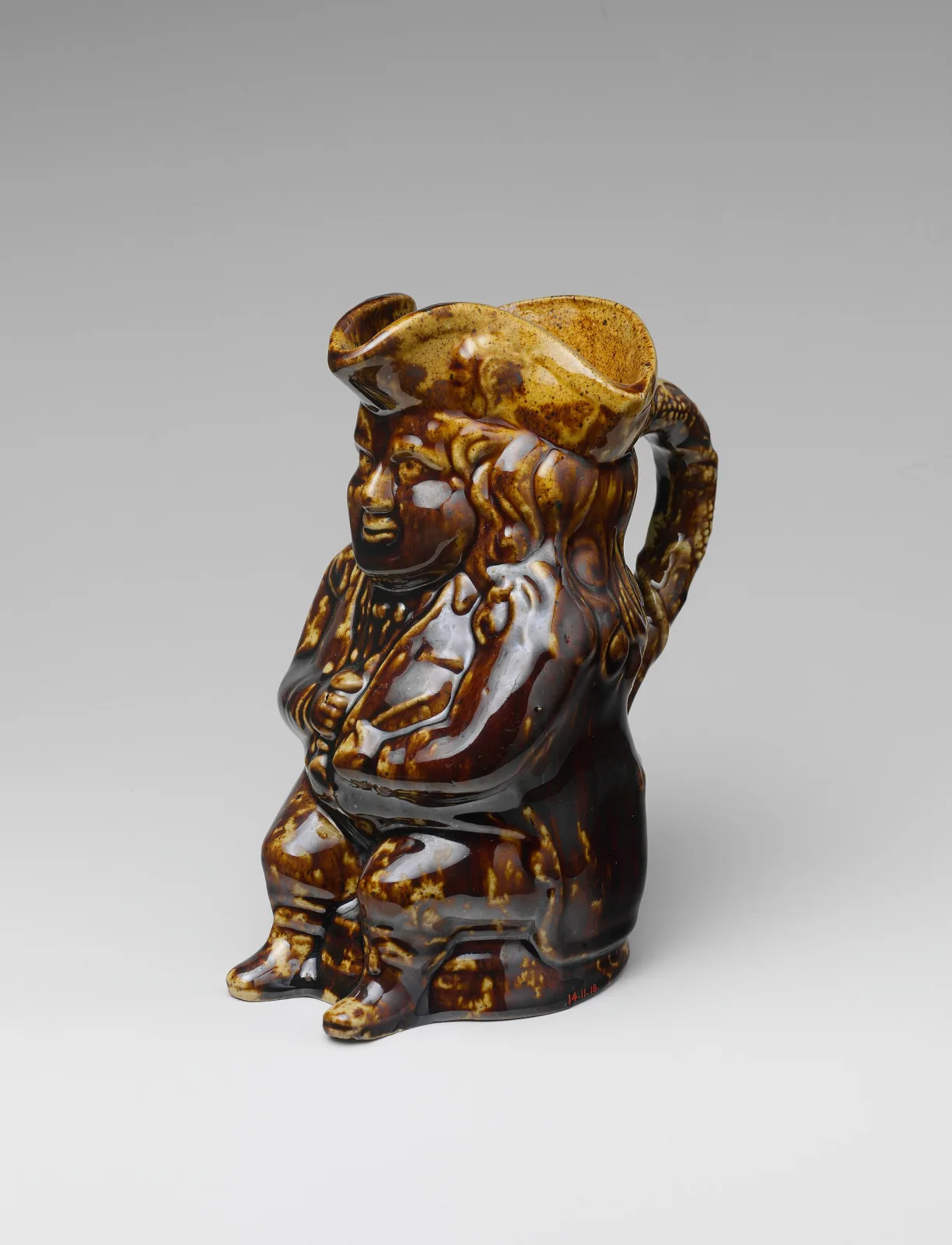
Toby jugs and character jugs are among the most distinctive and immediately recognizable forms in English ceramics. A Toby jug is a full-figure pottery vessel — usually a seated jolly fellow in tricorn hat, holding a mug of ale, with the hat brim acting as the spout and one arm forming the handle — first produced in Staffordshire around 1765 and made continuously by dozens of factories ever since. A character jug is its descendant: a head-and-shoulders portrait jug, modeled as a recognizable historical, literary, or fictional figure, popularized by Royal Doulton from 1934 onward and now collected in tens of thousands of variations across the English-speaking world.
The two forms are easy to confuse and the trade often uses the names interchangeably, but the collecting market treats them as distinct categories with separate price structures, separate references, and largely separate dating systems. A Georgian Ralph Wood Toby in pearlware glazes is a different object from a 1950s Royal Doulton Mr. Pickwick character jug, even if both depict cheerful drinking men. Identifying either correctly means working through a fixed sequence of clues: form (full-figure or head-and-shoulders), maker's backstamp, modeler's name or initials, size designation (large, small, miniature, tiny), pattern or D-number, glaze and body type, and the specific subject portrayed.
This guide covers the full chronology of Toby and character jugs from the 1760s Whieldon and Ralph Wood prototypes through the Victorian Staffordshire output, the early-twentieth-century Royal Doulton revival, the post-war character jug explosion, and the late-twentieth-century limited-edition market. It treats the major makers (Royal Doulton, Wood & Sons, Beswick, Burgess & Leigh, Crown Devon, Sylvac, Kevin Francis, Bairstow Manor), the principal modelers (Charles Noke, Harry Fenton, Leslie Harradine, Stanley Taylor, Max Henk, Eric Griffiths, William K. Harper, David Biggs), the size hierarchy and its dating implications, the Doulton D-number system, the standard subjects, the principal reproductions and fakes, condition assessment, the working valuation framework, and care of these pieces. By the end you should be able to confidently identify Toby and character jugs at flea markets, estate sales, charity shops, and online auctions, and place each piece within its production era and maker.
Table of Contents
- What Is a Toby Jug? What Is a Character Jug?
- The Eighteenth-Century Origins
- The Standard Toby Subjects
- Victorian and Edwardian Tobies
- Royal Doulton and the Character Jug Revival
- The Doulton Modelers
- Size Designations and What They Mean
- D-Numbers and Doulton Backstamps
- Other Major Twentieth-Century Makers
- Subjects, Themes, and Series
- Color Variations, Prototypes, and Errors
- Reproductions, Fakes, and Lookalikes
- Condition Assessment
- What Drives Value
- Care and Display
- Common Beginner Mistakes
- Frequently Asked Questions
What Is a Toby Jug? What Is a Character Jug?
The terminology matters because the two forms have separate price structures and separate reference literatures. Get the name wrong and you will look for the piece in the wrong catalog.
Toby Jug — The Full Figure
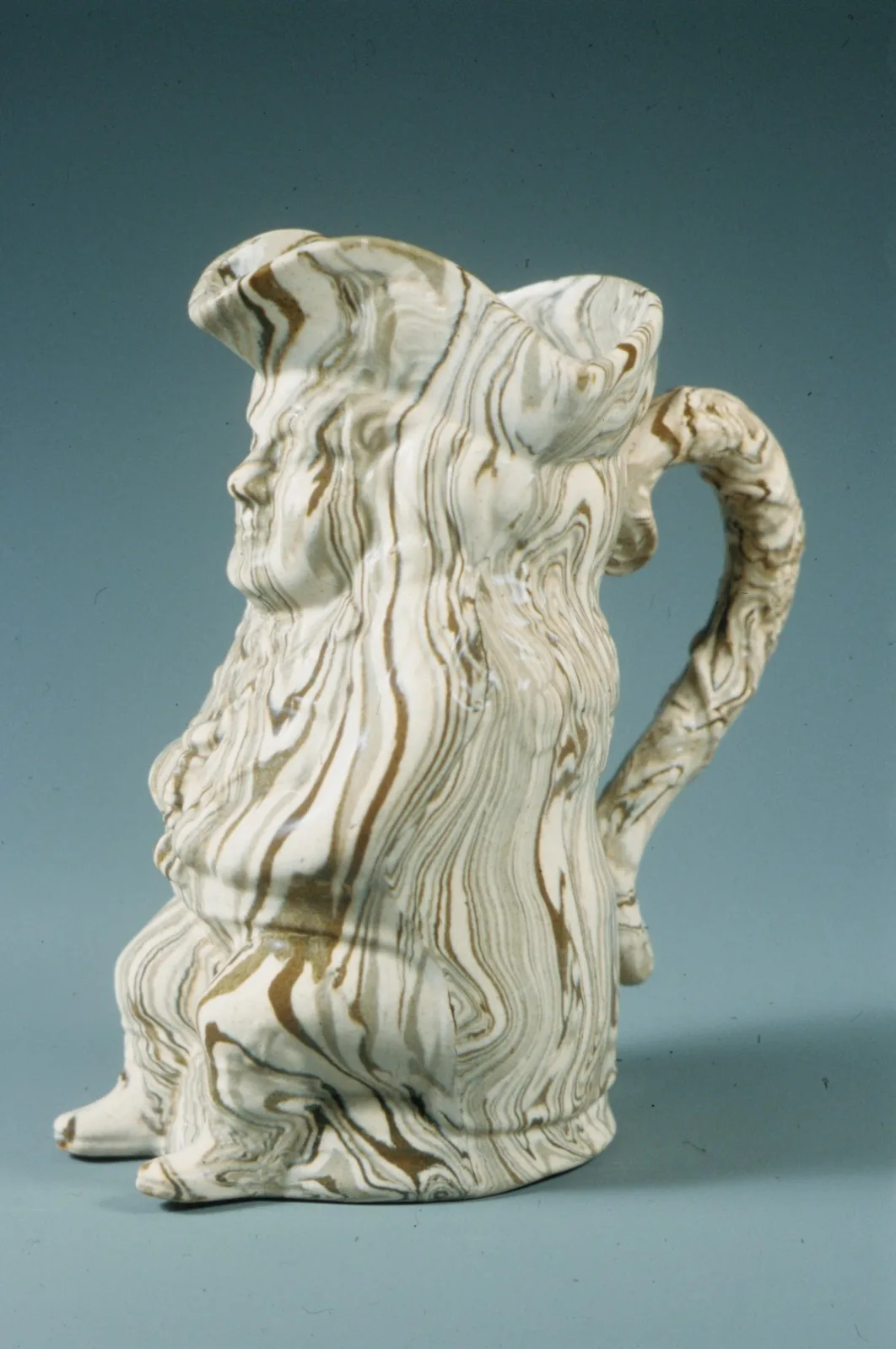
A Toby jug is a full-figure ceramic vessel modeled as a seated man, usually with these features in some combination: a tricorn or three-cornered hat whose corners form the pouring spout, a mug or jug of ale in one hand, a long pipe or snuff in the other, knee breeches and stockings, buckled shoes, and an arm akimbo or coat hem that forms the carrying handle. The standard Toby is around 9 to 10 inches tall, but heights run from 4-inch miniatures to 12-inch large versions. The form is a complete figurine that happens to function as a jug, not a portrait.
Character Jug — Head and Shoulders
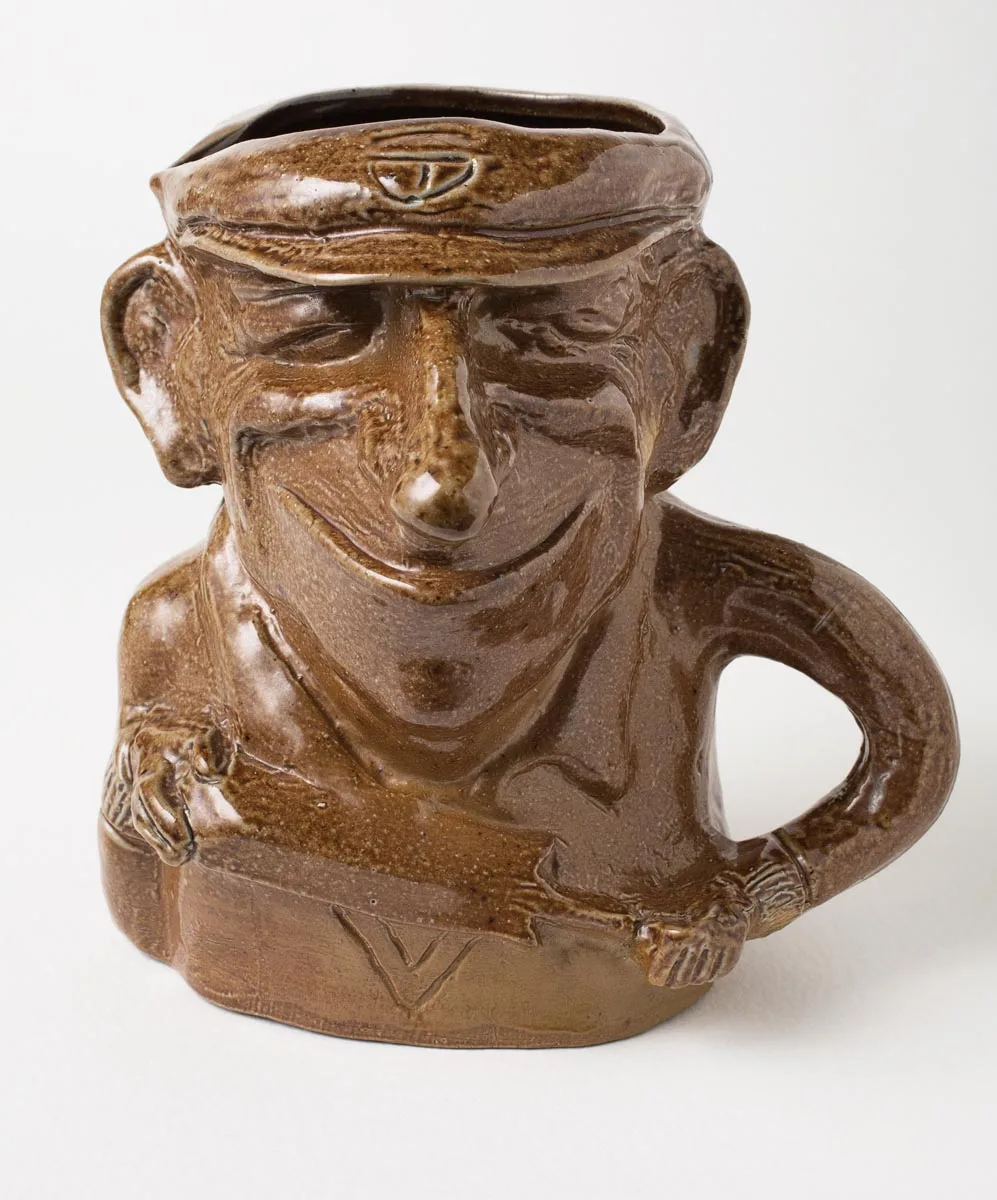
A character jug shows only the head and shoulders of a recognizable figure — historical (Henry VIII, Winston Churchill, Napoleon), literary (Mr. Pickwick, Long John Silver, Robin Hood), occupational (Sailor, Lawyer, Falconer), or fictional. The handle is typically a thematic accessory: a sword, a quill, an axe, a banner, an animal connected to the subject. Character jugs are made in graduated sizes (large 6½–7½ inches, small 4 inches, miniature 2½ inches, tiny 1¼ inches). The form was popularized by Royal Doulton's Charles Noke in 1934 and has been the dominant collectible jug form ever since.
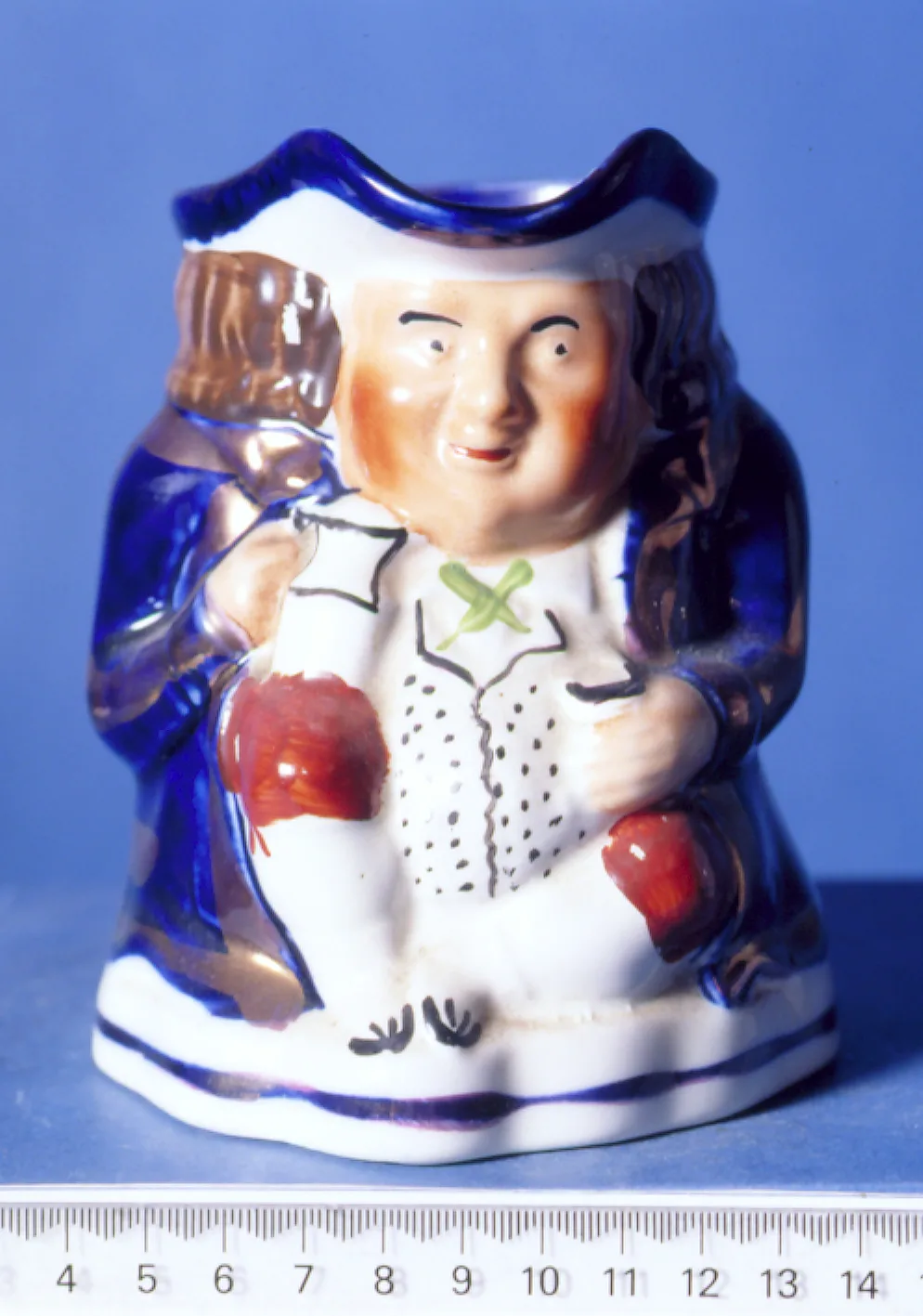
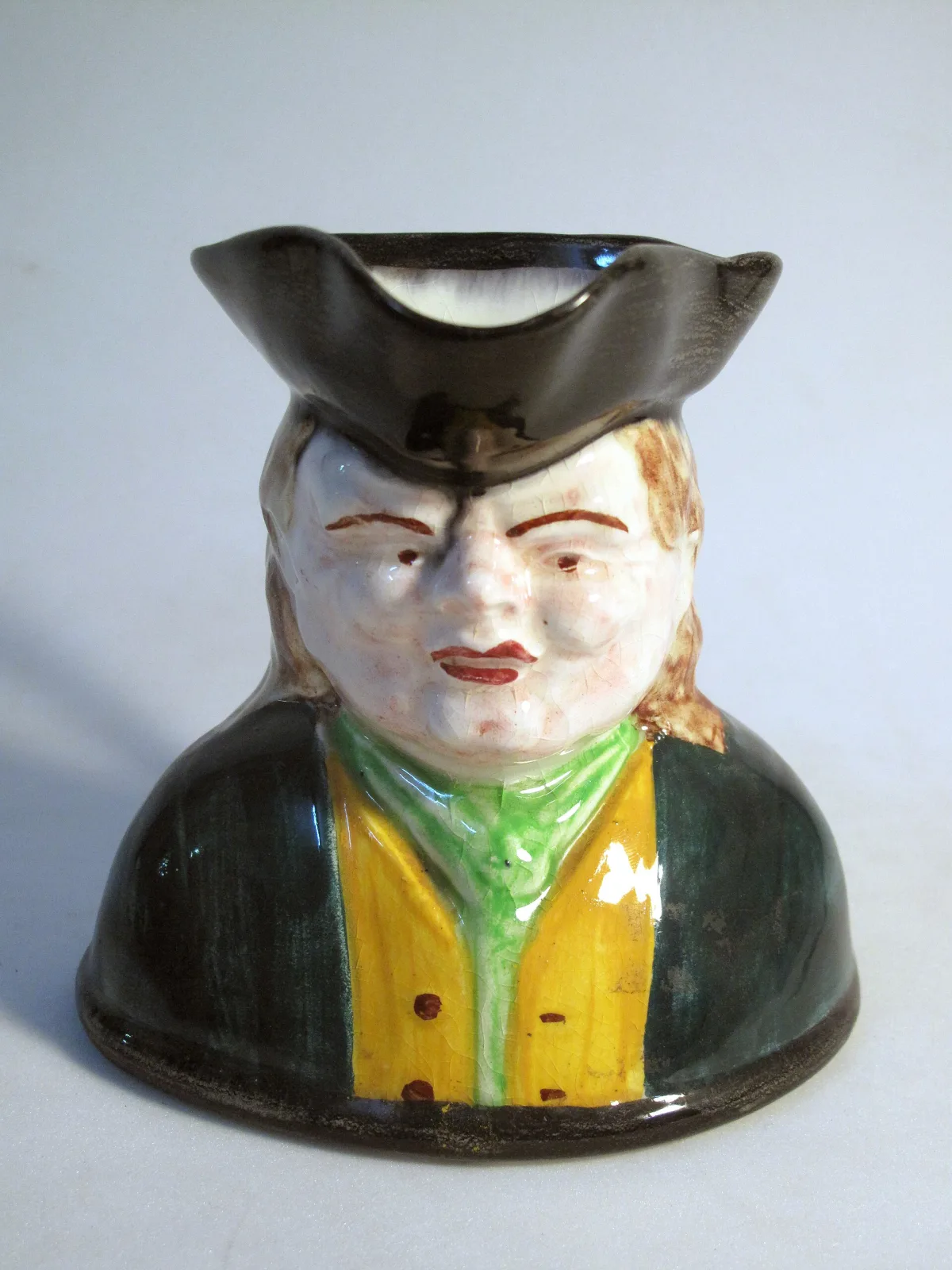
Both are twentieth-century, and both are shown here for the same reason: the difference between the two is a matter of form, not of age or maker, so it reads just as clearly on modern pieces as on eighteenth-century ones. A Toby is a whole seated figure and the pouring rim is the brim of his hat. A character jug is a head, or a head and shoulders, with the handle applied behind. Everything else — subject, glaze, factory, value — is a separate question, and getting this one wrong at the start sends the entire identification off in the wrong direction, because the reference literature is organised along exactly this line.
Why the Confusion
Both forms are sometimes called "Toby jugs" in casual speech, especially in the United States, where "Toby jug" is often used as a generic term covering both. Early Doulton catalogs and trade press use "character jug" carefully, but department-store advertising and gift guides have always blurred the line. A safe rule: if you see legs and a seated body, it is a Toby; if you see only head and shoulders, it is a character jug. Auction houses and serious references maintain the distinction strictly. For broader Staffordshire context see our antique Staffordshire figurines identification guide.
The Eighteenth-Century Origins
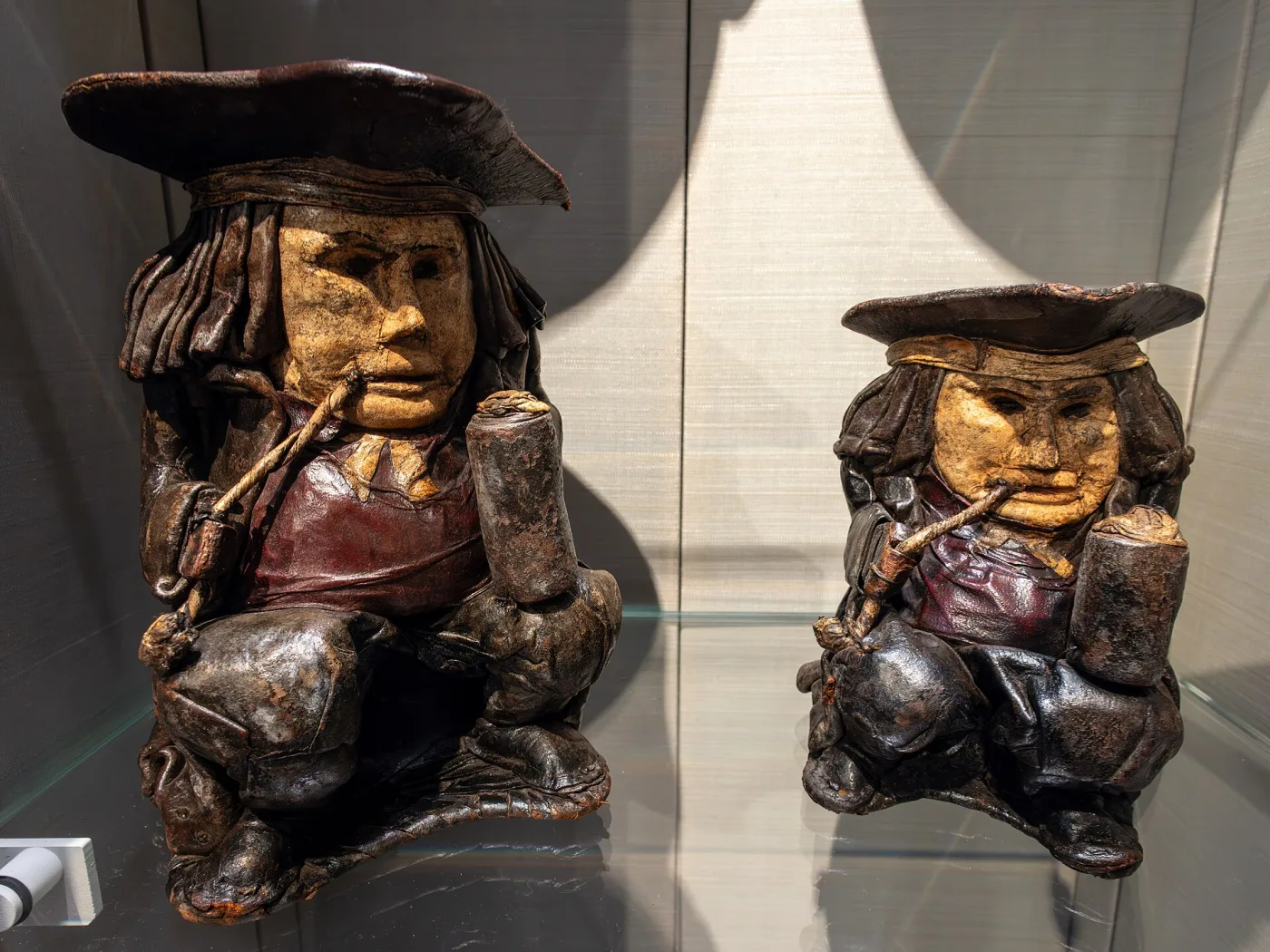
The Toby jug emerged in Staffordshire in the 1760s, almost certainly modeled by the potter Ralph Wood the Elder (1715–1772) or his son Ralph Wood the Younger (1748–1795), based on a print after the painter Francis Hayman titled The Brown Jug (sometimes "Toby Fillpot") published around 1761. The print depicted a jolly toper drinking from a jug of foaming ale; the Wood family translated it into three dimensions in earthenware with the colored lead glazes pioneered by Thomas Whieldon and refined in the Wood pottery.
Ralph Wood and the Whieldon Tradition
The earliest Toby jugs (1765–1780) are unmarked or marked only with an impressed "Ra. Wood Burslem" or a number. Bodies are creamware or pearlware, glazed with translucent metallic-oxide colors — green, manganese brown, ochre yellow, copper-blue — applied in distinct zones rather than the all-over enamels of later pieces. The modeling is sculptural and confident; faces are individualized rather than caricatured. These eighteenth-century Tobies are the most valuable category in the field, with fine Ralph Wood examples reaching $3,000–$10,000 at auction.
The Pratt-Type Tobies
By the 1790s a competing color palette emerged from Felix Pratt and his Fenton imitators — opaque underglaze enamel colors fired at high temperature, dominated by a distinctive ochre yellow, dull green, blue, and orange-brown. "Pratt-type" Tobies (the term covers wares from many factories using this palette, not only Pratt himself) are slightly later, slightly more brightly colored, and slightly more caricatured than Wood-family pieces.
The Pearlware and Bristol Tradition
Parallel production at smaller Staffordshire potteries and at Bristol used pearlware bodies (creamware whitened with cobalt) with painted underglaze decoration. These pieces are generally thinner-walled, lighter, and less sculpturally ambitious than the Wood Tobies. Bristol Tobies sometimes show the distinctive blue-tinged glaze pooling in recesses. For broader earthenware context see our antique creamware and pearlware identification guide.
The Standard Toby Subjects
Eighteenth- and nineteenth-century Toby jugs settled into a vocabulary of recognized "characters," each with its own iconography. Identifying the subject helps date and attribute the piece, since not every factory made every character.
Ordinary Toby (or Toby Fillpot / Toby Philpot)
The standard seated jolly drinker, tricorn hat, mug in right hand, pipe or jug-handle in left. This is the form that started the tradition and remains the default if no other identifying feature is present. Made by virtually every factory.
Standing Toby
A Toby on his feet rather than seated. Less common than the seated form. Often depicted holding a foaming jug aloft.
Sailor Toby
In naval costume, often with a striped jersey, kerchief, and the foot resting on a sea-chest or barrel. Late eighteenth and Napoleonic era; commemorates British naval power.
Squire Toby
A heavier, finer-coated gentleman drinker, sometimes called the "Hearty Good Fellow." Coat is more elaborate, posture more dignified.
Thin Man Toby
An emaciated figure — sometimes called the "Unhappy Man" or "Half-and-Half" — depicting a wasted drinker. Comparatively rare and highly collectible in good early examples.
Snuff Taker Toby
Holding a snuff-box or pinch of snuff to the nose rather than a drinking mug. Less common than the drinker.
Martha Gunn
A female Toby, modeled on the famous Brighton "dipper" (bathing attendant) Martha Gunn, who attended royal bathing parties on the Brighton beach in the 1780s and 1790s. Round face, mob cap, large bosom, often holding a gin bottle. Female Tobies are rarer than male and command a premium.
Lord Howe / Admiral Howe
Commemorating the British naval commander Richard Howe (1726–1799), particularly after his 1794 victory at the Glorious First of June. Naval uniform, bicorne hat, often a sword.
Other Named Subjects
The Night Watchman, the Drunken Parson, the Postman, the Hearty Good Fellow, Punch, and various other named subjects each have their own iconography. Reference to the standard Schkolne or Pearson references is essential for less common subjects.
Victorian and Edwardian Tobies
Toby production continued throughout the nineteenth century at Staffordshire, Yorkshire, and other British and German potteries, but the quality of modeling and decoration declined sharply from the Wood-and-Pratt high points. Victorian Tobies (roughly 1840–1900) are typically smaller, more brightly colored with overglaze enamels (rather than the underglaze metallic oxides of the eighteenth century), and modeled with less sculptural care.
The Allerton, Wood & Sons, and Shorter Generation
Several Staffordshire firms — Allerton's, Wood & Sons (a different firm from the eighteenth-century Ralph Wood family), Shorter & Son, and others — produced steady streams of Toby jugs throughout the late Victorian and Edwardian periods. These are commonly encountered, generally inexpensive ($30–$150), and usually marked with the firm's backstamp on the base.
Continental Imitations
From the 1880s onward, German and Czech potteries produced large numbers of Toby-style jugs for export to Britain and the United States. These are often unmarked or marked only with country-of-origin "Germany" or "Czechoslovakia," indicating post-1891 (US McKinley Tariff Act) or post-1918 production respectively. Body is typically a hard, white earthenware; decoration tends to brighter, more uniform enamels than English work.
Why Pre-Doulton Tobies Are Cheaper Than You Expect
Many people inherit Victorian Tobies expecting valuable antiques and are disappointed by appraisals in the $50–$200 range. The reason is supply: every middle-class English household had a Toby in the 1880s; survival is high; demand is moderate. Eighteenth-century Wood-family and Pratt-type pieces are genuinely rare and valuable; nineteenth-century Tobies are common.
Royal Doulton and the Character Jug Revival
The character jug as we know it today is a Royal Doulton invention. In 1934, Charles J. Noke (1858–1941), Doulton's longtime art director, introduced the first character jug — "John Barleycorn" — at the British Industries Fair. The piece was a head-and-shoulders portrait of the personification of malt and beer, modeled on a print held in the Doulton archive. It was an immediate commercial success.
Noke's Original Vision
Noke conceived the character jug as a head-and-shoulders sculptural form, deliberately departing from the full-figure Toby tradition to allow finer portrait modeling. The handle would be thematic — a barley sheaf for John Barleycorn, a long pipe for Old Charley — making each jug a complete sculptural statement. Production was at the Burslem factory in fine bone china and earthenware bodies, with hand-applied colored glazes and enamels.
The First Series (1934–1942)
Noke and his collaborators introduced approximately twenty character jugs between 1934 and 1942: John Barleycorn, Old Charley, Sairey Gamp, Parson Brown, Dick Turpin, Simon the Cellarer, Tony Weller, Mr. Pickwick, John Peel, Cardinal, Captain Cuttle, the Cavalier, Sam Weller, Jester, Mephistopheles, Auld Mac, Gondolier, Apothecary, Granny, Buz Fuz, and a few others. These early jugs are now the most collectible Doulton character jugs; first-version Mephistopheles and the rare prototype "Toothless Granny" command four-figure prices.
Post-War Expansion (1946–1970)
After the war the line expanded enormously under Harry Fenton (no relation to the Fenton glass family), Max Henk, and others. Subjects ranged across English literature (Falstaff, Long John Silver, Robin Hood, Robinson Crusoe), British history (Henry VIII and his six wives, Drake, Walter Raleigh, the Duke of Wellington), and folklore. By 1970 Doulton had introduced more than 100 distinct character jug subjects.
The Modern Era (1970–Present)
From the 1970s Doulton expanded into limited-edition pieces, sports figures, contemporary politicians, and licensed characters (Beatrix Potter, Disney, Star Trek). The number of distinct Doulton character jug subjects now runs to several hundred, and the catalog continues to grow even after the 2009 closure of the Burslem factory and the relocation of production. For broader Royal Doulton context see our antique ceramics and pottery identification guide.
The Doulton Modelers
Royal Doulton character jugs are modeler-driven, and identifying the modeler is a key dating and value clue. The signature or initials of the modeler usually appear incised on the inside or under the handle of the jug.
Charles J. Noke (active at Doulton 1889–1941)
The original character jug modeler. His pieces are characterized by strong sculptural confidence, sharp facial detail, and careful integration of the handle into the composition. Noke jugs span the 1934–1941 period and are the most desirable among Doulton character jugs.
Harry Fenton (active 1934–1953)
Noke's principal collaborator and the modeler of many of the war-era and early-postwar jugs. Fenton's style is slightly looser than Noke's, with more emphasis on character expression and less on sculptural finesse.
Leslie Harradine (active at Doulton 1912–1956)
Better known for the HN figurine series, but also responsible for several character jugs including the celebrated "Drake" and "Vice-Admiral Lord Nelson." Harradine pieces show his figurine-trained eye for fabric folds and accessory detail.
Max Henk (active 1953–1979)
The principal post-war character jug modeler. Henk introduced a more pictorial, narrative style with elaborate handles incorporating multiple thematic elements. Many of the best-known mid-century jugs (Long John Silver, Captain Henry Morgan, the Cardinal) are Henk's work.
Eric Griffiths (active 1972–1989)
Doulton's design director from 1972; modeled a number of historical jugs and oversaw the great expansion of the character jug catalog in the 1970s and 1980s.
William K. Harper (active 1971–1993)
Major modeler of the 1970s–1990s, particularly of historical and military subjects (Henry VIII and the six wives series, Winston Churchill, the Duke of Wellington).
Stanley J. Taylor (active 1980s–2000s)
Late-twentieth-century modeler of contemporary subjects and licensed characters.
David B. Biggs (active 1980s–2000s)
Modeler of many limited-edition and small-issue jugs of the 1990s.

Size Designations and What They Mean
Royal Doulton character jugs are produced in graduated sizes, and the size hierarchy is one of the most decisive dating and value clues. The size designation is part of the formal identification: a "Large Mr. Pickwick D5839" is a different collectible item from a "Tiny Mr. Pickwick D6260."
Large (about 6½–7½ inches)
The standard size. Almost every Doulton character jug subject was made in Large at some point. If a jug is unspecified, assume Large. Heights vary by subject — military figures with tall hats run to 7½ inches, while heads without headgear are 6½.
Small (about 3½–4 inches)
Introduced from 1937 onward as a complementary scale. Most Large jugs eventually had a Small companion, though some only ever appeared in Large. Small jugs are typically about half the height of their Large counterparts.
Miniature (about 2½ inches)
Introduced in the late 1930s. Not every subject was made in Miniature. The Miniature designation requires careful attention because it is sometimes confused with Tiny.
Tiny (about 1¼ inches)
Introduced 1939–1942 only, in a very limited series of six subjects: John Barleycorn, Old Charley, Sairey Gamp, Mr. Pickwick, Paddy, and Auld Mac. Production was suspended for the war and never resumed; the six Tinies are accordingly rare and valuable, often $200–$600 each in good condition.
Why Size Matters for Value
Different sizes have different scarcities. A Large of a common 1950s subject may be $40 while the Tiny version (if one exists) is $400. The Tiny series is the most valuable size category overall; Miniatures are sometimes rare; Smalls are usually the cheapest.
D-Numbers and Doulton Backstamps
Royal Doulton character jugs and Tobies are catalogued under "D-numbers" — sequential design registration numbers prefixed with "D" for Doulton, running from D5327 (John Barleycorn, 1934) to numbers in the D7000 range for modern issues. The D-number is the single most useful identification reference; with the number you can look up the subject, modeler, dates of issue, and original size designations in any Doulton character jug catalog.
Where to Find the D-Number
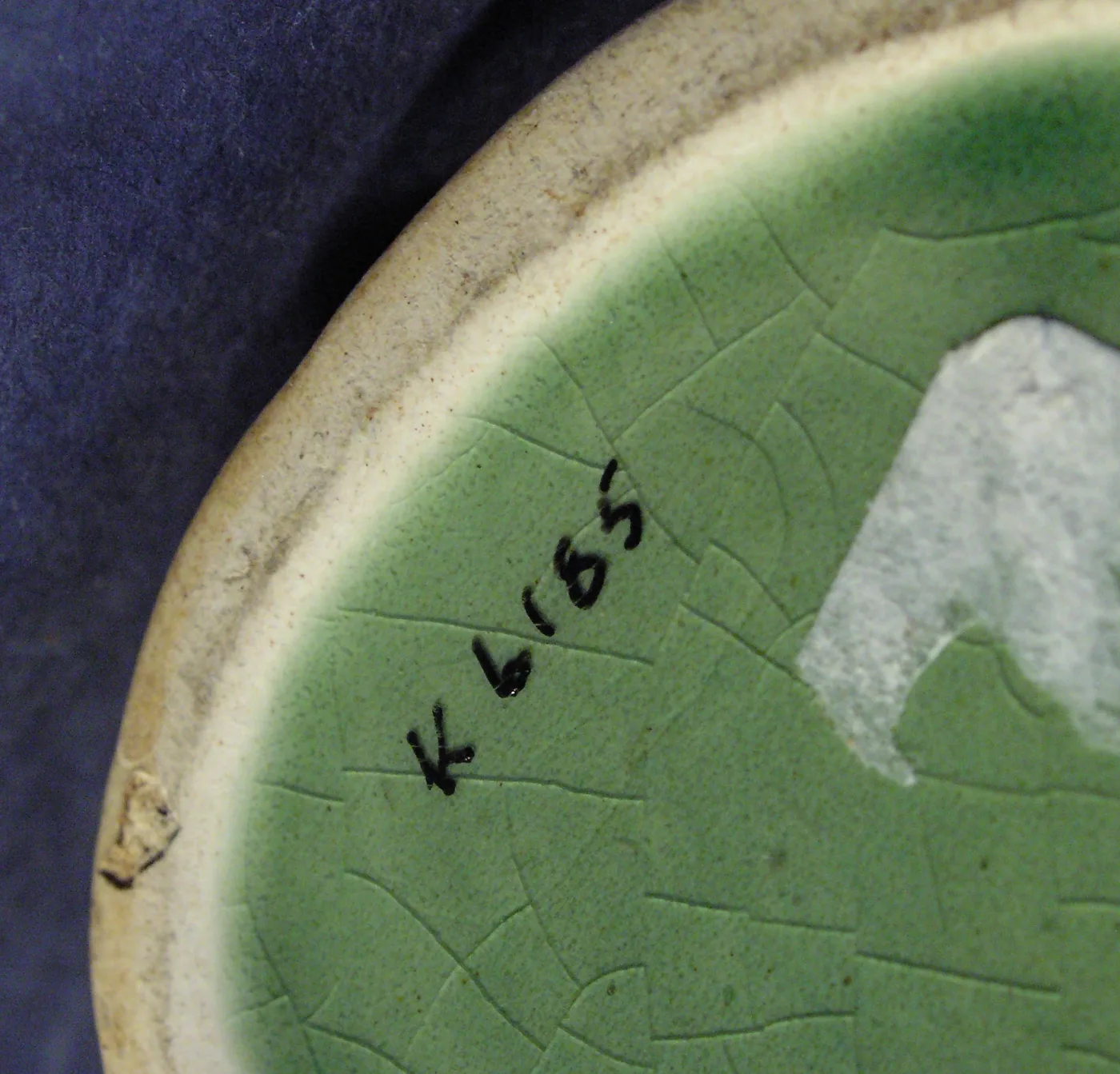
The D-number is usually printed or impressed on the underside of the base, often as part of the backstamp block or as a separate impressed number. On older jugs (pre-1960) the number may be hand-painted in black or red. On modern jugs it is usually printed in black underglaze.
The Doulton Backstamp Sequence
Royal Doulton uses a series of dated backstamps that allow approximate dating independent of the D-number. The principal versions:
- 1902–1922: Royal Doulton coronet over crown over "Royal Doulton England" with no further marks.
- 1922–1956: Coronet/crown stamp with "Made in England" added below.
- 1956–onward: The "A" mark appears below the standard stamp from 1939 to about 1956 as a quality-control mark; its presence dates a piece to that period.
- 1957–1972: Standard backstamp without "A" but with a copyright date, often the year of first issue rather than year of manufacture.
- 1972–onward: A "©" symbol with a year added; this year is the design copyright year, not necessarily the year the individual piece was produced.
The "A" Mark
An impressed or printed "A" near the backstamp, used between approximately 1939 and 1956 as an internal Doulton quality mark. Pieces with the A mark are within this date range; pieces of the same subject without the A are either earlier than 1939 (rare) or later than 1956 (more common).
Reading the Copyright Date
Modern Doulton backstamps include a copyright year — for example, "© Royal Doulton 1965." This is the year the design was copyrighted (usually first issue), not the year the individual jug was made. A jug marked "© 1965" was not necessarily made in 1965; it was made any time from 1965 until that mold was retired.
Other Major Twentieth-Century Makers
Royal Doulton is the dominant character jug maker but by no means the only one. A serious collector's shelf will include pieces from several other firms, each with its own backstamp system and price structure.
Beswick (Stoke-on-Trent, founded 1894)
Best known for animal figurines, but produced character jugs from the 1930s through the 1980s, often in series including "Beatrix Potter Jugs" and Dickens characters. Beswick character jugs are usually marked with a printed Beswick backstamp on the base. After Beswick was absorbed by Royal Doulton in 1969, some molds continued under the Beswick mark and others migrated to the Doulton stamp.
Burgess & Leigh (Burleigh Ware, founded 1851)
Produced a range of character and figural jugs from the 1930s, often with Art Deco styling and a distinctive bright palette. Backstamp is typically "Burleigh Ware" with a beehive or other device.
Crown Devon (S. Fielding & Co., active 1879–1982)
Produced numerous Toby and character jugs, often with musical movements in the base — wind-up boxes that played a tune (typically "The Drinking Song" or similar) when the jug was lifted. Crown Devon musical Tobies are a distinct collecting niche.
Sylvac (Shaw & Copestake, active 1894–1982)
Mid-priced character and figural jugs from the 1930s onward, marked with the Sylvac stamp and a model number on the base. Sylvac pieces are common and inexpensive ($20–$80 typical).
Wood & Sons (Burslem, founded 1865)
Not the eighteenth-century Ralph Wood family but a separate Wood firm; produced steady production of conventional Tobies through the twentieth century, often as inexpensive department-store goods.
Kevin Francis Ceramics (founded 1985)
A late-twentieth-century specialty maker of high-quality limited-edition character jugs, often in editions of 250 to 1,000 pieces, modeled by Peggy Davies and others. Kevin Francis pieces are now their own collecting category, with secondary-market prices often exceeding original retail.
Bairstow Manor Pottery (founded 1990s)
A more recent specialty maker working in a similar limited-edition tradition, often producing political and contemporary subjects. Bairstow pieces are clearly marked.
American Makers
American character and Toby production has been smaller in scale but includes pieces from Lefton, Shawnee, McCoy, and various smaller potteries. American pieces are generally not the focus of the established collecting market but can be charming and affordable.
Subjects, Themes, and Series
Character jug subjects fall into recognized categories that help with identification and with building a coherent collection.
English Literary Characters
The largest single category. Charles Dickens dominates: Mr. Pickwick, Sam Weller, Tony Weller, Sairey Gamp, Mr. Micawber, Bumble, Buz Fuz, Captain Cuttle, Fagin, Bill Sikes, Scrooge. Robert Louis Stevenson (Long John Silver), Daniel Defoe (Robinson Crusoe), Walter Scott, and Shakespeare (Falstaff, the Mad Hatter via Carroll) are also well represented.
British Historical Figures
Henry VIII and the Six Wives is the most famous historical series. Other major subjects: Winston Churchill, Lord Nelson, the Duke of Wellington, Sir Francis Drake, Sir Walter Raleigh, Sir Henry Morgan, Captain Cook, Queen Elizabeth I and II, King John, the Black Prince.
Folk and Legend
Robin Hood, Friar Tuck, Little John, Maid Marian, King Arthur, Merlin, Dick Turpin (highwayman), Rip Van Winkle.
Occupational Types
The Sailor, the Fortune Teller, the Lawyer, the Apothecary, the Cardinal, the Cavalier, the Falconer, the Gardener, the Lumberjack, the Town Crier, the Watchman.
Political and Contemporary
Particularly strong in the 1980s and 1990s — Margaret Thatcher, Ronald Reagan, Mikhail Gorbachev, various royal commemoratives.
Sports and Entertainment
Cricket and football figures, music-hall performers, more recently Beatles and Star Trek licensed pieces.
National Series
The "Great Britons" series, the "Heroes" series, various American (Davy Crockett, Daniel Boone, the Cowboy, the Native American), Canadian, and Australian commemorative jugs.
Color Variations, Prototypes, and Errors
Even with the same D-number and modeler, character jugs come in color variations that dramatically affect value. Identifying the correct variation is essential.
Color Variations as Distinct Issues
Several jugs were issued in multiple authorized color schemes, sometimes years apart, with the rarer color variant priced ten to fifty times higher than the common version. Examples: the original mauve-coated "Mephistopheles" versus the later black coat; the rare "Yellow-Coated Pearly King" versus the common red-coated version; the prototype "Toothless Granny" without a tooth showing versus the standard Granny with one tooth.
Prototype and Trial Pieces
Royal Doulton produced a small number of trial pieces for designs that were never put into full production. These prototypes are extraordinarily rare and command four- and five-figure prices when they appear at auction. Identification is difficult and usually requires reference to the Doulton archive or specialist authentication.
Withdrawn Pieces
A few Doulton subjects were withdrawn shortly after introduction for reasons of poor sales, copyright dispute, or political sensitivity. Withdrawn pieces are rare and command premiums. Examples: "Clown" (white-faced version), "McCallum" (advertising piece for a whisky), and a few others documented in the standard catalogs.
Factory Errors and Misglazes
As with most ceramic collecting, factory errors and misglazes are a niche specialty. Genuine errors that reached market — wrong-color glazes, misaligned decals, missing details — sometimes trade at premiums but more often at discounts (collectors generally prefer a perfect example of the standard). Authentication of "errors" is critical because some are simply later damage or amateur repainting.
Reproductions, Fakes, and Lookalikes
Toby and character jugs have been faked for nearly two centuries. The categories of risk depend on the period.
Eighteenth-Century Reproductions
Genuine eighteenth-century Wood-family Tobies are rare and valuable, and the market has been faked since at least the 1880s. Late-Victorian reproductions of Ralph Wood Tobies are quite competent and can fool casual buyers. Telltale signs of reproduction: clay body too uniform and too white, glaze too even and too glossy, modeling too crisp (genuine eighteenth-century slip molds wear and lose detail), and weight-feel too light or too heavy. Authentication of eighteenth-century pieces should always involve a specialist dealer or reference to a museum collection.
Continental and Asian Reproductions
From the 1970s onward, large numbers of Toby-style jugs were produced in Asia (Japan, then China, then Thailand) for export to the United States and Britain. These are typically marked "Made in Japan" or "Made in China" but the marks have sometimes been ground off or covered. Body is hard, white, modern earthenware; weight is often noticeably lighter than English pieces; modeling is generic.
Doulton Fakes and Forged Backstamps
Forged Royal Doulton backstamps are uncommon but not unknown, particularly on rare prototype subjects. The backstamp should be examined under magnification: genuine Doulton printing has fine, crisp dot structure and consistent registration; forged stamps are often coarser, sometimes with visible modern halftone patterns. Compare any suspicious stamp to a verified piece of the same period.
Reissues vs. Originals
Doulton has reissued many older subjects in modern production, often with the original D-number but with a modern copyright date. A reissue is not a fake — it is a legitimate later production — but it should not be sold as an original. Check the copyright date and the backstamp version against the introduction date for the subject.
"Royal Doulton" Spelling Variations
One simple authentication check: the genuine backstamp says "Royal Doulton" and uses a specific font and crown design. Generic "Royal" or "Royal England" or other near-but-not-identical wording is usually a different (often Asian) maker. For broader authentication context see our antique authentication and provenance research guide.
Condition Assessment
Toby and character jugs are functional vessels, often handled and used, and condition varies enormously. The condition assessment hierarchy follows standard ceramic practice with a few subject-specific points.
Hairlines and Cracks
Run a fingernail around the base, the rim, and the spout. Hairline cracks often follow the seam where the head joins the body or where the handle attaches. A dull "thunk" rather than a clear ring when tapped on the rim indicates a crack somewhere in the body.
Chips and Restoration
The most common damage points are the spout edge (where pouring chipped the rim), the handle (broken and reattached), and projecting features (hat brims, ear tips, weapon points). Inspect these areas under raking light and a UV blacklight — modern restoration adhesives and overpaint fluoresce under UV, while original glaze does not. Restored pieces are not worthless but typically trade at 30–50% of unrestored equivalents.
Crazing and Glaze Wear
Most Doulton character jugs of the mid-twentieth century show some glaze crazing — fine network cracks in the surface glaze. Light crazing is normal and does not significantly affect value; heavy crazing with brown staining or food residue does.
Handle Repair
Handles are the most commonly broken element on character jugs and a frequently restored area. Examine the handle/body join under magnification: a hairline gap, a slightly different glaze color, or UV fluorescence suggests reattachment. Original handles fire in a single piece with the body and show no join.
Color Loss
Hand-painted decoration on early Doulton can fade or wear, particularly on red and pink areas exposed to long sunlight. Compare to reference images for the subject; faded decoration reduces value.
What Drives Value
The valuation hierarchy for Toby and character jugs is reasonably well established and largely driven by rarity, modeler, and condition. Useful for both buying and selling decisions.
Rarity Hierarchy
- Tier 1 ($1,000+): Eighteenth-century Ralph Wood and Pratt-type Tobies in good condition; Doulton prototypes; rare withdrawn subjects (Clown white-face, McCallum); rare color variants of major subjects.
- Tier 2 ($300–$1,000): Tiny series Doulton jugs; pre-war Doulton large jugs in superior condition; rare Kevin Francis limited editions; quality late-Victorian Tobies.
- Tier 3 ($100–$300): Standard mid-century Doulton character jugs in Large in good condition; common Beswick and Burleigh pieces; quality Crown Devon musical Tobies.
- Tier 4 ($30–$100): Standard modern Doulton character jugs; small Doulton sizes; common Sylvac and Wood & Sons pieces; restored or chipped quality pieces.
- Tier 5 (under $30): Asian reproductions; heavily damaged pieces; very common modern issues; unmarked Continental Toby jugs of unclear maker.
What Adds Premium
Original box, certificate of authenticity (for limited editions), original Doulton paperwork, complete sets (Six Wives of Henry VIII as a set is worth substantially more than the sum of individual jugs), early production date within a long-running issue, and provenance documentation.
What Subtracts Value
Restoration (especially handle reattachment), glaze chips on visible features, fading of hand-painted decoration, missing original paperwork for limited editions, and reproduction or unmarked Continental origin where Doulton is implied.
Care and Display
Toby and character jugs are durable but vulnerable in a few specific ways.
Handling
Always lift by the body, never by the handle. Handles are the most commonly broken element, and the leverage of lifting a heavy jug by its handle has snapped untold thousands of pieces. Two-handed lifting from underneath is safest.
Display
Avoid direct sunlight, which fades hand-painted decoration. Display in a stable cabinet or on a museum-mount adhesive (Quake Hold, Museum Putty) to prevent earthquake or accidental knock damage. A glass-fronted cabinet protects from dust and from cleaning misadventure.
Cleaning
Dust with a soft brush. Wash only when necessary, in a plastic basin (not a porcelain sink — chip risk) using lukewarm water and mild dish soap. Do not soak; do not put in a dishwasher; do not use abrasive cleaners or bleach. Rinse thoroughly and dry with a soft cloth before returning to display.
Use as Vessels
Do not actually pour beer or any liquid from collectible character jugs. Glaze crazing on older pieces will absorb liquid and stain; lead glazes on eighteenth-century pieces are toxic and unsuitable for food contact under any circumstances; the structural stress of pouring weight risks handle failure. They are display objects.
Storage
If storing rather than displaying, wrap individually in acid-free tissue and pack in archival boxes with foam cushioning. Do not stack. Maintain stable temperature and humidity (avoid attics, basements, and uninsulated garages). For broader ceramic care guidance see our antique storage and care guide.
Common Beginner Mistakes
A handful of recurring errors account for most beginner misidentifications.
Calling Every Jug a "Toby"
The single most common error. A head-and-shoulders character jug is not a Toby. Check first whether you are looking at a full figure (Toby) or head and shoulders (character jug) and use the correct term in catalogs and listings.
Trusting "Royal Doulton" Wording on Asian Pieces
Many Asian reproductions carry deceptive but technically distinct wording — "Royal," "Royal Doulton-style," "After Royal Doulton" — that is not the same as the genuine Doulton backstamp. Read the entire mark carefully.
Assuming Old Means Valuable
Late-Victorian Tobies are a hundred-plus years old and almost always inexpensive. Eighteenth-century Wood-family Tobies are the genuinely valuable old pieces. Date alone does not determine value; maker, modeler, and rarity do.
Confusing Modeler Initials with Maker Marks
Initials incised inside a Doulton handle — "CN" for Charles Noke, "HF" for Harry Fenton, "MH" for Max Henk — are modeler marks, not maker marks. The maker is identified by the printed Doulton backstamp on the base.
Reading Copyright Date as Production Date
The "© 1965" on a Doulton backstamp is the design copyright year, not the year the jug was manufactured. The same mold may have been in production for decades after the copyright was registered.
Ignoring the Size in the Identification
"Mr. Pickwick" is not a complete identification. "Large Mr. Pickwick D5839" or "Tiny Mr. Pickwick D6260" are. The size and D-number together specify the exact collectible item.
Restoring Before Selling
Amateur restoration almost always destroys value. Do not glue a broken handle yourself, do not repaint a chip, do not fill a hairline. A specialist conservator restoration may add value or be neutral; an amateur restoration almost always subtracts. If the piece is valuable, consult before restoring. For broader restoration guidance see our antique restoration and conservation guide.
Frequently Asked Questions
What is the difference between a Toby jug and a character jug?
A Toby jug is a full-figure seated drinker, a complete sculpture that happens to function as a jug. A character jug is a head-and-shoulders portrait of a recognizable figure, with a thematic handle. Toby jugs date from the 1760s onward; character jugs were popularized by Royal Doulton from 1934.
Who made the first Toby jug?
The form is generally credited to Ralph Wood the Elder (1715–1772) or his son Ralph Wood the Younger of Burslem, Staffordshire, around 1765, modeled on a print after the painter Francis Hayman titled Toby Fillpot or The Brown Jug.
Who made the first character jug?
Royal Doulton's art director Charles J. Noke introduced "John Barleycorn" at the British Industries Fair in 1934, generally regarded as the first modern character jug. The form is a Doulton invention.
What is a D-number?
The Royal Doulton design registration number for a specific character jug subject. D-numbers run from D5327 (John Barleycorn, 1934) into the D7000+ range for modern issues. The D-number plus size designation (Large, Small, Miniature, Tiny) uniquely identifies a Doulton character jug.
What is the "A" mark on Royal Doulton?
An impressed or printed quality-control mark used at Doulton between approximately 1939 and 1956. Pieces with the A mark date from this period.
How big are Doulton character jug sizes?
Large is roughly 6½ to 7½ inches; Small is 3½ to 4 inches; Miniature is about 2½ inches; Tiny is about 1¼ inches. The Tiny size was made in only six subjects, 1939–1942, and is the rarest size category.
Why are eighteenth-century Tobies so expensive?
Genuine survival rate is low (the form was novelty earthenware, easily broken), the modeling and Wood-family/Pratt glazes are sculpturally distinguished, and the market has recognized them as serious early ceramics for over a century. Prices of $3,000–$10,000 for fine examples are normal.
How do I identify the modeler of a Doulton character jug?
The modeler's initials are usually incised inside the handle or under the lip. CN = Charles Noke, HF = Harry Fenton, MH = Max Henk, EG = Eric Griffiths, WKH = William K. Harper, SJT = Stanley J. Taylor, DBB = David B. Biggs.
Are Beswick character jugs collectible?
Yes, particularly the pre-1969 pieces (before Beswick was absorbed by Doulton). Beswick is generally less collected than Doulton but its specialty series (Beatrix Potter character jugs especially) have strong markets.
What is the most valuable character jug?
Among Doulton, prototypes and trial pieces — pieces that were never put into production — command the highest prices, often four or five figures. Among issued pieces, rare withdrawn subjects (the white-faced Clown, McCallum) and specific color variations (mauve-coated Mephistopheles, yellow-coated Pearly King) reach the top of the market. A rare prototype can sell for $5,000–$20,000 at specialist auction.
Should I clean my old Toby jug?
Dust with a soft brush. Wash only if genuinely dirty, with lukewarm water and mild dish soap, in a plastic basin. Do not soak, do not use the dishwasher, do not use bleach or abrasives. Eighteenth-century pieces should ideally be cleaned only by a conservator.
Why does my Doulton character jug show a date that does not match the catalog?
The date on the backstamp is the design copyright year, not the year of manufacture. A jug marked "© 1965" was made any time from 1965 onward, until the mold was retired.
What references should I read?
Kevin Pearson, The Doulton Story and The Character Jug Collectors Handbook; Royal Doulton's own catalogs (multiple editions); Vivian Schkolne, British Toby Jugs; the Doulton International Collectors Club publications. For Tobies specifically, the John Bedford and Schkolne references remain the standard. Auction catalogs from Bonhams, Phillips, and specialist Doulton auctions document realized prices.