Antique Transferware Identification Guide: Patterns, Marks & Value
Transferware represents one of the most significant innovations in ceramic history. Born from the Industrial Revolution in late 18th-century England, transfer-printed pottery made beautifully decorated tableware accessible to the growing middle class for the first time. By pressing an engraved copper plate design onto tissue paper and then transferring it to a ceramic body, potters could mass-produce intricate scenes, patterns, and motifs that had previously required expensive hand painting.
Today, antique transferware is among the most actively collected categories of ceramics worldwide. From the iconic blue and white Staffordshire pieces depicting American historical scenes to the dreamy cobalt blurs of Flow Blue china, these pieces tell stories of trade, taste, and cultural exchange spanning more than two centuries. Whether you have inherited a single platter or are building an extensive collection, knowing how to identify, date, and authenticate transferware is essential.
This guide covers the history and development of transfer printing, the major factories and their marks, color variations and what they reveal about age, pattern identification techniques, condition assessment, and current market values. By the end, you will be equipped to evaluate transferware pieces with confidence and make informed collecting decisions.
Table of Contents
- History of Transfer Printing on Ceramics
- The Transfer Printing Process Explained
- Color Identification and Dating
- Blue and White Transferware
- Flow Blue China
- Staffordshire Historical Transferware
- Major Pattern Categories
- Key Makers and Their Marks
- Reading Marks and Dating Pieces
- American Historical Views
- Common Forms and Shapes
- Condition Assessment and Grading
- Identifying Reproductions and Fakes
- Market Values and Price Trends
- Care and Display
- Building a Transferware Collection
History of Transfer Printing on Ceramics
The technique of transfer printing on ceramics emerged in the 1750s at several English potteries, though the exact inventor remains debated among historians. John Sadler and Guy Green of Liverpool are often credited with the first commercial application around 1756, when they demonstrated the ability to print over 1,200 tiles in a single day, work that would have taken hand painters many months to complete.
The process was initially used for overglaze printing, where the design was applied on top of the fired glaze. By the 1760s and 1770s, potters in Staffordshire, including Thomas Turner at the Caughley factory and later Josiah Spode, developed underglaze transfer printing. This advancement placed the design beneath the protective glaze, making it far more durable for everyday use. Spode is widely credited with perfecting underglaze blue transfer printing on earthenware around 1784, establishing a technique that would dominate the English pottery industry for the next century.
The Golden Age of Transferware (1780-1860)
The period from 1780 to 1860 is considered the golden age of transfer-printed pottery. During this era, hundreds of Staffordshire potteries produced an enormous variety of patterns for both domestic and export markets. Beyond transferware, these same potteries also created the beloved Staffordshire figurines that adorned Victorian mantelpieces across Britain and America. The American market became particularly important after the War of 1812, when English potters began producing pieces decorated with American landscapes, buildings, and patriotic scenes specifically designed to appeal to American buyers.
Major manufacturers during this period included Spode, Adams, Ridgway, Clews, Stevenson, Wood, and Davenport, among many others. Each factory developed distinctive styles and patterns, and competition drove constant innovation in both design and technique. The introduction of new colors beyond the original cobalt blue began in the 1820s, with black, green, red, brown, purple, and pink all becoming available to potters.
Decline and Revival
By the mid-19th century, changing tastes and new decorating technologies, including chromolithographic printing and decal transfers, began to supplant traditional copper plate transfer printing. However, several factories continued producing transfer-printed wares well into the 20th century, and collectors began taking serious interest in earlier pieces from the 1890s onward. The formation of the Transferware Collectors Club in 1986 marked a significant milestone in the scholarly study and appreciation of these ceramics.
The Transfer Printing Process Explained
Understanding how transfer printing works is essential for authenticating pieces and distinguishing genuine antique transferware from modern reproductions. The traditional process involved several skilled steps, each leaving telltale signs that collectors learn to recognize.
Engraving the Copper Plate
The process began with a skilled engraver cutting the design into a flat copper plate using a combination of line engraving, stipple work, and etching techniques. The quality of the engraving directly affected the quality of the final printed piece. Fine engraving with varying line depths produced rich, detailed images with subtle tonal gradations. Early engravings tend to be particularly fine and detailed, while later mass-produced pieces often show coarser, less nuanced line work.
Printing on Tissue Paper
The engraved copper plate was heated on a stove and the ceramic color, typically a metallic oxide mixed with oil, was rubbed into the incised lines. The surface was then wiped clean, leaving color only in the engraved lines. A sheet of thin tissue paper was laid over the plate and pressed through a rolling press, picking up the design from the copper. Each print required re-inking the plate, and the tissue paper was used only once.
Transferring to the Ceramic
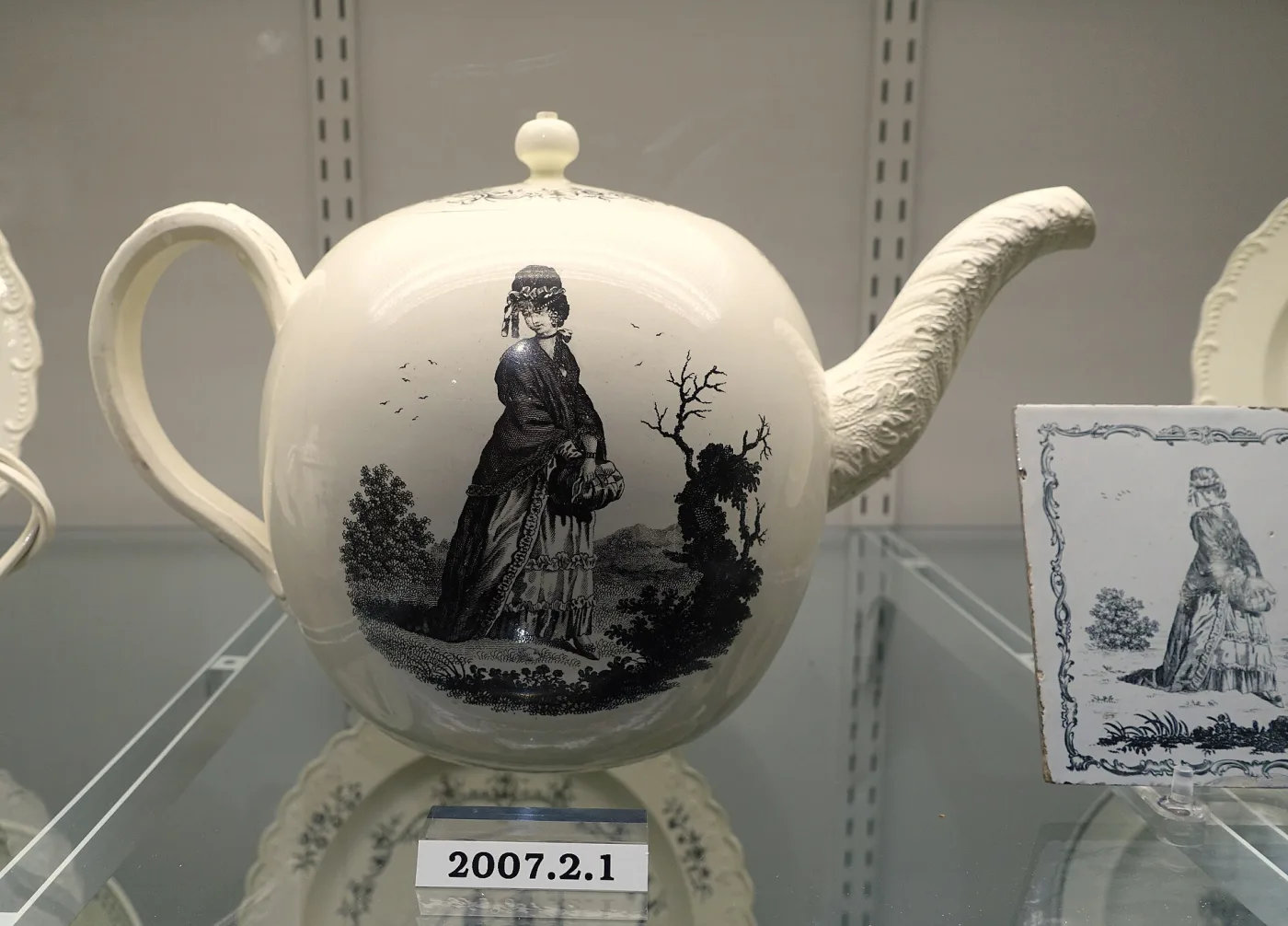
While the print was still wet, the tissue paper was carefully applied to the unfired or biscuit-fired ceramic body. A worker, often a woman or child in historical factories, rubbed the back of the paper firmly to transfer the design, then soaked it in water to remove the tissue. This step is crucial for collectors because it often leaves visible seam lines where separate pieces of tissue paper met on curved or complex forms. These seam lines are one of the most reliable indicators of genuine transfer printing.
Firing
For underglaze printing, the piece was then dipped in liquid glaze and fired in a kiln at high temperature. The glaze melted and flowed over the printed design, permanently sealing it beneath a glassy surface. This is why underglaze transferware is so durable: the design cannot be worn away by use. Overglaze prints, by contrast, sit on top of the glaze and are more susceptible to wear and fading.
Color Identification and Dating
The color of a transfer print is one of the most useful dating clues available to collectors. Different colors became technologically possible at different times, and certain colors were fashionable during specific periods.
Blue (1780s onward)
Cobalt blue was the first and most enduringly popular color for transfer printing. Cobalt oxide was one of the few pigments that could withstand the high temperatures of underglaze firing without burning out or changing color. Early blues tend to be deep and rich, sometimes almost black-blue, while later blues are often lighter and more uniform. The shade of blue can help narrow the date: very dark, intense blues suggest the 1780s-1820s period, while medium blues are typical of 1820s-1850s production.
Black (1810s onward)
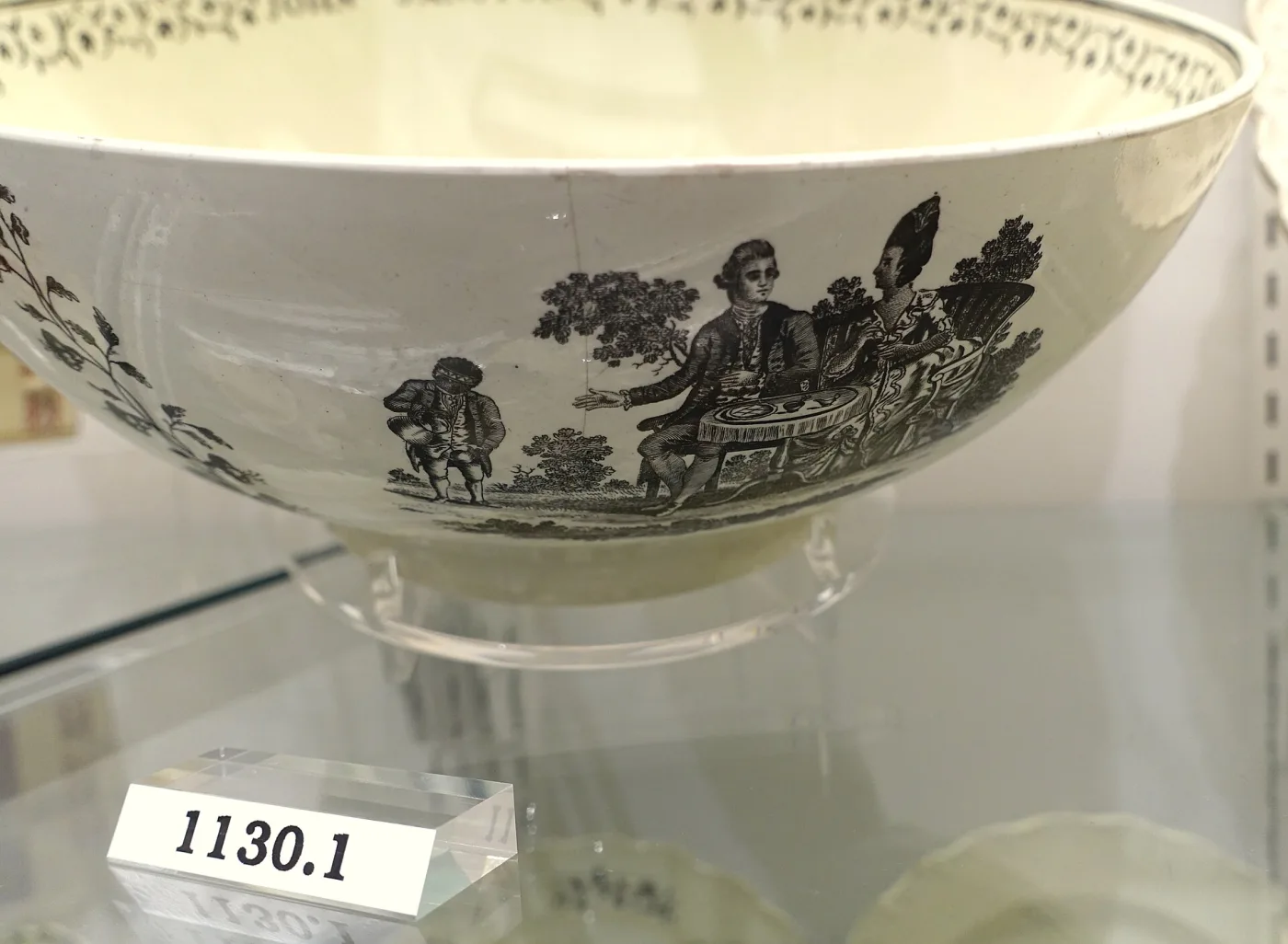
Black transfer prints became commercially available around 1810-1815. They are particularly common on creamware and pearlware pieces. Black printing was often used for commemorative and topographical scenes, and for bat printing, a related technique using flexible glue bats instead of tissue paper.
Green, Red, Brown, and Purple (1820s onward)
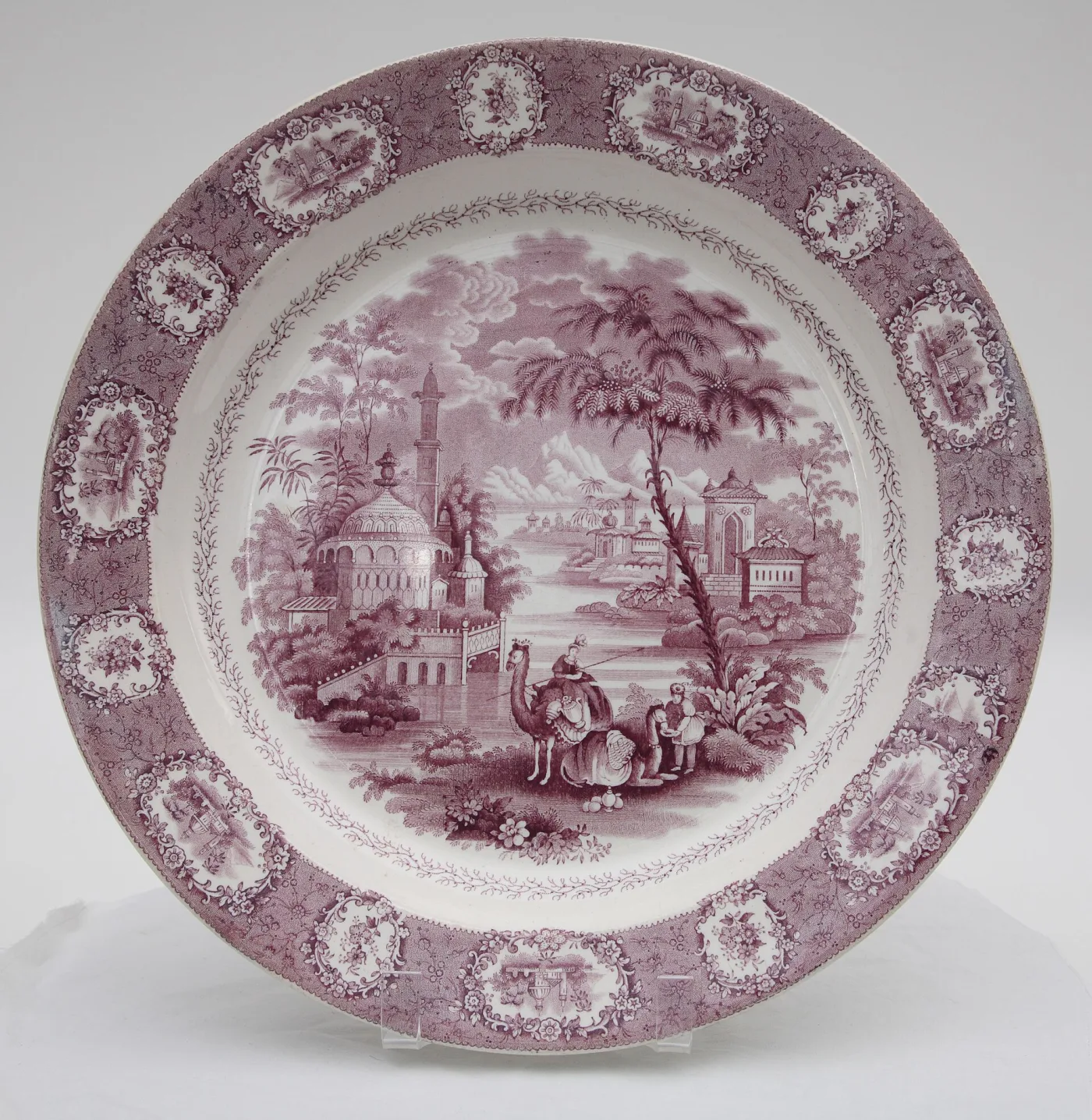
The development of underglaze colors beyond blue expanded significantly in the 1820s. Green, red (often ranging from pinkish-red to deep crimson), brown, and purple all became available. These colors are generally associated with the 1825-1860 period. Two-color and multi-color transfer prints, where multiple plates were used to build up a polychrome design, also appeared during this period, though they are less common and often more valuable.
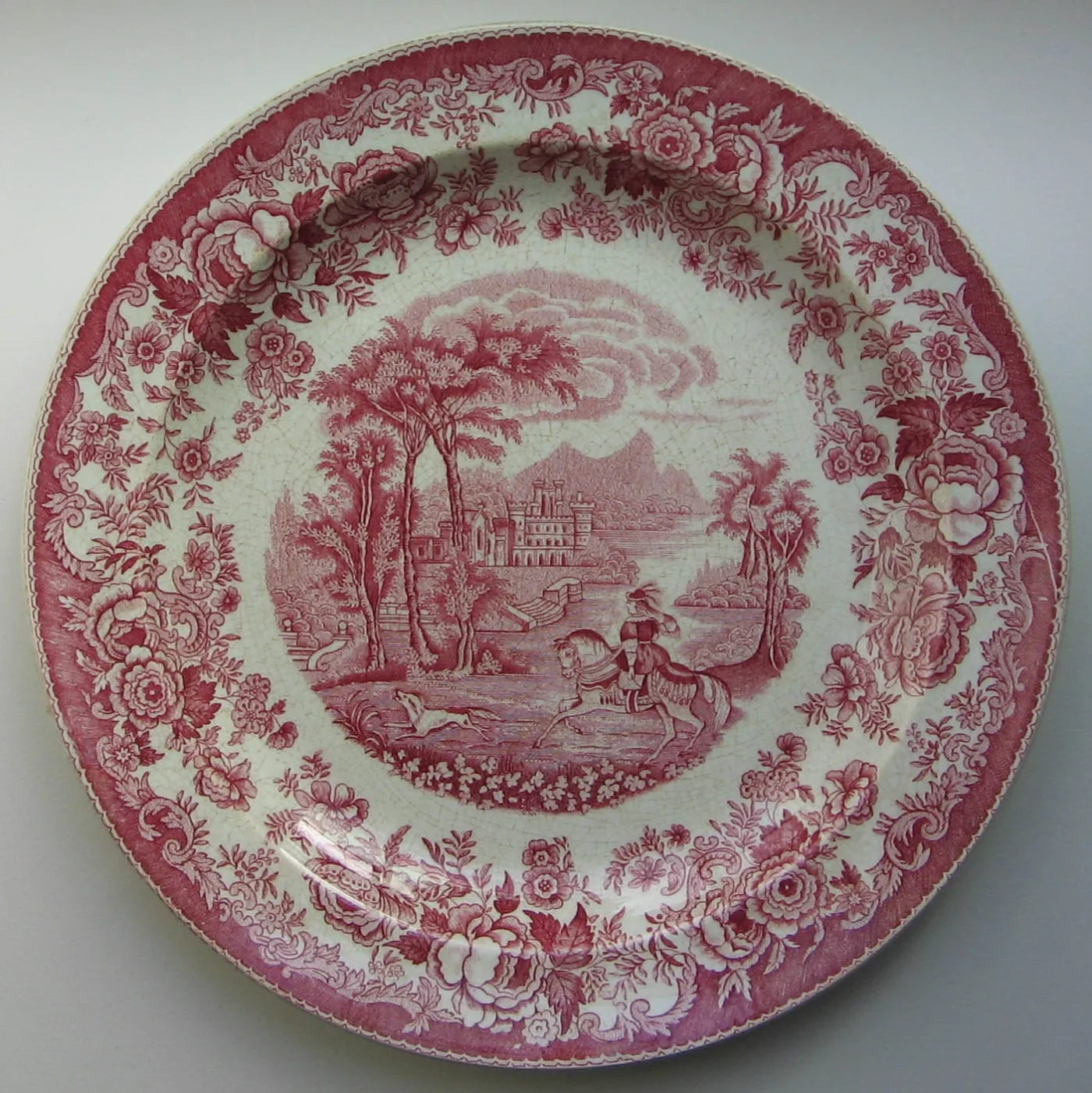
Pink and Mulberry (1830s-1850s)
Pink and mulberry (a reddish-purple shade) transfers were particularly fashionable from the 1830s through the 1850s. Mulberry transferware is actively sought by collectors and often commands premium prices. The color ranges from a warm plum tone to a grayish purple, depending on the specific pigment formulation used by each pottery.
Blue and White Transferware
Blue and white transfer-printed pottery remains the most iconic and widely collected category of transferware. Its appeal draws on centuries of fascination with blue and white ceramics, from Chinese porcelain to Delftware, and the technical mastery of Staffordshire potters in creating affordable alternatives to expensive imported wares.
Early Blue and White (1780-1810)
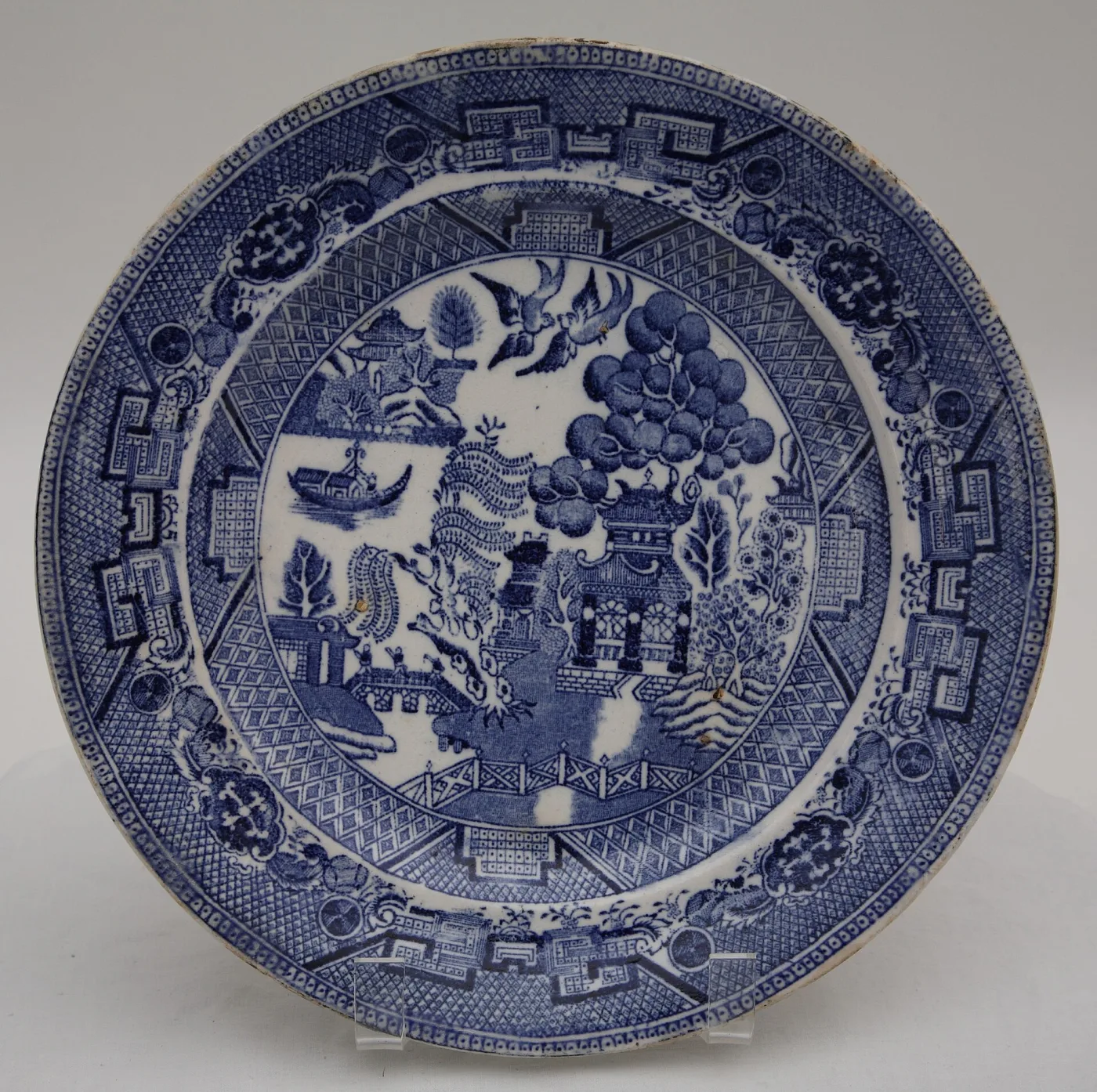
The earliest blue and white transferware was produced on pearlware bodies, which have a slightly bluish-white glaze. Designs from this period tend to feature chinoiserie motifs, including pagodas, willow trees, and figures in Chinese-style landscapes. The famous Blue Willow pattern, attributed to Thomas Minton around 1790, became one of the most reproduced ceramic designs in history. Early pieces show fine, detailed engraving and deep, rich cobalt coloring.
Romantic and Scenic Designs (1810-1850)
From around 1810, potters increasingly drew inspiration from European and American landscapes, architectural views, and romantic literary scenes. Patterns in this period often feature elaborate floral or scroll borders surrounding a central vignette. The border design is often as important as the central pattern for identification purposes, as many factories used distinctive border styles consistently across their product lines.
Late Blue and White (1850-1900)
Later blue and white transferware often shows lighter, more uniform blue coloring and designs that reflect Victorian aesthetic preferences. Flow Blue, where the cobalt was deliberately made to bleed and blur under the glaze, became enormously popular from the 1840s onward. By the late 19th century, many designs had become simplified or were printed using newer photographic transfer techniques that produced a flatter, less nuanced appearance compared to hand-engraved copper plates.

Flow Blue China
Flow Blue is a distinctive subcategory of blue and white transferware where the cobalt pigment was intentionally caused to flow or bleed during firing, creating a soft, blurred effect. This was achieved by introducing a volatile chemical, typically lime or ammonia, into the kiln during the glost firing. The technique was first used commercially in the 1830s and remained popular through the early 1900s.
Identifying Flow Blue
Genuine Flow Blue shows a characteristic bleeding of the blue pigment that softens the edges of the printed design. In heavily flowed pieces, the original pattern may be barely visible beneath the rich cobalt haze. In lightly flowed examples, the pattern remains clearly readable but with softened edges and a dreamy, atmospheric quality. The degree of flow varies considerably between pieces, even within the same pattern, because the technique depended on kiln conditions that were difficult to control precisely.
Major Flow Blue Periods
Collectors generally recognize three main periods of Flow Blue production. Early Flow Blue (1835-1860) features designs with Asian, scenic, and floral themes on ironstone bodies, often with heavy flow that obscures much of the pattern. Middle Period Flow Blue (1860-1880) tends to show moderate flow with patterns that remain clearly visible, including many Japanese-influenced designs reflecting the Aesthetic Movement. Late Flow Blue (1880-1910) typically features lighter flow on whiter bodies, with art nouveau and geometric designs becoming common. Late period pieces are generally more available and less expensive than early examples.
Notable Flow Blue Makers
Prominent Flow Blue manufacturers include W.H. Grindley, Johnson Brothers, Alfred Meakin, J. & G. Meakin, Burgess & Leigh, and many other Staffordshire firms. American potteries, including Mercer Pottery and Wheeling Pottery, also produced Flow Blue in limited quantities. Identifying the maker is often the first step in dating and valuing a Flow Blue piece, and most manufacturers marked their wares with impressed or printed backstamps. For broader context on English ceramic traditions, see our guide to Wedgwood identification.
Staffordshire Historical Transferware
Staffordshire, a county in the English Midlands, was the undisputed center of the British pottery industry from the 17th century onward. The concentration of potteries in and around the towns of Stoke-on-Trent, Burslem, Hanley, Fenton, Longton, and Tunstall earned the region the name "The Potteries." The vast majority of antique transferware encountered by collectors today was produced in Staffordshire.
The Staffordshire Potting District
The region's dominance in pottery production was driven by several geographic advantages: abundant local clay deposits, accessible coal for firing kilns, and proximity to canal and river transportation networks for shipping finished goods. By the early 19th century, hundreds of potteries operated in the district, ranging from large factories employing hundreds of workers to small workshops with a handful of craftsmen.
Dark Blue Staffordshire (1820-1835)
The term "Dark Blue Staffordshire" refers specifically to the richly colored, deeply engraved transfer-printed wares produced during a relatively brief period from roughly 1820 to 1835. These pieces, characterized by their intense dark cobalt color and finely detailed scenes, are among the most highly valued transferware in the market. They were produced by makers including Enoch Wood, James and Ralph Clews, Andrew Stevenson, Ralph Stevenson, and the Rogers factory, among others.
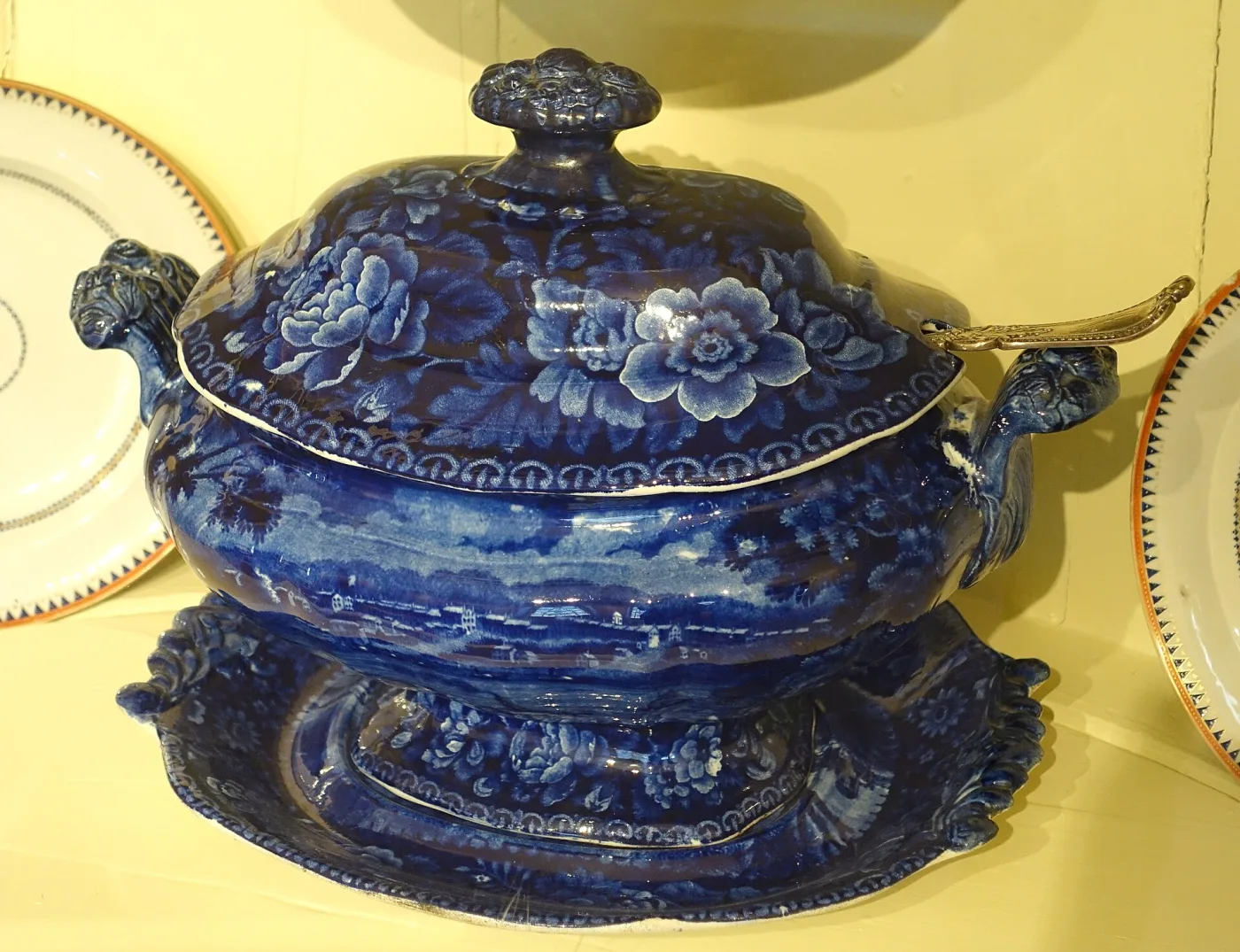
Medium Blue and Light Blue Periods
As the 1830s progressed, the prevailing blue color shifted from deep, dark cobalt to a medium blue, and eventually to the lighter blues that characterized mid-century production. This color shift was partly driven by changes in cobalt sourcing and partly by evolving consumer taste. Medium blue pieces from the 1830s-1840s are still highly collectible, while lighter blue pieces from the 1850s onward are generally more affordable and available.
Major Pattern Categories
Transferware patterns can be broadly classified into several major categories, each with distinctive characteristics that aid identification and dating.
Chinoiserie Patterns
Among the earliest and most enduring transferware designs, chinoiserie patterns depict idealized Chinese and East Asian scenes. The Willow pattern is the most famous example, but hundreds of chinoiserie variants were produced. These include the Two Temples pattern, the Broseley pattern, the Mandarin pattern, and numerous unnamed designs featuring pagodas, bridges, boats, and figures in Asian dress. Chinoiserie patterns were produced throughout the entire history of transfer printing, making dating based on pattern alone unreliable without considering other factors.
Romantic and Italianate Scenes
From the 1820s onward, romantic landscapes featuring ruins, castles, rivers, and figures in pastoral settings became enormously popular. Many of these designs were loosely based on Italian scenery, reflecting the Romantic era's fascination with classical antiquity and picturesque landscapes. Spode's Italian pattern, introduced around 1816 and still in production today, is perhaps the most famous example. Other notable patterns include Copeland's Tower and Adams' Italian Scenery series.
Floral Patterns
Floral designs were among the most commercially successful transfer patterns and were produced by virtually every pottery. These range from naturalistic botanical studies to highly stylized decorative arrangements. Identifying specific floral patterns can be challenging due to the sheer number produced, but distinctive border designs often help narrow the maker and date. Popular series include Spode's Botanical series and the many variations of rose, chrysanthemum, and mixed flower designs.
Topographical and Architectural Views
Patterns depicting identifiable buildings, towns, and landscapes form one of the most fascinating and collectible categories of transferware. English potters produced extensive series of views showing British cathedrals, country houses, and towns, as well as foreign scenes from across Europe, Asia, and the Americas. These pieces serve as valuable historical documents, often preserving images of buildings and landscapes that no longer exist in their depicted form.
Literary and Mythological Scenes
Some transferware patterns illustrate scenes from literature, mythology, and the Bible. Popular subjects included scenes from the works of Sir Walter Scott, Shakespeare, and classical mythology. The Don Quixote series, produced by several different factories, and various Aesop's Fables patterns are among the most sought after by collectors.
Border Designs
Border patterns are critically important for identification because many factories used consistent border designs across multiple central patterns. The border is often the key to attributing a piece to a specific maker. Common border types include floral scroll borders, shell and seaweed borders, grape and vine borders, oak leaf borders, and geometric borders. On the export trade, transfer-printed centers were sometimes framed by the coarse "stick spatter" bands of Staffordshire spatterware, blurring the line between printed and spattered decoration on a single plate. Learning to recognize the characteristic borders of major manufacturers is one of the most valuable skills a transferware collector can develop.
Key Makers and Their Marks
Identifying the manufacturer of a transferware piece is fundamental to establishing its age, origin, and value. While hundreds of potteries produced transfer-printed wares, certain makers are particularly significant for collectors.
Spode and Copeland
Josiah Spode is credited with perfecting underglaze blue transfer printing on earthenware. The Spode factory, established in Stoke-on-Trent around 1770, produced some of the finest transferware ever made. After Josiah Spode II's death, the factory was purchased by William Taylor Copeland in 1833 and operated as Copeland or Copeland & Garrett until 1970. Spode marks typically include the name "SPODE" impressed or printed, often with a pattern name, and reading the succession of Spode and Copeland names is the key to dating a piece; our Spode and Copeland identification guide works through the marks, bodies, and patterns in detail. Copeland marks vary by period but usually include the Copeland name.
Enoch Wood & Sons
Enoch Wood & Sons (operating 1818-1846 in Burslem) produced some of the most celebrated American view transferware. Their dark blue American scenes, including views of Boston, New York, and other cities, are among the most valuable pieces in the field. Marks typically read "ENOCH WOOD & SONS" or "E.W. & S." with an eagle mark sometimes used on pieces intended for the American market.
James and Ralph Clews
The Clews brothers operated a pottery in Cobridge from approximately 1818 to 1834. They are best known for their "Picturesque Views" series of American scenes and their "Dr. Syntax" series illustrating the comic adventures of William Combe's literary character. Their work is characterized by exceptionally fine engraving and rich, deep blue coloring. Marks include "CLEWS" or the full firm name, often with a crown device.
Ridgway
The Ridgway family operated several potteries in Shelton and Hanley from the late 18th century through the 19th century. John and William Ridgway produced extensively for the American market, and their "Beauties of America" series is one of the most important sets of American view transferware. Various Ridgway marks were used, including "J. & W. RIDGWAY," "J. RIDGWAY," and "RIDGWAY & MORLEY."
Adams
William Adams and his descendants operated potteries in Stoke and Tunstall from the late 18th century well into the 19th century. They produced a wide range of transfer-printed patterns, including views of London, American views, and scenic series. Adams marks typically include "ADAMS" or "W. ADAMS & SONS," often with the pattern name printed beneath.
Davenport
The Davenport factory in Longport (1794-1887) was known for high-quality transfer-printed wares. Their mark, a distinctive anchor device with "DAVENPORT" above or below, is one of the most easily recognized in the field. The addition of date numerals to the mark from 1805 onward makes Davenport pieces particularly useful for establishing firm dates.
Reading Marks and Dating Pieces
Backstamps, impressed marks, and printed marks provide some of the most reliable evidence for identifying and dating transferware. Learning to interpret these marks is an essential skill for any collector.
Impressed Marks
Impressed marks were stamped into the unfired clay body before the first firing. They typically identify the manufacturer and sometimes include a date code, workman's mark, or body type designation. Impressed marks are found on the unglazed foot rim or base of pieces and can sometimes be difficult to read, especially on heavily crazed or stained pieces. Running your fingers across the base while viewing in raking light can help reveal faint impressions.
Printed Backstamps
Printed marks were applied to the base using the same transfer printing technique used for the decorative design. They often include the manufacturer's name, the pattern name, and sometimes a cartouche or decorative device. The color of the printed mark usually matches the color of the decorative pattern on the piece. These marks became increasingly common from the 1820s onward and are the primary means of identifying many 19th-century transferware patterns.
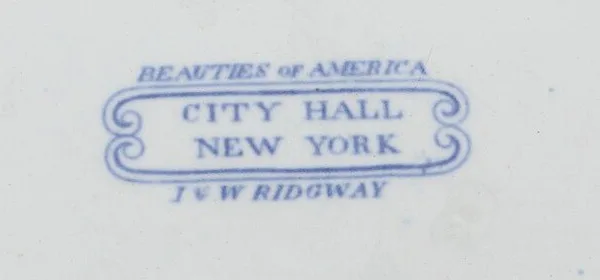
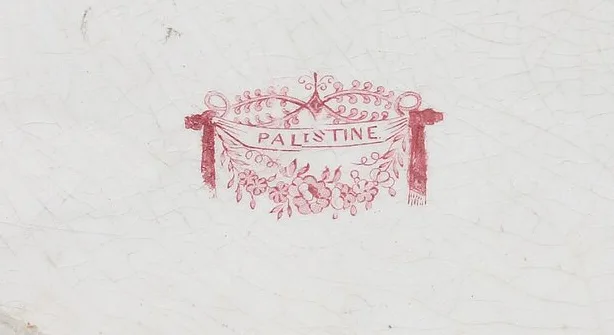
These are the two things a printed backstamp actually gives you, and they are worth separating. The Ridgway mark names the series, the individual view and the maker, which is as much as a transferware mark ever tells you; the Adams mark names only the pattern, which is the more common case and is still enough to search on, because pattern names are catalogued. Note that both marks are printed in the same colour as the decoration on the front. That is not decorative — the mark was engraved onto the same copper plate and pulled with the same ink in the same operation, so a backstamp whose colour does not match the front is a signal worth pursuing. Both photographs here are cropped to the mark. The full underside of the Ridgway plate also carries a hand-painted red inventory number — a collection mark added long after manufacture, and mistaking one of those for a factory mark is among the commonest errors in this field.
The McKinley Tariff Act of 1891
One of the most useful dating benchmarks for transferware is the McKinley Tariff Act, which took effect on March 1, 1891. This law required all goods imported into the United States to be marked with the country of origin. As a result, transferware produced after this date for export to America typically bears the words "ENGLAND," "MADE IN ENGLAND," or similar country designations. Pieces marked "ENGLAND" generally date to 1891-1910, while "MADE IN ENGLAND" typically indicates production after 1910. The absence of a country mark does not necessarily mean a piece predates 1891, as pieces intended for domestic British or non-American markets were not required to carry country marks.
Registration Marks and Numbers
The British design registration system provides another valuable dating tool. The diamond-shaped registration mark was used from 1842 to 1883 and encodes the exact date of design registration in its arrangement of letters and numbers at each point of the diamond. From 1884 onward, sequential registration numbers replaced the diamond mark. While these marks indicate the date of design registration, not necessarily the date of manufacture, they establish a firm earliest possible date for a piece.
Pattern Names and Numbers
Many transferware pieces carry printed or impressed pattern names, which are invaluable for research and identification. Some factories used pattern numbers instead of or in addition to names. Reference books and online databases maintained by organizations like the Transferware Collectors Club allow collectors to cross-reference pattern names and numbers with specific manufacturers and production dates.
American Historical Views
Among the most prized categories of transferware are pieces depicting American scenes, buildings, and landmarks. Produced primarily by Staffordshire potters from about 1818 to 1860, these pieces were made specifically for export to the American market and represent a unique intersection of English manufacturing skill and American national pride.
Dark Blue American Views (1818-1835)
The earliest and most valuable American view transferware was printed in deep, dark cobalt blue. These pieces depict city views, important buildings, natural wonders, and historical events. Major series include Enoch Wood's "English and American Views," the Clews "Picturesque Views," Stevenson's "American Views," and Ridgway's "Beauties of America." Pieces showing views of cities like Boston, New York, Philadelphia, and Washington, or institutions like Harvard, Yale, and the Capitol, command particularly high prices.
The Arms of the States Series
Thomas Mayer produced a celebrated series showing the coats of arms of individual American states, each surrounded by an elaborate floral border. These pieces are among the most recognizable and sought after of all American transferware, with rare state arms commanding premium prices at auction.
Landing of General Lafayette
The visit of the Marquis de Lafayette to the United States in 1824-1825 inspired a wave of commemorative transferware. Multiple factories produced pieces celebrating Lafayette's tour, including views of his reception at Castle Garden in New York and various patriotic designs incorporating his portrait. These pieces are eagerly collected by both transferware and Lafayette memorabilia enthusiasts.
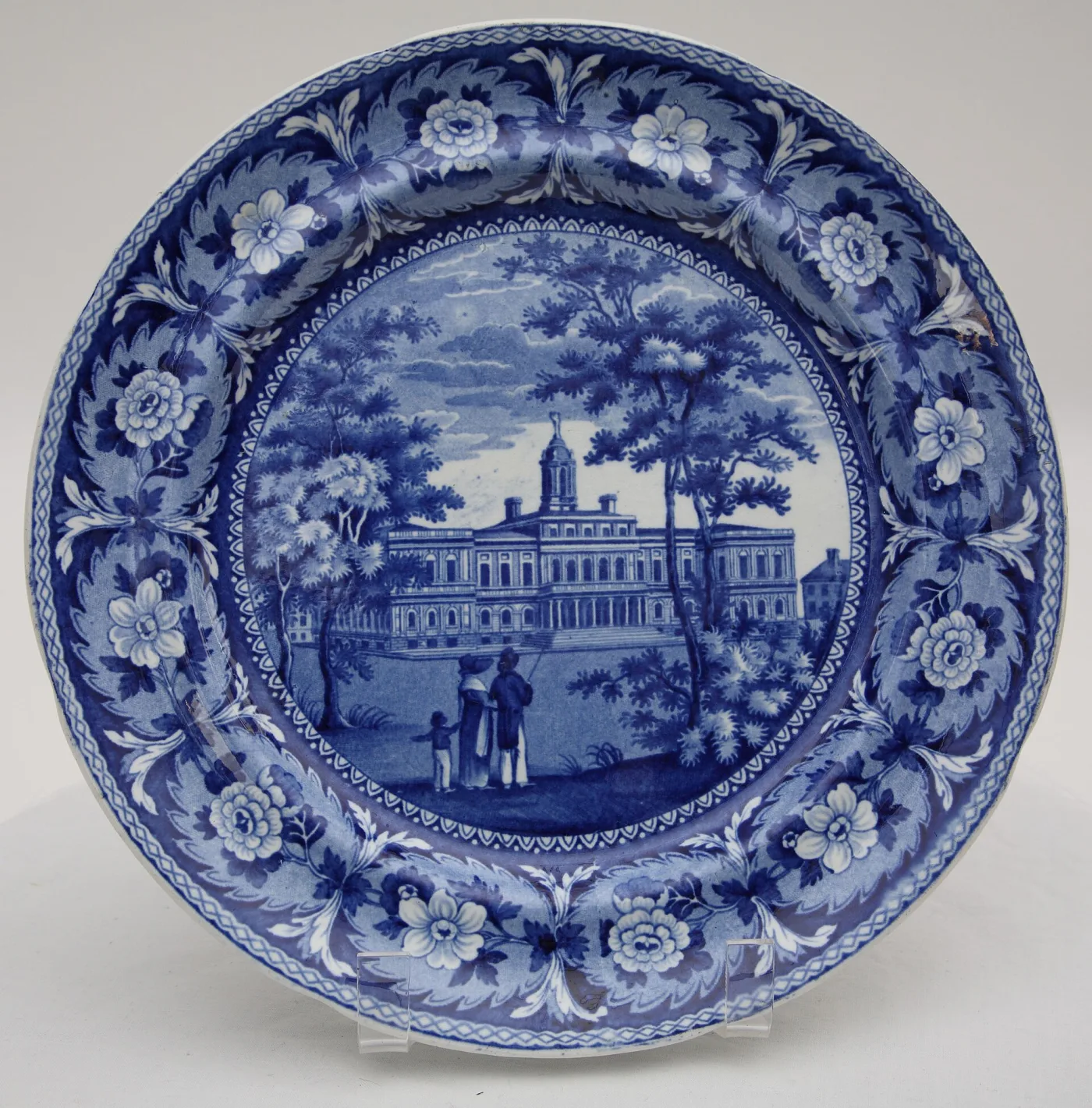
Later American Views
After the dark blue period, American views continued to be produced in medium blue, light blue, and other colors including red, green, brown, and black. While generally less valuable than their dark blue counterparts, these later American views remain highly collectible, especially pieces showing rare views or produced by well-known makers. The Jackson and Goodwin factory produced an extensive series of American views in various colors during the 1830s-1840s.
Common Forms and Shapes
Transferware was produced in virtually every tableware form used during the 18th and 19th centuries. Understanding the range of forms helps collectors identify pieces and assess their relative rarity and value.
Flatware
Plates, platters, and saucers are the most commonly encountered forms of transferware. Plates were produced in standard dinner, luncheon, dessert, and tea sizes. Platters ranged from small meat dishes to enormous serving platters over 20 inches in length. Large platters in desirable patterns can be among the most valuable pieces of transferware. Soup plates, with their wide, flat rims and deep wells, are also common and provide an excellent surface for displaying both the central pattern and the border design.
Hollow Ware
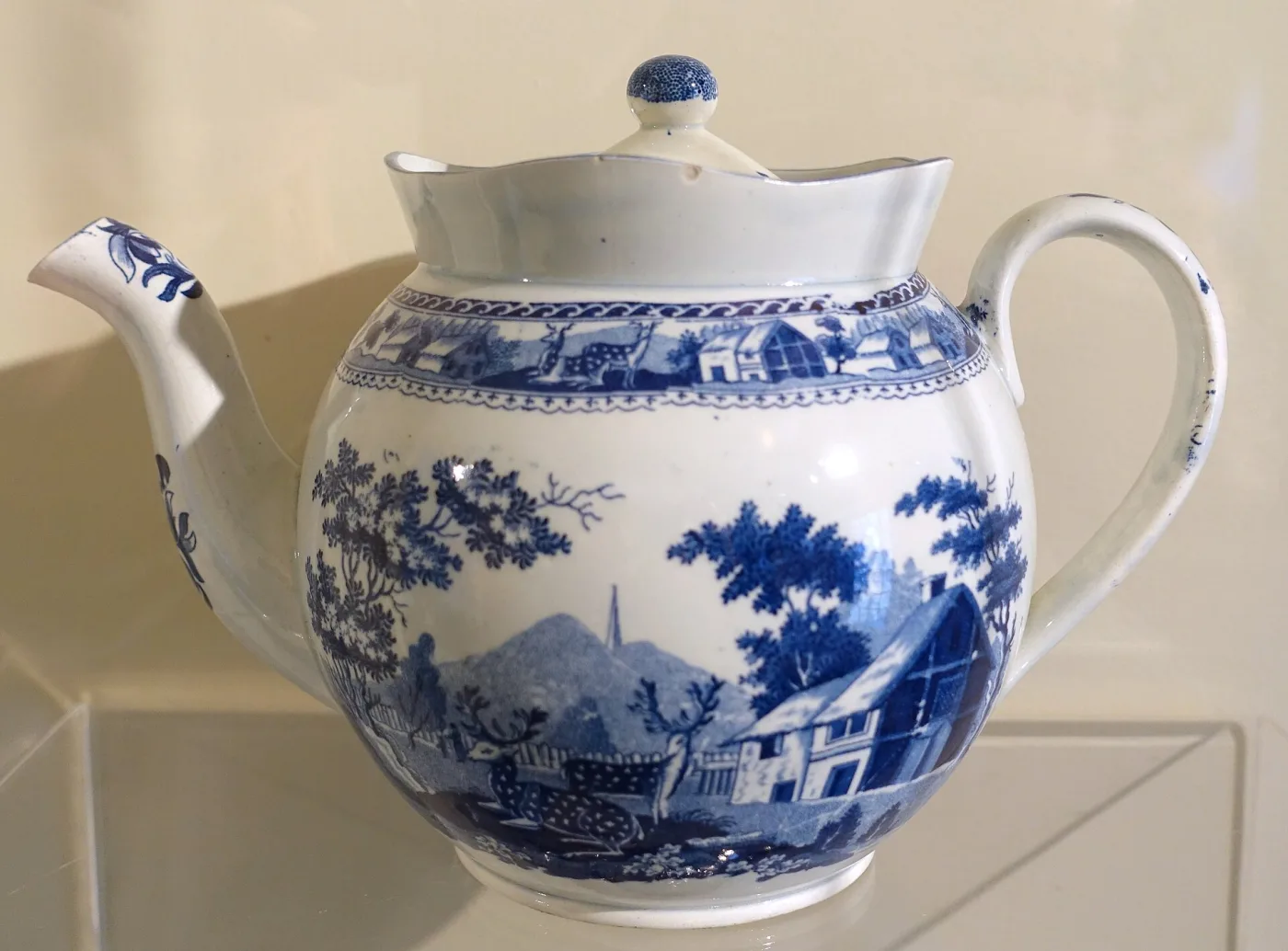
Hollow forms, including teapots, coffeepots, sugar bowls, creamers, sauce tureens, soup tureens, vegetable dishes, and gravy boats, are generally less common than flatware and often more valuable. These pieces required more complex manufacturing, as the transfer had to be applied to curved surfaces, often resulting in visible seam lines where the tissue paper was joined. Teapots and coffeepots are particularly desirable, as are large soup tureens with their covers and stands.
Specialized Forms
Beyond standard tableware, transferware was produced in a wide variety of specialized forms. These include wash basin and pitcher sets, chamber pots, foot baths, cheese domes, egg cups, toddy plates, pill slabs, tiles, and children's dishes. Unusual forms are often highly collectible due to their relative rarity. Children's transferware, featuring miniature dinner services and mugs with educational or moral themes, has its own devoted collecting community.
Condition Assessment and Grading
Condition is a critical factor in determining the value of transferware. Because these pieces were functional tableware intended for daily use, finding examples in pristine condition can be challenging, particularly for early pieces.
Crazing
Crazing, the network of fine lines in the glaze surface, is extremely common on antique transferware and is generally considered acceptable to experienced collectors. It results from the differential expansion and contraction of the glaze and ceramic body over time. While heavy crazing with staining can detract from appearance and value, light crazing alone is not considered a significant defect in antique pieces and can actually help confirm age.
Chips, Cracks, and Repairs
Edge chips are common on plates and platters and reduce value significantly, though minor rim chips may be acceptable on rare patterns. Hairline cracks and larger breaks dramatically reduce value. Professional restoration is common in the transferware market, and collectors should examine pieces under ultraviolet light or blacklight, which can reveal repairs that are invisible to the naked eye. Restored pieces should always be disclosed and priced accordingly.
Staining and Discoloration
Staining from years of use is common, particularly in the crazed areas of the glaze. Surface stains can sometimes be reduced through careful cleaning, but deep staining penetrating the craze lines is usually permanent. Knife marks, particularly on plates, are common and indicate genuine use. While they reduce value compared to unmarked examples, they are part of the piece's history and are generally accepted by collectors.
Print Quality
The quality and condition of the transfer print itself affects value significantly. Look for crisp, well-defined printing with good color intensity. Faded or pale printing, often caused by worn copper plates that should have been re-engraved, is less desirable. Printing defects from the manufacturing process, such as smudges, incomplete transfers, or heavy seam lines, also reduce value, though they can be interesting from a technical standpoint.
Identifying Reproductions and Fakes
The popularity and value of antique transferware has inevitably attracted reproductions and fakes. Learning to distinguish genuine antique pieces from modern copies is essential for collectors.
Modern Reproduction Characteristics
Modern reproductions often betray themselves through several telltale signs. The ceramic body is typically whiter and more uniform than antique bodies, which tend to show slight color variations and imperfections. Modern glazes are usually smoother and more uniform, lacking the subtle irregularities and warmth of antique glazes. The printing on reproductions often appears too sharp or too uniform, lacking the slight variations that characterize hand-applied transfers from engraved copper plates.
Weight and Feel
Antique ironstone and earthenware has a distinctive heft and feel that experienced collectors learn to recognize. Modern pieces are often lighter in weight due to different clay bodies and manufacturing techniques. The foot rim of antique pieces typically shows evidence of hand finishing, including slight irregularities, while modern pieces tend to have machine-perfect bases.
Common Reproduction Patterns
Certain popular patterns have been widely reproduced. The Willow pattern has been continuously produced since the late 18th century, making dating without marks particularly challenging. Flow Blue has also been extensively reproduced, particularly since the 1980s. Modern Flow Blue reproductions often show a more uniform, artificial-looking flow compared to the natural variation found in genuine antique pieces. American historical views have also been reproduced, though high-quality fakes of the rare dark blue pieces are less common due to the difficulty of replicating the original engraving quality.
Authentication Tips
When evaluating a piece, apply the same principles used in antique authentication and provenance research: check for genuine signs of age including natural wear patterns on the base, appropriate crazing, and subtle irregularities in the body and glaze. Examine the printing under magnification; genuine copper plate transfers show fine engraved lines with varying depths, while modern photographic transfers appear as a uniform dot pattern similar to newspaper printing. Check backstamps against published reference materials, and be wary of pieces that look "too good" for their supposed age.
Market Values and Price Trends
The transferware market has shown consistent strength over the past several decades, with particularly rare pieces achieving record prices at auction while more common patterns remain accessible to beginning collectors.
High-Value Categories
The most expensive transferware pieces are generally dark blue American historical views, with rare views of specific cities or buildings fetching $5,000 to $50,000 or more at auction. Large forms, such as platters and tureens in desirable patterns, command premium prices. Unusual forms, including foot baths, cheese domes, and complete children's dinner services, also achieve high prices when they appear on the market. Early Flow Blue in rare patterns can bring $1,000 to $10,000 for individual pieces.
Mid-Range Market
Standard plates and common hollow ware forms in well-known patterns typically sell in the $100 to $1,000 range, depending on the maker, pattern, color, condition, and form. Medium blue and light blue Staffordshire pieces generally bring less than comparable dark blue examples. Non-blue colors, including red, green, brown, and mulberry, have their own price dynamics, with mulberry pieces often commanding prices comparable to or exceeding standard blue examples.
Entry-Level Collecting
Beginning collectors can find attractive transferware pieces for $25 to $100, particularly later 19th-century plates and smaller forms in common patterns. Late Flow Blue, generic floral patterns, and unmarked pieces offer affordable entry points. Collecting by theme, such as a particular color, form, or subject matter, can be a rewarding approach that doesn't require the budget needed for rare historical pieces.
Market Trends
The transferware market has evolved significantly in recent years. While traditional collecting categories like dark blue American views remain strong, there has been growing interest in non-blue colors, particularly mulberry and green. The decorative market has also influenced prices, with pieces valued for their visual appeal in interior design as well as their historical significance. Online selling platforms have broadened the market, making both rare and common pieces more accessible to buyers worldwide.
Care and Display
Proper care and display of transferware helps preserve both the physical condition and the value of your collection.
Cleaning
For routine cleaning, wash transferware by hand using warm water and a mild dish soap. Avoid dishwashers, as the high heat and harsh detergents can damage both the glaze and any overglaze decoration. For stubborn stains, a paste of baking soda and water applied gently with a soft cloth can be effective. Hydrogen peroxide diluted to a three percent solution can help lighten stains in the craze lines. Never use abrasive cleaners, bleach, or scouring pads, as these can permanently damage the glaze surface.
Display Considerations
When displaying transferware, avoid prolonged exposure to direct sunlight, which can fade some colors over time, particularly red and pink transfers. Plate hangers should have cushioned wire contacts to prevent chipping. For valuable pieces, consider using acrylic plate stands instead of wall-mounted hangers. Ensure shelving and display cabinets are sturdy enough to support the weight of ceramics and protected against accidental tipping or vibration.
Storage
When storing transferware, place soft padding between stacked plates to prevent scratching and chipping. Acid-free tissue paper or felt circles cut to size work well for this purpose. Store pieces in a stable environment with consistent temperature and humidity to minimize the risk of further crazing. For detailed preservation guidance, consult our antique storage and care guide. Avoid storing ceramics in attics or unheated garages where temperature extremes can cause thermal shock.
Building a Transferware Collection
Whether you are just starting out or expanding an established collection, a thoughtful approach to building your transferware holdings will yield the greatest satisfaction and long-term value.
Define Your Focus
The sheer variety of transferware can be overwhelming without a collecting focus. Consider specializing in a particular area: a specific maker like Spode or Ridgway, a color such as mulberry or Flow Blue, a pattern category like American views or chinoiserie, a form like teapots or children's dishes, or a time period. Focused collecting builds expertise more quickly and creates a more coherent and visually impactful collection.
Research Resources
Invest in key reference books before investing heavily in pieces. Essential volumes include "Transferware Collectors Club Bulletin" back issues, Petra Williams' "Flow Blue China" series, Robert Copeland's "Spode's Willow Pattern," and Jeffrey Snyder's "Historical Staffordshire" guides. The Transferware Collectors Club provides access to an extensive pattern database, educational materials, and a community of knowledgeable collectors. Online resources and museum collections also offer valuable research opportunities.
Where to Buy
Transferware can be found at antique shows, estate sales, auction houses, antique shops, and online marketplaces. Auction houses, particularly those with strong ceramic departments, are good sources for rare and documented pieces. Estate sales can yield bargains when transferware is not the primary focus of the sale. Antique shows allow hands-on examination before purchase, which is particularly important for condition assessment. When buying online, request detailed photographs of the front, back, marks, and any condition issues, and buy from sellers with established reputations and return policies.
Condition vs. Rarity
A common collecting dilemma is whether to accept condition issues on rare pieces. In general, rarity trumps condition for serious collectors: a rare dark blue American view platter with a hairline crack may be worth acquiring if it is unlikely another example will appear soon. For more common patterns, however, holding out for the best condition available is usually the wiser strategy. The exception is if you are collecting for decorative use rather than investment, in which case condition-impaired pieces can offer beautiful aesthetics at accessible prices.