Belleek Porcelain Identification Guide: Marks, Periods & Dating
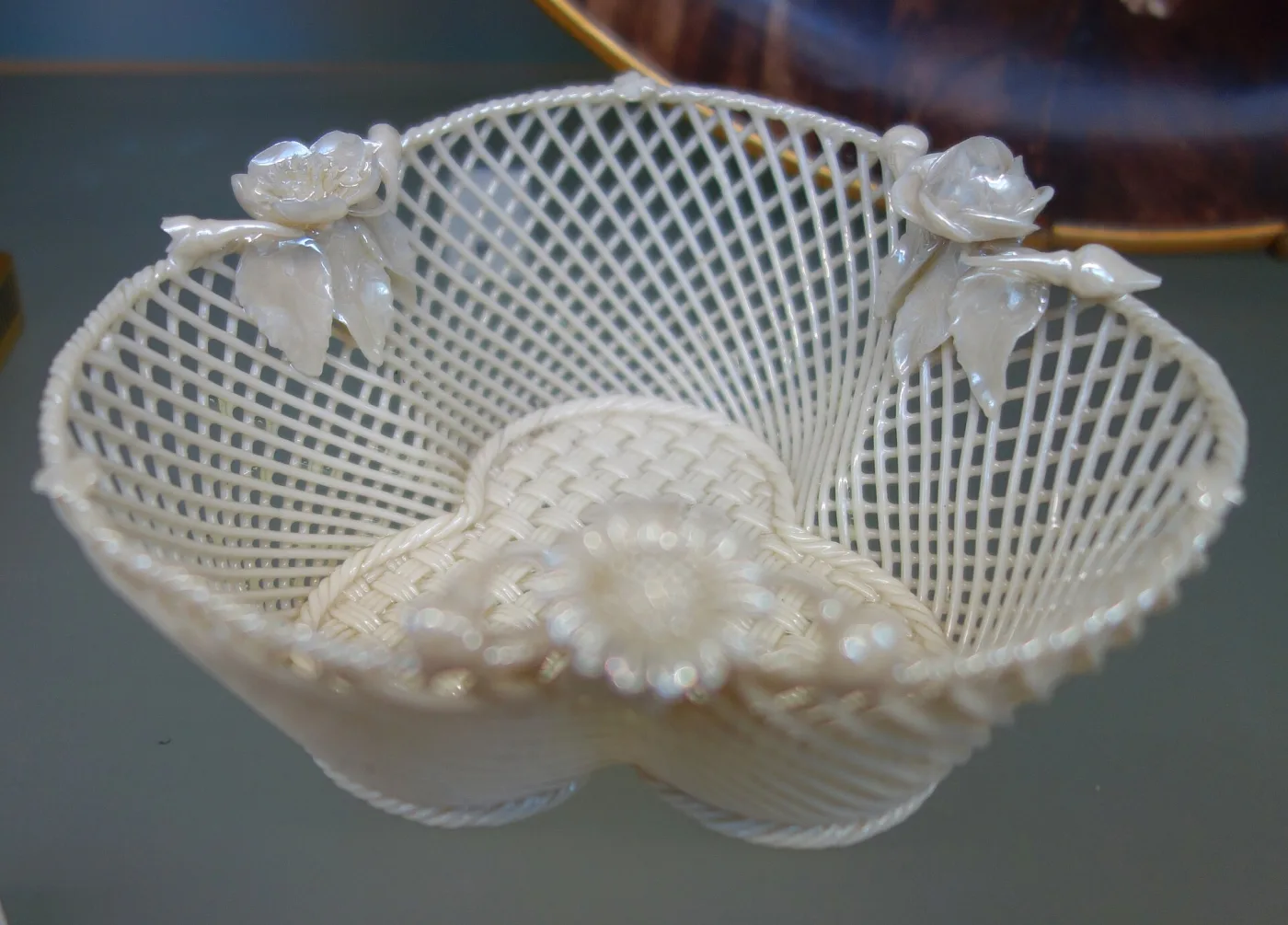
Belleek is the eggshell-thin, faintly iridescent Irish parian china produced continuously at the village of Belleek in County Fermanagh since 1863. The wares were conceived as an Irish answer to the porcelain of Sèvres, Meissen, and the great English factories — but executed in a uniquely indigenous material: a feldspathic parian body so thin you can read print through it, glazed with a soft pearlescent lustre that shifts colour as it catches the light. From the first hand-modelled shell tea services of the 1860s to the modern collector editions still leaving the Fermanagh works today, Belleek has carried a continuous craft identity unmatched by any other porcelain factory in the British Isles.
For the collector, Belleek is unusual in that the factory has assigned and dated its own backstamps with rare consistency. Eight principal mark periods — from the First Period Black Mark of 1863–1890 through the modern Blue Mark introduced in 2022 — divide nearly a hundred and sixty years of production into firmly datable bands. A piece's mark, taken together with body, glaze, and form, places it within a fifteen- to twenty-year window almost without exception. This guide reads each mark period in turn, then walks through the body and lustre, the principal pattern families (Tridacna, Echinus, Neptune, Shamrock, Limpet, Thorn, Hexagon), the basketwork wares, the inevitable confusion with American "Belleek-type" parian, and the value ranges that follow from period and rarity. It builds on the broader framework of our antique porcelain identification guide.
By the end you will be able to read a Belleek mark within seconds, place a piece confidently within a mark period, tell genuine Irish Belleek from Ott & Brewer or Willets American parian, recognise the basketwork patterns and the great hand-built figural wares, and apply realistic value expectations to anything from a £30 Third Period shamrock cup to a five-figure First Period International Centrepiece.
Table of Contents
- A Brief History of Belleek Pottery
- The Eight Mark Periods: A Dating Framework
- First Period Black Mark (1863–1890)
- Second & Third Period Black Marks (1891–1946)
- Green Mark Periods (1946–1980)
- Gold and Modern Marks (1980–present)
- The Parian Body
- Nacreous Lustre Glaze
- Patterns: Tridacna, Echinus, Neptune & More
- Belleek Basketwork
- Figural and Hand-Built Wares
- Applied Flowers and Thorn Decoration
- American "Belleek-Type" Parian
- Reproductions and Modern Production
- Authentication Workflow
- Condition and Damage
- Value Factors and Price Ranges
- Building a Belleek Collection
- Care, Display & Preservation
A Brief History of Belleek Pottery
The story begins with three figures: John Caldwell Bloomfield, the local landowner who inherited the Castle Caldwell estate in 1849 and surveyed his land for feldspar, kaolin, and other ceramic minerals; David McBirney, a Dublin draper who provided the capital; and Robert Williams Armstrong, an English architect and ceramic technician who became the works' first art director. Construction of the pottery began in 1857, and the first wares were fired in 1863.
The Bloomfield–McBirney–Armstrong Foundation
Bloomfield's motive was partly philanthropic — the post-Famine landlords of north-west Ireland faced widespread destitution among their tenants, and a pottery promised local employment. Armstrong's contribution was technical: he had worked at Worcester and Goss and brought the parian formula and the slip-casting expertise required to produce thin, translucent wares from local feldspar.
The First Period (1863–1890)
Production grew rapidly. By the 1870s Belleek was shipping internationally, winning medals at exhibitions in Dublin, Paris, Vienna, and Philadelphia. The First Period — coinciding with the original Black Mark — produced the most ambitious and most expensive Belleek ever made, including the great International Centrepiece, the Prince of Wales Ice Pail, and elaborate basketwork compotes that took months to assemble. David McBirney died in 1882; Armstrong followed in 1884; control passed to a consortium that struggled financially through the late 1880s.
Reorganisation and the Second Period (1891–1926)
The 1890 reorganisation as Belleek Pottery Ltd brought new capital and the requirement, under the McKinley Tariff Act of 1891, to mark exported wares with country of origin. The "IRELAND" inscription was added to the existing Black Mark, defining the Second Period — the same regulation that produced the "Nippon" marking on Japanese export porcelain in exactly the same year. Production stabilised through the early twentieth century around tableware, basketwork, and applied-flower decoration.
The Twentieth Century
The Third Period Black Mark (with "Co. Fermanagh, Ireland" added, 1926–1946) saw the factory through depression and war. The conversion to a Green Mark in 1946 modernised the imagery without altering the basic harp-hound-tower trio. The factory continued under various ownerships — Erne Pottery and Allied Holdings groups — through the late twentieth century, becoming an employee-owned company in 1990. Belleek Pottery survives today as Ireland's oldest working china factory.
Cultural Position
Belleek occupies a particular place in Irish material culture. Like the lace of Carrickmacross or the silver of Dublin assay-marked work, it carries explicit national symbolism — harp, wolfhound, round tower, shamrock — into a luxury craft object. For Irish diaspora collectors, particularly in the United States and Australia, Belleek is both fine porcelain and a portable expression of cultural identity, which has supported the market through every downturn since 1863.
The Eight Mark Periods: A Dating Framework
Belleek backstamps are the most useful single dating tool in collectible Irish ceramics. Every mark since 1863 incorporates three central devices — the Irish harp, the Irish wolfhound, and the round tower — usually flanked by sprigs of shamrock, sometimes within a banner, and from 1891 onward with a country-of-origin inscription. The mark colour and the precise wording define the period.
Why the Marks Matter
Belleek did not produce many fundamentally new shapes after the First Period. A Tridacna teacup made in 1875 and one made in 1975 may look almost identical to the casual eye — same shell-mould body, same applied handle, same nacreous glaze. The mark distinguishes one from the other and divides their values by a factor of fifty or more.
Colour Sequence at a Glance
Black marks: 1863 to 1946 (three periods). Green marks: 1946 to 1980 (three periods). Gold marks: 1980 to 2007 (one main period). Blue, Black-and-Gold collector marks, and the modern Blue Mark have followed in the twenty-first century. The colour transition from black to green is the single biggest dating clue: a black-marked piece is always pre-1946, regardless of subsidiary detail.
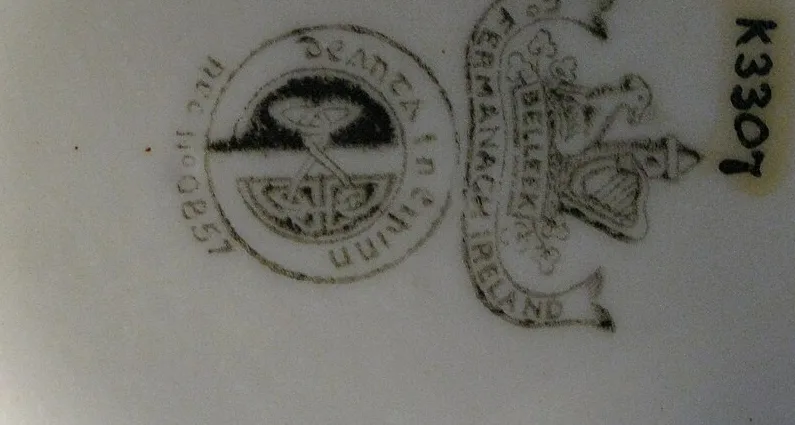
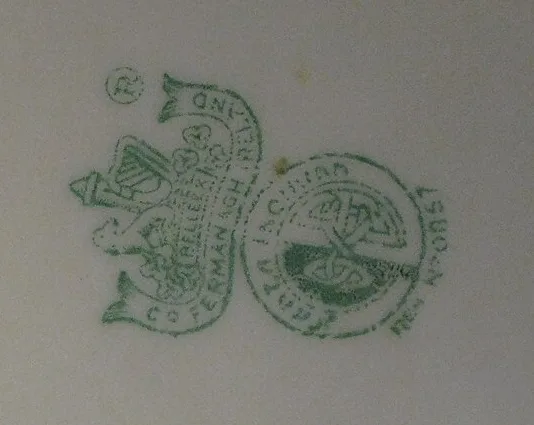
These two marks are from the same museum collection and they are the single biggest dating clue this ware offers: a black mark is always pre-1946 and a green mark is always after it. Get the colour first and everything else is refinement. Then read the wording against the anchors set out in the next section. The black one carries both Co. Fermanagh Ireland and Déanta in Éirinn, which puts it in the Third Black period of 1926–1946 — and the museum independently dates the service it belongs to at about 1926 to 1941, which is a satisfying confirmation that the method works. The green one adds a registered-trademark symbol, which those anchors place at 1955 or later, and the circled form later still. Note also what is the same in both: the three devices — harp, wolfhound and round tower — run through the entire sequence from 1863 onwards, so their presence tells you the factory and nothing whatever about the date.
Wording Anchors
"BELLEEK" alone with the three devices: 1863–1890. "BELLEEK / IRELAND": 1891–1926. "Co. FERMANAGH IRELAND" added: 1926–1946. "DEANTA in ÉIRINN" (Irish-language "Made in Ireland") appears on Third Black Mark and on early Green Marks. "R" registered-trademark symbol added: from 1955. "Ⓡ" inside circle and additional refinements: 1965 and later.
Impressed vs. Printed Marks
Most Belleek marks are printed in underglaze cobalt (black appearance) or in coloured glaze. Some early First Period pieces also carry impressed factory marks giving the date of pattern registration. Impressed pattern numbers, painter's marks, and gilders' initials sometimes accompany the main backstamp on better pieces.
Pattern Registry and Design Marks
British registration diamonds (1842–1883) and Rd. No. numbers (1884 onward) appear on registered Belleek designs. The diamond or number can be cross-referenced to the published registry to date the original pattern release, which is usually decades earlier than the individual piece. The same registry framework is described in detail in our authentication and provenance research guide.
First Period Black Mark (1863–1890)
The First Period — the original Black Mark — is the most coveted Belleek for collectors. It coincides with the Armstrong–McBirney leadership and with the most ambitious modelling and decoration the factory ever attempted.
The First Black Mark
The mark shows an Irish wolfhound recumbent at left, a round tower at right, a harp upright between them, all atop a banner reading "BELLEEK." Three sprigs of shamrock appear below. The mark appears in cobalt blue that prints almost black under the glaze. No country-of-origin inscription is present.
Body and Lustre Characteristics
First Period bodies are exceptionally thin and translucent. Held to light, a First Period cup transmits the silhouette of a finger placed behind it. The lustre glaze of this period is particularly luminous — early Belleek lustre has a slightly warm cream undertone and a more pronounced iridescent shift than later production. Crazing is uncommon and indicates exposure problems rather than original quality.
Hand-Built Wares
The First Period was the heyday of Belleek's elaborate hand-built work. Basketwork plates, compotes, and centrepieces with applied flowers; figural pieces modelled by William Bromley, William Henshall, and Frederick Slater; ambitious exhibition objects such as the International Centrepiece (made for the 1872 Dublin Exhibition). Hand-built First Period work routinely reaches five figures at specialist auction.
Pattern Registrations
The principal Belleek table patterns — Tridacna, Echinus, Hexagon, Neptune, Limpet, Thorn — were all registered during the First Period. A First Period Neptune teacup carries a very different value from a Third Period one of the same shape: the period premium can reach 10–20x.
First Black Mark Identification Pitfalls
Reproductions of the First Mark exist on later wares (occasionally on outright fakes). Always cross-check the mark against body thinness, lustre quality, and form refinement. A heavy, dull-lustred piece with a "First Black Mark" is almost certainly fraudulent or a later mark misread. Genuine First Period pieces have a recognisable combination of body, lustre, and decoration that cannot be faked with a stamp alone.
Second & Third Period Black Marks (1891–1946)
The two later Black Mark periods cover more than half a century of production and represent the bulk of pre-war Belleek in the collector market.
Second Black Mark (1891–1926)
The Second Mark adds the word "IRELAND" beneath the harp-hound-tower device, complying with the 1891 McKinley Tariff Act. Otherwise the design is essentially unchanged from the First Mark. Second Period bodies remain very thin and the lustre quality remains high. Patterns expand and basketwork production scales up to meet middle-class international demand.
Third Black Mark (1926–1946)
The Third Mark adds "Co. FERMANAGH, IRELAND" — the full Irish county location — beneath the device. Some Third Mark pieces also carry the Irish-language inscription "Deanta in Éirinn" (Made in Ireland) added in the 1930s. Bodies remain thin and lustre good through the Third Period, although some austerity is visible in the Depression and wartime years.
Distinguishing Black Mark Periods
The simplest test is the wording beneath the central device: nothing (First), "IRELAND" (Second), "Co. FERMANAGH IRELAND" or "Deanta in Éirinn" (Third). A magnifier helps with worn marks. Where the wording is illegible, body thinness and lustre quality favour the earlier period; heavier body and weaker lustre suggest the Third.
Third Period Production Volume
The Third Period saw the largest tableware production of any pre-war period — much of the Belleek that turns up at estate sales and antique fairs today is Third Mark. This means Third Mark pieces are usually the most accessible entry point to genuine antique Belleek, with common Tridacna and Limpet cups available in the £30–£120 range.
Wartime Production
Wartime restrictions on materials and labour reduced output in 1940–1945. Pieces with a Third Mark and demonstrably wartime character (provenance-documented or with utility-period decoration) carry historical interest. The transition to the Green Mark in 1946 marks the formal end of the Black Mark era.
Green Mark Periods (1946–1980)
The Green Mark transition modernised Belleek without changing the basic iconography. The three devices and shamrock surround remain; only the colour and minor design elements shift.
First Green Mark (1946–1955)
The first Green Mark essentially reproduces the Third Black Mark design in green glaze rather than cobalt. "DEANTA IN ÉIRINN" appears beneath the device. Bodies through the late 1940s and early 1950s remain thin and lustre good. Post-war shortages affected gilding and applied decoration on tableware.
Second Green Mark (1955–1965)
The Second Green Mark adds the "R" registered-trademark symbol. Most other detail remains unchanged. This is the most common Green Mark in the market.
Third Green Mark (1965–1980)
The Third Green Mark adds the circled-R registered trademark and minor refinements to the device design. Body and lustre quality remain consistent. The transition to the Gold Mark in 1980 closes the Green Mark era.
Collecting Green Mark Belleek
Green Mark pieces represent the affordable middle of the Belleek market. Common patterns trade in the £25–£150 range; better hand-built basketwork and figural pieces can reach £400–£1,500. The Green Mark era saw new pattern introductions — Tara, Aran, Cleary, Killarney — that complement the Victorian-registered classics.
Quality Through the Green Mark Era
Belleek's craft standards held through the Green Mark period despite broader changes in the ceramic industry. Critics sometimes describe later Green Mark lustre as marginally less luminous than First Period work — true on close comparison, but the difference is subtle and the pieces remain unmistakably Belleek.
Gold and Modern Marks (1980–present)
The Belleek Mark has shifted four times since 1980, reflecting modernisation, marketing strategy, and the development of a focused collectors' market through the Belleek Collectors' International Society.
Gold Mark (1980–1992)
The Gold Mark transitions from green glaze to gold lustre printing, while retaining the three devices and shamrock surround. Inscription typically reads "Belleek" with "Ireland" or "Co. Fermanagh, Ireland" below.
Second Gold Mark (1993–1996) and Blue Mark (1997–2007)
Refinements through the late twentieth century included the Second Gold Mark and the Blue Mark, which used a vivid blue glaze. Each subdivision is well-documented in the published mark guides and the Belleek Collectors' Handbook.
Recent Marks (2007–present)
Subsequent twenty-first century marks have included the Black-and-Gold Mark, a celebratory mark for the 150th anniversary in 2013, and the current Blue Mark introduced in 2022. The factory continues producing collector pieces, limited editions, and classic table patterns under modern marks.
Limited Editions and Collector Pieces
From the 1980s onward the factory has produced annual collector pieces, society exclusives, and limited-edition figurines. Modern Belleek is often sold as a contemporary luxury collectible rather than as antique, but the better limited editions have appreciated noticeably on the secondary market.
The Belleek Collectors' International Society
The official collectors' society publishes a quarterly journal, organises factory tours, and offers society-exclusive pieces each year. Society membership and annual subscription pieces are themselves collected, and the society's mark archive is the authoritative reference for modern mark identification.
The Parian Body
The body itself is half the story. Belleek's parian is what makes the wares unmistakable when you handle one — light, thin, vitreous, slightly creamy in tone before the glaze, and with a faintly waxy finish where unglazed.
What Parian Is
Parian is a soft-paste feldspathic porcelain originally developed in mid-Victorian England as an imitation of Parian marble. The body fires to a slightly waxy, marble-like surface that takes fine modelling well. Belleek refined the formula for translucency and thinness, producing a parian distinct from the heavier Copeland or Minton parians of the same period.
The Belleek Recipe
Belleek's body contains a high proportion of feldspar from local Fermanagh deposits, together with kaolin and ball clay. The exact formula was a closely guarded factory secret. The body is fired at a lower temperature than hard-paste European porcelain, producing a slightly softer, less dense vitreous body that nevertheless permits the famous translucency.
Translucency Test
Hold a thinly-cast Belleek cup or vase up to a strong light source. Genuine Belleek shows transmitted light through the body — sometimes enough to read print held behind the piece. The translucency is consistent across the period from First Mark to modern. Reproductions in different bodies (bone china, earthenware) lack this characteristic transparency.
The Foot Ring and Unglazed Body
Examine the unglazed foot ring on the base. Belleek parian shows a faintly cream-coloured, smooth, slightly waxy body. The body should not be chalky, not gritty, and not granular. Compare to the body characteristics of creamware or earthenware to feel the distinction.
Hand-Modelling and Slip-Casting
Most tableware is slip-cast in plaster moulds. Hand-built work (basketwork strands, applied flowers, figural elements) was added before firing. The combination of slip-cast components and hand-built decoration is characteristic of Belleek production from the First Period to the present.
Nacreous Lustre Glaze
The pearlescent, slightly iridescent glaze is the second defining feature of Belleek. Reading the lustre takes practice, but once you have the eye it is nearly impossible to miss.
The Lustre Effect
Belleek lustre is a thin, transparent, faintly iridescent glaze that shifts subtly through cream, peach, and pearl-grey as the angle of light changes. It is sometimes described as "mother-of-pearl" or "nacreous." Unlike the heavy, opaque iridescence of carnival glass or the more pronounced metallic shimmer of late nineteenth-century lustreware, Belleek lustre is delicate, soft, and overlies the body without obscuring it.
Lustre Quality by Period
First and Second Period lustre is generally regarded as the finest — most luminous, with the strongest colour shift and the warmest cream undertone. Third Period and later Green Mark lustre is reliably good but very slightly less luminous on close comparison. Modern Belleek lustre has been the subject of formula refinements and remains characteristic of the brand.
Lustre Application
The lustre is applied after the initial glaze firing and re-fired at lower temperature. Multiple thin coats produce the soft layered shimmer. Areas of hand-built decoration — basketwork strands, applied flowers — sometimes receive lighter or no lustre to preserve fine detail.
Areas Without Lustre
Decorative applied elements such as applied roses, shamrocks, or floral garlands are usually left in unglazed or matte-glazed parian to contrast with the lustrous body. This combination of pearlescent lustre body and matte applied decoration is a Belleek signature.
Damage and Wear
Lustre can be worn off by abrasion or harsh detergent. Worn lustre shows as dull patches against the surrounding shimmer. Most worn lustre is from dishwasher use or improper cleaning. Genuine antique pieces should have lustre intact across all original surfaces.
Patterns: Tridacna, Echinus, Neptune & More
Belleek's classic table patterns were nearly all developed and registered during the First Period and have been in continuous production ever since. Pattern identification is straightforward once you know the principal forms.
Tridacna
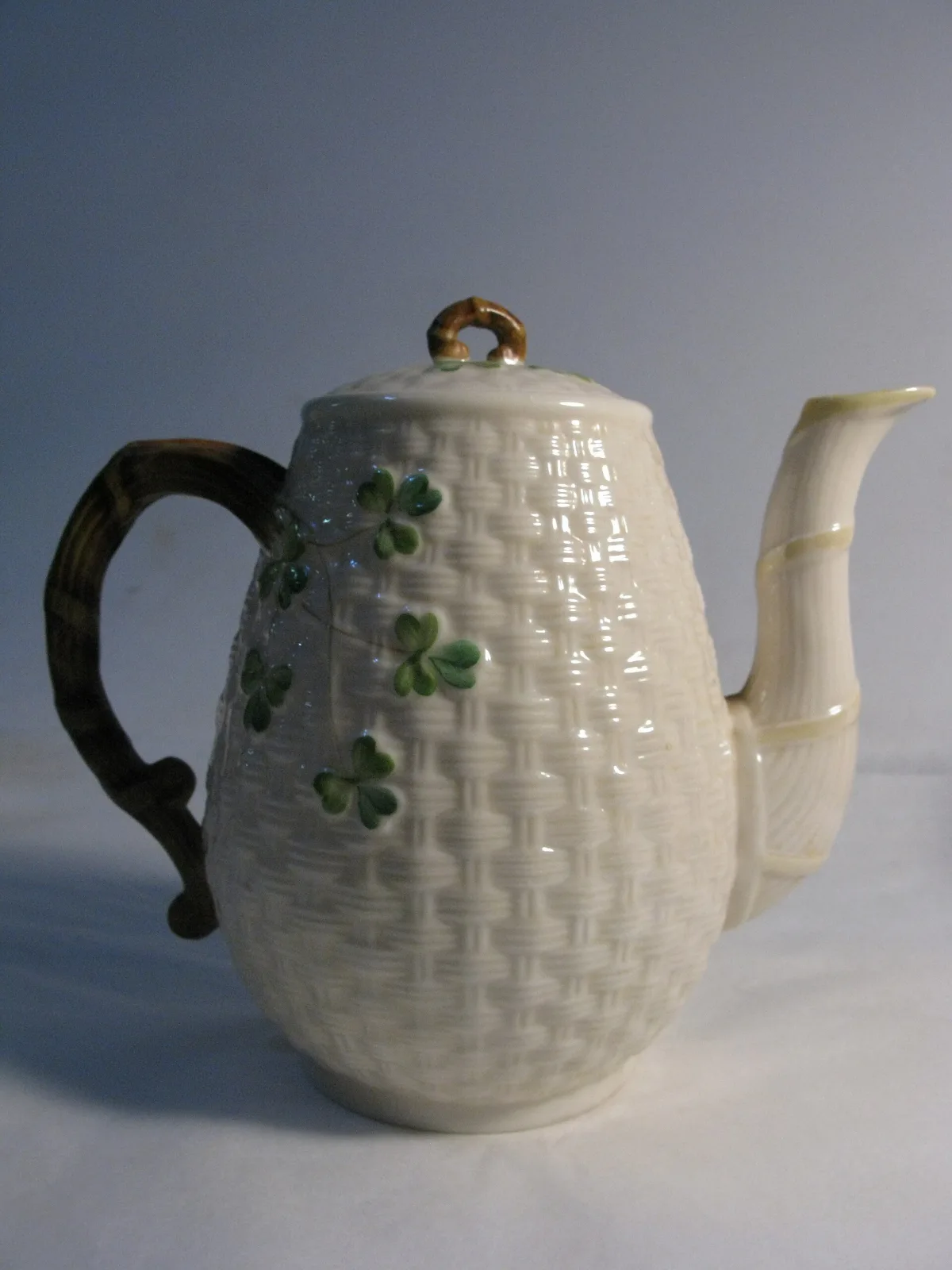
The most popular and most-collected Belleek pattern. Modelled on the tridacna giant clam, the cups, saucers, and bowls have a scalloped fluted body imitating the shell's ribbed surface. Tridacna is widely produced across all mark periods and provides the most accessible Belleek collecting field.
Echinus
An ornate sea-urchin-inspired pattern with shell forms, applied coral branches, and elaborate handles. Echinus tea sets are heavily decorated and substantially more valuable than Tridacna at any given period.
Neptune
Sea-form pattern with shell-moulded bodies, coral-form handles, and applied sea-creature motifs. Neptune cups and bowls have a slightly thicker scalloped foot than Tridacna and the handle is typically modelled as a coral branch.
Limpet
Limpet-shell body with applied seaweed handles. The pattern is slightly more sober than Neptune or Echinus and accommodates a quieter aesthetic.
Hexagon
Six-sided body with applied floral garlands or shamrock decoration. Hexagon tea services are distinctive in profile and were produced in large numbers across all mark periods.
Thorn
Applied thorny-stem decoration with attached flowers, often combined with basketwork strapping on bowls and vases. Thorn vases are among the most ambitious Belleek shapes and carry premium values.
Shamrock
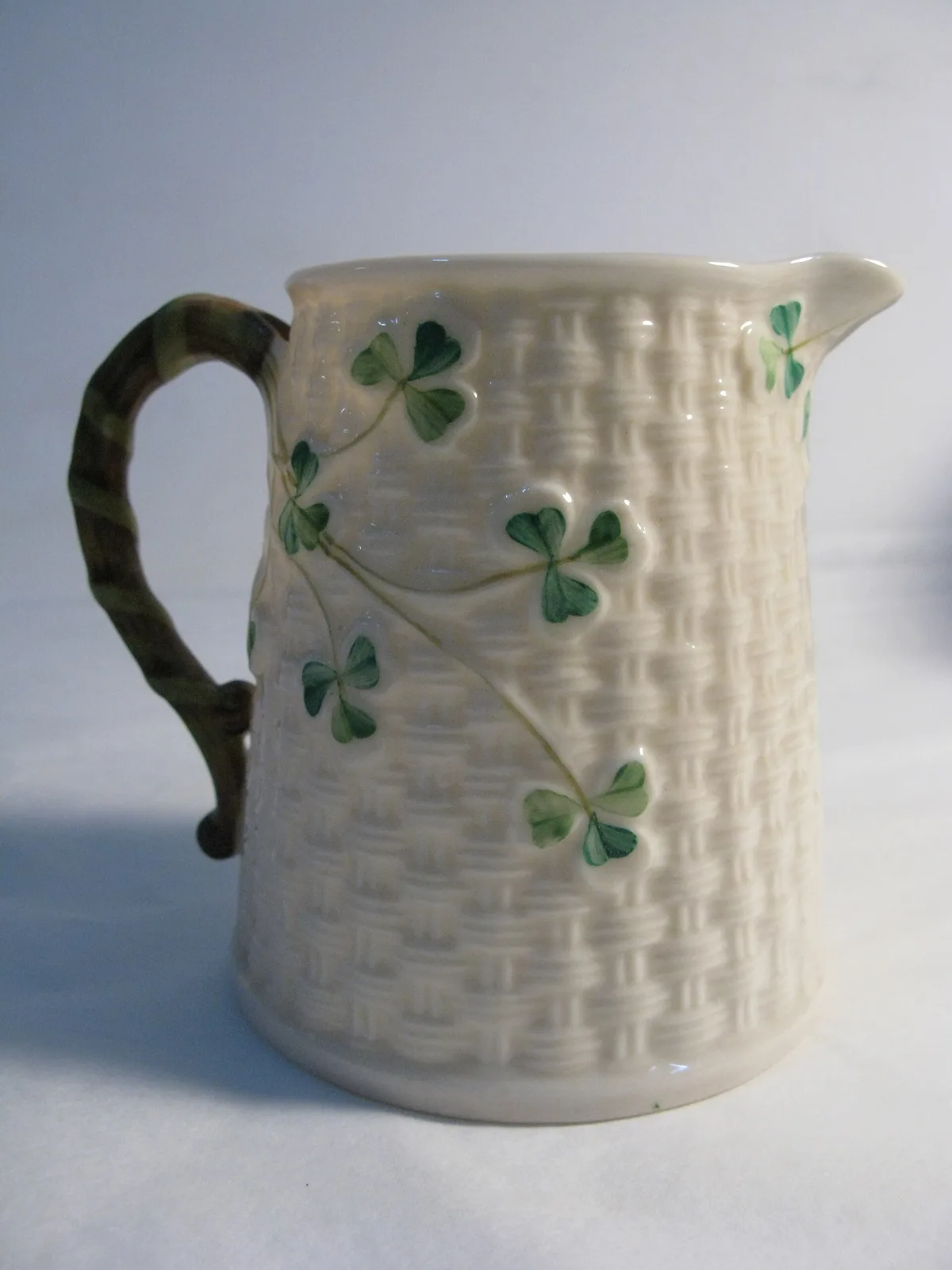
Hand-painted or applied green shamrocks on a base Tridacna or other body. Shamrock is the most explicitly "Irish" Belleek pattern and is the workhorse of the modern souvenir trade. Antique shamrock pieces from the Black Mark periods are distinct from modern production in the quality of the hand-painted shamrocks.
Other Patterns
Lesser patterns include Cone (faceted geometric), Ivy (applied ivy decoration), Daisy, Erne (named after the Fermanagh river), Tara, Aran, and modern collector-edition patterns. The published Belleek pattern reference lists more than 200 documented patterns across the factory's history.
Belleek Basketwork
Belleek basketwork — interwoven parian strands forming open-weave bowls, baskets, plaques, and centrepieces — is the technical pinnacle of the factory's craft and a collecting category of its own.
The Strand Technique
Wet parian is extruded as thin clay strands, then woven by hand in plaster jigs to form the basket framework. Each strand is laid wet over the next and the entire assembly dries before firing. The work demands skilled hands and a tolerance for kiln failure: basketwork pieces frequently distort or collapse in firing, making the surviving production small and the prices high.
Three-Strand vs. Four-Strand Weave
First Period basketwork is typically three-strand weave. Four-strand weave was introduced in the late nineteenth century and predominates from the Second Period onward. The strand count is a useful dating clue alongside the mark.
Applied Decoration
Most basketwork carries applied flowers — roses, daisies, shamrocks, sometimes thistles — sprigged onto the basket rim or base. Applied flowers are exceptionally fragile and damage to them is the principal condition issue with basketwork pieces.
Forms
Basketwork plates and shallow bowls are the most common forms. Flat baskets, oval baskets, and elaborate compotes are less common and command higher prices. The great First Period exhibition centrepieces incorporate multiple basketwork elements in a single ambitious assembly.
Pad Marks
Some basketwork pieces carry "pad marks" — small impressed identifiers on a flat pad set into the basket framework — in addition to or instead of the standard printed backstamp. Pad marks identify hand-built work and sometimes carry the maker's initials.
Modern Basketwork
The factory continues producing basketwork today, including limited editions and society-exclusive pieces. Modern basketwork is more consistent technically than First Period work — fewer kiln losses, more uniform strand thickness — but the antique pieces remain more prized for their organic, hand-built character.
Figural and Hand-Built Wares
Beyond tableware and basketwork, Belleek produced figural pieces — busts, religious figures, animal models, dramatic centrepieces — particularly during the First Period.
The First Period Modellers
William Bromley, William Henshall, William Boyton Kirk, and Frederick Slater were the principal figural modellers of the First Period. Their work appears on exhibition centrepieces, religious figures, and elaborate decorative wares. Documented attribution to a specific modeller substantially increases value.
Exhibition Pieces
The International Centrepiece (1872 Dublin Exhibition), the Prince of Wales Ice Pail, the Equestrian Sportsmen group, and other ambitious exhibition pieces represent the apex of First Period work. Most are now in museum collections; those in private hands trade in five-figure territory at specialist auction.
Religious and Memorial Figures
Belleek produced parian busts of religious figures — the Madonna, saints, and biblical scenes — for the Irish Catholic market. Memorial busts and portrait figures (Daniel O'Connell, Robert Emmet, Charles Stewart Parnell) carry political and cultural interest in addition to ceramic value.
Animal Figures
Wolfhounds, horses, pigs, and other animal models were produced throughout Belleek's history. The Irish wolfhound, in particular, parallels the wolfhound on the backstamp and is a popular collecting subject.
Modern Limited Editions
Late twentieth and twenty-first century Belleek includes a strong line of figural collector pieces — Celtic figures, fairy figures, religious figures — released as annual limited editions. Modern figures should be evaluated separately from antique figural work and held to different value expectations.
Applied Flowers and Thorn Decoration
Belleek's applied floral work — roses, shamrocks, thistles, daisies, lilies of the valley — is a defining decorative idiom and a frequent source of damage and restoration questions.
Hand-Sprigged Construction
Each flower is hand-sprigged: petals are modelled individually, assembled wet onto a stem, and applied to the parent piece before firing. A single rose may incorporate ten or twelve separate petals, each pinched and pressed by hand. The result is exceptionally fragile, easily chipped, and extraordinarily expressive in surviving good condition.
Flower Identification
Roses are the most common applied flower and appear on basketwork, vases, and centrepieces. Shamrocks are applied as small sprigs or painted onto the body. Lilies of the valley, daisies, thistles, and forget-me-nots appear on better-quality work. Some pieces incorporate four or more flower types in a single composition.
Damage and Restoration
Applied flowers chip easily and most antique Belleek with floral decoration shows some damage on close inspection. Professional restoration of applied flowers is common; UV examination reveals modern fillers and replacement petals. Restored pieces should be disclosed and priced accordingly.
The Thorn Pattern
Thorn vases and bowls combine applied thorny stems with attached flowers and basketwork strapping. They are among the most fragile of all Belleek forms and surviving good-condition Thorn pieces are scarce. The pattern is closely related to the broader Victorian taste for naturalistic applied decoration also seen on majolica.
Colour Application
Some applied flowers are left in white unglazed parian; others are tinted with pastel colours after firing. Hand-tinted floral work is more labour-intensive and carries higher prices than untinted equivalents. The painters' signatures on better hand-tinted pieces are documented in the Belleek archive.

American "Belleek-Type" Parian
The Irish factory's commercial success spawned a series of American imitators in the late nineteenth century. Several New Jersey and Ohio potteries marketed their own thin lustred parian as "Belleek" or "American Belleek," and the resulting confusion still complicates the market.
Ott & Brewer (Trenton, NJ)
Ott & Brewer produced American Belleek-type parian from the late 1870s. The body and lustre approximate Irish Belleek but with subtle differences: Ott & Brewer parian is slightly heavier, the lustre is more silvery and less warm-cream, and the marks are entirely different (typically a crown and sword device with "Belleek" or "OB" initials).
Ceramic Art Company / Lenox (Trenton, NJ)
Founded in 1889 by Walter Scott Lenox (a former Ott & Brewer employee) and Jonathan Coxon. The Ceramic Art Company produced Belleek-type parian until 1906, when the firm was reorganised as Lenox. CAC pieces are marked with "CAC" inside a wreath, with or without "Belleek." Lenox-era marks use "Lenox" with various device combinations.
Willets Manufacturing Company (Trenton, NJ)
Willets produced American Belleek from 1880 to 1909. Marks typically incorporate the company name in a serpent or coiled-snake device, often with "Belleek" added.
Other American Belleek-Type Producers
Knowles, Taylor & Knowles (East Liverpool, OH); American Art China Works; Columbian Art Pottery; and several smaller Trenton firms produced varying quality Belleek-type parian. None are Irish Belleek; all are properly described as "American Belleek-type" or by the factory name.
Distinguishing Irish from American
The mark is decisive: an Irish Belleek mark (harp-hound-tower) confirms Irish manufacture; any other mark indicates American or other origin. Without a mark, body weight, lustre tone, and hand-modelling character distinguish the two: Irish Belleek is lighter, with a warmer-cream lustre and more refined applied decoration. The crossover with broader American ceramic traditions is documented alongside other late nineteenth-century work in our Noritake porcelain identification guide.
Reproductions and Modern Production
Belleek is rarely outright faked, but mark confusion, deliberate misrepresentation of modern pieces as antique, and the existence of "Belleek-style" wares from unrelated producers all complicate the market.
Modern Belleek Sold as Antique
The most common problem is modern Belleek (Gold Mark and later) sold as "antique Belleek" at antique-market prices. The mark itself is genuine but the piece is recent. Read the mark carefully: any Gold, Blue, or Black-and-Gold Mark is post-1980 and not antique.
Worn or Removed Marks
Some unscrupulous sellers grind or polish out Gold and Green Marks to suggest unmarked First Period work. Examine the base under raking light for grinding traces and under UV for retouched glaze.
Outright Forgeries
Outright fake First Period marks applied to modern or other-factory wares do exist but are uncommon. The combination of body, lustre, and modelling quality cannot be faked with a stamp alone: a heavy, dull-lustred piece with a "First Black Mark" is fraudulent regardless of how convincing the printed mark appears.
"Belleek-Style" Modern Wares
Various modern Asian and European producers market thin lustred parian as "Belleek-style" without using the Belleek name. These are legitimate decorative wares but should not be confused with Irish Belleek. Mark absence and body differences distinguish them.
The Belleek Archive
The factory maintains an archive of all marks used since 1863 and authenticates pieces submitted by collectors. The official mark reference is the Belleek Collectors' Handbook, updated periodically. Authentication enquiries can be addressed to the Belleek Visitor Centre at the factory in County Fermanagh.
Authentication Workflow
Authenticate any Belleek piece in this order:
1. Read the Mark
Identify the mark colour (black, green, gold, blue) and the wording. Match against published mark periods to assign a date range.
2. Confirm the Body
Hold to light and confirm parian translucency. Examine the unglazed foot ring for cream-coloured, smooth, slightly waxy parian. Reject pieces with chalky, gritty, or heavy bodies regardless of mark.
3. Check the Lustre
Confirm pearlescent, faintly iridescent lustre across all original surfaces. Reject pieces with dull, opaque, or worn lustre as either damaged or non-Belleek.
4. Match Form and Pattern
Identify the pattern (Tridacna, Echinus, Neptune, etc.) and cross-reference to the published pattern catalogue. Confirm the form is genuine Belleek production and not a non-factory imitation.
5. Examine Applied Decoration
Check applied flowers, basketwork strands, and figural elements for original Belleek modelling style. Compare with reference photographs and museum holdings.
6. UV and Restoration Check
UV examination identifies modern fillers, replacement applied flowers, and overpainted lustre. Disclosed restoration is acceptable on rare pieces; undisclosed restoration substantially affects value.
7. Provenance and Documentation
For high-value pieces, gather written provenance: prior auction records, dealer invoices, family history. The general framework laid out in our authentication and provenance research guide applies.
8. Specialist Confirmation
For pieces above £1,000 or in any case of doubt, consult a specialist dealer, the Belleek Pottery archive, or a specialist auction house (Adams of Dublin, Bonhams Knightsbridge, Whyte's). Specialist confirmation costs little and prevents expensive mistakes.
Condition and Damage
Belleek's thinness and applied decoration make condition particularly important. Always examine pieces thoroughly under good light.
Chips and Rim Damage
Rim chips are common on Tridacna, Neptune, and other shell-moulded forms. The fluted rim is fragile and small chips reduce value modestly; larger chips or restoration reduce value substantially. Run a fingernail around the entire rim.
Hairline Cracks
The thin parian body is prone to hairlines, particularly at handle junctions and around foot rings. Hairlines may be invisible to the eye but reveal themselves under raking light or with a UV lamp.
Applied Decoration Damage
Applied flowers, basketwork strands, and thorn decoration chip and break easily. Many antique pieces have at least minor damage to applied elements. Document the condition before purchase and check for restoration.
Lustre Wear
Lustre wear from dishwasher use, harsh detergent, or abrasive cleaning shows as dull patches. Worn lustre cannot be restored and substantially reduces value.
Stains and Discolouration
Tea staining of the body through crazing is uncommon (Belleek glaze is usually un-crazed) but can occur on damaged pieces. Iron staining from rust or hard-water deposits appears occasionally.
Restoration Standards
Professional restoration of important pieces is common and acceptable when disclosed. The general framework in our restoration and conservation guide applies. Avoid pieces with undisclosed restoration or with restoration of poor quality.
Value Factors and Price Ranges
Belleek values span more than three orders of magnitude, from modest modern collector pieces to five-figure First Period exhibition work. The general framework laid out in our antique valuation and appraisal guide applies; the Belleek-specific factors below.
Primary Value Drivers
Mark period (First Period > Second > Third > Green > Gold > Modern); form (basketwork, figural > hand-built tableware > slip-cast tableware); pattern (Echinus, Neptune, Thorn > Tridacna, Hexagon > common shapes); condition; size; applied decoration; documented modeller or painter attribution.
Approximate Price Ranges
Modern (Gold and later) tableware: £20–£150 typical. Green Mark common tableware: £30–£200. Third Black Mark tableware: £40–£300. Second Black Mark tableware: £80–£600. First Black Mark tableware: £200–£2,000. Common basketwork (Second/Third Period): £150–£800. First Period basketwork: £400–£3,500. Hand-built figural and applied-flower pieces, First Period: £600–£8,000+. Documented First Period exhibition pieces: £3,000–£25,000+ at specialist auction.
Pattern Premiums
Echinus, Neptune, and Thorn pattern tableware carries 2–5x premiums over the same period's Tridacna or Hexagon. Shamrock and Ivy patterns are middle-priced. Common Tridacna provides the most accessible entry point at any period.
Pairs, Sets, and Complete Services
Matched pairs of vases bring 2.5–3x single-piece prices. Complete tea services with original tray and creamer/sugar at First or Second Period bring substantial premiums. Original presentation boxes or fitted cases add 30–50% to documented examples.
Damage Discounts
Rim chips: 20–40% discount on common pieces, 10–25% on rare pieces. Hairline cracks: 30–60% discount. Heavy applied-flower damage: 40–70% discount. Restoration disclosed: 15–35% discount. Restoration undisclosed and later found: substantial price collapse.
Auction Houses for Belleek
Specialist auction houses for Belleek include Adams of Dublin, Whyte's of Dublin, Mealy's, Bonhams Knightsbridge, Sotheby's Olympia, and (in the US) Sloans & Kenyon and Pook & Pook. Specialist Irish auctions in Dublin and Belfast handle the upper end.
Building a Belleek Collection
Belleek rewards focused collecting. The general principles in our collecting strategies guide apply; the Belleek-specific refinements below.
Specialise by Period or Pattern
Specialise: First Period basketwork, Third Period Tridacna tableware, Neptune teaware across periods, applied-flower vases, figural pieces by specific modellers. Specialisation builds the eye that lets you recognise undervalued pieces and avoid mark confusions.
Start with Mark Identification
Before any purchase, become fluent in mark identification. The Belleek Collectors' Handbook and the Belleek Pottery website both publish reference mark images. A collector who cannot read the marks at a glance will overpay or underbuy at every transaction.
Reference Libraries
Essential references include Marion Langham's "Belleek Irish Porcelain: An Illustrated Guide to Over 700 Pieces," Richard Degenhardt's "Belleek: The Complete Collector's Guide and Illustrated Reference," the Belleek Collectors' International Society quarterly journal, and the factory's own published mark reference. Specialist auction catalogues from Whyte's and Bonhams build comparative market knowledge.
Visit the Belleek Pottery
The factory at Belleek, County Fermanagh maintains a visitor centre, museum, and active production. A visit provides incomparable reference for body, lustre, and applied decoration standards. The factory tour shows current production techniques continuous with First Period methods.
The Collectors' Society
The Belleek Collectors' International Society publishes quarterly journals, organises conventions, and offers society-exclusive annual pieces. Membership provides reference material, market intelligence, and a community of specialist collectors.
Provenance Documentation
Maintain detailed records of every purchase: photographs of marks, condition reports, prior auction listings, family history notes, dealer invoices. Strong provenance dramatically increases resale value, particularly on First Period and exhibition pieces.
Insurance and Appraisal
Belleek collections above £5,000 in aggregate value deserve scheduled insurance and updated appraisals every five years. Specialist appraisers familiar with Irish porcelain produce more useful valuations than general antique appraisers.
Care, Display & Preservation
Belleek's thinness, applied decoration, and lustre glaze demand careful handling. The general principles in our antique storage and preservation guide apply across the Belleek range.
Handling
Lift Belleek pieces by the body, never by rims, handles, or applied decoration. Older handles and applied flowers may be glued from prior restoration. Wear cotton or nitrile gloves for high-value pieces — skin oils mark lustre over time and applied parian can absorb pigment from unwashed hands.
Washing
Wash Belleek by hand in lukewarm water with mild dish soap. Never use the dishwasher — modern dishwasher detergents will lift lustre and accelerate any latent crazing. Never soak applied-flower pieces; water entering between sprigged elements can cause separation.
Storage
Store Belleek tableware separated by tissue or cloth, never stacked rim-to-rim or with cups inverted into bowls. Store basketwork and figural pieces individually in archival boxes with acid-free tissue. Store in stable temperature and humidity away from direct sunlight.
Display
Display in stable temperature (16–22°C / 60–72°F) and humidity (40–60%). Avoid direct sunlight, which can fade hand-painted shamrock decoration and lustre tone over decades. Secure tall pieces (vases, centrepieces) with museum wax. Plate display rails should support the plate by the foot, not pressing on the rim.
Transport
For shipping or moving, double-box with at least three inches of cushioning between boxes. Wrap projecting handles, applied flowers, and basketwork elements individually before wrapping the main body. Never ship First or Second Period pieces without insurance, signature confirmation, and detailed condition documentation.
Lustre Preservation
Avoid abrasive cleaning, ammonia-based cleaners, and prolonged exposure to acidic foods. Lustre damage is irreversible. The best preservation is restrained use: enjoy your Belleek as display ware rather than working tableware, and the lustre will outlast you.
Documentation
Photograph each piece from multiple angles including the base mark. Keep a written inventory with marks, patterns, dimensions, prior provenance, and current condition. Update the inventory when condition changes or new attributions are made.