
Antique Trivets Identification Guide: Cast Iron, Brass, and Silver Stands
The trivet is the unsung utility object of the pre-electric kitchen and parlor — a small, low, three- or four-footed stand placed under a hot kettle, sadiron, or serving dish to protect the surface beneath. From the colonial wrought iron tripod set by the hearth to the Victorian cast iron heart with a delicate pierced face, from the brass disc engraved with horseshoes to the silver-plated lace-edged hot plate of the Edwardian dining room, trivets crossed every level of the household and survived in extraordinary numbers because they were small, durable, and hard to wear out. Today they form one of the most accessible categories of American and English antique collecting, with examples available for ten dollars and rarities pushing into the low thousands.
Identifying a trivet means working through several questions in sequence. What is it made of — wrought iron, cast iron, brass, copper, silver, or silver plate? What was its function — sadiron stand, kettle stand, dining room hot plate, decorative giveaway? What is its decorative pattern, and does that pattern tie to a known maker, a regional folk tradition, or an advertising premium? How are the feet attached, and what does the foot construction tell you about period and method? Are the marks on the back legible, and do they match a documented maker?
This guide covers the history of the trivet from colonial wrought iron through Victorian cast iron mass production into Edwardian and early twentieth-century decorative work, the major material categories with their tells, the dominant patterns and motifs (heart, horseshoe, eagle, Masonic, advertising, fraternal), the major American and English makers, dating by construction and feet, the major reproduction problems and how to spot them, condition and restoration questions, and a practical valuation framework. By the end you should be able to walk a flea market or estate sale and quickly classify a trivet by material, period, and likely value.
Table of Contents
- A Short History of the Trivet
- Functions: Sadiron, Kettle, Hot Plate
- Material Categories
- Wrought Iron Trivets
- Cast Iron Trivets
- Brass and Copper Trivets
- Silver and Silver-Plated Trivets
- Patterns and Motifs
- Major Makers
- Advertising and Fraternal Trivets
- Dating by Construction
- Reading the Feet
- Reproductions and Fakes
- Condition Assessment
- What Drives Value
- Care and Cleaning
- Common Beginner Mistakes
- Frequently Asked Questions
A Short History of the Trivet
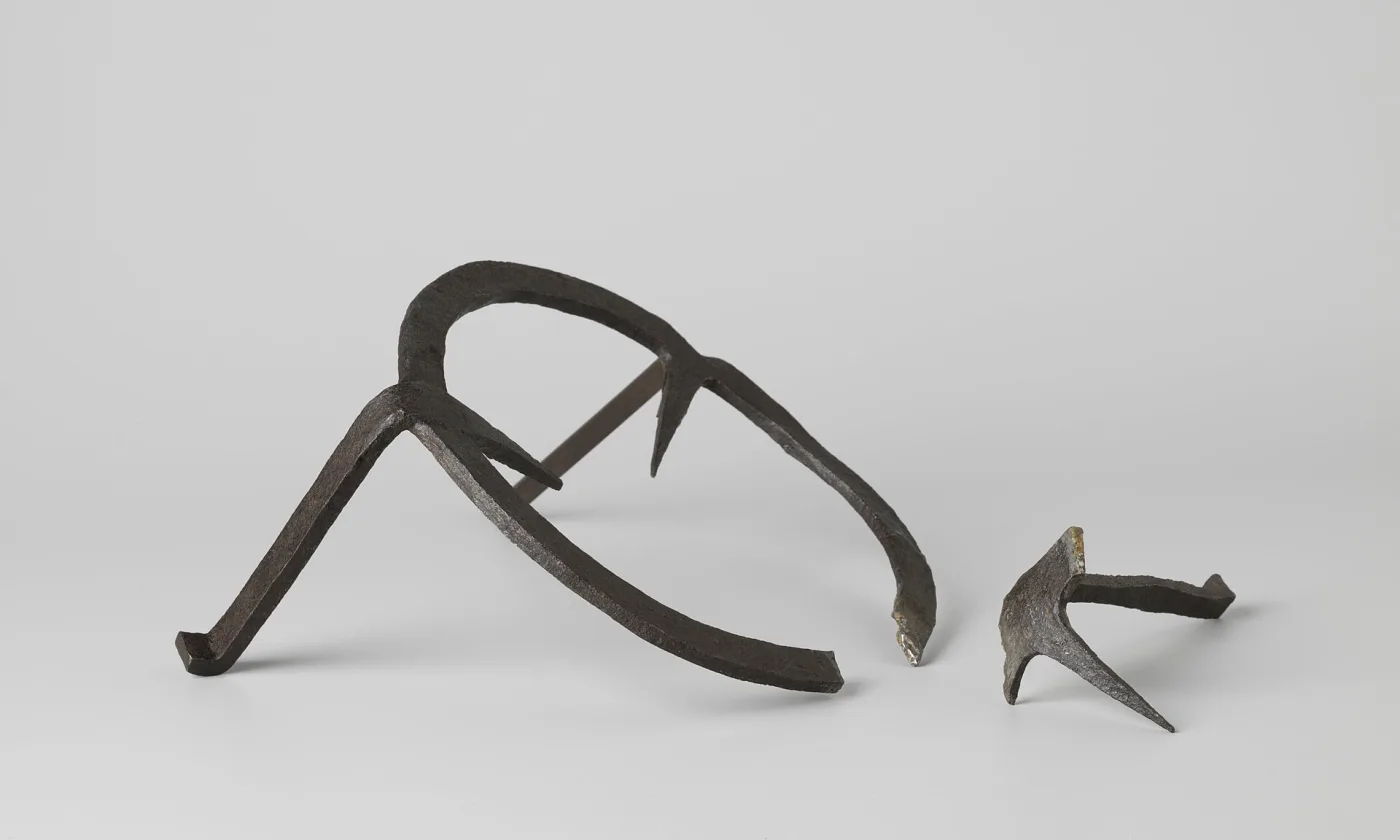
The word trivet comes from the Latin tripes, three-footed, and that etymology describes the form for most of its long history. Wrought iron three-legged stands appear in European hearths from at least the medieval period, set into the coals or laid on the hearth stone to support cooking pots above the fire. By the seventeenth and eighteenth centuries American colonial blacksmiths were producing similar tripod stands and elongated "sliding" trivets that hooked onto the bar of a fireplace grate, allowing the cook to swing a kettle in or out of the heat without lifting it.
The trivet's great expansion came with two technologies of the early nineteenth century: the cast iron sadiron and the cast iron stove. The sadiron — a heavy solid iron pressed flat across cloth — needed a heat-proof stand both on the stove (to support the iron while it heated) and on the ironing surface (to set it down between strokes without scorching the cloth). The cast iron sadiron stand, produced in tens of thousands of decorative patterns, became the dominant trivet form from about 1840 through 1910. Almost every American household had several.
By the late Victorian period the trivet had also moved into the parlor and dining room. Brass and silver-plated hot plate stands held tea kettles, urns, hot serving dishes, and chafing dishes; pierced silver disc trivets were a wedding-gift staple by 1880. The form survived the arrival of the electric iron and the gas range — partly because trivets are also useful as protectors under any hot dish, partly because their decorative quality outlived their utilitarian purpose, and partly because they made cheap, attractive advertising and souvenir items.
The Twentieth-Century Decline (and Revival)
By 1920 the working sadiron was disappearing fast and the dedicated trivet was becoming a kitchen anachronism. Production shifted toward decorative and advertising premiums (printers, insurance companies, hardware stores gave away cast iron trivets bearing their name) and toward novelty reproductions of period patterns. The 1950s and 1960s saw a major reproduction wave — John Wright Inc. of Wrightsville, Pennsylvania, and Wilton Products of Pennsylvania reissued hundreds of patterns in cast iron, sometimes with their own marks, sometimes deliberately unmarked. This reproduction history is the central problem of trivet collecting today.
Functions: Sadiron, Kettle, Hot Plate
Trivets were made for several distinct purposes. The form often signals the function.
Sadiron Stands
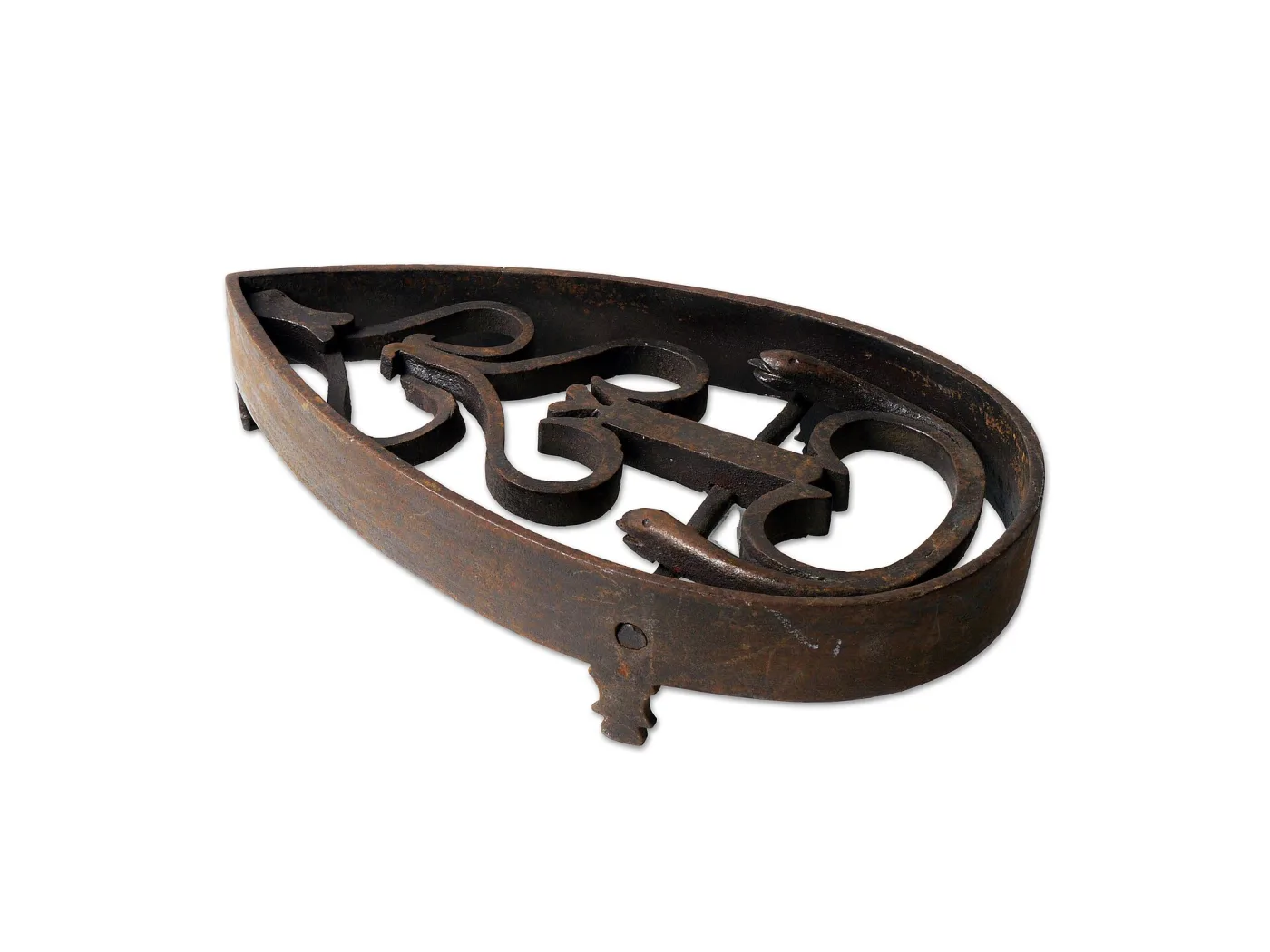
The classic American cast iron trivet, made to support a sadiron either on the stove top while it heats or on the ironing board between strokes. Sadiron stands are typically 5 to 7 inches long, pointed at one end and rounded or shaped at the other, mirroring the shape of the iron itself. They have three short feet, a flat decorative top, and often a long handle (or handle hole) extending from the rounded end. The pointed end faces away from the user; the handle end faces the ironer.
Kettle Stands and Hot Plates
Larger and usually round or oval, kettle stands held the brass or copper tea kettle on the parlor stove or sideboard. Diameter is typically 6 to 10 inches, with three or four feet of moderate height, and the top surface may be plain, pierced, or decoratively cast. Brass and copper kettle stands are particularly common in the English market; cast iron versions are more American.
Hearth Trivets
Wrought iron trivets for the open hearth — often elongated rectangles with handles, designed to slide onto a fireplace grate bar or stand on the hearth stone. Hearth trivets are usually older (eighteenth and early nineteenth century) and reflect blacksmith rather than foundry production. For broader background on blacksmithed forms and tools, see our antique tools identification guide.
Dining Hot Plate Stands
Pierced silver-plate or sterling discs, often with feet, used at table to support hot serving dishes without scorching the linen. These appeared in quantity from about 1870, peaked around 1900, and faded after the First World War. They are a small but distinct collecting category, related to but separate from cast iron sadiron stands.
Stove Trivets
Built into the cast iron range itself or supplied with it, these are large structural trivets that swing or slide over a hot plate to support a kettle or pot. They are usually integral to the stove and not collected separately, but you will occasionally see them on the secondary market as detached parts.
Material Categories
The material is the first thing to determine because it controls period, function, and value.
Wrought Iron
Hand-forged iron with characteristic hammer marks, fibrous grain visible at breaks, and forge-welded joints rather than cast joints. Wrought trivets predate roughly 1850 (some later folk-art examples exist) and are the most rustic and the most variable in form. Their value depends heavily on smithing quality, age, and original surface.
Cast Iron
Molten iron poured into a sand mold, producing a hard, brittle, gray-iron object with mold seams visible at the parting line. Cast iron is the dominant trivet material from about 1840 onward and accounts for the great bulk of American trivets in collecting. Cast iron has a distinctive feel — heavier than steel for the same volume, slightly grainy when freshly broken — and a characteristic gray patina under any old paint. Our broader cast iron collectibles guide covers the gray-iron category in depth.
Brass
Yellow alloy of copper and zinc, used for English kettle stands, decorative dining trivets, and Continental folk-art forms. Brass trivets are usually cast or stamped, with engraved or pierced decoration. Older brass shows a deep mellow patina that takes a century to develop; bright lacquer-yellow is reproduction or aggressive cleaning. For broader brass-versus-bronze identification cues, see our bronze, brass, and spelter identification guide.
Copper
Reddish-brown pure metal or near-pure copper alloy, used for hammered Arts and Crafts kettle stands and Continental hearth trivets. Copper trivets are scarcer than brass and often handsomer; hand-hammered Roycroft and Stickley examples bring premium prices. For copper construction techniques and period cues, see our antique copper cookware guide.
Silver and Silver Plate
Sterling silver, Sheffield plate, and electroplated silver dining trivets — usually round pierced discs on small feet — appeared from the 1870s. Sterling examples are hallmarked; plate examples carry EPNS or maker's marks. These are dining-table objects, not kitchen objects.
Tile-Inset Trivets
A subform combines a metal frame (cast iron or brass) with an inset ceramic tile, often a decorative transferware or tube-lined design. Tile-inset trivets are usually 1880-1920 and bridge cast iron and ceramic collecting categories. The tiles themselves are often pieces by Minton, Wedgwood, or American art tile makers; for tile context, see our decorative tiles guide.
Wrought Iron Trivets
Wrought iron trivets are the oldest and the most variable category, and the hardest to date precisely.
Construction
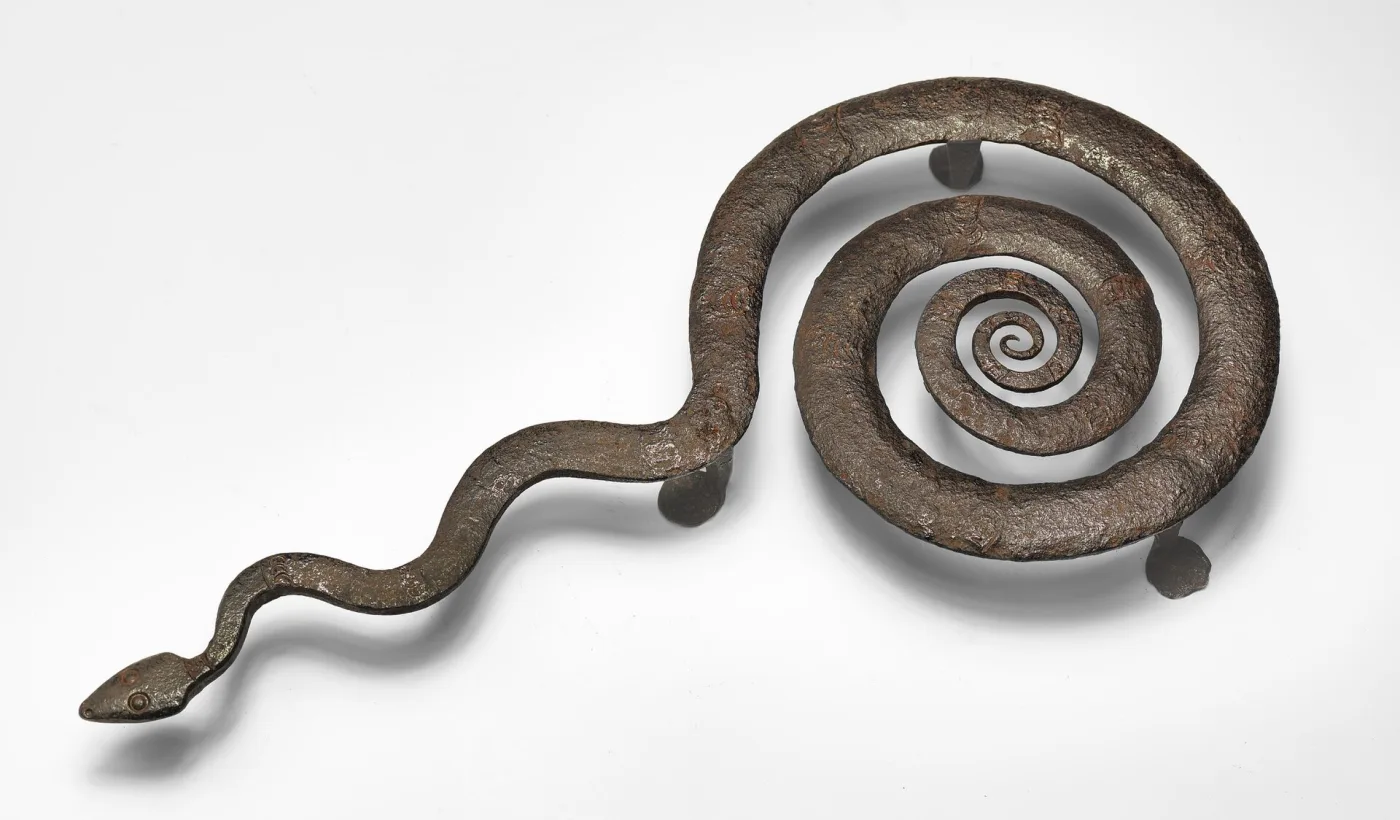
Hand-forged from iron bar stock by a blacksmith, with joints made by forge welding (heating two pieces to white heat and hammering them together so they fuse) rather than casting or riveting. The surface shows hammer marks, slight irregularities in section, and sometimes a fibrous grain where the iron has been split or scarfed. Forge welds are often visible as faint joint lines on the finished piece.
Forms
Three principal forms dominate. The tripod hearth trivet has three legs splayed from a flat triangular or circular top, sometimes with a handle. The grate trivet is an elongated rectangle with a hook or shaped end that fits onto a fireplace grate bar. The bracket trivet is a wall-mounted folding stand that swings out over the fire. All three have eighteenth- and early-nineteenth-century forms; later wrought work continues into the twentieth century in folk-art and revival contexts.
Folk-Art Wrought Iron
Pennsylvania German blacksmiths produced wrought trivets with engraved hearts, tulips, and stars from the late eighteenth century through about 1860. These overlap with broader Pennsylvania Dutch folk traditions and command premium prices in the folk art market. For wider context see our folk art identification guide.
Identifying Wrought from Cast
The single fastest test: look for mold seams. Cast iron almost always shows a faint parting line where the two halves of the sand mold met; wrought iron never does. Cast iron is also more uniform in section and generally has more pierced or fine decorative detail than handwork would economically produce. A heavy, plain, slightly irregular three-legged stand with no seams is wrought; a complex pierced heart or eagle pattern is almost certainly cast.
Cast Iron Trivets
Cast iron is the heartland of American trivet collecting. Tens of thousands of patterns were produced from the 1840s through 1920, and reproductions continue today.
The Production Process
A wooden or metal pattern is pressed into a two-part sand mold; the mold is closed; molten iron is poured in through a sprue; the iron cools, the mold is broken open, and the casting is cleaned of flash. Sprue and gate scars are usually filed off the visible surface but often survive on the underside or back. Mold seams along the parting line are nearly always visible if you know where to look — usually along the side edge of the trivet, halfway up the foot.
Surface Finish
Period cast iron trivets were sold either bare (raw gray cast iron, intended to be polished or blacked by the user) or factory-japanned (coated with black asphaltum varnish baked on at low heat). Original japanning is dull, slightly mottled, and usually shows wear on the high points where it has been rubbed off in use. Bright glossy black is modern enamel paint, applied either at the factory in the late twentieth century or by a restorer.
Age Patina
Genuinely old cast iron develops a characteristic fine pitted gray surface where any original japanning or paint has worn away — the result of a century of slow oxidation and handling. A reproduction casting that has not had time to develop this patina looks too smooth, too uniform, and often slightly pinkish or tan from a recent rust treatment.
Ringing Test
Period cast iron rings clear and bright when struck gently with a fingernail or coin — a clean musical note that lasts a moment. Reproduction cast iron, particularly from the 1960s onward, is often a different alloy and rings dull or thudly. The test is not infallible (some good period iron rings dully too, particularly heavy thick castings), but a strong clear ring is at least consistent with age.
Brass and Copper Trivets
Brass and copper trivets were made in both English and American workshops and form a separate but related collecting category.
English Brass Kettle Stands
The classic English brass trivet is a round or oval disc on three short cast feet, often engraved with horseshoes, hunting scenes, or geometric borders. They are usually 6 to 9 inches across and were made in quantity from the 1850s through 1910 by Birmingham and Sheffield brassfounders. The construction is typically a stamped sheet brass top with applied or threaded brass feet.
Pierced Brass Trivets
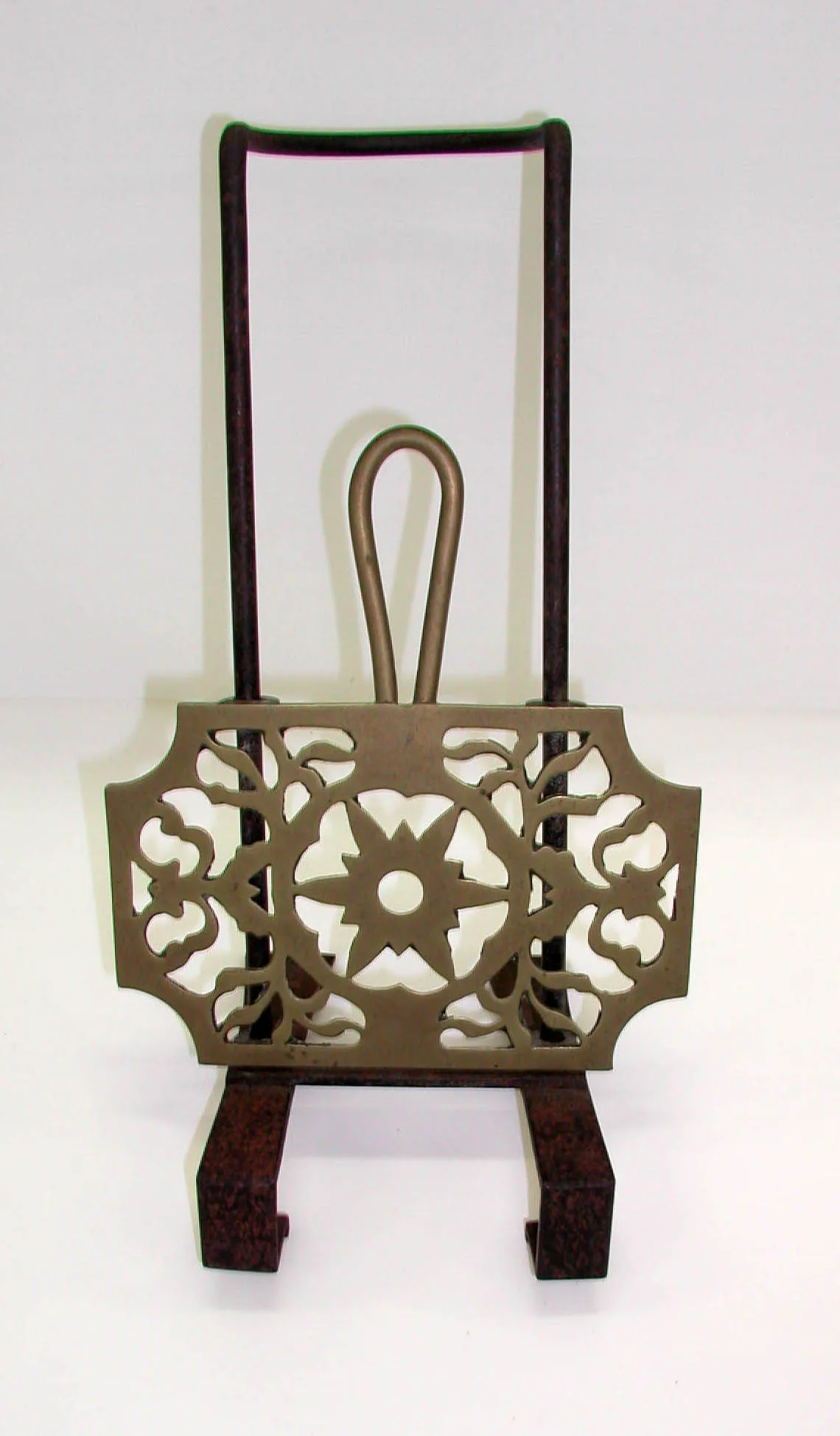
A finer category: brass discs with intricate pierced fretwork tops, sometimes with engraved or chased borders. These are dining-table hot plates rather than kitchen objects and overlap with silver-plate dining trivets. Quality varies enormously; the best are restrained, well-pierced, and well-proportioned.
Hammered Copper Arts and Crafts
From about 1900 to 1925 American Arts and Crafts metalworkers — Roycroft (East Aurora, NY), Stickley (Eastwood, NY), Dirk Van Erp (San Francisco), and many smaller shops — produced hammered copper kettle stands, often with riveted feet and a handsome warm patina. These are at the high end of the trivet market and command Arts and Crafts metalwork prices, not country brass prices. The mark is critical: a Roycroft orb-and-cross or a Dirk Van Erp windmill stamp transforms value entirely.
Continental and Folk Brass
Dutch, German, and Scandinavian brass and copper trivets often show heavier hammered or chased decoration, regional motifs (windmills, sailing ships, peasant figures), and sometimes engraved dates that are honest. Continental folk metalwork is a small specialist field with its own price structure.

Silver and Silver-Plated Trivets
Dining-table trivets in silver and silver plate are a distinct subfield with its own identifying clues.
Sterling Silver
Solid silver hot plate stands carry a full set of hallmarks (lion passant, town mark, date letter, maker's mark in English work) on the underside or on the rim of the foot. They are typically pierced discs 6 to 9 inches across, on three small feet, sometimes with applied chased borders. Period English makers include Mappin & Webb, Walker & Hall, and the Sheffield silver firms generally. American sterling examples by Gorham, Tiffany, and Reed & Barton are more rarely encountered. For deeper hallmark coverage see our antique silver identification guide.
Sheffield Plate and Electroplate
Sheffield plate (1742-1840) trivets are uncommon — the form was not yet popular as a dining object during the Sheffield plate period. Electroplated nickel silver (EPNS, after 1840) trivets are abundant and inexpensive; they carry a maker's mark and the EPNS stamp on the underside. Worn-through plate over a yellow nickel base is the typical Victorian signature.
Pierced Patterns
Lace-edged piercing, fretwork borders, applied chased rims, and engine-turned decoration are the standard ornamental vocabulary of silver-plate trivets. The patterns mostly follow contemporary tableware style, so a heavily lobed and chased trivet is mid- to late-Victorian (1860-1900); a plainer engine-turned one is Edwardian (1900-1914); a geometric Art Deco pattern is 1925-1940.
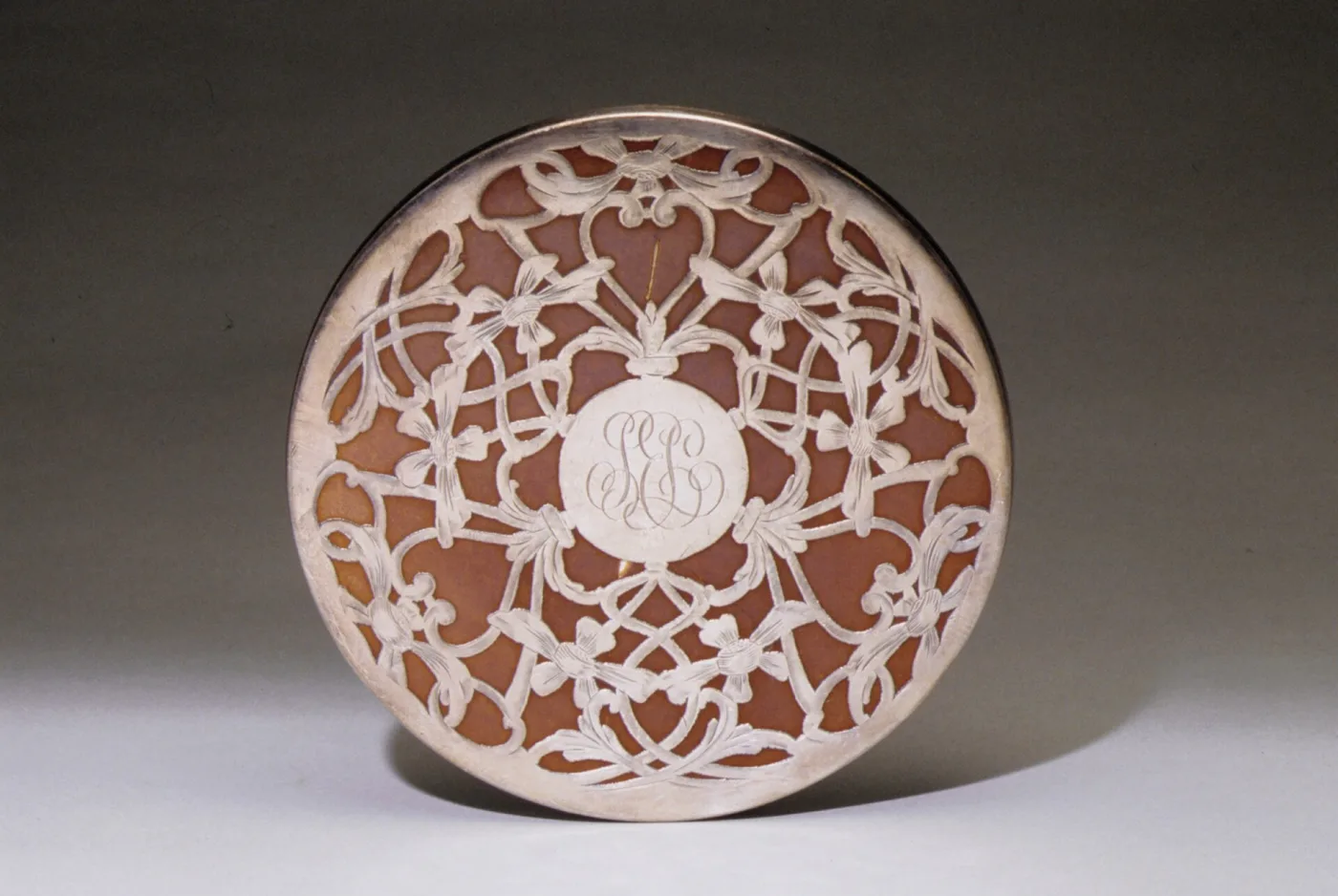
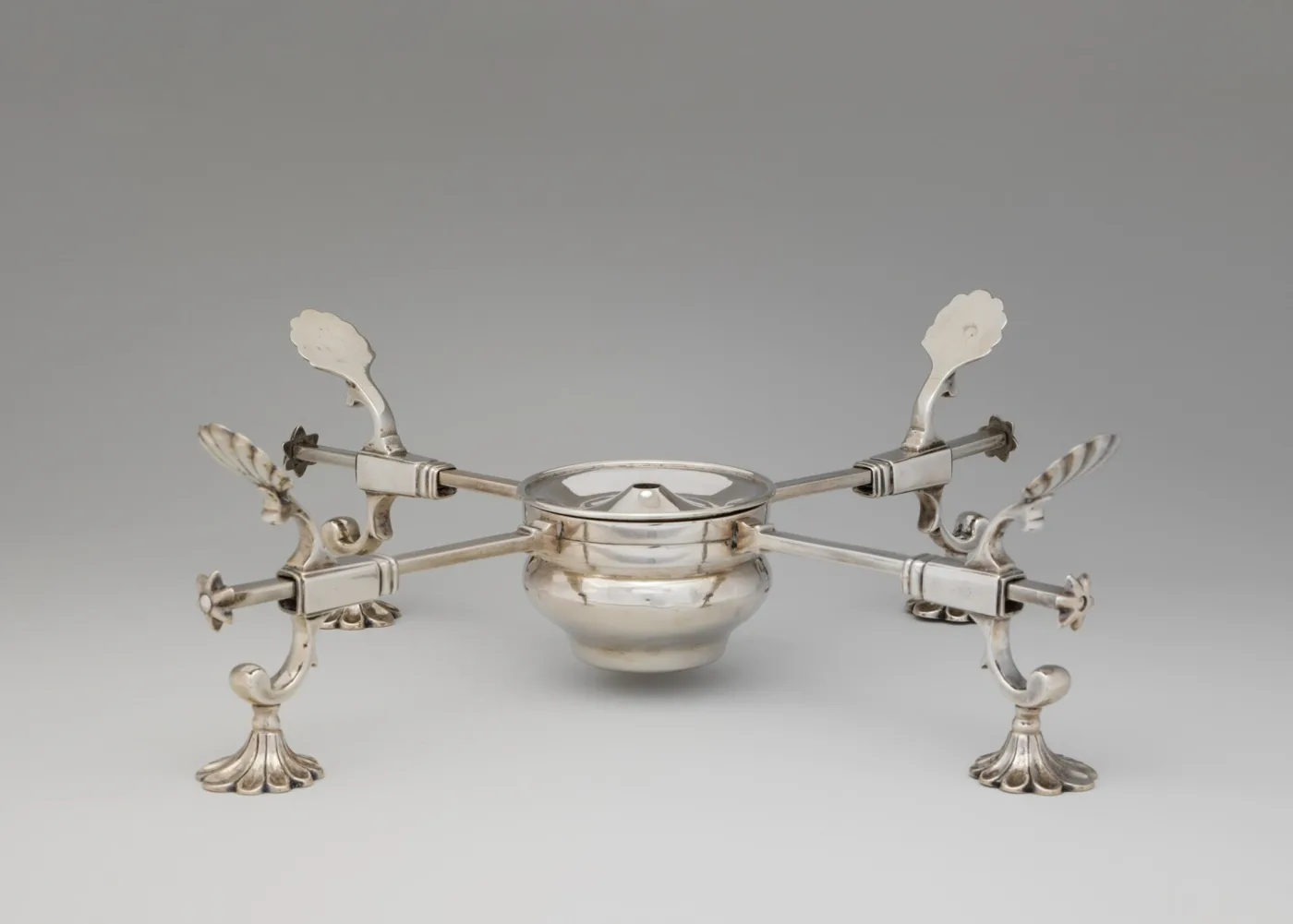
Both keep a hot dish off the linen and they are not interchangeable, so do not price one against the other. The pierced disc is the hot plate stand this section describes: flat, fixed, decorative, and monogrammed because it left the shop as a wedding or anniversary present — this one is not solid silver at all but a silver overlay on a Lenox ceramic body, which is worth checking for before you weigh a piece as sterling. The dish cross is a different mechanism entirely: its four arms slide and swivel so a single stand takes several sizes of dish, and the burner in the middle keeps the food hot rather than merely protecting the table. The form is Georgian and English in origin, though this example is American. Dish crosses trade in the silver market rather than the trivet market.
The Wedgwood Insert
A premium English form has a Wedgwood jasperware roundel inset into the silver-plate frame — typically a blue or green ground with white classical figures. These trivets are documented to specific maker pairings (Mappin & Webb with Wedgwood inserts, for example) and bring a premium when complete and original. For Wedgwood ware identification see our Wedgwood identification guide.
Patterns and Motifs
Cast iron trivets exist in an enormous number of decorative patterns, but a smaller list of motifs accounts for the majority of collected examples.
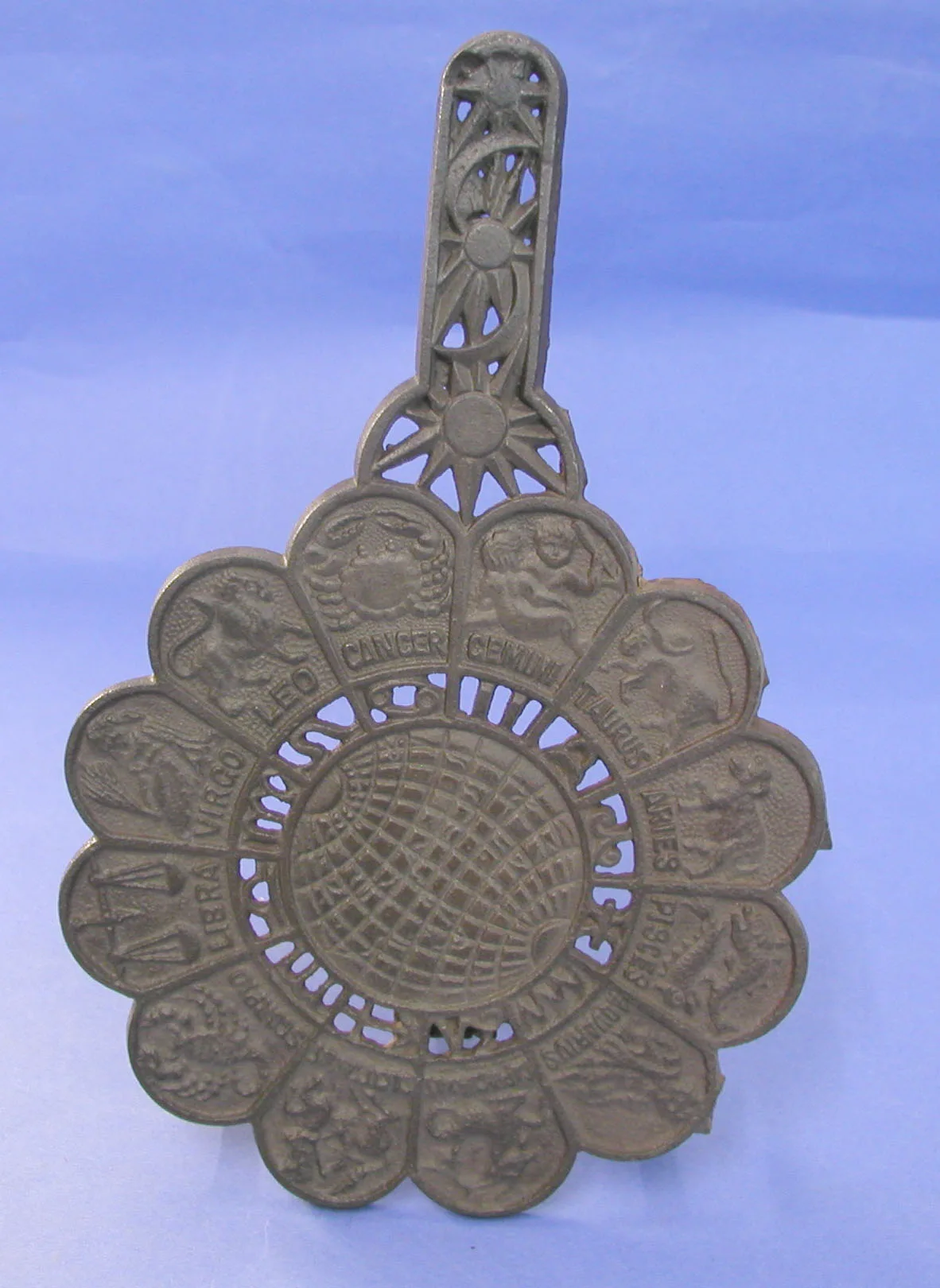
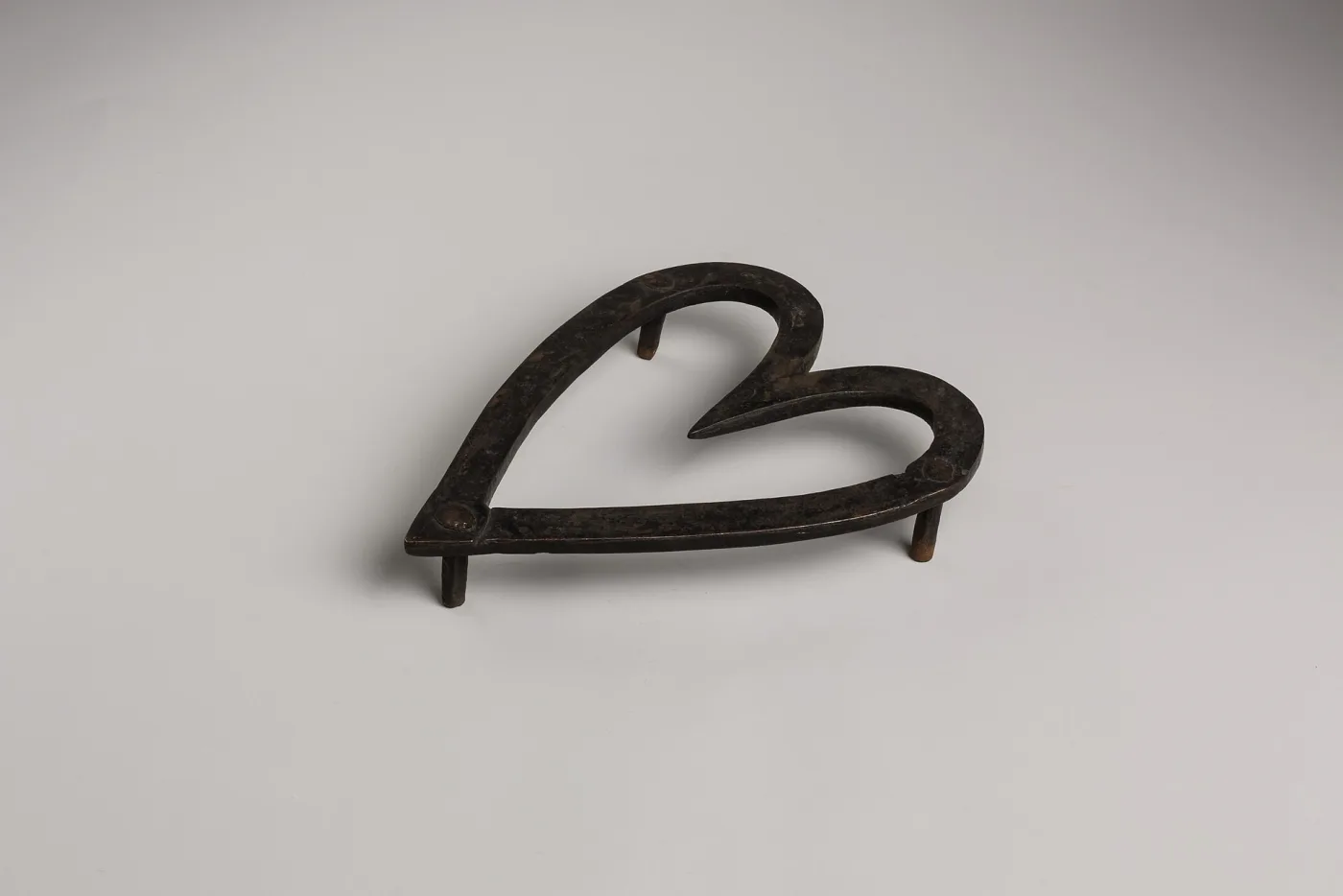
Heart
The single most popular pattern. Cast iron heart-shaped sadiron stands appear from the 1840s through the 1920s in dozens of variants — plain heart, heart-and-cross, heart with central rosette, heart with handle, heart pierced with smaller hearts. Heart trivets are also among the most reproduced patterns; many late-twentieth-century cast iron hearts were never antique to begin with.
Horseshoe
Horseshoe trivets — often with the legend "Good Luck" or with horseshoe-and-clover combinations — were popular as gifts and advertising pieces from the 1880s through the 1930s. The horseshoe was a particularly common shape for advertising trivets bearing a stove-maker's name or a hardware store's premium.
Eagle
The American eagle, often spread-winged with shield, appears on patriotic trivets from the early Republic through the centennial (1876) and into the twentieth century. Centennial-era 1876 trivets sometimes carry dates and the legend "1776-1876" — these are honest period markings.
Masonic and Fraternal
Square-and-compass, Odd Fellows three rings, Knights of Pythias symbols, and other fraternal motifs appear on trivets given as lodge premiums and gifts from about 1870 onward. They have an active subcollector market.
Pennsylvania Dutch
Tulip, distelfink (a stylized songbird), pomegranate, and geometric hex motifs appear on cast iron and wrought trivets made in or for the Pennsylvania German community. Some are genuinely period pieces by named makers; many are mid-twentieth-century reproductions made for the tourist trade in Lancaster County.
Floral and Geometric
A vast catalogue of generic floral patterns (daisies, roses, sunflowers, fleur-de-lis), geometric piercings (lattice, star, circle), and abstract scrollwork covers the bulk of unmarked cast iron trivets. These are often unattributed but pleasing and inexpensive.
Figural
Specific figural trivets — owls, cats, fish, lions, women in hoop skirts — were a Victorian and Edwardian specialty. Some are documented to specific makers (Wapak, Wilton); others are anonymous. Figural trivets are among the more collected categories.
Major Makers
A relatively small number of foundries dominate documented cast iron trivet production. Marks are usually cast into the underside.
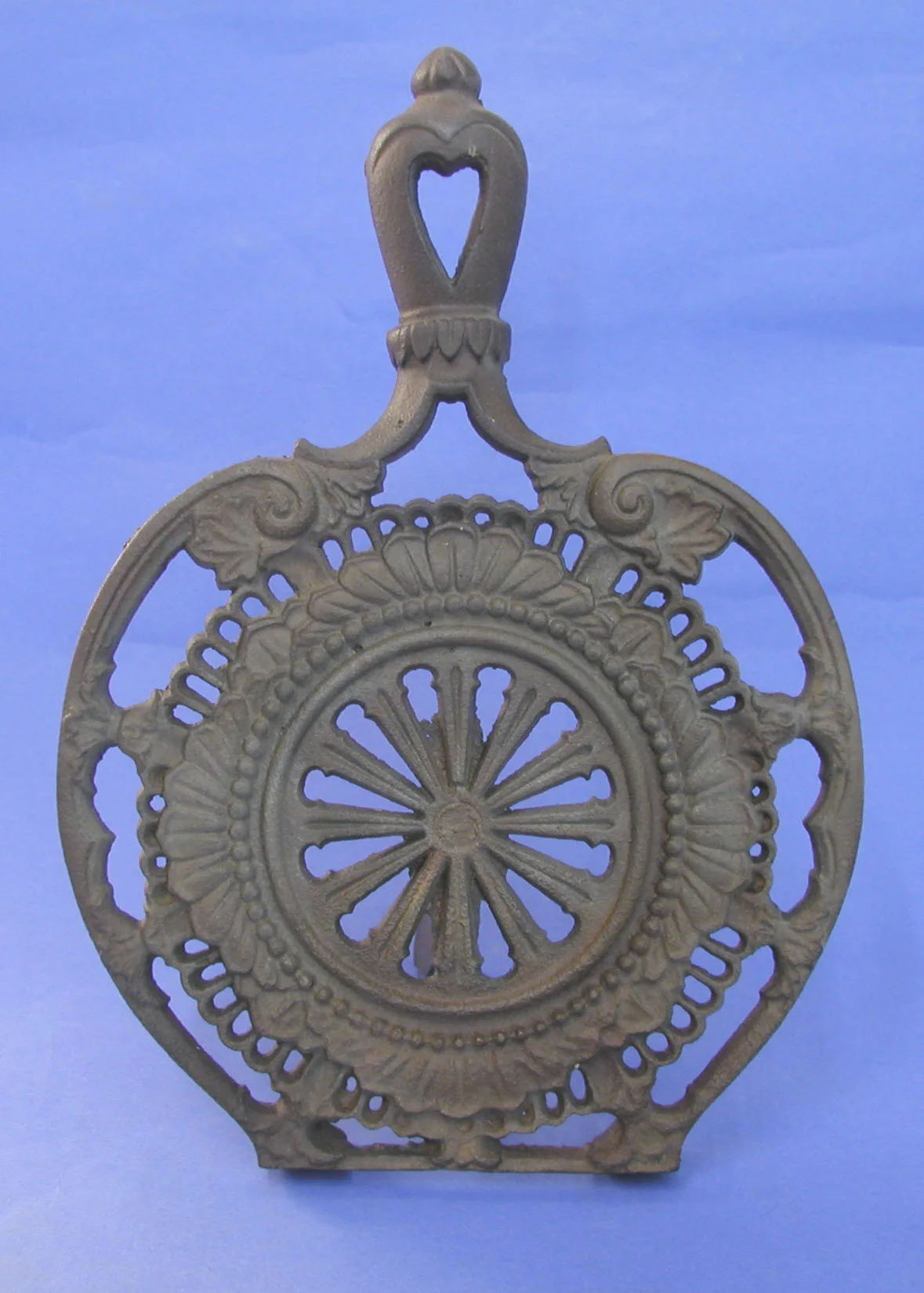
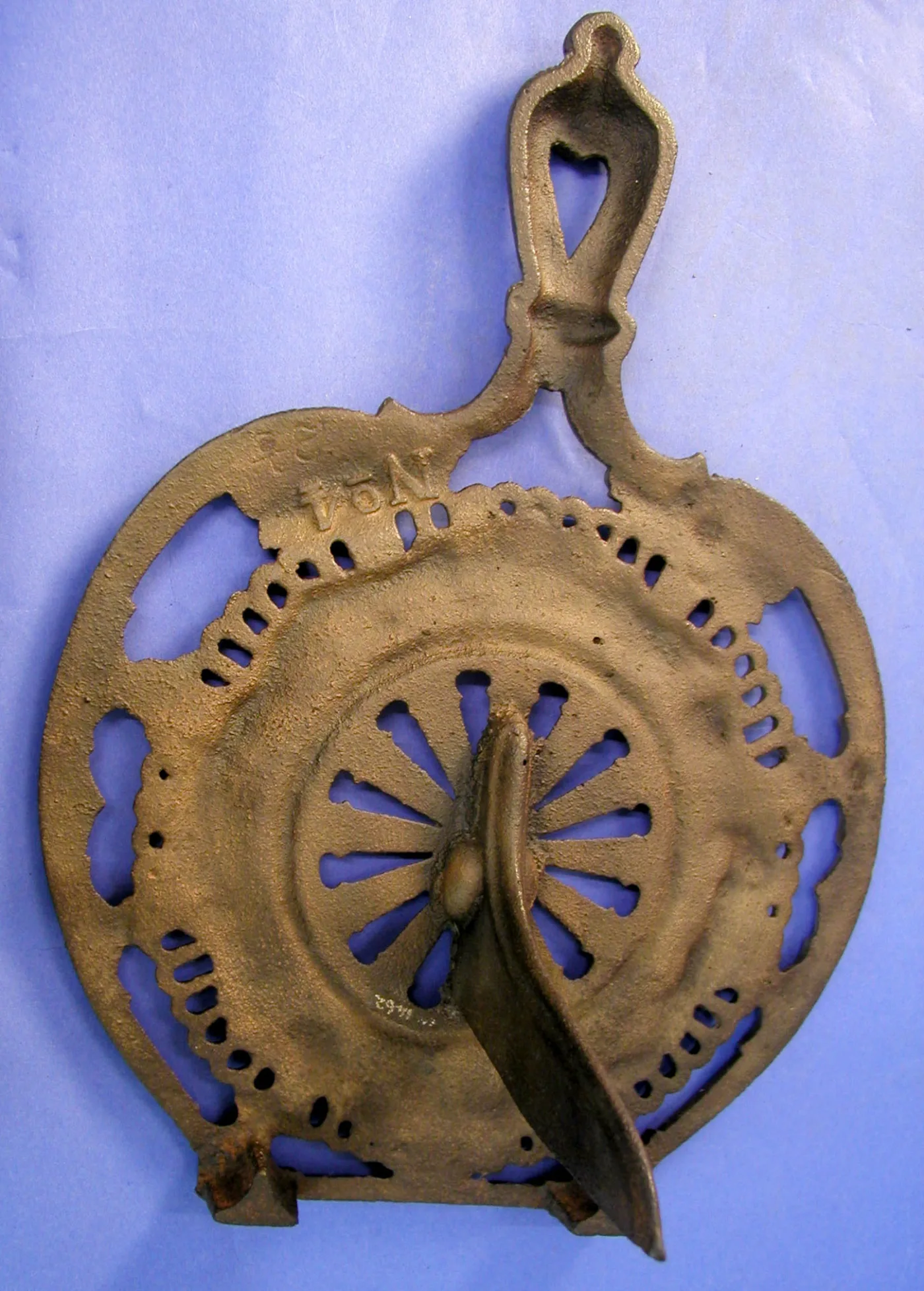
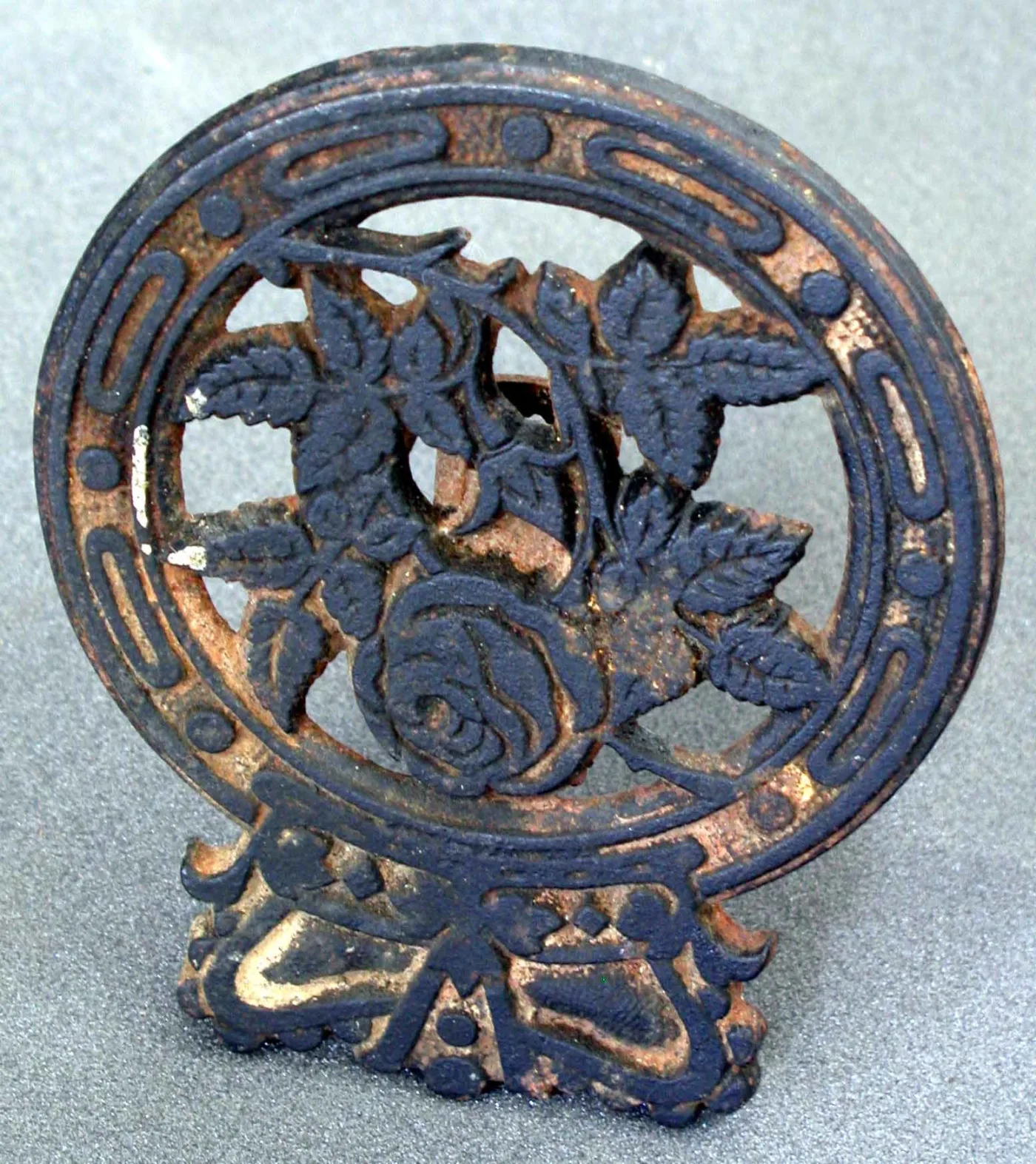
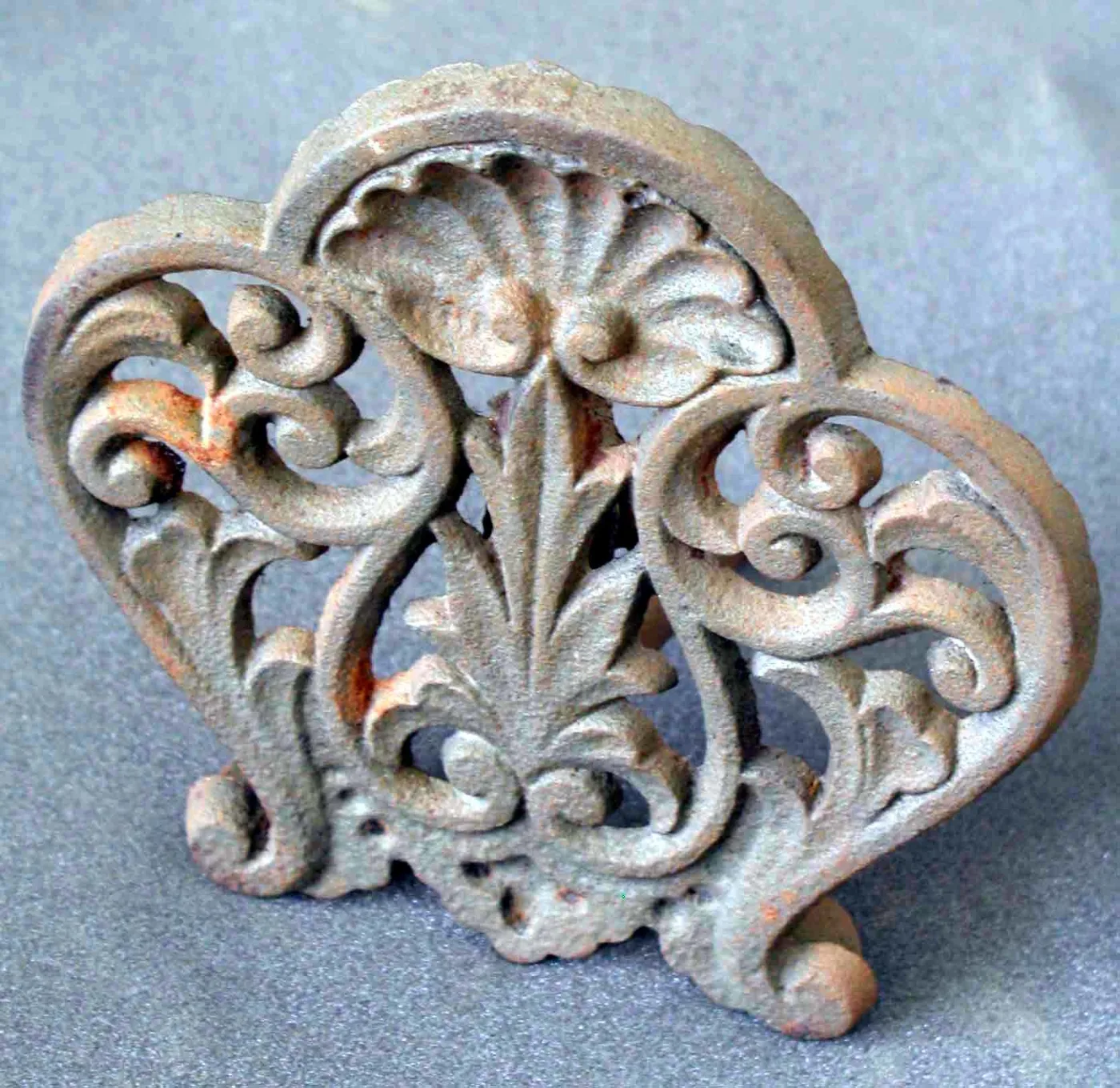
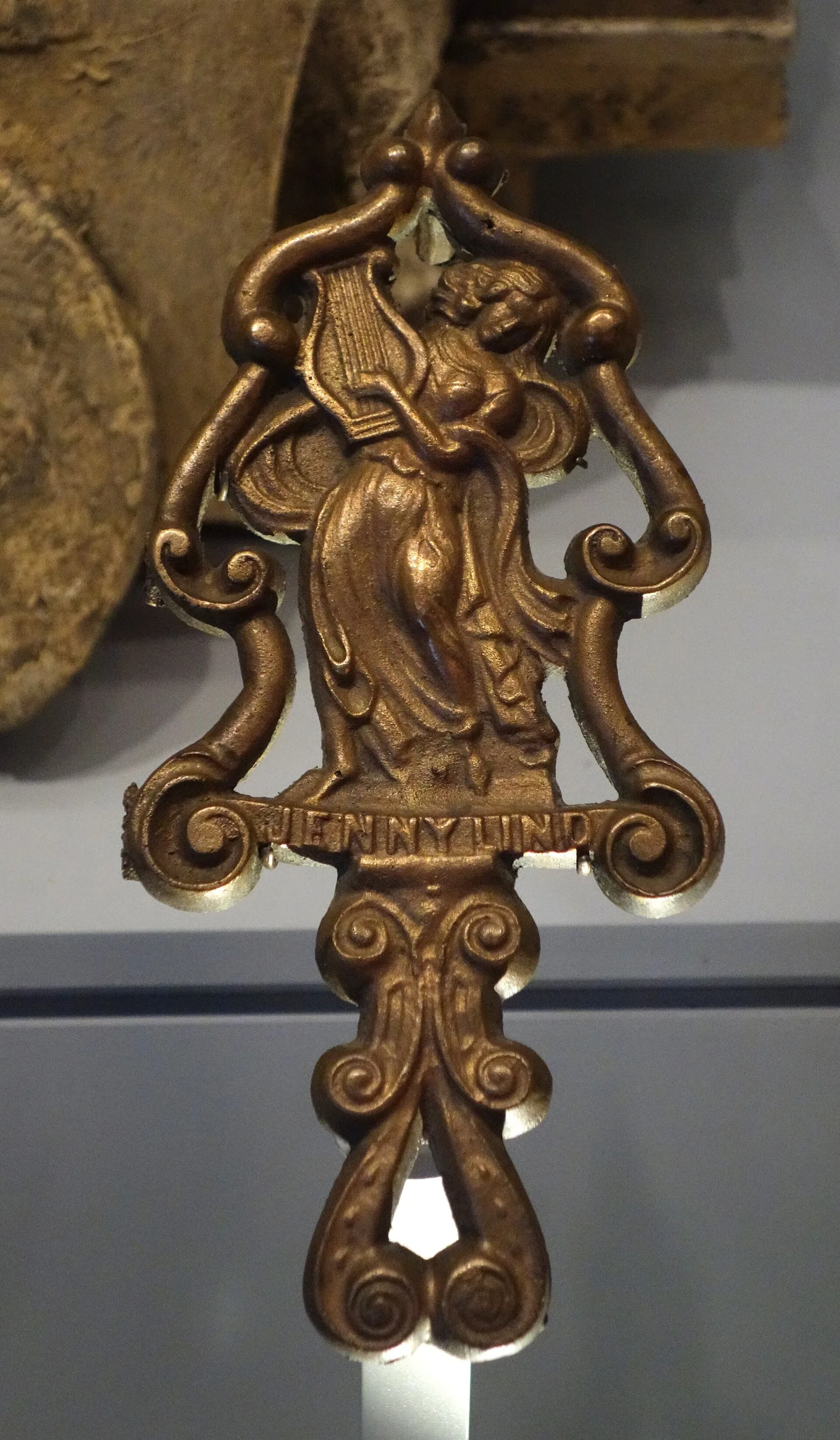
One trivet, two views, and only one of them says anything about who made it. The face is decoration, and decoration travelled — foundries copied each other freely, so a rosette proves nothing. The back carries a raised "No. 4", a foundry pattern number rather than a maker's name, and that is by far the commonest form of marking on American and English cast iron trivets. It is also the thing you look up in a pattern reference. The long tapering blade down the centre is not a fourth foot: Auckland Museum records this piece as having two feet and a spike for securing the trivet, so it engaged a grate or a stove opening rather than standing free on a table. Turn every trivet over before you buy it, because the underside holds the marks, the feet, the sprue scar and, as here, the answer to what the object was actually for.
American Cast Iron — Period
Wapak Hollow Ware (Wapak, Ohio, 1903-1926) made high-quality figural and decorative trivets, all marked. Griswold Manufacturing (Erie, PA, 1865-1957) is best known for cookware but produced trivets, all clearly marked. Sexton Inc. of Pennsylvania made advertising trivets and decorative pieces, often marked. Various Pennsylvania, Ohio, and Connecticut foundries produced unmarked or sparingly marked trivets in enormous quantity.
Reproduction Era — John Wright
John Wright Inc. of Wrightsville, Pennsylvania (1946-present, now JWI) reproduced hundreds of historical cast iron trivet patterns from the late 1940s onward. Wright reproductions are usually marked "JZH" or "John Wright" on the back, but unmarked Wright trivets exist and are difficult to distinguish from period work without close attention to surface, casting quality, and feet construction.
Reproduction Era — Wilton
Wilton Products, also of Pennsylvania, produced reproduction cast iron trivets from the 1950s through the 1980s. Wilton pieces are often marked "Wilton" or with a small "W"; many also unmarked. Wilton work is usually clean, sharp, and slightly too uniform in surface.
English Brass
Major Birmingham and Sheffield brassfounders (Peerage, Mappin Brothers, William Tonks) produced quantity brass kettle stands; their marks are often a small stamped name on the underside.
American Arts and Crafts Metalwork
Roycroft (East Aurora, NY), Gustav Stickley's Craftsman Workshops, Dirk Van Erp (San Francisco), and Old Mission Kopper Kraft made hammered copper kettle stands from the early 1900s. All carry distinctive marks; values follow the broader Arts and Crafts metalwork market.
Advertising and Fraternal Trivets
Cast iron trivets were a popular medium for advertising and fraternal premiums from about 1870 through the 1930s. They form a distinct collecting subfield.
Stove and Range Maker Advertising
Companies like Acme, Glenwood, Round Oak, and Florence stoves gave away trivets bearing their name and stove pattern as customer premiums. These often include the company's home city and sometimes a patent date.
Hardware Store and Insurance Premiums
Local hardware stores, insurance companies, banks, and feed mills commissioned cast iron trivets bearing their name and town as customer giveaways. These survive in great variety; provenance to a specific town or business adds collecting interest.
Fraternal Lodge Trivets
Masonic, Odd Fellows, Knights of Pythias, Eagles, Elks, and other fraternal orders had cast iron trivets made for member gifts and lodge fundraisers. The fraternal symbol is usually the central decorative element.
Centennial and Patriotic Trivets
The 1876 American Centennial generated a wave of patriotic trivets bearing eagles, dates, and slogans. Some are honestly dated 1876; many bear later dates or anniversary marks.
Trade Card Cross-Reference
Advertising trivets often correspond to printed trade cards from the same merchants. Cross-referencing trivets and trade cards by company name and town can pin down dates with surprising precision; for trade card identification see our trade cards identification guide.
Dating by Construction
Several construction details give a useful date window for cast iron trivets.
Mold Seam Quality
Crisp, well-finished mold seams (filed flush, barely visible) are typical of higher-quality nineteenth-century work. Rougher, slightly raised seams that have only been knocked back are common on later or cheaper foundries. Modern reproductions sometimes have aggressive grinding marks where seams have been worked off.
Sprue Scar
The sprue scar is the small rough patch on the underside where the casting gate was broken off. Period scars are filed back and slightly weathered; reproduction scars are often cleaner, sharper, and either ground or left raw with bright metal showing.
Threaded Feet
Some Victorian brass trivets have threaded feet that screw into the disc. Threading style (square cut, tapered) and quality of fit can give clues to period; very precise modern threading is reproduction.
Patent and Registry Dates
Period trivets sometimes bear patent dates ("Pat. Mar. 12, 1872") or registry numbers cast into the underside. These dates are reliable terminus post quem markers — the trivet cannot be earlier than the date — but the casting may be considerably later, particularly for popular patents that stayed in production for decades.
Country-of-Origin Markings
The U.S. Tariff Act of 1891 required imported goods to be marked with country of origin ("Made in England," "Made in Germany," etc.). British marking law in 1908 had a similar effect. A trivet marked "Made in England" is post-1891 (and probably twentieth century); a trivet marked "England" alone is usually pre-1891 or early period.
Reading the Feet
The feet of a cast iron trivet are one of the most reliable date and authenticity tells. Period feet differ in construction from reproduction feet.
Cast-In Feet
Period cast iron trivets have feet cast as integral parts of the body — a single piece of iron, with feet, top, and any decoration all cast together. The transition from foot to body is smooth and continuous; there is no visible joint.
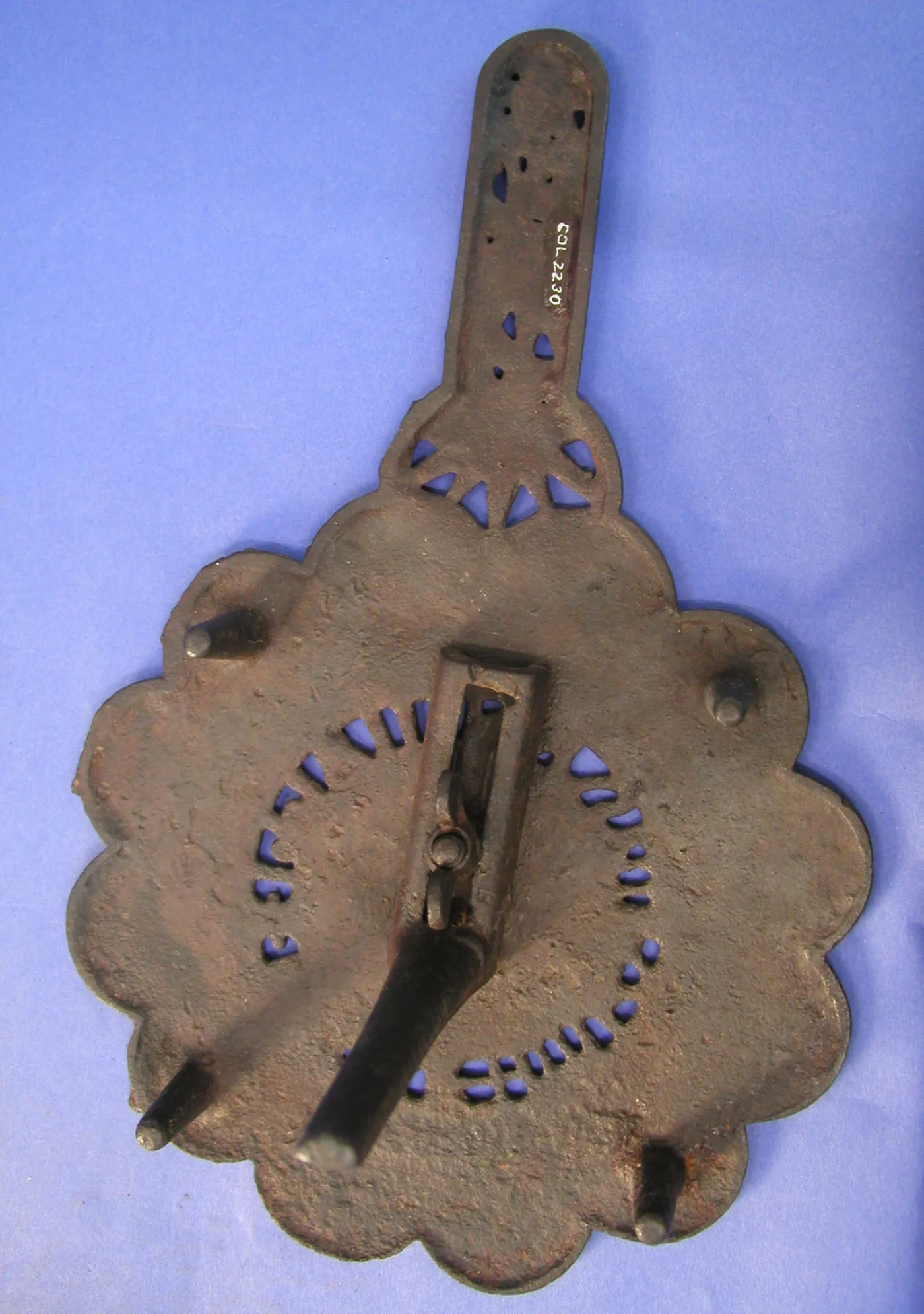
Riveted Brass Feet
Brass kettle stands often have separately cast feet riveted or threaded into the disc. Hand-riveted period feet show slightly irregular peening; modern feet are too uniform.
Foot Wear
Period trivet feet show wear on the contact surface — flattening, slight rounding, sometimes scratching from being slid on stove tops. Reproduction feet are often pristine, sharp-edged, and unworn even when the rest of the trivet has been "aged" with patina treatments. Always look at the bottom of the feet first.
Foot Position
Three feet is the original tripod arrangement and is overwhelmingly the standard form. Four feet is less common but occurs on rectangular and oval trivets where stability requires four corners. A trivet with two feet on one end and one on the other is a sadiron stand; the single foot supports the pointed end while the two-foot end carries the weight of the iron's body.
Foot Length and Style
Feet vary from short stubby projections (3/8 inch, common on nineteenth-century work) to longer tapered legs (3/4 to 1 inch, more common on later or fancier pieces). Foot style often matches the decorative idiom of the top — heavy feet for heavy patterns, slim tapered feet for delicate piercing.
Reproductions and Fakes
The trivet market has the most serious reproduction problem of any common antique category, because John Wright and Wilton reproductions look superficially like the period work they copy.
The John Wright Problem
John Wright Inc. (Wrightsville, PA) has been reproducing cast iron trivets continuously since 1946. Wright reproductions are sometimes marked "JZH" (the founder's initials) or "John Wright" on the underside, but many are unmarked or only marked with a tiny pattern number. Many of the heart, eagle, and Pennsylvania Dutch trivets sold at flea markets as "1880s" are actually 1950s-1990s Wright castings.
Telltales of Reproduction Cast Iron
Several cumulative signs flag reproduction work. The casting is too sharp — period sand-cast iron has slightly soft, slightly grainy edges; reproduction castings (especially modern ones) are often crisper than period equivalents because mold technology has improved. The surface is too uniform — period iron has subtle pitting and irregularity from a century of oxidation; reproductions look smooth and even. The feet are unworn — period trivet feet show contact wear; reproduction feet are pristine. The paint or japanning is wrong — period japanning is dull and patchy; modern enamel is bright and even. The weight feels off — modern alloys sometimes weigh slightly less than period gray iron for the same dimensions.
Wilton Reproductions
Wilton Products produced cast iron trivet reproductions from the 1950s through the 1980s, including a number of patriotic and Pennsylvania Dutch designs. Wilton pieces are often marked "Wilton" or with a stylized W, but unmarked Wilton work exists. Their casting is generally cleaner and sharper than period work.
Asian Reproductions
From roughly 1990 onward, Chinese and Indian foundries have produced cast iron trivets in period American patterns for the import market. These are usually unmarked, lighter and softer than period or even Wright castings, and often have rough seams and visible filing marks. They are easy to spot once you have handled period iron.
Outright Fakes
Genuine forgery — making a trivet that purports to be a specific maker's rare pattern — is uncommon because the financial reward rarely justifies the work. Most "fakes" in the trivet market are honest reproductions sold dishonestly, not original forgeries.
Condition Assessment
Trivet condition is graded across several dimensions, and unlike many antiques, light surface oxidation is not a defect.
Surface and Patina
Original japanning with even wear, original paint with light age toning, or honest unpainted oxidized surface — all are desirable and value-positive. Aggressive restoration (sandblasting, heavy wire-brushing, glossy modern enamel paint) destroys the surface and reduces value materially. A trivet that has been "cleaned to look new" is worth less than the same trivet left honestly aged.
Cracks and Breaks
Cast iron is brittle and can crack from impact or freeze-thaw stress. Hairline cracks are common; full breaks reduce value substantially but can be repaired by brazing for display value. Always check around the feet and along the long axis where stress is highest.
Pitting and Rust
Light pitting is normal and confirms age. Heavy active rust (orange, flaking) needs stabilization but does not destroy value if the underlying iron is sound. Deeply pitted, lacy iron from prolonged outdoor exposure is more seriously damaged.
Foot Wear
Worn feet are honest and confirm authenticity. Missing feet — broken off, rusted away — are a serious condition issue and reduce value substantially.
Plating Wear (silver and brass)
For silver-plate and brass trivets, light wear-through to the underlying base metal is honest and acceptable. Heavy wear-through reduces value but does not destroy it. Re-plating, like re-japanning of cast iron, destroys original surface and is generally not recommended.
What Drives Value
Several interacting factors drive trivet values in the current market.
Material
Sterling silver > hammered copper Arts and Crafts > brass kettle stands > cast iron decorative > cast iron utility, all else equal. Within cast iron, however, scarcity and pattern interest can outweigh material entirely.
Marked vs Unmarked
A clearly marked piece by a documented maker (Wapak, Roycroft, Mappin & Webb, Wedgwood-inset) sells at a premium over an equivalent unmarked example. Marks transform the price structure for any piece they confirm.
Pattern Rarity
Within cast iron, common patterns (generic hearts, common horseshoes) are inexpensive even in good condition; rare and figural patterns (specific figural designs, rare advertising, documented Pennsylvania German wrought iron) bring premium prices. Pattern reference books (Dick & Robison, Lindsay, Sexton, Waugh) document the full pattern catalogue.
Condition and Surface
Honest surface, original japanning or paint where present, complete feet, and no major damage. Restoration consistently reduces value compared to honest age.
Provenance and Documentation
For high-end pieces (Roycroft hammered copper, sterling Wedgwood-insert dining trivets, documented period Pennsylvania German wrought iron), provenance documentation adds substantially. For casual cast iron decorative pieces, provenance is rarely a factor. For broader provenance principles, see our authentication and provenance research guide.
Market Tier Examples
Anonymous unmarked period cast iron heart sadiron stand: $20-60. Marked period cast iron figural trivet (Wapak owl, e.g.): $150-400. Roycroft hammered copper kettle stand with original orb-and-cross: $400-1,200. Sterling silver hot plate stand with Wedgwood roundel by major maker: $300-800. Pennsylvania German engraved wrought iron trivet, eighteenth or early nineteenth century: $400-2,000+ at auction.
Care and Cleaning
Trivets need different cleaning approaches by material.
Cast Iron
For honest aged surface, do little or nothing — a soft brush and occasional wipe with a dry cloth is sufficient. For active rust, stabilize with a light application of paste wax or a museum-grade microcrystalline wax (Renaissance Wax) after gentle dry-brush removal of loose flakes. Avoid wire wheels, sandblasting, and chemical rust removers; they destroy original surface and patina. Never repaint a period cast iron trivet with modern enamel — it permanently reduces value.
Brass
Period brass develops a deep mellow patina that is part of its value. Clean lightly with a soft cloth and minimal polish only on display surfaces; leave the underside, foot interiors, and engraved details alone. Avoid lacquering — modern lacquers obscure surface and are difficult to reverse.
Copper
Hammered copper Arts and Crafts trivets should generally not be polished bright. The original brown-red oxidized patina is part of the design intent; polishing destroys it and reduces value markedly.
Silver and Silver Plate
Light silver polish on display surfaces only, sparingly. Avoid silver dips, which remove patina along with tarnish. For broader silver care principles, see our storage, care, and preservation guide.
Storage
Store trivets in a dry, low-humidity environment. Cast iron is vulnerable to humidity-driven rust; brass and copper to verdigris in damp conditions. A small cotton or microfiber pad under each trivet prevents scratching of display surfaces.
Common Beginner Mistakes
Several traps catch new trivet collectors.
Buying a Wright or Wilton Reproduction as Period
The most common single mistake. Always examine feet for wear, surface for honest patina, and underside for marks before assuming period attribution. When in doubt, a piece is more likely a reproduction than a period rarity.
Repainting Cast Iron
Glossy black enamel destroys value. Resist the urge to "tidy up" a worn japanned or oxidized cast iron trivet; honest age is more valuable than fresh paint. If you must paint, use a matte black asphaltum or a museum-conservation product applied thinly — but on a collectable piece, prefer doing nothing.
Polishing Hammered Copper
The dark warm patina on Roycroft, Stickley, and Van Erp hammered copper is integral to value. Polishing it bright destroys the piece's value as Arts and Crafts metalwork.
Ignoring the Underside
Marks, casting characteristics, foot wear, and any condition issues are mostly visible on the underside. Always turn a trivet over before buying.
Confusing Trivets with Other Forms
Several similar objects are not technically trivets. A flatiron rest is a smaller floor stand for a sadiron, not a working trivet. A pot lifter is a hooked tool for moving stove plates. A wrought iron skillet stand for fireplace cooking is a related but distinct form. Catalog descriptions sometimes confuse these.
Trusting "1876" Marks
Many cast iron trivets bear the date 1876 either as a centennial commemoration or as a patent date — these are not all from 1876. Patent dates are useful but not equivalent to date of manufacture, and reproduction trivets sometimes copy the 1876 mark from period originals. Use the date as one clue among many, not as definitive.
Frequently Asked Questions
How can I tell a period cast iron trivet from a John Wright reproduction?
Check the underside for a JZH or John Wright mark first. If unmarked, examine the feet for honest contact wear (period feet are flattened and worn; reproduction feet are pristine), the surface for fine pitting and irregular patina (period) versus uniform smoothness (reproduction), and the casting edges for soft natural irregularity (period) versus crisp uniformity (reproduction). Combine all three checks; no single test is definitive on its own.
Why are some cast iron trivets so much more valuable than others?
Pattern rarity is the main driver. Common heart and horseshoe patterns are abundant and inexpensive ($20-60). Specific figural patterns by documented makers (Wapak owls, eagle and shield Centennial pieces in good surface) reach $200-400. Documented Pennsylvania German wrought iron from the eighteenth century is the rarest category and reaches the low thousands at auction. Material, maker, condition, and pattern interact.
Should I clean an old rusty cast iron trivet?
Stabilize active rust with a soft brush and a thin coat of microcrystalline wax. Do not sandblast, wire-wheel, or chemically strip — these destroy original surface and patina. Light, gentle conservation is safer than aggressive restoration.
Is a trivet still valuable if it's missing a foot?
Yes, but at a reduced price. A missing foot reduces value perhaps 30-50% on a common piece, less on a rare or important pattern. A skilled metalworker can sometimes braze on a replacement foot, but this restoration must be disclosed and reduces value compared to an intact original.
How do I identify a trivet's function — sadiron stand vs kettle stand?
Sadiron stands are pointed at one end and rounded at the other, mimicking the shape of a sadiron, and are typically 5-7 inches long with three feet. Kettle stands are round or oval, larger (6-10 inches), with three or four feet. Hot plate stands are round pierced discs in silver, brass, or silver-plate, intended for the dining table rather than the kitchen.
What does "japanned" mean on a cast iron trivet?
Japanning is a black asphaltum varnish baked on at low heat, used on cast iron from about 1830 onward to prevent rust and provide a finished black appearance. Original japanning is dull, slightly mottled, and worn at high points; modern enamel paint is glossy and uniform.
Are tile-inset trivets antique or modern?
Both. Period tile-inset trivets (1880-1920) combine a cast iron or brass frame with a Minton, Wedgwood, or American art tile insert. Modern reproductions often use modern tiles with reproduction frames. Authentication requires checking both the frame for period casting characteristics and the tile for period transfer or tube-line decoration.
Why are silver and silver-plate trivets generally less collected than cast iron?
They are a smaller subfield, less photogenic than figural cast iron, and overlap heavily with general silver-plate hollowware collecting. The best examples (sterling with Wedgwood inserts, Mappin & Webb pierced sterling) are very collectable; the run-of-the-mill EPNS pierced disc is inexpensive.
What's the most valuable trivet ever sold?
Top results are documented Pennsylvania German engraved wrought iron pieces at folk-art auctions ($2,000-$5,000+), high-quality Roycroft and Dirk Van Erp hammered copper kettle stands ($800-$2,000), and exceptional sterling silver hot plate stands by Tiffany, Gorham, or Mappin & Webb ($500-$1,500). Routine cast iron trivets are firmly in the under-$200 market.
Can I use my antique trivet under a hot dish today?
Cast iron and brass trivets are perfectly suited to their original use and can hold hot kettles, pots, or serving dishes without harm. Avoid using sterling silver hot plate stands for very hot items (they can tarnish quickly), and avoid using painted or japanned cast iron under heavy direct heat (which can blister the surface). Most collectors display rather than use.
Are advertising trivets more valuable than decorative trivets?
It depends on the advertiser. Trivets advertising a documented and collected stove maker (Round Oak, Glenwood, Florence) are sought; trivets advertising an obscure local feed mill in a small town are typically inexpensive but appeal to local-history collectors. Stove company advertising is the strongest advertising-trivet subcategory.
How do I cross-reference a trivet pattern to a published reference?
The standard pattern reference is Esther Stevens Brazer's and later Dorothy and Edmund Field's catalogues; collector handbooks by Robison, Frith, and Sexton document hundreds of patterns by maker, period, and source. Online collector forums (especially those focused on Pennsylvania Dutch and cast iron collecting) have searchable pattern photo archives.