Antique Trade Cards Identification Guide: Victorian Chromolithograph Advertising
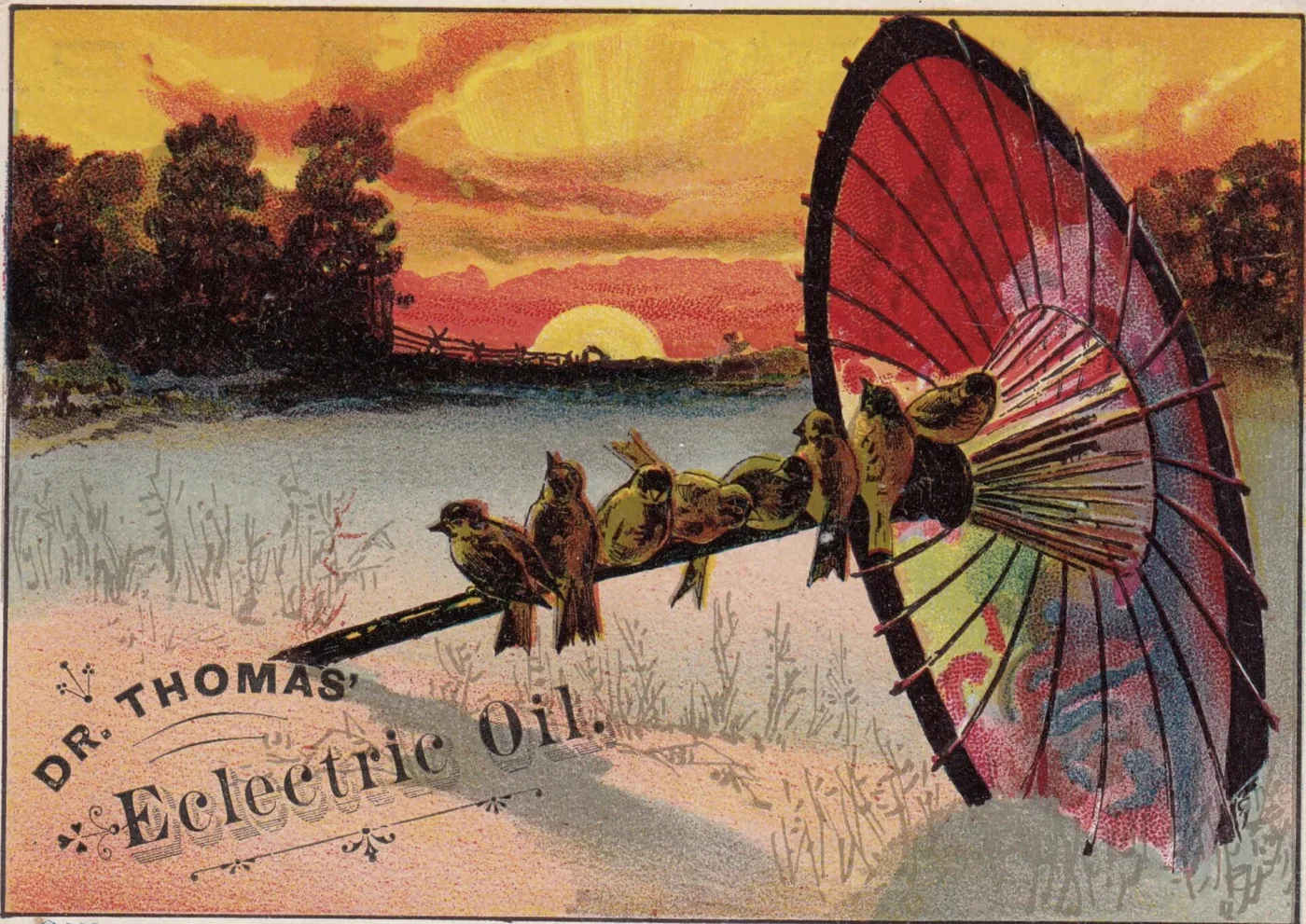
Victorian trade cards are the small, brightly colored advertising cards that flooded American and European households between roughly 1870 and 1900. Handed out free at general stores, slipped inside packages of soap and coffee, mailed by patent medicine companies, and sometimes printed for druggists and grocers to imprint with their own names, they were the first true mass-market color advertising. The chromolithograph process — which could lay down ten, twelve, or twenty separate stone-printed colors on a single card — made them the most colorful printed objects most Victorians had ever seen, and households saved them by the thousands in scrap albums that still surface intact at estate sales today. Their woven equivalent, the brightly colored silk Stevengraph pictures and bookmarks made on Jacquard looms, appealed to the same appetite for affordable, vividly colored keepsakes.
Identifying a trade card means working through several overlapping questions. What product is being advertised, and is it a stock card (a generic image overprinted with any merchant's name) or a private issue (commissioned and printed for one company)? Who lithographed it, and is the printer's imprint visible? Is it a standard rectangular card, a die-cut shape, a mechanical (moving parts), a hold-to-light, or a metamorphic? Is it a single card or part of a numbered set? And — increasingly important in today's market — is it an original 1880s chromolithograph or a 1970s or 1990s reproduction printed by photo-offset?
This guide covers the history and types of trade cards, the major American and European lithographers and the imprints they left, the great commissioning companies (Arbuckle, Singer, Clark's O.N.T., Ayer's, Lion Coffee, Liebig), the dating clues hidden in printing technique and paper stock, the special formats (mechanical, die-cut, hold-to-light, metamorphic), the racially insensitive imagery that appears on a meaningful fraction of period cards, condition grading and the scrap-album damage pattern, the reproductions that flooded the market in the 1970s, and how to build a serious collection by maker, product, or theme.
Table of Contents
- A Brief History of the Trade Card
- What a Trade Card Actually Is
- Types and Formats
- Stock Cards vs. Private Issues
- The Major Lithographers
- The Great Commissioning Companies
- The Liebig Phenomenon
- Dating a Trade Card
- Mechanical, Die-Cut, and Hold-to-Light Cards
- Reading the Imagery
- Racially Sensitive and Stereotype Imagery
- Condition and the Scrap-Album Damage Pattern
- Reproductions and Reprints
- What Drives Value
- How to Build a Collection
- Storage and Display
- Common Beginner Mistakes
- Frequently Asked Questions
A Brief History of the Trade Card
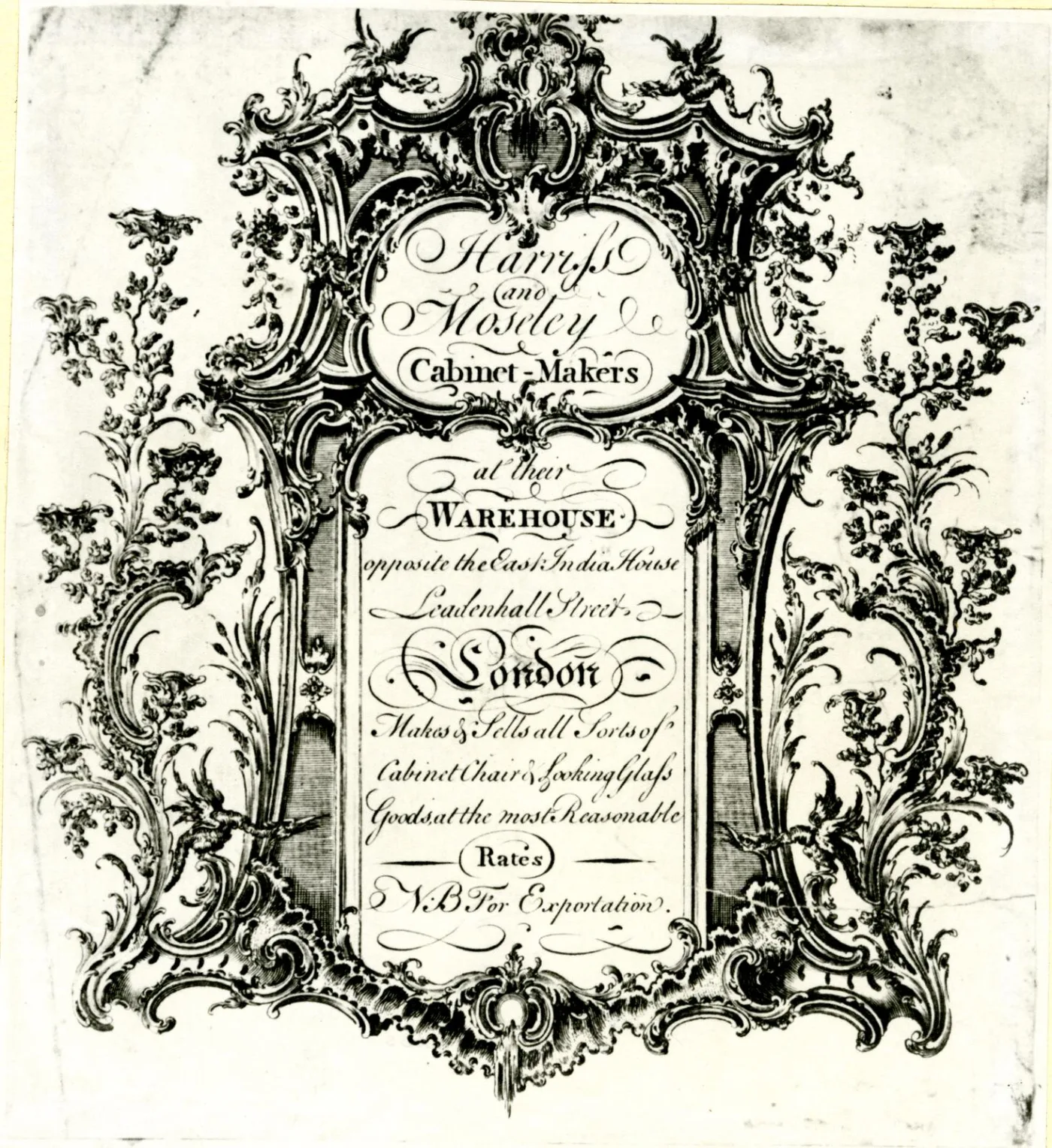
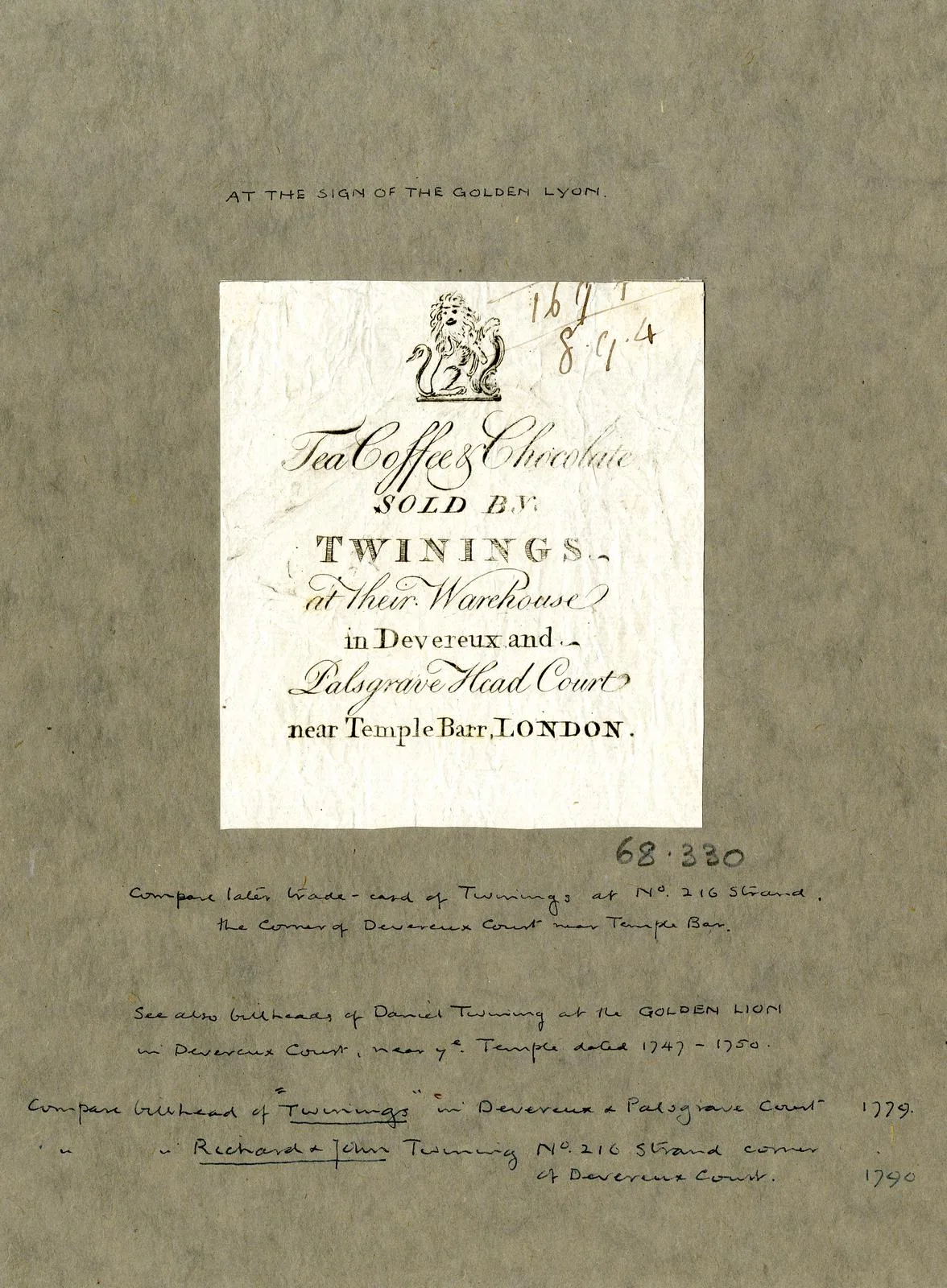
Trade cards have a much longer history than the chromolithograph era for which they are best known. The earliest English and Continental trade cards appeared in the late seventeenth century as engraved business cards — small copperplate prints announcing the address and trade of a London hatter or Paris perfumer, sometimes elaborately decorated with cartouches and putti. These remained the standard form for nearly two hundred years.
The transformation begins in the 1840s with the spread of chromolithography. Invented in France in the 1830s by Godefroy Engelmann and refined through the 1840s and 1850s, chromolithography is the layered printing of color from a separate limestone or zinc plate for each color. By the 1860s American printers — Louis Prang of Boston above all — had perfected the process, and by the 1870s the equipment had spread widely enough that mid-tier printers could produce vivid color cards in editions of tens of thousands at low cost per piece.
The boom years are 1876 to 1895. The Centennial Exposition in Philadelphia in 1876 spread chromolithograph advertising nationally, and the next two decades saw an unprecedented flood of free color cards distributed at the retail counter, by mail, and inside product packages. Households kept them in scrap albums, children traded them, and the cards became a kind of folk medium for the products and aspirations of the late Victorian consumer economy.
The Decline
By the late 1890s the trade card was already in retreat. Color magazines, color halftone advertising in newspapers, and the rise of the picture postcard (newly cheap to mail after 1898) drew advertising budgets away from the free-card model. Most American firms had stopped issuing trade cards by 1905, though some — Liebig in Europe most famously — continued issuing collectible card sets well into the twentieth century.
What a Trade Card Actually Is
A trade card, in the collectible sense, is a small printed advertising card distributed free to consumers, usually 3 to 5 inches on its long edge, normally rectangular, with a colorful pictorial image on the front and product, brand, or merchant text on the front, the back, or both. Most are printed on lightweight cardstock — heavy enough to stand up to handling, thin enough to paste into albums.
Trade cards are distinct from related categories that beginners often confuse with them. They are not postcards — a trade card was rarely meant to be mailed, and the standard postcard size and divided back are postal regulations from 1898 onward, after the trade card era was largely over. They are not advertising signs or general vintage advertising — those are larger and meant for display, while trade cards are pocket-size handouts. They are not cigarette cards, baseball cards, or tobacco insert cards (a different and equally collectible category that mostly post-dates the trade card era).
Standard Sizes
The most common size is roughly 3 x 4.5 inches, sometimes called the "standard" trade card. Smaller cards (2.5 x 3.5 inches) are common for druggist and small-merchant issues. Larger cards up to 5 x 7 inches were issued by major brands seeking shelf and album impact. Liebig cards are a consistent 4 x 2.75 inches in their classic series.
Types and Formats
Within the broad trade card category there are several specific format families that affect identification, dating, and value.
Standard Rectangular Cards
The basic form. A flat card with a chromolithograph image on the front and either continued imagery or product text on the back. The vast majority of surviving trade cards are this type. Identification rests on imagery, brand, and lithographer's imprint.
Die-Cut Cards
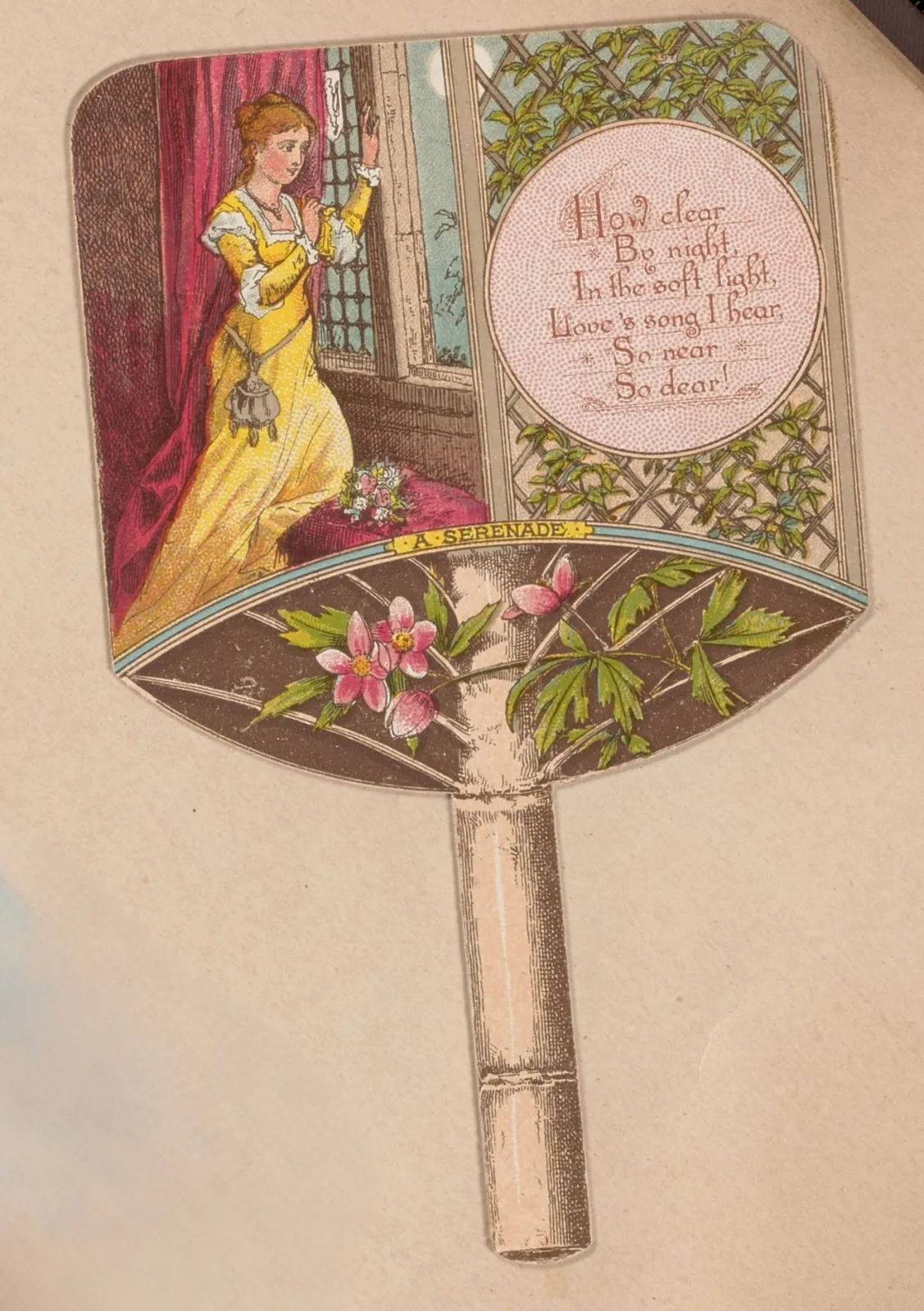
Cards cut to the silhouette of their subject — a fan, a flower, a cat, a child, a horseshoe, a piece of fruit. Die-cuts were a premium novelty form, more expensive to produce, and tend to attract a price premium today. Watch for chips and tears at the cut edges, which are common condition issues.
Mechanical Cards
Cards with moving parts — a paper tab that pulls to change a face from frowning to smiling, a wheel that rotates to show different scenes through a window, a flap that lifts to reveal an interior view. Mechanicals are among the most collected trade card formats and the most fragile. A working mechanical with all parts intact is significantly more valuable than a similar damaged example.
Metamorphic Cards
A specific kind of mechanical where the image transforms — a young woman becomes an old crone, a thin man becomes fat, a sober gentleman becomes drunk — usually through a folded flap or a sliding strip. Metamorphic cards often advertised patent medicines and laxatives with a "before and after" conceit.
Hold-to-Light Cards
Cards with a hidden image that appears only when light shines through — usually achieved by die-cutting small windows in the card and backing them with translucent tissue. Held to a window or candle, the card reveals a moonlit scene, a glowing fire, or stars in a sky. Hold-to-lights are scarce and prized.
Folder and Booklet Cards
Cards that fold once or twice to reveal interior panels, sometimes with eight or twelve printed surfaces. These approach the territory of the small advertising booklet and bring strong prices when complete and uncreased.
Scented and Embossed Cards
A small subset of premium cards were embossed (raised with a die for tactile relief) or scented (sprayed with floral essences for perfumery and soap promotions). Scent rarely survives, but embossing is permanent and immediately recognizable.
Stock Cards vs. Private Issues
The single most important distinction for identification and value is between stock cards and private issues.
Stock Cards
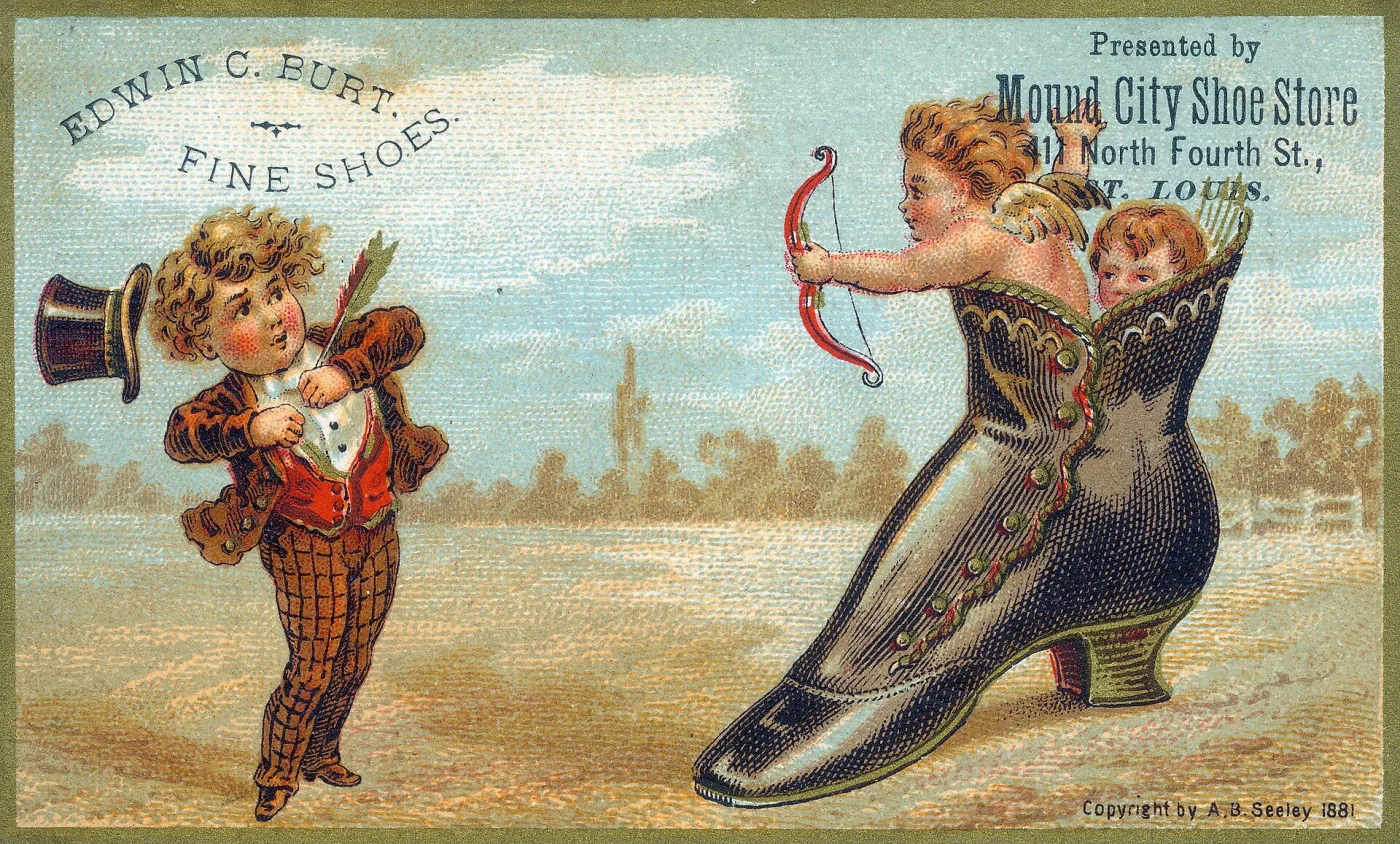
A stock card is a generic chromolithograph image — children with kittens, a basket of flowers, a winter sleigh scene, a Victorian beauty — printed in bulk by a lithographer with a blank space (often a banner, scroll, or oval) where any merchant could have his own name and product overprinted. The same charming image of a girl with a parasol might appear on a card for a New Hampshire grocer, an Ohio druggist, and a New York hat shop. Stock cards were sold by the gross to merchants who paid a small additional fee for letterpress imprinting of their store name.
Stock cards are very common, generally inexpensive ($1 to $10 each), and useful as decorative objects or as documentation of small-town merchants. The merchant imprint is sometimes the most interesting feature — a card with imagery worth $2 may be worth $15 if its imprint records a now-vanished frontier town or an early Black-owned business.
Private Issues
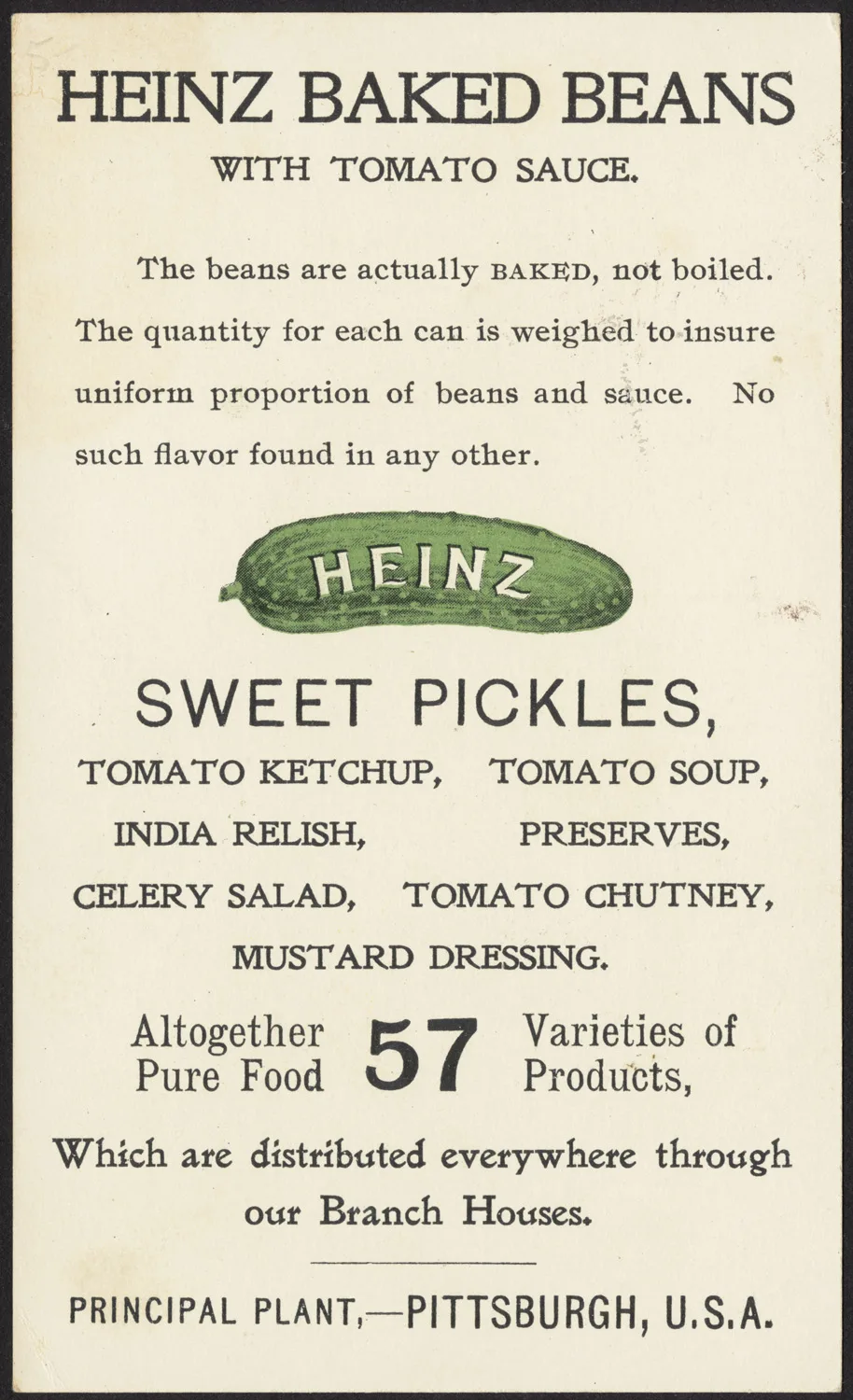
A private issue is a card commissioned by a single company specifically for its own product. The imagery is bespoke, often integrating the product into the scene (a child holding a bottle of Lyon's Tooth Powder, a kitten playing with a spool of Clark's O.N.T. thread, a sailor smoking Lone Jack tobacco). Private issues from major brands — Arbuckle, Singer, Clark's, Ayer's, Lion Coffee, McLaughlin Coffee, Hood's Sarsaparilla — are more collectible and more researched than stock cards, and they include the famous numbered sets that drive prices.
How to Tell Them Apart
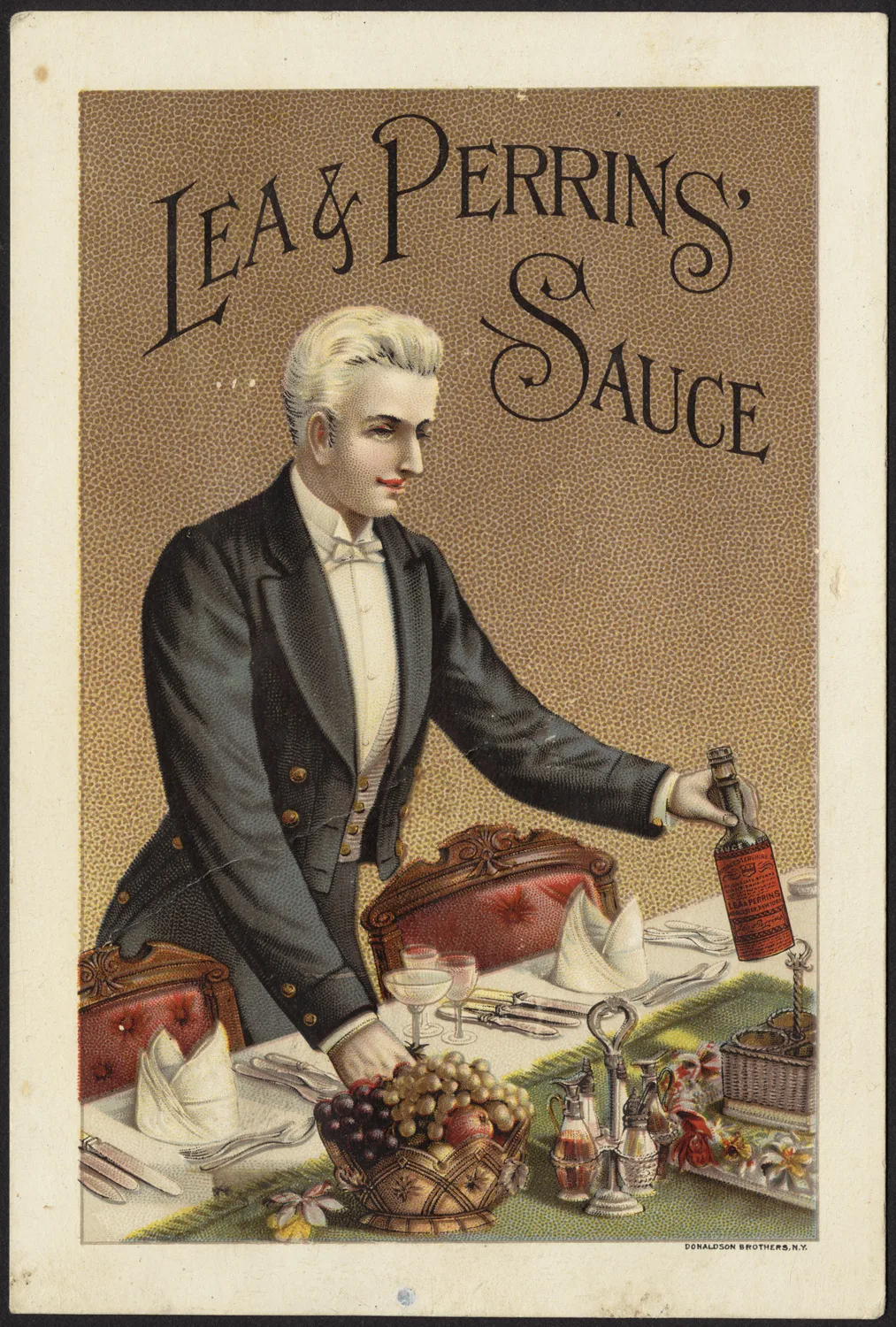
Look at the integration of text and image. If the merchant name sits in a generic banner or oval that is clearly separable from the rest of the design, you have a stock card. If the product or company name is intrinsic to the scene — printed on a bottle the figure holds, on a bag of coffee, on a sign in the background — you have a private issue. Any card with a numbered series ("No. 14 of 50," "Series II") is a private issue.
The Major Lithographers
Identifying the lithographer who printed a card sharpens dating, regional attribution, and quality grading. Many cards bear a tiny printer's imprint along the bottom margin, in the cut edge, or on the back — easy to miss, but a key piece of evidence.
Louis Prang & Co. (Boston, 1856-1899)
The most prestigious American chromolithographer of the period. Prang printed both fine art reproductions and high-end trade cards for premium clients. Prang cards are recognizable by their painterly color work, fine register (color layers aligned precisely), and frequent "L. Prang & Co. Boston" imprint. Prang cards are sought after both by trade card collectors and by collectors of nineteenth-century chromolithography in general.
Major & Knapp (New York)
An important New York firm active in the 1870s and 1880s, printing for many large clients including insurance companies and patent medicine firms. Look for "Major & Knapp Lith." imprints.
Donaldson Brothers (New York and Five Points)
A prolific producer of stock cards through the 1880s, recognizable by their bright clean color and frequent "Donaldson Bros." imprints.
Forbes Lithograph (Boston)
Active producer of cards for New England merchants and brands. Forbes imprints appear on many Hood's Sarsaparilla cards.
Ketterlinus (Philadelphia)
A large Philadelphia firm that printed widely for Eastern Seaboard clients.
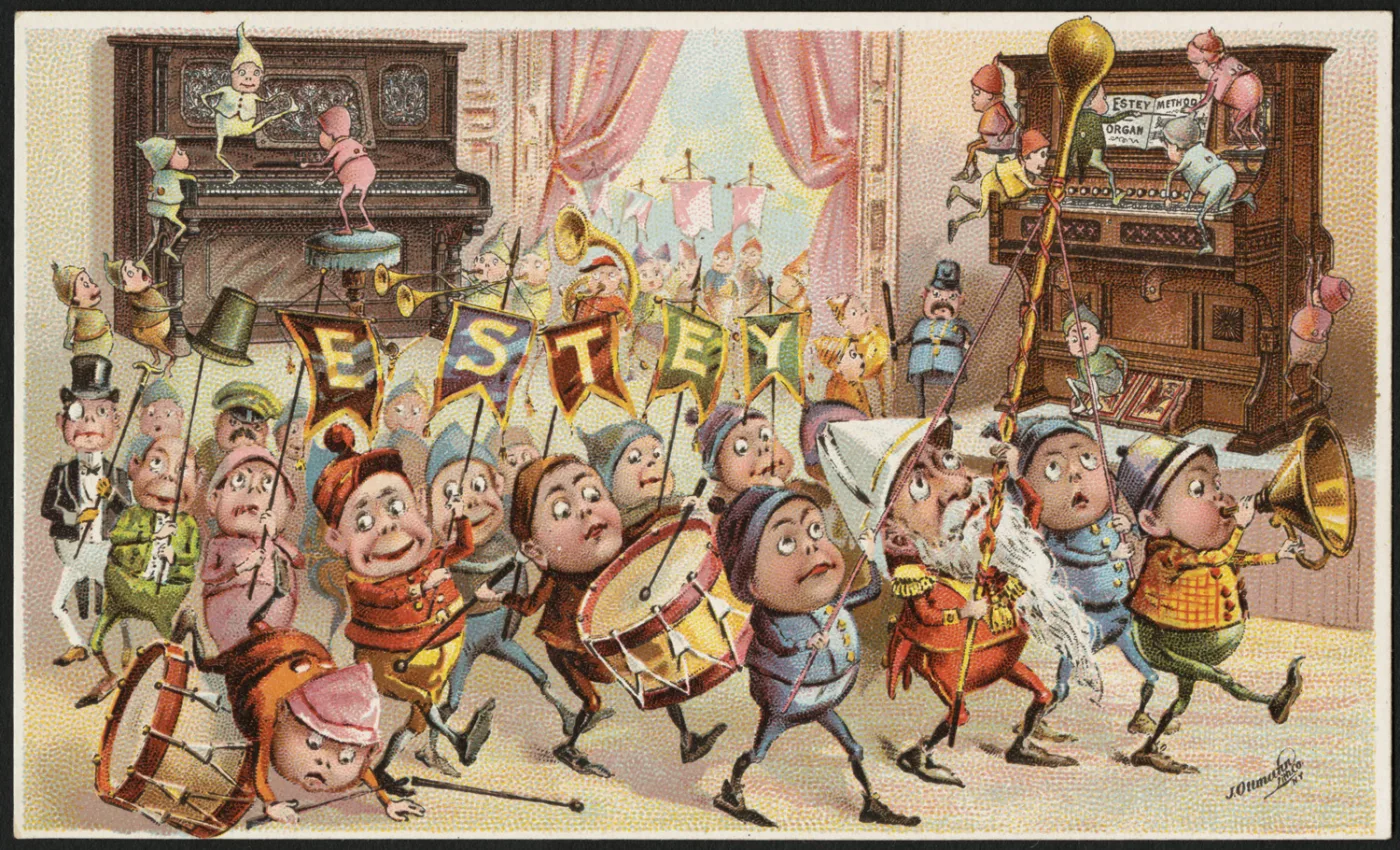
J. Ottmann (New York)
Specialist in mechanical and complex format cards. Ottmann imprints often signal a more elaborate, more collectible piece.
Sackett, Wilhelms & Betzig (New York)
Late-period lithographer (1890s) producing fine color work, often on the higher end of the trade card market.
European Printers
Liebig contracted multiple European chromolithographers, with imprints from Hamburg, Vienna, and Brussels appearing on the company's cards. Continental private-issue trade cards often bear French or German printer imprints — Vieillemard (Paris), Romanet (Paris), and Appel (Hamburg) among the most common.
The Great Commissioning Companies
Certain companies commissioned trade cards in such volume and with such consistent quality that their cards form distinct collecting categories.
Arbuckle Brothers (Coffee)
The Pittsburgh coffee roaster Arbuckle Brothers issued enormous numbered series of trade cards from the 1880s through the early 1900s, each card devoted to a state, a country, a type of cooking, or a famous historical figure. The state series (50 cards) and the "Cooking Tour of the World" series are heavily collected. The company gave the cards away in packages of Arbuckles' Ariosa Coffee, where they were intended to encourage children to nag their parents into sustained coffee buying.
Singer Sewing Machine
Singer issued a famous "Costumes of Nations" series in the 1890s — each card depicting people of a different country using a Singer machine. The series was issued worldwide in multiple languages and is widely collected.
Clark's O.N.T. and J. & P. Coats (Thread)
Both thread companies issued thousands of trade cards, many featuring children, kittens, or animals playing with spools of thread. Clark's "O.N.T." (Our New Thread) cards are particularly common and collectible.
Ayer's Sarsaparilla and Other Patent Medicines
The patent medicine industry was a heavy user of trade cards. Ayer's Sarsaparilla, Hood's Sarsaparilla, Hostetter's Bitters, Warner's Safe Cure, Mrs. Winslow's Soothing Syrup, and dozens of other firms commissioned large card runs depicting recovery from illness, family scenes, beautiful women, and frequent before-and-after metamorphic cards. Patent medicine trade cards parallel the broader category of apothecary and pharmacy antiques and often turn up alongside drugstore counter material such as branded advertising thermometers.
Lion Coffee, McLaughlin's, and Other Coffee Brands
Coffee was the second-largest trade card category after patent medicine. Lion Coffee (Woolson Spice Company, Toledo) issued a famous series in the 1890s. McLaughlin's XXXX Coffee issued numerous series, including state birds and historical scenes.
Soap Companies
Lautz Brothers, Dingman's Electric Soap, Higgins Soap, and (most famously) Pears' Soap issued large card series. Pears' commissioned high-quality painterly cards with an unusually consistent aesthetic.
The Liebig Phenomenon
Justus von Liebig's Extract of Meat Company (Liebig's Fleisch-Extract) issued chromolithograph trade cards in numbered themed sets from 1872 until 1975. The Liebig project is the largest and most consistent trade card issue in history: roughly 1,800 separate sets, each typically of six cards, totaling more than 11,000 individual cards across more than a century, in editions of multiple languages including French, German, Italian, English, Dutch, Spanish, and Portuguese.
Liebig cards are tightly catalogued in the "Sanguinetti" numbering system, named for the Italian collector Fada Sanguinetti, whose catalog assigns every set a number from S.1 onward. A serious Liebig collector references cards by their Sanguinetti number and language version. Early Liebig sets (S.1 through about S.200, roughly 1872-1885) are scarce and bring high prices; later sets are abundant and inexpensive. Mint-condition complete sets are worth significantly more than the same cards split up.
Identifying Liebig
Liebig cards are uniformly 4 x 2.75 inches (approximately 110 x 70 mm), printed on stiff cardstock, with chromolithograph fronts depicting the set theme and product advertising on the back. The back text varies by language version. Early cards have "Compagnie Liebig" or similar imprints; later cards bear the OXO or Fray Bentos brand connections that the company acquired.

Dating a Trade Card
Most trade cards are not explicitly dated, but several converging clues let you narrow the date to within a five- or ten-year window.
Printing Technique
True chromolithography (multiple stone or zinc plates, each laying down a single ink color, registered by hand) was standard from the 1860s through the 1890s. Examine the card under a 10x loupe: chromolithograph color is laid down in solid areas with no halftone dot pattern. By the late 1890s, photo-mechanical halftone (regular dot grid) began to appear. A card showing a halftone screen is later than 1895 or is a reproduction.
Patent and Copyright Dates
Many cards bear a small copyright notice — "Copyright 1884 by Major & Knapp" or "Pat. April 12, 1881" — usually in tiny type along an edge. This gives a terminus post quem (the card was made on or after that date) and is often the best dating evidence available.
Address and Telephone Clues
For cards with merchant addresses, a city directory will often place the merchant at that address only during certain years. A "Telephone 257" printed on a card means the card postdates telephone service in that town, often 1880-1895 in small American cities.
Costume and Style
Women's fashions on trade cards are usefully dated. The high bustle of 1883-1885, the leg-of-mutton sleeves of 1893-1896, and the S-curve corset silhouette of 1900-1907 each pin a card to a narrow window. This is similar to the costume-dating used for antique photographs and other paper antiques.
Paper Stock
Original trade card stock is moderately heavy, often slightly cream-colored, with a matte finish. The paper has "tooth" visible under magnification. Twentieth-century reproduction stock is brighter white, smoother, and often shows photo-offset characteristics.
Mechanical, Die-Cut, and Hold-to-Light Cards
The premium novelty formats deserve a closer look because they bring the strongest prices and require the most careful handling.
How Mechanicals Work
Most mechanical trade cards use one of three actions. A pull tab slides a backing strip behind a die-cut window, changing the visible image. A turning wheel (riveted with a brass eyelet at center) rotates a hidden disk to display new scenes through windows. A folded flap lifts to reveal a hidden interior. Sophisticated mechanicals combine two of these actions in one card.
Common Mechanical Subjects
Eyes that open and close, mouths that open to swallow medicine, transformations from sad to happy, before-and-after weight gain (for tonics and bitters), and seasonal changes are the standard mechanical themes. The patent medicine industry produced more mechanicals than any other.
Die-Cut Cards
A die-cut card is cut to the outline of its subject and often has interior cutouts as well. Premium die-cuts have multiple interior cuts and may be hinged or folded. Common die-cut subjects include fans, parasols, horseshoes, Easter eggs, Christmas stockings, fruit, and figures. Edge condition is critical: a die-cut with intact, crisp edges is significantly more valuable than one with chipped or rounded outline.
Hold-to-Light
Hold-to-light cards are scarce and almost always premium-priced. Test by holding the card up to a window or strong lamp: hidden imagery should appear in windows or backings. Some hold-to-lights have suffered from old display where light has faded the tissue backing — these are still desirable but worth less than fresh examples.
Metamorphics
True metamorphic cards (those that fold or transform to change scenes) are scarce and command strong prices. The before-and-after structure is typical: before taking the medicine, a wan and suffering figure; after, a vigorous one.
Reading the Imagery
Trade card imagery is repetitive but expressive, drawing on a small set of late-Victorian visual themes that tell us much about the period's culture.
Children and Domesticity
Children with kittens, children at play, children with the product (drinking the cocoa, eating the soup, sewing with the thread) appear on a huge fraction of cards. The intent was both to charm parents and to suggest the product's suitability for the family.
Beautiful Women
Idealized Victorian women — fashionable, demure, often holding flowers — appear on many cards, particularly those for soap, perfume, and patent medicine.
Animals
Cats, dogs, horses, and farm animals appear constantly, sometimes humorously anthropomorphized (cats holding fans, dogs reading newspapers).
Patriotic and Historical
American flags, eagles, Lincoln, Washington, and Civil War scenes were popular for the decade after the Centennial. The broader category of patriotic Americana overlaps significantly with patriotic trade cards.
Foreign and Exotic
Scenes set in China, Japan, the Middle East, and Africa appear regularly, drawing on the period's fascination with the exotic. These were almost universally produced from European or American imagination rather than observation, and many include stereotypes that read uncomfortably today.
Holiday Themes
Christmas, Easter, Valentine's Day, and Fourth of July themes generated specific runs of cards, often issued in seasonal sets. Christmas trade cards are a distinct collecting subspecialty; the broader category of Victorian Christmas ornaments and decorations shares much of the same aesthetic.
Racially Sensitive and Stereotype Imagery
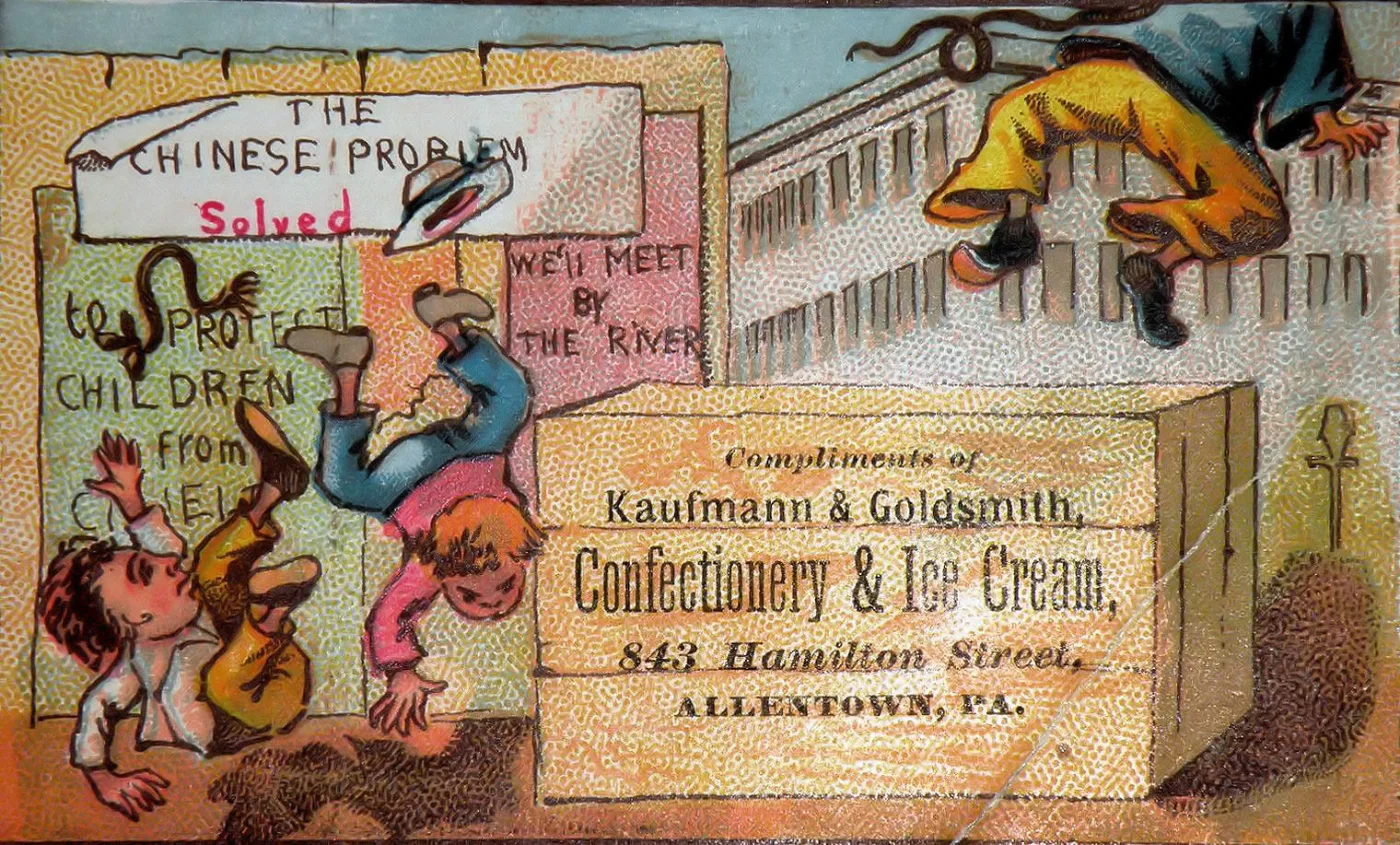
A meaningful fraction of nineteenth-century trade cards depict African Americans, Chinese, Native Americans, Jewish people, and other groups through racial caricature and stereotype. These cards are documents of a period in which such imagery was casually acceptable in mainstream commercial advertising. They are also, for many collectors, repugnant on first viewing.
The trade card community generally collects this material with explicit understanding of its context and an emphasis on documentation rather than celebration. Reputable dealers describe such cards plainly. Black collectors and academic researchers have built important collections of Black-image trade cards as evidence of how racist commercial culture worked. Whether to collect this material, to collect it with curatorial framing, or to avoid it entirely is a matter for each collector. A guide to identification would be incomplete without naming the issue.
Condition and the Scrap-Album Damage Pattern
Most surviving trade cards spent decades in scrap albums, pasted in by the children and women who collected them. This produces a characteristic damage pattern that affects nearly every card you will encounter.
Album Residue
Glue or paste residue on the back is universal on album cards. Modern conservators can sometimes reduce this residue, but skinned spots — where the back paper layer pulled off when the card was removed from the album — are permanent. A "skinned" card with the back paper torn during album removal is worth perhaps half what an unskinned card is worth.
Corner and Edge Wear
Corner rounding, edge chips, and small tears are common. Sharp corners and clean edges are a meaningful premium.
Foxing and Toning
Brown spotting (foxing) and overall yellowing (toning) are routine on hundred-year-old paper. Heavy foxing reduces value materially; light toning is acceptable to most collectors.
Fading
Cards displayed in sunlight (or hold-to-lights kept in windows) often show fading of the brightest colors, particularly the reds and yellows. Severely faded cards lose much of their visual impact and a comparable share of their value.
Creases and Folds
Creases across the image are serious condition issues. Creases through the borders only are tolerated more easily. Sharp center folds, especially through faces or product imagery, are major value-killers.
Standard Grading Vocabulary
Trade card dealers use a vocabulary borrowed from postcard and stamp grading: Mint (perfect, unused, no album residue), Near Mint, Excellent, Very Good (light album residue, sharp image), Good (visible flaws, presentable), Fair (significant damage), Poor (major damage, study only).
Reproductions and Reprints
Trade cards have been reproduced repeatedly for nostalgia and decoration, and several waves of reproduction now circulate in the market.
1970s and 1980s Souvenir Reprints
Museum gift shops and collectibles companies issued sets of reprinted classic trade cards in the 1970s. These are usually larger than originals (postcard size, 4 x 6 inches), printed by photo-offset (so a 10x loupe shows a regular halftone dot pattern), and printed on bright modern stock. The reverse often carries a printer's identifier and a copyright date.
Liebig Reprints
Many Liebig sets have been reprinted by collectors' clubs, sometimes in editions clearly marked as reproductions and sometimes not. Authentic Liebig cards have specific paper, color, and reverse text characteristics that differ from reprints.
Modern Inkjet Forgeries
A small number of high-value cards have been faked outright by inkjet printing on aged paper. Inkjet output dissolves under the test of a wet cotton swab on an inconspicuous edge — a test no buyer should perform without permission. More routine identification: inkjet output shows no chromolithograph layer structure under magnification, instead showing the spray-pattern of inkjet droplets.
The Halftone Test
The single most reliable reproduction test: examine the card under a 10x or 20x loupe. Original chromolithograph cards show solid color areas with no dot pattern. Photo-offset reproductions show a regular halftone dot rosette. Inkjet reproductions show irregular spray patterns. This single test catches almost all reproductions.
What Drives Value
The trade card market spans from $1 stock cards to four-figure rare mechanicals. Several factors drive the spread.
- Format premium. Mechanicals, hold-to-lights, and elaborate die-cuts trade at multiples of standard cards on the same product.
- Brand desirability. Coca-Cola, Singer, Arbuckle, Pears', and major patent medicine brands have dedicated collector bases.
- Subject matter. Sports, baseball, bicycling, transportation (early cars, bicycles), aviation, Black history (with proper framing), and World's Fair imagery bring premiums.
- Set completeness. Complete numbered sets are worth substantially more than the sum of their parts.
- Condition. Standard ungraded cards in Mint condition can bring 4-10x the price of the same card in Good condition.
- Lithographer attribution. Documented Prang, Major & Knapp, and Ottmann printings sell for more than unattributed work of similar quality.
- Local interest. A card with a clear merchant imprint from a desirable town (San Francisco, New Orleans, gold-rush California, frontier territories) brings premium prices to local collectors.
Typical Price Ranges
Stock cards with merchant imprint: $1-$10. Standard private issue cards from common brands: $5-$25. Better Arbuckle, Singer, Clark's, and major brands in clean condition: $15-$60. Premium mechanicals: $50-$300. Rare hold-to-lights and complex mechanicals: $200-$800. Documented rarities and fresh first-edition early Liebig sets: $500-$2,000+.
How to Build a Collection
The trade card universe is vast enough that almost everyone collects by theme, brand, format, or region rather than trying to amass everything.
By Brand
Many collectors focus on a single brand — Arbuckle Coffee, Singer, Liebig, a specific patent medicine. The numbered series structure of Arbuckle and Liebig makes brand collecting goal-oriented and rewarding.
By Theme
Cats, dogs, baseball, bicycles, ships, hot-air balloons, World's Fairs, specific holidays — all are popular thematic specialties. A theme collection draws cards from many brands and lithographers, exposing the collector to the full visual range of the medium.
By Format
Mechanicals only, die-cuts only, hold-to-lights only — format-based collections concentrate on the technically interesting cards and tend to be smaller but higher-value.
By Region
Many collectors focus on cards with merchant imprints from a single state or city. The local-history value of a small-town imprint is sometimes greater than the trade card value, making this a good intersection for historical society and library collections.
Where to Buy
Trade cards turn up at general antique shows, paper-and-ephemera shows (the Allentown Paper Show in Pennsylvania is the largest American trade card venue), specialty paper dealers, eBay, and estate sales. Scrap albums full of cards still surface intact and represent the best buying opportunity for cheap volume. The photograph collecting community overlaps with the trade card community and many dealers sell both.
Storage and Display
Trade cards are paper, and the standard rules of paper conservation apply.
Storage
Store cards in archival polypropylene or polyester sleeves (Mylar is the conservator's standard). Avoid PVC sleeves, which off-gas plasticizers that damage paper over time. Stack sleeved cards in archival boxes in a stable temperature and humidity environment — roughly 65-72°F and 40-50% relative humidity. Avoid attics (heat fluctuation) and basements (damp).
Display
Cards displayed in frames must be matted with archival board and glazed with UV-filtering glass or acrylic. Direct sunlight will fade chromolithograph colors irreversibly. Display in indirect light, and rotate displayed cards every few months to avoid cumulative fading damage.
Album Removal
Do not attempt to remove cards from an old album. Forced removal is the leading cause of skinned backs, the most common irreversible damage to trade cards. If an album is in stable condition, leave the cards in place and value the album as a collection in its own right. If removal is essential, consult a paper conservator — humidity-chamber techniques can sometimes release cards safely.
For broader paper-antique care principles, our storage and preservation guide covers archival materials, environmental targets, and conservation triage in depth.
Common Beginner Mistakes
A short list of errors that recur in trade card collecting.
- Confusing trade cards with postcards. Postcards have a divided back and are postal-rated for mail (1898 onward in the US). Trade cards predate this and have undivided backs filled with product copy.
- Missing the printer's imprint. Tiny lithographer credits along the bottom margin are easy to overlook and contain crucial dating information.
- Buying without a loupe. The halftone-vs-chromolithograph test takes 10 seconds with a loupe and prevents most reproduction purchases.
- Overpaying for stock cards with attractive imagery. A pretty image on a generic stock card with a trivial merchant imprint is still a stock card. Beautiful does not mean rare.
- Ignoring condition. A lightly album-residued card and a heavily skinned card sit at very different price points; beginners often pay alike for both.
- Treating Liebig like a single category. Some Liebig sets are common and inexpensive; some early sets are scarce and valuable. Buy by Sanguinetti number, not by the brand alone.
- Forced album removal. Far better to keep an intact album than to skin a card trying to free it.
- Disregarding scrap albums. A full scrap album of period cards purchased intact can yield a premium collection at a fraction of per-card retail. The album itself often has historical interest as a document of one household's consumer life.
Frequently Asked Questions
Are trade cards a good investment?
Common stock cards have shown limited appreciation. Premium mechanicals, hold-to-lights, complete early Liebig sets, and exceptional condition examples of major brands have appreciated meaningfully. As with most paper collectibles, condition concentration matters more than raw rarity for long-term price growth.
How do I get a collection appraised?
The Ephemera Society of America maintains a directory of paper specialists. Major auction houses with paper departments (Heritage, Swann Galleries, Cowan's) provide appraisals for high-end collections. For a single card or small group, photograph the card and consult a specialist dealer at a paper show.
What's the difference between a trade card and a postcard?
Trade cards predate the modern postcard format. Standard postcards have a divided back (address on the right, message on the left) and are rated for mail. Trade cards have undivided backs (continuous product copy) and were not meant to be mailed. There is some overlap in the 1898-1905 transition years, but the categories are otherwise distinct.
Are mechanical trade cards worth more than flat ones?
Generally yes, often substantially more. A working mechanical from a desirable brand commonly brings 3-10x the price of a flat card from the same product line.
Should I clean an old trade card?
No. Avoid all cleaning. Surface dust can be brushed off with a soft brush; anything more aggressive risks pulling color or skinning the surface. Conservation cleaning of valuable cards belongs to professional paper conservators, not to collectors with a damp cloth.
Why are some Liebig cards so much more expensive than others?
Early sets (S.1 through about S.200, mostly 1872-1885) had small initial print runs and high attrition; later sets (S.500 onward, mostly 1900-1975) had large runs and many survive. The language version also matters — French and German versions are common, while early English-language sets are scarce.
Is it ethical to collect cards with racist imagery?
This is a personal question without a single right answer. The mainstream collecting and museum communities accept curatorial collection with explicit framing as documentation of a period's commercial racism. Many collectors choose to avoid such material entirely. Both positions are defensible; the indefensible one is to collect such material uncritically as "cute Victoriana."
How do I know if my card is from a numbered set?
Look for "No. 14," "Series II," "1 of 50," or similar markings, usually small along an edge or on the back. If the card depicts a state, country, recipe, or famous person and you suspect it's from a series, search the brand and topic — most major series are catalogued online.
Are die-cut trade cards always more valuable?
Generally yes, with the caveat that condition matters more for die-cuts than for flat cards, since chipping at the cut edge is common and harshly penalized.