Antique Slag Glass Identification Guide: Colors, Lamps & Makers
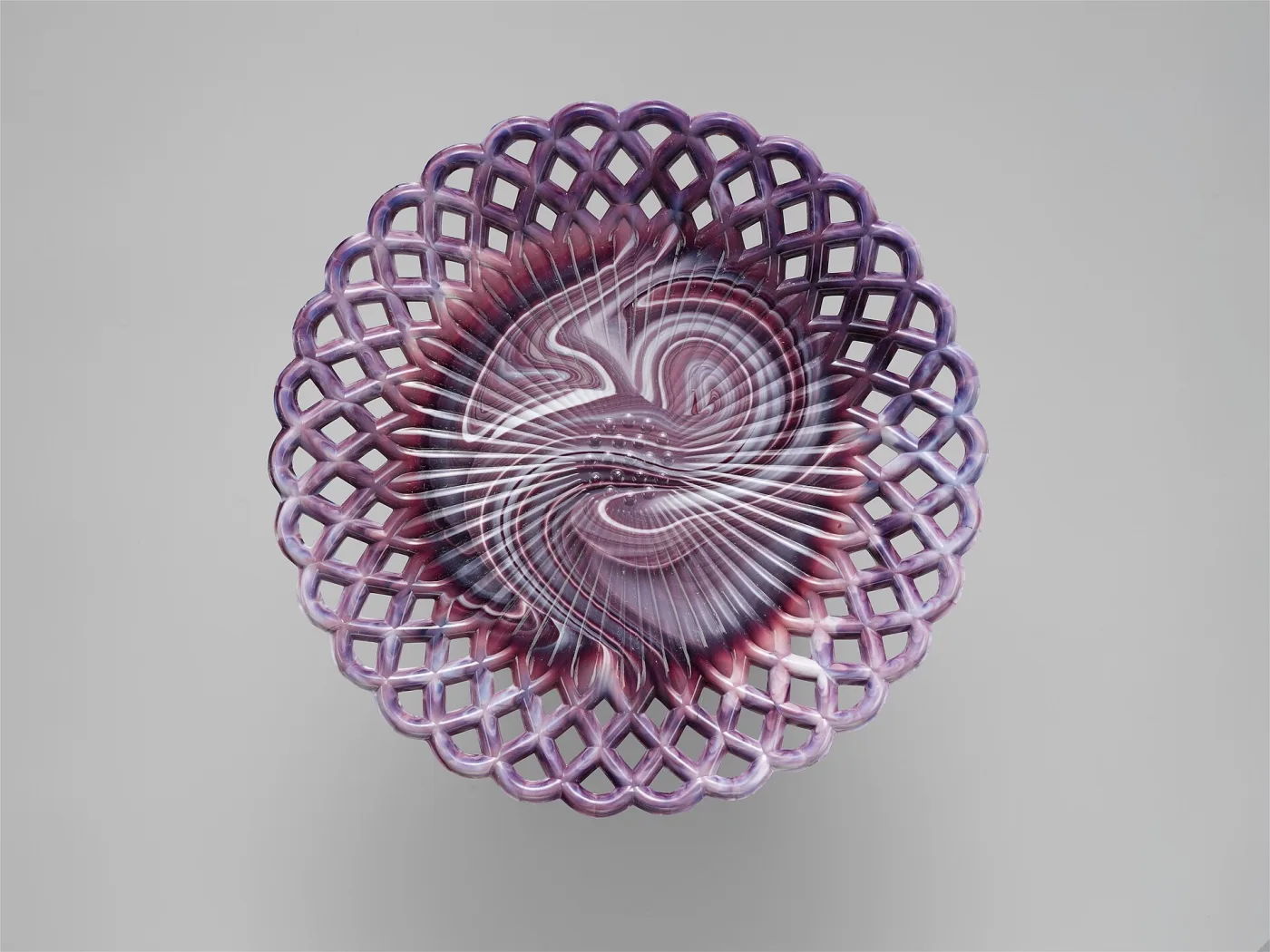
Slag glass is the marbled, opaque-to-translucent pressed glass that swept through British and American factories between roughly 1880 and 1930, defined by streaks of contrasting color swirled through a denser body. The name is industrial: early production reused slag, the residue from iron and steel smelting, mixed into the molten glass to produce the characteristic streaks. The result was a material that looked expensive—reminiscent of malachite, marble, or onyx—at a fraction of the price.
For collectors, slag glass occupies the intersection of pressed-glass tableware and turn-of-the-century lighting. It appears in pitchers, vases, plates, and vanity items from the British "marbled glass" makers, and as bent or flat panels in the colossal table lamps that defined American parlors from 1900 to 1925. Identifying slag glass means reading color combinations, recognizing makers' molds and registry marks, and distinguishing pressed-panel lamps from leaded-glass and reverse-painted alternatives.
This guide walks through how slag glass was made, the major British and American makers, the principal color families (purple, caramel, chocolate, blue, green, pink), the lamp formats that drive the modern market, the registry and trademark anchors that pin a piece to a maker and decade, and the reproductions and "new slag" that complicate today's identification.
Table of Contents
- What Slag Glass Is and How It Was Made
- British Origins: Sowerby, Davidson, Greener
- American Slag: Challinor Taylor and Successors
- Color Families: Purple, Caramel, Chocolate, Blue, Green, Pink
- Registry Marks and the British Diamond
- Slag Glass Panel Lamps: Format and Construction
- Bent-Panel Versus Flat-Panel Lamps
- Lamp Bases: Bradley & Hubbard, Miller, Handel, Pittsburgh
- Tableware, Vases, and Vanity Pieces
- Mid-Century Revival: Imperial, Akro Agate, Westmoreland
- Reproductions, Reissues, and Modern "New Slag"
- Condition: Cracks, Heat Damage, Replaced Panels
- Care, Cleaning, and Display
- Field Checklist Before You Buy
What Slag Glass Is and How It Was Made
Slag glass is a pressed glass with two or more colors deliberately incompletely mixed in the gather, so that streaks of one color marble through the body of another. The opacifier is usually a fluoride or arsenic compound that gives the glass its characteristic milky body; the streaks are added by combining a contrasting cullet (broken glass of a different color) with the main batch just before pressing.
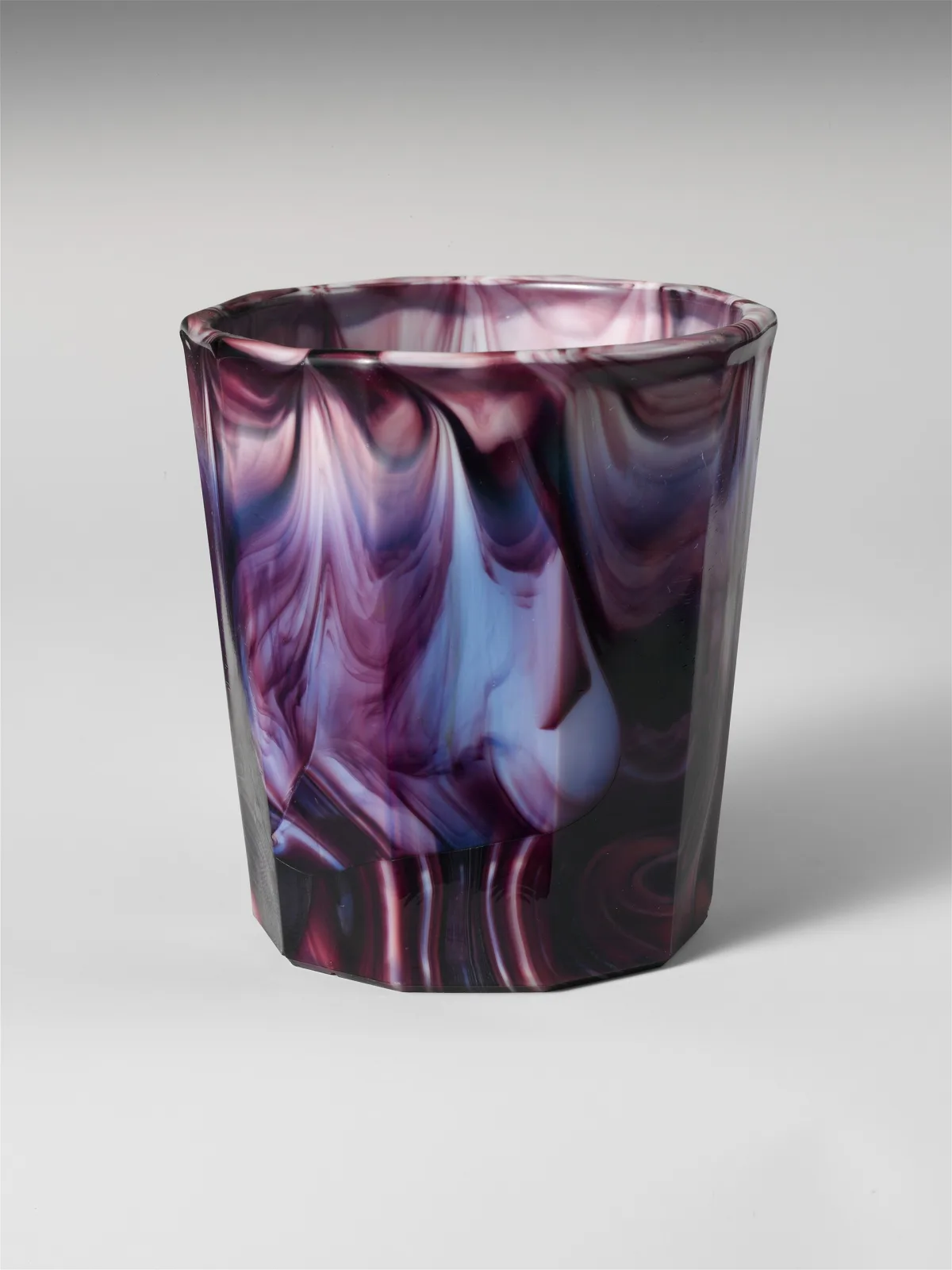
The Victorian English makers who pioneered the material in the late 1870s called it "marbled glass," "malachite glass," or simply "slag," depending on color and marketing. The slag designation referenced the iron and steel slag occasionally added to the batch—particularly in the purple-and-white "purple slag" made famous by Tyneside factories—but the term broadened to cover any pressed glass with this marbled, multi-colored character regardless of whether literal smelting slag was used.
Production was always pressed, never blown. A measured gather of molten glass was dropped into a metal mold, a plunger pressed it into shape, and the piece was finished by reheating, fire-polishing, and annealing. The streaking happened in the gather: workers would dip the punty into a contrasting batch, then withdraw and twist before delivering the gather to the mold. This produced the swirled, never-twice-identical color patterns that distinguish slag from solid-color pressed glass and from milk glass, which is uniformly opaque white.
Slag Versus Other Marbled Glasses
Slag glass should not be confused with end-of-day glass (multi-colored scrap glass blended at random for one-off pieces), with marbleized art glass like Tiffany's Cypriote (a hand-blown studio technique), or with carnival glass (pressed glass with iridescent surface treatment). Slag is always pressed, always streaked rather than uniformly colored, and almost always commercially produced in identifiable molds.
British Origins: Sowerby, Davidson, Greener
Slag glass as a recognized commercial category began in the industrial north of England, where three large pressed-glass makers in the Tyne and Wear region dominated production from the late 1870s through the early twentieth century: Sowerby of Gateshead, George Davidson of Teams (Gateshead), and Henry Greener of Sunderland. All three competed in pressed tableware, novelty pieces, and vases, and all three issued substantial slag glass lines.
Sowerby's Ellison Glass Works registered the largest body of slag designs, often in their distinctive "vitro-porcelain" line. Sowerby pieces typically carry a peacock-head trademark molded into an inconspicuous part of the base, and their purple slag and "blanc-de-lait" white slag are textbook examples of the genre. Sowerby production peaked in the 1880s and continued in reduced volume into the early twentieth century.
George Davidson & Co. at the Teams Glass Works produced slag in similar palettes and competed directly with Sowerby. Davidson pieces are sometimes marked with a lion-rampant trademark or with British registry marks; the firm continued well into the twentieth century and is best known among collectors today for their later "Pearline" range, which is technically opalescent rather than slag but is often grouped with slag in Victorian glass references.
Henry Greener & Co. at the Wear Flint Glass Works produced both slag and commemorative pressed glass. Greener used a lion-with-axe trademark (the lion holding a halberd) that often appears on the base of Greener pieces. Their slag output was generally more conservative in form than Sowerby's, leaning toward classical urn shapes and plain sugar-and-cream sets.
Reading the Tyneside Mark Trio
For British slag, the maker mark (peacock for Sowerby, lion-rampant for Davidson, lion-with-axe for Greener) is the fastest authentication. These marks are small, pressed into the base, and easy to miss without a flashlight and a loupe. When the mark is absent, registry marks (covered in a later section) or design diamond numbers can still place the piece. British slag without any mark or registry information is harder to attribute and trades at a discount unless the form is distinctive enough to identify by mold alone.
American Slag: Challinor Taylor and Successors
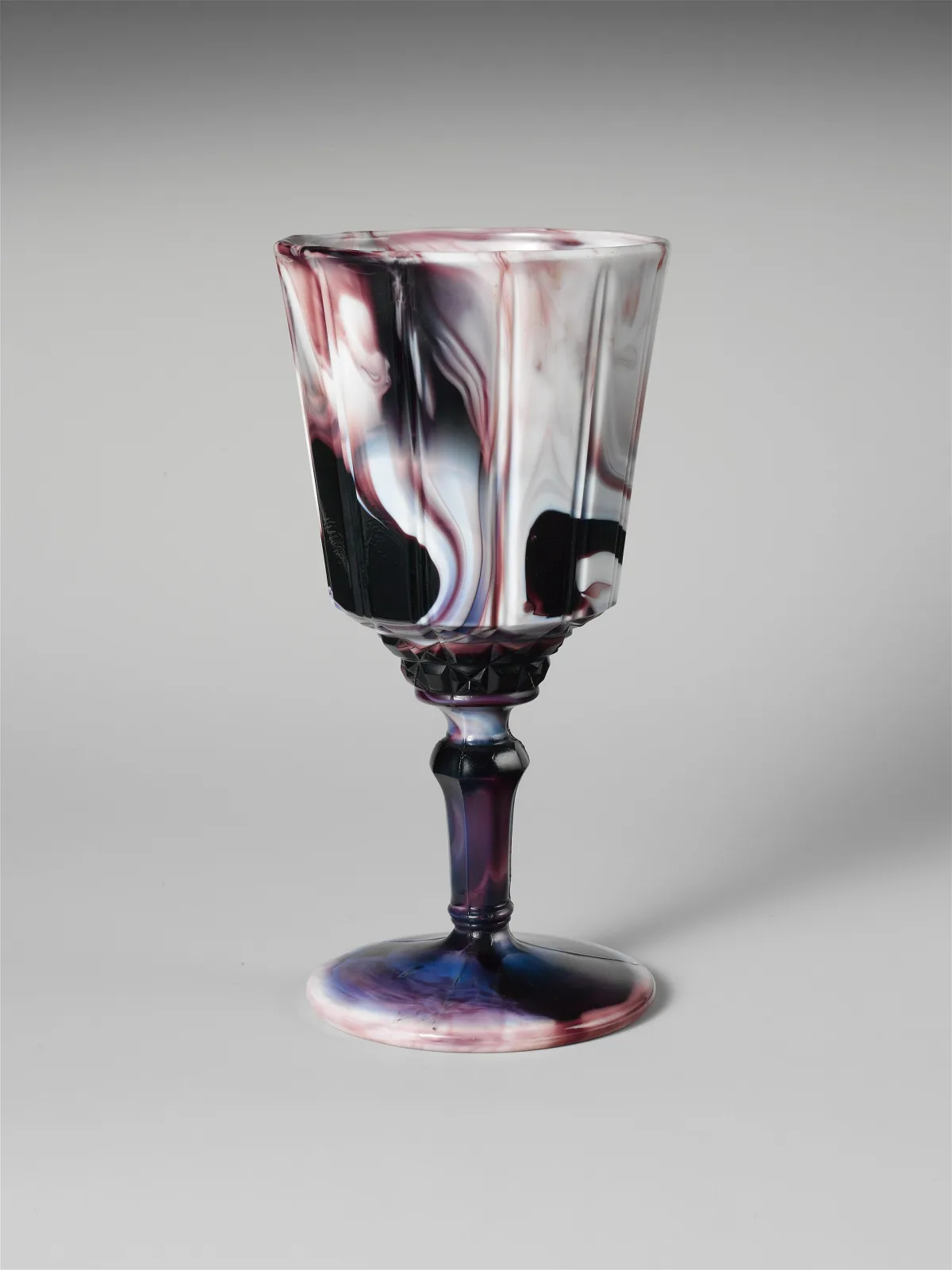
American slag glass production followed British practice by about a decade. The first major American slag maker was Challinor, Taylor & Company of Tarentum, Pennsylvania, which from roughly 1885 onward produced "mosaic glass" (their preferred term) in purple-and-white, blue-and-white, and other combinations. Challinor Taylor pieces are usually unmarked but identifiable by their characteristic mold designs—including a distinctive "flower-and-panel" tableware line—and by the slightly heavier, denser body typical of American slag.
Other American makers followed quickly. Atterbury & Co. (Pittsburgh) produced slag novelties; Indiana Tumbler & Goblet Company in Greentown, Indiana, made the famous "chocolate glass" from 1900 to 1903 (a brown-and-cream slag); and the National Glass Company combine, which absorbed Greentown and others around 1900, continued the Greentown molds in chocolate and other slag colors at successor factories after the original Greentown plant burned in 1903.
By the early twentieth century, American slag production had largely shifted from tableware toward lamp panels. As parlor lighting became electrified between 1905 and 1925, slag glass found its second life as the source material for the bent and flat panels of the table lamps that defined the era. Companies like McKee Glass, Imperial Glass, and various smaller pressing houses fed bent-panel lamp manufacturers with slag stock in caramel, green, and purple.
Greentown Chocolate Glass
Greentown chocolate glass deserves special mention. Produced for only three years (1900-1903) before the factory fire, Greentown chocolate is a deep brown slag with cream marbling, used for tableware in distinctive molds—the "Cactus" pattern, the "Dewey" pattern (commemorating Admiral Dewey's 1898 victory), and the "Geneva" pattern among others. Genuine Greentown chocolate is a defined collector category; it has also been heavily reproduced (covered later), so attribution requires careful comparison against catalog references.
Color Families: Purple, Caramel, Chocolate, Blue, Green, Pink
Slag glass is most efficiently catalogued by color combination. Each major palette has a typical date range, geographic origin, and collector following.
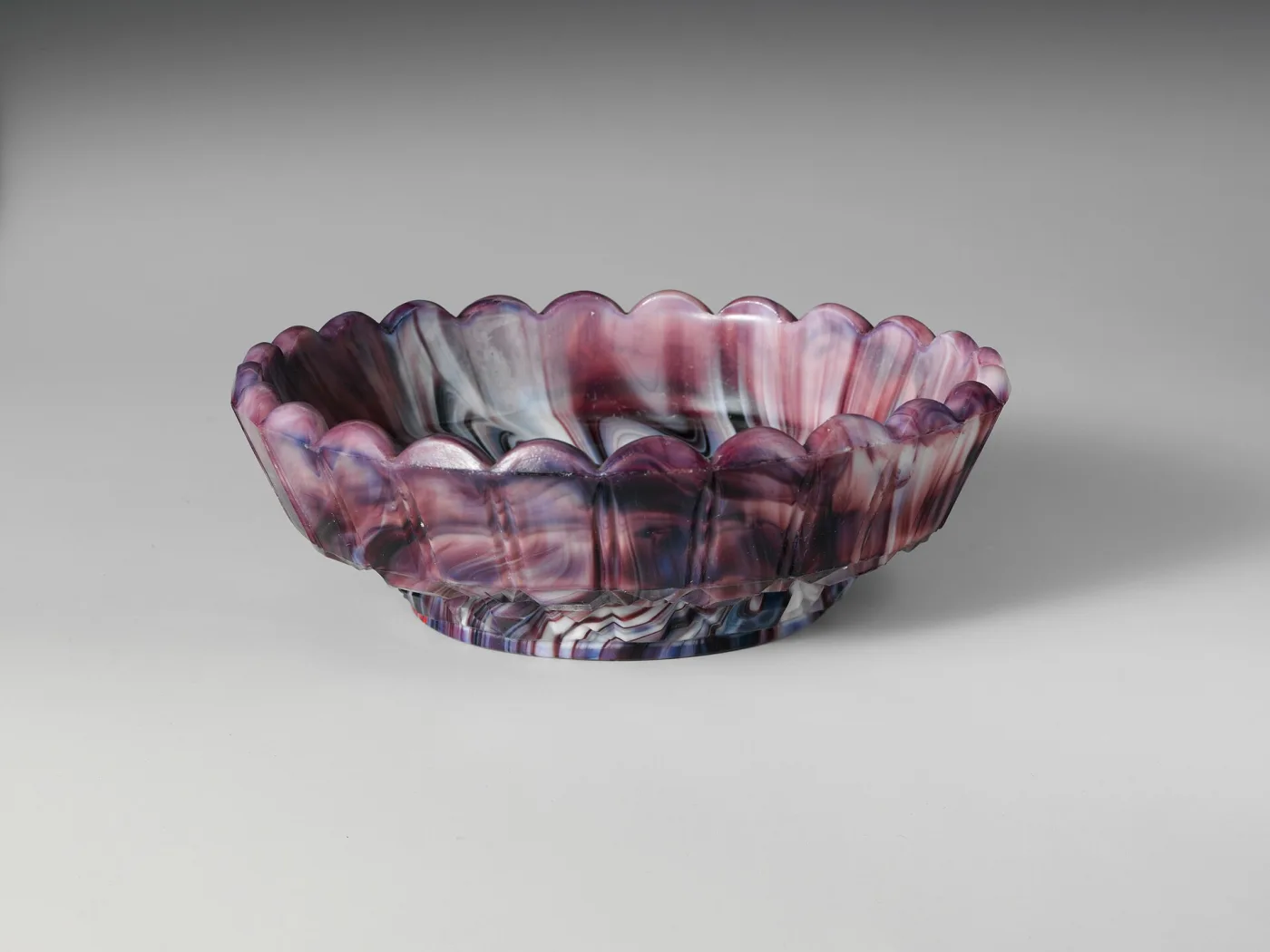
Purple slag (purple-and-white). The classic Victorian English slag. A deep manganese purple body with broad streaks of white opaque glass, often with a hint of pink or amber where the colors meet. Made primarily 1880-1900 by Sowerby, Davidson, Greener, and Challinor Taylor's American line. Purple slag survives in tableware (cream-and-sugar sets, plates, footed bowls), vases, and novelty figural pieces.
Caramel slag (caramel-and-white or solid caramel). A warm tan to butterscotch color, sometimes with cream streaks, sometimes nearly solid. Caramel slag is the dominant lamp-panel color, used heavily by American bent-panel lamp makers from 1905 to 1925. Imperial Glass produced large quantities of caramel slag in the 1920s under the trade name "Caramel Slag" and continued the line in a 1950s-60s revival.
Chocolate slag (Greentown chocolate). Deep milk-chocolate brown with cream marbling, made primarily by Indiana Tumbler & Goblet at Greentown (1900-1903) and successor factories. Distinct from caramel slag in being darker and less yellow-toned. Genuine Greentown chocolate is the highest-value American slag tableware.
Blue slag (blue-and-white). A medium to deep blue body with white streaking, made by Sowerby, Davidson, and several American factories. Less common than purple slag in the Victorian era but produced in lamp panels in the 1910s and 1920s.
Green slag (green-and-white or solid green-streaked). Used heavily in lamp panels, particularly in the bent-panel lamps of the 1910s-1920s. Imperial Glass produced "Jade Slag" in the late 1920s. Green slag tableware exists but is scarcer than purple or chocolate.
Pink slag (pink-and-white). The rarest of the principal slag families. True pink slag was produced briefly around 1900, primarily by Harry Northwood's company; the Inverted Fan-and-Feather pattern in pink slag is the iconic example and commands high four-figure prices for pristine pieces. Most "pink slag" offered for sale today is actually pink-and-cream opalescent or modern reproduction.
Reading the Streaking
The streaking pattern itself can help with identification. Victorian British slag tends to show broad, sweeping streaks with high contrast between body and marbling. American slag from 1885-1905 often shows finer, more uniform streaking. Bent-panel lamp slag from 1910-1925 is typically heavily streaked with smaller, more frequent marbling—useful when a panel lacks a maker mark but you need to date by visual character. Modern reproductions often show too-regular streaking that looks computer-printed; genuine old slag has a hand-thrown irregularity that comes from the worker's punty twist.
Registry Marks and the British Diamond
British slag from 1842 to 1883 frequently carries a diamond-shaped registry mark molded into the base, indicating that the design was registered with the Patent Office. The diamond contains coded letters and numbers indicating the year, month, day, and parcel number of registration. Decoding the diamond tells you the precise date the design was registered—not necessarily the date of manufacture, but a firm earliest date.
From 1884 onward, the diamond was replaced by a simpler "Rd" (registered design) number, increasing chronologically year by year. A piece marked "Rd 12345" can be dated to a specific year by consulting the standard Patent Office tables: low Rd numbers indicate the mid-1880s, while five-figure numbers reach into the 1890s and six-figure numbers into the early twentieth century.
Both the diamond and the Rd number indicate the registration of the mold design, not the date the specific piece was pressed. A mold registered in 1884 might have been used for decades, so a piece with an 1884 registration mark could have been made anywhere from 1884 to perhaps 1910. Combined with maker marks and stylistic features, however, registration marks tighten the dating window considerably.
American Patent and Trademark Anchors
American slag does not have an equivalent of the British registry diamond. Some American makers patented specific molds and marked the resulting pieces "Pat." with a date; these are useful where present but inconsistent. More often, American slag is dated by maker attribution, mold matching against published company catalogs, and lamp-base or fitting context (for panel lamps). The systematic provenance and authentication strategies covered in the broader authentication and provenance research guide apply directly to ambiguous American slag.
Slag Glass Panel Lamps: Format and Construction
The slag glass panel lamp is the highest-value modern slag category. These lamps, produced primarily between 1905 and 1925, consist of a metal frame supporting between four and eight panels of pressed slag glass, typically caramel or green, with a metal base, harp, and finial. They were marketed as a more affordable alternative to leaded-glass lamps in the Tiffany style and to reverse-painted lamps in the Handel and Pairpoint style.
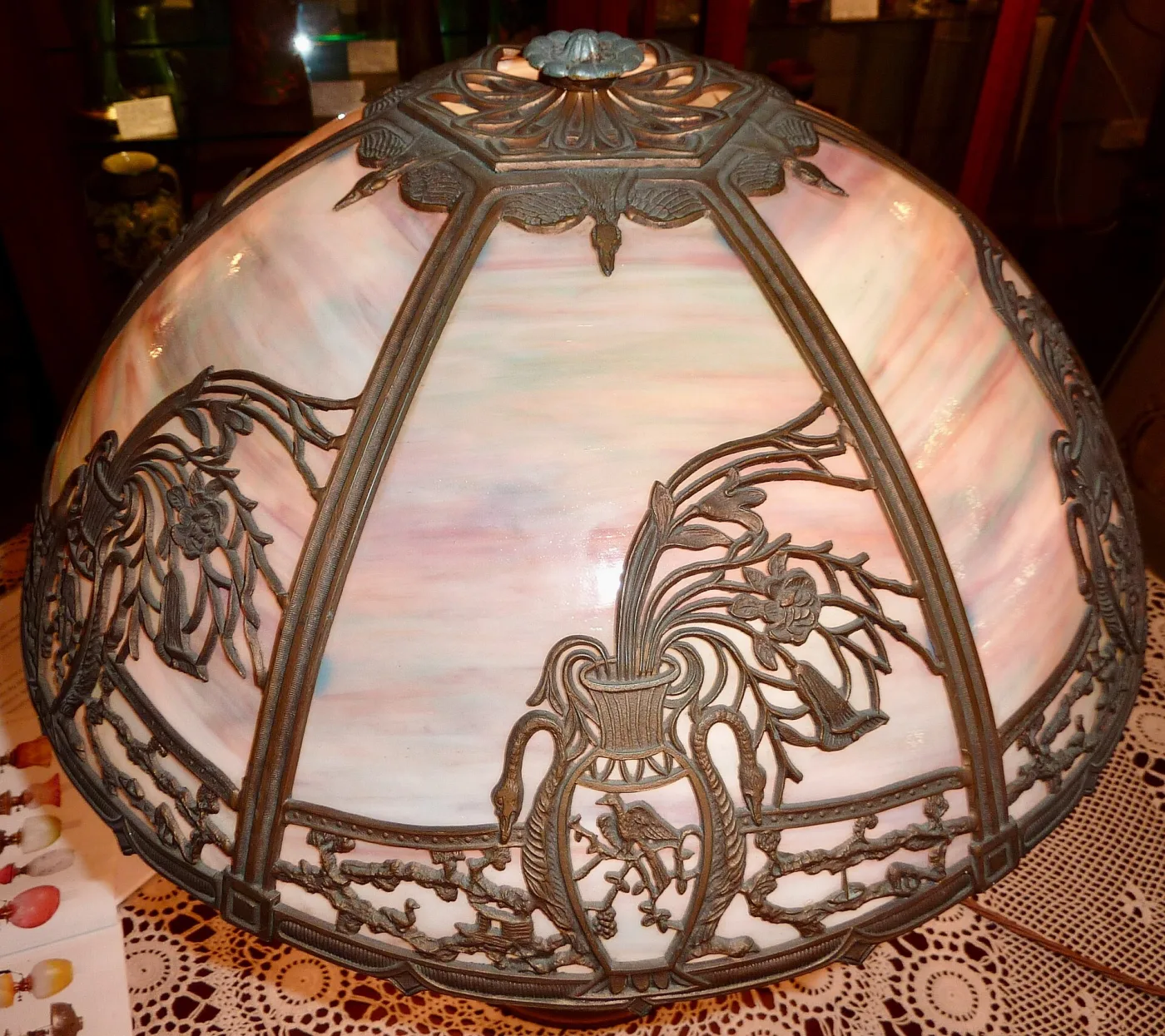
A typical slag panel lamp has a domed or peaked shade frame in cast bronze, brass, or pot metal, with the slag panels secured by metal channels or rivets. The shade sits on a harp atop a metal base that may be plain, embossed, or fully sculpted in a Greek key, oak leaf, or floral pattern. Wiring is original Edison-era cloth-covered cord with a brass socket; the bulb is a single Edison-base incandescent at the center of the shade.
The cost-engineering reasoning is visible in the construction. A leaded shade requires hundreds of small glass pieces individually copper-foiled and soldered—labor-intensive and expensive. A slag panel lamp uses six to eight large pressed panels, mass-produced at a glass factory and dropped into a pre-cast metal frame. The result was a lamp that looked stained-glass at distance but cost a fraction to manufacture. Even at low cost, the lamps retailed at meaningful prices in the 1910s, and they have re-emerged as serious collector items today.
Why Panel Lamps Survived
Slag panel lamps survived in large numbers for two reasons. First, they were robust: pressed glass panels were thicker and harder to break than the small leaded pieces of a Tiffany-style shade, and the metal frames were sturdy. Second, they were ubiquitous in middle-class American parlors of the 1910s-1920s, so many were preserved when later generations cleared out estates. The result is a market deep enough to support active collecting without being so thin that prices spiral.
Bent-Panel Versus Flat-Panel Lamps
Slag panel lamps divide into two construction types that affect both desirability and price.
Flat-panel lamps use rectangular slag panels mounted in a paneled frame, typically four to six panels per shade. The shade looks faceted from the side, with visible vertical seams between panels. Flat-panel construction was simpler and cheaper, and these lamps survive in greater quantity. Many smaller manufacturers produced flat-panel lamps, often unmarked, with frames in pot metal rather than cast bronze.
Bent-panel lamps use curved slag panels that follow a continuous dome curve, producing a smoother shade silhouette. Bent-panel construction required the glass panels to be slumped over a form during a secondary heating—a more demanding production step—and the metal frames were typically heavier and more elaborately cast. Bent-panel lamps command meaningful premiums over flat-panel lamps of similar quality, especially when the frame is signed by a major lamp maker.
A useful test: run a finger inside the shade along a panel. A bent panel will feel continuously curved; a flat panel will feel flat with abrupt edges where it meets the metal frame. From outside, look at the silhouette—a smooth dome indicates bent panels; visible facets indicate flat panels.
Number of Panels and Shade Diameter
Most slag panel lamps have six or eight panels and shade diameters of 18 to 22 inches, with a typical overall height of 22 to 26 inches. Smaller "boudoir" lamps with four-panel shades and 12-14 inch diameters were also made and have a separate following. Larger 24-inch and up shades were used in floor lamps and library settings; these are scarcer and command commensurate prices.

Lamp Bases: Bradley & Hubbard, Miller, Handel, Pittsburgh
The metal base and frame of a slag panel lamp matters as much as the glass. The major American lamp manufacturers signed their work, and a signed base can multiply the value of a lamp relative to an otherwise identical unmarked example.
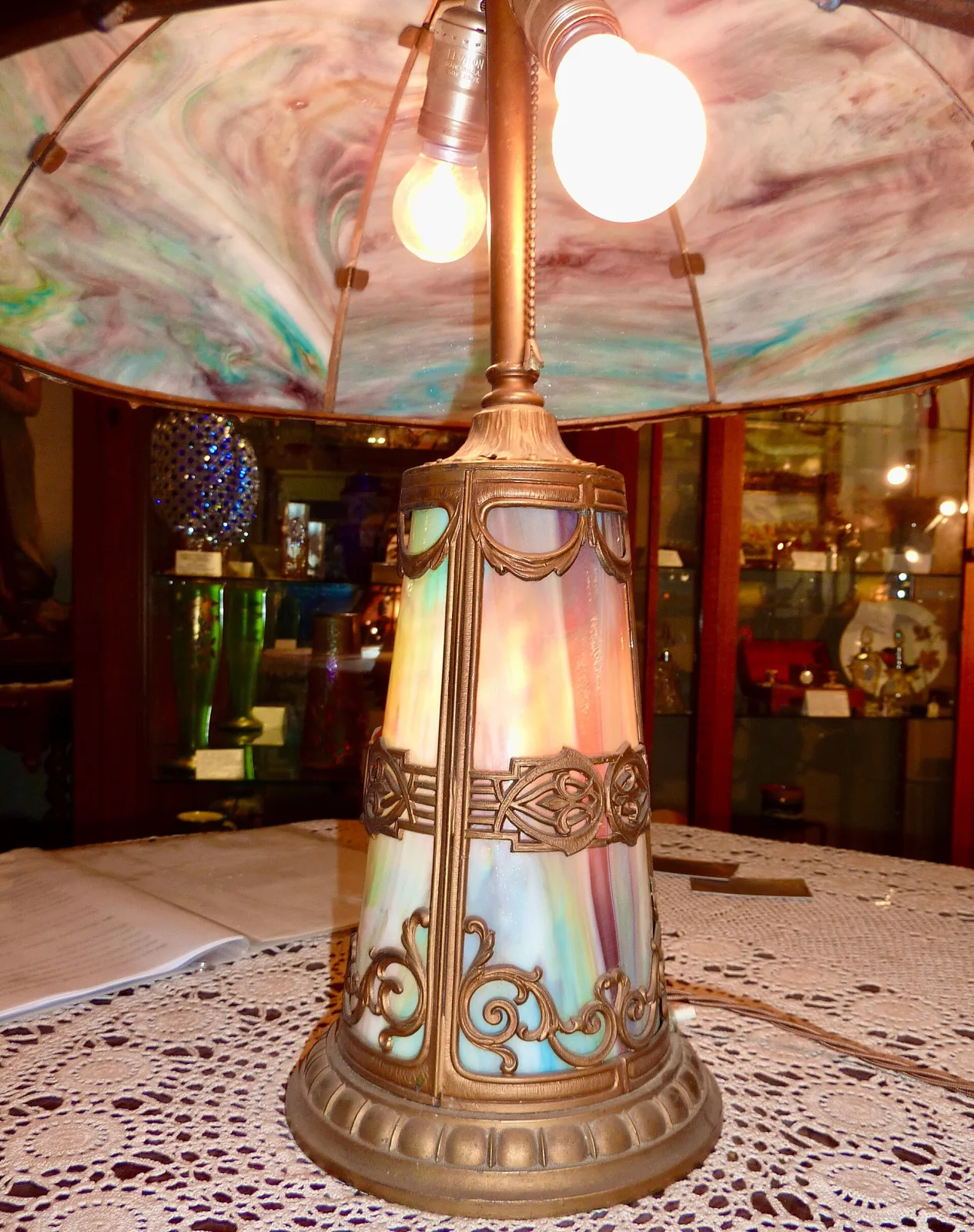
Bradley & Hubbard of Meriden, Connecticut, was a leading producer of slag panel lamps from the 1900s into the 1920s. B&H lamps typically carry a stamped or cast trademark on the base, often "B&H" within a triangle or shield. Cast-metal B&H bases tend to be heavy and finely detailed; the frames around bent panels are usually substantial bronze or bronze-finished pot metal.
Edward Miller & Company (Meriden) competed directly with Bradley & Hubbard, producing slag panel lamps with similar construction quality. Miller marks include "Miller," "Edward Miller," or initials on the base, sometimes with a model number. Miller is particularly associated with floral-and-foliate cast bases.
Handel of Meriden, more famous for reverse-painted shades, also produced slag panel lamps. Handel slag lamps typically carry a stamped Handel signature on the inside rim of the shade frame and on the base. Handel slag is scarcer than B&H or Miller slag and commands a premium.
Pittsburgh Lamp, Brass & Glass Co. produced numerous slag panel lamps from a Pittsburgh-area factory. Pittsburgh marks include "PLB&G" or full company names. Pittsburgh lamps often have bronze-finished cast bases with classical motifs—Greek key, acanthus, urn-and-laurel.
Unmarked frames are the most common category. Many smaller lamp jobbers and assemblers bought slag panels and metal castings from suppliers and assembled lamps without their own trademark. Unmarked lamps can still be quality pieces, but they trade at a discount to signed examples and require evaluation primarily on the merits of the glass and the casting.
Cross-Reference with Lighting Guides
For broader context on turn-of-the-century lighting—including the kerosene-to-electric transition that drove slag lamp popularity—the general lighting identification guide, the Tiffany lamps guide, and the oil lamp guide give complementary perspectives. Slag panel lamps occupy a clear middle ground between the high-end leaded-glass tradition and utilitarian lighting.
Tableware, Vases, and Vanity Pieces
Outside of lamps, slag glass appears in a wide range of pressed-glass tableware and decorative pieces. The principal categories:
Cream and sugar sets were a staple of British and American slag production. Sowerby, Davidson, Greener, and Challinor Taylor all issued slag cream-and-sugar sets in standard 4-inch heights, often in matching covered butter dishes and spooners as part of a four-piece "table set." Purple slag table sets are the iconic Victorian configuration.
Plates, bowls, and compotes in slag glass were produced for fruit, cake, and dessert service. Diameters range from small bread plates (5-6 inches) to large fruit bowls (9-12 inches). Footed compotes and pedestal cake stands are a high-value sub-category.
Vases in slag glass range from small bud vases (5-6 inches) to substantial trumpet vases (10-14 inches) and footed urns. Bud vases in purple and blue slag are common at modest prices; large urn-shaped slag vases from Sowerby are scarcer and command premiums. The broader category overlaps with the discussion in our vase identification guide.
Vanity pieces include slag-glass dresser jars, perfume bottles, ring trees, and small covered boxes. These were popular as gift items in the 1890s-1900s and often appear today in the original purple, blue, or caramel palettes. The vanity category overlaps with the broader dresser-set guide.
Novelty and figural pieces—shoes, hands holding bowls, animals, slipper-shaped match holders—were produced in slag in significant numbers, particularly by Sowerby. These are charming, often inexpensive, and are an entry point for many beginning slag collectors.
Sets Versus Single Pieces
Complete original sets—a four-piece purple slag table set with matching covered pieces, for example—command premiums of 50% or more over the sum of individual prices. Provenance from a documented collection further supports the premium. Be skeptical of "sets" assembled from disparate pieces by dealers; check that color, streaking pattern, and mold style are consistent across all pieces in the supposed set.
Mid-Century Revival: Imperial, Akro Agate, Westmoreland
Slag glass enjoyed a significant mid-twentieth-century revival, complicating identification for modern collectors. Three American makers produced large quantities of revival-era slag that is now itself becoming collectible but should not be confused with Victorian production.
Imperial Glass of Bellaire, Ohio, produced "Imperial Slag" in the 1950s through the 1970s in purple, caramel, jade green, ruby, and other colors. Imperial slag is usually marked "IG" (entwined initials), "ALIG" (after the 1973 acquisition by Lenox), or with paper labels. Imperial reissued some Victorian-era molds, including pieces originally from the Cambridge and Heisey factories, in slag colors. These are well-made, attractive, and now have their own following—but they are mid-century, not Victorian.
Akro Agate of Clarksburg, West Virginia (1914-1951), produced small slag-style pieces, mostly children's tableware, marbles, and vanity items. Akro Agate slag is in the "marbleized" tradition, with finer streaking than Victorian slag, and is usually marked with the crow-and-marble logo or the words "Akro Agate Made in USA." Akro Agate is a defined collector field of its own.
Westmoreland Glass of Grapeville, Pennsylvania, produced slag and "marble glass" pieces in the mid-century, particularly in purple-and-white and blue-and-white. Westmoreland marks include the entwined "WG" trademark. Westmoreland slag is sometimes mistaken for Victorian Sowerby due to similar palettes, but the body density, streaking pattern, and mold styles distinguish them on close inspection.
Telling Revival from Original
Body weight is a useful test: Victorian British slag tends to be lighter and slightly chalkier-feeling than Imperial or Westmoreland revival slag, which is denser and more glassy. Streaking on revival pieces tends to be finer and more uniformly distributed; Victorian streaking is broader and more dramatic. Mold quality also differs: Victorian molds have softer detail and visible mold seams that have been hand-finished; revival molds are sharper, with more uniform seams. When in doubt, look for trademarks: an unmarked piece in a classic Victorian palette could be either, but an "IG" mark places the piece firmly in the 1951-1973 Imperial era.
Reproductions, Reissues, and Modern "New Slag"
Modern slag reproductions fall into several categories that the collector should distinguish.
Authorized reissues from Imperial, Westmoreland, Fenton, and Mosser used original or revival molds to produce slag in the late twentieth century. These pieces are often well-made, marked by the producer, and sold openly as new production. They are not deceptive when correctly represented; the issue arises when later sellers misrepresent them as Victorian.
Greentown chocolate reproductions are a particular hazard. Because the original Greentown molds were dispersed after the 1903 fire, several later makers produced chocolate-glass pieces in similar patterns. Some carry distinguishing marks; others do not. Genuine Greentown chocolate from 1900-1903 has a particular body density, color depth, and surface character that careful comparison against documented examples reveals. New collectors often pay Greentown prices for later chocolate-glass reproductions; this is a category where reference catalogs are essential.
Studio glass and modern art slag is produced by contemporary glassmakers, sometimes in deliberate Victorian style. These pieces are typically signed and dated by the maker; difficulties arise only when the signature is on an obscure surface or has been misrepresented.
Outright fakes with forged maker marks are uncommon in slag because the value of most slag pieces does not justify the effort. The exception is high-value pink slag (Northwood Inverted Fan-and-Feather), Greentown chocolate, and signed Bradley & Hubbard or Handel slag panel lamps, where forged marks do appear from time to time. For high-value purchases in these categories, professional authentication is well worth the fee. The systematic approach in the American Brilliant Cut Glass guide and the broader general glass identification guide applies directly: read trademarks under good light, cross-check forms against published catalogs, and walk away when doubt exceeds enthusiasm.
UV Examination of Slag
Some slag bodies fluoresce under UV light because of the opacifiers and colorants used. Victorian purple slag often shows a soft greenish or yellowish fluorescence under shortwave UV; this is a maker characteristic, not a problem. Modern reproductions may show different fluorescence patterns, particularly bright fluorescent additives in twenty-first-century glass. UV is not a definitive test for slag authenticity but can flag pieces for closer examination.
Condition: Cracks, Heat Damage, Replaced Panels
Slag glass shares the condition issues of other pressed glass plus some specific to its lamp use.
Hairline cracks often radiate from points of stress: rim chips, base impacts, or—in lamp panels—from corners where the panel was clamped in the metal frame. Hairlines are best detected by holding the piece against bright light and rotating slowly; a hairline appears as a fine dark line, sometimes only visible at certain angles.
Heat damage affects lamp panels in particular. Decades of bulb heat can cause the slag to develop fine surface crazing, color fading where directly above the bulb, and in extreme cases small thermal cracks. Modern collectors typically use lower-wattage LED bulbs to mitigate ongoing damage, but historic damage cannot be reversed.
Replaced panels in slag lamps are widespread. When one or more panels were broken decades ago, replacements were sourced from other lamps or from modern slag stock. A replaced panel will usually differ subtly in color, streaking pattern, or thickness from the surrounding originals. Examine all panels of a multi-panel lamp side-by-side under the same light: the original set should look like siblings; replacements look like cousins. Single-replacement lamps trade at significant discount; a lamp with two or three replaced panels is usually best valued as the metal base alone.
Frame regilding and rebronzing on lamp bases is common. Original patina on a cast base develops over decades into a soft, varied bronze tone with green oxidation in recesses; aggressive cleaning or rebronzing produces a uniform, brassy appearance that experienced collectors recognize immediately. Original patina is preferred and adds to value; rebronzed bases are penalized.
Detecting Restoration
For tableware, examine rim and foot edges for grinding (a sign that a chip was ground out, leaving a flat or slightly thinner edge). Run a fingernail around suspect edges; ground areas feel slightly different from the soft-rounded original molding. For lamp panels, hold each panel up to a light source and examine for fill or bonding—a repaired crack will often show a faint line of different refractive index. The general principles in the restoration and conservation guide apply, particularly the warning that professional invisible restoration exists and may require UV or magnification to detect.
Care, Cleaning, and Display
Slag glass survives well with sensible handling. Tableware and decorative pieces can be hand-washed in warm water with mild dish soap; never use a dishwasher (heat shock and detergent are both damaging), and dry with a soft cloth rather than air-drying, which can leave water spots on the slightly porous opaque body. Avoid abrasive scrubbing; mild soaking loosens almost all everyday grime.
Slag panel lamps require a gentler approach. Dust shades with a soft, dry brush; for accumulated grime on the inside surface (where bulb heat bakes deposits onto the glass), a barely damp cotton cloth with mild soap, used carefully, will lift most dirt. Avoid getting moisture into the metal frame channels where panels are seated, as water can corrode the metal and weaken the panel-to-frame bond. Never submerge a slag panel lamp.
For display, slag tableware looks best in glass-front cabinets where ambient light backlights the streaks. Slag panel lamps should be displayed working but with low-wattage LED bulbs (4-7 watts equivalent is plenty) to minimize heat damage. The general storage and preservation guide covers humidity, light, and rotation principles that apply to slag along with other antiques.
Insurance and Inventory
For any significant slag collection, photograph each piece including the base (showing trademark or registry mark), maintain an inventory of makers, colors, and patterns, and document purchase prices and provenance. The same inventory practices that benefit a wider antique collection apply with particular force to slag panel lamps, whose value is concentrated in fragile glass panels and signed metal bases that need separate documentation.
Field Checklist Before You Buy
When you encounter a slag-glass piece in the field—at a flea market, estate sale, auction preview, or specialist dealer—work through this sequence before considering price.
First, identify the form and color family. Tableware, vase, vanity piece, novelty, or lamp panel? Purple, caramel, chocolate, blue, green, or pink slag? The form-and-color combination establishes the broad category and likely date range.
Second, examine the base or an inconspicuous mold area for maker marks. British peacock (Sowerby), lion-rampant (Davidson), lion-with-axe (Greener), Imperial "IG," Westmoreland "WG," Akro Agate crow-and-marble, lamp-base stampings (B&H, Miller, Handel, Pittsburgh). Note the registry diamond or Rd number on British pieces; decode against published tables for an earliest registration date.
Third, evaluate the streaking and body. Broad, dramatic streaks and a slightly chalky body suggest Victorian production; finer, denser streaks suggest mid-century revival. Compare against published reference photographs of the maker and pattern in question.
Fourth, examine condition. For tableware, run fingertips over rim and foot edges for grinding; hold against light for hairlines; check feet and handles for chips. For lamp panels, examine each panel side-by-side for color and streaking consistency; check the frame for heat damage, bronze loss, and missing decorative elements; verify wiring is safe (replace cloth cord and socket if needed for actual use).
Fifth, consider price relative to maker, condition, and rarity. Common purple slag tableware in average condition trades modestly. Signed Sowerby pieces in good condition trade at meaningful premiums. Greentown chocolate, pink slag, and signed bent-panel lamps with original patina occupy the upper tier and warrant cautious examination.
Sixth, ask about provenance. Documented estate provenance, original purchase records, and inclusion in published collection catalogs all support attribution and value. While most slag in the market trades on physical examination alone, high-end pieces benefit materially from provenance documentation. Categories that reward similar systematic reading—carnival glass, uranium glass, Depression glass, and mercury glass—are natural adjacent collecting fields for slag enthusiasts and apply the same maker-mark-and-mold approach.
Seventh, when in doubt, walk away. Slag pieces are common in the secondary market, and a missed opportunity is rarely a serious loss. A misattributed Imperial revival piece purchased at Victorian Sowerby prices, or a replaced-panel lamp purchased as all-original, is a meaningful and often unrecoverable mistake. Slag collecting rewards patience and reading. With a flashlight, a loupe, and the framework above, you can read most slag pieces in under a minute and place them confidently in maker, color family, and decade.