Antique Milk Glass Identification Guide: Makers, Patterns & Value
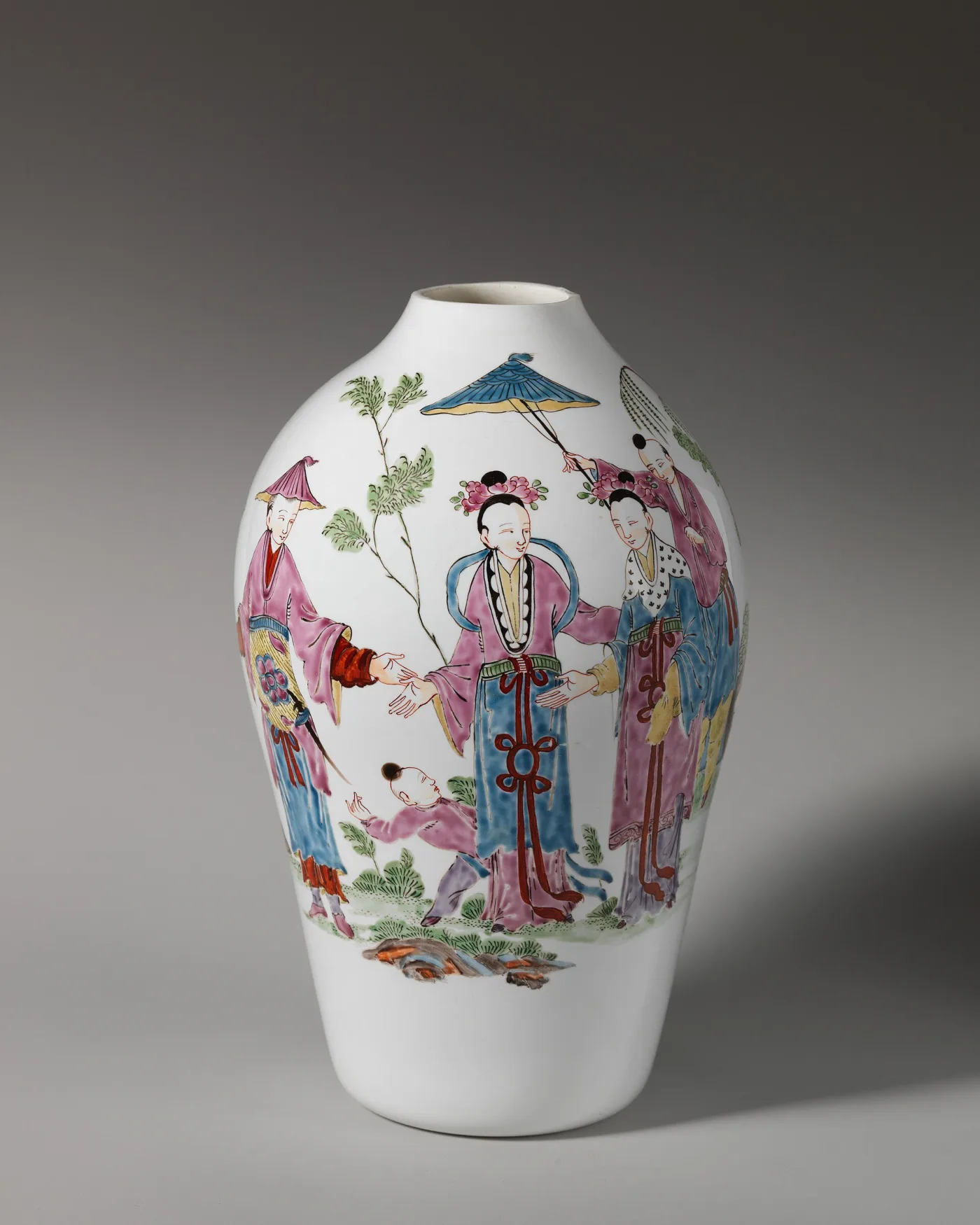
Milk glass is one of the most recognizable and widely collected forms of antique glassware in the world. Characterized by its distinctive opaque white appearance, milk glass has captivated collectors for over four centuries. The material originated in 16th-century Venice, where glassmakers on the island of Murano developed techniques using bone ash and tin oxide to create a porcelain-like opacity in molten glass. These early artisans sought to imitate the coveted look of Chinese porcelain, and the resulting product became known in Italian as "vetro di latte" or "lattimo" glass.
The popularity of milk glass surged dramatically during the late 19th century and continued through the mid-20th century, with the period from the 1880s to the 1970s representing the golden age of American milk glass production. During this era, dozens of American glass companies produced an astonishing variety of forms, from elegant tableware and decorative vases to whimsical covered animal dishes and intricate lace-edge plates. Companies like Westmoreland, Fenton, Atterbury, and Indiana Glass became household names, and their products graced dining tables and curio cabinets across the nation.
This comprehensive guide covers everything you need to know about identifying antique milk glass. You will learn to recognize the marks and signatures of major manufacturers, distinguish between valuable antique pieces and modern reproductions, identify the most sought-after patterns and forms, understand how production methods changed over the decades, and evaluate the factors that determine a piece's worth in today's collector market. Whether you are a seasoned collector looking to refine your expertise or a newcomer who just discovered a piece at an estate sale, this guide will help you navigate the fascinating world of milk glass.
Table of Contents
History of Milk Glass
The story of milk glass begins in the glassmaking furnaces of Venice and Murano during the 16th century. Italian glassblowers, renowned throughout Europe for their technical mastery, experimented with various metallic oxides and mineral compounds to achieve an opaque, white glass that could rival the beauty of imported Chinese porcelain. The resulting material, called "lattimo" from the Italian word for milk, quickly became fashionable among the European aristocracy. These early Venetian pieces were primarily decorative objects and luxury tableware, produced in limited quantities and available only to the wealthiest patrons.
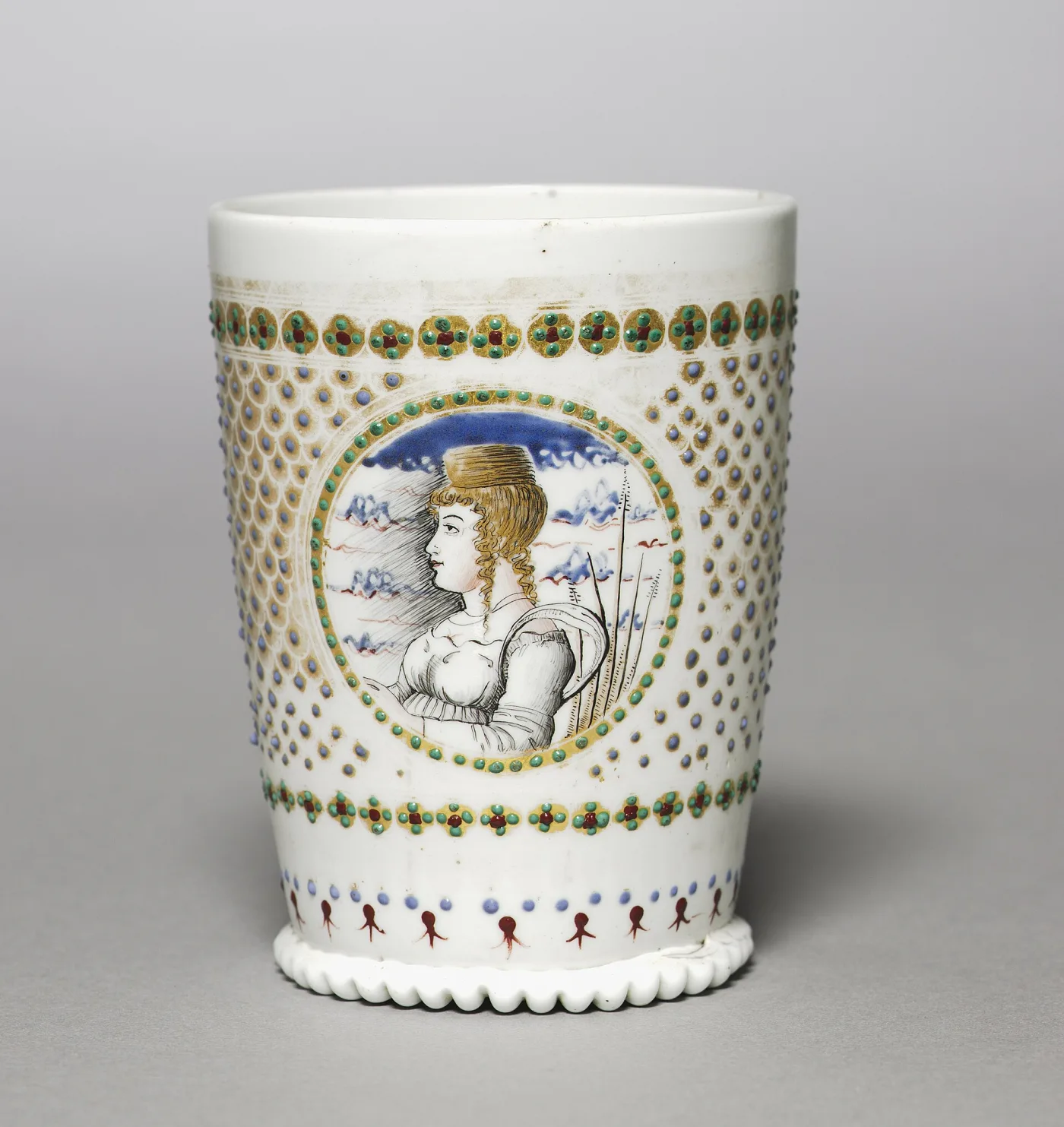
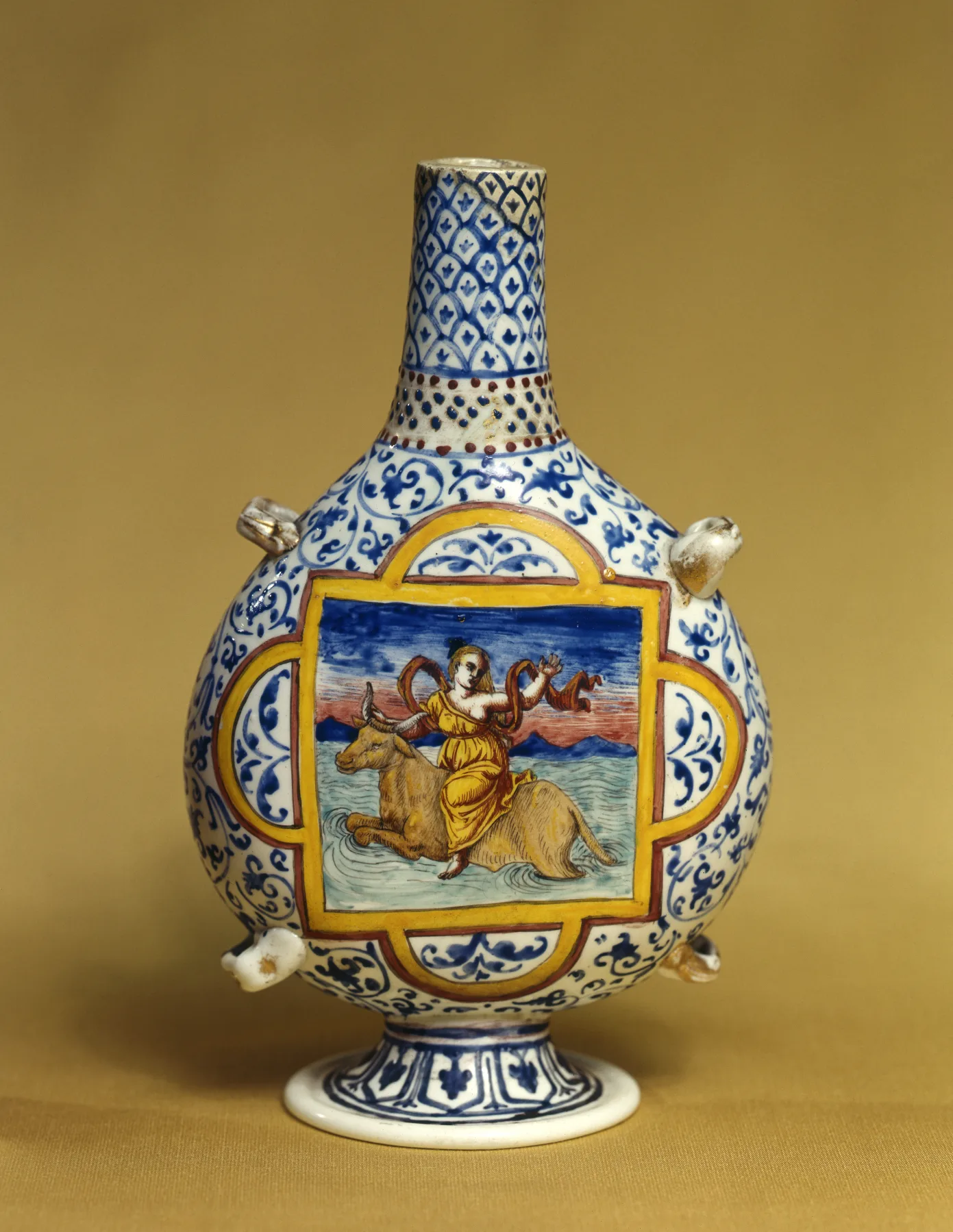
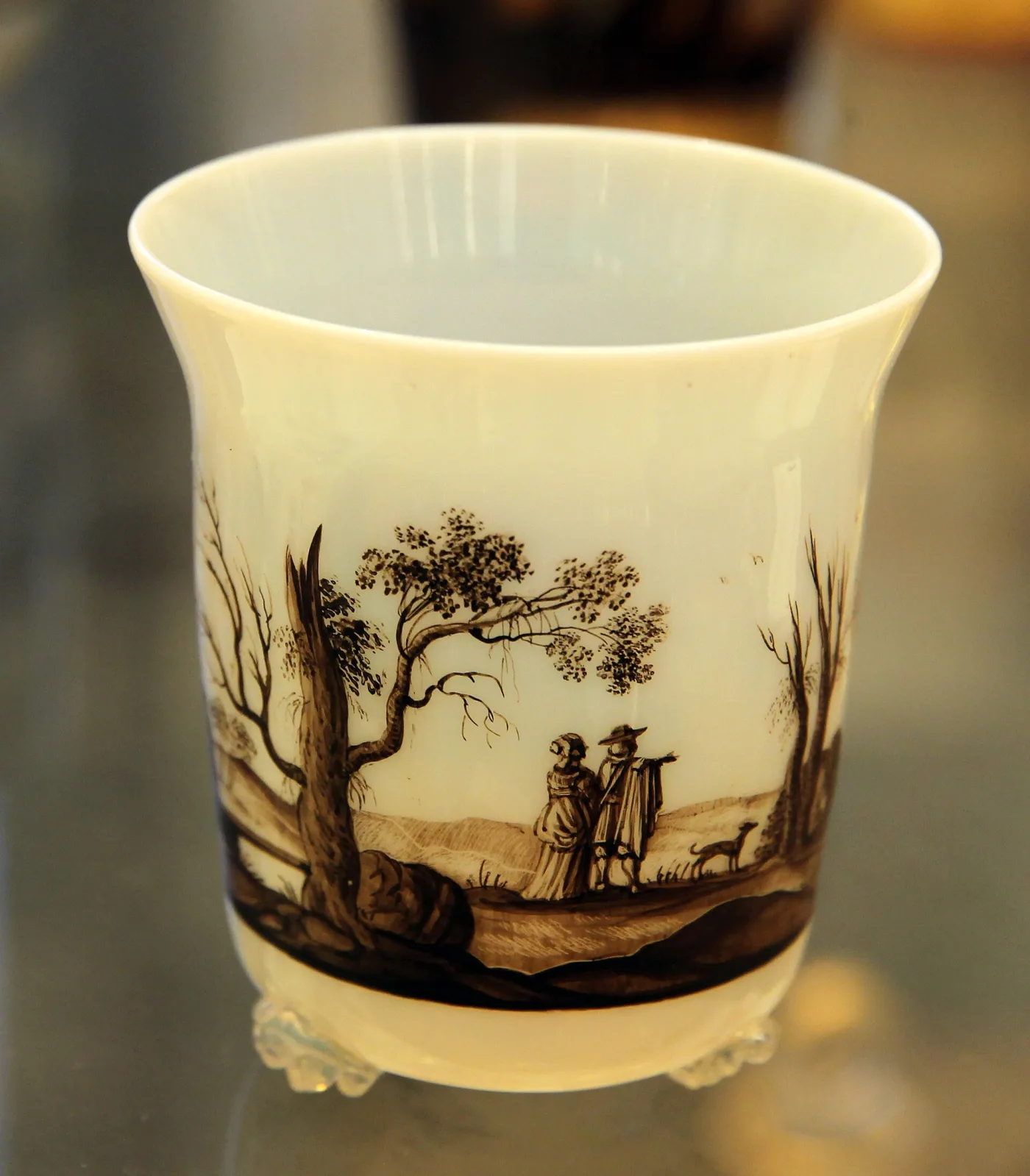
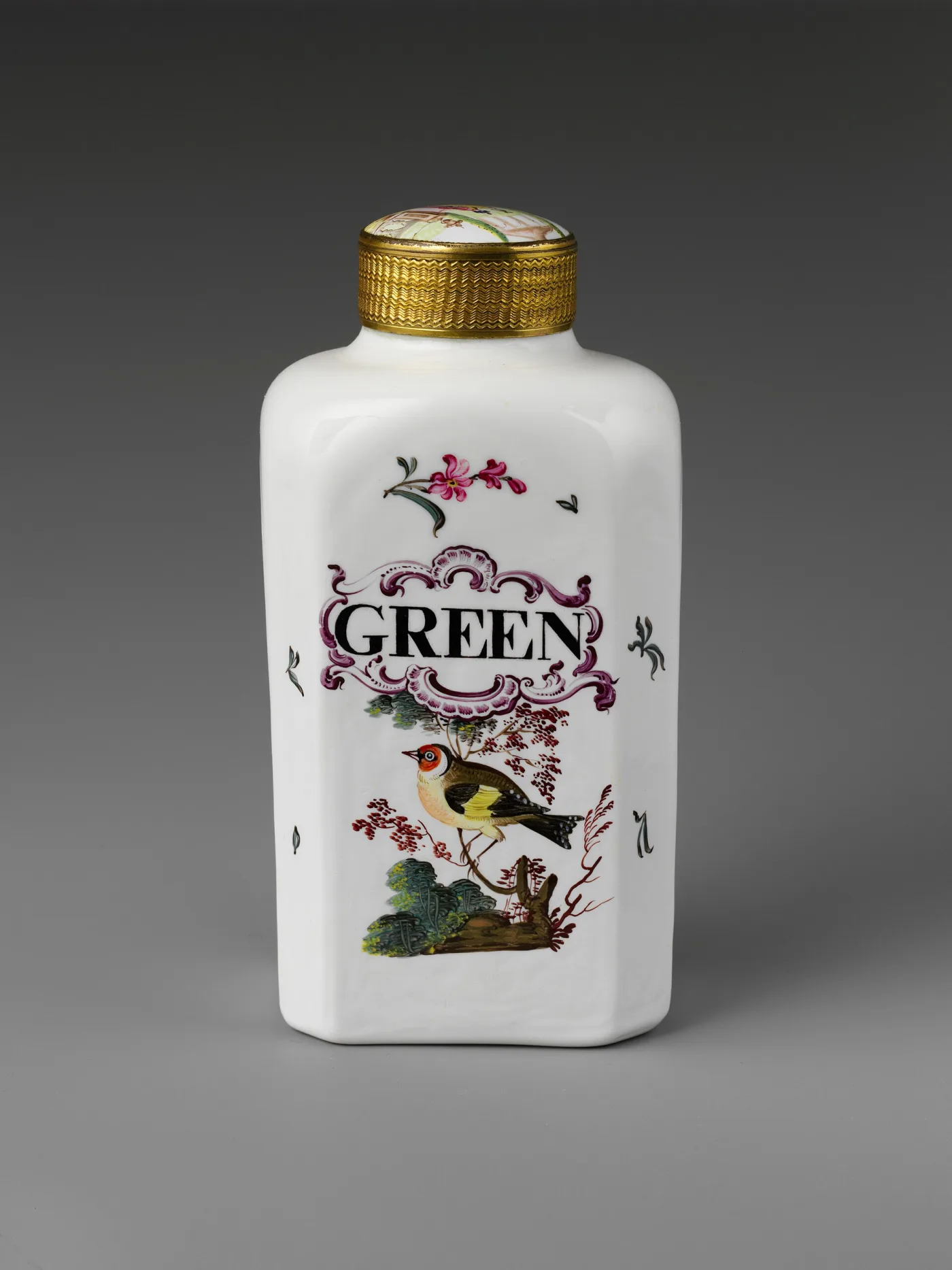
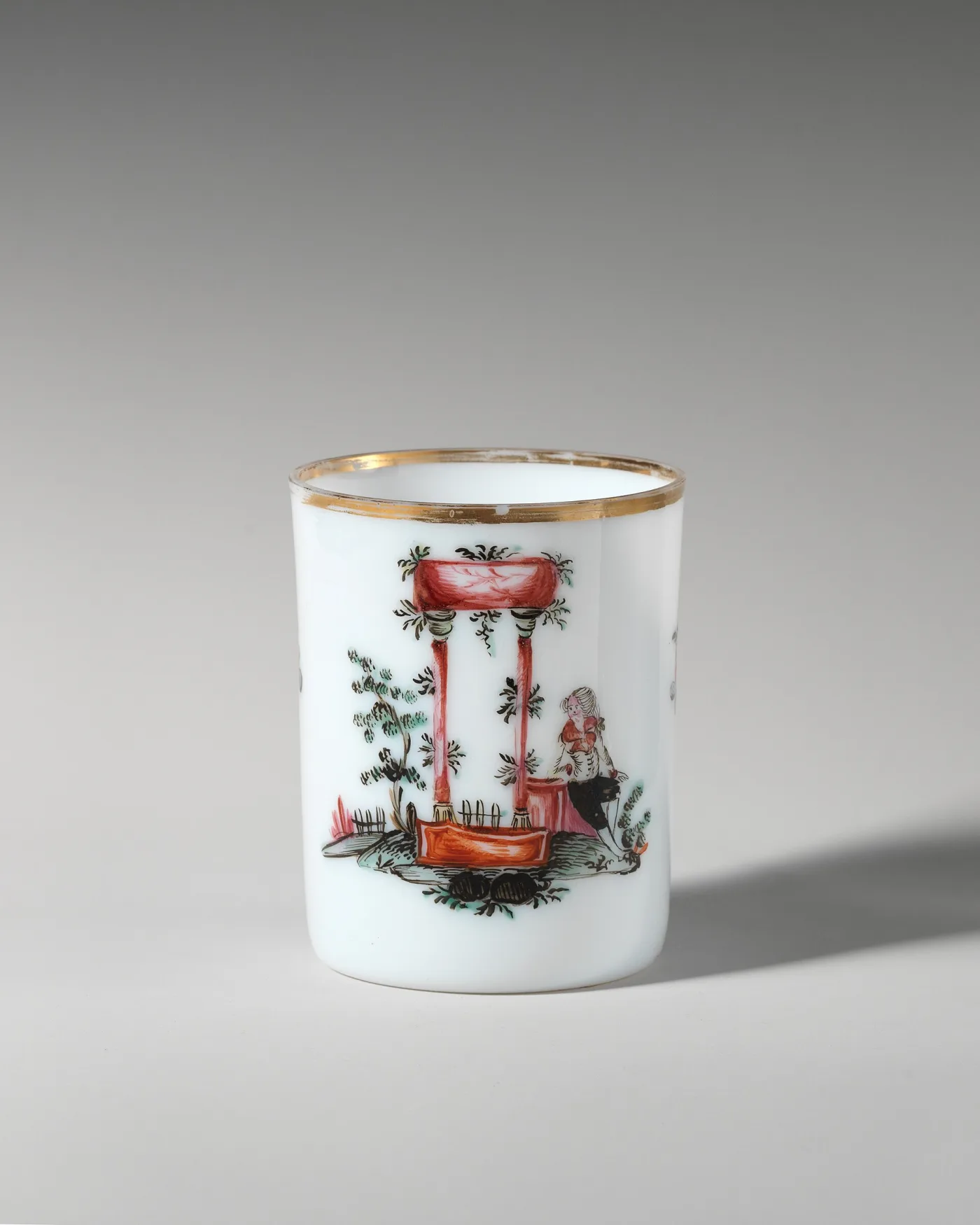
Fifty years separate these two, and they show the same white body being pulled in two directions. Both are lattimo — the Cleveland record defines the word as glass made milk-like with an opacifier such as tin oxide, in imitation of Chinese porcelain. But the beaker is painted like a Venetian portrait medal, while the Walters flask is painted blue-and-white and, as its own record admits, ends up closer to Italian maiolica earthenware than to the Chinese wares it was chasing. Neither is pressed and neither is American; they are the ancestors of everything else in this guide, four centuries upstream of Westmoreland.
By the 17th and 18th centuries, milk glass production had spread beyond Italy to glasshouses in France, Germany, England, and the Low Countries. European manufacturers refined the formulas and techniques, creating variations that ranged from dense, fully opaque white to semi-translucent opaline glass with a delicate, almost ethereal quality. French opaline glass from this period, often decorated with hand-painted enamel designs and gilded accents, remains among the most prized and expensive milk glass ever produced. English glassmakers, meanwhile, developed their own traditions, incorporating bone ash as a primary opacifying agent.
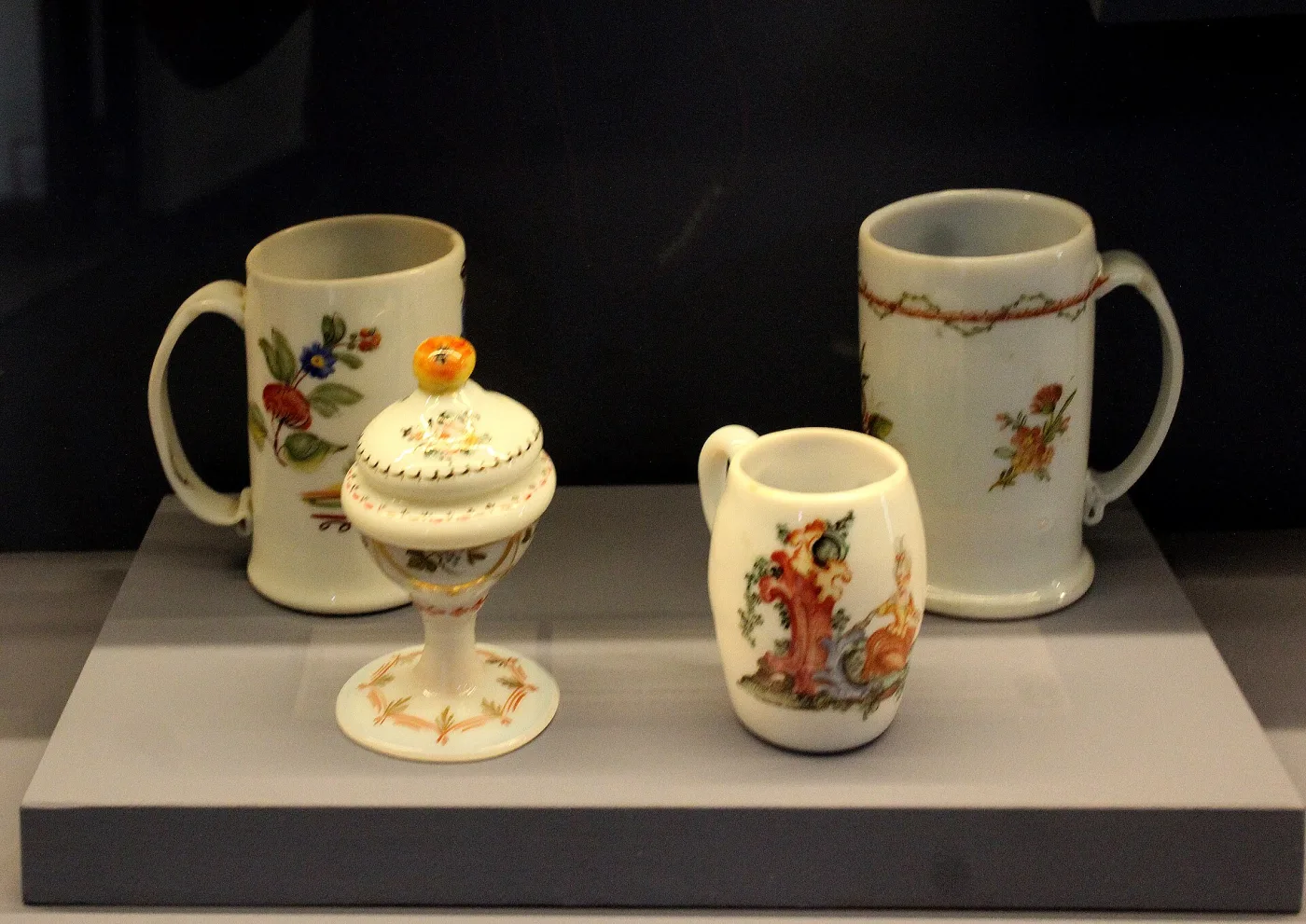
The American milk glass industry emerged in the mid-19th century and quickly became the dominant force in production worldwide. Companies such as Atterbury & Company in Pittsburgh began manufacturing milk glass tableware and novelty items in the 1860s, taking advantage of advances in pressing technology that allowed mass production of decorative glass. The pressed glass revolution meant that intricate patterns previously only achievable through expensive hand-cutting or blowing could now be produced affordably by machine, making milk glass accessible to middle-class households for the first time.
The golden age of American milk glass stretched from roughly the 1940s through the early 1970s. During this period, Westmoreland Glass Company and Fenton Art Glass dominated the market, producing an extraordinary range of patterns and forms. Milk glass became a staple of American domestic life, appearing as wedding gifts, holiday table settings, and decorative accent pieces. The Paneled Grape pattern by Westmoreland alone was produced in over 100 different forms, from water goblets to massive covered compotes. However, changing tastes and economic pressures gradually diminished demand, and by the 1980s most major producers had either closed or dramatically reduced their milk glass lines.
How Milk Glass Is Made
Understanding how milk glass is manufactured provides essential knowledge for identification and authentication. The opacity that defines milk glass results from the addition of specific opacifying agents to the basic glass batch. The most historically significant of these agents is tin oxide, which was the primary opacifier used in early Venetian and European production. Tin oxide creates a dense, uniform white opacity by forming tiny crystalline particles suspended within the glass matrix that scatter light in all directions, preventing transparency.
American manufacturers, particularly those operating during the 19th and 20th centuries, employed a wider range of opacifying agents depending on cost, availability, and desired aesthetic qualities. Bone ash, derived from calcined animal bones, was a common and effective opacifier that produced a slightly warmer, creamier tone compared to tin oxide. Feldspar, a naturally occurring mineral, served as both an opacifier and a flux that lowered the melting temperature of the glass batch. Cryolite, a rare sodium aluminum fluoride mineral originally mined primarily in Greenland, produced a particularly brilliant white opacity and was favored by several major producers during the early to mid-20th century.
The manufacturing process itself evolved significantly over the centuries. Early milk glass was free-blown or mold-blown by skilled artisans, resulting in pieces with slight variations in thickness, subtle tool marks, and organic irregularities that collectors today prize as signs of authenticity. The introduction of pressing technology in the 1820s and 1830s revolutionized production, allowing molten glass to be pressed into iron or steel molds using mechanical or hydraulic force. Pressed milk glass could reproduce intricate surface patterns with remarkable fidelity, enabling the elaborate hobnail, lace-edge, and grape motifs that became hallmarks of the medium.
One fascinating property of certain milk glass formulations is fluorescence under ultraviolet (UV) light. Milk glass produced with specific chemical compositions, particularly those containing uranium oxide or certain manganese compounds, will glow bright green or yellow-green when exposed to a UV blacklight. This fluorescence is a valuable tool for dating and authenticating milk glass, as the chemical formulations changed over time. Most pre-1960s American milk glass exhibits some degree of UV fluorescence, while many later reproductions and modern pieces do not. However, it is important to note that the absence of fluorescence alone does not prove a piece is modern, as some legitimate antique formulations also lack this property.
Major Milk Glass Manufacturers
Identifying the manufacturer of a milk glass piece is often the first and most important step in authentication and valuation. Each major producer developed distinctive styles, patterns, and quality characteristics that experienced collectors learn to recognize even before examining marks.
Westmoreland Glass Company (1889-1985)
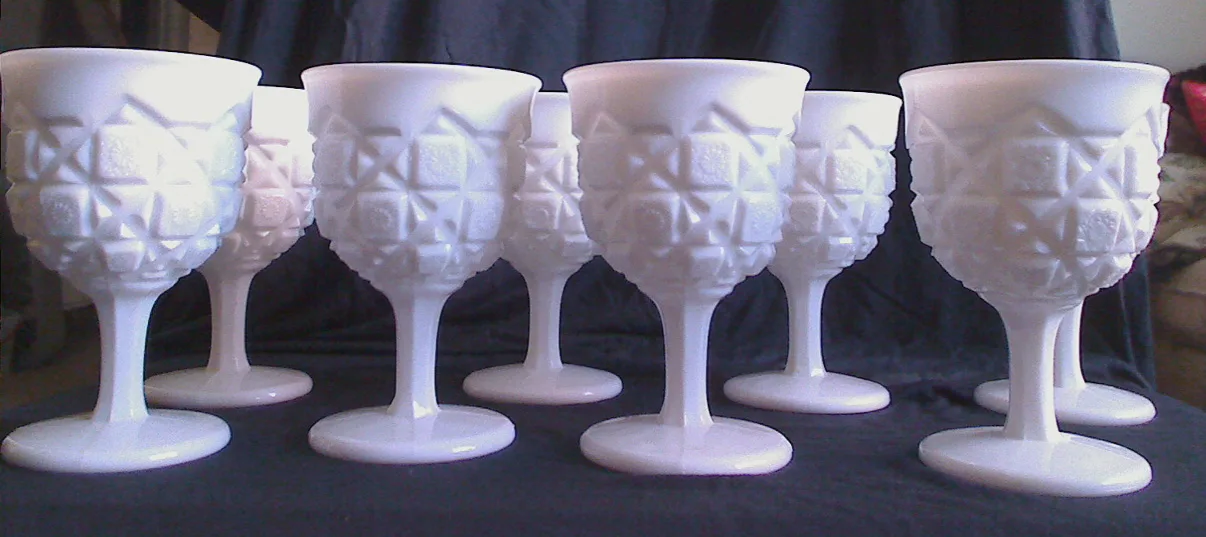
Westmoreland Glass Company, based in Grapeville, Pennsylvania, is widely considered the premier American milk glass manufacturer. Founded in 1889, the company initially produced candy containers and other novelties before transitioning to decorative glassware in the early 20th century. Westmoreland's milk glass is characterized by exceptional quality, with a dense, pure white opacity, crisp pattern detail, and a smooth, refined finish. The company's intertwined "WG" mark, introduced in 1949, is one of the most recognized symbols in the milk glass collecting world. Earlier pieces may bear a keystone-shaped logo or no mark at all. Westmoreland's Paneled Grape pattern, introduced in the 1940s, became the bestselling milk glass pattern in American history and remains the most collected today.
Fenton Art Glass Company (1905-2011)
Fenton Art Glass, headquartered in Williamstown, West Virginia, was one of the longest-operating glass companies in America. The company became synonymous with the Hobnail pattern, which it produced in milk glass and numerous other colors and treatments from the late 1930s onward. Fenton milk glass is generally distinguished by its slightly warmer white tone compared to Westmoreland and by the excellent quality of its hand-finishing. A critical identification detail is that Fenton did not begin permanently marking its glass with the now-famous oval "Fenton" logo until 1970. This means that the vast majority of desirable vintage Fenton milk glass from the 1940s through 1960s is unmarked, making pattern recognition and quality assessment essential identification skills. Post-1970 pieces bear the oval logo, sometimes with additional date codes.
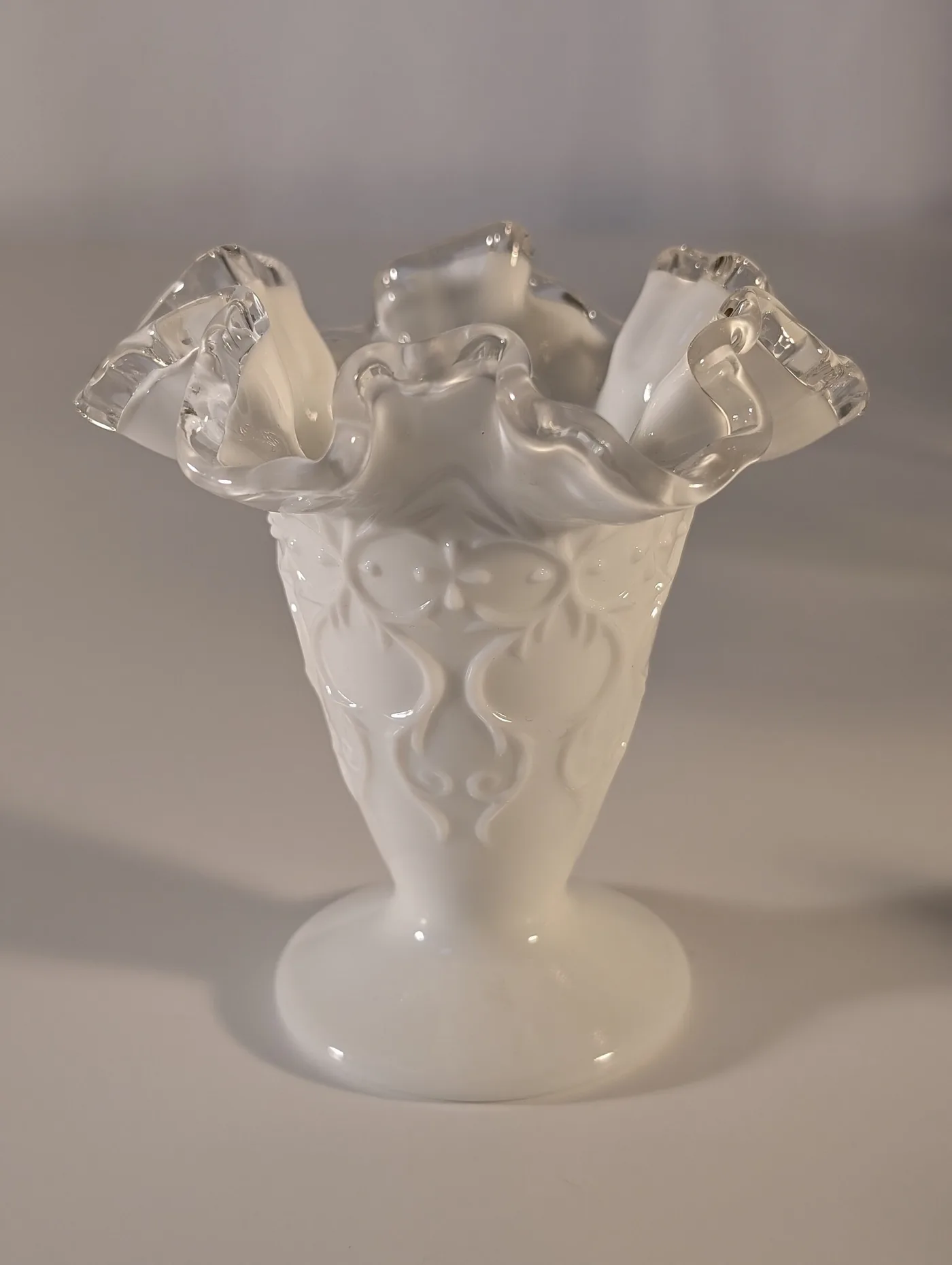
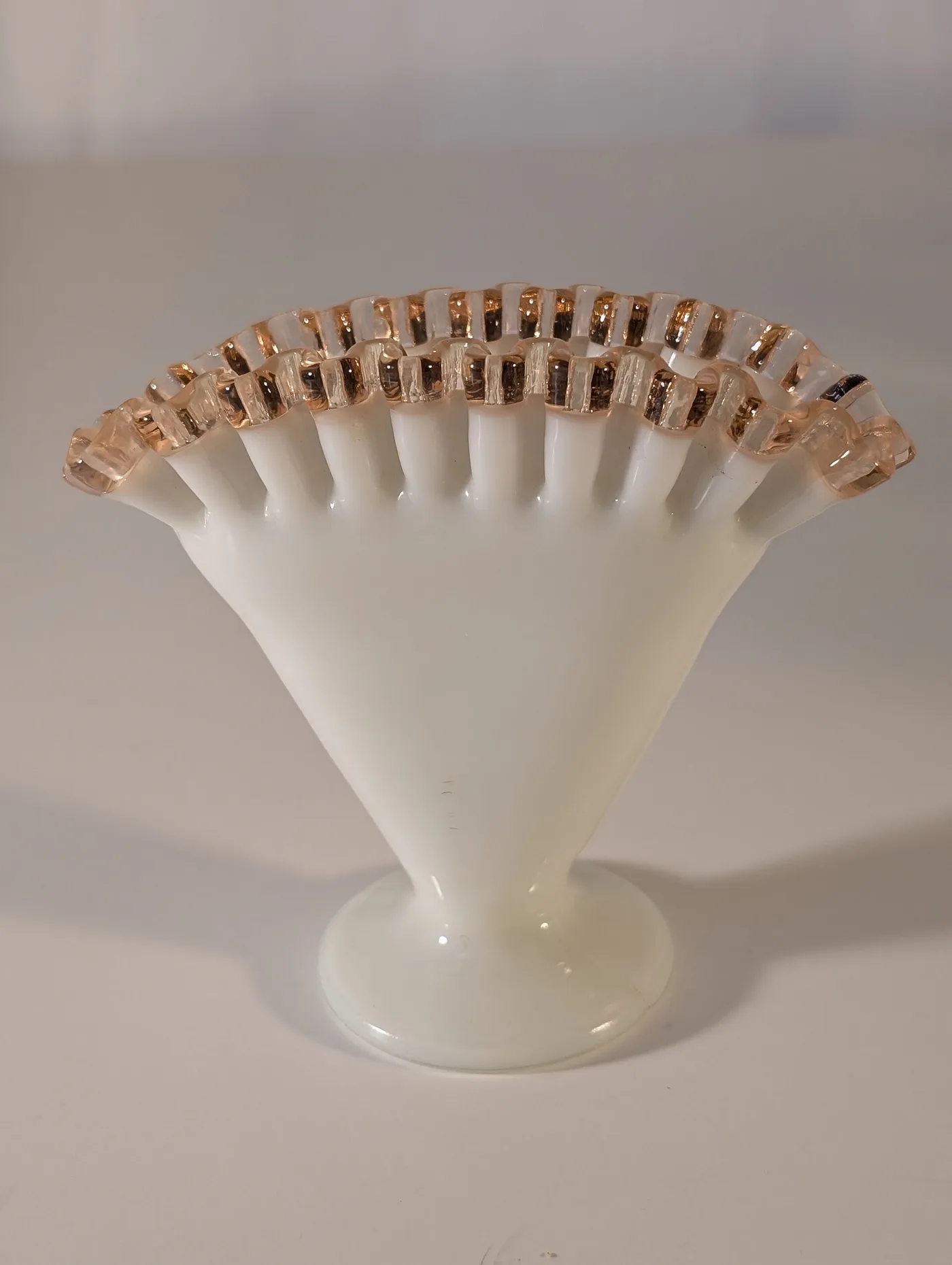
Compare the rims, not the shapes. On both vases the ruffled edge is a separate gather of glass laid onto the lip while hot and then crimped, so the line where it meets the white body runs visibly around the vase an inch or so below the crimping — a hard boundary between two different glasses, not a painted band and not a fade. That construction is the identification. Neither of these carries a mark, and neither should: the point made above is that Fenton did not mark its glass until 1970, so vintage crest wares are attributed by the treatment and the form. Both of these are the uploader's attribution rather than a museum's, which is the ordinary situation for twentieth-century American glass and the reason pattern knowledge does more work here than mark knowledge.
Atterbury & Company (1858-1893)
Atterbury & Company of Pittsburgh, Pennsylvania, was one of the earliest and most innovative American milk glass producers. The company is best known for its patented covered animal dishes, which featured realistic depictions of hens, roosters, ducks, swans, and other animals serving as lids for oval or rectangular bases. Atterbury milk glass typically has a dense, heavy quality with a slightly blue-tinted white color that distinguishes it from later producers. Many Atterbury pieces bear patent dates molded into the glass, which greatly assists identification. The company's covered hen dishes and its famous "Basket Weave" pattern plates are among the most valuable and sought-after pieces of American milk glass.
Challinor, Taylor & Company
Challinor, Taylor & Company operated in Tarentum, Pennsylvania, during the late 19th century and was a significant producer of pressed milk glass tableware. The company is particularly known for its figural and novelty pieces, including covered animal dishes that rivaled those of Atterbury in quality and imagination. Challinor, Taylor milk glass often exhibits a slightly grayish or bluish cast and features sharp, well-defined mold details. The company produced several distinctive patterns including their "Tree of Life" and various scroll designs.
Indiana Glass Company
Indiana Glass Company, located in Dunkirk, Indiana, was a prolific producer of milk glass from the early 20th century through the 1980s. The company is particularly well known for its "Harvest Grape" pattern, a lush design featuring clusters of grapes and leaves that is sometimes confused with Westmoreland's Paneled Grape. Indiana Glass milk glass tends to be slightly thinner and lighter in weight than Westmoreland or Fenton products, and its white color often has a slightly cooler, more bluish undertone. The company also produced a popular line of milk glass with painted fruit and floral decorations.
McKee Glass Company
McKee Glass Company, another Pennsylvania producer, contributed significantly to the milk glass market from the late 19th century through the mid-20th century. McKee is particularly noted for its kitchen and utilitarian milk glass items, including mixing bowls, measuring cups, canisters, and refrigerator dishes. The company's "Laurel" and "Rock Crystal" patterns in milk glass are popular with collectors. McKee glass tends to have excellent clarity of pattern detail and a consistent, uniform white color.
Anchor Hocking
Anchor Hocking, the large Lancaster, Ohio-based glass manufacturer, produced substantial quantities of milk glass during the mid-20th century. The company's milk glass products were generally aimed at the mass market and included everyday tableware, serving pieces, and decorative items. Anchor Hocking pieces are typically lighter in weight than those from specialty producers and feature simpler pattern work. The company's "Fire-King" brand milk glass dinnerware, often with painted decorations, is collected avidly today. Most Anchor Hocking milk glass is marked with the company's anchor logo on the base.
Kemple Glass Works
Kemple Glass Works of East Palestine, Ohio, operated from 1945 to 1970 and is notable for having acquired and used many original molds from earlier, defunct glass companies including McKee and others. This means that Kemple produced milk glass pieces that are physically identical in form and pattern to much earlier originals, creating identification challenges for collectors. Kemple pieces are typically marked with a "K" on the base, but this mark can be faint or easily overlooked. Understanding the Kemple connection is important because pieces from original molds but made by Kemple have different values than true antiques from the original manufacturers.
Identifying Maker's Marks
Maker's marks are among the most reliable tools for identifying and dating milk glass, though the absence of a mark does not necessarily indicate a lesser piece. Many of the finest and most valuable milk glass pieces were produced before permanent marking became standard practice. Learning to read and interpret marks requires patience and attention to detail, as marks can be small, faintly impressed, and sometimes partially obscured by surface wear. For a broader understanding of how marks function across different glass types, our guide on antique glass identification provides essential foundational knowledge.
The Westmoreland "WG" mark is perhaps the most frequently encountered milk glass mark. The letters W and G are intertwined in a distinctive monogram, typically found on the underside of pieces. This mark was introduced in 1949 and used consistently through the company's closure in 1985. However, Westmoreland produced milk glass for decades before adopting this mark, so many authentic Westmoreland pieces are unmarked. Earlier Westmoreland pieces from the 1920s through 1940s may bear a keystone-shaped logo, though this too was not applied to all production.
Fenton's marking history creates particular challenges for collectors. As noted, the company did not begin permanent marking until 1970, meaning that the most desirable vintage Fenton milk glass from the golden era of the 1940s through 1960s bears no manufacturer's mark. The post-1970 Fenton mark is an oval containing the word "Fenton," sometimes accompanied by a number indicating the decade of production. For unmarked pieces, collectors must rely on pattern identification, quality characteristics, and knowledge of Fenton's specific forms to make attributions.
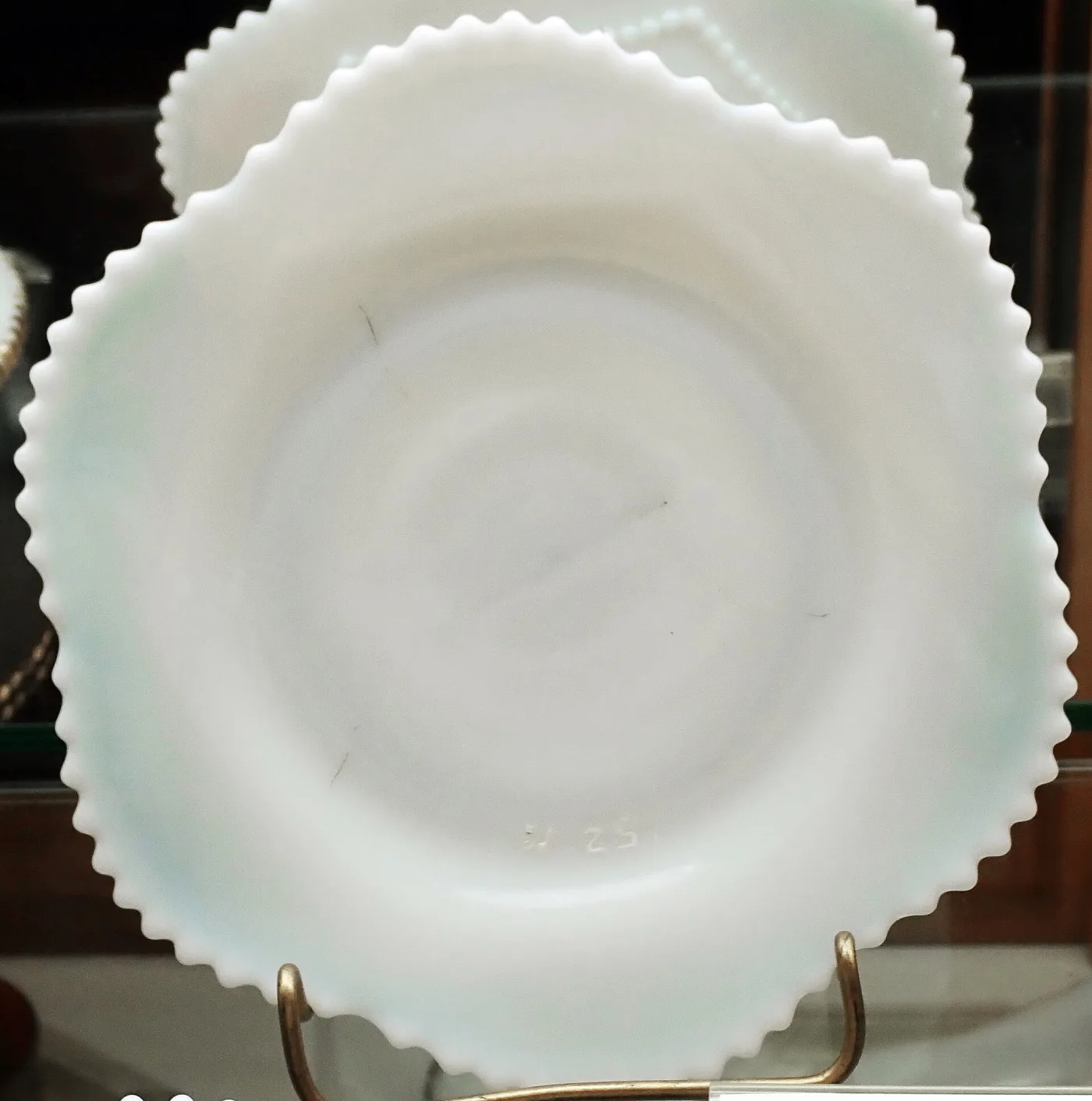
Beyond permanent marks molded or stamped into the glass, many milk glass pieces originally bore paper labels that have long since been removed or deteriorated. Westmoreland, Fenton, Indiana Glass, and others all used paper labels at various points in their history. The ghost outline of a removed label can sometimes still be detected on the surface of a piece, particularly if the glass was stored for long periods without cleaning. Mold marks, including seam lines where mold sections joined, also provide valuable identification information. The number, placement, and character of mold seams changed over time as manufacturing technology evolved, and experienced collectors use these features as additional dating evidence.
Popular Milk Glass Patterns
Pattern identification is one of the most essential skills for any milk glass collector. Each pattern has its own history, range of available forms, and market value profile. The following are among the most important and widely collected milk glass patterns.
Hobnail
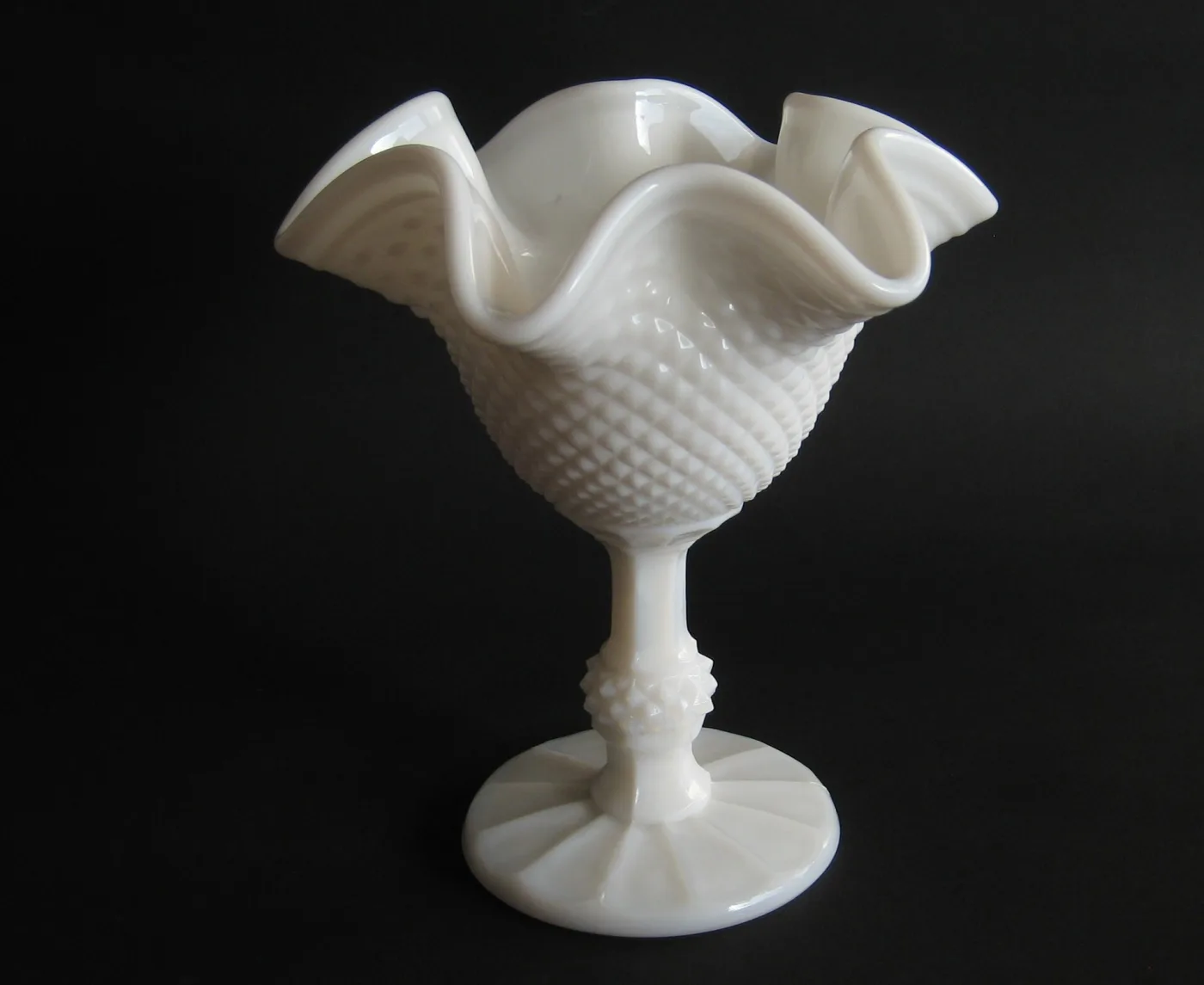
The Hobnail pattern, characterized by rows of raised, rounded bumps covering the surface of the glass, is arguably the most iconic milk glass pattern ever produced. Fenton Art Glass made the Hobnail pattern its signature, producing it in milk glass from the late 1930s through the company's closure. Fenton Hobnail milk glass was made in an extraordinary range of forms including vases, bowls, baskets, candlesticks, bells, and complete table settings. The pattern's tactile, dimensional quality and clean, uniform appearance make it instantly recognizable and perpetually popular with collectors.
Paneled Grape
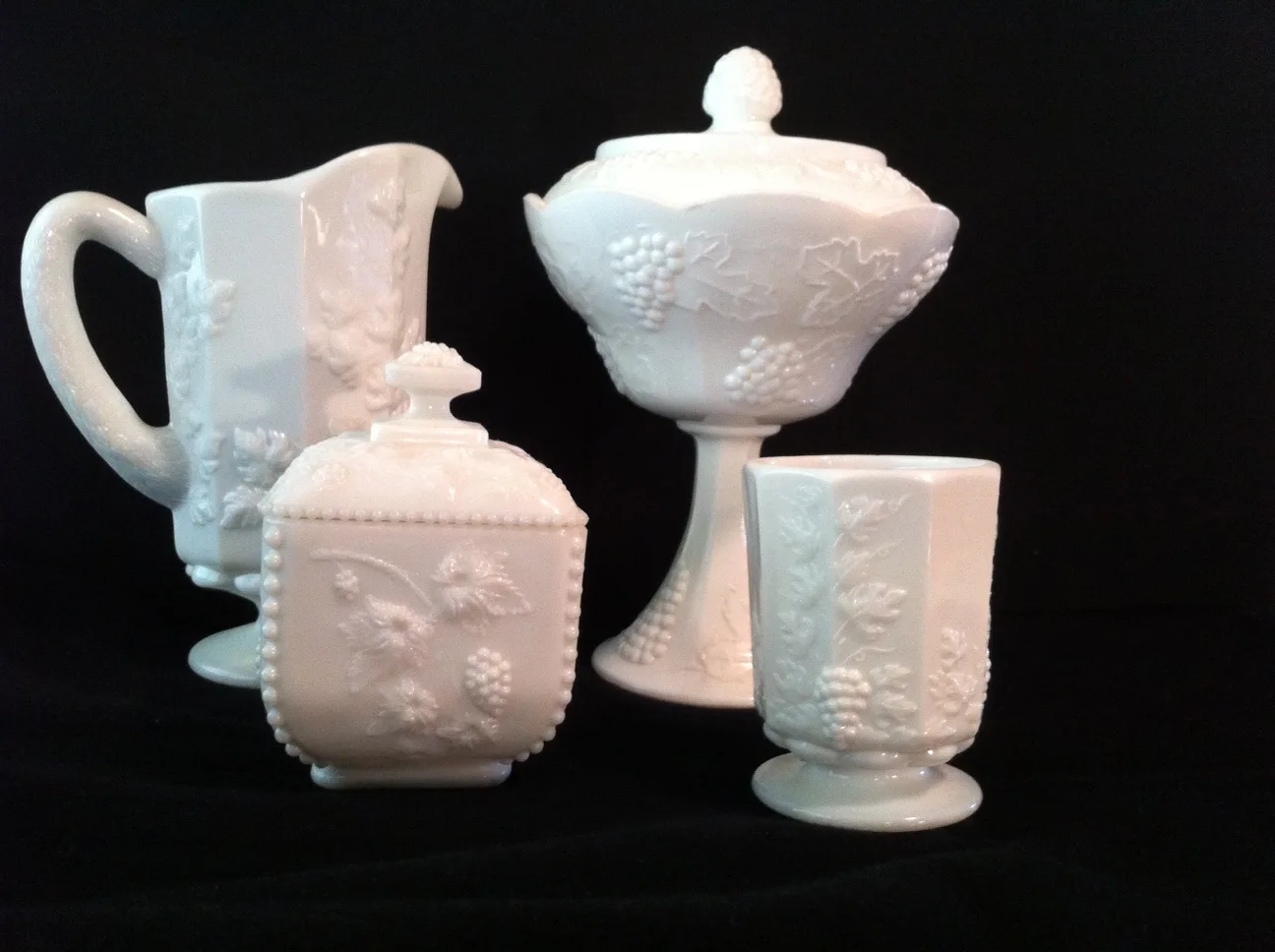
Westmoreland's Paneled Grape pattern is the bestselling milk glass pattern in history. Introduced in the 1940s, it features panels of grape clusters and leaves in high relief, producing a rich, sculptural effect. The pattern was produced in well over 100 different forms, from tiny individual salt dishes to massive punch bowl sets. The sheer variety of available forms makes Paneled Grape an ideal pattern for collectors who enjoy assembling complete table services. Values range widely depending on the form, with rare pieces like water pitchers and covered candy dishes commanding premium prices.
Lattice Edge and Lace Edge
Lattice Edge patterns feature an open, pierced border resembling woven lattice work, creating a delicate, airy appearance that contrasts beautifully with the solid opacity of the milk glass body. Lace Edge patterns achieve a similar effect through deeply scalloped and textured rims that suggest fine lace. Both styles were produced by multiple manufacturers and are particularly popular in plates, cake stands, and compotes. These patterns showcase the remarkable precision that could be achieved with pressed glass technology, as the thin, pierced sections required careful mold design and precise temperature control during pressing.
English Hobnail
English Hobnail is a variation on the standard Hobnail pattern that features pointed, faceted bumps rather than smooth, rounded ones. This gives the pattern a more angular, crystalline appearance that catches and refracts light differently than standard Hobnail. Westmoreland was the primary producer of English Hobnail in milk glass, though other companies also made versions. English Hobnail pieces tend to be heavier than standard Hobnail due to the deeper pressing required to create the pointed bumps.
Blackberry
The Blackberry pattern features naturalistic depictions of blackberry branches with fruit, leaves, and thorny stems in relief. This pattern was produced by several manufacturers in the late 19th century and is particularly valued in covered dishes and large serving pieces. The intricate botanical detail of well-executed Blackberry pattern pieces demonstrates the artistic ambitions of Victorian-era glass designers who treated pressed glass as a serious decorative art form.
Thumbprint and Scroll Patterns
Thumbprint patterns feature rows of oval or circular indentations resembling thumbprints pressed into the glass surface. These patterns were produced by numerous companies and appear on a wide range of forms. Scroll patterns incorporate flowing, curvilinear decorative elements inspired by Baroque and Rococo ornamental traditions. Both pattern families were popular throughout the entire history of American milk glass production, though specific variations can often be attributed to particular manufacturers based on the scale, spacing, and execution of the motifs.
Shell Patterns
Shell patterns draw inspiration from marine shells, featuring scalloped edges, ribbed surfaces, and naturalistic shell forms. These patterns were particularly popular during the late 19th century and were produced by companies including Atterbury and Challinor, Taylor. Shell-themed milk glass pieces often appeared in bathroom and vanity sets, where their organic forms complemented the era's taste for nature-inspired domestic decoration. Covered shell dishes, where the lid is formed as a realistic seashell, are prized collector pieces.
Forms and Shapes
The variety of forms produced in milk glass is remarkable, ranging from purely functional tableware to elaborate decorative objects. Understanding the full range of available forms helps collectors recognize unusual or rare pieces and build more complete collections.
Vases represent one of the largest categories of milk glass production. Manufacturers produced vases in every conceivable size and shape, from tiny bud vases standing just a few inches tall to massive floor vases reaching two feet or more. Swung vases, created by pulling the still-hot glass upward after pressing, produced elongated, organic shapes that are particularly striking in milk glass. Fenton's Hobnail vases in various sizes remain among the most commonly found and collected milk glass forms.
Compotes, elevated serving dishes consisting of a bowl mounted on a pedestal base, were produced in both open and covered versions. Covered compotes, with their elegant lids often topped by decorative finials, are among the most impressive and valuable milk glass forms. Westmoreland's Paneled Grape covered compote is one of the most recognized pieces in all of American glass collecting. Large compotes served as centerpieces for formal dining tables, and their substantial presence and sculptural quality make them popular display pieces today.
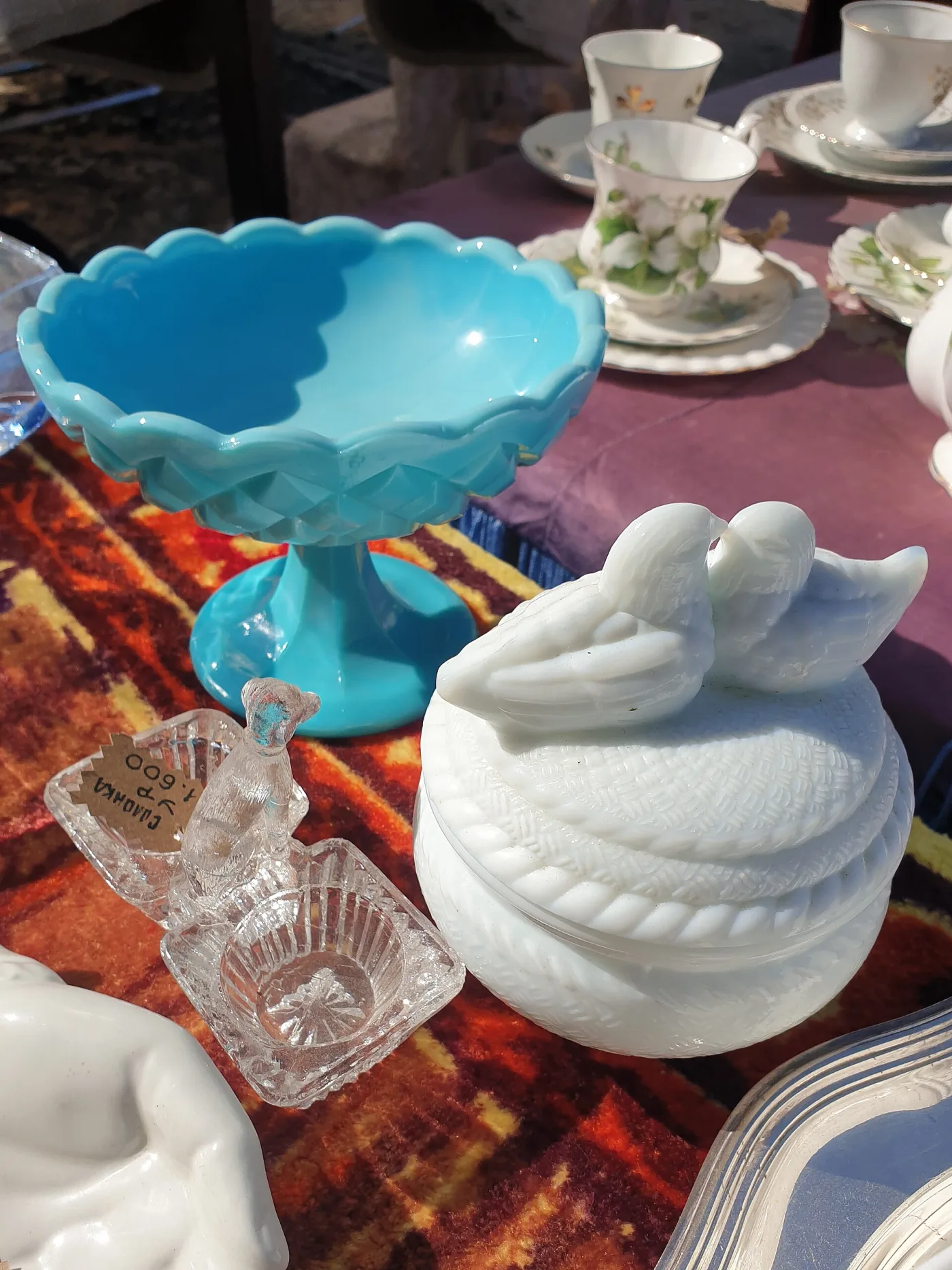
Covered animal dishes are perhaps the most distinctive and eagerly collected category of milk glass. These novelty pieces feature realistically molded animal figures as lids for oval or rectangular bases. Hens on nests are the most common form, but the category also includes roosters, ducks, swans, eagles, cats, dogs, rabbits, foxes, lions, and even fish. Atterbury and Challinor, Taylor were the premier producers of animal dishes in the 19th century, while Westmoreland and others continued the tradition into the 20th century. Rare and unusual animal dishes can command prices in the hundreds or even thousands of dollars.
Plates and platters in milk glass served both functional and decorative purposes. Many featured elaborate edge treatments including lattice, lace, and scroll borders. Commemorative and souvenir plates depicting historical events, landmarks, and patriotic themes form a distinct subcategory that attracts both glass and memorabilia collectors. Goblets, tumblers, and complete beverage sets were popular entertaining accessories, with Westmoreland's Paneled Grape water set being a quintessential example.
Candlesticks and candelabra in milk glass provided elegant lighting accessories for formal table settings. Epergnes, elaborate tiered centerpieces with multiple trumpet-shaped vases, represent some of the most dramatic and visually impressive milk glass forms. Sugar and creamer sets, salt cellars, and complete condiment sets offered practical elegance for daily dining. Lamp bases in milk glass were widely produced, with many featuring hand-painted decorations. Bottles, jars, and dresser sets rounded out the domestic applications of milk glass, making it one of the most versatile decorative materials of its era.

Dating Milk Glass
Accurately dating milk glass requires examining multiple physical characteristics and understanding how manufacturing techniques evolved over time. No single indicator is definitive, but the combination of several clues can help establish a reliable date range for most pieces.
Seam lines are among the most useful dating features. Early pressed glass, produced in the mid-to-late 19th century, typically shows mold seams that are more prominent and less carefully finished than those on later pieces. Hand-finishing techniques used by skilled workers to smooth seams improved steadily over the decades. By the mid-20th century, precision mold engineering and improved finishing techniques produced pieces with much finer, less visible seam lines. The number of mold sections also varied, with older pieces often showing evidence of fewer, larger mold sections.
Pontil marks, the rough scars left where a glass piece was detached from the pontil rod used to hold it during finishing, are indicators of hand-blown rather than pressed production. A genuine pontil mark on a milk glass piece strongly suggests early production, likely before 1880. Most pressed milk glass does not have pontil marks, but instead shows a smooth base or, in some cases, a polished or ground area where any base irregularities were removed.
Weight and thickness provide important clues about age and manufacturer. As a general rule, older milk glass tends to be heavier and thicker than later production. This is partly because earlier pressing technology required thicker glass to ensure complete mold filling, and partly because the opacifying agents used in older formulations often increased the density of the glass. A piece that feels surprisingly heavy for its size may well be older than a lighter piece of similar form. This weight comparison is also useful when examining glass bottles and containers, as our guide on antique bottle identification and glass dating techniques explains in detail.
Color variations offer subtle but valuable dating information. Early American milk glass from the 1860s through 1890s often exhibits a distinct blue tint when held up to strong light, a characteristic sometimes called "blue milk glass" or simply an old-glass blue cast. This blue tint results from the specific chemical formulations used during that era, particularly those containing arsenic as a clearing agent. Later production typically shows a pure white or slightly warm, creamy tone without the blue cast. The color of the glass can be assessed by holding a piece in front of a strong light source and observing the transmitted color at thin areas or edges.
UV fluorescence testing has become an essential tool for dating milk glass. When exposed to a long-wave UV blacklight in a darkened room, many pre-1960s milk glass pieces will fluoresce a vivid green or yellow-green color. This fluorescence results from trace elements in the glass formula, particularly uranium oxide, which was commonly used as a colorant and clarifier in older glass batches. The presence of strong UV fluorescence is a positive indicator of age, though some legitimate antique pieces may show little or no fluorescence depending on their specific chemical composition. Modern reproductions rarely fluoresce, making this test a useful first screening tool.
Color Variations
While classic white milk glass is by far the most common and widely recognized variety, manufacturers produced opaque glass in a surprisingly broad palette of colors. These colored variations are increasingly popular with collectors and often command higher prices than their white counterparts due to their relative scarcity.
White milk glass ranges from pure, bright white to softer, warmer cream and ivory tones depending on the manufacturer, era, and specific chemical formulation. The purest whites were typically achieved with tin oxide or cryolite-based formulas, while bone ash and feldspar formulations tended to produce warmer tones. Collectors develop preferences for particular shades, and the specific white of a piece can sometimes help identify its maker.
Blue milk glass, produced by adding cobalt oxide to the glass batch, ranges from pale sky blue to deep, rich sapphire tones. Blue milk glass was popular throughout the 19th and early 20th centuries and was produced by most major manufacturers. Certain blue milk glass pieces, particularly those by Atterbury and Challinor, Taylor, are among the most valuable colored milk glass items. The blue opaque glass produced by these companies has a distinctive density and richness that sets it apart from later production.
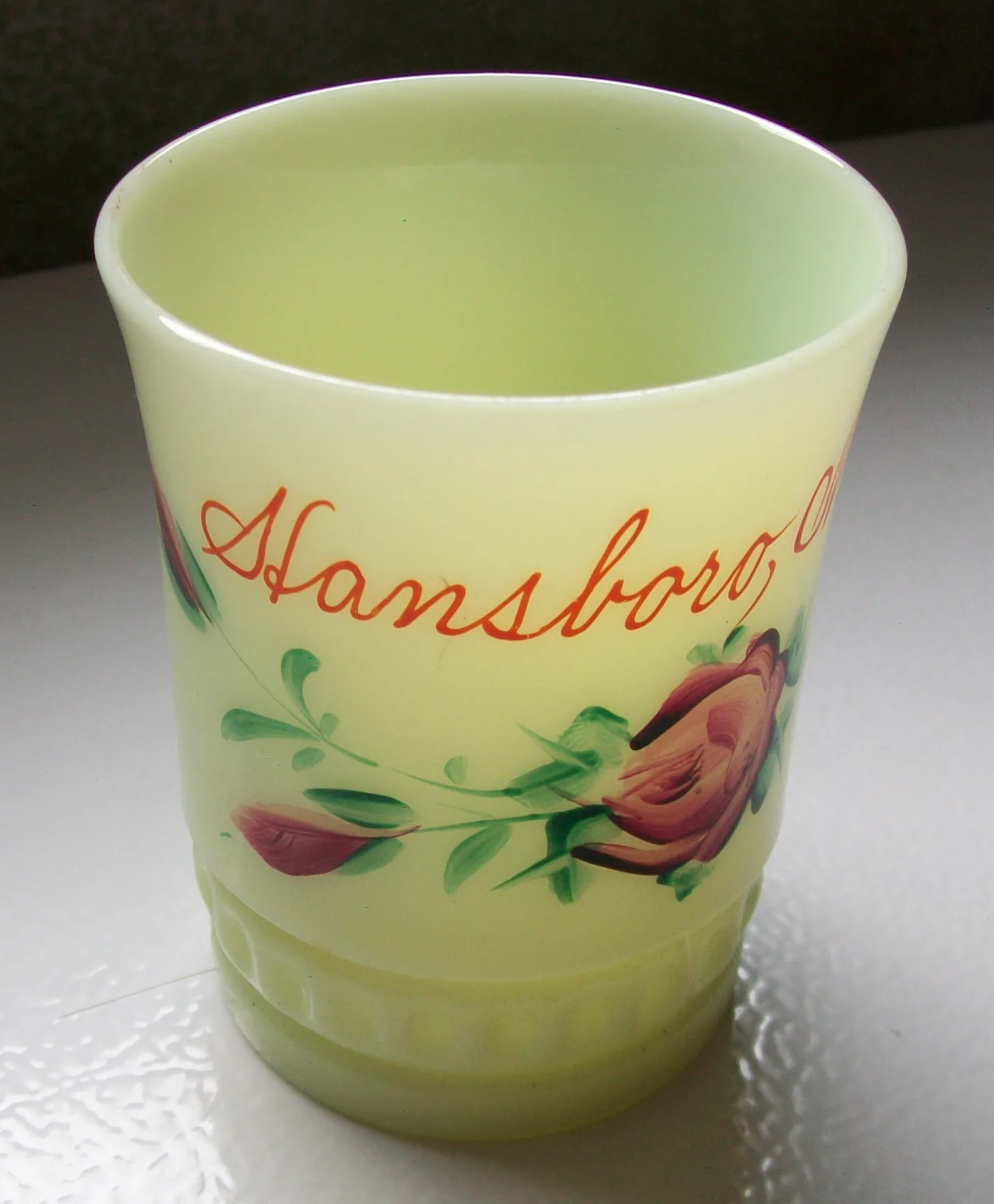
Pink milk glass varies from delicate shell pink to deeper rose tones. Pink was a relatively uncommon production color, making genuine antique pink milk glass pieces particularly desirable to collectors. Westmoreland and Fenton both produced limited quantities of pink milk glass, and these pieces typically command significant premiums over equivalent white forms. Green and jade milk glass, produced with various chromium and iron compounds, ranges from pale celadon to deep forest green. Jade milk glass, sometimes called "jadite," was particularly popular in kitchen items during the 1930s through 1950s, and the closely related opaque green wares of McKee, Jeannette, and Fire-King are explored in depth in our jadeite glass identification guide.
Black milk glass, a seemingly contradictory term, refers to opaque black glass that is technically a very dark form of milk glass. When held to strong light, the edges of true black milk glass often reveal a deep purple, green, or amber translucency. Black milk glass was popular during the Victorian era and has experienced a collecting resurgence in recent years. Almond and custard milk glass feature warm yellow or ivory tones, with custard glass distinguished by its distinctive uranium-based yellow color that fluoresces brilliantly under UV light. Caramel slag glass combines milk glass with caramel-brown glass in a marbled or swirled pattern, producing dramatic effects that make each piece unique. For collectors interested in understanding how color and iridescence relate across different glass types, our article on carnival glass identification and color analysis offers valuable comparative insights.
Authentication and Reproductions
The enduring popularity of milk glass has unfortunately made it a target for reproductions, reissues, and outright fakes. Similar authentication challenges face collectors of other opaque and specialty glass types, including antique mercury glass, where double-walled silvered construction must be verified. Learning to distinguish genuine antique milk glass from later productions is an essential skill that protects both your investment and the integrity of your collection.
Weight is one of the most reliable initial indicators of age and authenticity. Genuine antique milk glass from the 19th and early-to-mid 20th centuries is almost invariably heavier than modern reproductions. This weight difference results from differences in glass formulation, with older recipes producing denser glass, and from the thicker walls typical of earlier pressing technology. When comparing two pieces of similar form, the heavier piece is generally more likely to be the older one. Pick up the piece and assess whether it has a satisfying, substantial heft that suggests quality materials and manufacturing.
The UV light test is perhaps the most widely used authentication tool for milk glass. As described in the dating section, many pre-1960s pieces fluoresce green or yellow-green under long-wave UV light, while most modern reproductions do not. To perform this test properly, take the piece into a completely darkened room and shine a long-wave UV blacklight directly on the glass surface. Genuine antique milk glass will often produce a vivid, unmistakable glow. However, remember that this test is not infallible in either direction. Some authentic old pieces do not fluoresce, and some modern glass companies have learned to replicate fluorescence by adding appropriate chemicals to their formulas.
Examine the quality of surface detail carefully. Antique milk glass produced by major manufacturers like Westmoreland, Fenton, and Atterbury exhibits crisp, well-defined pattern details with clean edges and smooth surfaces between design elements. Reproductions often show softer, less distinct pattern work because they are produced from molds that have been copied from original pieces, losing fine detail with each generation of reproduction. Seam placement and finishing also differ between vintage and modern pieces. Older pieces typically show better seam finishing, with less visible mold lines. Color consistency is another indicator, as genuine antique pieces tend to have a more uniform, richer opacity compared to some reproductions that may appear slightly translucent or uneven in color density.
Common reproductions to watch for include copies of Atterbury's covered animal dishes, which have been reproduced extensively since the 1960s. Westmoreland molds were sold after the company's closure in 1985, and several companies have used them to produce pieces that closely resemble originals but lack the quality of glass and finishing of genuine Westmoreland production. Fenton itself reissued many of its earlier patterns in later decades, and while these are legitimate Fenton products, they have different values than earlier vintage pieces. Imported milk glass from China and other Asian countries has flooded the market in recent decades, and these pieces are generally distinguishable by their lighter weight, poorer pattern detail, and lack of UV fluorescence. Understanding authentication methods across related glass categories is also helpful, and collectors may benefit from studying how to identify depression glass patterns and fakes for additional perspective on glass authentication techniques.
Valuation Factors
The value of antique milk glass is determined by the interplay of several key factors, and understanding these factors enables collectors to make informed purchasing decisions and accurately assess the worth of pieces in their collections.
Rarity is the single most important value driver in the milk glass market. Pieces produced in limited quantities, experimental forms that never reached full production, and items from short-lived manufacturers command premium prices. The rarity of a specific form within a given pattern also matters significantly. For example, while Westmoreland Paneled Grape goblets and small bowls are relatively common and affordable, large covered compotes, water pitchers, and certain specialty forms in the same pattern are much scarcer and correspondingly more valuable.
Condition profoundly affects value. Milk glass is susceptible to chipping, especially along thin edges and rims, and even minor chips can reduce a piece's value by 50 percent or more. Cracks, regardless of size, are considered serious defects that dramatically diminish value. Surface wear from use or improper cleaning can dull the finish and reduce the crispness of pattern details. Staining, particularly the yellowish discoloration that can develop on milk glass stored in damp or smoky environments, also affects value. Collectors and dealers use a grading scale that ranges from mint condition through excellent, very good, good, and fair, with prices declining steeply at each lower grade.
The manufacturer of a piece significantly influences its value. Westmoreland and Fenton pieces generally command the highest prices in the American milk glass market, followed by Atterbury and other well-regarded 19th-century producers. Pattern and form interact with manufacturer reputation to determine value, as certain combinations are especially prized. Age is a value factor that generally correlates with rarity, as older pieces have had more time to be broken, lost, or discarded. Pieces with documented provenance, particularly those from notable collections or with original purchase receipts, can command premiums above market averages. For a thorough understanding of how to evaluate any antique, our detailed guide on antique valuation and appraisal methods provides a comprehensive framework applicable across all collecting categories.
Current market prices for antique milk glass span a wide range. Common Fenton Hobnail pieces in white can often be found for $10 to $30 each, while rare forms in the same pattern may bring $100 or more. Westmoreland Paneled Grape pieces range from $15 for small common forms to $200 or more for large, rare pieces. Atterbury covered animal dishes typically sell for $75 to $500 depending on the specific animal, condition, and rarity, with exceptional examples exceeding $1,000. Colored milk glass in any pattern generally commands prices two to five times higher than equivalent white pieces. Truly rare and exceptional pieces from any manufacturer can bring prices well into the four-figure range at specialized auctions.
Caring for Milk Glass
Proper care and handling of milk glass is essential for preserving both its beauty and its value. While milk glass is relatively durable compared to some other antique glass types, it requires thoughtful treatment to maintain its condition over the long term.
Cleaning milk glass should be done gently and conservatively. The safest method is hand washing in lukewarm water with a small amount of mild liquid dish soap. Use a soft cloth or sponge rather than abrasive scrubbers, which can scratch the glass surface and dull its finish over time. Never place antique milk glass in a dishwasher, as the high temperatures, harsh detergents, and mechanical agitation can cause thermal shock, crazing, or surface damage. For stubborn stains or mineral deposits, a brief soak in a solution of warm water and white vinegar can be effective. Avoid using bleach or harsh chemical cleaners, which can etch or discolor the glass surface.
Display considerations are important for both aesthetics and preservation. Milk glass looks its best when displayed against contrasting backgrounds, with dark surfaces particularly effective at highlighting the glass's distinctive white opacity. Avoid displaying milk glass in direct sunlight for extended periods, as prolonged UV exposure can sometimes cause subtle color changes in certain glass formulations. When arranging multiple pieces on shelves, ensure adequate spacing between items to prevent accidental contact during dusting or when adding and removing pieces. Felt or fabric shelf liners provide cushioning and prevent scratching.
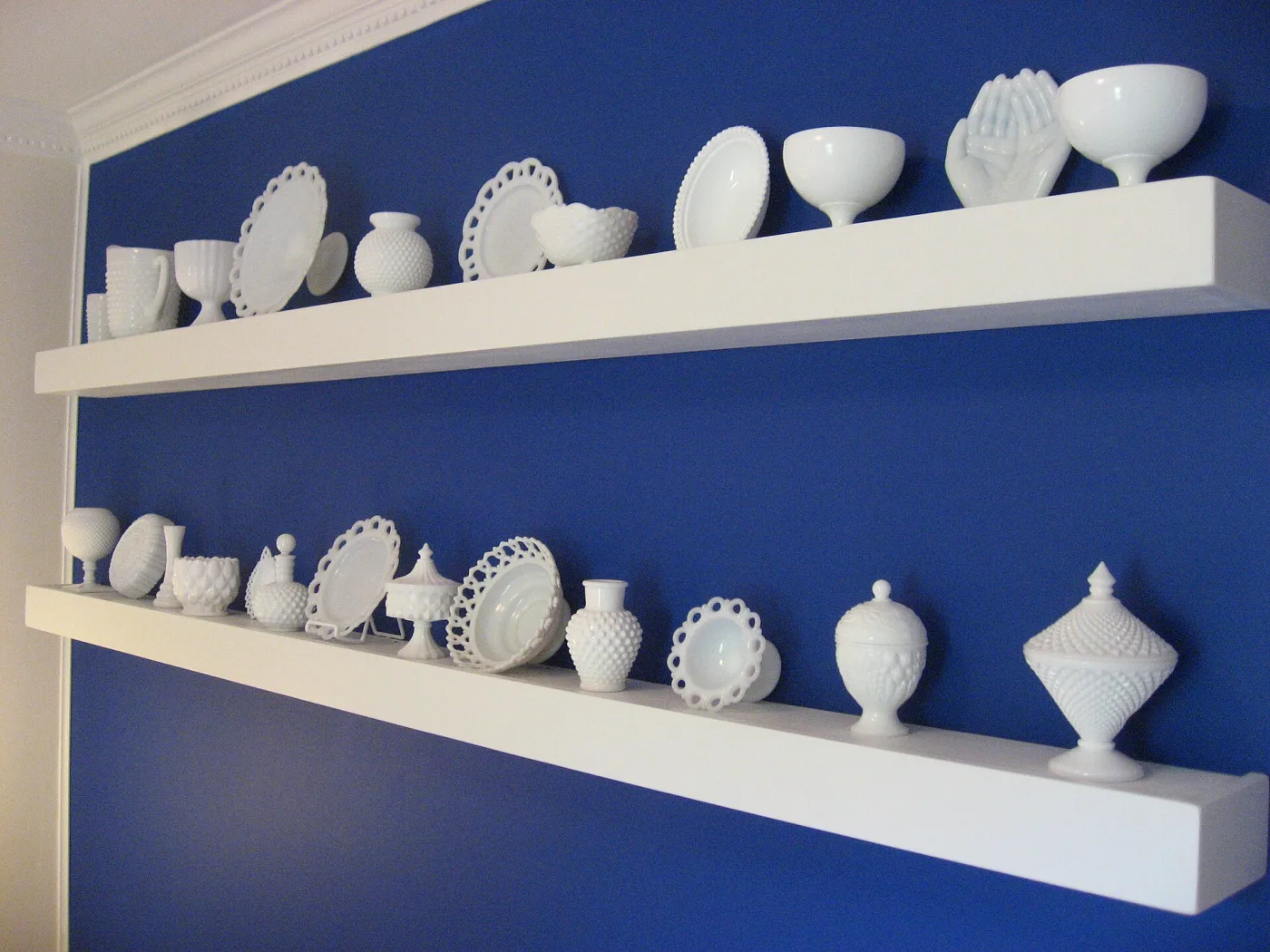
Storage of milk glass pieces not on display requires careful attention. Each piece should be individually wrapped in acid-free tissue paper or unprinted newsprint. Never stack milk glass pieces directly on top of each other without padding, as the weight and contact can cause scratching, chipping, or cracking. Store wrapped pieces in sturdy boxes with adequate cushioning, and keep boxes in climate-controlled environments. Extreme temperature fluctuations are particularly harmful to glass of all types, as they create expansion and contraction stresses that can lead to cracking. For more detailed information on preserving all types of antique items, our guide on antique preservation and storage best practices offers comprehensive advice applicable to your entire collection. When handling milk glass, always pick up pieces by the body rather than by handles, finials, or other protruding elements, which are the most vulnerable points for breakage.
Building a Milk Glass Collection
Building a milk glass collection is a rewarding pursuit that combines aesthetic appreciation, historical interest, and the thrill of the hunt. The wide availability of milk glass at various price points makes it an accessible collecting field for beginners, while the depth and variety of available pieces provide endless challenges for advanced collectors.
Finding milk glass pieces is one of the great pleasures of collecting. Estate sales are perhaps the single best source, as milk glass was so widely popular during the mid-20th century that it appears in a high percentage of household dispersals from that era. Antique shops, flea markets, and antique shows offer curated selections at retail prices, while online marketplaces provide access to pieces from across the country. Thrift stores and charity shops occasionally yield remarkable finds at bargain prices, particularly in areas where awareness of milk glass values is low. Auction houses, both local and online, handle higher-end pieces and complete collections.
Developing a collecting strategy helps focus your efforts and resources. Many collectors choose to specialize in a single pattern, such as Westmoreland Paneled Grape or Fenton Hobnail, and attempt to acquire every form produced in that pattern. This approach provides clear goals and a defined scope. Others collect by form, assembling collections of covered animal dishes, vases, or candlesticks across all manufacturers and patterns. Collecting by manufacturer allows you to explore the full range of a single company's production. Some collectors focus on a specific era, such as the Victorian period or the mid-century modern era, while others pursue colored milk glass across all patterns and manufacturers. For more ideas on structuring and growing any type of antique collection, our guide on collecting strategies for building a meaningful collection provides proven approaches that apply to milk glass and beyond.
Investment potential in milk glass is moderate but steady. The market for common pieces has remained relatively stable, while rare and exceptional items have shown consistent appreciation over the past several decades. The closure of major manufacturers like Westmoreland in 1985 and Fenton in 2011 means that no new vintage-quality milk glass is being produced, which creates a finite and slowly diminishing supply as pieces are broken or lost. Colored milk glass, rare forms, and pieces in exceptional condition have shown the strongest price appreciation. As with all antique collecting, buying quality over quantity tends to produce better long-term results. Focus on pieces in excellent condition from recognized manufacturers in desirable patterns, and your collection will likely hold or increase its value over time.
Educating yourself is the most important investment you can make as a milk glass collector. Reference books such as "Milk Glass: Imperial Glass Corporation" by Myrna and Bob Garrison, "Westmoreland Glass" by Charles West Wilson, and "Fenton Art Glass: A Centennial of Glass Making" by William Heacock provide invaluable pattern identification resources and production histories. Joining collector organizations and online forums connects you with experienced collectors who generously share their knowledge. Handling as many pieces as possible at shows, shops, and collector meetings develops the tactile familiarity that is ultimately the most reliable identification skill a collector can possess.