
Weller Pottery Identification Guide: Marks, Glaze Lines & Value Assessment
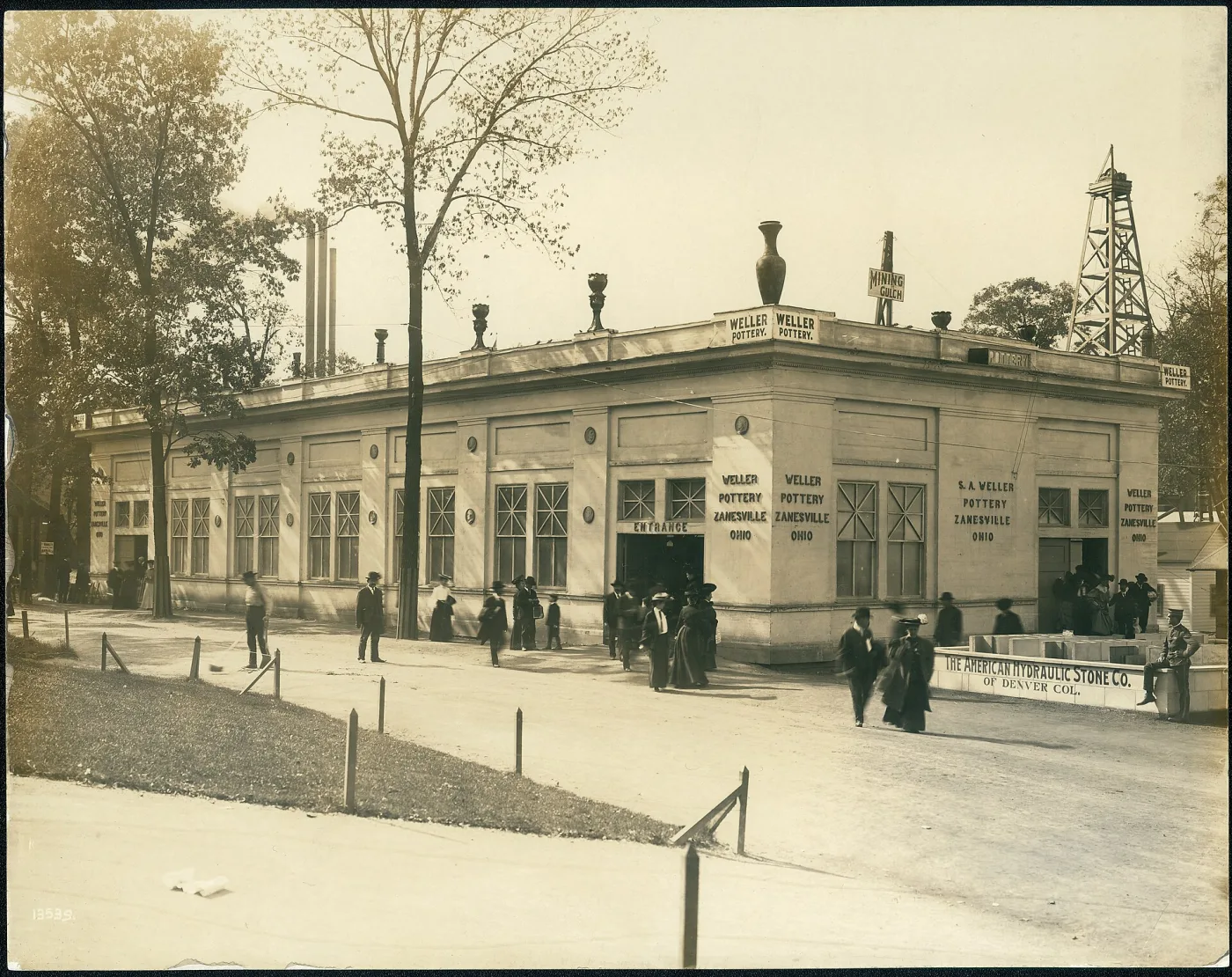
Weller Pottery was, for several decades on either side of 1900, the largest art pottery in the world. Founded in 1872 by Samuel A. Weller in a small log workshop near Fultonham, Ohio and relocated to Zanesville a decade later, the firm grew from a maker of utilitarian flowerpots into a sprawling enterprise that rivaled Rookwood, surpassed Roseville in volume, and dwarfed contemporaries like McCoy and the Colorado matte-glaze house Van Briggle through most of its working life.
Where Rookwood obsessed over documentation, Weller pursued breadth. The company produced dozens of distinct ware lines — from the warm, slip-painted Louwelsa that competed directly with Rookwood's Standard Glaze, to the iridescent Sicardo developed by French chemist Jacques Sicard, to the molded Forest, Woodcraft, and Coppertone lines that defined garden and porch ornament in the 1920s. This range is what makes Weller both endlessly collectible and occasionally bewildering: the same firm produced museum-quality artist-signed Hudson vases and inexpensive molded Pop-eye Dog figurines, and a collector has to read marks, glaze surfaces, and form together to place any given piece accurately.
This guide walks through every element of Weller identification: the evolution of impressed and ink marks from 1895 to 1948, the major decorated lines and their date ranges, the artists who signed work, the molded production lines that defined Weller's later decades, and the authentication checks that separate genuine Zanesville pieces from later studio work and outright reproductions. Whether you found a Louwelsa jardiniere at an estate sale or are weighing a signed Sicard vase at auction, the framework below will let you read a Weller base with the same fluency as a seasoned art-pottery specialist.
Table of Contents
- A Brief History of Weller Pottery
- Reading the Base: Marks Overview
- Impressed and Incised Marks
- Ink Stamps and Paper Labels
- Early Art Lines (1895–1905)
- Sicard and the Iridescent Era
- Dickensware, Eocean, and Hudson
- Molded Production Lines
- Garden Ornament & Coppertone
- Notable Weller Decorators
- Dating Pieces Without a Date Mark
- Authentication and Detecting Fakes
- Condition, Damage & Restoration
- Value Factors and Price Ranges
- Building a Weller Collection
- Care, Display, and Preservation
A Brief History of Weller Pottery
Samuel A. Weller was nineteen when he set up a single-kiln pottery near Fultonham in 1872. The original output was strictly utilitarian — flowerpots, hanging baskets, milk pans, cuspidors, and stoneware vessels not unlike the contemporaneous stoneware crocks made across Ohio at the time. Weller moved the works to Zanesville in 1882, drawn by the same combination of clay, gas, and rail access that would soon make Zanesville the densest pottery district in the United States.
The Lonhuda Acquisition (1894–1895)
The turning point came in 1894, when Weller purchased the Lonhuda Pottery of Steubenville, Ohio. Lonhuda's founder, William A. Long, had developed an underglaze slip-painting process that produced warm-toned, decorated wares competitive with Rookwood's Standard Glaze. Weller absorbed Lonhuda's equipment, its formulas, and Long himself, and within a year was producing his own version of the line — renamed Louwelsa in a transparent fusion of Lonhuda and Weller. The acquisition transformed Weller overnight from a utility maker into a major art pottery.
The Art Pottery Years (1895–1915)
Between 1895 and the First World War, Weller introduced an extraordinary cascade of decorated lines: Louwelsa (1895), Aurelian (1898), Eocean (1898), Dickensware (1897), Sicardo (1902), Jap Birdimal (1904), Hudson (around 1917), and dozens of smaller variations. The pottery hired English designer Frederick Hurten Rhead and the previously mentioned Jacques Sicard, paying European-trained artists handsomely to elevate Weller's design standing. By 1905 the works covered five Zanesville plants and employed hundreds.
The Molded Era (1915–1936)
The labor and material costs of hand-decorated wares became unsustainable after World War I. Weller shifted toward molded production lines decorated by glaze and relief modeling rather than hand painting. Forest, Woodcraft, Glendale, Baldin, Coppertone, Silvertone, Roma, Klyro, and dozens more define this period. The molded pieces are typically lower in collector tier than artist-signed earlier work, but the best molded lines — particularly Coppertone, Glendale, and Hudson Light — remain strongly collected.
Decline and Closure (1936–1948)
The Depression hit Weller hard, and the death of Samuel Weller in 1925 had already left the firm without its driving founder. Various attempts to revive sales through low-cost dinnerware and giftware lines through the 1930s and early 1940s failed to restore profitability. Production ceased in 1948, the molds were dispersed, and the Zanesville plants were sold. No revival of the Weller name has produced new wares with the original molds, which means every piece carrying genuine Weller marks dates from the 1872–1948 window.
Reading the Base: Marks Overview
Unlike Rookwood, Weller never adopted a single unified date system. Instead, marks evolved across more than fifty years and varied by line, plant, and decade. Reading a Weller base means evaluating three layers simultaneously: the company mark, the line identification, and any artist signature.
The Three Layers of a Weller Base
A typical Weller base shows: (1) some form of "Weller" company mark — impressed, incised, ink-stamped, or sometimes absent entirely; (2) a line name or shape number — Louwelsa, Sicardo, a half-circle Hudson kiln mark, or simply a numeric shape; and (3) on decorated pieces, the artist's signature or cipher, usually on the side rather than the base.
Why Marks Are Inconsistent
Weller's scale worked against tidy mark practice. With dozens of lines, multiple plants, and seasonal staffing, mark application was delegated to many hands and changed often. A Louwelsa piece might be impressed "LOUWELSA WELLER" with a half-circle and shape number, or simply ink-stamped, or carry only the artist's signature with no company mark. Mark variation alone is not a sign of inauthenticity — it is normal for Weller.
Pieces Without Marks
A substantial fraction of authentic Weller carries no impressed or stamped mark at all. Many pieces left the factory with only a paper label, which fell off in use. For these unmarked pieces, identification depends on glaze, form, mold details, and clay body comparison against documented examples. Reference books are essential here.
Impressed and Incised Marks
Impressed marks — letters or designs pressed into the clay before firing — are the most authoritative Weller marks because they cannot be added after firing. Their style helps date pieces within rough windows.
Early Impressed Marks (1895–1905)
The earliest art-pottery marks pair the line name with "WELLER" in block letters. "LOUWELSA WELLER" arranged in a half-circle around a shape number is the classic configuration on Louwelsa vases. Aurelian pieces are typically impressed "AURELIAN WELLER" in similar arrangement. These marks are often deeply impressed and clearly legible despite glaze fill.
Block-Letter "WELLER" (1905–1925)
From roughly 1905 onward, many lines simply carry "WELLER" impressed in block letters with no line name. Shape numbers, size letters, and decorator marks appear separately. This unmarked-line approach can frustrate collectors used to Rookwood specificity — without familiarity with the line glazes themselves, base reading alone is not enough.
Script "Weller" (1920s–1930s)
Cursive or script Weller marks appear on later molded lines. The script is sometimes impressed, sometimes raised in relief as part of the mold itself. Raised script marks integral to the mold body indicate molded production lines, never hand-decorated art ware.
Half-Kiln and "Hudson" Marks
Hudson pieces — Weller's high-quality painted line of the late 1910s and 1920s — often carry a half-circle kiln mark with "WELLER" inside the arc, sometimes accompanied by a shape number and artist cipher. Hudson is among the most carefully marked of all Weller lines.
Ink Stamps and Paper Labels
From the late 1910s onward, Weller increasingly used ink stamps and paper labels rather than impressed marks, particularly on lower-tier production pieces. These marks are less durable but still informative.
Black or Brown Ink "Weller Pottery"
A black or brown rubber-stamped "Weller Pottery" with a circular or oval border appears on many 1920s and 1930s pieces. The ink sits on top of the glaze and can wear through use, particularly on garden pieces or jardinieres handled outdoors. A faint or partial ink stamp is normal and does not indicate a problem piece.
Paper Labels
Weller used paper foil labels through much of its history, particularly for small giftware and figurines. These labels are gold, silver, or printed paper with "Weller" or "Weller Pottery, Zanesville, Ohio." Most labels are long gone, but a few pieces survive with original labels intact. An intact paper label is a strong attribution aid and adds modest value.
"Weller Ware" and Late Marks
The "Weller Ware" mark, often in script, appears on dinnerware and giftware from the 1930s and 1940s. These marks are typically ink-stamped or printed. Pieces with "Weller Ware" marks generally postdate 1930 and represent the lower end of collector interest.
Early Art Lines (1895–1905)
The art lines launched in Weller's first decade as a decorated pottery remain its most prestigious work for collectors. Recognizing them on sight is the foundation of Weller fluency.
Louwelsa (1895–1924)
Louwelsa is Weller's direct competitor to Rookwood Standard Glaze. The line features warm slip-painted decoration — roses, daisies, fruit, portraits of dogs and Native Americans — under a clear yellow-tinged high-gloss glaze, on dark brown or black backgrounds. Louwelsa was produced in enormous quantity and was Weller's commercial backbone for almost three decades. Quality varies widely; the best Louwelsa pieces by artists like Levi J. Burgess or Frank Ferrell rival contemporaneous Rookwood, while the routine production pieces command modest prices.
Aurelian (1898–1910)
Aurelian is essentially a brighter, more colorful variant of Louwelsa. The backgrounds are streaked yellow, orange, and red rather than uniform brown, and the underglaze decoration tends toward bolder florals. Aurelian pieces are scarcer than Louwelsa and bring stronger prices for equivalent quality.
Eocean and Eocean Rose (1898–1925)
Eocean reverses the Louwelsa palette: pale gray, green, or pink grounds with darker slip-painted decoration under a clear glaze. The effect is cool and restrained where Louwelsa is warm and dramatic. Eocean Rose adds blushed pink tones and is among the most desirable Weller subtypes. Both lines are signed by artist on the side when decorated.
Dickensware Series I, II, and III (1897–1910)
Dickensware is a complex group of related lines. Series I uses Louwelsa-like slip decoration but with literary, Dickens-character, or genre subjects. Series II is more famous and very distinct: matte glaze with sgraffito (incised) decoration showing Native American portraits, monks, golfers, animals, and Dickens characters cut through dark slip to expose lighter clay beneath. Series III is the rarest, featuring decals over matte glazes. Series II Dickensware Native American portraits by Karl Kappes and Levi Burgess are among the most expensive Weller pieces on the market.
Sicard and the Iridescent Era
The Sicardo line is Weller's single most prestigious artistic achievement and a cornerstone of any serious American art pottery collection.
Jacques Sicard's Background
Jacques Sicard had trained in France with Clément Massier, the developer of iridescent metallic-luster glazes that took Paris exhibitions by storm in the 1890s. Samuel Weller recruited Sicard in 1901 and gave him a private studio at the Zanesville works. From 1902 to 1907, Sicard and his assistant Henri Gellie produced metallic-luster pieces in tones of gold, purple, green, and copper, often decorated with stylized florals, peacocks, or arabesques.
Identifying Sicardo
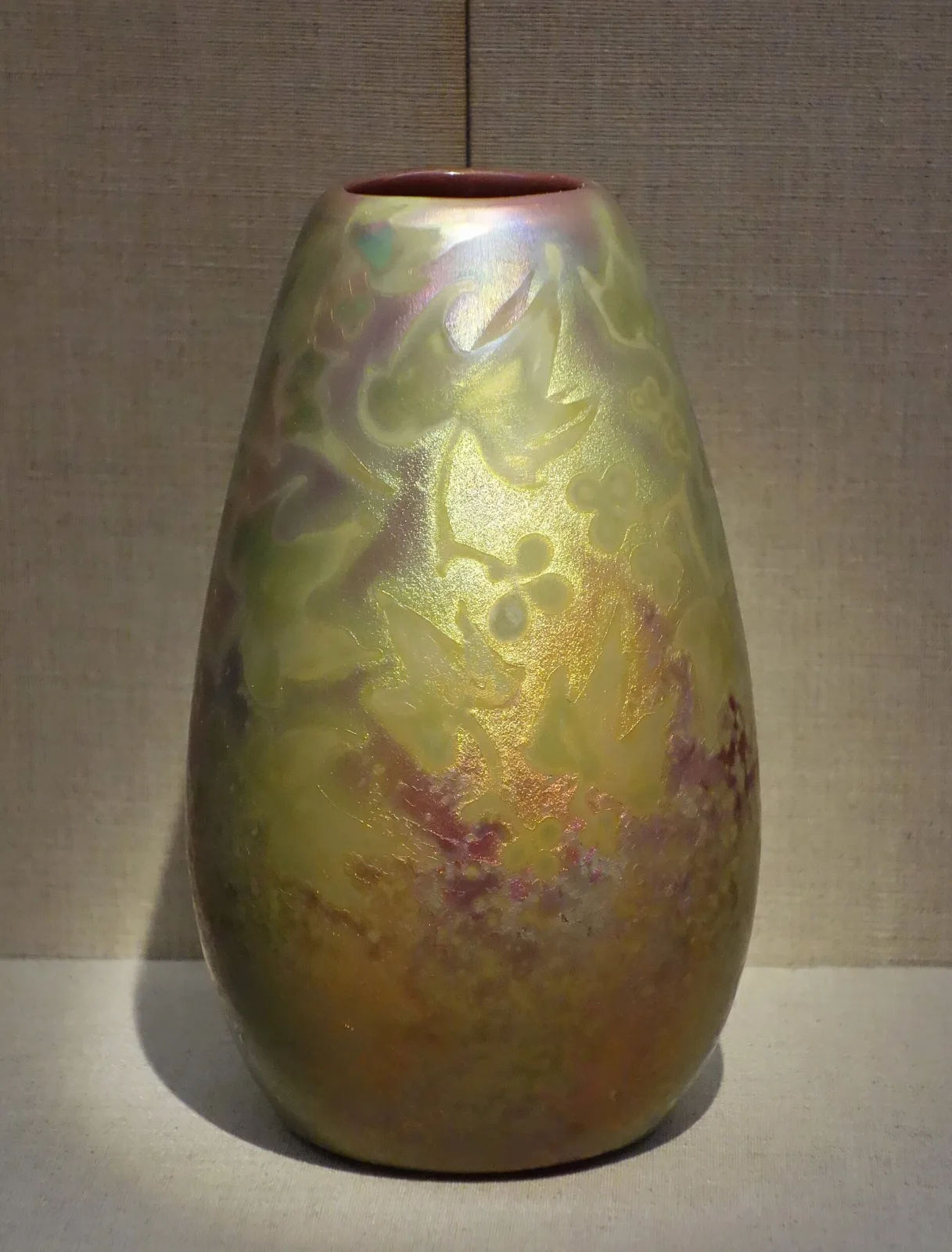
Sicardo pieces are unmistakable: a dark base color (typically deep red or black) is overlaid with luster glazes that shift color when tilted under light. The line is signed in luster — "Weller Sicardo" or "Sicard Weller" — on the side of the piece, not always on the base. Genuine Sicardo luster is integral to the glaze; later imitations show surface-applied luster that can be partially removed by careful rubbing.
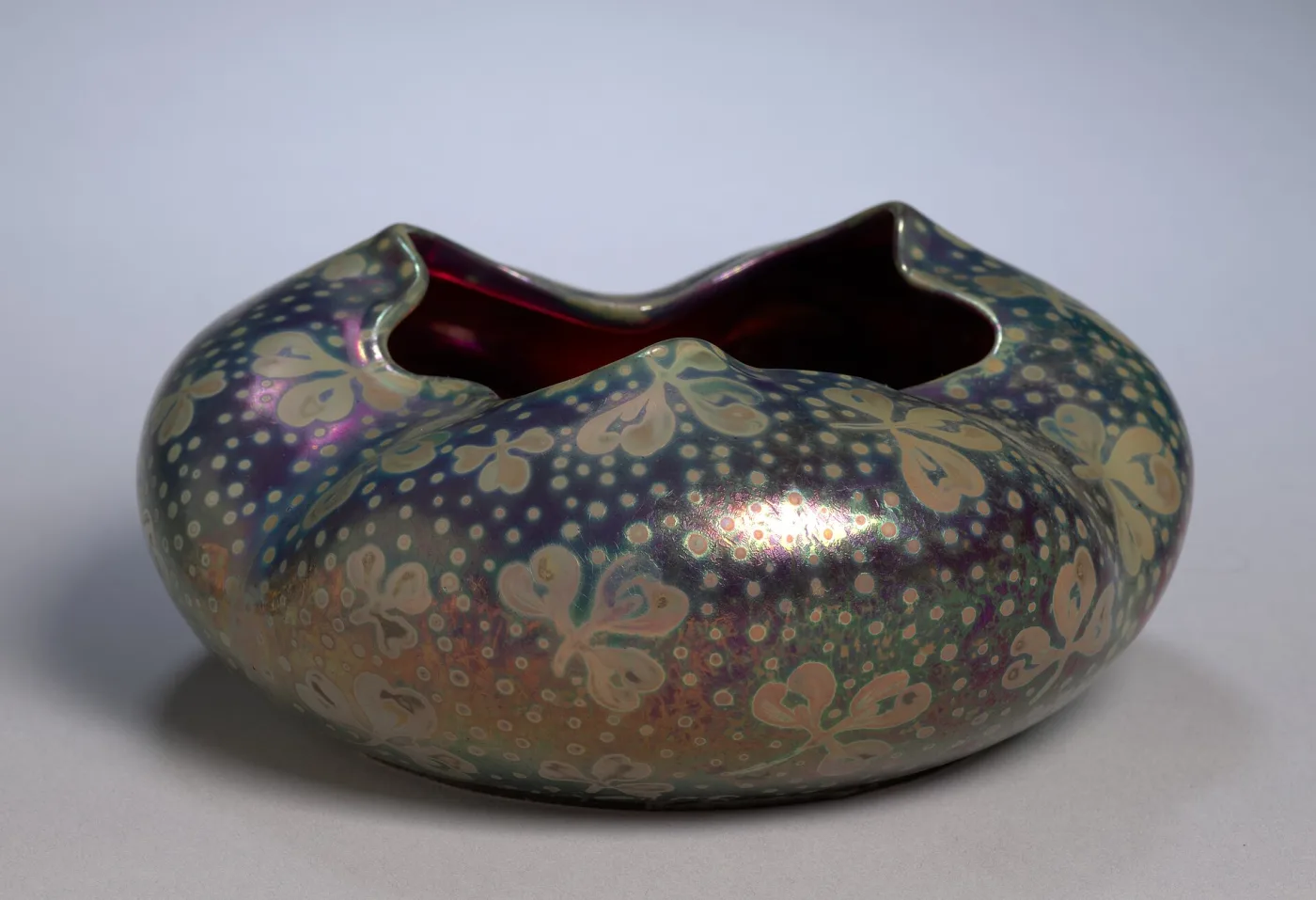
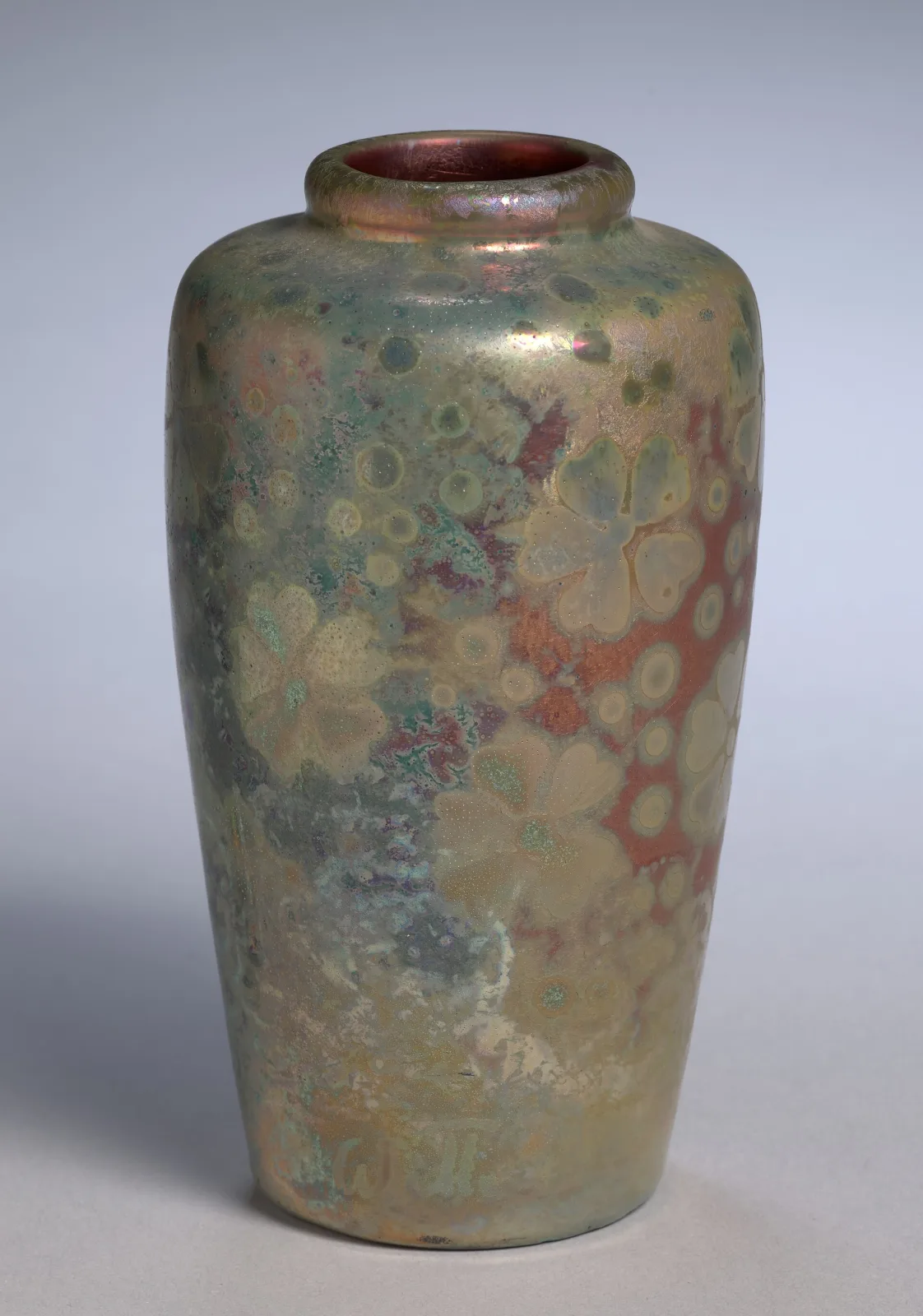
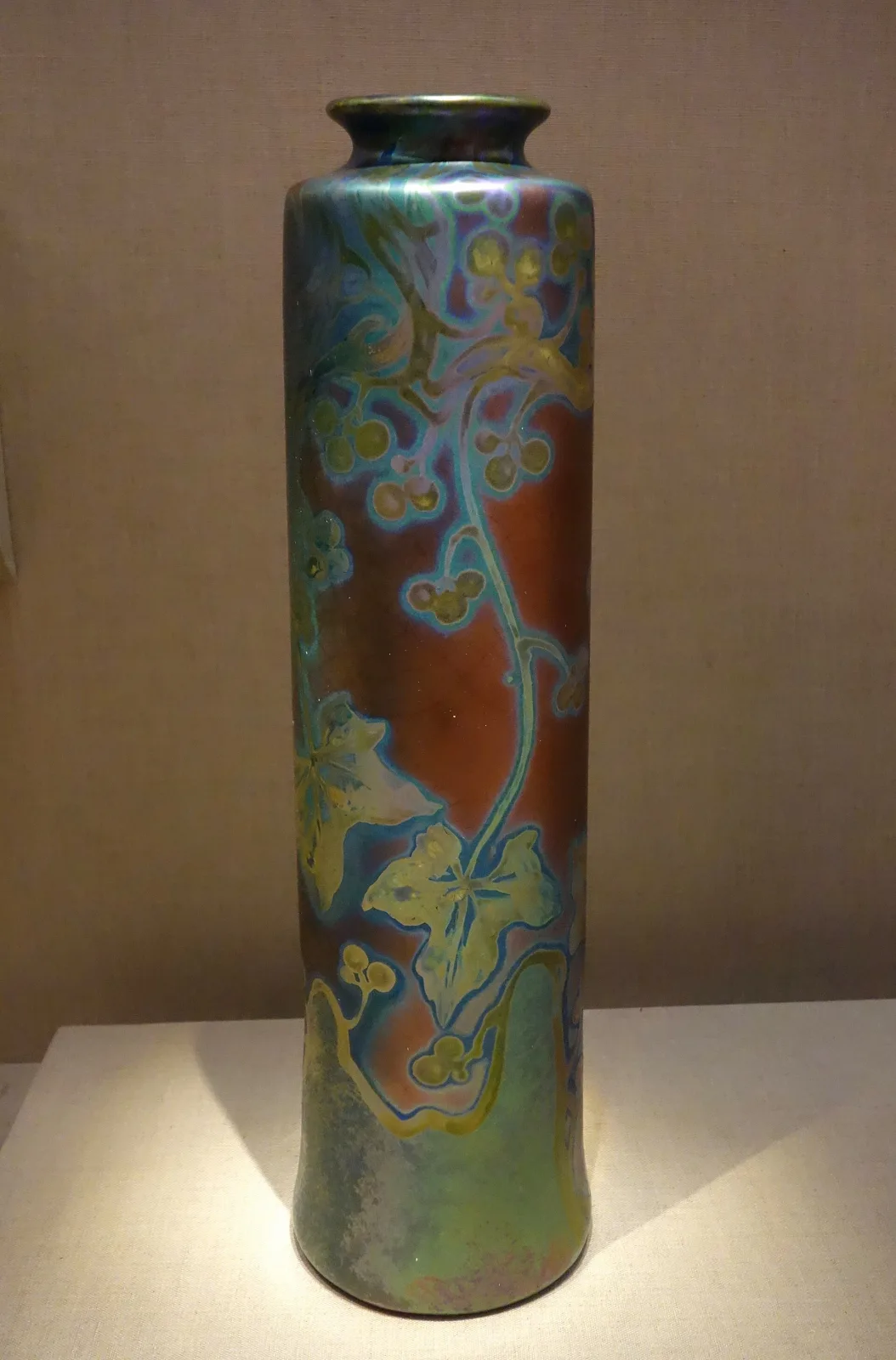
Two Sicardo pieces from the same museum, and the pair makes the point that photographs of this line are unreliable evidence. Both were shot under different lights and both look like different glazes as a result; in the hand they are recognisably the same treatment. So do not attempt to authenticate Sicardo from a listing photograph, and be sceptical of a seller’s colour description — the honest answer to “what colour is it” is that it depends on where you stand. What does transfer from these images is the structure: an all-over lustre ground, decoration in the same lustre distinguished only by sheen, no hard-edged painting anywhere, and forms that are simple because the glaze is doing all the work. A piece with crisp painted outlines over an iridescent ground is something else, whatever it is being sold as.
The End of Sicardo
Sicard returned to France in 1907 and the Sicardo formula went with him; Weller could never restart the line in his absence. Total production was small relative to other Weller lines, and surviving pieces command strong prices. Even small Sicardo vases routinely bring four-figure prices, with major examples exceeding $10,000.
Lasa and Related Iridescent Lines
Weller's Lasa line (1920s) is a later, lower-cost attempt at iridescent effects using transfer-printed scenic landscapes under metallic luster glazes. Lasa is mechanical-feeling next to Sicardo and trades at a small fraction of Sicardo prices, but it is genuine Weller and increasingly collected in its own right.
Dickensware, Eocean, and Hudson
Beyond the very early lines, Weller's strongest decorated work continued through the late 1910s and 1920s on lines worth knowing in detail.
Hudson (circa 1917–1934)
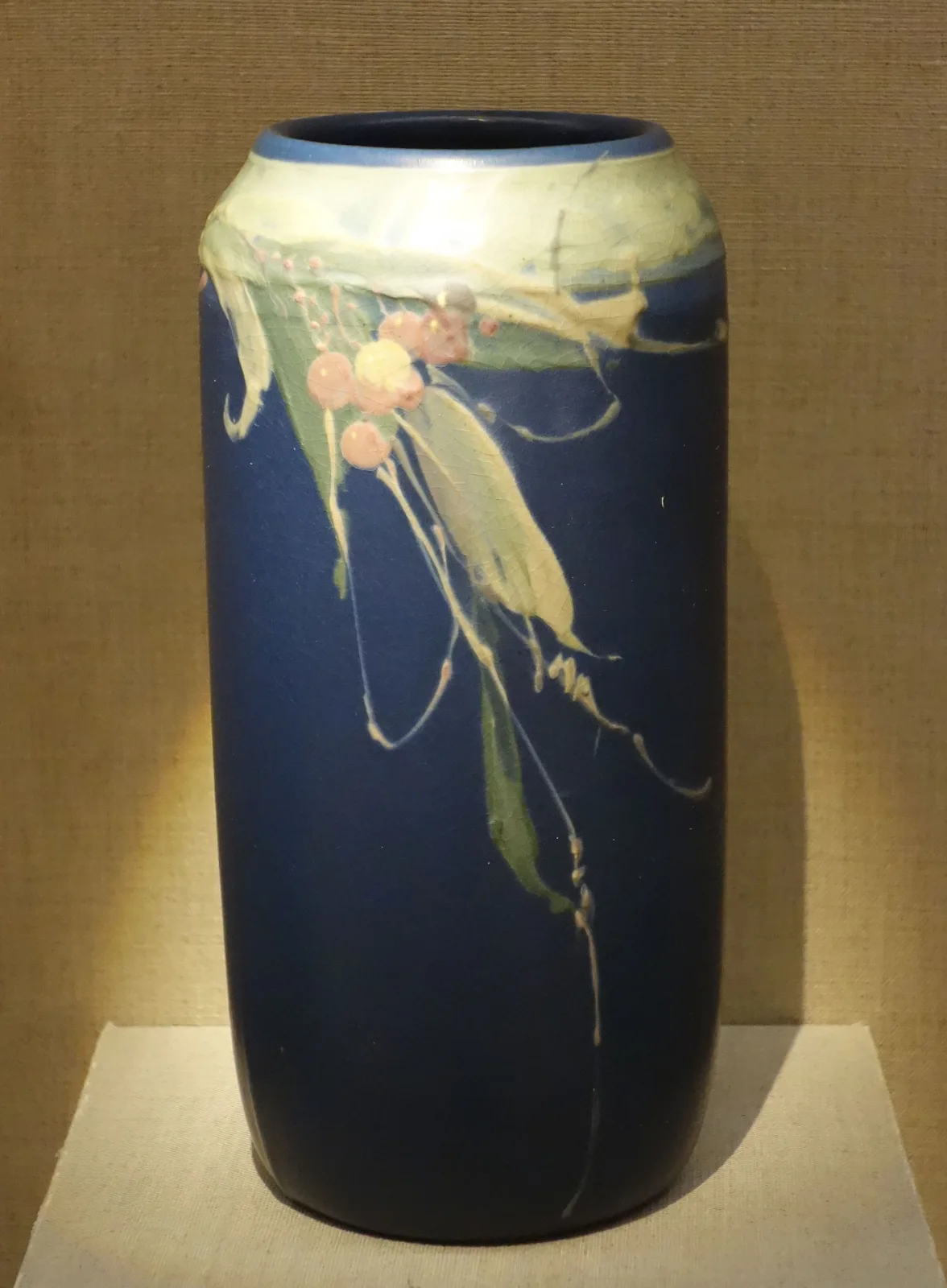
Hudson is Weller's late-period answer to Rookwood Vellum: soft pastel underglaze decoration on white or cream grounds under matte or semi-matte glazes. Subjects include florals, landscapes, and occasional figurals. Hudson pieces by Hester Pillsbury, Sarah Reid McLaughlin, Mae Timberlake, and Edwin L. Pickens command strong prices and are among the most collected late-period Weller work.
Hudson Light and Hudson White
Hudson Light is a subset with paler grounds and minimal decoration — often a single floral spray on cream — typically signed by artist. Hudson White is similar but uses pure white grounds and is less common. Both share Hudson's matte glaze surface.
Jap Birdimal (1904–1907)
Designed by Frederick Hurten Rhead, Jap Birdimal uses slip-trailed outlines filled with colored slips to produce stylized Japanese-influenced bird and floral compositions. The technique is closer to cloisonné enamel than to standard underglaze painting. Jap Birdimal is scarce, distinctly modern in feel, and prized.
Etna and Floretta
Etna (1906) features high-relief slip decoration in pink, white, and pale tones on gray-toned grounds. Floretta (1904) features applied molded fruit or flowers in low relief, often painted in naturalistic colors. Both are mid-tier collected lines.
Molded Production Lines
After World War I, Weller's volume came overwhelmingly from molded lines decorated by glaze rather than by hand. These lines are accessible entry points to collecting and remain very popular for decorative use.
Forest (circa 1920)
Forest is a molded line with high-relief trees and woodland scenes on jardinieres, vases, planters, and umbrella stands. The naturalistic brown, green, and tan glaze coloring is distinctive. Forest pieces remain in active decorative use and routinely trade in the low hundreds for typical sizes.
Woodcraft (1917–1933)
Woodcraft simulates tree trunks, branches, owls, foxes, and squirrels in matte glazes. Many forms are vases or planters shaped as hollow stumps with applied animals. Woodcraft is among Weller's most commercially successful molded lines and remains widely collected.
Glendale (1920s)
Glendale features bird-and-egg compositions in high relief — a nesting kingfisher, jay, or other species over a partial egg or nest, painted in muted naturalistic colors under matte glaze. Quality Glendale pieces with strong color command among the highest prices for any Weller molded line.
Baldin (1915–1920)
Baldin shows applied molded apples and apple leaves against blue or green backgrounds. The line is heavy and dramatic, with strong relief. Larger Baldin pieces — jardinieres on pedestals, umbrella stands, and oversized vases — are reliably valuable.
Roma, Klyro, and Late Production
Roma uses pastel matte grounds with applied molded swags, garlands, and floral relief; Klyro features stylized geometric Art Deco shapes; many other production lines round out the 1920s and 1930s output. Most of these molded lines sell in the $50–300 range for typical pieces, with exceptional sizes or examples bringing more.
Garden Ornament & Coppertone
Weller's garden ware — birdbaths, frogs, planters, lawn ornaments, and the iconic Coppertone line — deserves its own section because it represents some of the most accessible and visually striking Weller available.
Coppertone (1920s–early 1930s)
Coppertone uses a mottled green-and-tan glaze that mimics oxidized copper, applied to figural pieces — most famously frogs, fish, and turtles. The signature Coppertone frog perched on the rim of a lily-pad bowl is one of the most recognizable American art-pottery forms. Larger and more elaborate Coppertone figural pieces command strong four-figure prices.
Garden Frogs and Figural Pieces
Beyond Coppertone, Weller produced an enormous range of garden ornaments and statuary in figural form — gnomes, rabbits, geese, swans, dogs. Many of these pieces show heavy outdoor wear; condition matters even more than usual for garden pieces, since chips and weathering significantly reduce value.
Pop-eye Dogs and Animal Figures
The "Pop-eye Dog" figurine — a stylized scottie with bulging eyes, produced in various colors and sizes — is one of the most beloved Weller collectibles. Pop-eye dogs are routinely faked, and authentication requires comparison against documented genuine examples (see authentication section).
Jardinieres and Pedestal Sets
Many decorated Weller lines were produced in jardiniere-and-pedestal pairs intended for parlor or hallway use. Surviving complete pairs in good condition — particularly in Forest, Woodcraft, Baldin, or Louwelsa — bring substantial premiums over single jardinieres. The matching pedestal is often missing because pedestals were more likely to be discarded, leaving orphan jardinieres common and complete pairs scarce, similar to other jardiniere and planter collecting categories.
Notable Weller Decorators
Weller employed dozens of decorators across its art-pottery years. Recognizing the major signatures pays direct dividends, since artist identity is one of the largest value drivers on decorated pieces.
Frederick Hurten Rhead (1904–1907)
The English-born Rhead is one of the most important American art-pottery designers of his era. At Weller he designed the Jap Birdimal line and several short-run art lines. Pieces firmly attributed to Rhead bring strong prices, though Rhead's tenure at Weller was brief — most of his American reputation rests on later work at Roseville and Homer Laughlin.
Jacques Sicard (1902–1907)
Sicard's entire Sicardo output bears his signature in luster glaze, usually integrated into the design. Authentic Sicard signatures are sometimes hard to read because of the glaze tonality; angled light helps reveal them.
Levi J. Burgess
One of Weller's most prolific decorators across Louwelsa, Aurelian, and Dickensware. Burgess's florals are competently painted and his Dickensware portraits are among the most desirable in that line.
Hester Pillsbury
Pillsbury was the leading Hudson decorator. Her floral compositions on Hudson pieces represent some of the best late-period Weller painting and consistently command among the highest prices for the line.
Sarah Reid McLaughlin, Mae Timberlake, and Edwin L. Pickens
This trio produced strong Hudson and Eocean work in the 1910s and 1920s. McLaughlin's florals, Timberlake's scenic landscapes, and Pickens's figural work are all collected.
Karl Kappes and the Dickensware Portraits
Kappes was one of the principal artists on Dickensware Series II, producing the celebrated Native American portrait pieces. Signed Kappes Dickensware portraits are top-tier Weller and routinely break $5,000 at auction.

Dating Pieces Without a Date Mark
Weller pieces almost never carry an explicit date. Unlike Rookwood's Roman numerals, the company never adopted a year-by-year dating system, so dating relies on inferences from line, mark style, and form.
Line Production Windows
The most reliable dating tool is line identification. Louwelsa cannot predate 1895; Sicardo runs 1902–1907; Hudson begins around 1917; Coppertone is 1920s. Identifying the line places a piece in a roughly 5–25 year window with no other evidence required.
Mark Style Evolution
Impressed half-circle marks with line names typify 1895–1905. Block "WELLER" alone dominates 1905–1925. Ink-stamped marks and script signatures appear from the late 1910s onward. Raised script "Weller" integrated into molds indicates 1920s–1940s production lines.
Clay Body and Glaze Indicators
Early Weller clay is denser and slightly redder than later production. Glazes deepen and become more uniform after the introduction of better firing kilns around 1905. Crazing patterns differ across decades and can support — though not prove — date estimates.
When Dating Doesn't Matter Much
For many production lines (Roma, Klyro, Forest, Woodcraft), exact year of production has limited impact on value. Knowing that a Forest jardiniere is "1920s Weller" is usually sufficient. Precise dating matters most for artist-signed decorated pieces, where a Hudson piece signed by an artist who died in 1923 cannot postdate that year.
Authentication and Detecting Fakes
Weller is widely reproduced and frequently misattributed. Strong authentication discipline saves serious money over a collecting career.
Verify Impressed Marks Are in the Clay
Genuine impressed Weller marks are stamped into the wet clay before firing, leaving recessed letters that capture glaze. Marks that sit on top of the glaze surface, or marks scratched through fired glaze, are immediate problems. Use raking light to confirm impressed marks are below the glaze surface.
Cross-Check Line, Form, and Mark
Every authentic Weller piece should show internal consistency. A Sicardo glaze on a 1930s form indicates a problem — the Sicardo line ended in 1907 and never produced that shape. A Hudson glaze on a piece marked "LOUWELSA WELLER" indicates either a misidentified glaze or a doctored mark. Reference books with shape catalogs are essential.
Watch for Painted-On Marks and Fake Signatures
A common deception involves taking an unmarked or generic ware piece and painting a "Weller" signature or impressed-looking mark in ceramic ink, then refiring at a low temperature. Examine suspect marks under magnification — painted marks lack the integration with glaze that genuine impressed marks always show, much like the techniques used in authenticating provenance for other antiques.
Reproduction Pop-eye Dogs and Coppertone Frogs
Pop-eye dogs and Coppertone frogs are heavily reproduced. Genuine examples have specific clay body colors, weights, and glaze details that reproductions miss. Side-by-side comparison with documented authentic pieces is the only reliable check. Reference photographs in Weller-specific books (see collecting section) document the diagnostic differences in detail.
Studio and Estate Sale Misattributions
Many art-pottery-style pieces from regional Ohio potteries — Owens, Lonhuda after Weller's purchase, Brush-McCoy — are routinely misattributed to Weller at estate sales. Owens in particular produced lines (Utopian, Lotus, Henri Deux) that visually resemble contemporaneous Weller. Confirm marks before assuming attribution.
Condition, Damage & Restoration
Weller responds to condition much as other early-twentieth-century art pottery does, but the variety of glazes means problem types differ across lines.
Crazing
Crazing is nearly universal on Louwelsa, Aurelian, and other high-gloss decorated lines. Light, even crazing is generally accepted and only modestly affects value. Heavy crazing with stain absorption, particularly on light-ground Eocean and Hudson pieces, reduces values more sharply.
Chips, Cracks, and Hairlines
Rim chips, base chips, and hairlines reduce values significantly. On decorated pieces a through-body crack can halve the value or more. Garden pieces and Coppertone tolerate weathering better than parlor pieces tolerate visible damage; the same chip on a Coppertone frog and a Hudson vase have very different price impacts.
Restoration Detection
Examine pieces under UV light to detect restoration. Modern resin and paint typically fluoresce differently than original glazes. Pop-eye dogs are particularly prone to nose, ear, and tail restoration. Run a fingernail across the suspect area — restored surfaces usually feel slightly different from original glaze.
Sicardo Luster Loss
Sicardo's metallic luster can dull from overcleaning, abrasion, or harsh chemicals. A worn Sicardo surface that has lost its iridescent shift is dramatically less valuable than an example with full luster intact. Never use abrasive cleaning or ultrasonic methods on Sicardo.
Value Factors and Price Ranges
Weller values respond to a predictable hierarchy of factors. Understanding the order helps quick evaluation.
Line
Line identity is the strongest single value driver. Sicardo, Dickensware Series II (especially Native American portraits), Hudson by leading artists, Jap Birdimal, and major Coppertone figural pieces occupy the top tier. Louwelsa, Aurelian, and Eocean fall in the middle tier. Production lines like Forest, Woodcraft, and Roma sit at the entry tier.
Artist Signature
On decorated lines, a signature by a recognized artist multiplies values. A typical Hudson vase by a minor or unidentified decorator might bring $200–400; the same vase by Hester Pillsbury or Sarah Reid McLaughlin can bring $1,500 or more.
Subject Matter
Within any decorated line, ambitious subjects command premiums. Dickensware Native American portraits, Hudson scenic landscapes, large floral compositions, and figural studies bring more than simple repeating motifs.
Size and Form
Larger pieces generally bring more in the same line. Unusual or scarce forms — ewers, candlesticks, umbrella stands, complete jardiniere-and-pedestal sets — bring premiums.
Current Market Tiers
Approximate ranges: Routine production wares (Roma, Klyro, Forest, Woodcraft) $50–400. Mid-tier decorated lines (Louwelsa, Aurelian, Eocean by minor artists) $200–1,200. Top-tier Hudson, Dickensware Series II, and Sicardo regularly bring $1,500–10,000, with major Dickensware portraits, exceptional Sicardo vases, and the finest Hudson plaques exceeding $20,000 at specialist auctions. For broader market context, see our antique valuation and appraisal guide.
Building a Weller Collection
Weller's breadth makes it ideal for focused collecting. A strategic approach yields a deeper and more valuable collection than scattershot buying.
Choose a Focus
Most serious Weller collectors specialize: a single line (Sicardo, Hudson, Coppertone), a single decorator (Pillsbury, Burgess, Sicard), a single form (jardinieres, ewers, figurines), or a date range. Specialization develops your eye and reveals opportunities others overlook.
Start with Production Lines
Forest, Woodcraft, Roma, and Coppertone non-figurals offer accessible entry points. Learning to read Weller marks and glazes on these inexpensive pieces builds the fluency you need to evaluate decorated work confidently.
Use Reference Books
Sharon and Bob Huxford's The Collectors Encyclopedia of Weller Pottery remains the standard reference, supplemented by Doris and John Frizzell's Weller Art Pottery in Color. The American Art Pottery Association journal publishes regular Weller research. Riley Humler's specialist auction catalogs document recent market data.
Buy From Reputable Sources
Established art-pottery auction houses (Treadway, Rago, Cowan's, Cincinnati Art Galleries) offer the most reliable sourcing. Pottery-specific dealers and major American art-pottery shows are reliable. Online marketplaces require careful diligence — request multiple high-resolution photographs of base marks, glaze surface in raking light, and any damaged areas before bidding, and apply the same building-a-collection discipline that works across all collecting categories.
Document Your Collection
Photograph each piece's body, base, marks, and any damage. Record purchase information, line attribution, and reference book illustrations of comparable pieces. Documentation supports insurance, eventual resale, and your own learning.
Care, Display, and Preservation
Properly cared for, Weller pieces survive indefinitely. A few practices preserve both the ceramic and its value.
Handling
Always lift pieces from the body, never by handles or projecting decoration. Support large pieces with both hands and remove rings when handling decorated surfaces to avoid accidental scratches.
Cleaning
Dust with a soft brush. When deeper cleaning is needed, use lukewarm water with a few drops of mild dish soap and dry thoroughly with a soft cloth. Never use abrasive cleaners, harsh detergents, or ultrasonic cleaning. For Sicardo, use only a soft dry cloth — water and detergent can dull the luster surface over time.
Display Conditions
Keep Weller out of direct sunlight. Maintain stable temperature and humidity. For tall vases and pedestal sets, secure with museum wax in seismically active regions. Coppertone and garden pieces displayed outdoors will continue to weather; bring valuable examples indoors for long-term preservation.
Storage
Wrap stored pieces individually in acid-free tissue and place in stable, padded containers. Never stack pieces together directly. Photograph everything before storage so condition changes can be documented.
Insurance
Valuable Weller collections deserve scheduled insurance coverage with current appraised values. Update appraisals every five to ten years to reflect market shifts, and keep documentation off-site or in cloud storage so records survive any incident affecting the collection itself.