Rookwood Pottery Identification Guide: Marks, Glazes & Value Assessment
Rookwood Pottery occupies a singular place in American ceramic history. Founded in Cincinnati, Ohio in 1880 by Maria Longworth Nichols, Rookwood became the first commercially successful art pottery in the United States and remained the standard against which all other American art potteries — including Roseville, McCoy, Weller, the Colorado matte-glaze house Van Briggle (founded by a former Rookwood decorator), and the women decorators of New Orleans' Newcomb College Pottery — measured themselves. For collectors of American ceramics and pottery, owning a piece of Rookwood means owning a fragment of the Arts and Crafts movement at its purest.
What sets Rookwood apart is its meticulous, almost obsessive documentation. Nearly every piece produced between 1880 and the company's first bankruptcy in 1941 carries a precise date cipher, a shape number, glaze codes, clay markings, and — most prized of all — the cipher or signature of the individual artist who decorated it. This system makes Rookwood one of the few American art potteries where a knowledgeable collector can determine the exact year of manufacture, the decorator, the clay body, the glaze line, and the original retail tier of any given piece from the bottom alone.
This guide walks through every element of Rookwood identification: the famous reverse-R-and-P flame mark, the Roman numeral date system, the major glaze lines from Standard through Vellum and Iris, the most collected artists, and the differences between the Cincinnati golden age and the later Starkville, Mississippi and modern revival productions. Whether you have inherited a vase, found a candlestick at an estate sale, or are evaluating a piece offered at auction, the framework below will let you read a Rookwood mark with the same confidence as a specialist dealer.
Table of Contents
- A Brief History of Rookwood Pottery
- The Flame Mark and How It Evolved
- Date Ciphers and Roman Numerals
- Shape Numbers and Size Letters
- Clay Body Marks and Glaze Codes
- Major Glaze Lines
- Artist Ciphers and Signatures
- Notable Rookwood Decorators
- Production vs. Decorated Wares
- Rookwood Architectural Faience
- Late Cincinnati, Starkville & Revival
- Authentication and Detecting Fakes
- Condition, Damage & Restoration
- Value Factors and Price Ranges
- Building a Rookwood Collection
- Care, Display, and Preservation
A Brief History of Rookwood Pottery
Rookwood was born from the porcelain craze that swept American high society after the 1876 Philadelphia Centennial Exposition. Maria Longworth Nichols, the daughter of a wealthy Cincinnati patron of the arts, established the pottery in a converted schoolhouse on the banks of the Ohio River in 1880. She named it Rookwood after her family's estate, and chose as its mark a stylized rook — though the rook itself would be quickly replaced by the now-iconic flame symbol.
The Founding Years (1880–1890)
The earliest Rookwood pieces are experimental and inconsistent. Maria Nichols hired the best decorators she could find, including Albert Valentien, Matt Daly, and Laura Fry, and gave them latitude to invent techniques. Pieces from this period often bear simple incised marks reading "Rookwood" with the date in full numerals. Output was small, quality was uneven, and the pottery operated at a loss for nearly a decade — sustained only by the Longworth fortune.
The Golden Age (1890–1915)
Under William Watts Taylor's management, Rookwood transformed from a wealthy woman's hobby into a disciplined art enterprise. The flame mark was standardized in 1886, the date cipher system added in 1887, and a series of breakthrough glazes — Standard, Iris, Sea Green, Aerial Blue, and Vellum — earned international acclaim. Rookwood won the Grand Prix at the 1900 Paris Exposition, cementing its status as the most important American pottery of the era. This is the period most prized by serious collectors today.
The Decorated Era Continues (1915–1930)
After Taylor's death in 1913, Rookwood continued producing high-quality decorated wares but began increasing production of less expensive molded pieces to support the artist studios. New glazes including Production Vellum, Mat, and Wax Mat appeared. Output grew to thousands of pieces annually, and the company began producing the architectural faience and tile work that adorns subway stations, train terminals, and hotels across the country.
Decline and First Bankruptcy (1930–1941)
The Great Depression devastated luxury pottery markets. Rookwood struggled despite reducing production costs, eliminating less profitable lines, and laying off senior decorators. The company entered receivership in 1941. A series of owners attempted to revive production through the 1940s and 1950s, with diminishing artistic results.
Starkville Years and Revival (1959–Present)
In 1959, the pottery was relocated to Starkville, Mississippi under new ownership. Starkville-era pieces continue using the flame mark but show declining decoration quality and different clay bodies. Production ceased in 1967. In 2004, the Rookwood name and original molds were acquired by Cincinnati investors, and a new Rookwood Pottery Company resumed production in 2006 — making genuine new Rookwood that collectors must distinguish from the historic Cincinnati period.
The Flame Mark and How It Evolved
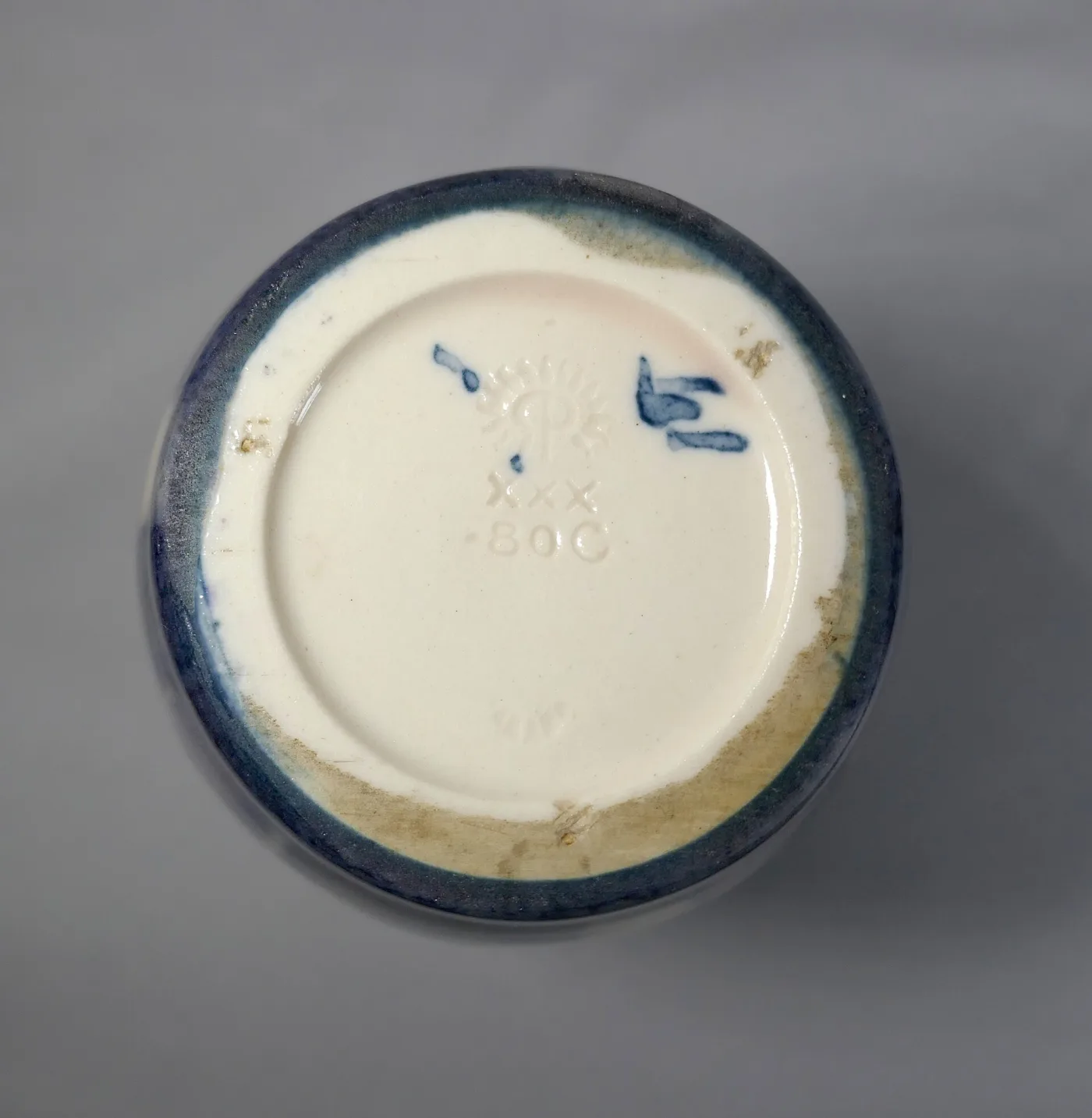
The flame mark — a reversed R-and-P monogram surrounded by flame points — is the single most important identifier on any Rookwood piece. Understanding its evolution lets you immediately narrow down the year range before even reading the date cipher.
Pre-Flame Marks (1880–1886)
The earliest Rookwood pieces bear incised, painted, or impressed marks reading simply "Rookwood" with the full year (e.g., "Rookwood 1882"). Some early experimental pieces have an oval Rookwood stamp or the painted initials "MLN" for Maria Longworth Nichols. These pre-flame pieces are scarce and command strong premiums regardless of condition.
The Standard Flame Mark (1886–1900)
In 1886, Rookwood adopted the reverse R-and-P monogram. From 1886 to 1900, the flame mark appeared without flame points around it — just the monogram. Beginning in 1887, a single flame point was added to mark the year, with one additional flame added each subsequent year. By 1900, the monogram is surrounded by fourteen flame points forming a complete circle of flames.
The Roman Numeral Era (1901–1967)
Starting in 1901, the flame mark stabilized — the monogram with its full ring of fourteen flames — and Roman numerals were placed beneath it to indicate the year. I = 1901, II = 1902, and so on through LXVII = 1967 (the final Starkville year). This Roman numeral system is the easiest and most reliable way to date a Rookwood piece, provided the mark is legible.
Modern Revival Marks (2006–Present)
New Rookwood pieces produced since 2006 use a similar flame mark but with the year shown as an Arabic numeral (e.g., "2018") rather than Roman numerals. Some revival pieces include "Cincinnati, Ohio" or "Rookwood 2006+" notation. These are genuine new Rookwood, not fakes, but they should never be sold as vintage pieces.
Date Ciphers and Roman Numerals
The Rookwood dating system is unusually precise. With the flame mark and Roman numerals together, you can pinpoint the year to within twelve months — a luxury that no other major American art pottery offers consistently.
Reading Pre-1901 Dates
For pieces made between 1887 and 1900, count the flame points around the R-and-P monogram. 1887 = one flame, 1888 = two flames, 1889 = three, and so on. By 1900 the monogram is fully encircled by fourteen flames. Some collectors find this confusing because the early flames look like small tick marks rather than dramatic flames.
Reading Roman Numerals (1901–1967)
Add the Roman numeral to 1900 to get the year. XXV = 25 + 1900 = 1925. L = 50 + 1900 = 1950. Some common examples: V (1905), X (1910), XX (1920), XXX (1930), XL (1940), L (1950), LX (1960). The Roman numerals usually appear directly beneath the flame mark, though on small pieces they may appear elsewhere on the base.
When Dates Are Unreadable
Glaze pooling, base wear, or partial impression can make the date cipher hard to read. In these cases, use secondary evidence: glaze line (Standard suggests pre-1915, Vellum suggests 1904–1948), shape number range, artist signature, and clay body color all narrow the date window. A piece signed by Albert Valentien, for example, cannot be later than 1905 because he left Rookwood that year.
Shape Numbers and Size Letters
Every Rookwood form was assigned a shape number when introduced, and the pottery maintained meticulous shape records that survive in archives today. Shape numbers run roughly chronologically, so a low number indicates an early form while a high number indicates a later one.
The Numbering Sequence
Rookwood shape numbers begin at 1 in 1883 and run sequentially through approximately 7301 by 1967. Numbers below 100 represent earliest forms. Numbers in the 600–900 range correspond to the late 1890s golden age. Numbers in the 2000s and 3000s span the 1910s through 1930s.
Size Letters
A letter following the shape number indicates relative size within that shape family. Letters typically run A (largest) through F or G (smallest), though the exact range depends on how many sizes were produced for that shape. "2090C" means shape 2090 in the third-largest size offered. Some collectors mistakenly read size letters as glaze codes, leading to confusion.
Reference Resources
Several published Rookwood shape books — particularly Herbert Peck's The Book of Rookwood Pottery and Anita Ellis's Rookwood Pottery: The Glaze Lines — illustrate hundreds of shapes with their numbers and date ranges. A serious collector should keep at least one shape reference within arm's reach when examining pieces.
Clay Body Marks and Glaze Codes
Below the flame mark and shape number, Rookwood often inscribed letters or symbols identifying the clay body used and the glaze line applied. These marks let you confirm that a piece is what its glaze surface appears to be — an important authentication check.
Clay Body Letters
Common clay codes include W (white clay, used from 1886), G (ginger), S (sage green clay), Y (yellow), R (red), and O (olive). Some pieces show two letters indicating clay tint variations. Standard Glaze pieces typically used Y or G clay bodies, while Iris and Sea Green were applied over W (white).
Glaze Line Codes
Glaze line codes appear as letters such as V (Vellum), Z (Mat), or specialty codes for limited lines. Standard Glaze, the most common, often has no letter code. The presence of an impressed "V" on a piece with a soft matte vellum surface confirms it as genuine Vellum line rather than a similar-looking modern reproduction.
Decorator Marks and Tally Marks
Small wedge, X, or asterisk marks sometimes appear near the base. These are factory tally marks indicating second-quality pieces (sold at reduced prices through Rookwood's own outlet) or pieces with minor flaws. A piece marked with a wheel-ground X through the flame mark is a factory second — collectible but worth less than a first-quality piece from the same year.
Major Glaze Lines
Rookwood's reputation rests on its glazes. Each major glaze line has a distinctive look, a defined production period, and a different position in the collector market.
Standard Glaze (1884–1909)
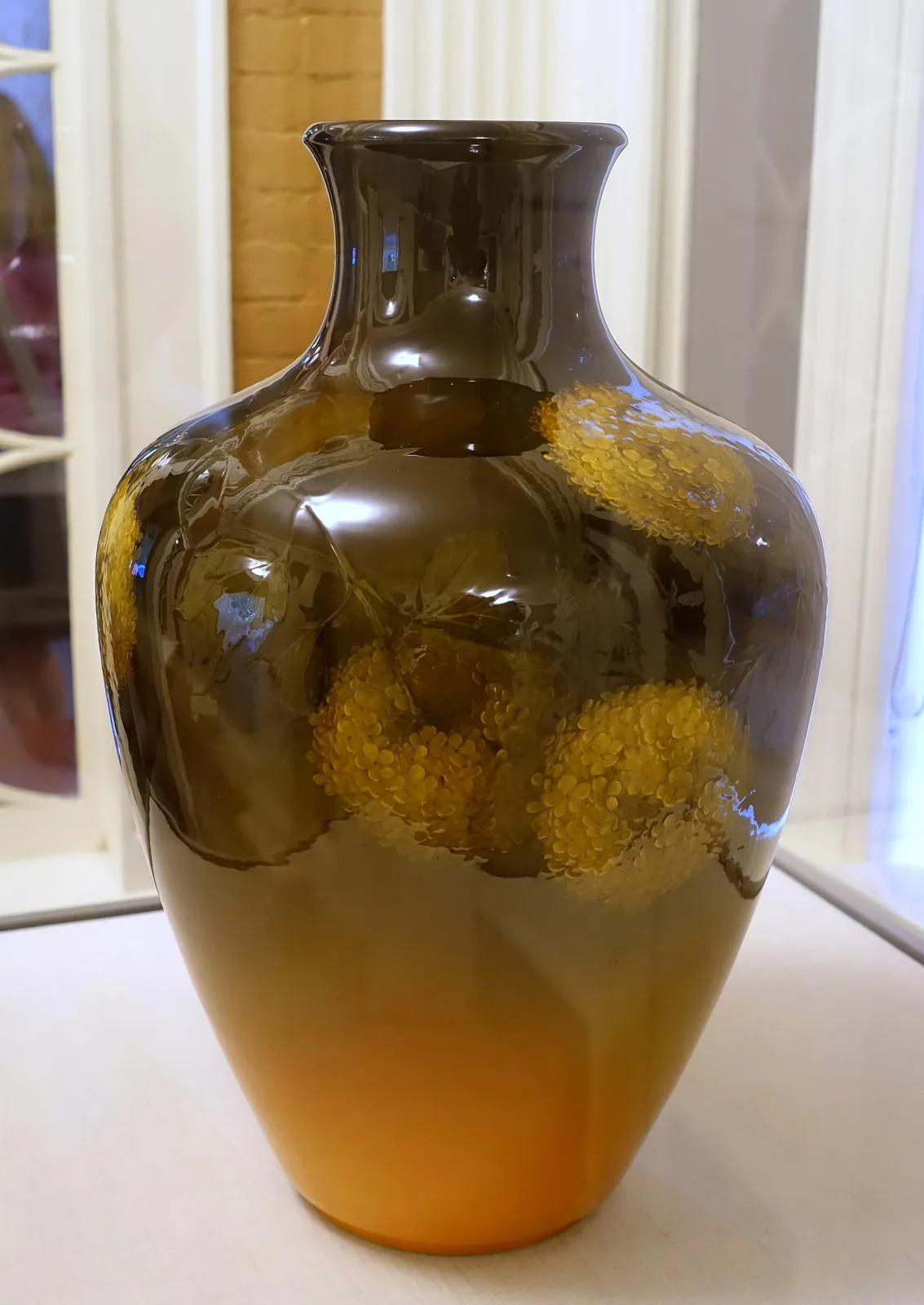
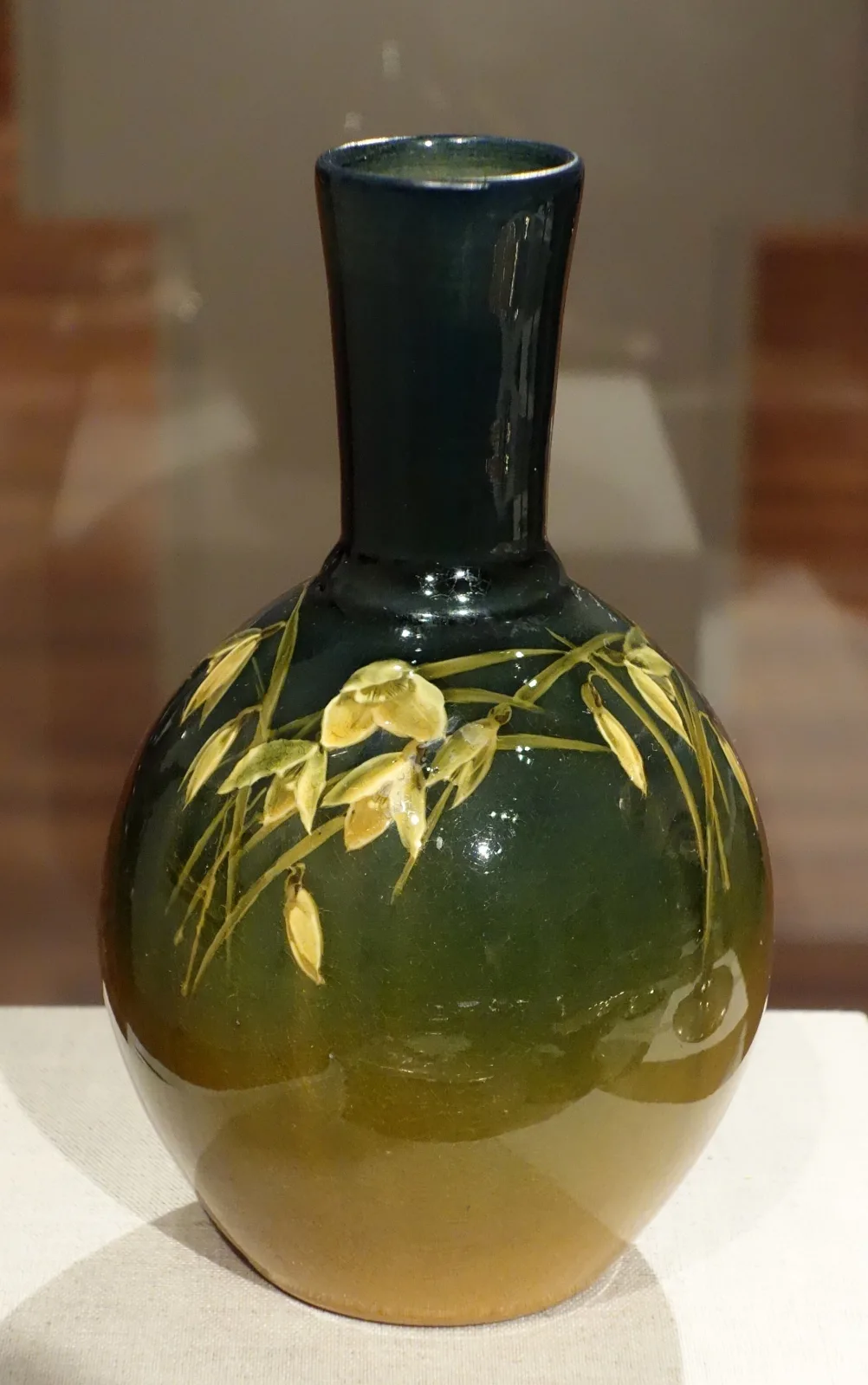
Standard Glaze is the warm-toned, high-gloss glaze most associated with early Rookwood. Pieces show underglaze slip-painted flowers, fruits, or portraits in golds, browns, ochres, and oranges, all covered by a clear yellow-tinged overglaze that gives the surface a luminous depth. Standard pieces are abundant on the market, and prices depend heavily on the decorator and the quality of painting.
Iris Glaze (1894–1912)
Iris is a colorless transparent glaze applied over underglaze decoration on white clay. It produces clear, pastel-toned images — pale blues, pinks, lavenders, and whites — with extraordinary clarity. Iris pieces are far scarcer than Standard and command much higher prices, especially when decorated by leading artists. Black Iris (pieces with dark backgrounds beneath the clear glaze) is the most valuable subtype.
Sea Green Glaze (1894–1904)
Sea Green is a translucent green-tinted glaze that gives underglaze decoration an underwater quality. It was difficult to produce consistently and was discontinued early. Sea Green pieces are scarce and prized.
Aerial Blue (1894–1895)
Aerial Blue is an extremely rare cobalt-decorated line produced for only about a year. Authentic Aerial Blue is one of the rarest Rookwood lines on the market.
Vellum Glaze (1904–1948)
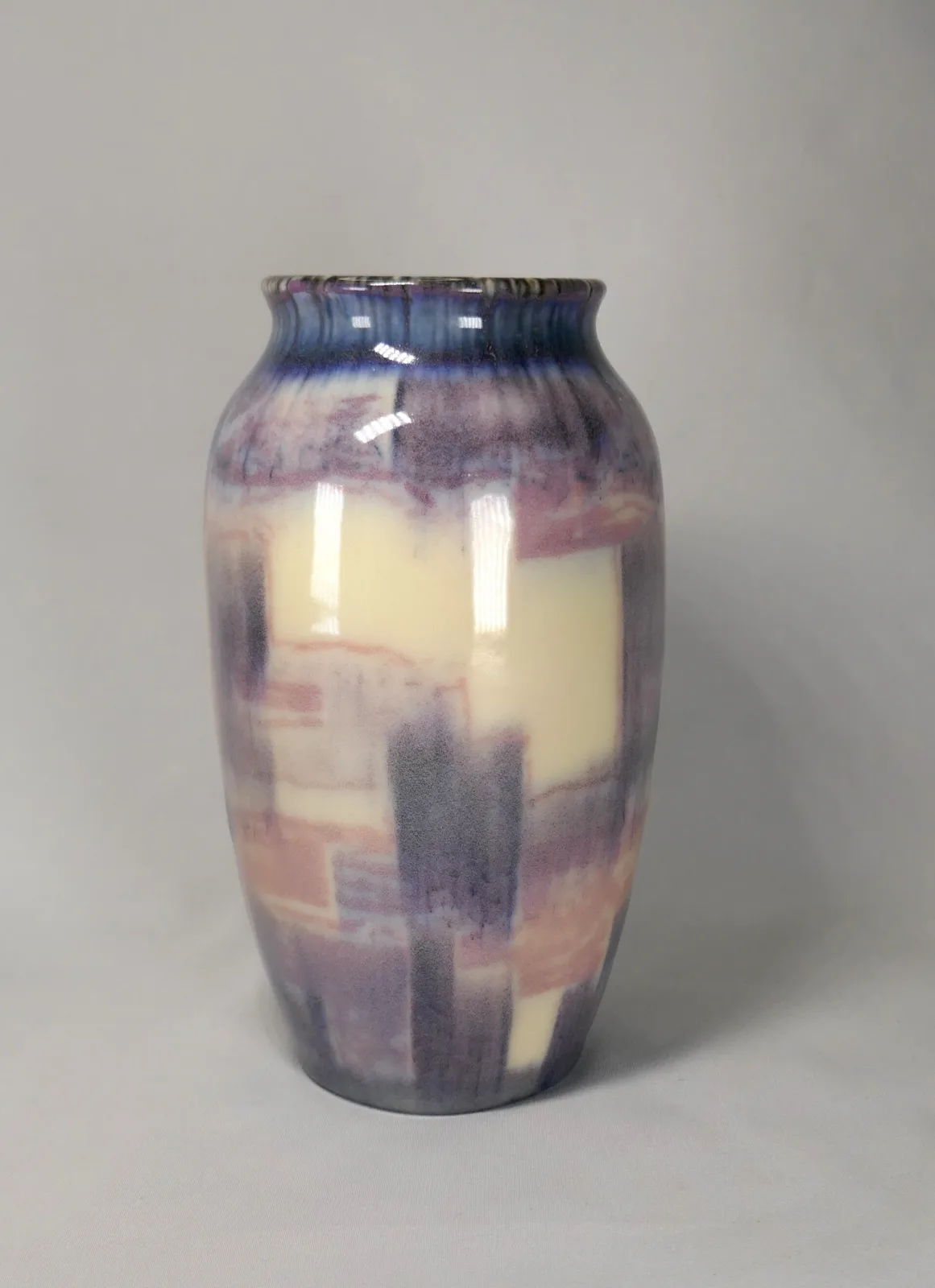
Vellum is a soft, matte transparent glaze that gives Rookwood pieces a velvet-like surface. It was used for painterly landscapes, scenic plaques, and floral compositions. Vellum scenic plaques by artists like E. T. Hurley, Lenore Asbury, and Fred Rothenbusch are among the most desirable Rookwood objects.
Mat and Wax Mat (1900s–1940s)
Mat glazes are opaque matte surfaces in solid colors used for production wares and modeled relief decoration. Wax Mat (developed in the 1920s) is a softer, slightly waxy variant used on decorated pieces. These lines are more affordable entry points than Standard or Vellum decorated pieces.
Production and Mat Production Glazes
From around 1904 onward, Rookwood made undecorated molded production pieces in various Mat colors. These "Production Ware" pieces are signed with the flame mark and date but have no artist signature, since they were not hand-decorated. Production ware represents the most affordable genuine Rookwood available today.
Artist Ciphers and Signatures
Rookwood decorators signed or initialed their work, and the artist's identity is often the single largest factor in a piece's value. A typical example of a competently decorated Standard Glaze vase may sell for $300–600 unsigned or by a minor decorator, but the same piece by Kataro Shirayamadani or Albert Valentien could exceed $5,000.
Where to Find the Signature
Artist signatures or monograms typically appear on the side of the piece (incised into the clay before glazing) or on the base. Side signatures are more common on decorated pieces; base signatures appear on smaller items where side placement would interrupt the design. Use raking light to spot lightly incised marks that disappear in direct illumination.
Recognizing Ciphers
Most Rookwood decorators used a personal cipher — often their initials combined into a single graphic mark — rather than full signatures. Published cipher dictionaries match ciphers to specific artists. Some decorators (like Kataro Shirayamadani) used distinctive logograms; others used simple monograms that can be confused with other artists' marks if you don't have a reference handy.
Production Ware Has No Artist Mark
The absence of an artist cipher does not mean a piece is fake. Production wares — molded pieces with cast decoration, dipped in a single glaze and fired — were never decorated by individual artists and therefore carry no signature. The flame mark and date cipher alone authenticate them.
Notable Rookwood Decorators
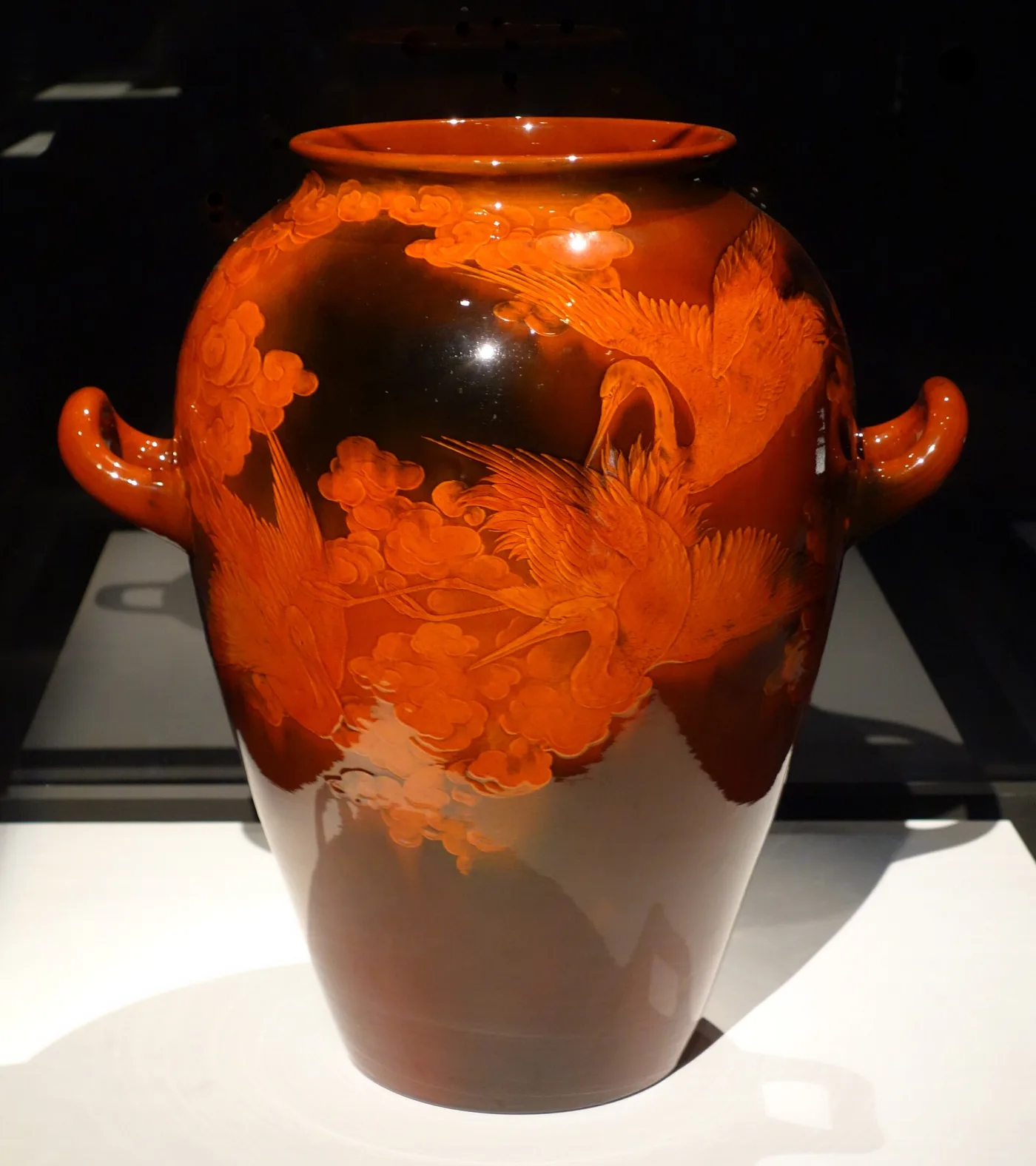
Rookwood employed over a hundred decorators across its Cincinnati period. A handful command the strongest collector following, and learning to recognize their ciphers pays immediate dividends.
Kataro Shirayamadani (1887–1948)
The Japanese decorator Shirayamadani is widely considered Rookwood's greatest artist. His work spans nearly six decades and includes elaborate floral, fish, dragon, and landscape compositions in Standard, Iris, Vellum, and Mat glazes. His pieces consistently set Rookwood auction records.
Albert R. Valentien (1881–1905)
The pottery's first head decorator, Valentien produced thousands of pieces during Rookwood's formative years. His Standard Glaze florals are sought after, and his pieces appear regularly on the market.
Matthew Daly (1884–1903)
Daly specialized in portraits — particularly Native American chiefs and African-American subjects — on Standard Glaze. His finest portrait pieces are among the most expensive Rookwood items ever sold.
E. T. Hurley (1896–1948)
Hurley was Rookwood's master of Vellum scenic plaques. His landscapes of birch forests, harbors, and moonlit scenes define the Vellum aesthetic. Signed Hurley plaques are major collector targets.
Carl Schmidt, Sara Sax, and Fred Rothenbusch
This trio produced exceptional Iris and Vellum work in the early twentieth century. Schmidt's florals, Sax's stylized designs, and Rothenbusch's scenic landscapes all command strong prices.
Lesser-Known Decorators
Many capable Rookwood decorators are less famous but produced quality work. Sallie Coyne, Lorinda Epply, William Hentschel, and Charles Todd all signed pieces that offer accessible entry points into artist-signed Rookwood collecting.
Production vs. Decorated Wares
Rookwood produced two parallel categories of pieces throughout most of its history: hand-decorated art pottery (the prestige line) and molded production wares (the affordable line). Both are genuine Rookwood, but they exist in very different market tiers.
Decorated Wares
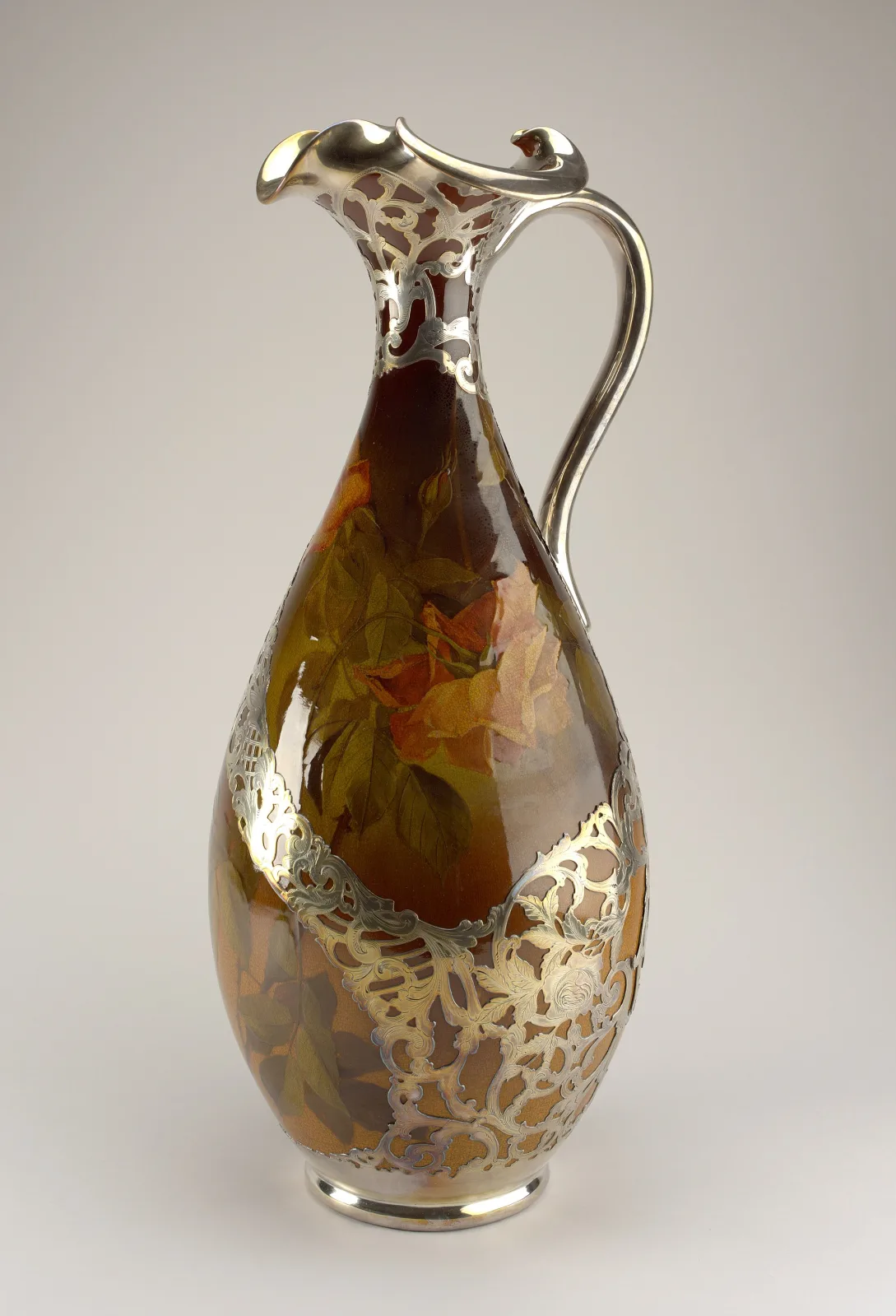
Hand-decorated pieces show underglaze slip painting, incised decoration, or carved relief by an individual artist. They carry an artist cipher, often a glaze line code, and represent the high end of Rookwood production. Prices range from a few hundred dollars for minor pieces to six figures for masterworks.
Production Wares
Production pieces were cast from molds with integral relief decoration, dipped in a single colored Mat glaze, and fired. They were never touched by a decorator. The flame mark, date, and shape number appear on the base; no artist signature is present. Production pieces sell from $50 to several hundred dollars depending on shape, glaze color, and date.
How to Tell Them Apart
Decorated pieces show brush strokes, color variation, and the slightly raised texture of slip painting under glaze. Production pieces show uniform glaze coverage with relief detail formed by the mold itself, not added by an artist. Pieces with crisp molded flowers and a single solid glaze color are almost always production wares.
Rookwood Architectural Faience
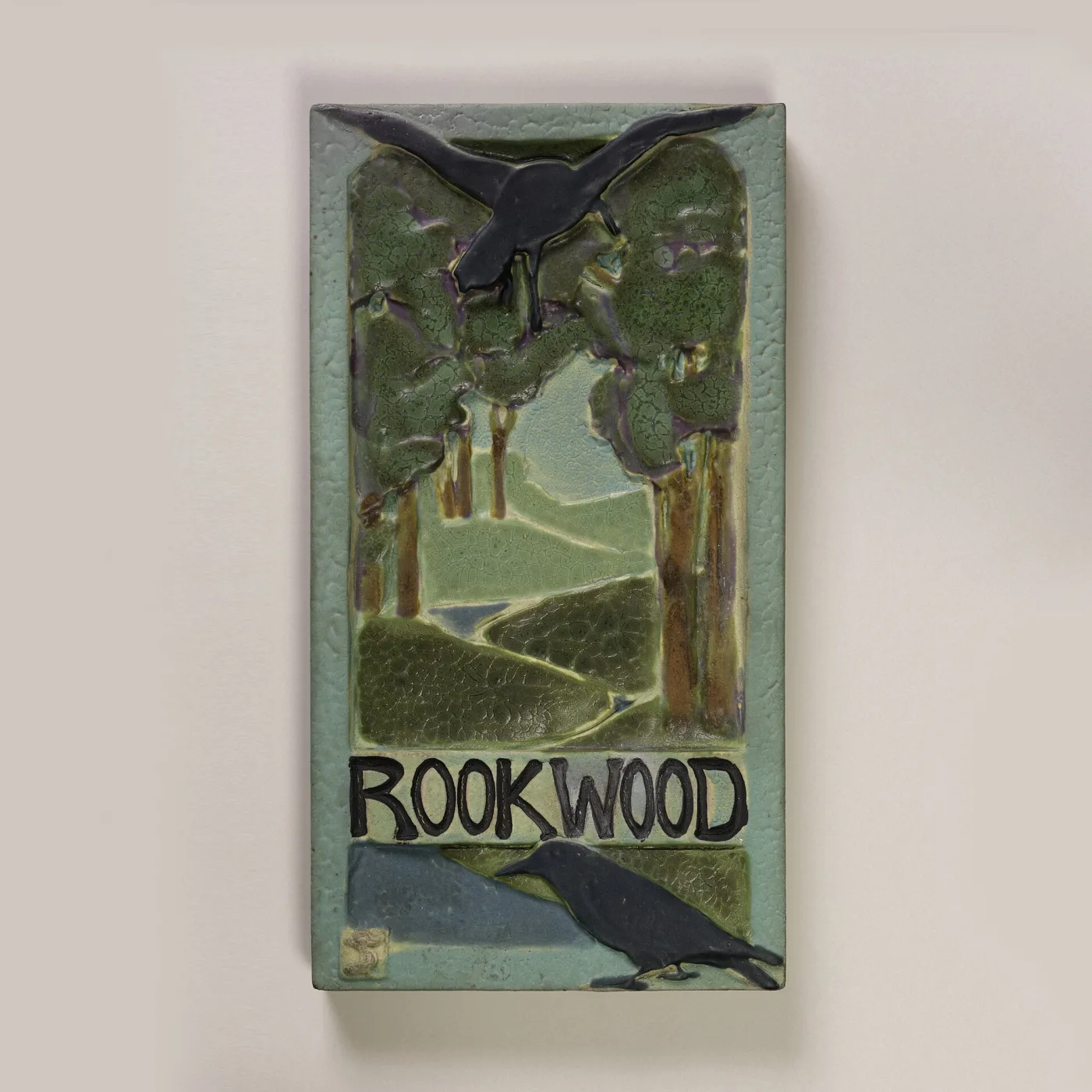
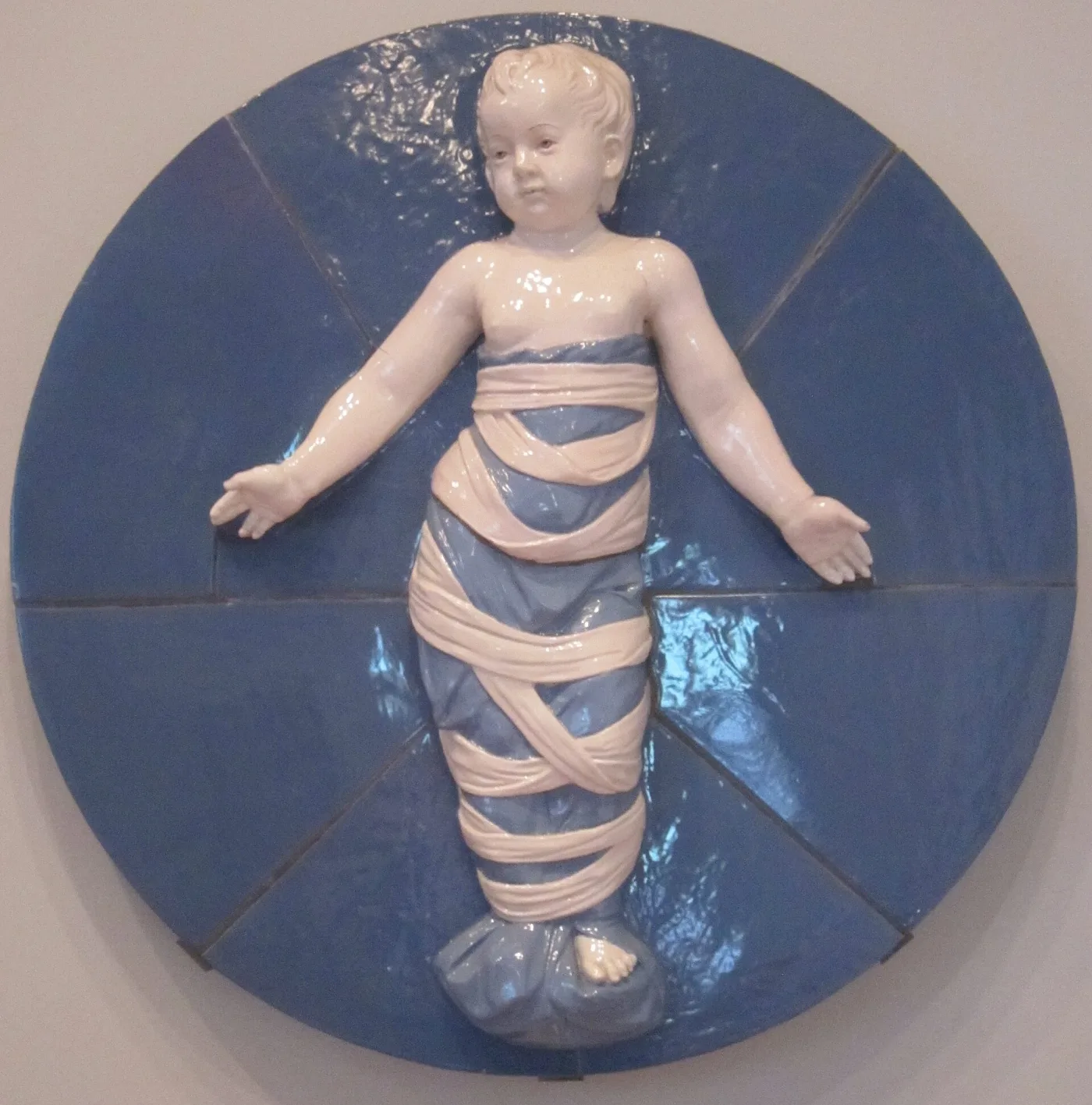
From around 1903 to 1948, Rookwood operated a separate Architectural Faience department producing decorative tile installations for public buildings, hotels, and private homes. Examples remain in place at New York's Grand Central Terminal, the Cincinnati subway, and countless commercial buildings.
Identifying Architectural Pieces
Loose architectural tiles and panels often turn up at salvage operations and antique markets. They typically bear the flame mark on the back along with size and pattern numbers. Tile decoration ranges from simple Mat-glazed color fields to elaborate scenic panels with bird, animal, or floral relief work, similar in feel to other antique decorative tiles.
Faience Bookends and Paperweights
Rookwood also produced small architectural faience objects — bookends, paperweights, doorstops, and figurines — using the same molds and glazes as their tile work. These pieces are popular with collectors because they bring genuine Rookwood quality at modest prices.
Late Cincinnati, Starkville & Revival
Not all Rookwood is equal in collector eyes. Pieces from different eras carry very different valuations even when bearing identical-looking marks.
Late Cincinnati (1930–1959)
After the 1941 bankruptcy, Rookwood continued operating under reduced circumstances. Late Cincinnati pieces still carry the flame mark and Roman numerals but generally lack the artistic ambition of golden age work. Decorated pieces from this period are less common, and production wares dominate.
Starkville Period (1959–1967)
Starkville pieces bear the flame mark with Roman numerals LIX (1959) through LXVII (1967). They typically use a different clay body that fires whiter than Cincinnati clay, and glaze application is often less refined. Many collectors discount Starkville pieces significantly even though they are technically genuine.
Modern Revival (2006–Present)
The revived Rookwood Pottery Company produces new pieces using some of the original molds and glaze formulas. These pieces use Arabic numeral dates and are clearly marked as modern Rookwood. They are collectible in their own right but should never be confused with vintage pieces or sold as such.
Authentication and Detecting Fakes
Because Rookwood prices are high, fakes and misrepresented pieces appear regularly in the market. Several authentication checks separate genuine pieces from problem ones.
Verify the Flame Mark Is Impressed, Not Painted
Authentic Cincinnati flame marks are impressed into the clay before firing, leaving a slightly recessed mark that captures glaze in its lines. Painted-on marks, transfers, or marks that sit on top of the glaze are immediate red flags. Examine the mark under raking light to confirm it was made in the clay, not added after firing.
Cross-Check Date, Shape, Glaze, and Artist
Every legitimate Rookwood piece should be internally consistent. If a piece is signed by an artist who died in 1905 but bears a Roman numeral indicating 1925, something is wrong — either the date or the signature has been altered. Similarly, a Vellum glaze code on a piece dated 1895 is impossible because Vellum was not introduced until 1904. Use a Rookwood reference book to confirm that all elements agree.
Watch for Altered Pieces
A more sophisticated form of deception involves taking a genuine but undistinguished piece and adding a forged artist signature to inflate its value. Examine signatures with a loupe: authentic ciphers are incised into the clay before glazing and the glaze flows continuously into the incision. Forged signatures scratched through finished glaze leave bright clay-colored lines and disturbed glaze edges.
Beware Reproductions and Studio Pieces
Some 1980s and 1990s studio potters produced Rookwood-style pieces without intending fraud, but these sometimes acquire false attributions in later sales. Pieces lacking any flame mark but described as "Rookwood style" should be priced as such — not as genuine Rookwood. Comparing suspect pieces against documented examples, much as collectors do when authenticating provenance for other antiques, is the surest path to confidence.
Condition, Damage & Restoration
Condition affects Rookwood values significantly, though the market accepts certain age-related issues more readily than equivalent problems on other ceramics.
Crazing
Fine surface cracks in the glaze (crazing) appear on most Rookwood pieces over a century old, particularly Standard Glaze. Light, even crazing is generally accepted and does not heavily discount value. Heavy crazing with staining or active flaking is more problematic.
Chips, Cracks, and Hairlines
Rim chips, base chips, and hairline cracks reduce values significantly. A through-body crack on a decorated piece can cut its value in half or more. Tiny rim flakes on production wares are more tolerated than on signed decorated pieces.
Restoration Detection
Examine pieces under ultraviolet light to detect restoration. Modern restoration materials typically fluoresce differently than original Rookwood glazes. Painted-over chips, filled cracks, and repaired rims all show under UV. Run a fingernail across glaze surfaces; restoration usually feels slightly different in texture from the original.
Factory Seconds
Pieces with a wheel-ground X through the flame mark are factory seconds — sold by Rookwood at reduced prices because they failed first-quality inspection. They are collectible but typically trade at 50–70 percent of equivalent first-quality pieces.

Value Factors and Price Ranges
Rookwood values respond to a predictable combination of factors. Understanding their relative weight helps collectors evaluate any piece quickly.
Artist Signature
Artist identity is the strongest single value driver for decorated pieces. A Shirayamadani vase commands many multiples of an equivalent piece by a less famous decorator. Anonymous or minor-artist pieces still hold value but at much lower price points.
Glaze Line
Vellum scenic plaques, Iris pieces (especially Black Iris), Sea Green, and Aerial Blue rank highest among glaze lines. Standard Glaze is more abundant and typically less expensive per equivalent quality. Mat and Wax Mat fall somewhere between, with Mat Production at the lowest tier.
Decoration Quality and Subject
Within any artist's body of work, ambitious subjects — portraits, scenic plaques, large florals, animal subjects — command more than simple repeating motifs. Rare subject matter (Native American portraits, fish, dragons) drives the highest prices.
Size and Shape
Larger pieces generally bring more than smaller ones in the same line. Unusual or scarce shapes — including bottle forms, ewers, and the largest vases — bring premiums. Jardinieres and pedestal sets in Rookwood are scarce and valuable.
Current Market Tiers
As a rough guide: Production wares typically run $75–400. Anonymous or minor-artist decorated pieces run $300–1,500. Pieces by recognized artists in good glaze lines run $1,000–8,000. Top-tier Vellum plaques, Iris pieces by leading artists, and rare subjects regularly exceed $10,000, with the very best Rookwood selling above $100,000 at auction. For broader market guidance, see our antique valuation and appraisal guide.
Building a Rookwood Collection
Rookwood offers entry points at every price level, and a strategic approach helps collectors maximize both enjoyment and long-term value.
Choose a Focus
Many collectors specialize: a single decorator, a single glaze line, a single subject matter (florals, scenics, animals), or a specific date range. Focus deepens expertise and helps you recognize value others overlook.
Start with Production Ware
If decorated pieces feel out of reach, start with production wares to build familiarity with the flame mark, date system, and shape numbers. Once you can read a Rookwood base confidently, you can graduate to decorated pieces with more confidence.
Use Reference Books
Herbert Peck's The Book of Rookwood Pottery, Anita Ellis's Rookwood Pottery: The Glaze Lines, and Riley Humler's auction-focused references should be in every collector's library. The Cincinnati Art Museum maintains the largest public Rookwood collection and offers helpful comparative material.
Buy From Reputable Sources
Established auction houses (Cincinnati Art Galleries, Treadway, Rago, and Cowan's are Rookwood specialists), pottery-specific dealers, and major antique shows offer the most reliable sources. Online marketplaces require extra diligence — request multiple base photographs and verify date, glaze, artist, and shape consistency before bidding.
Document Your Collection
Photograph each piece's body and base, record purchase information, and note any reference book illustrations of identical or closely related examples. Documentation supports insurance, estate planning, and eventual resale.
Care, Display, and Preservation
Properly cared for, Rookwood pieces survive indefinitely. A few simple practices protect both the ceramic and its value.
Handling
Always lift pieces from the body, never by handles, rims, or projecting decoration. Support large pieces with both hands. Remove rings and bracelets when handling decorated pieces to prevent accidental scratches.
Cleaning
Dust pieces with a soft brush. When deeper cleaning is needed, use lukewarm water with a few drops of mild dish soap, then dry thoroughly with a soft cloth. Never use abrasive cleaners, harsh detergents, or ultrasonic cleaning. Avoid soaking pieces with active crazing, as water can seep into the body through glaze fissures.
Display Conditions
Keep Rookwood out of direct sunlight, which can fade some glazes over decades. Maintain stable temperature and humidity; sudden swings stress glazed surfaces. Secure tall vases with museum wax or earthquake gel in seismically active regions.
Storage
Wrap stored pieces individually in acid-free tissue and place them in stable, padded containers. Never stack pieces directly together. Photograph everything before storage so any condition changes can be documented later.
Insurance
Valuable Rookwood collections deserve scheduled insurance coverage with current appraised values. Update appraisals every five to ten years to reflect market changes, and keep documentation off-site or in cloud storage so it survives any incident affecting the collection itself.