Antique Fenton Art Glass Identification Guide: Marks, Colors, Patterns, and Dating
The Fenton Art Glass Company, founded in 1905 by brothers Frank L. and John W. Fenton, is the most prolific and longest-running American art glass maker of the twentieth century. From its plant on the bank of the Ohio River at Williamstown, West Virginia, Fenton produced hundreds of millions of pieces across more than a hundred named patterns and dozens of distinctive colors before the factory closed its main production lines in 2011 — a span of 106 years that essentially traces the history of pressed and blown American art glass through the twentieth century. Almost every American household of the twentieth century owned at least one Fenton piece, and almost every antique mall today has a Fenton shelf.
Identifying Fenton means working through a fixed sequence of clues: the color of the glass (and whether it is opal, opaque, transparent, iridescent, or cased), the pattern (hobnail, coin dot, thumbprint, diamond lace, and dozens more), the form (vase, bowl, basket, lamp, figurine), the decorating treatment (crests, hand-painted decoration, overlays), and most decisively the mark — which after 1970 is an embossed oval logo and before 1970 was almost always a paper sticker, now usually missing. Reading these layers in combination places almost any Fenton piece within a tight production window and a specific factory line.
This guide covers Fenton's full chronology from the 1905 founding through the 2011 closure and the post-2011 trademark licensing era. It treats the major color families (carnival glass, milk glass, hobnail, Burmese, cranberry, custard, chocolate, opalescent, slag, black amethyst), the signature patterns, the crest treatments, the hand-painted decorating program, the mold mark and signature system, the relationship to other West Virginia and Ohio glass houses, the major reproduction concerns, condition assessment, the working valuation framework, and care of Fenton pieces. By the end you should be able to confidently identify Fenton glass at flea markets, estate sales, and online auctions, and place each piece within its production era.
Table of Contents
- A Short History of Fenton Art Glass
- Marks, Stickers, and the Oval Logo
- Carnival Glass — Fenton's First Hit
- Hobnail and Milk Glass
- Color Families and Glass Types
- Crest Treatments
- Signature Patterns
- Hand-Painted Decorating Program
- Forms and Categories
- Dating Fenton by Catalog and Mark
- Reproductions, Fantasy Pieces, and Lookalikes
- Condition Assessment
- What Drives Value
- Care and Display
- Common Beginner Mistakes
- Frequently Asked Questions
A Short History of Fenton Art Glass
Frank L. Fenton and his brother John W. Fenton incorporated the Fenton Art Glass Company in 1905 in Martins Ferry, Ohio, initially as a glass decorating shop buying blanks from other factories and applying their own painted decoration. By 1906 they had outgrown the rented Martins Ferry quarters and built their own glass plant across the Ohio River at Williamstown, West Virginia — the site Fenton occupied for the next 105 years. The first piece of Fenton-made glass came out of the Williamstown plant on January 2, 1907.
The Carnival Glass Era (1907–1925)
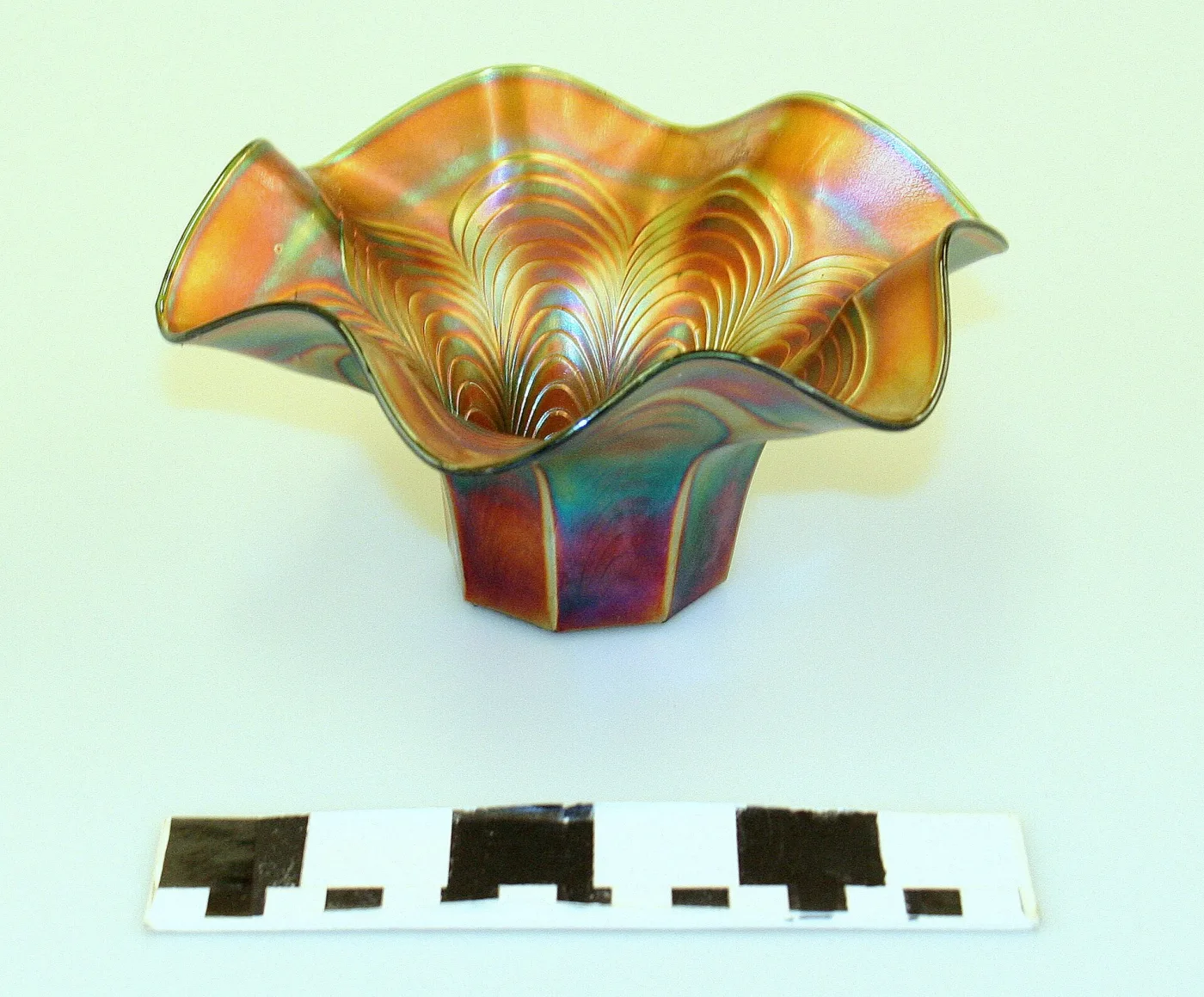
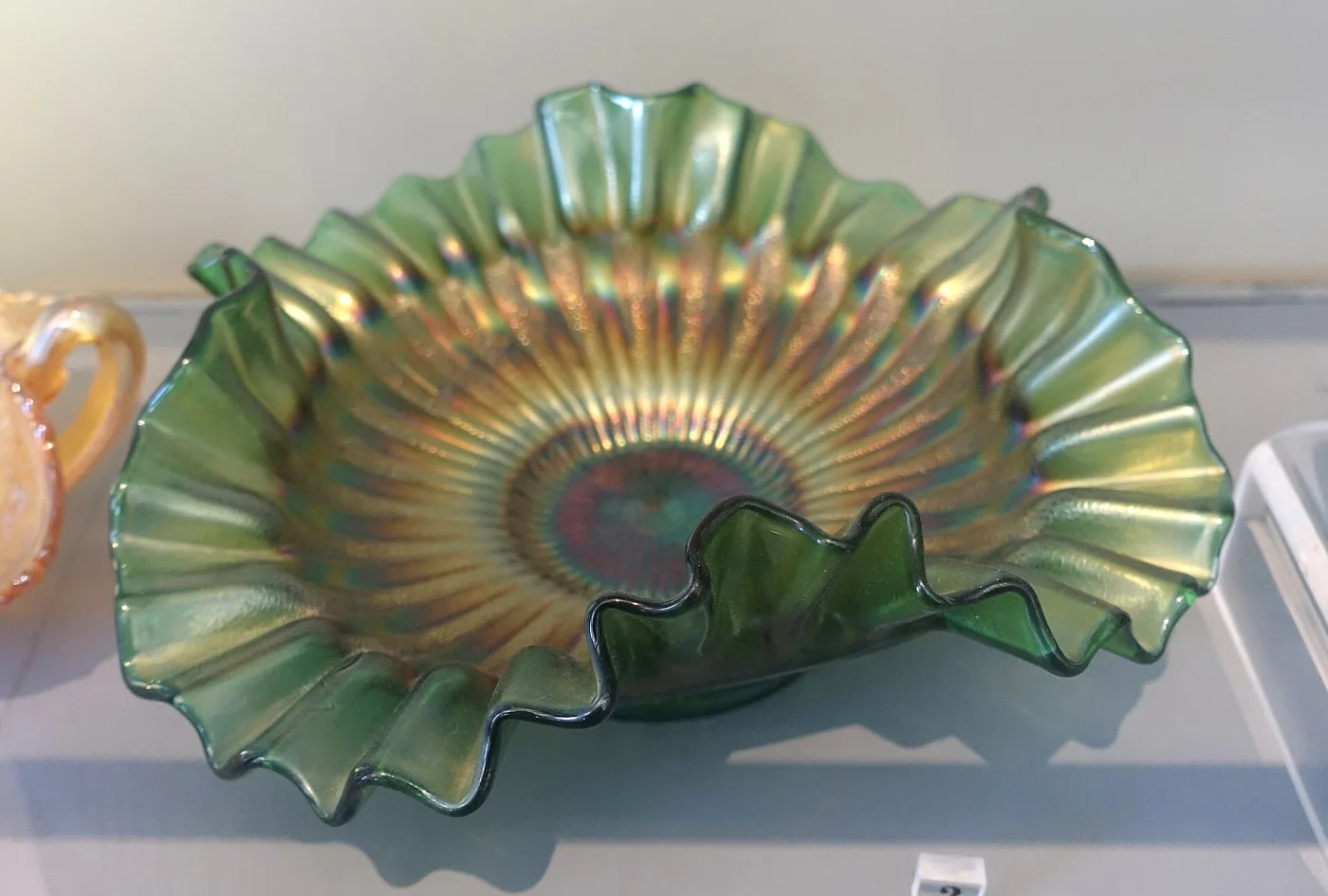
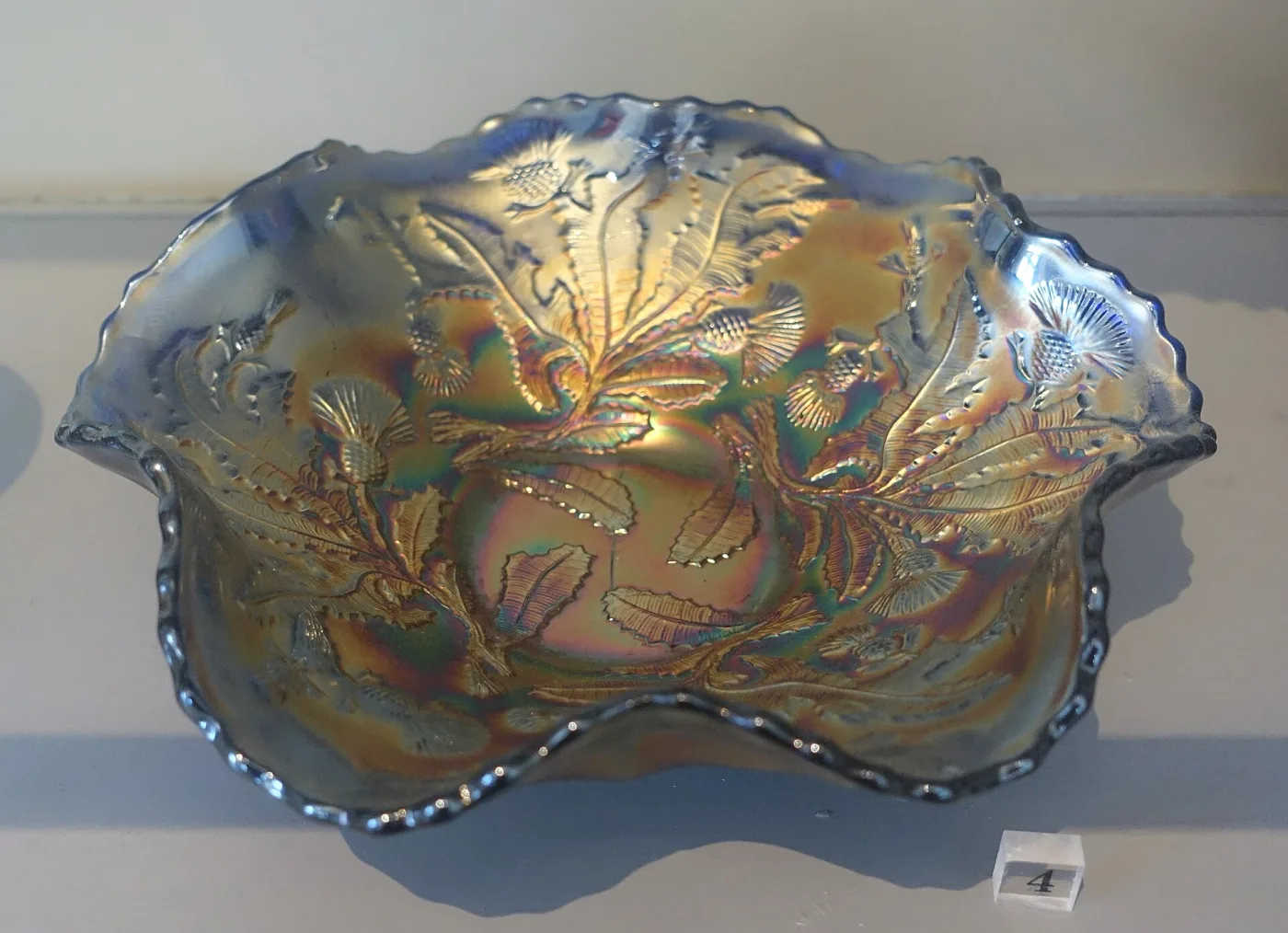
Fenton's first commercial hit was iridescent pressed glass — what collectors now call carnival glass. Fenton developed its "iridescent ware" in 1907, marketed it heavily, and dominated the carnival market for nearly two decades. The factory produced hundreds of carnival patterns in a wide range of base colors (marigold being the most common, plus amethyst, green, blue, red, and white). Fenton was not the only carnival glass maker — Northwood, Imperial, Millersburg, and Dugan also made carnival — but Fenton was the largest. The carnival glass market collapsed by the mid-1920s; Fenton survived where some competitors did not. For broader iridescent context see our antique carnival glass identification guide.
The Stretch and Opaque Era (1916–1935)
As carnival declined, Fenton developed "stretch glass" (an iridescent treatment with a stretched-onionskin surface texture), introduced opaque colored glass, and developed early opalescent and overlay techniques. The 1920s and 1930s also saw the introduction of jadite-like green, custard yellow, chocolate brown, and black amethyst (a very dark purple that appears black until held to strong light).
The Hobnail and Milk Glass Era (1939–1980s)
In 1939 Fenton introduced its French Opalescent Hobnail line — milk-edged, white-pebbled hobnail glass that became the company's all-time best seller. Hobnail dominated Fenton production from 1939 through the 1980s; if you know one Fenton piece by sight, it is probably hobnail. Milk glass (opaque white) hobnail, French opalescent (translucent with white edges), cranberry hobnail, and dozens of other treatments together account for the great majority of mid-century Fenton output. For the broader milk glass tradition see our antique milk glass identification guide.
The Crest and Hand-Painted Era (1940s–2000s)
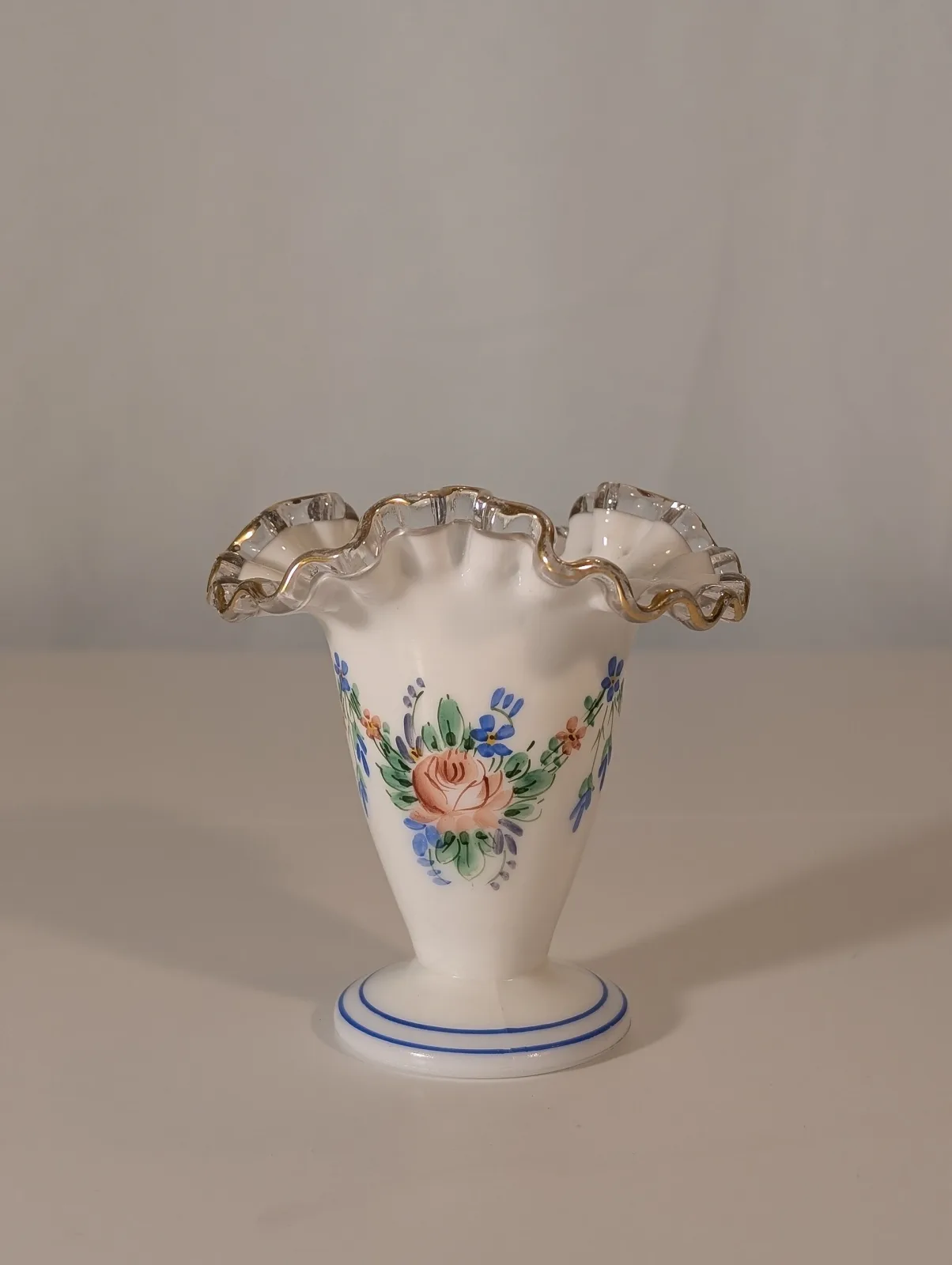
Crest treatments — clear or colored ruffled rims applied to opaque or opalescent bodies — emerged in the 1940s with Silver Crest (white body, clear ruffle) and expanded to Aqua Crest, Emerald Crest, Gold Crest, Peach Crest, and others. From the 1970s a major hand-painted decorating program (florals, country scenes, signed by individual artists at the factory) added a collectible signature dimension to standard production shapes.
Closure and Aftermath (2007–2011)
Production declined through the 2000s as competition from Asian glass and changing decorative tastes eroded Fenton's market. The company stopped its core handmade glass production in summer 2011, retaining only a small jewelry and giftware operation that licensed the Fenton name. The 2007–2011 closing-year pieces are now collectible in their own right. The Fenton family continued to operate a smaller business doing made-to-order pieces from existing molds for several years afterward; some 2010s and 2020s pieces marked "Fenton" were made by other factories under license. For broader American glass-house context see our antique glass identification guide.
Marks, Stickers, and the Oval Logo
Marking is the single most decisive identification clue for Fenton, and the system has changed significantly across the century.
Pre-1970: Paper Stickers Only
Before 1970 Fenton did not mold or etch a permanent mark into the glass. Identification on pre-1970 pieces depended on a paper sticker — silver foil with red or black lettering for most of the period, with several distinct sticker designs across decades. A 1950s hobnail bowl that still has its original silver-and-red "Fenton" foil sticker is a happy find; almost all such stickers have washed off, fallen off, or been removed. The absence of a mark on a pre-1970 piece is normal and does not in itself argue against Fenton attribution.
1970–1983: Embossed Oval "Fenton" Logo
Beginning in 1970 (introduced gradually through 1971), Fenton added an oval logo embossed into the glass, with the script word "Fenton" inside an oval outline. This is the standard mark for the bulk of late-twentieth-century Fenton production. The oval is normally on the underside of the foot or base.
1983–2011: Oval with Number
From 1983 a small number was added below or near the oval to indicate the decade — "8" for the 1980s, "9" for the 1990s, "0" for 2000–2009, "1" for 2010–2011. This is an extremely useful dating tool for late Fenton: an oval logo with no decade number is 1970–1982; with an "8" is 1980s; with a "9" is 1990s; with a "0" is 2000s; with a "1" is 2010s.
Special Marks
- Sandblasted "Fenton" signature: on some hand-painted pieces, an additional sandblasted Fenton signature on the base.
- Artist signatures: hand-painted pieces are normally signed by the decorator with an initial or full name on the body or base of the piece.
- "OVG" mark: from the 1980s and 1990s, the Olde Virginia Glass mark (a separate Fenton subsidiary line) appears on some pieces.
- "F" in oval: on pieces made by Fenton for other distributors, sometimes with a different mark.
Reproduction Concerns
Fake Fenton oval marks have been added to non-Fenton pieces, particularly on cheaper carnival glass reproductions from Asia. Genuine Fenton oval marks are crisp, well-positioned, and consistent across pieces of the same line. A blurry, oddly placed, or unevenly embossed oval is suspect.
Carnival Glass — Fenton's First Hit
Fenton's carnival glass (1907 to about 1925, with revivals later) is one of the major collecting categories of American glass.
What Carnival Glass Is
Pressed glass that has been sprayed with a metallic salt solution while hot, producing a shimmering iridescent surface in oil-slick rainbows of color over a base color. The base color shows through to the underside of the piece (which is normally not iridized). To check the base color, hold the piece up to a strong light and look at the un-iridized underside.
Fenton Base Colors
- Marigold: orange-amber base, the most common Fenton carnival color.
- Amethyst (purple): dark purple base, second most common.
- Green: medium green base.
- Blue (cobalt): dark blue base, valuable.
- Red: rare and very valuable; Fenton red carnival is one of the most expensive Fenton categories.
- White (clambroth): very pale milky base with iridescence; uncommon.
- Aqua opalescent: aqua base with milky opalescent edges; rare and highly collectible.
Major Fenton Carnival Patterns
Fenton produced hundreds of carnival patterns. The most collectable include: Orange Tree (with a tree-of-life pattern), Peacock and Urn, Dragon and Lotus, Persian Medallion, Hearts and Flowers, Stag and Holly, Lion (a low bowl with a standing lion in the center), and the famous Goddess of Harvest bowl (extraordinarily rare, with only a handful known).
Modern Fenton Carnival
Fenton revived carnival glass production in the 1970s, often in new colors not made in the original era and from new molds or modified old molds. Modern Fenton carnival (1970–2011) is collectable in its own right but should not be confused with original 1907–1925 production; the oval mark settles the question.
Hobnail and Milk Glass
Hobnail is the single defining Fenton pattern for most collectors, accounting for the bulk of mid-century output.
What Hobnail Is
Pressed glass with a regular pattern of small raised round bumps ("hobnails") covering the body. The pattern dates back to nineteenth-century pressed glass; Fenton's particular execution of it, beginning in 1939, became the company's signature.
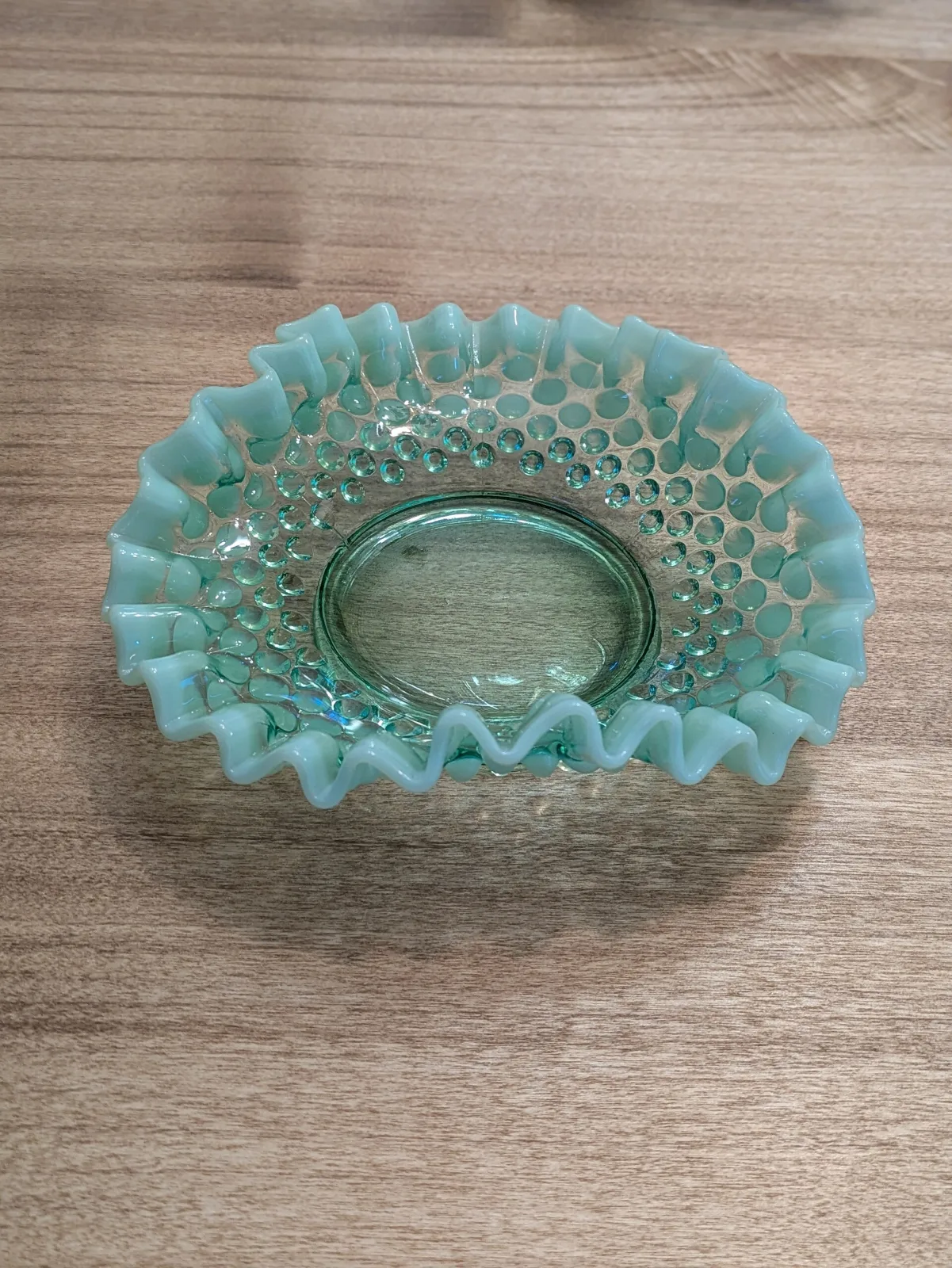
French Opalescent Hobnail
Clear glass with milky white edges and tips on the hobnails — a translucent, glowing effect when held to light. Produced from 1939 onward; the original Fenton hobnail line.
Milk Glass Hobnail
Opaque white glass with full hobnail pattern. The volume product of the 1950s and 1960s, made in vases, bowls, baskets, candlesticks, lamp shades, candy dishes, ashtrays, and dozens of other forms.
Cranberry Hobnail
Pink-red transparent glass with white opalescent hobnail tips — a luxury-grade Fenton hobnail treatment, hand-blown rather than pressed in many pieces, more expensive when new and now substantially more valuable than milk-glass hobnail. For broader cranberry-glass context see our antique cranberry glass identification guide.
Other Hobnail Colors
Blue opalescent, plum opalescent, topaz opalescent, ruby (transparent red), green, amber, custard, lime — Fenton produced hobnail in essentially every color they made over the line's seventy-year run. The catalog reissues from year to year mean the same form (a 6.5-inch hobnail vase, for example) exists in dozens of color variants.
Color Families and Glass Types
Fenton color identification is critical because the same form appears in many colors, and color drives value.
Burmese
A heat-sensitive glass that shades from pale yellow at the base to pink at the rim, achieved by reheating selected areas — the same reactive-striking principle behind transparent amberina glass. Fenton's Burmese (1970–2011, with earlier Burmese-style production) is one of its most distinctive premium lines, often hand-painted with floral decoration. Glossy and satin (matte) finishes both exist.
Custard Glass
Opaque pale yellow glass, sometimes hand-painted with decoration. A late-nineteenth-century glass type that Fenton revived in the twentieth century; see our custard glass identification guide for makers, marks, and dating clues.
Chocolate Glass
Opaque caramel-brown glass with marbled streaks. Fenton produced a small line of chocolate-glass pieces, mostly in the early-twentieth-century period, now uncommon and collectible.
Black Amethyst
Very dark purple that appears black except when held to bright light, when the deep purple shows through. Fenton's black amethyst has a slight purple edge visible at thin sections (rims, handles) and is distinguishable from true black opaque glass by this test.
Opalescent Glass
Glass with milky white opalescent edges that appear when the piece is reheated and the edges shock-cool. French opalescent (clear body, white edges), blue opalescent, plum opalescent, topaz opalescent, and cranberry opalescent are the major variants.
Vasa Murrhina
An Italian-inspired technique with cased glass containing colored and metallic flecks suspended in clear glass. Fenton's Vasa Murrhina line (1964–1968) is a specific collectible subcategory.
Slag Glass
Marbled opaque glass with two colors swirled together. Fenton's purple slag and chocolate-and-white slag pieces are distinctive. For the broader slag tradition see our antique slag glass identification guide.
Karnak Red, Mongolian Green, and Other Art Glass Colors
Fenton produced several short-run art-glass colors in the 1920s and 1930s — Karnak Red (a deep iridized red), Mongolian Green (a pale jade), and Mandarin Red (vivid orange-red). These pre-1940 art glass pieces are uncommon and substantially more valuable than later production.
Spatter and Overlay
Spatter glass has random colored chips or flecks fused into clear glass; overlay glass has a colored layer cased over a different colored interior. Both techniques appear at Fenton in various decades.
Crest Treatments
Crest pieces — opaque or opalescent bodies with a clear or differently-colored crimped ruffle applied to the rim — are a distinctly Fenton category.
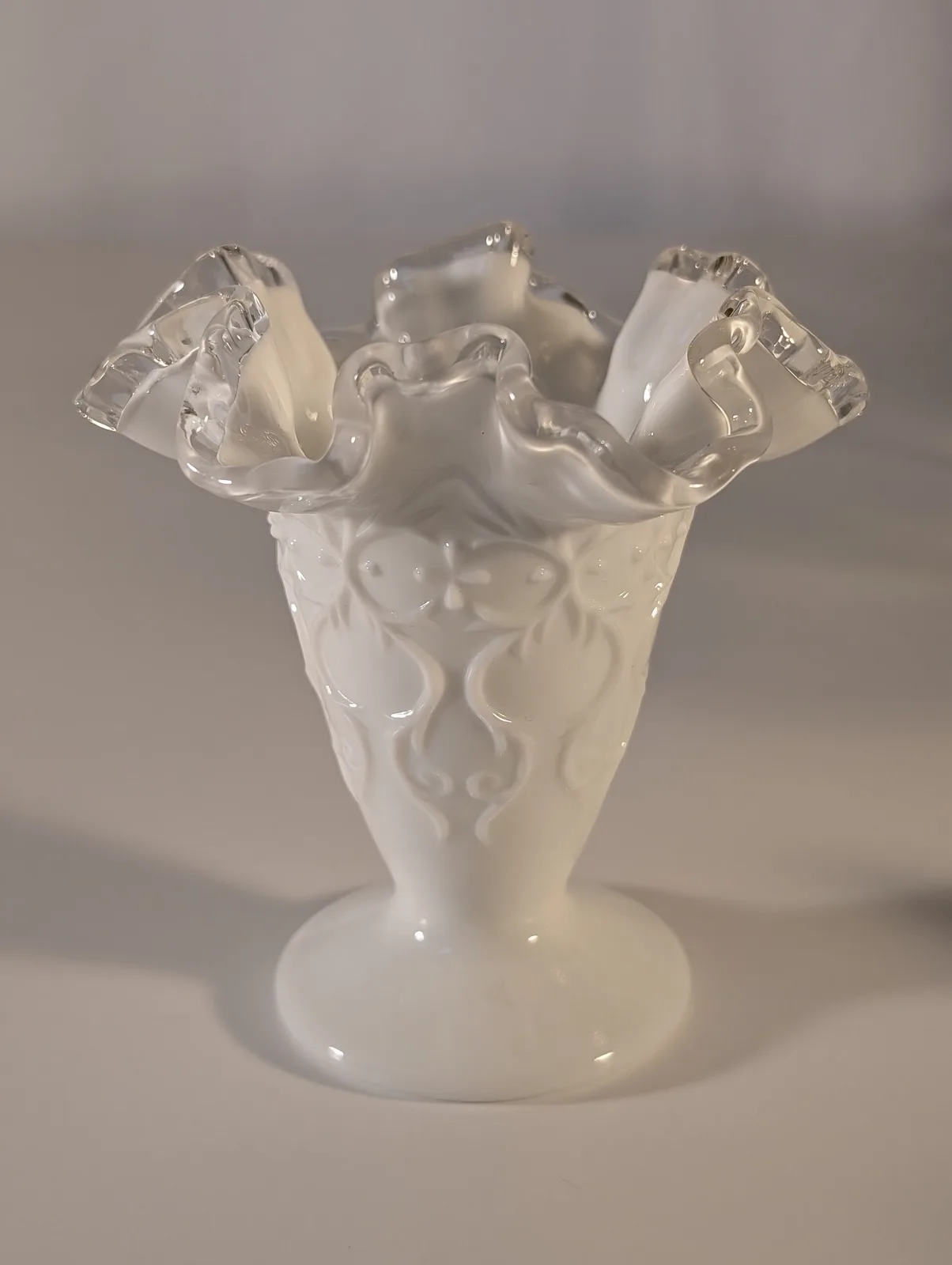
Silver Crest (1943–present)
Milk-glass body with a clear glass crimped ruffle. The original and most prolific crest treatment; produced essentially throughout the modern Fenton era. Common forms: bowls, vases, baskets, candy dishes, candlesticks, comports.
Aqua Crest
Milk-glass body with an aqua (light blue-green) crimped ruffle.
Emerald Crest
Milk-glass body with an emerald-green crimped ruffle.
Gold Crest
Milk-glass body with an amber/gold crimped ruffle. Less common than silver or aqua.
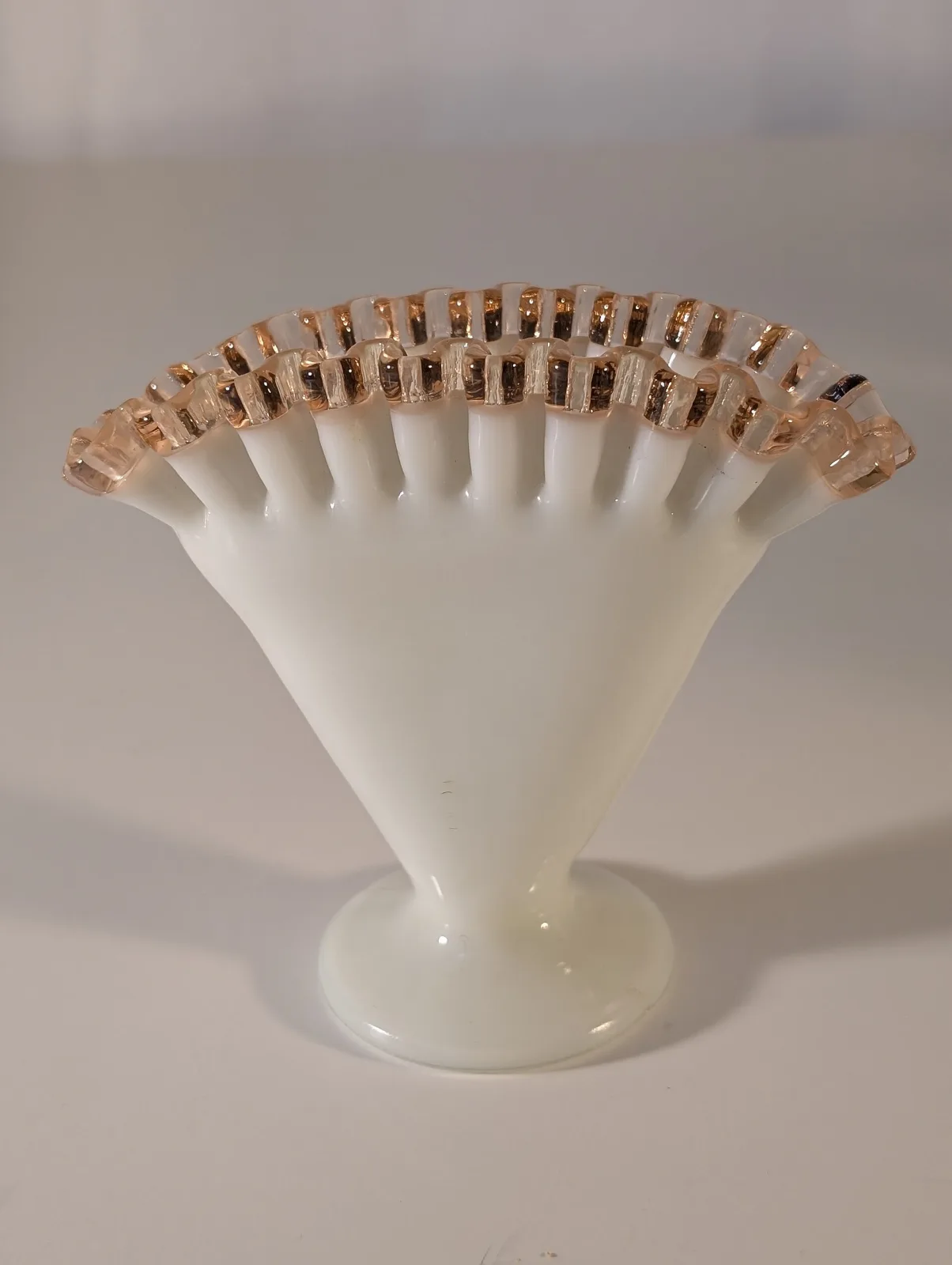
Peach Crest
Pink (peach blow) body with a clear crimped ruffle. A more elaborate variant; the body itself is a peach blow gradient (white interior, pink exterior cased glass).
Crystal Crest, Black Crest, Ivory Crest
Less common variants. Black Crest (milk body, black ruffle) is particularly striking and collectible.
Identifying Crests
Genuine Fenton crests are smooth-fused — the ruffle is fused to the body without a visible joint line, and the crimping is regular and crisp. Reproduction or non-Fenton crests sometimes show a join line or have less regular crimping.
Signature Patterns
Beyond hobnail, Fenton produced dozens of named patterns. Recognizing the major ones speeds identification.
Coin Dot
Pattern with regularly spaced round dots (smaller than hobnails, more sparsely arranged) often in opalescent or cranberry glass. Distinctive and collectable.
Thumbprint
Pattern with regular oval indentations ("thumbprints") pressed into the glass. Variants include Daisy and Button (a Victorian-revival pattern with stars and ovals).
Diamond Lace
Open lattice diamond pattern, often as the body or as an applied decoration on an epergne or basket.
Vasa Murrhina
Italian-inspired flecked pattern (covered in the colors section).
Spiral Optic and Rib Optic
Internal optic patterns where the glass is moulded with internal spirals or vertical ribs that show through the wall as light catches them. A subtle but elegant Fenton signature.
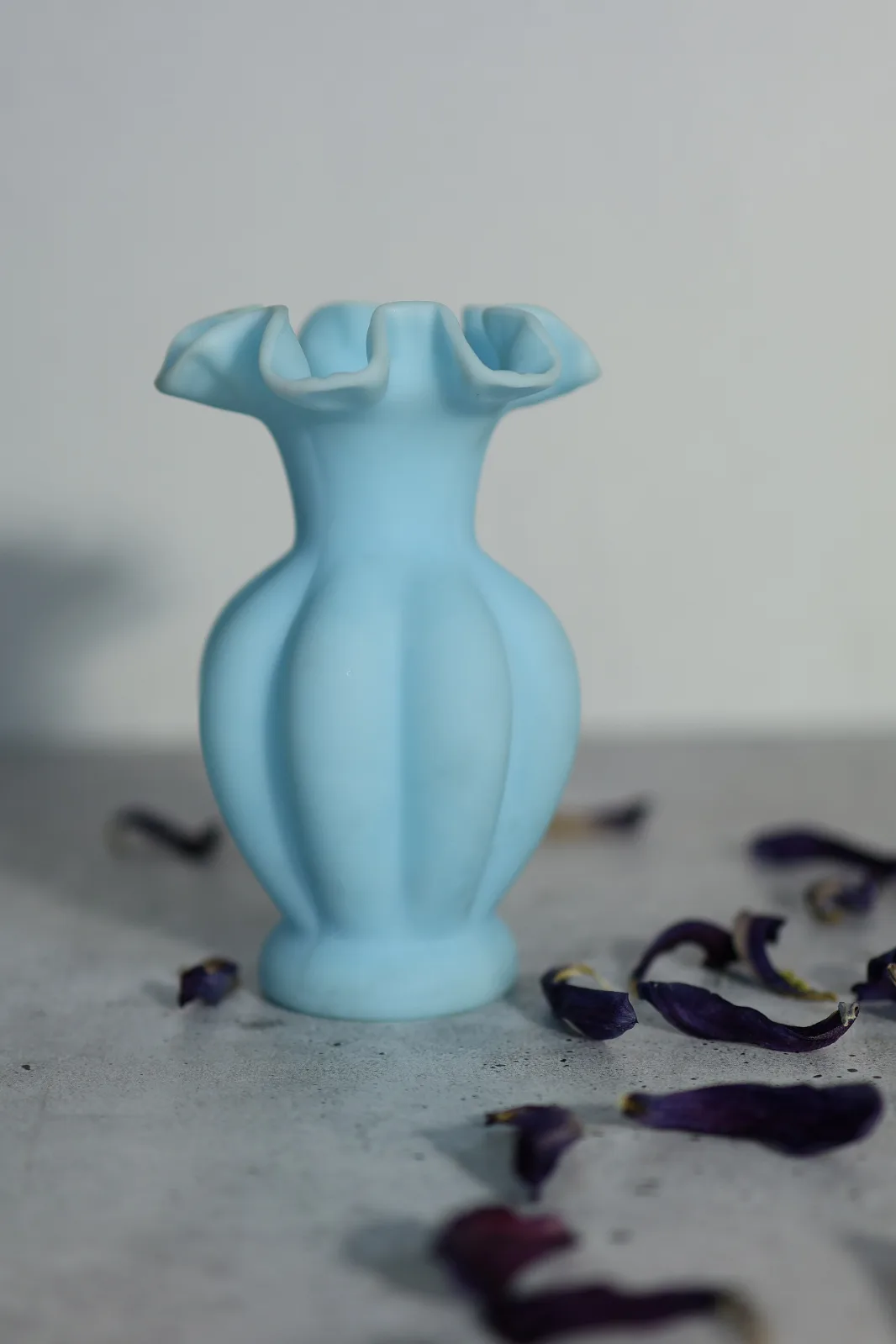
Beaded Melon
Vase shape with vertical ribbed lobes (like a melon) topped with a beaded rim. Distinctively Fenton.
Cactus, Lily of the Valley, Rose, and Other Florals
A variety of floral pressed patterns produced over many decades.
Persian Medallion, Orange Tree, Dragon and Lotus
Carnival-era patterns (covered in the carnival section) that continued into modern revival production.
Hand-Painted Decorating Program
From the 1970s onward, Fenton ran one of the largest in-house hand-painting operations in American glass.
Origins and Scope
Fenton expanded hand-painted decoration from a small program in the 1960s to a major decorating studio by the 1980s, employing dozens of in-house artists. Subjects included floral sprays (roses, daisies, violets, hollyhocks), country and landscape scenes, holiday motifs, and signed limited editions.
Artist Signatures
Each hand-painted piece is signed by the artist who decorated it, normally on the lower body or base. Major Fenton artists with collectible names include Louise Piper, Frances Burton, Diane Gessel, Robin Spindler, and many others. Pieces signed by Bill Fenton (a member of the founding family who occasionally signed special pieces) carry premiums.
Limited Editions and Collector Series
Fenton produced numerous limited-edition series — Birds of Winter, the Mother's Day series, Connoisseur Collection, Designer Series — each with documented production numbers and often issue dates noted on the base.
Fenton Family-Signed Pieces
Members of the Fenton family (Frank M., Bill, George, Tom, Don, Christine) signed special pieces at decorator events and the factory tour shop. Family-signed pieces carry collector premiums; a hand-painted piece signed by both the artist and a family member is more valuable than either alone.

Forms and Categories
Fenton produced essentially every form in the American glass repertoire. Recognizing the standard categories helps locate a piece in catalog references.
Vases
Bud vases, swung vases (the rim pulled out into uneven crimps while hot, producing tall asymmetric forms), beaded melon vases, cylinder vases, fan vases, hand vases. Hobnail vases in milk glass and cranberry are especially common.
Bowls
Crimped bowls, ruffled bowls, three-toed bowls, footed bowls, console bowls, banana bowls (oval crimped). Sizes from small berry bowls to large punch bowls.
Baskets
Hand-applied handles arched over the body, with the body in any of the standard Fenton patterns. Hobnail baskets are extremely common; crest-treatment baskets are particularly photogenic. For broader basket context see our antique baskets and woven goods identification guide.
Candle Holders and Candlesticks
Single, double, and three-light candelabra; mushroom-shaped candlesticks; cornucopia candleholders. For the broader category see our antique candlesticks and candelabra identification guide.
Lamps and Lamp Parts
Gone with the Wind lamps (matched milk-glass shade and base), student lamps, hand-painted glass lamp shades. Fenton lamp production was substantial; complete original lamp and shade pairs command premiums.
Figurines and Animals
Solid pressed-glass animals (cats, owls, bears, swans, fish) in various colors. The Fenton bear, cat, and owl figurines are some of the most-collected small Fenton items. Hand-painted figurines from the decorating program add additional value.
Compotes, Comports, and Epergnes
Footed bowls (compotes), pedestal candy dishes (comports), and multi-tier epergne centerpieces with flutes and trumpets. Hobnail epergnes in milk glass are especially distinctive Fenton forms, and are frequently fitted into reproduction Victorian frames — a trap covered in our antique epergne identification guide.
Punch Bowls and Sets
Large pressed-glass punch bowls with matching cups and underplates. Carnival-era and modern punch sets are both made.
Boxes, Trinket Dishes, Jars
Hinged or lift-lid boxes, butter dishes, covered candy jars (often with hand-painted lids), apothecary-style jars. For broader covered-vessel context see our antique apothecary jars identification guide.
Dating Fenton by Catalog and Mark
Fenton can be dated more precisely than almost any other American glass house because of the surviving catalogs and the marking system.
The Mark System (Recap)
- No molded mark, paper sticker only: 1905–1969.
- Oval logo, no number: 1970–1982.
- Oval logo with "8": 1980–1989.
- Oval logo with "9": 1990–1999.
- Oval logo with "0": 2000–2009.
- Oval logo with "1": 2010–2011.
Catalog References
Fenton's annual catalogs survive in collector archives and have been reprinted in books such as the Heacock and Whitmyer series on Fenton glass. A piece can normally be located by form number (which Fenton stamped on its molds) in the catalog year of issue, narrowing date and color combination precisely. The standard reference is Margaret and Kenn Whitmyer's multi-volume Fenton Art Glass series.
Color-Form Combinations
Many forms were produced in only a few colors in any given catalog year. A specific shape in a specific color can often be dated to a single year or two-year window by cross-checking against catalogs. Cranberry hobnail in a particular vase shape, for instance, may have been catalogued only in 1953–1954.
Form Numbers
Fenton form numbers (typically four digits) appear on some pieces stamped or pressed into the base. The form number identifies the mold; combined with the color, it places the piece precisely in the catalog. Reference books cross-tabulate form numbers, names, colors, and years.
Quality and Workmanship Cues
Pre-1940 Fenton tends to be heavier and rougher in finishing than later work. Mid-century hobnail is mechanically pressed and well-finished. Late Fenton (1990s–2011) often shows fine hand finishing on premium lines (Burmese, hand-painted, limited editions).
Reproductions, Fantasy Pieces, and Lookalikes
Fenton's prominence and broad market mean reproductions and lookalikes are common.
Asian Reproductions
Chinese and Indian factories have produced large quantities of hobnail and carnival glass since the 1990s. These pieces are typically lighter, with less crisp pattern definition, and lack any Fenton mark. Iridescence on reproduction carnival is often more even and metallic-looking than the deeper, slightly varied iridescence of period Fenton.
Other American Glass Houses
Imperial, Westmoreland, L. E. Smith, Kanawha, Pilgrim, Indiana Glass, and other West Virginia and Ohio glass houses produced similar hobnail, milk glass, and crest treatments. A milk-glass hobnail bowl without a mark could be Fenton, Westmoreland, or Imperial. Fine details — hobnail size and spacing, opalescence quality, ruffle crimping — distinguish them, and reference books illustrate the variations.
Fantasy Pieces
Modern producers have made "Fenton" pieces in colors or patterns Fenton never produced, sometimes with fake oval marks. A piece in an implausible color combination (e.g., a hobnail pattern in a color Fenton catalogs do not document) should be checked against authoritative references.
Marriages
Lamp shades and bases sometimes paired from different makers or different Fenton catalog years. A "Fenton lamp" with a Fenton shade and a non-Fenton base is sometimes sold as a complete original Fenton lamp; the base should match a Fenton catalog form.
Repaired and Polished Pieces
Chipped rims sometimes ground down and polished, eliminating the chip but leaving the rim noticeably thinner or flatter than the original profile. Crest ruffles are particularly susceptible. For broader fake-detection methodology see our antique authentication and provenance research guide.
Condition Assessment
Glass is fragile. Condition assessment of Fenton requires checking rim, foot, body, decoration, and integrity separately.
Rim and Crimping
- Chips: tiny "flea bites" (small chips at the rim) reduce value modestly; larger chips substantially.
- Ground rims: a chipped rim sometimes ground smooth, leaving a flat or thinned profile. Compare to known examples to detect.
- Crest ruffle damage: small chips or cracks in the applied ruffle of crest pieces are common and reduce value.
Foot and Base
- Foot chips: common on heavy pieces from sliding on shelves; reduce value moderately.
- Foot grinding: pontil marks on hand-blown pieces should be ground smooth (a flat polished spot in the center of the base). A rough or unfinished pontil mark is unusual on Fenton.
Body
- Cracks: any crack — even hairline — substantially reduces value. Hold the piece up to light and look for the slightly darker line of a crack.
- Bruises: internal stress fractures from impact (no surface chip but a small whitened internal mark). Reduce value materially.
- Cloudiness: mineral deposits inside vases from long flower-water use. Often removable with denture cleaner or specialty glass cleaners; sometimes permanent.
Hand-Painted Decoration
- Wear: hand-painted decoration is fired-on but can wear with heavy use. Fading or worn paint reduces value.
- Overpainting: some pieces have been touched up by amateurs; non-original paint is detectable under UV and reduces value.
Marks and Stickers
- Original sticker: a present-and-intact original Fenton paper sticker on a pre-1970 piece adds modest value.
- Oval logo: should be crisp and consistent; deformed or partial impressions are factory seconds or oddities (and Fenton sold seconds at the factory shop, so seconds-marked pieces exist).
What Drives Value
Fenton's enormous production means value varies widely. Common pieces ($10–$50) and rare pieces ($1,000–$10,000+) coexist within the same catalog year.
Color and Glass Type
Burmese, ruby (red), red carnival, and certain rare opalescent colors are the highest-value Fenton categories. Milk glass hobnail in standard forms is the lowest. Cranberry hobnail sits in the middle. Pre-1940 art glass colors (Karnak Red, Mongolian Green) command premiums over later production.
Period
Pre-1925 carnival glass and 1920s–1930s art glass colors are more valuable than mid-century hobnail and crest. Closing-era 2007–2011 pieces have collector premium for the era.
Form Rarity
Common forms (hobnail bud vase, milk-glass bowl, basic compote) are inexpensive. Unusual forms (large epergnes, lamp pairs, figural pieces) and short-run forms (Vasa Murrhina, certain limited editions) command premiums.
Hand-Painted Decoration
Hand-painted pieces are worth substantially more than plain pieces of the same form. Signed by a noted artist or family member adds further. Limited-edition numbered pieces with original certificates and boxes are strongest.
Originality and Mark
An intact original Fenton sticker on a pre-1970 piece adds value. The oval logo (post-1970) is expected; its absence on a post-1970 piece is suspicious.
Condition
Mint > minor wear > flea bites > chips > cracks. Cracked pieces are often near-worthless; mint pieces command full retail. Original boxes, certificates, and labels add premiums of 15–30 percent on collectible items.
Provenance and Sets
Complete sets (matching pitcher and tumblers, complete punch bowl set with cups, lamp pair) command premiums over the sum of their parts. Original retail provenance (Fenton factory shop tag, gift wrap) is uncommon but nice. For broader valuation methodology see our antique valuation and appraisal guide.
Care and Display
Cleaning
Hand-wash in warm water with mild dish soap. Rinse thoroughly. Dry with a soft lint-free cloth. Avoid the dishwasher — heat cycles can crack older glass and detergent etches the surface over time. For internal cloudiness in vases, soak with denture cleaner tablets or a specialty calcium remover; do not use abrasive cleaners.
Hand-Painted Pieces
Hand-painted decoration is fired but can be damaged by abrasive cleaning, harsh chemicals, or prolonged soaking. Wipe with a damp cloth; do not scrub.
Display
Avoid direct sunlight on hand-painted pieces — the colors are fired but prolonged UV exposure dulls some pigments over decades. Avoid temperature shock (hot water on cold glass, or vice versa); thermal cracks from quick temperature changes are a common Fenton damage source.
Storage
Wrap individually in acid-free tissue or bubble wrap. Pack so pieces do not touch each other or the box wall. Store in a stable-temperature environment; basements and unheated garages risk thermal cycling and humidity damage.
Stickers
If a piece still has its original Fenton paper sticker, do not wash that area or use any solvent near it. The sticker is a value addition and very few pre-1970 pieces still have intact stickers. For long-term preservation principles see our antique storage, care, and preservation guide.
Common Beginner Mistakes
Assuming All Hobnail Is Fenton
Westmoreland, Imperial, L. E. Smith, Anchor Hocking, Duncan & Miller, and others made hobnail. Fenton was the largest producer but not the only one. Check the mark (post-1970) or compare hobnail size, spacing, and finish quality to references.
Confusing Black Amethyst with Black Glass
Hold to a strong light; if the deep purple shows at edges, it is amethyst. True opaque black is a different (and rarer) Fenton glass.
Ignoring the Decade Number
The small number near the oval mark dates Fenton to the decade. A piece you assume is 1970s might actually be 1990s or 2000s — the decade number settles it. This is the single most useful Fenton dating tool.
Overcleaning Stickers Off
An original Fenton sticker is a value-adding feature. Many beginners wash pieces vigorously and remove the sticker without realizing it.
Confusing Modern Carnival with Period Carnival
Fenton revived carnival glass production in the 1970s. Modern Fenton carnival is collectable but priced very differently from 1907–1925 original carnival. The oval mark is the decisive distinguisher; modern revivals have the oval, originals do not.
Buying Without Inspecting for Cracks
Hairline cracks substantially reduce value. Hold the piece up to a strong light and rotate; cracks show as slightly darker lines.
Assuming Hand-Painted Means Old
Most Fenton hand-painted decoration is post-1970, not antique in the strict sense. Hand-painted pieces are collectible but mostly not pre-WWII.
Trusting Online Identification Without References
Internet auction descriptions are often wrong about Fenton attribution and dating. Cross-check against the Whitmyer reference series or other authoritative Fenton books before paying premiums based on attribution claims.
Frequently Asked Questions
How can I tell if a piece is Fenton?
Look for the embossed oval "Fenton" logo on the base — present from 1970 onward. Pre-1970 pieces had only paper stickers, almost always now missing, so attribution depends on color, pattern, and form matched against Fenton catalog references. The Whitmyer multi-volume Fenton Art Glass series is the standard reference.
What does the small number next to the Fenton oval mean?
The decade of manufacture. "8" = 1980s, "9" = 1990s, "0" = 2000s, "1" = 2010s. An oval with no number is 1970–1982. This is the single most useful Fenton dating tool.
Why doesn't my old Fenton piece have a mark?
Because Fenton did not mold or etch a permanent mark into the glass before 1970. Pre-1970 pieces had paper stickers, which usually fell off, washed off, or were removed. The absence of a mark on a piece otherwise consistent with Fenton (color, pattern, form) does not argue against attribution.
Is hobnail glass always Fenton?
No. Westmoreland, Imperial, L. E. Smith, Anchor Hocking, Duncan & Miller, and others made hobnail. Fenton was the most prolific producer, and the most common hobnail in American antique markets is Fenton, but other makers' hobnail is common too. Compare hobnail size, spacing, opalescence quality, and form to references.
What is Fenton Burmese glass?
A heat-sensitive glass that shades from pale yellow at the base to pink at the top, achieved by reheating the upper part during forming. Fenton produced Burmese from 1970 onward (with earlier Burmese-style work) and it is one of their highest-quality lines, often hand-painted with floral decoration.
How much is my Fenton piece worth?
Common milk-glass hobnail pieces are typically $10–$50. Cranberry hobnail and crest pieces run $30–$200. Hand-painted pieces from the modern era run $50–$300. Burmese and Vasa Murrhina pieces run $100–$500. Pre-1925 carnival glass in good condition runs $50–$500 for common patterns and well into four figures for rare colors and patterns. Red carnival, rare art-glass colors (Karnak Red, Mongolian Green), and exceptional limited-edition pieces command premiums.
What is the difference between Fenton and Northwood carnival?
Both are major American carnival makers but with different patterns and base color preferences. Northwood often used a stippled background and tended toward cobalt and amethyst; Fenton produced more marigold and red and a wider pattern range. Northwood pieces from 1908 onward are marked with an underlined "N" in a circle on the base; Fenton was unmarked in the carnival era. The mark is the easiest distinguisher.
Did Fenton make milk glass?
Yes — Fenton was one of the major American milk glass producers, particularly hobnail-pattern milk glass from the 1950s through the 1980s. Other major milk glass houses include Westmoreland, Imperial, and Anchor Hocking. Fenton hobnail milk glass is recognizable by the regular hobnail pattern and (post-1970) the oval mark.
Is Fenton still making glass?
Core handmade glass production ended in 2011 when the Williamstown plant shut down. Some Fenton-marked pieces have been produced since then by other factories under license, and family members continued small-scale production for several years. The Fenton Art Glass Company as a major glassmaker effectively ended in 2011.
What references should I read?
Margaret and Kenn Whitmyer, Fenton Art Glass (multi-volume, the standard reference); William Heacock, Fenton Glass: The First Twenty-Five Years, The Second Twenty-Five Years, The Third Twenty-Five Years (three-volume historical series); the Fenton Art Glass Collectors of America (FAGCA) publications. Specialist auction catalogs from major glass auctions (Jeffrey S. Evans, Burns Auction Service) document realized prices and attribution discussion for higher-grade pieces.