Antique Cranberry Glass Identification Guide: Gold-Ruby, Makers, and Dating
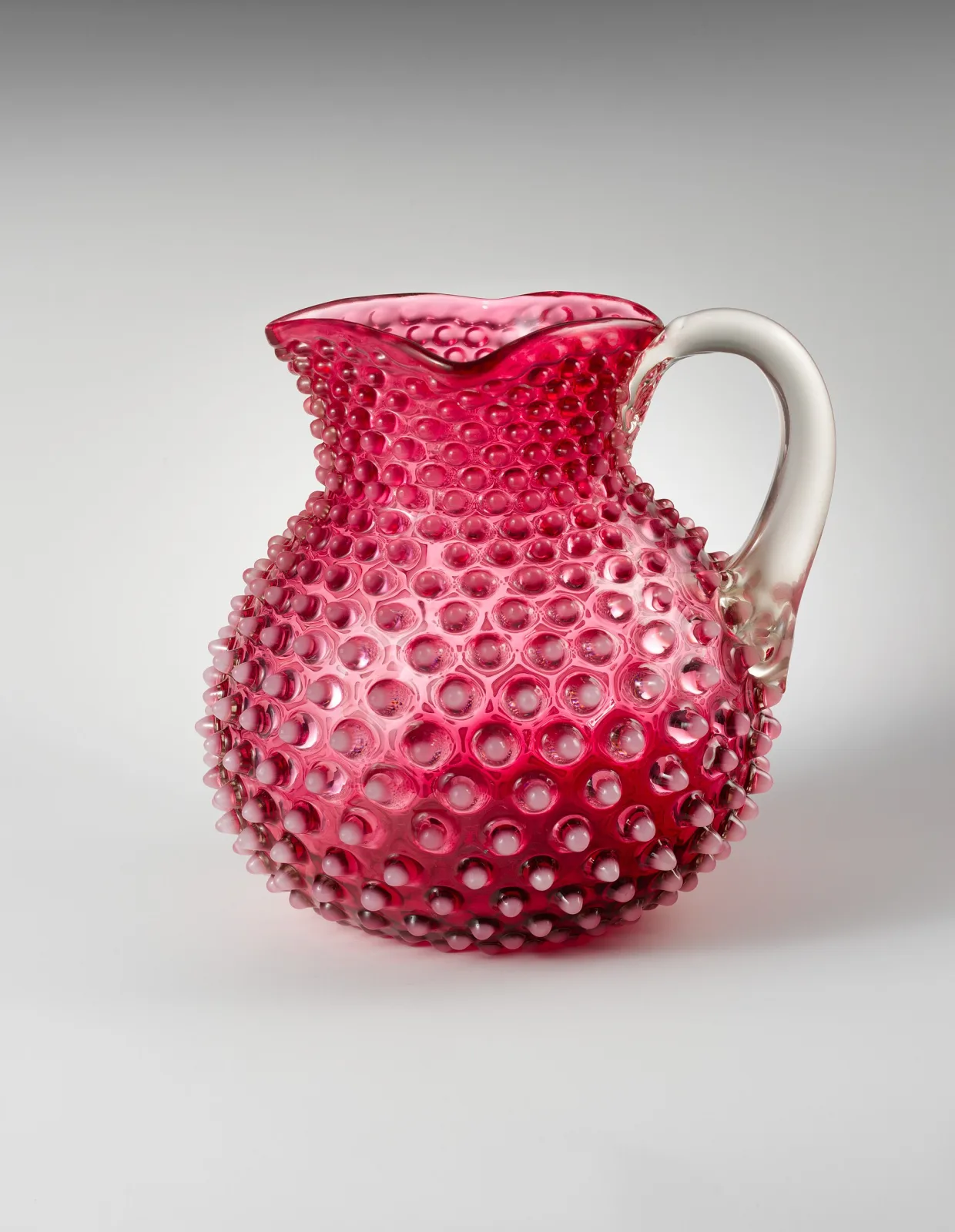
Cranberry glass — properly called gold-ruby glass — is the warm, jewel-toned pink-red glass that defined the Victorian parlor and dining table from roughly 1840 through 1920. It is colored not by copper or selenium, as ordinary ruby glasses are, but by colloidal gold suspended in the molten batch and developed to color by careful reheating, a process discovered in the seventeenth century by the Bohemian chemist Johann Kunckel and refined into a commercial Victorian staple by English and Bohemian glassworks. The result is a color that no other technique quite matches: a true rose-pink to deep raspberry that glows when held to the light and shifts subtly between cool and warm tones depending on the angle.
Identifying antique cranberry glass means working through several layered questions at once. Is the color a true gold-ruby, or a later imitation made with selenium or aniline staining? Is the glass mouth-blown with a pontil mark, or pressed and machine-finished? Is it solid cranberry through the body, or a thin cranberry casing over a clear core? What pattern, optic mold, or applied decoration does it carry, and which maker — English, Bohemian, or American — does that pattern point to? And finally, is it Victorian period (roughly 1840 to 1900), Edwardian survival (1900 to 1914), or one of the many twentieth-century reproductions made by Fenton, Pilgrim, and others?
This guide walks through the chemistry and history of gold-ruby glass, the construction techniques (solid versus cased, mouth-blown versus pressed), the major English and Continental makers, the typical Victorian and Edwardian forms (pitchers, decanters, cruets, epergnes, biscuit jars, sugar shakers), the patterns that define cranberry collecting (hobnail, coin spot, thumbprint, swirl, optic rib), the role of Mary Gregory enamel decoration, the American makers and their later opalescent and Fenton-era revivals, dating clues, the most common reproductions and fakes, condition assessment, and value drivers in today's market.
Table of Contents
- The Chemistry of Gold-Ruby Glass
- A Brief History of Cranberry Glass
- Construction: Solid, Cased, Blown, Pressed
- Reading the Color
- English Makers
- Bohemian and Continental Makers
- American Makers
- Typical Victorian Forms
- Patterns and Optic Molds
- Mary Gregory Enamel Decoration
- Opalescent Cranberry
- Dating Cranberry Glass
- Fenton and Twentieth-Century Cranberry
- Reproductions and Fakes
- Condition Assessment
- What Drives Value
- Care, Cleaning, and Display
- Common Beginner Mistakes
- Frequently Asked Questions
The Chemistry of Gold-Ruby Glass
The defining characteristic of true cranberry glass is its color source: colloidal gold. A small amount of gold chloride (typically a fraction of a percent by weight) is dissolved into a clear lead crystal or soda-lime batch. As the molten glass cools and is then carefully reheated — a process called striking or development — microscopic gold particles precipitate out of solution. These particles scatter light in a way that produces the characteristic rose-pink to deep raspberry color.
The strike step is delicate. Underdeveloped batches strike pale and weak; overheated batches turn brown, opaque, or "livery." The skill of the gaffer in achieving the correct strike is one reason quality cranberry from a top maker like Stevens & Williams or Harrach commands a premium over batch-mixed factory ware.
Why It Is Called "Cranberry"
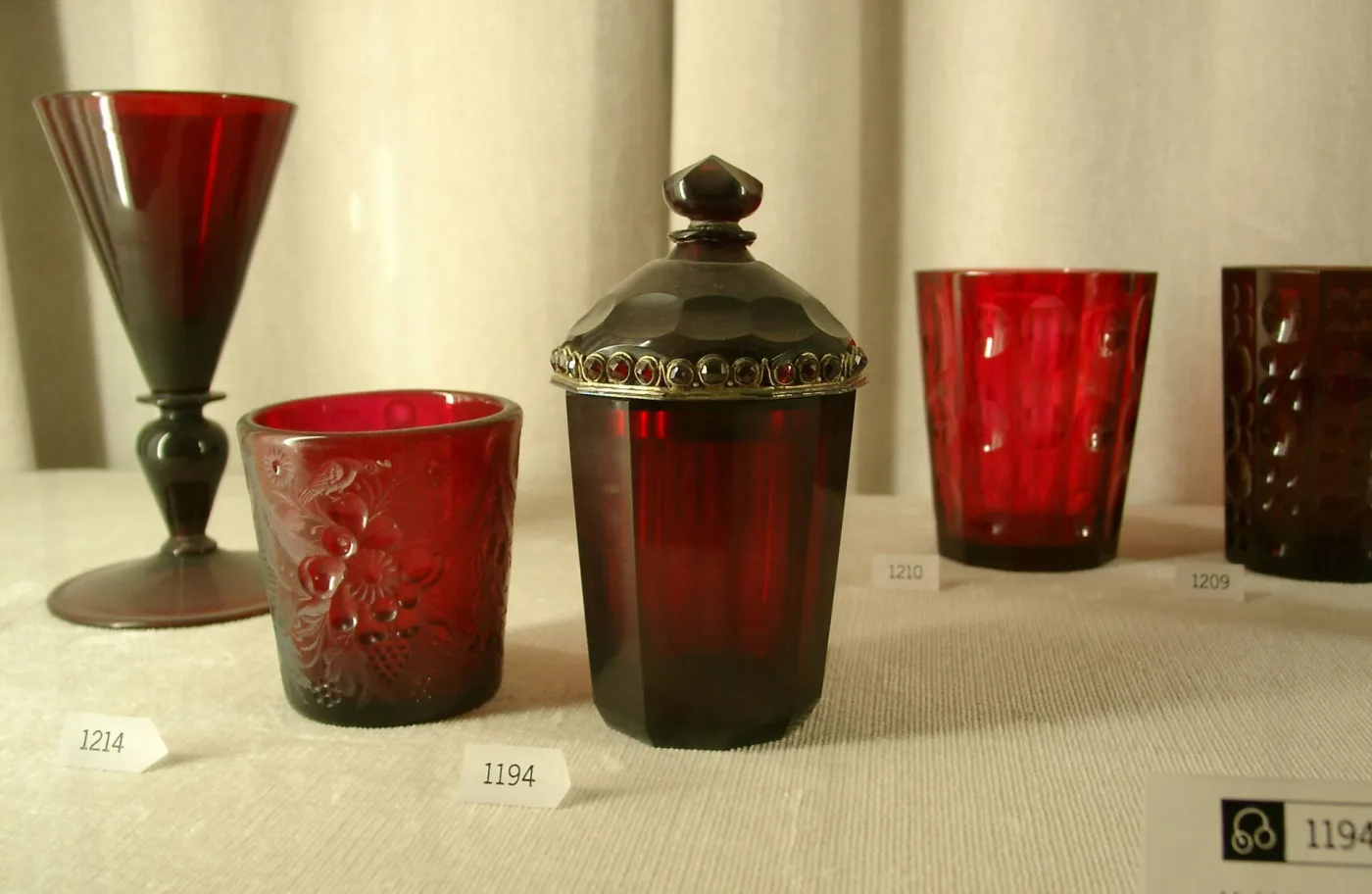
"Cranberry glass" is primarily an American collectors' term, popularized in the early twentieth century by reference to the deep pink-red of cranberry sauce. English and Continental makers historically called the same product gold-ruby, ruby glass, or rose glass. In modern usage the terms overlap, with "cranberry" tending to refer to the lighter, pinker shades and "ruby" to the deeper, more saturated reds. Both come from the same gold-colloid chemistry.
Distinguishing Gold-Ruby from Other Reds
Several other techniques produce red-toned glass and are sometimes confused with cranberry. Copper-ruby (using cuprous oxide) produces a more orange-red and is most familiar in stained-glass cathedral windows and the deep ruby of Bohemian Biedermeier flashed glass. Selenium-cadmium reds, developed in the late nineteenth century and dominant in twentieth-century factory glass, produce a brighter, more uniform tomato-red. Aniline-stained "cranberry" — clear glass coated with a dye — appears entirely on the surface and washes off or wears at handles. True gold-ruby color is uniform throughout the glass body (unless cased) and resists chemical wear.
A Brief History of Cranberry Glass
Gold-ruby glass was first developed by Johann Kunckel in Potsdam around 1679, who built on earlier alchemical work by Andreas Cassius. Kunckel's formula was a closely guarded secret and his pieces — small heavy goblets and beakers in deep ruby — are now largely museum objects. Through the eighteenth century gold-ruby remained a luxury court curiosity, made in tiny quantities at German and Bohemian glassworks for aristocratic patrons.
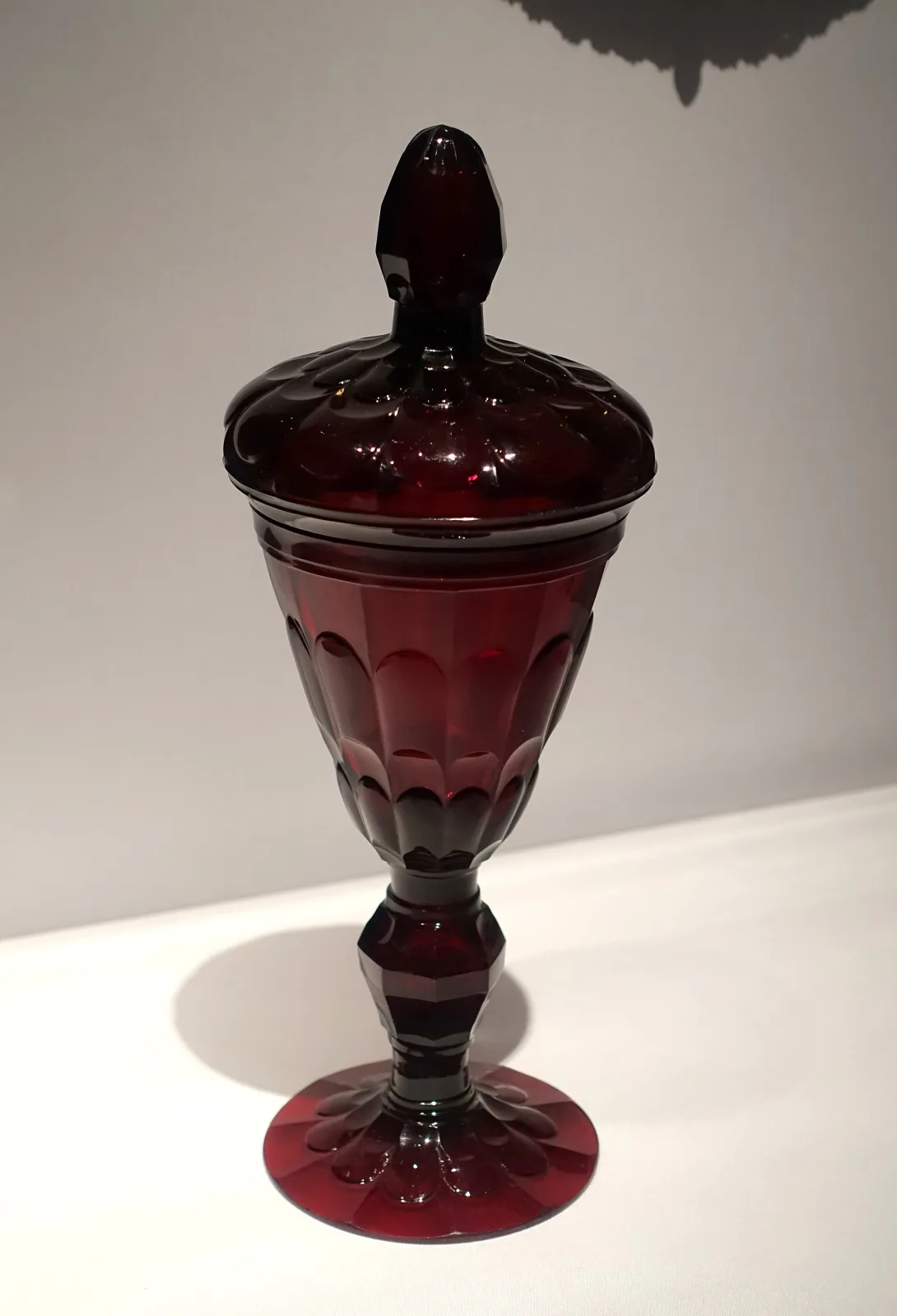
The commercial breakthrough came in the 1820s and 1830s in Bohemia, where Friedrich Egermann and other Bohemian masters developed flashed and cased ruby techniques that brought the cost down and made gold-ruby accessible to the wider middle class. By the 1840s English glassworks at Stourbridge had picked up the technique, and by the 1850s gold-ruby was a standard luxury color in the English glass trade.
The Great Exhibition of 1851 in London marked the public arrival of cranberry glass as a domestic Victorian status object. Display pieces from W. H. B. & J. Richardson, Bacchus, and the Bohemian houses dazzled the visiting public, and by the 1860s cranberry decanters, pitchers, and epergnes had become standard equipment on the better English and American dining tables.
The peak Victorian decades for cranberry glass were 1860 to 1900. During this period English and Bohemian production reached industrial scale, American makers (notably Hobbs Brockunier & Co., Boston & Sandwich, and the New England Glass Company) entered the market, and the color appeared on every conceivable Victorian table form. Cranberry glass enters most surveys of antique glass identification as a key Victorian color category alongside vaseline, amberina, and Burmese.
The Early Twentieth Century
After 1900 the demand for elaborate Victorian dining pieces declined and large cased pieces became scarcer in production. The American makers Fenton (founded 1905), Northwood, and later Pilgrim Glass kept cranberry alive into the twentieth century in smaller decorative forms — opalescent hobnail vases, bowls, lamps, perfume bottles — and produced reproductions of Victorian patterns from the 1930s onward. By 1980 nearly all "cranberry" glass on the market was either Fenton-era twentieth-century work or modern reproduction; genuine Victorian pieces require careful identification.
Construction: Solid, Cased, Blown, Pressed
The single most important fact about a piece of cranberry glass is its construction. The four major variations are solid mouth-blown, cased mouth-blown, solid pressed, and surface-stained.
Solid Mouth-Blown
The body is a single layer of cranberry glass throughout, gathered on the blowpipe and worked into form by hand. Solid blown pieces show characteristic pontil marks on the base (the small rough or polished scar where the punty rod was attached during finishing), thin walls of variable thickness, and slight asymmetry from hand work. The color reads the same depth from both inside and outside the body. Most fine Victorian cranberry pitchers, decanters, and small vessels are solid blown.
Cased (Overlay) Mouth-Blown
A thin outer skin of cranberry glass encases a thicker clear, opal, or colored core. Cased glass is typically blown by gathering the inner layer first, then dipping into the outer color, and blowing the bubble out so that both layers expand together. Looking at the rim or a chip you will see a sharp boundary between the cranberry skin and the inner color. Cased work allows for cutting through the cranberry layer to reveal the lighter core beneath — the typical Bohemian "cut to clear" cameo effect — and is the basis for most fine engraved cranberry pieces. For a closer look at related cut-to-clear work, see our cut glass identification guide.
Solid Pressed
Pressed cranberry — molten glass forced into a mold by a metal plunger — appeared from the 1860s onward as machine techniques caught up with demand. Pressed pieces show mold seams (faint vertical lines where the mold halves met), more uniform wall thickness, and softer, less crisp pattern detail than cut work. Pressed cranberry is most often American (Hobbs Brockunier, Boston & Sandwich) and is more affordable than blown work. It is honest period glass, not a flaw — but it is a different category from mouth-blown and should be priced accordingly.
Surface-Stained Imitation
Late nineteenth-century imitators sometimes stained clear glass with a copper or aniline wash to mimic cranberry. Stained pieces show wear at handles and rims (the color rubs off), a brownish or orange undertone, and uneven coverage at the base. Surface staining is not true cranberry and should be priced as imitation.
Reading the Color
The shade of cranberry varies considerably between makers, periods, and individual pieces. Holding a piece up to a strong daylight window is the single most important diagnostic gesture in cranberry collecting.
Light Pink to Rose
The lightest cranberry — sometimes called rose, peach-blow, or pink — was popular for delicate decorative items, perfume bottles, and bridesmaid's gifts. English and American work from 1880 to 1900 favored this lighter tone. A pale pink that approaches almost colorless at the rim suggests light gold concentration and a Stourbridge or American origin.
Classic Cranberry (True Rose-Red)
The mid-tone — a clear rose-red that glows pink in transmitted light — is the textbook cranberry color and the most desirable for general collecting. Mid-Victorian English work from the 1860s to 1880s typically shows this depth.
Deep Raspberry to Ruby
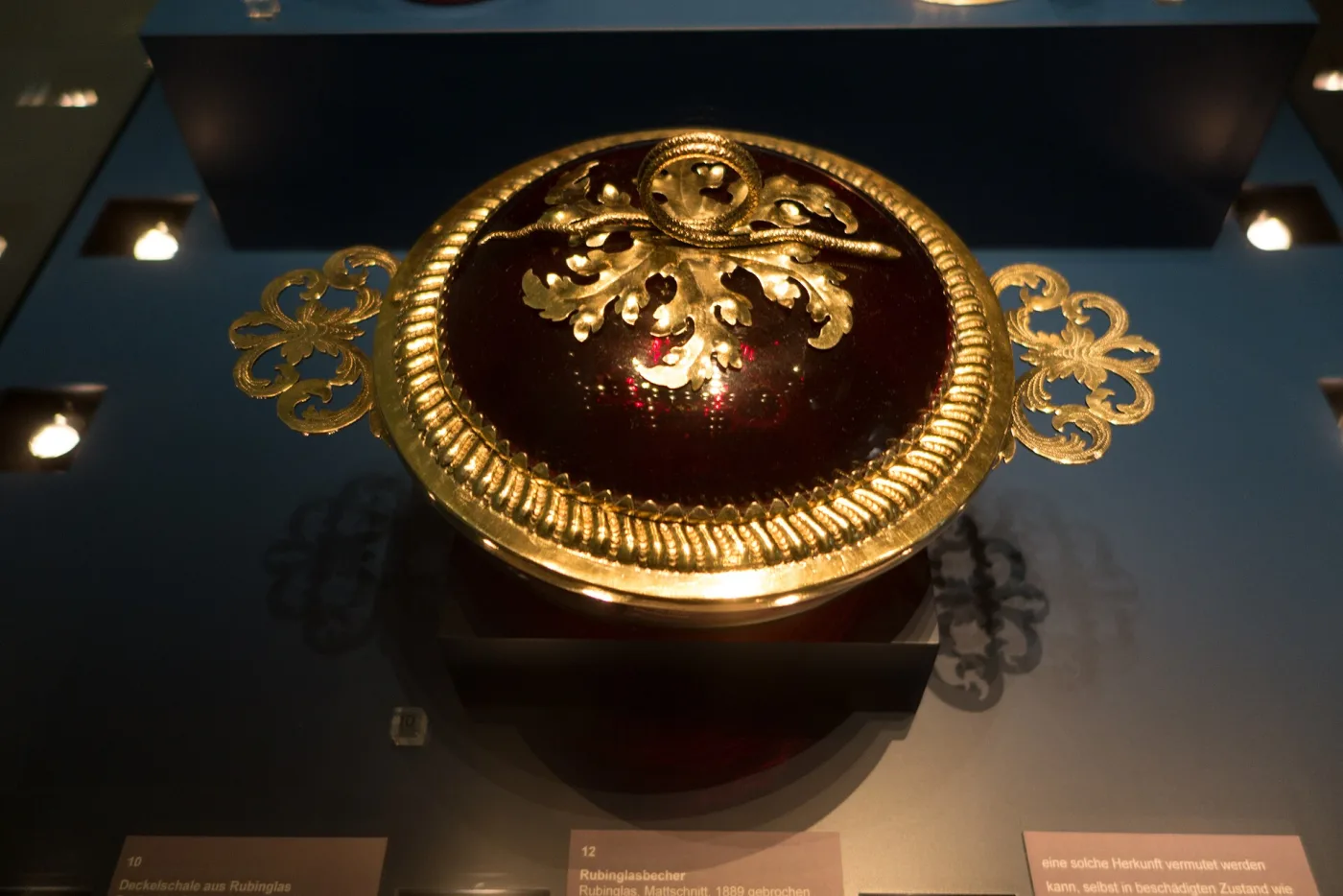
Bohemian and German pieces tend to deeper, more saturated reds, often shading toward true ruby. These are properly called gold-ruby rather than cranberry, but the terms overlap. Deep raspberry coloration in heavy thick-walled pieces is a strong Bohemian indicator.
Color Defects
Watch for "livery" or muddy patches (overstruck batch), pale colorless spots (understruck), and orange or brownish patches (selenium contamination or surface stain rather than gold-ruby). A true gold-ruby piece will show clean, even color throughout, with at most subtle gradation from rim to base.
English Makers
The Stourbridge district in the West Midlands was the heart of English cranberry production from the 1840s through the 1920s. The major houses to know are:
Stevens & Williams (Brierley Hill)
Founded 1847 (the firm became Royal Brierley in 1929), Stevens & Williams produced some of the finest English cranberry of the late Victorian period — applied trail decoration, pulled-feather effects, and intricate cased and engraved pieces. Designs by Frederick Carder (before his emigration to Steuben) and John Northwood I are particularly sought.
Thomas Webb & Sons (Stourbridge)
Webb produced cranberry across the full quality range from inexpensive table glass to exceptional cased and engraved cameo pieces. Webb's mark — an acid-stamped "Thomas Webb & Sons" or a small sphinx/Webb logo — appears on better pieces from about 1880 onward, but a great deal of fine Webb cranberry is unmarked.
W. H. B. & J. Richardson
An early major Stourbridge house, active from the 1820s, with strong cranberry production through the 1850s and 1860s. Richardson's 1851 Great Exhibition pieces helped establish cranberry as a fashionable color.
John Walsh Walsh (Birmingham)
Walsh Walsh produced cranberry from the 1880s into the early twentieth century, much of it opalescent with ribbed and threaded decoration. The firm is particularly associated with Vesta and Pompeian patterns.
Sowerby and Davidson (Gateshead)
The northeast English pressed-glass houses (Sowerby of Gateshead, Davidson of Gateshead, Greener of Sunderland) produced pressed cranberry and cranberry-like wares in pattern molds from the 1870s. Sowerby's peacock-head trademark and registered design numbers help with dating.
Bohemian and Continental Makers
Harrach (Neuwelt)
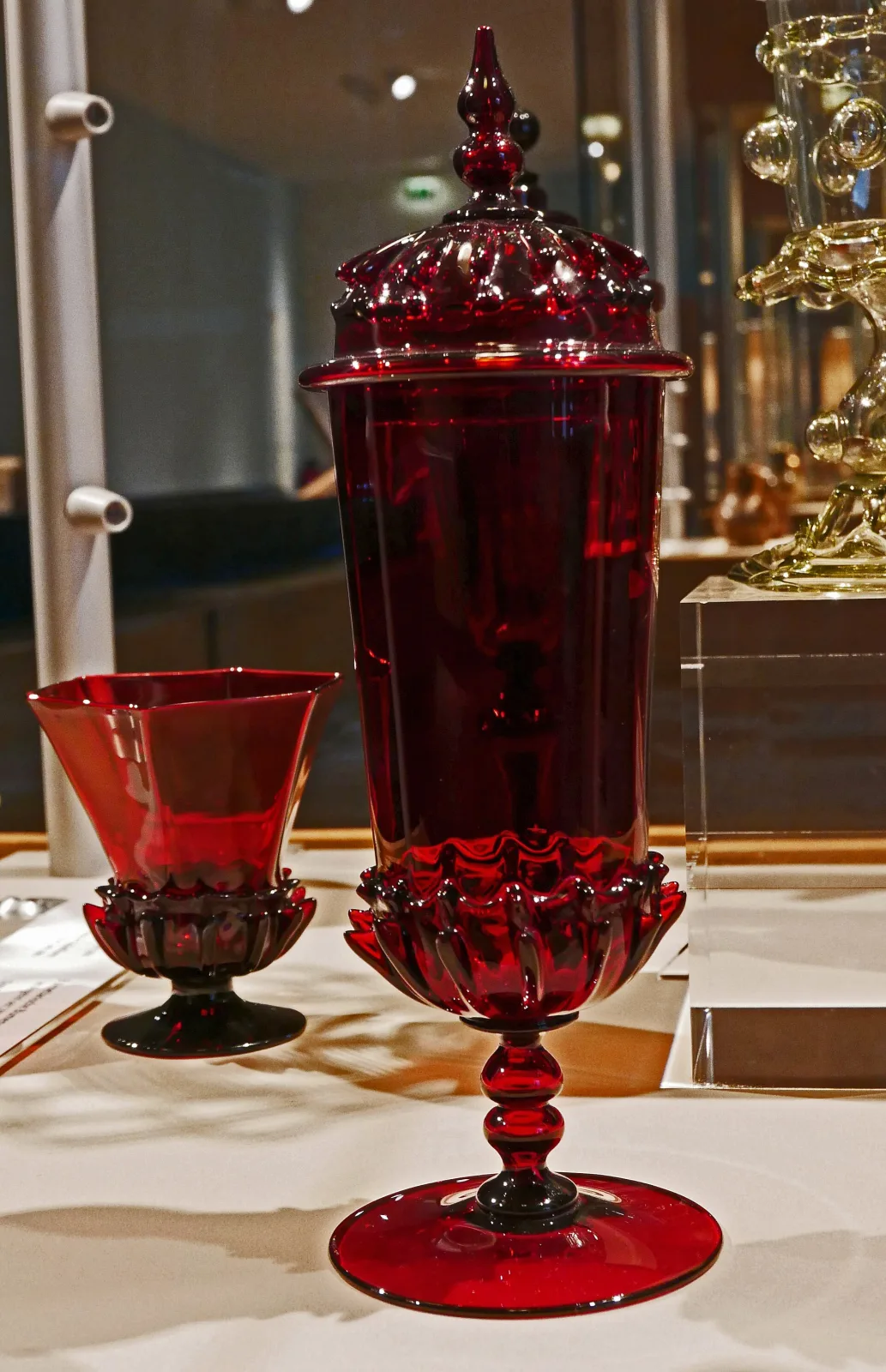
The Neuwelt glassworks of the Harrach family operated from 1712 and dominated luxury Bohemian glass through the nineteenth century. Harrach cranberry — usually deep ruby cased over clear with cut-to-clear engraving — is among the highest-quality gold-ruby work ever produced.
Moser (Karlsbad)
Founded 1857 by Ludwig Moser, the Karlsbad firm produced exceptional cranberry and ruby glass with applied gilt enamel decoration, often signed "Moser" in script on the base from about 1890. Moser cranberry with raised gold and enamel oak leaves, acorns, or floral sprays is highly collectible.
Riedel (Polaun)
The Riedel family glassworks in northern Bohemia produced cranberry from the 1850s, often in pressed and pattern-molded forms for export.
Egermann (Haida and Blottendorf)
Friedrich Egermann developed flashed-ruby techniques in the 1820s that influenced all subsequent cranberry production. Egermann pieces — typically Biedermeier-period beakers, decanters, and goblets — survive in modest numbers.
Loetz (Klostermühle)
Loetz produced some cranberry in iridescent and Art Nouveau forms around 1900, often in combination with their famous oil-spot iridescence. These are border pieces between cranberry collecting and Art Nouveau glass collecting.
American Makers
Hobbs Brockunier & Co. (Wheeling, West Virginia)
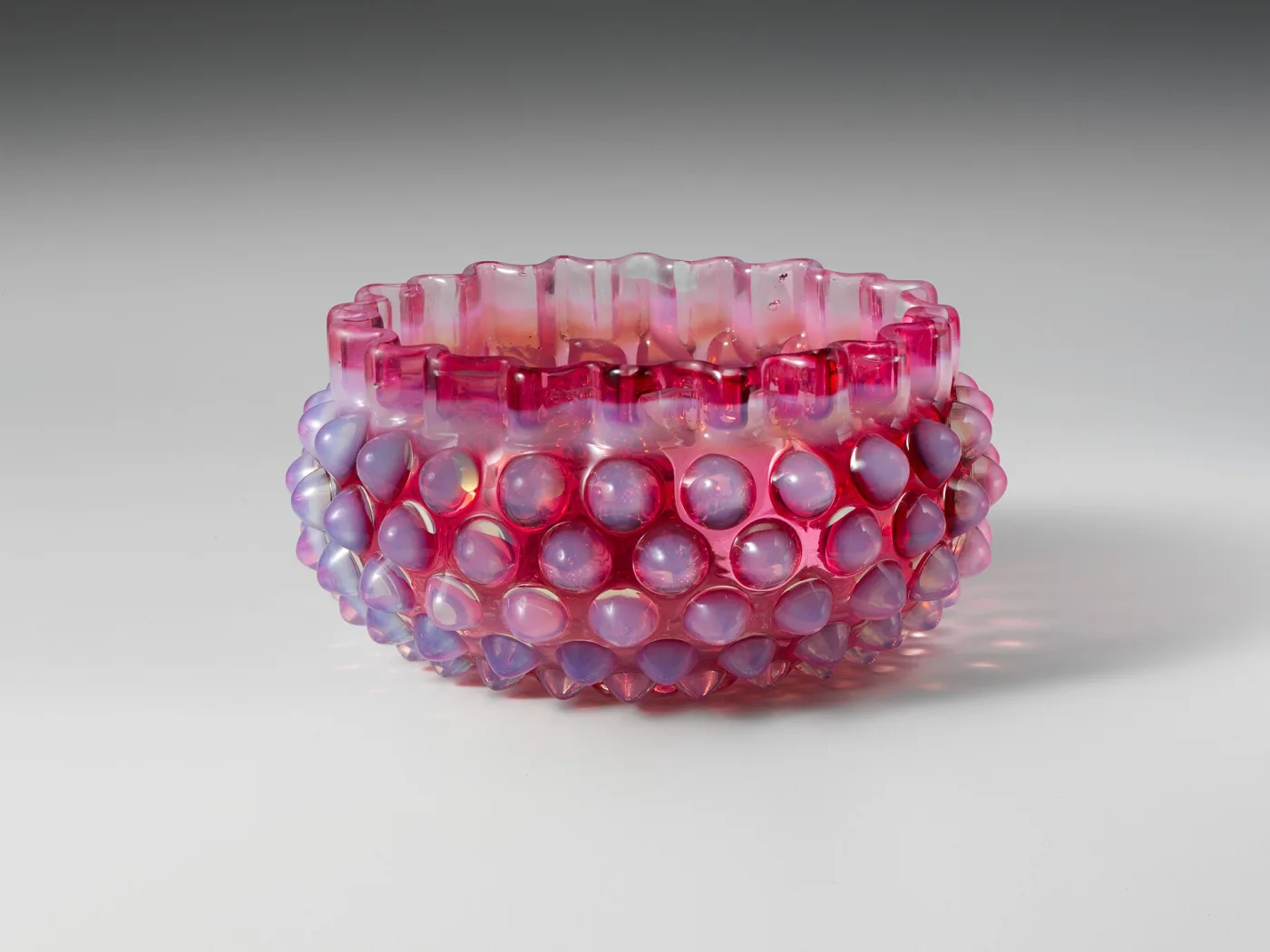
The most important American cranberry maker of the Victorian era, active in Wheeling from 1863 to 1891. Hobbs produced cased cranberry, the famous Hobnail pattern (also called Dewdrop, patented 1886), Spangle, and Coral. Hobbs cranberry hobnail pitchers, water sets, and cruets are foundational American cranberry collectibles.
Boston & Sandwich Glass Co. (Massachusetts)
Active 1825 to 1888, Sandwich produced both blown and pressed cranberry, often with applied clear handles, pulled feet, and threaded decoration. Sandwich cranberry tends to a slightly lighter, pinker tone than Wheeling work.
New England Glass Co. (East Cambridge)
New England Glass made cranberry from the 1860s through its 1888 closure, often in cased forms with cut-to-clear decoration in the Bohemian manner.
Phoenix Glass (Monaca, Pennsylvania)
Phoenix produced Mary Gregory–style enameled cranberry in the late 1880s and 1890s — much of what is sold as English Mary Gregory is actually American Phoenix work.
Fenton Art Glass (Williamstown, West Virginia)
Founded 1905, Fenton became the dominant American cranberry maker of the twentieth century. Their cranberry production runs from 1907 essentially continuously through the 2007 closure of the original factory, with revivals of Hobnail (from 1939), Coin Spot, Drapery, and other Victorian patterns. Fenton cranberry is technically modern, not antique, but is collectible in its own right and frequently mistaken for nineteenth-century work.

Typical Victorian Forms
Cranberry glass appears across nearly every Victorian table and decorative form. The most commonly encountered objects are:
Pitchers and Water Sets
Tall pitchers (often six to eleven inches) with applied clear glass handles, frequently sold as a set with four or six matching tumblers. Water sets in cased cranberry hobnail or coin spot are among the most collected American forms.
Decanters and Cruets
Slender bottles for wine, vinegar, oil, or condiments, with cut or applied clear stoppers. Many cranberry cruets originally sat in silver-plated stands as part of larger cruet assemblies — see our cruet sets identification guide for the framework context.
Epergnes
Multi-trumpet centerpiece vases, typically with a central tall trumpet and three or four smaller side trumpets emerging from a clear silver-plate or glass frame. Cranberry epergnes are showpieces of the late Victorian dining table; complete examples in original frames command strong prices, and our epergne identification guide covers how to tell an original set from a married assembly.
Biscuit Jars and Pickle Jars
Cylindrical or barrel-shaped jars with silver or silver-plate hinged lids and bail handles. Often paired with matching cranberry tumblers or sugar shakers as part of breakfast table sets.
Sugar Shakers (Muffineers)
Tall pierced-top vessels for shaking sugar onto porridge or fruit. Cranberry sugar shakers in Inverted Thumbprint or Coin Spot patterns are common Hobbs Brockunier products.
Syrup Pitchers
Smaller pitchers with hinged silver-plate spring-loaded lids for pouring breakfast syrup. A characteristic American form from about 1880 to 1900.
Vases, Bowls, and Finger Bowls
Decorative pieces in every size from small bud vases to large floor vases. Finger bowls — small clear-edged bowls for rinsing fingers between courses — are a typical Victorian table item.
Perfume Bottles and Vanity Pieces
Smaller cranberry pieces — perfume bottles, dresser jars, ring trees — were standard Victorian dressing-table furniture, often with silver mounts. For broader vanity-set context, see our vanity and dresser sets guide.
Patterns and Optic Molds
Cranberry glass carries a recognizable vocabulary of pattern names that recur across makers. Knowing the patterns helps narrow attribution and date.
Hobnail (Dewdrop)
Raised round bumps in regular rows across the body. Patented by William Leighton Jr. for Hobbs Brockunier in 1886, hobnail became the single most common Victorian cranberry pattern and the basis for the entire Fenton hobnail line from 1939 onward. Victorian hobnail is mouth-blown into a hobnail mold and shows polished pontil marks; Fenton hobnail is pressed and has smooth ground bases.
Coin Spot (Coin Dot)
Round opalescent spots arranged in vertical columns, produced by blowing into a spotted mold and reheating to develop the opalescent contrast. A classic Northwood and Hobbs pattern from the 1880s.
Inverted Thumbprint
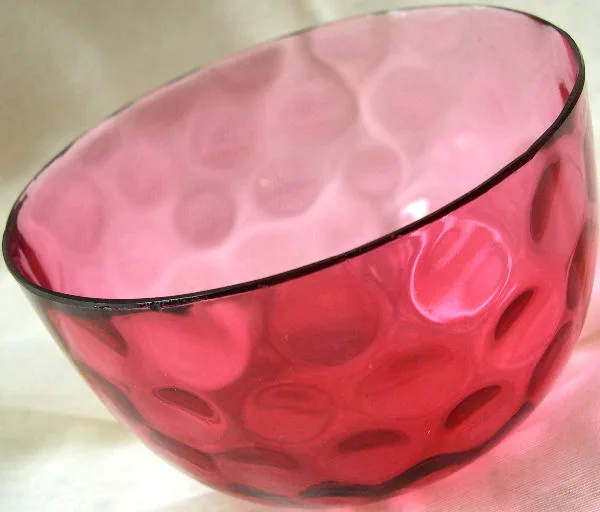
Concave oval thumbprint indentations in regular rows. Common across English and American makers from the 1870s onward.
Swirl and Reverse Swirl
Spiraled vertical ribs running around the body, produced by twisting the gather between gathering and final blow. Reverse swirl spirals in the opposite direction.
Optic Rib
Subtle vertical ribs molded into the inside of the body, producing the characteristic light-and-shadow effect of "optic" Victorian glass.
Drapery and Spanish Lace
Opalescent patterns suggesting drapery folds or lace mesh, popular in late Victorian American cranberry from Northwood and Jefferson.
Threaded
A fine clear glass thread spiraled around the body — a virtuoso English Stourbridge technique associated with Northwood's threading machine (patented 1876).
Cut and Engraved
Cased cranberry over clear was extensively cut and engraved in the Bohemian manner, with floral, hunting, and architectural scenes carved through the cranberry layer to reveal the clear interior. This is the highest-value category of cranberry glass.
Mary Gregory Enamel Decoration
"Mary Gregory" cranberry — pieces decorated with a small white enamel figure of a child, usually a boy or girl in Victorian dress at play, painted in white slip onto a cranberry ground — is one of the most recognizable categories of antique cranberry glass. The romantic American collectors' story attributes the work to Mary Gregory, a decorator at Boston & Sandwich; subsequent research has shown that the great majority of Mary Gregory–style pieces are actually Bohemian export work from the 1880s onward, with smaller production by Phoenix Glass in Pennsylvania.
Authentic period Mary Gregory shows the enamel applied in slightly raised brushstrokes, with the detail painted in white only (later twentieth-century reproductions sometimes add color). The figures are usually full-length children in a landscape vignette, often holding a butterfly net, flowers, a hoop, or a small animal. Quality varies from very fine work (precise faces, modeled drapery) to crude (stiff figures, dot eyes).
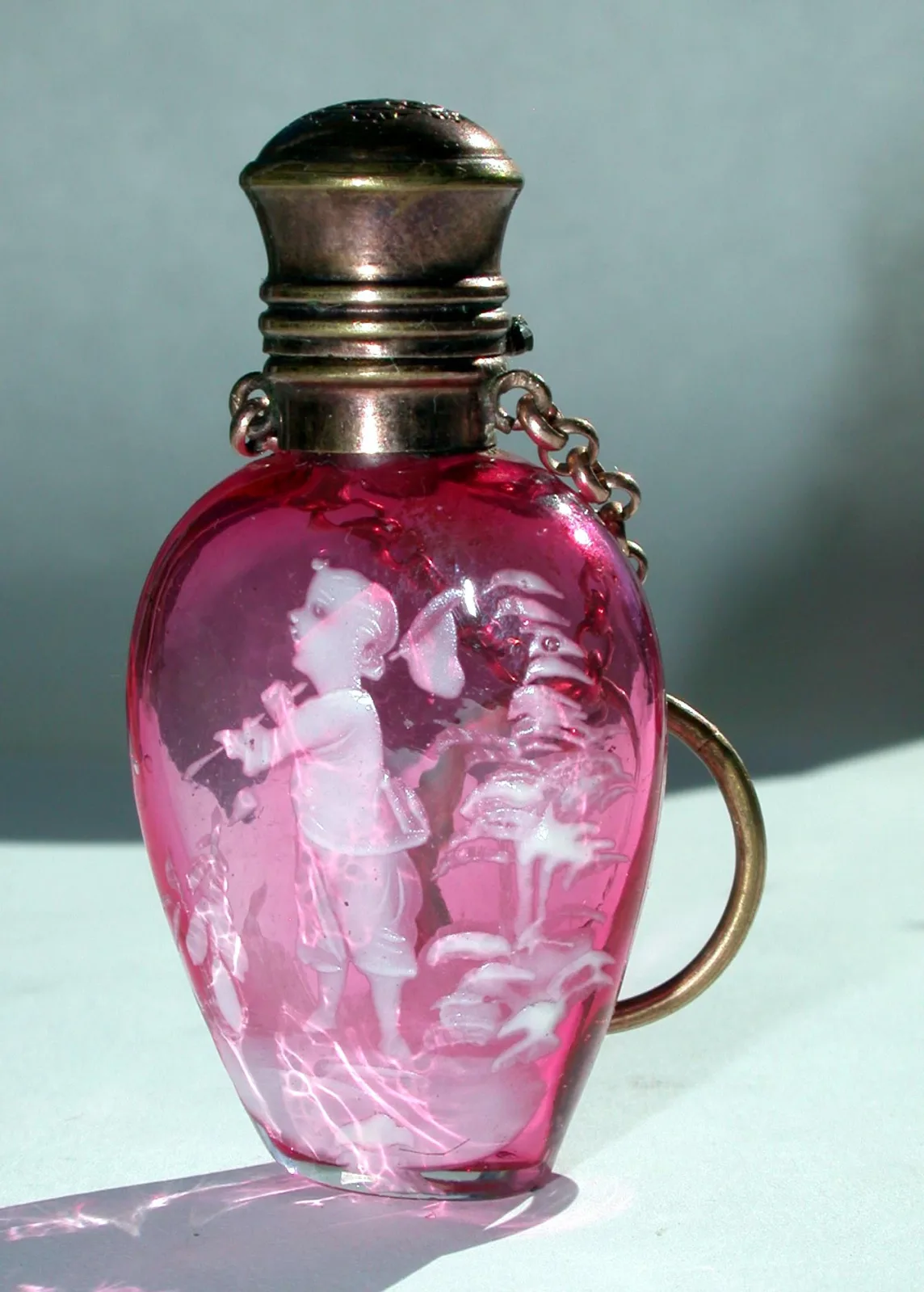
Modern Mary Gregory reproductions — particularly Westmoreland's 1950s work, Pilgrim's 1980s line, and Czech reproduction pieces sold from the 1970s onward — have flooded the market. Period Bohemian pieces have a slight wear pattern on the enamel from a century of light cleaning, slightly yellowed enamel from age, and pontil marks on the base; reproductions have crisp white enamel, ground bases, and often a paper or printed label.
Opalescent Cranberry
Opalescent cranberry — where parts of the pattern are milky white opalescent rather than the cranberry ground color — is produced by combining gold-ruby with bone ash or other heat-sensitive ingredients that turn opal when reheated. The result is a cranberry body with white opal highlights at raised pattern elements (hobnails, coin spots, drapery folds).
The major American opalescent cranberry makers are Hobbs Brockunier, Northwood, Jefferson Glass, and (slightly later) Fenton. English opalescent cranberry was produced by John Walsh Walsh, Davidson, and Greener. The technique reached its full development around 1885 to 1905 and remains one of the most distinctive subcategories of cranberry collecting.
To distinguish authentic Victorian opalescent cranberry from twentieth-century work, examine the opal areas: period pieces show the opal as a deep, almost three-dimensional layer that glows when backlit, while later Fenton and reproduction work shows a thinner, flatter opal that reads more uniformly white in transmitted light.
Dating Cranberry Glass
No single test dates cranberry glass; dating relies on convergent evidence from construction, pattern, color, marks, and form.
Pontil Marks
The base of any mouth-blown piece carries a pontil mark — the scar where the punty rod was attached during finishing. Rough pontils (open, unground) are typical of earlier Victorian work (1840 to 1870); polished pontils (ground smooth and polished, but still visibly disturbed) are typical of later Victorian and Edwardian work (1870 to 1920); fully ground and re-polished bases with no visible pontil are typical of pressed glass and most twentieth-century factory work. A piece with no pontil at all is either pressed or modern.
Wear Patterns
Genuine antique cranberry develops a fine network of micro-scratches on the base from a century of contact with table surfaces. Examine the base under raking light; period wear is irregular, multi-directional, and concentrated where the piece naturally rests. Reproductions show no wear or uniformly machine-buffed bases.
Mounts and Hardware
Silver-plate or sterling mounts on biscuit jars, syrup pitchers, sugar shakers, and epergnes are themselves datable through hallmarks and maker's marks. A cranberry biscuit jar with a Victorian English silver hallmark on the lid is securely dated to that hallmark's period — assuming the lid is original to the body. Our antique silver identification guide covers hallmark reading in detail.
Patent and Registry Marks
English pressed cranberry sometimes carries a registered design diamond (1842 to 1883) or RD number (from 1884), both of which date to specific design registration years. American patented patterns (Hobbs hobnail, 1886) are dated by the patent.
Form and Pattern Logic
Some forms and patterns simply did not exist in earlier periods. A water set with six matching tumblers, a syrup pitcher with a hinged spring-loaded lid, or a piece in the Coin Spot pattern is necessarily from the 1880s or later. A simple flute-cut decanter with a polished pontil and applied clear handle could plausibly be 1850s through 1880s.
Fenton and Twentieth-Century Cranberry
Fenton Art Glass deserves a section of its own because so much of what is sold as "antique cranberry" is in fact twentieth-century Fenton. Fenton produced cranberry continuously from 1907 through 2007, with major lines including:
Hobnail (1939–2007): The defining Fenton cranberry line, made in vases, baskets, bowls, lamps, perfume bottles, and table forms. Period Fenton hobnail differs from Hobbs Brockunier Victorian hobnail in being pressed (not blown), having ground smooth bases (no pontil), more uniform wall thickness, and a typically lighter, slightly orange-tinted cranberry shade.
Coin Spot: Reissued from the 1940s, made in pitchers, vases, and rose bowls. Fenton Coin Spot has a smoother, more uniform opalescent contrast than Victorian originals.
Drapery, Spiral Optic, Diamond Optic: Optic-mold patterns running across Fenton's mid-century cranberry production.
Marks: Fenton began marking pieces with a raised "Fenton" oval mark from 1970 onward; pieces from 1983 onward typically carry the Fenton oval plus an "8" prefix on the production. Pre-1970 Fenton is generally unmarked, which is why so much of it is misattributed as Victorian.
Pilgrim, Westmoreland, and Other Modern Makers
Pilgrim Glass (Ceredo, West Virginia, 1949–2002) produced extensive cranberry from the 1950s through 1990s, much of it Mary Gregory–style with cranberry grounds and white enamel figures. Westmoreland Glass (Grapeville, Pennsylvania) made cranberry milk-glass hybrids and reproduction Victorian forms. Czech, Italian, and Chinese reproduction cranberry has been steadily produced since the 1970s and is widely available in tourist markets and reproduction antique shops.
Reproductions and Fakes
Outright fraud is uncommon in cranberry glass — there is no market for forgeries with fake hallmarks, because most cranberry was never marked in the first place. The honest problem is misattribution: twentieth-century pieces sold as Victorian, or modern reproductions sold as twentieth-century antiques.
Modern Czech and Italian Reproductions
Reproduction Bohemian-style cranberry — often Mary Gregory pieces, decanters, and small vases — has been made in the Czech Republic continuously since the 1970s. These show ground smooth bases, perfect symmetry, brilliant unworn surfaces, and frequently a paper "Made in Czech Republic" label or a remnant where one was removed.
Surface-Stained Imitation
Clear glass coated with a copper or aniline ruby stain is the cheapest fake. The stain wears off at handles, rims, and contact points; it can sometimes be partly removed with acetone. Authentic gold-ruby is in the body of the glass and cannot be removed.
Married Pieces
Cranberry pieces with silver mounts (biscuit jars, syrup pitchers, epergnes) frequently have replacement or married hardware. The mount may be authentic Victorian and the body authentic Victorian, but they were not originally a pair. Examine the fit (a married mount is usually slightly loose or overhangs unevenly), the wear pattern (where the metal contacts the glass), and the patina match.
Reground Damage
Chipped rims and broken handles are sometimes ground down and re-polished to mask damage. A pitcher with a slightly short or asymmetric rim, or a decanter with a stopper that no longer fits, may have been reground. Compare the proportion to known examples of the form.
Condition Assessment
Cranberry glass condition follows the standard glass collecting conventions, with a few cranberry-specific notes.
Chips and Cracks
Examine the rim, foot, handle terminals, and stopper edges under raking light and with a fingernail run lightly along all edges. Internal cracks in cranberry are sometimes hard to see because the color masks them; a small flashlight held inside the body reveals stress lines. A chip on a cranberry piece is more visible than on clear glass because the white internal break shows starkly against the color.
Sick Glass
Cloudiness inside decanters and pitchers ("sickness") is a common Victorian glass problem caused by long contact with water mineral deposits. Surface sickness on the inside can sometimes be improved by rinsing with denture-cleaner solution; deep sickness is permanent.
Stopper Fit
Original stoppers fit snugly, seat with a soft thunk, and rotate smoothly. A loose, wobbly, or rattling stopper is usually a replacement. Look for ground-glass mating surfaces on both stopper and bottle neck — these should be matte, not polished.
Enamel and Gilt Wear
Mary Gregory enamel and gilt decoration on Moser and Webb pieces should show the slight wear pattern of a century of light handling — minor loss at high points, slight yellowing of white enamel, and softening of fine detail. Crisp unworn enamel on a piece sold as nineteenth-century is suspicious.
Mount Condition
Silver-plate mounts on biscuit jars and epergnes commonly show wear-through to the base metal at high points. Re-plating destroys hallmark legibility and is generally undesirable. For broader plate-versus-sterling discussion see again the silver guide; for ceramic comparisons, our porcelain identification guide is a useful companion for collectors building Victorian table groupings.
What Drives Value
Several factors converge to set the market value of an antique cranberry piece.
Maker
Top Bohemian makers (Harrach, Moser) and the best English Stourbridge houses (Stevens & Williams, Webb) command the highest prices, particularly for cased and cut pieces with documented attribution. American Hobbs Brockunier and New England Glass pieces are mid-tier; unattributed cranberry sells at the entry level.
Construction Quality
Cased mouth-blown work with cut-to-clear engraving is the most valuable construction; solid mouth-blown is mid-tier; pressed glass is the entry point. Within each category, fine handwork (crisp pulled handles, even thin walls, complex applied decoration) commands a premium.
Color Saturation
A clean, bright, evenly-developed gold-ruby color is more valuable than a pale, spotty, or muddy strike. Color is the headline feature of cranberry glass and the eye notices it first.
Form Rarity
Common forms (small vases, single tumblers) are inexpensive; rarer forms (complete water sets, intact epergnes, signed Moser pieces) command multiples. Complete sets are worth substantially more than the sum of separate pieces.
Decoration
Mary Gregory enamel adds modest premium; quality cut and engraved work adds substantial premium; raised gilt and Moser-style enameling add the most.
Original Mounts and Hardware
Biscuit jars, epergnes, and pitchers with original sterling or hallmarked silver-plate mounts are worth substantially more than equivalent pieces with replacement or absent mounts.
Condition
Chips, cracks, repairs, and replaced stoppers all reduce value sharply. A flawless example of even a common form is worth more than a damaged example of a rare one.
Care, Cleaning, and Display
Cranberry glass is chemically stable but mechanically fragile. Handle by the body, not by the handle (handles are the most common breakage point on Victorian pitchers). Wash by hand in warm water with mild detergent, never in a dishwasher (heat shock and detergent damage the surface). Rinse and dry immediately to prevent water spots and sickness.
Display in indirect daylight or under low-UV LED lighting; cranberry color is stable but prolonged direct sunlight can slightly fade lighter shades over decades. Avoid temperature extremes — a piece moved from a cold storage area into a hot room can crack from thermal shock.
For sick glass, try a 24-hour soak with denture cleanser tablets dissolved in warm water. For stubborn deposits inside decanters, lead shot or rice swirled with soapy water can mechanically remove buildup. Never use abrasives or wire brushes inside cranberry — they leave permanent scratches that catch the light.
Store in padded boxes with separation between pieces; do not stack. For long-term care guidance applicable to most antique glass and ceramics, see our storage and preservation guide.
Common Beginner Mistakes
Buying Fenton as Victorian
The single most common mistake is paying Victorian prices for twentieth-century Fenton hobnail. Always check for ground smooth bases (Fenton) versus pontil marks (Victorian), check for the Fenton oval mark (post-1970), and compare color tone (Fenton runs slightly orange-pink, Victorian Hobbs Brockunier runs deeper rose).
Confusing Surface Stain with True Cranberry
Stained "cranberry" — clear glass with a ruby surface coating — is not gold-ruby and is worth a fraction of true cranberry. Examine the rim or any small chip: stained glass shows clear underneath the colored skin; true cranberry shows color throughout (or, if cased, a clean color boundary).
Ignoring Mount Authenticity
A cranberry biscuit jar is only as valuable as its mount is original. Loose mounts, mismatched silver patina, and mounts that overhang the body indicate replacement or marriage.
Overvaluing Mary Gregory
Mary Gregory cranberry has been heavily reproduced since the 1950s. Modern Pilgrim and Czech Mary Gregory pieces are decorative but worth a small fraction of period Bohemian work. Check pontils, base wear, and enamel patina.
Replacing Original Stoppers
A decanter with a non-original stopper is incomplete. If you must replace a missing stopper, source from period replacement stock and accept the value reduction; do not pretend the substitute is original.
Trusting Online Photos
Cranberry color is notoriously hard to photograph accurately. Always ask sellers for a backlit photograph (held to a window) so the color depth and any cloudiness or sickness are visible. For online buying strategy generally, see our buying and selling strategies guide.
Cleaning with Abrasives
Never use scouring powder, steel wool, or abrasive sponges on cranberry. The surface scratches hold light differently than the surrounding intact areas and the damage is permanent.
Frequently Asked Questions
What is the difference between cranberry glass and ruby glass?
Both are colored by colloidal gold (gold-ruby), but "cranberry" is the American collectors' term for the lighter pink-red shades, and "ruby" is the more general term used historically for the full color range including deeper saturated reds. Bohemian deep-red gold-ruby is properly called ruby; American light pink-red is properly called cranberry. The terms are loosely used and overlap in common practice.
Is cranberry glass valuable?
It depends. A small unattributed Fenton hobnail vase might sell for $20 to $40. A cased and cut Stevens & Williams pitcher can reach $500 to $1,500. A signed Moser cranberry vase with raised gold and enamel may run $1,000 to $5,000 or more. A complete Victorian epergne in original mounts can exceed $2,000. Common pressed cranberry sells in the $30 to $100 range.
How can I tell Victorian cranberry from Fenton?
Look at the base: Victorian mouth-blown pieces have pontil marks (rough or polished), while Fenton pressed pieces have ground smooth bases with no pontil. Check for a Fenton oval mark (used from 1970). Compare color: Victorian Hobbs Brockunier hobnail is a deeper rose, Fenton hobnail is lighter and slightly orange-tinted. Examine wear: a hundred-year-old piece shows fine multi-directional micro-scratches on the base; a forty-year-old Fenton piece shows much less.
Why does cranberry glass change color in different light?
Gold-ruby color is produced by light scattering from microscopic gold particles, and the apparent color depends on whether you are looking at light reflected from the surface (warmer pink) or transmitted through the body (cooler rose). The same piece looks slightly different against a dark background versus a backlit window — this is normal and one of the visual pleasures of the material.
Is Mary Gregory cranberry English?
Despite the romantic American name, the great majority of Mary Gregory–style cranberry is Bohemian export work from the 1880s to 1900, with smaller production by Phoenix Glass in Pennsylvania. The "Mary Gregory" attribution to the Boston & Sandwich decorator was a twentieth-century collector's legend; the Sandwich factory probably produced very little of what is now sold under that name.
Can cranberry glass be repaired?
Cracks and chips on cranberry are very difficult to repair invisibly because the color shows the break line clearly. A skilled glass restorer can do epoxy fills tinted to match, but the repair is always visible under close examination and reduces value sharply. Most collectors prefer honest damaged pieces over visibly restored ones.
What is opalescent cranberry?
A two-toned cranberry where parts of the pattern (typically the raised hobnails, coin spots, or drapery folds) are milky white opal rather than cranberry, produced by adding bone ash to the gold-ruby batch and reheating to develop opal at the heat-sensitive points. The technique reached its peak in American work of 1885–1905 from Hobbs Brockunier, Northwood, and Jefferson, and continues in Fenton production from 1907 onward.
Is cranberry glass safe to drink from?
Yes — gold-ruby color is chemically inert and does not leach. Lead crystal cranberry (typical of fine English Stourbridge work) contains lead in the glass batch, but ordinary occasional use poses no significant exposure risk. The same caution applies to the colorless Waterford and other cut lead crystal often used for decanters: avoid prolonged storage of acidic liquids in lead crystal decanters.
Where should I buy cranberry glass?
Reputable specialist dealers in Victorian glass, established antique shows (Brimfield, Round Top, Newark), and major auction houses (Bonhams, Skinner, Heritage) for higher-end pieces. Estate sales and general antique malls can yield bargains but require careful authentication. Online (eBay, 1stDibs, Ruby Lane) is workable for experienced buyers who can read photos well; insist on backlit images and full base shots before bidding.
What is the best reference book on cranberry glass?
William Heacock's Encyclopedia of Victorian Colored Pattern Glass series (1981 onward) remains the standard American reference. For English work, Charles Hajdamach's British Glass 1800-1914 is comprehensive. For Bohemian, Jan Mergl and Lenka Pánková's catalog of Harrach is the modern standard.