Royal Worcester Porcelain Identification Guide: Marks, Dates & Patterns
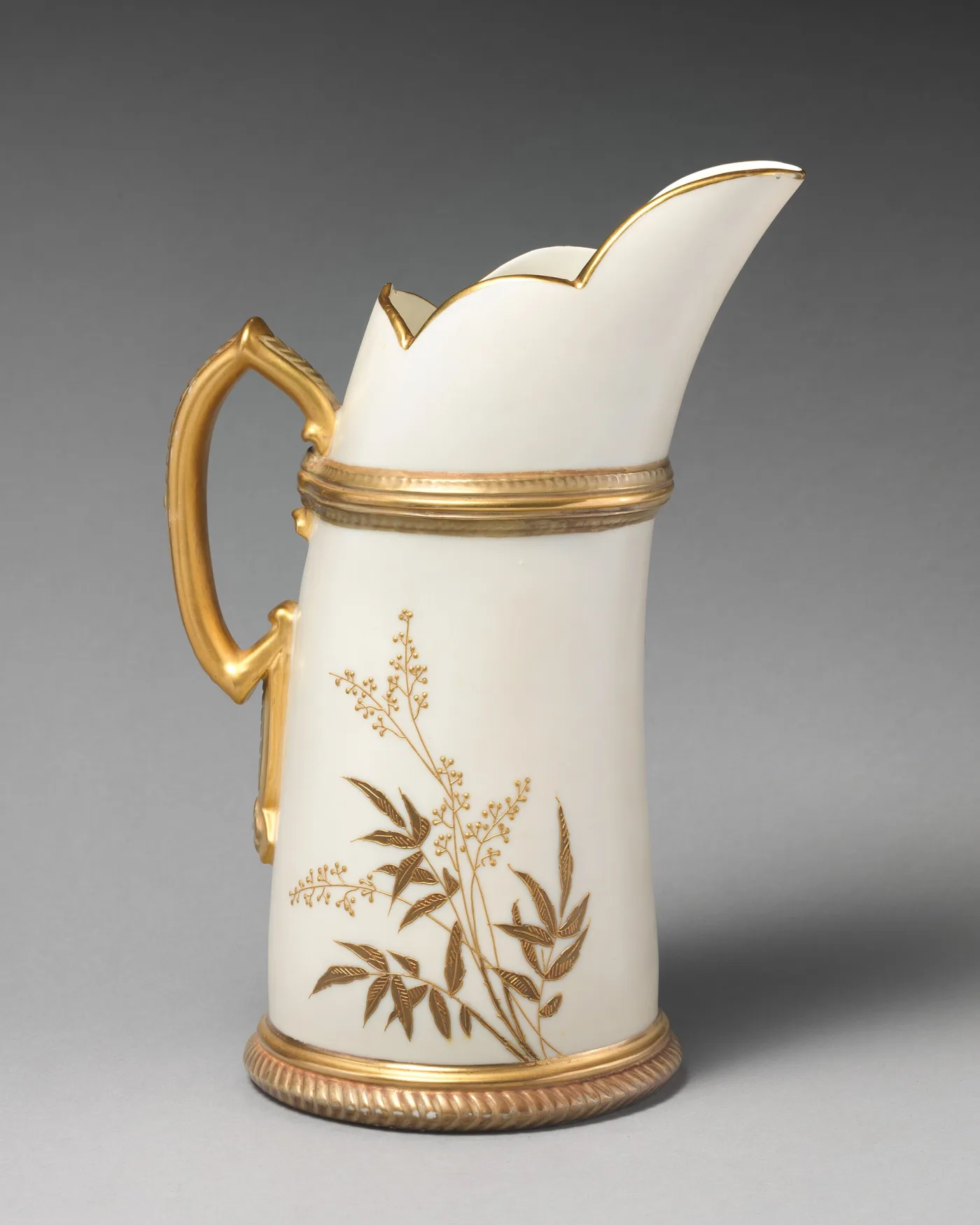
Royal Worcester is the oldest continuously produced porcelain in England, founded in 1751 by Dr. John Wall and a group of fifteen Worcester partners and reorganised so many times since that the factory's history is itself a kind of index to English ceramic production. From the soft-paste blue-and-white of the Dr. Wall period through the gilded cabinet wares of Flight & Barr, the hand-painted naturalistic plates of the Victorian Royal Worcester Porcelain Company, the blush-ivory and reticulated Hadley wares of the late nineteenth century, the great fruit-painting and bird-painting cabinet plates of the twentieth, and the modern Evesham tableware of recent memory — Worcester has spanned 270 years without an interruption. For collectors, that continuity is both a blessing and a problem. A Worcester teacup of 1770 and a Worcester teacup of 1970 may share a crescent or crown mark, but they are separated by a factor of fifty in value.
Fortunately Worcester is one of the most precisely datable English porcelains. After 1867 the factory adopted a printed mark with a year-cipher system — first dots around the crown-and-circle mark, then numbers, letters, stars, and various pictorial devices — that places virtually every twentieth-century piece in a single year. Before 1867, mark periods are looser but still narrow: the crescent mark of the Dr. Wall era, the script "Flight" or "Flight & Barr" of the early nineteenth century, the printed "Chamberlain's Worcester" of the rival Chamberlain factory (which merged with Flight, Barr & Barr in 1840), and the "Kerr & Binns" of 1852–1862 each define a fifteen- to thirty-year window. This guide reads each mark period in sequence, then walks through the body characteristics, the painters who built the modern reputation (the Stintons, Charles Baldwyn, Harry Davis, William Powell), the principal pattern families, the reticulated work of George Owen, the Dorothy Doughty bird models, and the values that follow. It builds on the broader framework of our antique porcelain identification guide.
By the end you will be able to read a Worcester mark, assign a date within a year or two for any twentieth-century piece, recognise the principal painters' styles, distinguish Dr. Wall first-period soft paste from Chamberlain hybrid paste from later bone china, and place values from £40 modern Evesham cups to five-figure signed Stinton highland-cattle cabinet plates.
Table of Contents
- A Brief History of Worcester Porcelain
- Worcester Mark Periods Overview
- Dr. Wall / First Period (1751–1783)
- Flight, Barr & Successors (1783–1840)
- Chamberlain's Worcester (1788–1852)
- Kerr & Binns (1852–1862)
- Royal Worcester Porcelain Company (1862–present)
- Reading the Date Codes
- Bodies: Soft Paste, Hybrid, Bone China
- Painters and Signed Pieces
- Blush Ivory and Hadley Ware
- Reticulated Worcester and George Owen
- Figures, Doughty Birds & Modelled Wares
- Notable Patterns: Evesham, Lavinia, Painted Fruit
- Reproductions and Mark Confusion
- Authentication Workflow
- Condition and Damage
- Value Factors and Price Ranges
- Building a Royal Worcester Collection
- Care, Display & Preservation
A Brief History of Worcester Porcelain
The Worcester porcelain story is uniquely long and unusually well-documented. Production began in 1751, only six years after the founding of Bow and Chelsea, but unlike those London factories Worcester never closed and never broke continuity with its earliest workmen.
Foundation: Dr. Wall and the Worcester Tonquin Manufacture
Dr. John Wall, a physician and amateur chemist, joined with Worcester apothecary William Davis and fifteen subscribing partners in 1751 to establish the Worcester Tonquin Manufacture. The factory acquired the Bristol soft-paste formula of Benjamin Lund, giving Worcester an immediate technical advantage over its East-Anglian competitors. Production focused on tea wares, table services, and decorative pieces in blue-and-white underglaze, with polychrome and gilded wares added through the 1760s.
The Flight and Chamberlain Periods
After Dr. Wall's death in 1776, the factory passed through several proprietorships before Thomas Flight purchased it in 1783. Flight's sons, Joseph and John, expanded the business and were joined by Martin Barr in 1792 — beginning the long sequence of partnerships (Flight, Flight & Barr, Barr, Flight & Barr, Flight, Barr & Barr) that defined the early nineteenth century. Meanwhile Robert Chamberlain, formerly Worcester's chief decorator, left in 1788 to found a rival factory in Worcester itself. The two firms competed for fifty years before merging as Chamberlain & Co. in 1840.
Kerr & Binns and the Royal Worcester Porcelain Company
The merged firm passed through Kerr & Binns (1852–1862) and was reorganised as the Royal Worcester Porcelain Company in 1862 under R.W. Binns. This is the firm that produced the great Victorian cabinet wares — blush ivory, reticulated porcelain, the Stinton landscape work, the Baldwyn swans, the Davis fruit — and survives in modified form today.
Hadley, Owen, and the Late Victorian Flowering
James Hadley, modeller and designer, left Royal Worcester in 1875 to found his own decorating studio, producing distinctive "Hadley Ware" (blush ivory with restrained naturalistic painting) before being reabsorbed into the main factory in 1905. George Owen, the great reticulated-porcelain master, joined in 1859 and worked at Royal Worcester for nearly fifty years, producing astonishing pierced cabinet pieces. The late Victorian and Edwardian period is widely considered the high-water mark of Worcester achievement.
The Twentieth Century and Modern Era
Royal Worcester continued strongly through the early twentieth century with the painters who define the modern collector market — Harry Stinton, James Stinton, John Stinton (the three Stintons painted highland cattle, sheep, and birds respectively), Charles Baldwyn (swans and birds), Edward Raby (flowers), Harry Davis (sheep, landscape, fruit), and William Powell (English birds). Dorothy Doughty's American bird models (1935 onward) became collectors' icons. The factory continued through both world wars, was acquired by various corporate parents in the late twentieth century, and ceased Worcester production in 2009, though the Royal Worcester name continues on outsourced tableware today.
Cultural Position
Royal Worcester stands alongside Wedgwood, Minton, and Spode in the front rank of English ceramic firms. Where Wedgwood built its reputation on jasperware and queensware, Worcester's distinction is fine porcelain — especially hand-painted cabinet wares where the painter, not the form, carries the value. The Worcester painter tradition is the deepest in English porcelain.
Worcester Mark Periods Overview
Worcester marks divide into five distinct eras, each with its own conventions:
1. Dr. Wall / First Period (1751–1783)
Crescent marks (open or hatched), fretted square Chinese-style marks, painted W or workmen's marks, and pseudo-Chinese seal marks. No date codes.
2. Flight and Barr Eras (1783–1840)
Script signatures: "Flight," "Flight & Barr," "Barr, Flight & Barr," "Flight, Barr & Barr." Often incised or impressed in addition to printed. Royal cipher (Crown) added after 1789. No year codes.
3. Chamberlain's Worcester (1788–1852)
Printed or written "Chamberlain's Worcester" or "Chamberlain Regent China," sometimes with the New Bond Street London showroom address. Separate marks; this is the rival firm.
4. Kerr & Binns (1852–1862)
Printed shield mark with "Worcester" and "K&B" monograms; also the so-called "circle with shield" mark.
5. Royal Worcester Porcelain Company (1862–present)
Printed crown-and-circle mark (introduced 1862, refined 1867 onward) with year-cipher system: dots 1867–1891, then sequence of letters, numbers, stars, and pictorial devices that runs continuously to the late twentieth century. This is the period of precisely datable pieces.
Wording Anchors
"Royal Worcester Porcelain Co." or "Royal Worcester England" with the printed crown-and-circle: 1862 onward. "Royal Worcester Spode Ltd": 1976 onward (after the Spode merger). "Bone China" inscription appears from c.1970. "Made in England" appears from 1891 onward, following the McKinley Tariff Act — the same regulation that produced the "IRELAND" added to Belleek's Second Mark and the "Nippon" word on Japanese export porcelain in the same year.
Dr. Wall / First Period (1751–1783)
The First Period — sometimes called the "Dr. Wall period" though Wall himself died in 1776 — is the most coveted and most collected Worcester. It coincides with the original soft-paste production and the great age of blue-and-white English porcelain.
Marks of the First Period
The most common mark is the crescent — either an open crescent (used on transfer-printed blue-and-white) or a hatched crescent (used on hand-painted blue). The fretted square (a Chinese-style four-character mark) appears on better-quality painted wares. Pseudo-Chinese seal marks, the painted W, and various workmen's marks also appear. Many First Period pieces are unmarked.
Soft-Paste Body
Worcester First Period is true soft-paste porcelain — soaprock formulation derived from the Bristol works. The body fires to a faintly greenish or grey-white translucent porcelain, slightly softer than the hard-paste European wares, and shows the characteristic soft-paste "ground" colour when held to strong light.
Forms and Decoration
Tea and coffee wares, sauce boats, plates, dessert services, and decorative vases. Underglaze cobalt blue-and-white is the workhorse decoration; polychrome painted wares with chinoiserie, European flowers, and exotic birds appear from the 1760s onward. Transfer-printed wares (often by Robert Hancock) carry distinctive engraved imagery.
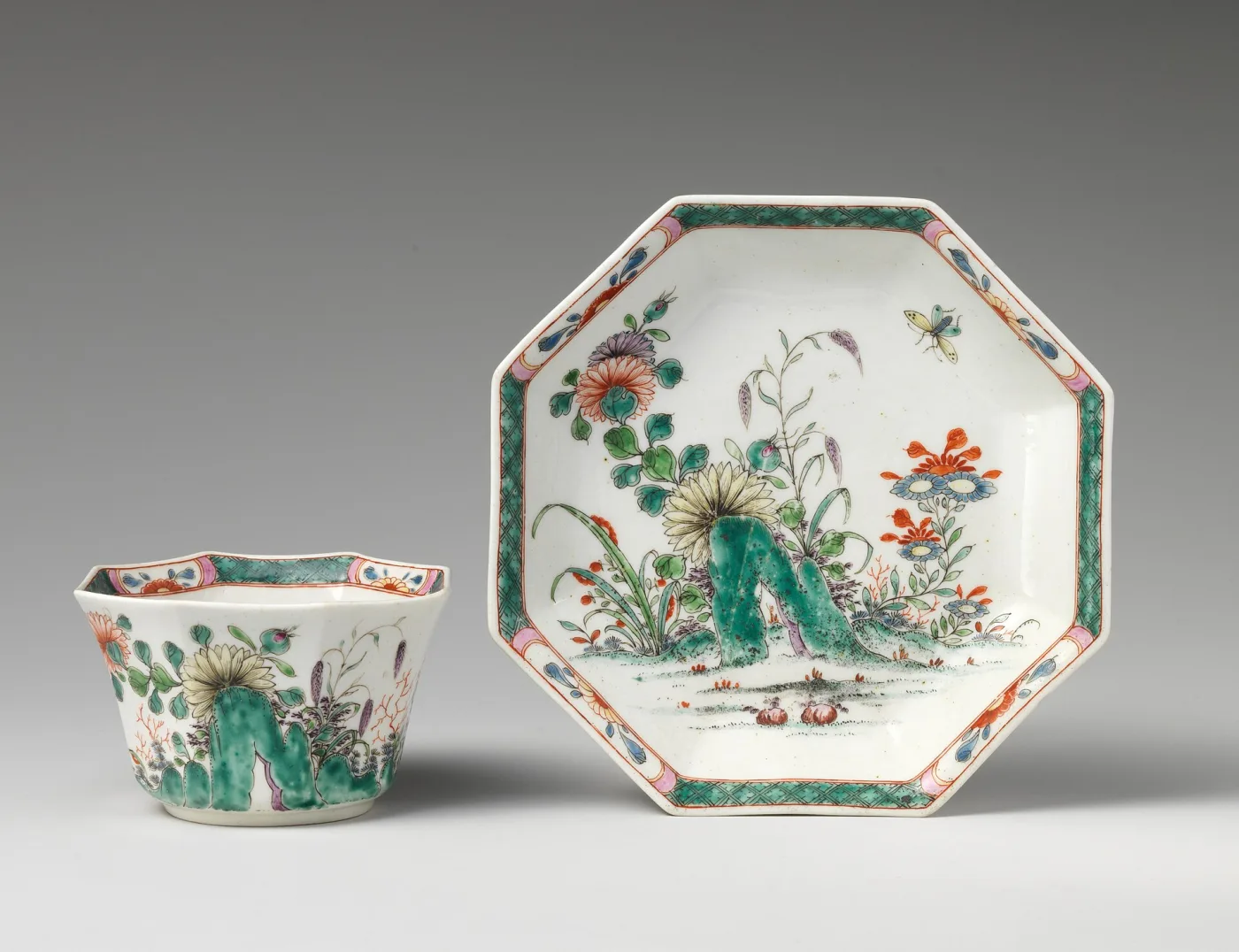
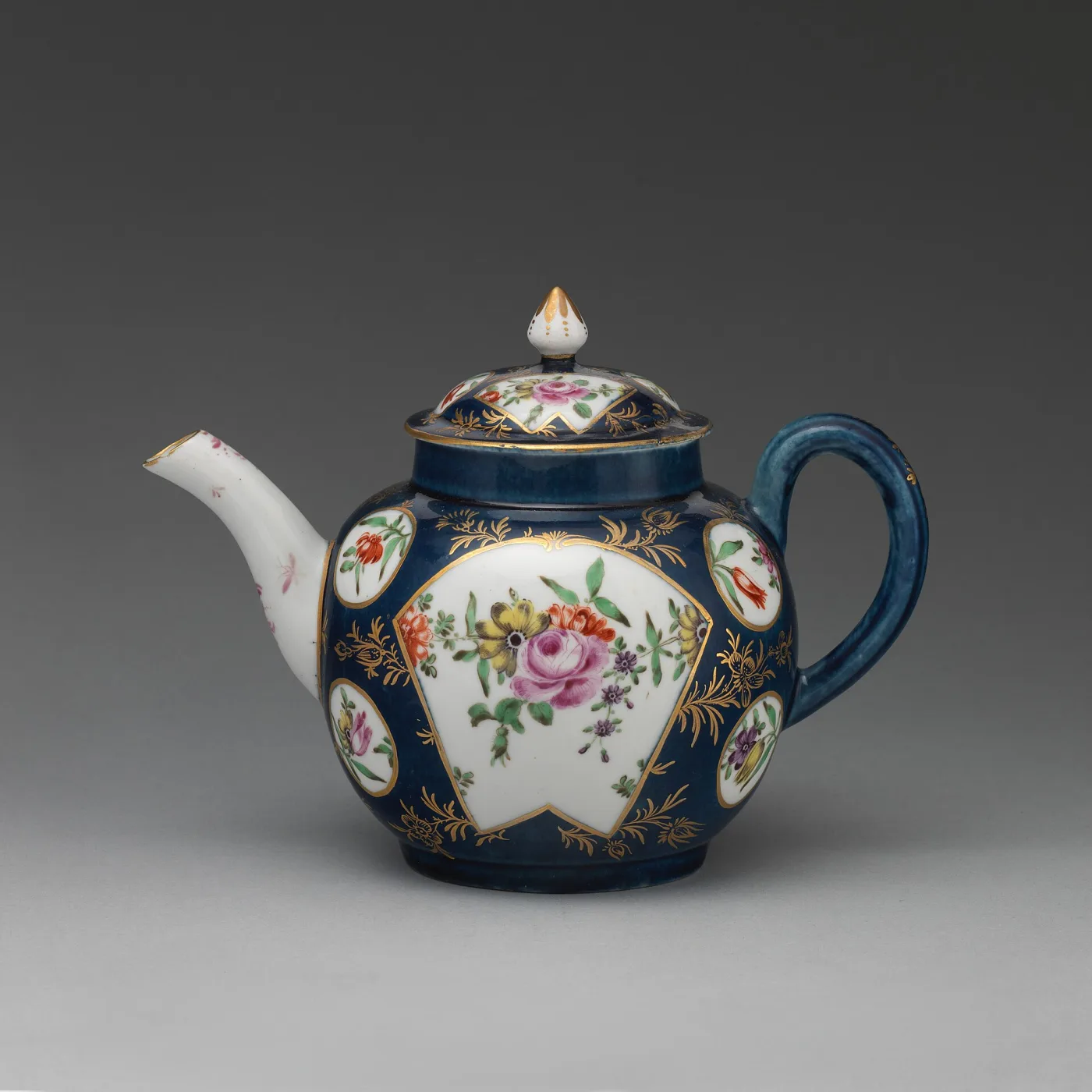
Both of these are First Period Worcester — the factory before the "Royal", 1751 to 1783 — and neither will carry a crown-and-circle mark. Expect a crescent, a fretted square, a workman's device, or nothing at all; a crowned circle on a piece in either of these styles means it is later, or it is not Worcester. Fifteen years separate the two pieces and what changed is the ground rather than the form. The scale blue on the right is the most copied Worcester effect of all, so it repays close looking: the scales were painted individually over an underglaze wash, which means they vary in depth and overlap unevenly, while a printed imitation repeats exactly.
Famous Painters of the Period
Documented First Period painters include "Powell" (not the later William Powell), Jeffreyes Hammet O'Neale (who painted Aesop's fables), and various unnamed but distinctive hands. Attribution is largely stylistic; signed First Period pieces are rare.
First Period Identification Pitfalls
Caughley porcelain (1775–1799) is the principal confusion. Caughley used very similar crescent marks and very similar blue-and-white designs — Caughley was founded by Thomas Turner, formerly of Worcester, and deliberately imitated the parent factory. Body differences (Caughley is slightly more grey-toned), pattern differences, and the precise crescent form distinguish the two. Specialist references are essential. The general framework for resolving such mark confusions is laid out in our authentication and provenance research guide.
Flight, Barr & Successors (1783–1840)
Thomas Flight purchased Worcester in 1783 and his successors ran the factory through a series of partnership names until the 1840 merger with Chamberlain. The Flight–Barr era is the great period of Worcester Regency cabinet ware — heavily gilded, brilliantly enamelled, classically-formed.
Flight (1783–1792)
The earliest Flight mark is the script "Flight" or the painted/incised initial "F." Production initially continued in the style of the Wall period but shifted rapidly toward Regency neoclassicism.
Flight & Barr (1792–1804)
Martin Barr joined the firm in 1792. Marks incorporate "Flight & Barr" — sometimes incised in script into the unfired clay, sometimes printed. The crown above the mark dates from the royal patent of 1789 ("Manufacturers to Her Majesty").
Barr, Flight & Barr (1804–1813)
The death of Joseph Flight and Martin Barr's elevation produced a partnership rename — "BFB" sometimes appears as initials, often impressed.
Flight, Barr & Barr (1813–1840)
The longest-running of the Flight partnerships. Marks include "FBB" (impressed), "Flight Barr & Barr" (printed or written), and various combinations with royal warrant references and London showroom addresses.
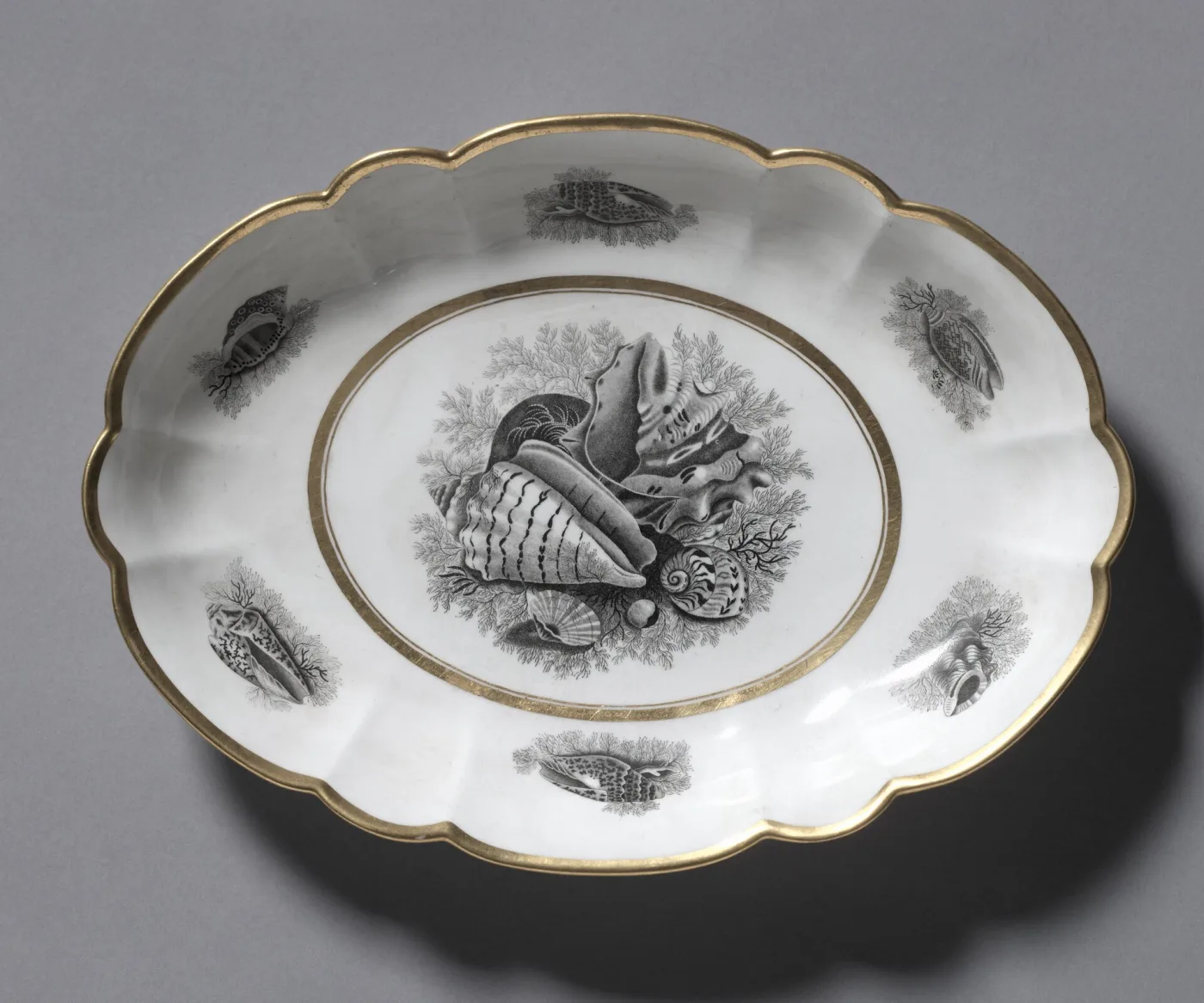
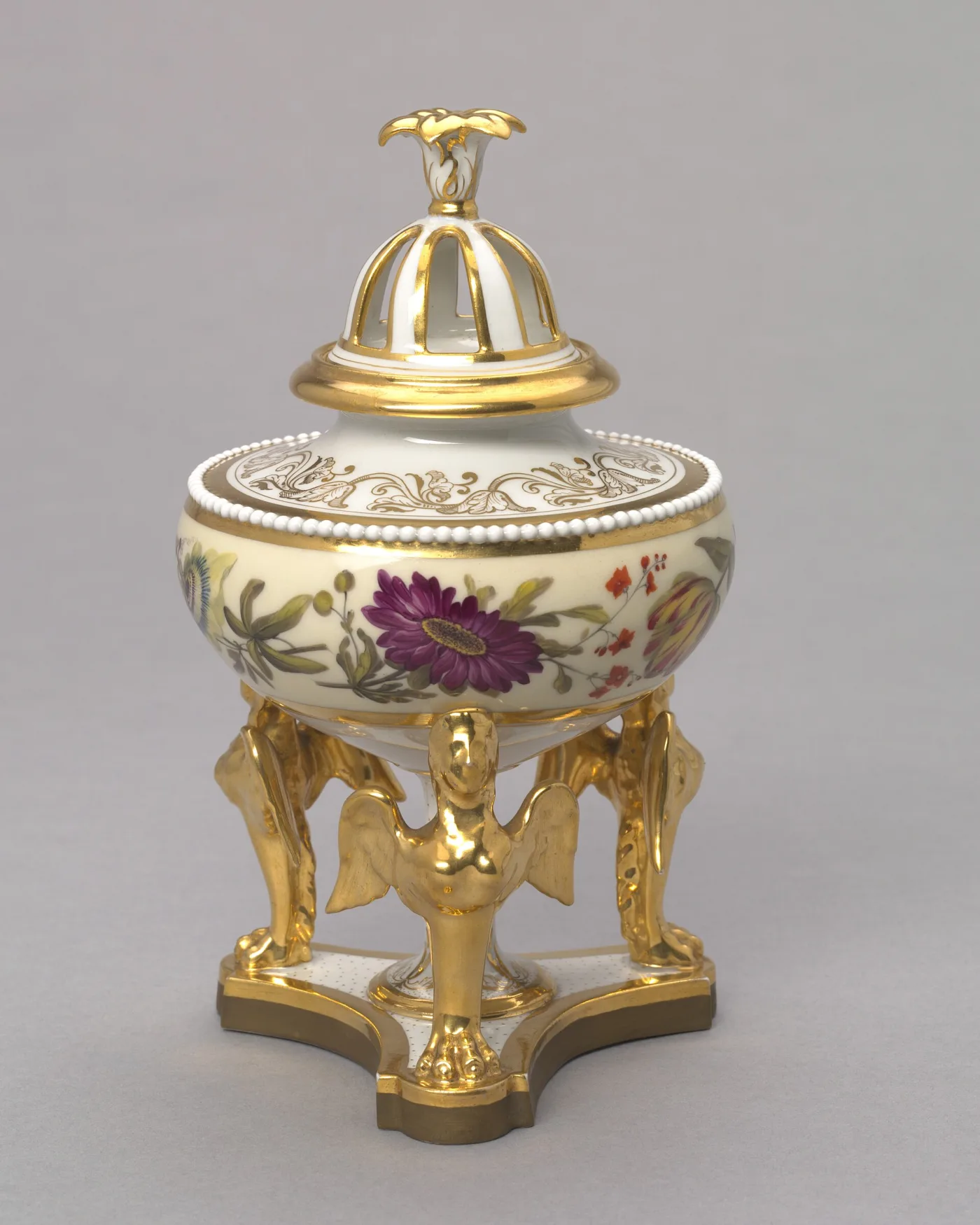
The partnership names look almost identical and are not interchangeable; the word order is the date. Flight (1783–92), Flight & Barr (1792–1804), Barr, Flight & Barr (1804–13), Flight, Barr & Barr (1813–40). Read the order on the base before you read anything else. These two also illustrate why you should reconcile the name against the date rather than trusting either alone: the urn on the right is catalogued with the last of those names but dated 1810, three years before that partnership existed. When a name and a date disagree, one of them is wrong, and it is worth establishing which before you price the piece.
Bodies of the Flight–Barr Era
Through the early Flight years the body remains soft-paste, with the introduction of bone china (under Spode's influence) in the early nineteenth century. By the Barr partnerships Worcester was producing some of the finest bone china in England — heavily gilded, brightly enamelled, often signed by named painters such as Thomas Baxter (flower painter), William Doe (figures), Samuel Astles (heraldic and topographical work), and the brothers Pennington.
Forms
Tea services, dessert services, cabinet plates with topographical or heraldic decoration, vases with named-view panels, and presentation pieces. Royal commissions (including pieces for George III and the Duke of Clarence) are documented. This is the high-water mark for English Regency porcelain.
Chamberlain's Worcester (1788–1852)
Robert Chamberlain, Worcester's chief decorator, left Flight in 1788 to start his own decorating studio with his sons Humphrey and Robert junior. The Chamberlain firm acquired or developed its own porcelain body and, from c.1790, produced complete porcelain wares in direct competition with the parent factory.
Chamberlain Marks
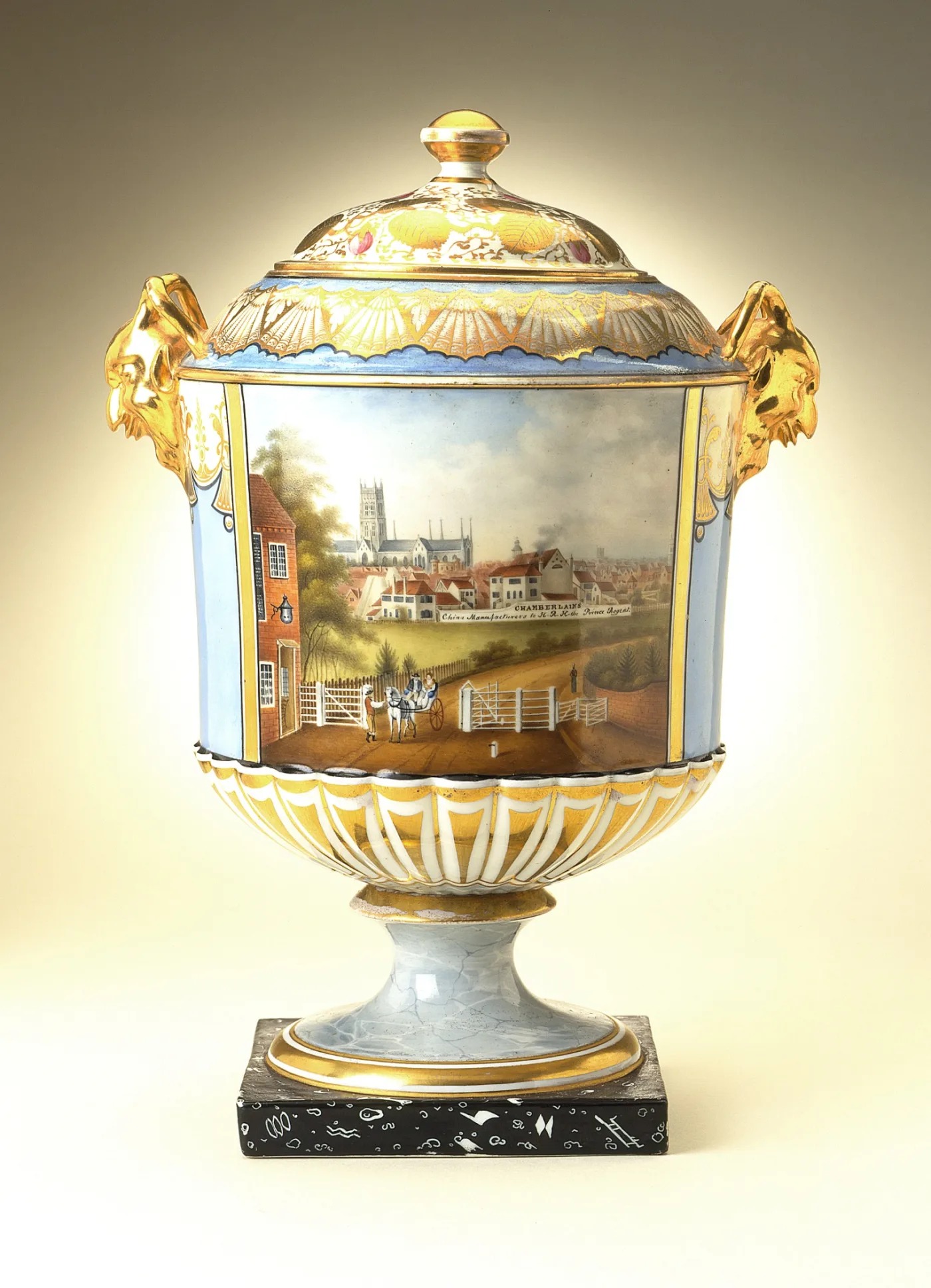
"Chamberlain's Worcester" in painted or printed script, sometimes with the New Bond Street London showroom address (Chamberlain's London Warehouse, 155 New Bond Street). The Regent China inscription appears on Chamberlain's premium body from c.1811. Various pattern numbers accompany the mark on dessert services.
Chamberlain Bodies
Initially a soft-paste similar to Wall-period Worcester; from the early nineteenth century a heavier, more durable hybrid hard-paste body marketed as "Regent China." The Chamberlain Regent body is slightly greyer and heavier than Flight bone china.
Decoration
Heavily gilded cabinet pieces, named topographical views, heraldic services, and chinoiserie patterns. Chamberlain pieces are often more flamboyant and more heavily gilded than contemporary Flight production.
The 1840 Merger
The two Worcester firms merged in 1840 as "Chamberlain & Co." (Flight, Barr & Barr having been the larger firm but Chamberlain's name surviving in the merged title). The combined firm continued through difficulties to the 1852 reorganisation as Kerr & Binns.
Identification Notes
Chamberlain pieces should be valued separately from contemporary Flight production. Both are "Worcester porcelain" in the general sense, but the firms are distinct and the marks unambiguously distinguish them. Don't conflate.
Kerr & Binns (1852–1862)
The brief Kerr & Binns decade is transitional but produced some of the finest mid-Victorian Worcester. R.W. Binns, the surviving partner, would go on to lead the Royal Worcester Porcelain Company from 1862 to 1897.
Marks
The principal mark is a printed shield with a "W" and crescent inside, "Worcester" below, and "K&B" or "Kerr & Binns" added. A circle-and-shield variant is also documented. Marks vary by ware type.
Decoration
Heavily gilded cabinet pieces, brightly enamelled dessert services, and the famous Shakespeare Service (made for the Earl of Dudley, 1853). Pâte-sur-pâte work began at Worcester during this period under the influence of Marc-Louis Solon (who later moved to Minton).
Body
Bone china predominates, with various experimental bodies for specific exhibition pieces. Quality is consistently high.
Collecting Kerr & Binns
Genuine Kerr & Binns pieces are scarce and command strong prices. The decade is too short to have produced much surviving tableware, so most collectible Kerr & Binns is cabinet ware. The 1862 reorganisation closes this brief period.
Royal Worcester Porcelain Company (1862–present)
The Royal Worcester Porcelain Company, formed in 1862 under R.W. Binns and Edward Phillips, is the firm most collectors know simply as "Royal Worcester." Its production from 1862 to the late twentieth century is what fills cabinet shelves and auction rooms today.
The Crown-and-Circle Mark
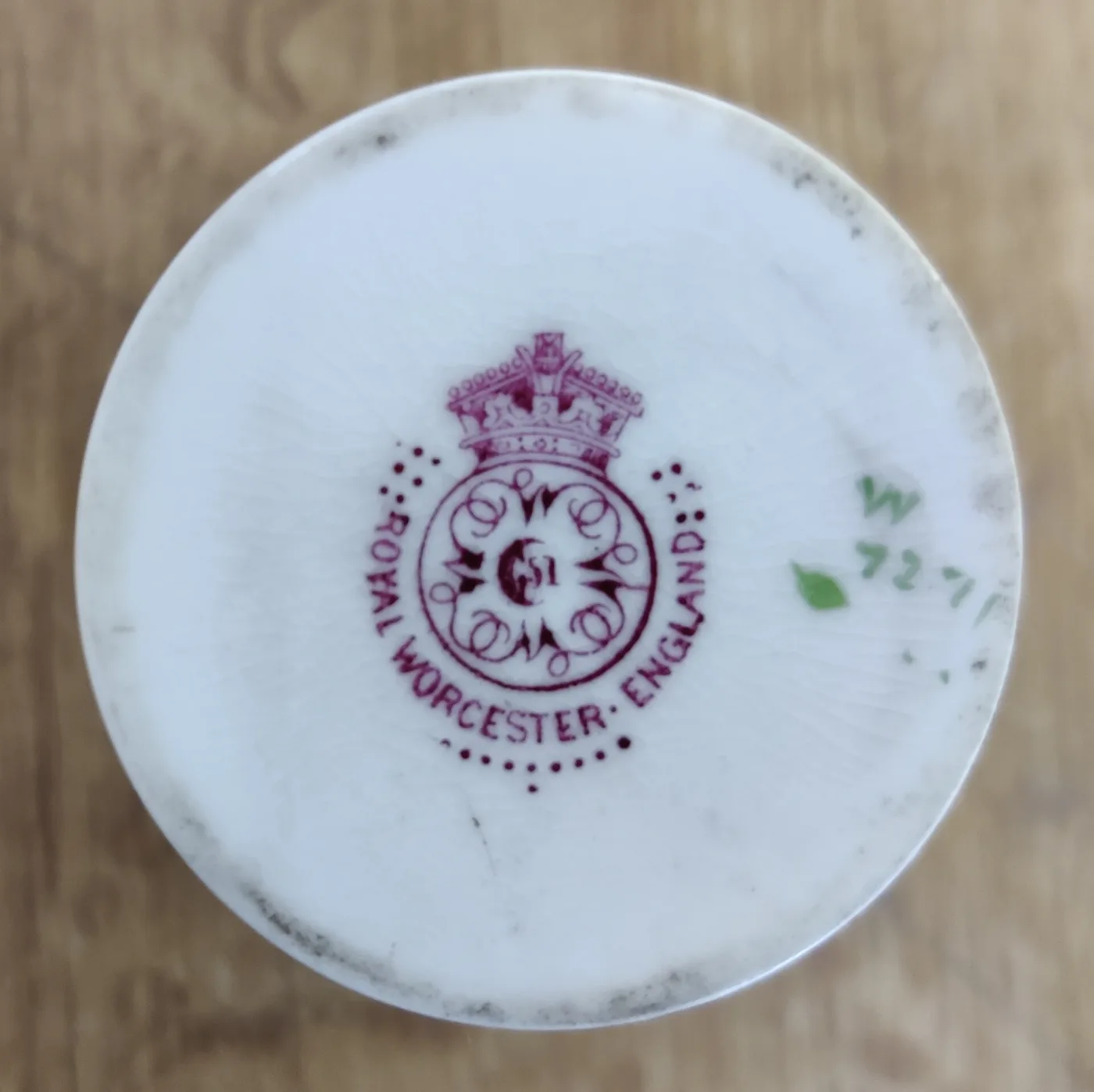
The classic Royal Worcester mark — a stylised crown above a circle containing the conjoined initials W with a crescent and the number 51 (for 1751, the founding date) — was introduced in 1862 and refined to its standard form in 1867. The mark is printed in various colours (puce, green, blue, black) at different periods. Year-cipher devices appear around or beside the circle from 1867 onward.
Late Nineteenth-Century Production
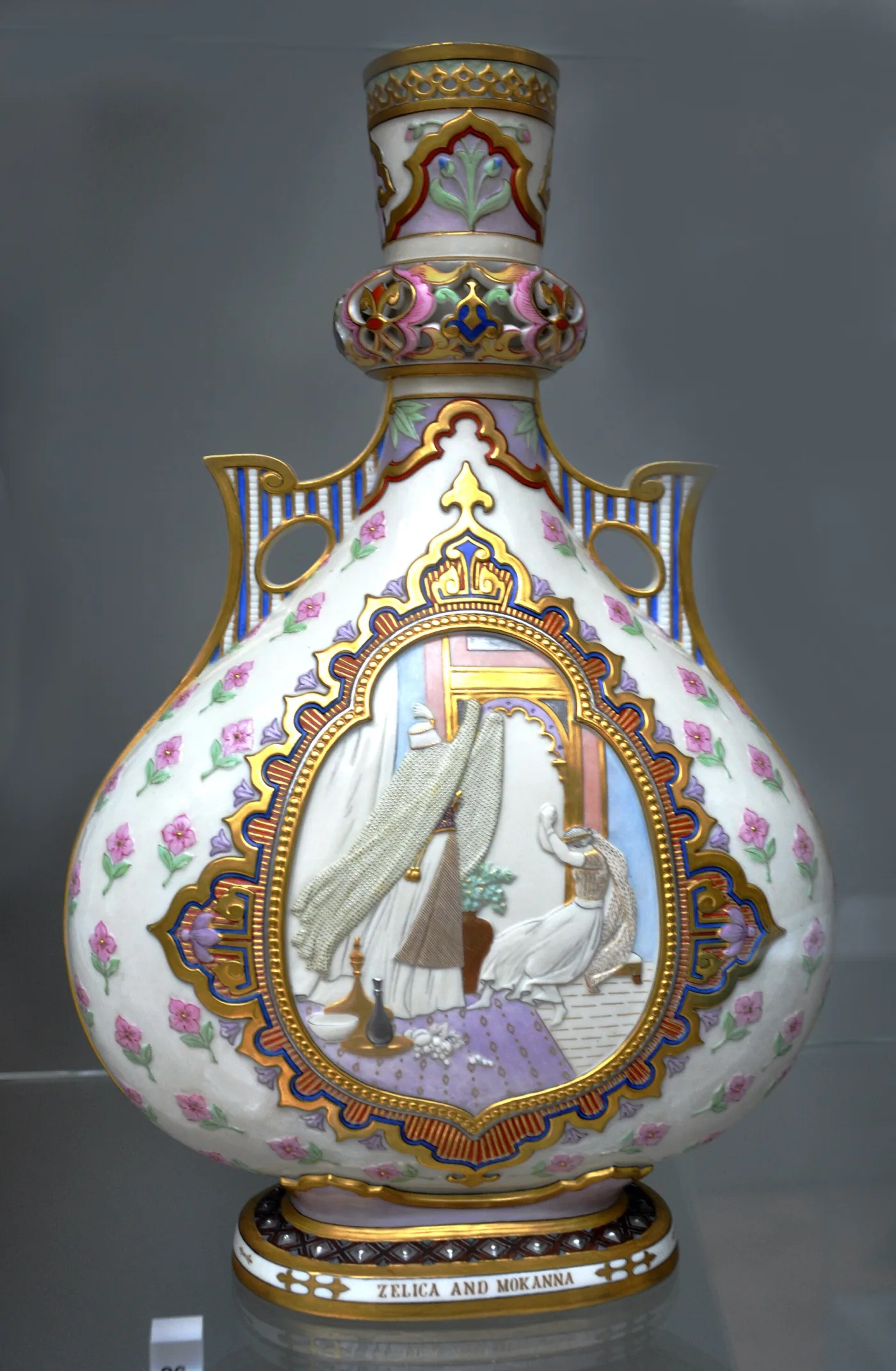
The late Victorian period (1867–1900) is the great age of Royal Worcester cabinet ware. Blush ivory (a soft pinkish-ivory ground), reticulated porcelain by George Owen, hand-painted floral plates, and the elaborate Hadley Ware all date from this period. Tableware production expanded to meet middle-class demand.
Early Twentieth-Century Painters
The Edwardian period through the 1930s saw the greatest of the named painters at work: the three Stintons (John, Harry, James), Charles Baldwyn, Edward Raby, Harry Davis, William Powell, Walter Sedgley, William Hawkins, and many others. Signed cabinet pieces by these painters are the highest-value modern Royal Worcester.
Mid-Twentieth-Century Production
The 1930s through the 1960s saw the Dorothy Doughty bird models, the Doris Lindner equestrian figures, the Ronald Van Ruyckevelt fishes, and a series of fine modelled wares alongside continuing painted production. Tableware patterns including Evesham, Lavinia, and Astley supported the commercial side of the business.
Late Twentieth-Century and End of Worcester Production
The factory continued through corporate ownership changes — merger with Spode in 1976 as Royal Worcester Spode, later acquisitions — until Worcester production ceased in 2009. The Royal Worcester name continues on outsourced (often Far Eastern) tableware today; these post-2009 pieces are not Worcester-made.
Reading the Date Codes
The Royal Worcester year-cipher system is the most precise dating tool in English porcelain. From 1867 every printed mark carries a device that locates the piece in a single year.
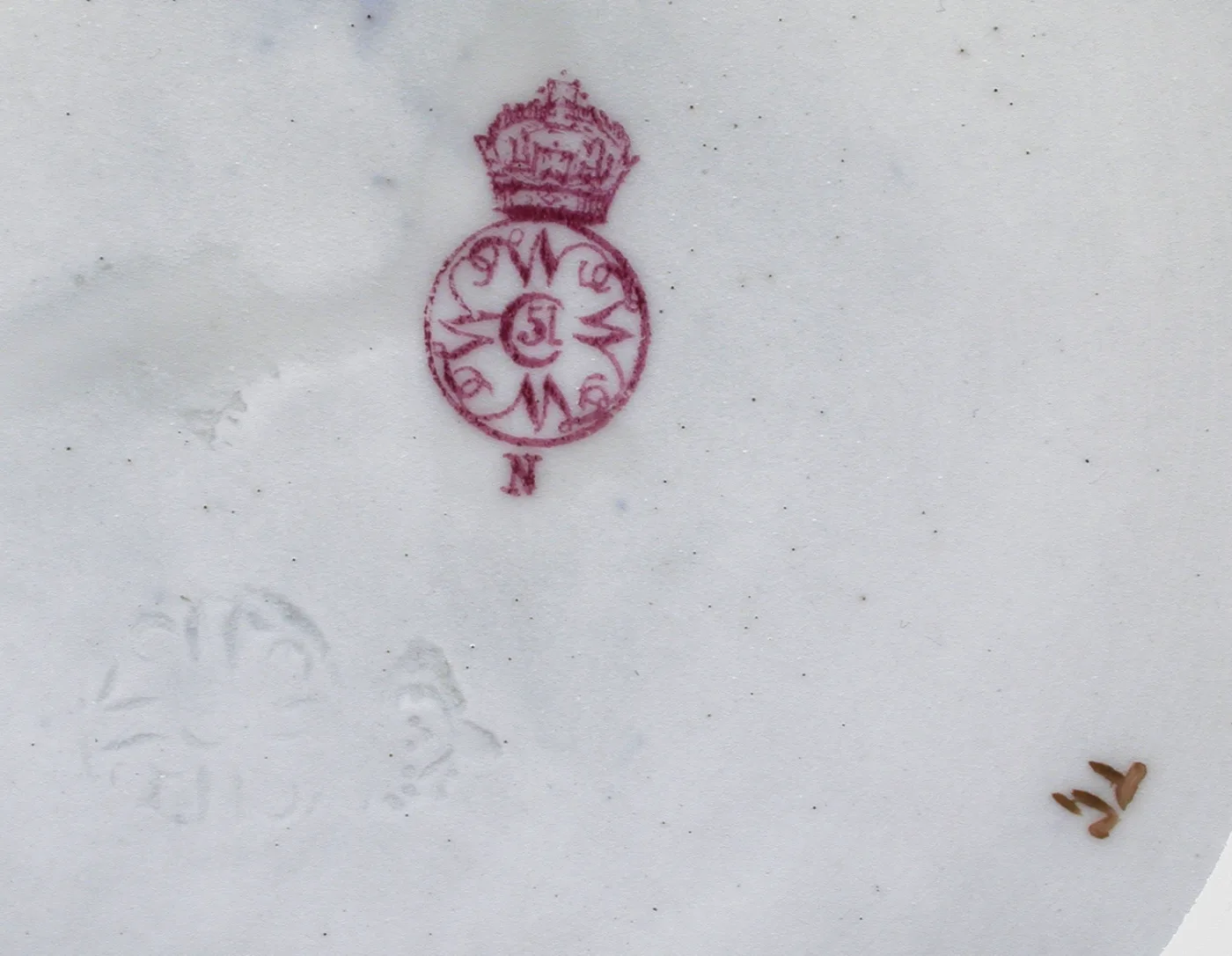
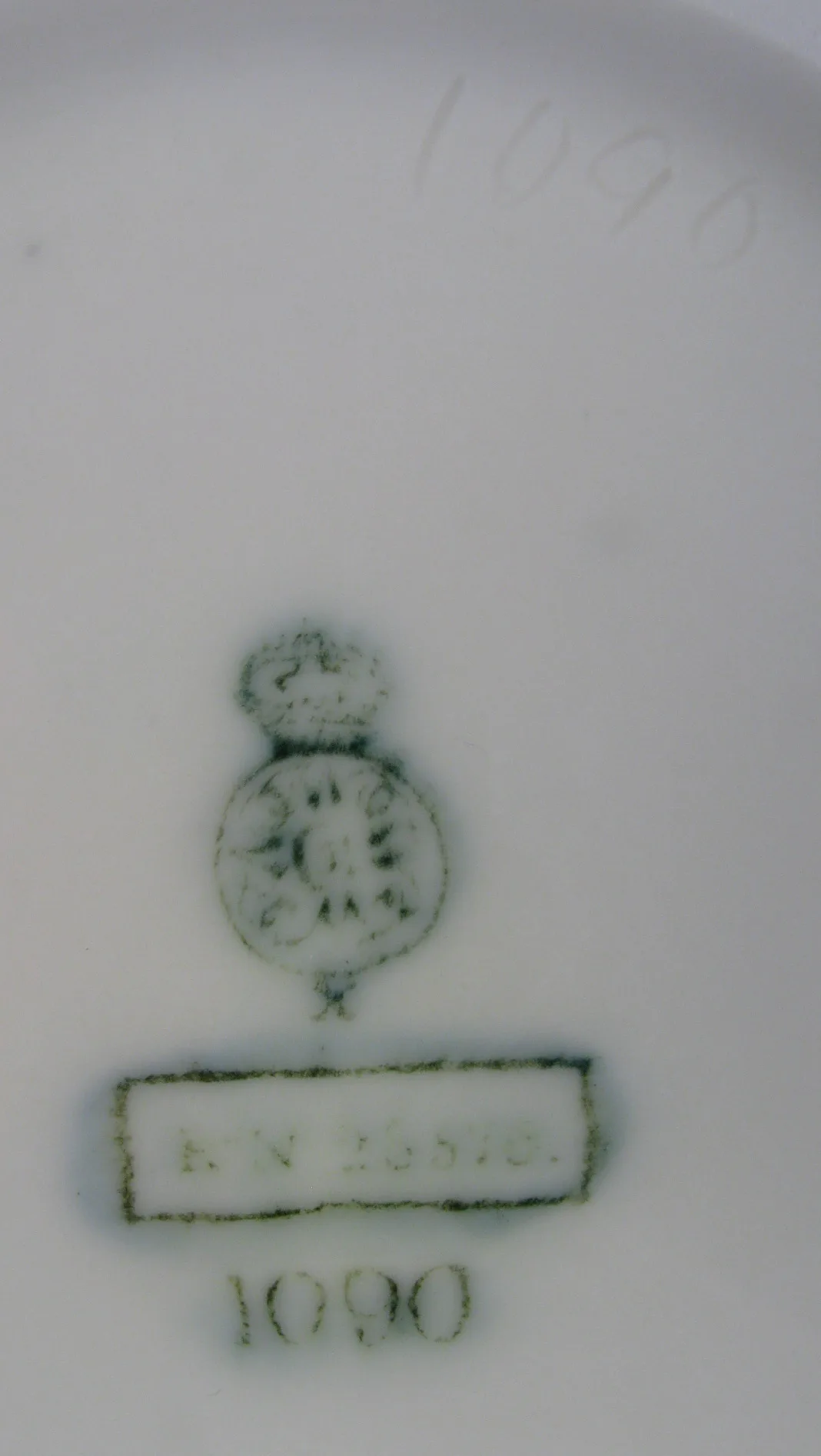
Several things are competing for your attention on a Worcester base and only one of them is the year. The crowned circle with 51 at its centre — the founding date, 1751 — is the factory mark itself and barely changes for decades, so it tells you the firm and not the date. The colour it is printed in shifts by period (puce, green, blue, black are all normal at different times) and is a useful cross-check but never a date on its own. The year lives in the small cipher tucked beneath or beside the circle: a letter on the left-hand mark here, dots or stylised devices on other pieces, and it must be read against a published table rather than counted from a remembered starting year. The impressed and printed numbers are shape and pattern references, and the boxed number on the right is a design registration — which is genuinely useful, because it can be looked up independently and used to confirm what the cipher says.
1867–1891: Dot System
One dot added each year beside the crown-and-circle mark: one dot in 1867, two in 1868, and so on through 1891 (twenty-four dots). The dots are usually small puce or black dots flanking the printed mark. Count the dots, add to 1867, subtract one.
1892–1915: Star/Asterisk and Letters
From 1892 the dot system was replaced with a six-pointed star plus dots, then a sequence of letters: A in 1898, B in 1899, and so on. The system varies and a published reference table (Sandon, "Worcester Porcelain Marks") is essential for exact reading.
1916–1929: Stylised Devices
A sequence of stylised devices (squares, circles, triangles, dots in various arrangements) marks each year. The Sandon reference is again essential.
1930–1948: Crown-with-Lines
Variations of the crown with horizontal lines beneath, each year having a distinct number of lines or dot configurations.
1949 Onward: Numerical Devices
Various numerical systems through the 1950s, 1960s, and 1970s. By the late twentieth century the mark often carries the year explicitly.
Pattern Numbers
Pattern numbers (often four to six digits) accompany the date-cipher and identify the specific decoration. Pattern numbers in published reference tables locate the pattern in the factory ledger and can be cross-referenced for confirmation.
The Sandon Reference
Henry Sandon's "Royal Worcester Porcelain from 1862 to the Present Day" and the related "Worcester Porcelain Marks" remain the authoritative dating references. Any collector serious about Royal Worcester should own one of these guides. Specialist auction catalogues from Bonhams, Christie's, and Woolley & Wallis (Salisbury) provide market comparables.
Bodies: Soft Paste, Hybrid, Bone China
Worcester body changes track the broader evolution of English porcelain. Identifying the body confirms or contests a proposed date.
Soft Paste (1751–c.1800)
The First Period body is true soft-paste porcelain — soaprock-based, faintly greenish-white in transmitted light, slightly soft and "warm" to handle. Foot rings often show a fine sandy or unglazed surface. Translucency is moderate; pieces transmit some light but not strongly.
Hybrid Hard Paste (c.1800–c.1820)
Transition pieces of the early Flight era use a hybrid body combining soft-paste and hard-paste characteristics. Slightly heavier than First Period, slightly cleaner-white. Chamberlain's Regent China is a parallel hybrid development.
Bone China (c.1820 Onward)
Bone china — porcelain containing bone ash for whiteness and translucency — was developed by Josiah Spode II and adopted across English porcelain factories. Worcester bone china is brilliantly white, strongly translucent, and ringingly hard. Bodies through the late Victorian and twentieth-century periods are bone china unless specifically marked otherwise.
Parian (1840s Onward, Limited)
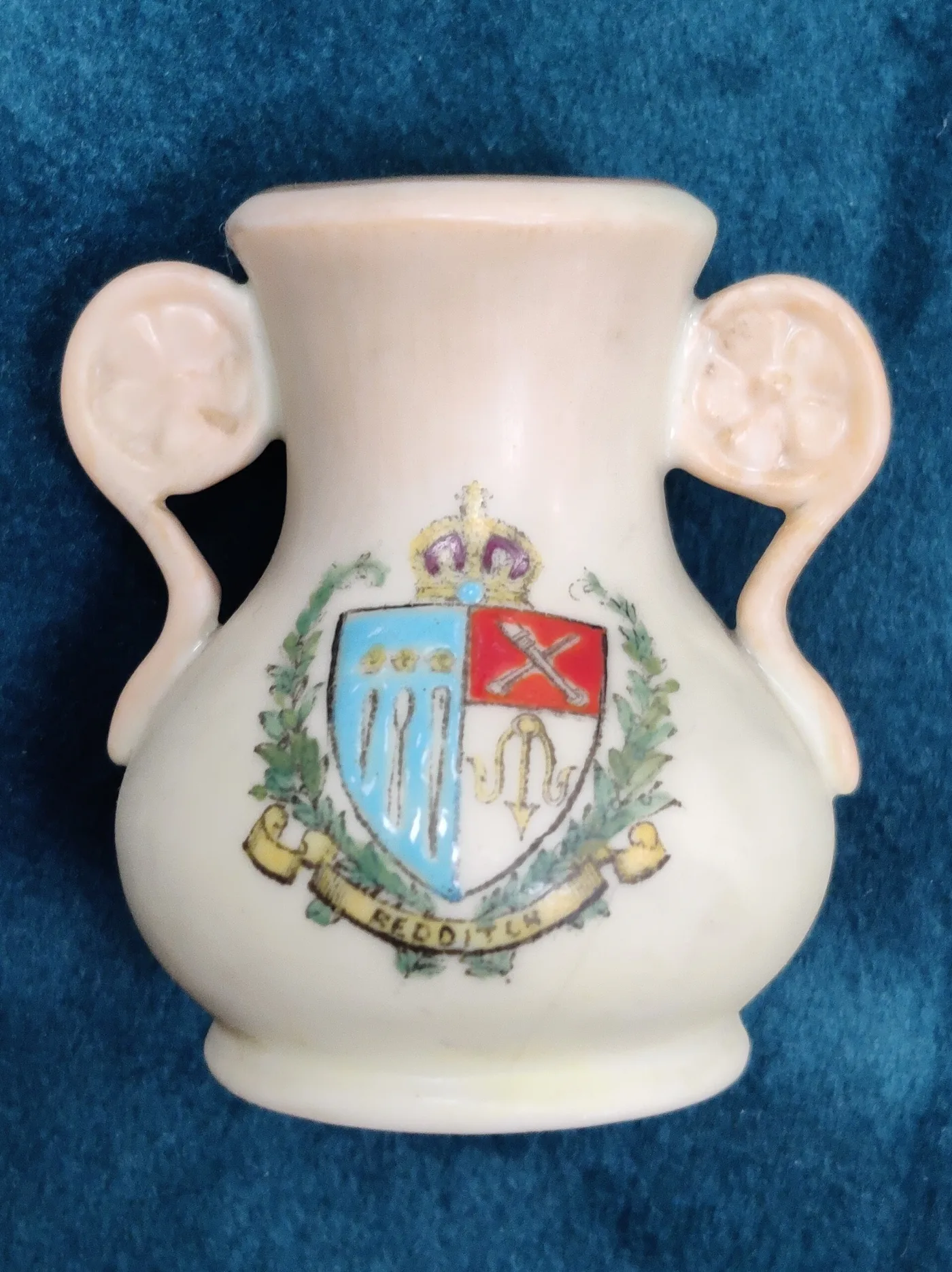
Worcester produced some parian (unglazed white biscuit porcelain) for figural and architectural work but never as extensively as Copeland or Minton. The same fine parian body was later used across the souvenir trade for Goss and crested china, so a creamy parian model bearing a painted coat of arms belongs to that field rather than to Worcester. Parian pieces should be identified by body, not assumed.
Translucency Tests
Hold a thinly-cast piece to strong light. Soft paste shows soft, slightly greenish transmission. Bone china shows brilliantly white, often blue-tinted transmission with strong light transit. Hybrid bodies fall between. A body that fails the translucency test is not a fine porcelain regardless of mark.
Foot Ring Examination
The unglazed foot ring reveals the body colour and texture clearly. Soft paste is creamy and slightly grainy; bone china is brilliantly white and smooth; the chambered hybrid Regent body is greyer and denser. Compare against known reference pieces to develop the eye.
Painters and Signed Pieces
The named painters of Royal Worcester are the firm's modern reputation. Hand-painted cabinet pieces signed by these artists carry the highest values and are the most actively collected category.
The Three Stintons
John Stinton (1854–1956 — exceptional longevity), Harry Stinton (1883–1968, John's son), and James Stinton (1870–1961, John's brother) are the most famous of all Royal Worcester painters. John and Harry specialised in highland cattle in mountain landscapes; James painted game birds. All three signed their work clearly. Signed Stinton cabinet plates and vases routinely reach £800 to £8,000 and exceptional pieces substantially more.
Charles Baldwyn
Charles Baldwyn (1859–1943) specialised in swans in landscape and bird subjects on a soft pale-blue or grey ground. His "Swans in Flight" cabinet plates and vases are among the most coveted Worcester subjects. Signed Baldwyn work commands strong prices.
Edward Raby
Edward Raby (1863–1940) painted flowers with great delicacy — roses, fuchsias, orchids — usually signed in script. Raby cabinet pieces are widely collected and reach four-figure prices for finer examples.
Harry Davis
Harry Davis (1885–1970) was the great twentieth-century landscape and sheep painter, often working on small vases and cabinet plates. His sheep-in-landscape pieces are exceptional. Davis signed his work; the signature "H. Davis" is unmistakable.
William Powell
William Powell (1878–1950) painted English garden birds — robins, wrens, blue tits, kingfishers — on miniature plates, vases, and pin trays. His birds-on-blossom compositions are characteristic. Powell signed clearly.
Walter Sedgley and Other Painters
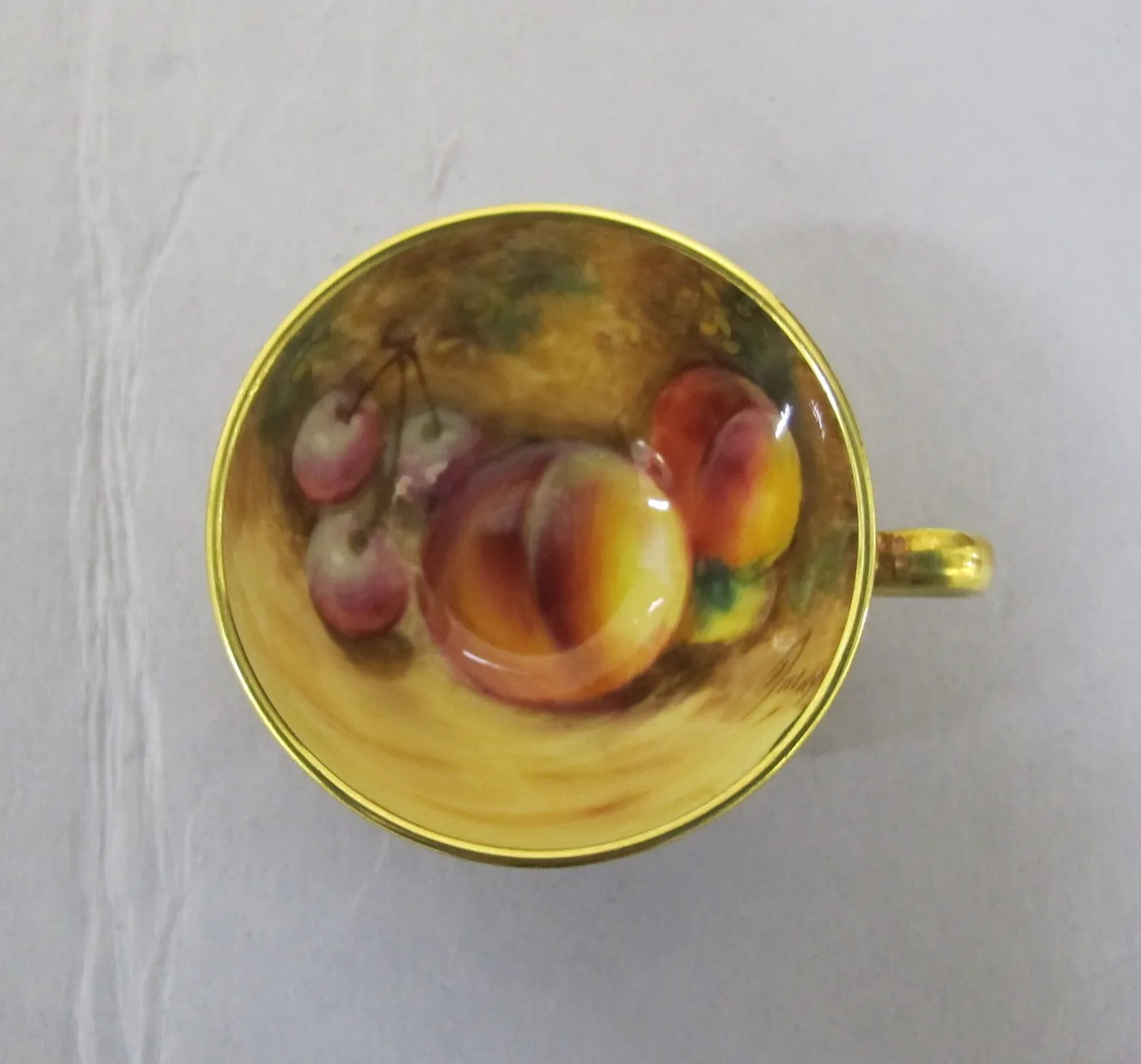
Walter Sedgley (active 1889–1929) painted flowers and figures. William Hawkins painted fruit (a precursor to the later twentieth-century fruit painters). The fruit painters Albert Shuck, Richard Sebright, Frank Roberts, and Reginald Austin produced the great twentieth-century painted-fruit cabinet pieces — large hand-painted fruit panels on cream grounds, heavily gilded, very widely collected.
Signature Reading
Signatures appear painted onto the decorated surface, typically near the lower edge of the painted panel. Read carefully — some painters used initials only, others a full surname. Forged signatures exist and should be examined under magnification: genuine painter signatures show the same brush hand as the surrounding decoration, while forged signatures often show inconsistent brushwork or different pigment.
Blush Ivory and Hadley Ware
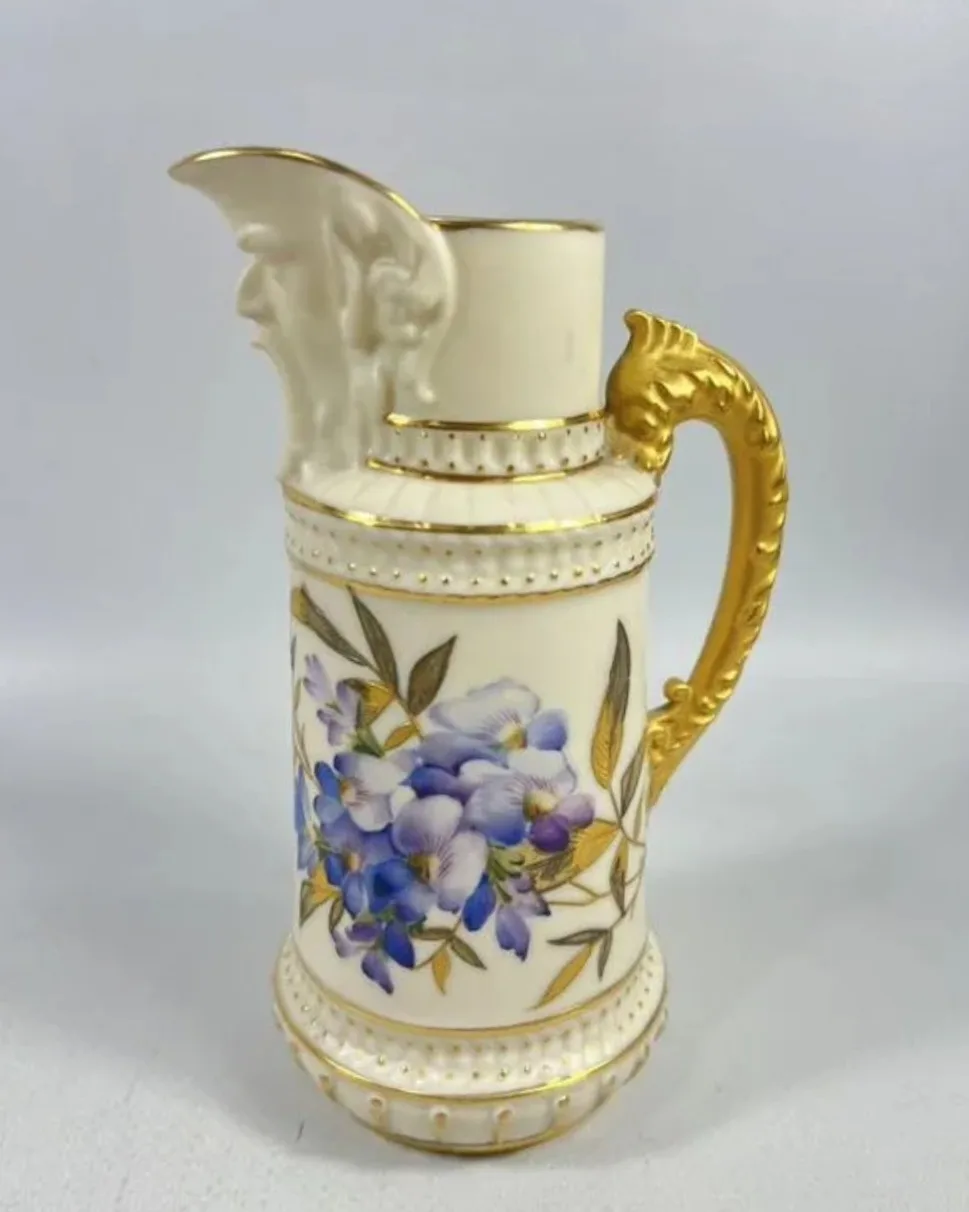
The blush ivory family — a soft pinkish-cream ground used as a background for floral or naturalistic painting — is one of the most distinctive Royal Worcester aesthetics and the type most casual collectors first encounter.
Blush Ivory
Introduced in the 1870s, blush ivory is a faintly pink-tinged cream ground glaze applied to the bone china body before painted decoration. The ground softens the bright white of the porcelain and provides a warm setting for flower painting, gilding, and figural decoration. Most blush ivory pieces also carry heavily gilded borders or reserves.
Hadley Ware
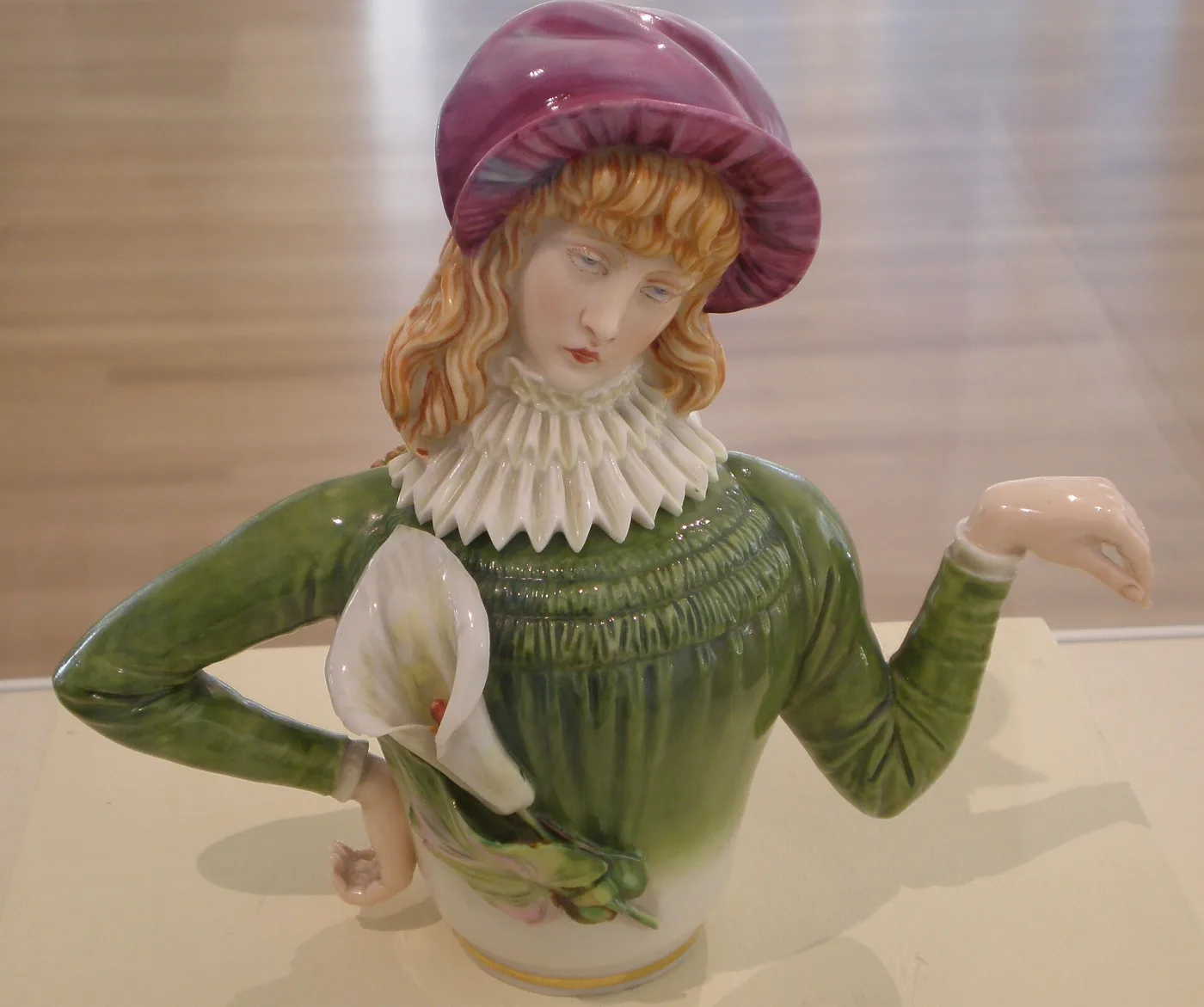
James Hadley, Royal Worcester's principal modeller, left in 1875 to set up an independent studio decorating Royal Worcester blanks. From 1896 his firm (Hadley & Sons) produced its own pieces marked "Hadley's Worcester." After 1905 the Hadley firm was reabsorbed and "Royal Worcester Hadley Ware" became a category within the parent factory's production.
Distinguishing Hadley Ware
Hadley Ware combines blush ivory with naturalistic flowers, restrained gilding, and characteristically slender forms. The early Hadley pieces (1896–1905) carry independent marks: "Hadley's Worcester" with various crown or shield devices. Reabsorbed Hadley Ware carries Royal Worcester marks with "Hadley" as a model name.
Common Hadley Ware Forms
Slender vases with elongated necks, double-handled urns, table lamps, and dessert services. The flowers are often roses, orchids, narcissi, or English garden flowers. Hadley Ware is widely available in the middle market and provides a accessible entry to Royal Worcester collecting.
Values
Standard Hadley Ware vases trade in the £80–£400 range; signed Hadley pieces or those with exceptional painting reach £500–£2,000 and beyond. The market for Hadley has been steady through the 2020s, with the better examples appreciating modestly.
Reticulated Worcester and George Owen
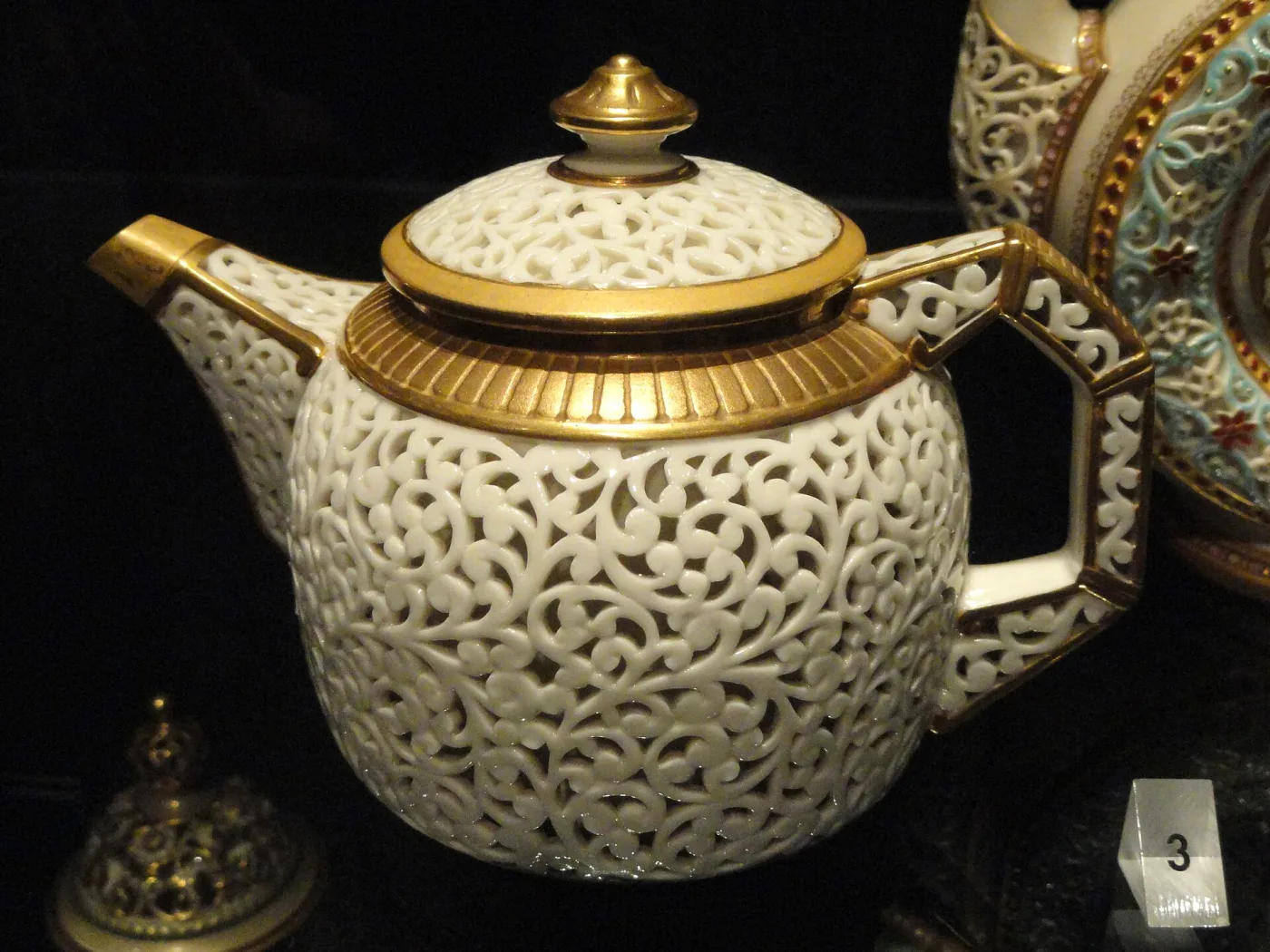
George Owen (1845–1917) was Royal Worcester's master of reticulated porcelain — pieces with elaborate pierced openwork created freehand from the unfired body without templates or moulds.
The Pierced Technique
Owen worked the wet porcelain body by hand with small tools, cutting away tiny windows of clay to create geometric or honeycomb openwork patterns. The work demanded extraordinary precision: a single misjudged cut ruined the piece, and the kiln frequently distorted pierced work. Most Owen pieces were produced in small numbers and many failed in firing.
Forms
Vases, bowls, perfume bottles, and decorative cabinet pieces. Most Owen work is on small forms — large reticulated pieces are exceptionally rare. The honeycomb pattern is the most characteristic; geometric and lattice patterns also appear.
Signatures and Marks
George Owen signed his finer pieces "G. Owen" on the base, usually in painted gold script. Some pieces carry only the Royal Worcester mark and date cipher; attribution to Owen is then made on stylistic grounds.
Values
Signed George Owen pierced pieces reach £3,000 to £25,000+ at specialist auction. Even small unsigned reticulated pieces with confident Owen attribution carry strong prices. This is the most valuable category of late Victorian Royal Worcester.
Other Pierced Workers
Reginald Austin, Walter Powell, and several other workers also produced reticulated pieces in Owen's style. Distinguishing genuine Owen from contemporary studio work requires specialist knowledge. Edward Locke (a former Worcester decorator) produced separate reticulated work at his own factory; Locke pieces should not be confused with Royal Worcester.
Figures, Doughty Birds & Modelled Wares
Royal Worcester figural production parallels its painted wares and forms a substantial collecting category in its own right.
Victorian Figures
Late nineteenth-century Worcester figures include James Hadley's celebrated "Cries of London" series (street vendors and London characters), Children-of-the-Nations figures, and various decorative figural groups. Hadley figures carry his impressed signature on the base and command strong prices.
Dorothy Doughty Birds (1935–1962)
Dorothy Doughty modelled a long series of American birds in natural settings — Bluebirds, Cardinals, Hummingbirds, Mockingbirds, Goldfinches, and dozens more — produced as limited-edition pairs by Royal Worcester from 1935 onward. The Doughty birds combine exceptional naturalism with hand-painted finishing and were issued in limited numbered editions. Original Doughty bird pairs reach £600 to £8,000 depending on subject and condition.
Doris Lindner Models
Doris Lindner (1896–1979) modelled equestrian and farm-animal figures for Royal Worcester from the 1930s onward — racehorses, polo players, hunters, and prize livestock. Many were issued as limited editions; "H.M. Queen Elizabeth II on Imperial" (1947) is the most famous. Lindner pieces are widely collected.
Ronald Van Ruyckevelt
Van Ruyckevelt modelled American game fish and ornamental birds for Royal Worcester from the 1960s. Limited-edition fish models in natural settings are characteristic. The work is technically accomplished and collectible.
Frederick Gertner and Earlier Modellers
Frederick Gertner, James Hadley (the modeller-decorator we've already met), William Boyton Kirk (who also worked at Belleek), and Charles Henry Brannam (briefly) all contributed to Royal Worcester's modelling tradition. Hadley remains the most influential.
Identifying Limited Editions
Limited-edition Royal Worcester figures and birds carry edition numbers (typically of 500 or fewer) and certificates of authenticity. Original certificates substantially enhance value. Issue records are documented in the Worcester archive and in specialist references.
Notable Patterns: Evesham, Lavinia, Painted Fruit
Royal Worcester tableware patterns range from grand hand-painted cabinet services to mass-market modern tableware. The principal pattern families:
Evesham
Introduced 1961, Evesham depicts named English fruits (Bramley apple, Blenheim orange, Conference pear, Worcester pearmain) on a cream ground with gilded edges. Evesham became the best-selling Worcester tableware of the late twentieth century and remained in production for decades. Most modern collectors first encounter Royal Worcester through Evesham.
Evesham Gold and Evesham Vale
Evesham Gold added heavier gilding; Evesham Vale used the same fruit motifs in a slightly different layout. The Evesham family expanded to include serving pieces, oven-to-table ware (capable of going from refrigerator to oven to table), and decorative pieces.
Lavinia
Late twentieth-century pattern with hand-painted flowers and gilded edges. Smaller production than Evesham; tableware pieces command modest prices.
Painted Fruit Cabinet Services
The hand-painted fruit cabinet services of the early-to-mid twentieth century are entirely different from Evesham. These are large hand-painted plates with named-fruit panels by Shuck, Sebright, Roberts, Austin, Smith, and other documented fruit painters, on cream grounds with heavy gilding. Painted-fruit cabinet plates reach £600 to £4,000 at specialist auction depending on painter and quality.
Astley, Holly Ribbons, and Modern Patterns
Astley (pink roses on cream), Holly Ribbons (Christmas pattern), and various other modern patterns supported the late twentieth-century tableware business. These are widely available and provide accessible Royal Worcester collecting at modest prices.
Heraldic and Topographical Patterns
Nineteenth-century special-order pieces include heraldic dessert services and topographical cabinet pieces with named views. These are valued case-by-case based on documentation and quality. The general framework for evaluating ceramic patterns is also relevant to the closely related English transferware tradition.

Reproductions and Mark Confusion
Royal Worcester has been imitated and confused with rival firms throughout its history. The principal pitfalls:
Caughley vs. First Period Worcester
Caughley (1775–1799) used very similar crescent marks and very similar blue-and-white designs. Caughley's founder Thomas Turner had trained at Worcester. Body and pattern differences distinguish the two, but confusion remains common. Caughley pieces are valuable in their own right but trade differently from Worcester.
Chamberlain vs. Flight Worcester
The two rival Worcester firms produced contemporary wares that are sometimes confused. Marks are unambiguous; body and decoration also differ. Don't conflate.
Locke & Co. (1895–1915)
Edward Locke, a former Royal Worcester decorator, founded his own factory producing very similar blush ivory and reticulated wares marked "Locke & Co. Worcester." Royal Worcester sued and won; Locke had to qualify his marks as "not Royal Worcester." Locke pieces are collectible but trade at a substantial discount to genuine Royal Worcester.
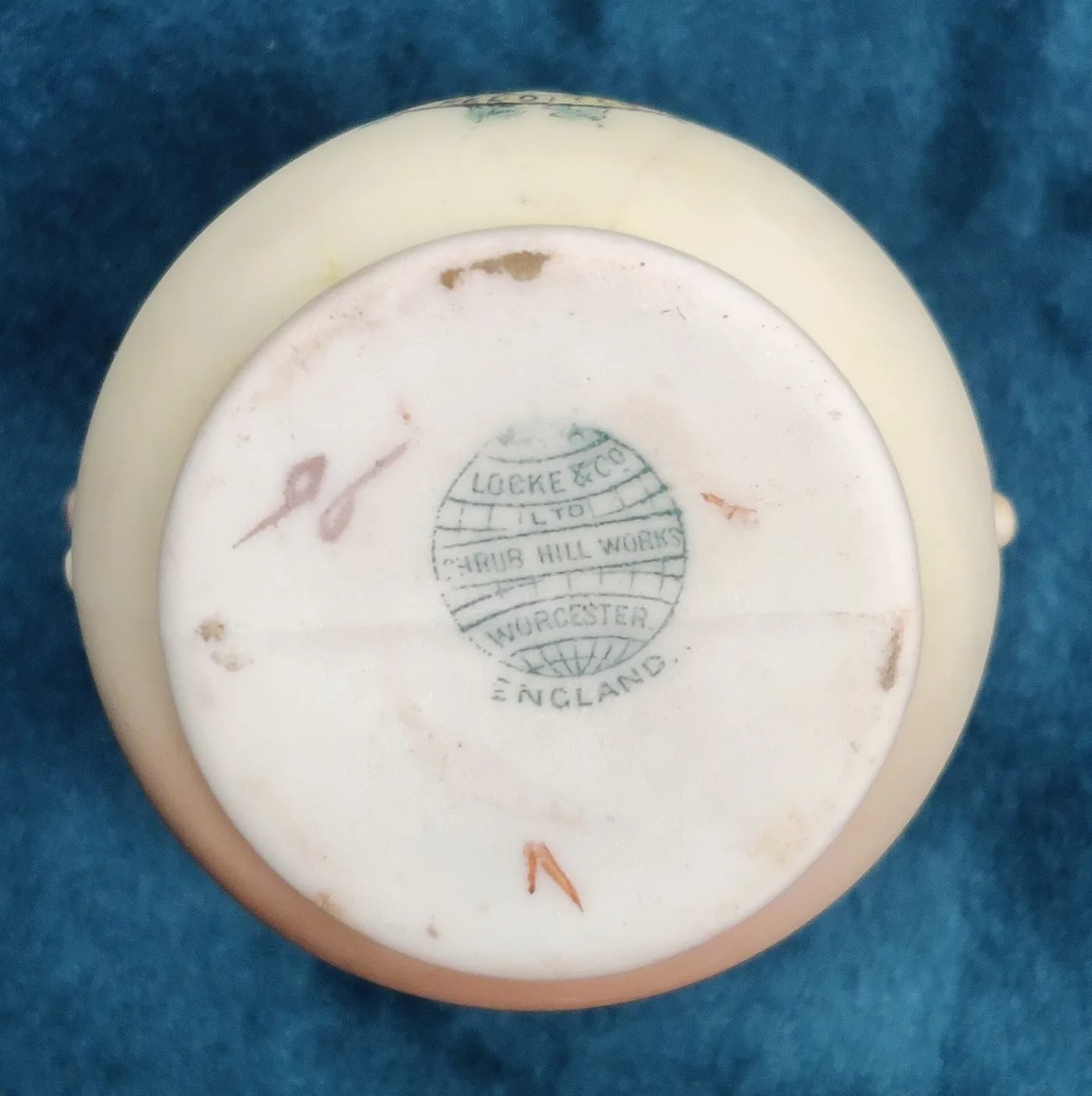
These two photographs are the same object, and together they are the shortest possible lesson in Worcester identification. Edward Locke had been a Royal Worcester decorator; his own works turned out the same ivory ground and comparable shapes a mile away, and he marked them honestly — this is not a fake, it is simply not Royal Worcester. The distinction takes seconds to make if you look for the shape of the mark rather than the words in it. Royal Worcester prints a crown above a circle with 51 at its centre; Locke prints a globe. Grainger, Chamberlain and Hadley all put "Worcester" on their bases too, because Worcester is a city before it is a brand.
Hadley Independent Period
James Hadley's independent firm (1896–1905) produced wares marked "Hadley's Worcester" — these are not Royal Worcester pieces, though they later became part of Royal Worcester production after the 1905 reabsorption. Independent Hadley pieces should be identified and valued separately.
Modern Outsourced Production
Since Worcester production ceased in 2009, the Royal Worcester brand has continued on tableware manufactured elsewhere — often in the Far East. Post-2009 pieces are not Worcester-made and should not be sold as antique or as Worcester porcelain in the historical sense. Check date codes carefully.
Outright Fakes
Outright fakes of Royal Worcester are uncommon — the date-code system is too well-documented to fake convincingly, and the body and painting are difficult to imitate. Genuine concerns are mark misreading, undisclosed restoration, and forged painter signatures on otherwise genuine pieces.
Authentication Workflow
Authenticate any Royal Worcester piece in this order:
1. Read the Base Mark
Photograph the base mark clearly under raking light. Identify mark type (crescent, Flight script, Chamberlain printed, crown-and-circle, etc.), mark colour, and any year-cipher device. Cross-reference against the Sandon mark guide.
2. Apply the Date Cipher
For post-1867 pieces, count dots, identify letters or symbols, and assign the exact year. Confirm against the body and decoration: a "1875" date cipher on a piece in modern Evesham pattern is impossible and indicates either a fake mark or a misreading.
3. Confirm the Body
Examine body characteristics — soft-paste, hybrid, bone china — and confirm consistency with the proposed date. First Period bodies are not bone china; late nineteenth-century blush ivory bodies are not soft paste.
4. Identify the Pattern
Match pattern to the published Royal Worcester pattern catalogue. Pattern numbers, where present, cross-reference to the factory ledger.
5. Examine Painted Decoration
For signed cabinet pieces, examine the painter's signature under magnification. Genuine signatures show the same brushwork hand as the surrounding decoration. Forged signatures often show inconsistent brushwork or different pigment.
6. UV and Restoration Check
UV examination identifies modern fillers, overpaint, and replaced gilding. Disclosed restoration is acceptable on rare pieces; undisclosed restoration substantially affects value.
7. Provenance Documentation
For high-value pieces, gather prior auction records, dealer invoices, family history. The general framework laid out in our authentication and provenance research guide applies.
8. Specialist Confirmation
For pieces above £1,500, consult a Royal Worcester specialist (the Museum of Royal Worcester at the former factory site in Worcester, specialist dealers, or specialist auction departments at Bonhams and Woolley & Wallis). Specialist confirmation prevents expensive mistakes and supports later resale.
Condition and Damage
Royal Worcester's quality and the painted decoration's vulnerability make condition particularly important.
Chips and Rim Damage
Rim chips on plates and cup rims are common. Small chips reduce value modestly; restoration improves appearance but reduces collector value. Always run a fingernail around rims and under bases.
Hairline Cracks
The thin bone china body is prone to hairlines, especially at handle junctions and around foot rings. Hairlines may be invisible to the eye but reveal themselves under raking light or with a UV lamp. Tea staining following the hairline confirms it.
Gilding Wear
Heavy gilding on Worcester cabinet pieces is vulnerable to wear from handling, washing, and abrasive cleaning. Worn gilding is restorable but the restoration reduces value. Original mint gilding commands premium prices.
Painted Decoration Wear
Hand-painted enamels can wear or flake, particularly on heavily-used pieces. Cabinet pieces should retain crisp, sharp painted decoration. Worn or restored painting substantially affects value, especially on signed pieces.
Crazing
Some Royal Worcester bone china exhibits hairline crazing across the glaze surface. Crazing is largely cosmetic but can capture staining over time. Heavy crazing reduces value modestly.
Restoration Standards
Professional restoration of important pieces is common and acceptable when disclosed. The general framework in our restoration and conservation guide applies. Avoid pieces with undisclosed restoration or with restoration of poor quality.
Value Factors and Price Ranges
Royal Worcester values span three orders of magnitude. The general framework in our antique valuation and appraisal guide applies; the Worcester-specific factors below.
Primary Value Drivers
Period (First Period > Flight–Barr > Kerr & Binns > late Victorian > early twentieth century > mid-twentieth > modern); painter signature (signed cabinet pieces > unsigned); pattern (rare patterns > standard); form (cabinet pieces > tableware); condition; size; documented provenance.
Approximate Price Ranges
Modern Evesham, Lavinia, and similar tableware: £30–£200 per piece. Late twentieth-century blush ivory vases: £80–£400. Edwardian unsigned painted plates: £100–£500. Signed William Powell bird miniatures: £200–£800. Hadley Ware vases (signed): £200–£1,500. Edward Raby flower cabinet plates (signed): £400–£2,000. Painted-fruit cabinet plates by Sebright, Shuck, Roberts: £600–£4,000. Signed Stinton cattle or game-bird plates: £800–£8,000. Charles Baldwyn swan vases: £1,500–£10,000+. George Owen reticulated pieces: £3,000–£25,000+. First Period blue-and-white tea wares: £200–£3,000 depending on form and quality. Documented Flight–Barr Regent pieces with named-view painting: £1,000–£15,000+.
Dorothy Doughty Bird Values
Doughty bird pairs (1935–1962) range widely by subject: common subjects £400–£1,500, rarer or earlier subjects £2,000–£8,000+, with the famous "Apple Blossom" cardinals reaching premium prices in specialist auction.
Pairs, Sets, and Services
Matched pairs of signed cabinet vases bring 2.5–3x single-piece prices. Complete dessert services with all original pieces command substantial premiums. Original presentation cases or pedestals add 20–40% to documented examples.
Damage Discounts
Rim chips: 20–40% discount on common pieces, 10–25% on rare pieces. Hairline cracks: 30–60% discount. Worn gilding: 20–40% discount. Worn painted decoration: 40–70% discount on cabinet pieces. Restoration disclosed: 15–35% discount. Restoration undisclosed and later found: substantial price collapse.
Auction Houses for Royal Worcester
Specialist auction houses include Bonhams Knightsbridge (regular British ceramics sales), Christie's South Kensington, Woolley & Wallis (Salisbury — particularly strong Worcester specialist sales), Mallams, and Bonhams Edinburgh. The Museum of Royal Worcester at the former factory in Worcester provides authoritative reference and occasional sales advice.
Building a Royal Worcester Collection
Royal Worcester rewards focused collecting at every level. The general principles in our collecting strategies guide apply; the Royal Worcester-specific refinements below.
Specialise by Period or Painter
Worcester's 270-year history is too broad for general collecting. Successful collections specialise: First Period blue-and-white, Flight–Barr Regent gilded wares, signed Stinton cattle, Charles Baldwyn swans, painted-fruit cabinet plates, Doughty birds, or Hadley Ware. A focused collection builds knowledge faster than a scattered one and commands premium prices on resale.
Start with Mark Identification
Before any purchase, become fluent in mark periods and the date-cipher system. The Sandon "Royal Worcester Porcelain Marks" should be the first reference acquisition. A collector who cannot date a piece at a glance will overpay or underbuy consistently.
Reference Libraries
Essential references include Henry Sandon's "Royal Worcester Porcelain from 1862 to the Present Day"; Henry Sandon and John Sandon's "Sandon Guide to Royal Worcester Figures"; Geoffrey Godden's "Caughley and Worcester Porcelains" (essential for First Period); David Battie's "Sotheby's Concise Encyclopedia of Porcelain"; and specialist auction catalogues from Bonhams and Woolley & Wallis.
Visit the Museum of Royal Worcester
The Museum of Royal Worcester occupies the former factory in Worcester, England. The museum holds the most comprehensive Royal Worcester collection in the world and is the authoritative reference for body, glaze, and decorative standards. A visit before serious collecting is invaluable.
Specialist Dealers
UK and US specialist Royal Worcester dealers offer authenticated pieces with provenance, expert advice, and (typically) repurchase rights. Specialist dealer prices are higher than auction but the certainty and provenance often justify the premium for high-value cabinet pieces.
Provenance Documentation
Maintain detailed records of every purchase: photographs of marks, condition reports, prior auction listings, dealer invoices, painter attributions. Strong provenance dramatically increases resale value, particularly on signed cabinet pieces and rare painters.
Insurance and Appraisal
Royal Worcester collections above £5,000 in aggregate deserve scheduled insurance and updated appraisals every five years. Specialist appraisers familiar with the painter market and the date-cipher system produce more useful valuations than general antique appraisers.
Care, Display & Preservation
Royal Worcester's gilding, hand-painted decoration, and (in cabinet pieces) elaborate modelling demand careful handling. The general principles in our antique storage and preservation guide apply across the Worcester range.
Handling
Lift pieces by the body, never by gilded rims, painted reserves, or projecting handles. Older handles may be glued from prior restoration. Wear cotton or nitrile gloves for signed cabinet pieces — skin oils dull gilding over time and pigment can absorb from unwashed hands.
Washing
Wash Royal Worcester by hand in lukewarm water with mild dish soap. Never use the dishwasher — modern detergents strip gilding and accelerate latent crazing. Never soak pieces with applied decoration. Modern Evesham marketed as oven-to-table is more durable than cabinet ware but should still be hand-washed for long-term preservation.
Storage
Store tableware separated by tissue or cloth, never stacked rim-to-rim. Store cabinet plates in plate display boxes with acid-free tissue between each plate. Store figural pieces individually in archival boxes. Stable temperature and humidity, away from direct sunlight.
Display
Display in stable temperature (16–22°C / 60–72°F) and humidity (40–60%). Avoid direct sunlight, which fades hand-painted pigments and dulls gilding over decades. Secure tall pieces with museum wax. Plate display rails should support the plate by the foot ring, not pressing on the gilded rim.
Transport
For shipping, double-box with at least three inches of cushioning. Wrap projecting handles, applied flowers, and reticulated openwork individually before wrapping the main body. Never ship signed cabinet pieces or First Period pieces without insurance, signature confirmation, and detailed condition documentation.
Gilding Preservation
Avoid abrasive cleaning, ammonia-based cleaners, and prolonged exposure to acidic foods. Gilding damage is largely irreversible and substantially affects value. Restrained handling preserves gilding through generations.
Documentation
Photograph each piece from multiple angles including the base mark and date cipher. Keep a written inventory with marks, dates, patterns, painter attributions, dimensions, prior provenance, and current condition. Update the inventory when condition changes or new attributions are made.