Sèvres Porcelain Identification Guide: Marks, Date Letters & Painters
Sèvres is the royal — later imperial, then republican — porcelain manufactory of France, the most ambitiously decorated and most exhaustively documented porcelain factory in European ceramic history. From its earliest wares as the Vincennes manufactory in 1740, through the move to a purpose-built factory at Sèvres on the road between Paris and Versailles in 1756, to the present-day Manufacture Nationale de Sèvres, the factory has produced almost three centuries of continuous luxury porcelain under royal, imperial, and state patronage. No other European factory rivals Sèvres for the combination of technical achievement, archival completeness, and political symbolism.
For the collector and identifier, Sèvres offers a uniquely rich dating apparatus. The interlaced double L cipher — the royal monogram of Louis XV — has served as the principal factory mark since 1753, modified through the Empire, Restoration, July Monarchy, Second Empire, and Republican periods. Inside the interlaced Ls, a single letter from 1753 to 1777 and a double letter from 1778 to 1793 records the year of decoration. Painters' and gilders' marks accompany the date letter, identifying the individual hand that decorated each piece against a known archive of factory employees. A correctly read Sèvres mark places a piece within a single year and frequently to a named decorator — a precision unmatched by any other eighteenth-century European porcelain. This builds on the broader framework of our antique porcelain identification guide.
The market, however, is haunted by reproductions. Nineteenth-century Paris porcelain decorators routinely applied Sèvres marks to white blanks bought from Sèvres or from competing factories. Edmé Samson and his successors produced exceptionally skilled imitations from the 1850s onward. The result is that perhaps the majority of "Sèvres" porcelain on the open market is in fact later Paris decoration, Samson, or outright forgery. This guide reads the genuine factory periods, marks, and painters' ciphers; explains the transition from soft-paste pâte tendre to hard-paste pâte dure in 1769; surveys the famous ground colours; and provides a working framework for distinguishing genuine Sèvres from the very large body of imitation that surrounds it.
Table of Contents
- A Brief History of the Sèvres Manufactory
- The Vincennes Period (1740–1756)
- The Royal Period at Sèvres (1756–1793)
- The Interlaced L Mark and Variations
- Date Letters: 1753–1817
- Painters' and Gilders' Ciphers
- Soft-Paste vs. Hard-Paste Body
- Ground Colours and Reserves
- Forms and Models
- Biscuit Figures and Sculpture
- Revolutionary and Empire Sèvres (1793–1814)
- The Brongniart Reform (1800–1847)
- Nineteenth-Century Sèvres
- Samson and Paris Decorators
- Authentication Workflow
- Condition and Restoration
- Value Factors and Price Ranges
- Building a Sèvres Collection
- Care, Display & Preservation
A Brief History of the Sèvres Manufactory
The Sèvres factory is the porcelain arm of the French state. From its founding by royal privilege in 1740 it has operated under continuous government interest — royal, imperial, monarchical, and republican — to a degree no other European porcelain factory approaches. This continuity of patronage shaped both what was made and how it was marked.
The Vincennes Foundation (1740)
The factory was founded in 1740 at the Château de Vincennes east of Paris by a partnership including Claude-Humbert Gérin, brothers Robert and Gilles Dubois (refugees from the Chantilly factory), and the financier Orry de Fulvy. Production from the outset aimed at soft-paste porcelain — pâte tendre — modelled on the techniques of Saint-Cloud and Chantilly but pursuing a finer, whiter body and more refined decoration.
Royal Privilege and Madame de Pompadour
In 1745 the factory received a royal privilege from Louis XV granting it exclusive rights to produce porcelain "in the manner of Saxony" (i.e., competing with Meissen) decorated with figures and gilding. Madame de Pompadour, the king's official mistress and a tireless patron, championed the factory throughout the 1750s, ensuring royal patronage, expansion, and political protection. Her direct interest secured both the financial future and the artistic ambition of the works.
The Move to Sèvres (1756)
In 1756 the factory moved from Vincennes to a purpose-built building at Sèvres, halfway between Paris and Versailles, designed by Lindet for an operation now employing several hundred workers, artists, and decorators. The new building gave the factory its modern name. The first wares marked "Sèvres" in any form appear from this date.
Royal Acquisition (1759)
By 1759 the factory was in financial difficulty. Louis XV personally bought it, making it a property of the Crown. From this point Sèvres operated as a royal manufactory, with the king as proprietor and Madame de Pompadour (until her death in 1764) as its most active patron. Annual sales were held at Versailles, where the court was effectively obliged to purchase the year's production.
Successors of the Royal Period
The Crown's ownership continued through Louis XVI's reign to the Revolution. After a chaotic Revolutionary period the factory was preserved by Napoleon and reorganised under Alexandre Brongniart from 1800 — a directorship lasting until 1847 that defined nineteenth-century Sèvres. Subsequent state regimes — the Bourbon Restoration, the July Monarchy, the Second Empire, and the Third Republic — each maintained the factory and modified its marks accordingly. It survives as the Manufacture Nationale de Sèvres in the same buildings today.
The Vincennes Period (1740–1756)
Vincennes-period porcelain is the rarest and most coveted Sèvres-family ware. Production volumes were small, the body was still evolving, and surviving documented pieces are concentrated in museum collections (the Louvre, the Wallace Collection, the J. Paul Getty Museum, the Musée des Arts Décoratifs).
The Vincennes Soft-Paste Body
Vincennes pâte tendre is creamier and slightly more granular than later Sèvres soft-paste. The glaze has a subtle warm cast, and the body when chipped shows a sugary, sometimes faintly biscuit-coloured break. Early pieces (1740–1748) are technically uneven; from the 1750s the body achieves the cool, milky whiteness for which the factory became famous.
Early Decoration
The earliest decoration drew on Meissen and Chantilly idioms: indianische Blumen (Saxon flowers), Kakiemon-derived motifs, and chinoiserie. By the late 1740s the factory's own decorators were developing a distinctively French naturalistic floral idiom — loose painted bouquets in the manner of botanical illustration — that would define Sèvres flower painting for a century.
The First Marks
Before 1753 Vincennes pieces are often unmarked or carry inconsistent painters' marks. The interlaced L royal cipher was formally adopted as the factory mark in 1753, with date letter A. Pieces dated 1753–1755 carry the cipher with letter A through C, and the inscription "Vincennes" may also appear in cursive script.
Documented Vincennes Pieces
Authenticated Vincennes pieces with the interlaced L and an A, B, or C date letter trade in five- to six-figure territory at international specialist auction. Unmarked pre-1753 pieces are harder to authenticate and depend heavily on body, glaze, and modelling analysis against documented museum examples.
Famous Vincennes Forms
The cuvette fleurs (flower vase), pots-pourris, déjeuner trays, and the famous biscuit figures modelled by Jean-Jacques Bachelier and Etienne-Maurice Falconet (joining 1757 from Vincennes-trained sculptors) define the Vincennes aesthetic.
The Royal Period at Sèvres (1756–1793)
The Royal Period — from the move to Sèvres in 1756 to the suppression of the Crown in 1793 — represents the artistic and technical apex of Sèvres production. The wares of this period are what most collectors mean when they speak of "genuine Sèvres."
Soft-Paste at Its Height (1756–1769)
The first thirteen years at Sèvres saw soft-paste porcelain perfected. The body is cool, white, slightly translucent, and capable of supporting the most ambitious painted decoration of any European porcelain. The famous ground colours — bleu lapis, bleu céleste, rose Pompadour, jaune jonquil, vert pomme — were developed and applied with extraordinary chemical control.
The Hard-Paste Transition (1769)
In 1768 kaolin was discovered at Saint-Yrieix-la-Perche near Limoges, ending the French dependence on imports for true hard-paste porcelain. Production of hard-paste — pâte dure — began at Sèvres in 1769 in parallel with continuing soft-paste production. From the 1770s onward both bodies were produced concurrently; soft-paste production declined gradually and ceased entirely in 1804.
Painters and Gilders
The factory employed dozens of specialist decorators — flower painters, figure painters, gilders, ground-colour layers — each with a registered cipher entered in the factory's records. The factory archive identifies more than 400 named decorators across the eighteenth century alone. This documentary completeness allows individual pieces to be attributed to named artists with confidence.
Royal Service Pieces
Pieces from documented royal services — the service for Louis XV, the Catherine the Great service, the service for the Comte du Nord, the rose-ground services for Madame du Barry — are the apex of collectible Sèvres. Provenance from a documented royal service can multiply value by ten or more. The framework for tracking such provenance is laid out in our authentication and provenance research guide.
The Royal Annual Sale
Each year between 1758 and 1789 the factory held a sale at Versailles, with the king and court effectively obliged to purchase. Sales records survive in the factory archive and provide a year-by-year inventory of what was produced and to whom it was sold — a source for provenance research without parallel in European porcelain history.
The Interlaced L Mark and Variations
The interlaced double L — two facing Ls back-to-back forming a symmetrical cipher — was adopted in 1753 as the royal mark of Sèvres. It is by far the most important Sèvres mark and the foundation of any identification.
The Cipher Itself
The interlaced Ls represent the monogram of Louis XV. The two Ls face one another, intertwined at their vertical strokes, forming a symmetrical device. Painters typically rendered it in underglaze blue from 1753 onward. On later periods the cipher is in puce, brown, or other colours appropriate to the regime.
Colour of the Mark
Royal Period (1753–1793): underglaze blue, occasionally puce or other glaze colours. Revolutionary Period (1793–1804): variations including "RF" for République Française. Empire (1804–1814): under Napoleon, often replaced by an "M" with imperial eagle or by the printed "Manufre Imple de Sèvres" inscription. Restoration (1814–1830): return to the interlaced Ls in various colours plus a fleur-de-lys. July Monarchy and later periods: see the section on nineteenth-century marks.
Inside the Cipher: Date Letter
Inside (or adjacent to) the interlaced Ls is a date letter or letters identifying the year of decoration. Painters and gilders' marks appear nearby. A complete Sèvres mark of the Royal Period therefore comprises: interlaced Ls + date letter(s) + painter cipher + gilder cipher.
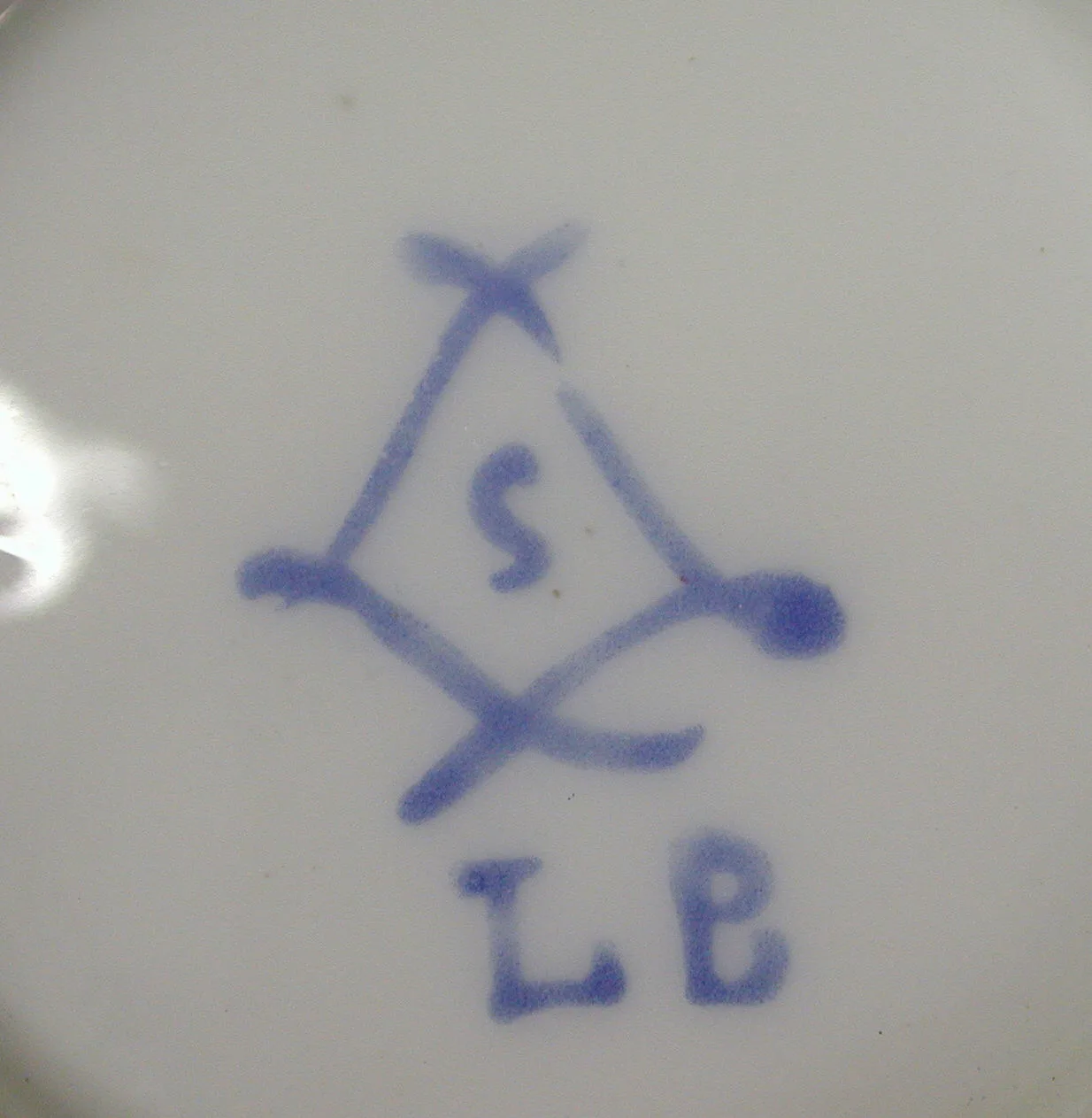
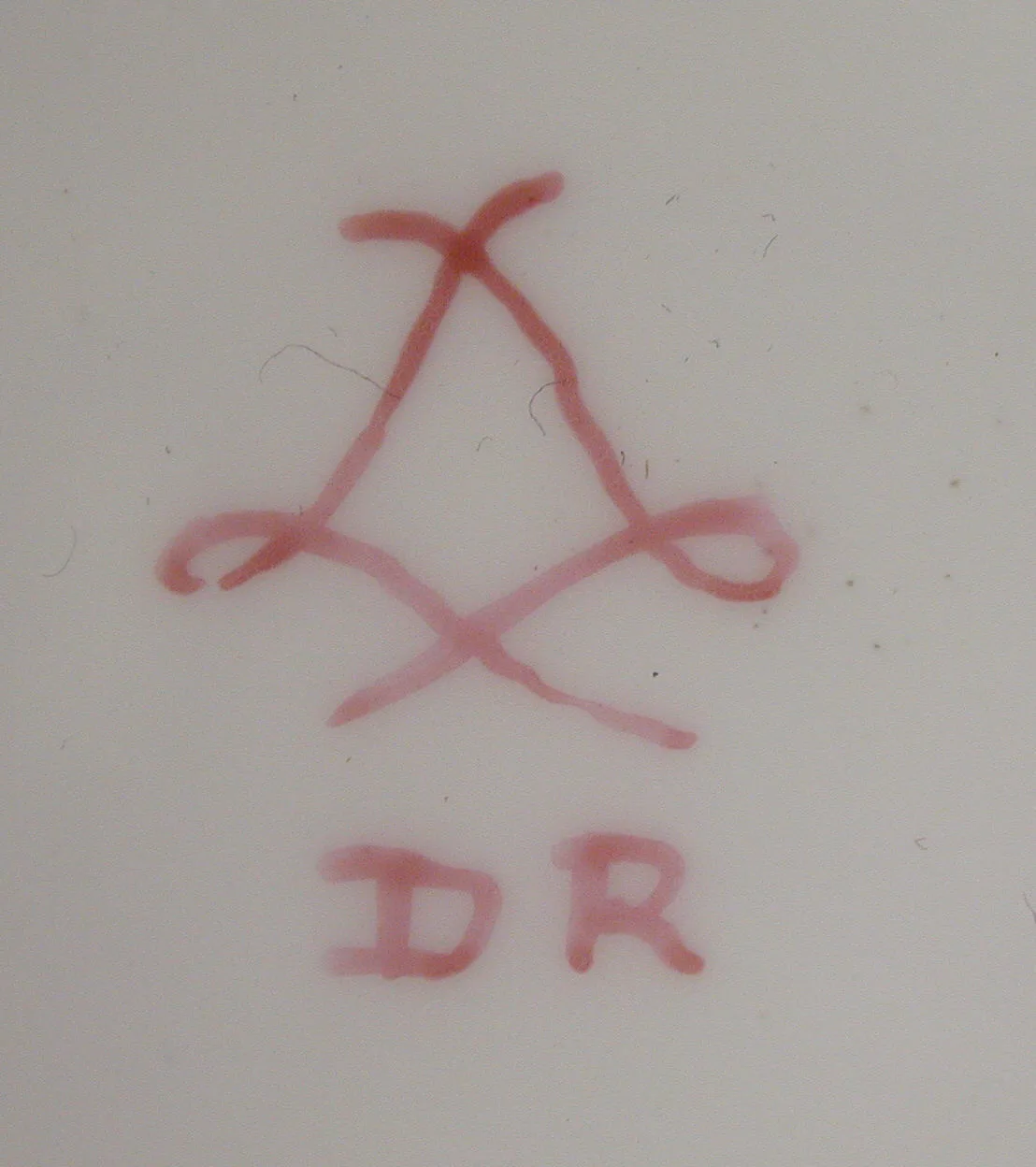
Both are genuine factory marks and they are not equivalent evidence. The first is a complete Royal Period mark — cipher, date letter, decorator — and fixes the decoration to a single year. The second gives you the factory and a decorator and nothing else. An empty cipher is common enough on real pieces that it is not by itself a forgery signal, but it removes the one thing that makes Sèvres unusually easy to date, and a cipher with nothing inside it is also the easiest kind of mark to copy. The colour difference is worth reading separately from the content: cobalt is the one colour that survives the high glaze firing, so a blue mark sits under the glaze and cannot be scratched off, while a crimson mark like the second one is an overglaze enamel lying on the surface, where a fingernail can feel it and a determined restorer can remove it.
Mark Placement
Most marks appear on the underside of the foot, painted under the glaze in cobalt blue (Royal Period). Some pieces carry impressed factory or potter's marks in addition to the painted cipher. Hand-built objects sometimes carry pad marks in the body. Always examine the entire base under good light and magnification.
Counterfeit Marks
The interlaced L cipher was the most widely copied porcelain mark in nineteenth-century Europe. A genuine cipher must be evaluated in combination with body, glaze, decoration, and the accompanying date letter and painter marks. A cipher in isolation, particularly on a piece of suspect body, proves nothing.
Date Letters: 1753–1817
The Sèvres date-letter system is one of the great gifts to porcelain dating. From its introduction in 1753 to its abandonment in 1817 it provides single-year dating for any properly marked piece.
Single Letters (1753–1777)
From 1753 to 1777 a single letter inside the interlaced Ls denotes the year. A = 1753, B = 1754, C = 1755, D = 1756 (the year of the move to Sèvres), E = 1757, F = 1758, G = 1759 (royal acquisition), H = 1760, I = 1761, J = 1762, K = 1763, L = 1764, M = 1765, N = 1766, O = 1767, P = 1768, Q = 1769 (start of hard-paste), R = 1770, S = 1771, T = 1772, U = 1773, V = 1774, X = 1775, Y = 1776, Z = 1777.
Double Letters (1778–1793)
From 1778 the system shifted to double letters: AA = 1778, BB = 1779, CC = 1780, DD = 1781, EE = 1782, FF = 1783, GG = 1784, HH = 1785, II = 1786, JJ = 1787, KK = 1788, LL = 1789 (Revolution), MM = 1790, NN = 1791, OO = 1792, PP = 1793.
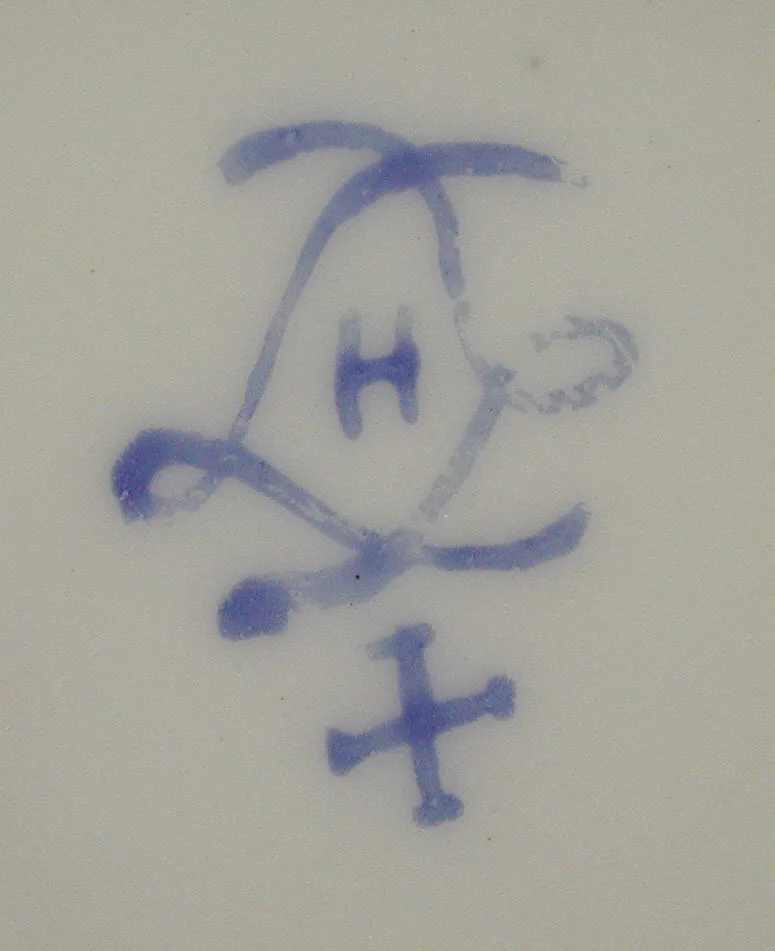
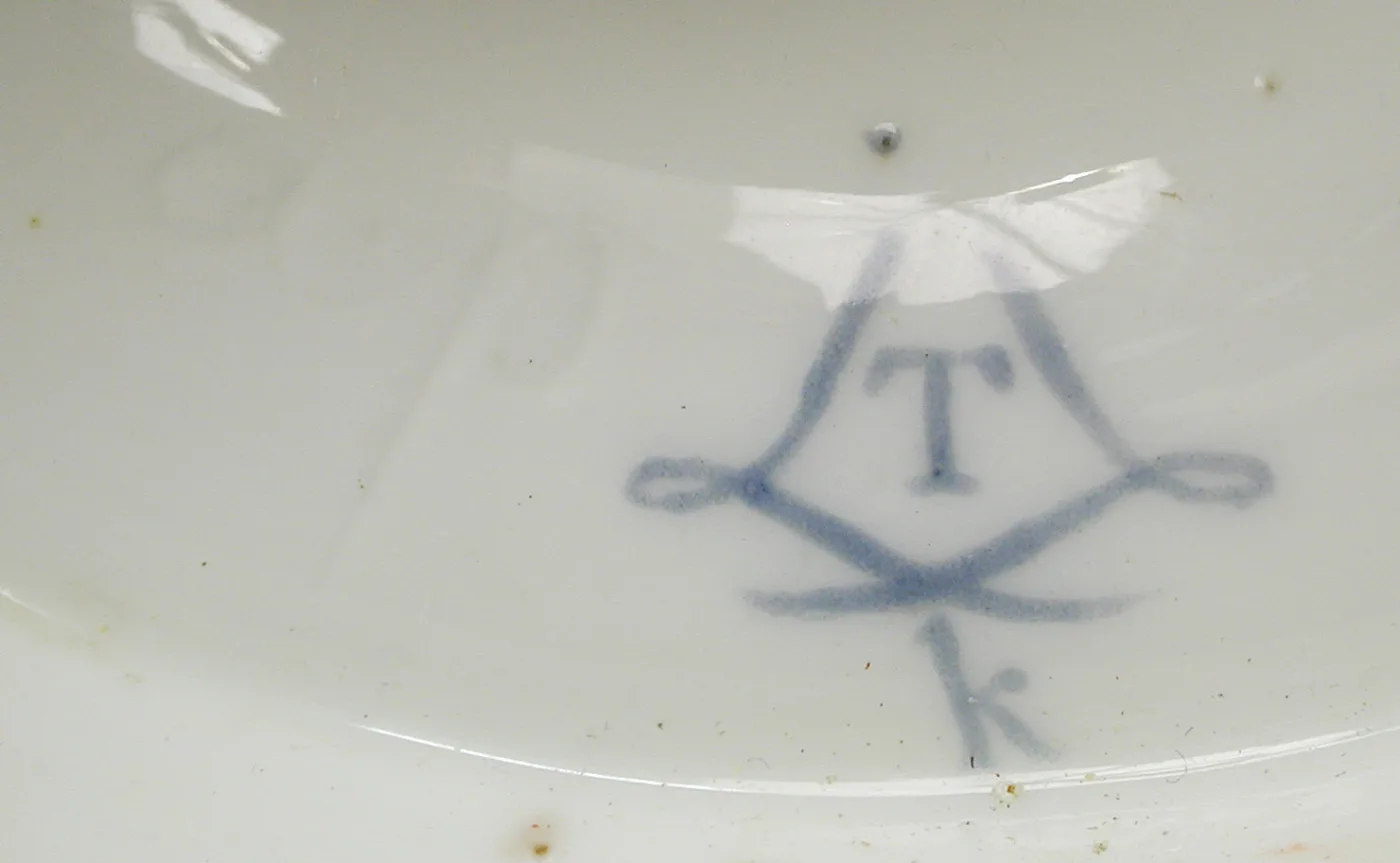
Read the letter, not the shape around it. The interlaced Ls barely change across forty years, while the letter inside them advances one step a year from A in 1753 to Z in 1777 and then doubles to AA in 1778. That is the whole apparatus, and it is why one legible letter outweighs any amount of style-spotting. Two cautions come with it. The letter records the year the piece was decorated, not the year the white body was thrown, and blanks sat in the factory store for years before a painter touched them. And letters that are worn, or partly hidden by whatever the piece has picked up in two hundred years, are the norm rather than the exception — raking light with a loupe at the foot rim recovers far more than a straight-on photograph does.
The Revolutionary Interlude
From 1793 (suppression of the monarchy) to 1800 (Brongniart's appointment) the date-letter system was disrupted. Pieces of this period may carry the interlaced Ls with PP, QQ, RR for 1793–1795, or various Revolutionary marks including "RF" or simply "Sèvres" inscribed.
Republican and Empire Dating (1800–1817)
Brongniart restored a date system using the last two digits of the year inside the painted cipher: 8 or X for 1800, 9 or XI for 1801, T9 for 1809, T10 for 1810, etc. Various combinations of year digits and the Brongniart-era "M.Imp.de Sèvres" (Manufacture Impériale de Sèvres) inscription replace the older letters. From 1818 onward the factory adopted a more variable dating system using year digits, regime initials, and printed marks.
Decoration Date vs. Production Date
The date letter records the year of decoration, not the year the white blank was produced. White blanks were often stored at the factory for years before decoration. A piece may have a body produced in (for example) 1760 but a date letter of 1765 indicating later decoration. This distinction matters for both connoisseurship and authentication.
Reading Worn Date Letters
Many genuine date letters are worn or partially abraded. Use raking light and high magnification. Cross-reference with painters' marks and stylistic period. The factory archive at Sèvres holds a complete date-letter reference that specialist dealers and auction houses consult routinely.
Painters' and Gilders' Ciphers
Alongside the date letter, painters' and gilders' marks identify the individual decorators. The factory maintained registers of painters with their assigned ciphers; the principal ones are catalogued in standard reference works.
The Painter System
Each painter and gilder at Sèvres was assigned a personal cipher — usually one or two letters, a small symbol, or a stylised initial — registered in the factory ledgers. The cipher was painted in cobalt blue (or coloured glaze) on the underside near the interlaced Ls. The same painter's cipher may appear on hundreds of pieces over a long career.
Documented Painters
Examples of well-documented Royal Period painters include: Charles-Nicolas Dodin (figure painter, cipher "k"), Jean-Louis Morin (military and marine scenes, cipher "M" with dot), Antoine Caton (figure scenes), Edme-François Bouillat (flowers, cipher "Y"), Pierre-Antoine Méreaud (flowers, cipher "M"), and many dozens of others. A piece signed by a major figure painter such as Dodin or Morin commands a substantial premium.
Gilders
Gilders are recorded separately. Henry-Joseph Vincent (cipher "VV"), Etienne-Henry Le Guay (cipher "LG"), and other named gilders signed their work. Gold ornament on Sèvres was applied separately from the main decoration and fired at lower temperature; documented gilding ciphers help confirm date and attribution.
Ground-Colour Layers
Some pieces also carry the cipher of the artist who applied the ground colour. Specialist coloureurs prepared and applied the famous coloured grounds, and their work is sometimes documented separately. This level of specialisation reflects the factory's industrial-craft organisation.
Reading Painter Marks Together
A typical Royal Period Sèvres base might show: interlaced Ls with date letter K (1763) inside, painter cipher k (Dodin) painted to one side, gilder cipher LG (Le Guay) to the other. The combination confirms 1763, decorated by Dodin, gilded by Le Guay — a degree of attribution unimaginable for almost any other eighteenth-century porcelain.
Soft-Paste vs. Hard-Paste Body
The transition from soft-paste pâte tendre to hard-paste pâte dure in 1769 is the most important technical division in Sèvres production. The two bodies fire differently, support different decorative techniques, and command different market values.
Pâte Tendre (Soft-Paste, 1740–1804)
Soft-paste is a frit-based body containing ground glass rather than true hard-paste china stone. It fires at a lower temperature (around 1100°C) and produces a cool, milky-white body of exceptional translucency. The glaze sits noticeably on the surface, slightly thick, with a soft warm tone. Where chipped, the body shows a granular, sugary break. Pâte tendre is the body of the great Royal Period painted pieces and is favoured for its supportive surface for fine painting.
Pâte Dure (Hard-Paste, 1769–present)
Hard-paste is a true porcelain of kaolin, feldspar, and quartz fired at around 1400°C. The body is harder, denser, and more vitreous than soft-paste. The glaze fuses with the body and is virtually inseparable. Where chipped, the body shows a glassy, conchoidal break. Pâte dure is the body of late eighteenth-century, all nineteenth-century, and all modern Sèvres.
Visual Distinction
Hold a piece to strong light: soft-paste shows a slightly warmer, creamier translucency with a fractionally thicker glaze line; hard-paste shows a cooler, harder, slightly bluer translucency with a fused glaze. Tap test: soft-paste rings duller and lower; hard-paste rings clear and high. Both signs are subtle and require comparative experience.
Market Significance
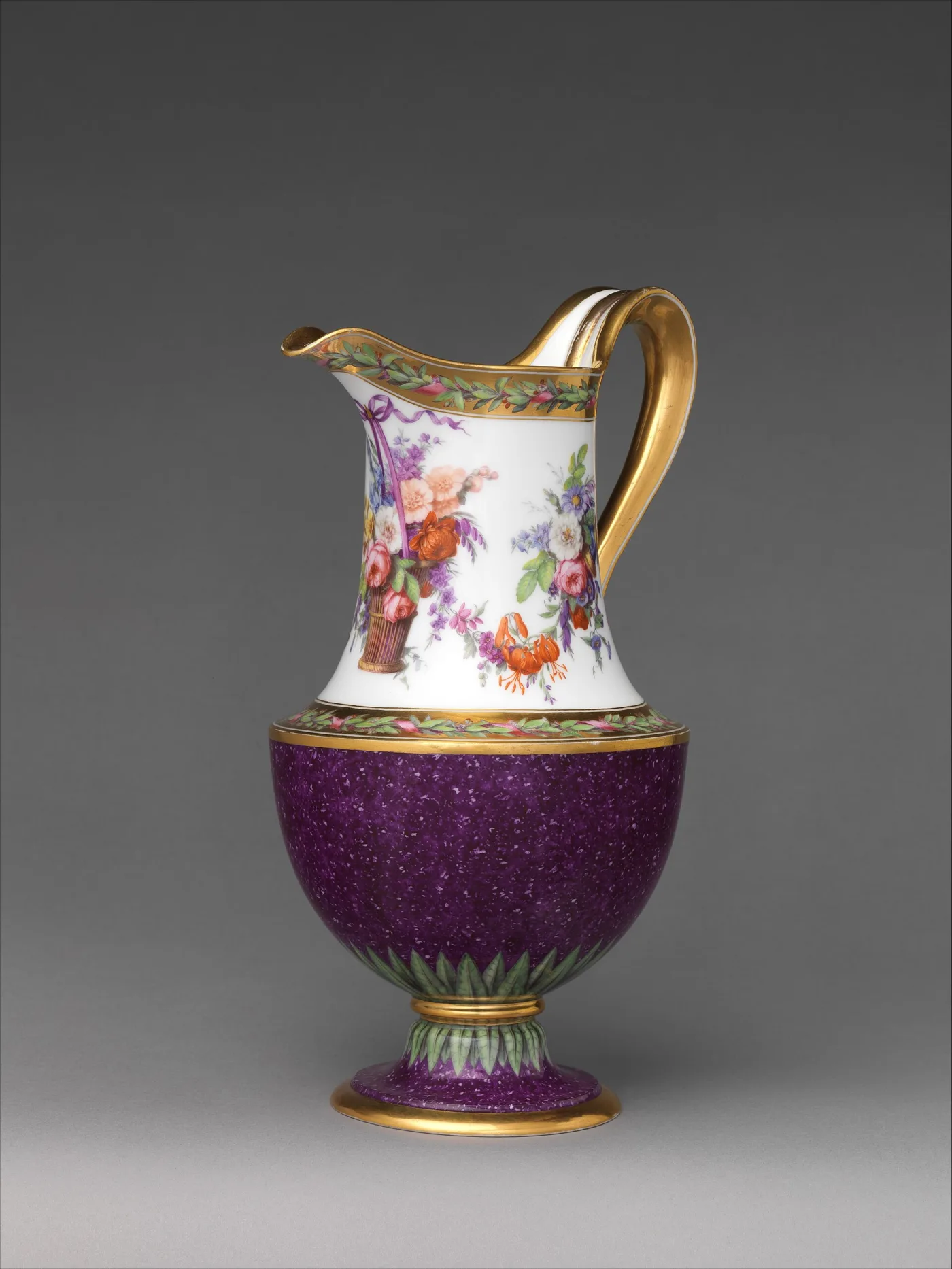
Soft-paste Royal Period Sèvres commands the highest values for tableware and decorative pieces. Hard-paste pieces of the same period are still highly valued but typically below soft-paste equivalents. Nineteenth-century hard-paste is more variable in value depending on decoration quality, period, and provenance.
Soft-Paste Identification Pitfalls
Some nineteenth-century factories produced pâte tendre-style bodies in imitation of Sèvres soft-paste. The Minton "Sèvres Imitation" pieces of the mid-nineteenth century, and certain Coalport and Worcester wares, deliberately approximate the Sèvres look. Body analysis combined with mark and decoration is essential.
Ground Colours and Reserves
Sèvres is famous above all for its coloured grounds — the rich, even, intensely saturated background colours against which reserved panels of painting and gilded ornament are set. Each major ground colour has a named identity and a specific period of introduction.
Bleu Lapis (from 1749)
The first great Sèvres ground, an intense deep cobalt blue developed in the late Vincennes period. The colour is dark, slightly mottled, and sponged over the body before glazing. Bleu lapis grounds frequently carry caillouté or vermiculé gilded patterns over the blue.
Bleu Céleste (from 1753)
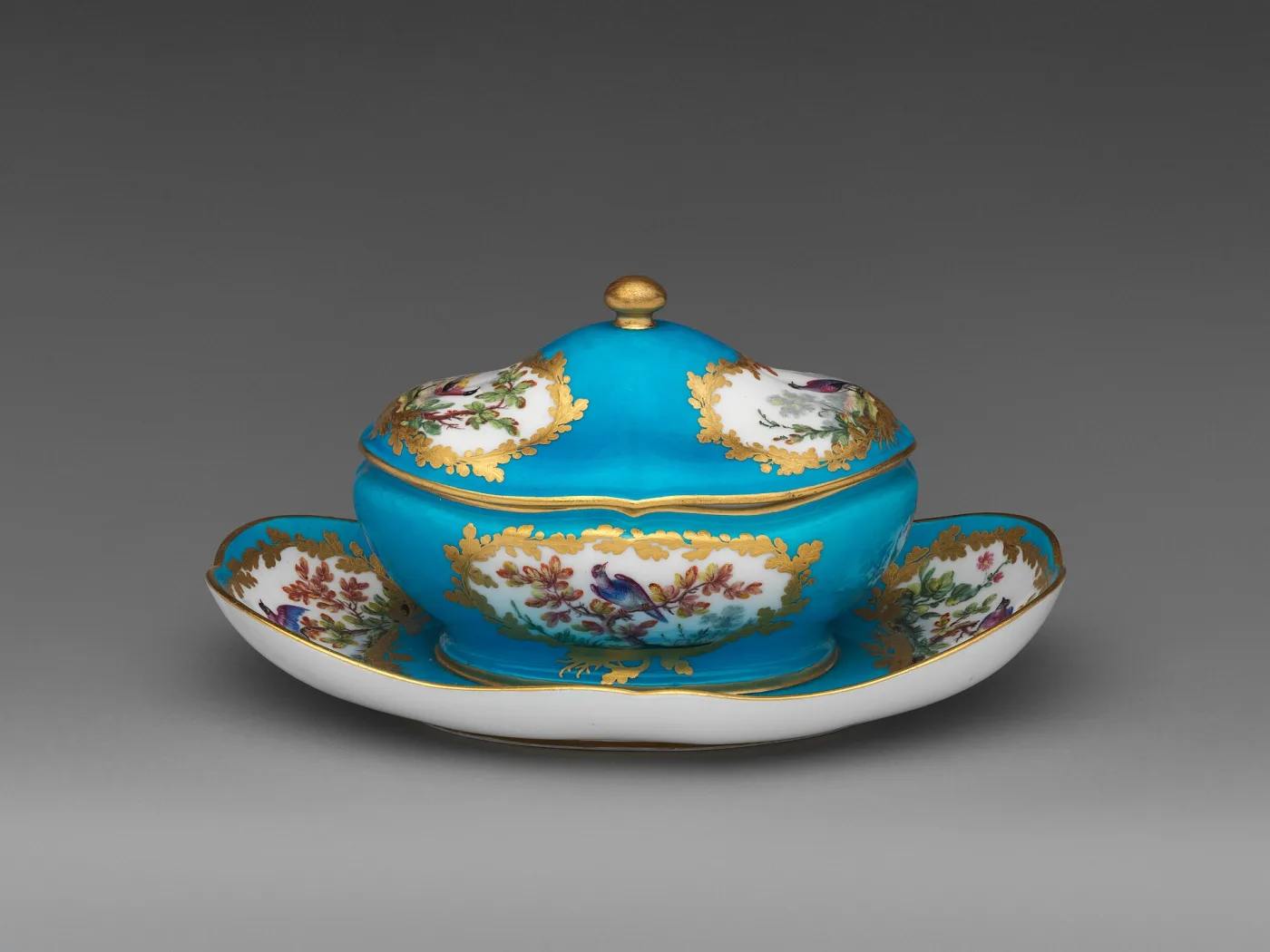
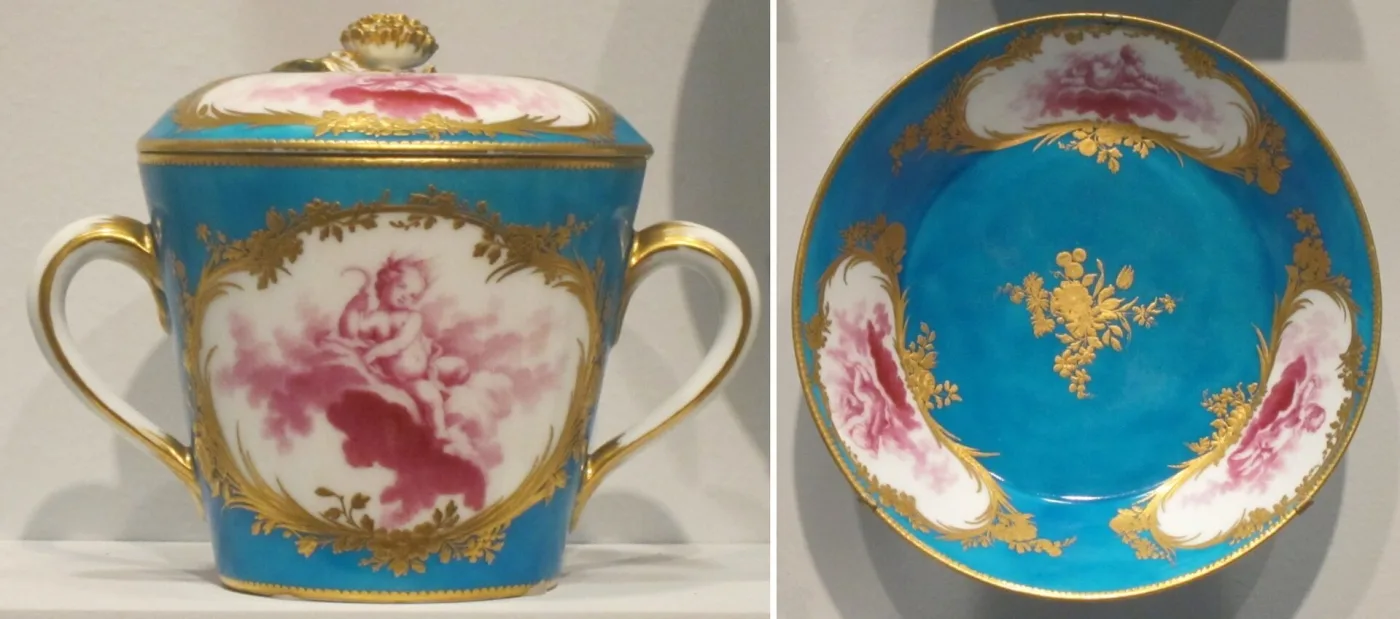
A bright turquoise-blue ground developed under the patronage of Madame de Pompadour. Bleu céleste is intense and luminous, applied evenly, and forms the famous background of the 1758 service made for the king. It is the most identifiably "Sèvres" of all ground colours.
Rose Pompadour (from 1757)
Named for Madame de Pompadour, a soft pink-rose ground introduced in 1757. The colour was difficult to fire evenly and few documented pieces survive in perfect condition. Rose Pompadour grounds are among the rarest and most expensive Sèvres types. (Note: "Rose du Barry" is a later nineteenth-century English collector's term for the same colour.)
Jaune Jonquil (from 1753)
A clear bright yellow ground introduced in 1753 and used through the 1760s and 1770s. The yellow tone varies from pale primrose to deeper egg-yolk. Yellow ground Sèvres is particularly prized.
Vert Pomme (from 1756)
An apple-green ground developed in 1756. The colour ranges from pale lime to deeper grass-green. Vert pomme grounds are richly represented in the great mid-century services.
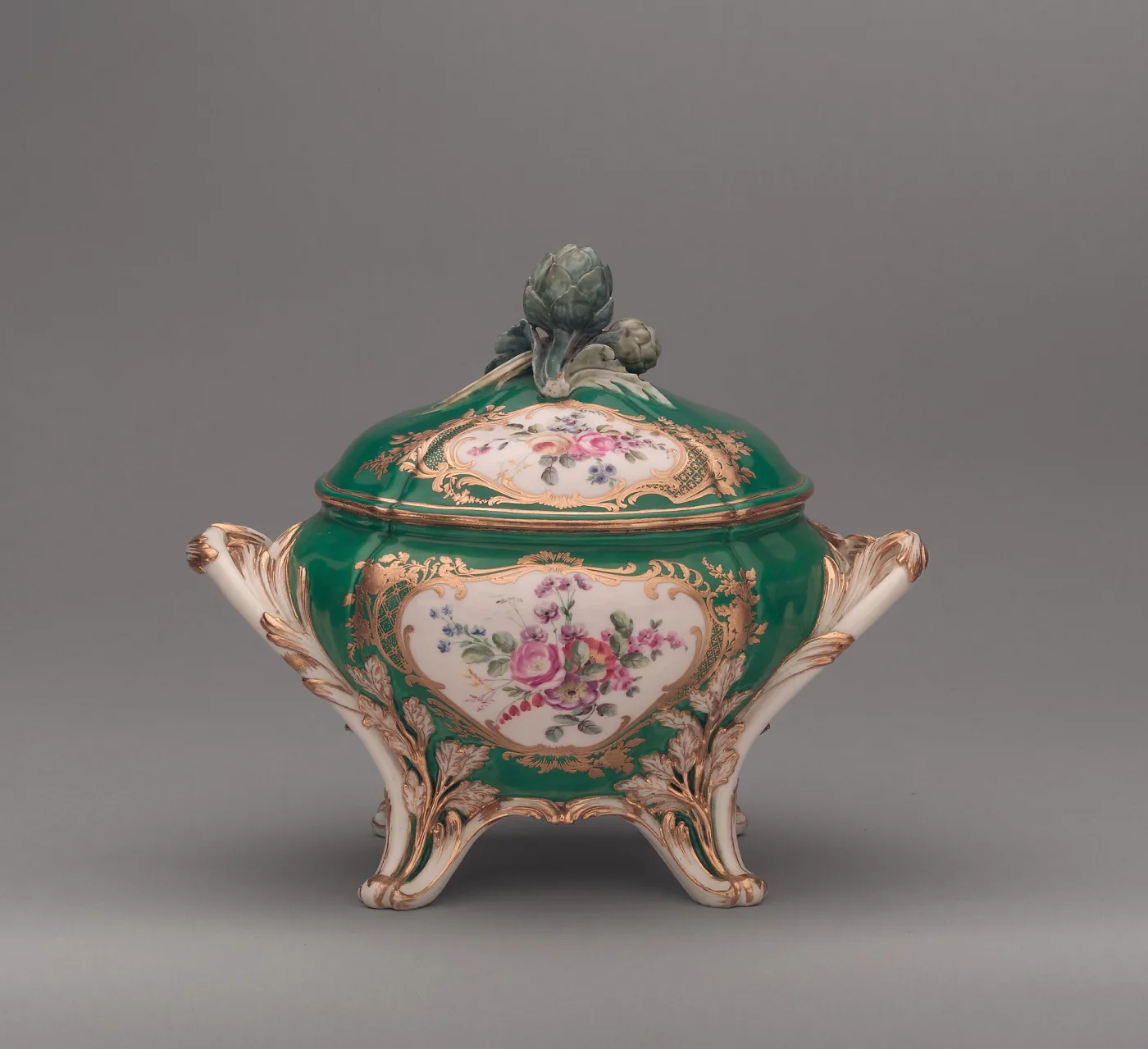
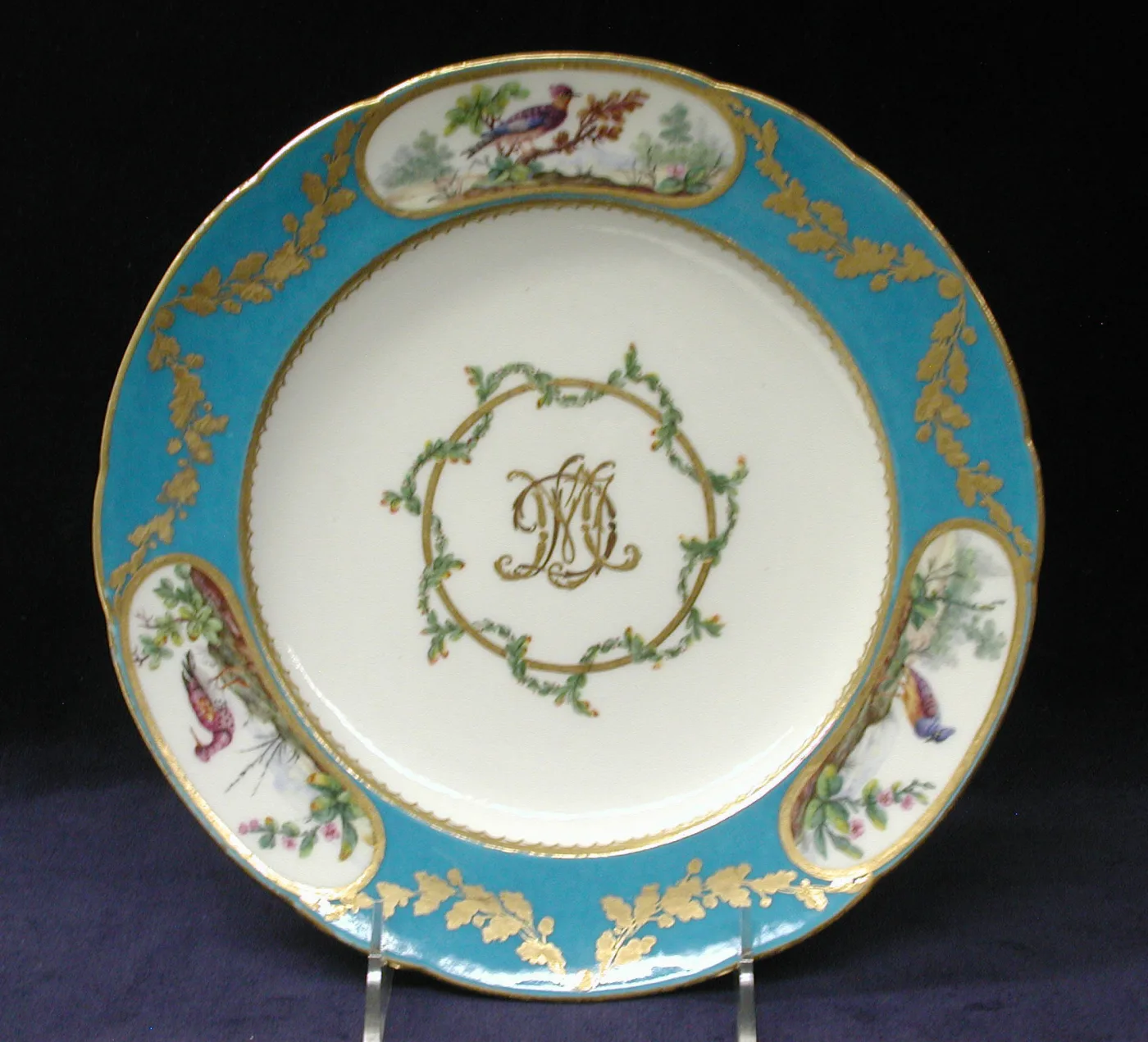
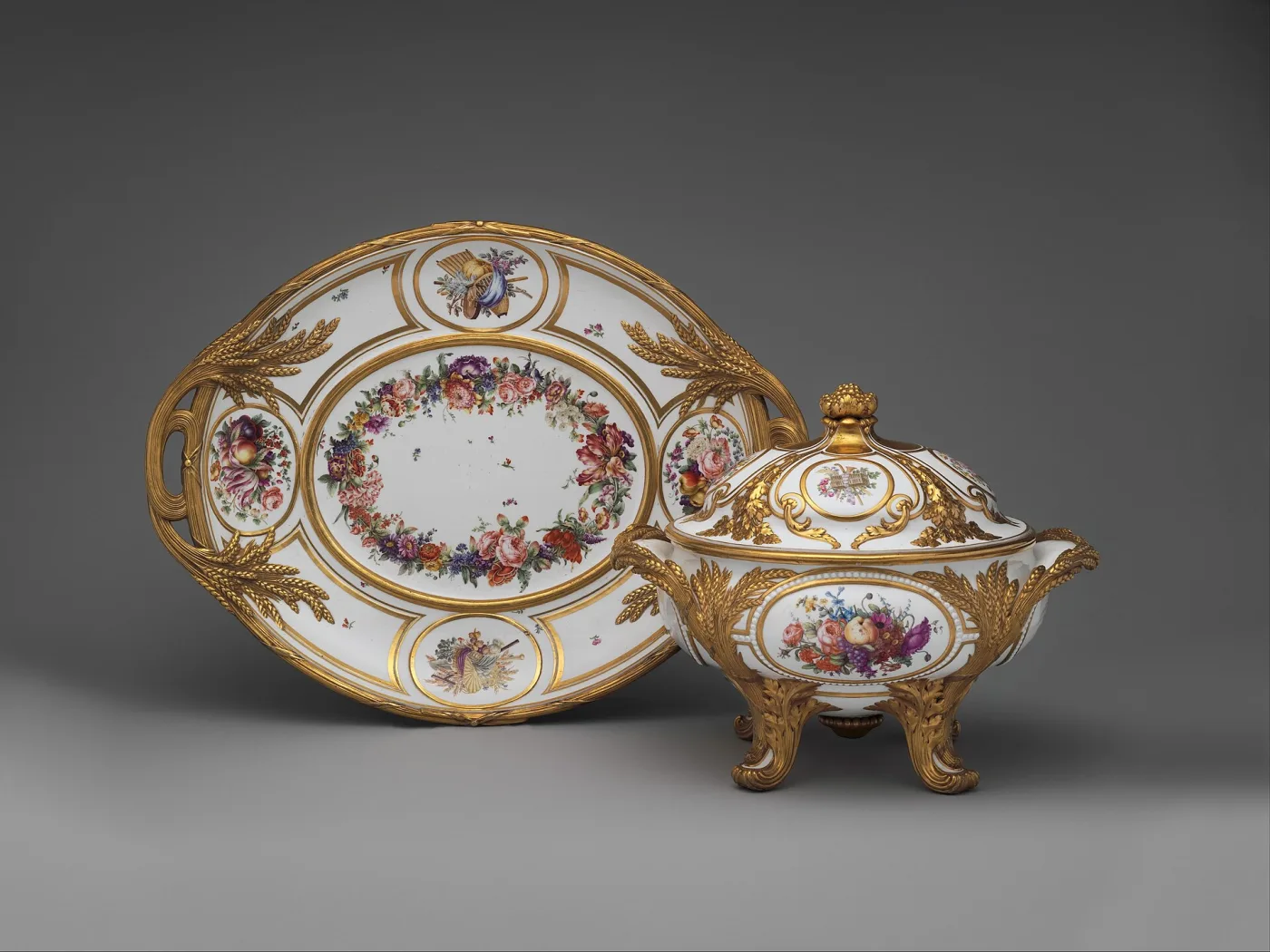
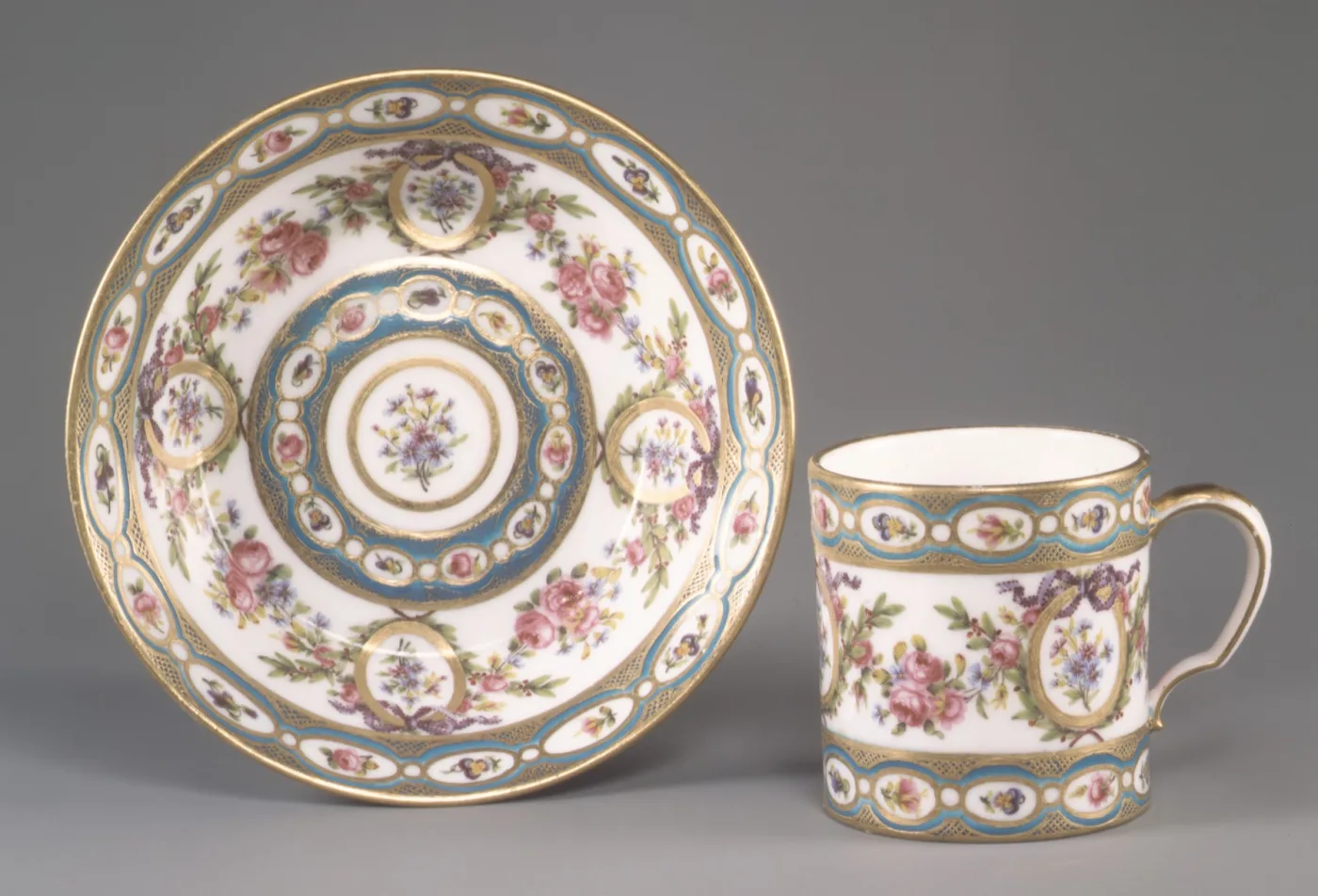
Ground colour is the fastest period bracket a Sèvres piece will give you, because each one entered production in a documented year and was not used before it: bleu lapis from 1749, bleu céleste and jaune jonquil from 1753, vert pomme from 1756, rose Pompadour from 1757. A ground therefore sets an earliest possible date even when the mark is gone. It does not set a latest one — the nineteenth-century factory revived every one of these colours, and so did every imitator who could match them, which is why a ground narrows the question and never closes it. One detail on the plate is worth separating out: the gilt cypher at the centre belongs to whoever the service was made for, not to the factory. Monograms of that kind are regularly reported as marks by people describing a piece over the telephone.
Other Grounds
Subsequent grounds include bleu nouveau (a darker cobalt), bleu Fallot (very dark), vert pré (meadow green), violet, brown, black, and the "oeil de perdrix" (partridge eye) gilded-pattern ground. The catalogue of Sèvres grounds runs to dozens of named variants.
Reserves and Cartouches
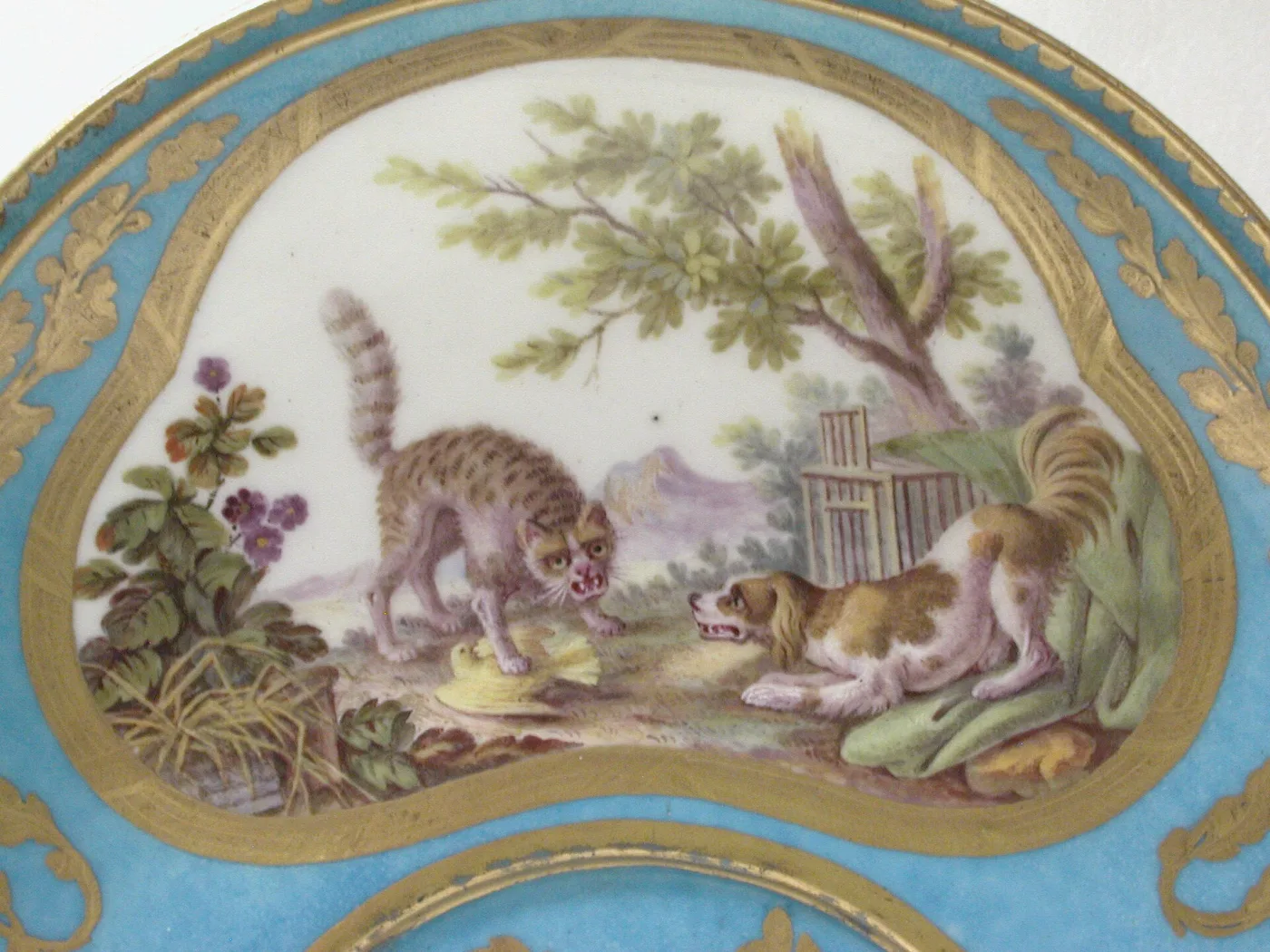
The coloured grounds frame reserved panels — usually oval or shaped cartouches — containing painted decoration: floral bouquets, figure scenes, landscapes, birds, military or marine subjects, mythological themes. The contrast between intense ground and detailed reserve painting is the signature aesthetic of Royal Period Sèvres.
Gilded Patterns Over Ground
Many ground colours carry gilded patterns: caillouté (pebble-pattern dots), vermiculé (worm-trail), pointillé (dotted), oeil de perdrix (eye-dot rings), and elaborate gilded scrollwork. The quality of gilding is itself a connoisseurship marker.
Forms and Models
Sèvres produced an enormous range of forms across nearly three centuries. The named forms of the Royal Period remain the foundation of collector identification.
Vases
Famous Sèvres vase forms include the vase à oreilles (vase with ear-shaped handles), vase Hébert (named for the maître mouleur), vase Duplessis (named for designer Jean-Claude Duplessis), vase pot-pourri à vaisseau (potpourri vase in the form of a ship), vase grec (Greek-form), and dozens more. Each named form has a defined silhouette and dating.
Tableware
The gobelet litron (cylindrical cup) and saucer is the foundational Sèvres tea-cup form, produced in three sizes from the 1750s onward. Other tableware includes the écuelle (covered broth bowl), théière (teapot), cafetière (coffee pot), pot à sucre (sugar pot), and various plates and dishes. Many Sèvres services included specialised pieces — wine coolers, ice pails, monteiths, fruit dishes.
Cabaret and Déjeuner Services
A cabaret is a small tea or breakfast service for one or two persons on a fitted tray (plateau). The déjeuner combines tea or coffee equipage with the tray as a complete set. Surviving complete déjeuners in original condition are highly valuable and form important museum pieces.
Cuvettes and Jardinières
Flower vases (cuvettes), jardinières, and pots-pourris formed an important decorative category. The cuvette Mahon and cuvette Verdun are recognised named forms. Pieces in matched pairs or garnitures (sets of three or five) carry substantial premium.
Plaques
Decorative porcelain plaques mounted in furniture, particularly in the work of Martin Carlin and other Louis XVI cabinet-makers, form a specialised Sèvres category. Carlin furniture mounted with Sèvres plaques is itself among the most valuable French eighteenth-century furniture. The interface with cabinetry is discussed in our broader antique furniture guide.
Form Pricing
Within any period, ambitious forms (pot-pourri à vaisseau, large vases, complete déjeuners, services with named provenance) command very large premiums over simpler forms (gobelet litron cups, simple plates). Documented pairs and garnitures multiply single-piece values significantly.
Biscuit Figures and Sculpture
Sèvres biscuit — unglazed porcelain — was developed in the 1750s as a sculptural medium for figural work. Biscuit porcelain has a matte, marble-like surface that takes fine modelling and reads as classical sculpture in miniature.
The Falconet–Boizot Tradition
The two great Sèvres sculptural directors were Etienne-Maurice Falconet (1757–1766) and Louis-Simon Boizot (1773–1809). Falconet's biscuit figures of cupids, putti, allegorical figures, and the famous "Bather" set the model for Sèvres sculpture. Boizot continued and expanded the tradition with mythological and portrait subjects.
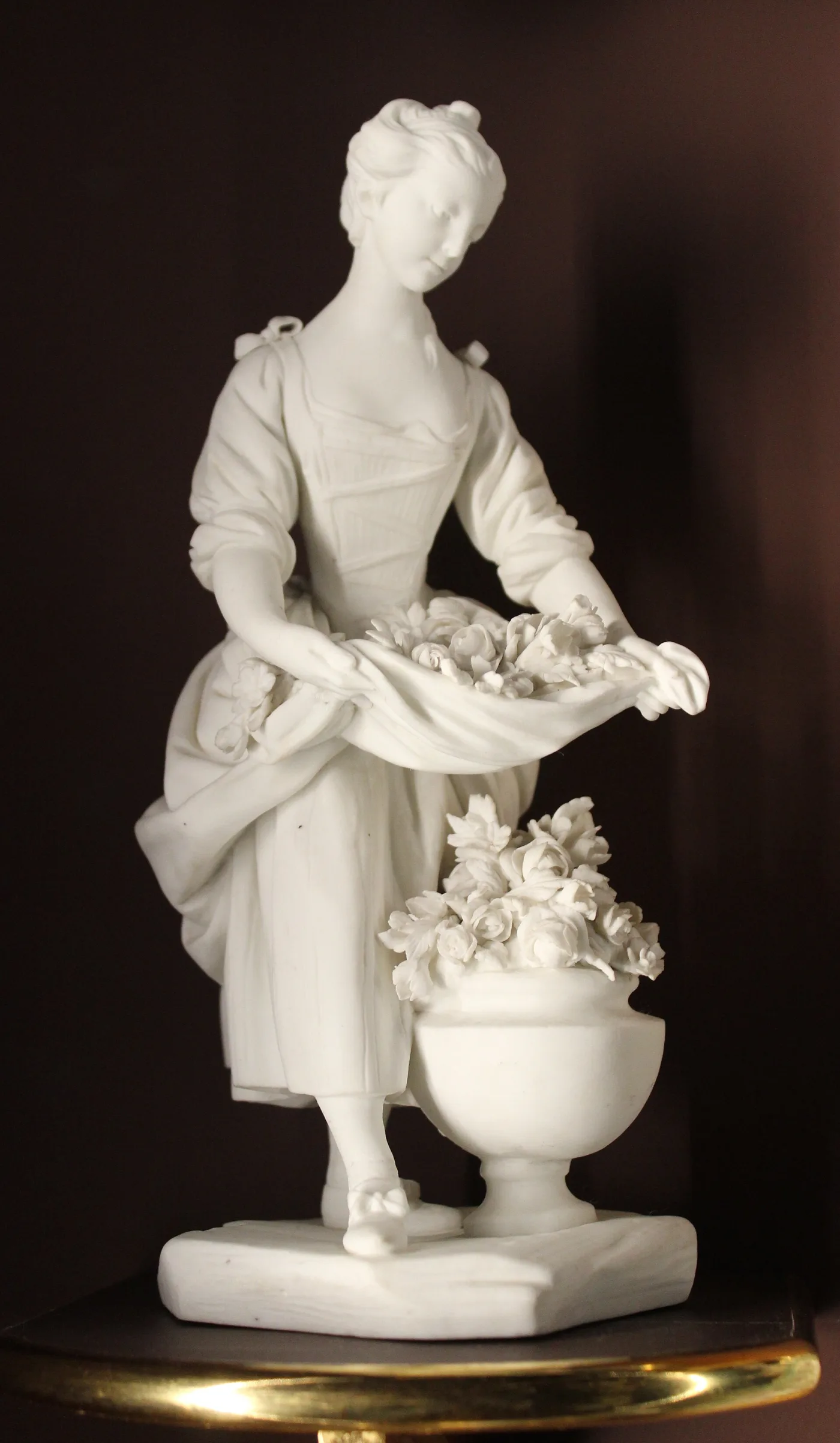
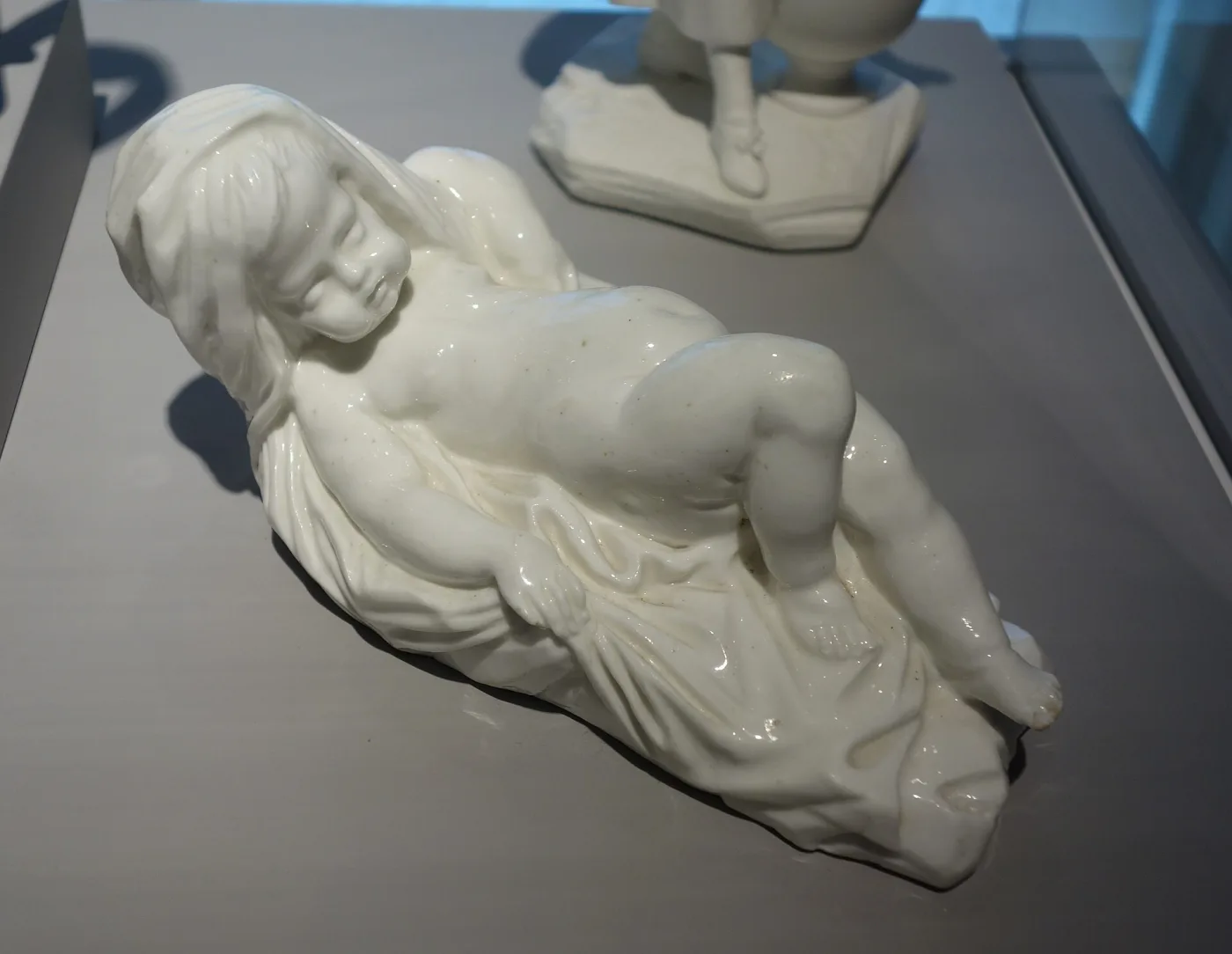
Biscuit was adopted in the 1750s precisely because glaze is hostile to sculpture: a layer of glass runs into every hollow and rounds off the sharp edge of every fold, which is visible in the second figure the moment you compare the two. The identification consequence follows from the same physics. A matte biscuit body will not hold a glaze-painted cipher, so biscuit is marked by impressing the factory name, a modeller's initials or a year code into the clay before firing — usually along the back edge of the base, where you have to tip the figure to find it. A painted interlaced L on a biscuit figure is uncommon rather than impossible, and is worth a second look rather than being treated as confirmation.
Modelling Quality
Sèvres biscuit figures are typically sharp in modelling, with very fine detail in faces, hands, and drapery. The body is dense, ivory-white, and shows almost no porosity. Lesser nineteenth-century imitations are softer in modelling and chalkier in body.
Marking of Biscuit
Biscuit figures often carry impressed marks: the factory's name, the modeller's initials, or a year code. Painted marks are uncommon on biscuit (the matte surface does not lend itself to glaze-painted ciphers).
Important Biscuit Groups
Falconet's "Baigneuse" (Bather, c. 1758), the Boizot group portraits, the allegorical figures of the Republic period, and the post-1800 Brongniart-period figures of historical worthies are major identifiable types. The biscuit tradition of figural decorative work also informs related categories such as bisque dolls and parian sculpture.
Glazed Figures
Some Sèvres figures were produced glazed and coloured rather than in biscuit. Glazed figures from the Royal Period are less common than biscuit work and typically carry interlaced L marks like tableware.
Revolutionary and Empire Sèvres (1793–1814)
The Revolution disrupted the royal manufactory but did not destroy it. Despite financial chaos, loss of patrons, and political upheaval, production continued — at much reduced scale — and the factory survived to be reinvigorated under Napoleon and Brongniart.
Revolutionary Marks (1793–1800)
From 1793 the interlaced L mark — a royal cipher — became politically problematic. Pieces of the Revolutionary period may carry "RF" (République Française), "Sèvres" inscribed in script, or simply painters' marks without the royal cipher. Marking is irregular and date-letter discipline broke down.
Napoleonic Patronage (1800–1814)
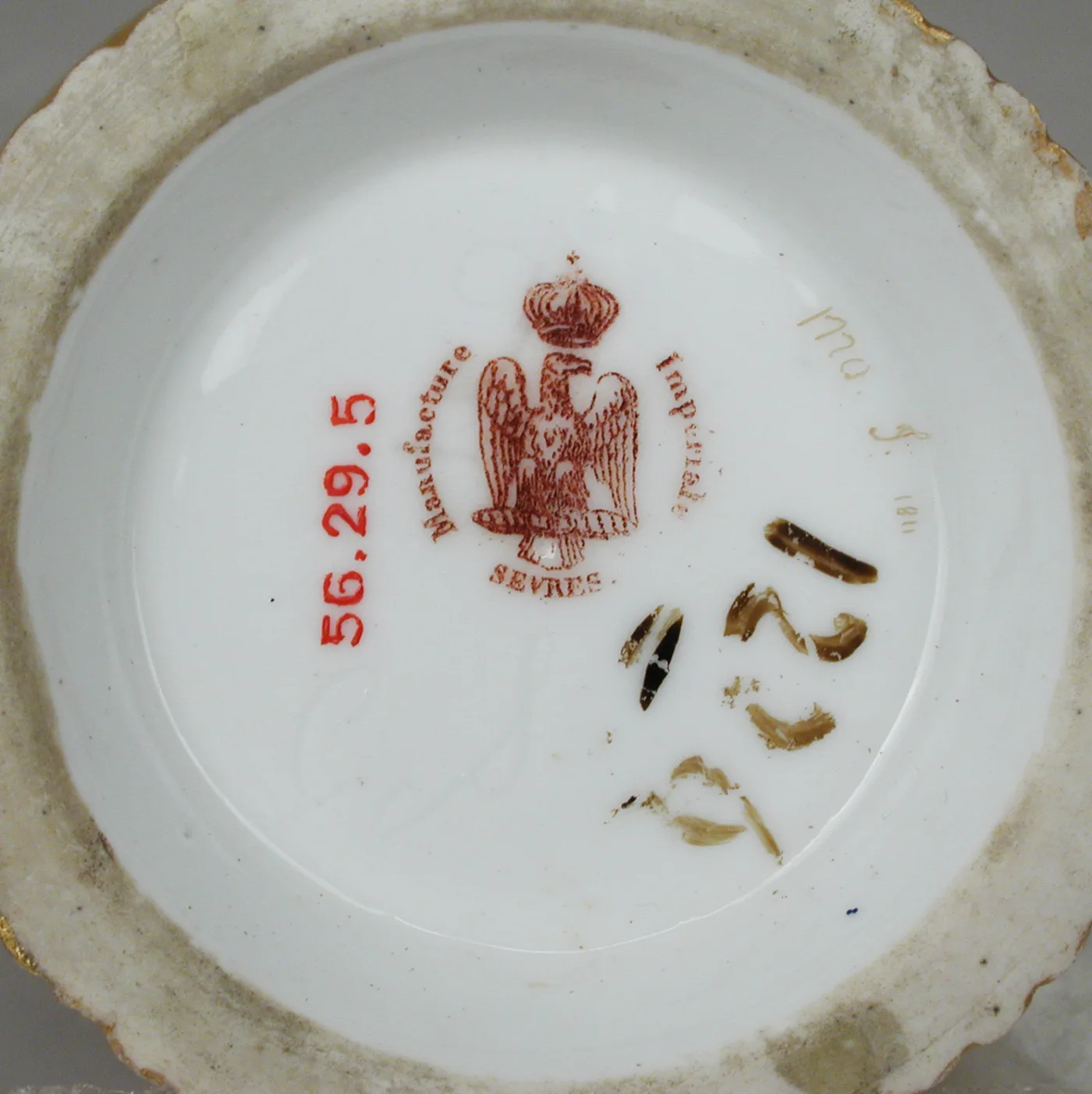
Napoleon Bonaparte, recognising the propaganda value of luxury porcelain, immediately took the factory under direct state ownership and put Alexandre Brongniart in charge in 1800. Production resumed under the inscription "Manufacture Impériale de Sèvres" — usually printed in red as "M.Imp.de Sèvres" with a Napoleonic eagle or imperial cipher. Date is often given as the last two digits of the year inside the printed mark.
Imperial Style
Empire-period Sèvres adopts the neoclassical, archaeological, and military iconography of the regime: Roman and Egyptian motifs, portrait medallions of Napoleon and Josephine, military trophies, mythological subjects in classical settings. Ground colours include rich greens, deep blues, and Empire-period yellows and oranges.
The Sèvres Egyptian Service
Among the most celebrated Empire-period Sèvres is the Egyptian Service, produced 1804–1808 with painted scenes derived from Vivant Denon's Egyptian campaign drawings. The original service went to the Empress Josephine and later to Tsar Alexander I. Other documented services were given as imperial diplomatic gifts.
Empire Mark Reading
Empire marks are typically printed in red and incorporate the imperial cipher (an "N" with crown, an imperial eagle, or the "M.Imp.de Sèvres" inscription). Painters' and gilders' marks continue in the same tradition as Royal Period work, though many decorators changed during the disruption.

The Brongniart Reform (1800–1847)
Alexandre Brongniart, geologist and chemist, was appointed director of the factory in 1800 and held the position for 47 years. His reforms reshaped Sèvres into a modern industrial-artistic enterprise and defined nineteenth-century French porcelain.
Technical Modernisation
Brongniart phased out soft-paste production (final cessation in 1804) in favour of more economical hard-paste. He systematised the chemistry of glazes and ground colours, introduced new firing techniques, and expanded the laboratory and reference library at the factory. His "Traité des arts céramiques" (1844) remains a foundational text in ceramic technology.
Artistic Direction
Under Brongniart the factory turned to large-scale decorative and commemorative work: vases of grand size for state gifts and palaces, plaques painted with copies of famous paintings, services for state occasions and diplomatic gifts. Painted scenes after Old Masters became a Sèvres speciality.
The Musée Céramique
Brongniart founded the factory's Musée Céramique in 1824, gathering the comparative collection of European ceramics that survives today as the Musée National de Céramique at Sèvres. The museum was integral to the factory's research and design programme.
Marks of the Brongniart Period
Brongniart-era marks variously include "M.Imp.de Sèvres" (until 1814), "Sèvres" in script or printed, year codes, and from 1818 a more systematic printed mark giving year and director. Marks become more bureaucratic and reproducible — and less individually painter-identified — than Royal Period work.
Value of Brongniart-Period Work
Brongniart-period pieces vary widely in value. State-quality painted plaques and major vases can reach six figures. Standard tableware of the period is more accessible. Documented decorator attribution remains important.
Nineteenth-Century Sèvres
After Brongniart's death in 1847 the factory continued under successive directors through the July Monarchy, Second Empire, and Third Republic. Each regime modified the marks and patronage but the factory's central position in French luxury porcelain continued.
July Monarchy (1830–1848)
Under Louis-Philippe the factory mark becomes "LP" with crown or "Sèvres" with date code. Production continues large state vases and dinner services. The factory's monumental commissions for the Palace of Versailles museum (re-opened 1837) define the period.
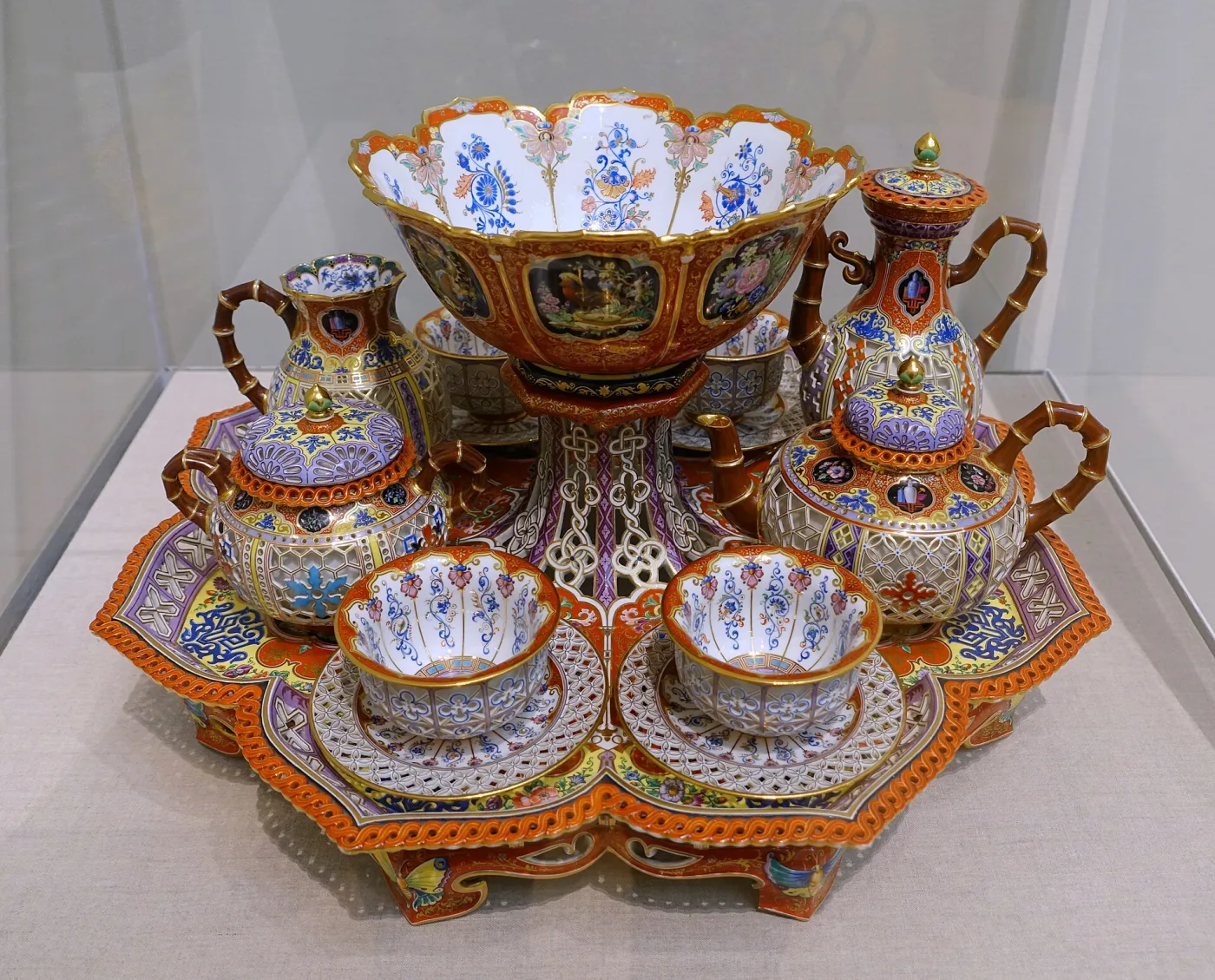
Second Empire (1852–1870)
Under Napoleon III the factory revives Royal Period and First Empire models and decorative idioms. Marks include "N" with crown or "S" with year code. Second Empire Sèvres copies of eighteenth-century forms are common and frequently sold to mid-century collectors as Royal Period — a recurrent source of confusion.
Third Republic (from 1870)
Republican marks include "RF" (République Française), "Sèvres" with year, and various date and decorator codes. Late nineteenth-century Sèvres turns increasingly to Art Nouveau idioms and pâte-sur-pâte decoration. The factory experiments with new ground colours and decorative techniques. The contemporary Art Nouveau aesthetic shapes much late-century Sèvres production.
Late-Century Standards
Nineteenth-century Sèvres maintained high standards of body and decoration but is rarely confused with eighteenth-century work by trained eyes. Hard-paste body, printed factory marks rather than painted ciphers, and more academic painting style distinguish the later work.
Service Pieces and State Gifts
Throughout the nineteenth century Sèvres remained the principal source of state porcelain gifts from the French government to foreign sovereigns, ambassadors, and dignitaries. Diplomatic gift pieces often carry presentation inscriptions or are documented in state archives, providing strong provenance.
Samson and Paris Decorators
No discussion of Sèvres identification is complete without an extended treatment of the imitations. The majority of "Sèvres" porcelain offered on the general antique market is in fact later reproduction, decoration of white blanks, or outright Samson.
The Paris Decorator Tradition
Throughout the nineteenth century Paris workshops bought white porcelain blanks — sometimes from Sèvres itself (the factory sold seconds and surplus blanks), sometimes from other French and German factories — and decorated them in the Sèvres manner, applying convincing interlaced L marks. These pieces are legitimately "Sèvres porcelain" insofar as the body may be from the factory, but they are not Sèvres decoration and were not produced for the royal/imperial/state market.
Edmé Samson et Cie (founded 1845)
Edmé Samson and his successors established the most famous and skilled reproduction workshop of the nineteenth century. Samson explicitly produced "imitations" of Meissen, Sèvres, Chinese export, English delft, and other historical types. Samson Sèvres copies are exceptionally well-modelled and well-decorated, often with convincing interlaced L marks. Authentic Samson marks (a Sèvres-like cipher with a small "S" or distinctive subtle modification) are sometimes recognisable; many Samson pieces, however, were marked with straight interlaced Ls.
Distinguishing Samson from Sèvres
Body: Samson uses hard-paste, often with a slightly bluer cast than Sèvres hard-paste. Painting: Samson decoration is technically skilled but stylistically slightly more academic and less spontaneous than Royal Period work. Gilding: Samson gold is often slightly redder and more uniform than Sèvres gilding. Marks: Samson marks may show subtle variations or "tells" recognisable to specialists.
The Helena Wolfsohn and Other Imitators
German Dresden firms including Helena Wolfsohn also produced Sèvres-style decoration on hard-paste blanks. These pieces typically carry "AR" or other Dresden-style marks but were sometimes marketed as Sèvres in the secondary market.
Practical Implication
Approach any Sèvres-marked piece with skepticism unless it has been authenticated by a specialist. Body analysis, painting quality, gilding character, and historical provenance must all align. A "Sèvres" piece offered at antique-mall prices is almost certainly Paris decoration, Samson, or worse. A genuine Royal Period Sèvres piece without documented provenance is itself unusual.
Where Samson Has Value
Disclosed Samson and high-quality Paris decoration have their own market. Skilled nineteenth-century Sèvres-style decoration on convincing blanks can trade in the £500–£5,000 range honestly. The problem is misrepresentation, not the existence of these wares.
Authentication Workflow
Authenticate any Sèvres piece in this order — never short-circuit the sequence:
1. Read the Mark
Identify the cipher (interlaced Ls, RF, imperial cipher, etc.) and any date letter, painter cipher, and gilder cipher. Match against published mark references and the factory archive. Note the colour of the mark (underglaze blue, puce, red printed, etc.).
2. Assign a Provisional Period
From the mark, place the piece in Royal, Revolutionary, Empire, Restoration, July Monarchy, Second Empire, or Republican period. Cross-check the mark against the period's known mark types.
3. Analyse the Body
Determine soft-paste or hard-paste from translucency, glaze character, and (where possible) examination of any chips. Confirm the body type matches the assigned period: soft-paste only to 1804; hard-paste from 1769 onward.
4. Evaluate the Decoration
Assess painting quality, ground colour, gilding, and stylistic period. Royal Period decoration shows spontaneity and refinement; nineteenth-century decoration is more academic; Paris and Samson decoration is technically skilled but stylistically derivative.
5. Painter Attribution
Cross-reference painter and gilder ciphers against the factory archive. Genuine Royal Period pieces carry ciphers of documented factory employees painting in the years matching the date letter. Mismatches (e.g., a painter's cipher used after the painter's documented career end) indicate forgery.
6. Provenance
For pieces of significant value, demand documented provenance: factory sale records, prior auction records, dealer invoices, family records. Royal service pieces should match documented sales archives. The general framework is laid out in our authentication and provenance research guide.
7. UV and Technical Examination
UV light identifies repaint, replacement parts, modern fillers, and over-decoration. X-ray fluorescence (XRF) of glazes and grounds can be performed at major auction houses to confirm period-appropriate chemistry.
8. Specialist Confirmation
For any piece offered or held above £5,000, consult an established specialist — Sotheby's or Christie's French ceramics department, the dealer Adrian Sassoon (London), or directly the Manufacture Nationale de Sèvres archive. Genuine Sèvres is rare enough that experts are quickly consulted for any candidate piece.
Condition and Restoration
Condition issues on Sèvres affect value substantially. Always examine under bright light, raking light, and UV before purchase.
Glaze Crazing and Staining
Soft-paste glazes are prone to fine crazing developed over centuries. Light, even crazing is acceptable on Royal Period pieces; heavy crazing or staining through crazing reduces value. Hard-paste pieces craze less and any crazing is a more serious condition concern.
Chips and Rim Damage
Rim chips, particularly on cups, vases, and plaques, are common. Even small chips reduce value 20–40% on most pieces; major damage proportionally more.
Hairline Cracks
Hairlines through painted decoration are particularly damaging. Inspect under raking light and tap-test. Hairlines at handles, foot rings, and around painted reserves are common failure points.
Repainting and Restoration
Repainted decoration is a common form of restoration on damaged pieces. UV examination reveals modern over-paint as bright fluorescent patches. Disclosed restoration is acceptable on rare pieces; undisclosed restoration significantly impacts price.
Gilding Wear
Gold gilding wears with use. Acceptable wear on Royal Period pieces is consistent with two and a half centuries of handling; gross wear (large bare patches) reduces value. Re-gilding is sometimes done but is detectable under magnification.
Original Fittings
Many Sèvres pieces (potpourri vases, jardinières) had original metal mounts, fittings, or covers. Loss of original fittings reduces value substantially. Replacement nineteenth-century mounts are sometimes added to plain Sèvres pieces — research the form against documented examples.
The Restoration Decision
For high-value pieces, professional conservation by specialist conservators is preferable to amateur restoration. The general framework in our restoration and conservation guide applies.
Value Factors and Price Ranges
Sèvres values span an enormous range, from a few hundred pounds for honest nineteenth-century tableware to seven figures for documented Royal Period pieces with provenance. The general framework in our antique valuation and appraisal guide applies; the Sèvres-specific factors below.
Period Hierarchy
Royal Period documented soft-paste: highest values. Royal Period hard-paste: high values, typically below soft-paste. Revolutionary/Empire: significant values, particularly for documented Imperial pieces. Brongniart-era state plaques and vases: high values for major works, moderate for standard production. Late nineteenth-century: moderate values varying by quality. Twentieth-century and modern: collector market values.
Ground Colour Premium
Rose Pompadour and bleu céleste grounds carry the largest premiums. Bleu lapis, jaune jonquil, and vert pomme are also major value drivers. Plain white-ground Royal Period pieces are less valuable than equivalent coloured-ground work but still substantial.
Painter Attribution Premium
Documented painting by major Sèvres figure painters (Dodin, Morin, Caton, Asselin) multiplies value substantially. Documented gilders (Le Guay, Vincent) add a measurable premium. Painted scenes after named Old Masters, signed and dated, command particular premiums.
Approximate Price Ranges (Authenticated Examples)
Nineteenth-century tableware (genuine factory): £200–£2,000. Brongniart-period standard work: £1,000–£10,000. Empire-period plaques and decorated pieces: £2,000–£25,000. Royal Period hard-paste tableware: £2,000–£20,000 (more for major painters). Royal Period soft-paste tableware: £3,000–£40,000+ (much more for major painters or named services). Royal Period major vases and pot-pourris: £15,000–£200,000+. Royal services with provenance: £50,000–£2,000,000+ per piece. Vincennes documented pieces: £20,000–£500,000+.
Provenance Premium
Documented royal, imperial, or aristocratic provenance multiplies values by factors of 2–20. A gobelet litron cup with documented Madame du Barry provenance commands many times what an identical cup without provenance would bring.
Pairs and Sets
Matched pairs of vases bring 2.5–4x single-piece prices. Garnitures of three or five pieces command exponentially higher premiums. Complete cabaret and déjeuner services in original condition are six- to seven-figure objects.
Auction Houses for Sèvres
Specialist Sèvres expertise resides primarily at Sotheby's and Christie's (London, New York, Paris), with departments dedicated to French eighteenth-century porcelain. Bonhams and Drouot Paris also handle significant Sèvres. For mid-market work, regional French auction houses regularly offer authenticated pieces.
Building a Sèvres Collection
Sèvres rewards specialised, well-researched collecting. The general principles in our collecting strategies guide apply; the Sèvres-specific refinements below.
Specialise
The factory's output is too vast for general collecting. Specialise: Royal Period painted figure scenes, eighteenth-century biscuit figures, Brongniart-period plaques, a single ground colour, work by a specific painter, Empire-period state porcelain. Specialisation builds the eye that recognises quality and detects misattribution.
Reference Library
Essential references include the Geoffrey de Bellaigue volumes (the Royal Collection Sèvres catalogue), Tamara Préaud's "Manufacture Royale de Sèvres" publications, the Brongniart treatises, and Antoine d'Albis's "Traité de la porcelaine de Sèvres." The Wallace Collection and Frick Collection scholarly catalogues are essential comparative references.
Museum Study
The Louvre, the Wallace Collection (London), the Frick Collection (New York), the J. Paul Getty Museum (Los Angeles), the Hillwood Estate (Washington), the Royal Collection (Windsor), and the Musée National de Céramique at Sèvres itself hold the world's principal Sèvres collections. Direct museum study is irreplaceable for body, glaze, and decoration standards.
Specialist Dealers
A small number of specialist dealers handle the upper Sèvres market: Adrian Sassoon (London), Galerie Aveline (Paris), Galerie Kugel (Paris), Earle D. Vandekar (New York), and a handful of others. Building relationships with established specialists provides access to vetted material and authoritative advice.
Auction Catalogue Study
Decades of Sotheby's and Christie's catalogue entries describe documented pieces in detail. Build a working library of past sale catalogues; cross-reference against any piece offered. Catalogue descriptions by specialist cataloguers contain essential connoisseurship information.
Documentation and Insurance
Maintain full documentation of every piece: mark photographs, condition reports, provenance chain, prior sale records, and current appraisal. Schedule on dedicated fine arts insurance and update appraisals every five years. The general care framework is in our antique storage and preservation guide.
Care, Display & Preservation
Sèvres porcelain's combination of soft-paste body, painted decoration, and applied gilding demands museum-standard handling. The general principles in our antique storage and preservation guide apply.
Handling
Lift Sèvres by the body, never by handles, rims, or applied decoration. Use cotton or nitrile gloves for any handling — skin oils degrade gilding over decades. For valuable pieces, two hands are essential, supporting both base and main body simultaneously.
Cleaning
Never wash Sèvres in a dishwasher. Hand-wash only in lukewarm water with a small amount of mild dish soap, using a soft cotton cloth. Never use abrasive sponges, scouring powders, or harsh detergents. Many pieces should not be washed at all — light dusting with a soft brush is preferable for fragile work and biscuit figures.
Display Environment
Display in stable temperature (16–22°C / 60–72°F) and humidity (40–60%). Avoid direct sunlight, which fades painted reserves and gilding over decades. UV-filtering glazing on display cases is recommended for high-value pieces. Avoid display near radiators, kitchens, and bathrooms where humidity fluctuates.
Securing on Display
Secure tall vases and pot-pourri urns with museum wax (microcrystalline). Use plate stands that support plates by the foot ring rather than pressing on the rim. Secure shelves against earthquake or vibration if local conditions warrant.
Storage
Wrap pieces individually in acid-free tissue and store in archival boxes. Never stack cups or plates rim-to-rim. Store hardware (lids, fittings) separately and labelled with the parent piece. Climate-controlled storage rooms are preferable to attics or basements.
Transport
Never ship Sèvres pieces of significant value without specialist fine-art shipping. For local transport, double-box with at least three inches of cushioning between boxes. Insure for full replacement value with signature confirmation on delivery. Major auction houses provide specialist shipping for high-value pieces.
Documentation Updates
Photograph each piece from multiple angles including the base mark and any condition concerns. Update condition records after any cleaning, transport, or restoration. Maintain a written inventory cross-referenced to insurance schedules and probable next-generation transfer.