Antique Teapots & Tea Services Identification Guide: Dating, Authentication & Valuation
Antique teapots and tea services represent a fascinating intersection of functional design, artistic expression, and cultural heritage. From delicate Chinese porcelain teapots dating back centuries to ornate Victorian silver services, these objects tell the story of tea's global journey and its profound impact on social customs across civilizations. Whether you've inherited a family tea set, discovered an intriguing piece at an estate sale, or are building a collection of tea ware, understanding how to properly identify and authenticate these treasures is essential. This comprehensive guide will walk you through everything you need to know about identifying antique teapots and tea services, from recognizing maker marks and materials to dating pieces accurately and determining their historical and monetary value.
Table of Contents
- Types of Antique Teapots and Tea Services
- Historical Evolution of Tea Culture
- Major Makers and Manufacturers
- Materials and Construction Techniques
- Maker Marks and Dating Systems
- Stylistic Periods and Design Elements
- Condition Assessment and Common Issues
- Valuation Factors and Market Trends
- Expert Tips for Collectors
- Frequently Asked Questions
Types of Antique Teapots and Tea Services
Understanding the various forms and categories of tea ware is essential for accurate identification and appreciation of these pieces.
Complete Tea Services
Full tea services typically include multiple coordinated pieces designed for formal tea service:
- Traditional Tea Service: Teapot, sugar bowl, creamer, waste bowl, and matching cups and saucers (typically 6 or 12 place settings)
- Victorian Five-Piece Service: Teapot, coffee pot, hot water pot, sugar bowl, and creamer on matching tray
- Bachelor's Set: Smaller three-piece service designed for individual use or small gatherings
- Cabaret Set: Compact service for two, often including tray with teapot, cups, saucers, and accessories
- Traveling Tea Sets: Miniature or collapsible services designed for portability
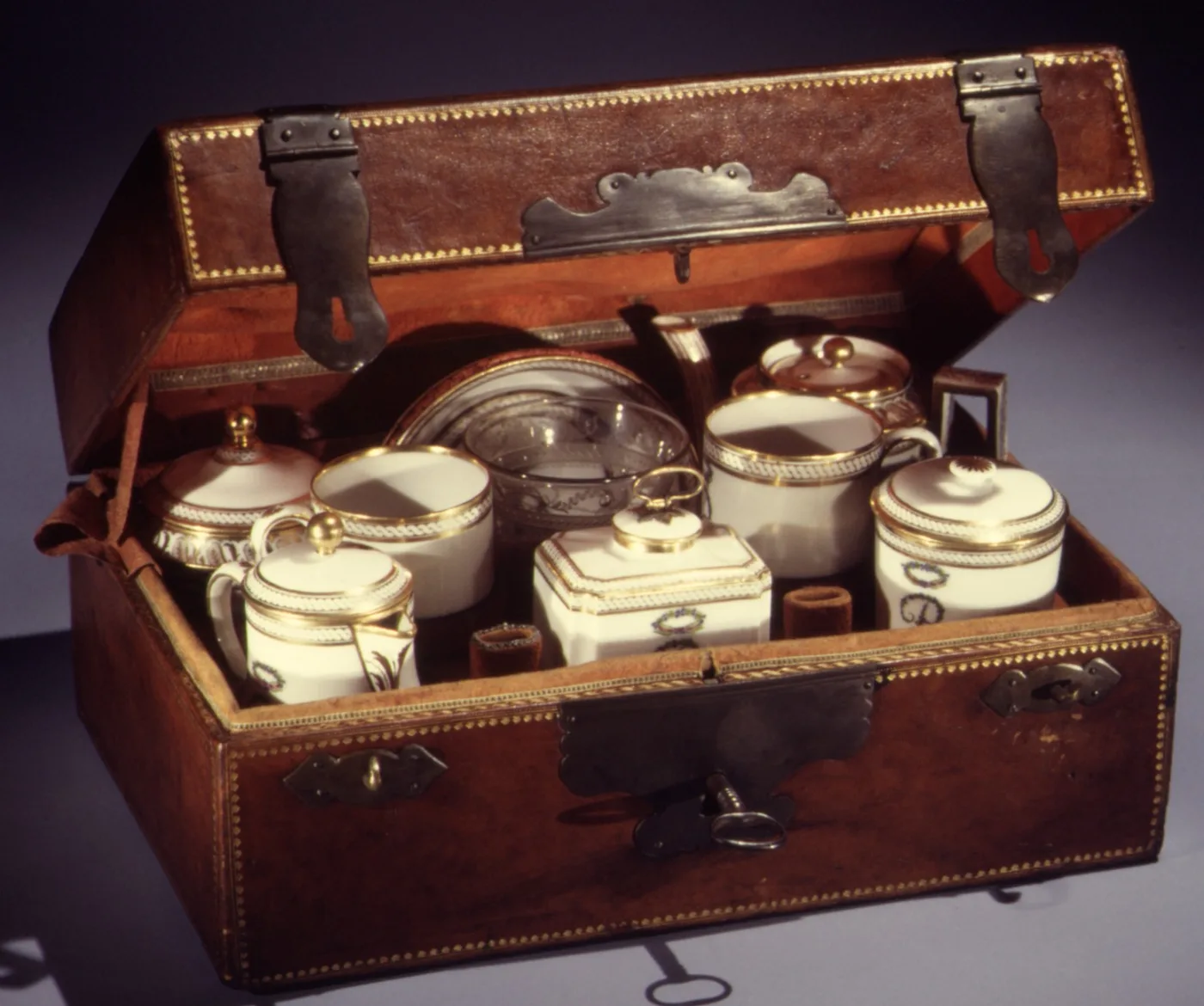
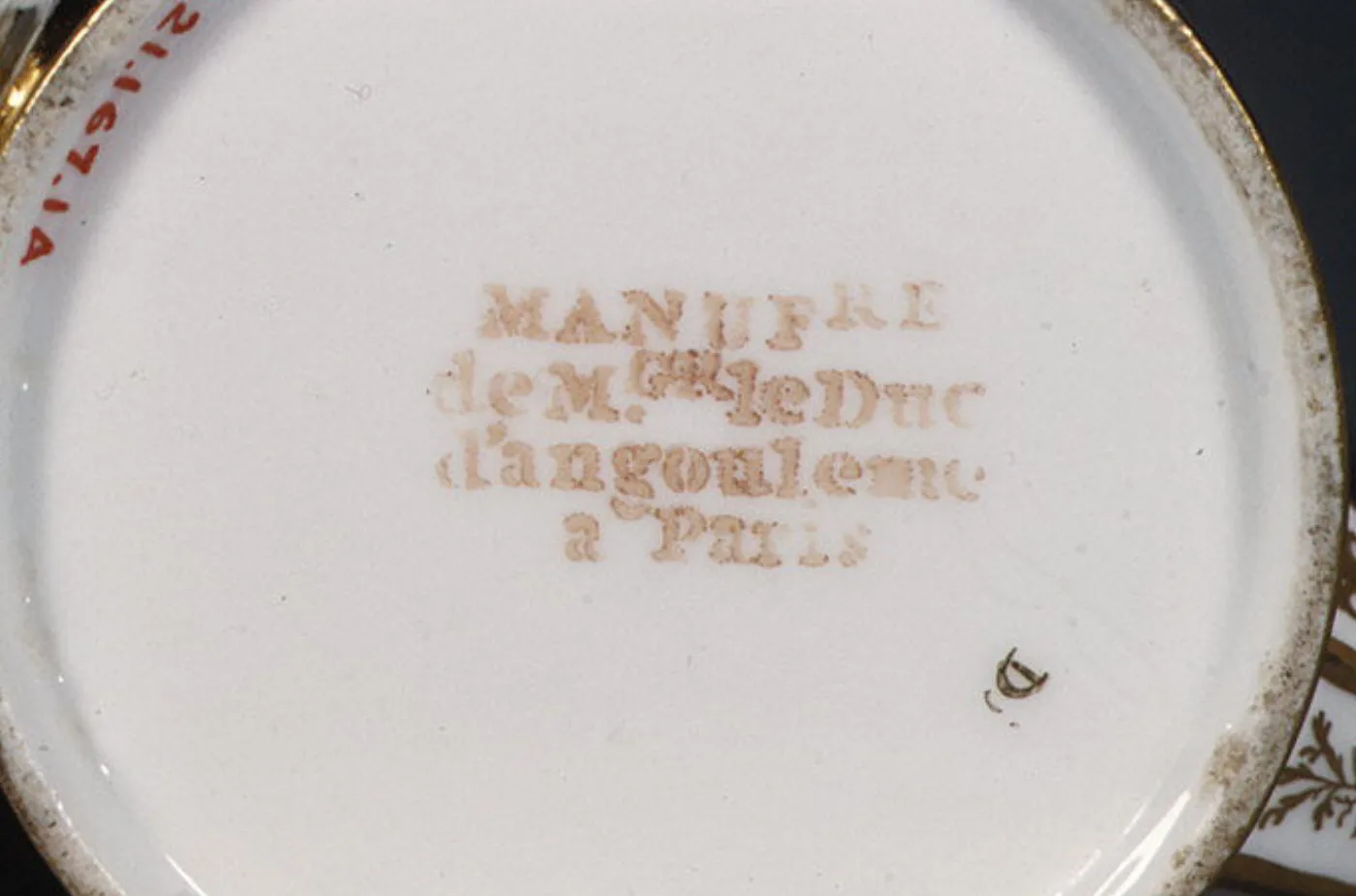
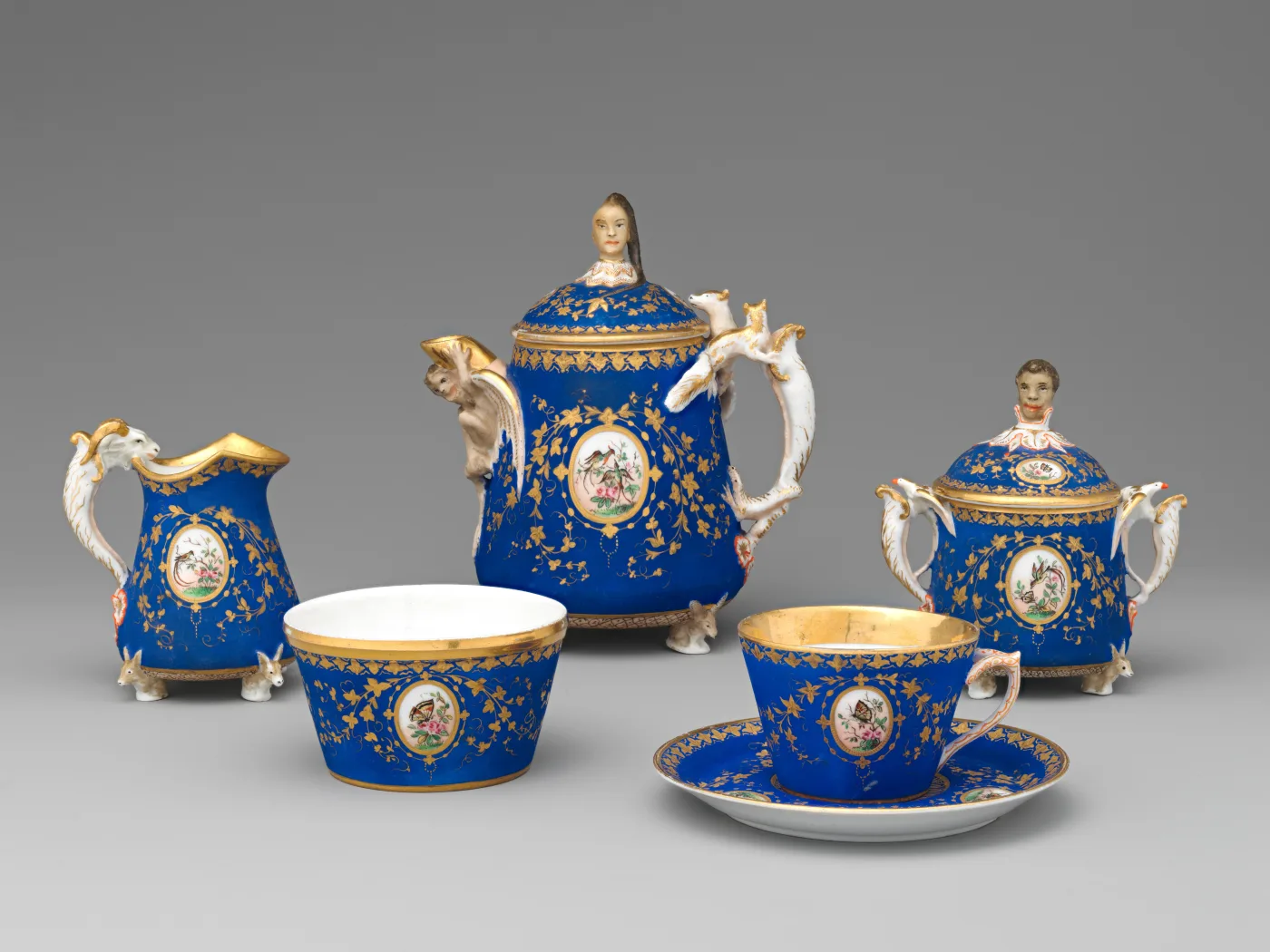
A service with its original case is worth far more than the same pieces loose, because the case proves the group belongs together and fixes how many pieces there should be. Turn a piece over before anything else: this one reads Manuf.re de M. le Duc d'Angoulême à Paris, the Dihl et Guérhard factory, written out in full rather than abbreviated to a symbol — normal practice for Paris porcelain of the 1780s and a useful contrast with the crossed-swords and anchor marks used elsewhere.
Individual Teapot Styles
Teapots come in numerous distinct forms, each with regional and historical significance:
- Chinese Yixing Teapots: Unglazed purple clay teapots from Jiangsu Province, highly porous and valued for tea flavor enhancement
- Japanese Kyusu: Side-handled teapots traditionally used for green tea, often ceramic with fine strainers
- English Globe Teapot: Round-bodied design popularized in the 18th century, classic British form
- Bullet or Drum Teapot: Cylindrical Georgian design, often in silver or Sheffield plate
- Cadogan Teapot: Peculiar design that fills from the bottom, Victorian novelty form
- Miniature Teapots: Small decorative or children's teapots, often highly collectible
- Novelty Teapots: Figural designs shaped as animals, buildings, people, or whimsical forms
Material Categories
Teapots and services were crafted from diverse materials, each with distinct characteristics:
- Porcelain Tea Ware: Hard-paste and soft-paste porcelain from European, Chinese, and Japanese manufacturers
- Silver Tea Services: Sterling silver, coin silver, and Sheffield plate services, often highly ornate
- Ceramic and Stoneware: Earthenware, stoneware, and majolica teapots, typically more rustic
- Cast Iron Tetsubin: Japanese cast iron teapots with enamel interiors, originally designed for heating water
- Britannia Metal and Pewter: Affordable alternative to silver, popular in 19th century
- Bone China: Refined English porcelain containing bone ash, translucent and durable
- Mixed Media: Combinations such as silver-mounted porcelain or wicker-wrapped handles
Specialized Tea Vessels
Beyond teapots, tea culture produced numerous specialized vessels:
- Tea Caddies: Storage containers for tea leaves, often in pairs for green and black tea
- Tea Canisters: Lidded vessels for bulk tea storage, frequently decorated
- Slop Bowls: Waste bowls for discarding tea dregs and rinsing cups
- Mote Spoons: Pierced spoons for removing tea leaves from cups
- Tea Strainers: Silver or ceramic strainers, often with matching drip bowls
- Tea Cozies: Fabric covers to keep teapots warm, sometimes elaborate needlework
- Samovar Sets: Russian tea urns with coordinating service pieces
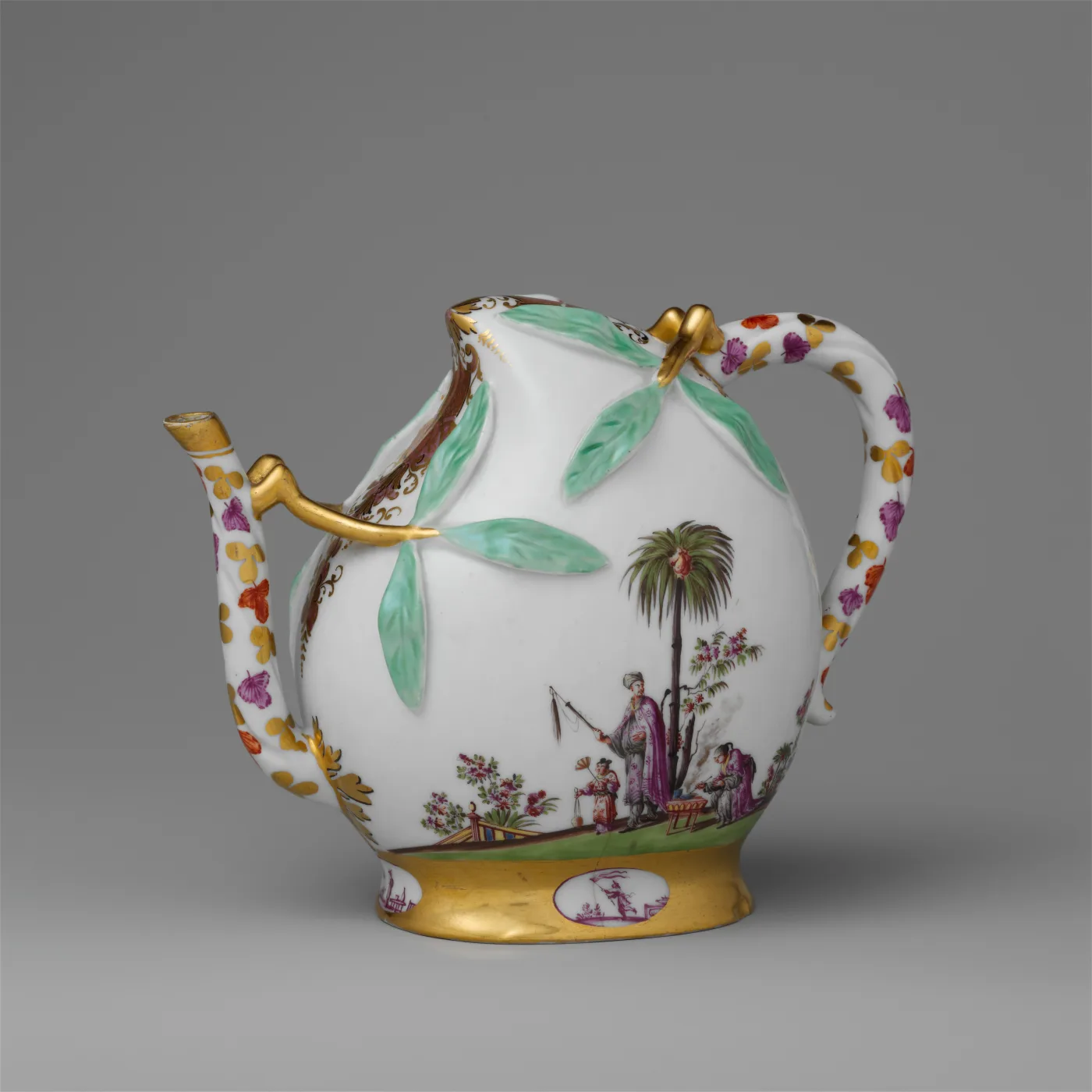
Historical Evolution of Tea Culture
Understanding the historical development of tea drinking customs helps date and contextualize antique tea ware.
Early Tea Trade Era (1600s-1700s)
Tea's arrival in Europe created demand for specialized vessels:
- Chinese Export Porcelain (1600s onward): Earliest tea ware in Europe, imported Chinese porcelain decorated for Western markets
- Dutch Delftware (1650s-1700s): European attempts to imitate Chinese blue and white porcelain
- Early Silver Services (late 1600s): Wealthy Europeans commissioned silver teapots, initially rare and precious
- Tea Ceremony Influence: Japanese tea ceremony traditions influenced vessel design and aesthetics
- Exotic Luxury Status: Tea and tea ware as symbols of wealth, refinement, and worldliness
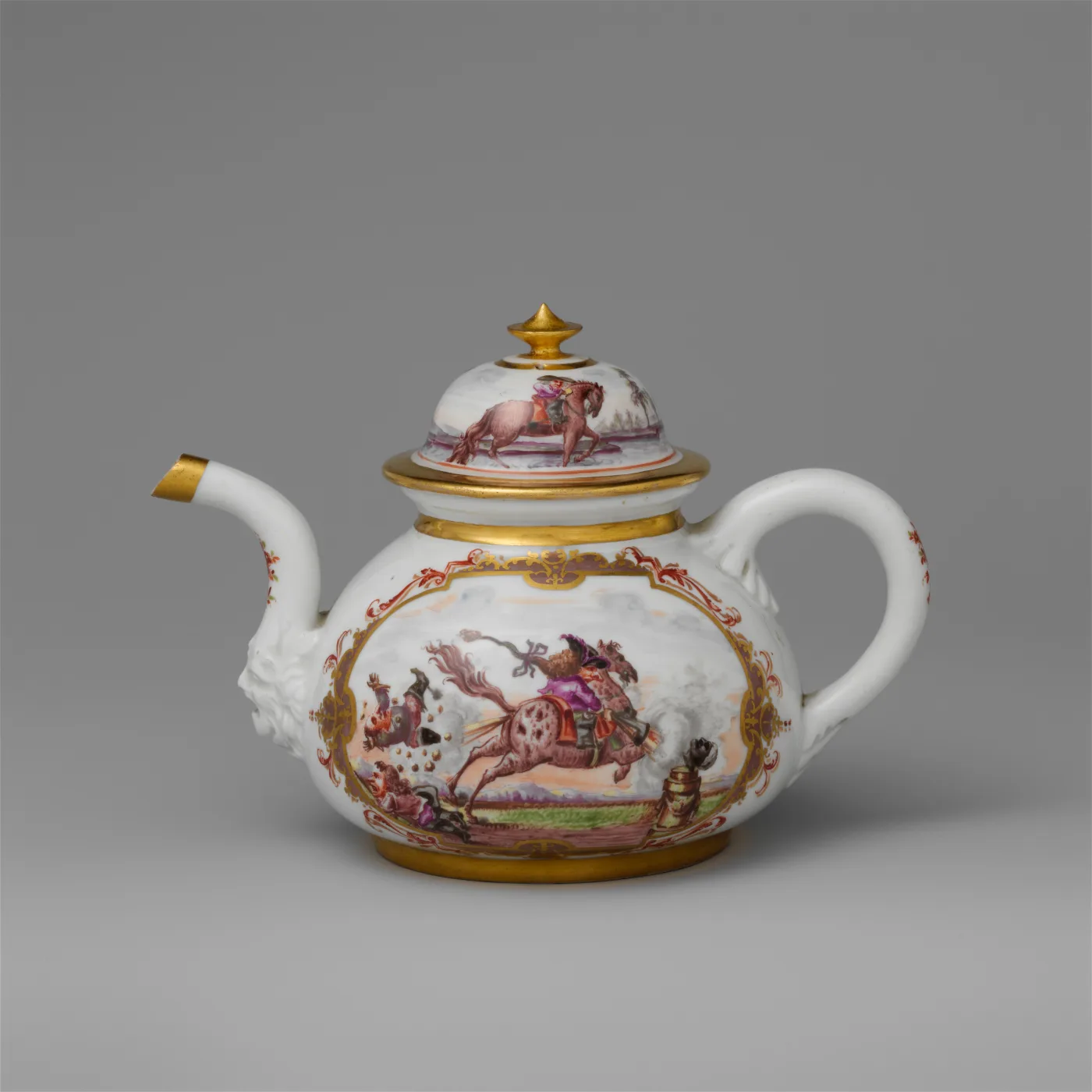
Georgian Period (1714-1830)
Tea drinking became firmly established in British society, driving design innovation:
- Silver Tea Services: Development of coordinated silver services, bullet-shaped and pear-shaped teapots
- Wedgwood and Staffordshire: English pottery manufacturers created affordable ceramic tea ware
- Worcester and Chelsea: Fine English porcelain factories established, competing with Chinese imports
- Social Ritual Development: Formalization of afternoon tea customs influenced service design
- Regional Styles: Distinct Scottish, Irish, and English silversmithing traditions emerged
Victorian Era (1837-1901)
The golden age of tea culture, with elaborate services and widespread production:
- Afternoon Tea Tradition: Anna, Duchess of Bedford popularized afternoon tea, creating demand for formal services
- Industrial Production: Mass production made tea services accessible to middle classes
- Ornate Decoration: Heavily decorated services with gilding, transfer prints, hand-painting
- Novelty and Whimsy: Figural teapots, commemorative pieces, and eccentric designs proliferated
- Pattern Books: Manufacturers created extensive pattern catalogs for customer selection
- Colonial Influence: Indian and Ceylon tea production influenced British tea culture
Arts and Crafts Movement (1880-1920)
Reaction against industrialization produced distinctive tea ware:
- Handcrafted Aesthetic: Emphasis on artisan production, visible maker's marks
- Simple Forms: Rejection of Victorian excess, cleaner lines and minimal decoration
- Art Pottery: Studio potteries created unique tea ware, each piece individual
- Hammered Silver: Hand-wrought silver with visible hammer marks, organic forms
- Natural Motifs: Botanical and natural world inspiration in decoration
Art Nouveau and Art Deco (1890-1940)
Modern design movements revolutionized tea service aesthetics:
- Art Nouveau (1890-1910): Flowing organic lines, whiplash curves, naturalistic decoration
- Art Deco (1920-1940): Geometric forms, bold colors, streamlined modernism
- Silver Innovation: Sleek chrome and silver plate services, machine-age aesthetics
- Ceramic Modernism: Clarice Cliff, Susie Cooper, and other designers created bold modern patterns
- International Style: Bauhaus influence, form following function
Mid-Century Modern (1945-1970)
Post-war design brought new materials and casual aesthetics:
- Scandinavian Design: Clean lines, functional beauty, understated decoration
- Studio Pottery: Bernard Leach, Lucie Rie, and studio movement tea ware
- Casual Tea Culture: Shift from formal services to everyday tea drinking
- Material Innovation: Heat-resistant glass, new glazes, experimental forms
- Asian Influence: Renewed Western interest in Japanese tea ceremony aesthetics
Major Makers and Manufacturers
Identifying the maker is crucial for authentication and valuation of antique tea ware.
English Porcelain Manufacturers
British porcelain factories produced some of the world's finest tea ware:
- Worcester (Royal Worcester from 1862): Founded 1751, crescent mark, extensive tea service production, blue and white and polychrome decoration
- Wedgwood: Established 1759, jasperware and basalt teapots, cream-colored earthenware services, impressed marks
- Spode: Founded 1770, fine bone china, blue Italian pattern, transfer-printed decoration
- Minton: Established 1793, elaborate hand-painted services, pâte-sur-pâte technique, gilded decoration
- Chelsea: 1745-1784, soft-paste porcelain, gold anchor mark, rare and valuable pieces
- Derby (Royal Crown Derby): Founded 1750, rich gilding, Imari patterns, crown marks
- Coalport: 1795-present, rococo revival styles, heavily decorated services
- Davenport: 1794-1887, printed earthenware, anchor mark, extensive tea service production
English Silver and Metalwork
Renowned silversmiths created prestigious tea services:
- Paul Storr: Georgian silversmith, heavy gauge silver, elaborate decoration, highly collectible
- Hester Bateman: Female silversmith, 1760s-1790s, delicate bright-cut engraving
- Matthew Boulton: Sheffield plate pioneer, Soho manufactory, affordable silver-plated services
- Elkington & Co: Electroplating innovators, Victorian services, EPNS marks
- Garrard: Crown Jewellers, prestigious services, royal commissions
- Liberty & Co: Arts and Crafts and Art Nouveau styles, Cymric silver, Tudric pewter
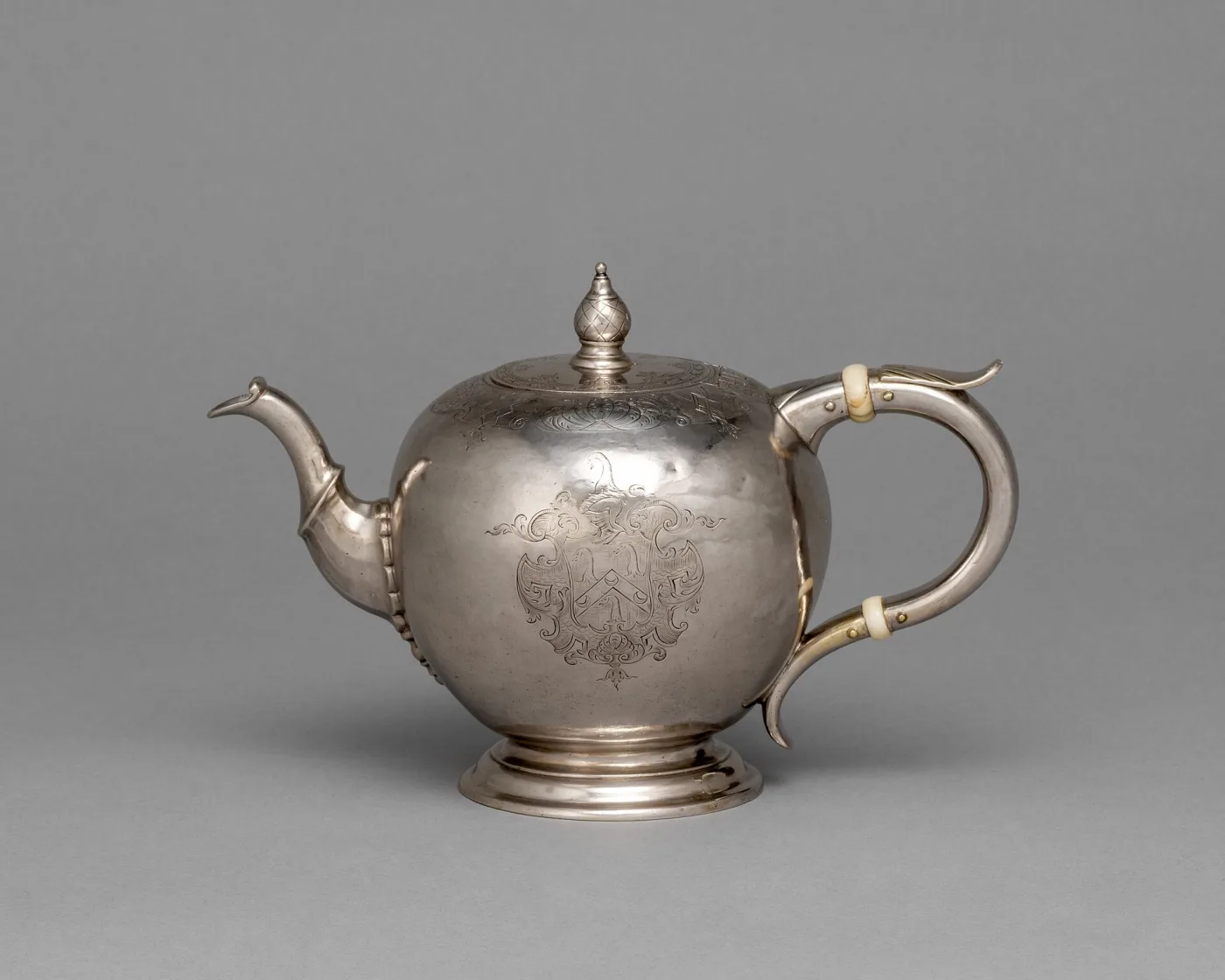
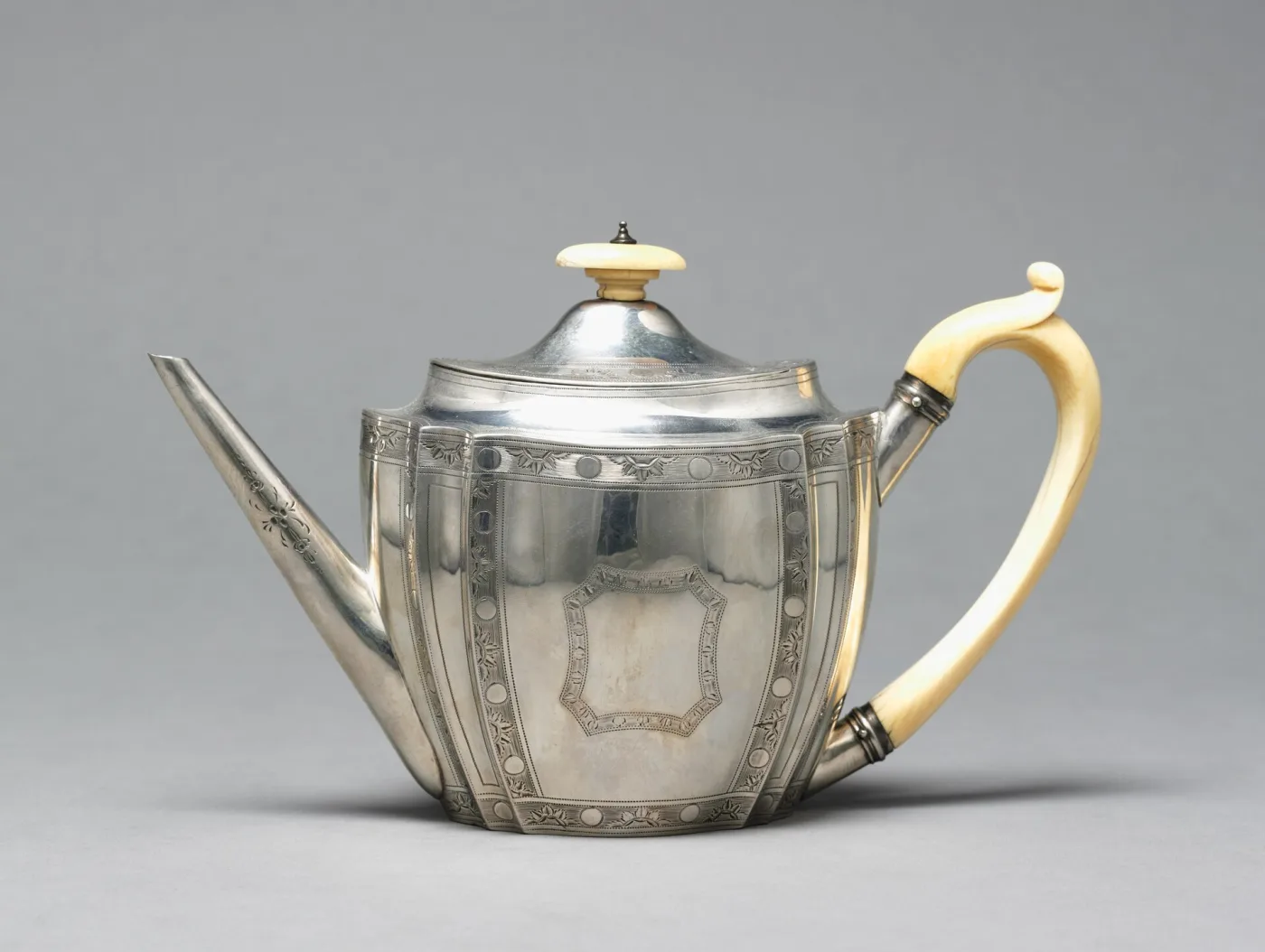
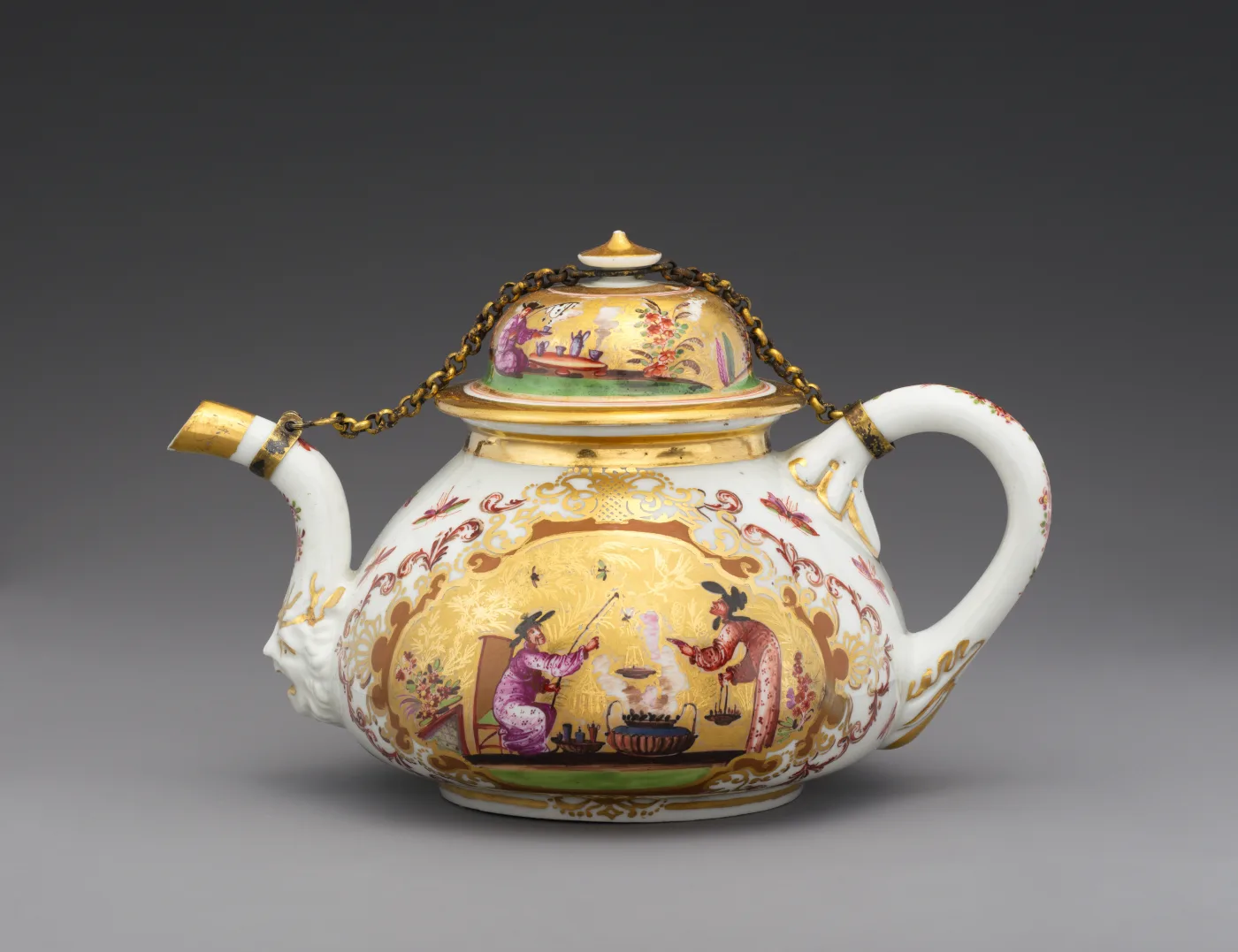
Fifty-five years separate these two, and the silhouette alone gets you close to the date. Round, bulging forms belong to the first half of the 18th century; the straight-sided, flat-based, fluted drum arrives with neoclassicism in the 1780s and 1790s. Form dates a teapot roughly, hallmarks date it exactly — but form is the check on the marks, and a shape that contradicts the hallmark date is a reason to look harder at both.
Chinese and Japanese Makers
Asian tea ware producers with centuries of tradition:
- Yixing Workshops: Purple clay teapots from Jiangsu Province, unglazed stoneware, master potters' seals
- Jingdezhen Porcelain: Imperial porcelain center, blue and white, famille rose, export ware
- Arita Porcelain: Japanese porcelain, Imari and Kakiemon styles, exported through Dutch East India Company
- Satsuma Ware: Cream-colored Japanese earthenware, elaborate gilding and enamel decoration
- Kutani Porcelain: Japanese porcelain, bold overglaze enamels, distinctive color palette
European Continental Makers
Important European manufacturers beyond Britain:
- Meissen: First European hard-paste porcelain, crossed swords mark, 1710 founding, exquisite hand-painted services
- Sèvres: French royal porcelain manufactory, elaborate gilding, ground colors, interlaced L marks
- KPM Berlin: Prussian state porcelain, scepter mark, neoclassical and rococo styles
- Vienna: Beehive mark, classical scenes, richly gilded borders
- Limoges: French porcelain center, numerous factories, white porcelain blanks often decorated elsewhere
- Copenhagen (Royal Copenhagen): Danish porcelain, blue fluted pattern, three-wave mark
American Manufacturers
United States tea ware producers developed distinct styles:
- Lenox: American fine china, established 1889, wreath mark, Presidential china commissions
- Gorham: Silver manufacturer, Providence Rhode Island, extensive tea service production
- Tiffany & Co: Luxury silver services, sterling standards, prestigious maker's marks
- Paul Revere: Early American silversmith, simple elegant forms, highly valuable when authentic
- Rookwood Pottery: Art pottery, hand-decorated teapots, artist signatures, flame mark
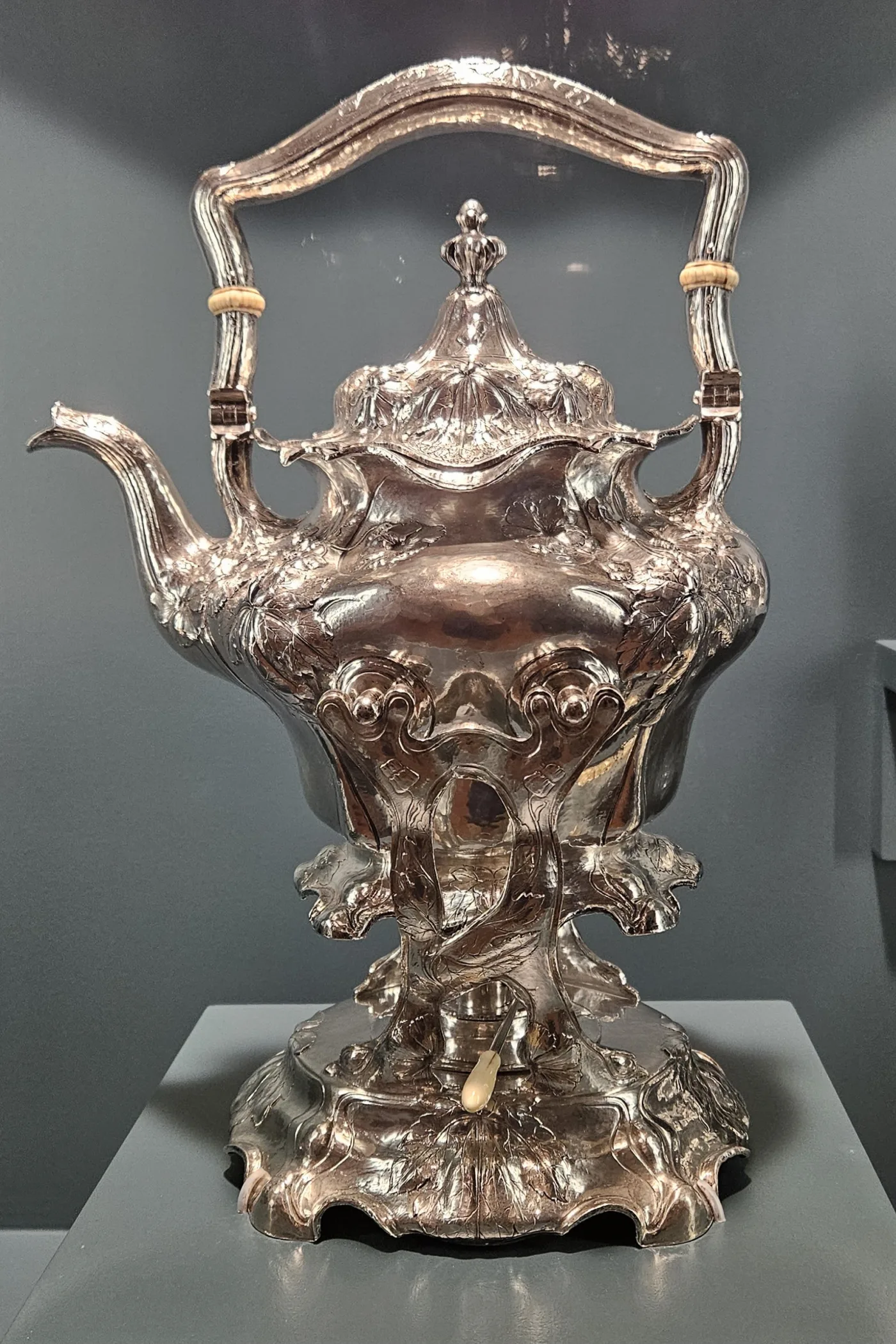
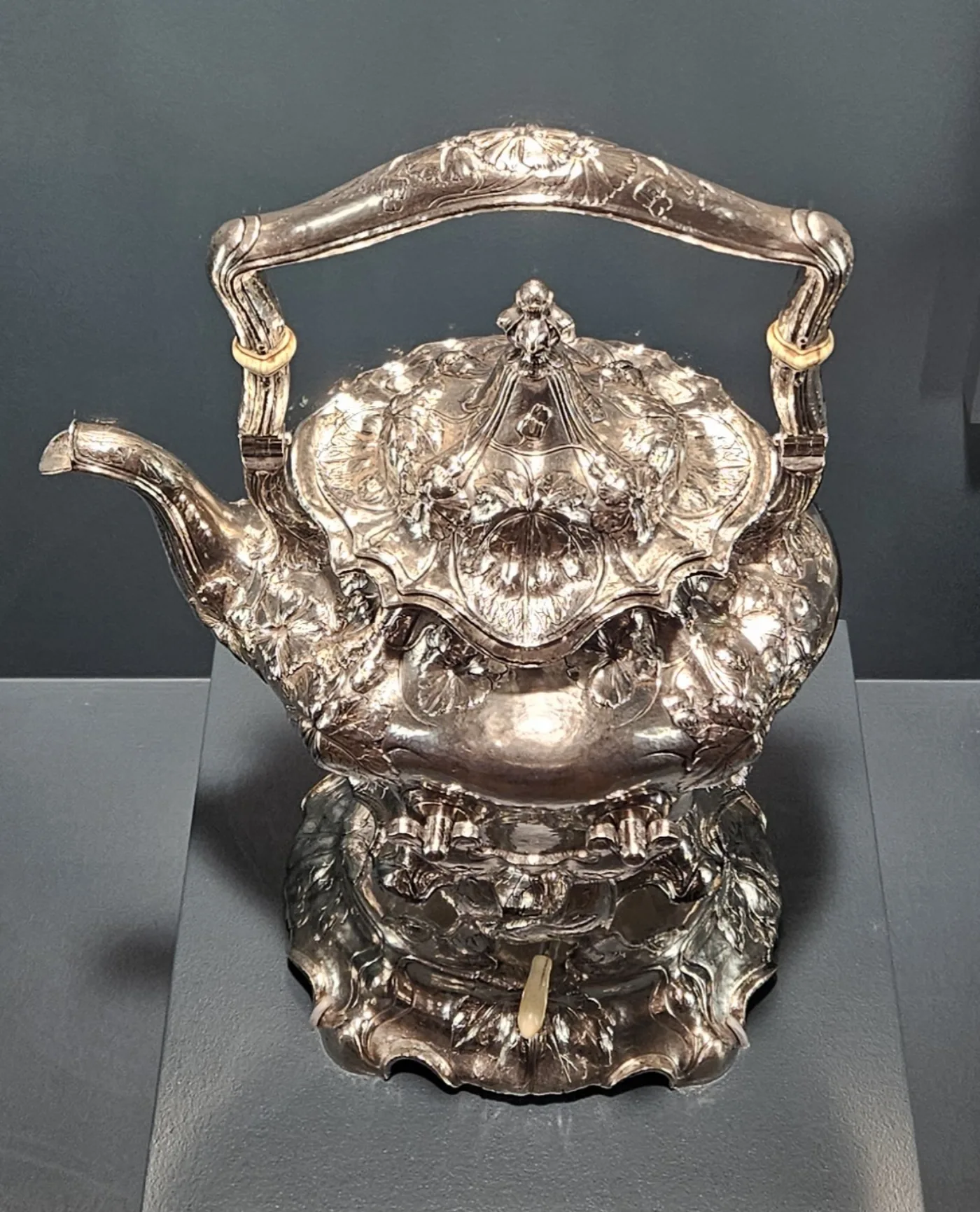
Martelé was Gorham's hand-raised line, made between 1897 and 1912, and the name means "hammered". Nothing on it is stamped or spun: the body is raised from sheet and the decoration chased by hand, so the pattern never repeats and faint hammer facets remain visible on the plain surfaces. That is the test — a machine-stamped Art Nouveau tea service shows the same motif at regular intervals, and no facets at all.

Materials and Construction Techniques
Understanding materials and manufacturing methods is essential for authentication and dating.
Porcelain Identification
Different porcelain types have distinct characteristics:
- Hard-Paste Porcelain: High-fired kaolin and petuntse, translucent, resonant ring when tapped, chip reveals glassy white fracture
- Soft-Paste Porcelain: European formula using ground glass, less translucent, softer body that scratches more easily
- Bone China: English innovation containing bone ash, highly translucent, warm tone, durable but chips cleanly
- Translucency Test: Hold to light source, true porcelain shows light transmission, thickness variations visible
- Weight Comparison: Porcelain denser than earthenware, substantial feel for size
- Glaze Quality: Smooth glassy surface, even application, crazing may indicate age or soft-paste
Silver and Metalwork Analysis
Metal tea services require careful examination for authenticity:
- Sterling Silver: 92.5% pure silver, hallmarks required, tarnishes to gray-black, dense weight
- Coin Silver: American standard, 90% pure, "COIN" marks or no standard markings
- Sheffield Plate: Copper fused with silver sheet, pre-1840s technique, edges may show copper core
- Electroplate (EPNS): Thin silver layer over base metal, post-1840, marks indicate plating, lighter weight
- Britannia Metal: Pewter-like alloy, lighter than silver, resembles pewter composition
- Hallmark Reading: British hallmarks show maker, standard, assay office, date letter, duty mark
- Construction Methods: Hand-raised vs spun, seam quality, handle attachment, spout assembly
Ceramic and Earthenware
Lower-fired ceramics have distinct properties:
- Earthenware: Porous body, opaque, requires glazing, lighter weight, softer sound when tapped
- Stoneware: High-fired, vitrified body, denser than earthenware, salt-glazed or feldspathic glazes
- Majolica: Tin-glazed earthenware, colorful lead glazes, relief decoration, Victorian popularity
- Creamware: Cream-colored lead-glazed earthenware, Wedgwood innovation, affordable elegance
- Redware: Iron-rich clay, terracotta color, traditional American pottery
Yixing Clay Characteristics
Chinese purple clay teapots have unique properties:
- Zisha Clay: Purple-brown unglazed stoneware, highly porous, absorbs tea oils
- Seasoning Patina: Develops darker, glossier surface with use, prized by collectors
- Clay Types: Purple (zisha), red (hongni), yellow (duanni), green (luni) variations
- Construction: Hand-built using paddle and anvil technique, precise fitting lids
- Maker's Seals: Impressed seals on bottom and inside lid, calligraphic signatures
- Age Indicators: Clay oxidation, patina development, wear patterns, seal degradation
Cast Iron Tetsubin
Japanese cast iron teapots have distinct features:
- Exterior Texture: Sand-cast surface, relief patterns, textured finish
- Enamel Interior: Modern tetsubin have enamel coating, antique pieces may lack coating
- Handle Construction: Arched handle, often bamboo-wrapped or plain iron
- Patina Development: Rust patina on exterior considered desirable in traditional pieces
- Weight: Very heavy relative to size, solid construction
- Decoration Methods: Relief casting, inlay, applied decoration, colored patinas
Decoration Techniques
Various decorative methods help date and authenticate pieces:
- Hand-Painting: Brushstroke variations, artist signatures, unique details each piece
- Transfer Printing: Uniform designs, dot patterns under magnification, lines may show slight breaks
- Gilding: Acid-gilding, mercury gilding (pre-1840), raised paste gilding, burnished vs matte finishes
- Enameling: Overglaze enamel decoration, raised surface, jewel-like colors
- Repoussé and Chasing: Metalwork techniques creating relief decoration from front and back
- Engraving: Incised decoration into metal or ceramic, bright-cut engraving on silver
- Pâte-sur-Pâte: Low relief decoration in slip on porcelain, labor-intensive technique
Maker Marks and Dating Systems
Properly reading and interpreting marks is fundamental to identification and dating.
English Porcelain Factory Marks
British manufacturers used various marking systems:
- Impressed Marks: Stamped into wet clay before firing, Wedgwood dates codes, maker names
- Painted Marks: Hand-painted factory marks, pattern numbers, artist signatures
- Printed Marks: Transfer-printed maker's marks, often including pattern names and registration numbers
- Pattern Numbers: Numeric codes identifying specific decoration patterns, often hand-written
- Date Codes: Worcester year codes, Minton year ciphers, Royal Crown Derby date coding
- Royal Warrants: "Royal" designation dates, warrant marks indicating royal patronage
- Registration Marks: Diamond-shaped registry marks (1842-1883), RD numbers (1884 onward)
British Silver Hallmarks
Understanding hallmark systems for accurate dating:
- Maker's Mark: Individual silversmith or company mark, registered with assay office
- Standard Mark: Lion passant (sterling), lion rampant (Scottish), crowned harp (Irish)
- Assay Office Mark: Leopard's head (London), anchor (Birmingham), crown (Sheffield), castle (Edinburgh)
- Date Letter: Single letter in shaped shield, cycles through alphabet with font/shield changes
- Duty Mark: Sovereign's head (1784-1890) indicating duty paid on silver
- Mark Placement: All pieces should bear full hallmarks, handles may have partial marks
- Foreign Marks: Import marks for silver from other countries, additional symbols
European Porcelain Marks
Continental factories developed distinctive marking systems:
- Meissen Crossed Swords: Variations over time, earlier marks more valuable, fake marks common
- Sèvres Interlaced Ls: Date letters inside, royal cipher, various factory periods
- KPM Scepter: Prussian scepter mark, sometimes with orb, impressed or underglaze blue
- Vienna Beehive: Shield with beehive, extensively faked, verify with other characteristics
- Limoges Marks: Multiple factories, "Limoges France" common, factory-specific marks variable
- Royal Copenhagen Waves: Three wavy lines, crown above, dating codes below
Chinese and Japanese Marks
Asian marking traditions differ from Western systems:
- Reign Marks: Chinese emperor reign periods written in characters, often apocryphal (fake)
- Hall Marks: Workshop or maker names in seal script or regular characters
- Auspicious Marks: Good fortune phrases, poetic inscriptions, symbolic characters
- Artist Seals: Yixing potters' personal seals, calligraphic signatures, studio marks
- Export Marks: "Made in China," "Nippon" (Japan pre-1921), "Made in Japan" (post-1921)
- Period Verification: Comparing mark style, calligraphy quality, placement with documented examples
American Maker Marks
United States marking practices evolved over time:
- Silver Standards: "STERLING," "COIN," numeric standards (925, 900), maker's mark required
- Porcelain Marks: Company names, pattern names, backstamps with establishment dates
- Patent Dates: "Pat. Applied For," patent numbers, design patents on forms
- Location Marks: City and state, country of origin requirements for imports
- Quality Marks: "Hand Painted," "24K Gold," quality claims integrated with marks
Dating Registration Marks
British design registration provides precise dating:
- Diamond Mark (1842-1883): Diamond shape with class, year, month, day, bundle letters/numbers
- RD Numbers (1884-present): "Rd" or "Rd No" followed by number, sequential numbering system
- Conversion Tables: Reference guides decode letters to calendar dates
- Class Codes: Different classes for ceramics (IV), metalwork (I), textiles (XII)
- Limitations: Registration date is design date, not necessarily production date of specific piece
Stylistic Periods and Design Elements
Recognizing stylistic characteristics helps date pieces even when marks are unclear or absent.
Georgian Period Characteristics (1714-1830)
Refined elegance and classical proportions define Georgian tea ware:
- Silver Forms: Bullet-shaped, pear-shaped, and inverted pear teapots, baluster forms, restrained decoration
- Decoration Style: Bright-cut engraving, minimal applied decoration, armorial engraving, crest placement
- Porcelain Patterns: Chinese-inspired blue and white, famille rose palettes, European chinoiserie
- Proportions: Balanced, mathematical harmony, classical influence, architectural elements
- Handles and Spouts: Graceful curves, scrolling handles, gooseneck spouts, wooden handle insulators
- Feet and Bases: Pedestal feet, ball feet, simple circular foot rings
Regency Style (1811-1820)
Transitional period with distinctive design elements:
- Greek Revival Influence: Classical motifs, acanthus leaves, Greek key patterns, mythological scenes
- Egyptian Motifs: Sphinxes, lotus designs, hieroglyphic-inspired decoration following Napoleon's campaigns
- Boat-Shaped Forms: Elongated oval bodies, nautical influence
- Bold Decoration: More elaborate than Georgian, still restrained compared to Victorian
- Gilding: Increased use of gilding on porcelain, mercury gilding on silver
Victorian Era Styles (1837-1901)
The Victorian period encompassed multiple revival styles:
- Rococo Revival (1840s-1860s): Elaborate scrollwork, naturalistic flowers, asymmetrical decoration, C-scrolls and S-curves
- Gothic Revival (1840s-1870s): Pointed arches, trefoils, medieval-inspired forms, ecclesiastical motifs
- Naturalistic (1850s-1880s): Realistic flora and fauna, three-dimensional applied flowers, botanical accuracy
- Aesthetic Movement (1870s-1890s): Japanese influence, asymmetrical designs, peacock feathers, sunflowers
- Renaissance Revival (1860s-1880s): Classical forms, mythological scenes, elaborate engraving
- Decoration Density: Heavy gilding, transfer prints, hand-painting, multi-color palettes
- Novelty Forms: Figural teapots, commemorative pieces, whimsical and eccentric designs
Arts and Crafts Movement (1880-1920)
Rejection of mass production and return to handcraft:
- Simple Forms: Clean lines, minimal decoration, form following function
- Visible Construction: Hammer marks celebrated, hand-wrought appearance valued
- Natural Materials: Unadorned clay, wood handles, honest material expression
- Medieval Inspiration: Gothic forms, Celtic motifs, Tudor influences
- Guild Marks: Workshop marks, artist signatures, individual craft emphasized
- Matte Glazes: Non-reflective finishes, earthy colors, subtle decoration
Art Nouveau Period (1890-1910)
Organic forms and flowing lines characterize this style:
- Whiplash Curves: Flowing, undulating lines, asymmetrical compositions
- Natural Motifs: Flowers, vines, insects, women with flowing hair
- Stylization: Natural forms abstracted, elongated proportions
- New Techniques: Iridescent glazes, crystalline glazes, experimental firing
- Integrated Decoration: Form and decoration unified, decoration growing from form
- Material Innovation: Pewter services, mixed metals, unconventional combinations
Art Deco Era (1920-1940)
Geometric modernism and machine-age aesthetics:
- Geometric Forms: Cubist influence, angular designs, stepped forms, ziggurat shapes
- Streamlined Designs: Aerodynamic curves, speed lines, modern transportation influence
- Bold Colors: Vibrant glazes, strong contrasts, black and chrome combinations
- Stylized Decoration: Geometric patterns, sunburst motifs, chevrons, lightning bolts
- Luxurious Materials: Chrome and silver plate, exotic woods, Bakelite handles
- Designer Names: Clarice Cliff, Susie Cooper, Keith Murray, notable ceramic designers
Mid-Century Modern (1945-1970)
Post-war design emphasized function and simplicity:
- Organic Modernism: Curved forms, biomorphic shapes, natural inspiration
- Scandinavian Influence: Clean lines, functional beauty, light colors, teak and ceramics
- Studio Pottery: Individual artist pieces, unique forms, experimental glazes
- Casual Aesthetics: Less formal, everyday use, practical designs
- New Materials: Heat-resistant glass, experimental ceramics, stainless steel
- International Style: Bauhaus influence, form following function, minimal decoration
Condition Assessment and Common Issues
Evaluating condition requires systematic examination and understanding of typical damage patterns.
Porcelain and Ceramic Damage
Common issues affecting ceramic tea ware:
- Cracks: Hairline cracks, firing cracks (original), stress cracks (damage), crazing (glaze only)
- Chips: Rim chips most common, spout chips significant, base chips less impactful
- Restoration: Filled chips, overpaint, replaced parts, UV light reveals repairs
- Staining: Tea staining inside, surface stains, mineral deposits, discoloration
- Gilding Wear: Rubbed gilding from use and washing, partial loss, brightening attempts
- Crazing: Fine network of glaze cracks, age indicator but reduces value, may allow staining
- Missing Elements: Lids absent, finial replacements, handle repairs, spout damage
Silver and Metal Issues
Metalwork has different condition concerns:
- Dents and Dings: Body dents, pushed-in areas, impact damage, handle bending
- Splits and Cracks: Metal fatigue, seam failures, stress cracks at joints
- Wear Through: Plated pieces showing base metal, high-point wear, handle wear
- Repairs: Solder repairs, patches, replaced parts, modern additions
- Corrosion: Verdigris on copper alloys, rust on iron, chemical damage
- Polishing Damage: Over-polishing, loss of detail, removal of patina, mark obliteration
- Monogram Removal: Ground-out engraving, thin spots, surface irregularities
Yixing Clay Condition
Unglazed stoneware has unique condition considerations:
- Patina Development: Desirable seasoning vs damage, oil absorption, color deepening
- Chips and Cracks: More visible on unglazed surface, affects sealing ability
- Lid Fit: Precise fit essential, warping from use, chips affecting seal
- Spout Issues: Internal clogging, chips at tip, strainer blockage
- Cleaning Damage: Soap residue (should never use soap), scrubbing damage, bleach damage
- Artificial Patina: Applied oils or waxes to simulate age, unnatural appearance
Complete Service Condition
For full tea services, additional factors matter:
- Completeness: All original pieces present, matching sets, original tray
- Pattern Matching: All pieces same pattern variation, production batch variations
- Mixed Sets: Later additions, pattern continuations, replacement pieces
- Original Case: Fitted case or box, storage condition, documentation included
- Consistency of Wear: Even wear suggests authentic set, mismatched wear indicates assembly
Restoration Detection
Identifying repairs and alterations:
- UV Light Examination: Restoration glows differently, overpaint visible, adhesives fluoresce
- Surface Inspection: Texture differences, color mismatches, spray patterns from restoration
- Weight Comparison: Filled areas heavier, hollow-sounding repairs
- Seam Inspection: Irregular seams, modern adhesives, new solder
- Patina Consistency: Uniform aging vs new-looking repairs, cleaning around repairs
- Professional Assessment: Expert examination for high-value pieces
Condition Impact on Value
How condition affects market value:
- Mint Condition Premium: No damage commands highest prices, especially rare pieces
- Minor Damage: Small chips, hairlines reduce value 20-40% depending on rarity
- Significant Damage: Major cracks, large chips, repairs reduce value 50-80%
- Restoration Quality: Professional invisible repairs less damaging than obvious amateur work
- Rarity Factor: Rare pieces retain value despite damage, common pieces must be perfect
- Functional Ability: Usable items more valuable than purely decorative damaged pieces
Valuation Factors and Market Trends
Multiple factors combine to determine the market value of antique tea ware.
Maker and Manufacturer
Provenance significantly impacts value:
- Prestigious Makers: Paul Storr silver, Meissen porcelain, master Yixing potters command premiums
- Factory Reputation: Worcester, Wedgwood, Sèvres more valuable than lesser factories
- Artist Attribution: Named artists, studio potters, designer pieces highly sought
- Royal Connections: Royal commissions, warrant holders, presentation pieces
- Limited Production: Short-lived factories, experimental pieces, special commissions
Rarity and Availability
Scarcity drives collector competition:
- Production Numbers: Limited production runs, discontinued patterns, one-of-a-kind pieces
- Survival Rates: Fragile items with low survival, historical losses, regional scarcity
- Completeness: Full matching services rarer than individual pieces
- Unusual Forms: Rare shapes, experimental designs, special commissions
- Historical Significance: Documented provenance, exhibition pieces, important collections
Aesthetic Quality and Desirability
Visual appeal and artistic merit matter:
- Decoration Quality: Fine hand-painting, elaborate gilding, exceptional craftsmanship
- Form and Proportion: Pleasing shapes, balanced design, innovative forms
- Color and Pattern: Rare ground colors, popular patterns, striking designs
- Size: Unusually large or small pieces, miniatures, monumental services
- Display Quality: Visual impact, home décor compatibility, conversation pieces
Historical and Cultural Significance
Context adds layers of value:
- Period Importance: Representative examples of movements, technological innovations
- Cultural Heritage: Pieces documenting tea culture evolution, social history
- Provenance: Famous owners, documented history, exhibition records
- Commemorative Pieces: Historical events, royal occasions, limited editions
- Regional Interest: Local history importance, regional maker significance
Current Market Trends
The antique tea ware market shows distinct patterns:
- Asian Market Growth: Chinese collectors driving Yixing values upward, export porcelain returning home
- Silver Service Softening: Formal silver services less in demand, smaller pieces better sellers
- Studio Pottery Rising: Mid-century and contemporary studio potters gaining appreciation
- Art Deco Strength: 1920s-1930s pieces remain popular, designer names important
- Victorian Selective: Best quality still valuable, common pieces declining
- Miniature Appeal: Doll-size and miniature services have dedicated collector base
- Functional Collecting: Usable pieces preferred over purely decorative damaged items
Regional Value Variations
Geographic markets show different preferences:
- British Market: Home market for English makers, Georgian silver premium, local history interest
- American Market: Colonial period items, American makers, broader international interest
- Asian Markets: Chinese export porcelain, Yixing teapots, repatriation of cultural objects
- Continental Europe: Local manufactory preference, Meissen, Sèvres, KPM strong
- Auction House Differences: Regional auction results vary, international houses reach broader markets
Investment Considerations
Collecting for enjoyment and potential appreciation:
- Buy Quality: Best condition, finest makers, documented provenance
- Focus Collection: Specialization creates expertise, coherent collections more valuable
- Market Research: Track auction results, follow trends, understand cycles
- Authentication Priority: Genuine pieces essential, reproductions have minimal value
- Passion First: Collect what you love, market appreciation secondary consideration
- Documentation: Maintain provenance records, purchase receipts, expert opinions
Expert Tips for Collectors
Practical guidance for building and maintaining a tea ware collection.
Starting Your Collection
Foundational steps for new collectors:
- Define Your Focus: Choose maker, period, material, or theme to concentrate knowledge
- Education First: Study reference books, museum collections, auction catalogs before buying
- Start Modestly: Begin with affordable pieces to develop expertise, mistakes less costly
- Join Organizations: Collector clubs, ceramics societies, silver collectors associations
- Attend Shows: Antique fairs, specialist shows, handle pieces, meet dealers
- Visit Museums: Study documented examples, understand quality standards, see rare pieces
- Build Library: Collect reference books, pattern guides, mark directories, auction records
Sourcing Strategies
Where and how to find quality pieces:
- Specialist Dealers: Expert knowledge, authenticity guarantees, higher prices but safer
- Auction Houses: Range from major international to local estates, research lots thoroughly
- Antique Shops: General dealers may misprice specialty items, opportunity for discoveries
- Online Marketplaces: eBay, 1stDibs, Ruby Lane require careful examination of photos
- Estate Sales: Original owner collections, potential bargains, arrive early
- Collector Networks: Private sales, swaps, organization sales rooms
- International Buying: Importing considerations, shipping fragile items, customs duties
Authentication Due Diligence
Protecting yourself from fakes and misattributions:
- Request Detailed Photos: Marks, damage, all angles, close-ups of decoration
- Question Provenance: Ask about history, previous owners, purchase source
- Verify Marks: Compare to reference books, check for known fake marks
- Understand Reproductions: Learn common reproductions in your collecting area
- Weight and Feel: Handle pieces when possible, develop tactile expertise
- Return Policies: Ensure ability to return if not as described or fake
- Expert Consultation: For significant purchases, pay for professional authentication
Displaying Your Collection
Showcasing tea ware safely and attractively:
- Lighting Considerations: Avoid direct sunlight, UV-filtering glass, museum-quality LED lighting
- Cabinet Selection: Stable shelving, glass doors, climate control, earthquake-safe regions need securing
- Arrangement Principles: Group by maker, period, color, or theme for visual coherence
- Rotation Display: Rotate pieces seasonally to share entire collection, reduce light exposure
- Functional Use: Some collectors use pieces carefully, others display only
- Security: Insurance, documentation, photographs, security systems for valuable collections
Care and Maintenance
Preserving your collection for future generations:
- Cleaning Methods: Gentle hand-washing, appropriate cleaners for materials, avoid dishwashers
- Silver Polishing: Use quality silver polish, avoid abrasives, polish gently, don't over-polish
- Porcelain Care: Warm water, mild soap, soft cloths, careful drying, support handles when washing
- Yixing Maintenance: Never use soap, rinse with water only, air dry thoroughly, develop patina
- Storage: Acid-free tissue wrapping, proper support, climate control, pest prevention
- Handling: Two hands for teapots, support spout and handle, clean hands or cotton gloves
- Documentation: Photograph pieces, record measurements, note marks, maintain provenance files
Common Mistakes to Avoid
Learn from collectors' frequent errors:
- Buying Without Research: Impulse purchases, overpaying, acquiring wrong pieces
- Ignoring Condition: Damaged pieces difficult to resell, restoration expensive
- Fakes and Reproductions: Not learning to spot reproductions in collecting area
- Collection Sprawl: Unfocused collecting lacks coherence, dilutes expertise
- Neglecting Insurance: Inadequate coverage, lack of documentation for claims
- Poor Storage: Damage from improper storage, climate issues, accidents from overcrowding
- Fear of Using: Some pieces meant to be used carefully, enjoyed not just stored
Building Expertise
Developing deep knowledge in your collecting area:
- Specialize: Narrow focus allows deep learning, becoming authority in niche
- Study Auction Results: Track realized prices, understand market trends, identify bargains
- Compare Examples: Side-by-side comparison reveals subtle differences, quality variations
- Network with Experts: Build relationships with dealers, curators, advanced collectors
- Teach Others: Writing, presenting, helping new collectors reinforces your knowledge
- Museum Volunteering: Behind-scenes access, handling collections, expert guidance
- Continuous Learning: New research published, attributions change, markets evolve
Conclusion
Identifying antique teapots and tea services combines historical knowledge, material science, artistic appreciation, and market understanding into a rewarding pursuit. Whether you're drawn to the refined elegance of Georgian silver, the artistic beauty of hand-painted porcelain, or the meditative qualities of Yixing clay, each piece tells a story of cultural exchange, craftsmanship, and social ritual.
Remember that successful identification requires examining multiple characteristics together—marks, materials, construction techniques, decoration styles, and condition all contribute to authentication and valuation. Take time to handle pieces when possible, compare examples, and build your expertise gradually. The most valuable tool in any collector's arsenal is knowledge gained through study, observation, and experience. With patience and persistence, you'll develop the eye and expertise to recognize quality, spot authenticity, and appreciate the rich heritage embodied in antique tea ware.
Frequently Asked Questions
My teapot has no mark at all. Can it still be identified?
Yes, and unmarked is normal rather than suspicious. English porcelain factories marked inconsistently before the 19th century, Chinese export ware was rarely marked for the Western trade, and silver marked for other markets may carry marks you do not recognise rather than none. Work from form, body and decoration instead: the silhouette places it within a few decades, the body tells you porcelain from bone china from earthenware, and the decoration technique narrows it further.
How do I tell hand-painted decoration from a transfer print?
Use a loupe on an area of flat colour. Hand painting shows brush strokes with varying density, and colours slightly overlapping their outlines. A transfer print shows a fine engraved line structure — hatching and stipple — and often a visible seam where the printed tissue was joined around a curve. Many pieces are both: printed outlines filled in by hand, common from the late 18th century onward, which is why you should check several areas rather than one.
Does a repaired spout or handle destroy the value?
It reduces value substantially but rarely to nothing, and how much depends on rarity. On a common Victorian service a restored spout can remove most of the value, because undamaged examples are easy to find. On a rare early piece a good restoration is accepted, and museums hold restored objects routinely. Check under ultraviolet light, where most restoration fluoresces differently from the original glaze, and expect the seller to disclose it.
Is my Chinese teapot really Yixing clay?
Genuine Yixing is unglazed stoneware, so the surface is matte and slightly gritty rather than shiny, and an old well-used pot develops a soft sheen only from handling and tea. It should feel dense for its size and ring dully rather than clearly when tapped. Glazed interiors are the clearest warning sign, since the whole point of Yixing is a porous body that absorbs tea oils. Seal marks on the base are common but are copied freely and prove little on their own.
Should I use an antique teapot for actual tea?
Not if it is silver-plated, lead-glazed, gilded or restored. Wear removes plating and gilding permanently, and older glazes and repairs may contain lead that hot liquid can release. Sterling silver and hard-paste porcelain in sound condition can be used, though thermal shock breaks more antique teapots than any other cause — warm them gradually. Anything valuable, rare or repaired is better kept for display.