Royal Doulton Identification Guide: Marks, HN Numbers & Dating
Royal Doulton is the broadest, longest-running, and most variable of the major English ceramic houses. Founded as a small Lambeth stoneware pottery in 1815, by the late nineteenth century the firm was producing salt-glazed art stoneware, painted faience, terracotta architectural pieces, and bone china tableware at two factories — Lambeth in London and Burslem in Staffordshire. The "Royal" prefix was granted by Edward VII in 1901, and from that moment the lion-and-crown backstamp became one of the most recognisable marks in English ceramics. For anyone working through an estate or evaluating a shelf of figurines, learning to read a Doulton base is the single most efficient way to date and value English antique porcelain from the past 200 years.
What makes Doulton uniquely complex is the sheer breadth of what the firm produced and the parallel mark systems used across its different lines. A salt-glazed Lambeth jug with an incised Hannah Barlow signature carries a completely different mark system from a 1930s HN-numbered figurine, which differs again from a Kingsware whisky flask, a Series Ware plate, a Bunnykins nursery bowl, or a post-war Royal Albert bone china teacup absorbed into the Doulton group. Add the small "D"-prefix design numbers, the painted year cyphers used at Lambeth, the impressed Burslem date codes, and the modern barcode-style production stamps, and a single Doulton base can hold five or six independent pieces of dating information once you know where to look.
This guide walks through every major Royal Doulton mark family and product line: the early Doulton & Watts and Doulton Lambeth marks, the introduction of the lion-and-crown backstamp in 1902, the HN numbering system used on figurines since 1913, the D-prefix design numbers used on tableware, the Burslem date cyphers, the famous character and Toby jugs, Series Ware, Kingsware, Flambé, Bunnykins, and the post-war bone china giftware lines. By the end you will be able to pick up almost any piece of Royal Doulton and place it within a five- to ten-year window, identify its line and pattern, and understand the value factors that drive its current market price.
Table of Contents
- A Brief History of Doulton
- Early Doulton & Watts and Lambeth Marks (1815–1901)
- The Royal Warrant and Lion-and-Crown Mark (1901–Present)
- Burslem Date Cyphers and Numerical Codes
- The HN Figurine Numbering System (1913–Present)
- D-Prefix Design Numbers for Tableware
- Royal Doulton Figurines and Designers
- Character Jugs and Toby Jugs
- Lambeth Salt-Glazed Stoneware
- Series Ware and Decorative Plates
- Kingsware and Dewar's Whisky Flasks
- Flambé and Sung Ware
- Bunnykins and Nursery Wares
- Bone China Tableware and Patterns
- Royal Albert and the Doulton Group
- Reproductions, Seconds & Outright Fakes
- Condition, Restoration & Damage
- Value Factors and Price Ranges
- Building a Royal Doulton Collection
- Care, Display, and Preservation
A Brief History of Doulton
To read Royal Doulton marks confidently you have to know how the firm grew from a one-room pottery into an industrial ceramics empire spanning art ware, sanitary ware, insulators, and the world's largest figurine output.
Doulton & Watts at Lambeth (1815)
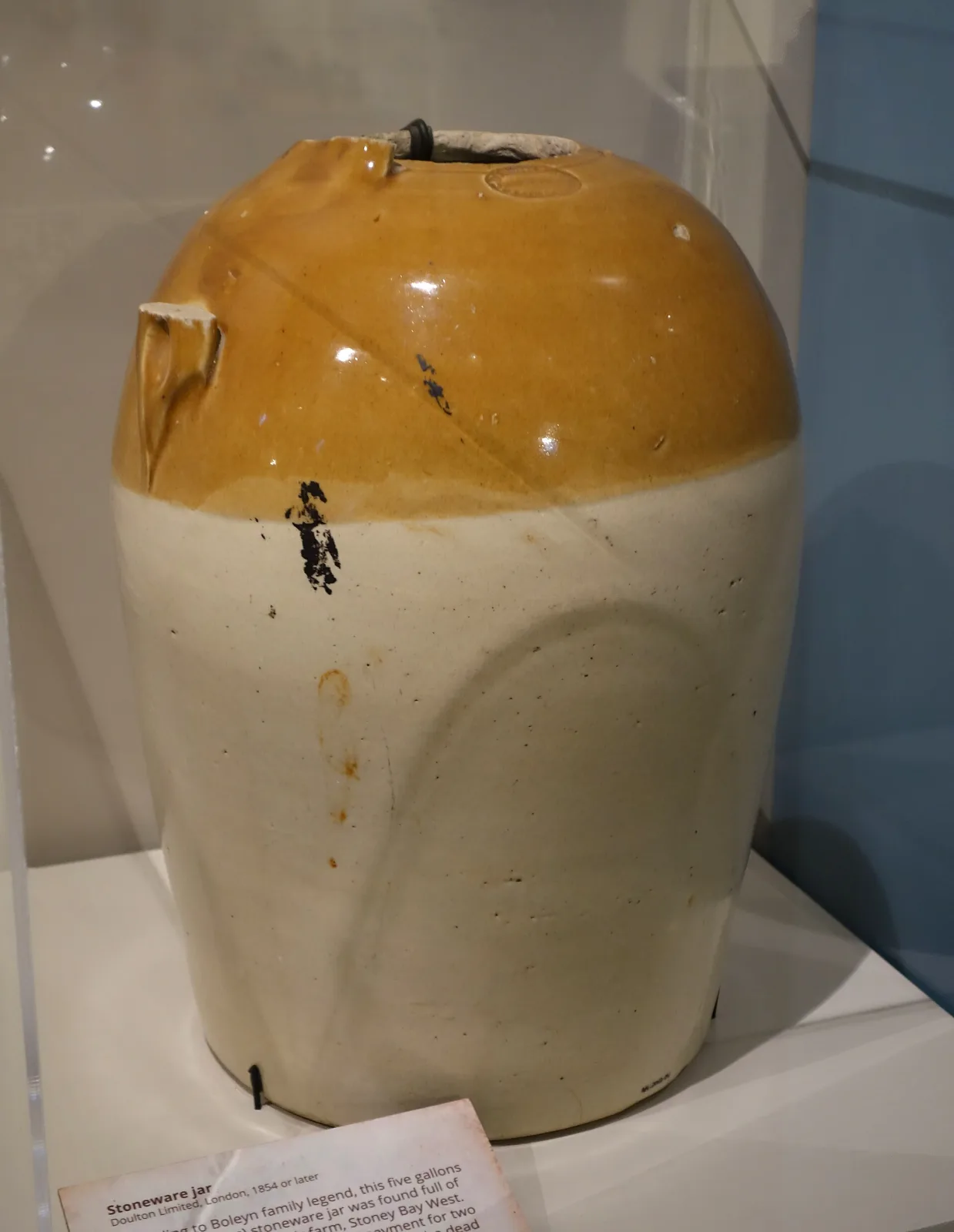
John Doulton, a journeyman potter, joined Martha Jones and John Watts in 1815 to take over a small Lambeth pottery on the south bank of the Thames. The firm — first Jones, Watts & Doulton, then Doulton & Watts after 1820 — produced salt-glazed stoneware bottles, jars, drainpipes, and industrial wares. None of this output was art pottery; the value to early collectors lies in the bottles, demijohns, and architectural terracotta.
Henry Doulton and the Art Pottery Studio (1860s–1870s)
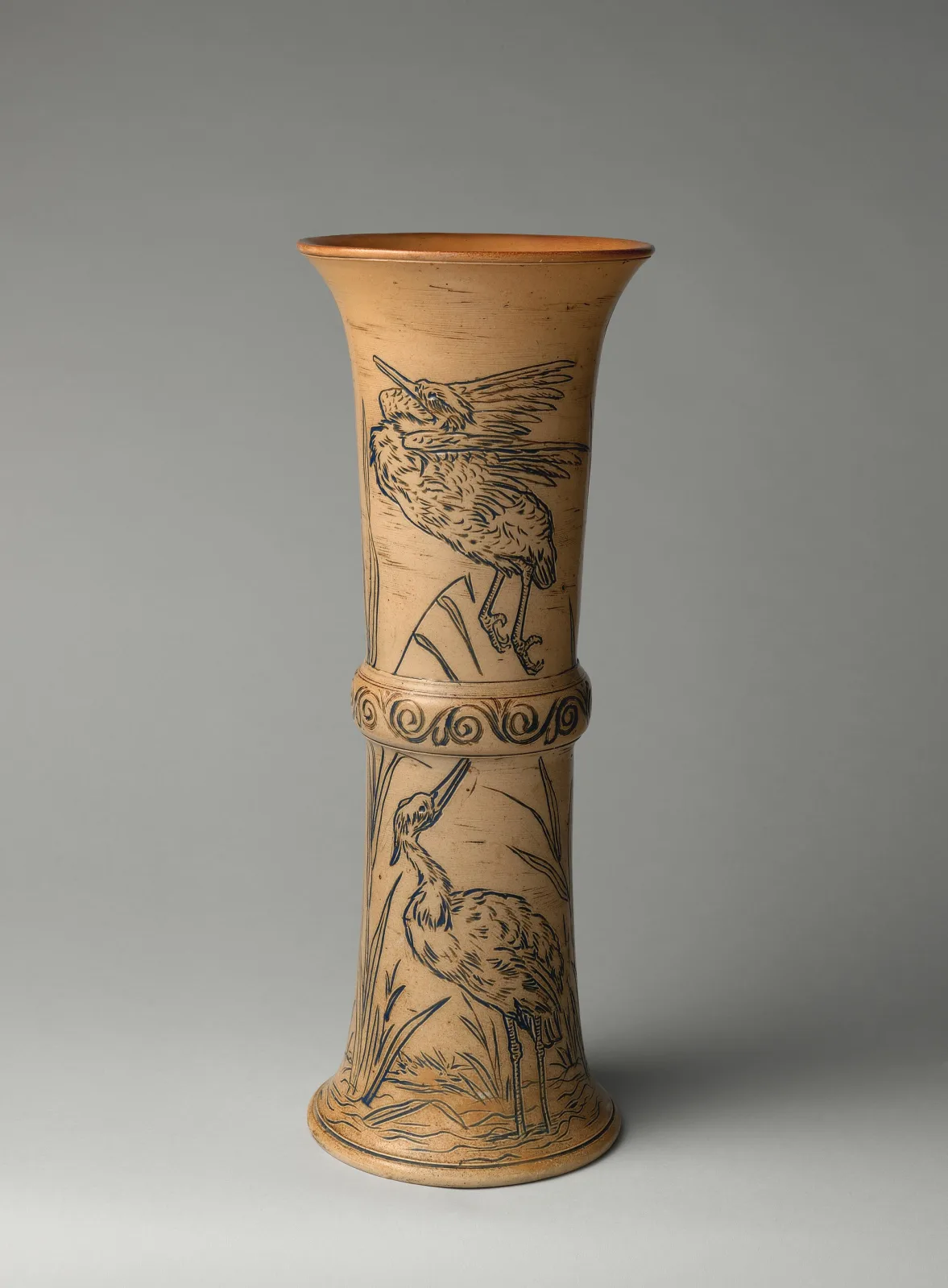
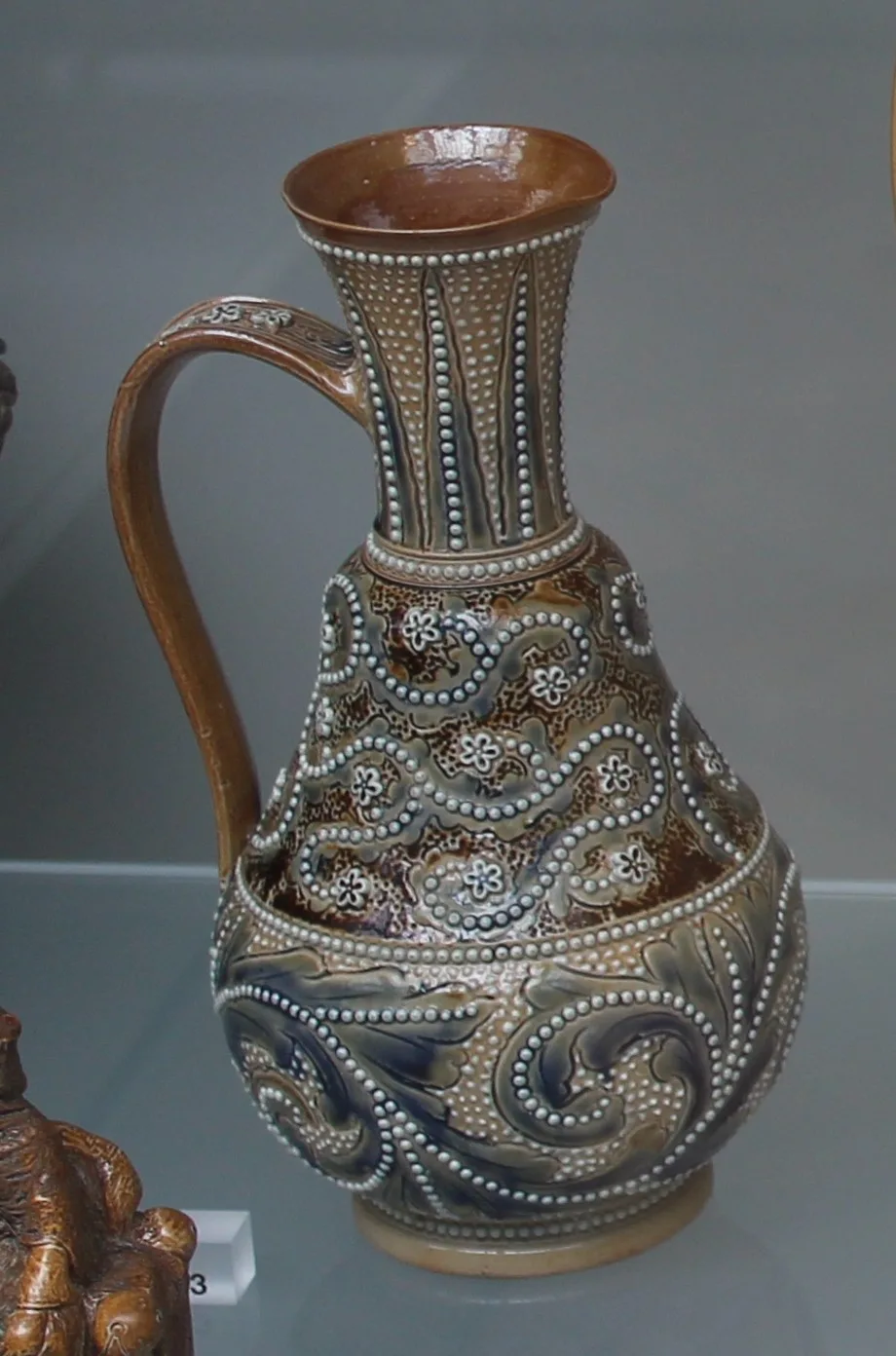
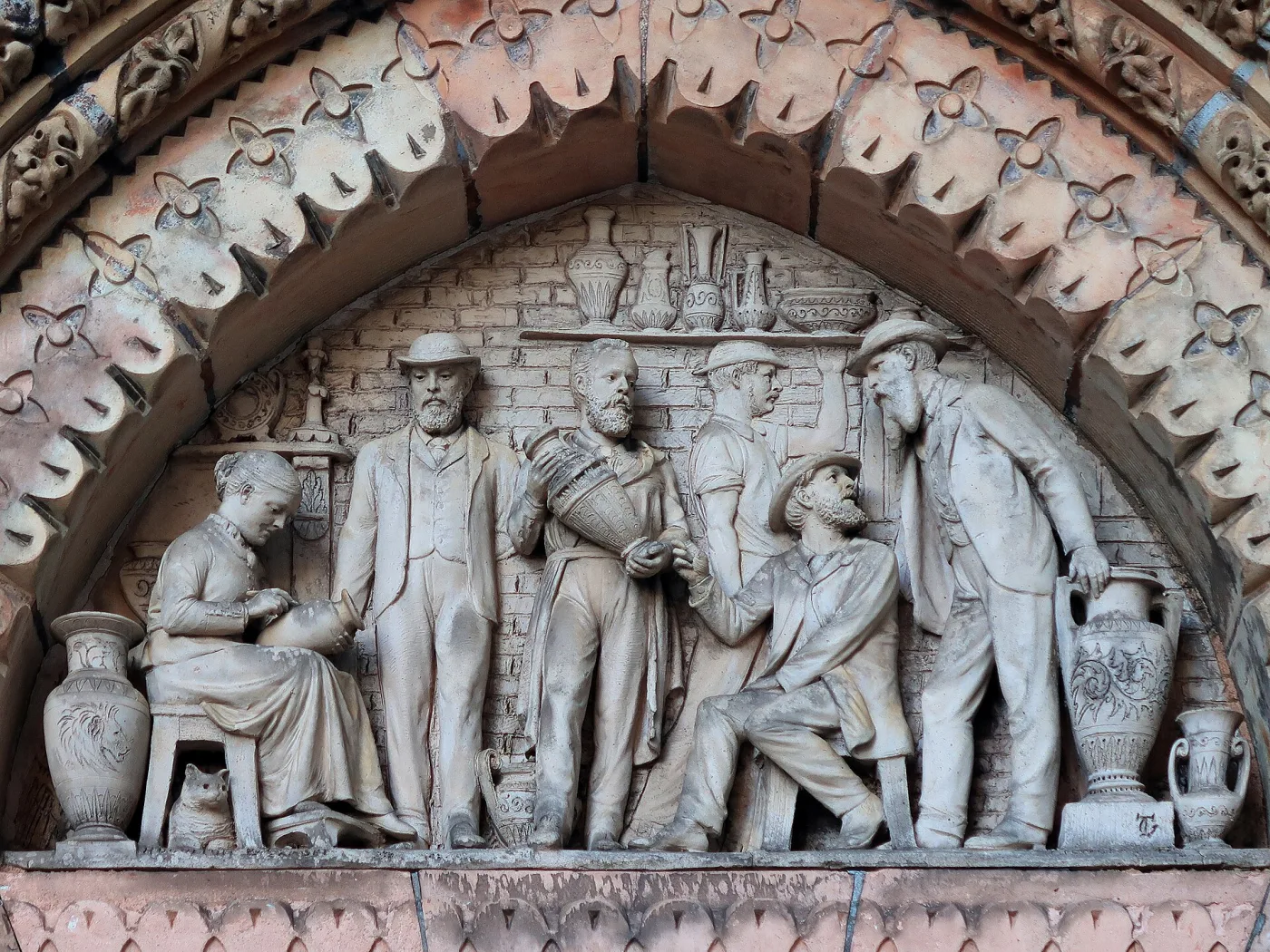
Henry Doulton — John's son — took control in the 1850s and steered the firm towards sanitary ware production that made its commercial fortune. From the late 1860s, working with the nearby Lambeth School of Art, he established an art studio inside the works that allowed female artists (a radical step at the time) to produce hand-decorated salt-glazed stoneware vases, jugs, and plaques. Hannah Barlow, Florence Barlow, Frank Butler, George Tinworth, Mark Marshall, and Eliza Simmance became names in their own right. This is the period that produced the most artistically ambitious Doulton work and the highest prices in today's market.
Acquisition of Pinder, Bourne & Co., Burslem (1877)
In 1877 Doulton bought Pinder, Bourne & Co. in Burslem, Staffordshire, gaining access to bone china and earthenware production. The Burslem factory became the centre of Doulton's tableware, figurine, and Series Ware output. From this point forward, Lambeth and Burslem operated as distinct production centres with overlapping but distinguishable mark systems.
Royal Warrant (1901)
In 1901, Edward VII granted Doulton the Royal Warrant, allowing it to use the "Royal" prefix and incorporate a crown into the backstamp. The new lion-and-crown mark, designed by Charles Noke, was introduced in 1902 and remains the foundation of all subsequent Doulton marks.
The Charles Noke Era (1902–1941)
Charles Noke, Art Director from 1914 (and a senior designer from 1889), revolutionised Burslem output. He launched the HN figurine series in 1913, developed the Sung and Flambé glaze experiments, oversaw the Series Ware programme, and recruited Leslie Harradine, Phoebe Stabler, and other designers whose work defined the inter-war Doulton aesthetic. Most of the figurines now collected as classic Royal Doulton come from the Noke years.
Lambeth Closure (1956)
The Lambeth studio was closed in 1956 as art stoneware demand declined and London property values made the site untenable. All Doulton production after 1956 came from Burslem and from acquired factories. Lambeth output therefore has a hard cut-off date that helps with provenance.
Group Acquisitions and Modern Era (1960s–Present)
From the 1960s onwards, Royal Doulton absorbed Minton, Royal Albert, Royal Crown Derby (later divested), Beswick, Paragon, and other British ceramic brands. After successive ownership changes the brand became part of the WWRD group in 2009 and then the Fiskars group. Modern Royal Doulton output continues but production has moved largely to Indonesia and other Asian facilities since 2005.
Early Doulton & Watts and Lambeth Marks (1815–1901)
Pre-1901 Doulton — everything before the Royal Warrant — carries a different family of marks that the lion-and-crown stamp later replaced. Reading them correctly is essential when dating Lambeth stoneware.
Doulton & Watts Marks (1820–1853)
Earliest output carries impressed "DOULTON & WATTS / LAMBETH POTTERY / LONDON" marks on bottles, jars, and other utility wares. These are nineteenth-century industrial stoneware and rarely encountered outside specialised antique bottle collecting circles.
Doulton Lambeth (1853–1882)
After Watts retired in 1853, the firm became "Doulton & Co." Marks impressed "DOULTON LAMBETH" with the date impressed alongside (often a four-digit year) appear from the late 1860s on art studio pieces. Look for the year directly impressed into the base of stoneware vases and jugs.
Doulton Lambeth Oval Mark (1872–1891)
The classic art-studio Lambeth mark is an oval beaded device reading "DOULTON LAMBETH" around the border with "ENGLAND" added after 1891 (in response to the US McKinley Tariff Act). An impressed four-digit year usually appears beside or beneath the oval, dating the piece to the exact year of production.
Artist Monograms and Initials
Lambeth studio pieces typically carry an artist monogram incised by the decorator herself. Major monograms to learn: HBB (Hannah Bolton Barlow), FEB (Florence Elizabeth Barlow), GT (George Tinworth), FAB (Frank Butler), MVM (Mark V. Marshall), ES (Eliza Simmance), AR (Arthur Beere), HS (Harry Simeon for early work). The presence of a known monogram dramatically increases value — a Hannah Barlow vase with sgraffito animals sells for many times the price of an unsigned piece of similar form.
Assistant Monograms
Many pieces also carry small assistant monograms applied by junior decorators who finished borders, banding, or background work. These supplementary marks date a piece to within the years that decorator worked at Lambeth and confirm factory production.
Faience and Impasto Marks
Lambeth Faience (painted earthenware) and Impasto wares (heavy slip painting on stoneware) carry their own descriptive marks alongside the oval. "DOULTON FAIENCE" or "DOULTON IMPASTO" with artist monogram identifies these distinct production lines.
The Royal Warrant and Lion-and-Crown Mark (1901–Present)
The lion-and-crown backstamp is the single most recognisable Royal Doulton identifier and the starting point of every modern Doulton dating analysis.
Mark Structure
The standard mark consists of a lion (couchant) atop a crown, with "ROYAL DOULTON" curving above and "ENGLAND" below (or "MADE IN ENGLAND" from 1932 onward). Many variants add line names ("FLAMBÉ," "SUNG," "BURSLEM," "KINGSWARE") or pattern names beneath the central device. The mark is usually printed in green, black, or brown, with red and gold variants on premium lines.
1902–1922: Lion with Crown
Initial form, used at Burslem from 1902. "ENGLAND" appears below in capital letters. The lion is more naturalistic than in later marks.
1922–1927: Smaller Mark Variant
A simplified mark with reduced crown detail appears from 1922. The change is subtle but identifiable in side-by-side comparison.
1927 Onwards: "Made in England"
From 1927 the country-of-origin marking changed from "ENGLAND" to "MADE IN ENGLAND" in response to American customs requirements. The transition gives a useful pre/post-1927 anchor.
1932 Onwards: Royal Doulton Bone China
Bone china pieces from 1932 add "BONE CHINA" beneath the mark, distinguishing them from earthenware production using the same lion-and-crown device.
Post-1956: Lambeth Phase-Out
From 1956 onward, all production is Burslem-based. The mark may include "FINE BONE CHINA" or "ENGLISH FINE BONE CHINA" on premium tableware lines.
Modern Marks (1990s–Present)
Late twentieth-century and modern Royal Doulton uses simplified versions of the lion-and-crown along with barcodes, copyright notices, and pattern names. Country marks include "Made in Indonesia," "Made in Thailand," and other Asian production sites from approximately 2005 onwards.
Burslem Date Cyphers and Numerical Codes
Beyond the backstamp itself, Doulton applied several numerical and symbolic codes that refine dating to within a year.
Impressed Date Codes
Many early Burslem pieces carry an impressed numerical code in the form "2/27" or "5-32" indicating month and year of production (February 1927; May 1932). These impressed marks appear beside or beneath the printed backstamp and are easy to overlook.
Painted Date Letters and Numbers
Some Burslem decoration carries a small painted number indicating the year. A simple "32" or "47" near the mark identifies the year directly. These are easily confused with pattern numbers; context (mark style, glaze character) confirms which is which.
The "England/Made in England" Anchor
As noted, the 1927 transition from "ENGLAND" to "MADE IN ENGLAND" provides the most reliable single dating anchor for inter-war Doulton. A piece with the older form predates 1927; the newer form is 1927 or later.
Trademark Symbols
The registered trademark symbol (®) became standard on Doulton marks from approximately the 1960s. Its absence indicates an older piece; its presence indicates 1960 or later.
Copyright Date Lines
Late twentieth-century marks include copyright notices like "© Royal Doulton 1987." These give the design copyright year, not necessarily the production date of the specific piece — a 1987 copyrighted design may have been produced for many years afterwards.
The HN Figurine Numbering System (1913–Present)
The HN number is the single most important identifier for Royal Doulton figurines. Every figurine produced since 1913 has been assigned a sequential HN number, allowing precise identification across more than 5,000 designs.
The "HN" Initials
"HN" stands for Harry Nixon, the colourist who headed the Doulton figurine painting studio when the numbering system was introduced. The initials have nothing to do with the figurine itself — they are simply the catalogue prefix.
HN 1: "Darling" (1913)
The first figurine numbered in the system, "Darling" — modelled by Charles Vyse — was reputedly chosen by Queen Mary on a 1913 royal visit. HN 1 remained in production with various colourways for decades and remains widely available today.
Numbering Sequence
HN numbers run sequentially in approximate order of introduction. HN 1–999 cover roughly 1913 to the mid-1940s; HN 1000–1999 cover the 1940s through 1960s; HN 2000–2999 cover the 1960s through 1980s; HN 3000–4000+ cover the 1980s through 2000s; HN 5000+ are very recent. The number alone gives an approximate decade.
Standard Books and Databases
The Charlton Standard Catalogue of Royal Doulton Figurines is the comprehensive reference for HN-numbered figurines, with photographs, dates, designer credits, and current values. Doulton collectors clubs maintain online databases that supplement the printed catalogues with auction results.
Colourway Variations
Many popular figurines were produced in multiple colourways, each assigned its own HN number. "Top o' the Hill" was issued as HN 1833 (the classic green-skirted version), HN 1834, HN 1849, and others — each a different colour scheme of the same sculpted figure. Collectors of specific figurines often pursue all known HN colourways.
Discontinued Stamps
Figurines withdrawn from production sometimes carry a small "DISCONTINUED" notation or have the HN number underlined. These notations identify the final production of a discontinued line and are worth noting for completeness.
D-Prefix Design Numbers for Tableware
Alongside HN figurine numbers, Doulton tableware patterns carry "D" prefix numbers — D 5000, D 6000, D 7000, and so on — identifying the pattern design. These numbers operate independently from HN numbers and are used on plates, cups, and other Series Ware and pattern lines.
D Numbers vs. Series Numbers
D numbers identify specific patterns or decoration designs. They do not date a piece directly but cross-reference to pattern catalogues that document introduction dates and production runs. The Charlton Standard Catalogue of Royal Doulton Series Ware lists thousands of D-numbered patterns.
Pattern Names
Most named patterns ("Old English Coaching Scenes," "Babes in Woods," "Country Castles") appear on the base alongside the D number. The combination of pattern name and D number unambiguously identifies the design.
Pattern Number vs. Decoration Code
Some Doulton tableware also carries a smaller decoration code — a colour or border variation identifier. These additional numbers refine identification within a pattern family.
Royal Doulton Figurines and Designers
The HN figurine series is the largest and most varied figurine programme in English ceramic history. Learning the major designers and their characteristic work is essential to collecting in this area.
Charles Vyse (early HN series)
Vyse modelled "Darling" and several of the earliest HN figurines before leaving Doulton to establish his own pottery in Chelsea. His independent Vyse figurines are also collectible but use different mark systems.
Leslie Harradine (1920s–1950s)
Harradine was the most prolific Doulton figurine designer, producing hundreds of HN figurines including many of the most popular "lady" figures with elaborately painted period dresses. His name is among the most familiar in twentieth-century English ceramics.
Phoebe Stabler
Stabler modelled influential early HN pieces including "The Crinoline" and "Lady of the Snows." Her Arts-and-Crafts-influenced work bridges late Victorian and early Art Deco aesthetics.
Margaret "Peggy" Davies
Davies was the principal post-war Doulton modeller, producing iconic mid-century figurines including the "Pretty Ladies" series. Her work defines 1950s and 1960s Doulton output.
Mary Nicoll
Nicoll specialised in character figures — fishermen, gardeners, gamekeepers — that complement the more formal lady figurines. Her work has a loyal collector following.
Eric Griffiths and Modern Designers
From the 1970s onward, Eric Griffiths, Nada Pedley, and others continued the figurine tradition. Modern figurines including limited editions and commemorative pieces follow the same HN numbering convention as their inter-war predecessors.
Identifying Original vs. Reissue
Many classic figurines were reissued decades after their original introduction. Mark style, base finish, and small details of painting separate original from reissue. The Charlton catalogue notes known reissue periods for major figurines.

Character Jugs and Toby Jugs
Royal Doulton character jugs are among the most widely collected Doulton products, with a numbering and mark system parallel to but distinct from the HN figurines. Familiarity with these jugs builds on the basics covered in our guide to antique Toby and character jugs.
Character Jug Origins
Charles Noke launched the modern character jug range in 1934 with "John Barleycorn," capitalising on the long English tradition of figural Toby and character pottery. Over the next sixty years Doulton produced hundreds of designs depicting historical, literary, and folk characters.
Jug Sizes
Character jugs were produced in four standard sizes: Large (about 7"), Small (about 4"), Miniature (about 2.5"), and Tiny (about 1.5"). Each size of the same character has its own model number and varies substantially in value — large versions generally bring the highest prices, tinies less.
D Numbers for Jugs
Character jugs carry "D" model numbers — D 5327, D 6234, etc. — that identify the design. These are catalogued in the Charlton Standard Catalogue of Royal Doulton Character & Toby Jugs.
Doulton Toby Jugs
Traditional Toby jugs — full-figure seated drinkers — were produced alongside the head-only character jugs. Doulton Tobies use a separate numbering system and tend to bring different price patterns from character jugs.
Designers
Major character jug modellers include Charles Noke himself, Harry Fenton, Max Henk, David Biggs, and Stanley Taylor. Designer attribution is documented in the Charlton catalogue and on the jug base in some cases.
Limited Editions and Rare Variants
Royal Doulton has issued numerous limited-edition character jugs marked with edition numbers and certificates. Pre-production prototypes and colourway trials occasionally surface and command premium prices when authenticated.
Lambeth Salt-Glazed Stoneware
The Lambeth studio output is artistically and commercially distinct from the Burslem figurine and tableware production. It represents the firm's most ambitious art ware and remains the foundation of the Doulton brand's serious collecting market.
Salt-Glazed Bodies
Lambeth stoneware was fired with salt thrown into the kiln at peak temperature, producing the characteristic mottled "orange peel" texture on the surface. The body is dense, grey-buff coloured underneath the slip decoration, and structurally extremely durable. Stoneware production techniques are covered more broadly in our stoneware crocks identification guide.
Sgraffito Decoration
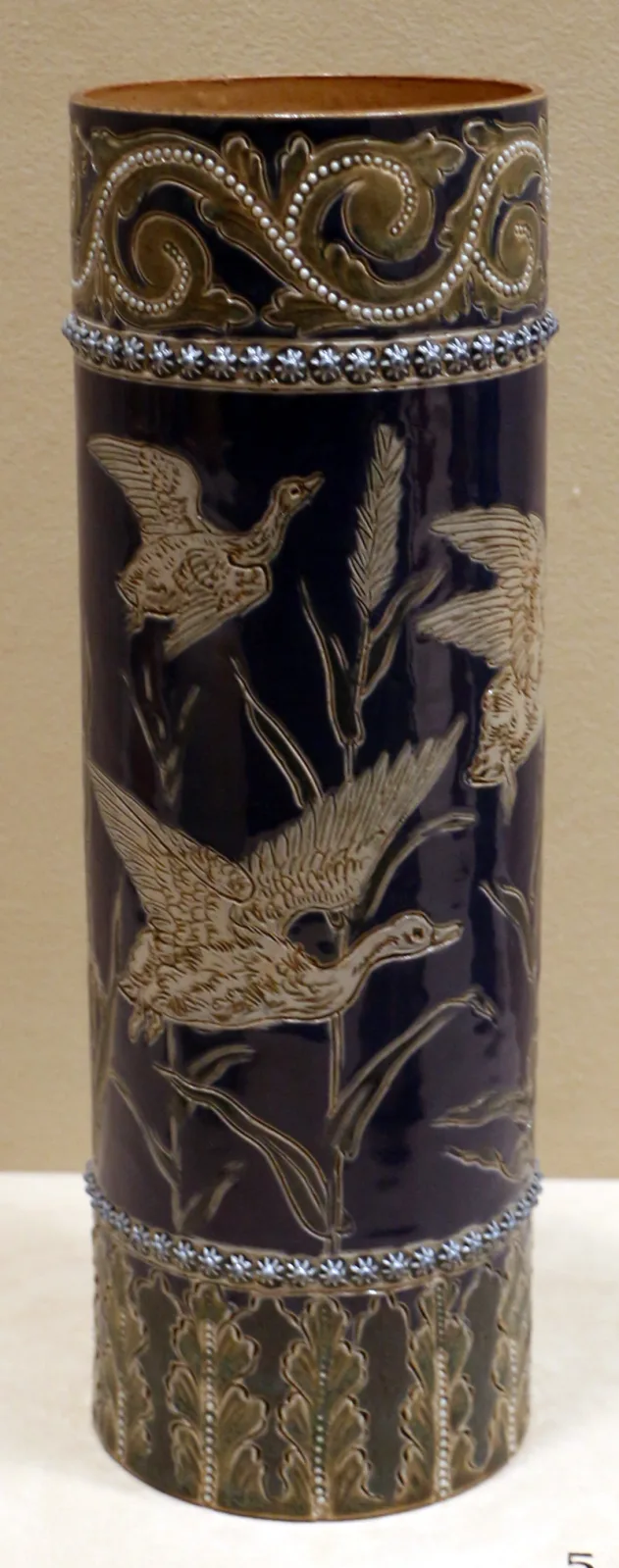
Hannah Barlow and her sister Florence are particularly known for sgraffito animal scenes — horses, sheep, cattle, deer — incised through coloured slip to reveal the lighter body beneath. The technique requires complete confidence with the line as no correction is possible after incising.
Pâte-sur-Pâte and Applied Decoration
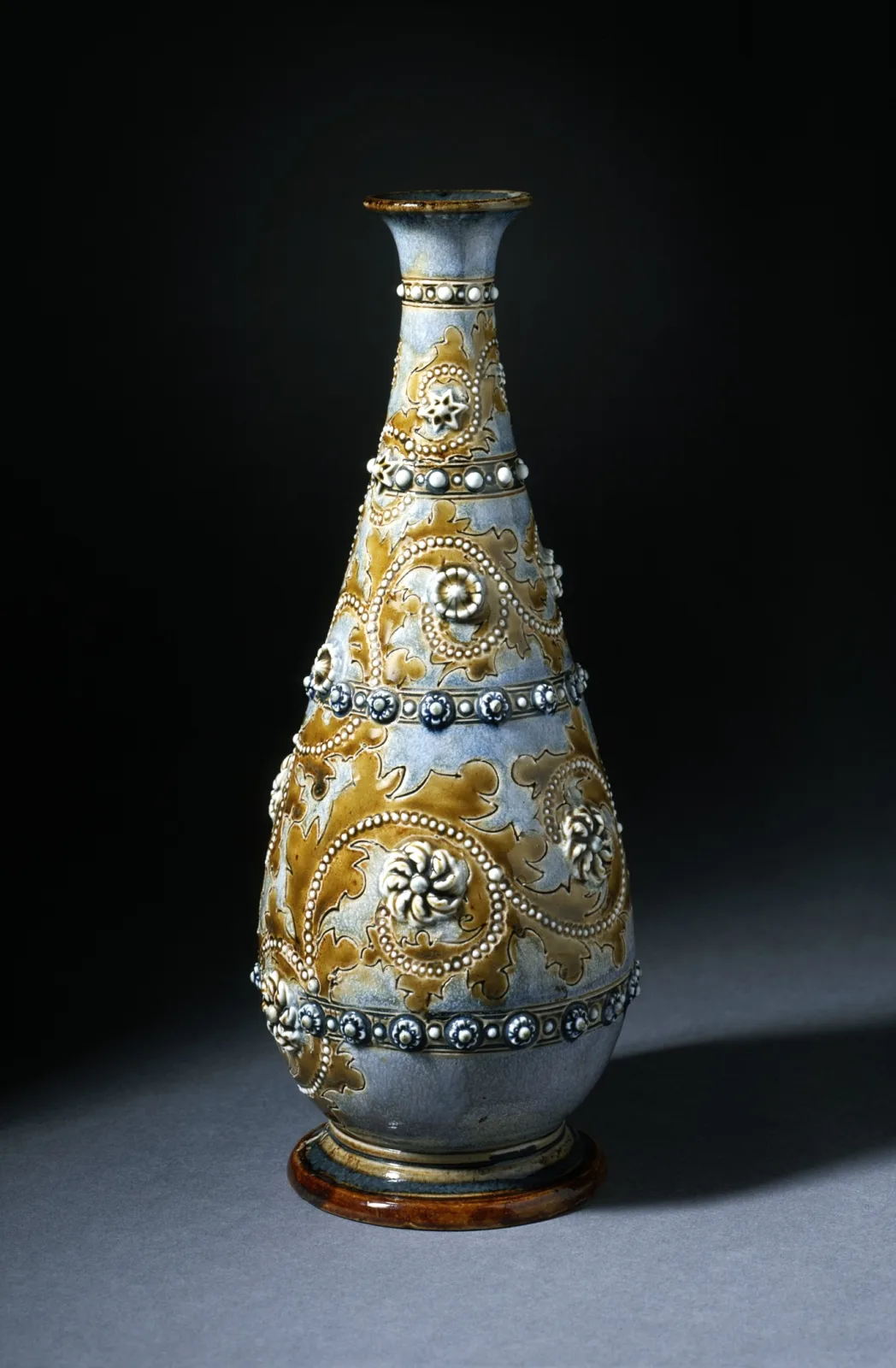
George Tinworth, Frank Butler, and Mark V. Marshall produced relief-modelled and applied decoration including grotesque masks, religious scenes, and Arts-and-Crafts floral compositions. Tinworth's religious plaques are particularly collected.
Doulton Faience
The Lambeth Faience line was painted earthenware (not stoneware) with elaborate floral and figural decoration on cream grounds. It carries a separate "DOULTON FAIENCE" mark and uses brushed enamel decoration rather than incised stoneware techniques.
Architectural Terracotta
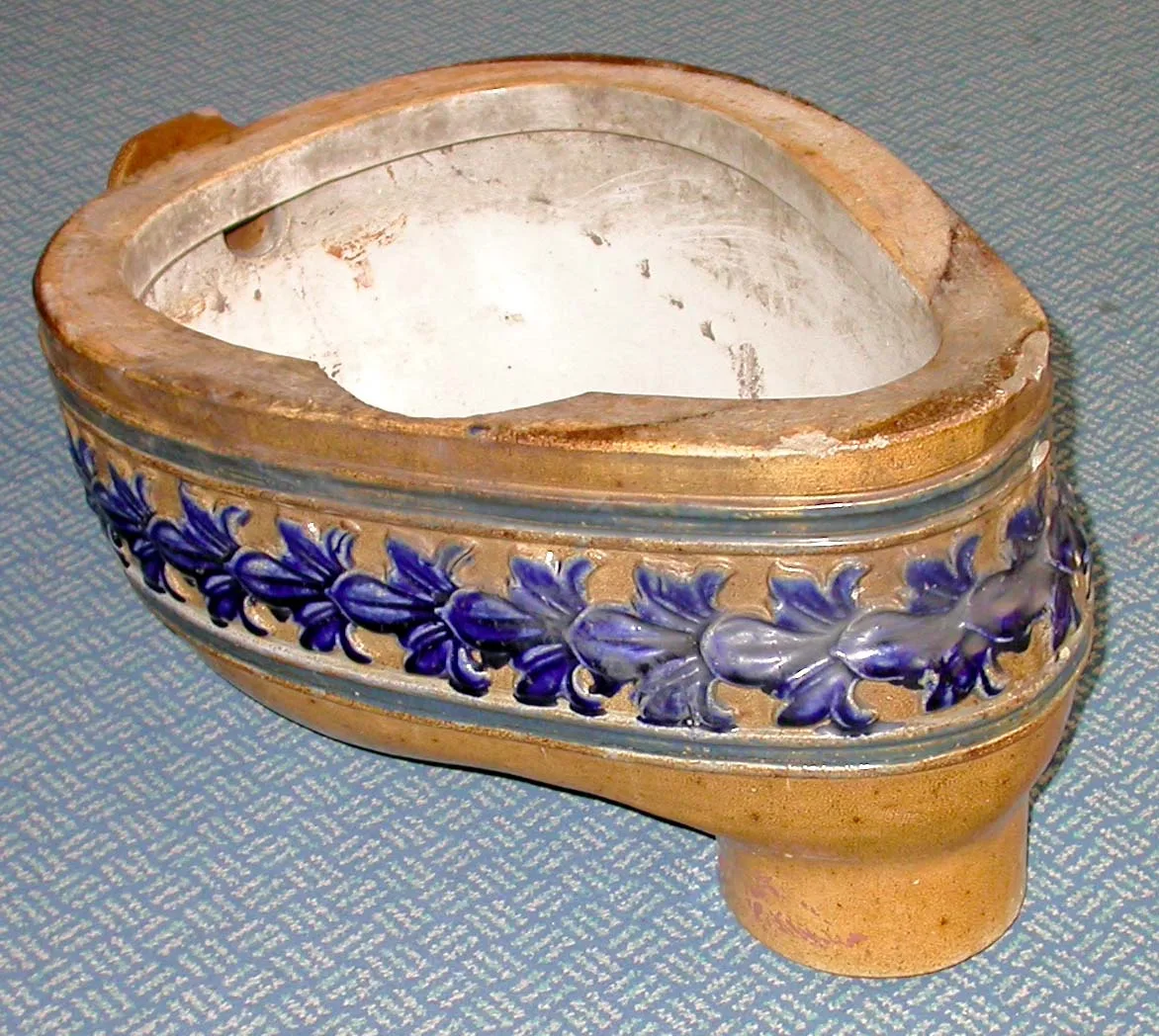
Lambeth produced architectural terracotta and faience for major Victorian buildings throughout England — fireplaces, fountains, doorways, and decorative panels. These pieces are rarely collected loose but represent an important segment of Doulton's nineteenth-century output. Architectural fragments overlap with our architectural salvage identification coverage.
Series Ware and Decorative Plates
Series Ware was Doulton's transfer-decorated tableware line, produced in named series from the 1900s through the 1950s. The line includes some of the most affordable collectible Doulton.
Series Ware Origins
Charles Noke launched Series Ware around 1900 as a means to produce decorative tableware with elaborate scenes via transfer printing supplemented by hand colouring. The line covered hundreds of named themes spanning historical, literary, sporting, and topographical subjects.
Famous Series Themes
Major Series Ware themes include "Old English Coaching Scenes," "Dickens Ware," "Shakespeare Characters," "Babes in Woods," "Country Castles," "Old English Inns," "Gibson Girls," "Robin Hood," "The Hunting Series," and many more. Each series has dedicated collector followings.
Forms and Identification
Series Ware was produced as plates, pin trays, vases, jugs, tobacco jars, candleholders, and a wide range of decorative forms. The series name typically appears on the base alongside the D number and the lion-and-crown mark.
Pricing
Series Ware remains broadly affordable. Common plate forms in average condition trade for modest sums; scarce shapes, full-colour exemplars, and pristine condition examples bring significant premiums. The most ambitious Series Ware vases and large jugs reach hundreds or low thousands of pounds.
Kingsware and Dewar's Whisky Flasks
Kingsware is a distinctive Doulton line of brown-glazed earthenware produced primarily for the Dewar's whisky firm as decanters and flasks bearing figural relief decoration.
The Dewar's Commission
Charles Noke developed Kingsware specifically to fulfil a commission from Dewar's, the Perth-based whisky distiller. From 1905 through the 1930s Doulton produced hundreds of Kingsware flask designs for the firm, distributed as promotional and presentation items.
Kingsware Body and Glaze
Kingsware is buff-bodied earthenware covered in a dark treacle-brown lustre glaze with figural relief decoration coloured in bright enamels (red, yellow, green). The combination of deep brown background and brightly painted relief figures is distinctive and immediately recognisable.
Form Range
Kingsware items include whisky flasks (the most common form), full decanters, jugs, mugs, plaques, and a wide range of decorative objects. Some pieces carry full Doulton lion-and-crown marks; others have only impressed "ROYAL DOULTON" text or simple capacity markings.
Dewar's Promotional Pieces
Kingsware flasks were filled with Dewar's whisky and distributed as promotional gifts; original contents are extremely rare. Most surviving examples are empty but retain their original cork or screw closures.
Collecting Kingsware
Kingsware has a focused collector base. Pieces range from modest prices for common flask forms to four-figure prices for scarce figural subjects, large decanters, and exceptional condition examples. Similar techniques and collecting principles apply across other figural decanters and decorative bottles.
Flambé and Sung Ware
Flambé and Sung wares are Doulton's most artistically prestigious twentieth-century output — high-fired art glazes inspired by Chinese ceramics and developed by Bernard Moore, Charles Noke, and Cuthbert Bailey from the 1900s.
Flambé Glaze Technique
Flambé glazes derive their dramatic red, blue, and purple flashes from copper and iron oxides fired in a reducing atmosphere. The process is notoriously unpredictable — small variations in atmosphere produce dramatically different effects, and a high proportion of pieces were lost in kiln failures. Successful Flambé pieces are individual artworks rather than reproducible patterns.
Sung Ware
Sung ware (named after the Chinese Song dynasty) combines Flambé techniques with additional decorative effects — applied figural decoration, gold leaf, additional underglaze colours. Sung is generally more elaborate and more valuable than plain Flambé.
Mark Identification
Flambé and Sung pieces carry the standard lion-and-crown backstamp with "FLAMBÉ" or "SUNG" added in the mark. Many also carry the signature or initials of the senior artist responsible — Charles Noke himself, Harry Nixon, Fred Moore, or others.
Animal Models
Doulton produced a range of Flambé-glazed animal models — elephants, foxes, panthers, monkeys, and the famous "Penguin" — that remain among the most popular collectible Flambé items today.
Pricing Tier
Flambé and Sung are firmly in the upper Doulton price tier. Even small Flambé animals routinely sell in the hundreds; large vases, Sung pieces, and signed exhibition pieces by Charles Noke reach four and five figures.
Bunnykins and Nursery Wares
Bunnykins is one of Doulton's most commercially successful product lines — a nursery ware series featuring anthropomorphic rabbits in human costume engaged in everyday activities.
Origins and Designer
Bunnykins was designed in the 1930s by Barbara Vernon, daughter of the Doulton works manager Cuthbert Bailey. Her watercolour rabbit scenes were adapted to tableware decoration by the Doulton design studio and launched commercially in 1934.
Tableware Bunnykins
Most Bunnykins production has been transfer-decorated children's tableware — plates, bowls, mugs, eggcups, and cereal sets. These remain widely produced today and trade modestly in the secondary market.
DB Figurine Series
From 1972 Doulton launched a separate line of three-dimensional Bunnykins figurines using a "DB" numbering system (DB 1, DB 2, etc.) running in parallel to the HN figurine series. DB figurines have become a substantial collecting category in their own right with hundreds of designs catalogued.
Limited Editions and Special Editions
Many DB figurines were issued as limited editions or members-only specials through the Royal Doulton International Collectors Club. Edition size, certificate inclusion, and box condition substantially affect value.
Identifying Early vs. Late Bunnykins
Pre-1956 Bunnykins (the "early years" before the Lambeth closure) carries earlier mark styles and is generally more valued than later production. Modern Bunnykins production continues primarily from Asian facilities.
Bone China Tableware and Patterns
Bone china tableware is the largest single category of Doulton production by volume. Pattern variety, mark complexity, and replacement-china availability all shape collecting and resale in this segment.
Body Identification
Royal Doulton bone china is dense, translucent, with a slightly creamy tone characteristic of high-bone-content (typically 50%) bodies. Held to bright light it shows warm translucency with no opacity. The ring test produces a clear bell-like tone distinct from earthenware's duller response.
Pre-War Tableware
Pre-1939 Doulton tableware patterns are catalogued by D number and pattern name. Major patterns include "Old Leeds Sprays," "Brambly Hedge" (introduced later), "Sherborne," and dozens of named ranges. The Charlton Standard Catalogue of Royal Doulton Tableware is the working reference.
Post-War Tableware
Post-war patterns proliferated alongside the bone china boom. Common patterns include "Larchmont," "Rondelay," "Romance Collection" patterns, "Carlyle," "Carnation," and hundreds more. Replacement-china services such as Replacements Ltd. maintain searchable databases.
Service Completeness
As with other major tableware brands, complete services bring premiums over the sum of individual pieces. Scarce serving items — coffee pots, gravy boats with attached stands, covered tureens, candleholders — disproportionately drive set values.
Modern Tableware
Modern Royal Doulton tableware combines traditional patterns with contemporary designs. Production has moved primarily to Asian facilities since 2005, and country-of-origin marks identify the production site.
Royal Albert and the Doulton Group
Royal Albert became part of the Doulton group in 1972, and since then much "Royal Albert" production has shared facilities with Royal Doulton. Understanding the relationship clarifies what is sometimes confused as Doulton.
Royal Albert Identification
Royal Albert carries its own distinctive backstamp — typically a crown over "Royal Albert" with pattern name and "Bone China" beneath. The mark predates the Doulton acquisition and continued largely unchanged through the group years.
"Old Country Roses"
"Old Country Roses" — designed in 1962 by Harold Holdcroft — is the most commercially successful bone china pattern in history, with more than 150 million pieces produced. Despite the volume, the pattern remains a recognised collectible with active replacement-china markets.
Other Group Brands
The Doulton group also incorporated Minton, Royal Crown Derby (later divested), Beswick, Paragon, and other British ceramic brands. Each retained its own mark identity but production overlapped from the 1970s onward. Beswick animal models in particular are often catalogued alongside Royal Doulton in collector references.
WWRD and Fiskars Eras
From 2009, Royal Doulton became part of the WWRD group (also incorporating Wedgwood and Waterford) and then the Fiskars group from 2015. Group ownership has not changed mark identity meaningfully but production geography has shifted further toward Asian facilities.
Reproductions, Seconds & Outright Fakes
Doulton's commercial success has produced reproductions, fantasy pieces, and outright fakes — particularly in the figurine and character jug categories where high values justify the effort.
Factory Seconds
Pieces with minor manufacturing flaws were sold as factory seconds at reduced prices and marked accordingly — typically with a scratch through the lion-and-crown mark or an additional "SECONDS" notation. Seconds are genuine Doulton but worth less than first-quality pieces. Many were sold via factory outlets and remain plentiful in the secondary market.
Pirate Reproductions
Asian factories have produced unauthorised copies of popular Doulton figurines and character jugs. These typically have inkjet-printed backstamps that sit on top of the glaze rather than fired in, lack the characteristic Doulton modelling crispness, and use inferior paste bodies. Examination under magnification reveals printed-dot patterns in fake backstamps.
Repaired and Restored Figurines
Damaged figurines are sometimes professionally restored to appear undamaged. UV-light examination reveals modern adhesives and repainted areas through fluorescence. Repaired pieces are not fakes but should be sold disclosed and at reduced prices. Apply the same authentication framework discussed in our antique authentication and provenance research guide.
Misattributed Pieces
Some Doulton-like pieces by other manufacturers (Beswick, Coalport, Sylvac) are sometimes sold as Doulton. The lion-and-crown mark is the definitive test — absence of the mark or presence of a different manufacturer's mark identifies the piece correctly.
Fake HN Numbers
Outright fake HN-numbered figurines exist and target the most valuable rare numbers. Cross-reference any rare HN claim against published photographs in the Charlton catalogue — modelled detail, pose, base shape, and mark style all need to match the catalogue exemplar.
Condition, Restoration & Damage
Condition substantially affects Doulton values. A pristine figurine with original box can bring five times the price of a chipped or restored example of the same HN number.
Common Damage Sites
Figurine fingers, hat brims, and projecting drapery are vulnerable to chipping. Character jug handles and headpieces are common damage sites. Lambeth vase rims and applied decoration suffer chipping. Run a fingernail around all projecting elements to detect repairs and adhesions.
Hairline Cracks
Stoneware and earthenware hairlines may not be visually obvious but reveal themselves through the ring test — a dull thud rather than a clear ring indicates a hidden crack. Hairlines reduce display piece values by 50% or more.
Gilt Wear
Gilt rim wear on tableware is normal and expected with use. Original gilding cannot be perfectly restored; regilt pieces are detectable under magnification. Severe wear reduces display piece values; lesser wear on serving items is generally accepted.
UV Examination
Modern adhesives, fillers, and overpainted restoration all fluoresce under UV light. Pre-purchase examination of expensive figurines and Lambeth pieces with a UV torch is standard professional practice.
Box and Documentation
Modern Doulton figurines and limited editions often retain original boxes, certificates, and documentation. Their presence adds 15–30% to typical figurine values, more on limited editions where certificate matching matters.
Value Factors and Price Ranges
Doulton prices span four orders of magnitude. Reading a piece correctly requires understanding which factors drive its specific market value. The general framework laid out in our antique valuation and appraisal guide applies; the Doulton-specific factors are below.
Primary Value Drivers
HN number (rare numbers, withdrawn lines, scarce colourways), designer attribution (Charles Noke, Leslie Harradine, Hannah Barlow signed pieces), line (Flambé and Sung command premiums; common Series Ware does not), condition, completeness for tableware services, and original packaging for modern pieces all push prices upward.
Approximate Price Ranges
Modern Bunnykins tableware: £5–£30 per piece. Common HN figurines from current production: £40–£150. Discontinued HN figurines: £80–£500. Scarce HN figurines and limited editions: £200–£2,000. Character jugs (large): £80–£500. Rare character jugs and prototypes: £500–£3,000+. Common Series Ware plates: £20–£80. Series Ware vases and large jugs: £100–£800. Hannah Barlow signed Lambeth stoneware: £400–£5,000 depending on form. Major Tinworth plaques: £500–£3,000. Flambé animals: £150–£800. Sung exhibition pieces: £1,000–£10,000+. Kingsware Dewar's flasks: £80–£400 typical, scarce subjects much more.
Auction vs. Retail
Specialist Doulton auctions (Potteries Auctions, Bonhams) handle the upper market. General estate auctions often undervalue Lambeth stoneware because cataloguers lack the specialist knowledge to read artist monograms. Specialist dealers price at 1.5–3x recent auction comparables.
The HN Number Premium
Within figurines, rarity drives enormous price spreads. Common HN numbers from long-production lines sell for low double figures; the same modeller's work in a rare HN number can bring four-figure prices. The Charlton catalogue's rarity ratings are essential reading.
Building a Royal Doulton Collection
Doulton's enormous range rewards focused collecting. The same disciplined principles outlined in our collecting strategies guide apply, with Doulton-specific refinements below.
Specialise Early
The Doulton catalogue is too vast to collect comprehensively. Most serious collectors specialise: a single figurine designer's output, character jugs of a specific era, Lambeth stoneware by one artist, Kingsware flasks, Flambé animals, or a single bone china pattern. Specialisation builds the knowledge that lets you recognise undervalued pieces and avoid expensive mistakes.
Start with Modern Pieces
Post-1980 figurines and character jugs offer the best learning ground. Marks are clear, references are abundant, prices allow mistakes without catastrophic loss, and the HN number system teaches you to read marks systematically. Move to inter-war and earlier pieces as your eye develops.
Reference Libraries
The Charlton Standard Catalogues are the essential references: Royal Doulton Figurines, Royal Doulton Character & Toby Jugs, Royal Doulton Series Ware, Royal Doulton Bunnykins, Royal Doulton Tableware. Add Desmond Eyles's earlier works on Lambeth stoneware and the Royal Doulton International Collectors Club magazine archives for primary documentation.
Collectors Club
The Royal Doulton International Collectors Club (RDICC) historically provided members-only releases, a quarterly magazine, and identification advice. Past members' editions are particularly collectible due to limited distribution.
Provenance Documentation
Maintain detailed records of every purchase: photographs of marks, condition reports, prior auction listings, original boxes and certificates, and dealer invoices. Strong provenance dramatically increases resale value, particularly on limited editions and Lambeth pieces.
Insurance and Appraisal
Doulton collections above £5,000 in aggregate value deserve scheduled insurance and updated appraisals every five years. Specialist appraisers familiar with English ceramics produce more useful valuations than general antique appraisers.
Care, Display, and Preservation
Royal Doulton ceramics are durable but the painted decoration, gilding, and applied modelling reward careful handling. The general principles in our antique storage and preservation guide apply across the Doulton range.
Handling
Lift figurines by the body, never by projecting arms, hats, or accessories. Support character jugs by the base, never by the handle alone. Wear cotton or nitrile gloves for high-value pieces, particularly Lambeth stoneware where skin oils can mark the matte glaze.
Washing
Wash painted figurines and tableware by hand in lukewarm water with mild dish soap. Never use the dishwasher — modern dishwasher detergents will strip gilding and dull overglaze enamels within a few cycles. Dry thoroughly with a soft microfibre cloth before stacking.
Stacking and Storage
Place felt or paper discs between stacked plates to prevent rim wear. Never stack cups inside one another. Store figurines individually in original boxes when possible, otherwise wrap in acid-free tissue. Store away from temperature extremes and direct sunlight.
Display
Display in stable temperature (16–22°C / 60–72°F) and humidity (40–60%). Avoid direct sunlight, which can fade overglaze enamels and Series Ware transfers over decades. Secure tall vases and top-heavy figurines with museum wax or earthquake gel. Cabinet glass should be UV-filtering for important displays.
Transport
For shipping or moving, double-box with at least two inches of cushioning between boxes. Wrap projecting handles, arms, and finials individually before wrapping the main body. Mark cases clearly and never ship valuable Lambeth or limited-edition pieces without insurance and signature confirmation.