Antique Decanters & Carafes Identification Guide: Marks, Styles & Value
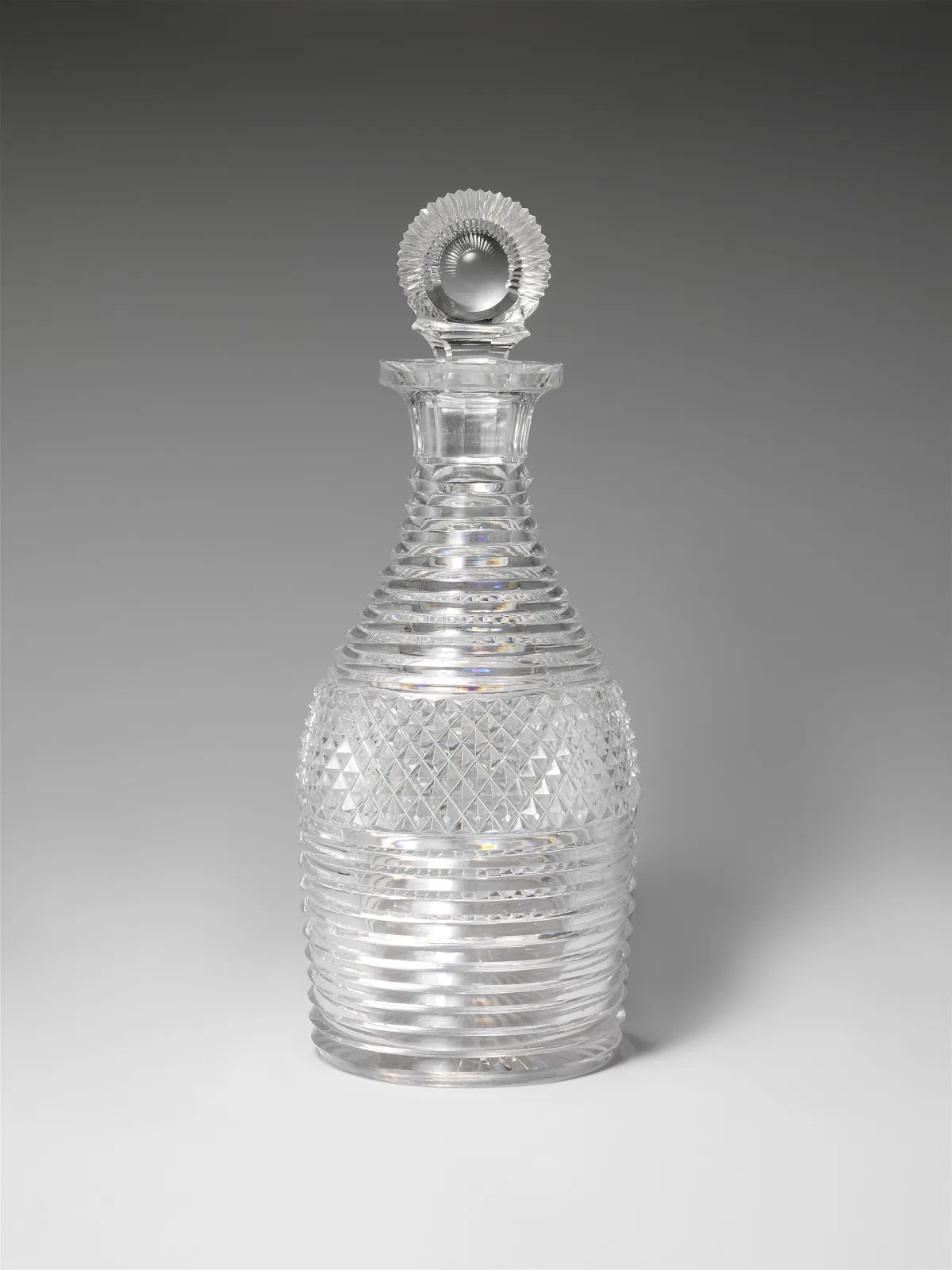
Antique decanters and carafes represent some of the finest achievements in decorative glassmaking, combining functional design with extraordinary craftsmanship. From the elegant simplicity of Georgian shaft-and-globe forms to the brilliant cut patterns of Victorian crystal, these vessels tell the story of centuries of social custom, artistic innovation, and technical mastery in glass production.
Whether you have inherited a family heirloom or discovered a promising piece at an estate sale, understanding how to identify and date antique decanters is essential for collectors. The interplay of form, cutting style, stopper design, and maker marks provides a wealth of clues that can reveal a decanter's origin, age, and value — sometimes turning an overlooked bottle into a prized collectible worth hundreds or even thousands of dollars.
This guide covers the major periods, styles, and manufacturers of antique decanters and carafes, along with practical techniques for authentication, condition assessment, and valuation. You will learn to distinguish genuine antiques from later reproductions, recognize the hallmarks of prestigious makers like Waterford, Baccarat, and Steuben, and understand the factors that drive market value in today's collecting landscape.
Table of Contents
- A Brief History of Decanters
- Types of Antique Decanters
- Identifying Decanters by Period
- Crystal vs. Glass: How to Tell the Difference
- Reading Cut Patterns and Decoration
- Stopper Identification and Matching
- Major Makers and Their Marks
- Pontil Marks and Base Examination
- Water Carafes and Claret Jugs
- Authentication Techniques
- Condition Assessment and Common Flaws
- Spotting Reproductions and Fakes
- Valuation Factors and Market Trends
- Care, Cleaning, and Display
- Collecting Tips for Beginners
A Brief History of Decanters
The practice of decanting wine dates back to ancient Rome, but the glass decanter as we know it emerged in the late seventeenth century when English glassmakers began producing vessels specifically designed for serving wine at the table. Before this, wine was typically served directly from the cask or from ceramic jugs.
The Rise of English Glass
George Ravenscroft's development of lead crystal glass in 1674 revolutionized decanter production. His formula, which added lead oxide to the glass mixture, produced a material that was heavier, more brilliant, and easier to cut and engrave than earlier soda-lime glass. This innovation made England the center of fine glassmaking for over a century and established the foundation for the decanter forms that collectors seek today.
From Utility to Art
Throughout the eighteenth century, decanters evolved from simple utilitarian vessels into elaborate works of decorative art. As antique glass production techniques advanced, glassmakers developed increasingly complex cutting patterns, colored overlays, and engraved designs. By the Regency period, a matched set of decanters had become an essential element of any fashionable dining room, reflecting the host's taste and social status.
The Golden Age
The period from roughly 1780 to 1830 is often considered the golden age of decanter production. During this era, glassmakers in England, Ireland, and continental Europe produced decanters of exceptional quality, featuring deep prismatic cutting, elegant proportions, and finely ground stoppers. The repeal of the Irish glass tax in 1780 also spurred a boom in Irish glassmaking, with factories in Waterford, Cork, Belfast, and Dublin producing some of the most sought-after decanters in collecting history.
Types of Antique Decanters
Antique decanters come in a remarkable variety of forms, each designed for a specific purpose and reflecting the tastes of its era. Understanding these forms is the first step in accurate identification.
Shaft-and-Globe Decanters
Among the earliest forms, shaft-and-globe decanters feature a spherical body with a tall, slender neck. Produced primarily from the 1680s through the 1730s, these decanters often have simple applied string rings at the neck and loose-fitting disk stoppers. Early examples may lack any cut decoration, relying instead on the beauty of the glass itself.
Mallet Decanters
Named for their resemblance to a mallet head, these decanters have a wide, flat-shouldered body tapering to a shorter neck. Popular from roughly 1720 to 1760, mallet decanters mark the transition from the ornate Baroque style to the cleaner lines of the Georgian period. They frequently feature applied trailing decoration and disk or spire stoppers.
Shouldered Decanters
The shouldered form, with its broad body, defined shoulders, and straight or slightly tapered neck, dominated from the 1750s through the early 1800s. These decanters provided a larger surface area for the increasingly popular cut decoration and often feature engraved labels identifying the contents — Brandy, Rum, Shrub, or Hollands.
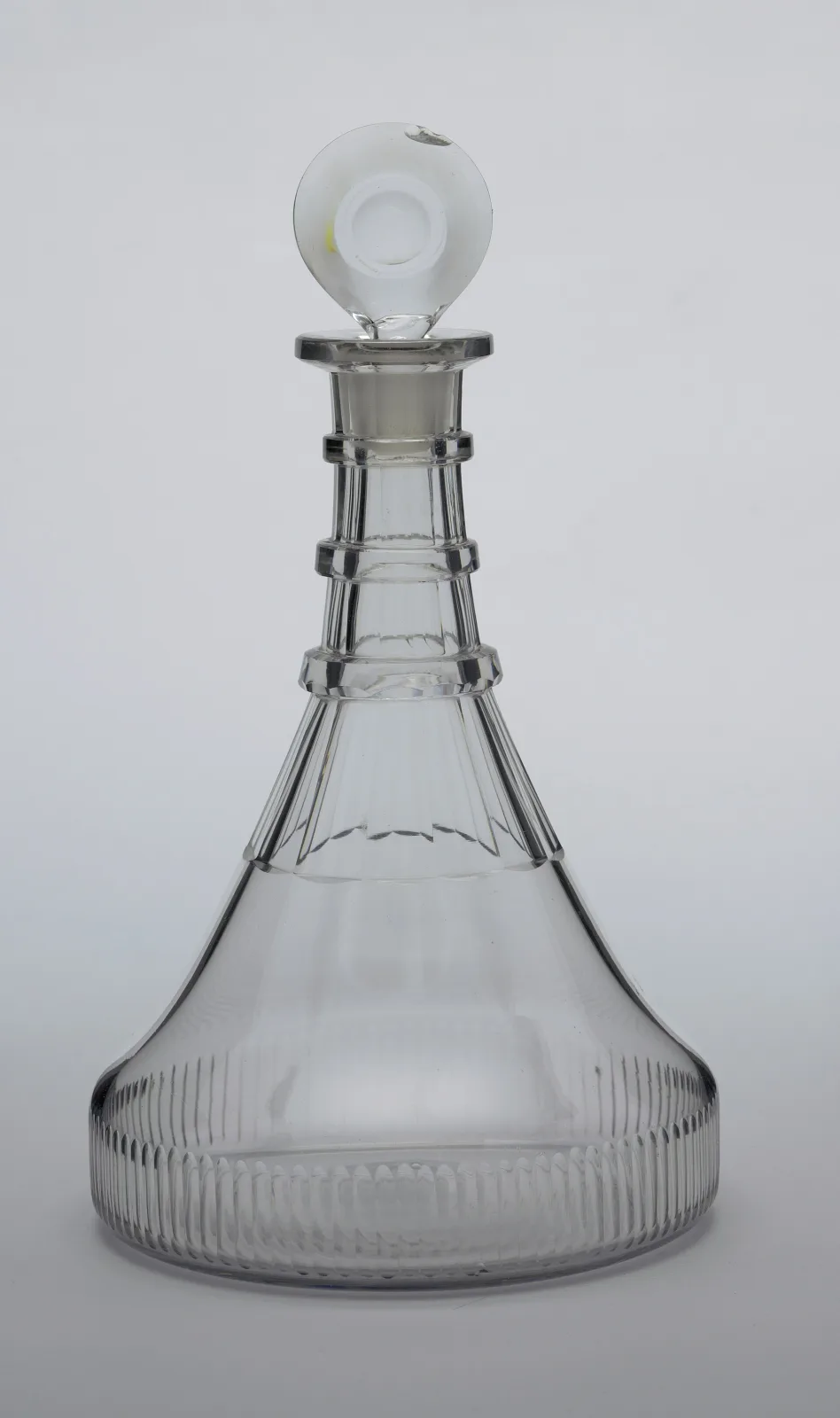
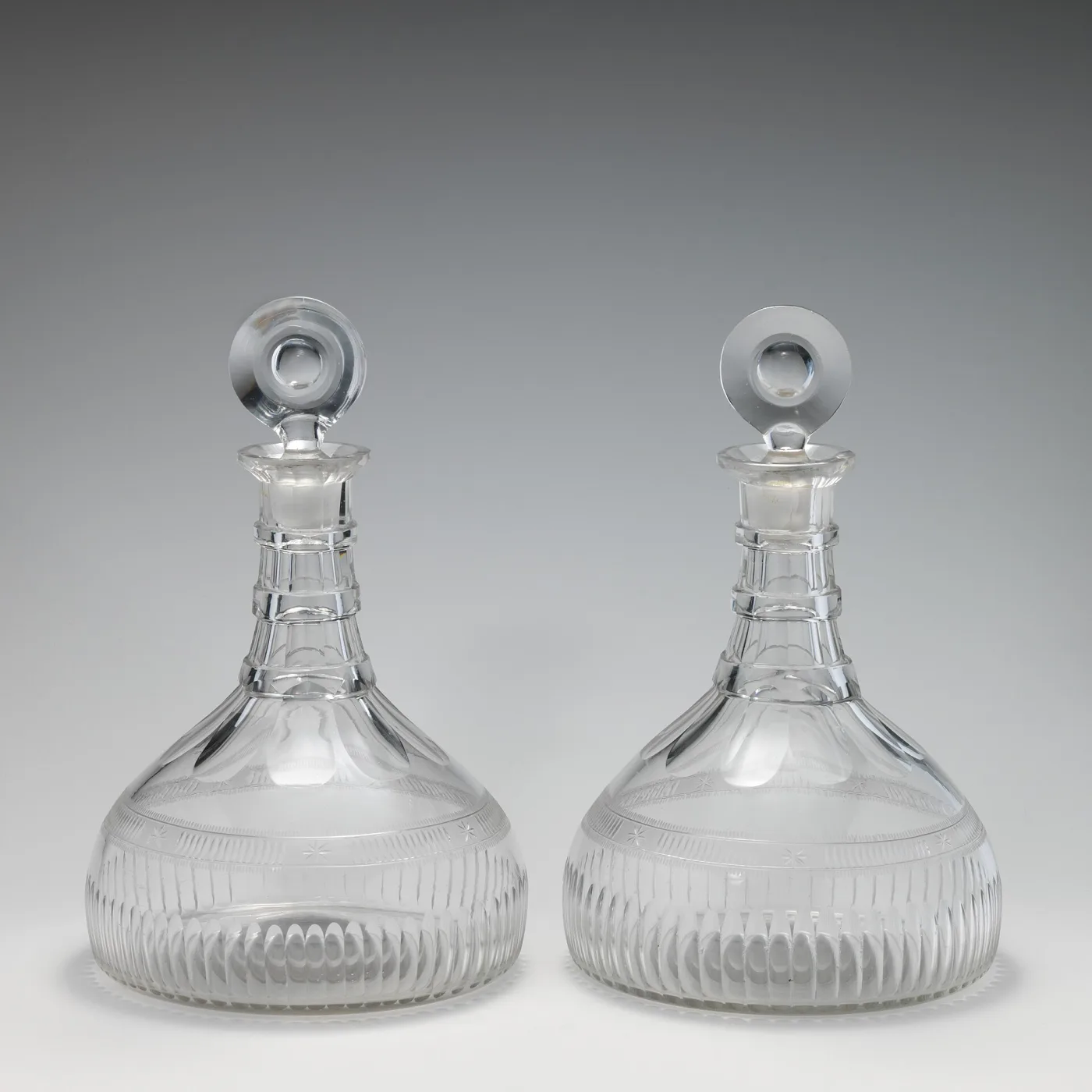
Ship's Decanters
Designed with a wide, heavy base and low center of gravity to prevent tipping on a rolling ship, ship's decanters are immediately recognizable. The broad-based form, often combined with ring neck decoration and mushroom stoppers, was produced from the late eighteenth century onward. These practical vessels remain among the most popular collecting categories.
Claret Jugs and Wine Ewers
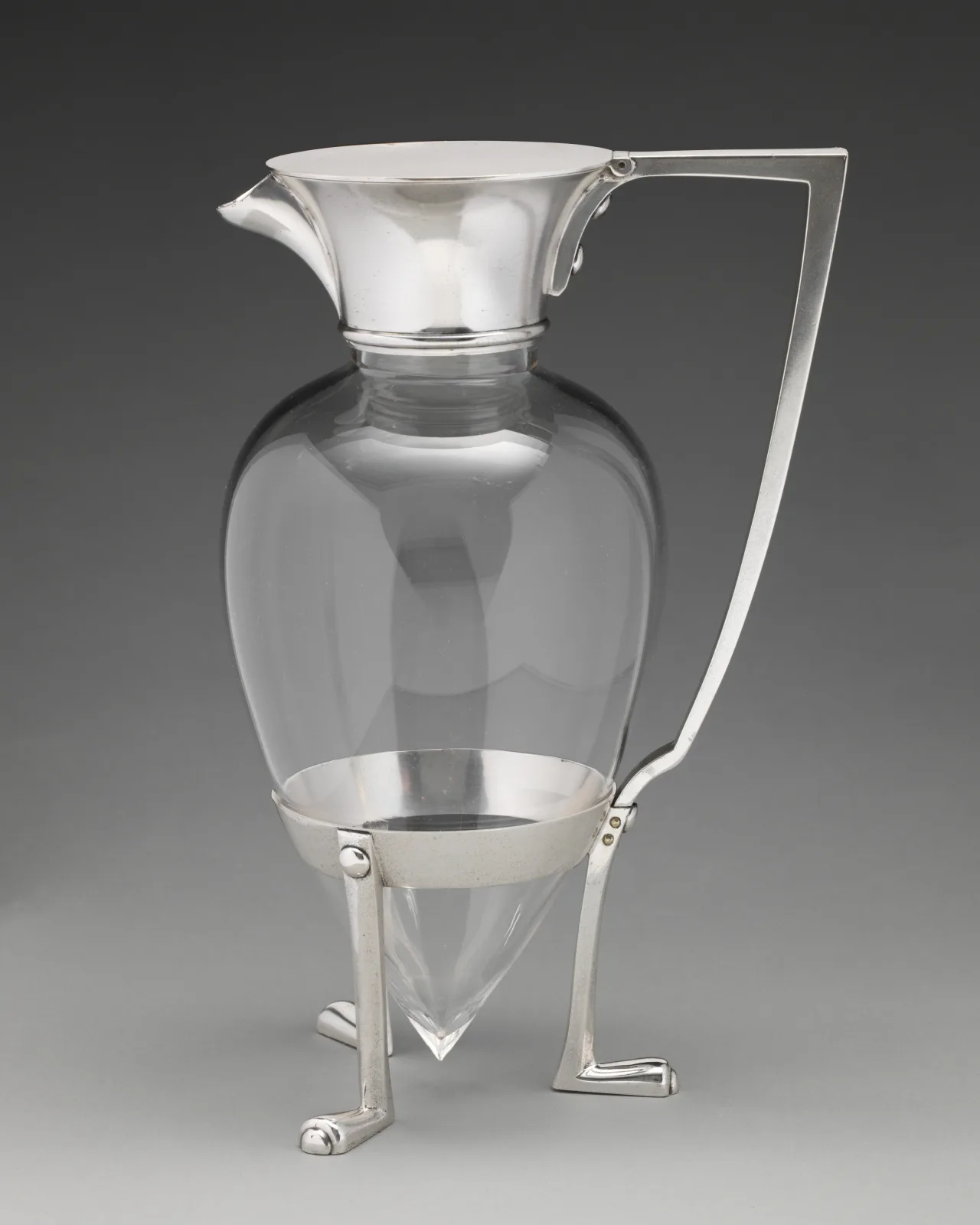
While technically distinct from decanters, claret jugs share the same collecting category. These handled vessels, designed specifically for serving red wine, often feature silver or silver-plated mounts at the lip, handle, and sometimes the body. Victorian and Edwardian claret jugs by makers like Stevens & Williams and Thomas Webb represent some of the most artistic glasswork of their era.
Spirit Decanters and Tantalus Sets
Smaller than wine decanters, spirit decanters were designed for whisky, brandy, and other spirits. They are often found in sets of two or three, sometimes housed in a tantalus — a lockable frame that displayed the decanters while preventing servants from helping themselves. Tantalus sets with original decanters and intact locks command premium prices at auction.
Identifying Decanters by Period
The shape, decoration, and construction of a decanter provide reliable clues to its period of manufacture. Learning to read these features is essential for accurate dating.
Georgian Period (1714–1837)
Early Georgian decanters tend toward simplicity, with elegant proportions and minimal cutting. As the period progressed, decoration became more elaborate. Key features include applied neck rings (single, double, or triple), flat-cut or faceted stoppers, and increasingly complex cutting patterns. The iconic "three ring neck" decanter, with its trio of applied glass rings, emerged in the 1780s and became a defining form of the period.
Regency Period (1811–1820)
Regency decanters represent the peak of cut glass artistry, foreshadowing the later American Brilliant Period tradition across the Atlantic. Broad, heavy forms with deep prismatic cutting, mushroom stoppers, and step-cut necks characterize this brief but influential era. The hobnail and star cutting patterns on stoppers created the airtight seals that Regency hosts demanded. These decanters, with their weight and brilliance, remain highly prized by collectors and often command the highest prices in the antique decanter market.
Victorian Period (1837–1901)
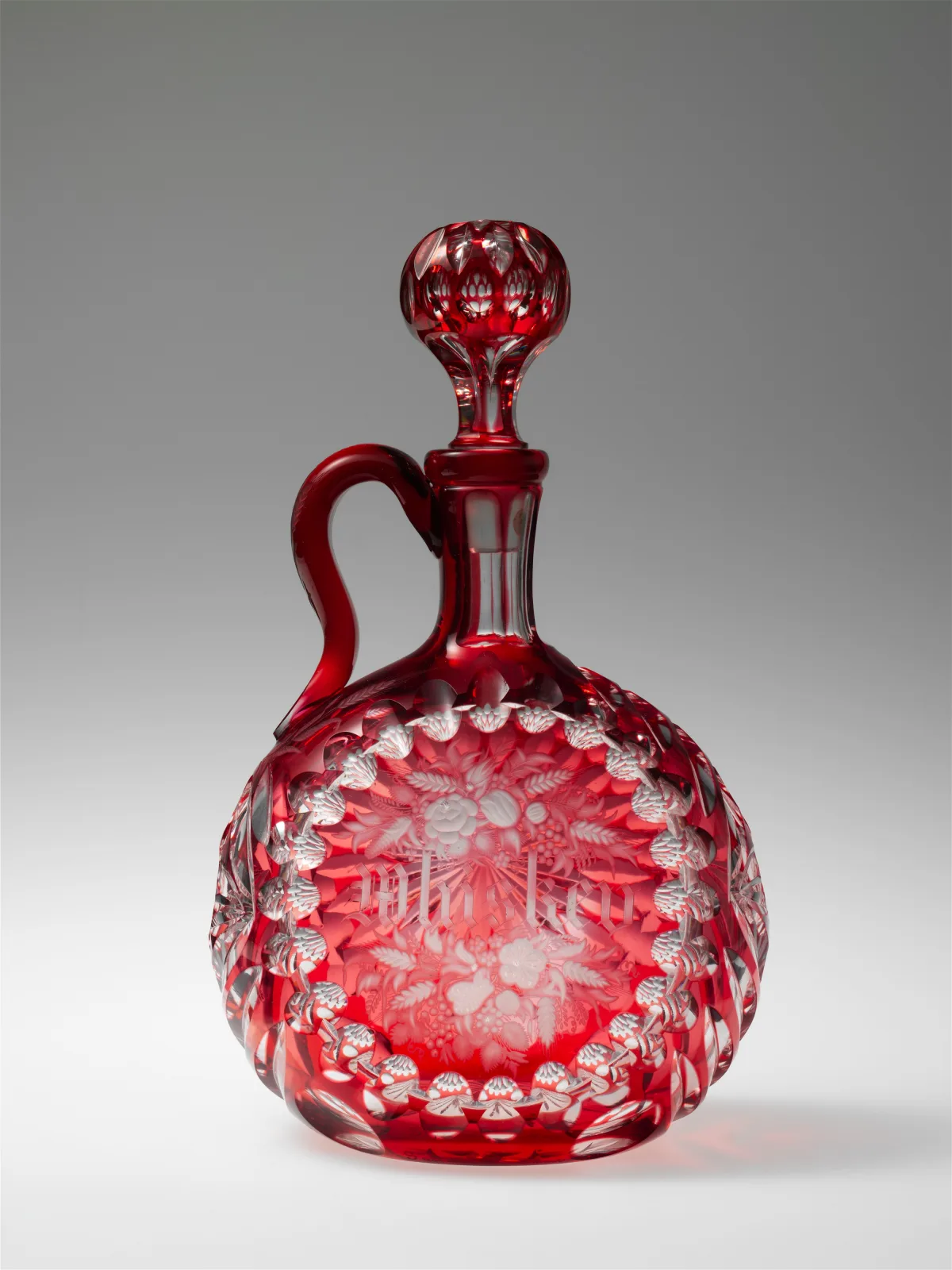
Victorian decanters display an enormous range of styles, from the restrained elegance of early Victorian pieces to the exuberant ornamentation of the later decades. The period saw the introduction of colored glass decanters, cranberry glass overlays, etched decoration, and the revival of earlier cutting styles. The development of pressed glass also brought decorative decanters within reach of the middle class, though these machine-made pieces are less valuable than their hand-cut counterparts. Many Victorian glass forms share characteristics with carnival glass and other decorative traditions of the era.
Art Nouveau and Art Deco Periods
The late nineteenth and early twentieth centuries brought dramatic changes to decanter design. Art Nouveau decanters feature flowing organic lines, iridescent surfaces, and nature-inspired forms, exemplified by the work of Émile Gallé and the Daum brothers. Art Deco decanters, by contrast, embrace geometric shapes, bold colors, and streamlined silhouettes, with Czech and French makers producing some of the most striking examples.
Crystal vs. Glass: How to Tell the Difference
Understanding the distinction between crystal and ordinary glass is crucial for decanter identification and valuation, as crystal pieces typically command significantly higher prices.
Lead Crystal
True lead crystal contains a minimum of 24% lead oxide (PbO), which gives it several distinctive properties. Lead crystal is noticeably heavier than equivalent pieces in soda-lime glass — pick up a decanter and its weight is often the first clue. When held to light, lead crystal produces vivid prismatic rainbows due to its high refractive index. When gently tapped with a fingernail, it produces a clear, sustained ringing tone rather than the dull thud of ordinary glass.
Full Lead Crystal
Decanters described as "full lead crystal" contain 30% or more lead oxide. These pieces exhibit the most pronounced brilliance and weight, and they were favored by makers like Waterford, Baccarat, and Steuben for their finest productions. The higher lead content also made the glass softer and easier to cut deeply, allowing for the most elaborate patterns.
Modern Lead-Free Crystal
Since the late twentieth century, health concerns about lead leaching have prompted some manufacturers to develop lead-free crystal using barium oxide or other substitutes. While modern lead-free crystal can be very beautiful, its presence in a decanter immediately rules out genuine antique status. If a decanter feels light for its size and lacks the characteristic ring of lead crystal, it may be a modern lead-free piece.
The Touch Test
Experienced collectors develop an instinct for crystal through handling. Lead crystal feels smooth and almost warm to the touch, while ordinary glass feels cooler and slightly gritty. The edges of cut crystal are sharper and more precisely defined than those in cut glass, reflecting the greater skill required and the softer material's responsiveness to the cutting wheel.
Reading Cut Patterns and Decoration
The cutting patterns on an antique decanter are not merely decorative — they serve as a visual language that can tell you when and where a piece was made.
Flat Cutting
The earliest form of cut decoration, flat cutting involves grinding broad, shallow facets into the glass surface. Common on decanters from the 1740s to 1770s, flat cutting creates a subtle play of light without the dramatic sparkle of later prismatic patterns. Look for flat-cut panels on the body and faceted stoppers as indicators of an early Georgian date.
Diamond Cutting
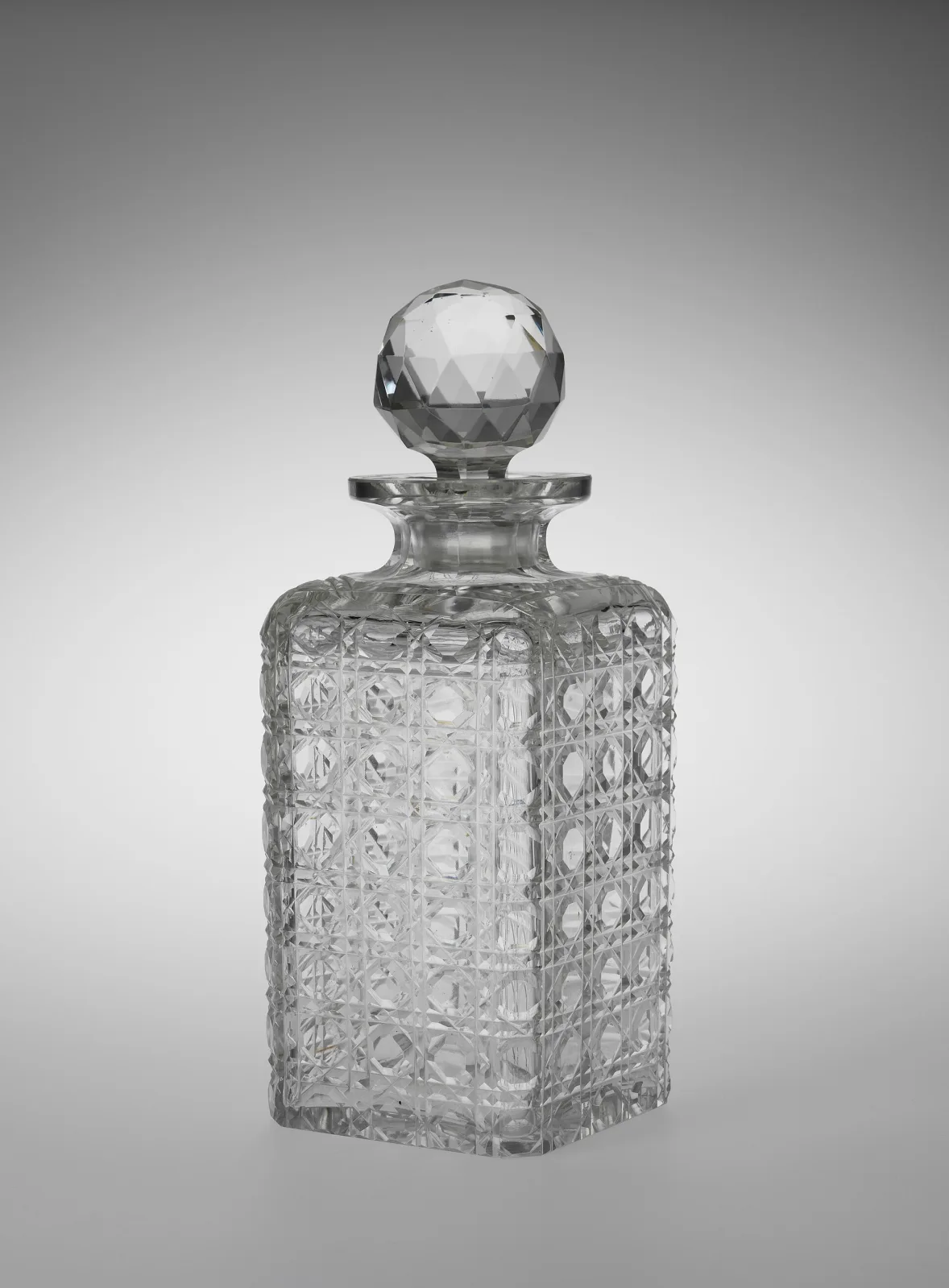
Diamond or crosscut patterns, created by intersecting diagonal cuts, became popular from the 1770s onward. The depth and precision of diamond cutting varied with the period and maker. Shallow, widely spaced diamonds suggest an earlier date, while deep, closely packed diamonds indicate a later Georgian or Regency origin. The "strawberry diamond" — a pattern of small, raised diamond points — is characteristic of the finest Regency and Waterford pieces.
Hobnail Cutting
Hobnail patterns consist of raised, rounded diamond-shaped bosses covering the surface. This labor-intensive technique reached its peak during the Regency period and is closely associated with Irish glass production. A decanter entirely covered in deep hobnail cutting represents many hours of skilled hand work and is correspondingly valuable.
Step Cutting
Horizontal bands of graduated cuts around the neck, shoulder, or base of a decanter create the step-cut effect. This technique was widely used from the late Georgian period through the Victorian era and provides an elegant frame for the more complex cutting patterns on the body.
Engraved Decoration
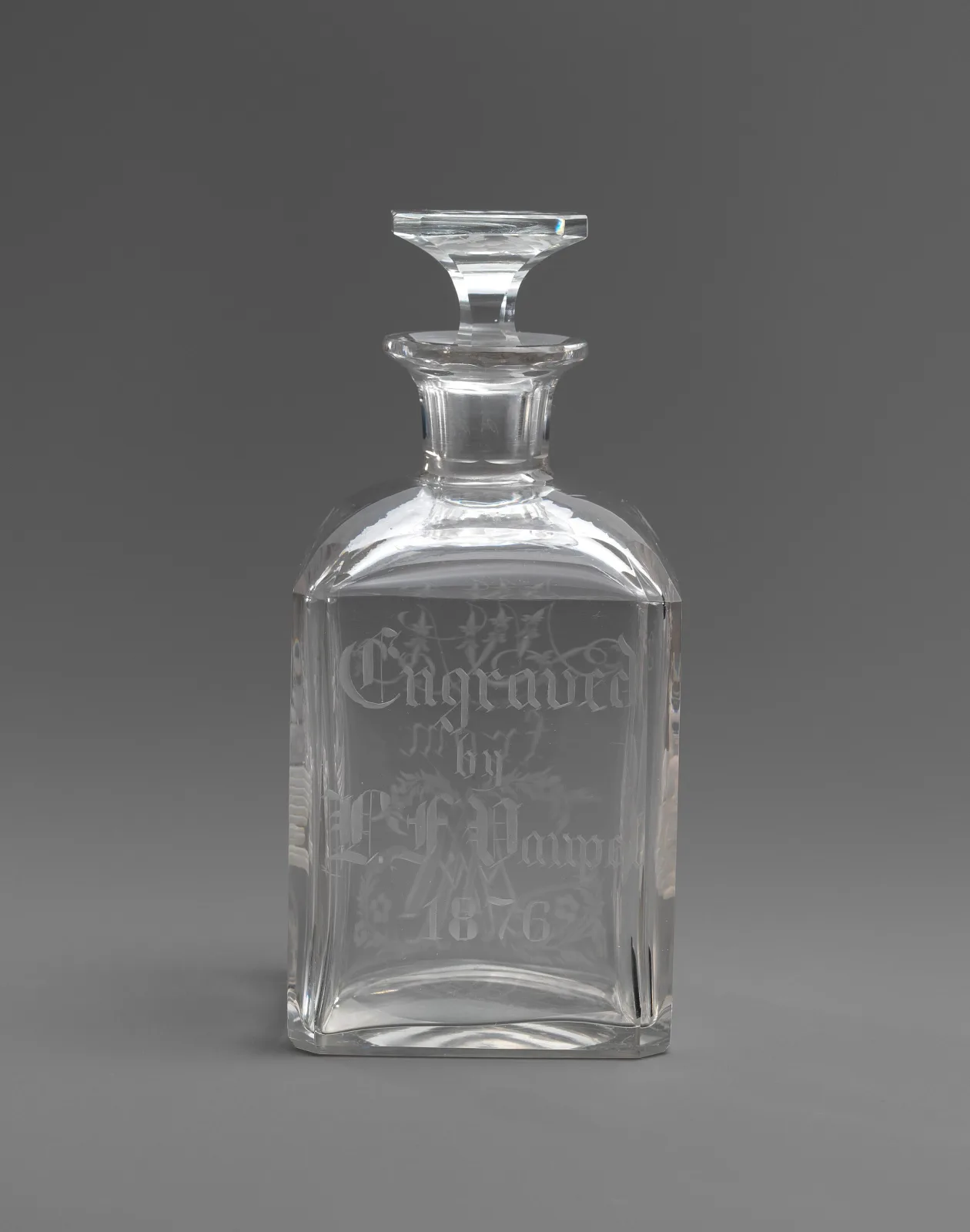
Wheel-engraved and stipple-engraved decoration adds another dimension to decanter identification. Engraved wine labels (Brandy, Sherry, Port) are common on Georgian decanters, while floral, scenic, and heraldic engravings appear across all periods. The quality of engraving is itself an indicator of origin, with the finest work produced by specialized engravers working for the leading glass houses.

Stopper Identification and Matching
The stopper is one of the most important elements in decanter identification — and one of the most frequently overlooked. A decanter with its original stopper is worth significantly more than one with a replacement, and stopper style is itself a dating tool.
Common Stopper Types by Period
Disk or lozenge stoppers (1680–1740): Flat, disk-shaped stoppers that sit loosely in the neck. These are among the earliest stopper forms and are characteristic of shaft-and-globe decanters.
Spire stoppers (1720–1770): Tall, pointed stoppers resembling a church spire. These elegant forms are associated with mallet and early shouldered decanters.
Faceted or cut stoppers (1750–1830): Stoppers with flat-cut or prismatic facets that match the cutting pattern on the decanter body. The quality and style of cutting on the stopper should correspond closely to that on the body if it is original.
Mushroom stoppers (1790–1830): Broad, dome-shaped stoppers with flat or slightly concave tops, often featuring radial cutting. These are the quintessential Regency stopper form and are closely associated with ship's decanters.
Pinnacle and target stoppers (1820–1900): Victorian-era stoppers in a variety of elaborate forms, including tall pinnacles, concentric target shapes, and ornate cut designs.
Checking for Original Stoppers
An original stopper fits its decanter with a smooth, airtight seal — glassmakers ground the stopper and neck together as a matched pair. A stopper that wobbles, sits too high, or leaves visible gaps is almost certainly a replacement. Additionally, the cutting style, glass color, and level of wear on the stopper should match the decanter body. Differences in any of these suggest a marriage of mismatched parts.
Major Makers and Their Marks
Identifying the maker of an antique decanter can dramatically affect its value. While many decanters are unmarked, several major manufacturers used recognizable marks or signatures.
Waterford (Ireland, 1783–1851; revived 1947)
Original Waterford glass from the late eighteenth and early nineteenth centuries is among the most sought-after in the collecting world. Early Waterford decanters are typically unmarked, though a small number bear an etched or molded "PENROSE WATERFORD" mark. The distinctive Waterford cutting style features deep prismatic patterns, fine strawberry diamonds, and exceptional clarity. Modern Waterford pieces bear an acid-etched seahorse mark or a "Waterford" script, which helps distinguish them from the antique originals — a distinction explored fully in our Waterford crystal identification guide.
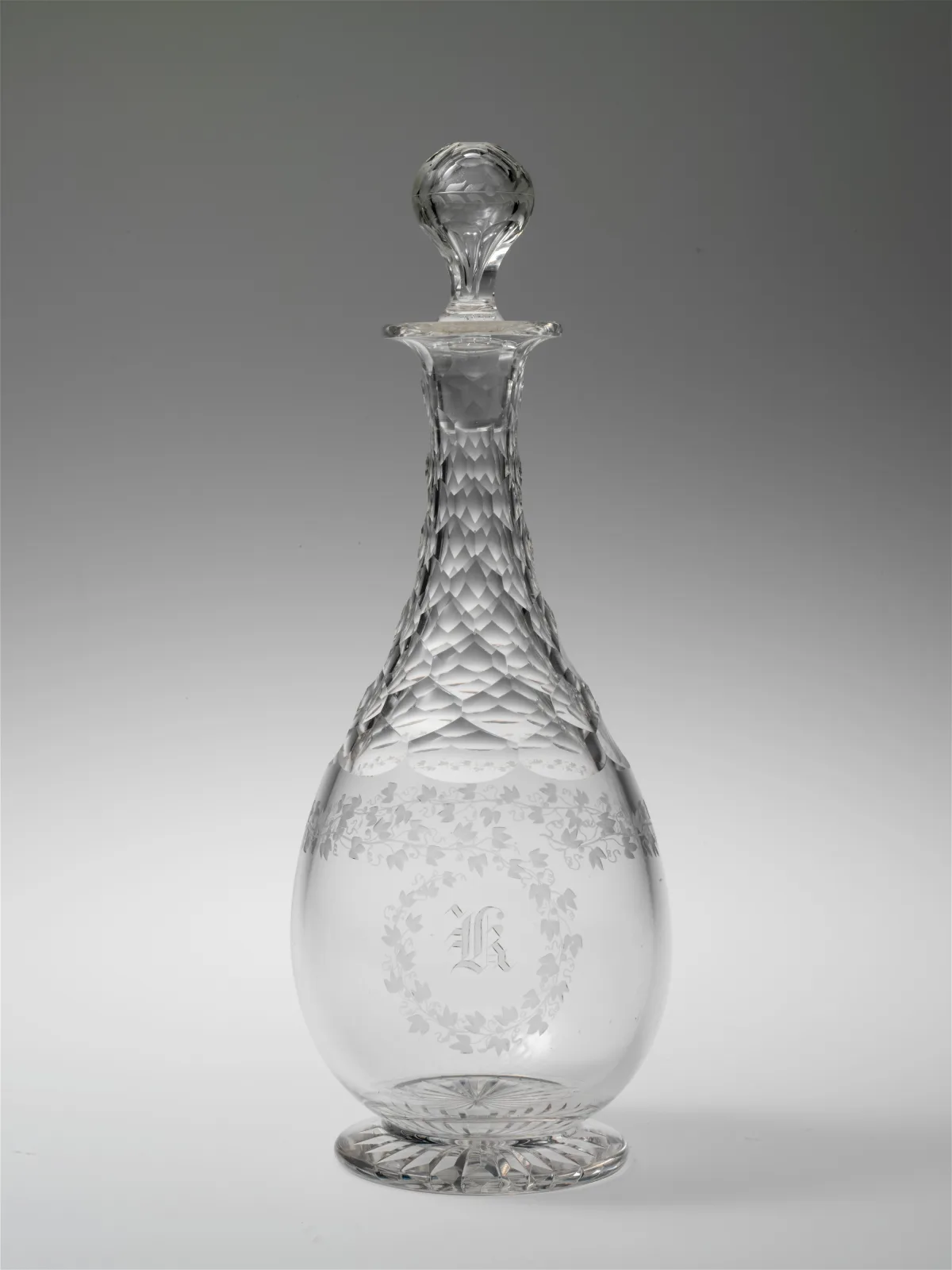
Baccarat (France, 1764–present)
Baccarat decanters are known for their exceptional clarity, precision cutting, and elegant proportions. Early pieces may bear an etched or engraved mark, while later examples typically have an acid-stamped circle enclosing the word "BACCARAT" on the base. Baccarat's Harcourt, Massena, and Harmonie patterns are among the most recognized decanter designs in the world, with antique examples from the nineteenth century commanding prices of $300 to $1,500 or more.
Steuben (United States, 1903–2011)
Steuben Glass Works, founded by Frederick Carder in Corning, New York, produced decanters of extraordinary quality and artistic merit. Early Steuben pieces, particularly those in Carder's signature aurene, cluthra, and cintra art glass, are highly collectible. Later Steuben decanters in clear crystal, designed by artists such as Sidney Waugh and George Thompson, are prized for their purity and sculptural elegance. Look for the engraved "Steuben" signature or the fleur-de-lis mark on the base.
Thomas Webb & Sons (England, 1837–1990)
Webb produced some of the finest Victorian decanters and claret jugs, including cameo glass pieces that rank among the pinnacles of English decorative art. Webb decanters may bear an acid-etched "WEBB" or "THOS WEBB" mark. Their cameo glass decanters, carved in the manner of the Portland Vase, are museum-quality pieces that can fetch tens of thousands at auction.
Stevens & Williams (England, 1847–present)
Based in Stourbridge, the historic heart of English glassmaking, Stevens & Williams produced decanters in a wide range of styles, from traditional cut crystal to innovative art glass. Their pieces may bear an engraved or acid-etched mark. The firm collaborated with leading designers including Keith Murray, whose modernist designs from the 1930s are particularly collectible.
Moser (Bohemia/Czech Republic, 1857–present)
Moser decanters are celebrated for their rich colors, deep engraving, and the distinctive "Moser gold" gilding technique. Bohemian glass has a long and distinguished tradition, and Moser pieces represent its finest expression. Look for the engraved "Moser" signature and the characteristic use of color — deep ruby, cobalt blue, emerald green, and amethyst — often combined with elaborate gilt decoration.
Pontil Marks and Base Examination
The base of a decanter reveals crucial information about its age and method of manufacture. Understanding pontil marks is one of the most reliable dating techniques available to collectors.
What Is a Pontil Mark?
When a glassblower shapes a decanter, the vessel is attached to a solid iron rod called a pontil (or punty) to hold it while the neck and rim are finished. When the pontil is broken free, it leaves a characteristic scar on the base. Before the mid-nineteenth century, this scar was left rough or only partially smoothed, providing one of the clearest indicators of hand-blown, pre-industrial manufacture. The presence of a pontil mark on antique bottles and decanters alike serves as a key authentication feature.
Types of Pontil Marks
Rough or open pontil (pre-1850): A raw, jagged scar where the pontil rod was broken away. This is the most common type on early decanters and is a strong indicator of age.
Smooth or ground pontil (1770s onward): The pontil scar has been ground and polished smooth. Higher-quality decanters often received this treatment even in earlier periods, so a smooth base does not necessarily indicate a later date.
Snap case mark (1850s onward): A device called a snap case replaced the pontil rod in many factories from the mid-nineteenth century, leaving no scar at all. The absence of any pontil mark on a decanter, combined with machine-perfect symmetry, suggests a date after about 1850.
Water Carafes and Claret Jugs
While decanters are designed primarily for wine and spirits, antique carafes and claret jugs occupy a closely related collecting category with their own distinctive forms and traditions.
Water Carafes
Water carafes differ from decanters in several ways: they typically lack stoppers, have wider mouths for easy pouring, and were often sold with matching tumblers as bedroom or washstand sets. Georgian and Victorian water carafes can be exquisitely cut and engraved, and matched sets with original tumblers are especially desirable. Their relationship to broader barware and drinkware traditions makes them an appealing entry point for new collectors.
Claret Jugs
Claret jugs — handled vessels with hinged lids or stoppers, designed for serving red wine — represent some of the most artistic creations in antique glass. The finest examples combine glass bodies with elaborate silver or silver-plated mounts made by leading silversmiths. Victorian claret jugs may feature engraved, etched, or cameo glass bodies with mounts hallmarked by makers such as Hukin & Heath, Mappin & Webb, and Elkington.
Celery Vases and Other Related Forms
Collectors of antique decanters often encounter related tableware forms, including celery vases, water jugs, rinsing bowls, and finger bowls. While these are distinct categories, pieces from the same maker or period often share cutting patterns and decorative vocabulary, and they can complement a decanter collection beautifully.
Authentication Techniques
Authenticating an antique decanter requires a combination of visual examination, physical testing, and knowledge of historical production methods. Familiarizing yourself with provenance research techniques can also strengthen your authentication work.
Visual Examination
Begin by examining the decanter under strong light, looking for the subtle irregularities that characterize hand-blown glass: tiny air bubbles (called seeds), slight asymmetry in the body, and variation in the thickness of the walls. Machine-made glass, by contrast, is perfectly uniform with no bubbles or thickness variations.
The Weight Test
Genuine lead crystal is significantly heavier than ordinary glass or modern lead-free crystal. A full-sized antique cut crystal decanter typically weighs between 2 and 4 pounds empty. If a decanter that appears to be cut crystal feels light in your hands, suspect modern lead-free glass or pressed glass imitating cut patterns.
The Sound Test
Gently tap the rim of the decanter with your fingertip. Lead crystal produces a clear, sustained ringing tone that may last several seconds. Ordinary glass produces a shorter, duller sound. This test should be performed gently — never use hard objects that could chip the rim.
UV Light Examination
Under ultraviolet (black) light, some antique glass formulations fluoresce distinctively. Manganese dioxide, used as a decolorizer in glass made before about 1915, causes a characteristic pinkish-purple fluorescence. This can help distinguish genuinely old glass from modern reproductions, though it is not conclusive on its own.
Condition Assessment and Common Flaws
Condition is the single most important factor in decanter valuation after maker and age. Understanding common condition issues helps collectors make informed purchasing decisions.
Chips and Cracks
Even minor chips on the rim, stopper, or base significantly reduce a decanter's value — often by 50% or more. Small rim chips can sometimes be professionally ground out without dramatically altering the profile, but this repair should be disclosed. Cracks, whether visible hairline fractures or concealed stress cracks, render a decanter essentially worthless to serious collectors.
Clouding and Staining
Internal clouding, caused by years of mineral deposits from water or wine, is one of the most common condition issues in antique decanters. Mild clouding can often be removed with specialized cleaning techniques (see Care section below), but severe or etched-in clouding is permanent. External clouding or a dull surface may indicate sick glass — a chemical deterioration of the glass itself — which is irreversible.
Missing or Replaced Stoppers
A decanter with its original stopper is worth roughly twice as much as one with a replacement or no stopper at all. When evaluating a stopper, check the fit, the matching of cutting patterns, and the degree of wear. Ground stoppers that match the neck grinding pattern exactly are almost certainly original.
Wear and Use Evidence
Some degree of wear is expected and even welcome in genuinely old decanters — it confirms authenticity. Look for minor scratches on the base from being placed on tables, slight softening of the sharpest cut edges, and a mellow patina on the surface. A decanter that claims great age but shows no wear at all should be viewed with suspicion.
Spotting Reproductions and Fakes
The antique decanter market has its share of reproductions, and learning to distinguish genuine antiques from later copies is essential for collectors.
Common Reproduction Red Flags
Machine-perfect symmetry, absence of any pontil mark, uniform wall thickness, and cutting patterns that appear slightly soft or rounded rather than sharp-edged all suggest a modern piece. The glass itself may also give clues: modern soda-lime glass has a slightly different color cast than antique lead crystal, appearing slightly greenish or grayish rather than the warm, clear tone of lead glass.
Fake Marks
Some unscrupulous sellers add false marks to increase value. Acid-etched marks on genuinely old but unmarked decanters are the most common form of fakery. Check that any mark appears consistent with the age and style of the piece, and be suspicious of marks that look too crisp or well-defined on a decanter showing significant wear elsewhere.
Married Pieces
A "married" decanter combines a body from one piece with a stopper from another. While not technically a fake, marriages significantly reduce value and should be disclosed. Check the color match between stopper and body under different light sources — subtle differences that are invisible under warm incandescent light may become obvious under natural daylight.
Valuation Factors and Market Trends
The value of antique decanters varies enormously, from a few dollars for a common Victorian pressed glass piece to tens of thousands for a rare maker-marked example. Understanding the factors that drive value helps collectors focus their buying and assess their holdings. For a broader perspective on antique pricing, consult our valuation and appraisal guide.
Key Value Drivers
Maker attribution: A documented maker raises value dramatically. Waterford, Baccarat, Steuben, Webb, and Lalique are among the names that command the highest premiums.
Age: Earlier pieces generally command higher prices, with pre-1800 decanters being the most desirable in their class. Georgian decanters from the 1780s and 1790s represent a sweet spot of age, quality, and availability.
Condition: As noted above, condition is paramount. A perfect decanter with original stopper will always outsell a chipped or clouded example of similar quality.
Rarity: Unusual forms, rare cutting patterns, colored glass, and documented provenance all increase rarity and value.
Current Market Ranges
As of 2026, the market for antique decanters remains strong across most categories. Common Victorian cut glass decanters typically sell for $50 to $200. Quality Georgian pieces range from $200 to $800. Maker-attributed pieces from Waterford, Baccarat, or similar houses command $300 to $3,000 or more. Exceptional or museum-quality decanters — signed cameo glass, documented royal commissions, important provenance — can reach $10,000 to $50,000 at major auction houses.
Care, Cleaning, and Display
Proper care preserves both the beauty and value of antique decanters. Following best practices in antique preservation will help protect your collection for years to come.
Cleaning Clouded Decanters
For mild internal clouding, fill the decanter with a mixture of warm water and white vinegar, or warm water and denture cleaning tablets, and let it soak for 24 to 48 hours. For stubborn deposits, try a handful of dry rice or lead-free cleaning beads with warm water and gentle swirling. Never use abrasive cleaners, boiling water, or put antique decanters in a dishwasher.
Stopper Care
A stopper that has become stuck is a common problem with antique decanters and the smaller bottles found in Victorian cruet sets. Never force a stuck stopper — the risk of breaking the neck is high. Instead, apply a few drops of vegetable oil around the joint and gently tap the stopper from alternating sides with a wooden implement. Warming the neck (but not the stopper) with a hair dryer can also help by expanding the glass slightly.
Display Considerations
Display decanters away from direct sunlight, which can cause some glass formulations to develop a purple tint over time (due to manganese content reacting with UV light). Use felt or cloth pads under decanters to prevent scratching on hard surfaces. If displaying in a cabinet, ensure adequate ventilation to prevent humidity buildup that can promote clouding.
Storage
If storing decanters rather than displaying them, wrap each piece individually in acid-free tissue paper and place in a padded box. Store stoppers separately, wrapped in tissue, to prevent them from becoming stuck. Avoid storing decanters in attics, basements, or garages where temperature and humidity extremes can damage glass.
Collecting Tips for Beginners
Starting a decanter collection is both enjoyable and potentially rewarding. Here are practical tips for new collectors entering this fascinating field.
Start with What You Love
The best collections are built around personal passion rather than investment calculations. Whether you are drawn to the clean lines of Georgian decanters, the brilliance of Regency cut crystal, or the artistic flair of Art Nouveau glass, focus on what excites you. A collection assembled with knowledge and enthusiasm will always be more satisfying than one assembled purely for profit.
Handle as Many Pieces as Possible
There is no substitute for hands-on experience. Visit antique shops, fairs, and auction previews to handle decanters across different periods and price ranges. The more pieces you examine, the more quickly you will develop an instinct for quality, age, and authenticity.
Buy the Best You Can Afford
In antique decanters, quality always wins. A single exceptional piece will appreciate more and give more pleasure than a shelf full of mediocre examples. Focus on condition, original stoppers, and documented provenance over sheer quantity.
Build Relationships
Reputable dealers, auction house specialists, and fellow collectors are invaluable resources. Join glass collecting societies, attend specialist auctions, and visit exhibitions. The knowledge you gain from experienced collectors will save you from costly mistakes and alert you to opportunities.
Document Your Collection
Keep detailed records of each acquisition, including photographs, measurements, purchase date and price, provenance information, and any identifying marks. This documentation protects your investment and creates a valuable resource for future research. Consider using our photography and documentation guide to capture your pieces effectively.