Antique Graniteware & Enamelware Identification Guide: Colors, Makers & Value
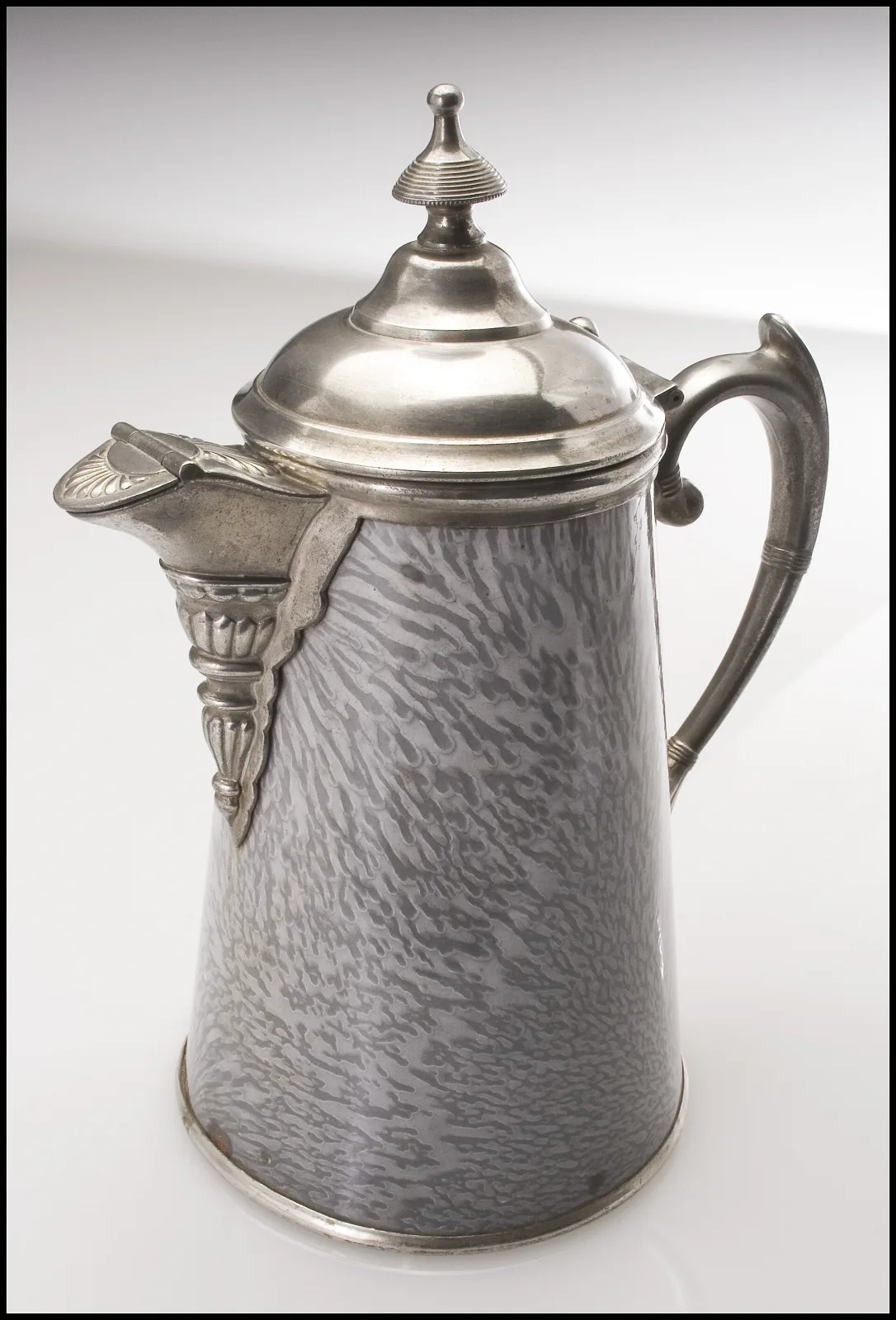
Graniteware — also known as enamelware, agateware, or speckleware — is one of the most recognizable and widely collected forms of antique kitchenware. These metal vessels coated with vitreous enamel were household staples from the 1870s through the mid-twentieth century, prized for their durability, easy cleaning, and striking mottled or swirled color patterns. Today, collectors seek out rare colors, unusual forms, and pieces bearing identifiable maker marks that connect each item to a specific manufacturer and era.
What makes graniteware particularly appealing is the sheer variety of colors, patterns, and forms produced over more than a century of manufacture. From the classic gray-and-white speckled pieces of the 1880s to the bold cobalt blues and chrysolite greens of the early 1900s, each color and pattern tells a story about when and where a piece was made. Understanding these visual cues is essential for accurate identification and valuation.
This guide covers the history and evolution of graniteware, major manufacturers and their marks, color and pattern identification, construction methods that reveal age, condition grading, and current market values. Whether you are picking through a barn sale or evaluating a collection you have inherited, the information here will help you recognize genuine antique graniteware and distinguish it from later reproductions.
Table of Contents
- History & Evolution of Graniteware
- What Is Graniteware? Materials & Construction
- Color & Pattern Identification
- Major Manufacturers & Maker Marks
- Common Forms & Shapes
- Dating Techniques & Age Indicators
- Spatterware, Swirl & Relish Patterns
- Condition Grading & Damage Assessment
- Identifying Reproductions & Fakes
- European Graniteware Traditions
- Rare Colors & Most Valuable Pieces
- Collecting Tips & Display Ideas
- Care & Preservation
- Current Market Values & Price Trends
History & Evolution of Graniteware
The story of graniteware begins in Germany during the 1760s, when experiments in fusing glass-like coatings onto iron produced the first practical enameled cooking vessels. However, it was not until the 1850s and 1860s that industrial-scale production became feasible, with German and Austrian factories leading the way. The enameling process involved applying powdered glass (frit) mixed with metal oxides to a shaped iron or steel base, then firing the piece at temperatures around 1,500 degrees Fahrenheit to create a smooth, non-porous surface.
American production began in earnest during the 1870s, driven by a growing middle class seeking affordable, hygienic alternatives to cast iron and uncoated tin. The St. Louis Stamping Company, founded in 1866, became one of the first major American producers, marketing its wares under trade names that emphasized the granite-like appearance of the mottled enamel surface. By the 1880s, dozens of American firms were manufacturing graniteware, and the product had become a kitchen essential coast to coast.
The Golden Age: 1880–1920
The period from roughly 1880 to 1920 represents the golden age of graniteware production. During these decades, manufacturers competed fiercely on both quality and aesthetics, introducing an astonishing range of colors, patterns, and specialized forms. Catalogs from this era show everything from simple gray-mottled coffee pots to elaborate swirled pieces in cobalt blue, emerald green, and lavender. This period also saw the peak of American manufacturing, with firms like Vollrath, Lisk, and Columbian Enameling & Stamping Company producing millions of pieces annually.
Decline & Transition: 1920–1960
The introduction of aluminum cookware in the 1920s and stainless steel in the following decades gradually displaced graniteware from American kitchens — the same modernizing years that saw the free-standing Hoosier kitchen cabinet give way to built-in cabinetry. Production shifted toward simpler, less decorative pieces — primarily white with colored trim — as manufacturers cut costs to compete. By the 1950s, most American graniteware factories had closed or pivoted to other products. European production, particularly in Eastern Europe, continued longer but also contracted significantly by the 1960s.
What Is Graniteware? Materials & Construction
Understanding how graniteware was made is fundamental to identifying and dating pieces. The term "graniteware" is something of a misnomer — there is no granite involved. The name refers to the mottled, granite-like appearance of the enamel surface. Several related terms describe essentially the same product with slight variations in pattern or marketing.
Base Metals
Early graniteware (1870s–1890s) was typically made on a cast iron or heavy-gauge sheet iron base. These pieces are notably heavier than later examples and often show a rougher texture where the enamel has chipped. By the 1890s, most manufacturers had switched to stamped steel, which was lighter, cheaper, and easier to form into complex shapes. Some premium pieces used a steel base with a secondary coating of ground coat enamel before the decorative top coat was applied, resulting in a smoother finish and better adhesion.
The Enameling Process
The enamel coating on graniteware is essentially glass — a mixture of silica, borax, feldspar, and metal oxide colorants ground into a fine powder called frit. The metal base was first cleaned, then dipped or sprinkled with the frit mixture. Firing in a kiln fused the glass particles into a continuous coating. Most quality pieces received at least two coats: a dark ground coat (often cobalt blue or black) for adhesion, and one or more decorative top coats. This layering is visible at chip sites and is an important authentication detail, as many reproductions use only a single coat.
Terminology Explained
Collectors and dealers use several terms interchangeably but with subtle distinctions. "Graniteware" and "granite ware" (two words) generally refer to the mottled or speckled variety. "Agateware" describes pieces with a swirled pattern resembling agate stone. "Enamelware" is the broadest term, encompassing all enameled metal kitchenware including solid-color pieces. "Spatterware" refers to pieces with a spattered or flecked decorative pattern. Understanding these terms helps when searching auction listings and dealer inventories, as the same piece might be cataloged under any of these names.
Color & Pattern Identification
Color is the single most important factor in identifying and valuing antique graniteware. Manufacturers used specific metal oxide combinations to achieve particular colors, and production dates can often be narrowed by the palette used. Certain colors were produced for only brief periods or in limited quantities, making them far more valuable to collectors today.
Gray Mottled (1870s–1950s)
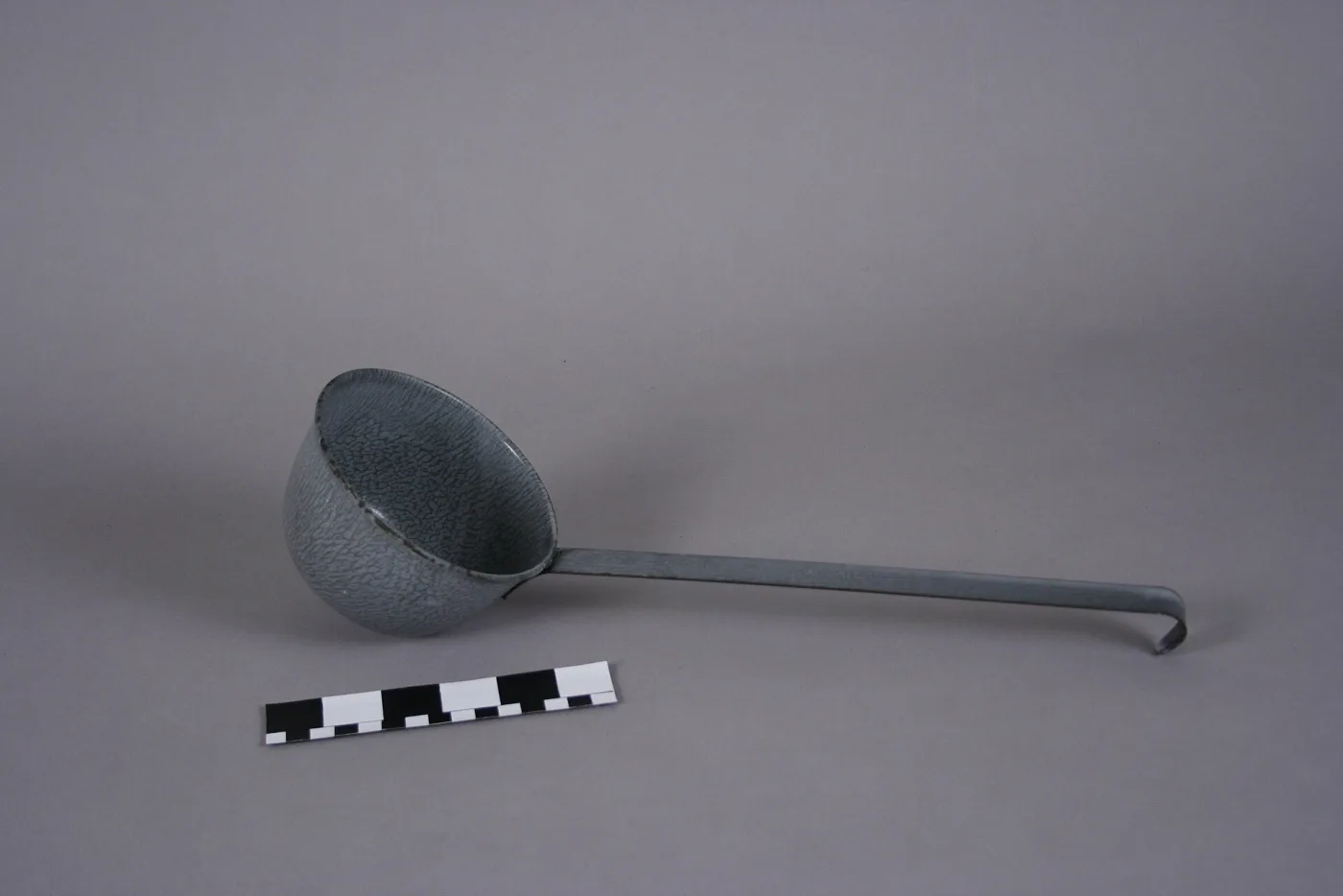
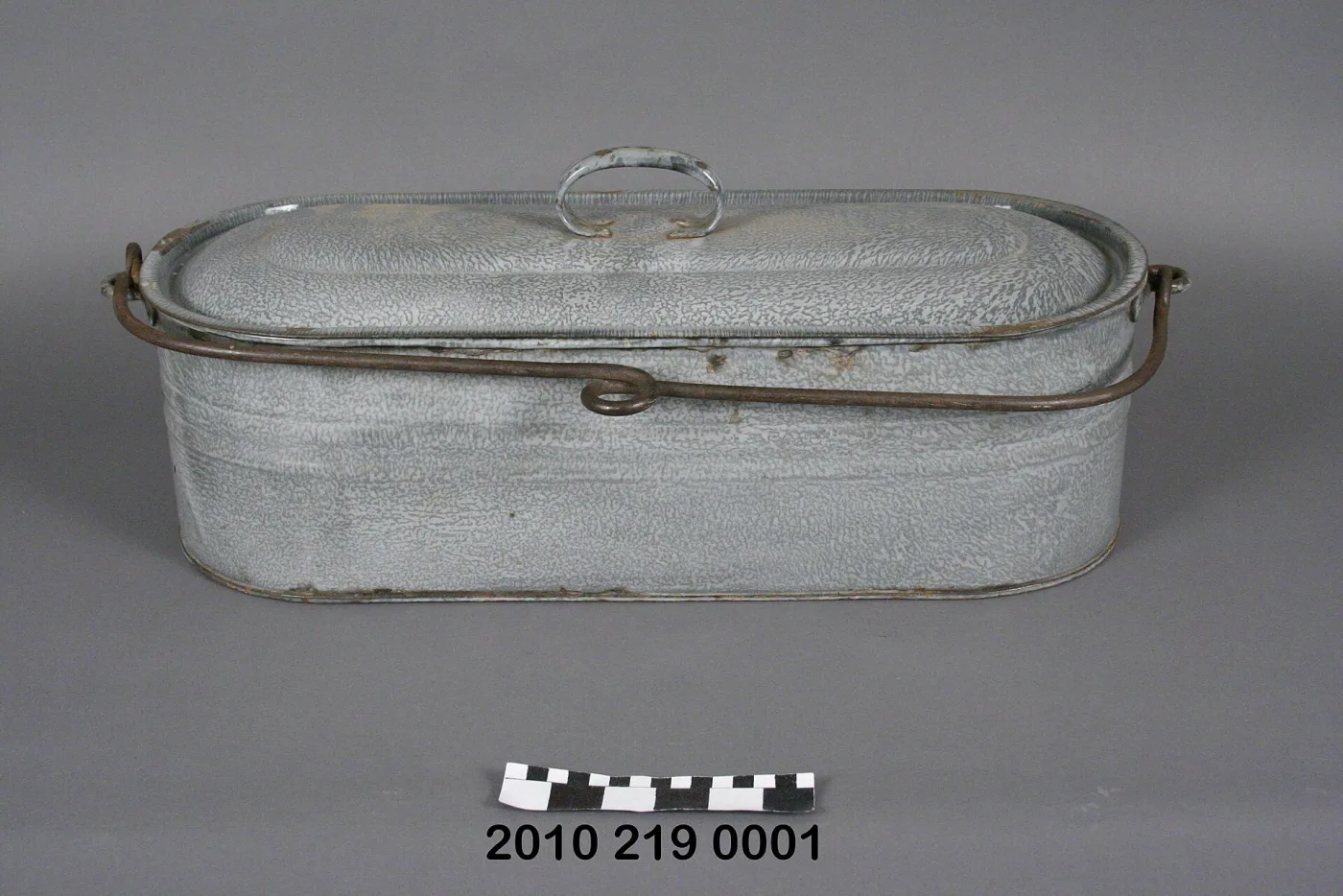
The most common and longest-produced variety, gray mottled graniteware features a dark gray or charcoal base with lighter gray and white speckling. Sometimes called "old gray" by collectors, this was the workhorse of graniteware production. While less valuable than colored varieties, early heavy-gauge pieces with crisp mottling patterns and original lids command respectable prices. The gray color was achieved using a combination of cobalt and manganese oxides.
Blue & White (1880s–1940s)
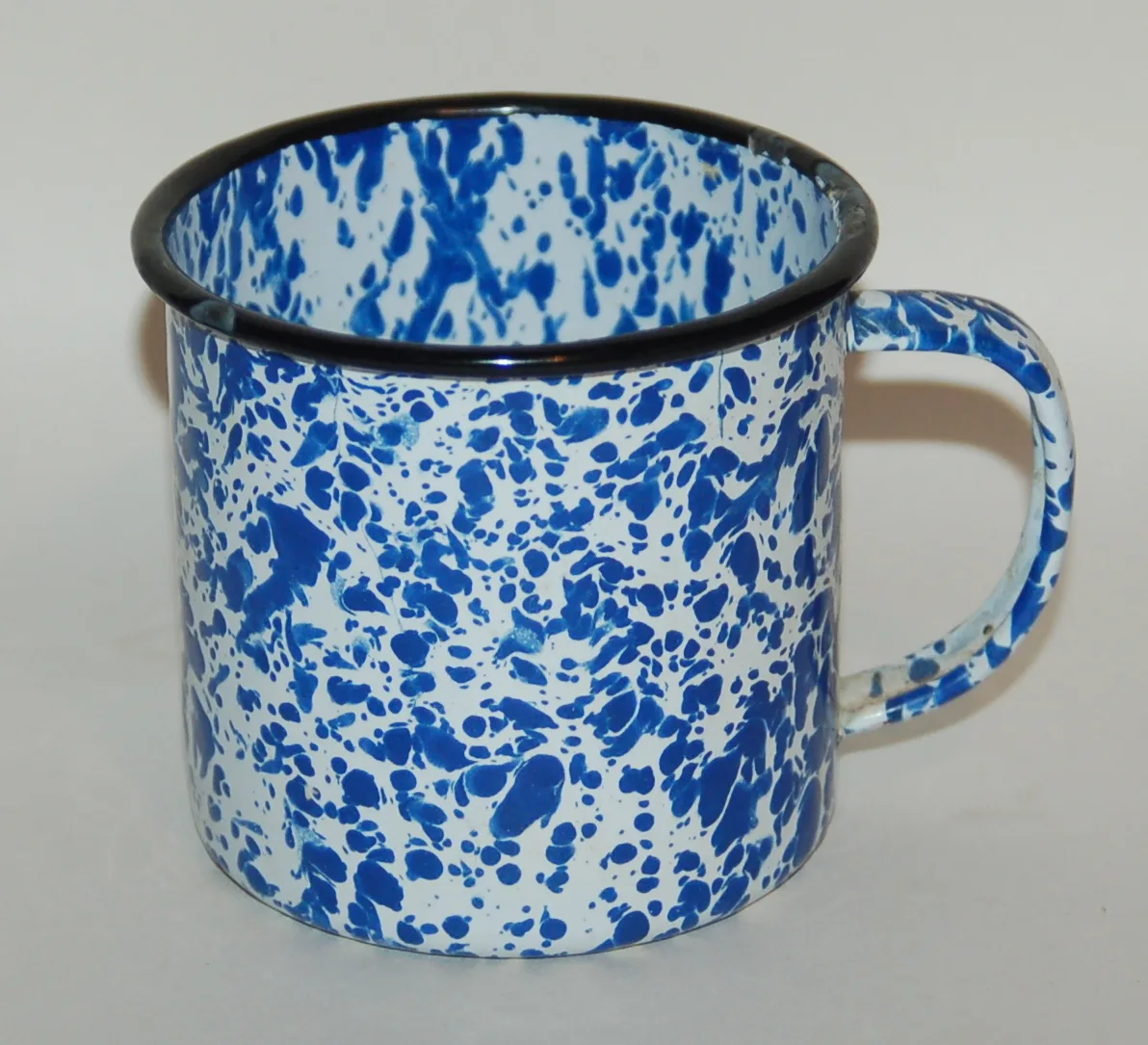
Perhaps the most iconic graniteware color, blue and white pieces range from deep cobalt swirls to light powder blue speckles. Cobalt blue and white swirl pieces from the 1880s and 1890s are among the most sought-after by collectors. The depth and richness of the blue varies by manufacturer and period — earlier pieces tend to show deeper, more saturated blues. Blue and white graniteware was produced by nearly every major manufacturer, making maker mark identification particularly important for this color.
Brown & White (1880s–1920s)
Brown and white graniteware, sometimes marketed as "onyx" ware, features rich chocolate brown swirled or mottled with cream or white. This was a popular color in the late Victorian period and is moderately collectible. The brown coloring came from iron and manganese oxides. Pieces in excellent condition with vivid swirl patterns are considerably more valuable than common mottled examples.
Green & White (1890s–1930s)
Green graniteware comes in several shades, from deep emerald to soft sage. Chrysolite green — a distinctive yellow-green — was particularly popular in the early 1900s and is highly collectible. Green and white swirl patterns are among the most attractive graniteware varieties and consistently bring strong prices at auction. The green coloring was typically achieved with chromium oxide.
Red & White (1890s–1920s)
Red and white graniteware is one of the rarer color combinations. True antique red graniteware has a deep, slightly brownish-red tone distinct from the bright cherry red of modern reproductions. The red coloring required iron oxide in specific concentrations and firing conditions that were difficult to control, contributing to its scarcity. Red swirl pieces are among the most valuable graniteware items.
Lavender, Violet & Unusual Colors
Some of the rarest and most valuable graniteware comes in unusual colors like lavender, violet, aqua, and cobalt blue solid. Lavender graniteware was produced in very limited quantities, primarily in the 1890s and 1900s, and commands premium prices. Similarly, true violet or purple pieces are extremely scarce. These unusual colors were often experimental or limited-run productions, and finding authenticated examples is a highlight for serious collectors.
Major Manufacturers & Maker Marks
Identifying the manufacturer of a graniteware piece significantly affects its value and helps confirm its age. While many pieces were sold without marks, a substantial number bear stamps, labels, or embossed marks that connect them to specific factories. Learning to recognize these marks is a key skill for collectors, similar to identifying hallmarks on antique silver.
St. Louis Stamping Company (1866–1897)
One of the earliest and most important American graniteware manufacturers, St. Louis Stamping produced high-quality pieces under several trade names including "Granite Iron Ware" and "Pearl Agate Ware." Their marks typically include the company name in an arc or oval with the trade name below. After 1897, the company merged to form Niedringhaus Rolling Mill Company. Early St. Louis Stamping pieces are highly prized by collectors.
Vollrath Company (1874–present)
Founded in Sheboygan, Wisconsin, Vollrath became one of the largest and longest-operating American enamelware producers. Their marks evolved over the decades, from early paper labels to stamped "VOLLRATH" marks and later embossed logos. Vollrath produced a wide range of colors and forms, and their pieces are generally well-made with good enamel adhesion. The company still operates today in commercial foodservice equipment.
Lisk Manufacturing Company (1889–1950s)
Based in Canandaigua, New York, Lisk was known for high-quality enamelware marketed under the "Lisk Flintstone" and "Lisk Savory" brands. Their pieces often carry a distinctive oval mark with the Lisk name. The company was particularly noted for their roasting pans and covered kettles in attractive blue and white swirl patterns.
Columbian Enameling & Stamping Company (1893–1950s)
Located in Terre Haute, Indiana, Columbian was a major producer known for a wide color range. Their "Stransky" brand enamelware was marketed as a premium product. Marks include the company name and often a globe or shield device. Columbian produced some of the most vivid colored graniteware, including desirable chrysolite green and cobalt blue pieces.
European Manufacturers
Major European producers include Baumalu (France), Judge Brand (England), and numerous German and Austrian firms. European marks often include a country of origin stamp, which became mandatory for imports under the McKinley Tariff Act of 1891. This dating clue is extremely useful: pieces marked "Germany" (rather than "Made in Germany," required after 1914) can be dated to the 1891–1914 period.

Common Forms & Shapes
Graniteware was produced in an enormous variety of forms to serve every kitchen function. The form of a piece affects both its collectibility and its value, with some shapes being considerably rarer than others.
Coffee Pots & Tea Pots
Among the most iconic graniteware forms, coffee pots were produced in several styles including gooseneck, straight-spout, and biggin (drip) types. Gooseneck coffee pots with matching lids in colored swirl patterns are particularly desirable, and they often shared the same kitchen counter as a household's cast iron coffee grinder. Size ranges from individual one-cup pots to large institutional pieces holding several quarts. Tea pots are less common than coffee pots and tend to command higher prices, especially in unusual colors.
Wash Basins, Bowls & Pans
Utilitarian wash basins and mixing bowls were produced in huge quantities and remain among the most affordable graniteware pieces. Round and oval basins in gray mottled patterns are extremely common. However, colored swirl examples and unusual shapes like lipped bowls or handled pans are more collectible. Pie pans, cake pans, and muffin tins in graniteware are popular with collectors who display them on kitchen walls. These items overlap with the broader world of antique kitchenware collecting.
Buckets, Pails & Lunch Pails
Water buckets, milk pails, and berry pails were graniteware staples. Lunch pails — often called dinner pails or miners' pails — are particularly collectible, especially stacking models with multiple compartments. These pieces saw hard use and surviving examples in good condition are relatively scarce. Bail handles on buckets and pails should be original; replacement handles significantly reduce value.
Specialty & Rare Forms
Beyond everyday kitchen items, manufacturers produced specialty forms that are now among the most collectible graniteware pieces. These include chamber pots, bed pans, soap dishes, candleholders, drinking cups, milk cans, funnels, colanders, and ladles. Miniature pieces — sometimes salesmen's samples, sometimes children's play items — are especially prized. Complete children's tea sets in colored graniteware are extremely rare and valuable.
Dating Techniques & Age Indicators
Accurately dating graniteware requires evaluating several physical characteristics together. No single feature is definitive, but the combination of construction, weight, enamel quality, and color provides a reliable age estimate.
Weight & Base Metal
The heaviest graniteware pieces tend to be the oldest. Cast iron bases (1870s–1890s) are substantially heavier than later stamped steel pieces. Pick up the piece and compare its weight to a modern enamelware item of similar size — antique pieces will feel noticeably heavier. Magnetic testing confirms a ferrous metal base (iron or steel) as opposed to aluminum, which was not used for enamelware until much later.
Enamel Layers & Chip Analysis
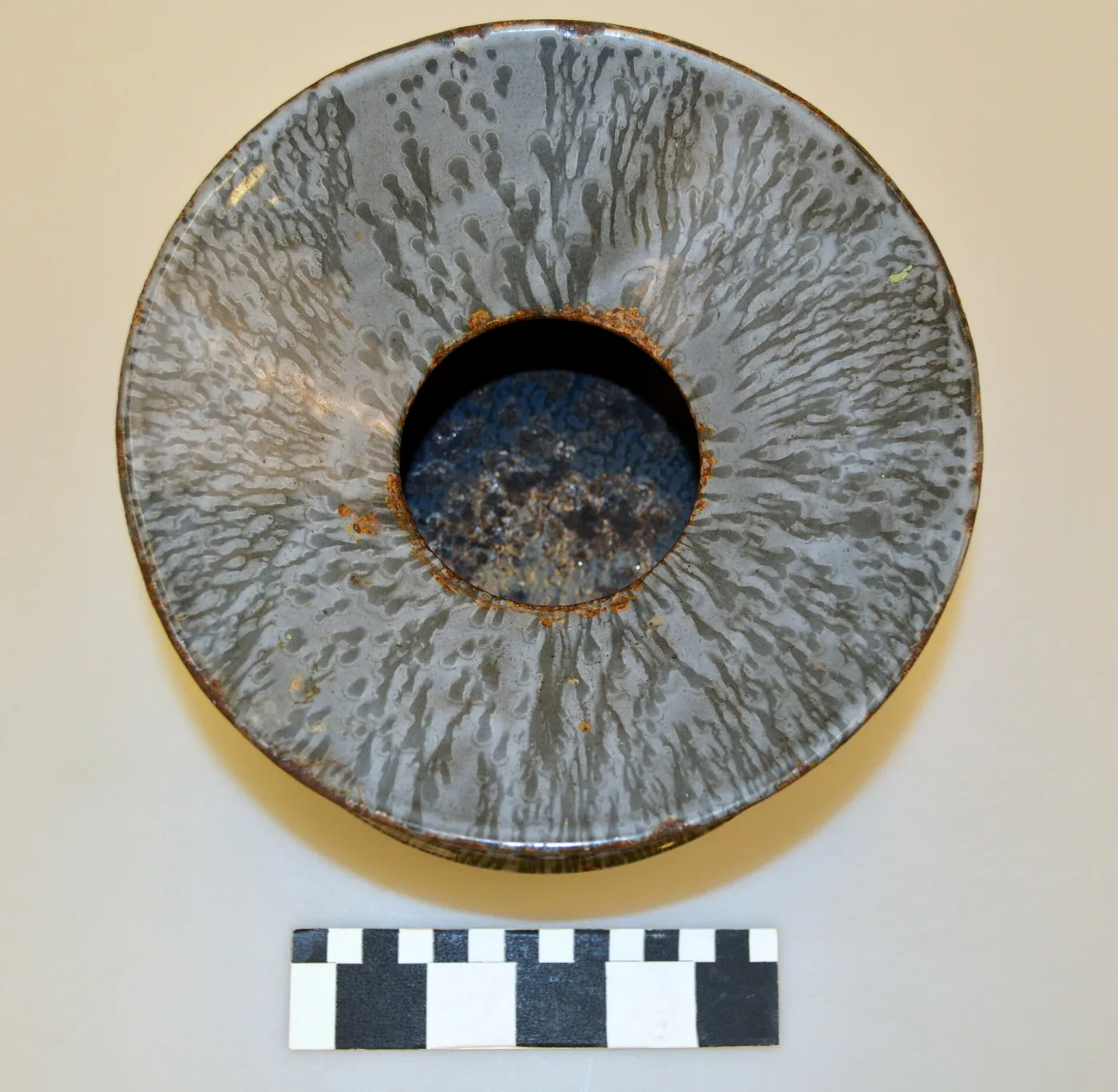
Examining chips and worn spots reveals the enamel layering structure, which is one of the most reliable dating and authentication methods. Quality antique pieces show multiple distinct layers: a dark ground coat (often cobalt blue or black) bonded to the metal, followed by one or more top coats. Single-layer enamel over bare metal suggests a later or lower-quality piece. The ground coat color itself is a dating clue — cobalt blue ground coats are typical of the 1880s–1910s period.
Seam Construction
How the body of a piece was assembled provides dating evidence. Early pieces (1870s–1890s) often have soldered seams that are visible as slight ridges under the enamel. By the early 1900s, most manufacturers had switched to seamless stamped construction for smaller items, though larger pieces like roasting pans continued to use seamed construction. Riveted handles are typical of earlier pieces; welded or spot-welded handles indicate later production.
Handle & Rim Details
Handle attachment methods evolved over time. Earliest pieces have cast iron handles riveted through the body. Wire bail handles with wooden grips appeared in the 1880s and continued through the production period. The style of the wooden grip — turned hardwood versus machine-made dowel — helps narrow the date. Rim treatments also changed: early pieces have rolled rims without a separate band, while later pieces often have a contrasting-color rim band (typically black or dark blue) added as a finishing detail.
Spatterware, Swirl & Relish Patterns
The decorative pattern of the enamel surface is central to graniteware identification and valuation. Several distinct pattern types were produced, each with its own manufacturing technique and collector following.
Mottled (Speckled)
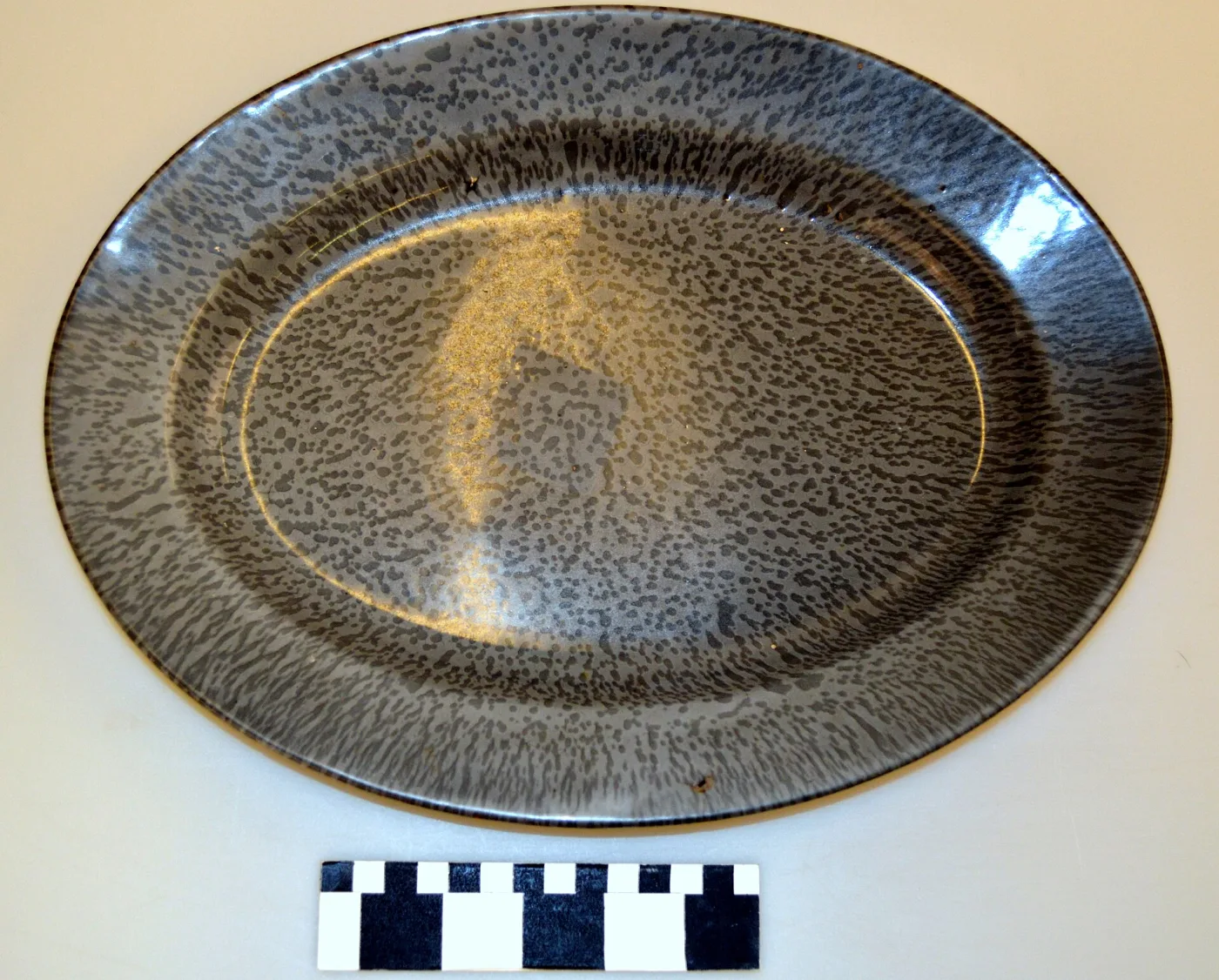
The most common pattern, mottled graniteware features irregular specks of one color scattered over a contrasting base. This effect was created by sprinkling dry enamel powder of different colors onto the piece before firing. The randomness of the speckling means no two pieces are exactly alike. Fine, even mottling is generally considered more desirable than coarse or uneven speckling.
Swirl (Agate)
Swirl patterns were created by applying two or more colors of enamel slip (liquid enamel) simultaneously and allowing them to flow together before firing. The resulting pattern resembles the veining in natural agate stone, giving rise to the term "agateware." Swirl patterns require more skill and labor to produce than mottled patterns, making them inherently scarcer. Bold, well-defined swirl patterns with good color contrast are the most valuable. The technique is somewhat similar to the decorative traditions found in pottery and ceramics.
Relish Pattern
The term "relish" in graniteware collecting refers to a specific fine-grained pattern that creates a stippled or orange-peel texture. This was achieved through a controlled application technique that produced a more uniform surface than standard mottling. Relish pattern pieces are less common than standard mottled ware and are appreciated for their refined appearance.
Solid Color & Decorated
While not technically "graniteware" in the strictest sense, solid-color enamelware is closely related and often collected alongside patterned pieces. White enamelware with colored trim (typically blue, red, or green) was the dominant style from the 1920s onward. Some manufacturers also produced pieces with decal decorations — floral motifs, fruit designs, or geometric patterns applied over the base enamel. These decorated pieces bridge the gap between utilitarian antique cookware and decorative art.
Condition Grading & Damage Assessment
Condition is critical to graniteware value. Unlike some antiques where patina adds character, graniteware derives much of its appeal from the visual impact of its enamel surface. Damage that compromises this surface directly reduces desirability and price.
Mint & Near Mint
Truly mint graniteware — showing no chips, scratches, or wear — is exceptionally rare for pieces over 100 years old. Near-mint pieces may show very minor wear to high points or slight dulling of the enamel surface but no chips or rust. Pieces in this condition command the highest prices, often several times what the same piece in good condition would bring.
Excellent to Good
Most collectible graniteware falls into this range. Excellent condition means minor chips (smaller than a dime) limited to edges and high-wear areas, with no active rust. Good condition allows for moderate chipping and some surface wear but requires the overall pattern and color to remain clearly visible and attractive. Pieces in this range represent the best value for most collectors.
Fair to Poor
Pieces with extensive chipping, significant rust, dents that distort the form, or missing parts (lids, handles, spouts) fall into this range. While rarely valuable to collectors, fair-condition pieces in rare colors or forms may still be worth acquiring. Poor-condition pieces are generally useful only as reference examples or for decorative purposes where condition is secondary to visual impact.
Repairs & Alterations
Antique graniteware was frequently repaired during its working life. Common repairs include soldered patches over holes, replaced handles, and re-enameled surfaces. While historically interesting, repairs generally reduce collector value. Re-enameled pieces can be particularly deceptive — look for inconsistent enamel thickness, color that does not match known period palettes, and modern-looking surface texture.
Identifying Reproductions & Fakes
The popularity of graniteware collecting has spawned a substantial reproduction market. Modern reproductions are widely available and range from obvious decorative items to pieces deliberately aged to deceive. Learning to distinguish old from new is essential, much like authenticating other categories of antique cast iron collectibles.
Common Reproduction Red Flags
Modern reproductions typically exhibit several telltale characteristics. The enamel surface is often too smooth and uniform compared to antique pieces, which show subtle irregularities from hand-application methods. Colors on reproductions tend to be brighter and more saturated than period colors — particularly reds, which in antique pieces have a slightly muted, brownish tone. The base metal on reproductions is usually thin-gauge steel that feels light in hand compared to antique pieces. Edges may show machine-perfect uniformity rather than the slight variations of hand-finished work.
The Chip Test
Examining chips is the most reliable authentication method. Genuine antique graniteware shows multiple enamel layers at chip sites: a dark ground coat bonded to the metal surface, topped by one or more color coats. Reproductions typically show a single enamel layer applied directly to bare metal. The exposed metal at old chip sites will show aged, darkened oxidation rather than the bright, silvery appearance of recent damage.
Country of Origin Marks
Marks reading "Made in China," "Made in Taiwan," or "Made in India" immediately identify modern reproductions. However, the absence of such marks does not confirm age, as many reproductions are unmarked. Conversely, marks reading "Germany" (without "Made in") suggest a date between 1891 and 1914, while "Made in Germany" indicates post-1914 production. These import marking conventions are valuable dating tools across many antique categories.
European Graniteware Traditions
While American graniteware dominates the collector market in the United States, European enamelware has its own rich tradition and dedicated following. European pieces often differ from American examples in both form and decoration.
French Enamelware
French enamelware, particularly pieces from the late 19th and early 20th centuries, is distinguished by its artistic decoration. While American graniteware relied primarily on mottled and swirled patterns, French producers frequently added hand-painted decorations, stenciled designs, and elaborate floral motifs. Firms like Japy Frères and De Dietrich produced pieces that blur the line between kitchenware and decorative art. French enamelware marked "FRANCE" or "MADE IN FRANCE" is dated post-1891 and post-1914, respectively.
German & Austrian Production
Germany was the birthplace of industrial enamelware production, and German firms maintained a reputation for quality throughout the production period. German graniteware tends to be heavier and more precisely finished than comparable American pieces. Austrian production was closely related, with many firms operating in both countries. Collectors prize German marbled and swirled pieces for their bold patterns and excellent enamel quality.
Scandinavian Enamelware
Swedish and Finnish enamelware from the early to mid-20th century is noted for its clean, functional designs that prefigure Scandinavian modernism. Firms like Kockums (Sweden) and Finel (Finland, later Arabia) produced pieces valued both as functional kitchenware and as examples of Nordic design. These pieces appeal to collectors who also appreciate mid-century modern aesthetics.
Rare Colors & Most Valuable Pieces
Color rarity is the primary driver of graniteware value. While condition, form, and maker all matter, a rare color in even moderate condition will outperform a common color in pristine shape.
Most Valuable Color Rankings
From most to least valuable, graniteware colors generally rank as follows: red and white swirl (the rarest and most expensive), lavender or violet (extremely scarce), cobalt blue and white swirl (the classic premium color), chrysolite green and white, brown and white swirl, blue and white mottled, solid colors with trim, and gray mottled (the most common). Within each color, swirl patterns command higher prices than mottled patterns, and unusual or vibrant variations within a color bring premiums.
Record-Setting Pieces
The highest prices in the graniteware market are achieved by pieces that combine rare color, desirable form, excellent condition, and identifiable maker. Red and white swirl coffee pots have sold for over $2,000 at specialized auctions. Lavender pieces in any form regularly bring four-figure prices. Complete children's tea sets in colored graniteware are among the most coveted items, with exceptional examples selling for $3,000 to $5,000 or more.
Emerging Collectible Colors
Collector interest continues to evolve, and certain colors that were once overlooked are gaining appreciation. Solid-color pieces in cream, yellow, and turquoise from the 1930s and 1940s are attracting new collectors who display them in vintage-styled kitchens. Two-tone pieces with contrasting interior and exterior colors are also growing in popularity, as are pieces with unusually bold or high-contrast mottling in standard colors.
Collecting Tips & Display Ideas
Building a graniteware collection is accessible and rewarding at virtually any budget level. The range of available pieces — from common gray mottled items under $20 to rare colored specimens worth thousands — means collectors can enter the field at any point and grow their collections over time.
Starting a Collection
New collectors are well served by focusing initially on a specific color, form, or manufacturer. Specializing helps develop expertise more quickly and builds a more cohesive collection. Blue and white pieces offer a good entry point: they are available in a wide range of forms and price points, and the color is consistently popular. Alternatively, collecting a single form — such as coffee pots, measures, or pie pans — across multiple colors creates an attractive and educational display.
Where to Find Graniteware
Estate sales, farm auctions, and country antique shops remain the best sources for graniteware at reasonable prices. Online auction platforms offer the widest selection but require careful evaluation of photos and seller descriptions, as condition issues may not be apparent in listings. Specialized graniteware and kitchenware collectors' shows provide opportunities to examine pieces in person and learn from experienced collectors. For guidance on evaluating pieces and negotiating prices, our antique buying and selling strategies guide offers practical advice.
Display & Decorating
Graniteware's visual appeal makes it a natural for decorative display. Open kitchen shelving, plate rails, and wall-mounted racks are popular display methods. Color-coordinated groupings — all blue and white, or a rainbow progression — create striking visual impact. Mixing graniteware with other vintage kitchen items like cast iron pieces and wooden utensils creates an authentic period kitchen atmosphere. Hanging pie pans and colanders on walls is a space-efficient way to display flat items.
Care & Preservation
Proper care preserves both the condition and value of antique graniteware. While these pieces were made for hard kitchen use, age has made them more fragile than when new.
Cleaning
Clean antique graniteware with warm water and mild dish soap using a soft cloth or sponge. Never use abrasive cleaners, steel wool, or scouring pads, which will scratch and dull the enamel surface. For stubborn stains, soak the piece in warm soapy water rather than scrubbing aggressively. Baking soda paste can be used sparingly on tough spots but test in an inconspicuous area first. Never put antique graniteware in a dishwasher — the harsh detergents and high temperatures can damage the enamel.
Rust Treatment
Surface rust at chip sites is common and can be stabilized without harming the piece. Gently remove loose rust with a soft brass brush, then apply a thin coat of museum-grade microcrystalline wax or Renaissance Wax to seal the exposed metal and prevent further oxidation. Do not use naval jelly, rust converters, or other chemical rust removers on antique graniteware, as these can stain the surrounding enamel.
Storage & Handling
Store graniteware in a dry environment to prevent rust formation at chip sites. Stack pieces carefully with soft cloth or felt between them to prevent scratching and chipping. Avoid hanging heavy pieces by thin wire handles, which can stress the handle attachments. Temperature extremes and rapid temperature changes should be avoided, as thermal shock can cause enamel to crack or flake. For comprehensive preservation strategies, see our antique storage and care preservation guide.
Current Market Values & Price Trends
The graniteware market remains active with steady demand, particularly for colored pieces in good condition. Understanding current price trends helps collectors make informed purchasing decisions and assess the value of pieces they already own.
Price Ranges by Color
Gray mottled graniteware in common forms typically sells for $10 to $50, with exceptional pieces reaching $100. Blue and white mottled pieces range from $25 to $150, while blue and white swirl commands $75 to $500 depending on form and condition. Green and white pieces fall in the $50 to $400 range. Brown and white swirl ranges from $75 to $350. Red and white pieces start at $200 and can exceed $2,000 for premium examples. Lavender and violet pieces rarely appear below $300 and frequently sell for $1,000 to $5,000.
Factors Affecting Value
Beyond color, several factors influence graniteware prices. Unusual forms (children's pieces, miniatures, specialty items) bring premiums over common forms in the same color. Identifiable maker marks add 20–50% to value compared to unmarked pieces. Complete sets with original lids are worth substantially more than lidless pieces. Provenance — documented history of ownership — adds value, especially for pieces from notable collections. Regional preferences also play a role: certain colors and forms are more popular in different parts of the country.
Market Trends
The graniteware market has shown steady appreciation over the past decade, with colored pieces consistently outperforming common gray ware. Red and lavender pieces have seen the strongest price gains, driven by their extreme scarcity and growing collector interest. The market for European enamelware, particularly French decorated pieces, has also strengthened as collectors discover this related field. Online auctions have expanded the buyer pool but also increased competition for premium pieces, particularly at the high end of the market.