
Antique Coffee Grinders & Mills Identification Guide: Makers, Types & Value
Antique coffee grinders are among the most collectible kitchen antiques on the market. They span more than two centuries of domestic and commercial life — from the small dovetailed wooden box mills of early-nineteenth-century European kitchens, through the iconic two-wheel cast iron grocer's grinders that stood on every American counter from 1870 to 1920, to the elegant wall-mounted glass-jar mills of the early twentieth century that hung beside the Hoosier kitchen cabinet. Their mechanical character, ornate cast iron, and association with one of the world's most beloved beverages have created a deep collector market with a clear hierarchy of makers, models, and condition tiers.
Identifying an antique coffee grinder means reading three things in concert: the form (box mill, wall mill, lap mill, commercial wheel grinder, side mill, or table-clamp mill), the maker's marks (cast names, paper labels, decals, and stamped numbers), and the period-correct details (crank style, hopper material, drawer construction, decals, and decorative paint). A correct attribution can move a grinder from a $40 flea-market piece to a $400 documented Enterprise No. 2, or from a $200 unknown into a $1,500 rare Logan & Strobridge "Royal" with original red paint and gold pinstriping.
This guide walks through the major form categories, the principal American and European makers, the cast-iron and brass commercial grinders that anchor the high end of the market, dating clues by patent date and decal style, original paint and pinstripe identification, condition grading, the reproductions and "marriages" that flood online sales, and the care considerations that decide whether a grinder is best displayed, used, or kept under glass.
Table of Contents
- A Short History of the Coffee Mill
- The Major Types of Antique Coffee Grinder
- Anatomy of a Coffee Grinder
- Major American Makers
- European Makers and Continental Mills
- Commercial Wheel Grinders: The Iconic Form
- Dating by Patent Date, Decal, and Detail
- Original Paint, Decals, and Pinstriping
- Materials: Iron, Brass, Wood, and Glass
- What Drives Rarity and Value
- Condition Grading and Common Defects
- Reproductions, Marriages, and Repaints
- Restoration: How Far Is Too Far
- Care, Display, and Use
- Common Mistakes Beginners Make
- Frequently Asked Questions
A Short History of the Coffee Mill
Coffee reached Europe in the seventeenth century, and the earliest grinders were adaptations of mortar-and-pestle and small spice-mill traditions. By the eighteenth century, dedicated coffee mills appeared in Turkey and the Levant — small brass cylindrical hand mills with conical burrs and folding cranks, still made in essentially the same form today. European cabinetmakers produced wooden box mills with iron mechanisms by the early 1700s, and these spread through the German states, France, and Britain, then to colonial America.
The American story shifts in the 1820s and 1830s when small foundries began casting iron coffee mills for household use, and accelerates in the 1860s with the invention of mass-production cast iron techniques and the rise of grocery retailing. From roughly 1870 through 1915, American makers — Enterprise of Philadelphia, Parker of Meriden, Arcade of Freeport, Logan & Strobridge of New Brighton, Bronson-Walton of Cleveland, Landers Frary & Clark, and dozens more — produced the cast iron, side, and wheel grinders that dominate the antique market today.
Why So Many Survive
Coffee grinders were durable, useful, and decorative. They survived in cellars, on shelves, and in shops long after electric grinders replaced them in the 1920s. Cast iron resists most kinds of decay, and the heavy commercial wheel grinders are too valuable as scrap to have been discarded casually even in lean years. The result is a deep population of surviving examples in every condition tier, and an active collector market with well-developed price benchmarks.
Where Coffee Grinders Sit Among Kitchen Antiques
Coffee grinders are part of a broader family of mechanical kitchen tools — apple peelers, food choppers, cherry pitters, and similar cast iron devices that share the same makers, the same patent-driven design culture, and similar collector communities. For broader context on the era's domestic technology, see our kitchenware and utensils identification guide.
The Major Types of Antique Coffee Grinder
Six form families account for nearly all collectible antique coffee grinders. The form is the first thing to identify; everything else — maker, date, value — follows from it.
Box Mills
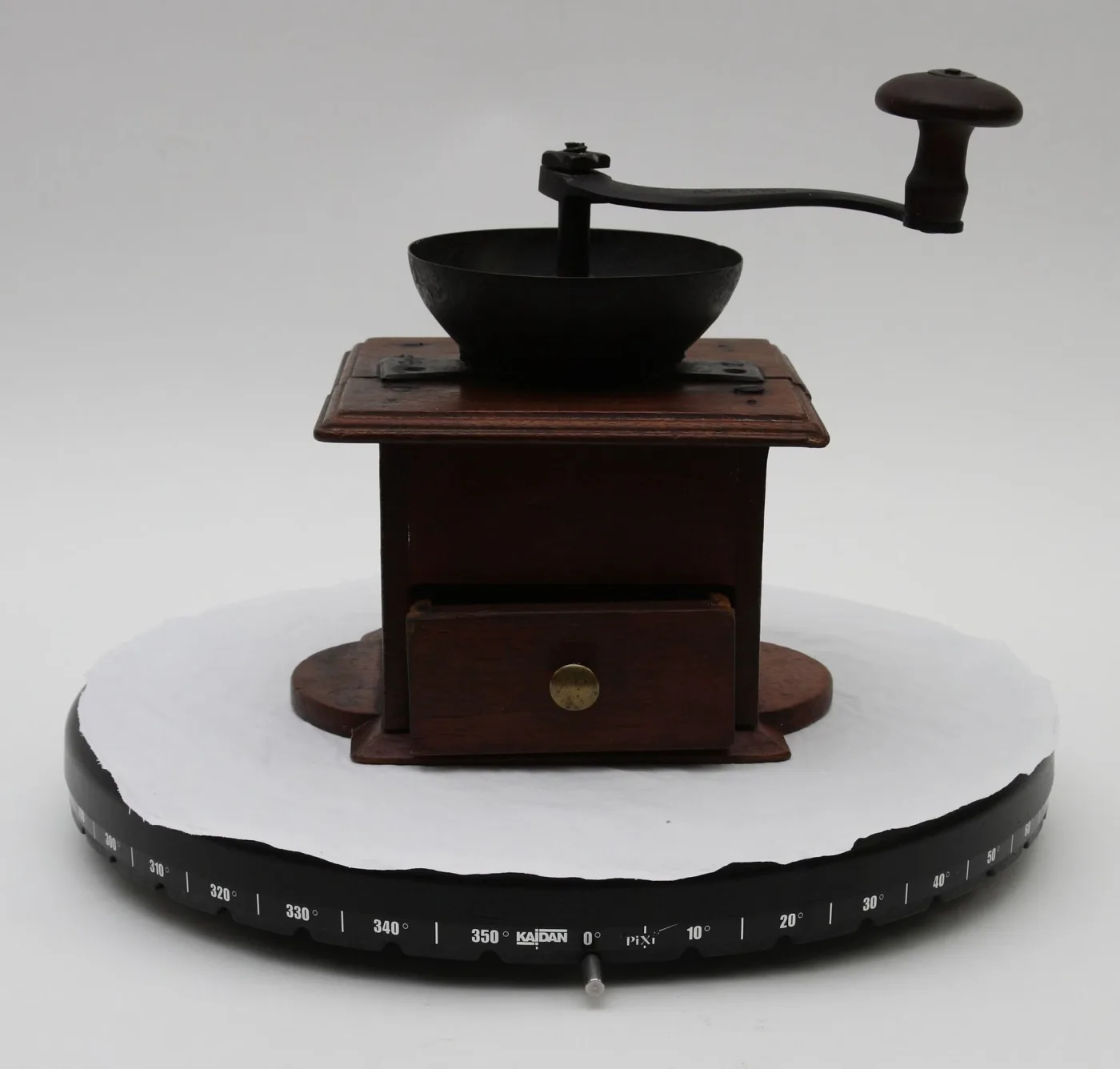
The classic European-American household form, in production from the early 1700s to about 1930. A square or rectangular wooden box, often with dovetailed corners, holds a small drawer at the bottom to catch the ground coffee. A cast iron hopper sits on the top, fitted with a vertical shaft and a removable side or top crank. Box mills range from plain country-pine versions to highly decorative inlaid and parquetry pieces from German and French cabinetmakers. Examples typically run $40 to $300, with rare maker-marked examples reaching $500 or more.
Lap Mills
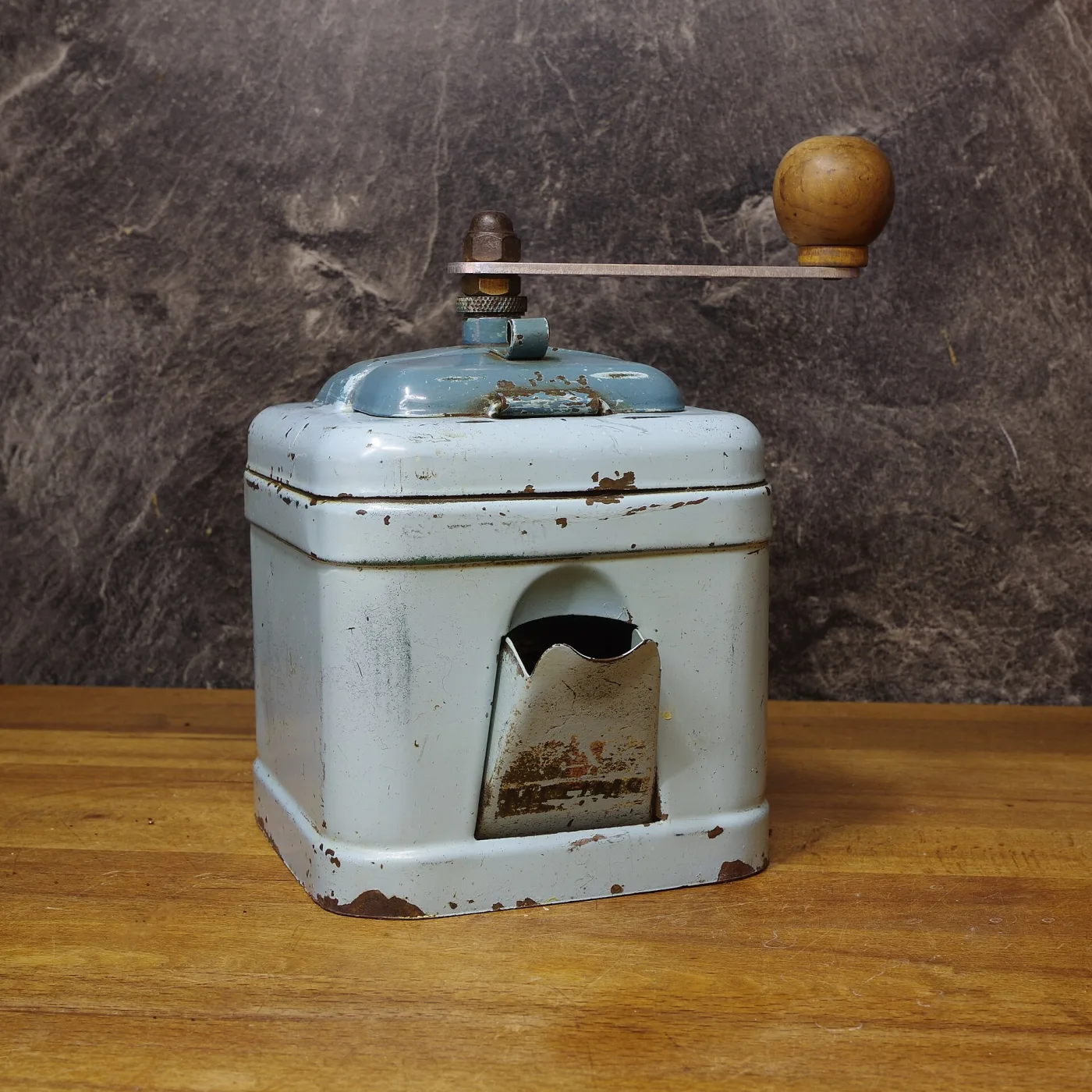
Small, hand-held mills meant to be used while seated, with the body braced between the knees. Usually all cast iron, with an open or covered hopper and a side-mounted crank. Lap mills are distinct from box mills in that they have no drawer — the ground coffee falls into a small cup or directly into a vessel held below. Many surviving examples come from the early-to-mid nineteenth century.
Wall-Mounted Mills
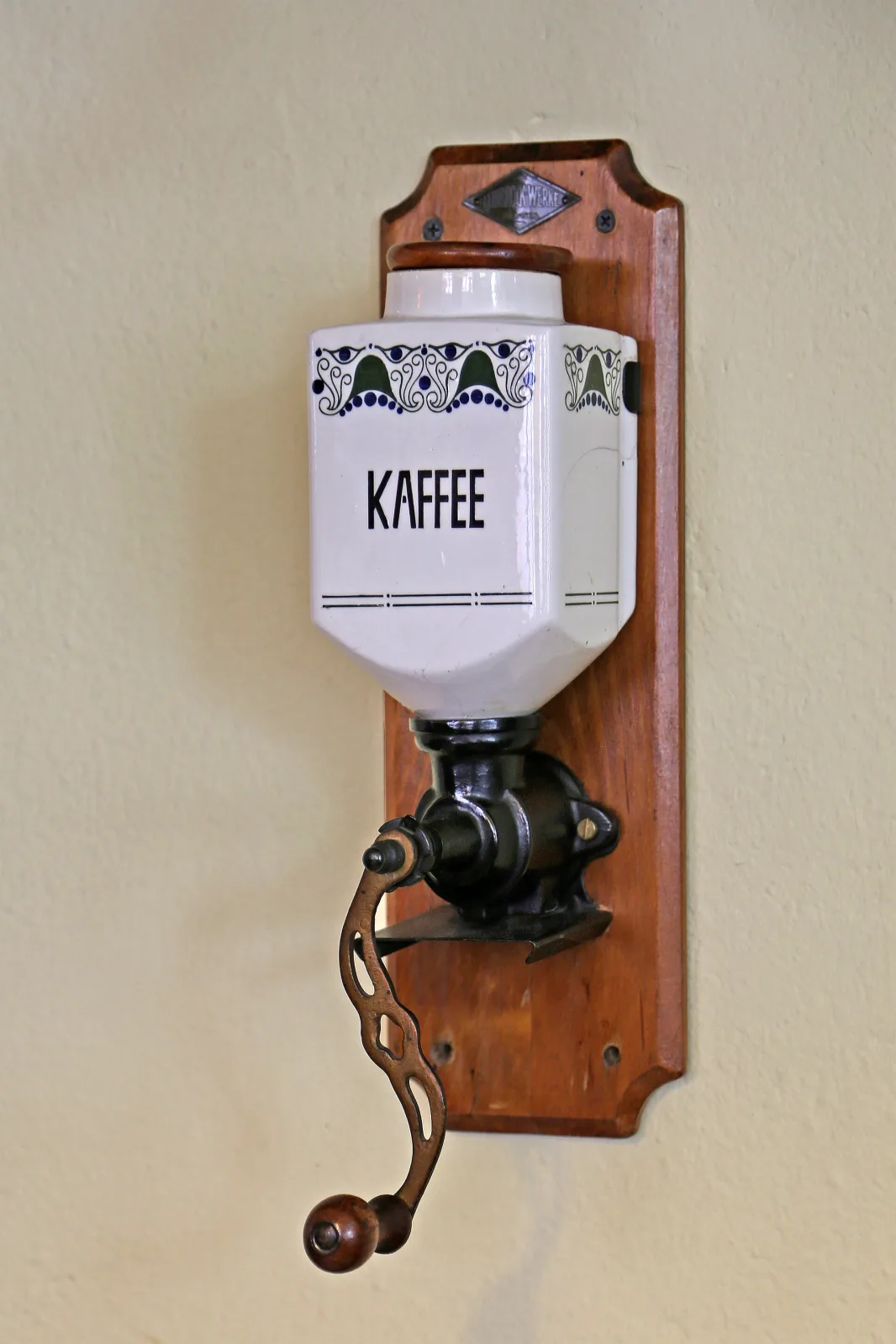
A twentieth-century form, popular roughly 1900-1940. A cast iron mechanism mounts to a wall plate, with a glass jar above to hold whole beans and a glass or metal cup below to catch the grind. Arcade Manufacturing's "Crystal" series and similar mills from Bronson-Walton, Logan & Strobridge, and Parker dominate this category. Wall mills with all original glass and decals are highly collectible.
Side Mills (Wall-Mounted Wood-Backed)
A predecessor to the wall mill, common in the 1880s-1900s. A small cast iron mill bolts to a square wooden backboard that mounts on a wall or kitchen post. The mechanism is identical to a box mill but inverted and back-mounted. These are scarcer than box mills and bring premium prices when complete with their original wooden backboard.
Counter (Lap-Style) Commercial Mills
Larger lap-style mills with a single horizontal flywheel, designed for store counter use. The shopkeeper stood beside the mill and turned a vertical crank. These are the bridge form between domestic mills and the iconic two-wheel grocer's grinders.
Two-Wheel Commercial Wheel Grinders
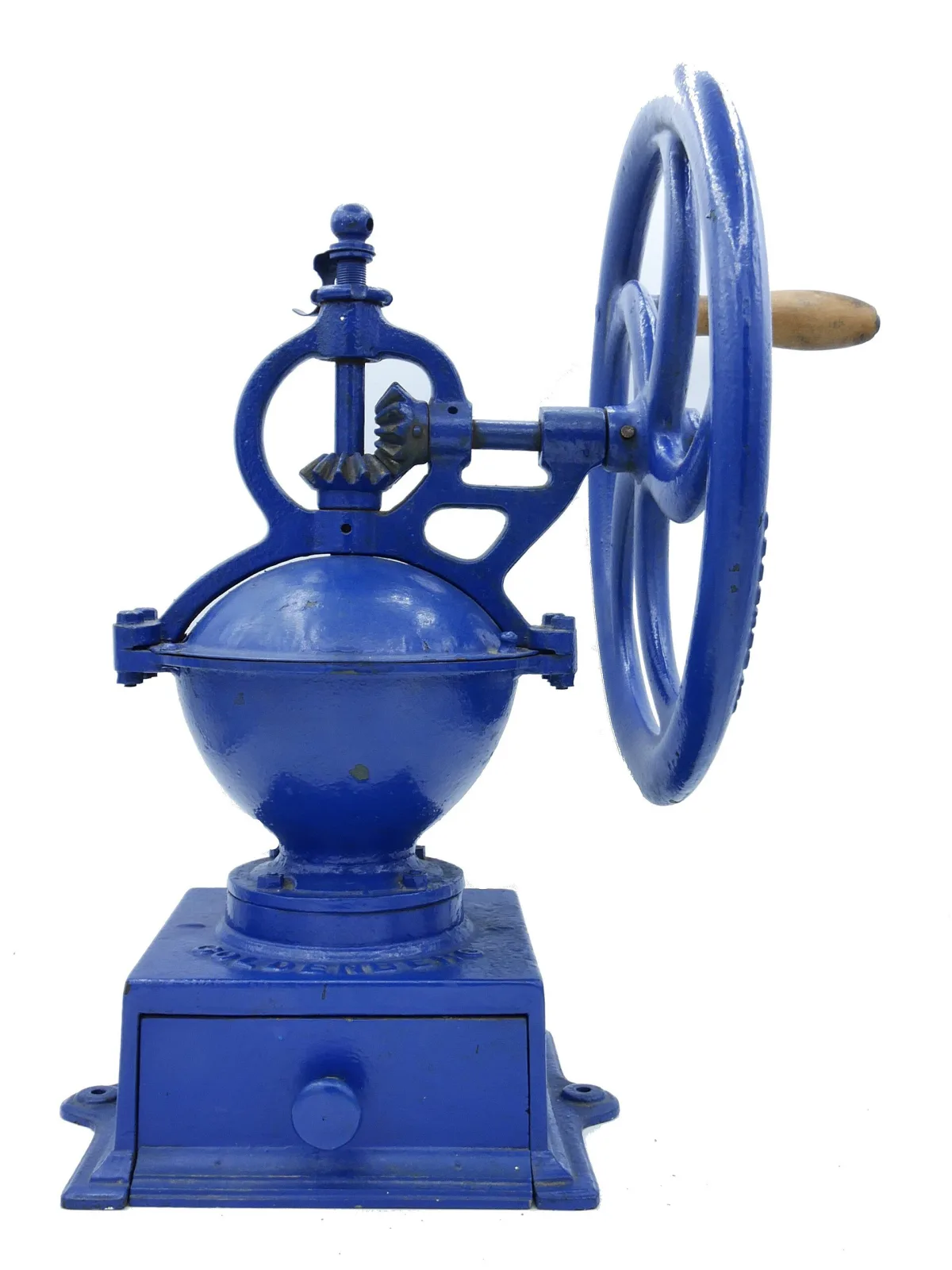
The form most non-collectors picture when they hear "antique coffee grinder." A heavy cast iron base and central hopper flanked by two large balance wheels (typically 16-26 inches in diameter), turned by a crank handle on one wheel. Mounted on grocery counters, originally in stunning red, blue, or green paint with gold pinstriping and stenciled maker's names. Enterprise, Elgin, Coles, Swift, and Star are the most common American makers; surviving wheel grinders in original paint and complete condition bring $800 to $3,500, with documented rare colors and large sizes reaching $5,000 or more.
Anatomy of a Coffee Grinder
Knowing the parts lets you assess completeness, identify replacements, and recognize marriages (parts from different mills assembled to look like one).
The Hopper
The container that holds whole beans before grinding. On box mills the hopper is a small cast iron cup, often square or octagonal. On commercial wheel grinders the hopper is a large polygonal casting with a hinged or removable lid, typically the largest single iron casting on the machine. Original hopper lids are commonly missing.
The Burr or Grinder Mechanism
The cutting elements — paired conical or flat metal burrs that crush the beans between them. One burr is fixed; the other rotates with the crank shaft. An adjustment nut or screw, usually on the top of the hopper or under the crank, sets the gap between burrs and thereby the grind coarseness. Worn burrs reduce both function and value.
The Crank and Handle
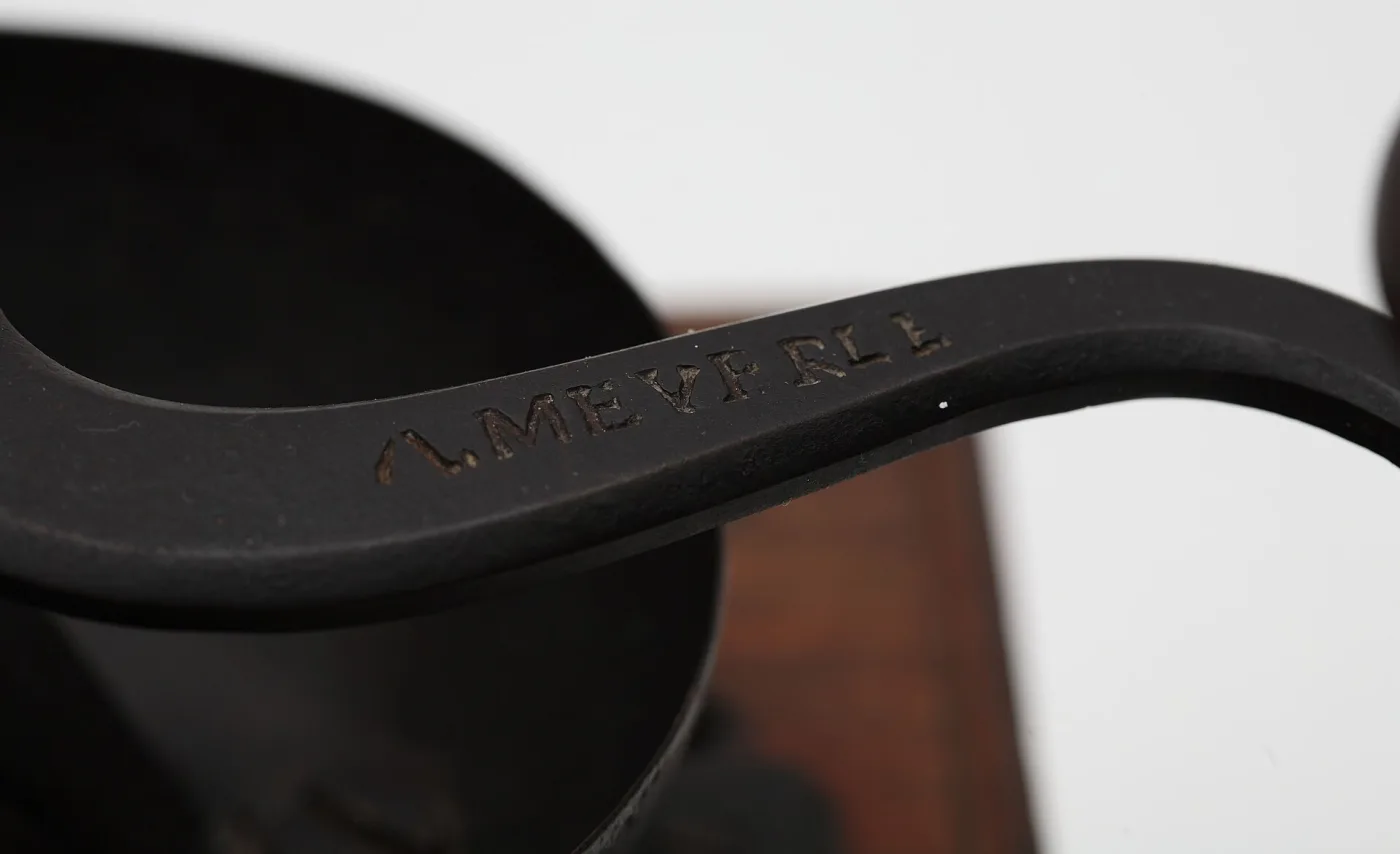
The horizontal arm with a wooden or iron handle on its end. Original crank handles on box mills are commonly turned wood, sometimes painted black. On wheel grinders the crank attaches to one of the wheels and ends in a wooden grip. Replacement handles are extremely common on box mills and are an easy detail to overlook.
The Drawer (Box Mills)
The small wooden drawer at the bottom of the box that catches ground coffee. Original drawers have hand-cut dovetails on early examples and machine-cut joints from about 1880. The drawer pull may be a small turned wood knob or a cast iron pull. Replacement drawers are a frequent issue and are usually betrayed by inconsistent wood color or modern joinery.
The Catch Cup or Glass Jar
On wall-mounted mills, a glass receiver hangs below the mechanism to catch the grind. On the "Crystal" Arcade and similar designs, a clear or amber pressed-glass cup with a metal collar attaches by friction or threads. Original glass cups are often broken and replaced; embossed maker names on the glass help confirm originality.
The Wheels (Commercial Grinders)
The large balance wheels of a commercial grinder serve two functions: they smooth the grinding action through inertia and they make the machine visually impressive on a store counter. Wheels are nearly always cast in pairs and pinstriped to match. Mismatched wheels are an obvious sign of a marriage.
The Base or Stand
Commercial grinders sit on heavy cast iron platforms, usually with mounting holes or feet. Enterprise grinders frequently have a cast Enterprise eagle on the front of the base. The base is part of the grinder's identity — a grinder with a non-original base loses value.
Major American Makers
A dozen American firms account for the vast majority of collectible domestic and commercial coffee grinders. Recognizing each maker's signature castings, decals, and quirks is the heart of grinder identification.
Enterprise Manufacturing Co. (Philadelphia, 1864-1956)
Enterprise is the most important American name in commercial coffee grinders. Founded 1864 by the Wagner family, Enterprise produced grinders, meat choppers, sausage stuffers, and a wide range of cast iron domestic machinery. Enterprise's two-wheel grinders — Models No. 0 through No. 9, with wheel sizes from 9 to 25 inches — are the iconic grocer's grinders. Originally finished in red enamel with gold pinstriping and the cast Enterprise eagle on the front, an unrestored Enterprise with substantial original paint is a signature antique kitchen piece. Enterprise model numbers are cast directly into the body or hopper.
Parker, Charles & Co. (Meriden, Connecticut, c. 1832-1957)
Parker produced an extensive line of small box mills, side mills, and wall mills, mostly for home use. Parker mills are typically marked with "PARKER'S" cast on the hopper or a small decal reading "Charles Parker Co. Meriden, Conn." Parker's "National" series of small box mills was sold by the millions; National-marked examples are very common but desirable when complete with original drawer, crank, and decal.
Arcade Manufacturing Co. (Freeport, Illinois, 1885-1946)
Arcade produced both household and commercial grinders, but is best remembered for its wall-mounted "Crystal" series — cast iron mechanisms with embossed clear or amber glass jars for beans and grind. Arcade also made cast iron toy banks and the famous Arcade toy car line, and the toy market has helped sustain Arcade collector interest. "Arcade Mfg. Co. Freeport, Ill." appears on the casting or on a decal.
Logan & Strobridge (New Brighton, Pennsylvania, 1892-c.1924)
Premium maker of decorative box mills and wall mills, often with very ornate cast hopper details and high-quality original paint with elaborate pinstriping and stencils. The "Royal" and "Telephone" wall-mounted models are particularly desirable; mint examples in original paint can reach four figures.
Bronson-Walton Co. (Cleveland, Ohio, c. 1905-1925)
Specialist in canister-style wall mills with a cylindrical metal canister above the mechanism (rather than a glass jar). Bronson-Walton mills often carry colorful lithographed labels rather than decals — these labels are extremely fragile and a complete one substantially raises value.
Landers, Frary & Clark (New Britain, Connecticut, 1842-1965)
Best known for the "Universal" brand of household products. Universal coffee mills are common, durable, and generally inexpensive on the antique market — solid users rather than rare collectibles, with most examples bringing $30-$100.
Coles Manufacturing Co. (Philadelphia, c. 1850s-1890s)
Producer of high-end commercial grinders that competed with Enterprise. Coles grinders are scarcer and bring premium prices when properly identified. Look for "COLES MFG. CO. PHILA. PA." cast on the hopper.
Elgin National Coffee Mill Co. (Elgin, Illinois)
Made commercial wheel grinders sold widely in the late nineteenth and early twentieth centuries. Elgin grinders are common on the antique market and represent the mid-tier of commercial grinders by current value.
Other American Names
Swift, Star, Ideal, Champion, Sun, Lane Brothers, Steinfeld, Brighton, and dozens of smaller foundries produced grinders in the great American mill era of 1870-1915. Any unfamiliar maker mark is worth researching — small-foundry grinders are often more valuable than common Enterprise examples simply because they are scarce.
European Makers and Continental Mills
European grinders form a parallel collecting category with strong followings in their home markets and a steady transatlantic flow of better examples.
Peugeot Frères (France, 1840-present)
Peugeot — yes, the same family that became the automaker — began producing coffee mills and pepper mills in 1840 and is still making them. Their patented helical burr grinder, marked "Peugeot Frères Breveté" or with the famous lion logo, is one of the most distinctive European designs. Antique Peugeot mills in working order with original wood boxes and brass hoppers bring $80-$300 routinely.
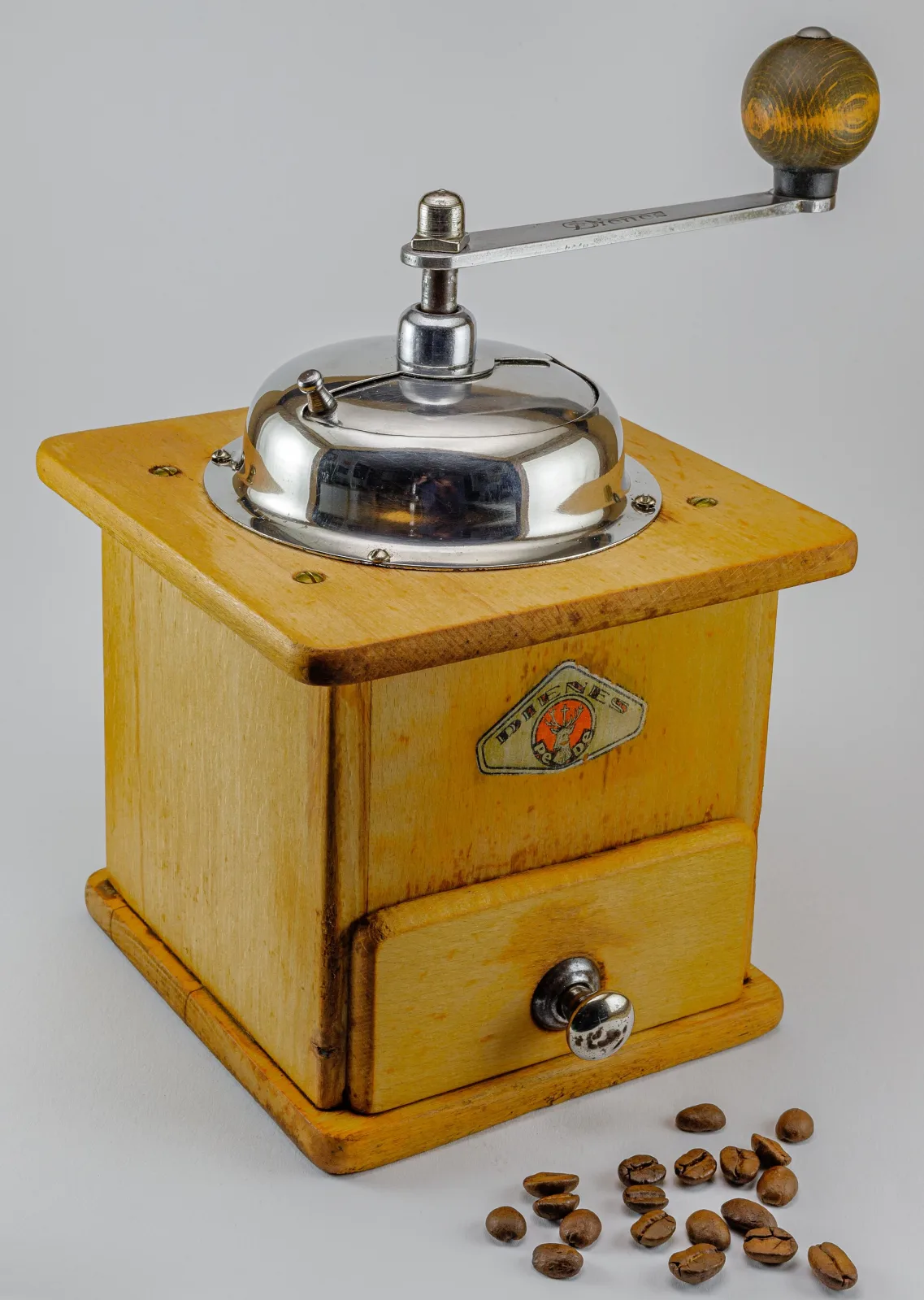
PeDe (Dienes, Germany, c. 1900-1960)
German wall mills with characteristic colorful enamel-and-glass construction. PeDe wall mills with intact glass and crisp decals are sought after by both German and American collectors. The "Eheim" and "Zassenhaus" names are similar German makers worth knowing.
Zassenhaus (Solingen, Germany, 1867-present)
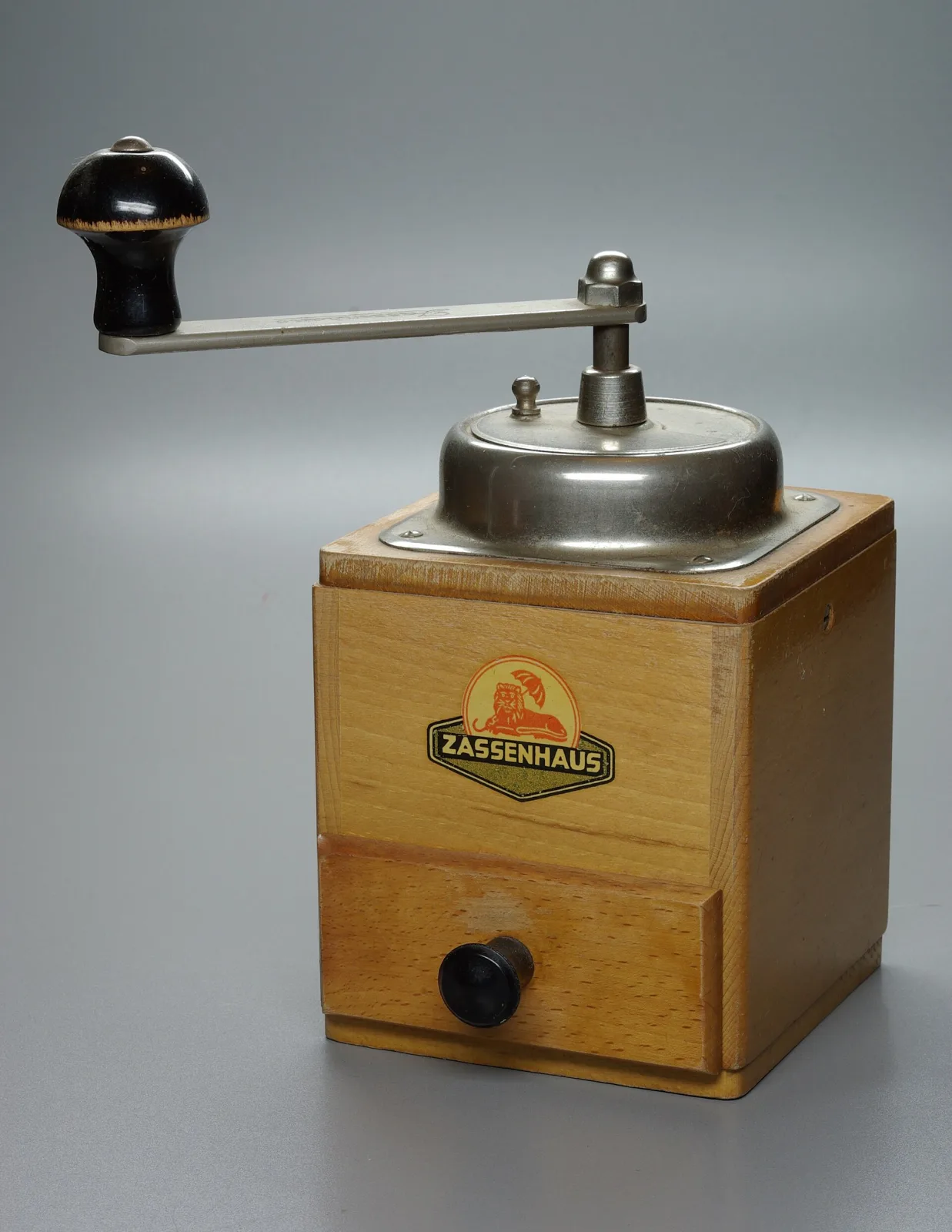
High-quality German wood-and-iron box mills, still in production. Antique Zassenhaus mills feature exceptionally well-machined burrs and are prized as both collectibles and users.
British Makers
Kenrick, Archibald Kenrick & Sons of West Bromwich, Baldwin Son & Co., and various Birmingham foundries produced commercial and domestic grinders for the British and colonial markets. British grinders tend to be more conservative in decoration than American ones and often feature ornate cast iron rather than painted finishes.
Turkish and Middle Eastern Brass Mills
Cylindrical brass hand mills with folding cranks, in production essentially unchanged from the seventeenth century to today. Genuinely old examples — eighteenth- and early-nineteenth-century — are difficult to date by appearance because the form is so consistent. Provenance and patina matter more than visible date markers. For other antique brass items of similar craftsmanship traditions, see our brass and bronze identification guide.
Commercial Wheel Grinders: The Iconic Form
The two-wheel grocer's grinder is the most recognizable, photographed, and heavily collected form of antique coffee mill. Knowing the hierarchy of size, maker, paint, and condition turns these from "old and big" into precise and accurately valued objects.
Sizing by Wheel Diameter
Commercial grinders are categorized by the diameter of their balance wheels. Common sizes:
- 9-12 inch wheels — small countertop models, lighter use
- 14-17 inch wheels — standard grocery counter grinders, the most common surviving size
- 18-22 inch wheels — larger commercial models for high-volume stores
- 24-30 inch wheels — flagship "store-front" grinders, rare and dramatic
Larger wheels generally bring higher prices, but rare small models in unusual paint can outprice common large ones.
Reading the Decoration
Original commercial grinders were finished in striking colors — most commonly red, but also blue, green, dark maroon, and occasionally black or white. Wheels were painted to match the body and pinstriped in gold or yellow with delicate hand-applied lines. Stenciled maker's names and model numbers in gold or contrasting paint were standard. Decals on the front of the body advertised the maker and sometimes the retailer.
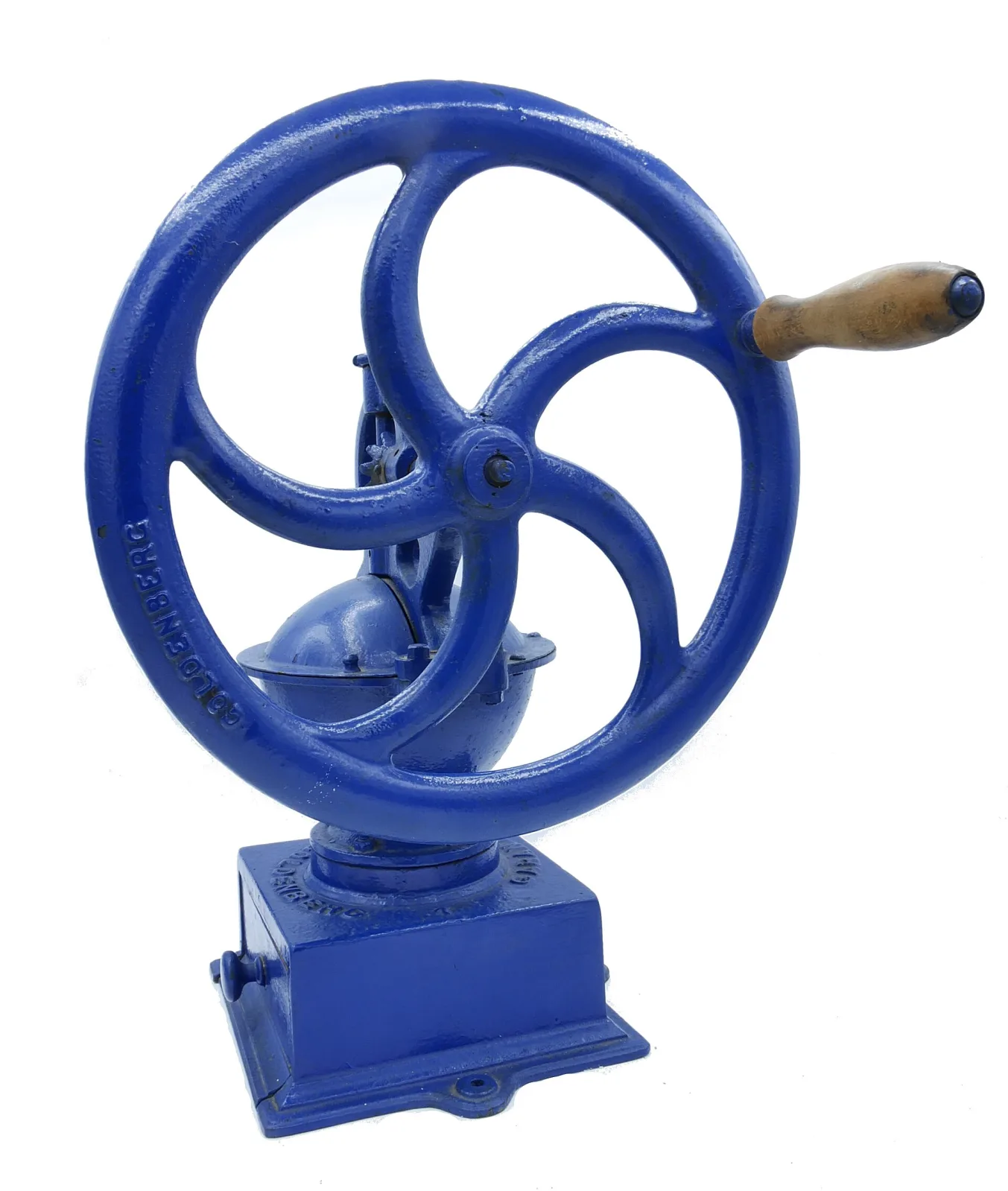
An original grinder in unrestored paint with most pinstripes and decals intact is far more valuable than a freshly repainted one — typically two to three times the price of a repaint, even if the repaint is professional. Collectors strongly prefer "as found" originality over restoration. For broader principles on preserving original surfaces, see our antique restoration and conservation guide.
Enterprise Model Hierarchy
Enterprise's wheel-grinder line is the most studied. Common surviving models include:
- Enterprise No. 0 — small countertop, 8.75-inch wheels — $400-$900
- Enterprise No. 1 — 9.75-inch wheels — $500-$1,200
- Enterprise No. 2 — 10.75-inch wheels — $700-$1,500
- Enterprise No. 3 — 12-inch wheels — $1,000-$2,200
- Enterprise No. 7 — 17-inch wheels — $1,800-$3,500
- Enterprise No. 9 — 25-inch wheels — $3,000-$6,500+
Prices reflect average condition; mint original-paint examples can double these figures, and stripped or repainted examples drop to roughly half.
The Eagle and the Horse
Enterprise grinders typically carry a cast iron eagle finial on the top of the hopper between the wheels — sometimes referred to as the "Enterprise eagle." Coles grinders often feature a cast horse or other figural element. These cast figures are commonly missing on surviving examples and substantially raise value when present and original.

Dating by Patent Date, Decal, and Detail
Coffee grinders rarely carry an explicit production date. Dating relies on patent dates cast or stamped into the metal, decal style and design, hardware details, and the broader trajectory of each maker's product line.
Patent Dates
Many cast iron grinders carry one or more U.S. patent dates cast into the body, often near the maker's name. The latest patent date is the floor for production — the grinder cannot have been made earlier. Production typically continued for years or decades after the patent date, so a grinder marked "PAT. NOV. 14, 1893" might have been made anywhere from 1893 to 1925. Patent dates are the single most reliable dating clue but are useful only as a lower bound.
Decal Style
Decal designs evolved across decades. Pre-1900 decals tend to be simple, often just the maker's name in a banner or scroll. Decals from 1900-1915 are more elaborate, with multi-color lithographed designs, intricate borders, and product slogans. Post-1915 decals show Art Deco influence — geometric borders, sans-serif lettering, and simpler color palettes. Decal style alone can date a grinder within a 10-15 year window.
Crank Handle Construction
Pre-1880 box mill cranks frequently feature hand-turned wooden handles attached with hand-forged iron pins. Late nineteenth-century cranks use machine-turned handles with screw-fixed iron caps. Twentieth-century cranks often have stamped sheet-metal handle caps and wire-formed crank arms. Handle construction is a useful corroborating clue when patent dates are absent or ambiguous.
Drawer Joinery (Box Mills)
Hand-cut dovetails — irregular and slightly variable spacing — indicate pre-1880 production. Machine-cut dovetails — perfectly even spacing, typical of late nineteenth-century cabinetry — indicate 1880 to roughly 1920. Stapled or pinned drawers indicate twentieth-century production. The joinery on a box mill drawer is one of the most reliable dating tools available, since drawers are rarely replaced cleanly.
Glass and Decoration (Wall Mills)
Pressed-glass jars on wall mills carry their own date markers. Embossed brand names with serif fonts and ornate scrollwork indicate 1900-1915. Streamlined sans-serif embossing on glass indicates 1920s-1930s. Hand-painted decoration on glass is rare on production mills and may indicate either a presentation piece or a later embellishment.
Original Paint, Decals, and Pinstriping
For commercial grinders especially, original surface decoration is the single largest value driver. Learning to read paint condition is the most useful skill in the field.
Recognizing Original Paint
Original paint on a cast iron grinder shows a specific pattern: heavier wear on contact points (crank handle, drawer pull, hopper lid edge), lighter wear on protected areas (back of hopper, undercarriage, inside the wheel spokes), age cracks and crazing in the paint surface, and consistent fading across exposed areas. Repaints lack this gradient — a "uniform" old-looking paint is almost always a repaint.
Pinstriping
Original pinstripes on commercial grinders were applied by hand with fine brushes, almost always in gold leaf or gold-mixed paint. Original stripes show slight variation in width and occasional brushwork irregularities. Modern repainted stripes are too even — applied with stencils or striping tools, with mechanical regularity. Surviving original stripes are commonly worn through in spots; the fact that they are partial actually confirms originality.
Decal Originality
Original decals are hand-applied transfers, typically slightly raised above the surrounding paint surface with visible edge line. They show wear, fading, and sometimes lifting at corners. Modern reproduction decals are flat, perfectly placed, and typically much more saturated in color than originals. Decals on previously unrestored grinders sometimes lift off in handling — handle restored grinders with original decals very gently.
The Patina Question
"Patina" on a coffee grinder means the cumulative effect of decades of light wear, dust, oxidation, kitchen grease, and soft handling. It is a complex layered surface that cannot be reproduced. Stripping a grinder to bare metal — even with chemical methods that "preserve" the iron — destroys the patina permanently. The corollary: a grinder with intact original paint and patina is a one-way object. You cannot get the patina back if you remove it.
Materials: Iron, Brass, Wood, and Glass
Cast Iron
The dominant material for grinder bodies, hoppers, wheels, and mechanisms. Cast iron is durable but rusts when paint is breached. Surface rust is normal and acceptable on unrestored grinders; deep pitting is a defect. Cast iron parts carry casting numbers and maker's names cast directly into the metal.
Brass and Bronze
Used for burrs, adjustment nuts, and small fittings on cast iron grinders. Turkish and Middle Eastern grinders are entirely brass. European premium box mills sometimes have brass hoppers over wood boxes. Brass parts that need polishing should be polished cautiously and sparingly — over-polishing destroys patina here as elsewhere.
Wood
Box mill bodies and drawers, side mill backboards, crank handles, and drawer pulls. Common woods include pine, oak, maple, and (on premium European examples) walnut, mahogany, and rosewood. Wood components are commonly damaged or replaced — original wood with original finish substantially raises value. For broader perspective on identifying period furniture woods, see our antique pine furniture identification guide.
Glass
Used for the upper bean jars and lower grind cups on wall mills. Pressed glass with embossed maker's names is the most common type. Glass is fragile and frequently broken; replacement glass without embossing reduces value substantially. Original embossed glass with the correct maker is essential to a top-tier wall mill valuation. For more on identifying period pressed glass, see our antique glass identification guide.
Lithographed Tin and Steel
Bronson-Walton and similar wall-mill makers used lithographed steel canisters in place of glass jars. Lithographed labels are exceptionally fragile and complete labels substantially raise value. Storage in dry conditions is essential — moisture peels lithographed labels permanently.
What Drives Rarity and Value
Coffee grinder values move on several axes. The same maker and model can vary 5x in price based on these factors.
Maker
Premium makers (Logan & Strobridge, Coles, early Enterprise) bring top dollar; mid-tier (Arcade, Bronson-Walton, Parker) bring strong middle prices; common makers (Universal, late-era unmarked mills) bring entry-level prices. Maker is usually the largest single value variable.
Form Rarity
Within any maker, certain forms are rarer than others. Wall mills are scarcer than box mills; commercial wheel grinders are the most valuable form per individual unit. Among Enterprise grinders, the small No. 0 and the giant No. 9 are scarcer than the mid-range No. 2-3.
Color and Paint
Standard red Enterprise grinders are common. Blue, green, white, and black-painted commercial grinders are scarce and valuable — a green Enterprise No. 2 in original paint can bring 2-3x a red one. Decorative variants (special-order paints, Art Nouveau decoration) bring large premiums.
Original Finish vs. Restored
An unrestored grinder with substantial original paint is almost always worth more than a freshly restored example. Beginners often see the "pretty" repainted version as more valuable; the experienced market sees originality as the highest value.
Size
For commercial grinders, larger generally equals more valuable, though scarce small models break this rule. For domestic mills, size matters less than form and condition.
Provenance
A documented store provenance — "from the original Smith's Grocery in Pittsburgh, sold to current owner's grandfather in 1925" — adds 20-50% to a commercial grinder's value. Period photographs of the grinder in its original setting are exceptionally valuable. For broader principles on documenting object provenance, see our authentication and provenance research guide.
Completeness
Original drawer, original crank, original hopper lid, original decals, original glass — each missing or replaced part takes value off. A "complete and original" grinder commands a premium that often exceeds the cost of the missing parts individually.
Condition Grading and Common Defects
Coffee grinder condition is assessed on functional, structural, and surface dimensions. A practical four-tier grading scale fits most market work.
Mint / Near Mint
Substantially intact original paint with full pinstriping and decals; complete original parts including crank, drawer, hopper lid, and glass; mechanism in full working order; minor surface wear consistent with light use only. Very rare for commercial grinders, more achievable for box mills.
Excellent
50-80% original paint visible, most pinstripes and decals present though faded; complete or very nearly complete original parts; mechanism works smoothly. The realistic upper grade for most surviving commercial grinders.
Good
30-50% original paint, some pinstripes and decals visible; some replaced parts (crank handle, drawer, glass); mechanism works but stiffly. The grade most surviving grinders fall into.
Fair / Project
Less than 30% original paint or fully repainted; multiple missing or replaced parts; mechanism may not function. Suitable for restoration projects or display only.
Common Defects to Inspect
- Cracked castings — especially in hopper bodies and on commercial grinder bases. Cracked castings are difficult to repair invisibly and substantially reduce value.
- Worn or chipped burrs — dramatically reduce function. Replacement burrs are sometimes available for common Enterprise sizes.
- Replaced wooden parts — modern wood, modern finish, or modern joinery on drawers, backboards, and handles.
- Repainted bodies — particularly when described as "professionally restored."
- Replacement glass on wall mills — usually betrayed by missing or wrong embossing.
- Marriage of parts — a hopper from one mill, a base from another, wheels from a third. Matching casting numbers and consistent paint patina across parts confirm an original assembly.
Reproductions, Marriages, and Repaints
The coffee grinder market has its own ecology of reproductions, frankenstein assemblies, and aggressive restorations. Knowing the patterns prevents costly mistakes.
Outright Reproductions
Cast iron reproduction wheel grinders have been imported from Asia in modest numbers since the 1990s. They are typically small (8-12 inch wheels), painted bright red or black with crude pinstripes, marked with fictitious or vague maker names, and sold as decorative pieces. Tell-tales include thin, sharp casting detail (originals were sand-cast and have softer lines), modern bolt and screw heads, mechanically perfect paint, and decals printed on modern adhesive backing. New decorative wheel grinders sell for $80-$200 and are easily distinguished from period examples once you have handled both.
Marriages and Frankensteins
More common and more dangerous than outright fakes are mills assembled from parts of multiple period machines. A grinder might have an Enterprise hopper, Coles wheels, and a generic period base. Look for:
- Inconsistent paint color and wear patterns across major castings
- Casting numbers that do not match across paired parts (wheels especially)
- Bolt holes on the base that don't align cleanly with the body — drilled to fit
- Maker names that contradict each other on different parts
Aggressive Restoration / Repainting
Repainted commercial grinders are widespread on the antique market. A repaint is not a fake — it's a legitimate restoration choice. But many repainted grinders are sold with implied or stated original-paint claims that don't hold up. Repaints typically show: too-even color, mechanically straight pinstripes, modern decal materials, blocked or filled casting detail (paint built up in the cast lines), and no patina in protected areas.
Reproduction Decals
Reproduction decals for popular Enterprise and Arcade models have been available for years. Skilled application can produce a convincingly "original looking" decal, especially when applied over a period or aged paint surface. Cross-checking the decal style against documented period photographs in maker catalogs is the most reliable defense.
"New Old Stock" Claims
Occasional listings claim "new old stock" — meaning unused, period-original. Genuine NOS coffee grinders are extremely rare; most claims are exaggerated or false. Verify with original packaging or a documented warehouse provenance before paying NOS-tier prices.
Restoration: How Far Is Too Far
Coffee grinder restoration is a contested topic. The market consensus is unambiguous: less is more.
Acceptable Conservation
Stabilizing rust without stripping paint, cleaning grease and grime with mild solvents and soft cloths, lubricating mechanisms with light machine oil, replacing missing burrs with period-correct or accurate reproduction parts, and applying microcrystalline museum wax over original surfaces are all widely accepted by collectors. None of these actions destroys originality.
Borderline Choices
Replacing missing wooden drawers with carefully matched reproduction wood, replacing broken glass with reproduction glass that matches the original embossing, and touching up small paint losses with carefully matched paint occupy a gray zone. Disclose these changes when reselling — undisclosed touch-ups become deceptive.
Aggressive Restoration
Stripping to bare metal, repainting with new color and pinstriping, applying reproduction decals, and replacing major castings are restoration choices that produce a "decorator" piece rather than an antique. A fully restored Enterprise No. 2 looks beautiful but typically brings 40-60% of an unrestored original-paint example. If the original paint is essentially gone before you start, restoration can rescue a piece for display use; if substantial original paint survives, restoration usually destroys value.
The Deciding Question
"Will this grinder be worth more or less if I leave it alone?" For pieces with substantial original paint and decals, the answer is almost always "more" — leave it. For pieces already stripped, restored once, or with no remaining original surface, sympathetic restoration can be defensible.
Care, Display, and Use
Cleaning
Dust with a soft brush. Wipe lightly with a barely damp cloth to remove kitchen grease. Avoid soaking wood components, which warps and lifts paint. Avoid metal polishes on painted iron — polish dissolves paint and decals. For brass burrs and fittings, use the lightest possible cleaning that preserves patina.
Display Environment
Stable temperature and humidity, away from direct sunlight (which fades paint and decals), away from kitchen cooking environments (grease and humidity damage paint and lithographed labels), and on stable shelving (cast iron is heavy — Enterprise No. 9 grinders weigh over 100 pounds). Consider a glass or open display case for premium examples.
Use
Vintage box mills can still grind coffee well, and using a Peugeot or Zassenhaus mill is part of their pleasure. But heavy-use grinding accelerates wear on burrs and exposes the wood and paint to coffee-bean oils. For premium examples or any grinder with substantial original paint, do not use as a working mill. A modern hand grinder will deliver better grind for daily coffee than a beat-up century-old mill.
Mechanism Lubrication
A tiny amount of light machine oil on shafts and bearings keeps mechanisms turning. Avoid penetrating oils inside the burr chamber — they contaminate any future coffee grinding.
Storage
If storing for extended periods, wrap in acid-free tissue, place in a cardboard box (not plastic — plastic traps humidity), and store in a dry, temperature-stable area. Avoid attics and basements; both have humidity and temperature swings that damage iron, paint, decals, and wood. For storage best practices applicable to all antique kitchen and metalware, see our antique storage and preservation guide.
Common Mistakes Beginners Make
Mistake 1: Polishing Cast Iron Bright
Stripping paint and polishing the cast iron underneath produces a "shiny" piece that looks new and brings half the price of an unrestored original. The cast iron was never meant to be seen.
Mistake 2: Over-restoring Wood Boxes
Refinishing a box mill's wooden body with modern polyurethane removes original finish, original tool marks, and original patina. The result is functional but sterile, and worth less.
Mistake 3: Confusing Maker Decals with Maker Marks
A decal can be applied to any grinder. Cast maker names — set into the iron itself — are far harder to fake. Always verify decals against cast markings when both are present.
Mistake 4: Buying by Photo Without Inspection
Online photographs flatter repainted commercial grinders. Marriages, repaints, and missing parts are difficult or impossible to detect from listing photos. For grinders priced over $300, in-person inspection or detailed additional photographs (close-ups of paint, casting details, drawer interior, mechanism) are essential.
Mistake 5: Assuming Bigger Equals Better
A small Enterprise No. 0 in mint original paint frequently outprices a huge No. 7 in repaint. Size matters, but condition and originality matter more.
Mistake 6: Ignoring the Drawer
Box mill drawers are commonly replaced. The drawer alone tells a substantial part of the dating story. Always pull and inspect.
Mistake 7: Underestimating European Mills
American collectors sometimes overlook fine European mills. A premium Peugeot or Zassenhaus in original condition often outprices a mid-tier American box mill, and rare PeDe wall mills compete with American wall mills at the high end.
Frequently Asked Questions
How can I tell if my coffee grinder is really antique?
Look for hand-cut dovetails on box mill drawers, cast (not stamped or stenciled) maker's names, period patent dates, original paint with appropriate wear patterns, and consistent patina across all parts. Any grinder with all these markers is almost certainly pre-1920.
What is the most valuable antique coffee grinder?
Documented Coles or Enterprise No. 9 grinders in original paint with complete pinstriping and decals can reach $5,000-$8,000. Rare Logan & Strobridge wall mills in mint condition reach $1,500-$2,500. Most antique grinders are worth $50-$500.
Are repainted grinders worth anything?
Yes, but typically 40-60% of an equivalent original-paint example. Repaints are legitimate decorator pieces but not premium collector items.
How do I find the maker on an unmarked grinder?
Look for cast names or initials on the hopper, body, and base — sometimes hidden under paint. Compare the form, casting style, and details to maker catalogs. Many small-foundry grinders are genuinely unattributable; "maker unknown" period examples still have value if condition and form are good.
Should I clean off the rust?
Light surface rust on unpainted parts can be carefully cleaned with fine steel wool and machine oil. Do not strip paint to remove rust beneath. Pitted heavy rust is a defect that cannot be reversed without aggressive restoration.
Can I still get parts for antique coffee grinders?
Replacement burrs, glass jars (reproduction), wooden handles, and some decals are available through specialist dealers and online communities. Original parts are scarcer but appear at antique shows and grinder collector group sales.
What's the difference between a coffee grinder and a coffee mill?
Functionally none — the terms are synonymous. "Mill" tends to be used for older European wooden examples and some commercial models; "grinder" is more common for American household and commercial pieces. Both terms are correct.
Are wall-mounted glass-jar mills antique or vintage?
Wall mills made before 1925 are antique by the strict 100-year definition; most surviving Arcade Crystal and similar glass-jar wall mills date to 1900-1930 and qualify as antique or borderline antique-vintage. Their collector market is firmly antique-tier regardless of strict definition.
How heavy are antique commercial coffee grinders?
Small countertop models (No. 0-No. 2) run 30-60 pounds. Mid-size grinders run 70-150 pounds. Large floor or counter models exceed 200 pounds. Plan transport accordingly.
What did antique coffee grinders cost when new?
An Enterprise No. 2 sold for about $7-$10 in 1900 ($230-$330 in modern dollars). A small box mill retailed for $1.50-$3 in the same era ($50-$100 modern). Premium Logan & Strobridge wall mills sold for $5-$8 ($165-$265 modern). Today's antique prices reflect collector demand layered over original value.
Can I use my antique mill to grind coffee for drinking?
For ordinary box mills and Peugeot/Zassenhaus-class users, yes — they grind well. For premium original-paint commercial grinders, no — use accelerates wear and contaminates the burr chamber. For any mill that has not been used in decades, clean the burrs of old coffee residue thoroughly before first use.
Where should I sell an antique coffee grinder?
Specialist auction houses (Morphy's, Bertoia, Conestoga) handle premium examples. Online auction platforms reach the broadest buyer base for mid-tier examples. Grinder-specific collector groups and Facebook collector pages move common pieces quickly. Local antique shops typically pay 30-40% of retail. For broader strategies on selling collectibles, see our antique buying and selling strategies guide.