
Fiesta Dinnerware Identification Guide: Colors, Marks, Dating & Value
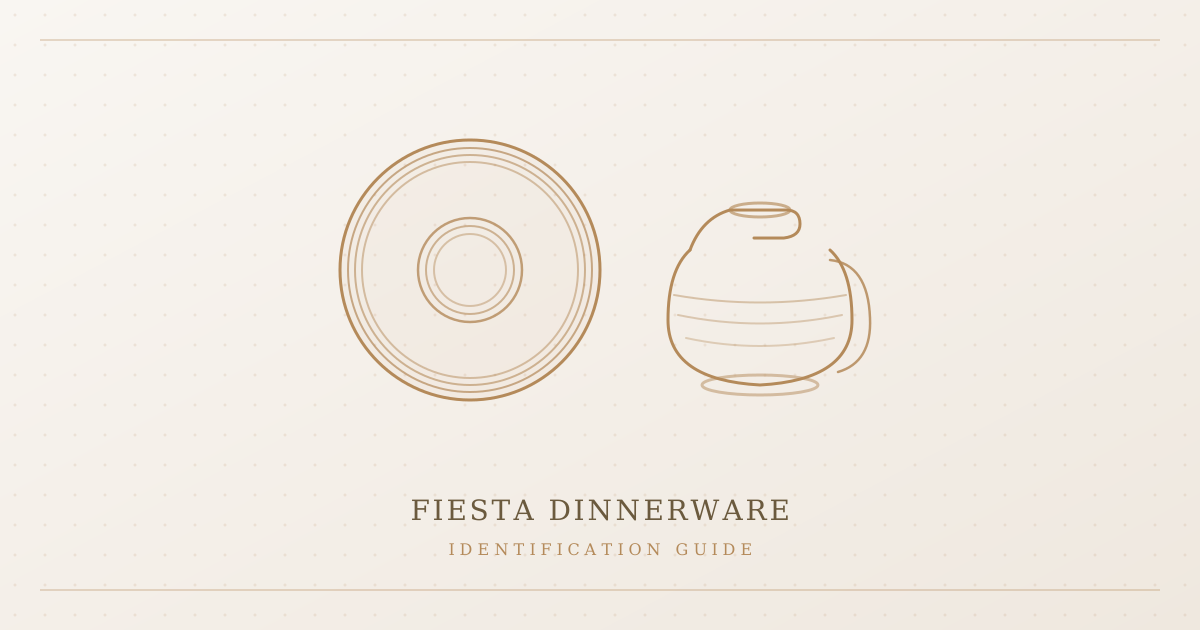
Few American ceramics are as instantly recognizable as Fiesta. The concentric rings, the solid jewel-bright glazes, and the streamlined Art Deco shapes have made Homer Laughlin's Fiesta line one of the most collected dinnerwares ever produced in the United States. Introduced at the Pittsburgh China and Glass Show in January 1936 and designed by the English-born art director Frederick Hurten Rhead, Fiesta was conceived as a mix-and-match table service: buyers chose pieces by color rather than by matched set, building a rainbow across the table. That single marketing idea, radical in the Depression, is why so much Fiesta survives today and why color sits at the center of every identification question.
For collectors, Fiesta divides cleanly into two great eras separated by a thirteen-year gap. Vintage Fiesta ran from 1936 to 1972 (a brief 1969 restyling as Fiesta Ironstone carried the name to early 1973). After more than a decade out of production, Homer Laughlin relaunched Fiesta in 1986 on a new, whiter clay body in contemporary colors, and that "post-86" line continues today. The 1986 dividing line is to Fiesta what the 1950 fire is to Hull pottery: the single fact that organizes dating, value, and authentication. Confusing a 1990s Persimmon plate with a 1936 original Red one is the most common — and most costly — beginner mistake.
This guide walks through every layer of Fiesta identification: the company and Rhead's design, the famous "radioactive red," the full color sequence and how it dates pieces, the ink-stamp and in-mold marks, the concentric-ring shapes, the sister lines (Harlequin, Riviera, Kitchen Kraft), the 1969 Ironstone restyling, the 1986 relaunch and its modern colors, reproduction and look-alike risks, condition, and value. Whether you pulled a cobalt mixing bowl from a cupboard or are weighing a medium green chop plate at auction, the framework below lets you read a Fiesta base the way a seasoned ceramics and pottery specialist does.
Table of Contents
- Homer Laughlin and the Birth of Fiesta
- Rhead's Design: Rings, Shapes & Art Deco
- Why Color Is Everything
- The Original Six and the Fifties Colors
- Fiesta Red and the "Radioactive" Glaze
- Reading the Base: Marks & Backstamps
- Dating Vintage Fiesta by Color and Body
- The 1969 Restyling: Fiesta Ironstone
- The 1986 Relaunch and Post-86 Colors
- Vintage vs. Post-86: The Key Tests
- Harlequin, Riviera & Kitchen Kraft
- Scarce Shapes and Specialty Items
- Authentication, Look-Alikes & Repairs
- Condition, Damage & Glaze Issues
- Value Factors and Price Ranges
- Building a Fiesta Collection
- Care, Display, and Safe Use
Homer Laughlin and the Birth of Fiesta
The Homer Laughlin China Company was founded in 1873 in East Liverpool, Ohio, and grew into the largest pottery in the United States, eventually centered in a vast plant across the river in Newell, West Virginia. By the 1930s the company was producing enormous quantities of everyday dinnerware, and like the commercial potteries that made restaurant ware and hotel china, it competed on durability, price, and volume rather than on hand decoration.
Frederick Hurten Rhead
Fiesta's designer, Frederick Hurten Rhead, came from a celebrated English ceramics family and had already left his mark on American art pottery — including work at Roseville and his own studio — before joining Homer Laughlin as art director in 1927. Rhead understood both studio aesthetics and mass production, and Fiesta was his attempt to bring modern, colorful design to affordable factory dinnerware. He is the same Rhead whose earlier influence touched several art-pottery lines, which is why Fiesta feels designed rather than merely manufactured.
A Depression-Era Sensation
Launched in January 1936, Fiesta arrived at exactly the right moment. It was cheerful, inexpensive, and sold by the piece in solid colors, so a household could buy a few items at a time and mix shades freely. The concept was an immediate commercial success, and Fiesta became Homer Laughlin's flagship line for decades. Its popularity spawned sister lines and a flood of imitators, cementing solid-color dinnerware as a defining look of mid-century American kitchens and tables.
The Long Arc to 1973
Fiesta remained in continuous production from 1936 until the colors and shapes were restyled in 1969 as Fiesta Ironstone, which itself ended in early 1973. The line then went dormant for thirteen years before its 1986 revival. Every piece of "vintage" Fiesta therefore dates to the 1936–1973 window, and the specific glaze color narrows that range dramatically — the heart of Fiesta dating.
Rhead's Design: Rings, Shapes & Art Deco
Fiesta's visual signature is a set of concentric rings — bands of raised relief that ripple inward toward the center of plates and outward around the bodies of pitchers, vases, and bowls. This banded motif, combined with smooth solid glazes and streamlined silhouettes, places Fiesta squarely in the Art Deco and early Streamline Moderne vocabulary of the 1930s — the American counterpart to the bolder, hand-painted British Art Deco ceramics of designers like Clarice Cliff.
The Concentric Rings
On flat pieces, the rings cluster toward the rim and again near the well; on hollowware, they wrap the body in graduated bands. The rings are molded into the form, not painted, and they catch the light to give each solid-color piece visual depth. Recognizing the ring placement is the first step in attributing an unmarked piece to Fiesta rather than to a competitor's solid-color line.
Streamlined Forms
Rhead's shapes are clean and modern: the disk-shaped water pitcher, the conical "ball" jug, the flared "fruit" and "dessert" bowls, the tapering vases, and the famous tripod candleholders. Handles are often partial rings or C-curves that echo the banded theme. The overall effect is machine-age optimism rendered in clay — design that looked forward rather than back, a deliberate contrast to the florals and revival styles dominating dinnerware at the time.
Why the Design Aids Identification
Because the rings and shapes are so specific, form alone often identifies Fiesta even before you turn a piece over. A solid-glazed plate with tightly grouped rings near the rim, or a pitcher with a disk body and a ringed handle, is almost certainly Fiesta or a close sister line. Confirming the mark and the glaze color then settles era and value.
Why Color Is Everything
In most ceramics, the maker's mark drives identification. In Fiesta, color does. Because the line was always sold by the piece in solid glazes, and because Homer Laughlin retired and introduced colors on a documented timeline, the glaze color is simultaneously the aesthetic appeal, the primary dating tool, and a major value driver.
Colors Were Added and Retired on a Schedule
Each Fiesta color has a production window. A color that was only made for a few years brackets a piece's date tightly; a color made for decades brackets it loosely. Knowing the sequence — which colors are original, which are "fifties colors," which belong to the Ironstone period, and which are post-86 — lets you date most pieces from the glaze alone.
Color Determines Scarcity and Value
Within vintage Fiesta, the short-lived colors are the prizes. Medium green, made only from 1959 to 1969, is the most valuable vintage color across most shapes; the 1950s colors (rose, chartreuse, forest green, gray) are scarcer than the long-running original colors. A collector who can name a glaze on sight has already estimated both the date and the relative value of a piece.
The Discipline of Reading Glaze
The catch is that color names and hues must be learned precisely. Original "red" differs from later "Scarlet"; vintage "turquoise" differs from post-86 "turquoise"; vintage cobalt is darker than most modern blues. The remainder of this guide treats glaze color as the master key — but always cross-checked against the mark and body, never trusted in isolation, much as you would when learning to date any porcelain or pottery.
The Original Six and the Fifties Colors
Vintage Fiesta colors fall into recognizable groups. Memorizing these groups is the single most useful thing a Fiesta collector can do.
The Original Colors (1936–late 1930s)
Fiesta launched in 1936 with a palette usually summarized as the "original six": red (a warm orange-red), cobalt blue, light green, yellow, old ivory, and turquoise. Turquoise joined slightly after the first five but is grouped with the originals. These early glazes tend to be slightly heavier and the bodies a bit more substantial than later ware, and they appear with the earliest marks.
The Fifties Colors (1951–1959)
In 1951 Homer Laughlin retired several original glazes and introduced four new high-style colors: rose (a dusty pink), chartreuse (yellow-green), forest green (deep green), and gray. These "fifties colors" were produced only through the late 1950s and are noticeably scarcer than the long-running originals, making them sought after by collectors building period-correct mid-century tables.
Medium Green (1959–1969)
Medium green, introduced in 1959, is the most coveted vintage Fiesta color. It was made in fewer shapes and for a shorter overall run at full production, so many forms in medium green are genuinely rare. Medium green examples of less common shapes regularly bring the highest prices in vintage Fiesta.
Long-Running Originals
Yellow, light green, and turquoise ran for much of the vintage era, while cobalt and ivory ended in 1951 and red had its own complicated history (see below). Because the long-running colors were made in huge quantities, common shapes in these glazes are the most affordable entry points into vintage Fiesta — and the best pieces on which to practice reading marks before chasing scarce colors.
Fiesta Red and the "Radioactive" Glaze
No aspect of Fiesta generates more curiosity than its red glaze, often called "radioactive red." The story is real, frequently exaggerated, and central to dating red pieces.
What the Glaze Actually Contains
The original Fiesta red glaze derived its warm orange-red color from uranium oxide, a colorant used by many potteries and glassmakers of the era — the same family of materials that gives uranium glass its glow. The uranium in the glaze makes genuine vintage red Fiesta detectable with a Geiger counter and causes it to register above background radiation. This is a genuine identifying test, not a myth.
The Wartime Gap
Production of red Fiesta was suspended around 1943 when the U.S. government restricted uranium oxide for the war effort, and red did not return until 1959. This creates a dating gap: a red piece is either pre-1943 or from the 1959–1972 window, never in between. The post-1959 red used reformulated uranium content and is sometimes called by collectors a slightly different shade.
Safety in Perspective
The radioactivity of vintage red Fiesta is low and, for display and careful handling, generally considered low-risk by collectors. The mainstream caution is practical: many collectors avoid eating acidic foods off vintage red glaze or using it daily, since uranium and lead can leach from glazes far more than from intact display pieces. Treat vintage red as a collectible to display rather than a daily plate, handle it sensibly, and never grind or sand the glaze.
Red Is Not Unique to Fiesta
Homer Laughlin used the same red glaze on sister lines like Harlequin and on Kitchen Kraft, and other potteries made similar uranium reds. A Geiger reading confirms a uranium glaze, not specifically Fiesta — the shape, rings, and mark still determine the line. Post-86 "Scarlet" and other modern reds do not contain uranium and will not register, which is itself a useful vintage-versus-modern test.
Reading the Base: Marks & Backstamps
Fiesta marks are relatively consistent, which makes the base a reliable starting point — though the mark must always be read together with the glaze color and body.
The In-Mold "fiesta" Mark
Most vintage hollowware and many flat pieces carry the word "fiesta" molded into the clay in lower-case letters, usually followed by "HLCo USA" or "MADE IN USA." Because this mark is part of the mold, it is integral to the body and cannot be added after firing. The in-mold mark, sometimes called the "indented" or "raised" mark depending on the piece, is the classic vintage signature.
The Ink Stamp
Many vintage plates and flat pieces instead carry an ink-stamped mark reading "Genuine Fiesta" with "HLC USA," applied under the glaze. Ink stamps can be partially worn but are still legible on most pieces. The presence of "Genuine Fiesta" in an ink stamp is a strong vintage indicator, since Homer Laughlin used it to distinguish the real line from the many imitators of the era.
HLC and Date Codes
Homer Laughlin's broader backstamp system used letter-and-number date codes on many of its wares, a practice familiar from commercial china. Not all Fiesta carries a decipherable date code, but where one is present it can pin a piece to a specific year. Reference books document the HLC date-code system in detail.
Post-86 Marks
Relaunched Fiesta from 1986 onward typically carries a different in-mold mark — often the word "Fiesta" with "H L C" and frequently "MADE IN USA," sometimes with "Lead Free" or "Microwave & Dishwasher Safe" wording on later pieces, and the post-86 ware sits on a distinctly whiter body. Modern marks, the white body, and the absence of uranium in red are the quickest ways to separate post-86 from vintage.

Dating Vintage Fiesta by Color and Body
Dating Fiesta is a process of triangulation: glaze color narrows the window, the mark style confirms the era, and the body and glaze feel support the estimate.
Step One: Identify the Color
Match the glaze to a documented Fiesta color and its production window. Cobalt and ivory ended in 1951; the fifties colors run 1951–1959; medium green runs 1959–1969; red has its pre-1943 and post-1959 windows. This single step usually brackets a piece to within a decade or two.
Step Two: Read the Mark
An in-mold lower-case "fiesta" mark or a "Genuine Fiesta" ink stamp confirms vintage production. A modern in-mold "Fiesta HLC" mark on a bright white body confirms post-86. The mark and the color should agree — if a glaze that only existed post-86 appears with a vintage-style mark, something is wrong.
Step Three: Assess Body and Glaze
Vintage Fiesta sits on an ivory-to-cream clay body; post-86 sits on a brighter, whiter body. Vintage glazes have a particular depth and, on older pieces, may show light crazing. As with dating any earthenware, comparing crazing, glaze feel, and body color against documented examples supports — though rarely proves — a date estimate, the same discipline applied across provenance research generally.
Watch the Shape
Some shapes were only made in certain periods. Sockets, handle styles, and the presence or absence of inside bottom rings on certain pieces all shifted over time. When color, mark, body, and shape all agree, the date estimate is solid; when they conflict, suspect a married piece, a reproduction, or a misread glaze.
The 1969 Restyling: Fiesta Ironstone
By the late 1960s, Fiesta's Art Deco styling had fallen out of fashion, and in 1969 Homer Laughlin restyled the line as Fiesta Ironstone in an attempt to modernize it.
What Changed
The Ironstone restyling reduced the line to a smaller selection of shapes and a new, muted color palette: Antique Gold (a mustard yellow), Turf Green (an olive), and a continued red, sometimes called Mango Red. The bright jewel tones of earlier Fiesta gave way to the earthy avocado-and-gold scheme typical of late-1960s and early-1970s American kitchens.
Why It Matters for Dating
Antique Gold and Turf Green are exclusive to the 1969–1973 Ironstone period, so a piece in either color dates precisely to that short window. These colors are distinct from the earlier yellows and greens and should not be confused with them. Ironstone pieces also carry period-appropriate marks.
Collector Status
Fiesta Ironstone is the least glamorous vintage era and generally the most affordable, but it completes the vintage story and includes the final appearances of the uranium-influenced red. For collectors documenting the full 1936–1973 arc, Ironstone is an inexpensive and historically important chapter that ended the original run before the thirteen-year hiatus.
The 1986 Relaunch and Post-86 Colors
In 1986, marking Fiesta's fiftieth anniversary, Homer Laughlin relaunched the line. Post-86 Fiesta is fully collectible in its own right and remains in production, but it must never be confused with vintage ware.
A New Body and New Glazes
The relaunched line uses a brighter, whiter, lead-free vitrified body and a continuously expanding palette of contemporary colors. The 1986 introductory colors included white, black, rose (a brighter pink than the vintage rose), cobalt (a different blue from vintage), and apricot. Dozens of colors have followed, many produced for limited periods and then retired.
Color of the Year and Retired Colors
Homer Laughlin and its successor have introduced and retired post-86 colors regularly, with certain hues becoming collectible after discontinuation. Short-run post-86 colors — such as the original apricot, lilac, sapphire, and various limited editions — can command surprising premiums among modern collectors, mirroring the way scarce vintage colors drive the older market.
Modern Shapes and Marks
Post-86 Fiesta reproduced many classic shapes and added new ones. The marks are modern in-mold "Fiesta HLC" stamps on the white body, frequently with safety and care wording. The combination of bright white body, modern mark, non-radioactive red, and contemporary color is the unmistakable signature of post-86 ware.
Vintage vs. Post-86: The Key Tests
Telling vintage from post-86 is the most important skill in Fiesta collecting, because the price difference between eras can be enormous for the same shape.
Body Color
Turn the piece over and look at any unglazed clay, such as the foot ring. Vintage Fiesta shows an ivory-to-cream body; post-86 shows a bright, almost stark white body. This is often the fastest single test and works even when marks are worn.
Glaze Color and Hue
Learn the vintage palette precisely. Vintage cobalt is a deep dark blue; post-86 "cobalt" is brighter. Vintage turquoise differs subtly from modern turquoise. A color that does not exist in the documented vintage palette — sapphire, plum, lilac, periwinkle, and many others — is automatically post-86.
The Mark
A lower-case in-mold "fiesta" or a "Genuine Fiesta" ink stamp indicates vintage; a modern "Fiesta HLC" in-mold mark with care wording indicates post-86. Marks alone can mislead on worn pieces, so confirm with body and glaze.
The Geiger Test for Red
Genuine vintage red registers on a Geiger counter because of its uranium glaze; post-86 reds do not. For red pieces specifically, this is a definitive vintage-versus-modern test, though it confirms only the glaze chemistry, not the shape or line.
Shape Cross-Reference
Some shapes were made only in one era. A shape that did not exist before 1986 is post-86 regardless of color, and a few vintage forms were never reproduced. Reference books and collector club resources document which shapes belong to which era.
Harlequin, Riviera & Kitchen Kraft
Fiesta's success spawned a family of related Homer Laughlin lines that collectors often pursue alongside it. Recognizing the siblings prevents misattribution and opens adjacent collecting paths.
Harlequin (1938–1964)
Harlequin was Homer Laughlin's lower-priced solid-color line, sold unmarked through Woolworth's. It shares Fiesta's solid-glaze concept but uses different, more angular Art Deco shapes with conical cups and distinctive handles. Because Harlequin is usually unmarked, identification rests on shape and the broad solid-color palette, which overlaps with but is not identical to Fiesta's.
Riviera (1938–1950s)
Riviera was a still more economical solid-color line on a square-plate body, also largely unmarked and sold through dimestores. Its square and rectangular shapes distinguish it from round Fiesta. Riviera, Harlequin, and Fiesta together represent Homer Laughlin's tiered solid-color strategy across price points.
Kitchen Kraft
Fiesta Kitchen Kraft was a line of ovenware — mixing bowls, casseroles, pie plates, and servers — glazed in Fiesta colors and intended for kitchen use rather than the table. These pieces sit alongside the broader category of American kitchenware and are collected both by Fiesta enthusiasts and by kitchen-collectible specialists.
Imitators and "Fiesta-Style" Ware
Dozens of other potteries produced solid-color dinnerware in the Fiesta wake — including lines that mimicked the rings and colors closely. These imitators are not Fiesta and lack its marks, but they confuse casual listings constantly. Always confirm the Fiesta mark and the specific ring pattern before paying Fiesta prices.
Scarce Shapes and Specialty Items
Within vintage Fiesta, certain shapes are far scarcer than the common plates and bowls, and these drive the high end of the market.
The Most Collected Forms
Showpiece shapes include the covered onion soup bowl (especially in turquoise, which was barely produced), the tripod candleholders, the bud vase and the larger flower vases, the carafe, the covered coffee pot, the syrup pitcher, and the divided and compartment plates. Large serving pieces and lidded items are generally scarcer than open tableware.
The Covered Onion Soup
The covered onion soup bowl was one of the earliest pieces and was discontinued quickly, making it scarce in every color and genuinely rare in turquoise. It is a benchmark "grail" piece that anchors the top of many collections.
Promotional and Specialty Items
Homer Laughlin produced promotional sets, the Fiesta "Tom and Jerry" punch sets, juice sets, and other specialty groupings. Complete original promotional sets with their correct color combinations command premiums over assembled equivalents, much as documented original groupings do across all collecting categories.
Color-and-Shape Intersections
Value in Fiesta lives at the intersection of scarce color and scarce shape. A common plate in a common color is inexpensive; a scarce shape in medium green or in the fifties colors can be a major piece. Learning which shapes were made in which colors — many were not made in every color — is the key to spotting underpriced rarities that sellers list as generic "Fiesta."
Authentication, Look-Alikes & Repairs
Fiesta is faked and misrepresented often enough that authentication discipline pays for itself, especially on scarce colors and shapes.
Confirm the Mark Is Integral
Genuine in-mold Fiesta marks are part of the clay body; ink stamps sit under the glaze. A mark that appears printed over the glaze, hand-scratched, or applied as a sticker masquerading as a backstamp is a red flag. Reproduction and fantasy pieces sometimes carry crude or incorrect marks.
Beware Reglazed and "Custom Color" Pieces
A persistent problem is genuine white-bodied post-86 (or even vintage) blanks that have been stripped and refired in a fake "vintage" or fantasy color, then sold as rare. Refired glazes often show subtle drips, an off texture, or colors that don't match any documented Fiesta glaze. When a color looks almost-but-not-quite right, suspect a custom reglaze.
Married Lids and Assembled Sets
Lidded pieces — coffee pots, casseroles, sugar bowls, the covered onion soup — are frequently "married," pairing a base in one color or era with a lid from another. Confirm that lid and base share the same glaze color, body, wear, and era before paying for a complete piece.
Distinguish Fiesta From Its Imitators
Solid-color lines by other makers are routinely mislabeled "Fiesta" online. The defining checks are the specific ring pattern, the documented Fiesta shapes, and a genuine Fiesta mark. An unmarked solid-color plate with rings is not automatically Fiesta — it may be Harlequin, Riviera, or an unrelated imitator.
The Red Test, Used Correctly
A Geiger counter confirms a uranium glaze on red pieces, separating vintage red from non-radioactive modern reds. Remember that it confirms glaze chemistry only — Harlequin and Kitchen Kraft used the same red, so the shape and mark still determine the line.
Condition, Damage & Glaze Issues
Fiesta was made to be used, so most pieces show some wear. Grading condition accurately is essential to fair valuation.
Chips, Nicks, and Cracks
Run a fingertip around rims, foot rings, spouts, and handles to find chips and flea-bites sellers omit from photos. Hairline cracks, often invisible until the piece is held to light or gently tapped for a dull ring, significantly reduce value. On scarce colors and shapes, even small flaws cut the price sharply.
Glaze Wear and Utensil Marks
Decades of use leave gray metal-utensil marks, especially on plates in lighter colors. Light marking is expected and only modestly affects value; heavy scratching and dullness reduce it more. Never use abrasive cleaners to remove marks — abrasion permanently damages the glaze surface.
Crazing and Staining
Light crazing is common on older vintage glazes and only modestly affects value. Heavy crazing with absorbed staining, particularly on ivory and lighter glazes, reduces value more. Avoid aggressive bleaching, which can drive moisture into the body and worsen the problem rather than cure it.
Restoration Detection
Examine pieces under UV light, where modern restoration resin and overpaint usually fluoresce differently from original glaze. Common restored areas are spouts, handle joins, and rim chips. A restored handle or spout lowers value substantially relative to an undamaged original, the same principle that governs restoration and conservation across antiques.
Value Factors and Price Ranges
Fiesta values follow a predictable hierarchy built on era, color, shape, and condition. Understanding the order speeds evaluation in the field.
Era First
Vintage (1936–1973) generally commands a premium over post-86 for the same shape, though scarce retired post-86 colors are themselves collectible. Establishing era is the first and most consequential valuation step.
Color and Shape Scarcity
Within vintage, medium green tops the color hierarchy, followed by the fifties colors (rose, chartreuse, forest green, gray), with the long-running originals most affordable. Within any color, scarce shapes — covered onion soup, candleholders, vases, carafes, lidded pieces — bring multiples of common plates and bowls.
Condition
Condition multiplies or destroys value. A mint scarce piece and a chipped or cracked one of the same color and shape can differ several-fold. For common shapes in common colors, abundant supply keeps prices modest regardless of minor wear.
Approximate Market Tiers
Rough ranges, condition permitting: common vintage plates, cups, and bowls in long-running colors run roughly $10–40 each; fifties colors and many medium-green common shapes run $30–150; scarce vintage shapes and medium green in less common forms run $100–600 and up; and grail pieces such as the turquoise covered onion soup or rare carafes and vases can reach four figures at specialist sale. Post-86 commons are typically $5–25, with scarce retired colors higher. For broader market context, see our antique valuation and appraisal guide.
Building a Fiesta Collection
Fiesta's huge range makes it ideal for focused collecting, and a deliberate strategy yields a deeper collection than scattershot buying.
Choose a Focus
Serious collectors usually specialize: a single color (all medium green, all cobalt), a single shape across all colors (every color of the disk pitcher), the fifties colors as a group, the original six, or post-86 retired colors. Specialization sharpens your eye and reveals opportunities others miss.
Start With Common Pieces
Common shapes in long-running colors are inexpensive and perfect for learning to read marks, glaze colors, and body. Building fluency on $15 plates protects you when you move to $600 pieces, exactly the progression recommended for building any collection.
Use Reference Books and the Collectors Club
The standard references — including the works of Bob and Sharon Huxford and ongoing collector-club publications — document colors, shapes, marks, and production windows piece by piece. The Homer Laughlin China Collectors Association (HLCCA) is an invaluable resource for reproduction alerts, color identification, and dating.
Buy From Reputable Sources and Document Everything
Established dinnerware dealers, collector-club shows, and specialist auctions offer the most reliable sourcing. Online marketplaces require diligence: request high-resolution photos of the base, marks, foot-ring clay color, and any damage before buying. Photograph each piece's body, base, marks, color, and any flaws, and record color, shape, era, and purchase information for insurance and resale.
Care, Display, and Safe Use
Properly cared for, Fiesta survives indefinitely. A few practices preserve both the ceramic and its value, with extra caution for vintage red.
Handling and Cleaning
Lift pieces from the body rather than by handles or spouts, the common break points. Wash vintage Fiesta by hand in lukewarm water with mild dish soap; avoid the dishwasher for older pieces, whose glazes and any crazing can degrade with repeated high-heat cycles. Never use abrasive pads, which permanently dull the glaze.
Vintage Red and Food Safety
Display vintage red, cobalt, and ivory rather than using them for food, particularly acidic foods, since uranium and lead can leach from older glazes. Post-86 Fiesta is lead-free and food-safe; vintage Fiesta is best treated as a collectible. When in doubt, display rather than dine.
Display Conditions
Keep Fiesta out of prolonged direct sunlight, which can affect some glazes over decades, and maintain stable temperature and humidity. Use plate stands and museum wax to secure displayed pieces, and separate stacked plates with felt or paper to prevent utensil-style scuffing, the same display sense that protects decorative objects generally.
Storage and Insurance
Wrap stored pieces individually in acid-free tissue and avoid stacking heavy items directly together. Photograph everything before storage so condition changes can be documented. Valuable vintage collections — scarce colors, grail shapes — deserve scheduled insurance with current appraised values, updated every five to ten years, with records kept off-site so documentation survives any incident affecting the collection itself.