
Antique Cruet Sets Identification Guide: Victorian Condiment Frames, Silver, and Glass
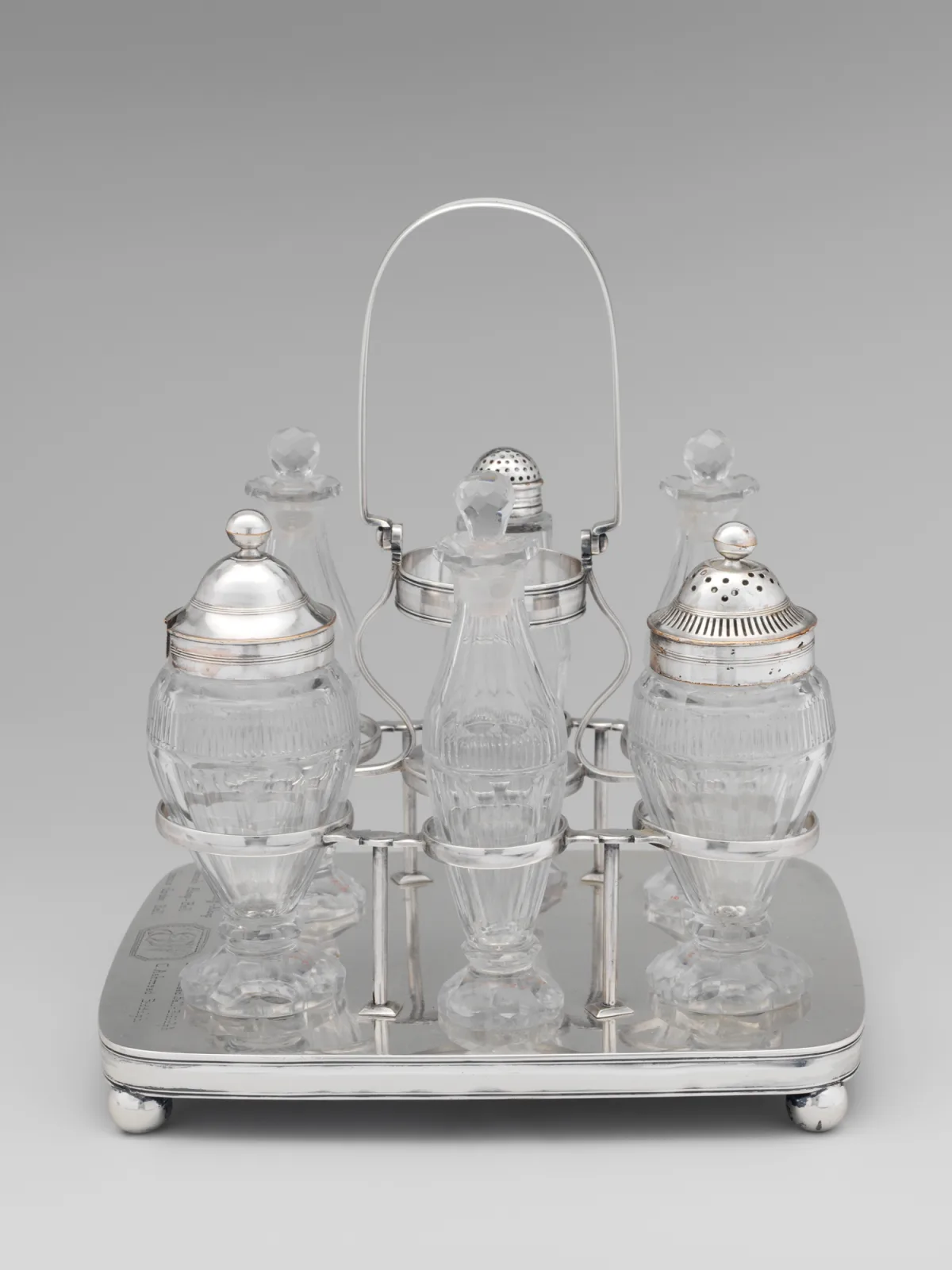
The cruet set — also called a cruet stand, caster set, or condiment frame — is the small forest of glass bottles, silver shakers, and pierced shakers that anchored the center of a respectable dining table from the 1700s through the 1930s. At its peak in the mid-Victorian period a fully fitted English cruet stand might hold seven or eight bottles for oil, vinegar, soy sauce, mushroom catsup, anchovy essence, mustard, and pepper, the bottles cradled in a footed silver or Sheffield plate frame, the whole thing carried to the table on its central handle and set down with a small ceremonial bump. They are deeply collected today, but they are also among the most misidentified objects on the secondary market, because cruet stands frequently come apart, lose their original bottles, gather replacements, and reappear as "marriages" that look right but are not.
Identifying a cruet set means working through a layered set of questions. What kind of frame is it — sterling silver, Sheffield plate, electroplate, britannia metal, or something else entirely? Whose hallmarks does the frame carry, and do they date the piece consistently? Are the bottles original to the frame, or are they later replacements? What is the cutting style of the glass, and does it match the period of the frame? Is the set complete with all stoppers and shakers, or is it missing pieces? Was it made for the English, American, French, or Continental market, and does it follow that market's typical configuration?
This guide covers the history of the cruet set from the Georgian boat cruet to the Edwardian breakfast caster, the construction of frames in silver, Sheffield plate, and electroplate, the major English and American makers, the configuration patterns by period, the glass cutting and pressing styles you will see in the bottles, the question of marriages and replacements, dating by hallmarks and registry marks, the special categories (pickle casters, sugar casters, soy frames, mustard pots), the reproductions and modern fakes, condition and what to repair, and how to value and collect cruet sets in today's market.
Table of Contents
- A Brief History of the Cruet Set
- Anatomy of a Cruet Stand
- Frame Types: Silver, Sheffield, Electroplate
- Configurations by Period
- The Bottles: Cutting, Pressing, and Stoppers
- Major Makers
- Reading Hallmarks and Marks
- Dating a Cruet Set
- Marriages, Replacements, and Honest Repairs
- Pickle Casters and American Forms
- Sugar Casters and Muffineers
- Soy Frames and Specialty Cruets
- Christopher Dresser and Aesthetic Movement Cruets
- Reproductions and Fakes
- Condition Assessment
- What Drives Value
- Care, Cleaning, and Storage
- Common Beginner Mistakes
- Frequently Asked Questions
A Brief History of the Cruet Set
The cruet — from the Old French cruette, a small jug — began as a pair of liturgical vessels for wine and water at the altar. By the late seventeenth century the secular form had emerged as a small footed frame holding two glass bottles for oil and vinegar at the dining table, an item that quickly became standard among the English and French aristocracy. Through the early Georgian period (roughly 1714 to 1760) cruet stands grew in size and ambition, developing into a distinct furniture-of-the-table form with characteristic English variations.
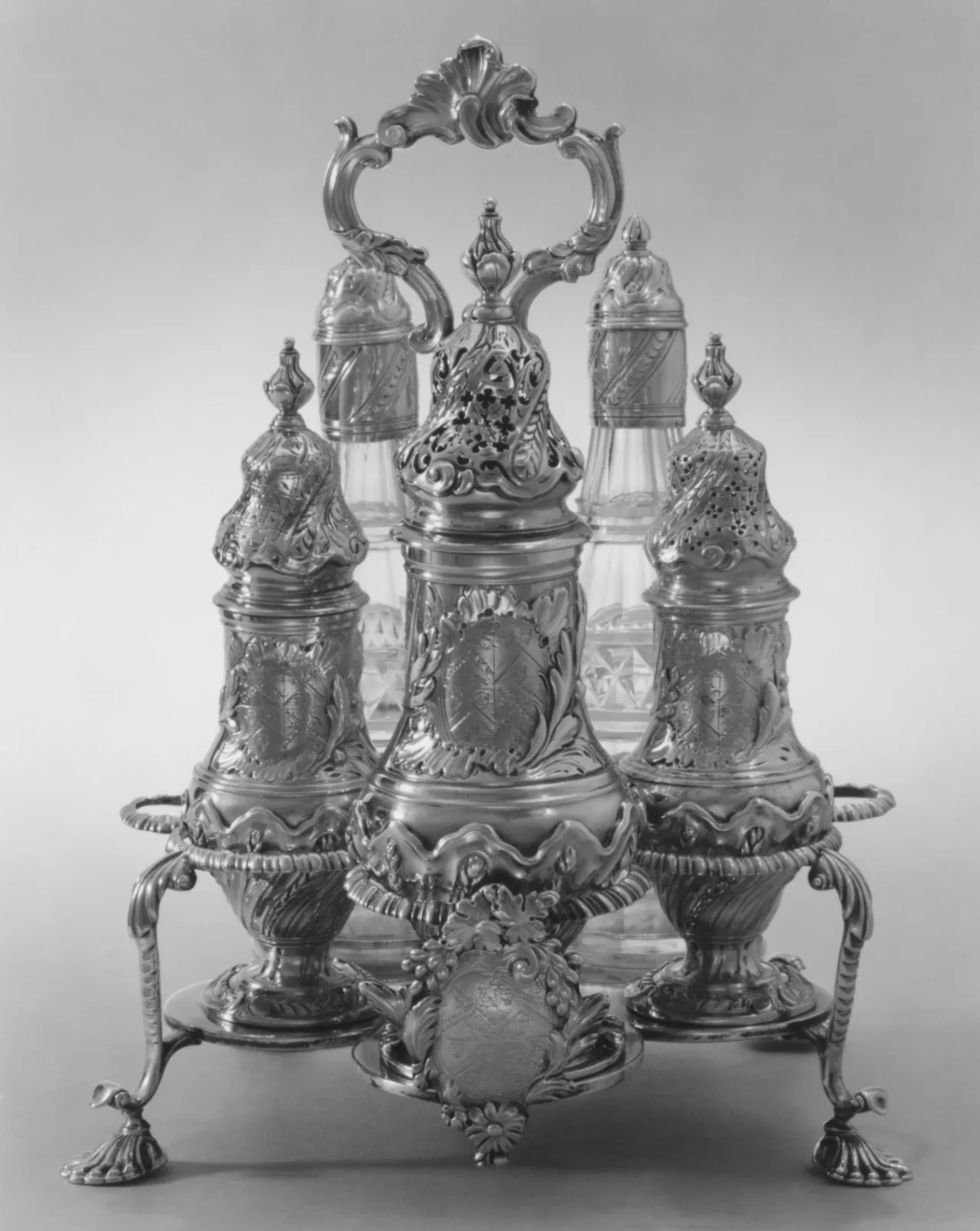
The classic eighteenth-century English form is the Warwick cruet, named for the Earl of Warwick whose 1715 commission established the pattern: a triangular silver frame on three scroll feet, holding three silver casters (sugar, pepper, dry mustard) and two glass bottles (oil and vinegar) under a central scrolled handle. Warwick cruets remained popular through the 1760s and were copied widely in Sheffield plate from the 1770s onward. The boat cruet — an oval boat-shaped frame holding four to six bottles — emerged in the 1770s and became the dominant form during the Regency and early Victorian periods.
The Victorian period (1837 to 1901) saw an explosion of cruet variety. The introduction of electroplating in 1840 made silver-look frames affordable to the middle class, and the spread of mass-produced pressed glass made bottles cheap and abundant. By the 1860s a respectable English household had a cruet on every dining table and a separate breakfast caster for the morning meal. The bottle count climbed: seven-bottle and eight-bottle frames were common by the 1870s, reflecting an expanded condiment culture that included soy sauce (a fashionable Anglo-Indian import), mushroom catsup, anchovy essence, Worcestershire, and various pickled relishes.
The Decline
The cruet stand declined sharply after the First World War. Servantless households, simpler dining, and the rise of bottled commercial condiments (Heinz ketchup, French's mustard, Lea & Perrins in its own bottle) made the elaborate cruet frame redundant. By the 1930s production had dwindled to occasional reproductions and bridal-gift items, and by 1950 the cruet stand was effectively obsolete as a working object — surviving only as an antique.
Anatomy of a Cruet Stand
A complete cruet stand consists of several distinct components, each of which can be original, replaced, or missing. Understanding the parts is essential to identifying what you have.
The Frame
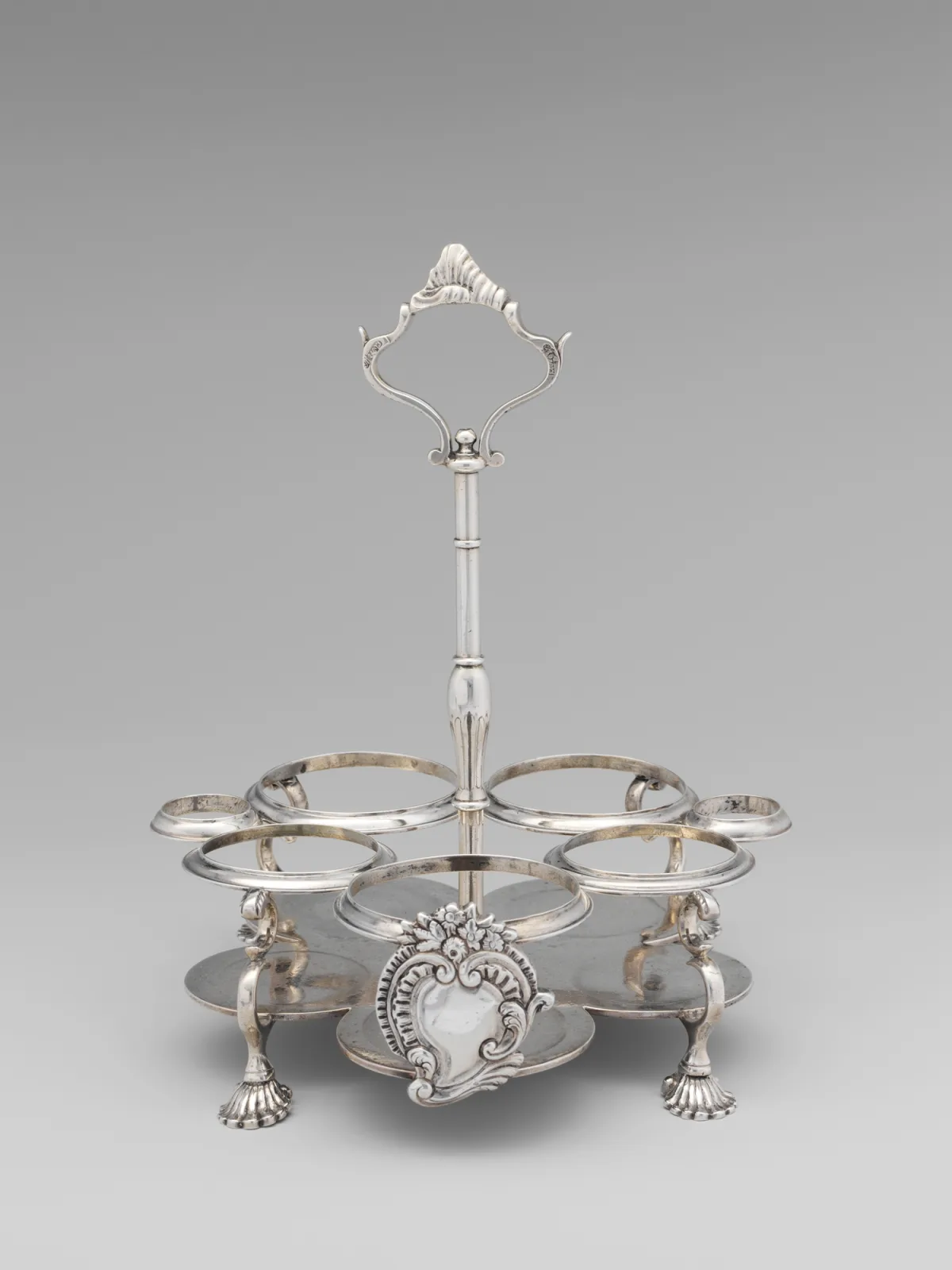
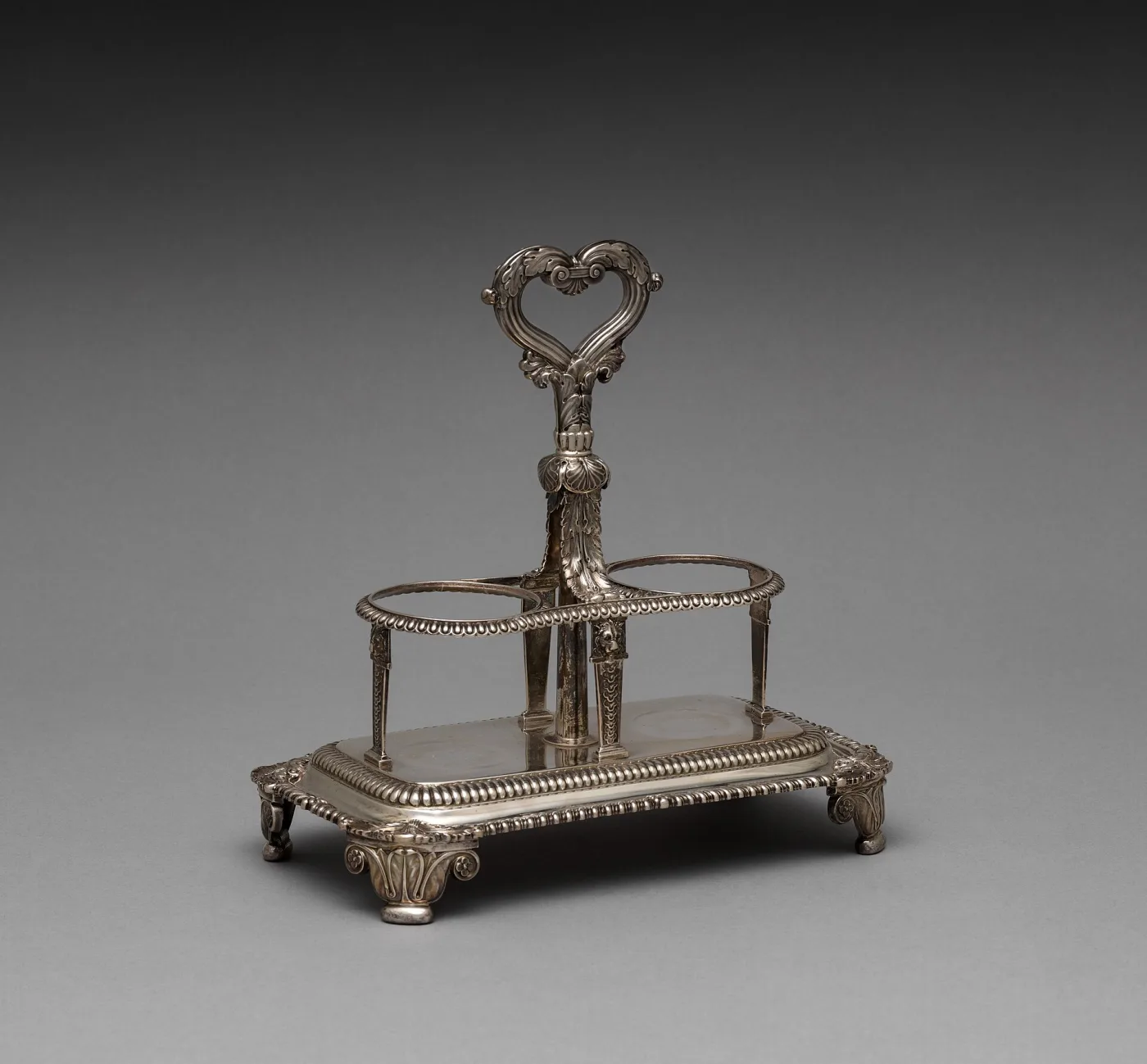
The frame is the metal carrier — usually silver, Sheffield plate, or electroplate — consisting of a base (often footed), a series of bottle rings or pierced sockets that hold the bottles upright, and a central handle that allows the entire stand to be carried and lifted. Better frames have engraved or chased decoration, pierced fretwork, and applied cast elements (shells, masks, vine leaves, scrollwork). The frame is the part that carries the maker's mark and hallmarks, and it is the part most likely to survive when bottles are lost.
The Bottles
Cruet bottles are glass — sometimes plain blown, more often cut, pressed, or molded — fitted with stoppers (for liquids like oil and vinegar) or pierced metal tops (for dry contents like pepper or sugar). Original bottles are matched in size, cutting pattern, and proportion to the frame; mismatched bottles are the single most common honesty problem in cruet collecting.
The Stoppers
Stoppers for liquid bottles are usually cut glass to match the bottle, with a faceted or mushroom-shaped head. Some stoppers are silver-mounted (a glass core with a silver collar and finial), and Continental cruets often have full silver or silver-plated stoppers with figural finials.
The Shakers and Casters
Pepper and salt are dispensed through pierced metal tops on glass or metal bodies; these are called shakers in American usage, casters in British. Sugar casters are taller pierced-top vessels for sprinkling sugar on porridge or fruit. Mustard pots have hinged silver lids and small bowl-shaped glass liners; their tiny silver spoons are usually missing.
The Glass Liners
Mustard pots and salt cellars often have small blue glass liners that protect the silver from the corrosive contents. Original blue liners survive in maybe one cruet in three; their absence is not a serious flaw, but their presence is a small bonus.
Frame Types: Silver, Sheffield, Electroplate
The frame material is the most important single fact about a cruet stand, because it controls both period and value.
Sterling Silver
Solid silver frames — sterling (.925) in England, often .800 or .835 on the Continent — are the most valuable category. English sterling cruets carry a full set of hallmarks (lion passant, town mark, date letter, maker's mark, and from 1784 to 1890 a duty mark) usually on the underside of the base or on the central handle post. A solid silver cruet by a known maker like Hester Bateman, Paul Storr, or Robert Hennell can run from a few hundred to many thousands of dollars depending on quality. For a deeper background on hallmark systems and silver authentication, see our antique silver identification guide.
Sheffield Plate
Sheffield plate (1742 to roughly 1840) is a fused-bimetal product where a thin sheet of silver is permanently bonded to a thicker copper core under heat and pressure, then worked into form. Sheffield plate cruets are recognizable by the slight pinkish copper color visible at edges where the silver has worn through, and by the characteristic seamed construction (most Sheffield was made from sheet, not cast, so seams and folded edges are normal). Sheffield plate is unmarked or sparingly marked — full hallmarking was illegal on plate in most periods — and the maker is often identified only by a small punched stamp.
Electroplate (EPNS, EPBM)
Electroplating, patented by Elkington of Birmingham in 1840, deposits a thin layer of silver onto a base metal (usually nickel silver, marked EPNS, or britannia metal, marked EPBM) by electrochemical action. Electroplate quickly displaced Sheffield after 1840, and the great majority of Victorian cruet stands you encounter today are electroplate. EPNS cruets typically wear through to a yellow nickel base, while EPBM wears to a dull gray. They are common, affordable, and a perfectly legitimate collecting category at lower price points.
Britannia Metal
Britannia metal — a tin alloy similar to high-quality pewter, harder and brighter than traditional pewter — was used for cheap unplated cruets through the nineteenth century and as a base for EPBM electroplate. Plain britannia frames are the cheapest category, often unmarked or marked "Britannia Metal" with a maker's number. For broader context on related tin and tin-alloy collecting, see our pewter identification guide.
Brass and Bronze
Some specialty cruets — particularly Aesthetic Movement and Arts and Crafts examples — are brass, bronze, or mixed metal. Christopher Dresser's designs for Hukin & Heath and James Dixon are sometimes electroplated nickel silver and sometimes plain brass. These are a small but serious collecting category at the design end of the market.
Configurations by Period
The number and arrangement of bottles is one of the strongest period indicators. The basic patterns:
Two-Bottle (Oil and Vinegar)
The most ancient form, surviving from the seventeenth century into modern times. Eighteenth-century examples are usually silver or Sheffield with two cut-glass bottles in a small handled frame. Continental tables often retained the two-bottle form longer than English tables.
Three-Caster Warwick (1715-1770)
The classic Georgian English form: three pierced-top silver casters (sugar, pepper, mustard) on a triangular footed frame. Warwicks are the most aristocratic cruet form and the most copied; later Sheffield plate and electroplate reproductions of the Warwick design continue into the twentieth century.
Five-Bottle Boat Cruet (1770-1830)
An oval boat-shaped frame holding two cut-glass oil and vinegar bottles flanked by three silver casters. Standard Regency and early Victorian form, found in both silver and Sheffield plate.
Seven-Bottle and Eight-Bottle (1840-1900)
Mid- and late-Victorian electroplate frames added bottles for soy, catsup, anchovy essence, and other condiments. Seven-bottle frames are common; eight- and ten-bottle frames are more rarely encountered and impressive when complete. Bottles in these large frames are often pressed glass rather than cut, reflecting the price competition of the period.
Breakfast Caster (Victorian)
A separate, smaller frame with three or four bottles intended for the breakfast table — typically holding pepper, salt, dry mustard, and a small bottle for vinegar or sauce. Breakfast casters are noticeably more compact than dinner cruets, and on the same breakfast table each diner's place was set with an individually engraved napkin ring from the same silver or electroplate service.
Edwardian Reduction (1900-1914)
Edwardian taste favored simpler tables and smaller cruets — three-bottle and four-bottle frames returned to favor, often in plain pierced electroplate without the elaborate cast decoration of mid-Victorian work. By the 1910s the cruet was already on the path to obsolescence.
The Bottles: Cutting, Pressing, and Stoppers
Cruet bottles deserve careful attention because they are both period indicators and frequent replacements. The cutting or pressing pattern, the stopper style, and the proportional fit to the frame all carry information.
Hand-Cut Glass
Eighteenth and early nineteenth century bottles were hand-cut on rotating wheels, producing crisp diamond, fan, hobstar, and prism patterns. Hand cutting shows slight variations between facets (no two are perfectly identical), and the cut edges are sharp to the touch with no rounding. Hand-cut bottles in a frame from before 1840 are a strong sign of originality. For a deep dive on cutting styles, see our antique cut glass identification guide.
Pressed Glass
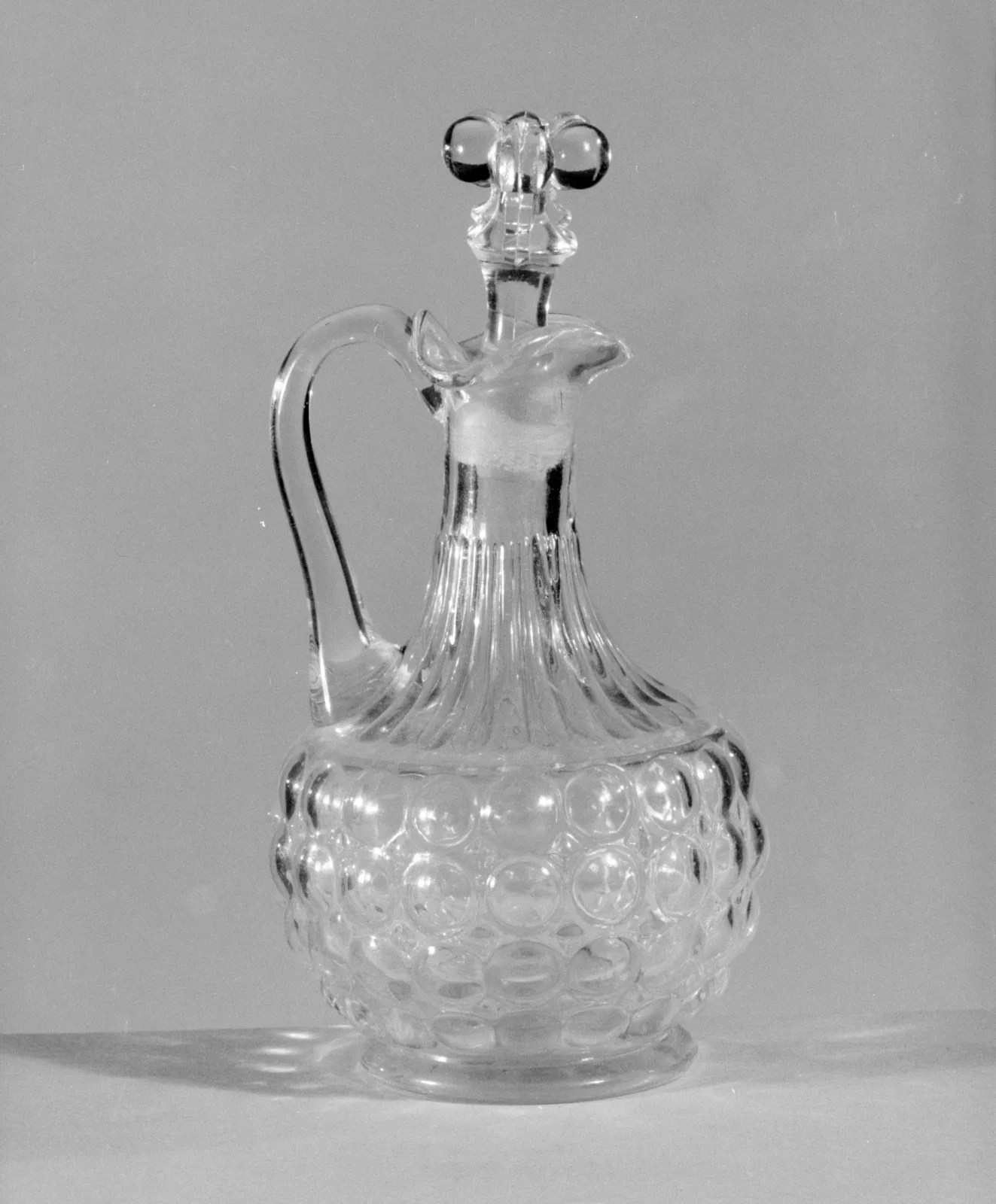
Pressing — pouring molten glass into a mold and pressing it to take the mold's shape — became the standard inexpensive method from the 1830s onward. Pressed bottles show mold seams (faint vertical lines where the mold halves met), uniform pattern repeats with no variation, and slightly softer edges than cut work. Most Victorian electroplate cruets carry pressed-glass bottles; this is honest and original, not a flaw, provided the pattern is appropriate to the frame's period. Our broader antique glass identification guide covers pressed glass dating in detail.
Mold-Blown and Blown-Cut
An intermediate technique uses a mold to form the rough shape, then a cutter to add detail. Mold-blown bottles show subtle seams and a hand-cut overlay; they are typical of better mid-Victorian cruets where economy and quality were balanced.
Stoppers
Original stoppers fit precisely into the bottle's ground glass neck — they should slide in smoothly, seat with a soft thunk, and not wobble. A loose or rattling stopper is usually a replacement. Stopper style should match the bottle: a faceted bottle should have a faceted stopper of the same cutting; a pressed bottle should have a pressed stopper. A cut stopper on a pressed bottle is an obvious mismatch.
Bottle Numbering
Some makers numbered or lettered bottles and stoppers (a small "3" scratched or wheel-engraved on both bottle and matching stopper, usually on the ground rim) so that the dishwasher could replace them correctly. Matching numbers are a strong sign of originality; non-matching numbers, or numbers on the bottles only, suggest later assembly.

Major Makers
Cruet stands were a staple product of nearly every English and Continental silversmith, but a smaller list of makers dominate serious collecting.
English Eighteenth Century
Hester Bateman (active 1761-1790) and the Bateman family workshop produced widely admired Warwick and boat cruets in restrained neoclassical taste. Paul Storr (1771-1844) made the most elaborate Regency silver cruets, often with cast figural feet and rich chased ornament — Storr cruets are at the top end of the market. Robert Hennell I, II, and III (active across the late eighteenth and early nineteenth centuries) made fine cruets in transitional Georgian styles.
Sheffield Plate
Matthew Boulton (Birmingham, active 1762-1809) led Sheffield plate production with high-quality cruets that are now much sought. Other major Sheffield plate makers include Old Sheffield Plate Co., Roberts & Cadman, and T. & J. Creswick.
Victorian Electroplate
Elkington & Co. (Birmingham, electroplating patent 1840) was the dominant electroplate maker through the Victorian period and produced cruet frames in every conceivable style. Mappin & Webb, Hukin & Heath, James Dixon & Sons (Sheffield), and Walker & Hall are the other major Victorian electroplaters whose cruets are commonly encountered. All four are known by maker's marks (often a small punch with initials or a logo) on the underside of the frame.
American Makers
Reed & Barton (Taunton, Massachusetts), Gorham (Providence, Rhode Island), Pairpoint (New Bedford, Massachusetts), and Meriden Britannia Co. (Connecticut) dominated American cruet and pickle-caster production from about 1860 through 1910. American silver-plate cruets are usually marked "Quadruple Plate" or with a maker's number on the base.
Continental Makers
French cruets (called huiliers) by Christofle, Odiot, and Puiforcat are generally more sculptural and less geometrically pierced than English work. German and Austrian cruets often carry the .800 silver mark and bear maker's punches that need to be looked up in regional reference works.
Reading Hallmarks and Marks
The hallmarks on the frame are usually the single most reliable evidence for date and origin. Read them in this order.
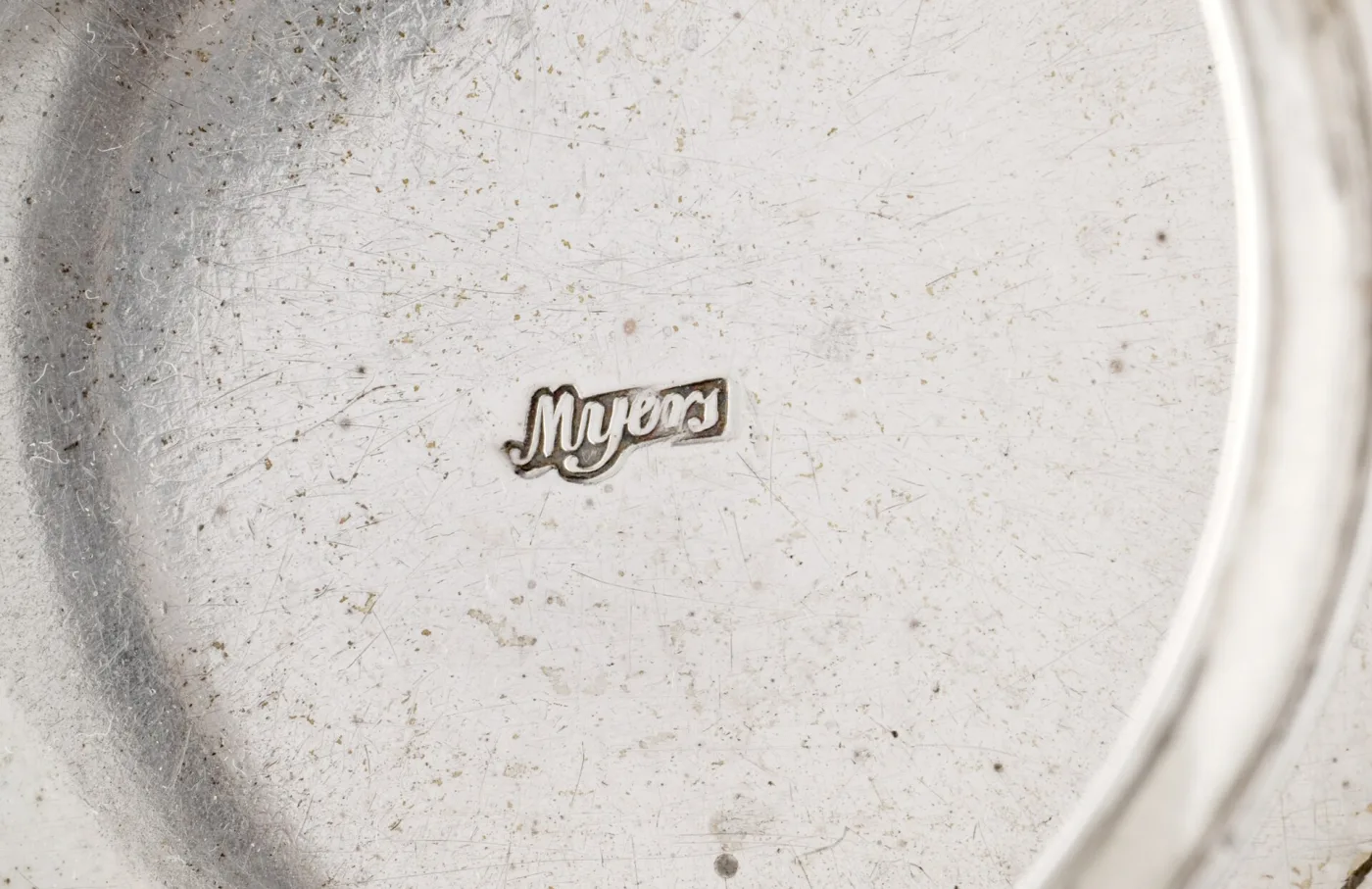
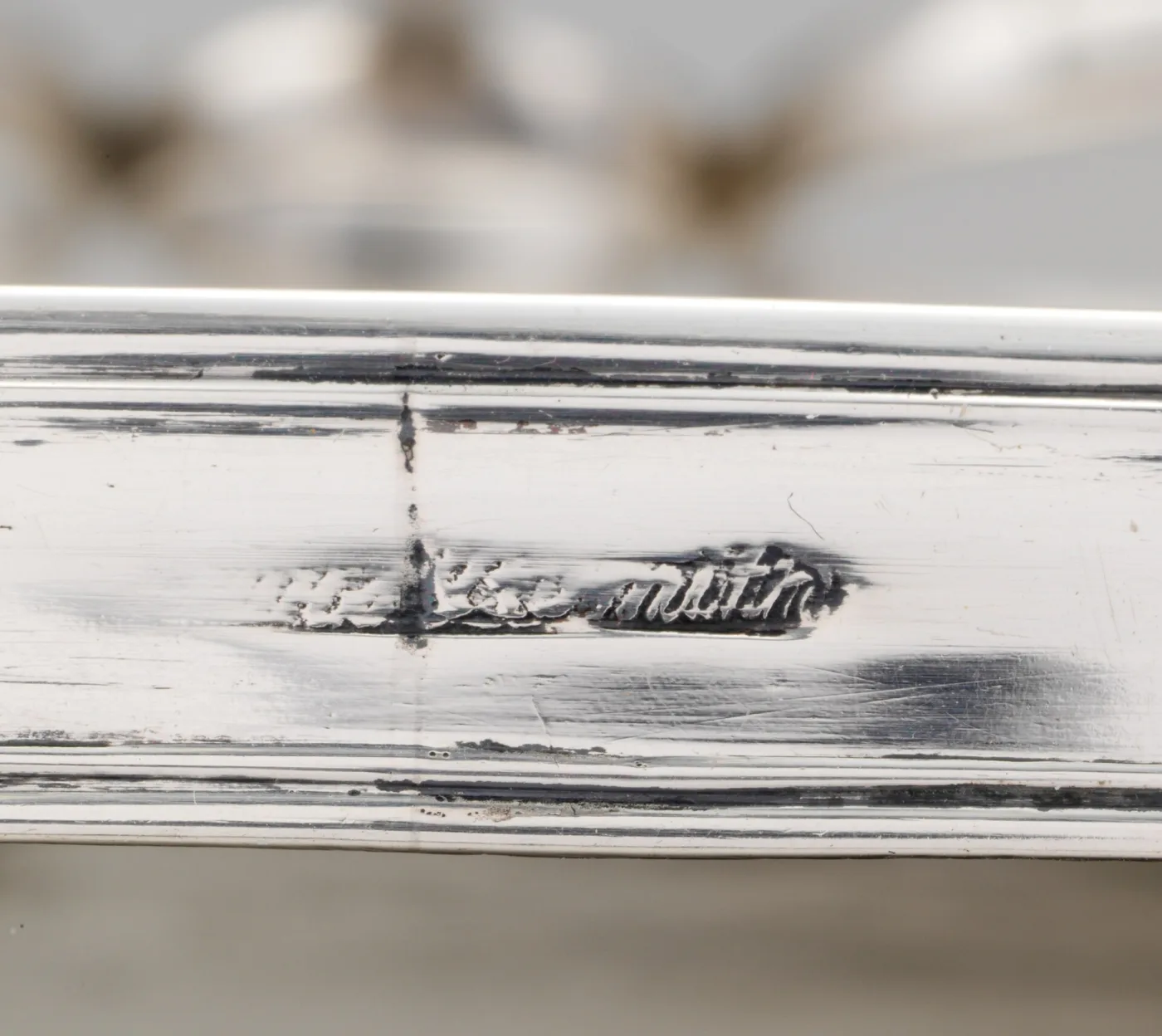
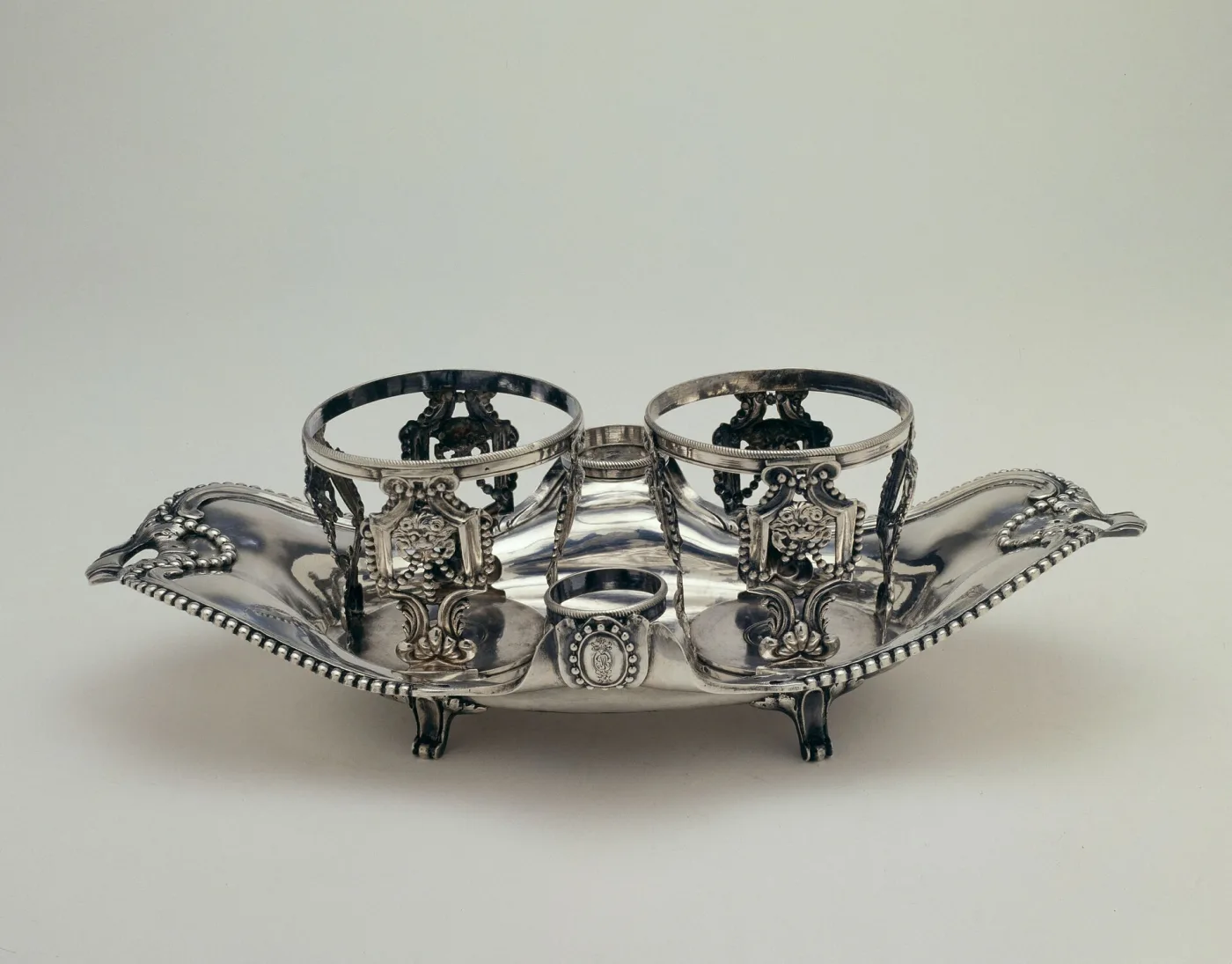
These are the marks on the two American stands shown earlier in this guide, and together they set expectations for what you will actually meet. Neither carries a date letter, because American silver has no assay office and no annual letter cycle — the maker's name in a shaped punch is the entire mark, and everything else has to be dated from the form. The Myers punch is sharp because it sits flat on the underside of the base, out of the way of every cloth that has ever touched the piece. The Lewis and Smith punch is on the moulded rim, where polishing reaches it, and a century and a half of that has taken it down to a legible –mith and a smear. The lesson is where to look before you conclude a piece is unmarked: try the underside of the base, the underside of a removable holder, and the flat inside a foot — and treat a half-read mark on an exposed edge as normal rather than as evidence of anything.
English Sterling Hallmarks
An English sterling cruet should carry four marks: the standard mark (lion passant for sterling .925), the town mark (a leopard's head for London, an anchor for Birmingham, a crown for Sheffield, a castle for Edinburgh), the date letter (a single letter in a cycle that changes annually and shifts shape every twenty years), and the maker's mark (initials or a symbol). From 1784 to 1890 a duty mark — usually the sovereign's head — was added to indicate that excise duty had been paid.
Sheffield Plate Marks
Sheffield plate is mostly unmarked. From 1784 a regulated maker's mark could be punched, but registry was inconsistent. Most Sheffield cruets you find will have only a tiny maker's punch (sometimes faint or worn) and no other marks. The absence of full hallmarks is itself a clue — a piece marked "sterling" but unmistakably copper at worn edges is not honest.
Electroplate Marks
EPNS (electroplated nickel silver) and EPBM (electroplated britannia metal) are the standard marks on Victorian and Edwardian electroplate. The maker's mark accompanies the EPNS or EPBM stamp, sometimes with a model number, a pattern number, and (after 1884) a registered design number (Rd. No.) that can be looked up to find the design's registration date.
Continental Silver Marks
French cruets carry the Minerva head (.950 first standard or .800 second standard) and a maker's lozenge punch. German cruets after 1888 carry the crescent-and-crown mark and the silver fineness as a number (800, 835, 900). Russian cruets (rare) carry the kokoshnik head and a city mark. For more on identifying Russian and Continental forms, our samovars guide has parallel hallmark coverage for the Russian system.
The Registered Design Number
From 1884 to 1908 English manufacturers could register a design and stamp it "Rd. No." followed by a number. The number can be looked up in published tables to find the registration year — extremely useful for narrowing the date of a Victorian electroplate cruet.
Dating a Cruet Set
Combine the hallmark evidence with stylistic and constructional cues for a confident date.
Hallmark Date Letter
For English sterling, the date letter is definitive — once you have decoded the cycle and shape, you have the year of assay. Reference books (Bradbury, Jackson, Pickford) and online hallmark databases give the cycles for each English assay office.
Stylistic Period
Frame style alone gives you a fifty-year window: a Warwick triangular frame is 1715-1770; a boat cruet is 1770-1830; a heavily pierced electroplate seven-bottle frame is 1850-1890; a plainer four-bottle pierced electroplate frame is 1890-1914. Combine style with hallmark evidence to confirm.
Construction Cues
Sheffield plate construction (folded seams, copper showing through wear) is 1742-1840. Electroplating is 1840 onward — a cruet that is electroplate is by definition not earlier than 1840 even if its style mimics an earlier period. Cast-and-applied decoration is common in eighteenth-century silver and Regency Sheffield; pressed-and-stamped construction is typical of mid-Victorian electroplate.
Bottle Style
Bottle cutting and pressing styles also have date ranges. A heavy hobstar pattern is late nineteenth century (1880-1910); a pillar-cut Regency bottle is 1810-1830; a pressed grape-and-vine pattern is mid-Victorian (1850-1880). Bottle style and frame date should agree; if they don't, suspect replacement.
Marriages, Replacements, and Honest Repairs
Cruet sets fall apart over a century or two of use. Bottles break, stoppers go missing, frames bend, and dealers reassemble what survives into "complete" sets that may or may not have started life together. Distinguishing original sets from marriages is one of the central skills of cruet collecting.
Signs of an Original Set
Bottles fit their sockets snugly with no wobble; cutting patterns match across all bottles; stoppers fit precisely and match the bottle cutting; bottle and stopper numbering matches (where present); shaker tops sit on their bodies without play; the overall proportions of bottles to frame look balanced (no bottle is conspicuously taller, shorter, or wider).
Signs of a Marriage
Bottles wobble in their sockets or sit at slight angles; cutting patterns differ subtly between bottles; one or two bottles are obvious replacements (different glass color, different pattern, different proportions); shaker tops are loose or oversized; stoppers don't match their bottles. Marriages are not necessarily dishonest if disclosed and priced accordingly; they become a problem when sold as original.
Honest Repairs
Some repairs are normal and acceptable. Re-soldered handle joins, replaced glass liners in mustard pots, and bent feet straightened back are all honest and don't materially affect value. More serious are re-plated frames (which destroy original surface and patina), replaced bottles in obvious mismatch, and removed or replaced hallmarked panels (a serious adulteration that undermines the whole identification).
The "Loaded" Trick
Sugar casters and pepper casters are sometimes "loaded" — their bases filled with pitch or plaster to give the piece weight and stability. This is original and normal for some forms. The trick to watch for is loaded bases used to disguise a worn-through electroplated body or a cracked silver one.
Pickle Casters and American Forms
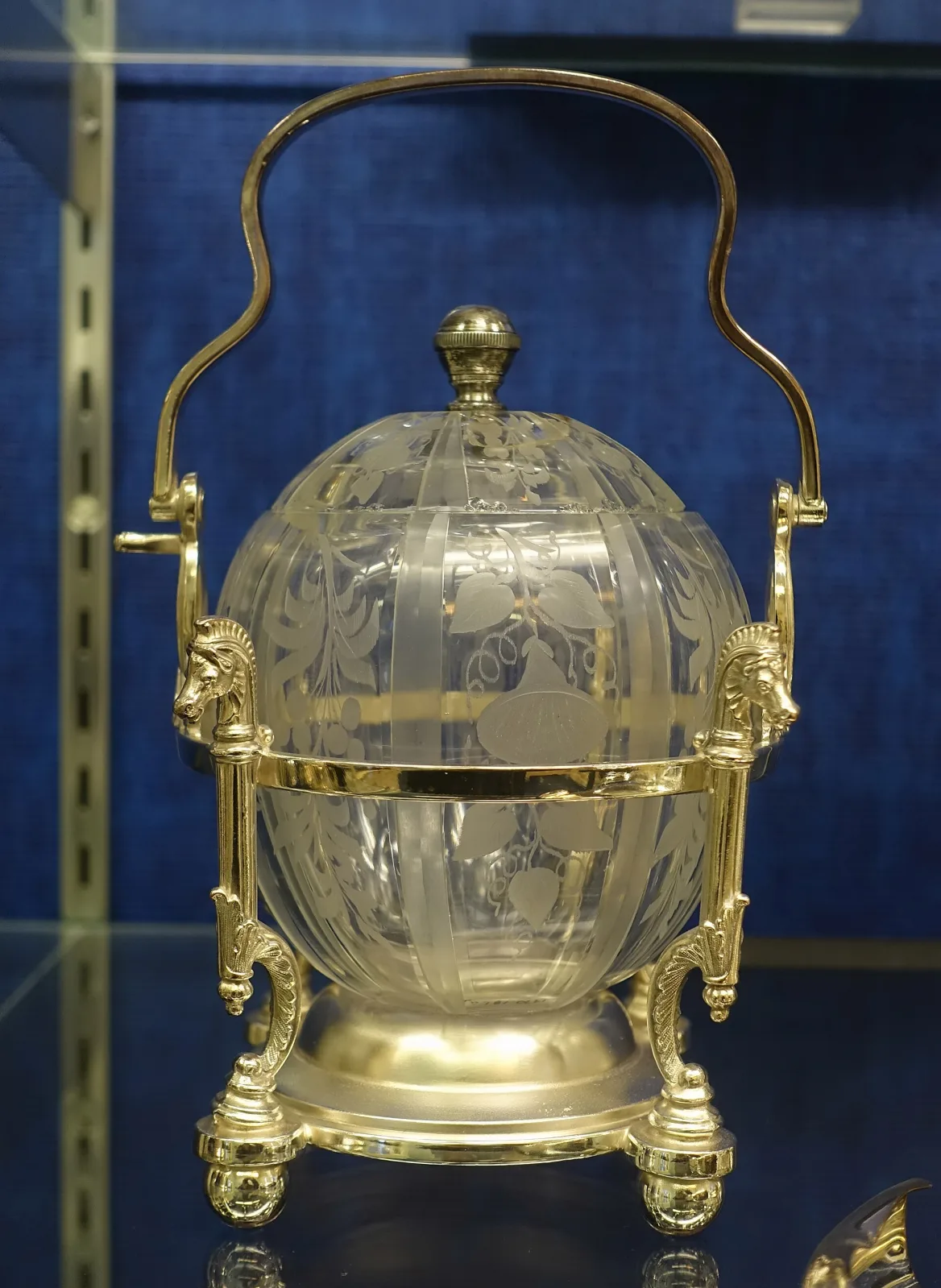
Pickle casters are a distinctively American form — a single tall glass jar (usually colored or pattern-pressed) suspended in a silver-plate frame with hinged lid, central handle, and matching tongs hanging from a frame hook. They are not technically cruets, but they sit on the same dining table and use the same plate-and-glass construction; they are normally classed with cruets in collecting.
Period
Pickle casters are almost entirely 1870-1910, with the peak years 1880-1900. They are a high-Victorian American phenomenon, made by the same firms (Reed & Barton, Pairpoint, Meriden, Wilcox, Tufts) that made cruet frames.
Glass Colors and Patterns
Pickle caster glass is the most collected aspect of these objects. Cranberry, ruby, blue, amber, and vaseline glass examples bring the strongest prices. Pattern-pressed clear glass is less expensive but still desirable. Cased glass (an outer color over an inner clear layer) and Mary Gregory hand-painted scenes appear on premium pieces. Our uranium glass guide covers vaseline-glass identification (which fluoresces under UV light) in detail.
The Tongs
Original pickle caster tongs hang from a frame hook by a small loop. They are missing in maybe two casters out of three. Replacement tongs are widely available but reduce value compared to a complete original example.
Sugar Casters and Muffineers
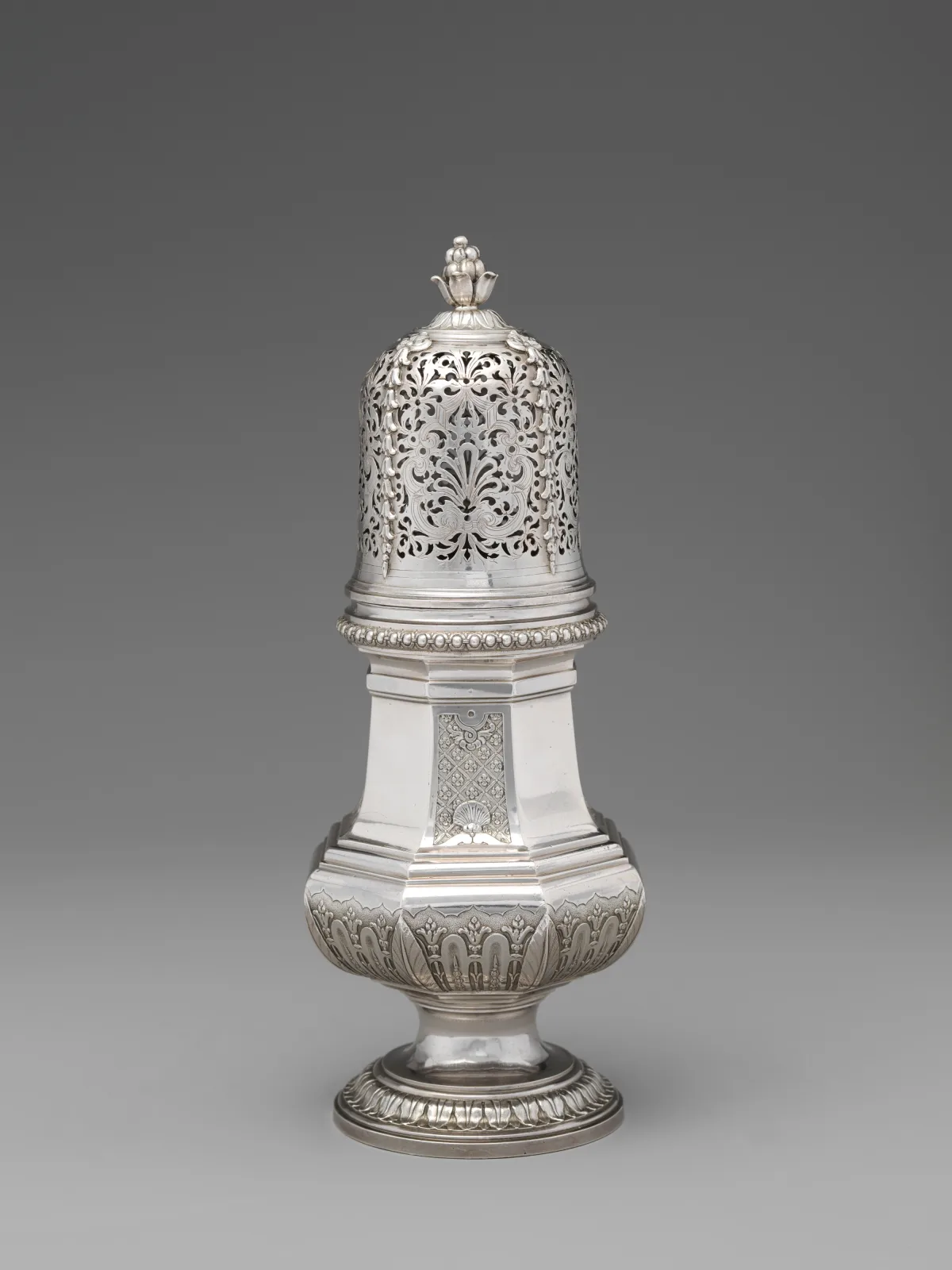
The sugar caster is a tall, footed pierced-top silver vessel for dispensing fine sugar. It is closely related to the muffineer, a slightly smaller version intended for sprinkling sugar or cinnamon on muffins, and historically the two terms were often interchangeable.
The Form
Sugar casters typically stand 6 to 9 inches tall, with a baluster or vase-shaped body, a domed pierced top with finial, and a low foot. The pierced pattern is usually intricate — circles, stars, fleur-de-lis, or scrolling foliage cut through the dome. Eighteenth-century English casters in plain baluster form are particularly elegant; nineteenth-century examples are more elaborately decorated.
Lighthouse Casters
A subform — the lighthouse caster — has a tall cylindrical body and a stepped or domed top, resembling a lighthouse silhouette. These are typical of early eighteenth-century English silver and are particularly collected.
The Bayonet Fitting
Better casters have a bayonet fitting — the top twists into the body with two small lugs — rather than a simple slip-on fit. The bayonet keeps the top from falling off in shaking and is a small mark of quality.
Soy Frames and Specialty Cruets
By the 1840s the English condiment vocabulary had absorbed a number of Anglo-Indian and East Asian sauces, and special cruet frames were made to hold them.
Soy Frames
A soy frame holds two to four small cylindrical bottles for soy sauce, mushroom catsup, and other dark Asian-derived sauces. Bottles are typically engraved or labeled with the contents ("Soy," "Catsup," "Anchovy," "Mushroom"). Soy frames are smaller and lower than dinner cruets and were often placed near the diner's plate rather than at table center.
Mustard Pots
Wet mustard, mixed with vinegar, was held in covered silver pots with hinged lids and small bowl-shaped blue glass liners. Mustard pots are sometimes part of a cruet stand and sometimes freestanding. Their tiny silver spoons (mustard ladles) are usually missing.
Salt Cellars
Open salt cellars — small bowls for table salt, intended to be served with a tiny spoon — were once part of every place setting. They are sometimes mounted in a cruet frame, more often freestanding. The blue glass liner protects silver from salt corrosion.
Egg Cruets
An egg cruet holds four to six egg cups in a silver frame with central handle and (sometimes) integral salt shaker. They are a Victorian breakfast specialty, less common today than dinner cruets but popular with collectors who appreciate niche forms.
Christopher Dresser and Aesthetic Movement Cruets
The Aesthetic Movement and the early Arts and Crafts produced a small but important body of cruet design that stands well apart from mainstream Victorian production.
Christopher Dresser (1834-1904)
Dresser's designs for Hukin & Heath, James Dixon & Sons, and Elkington from the 1870s and 1880s are among the most collected cruets in the entire field. His characteristic geometry — flat planes, exposed rivets, ebonized wooden handles, abrupt right-angle joins — was radical for its time and remains visually striking today. A genuine Hukin & Heath Dresser cruet with the firm's mark and matching pattern number can run from a few hundred to several thousand dollars depending on form. For broader context on Dresser's design vocabulary, see our art nouveau identification guide (which covers the slightly later but related decorative idiom).
The Aesthetic Influence
Wider Aesthetic Movement cruets (1870-1890) often show Japanese influence — bamboo-form handles, asymmetric flower-and-bird engraving, deliberate plain surfaces — and were produced by all the major Sheffield and Birmingham makers in addition to specialist designers like Dresser.
Arts and Crafts
Arts and Crafts cruets (1890-1914) by makers like A.E. Jones, Liberty & Co. (Cymric line), and individual silversmiths working in the Guild tradition tend toward hammered surfaces, semiprecious stone settings, and stylized natural ornament. They are scarcer than Aesthetic-period work but correspondingly prized.
Reproductions and Fakes
Cruets are not a major target for outright forgery — the work of casting, hand-cutting, and hallmarking would rarely repay the effort — but several categories of misleading material exist.
Twentieth-Century Reproductions
The cruet form was reproduced in electroplate by mid-twentieth-century firms (Wallace, International Silver, English Silver Manufacturing) for the bridal-gift and reproduction-furniture markets of the 1920s through the 1960s. These are honestly marked but often misrepresented in online listings as "Victorian." Look for clean, unworn plate, modern simple bottles in mismatched scale, and stamping that reads "Made in" followed by a country of origin (a labeling requirement that begins in 1891 for U.S. import and 1908 for British markings).
Married Sets
The most common honesty problem in cruet collecting is the marriage — see the dedicated section above. Marriages are usually assembled by dealers from period bottles and frames that don't belong together; they are not exactly fakes, but they are not what they appear to be.
Replated Frames
A worn-through electroplate frame can be re-plated to look new. This destroys the original surface and the soft patina that period electroplate develops, and it eliminates the surface evidence of age. A re-plated cruet looks too uniform, too bright, and too clean for its claimed date; it should be priced as a refurbished piece, not a period one.
Spurious Hallmarks
Genuine cast or fraudulently struck hallmarks on later or non-silver pieces do exist but are uncommon on cruets specifically — the time investment is rarely worth the return. Watch for marks that are too crisp, too perfectly aligned, or that include nonsense combinations (e.g., a London town mark with a Birmingham date letter cycle).
Condition Assessment
Condition is graded across several axes for cruets.
Plate Wear
For Sheffield and electroplate, look at the high points and edges where wear shows first — the handle top, the bottle ring rims, the foot edges. Light wear (faint copper or yellow base showing) is acceptable and authentic; heavy wear-through over large areas reduces value but doesn't destroy it.
Glass Condition
Chips, cracks, and bruises on bottles are common; they are not catastrophic on inexpensive sets but matter on better ones. Examine bottle rims, stopper tips, and the bottoms (where bottles knock against the frame socket). Hairline cracks can be hard to see and should be checked under bright raking light.
Frame Integrity
Bent feet, loose handles, broken frame rings, and missing decorative elements all reduce value. Some are repairable cheaply (re-soldered joins), others are expensive or impossible (replacing a missing cast figural foot).
Completeness
Missing bottles, missing stoppers, missing pierced shaker tops, and missing tongs (on pickle casters) all reduce value materially. A "complete" cruet — frame, all original bottles, all original stoppers, all original tops, original liners, original tongs where applicable — is markedly more valuable than the same set with a missing piece or two.
What Drives Value
Several factors interact to determine cruet value.
Material
Sterling silver > Sheffield plate > electroplate > britannia metal, all else equal. A solid silver cruet of modest design typically beats an elaborate electroplate one of the same period.
Maker
Hester Bateman, Paul Storr, Robert Hennell, Christopher Dresser, Mappin & Webb, Reed & Barton, and a handful of other names add a substantial premium. An unmarked or anonymous frame of equivalent quality sells at a discount.
Period and Style
Georgian (pre-1800) sterling outranks Regency, which outranks early Victorian, which outranks late Victorian electroplate, broadly speaking. But within each period, premium examples (Aesthetic Movement Dresser cruets, fine Pairpoint pickle casters) outperform unremarkable ones from earlier periods.
Completeness
A complete original set with all bottles, stoppers, and accessories present sells for noticeably more than the same set with one or two replacements. Marriages sell for less than honest replacements, when buyers can detect them.
Condition
Strong original surface, all hallmarks crisp, no major wear-through, no significant dents or repairs. Re-plated and heavily restored examples sell as renewed pieces, not as period ones.
Aesthetic Quality
Some cruets are simply more beautiful than others — better-proportioned frames, finer cutting on bottles, more interesting cast decoration, more striking glass colors. The market rewards beauty independent of period and maker.
Care, Cleaning, and Storage
Cruet sets need gentler care than the average silver object because they combine vulnerable glass with thin-plated metal.
Cleaning the Frame
Use a soft cotton cloth and a non-abrasive silver polish (Goddard's Silver Foam, Hagerty Silver Polish) sparingly — hard polishing wears electroplate quickly. Avoid silver dips for plate; the chemical action removes dirt and patina along with tarnish, and on Sheffield or electroplate it accelerates plate loss. For Sheffield plate especially, prefer a soft cloth and minimal polishing.
Cleaning the Glass
Bottles can be cleaned with warm water and a small amount of dish detergent. For interior staining (oil residue, vinegar deposits), uncooked rice with warm water and a drop of detergent, swirled inside the bottle, abrades stuck residue without scratching. Avoid harsh chemicals or hot water on cut glass with heavy decoration — thermal shock can crack the bottle.
Re-plating
Resist the urge to re-plate. Re-plating destroys the original surface, the soft patina of age, and the visible wear that authenticates the piece. A worn-through electroplate frame is more honest and more valuable in its honest state than re-plated to look new. For broader principles on conservation versus restoration, see our restoration and conservation guide.
Storage
Store cruets in a low-humidity environment, out of direct sunlight (which can iridize glass over time). Wrap bottles individually in acid-free tissue if removing them from the frame; store the frame upright with bottles in place if the construction is stable. Avoid storing in display cases with cardboard or felt that can off-gas sulfur compounds and accelerate tarnish.
Common Beginner Mistakes
Several traps catch new cruet collectors.
Buying a Marriage as Original
The single most common mistake. Without a careful check of bottle fit, cutting consistency, and stopper match, marriages can pass for original sets. Always check fit and consistency before paying period prices.
Mistaking Electroplate for Silver
EPNS and EPBM look like silver to a casual eye. The maker's mark, the plate stamp (EPNS, EPBM, "Quadruple Plate," or a number alone), and the worn-through edges are the giveaways. A cruet with no full hallmarks is almost certainly plate, not silver.
Over-cleaning
Aggressive polishing of plate strips silver and reveals base metal. Polish lightly, infrequently, and only the visible exposed surfaces.
Replacing Original Glass with Modern
If a bottle is missing, the temptation is to fill the socket with whatever fits. Modern reproduction bottles are widely available, but they nearly always look wrong — too clear, too uniform, too clean — next to period bottles. Better to leave the socket empty and disclose the gap than to insert an obvious modern replacement.
Ignoring the Mustard Pot
The mustard pot in a cruet set is often the most valuable single piece — particularly when it is hallmarked sterling and has its blue glass liner intact. Don't overlook it in negotiating for a set.
Trusting Online Photos
Many online listings show only the front of the cruet. Always ask for clear photos of the underside (showing hallmarks), the bottle bases (showing pontil marks or mold seams), and the stopper rims (showing cutting). For broader online buying advice, see our buying and selling strategies guide.
Frequently Asked Questions
What is the difference between a cruet and a caster?
Strictly, a cruet is a small bottle for a liquid (oil, vinegar, soy) and a caster is a pierced-top vessel for a powder (sugar, pepper, dry mustard). The cruet stand or cruet set holds both. In casual usage, the whole assembled object is called either a cruet, a cruet set, a cruet stand, a caster set, or a condiment set, often interchangeably.
How do I tell sterling silver from electroplate?
English sterling carries a full set of hallmarks — lion passant, town mark, date letter, maker's mark — usually on the underside of the base. Electroplate is marked EPNS or EPBM with a maker's mark, not a full hallmark set. If you see only initials and a number, or "Quadruple Plate," or "Silver on Copper," it is plate.
Are missing bottles a deal-breaker?
It depends on the price and the scarcity of replacements. A four- or five-bottle Victorian electroplate cruet missing one bottle is repairable from period spares at moderate cost. A Georgian sterling cruet missing a hand-cut bottle is more difficult — period replacements exist but rarely match perfectly. Price the set assuming a permanent gap unless you find an exact replacement.
Why does my cruet have copper showing through?
Either it is Sheffield plate (silver fused over copper, where wear naturally exposes the copper core) or it is electroplate over a copper-base alloy with the silver worn through. Both are normal age conditions and not faults; they are signs of authenticity. Re-plating destroys this evidence and is not recommended.
Are pickle casters the same as cruets?
No, but they are a related table-frame category and are usually classed together. A pickle caster has one tall jar (usually colored or pattern glass) in a silver-plate frame with hinged lid and tongs; a cruet has multiple small bottles. Both date primarily 1870-1910 in the American market.
How can I tell if my Christopher Dresser cruet is genuine?
Look for the maker's mark of Hukin & Heath, James Dixon & Sons, or Elkington, plus a registered design number that can be looked up to find the design's registration date in the 1870s or 1880s. Genuine Dresser pieces are usually catalogued in published references; cross-check against known patterns. Outright fakes are rare; period reproductions of Dresser-influenced design (similar geometry, no Dresser provenance) are common and should be priced accordingly.
What is the best resource for English silver hallmarks?
For comprehensive coverage, Sir Charles Jackson's English Goldsmiths and Their Marks remains the standard reference. For practical use, Bradbury's Book of Hallmarks is a portable companion. Online databases (the Goldsmiths' Company hallmark search, 925-1000.com) cover most marks you will encounter.
Should I use my cruet set?
Sterling silver cruets can be used for oil, vinegar, and dry pepper without harm. Avoid using them for salt (which corrodes silver), lemon juice, or strongly acidic dressings. Sheffield plate and electroplate cruets can also be used but more cautiously — wash gently and dry immediately. Most serious collectors display rather than use.
What is the most valuable cruet ever sold?
Top-tier auction prices for cruets reach the low five figures for exceptional Georgian sterling examples by Paul Storr and Hester Bateman, and for premium Christopher Dresser designs in their original Hukin & Heath or James Dixon mountings. Most period cruets sell for $100 to $1,000 depending on material, maker, and completeness.
Are there fake hallmarks on cruets?
Outright fake hallmarks are uncommon on cruets specifically because the form does not justify the forgery effort. Watch for the more common adulterations: re-plated frames, married bottles, replaced stoppers, and re-soldered or re-engraved hallmark panels.