
Stickley & Mission Oak Furniture Identification Guide: Marks, Joinery & Dating
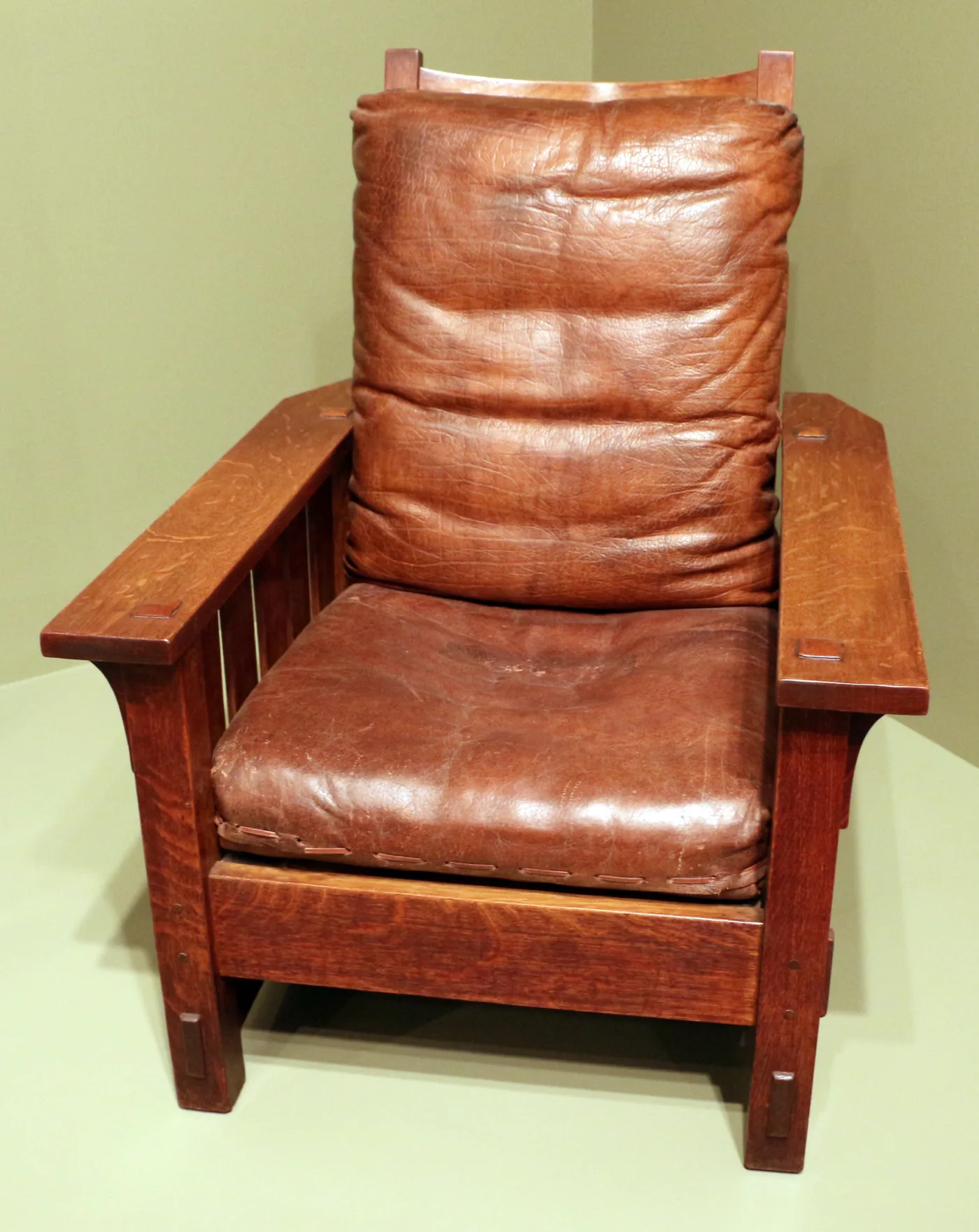
Stickley is the most consequential American furniture name of the twentieth century, and Mission oak is the style it founded. From Gustav Stickley's Craftsman Workshops at Eastwood, New York — operating from 1900 to 1916 — emerged an entire vocabulary of design: quartersawn white oak, exposed mortise-and-tenon joinery, fumed ammonia finishes, hand-hammered copper hardware, and the rectilinear forms that became the visual signature of the American Arts and Crafts movement. The "Mission" label, popularised by retailers around 1902 to evoke the Spanish-mission churches of California, attached itself to the broader category of straight-lined, quartersawn-oak furniture produced by Stickley and the dozens of competing firms that crowded into the style during its 1900–1916 boom.
For collectors, the challenge is that "Mission oak" includes everything from a $200 unsigned plant stand of indifferent quality to a six-figure signed Gustav Stickley sideboard. The price spread reflects four overlapping makers' marks (Gustav Stickley's red decal and "Als ik Kan" device; L. & J.G. Stickley's "The Work of L. & J.G. Stickley" and "Handcraft" decals; Stickley Brothers of Grand Rapids with their "Quaint Furniture" stamp; and Charles Stickley's lesser-known marks), the variations within each maker's mark history, and the parallel productions of Roycroft, Limbert, Lifetime, Harden, Stickley & Brandt, and many smaller shops. Reading these marks accurately is the difference between a $400 chair and a $40,000 one. This guide builds on the broader framework of our antique furniture identification guide.
By the end you will be able to attribute any Mission oak piece to its maker by mark, recognise the joinery and hardware signatures that confirm or contradict the mark, distinguish the four Stickley brothers' shops from each other and from their competitors, place the piece in a five-year date window, and assess condition factors that drive value from modest decorative-arts territory into the auction stratosphere.
Table of Contents
- The Stickley Brothers and the Mission Movement
- Gustav Stickley / Craftsman Workshops (1900–1916)
- Reading Gustav Stickley Marks by Period
- L. & J.G. Stickley of Fayetteville (1902–present)
- Stickley Brothers / Quaint Furniture, Grand Rapids
- Charles Stickley and Stickley & Brandt
- Mission Competitors: Roycroft, Limbert, Lifetime, Harden
- Quartersawn White Oak and Wood Selection
- Joinery: Mortise, Tenon, Pin, and Key
- Hardware: Hammered Copper and Iron
- Fumed Ammonia Finish and Patina
- Characteristic Mission Forms
- Reproductions, Marriages & Restored Pieces
- Authentication Workflow
- Condition Assessment
- Value Factors and Price Ranges
- Building a Mission Oak Collection
- Care, Display & Preservation
The Stickley Brothers and the Mission Movement
Five Stickley brothers — Gustav, Albert, Charles, Leopold, and John George — all became furniture makers, all built businesses in upstate New York or Grand Rapids, Michigan, and all participated in the Mission oak boom between 1900 and 1916. They began together (Gustav and his brothers ran Stickley Brothers in Binghamton in the 1880s) and ended in four separate firms competing in the same market. Understanding the family geography is the first step in reading any Stickley mark.
Gustav: The Eldest and the Innovator
Gustav Stickley (1858–1942) trained as a stone-mason and chair-maker, established the Gustave Stickley Company at Eastwood (suburb of Syracuse), New York in 1899, and renamed it the Craftsman Workshops in 1903. He published The Craftsman magazine from 1901 to 1916, designed Craftsman Homes (bungalows distributed nationwide through mail-order plans), and built the Craftsman Building in Manhattan in 1913. Bankrupt in 1915 and out of business in 1916, Gustav was the philosophical leader of American Arts and Crafts but the least commercially successful of the brothers.
L. & J.G. Stickley: The Survivors
Leopold (1869–1957) and John George (1871–1921) Stickley formed L. & J.G. Stickley at Fayetteville, New York in 1902. After Gustav's bankruptcy they purchased the Craftsman Workshops in 1918 and merged the operations as Stickley Manufacturing Company. L. & J.G. Stickley continued through the twentieth century, survived the Depression by switching to Colonial Revival, and remains in business today as Stickley, Audi & Co. — the only Stickley firm still operating.
Stickley Brothers of Grand Rapids
Albert (1862–1928) and John George Stickley (before he joined Leopold) founded Stickley Brothers Company at Grand Rapids, Michigan in 1891. After John George left in 1900 to join Leopold, Albert continued Stickley Brothers as a substantial Grand Rapids firm marketing under the "Quaint Furniture" trade name. Stickley Brothers was a much larger commercial operation than Gustav's workshops, with broader middle-market distribution.
Charles Stickley
Charles Stickley (1860–1927), the second eldest, partnered with brother-in-law Schuyler C. Brandt in 1891 to form Stickley & Brandt at Binghamton, New York. The firm produced Mission oak in the Gustav style but at lower price points and with simpler joinery. Charles is the least-known Stickley brother and his furniture trades at a substantial discount.
The Mission Boom and Bust
Mission oak peaked commercially around 1908–1912. By 1914 the market had begun to shift to Colonial Revival and lighter pieces such as mahogany Duncan Phyfe–style dining suites; the First World War accelerated the change. Gustav's bankruptcy in 1915 marked the symbolic end of the high-Craftsman era. By 1920 Mission was out of fashion; pieces sold for cents on the dollar through the 1920s and 1930s. The revival began in the 1960s with Robert Judson Clark's "The Arts and Crafts Movement in America 1876–1916" exhibition (Princeton 1972) and accelerated through the 1980s and 1990s. The 2000s and 2010s saw the established prices at auction; the market has consolidated through the 2020s with prime pieces holding while secondary pieces softened.
Gustav Stickley / Craftsman Workshops (1900–1916)
Gustav Stickley pieces are the most valuable and most collected Mission oak. The Craftsman Workshops produced approximately fifteen years of furniture under continuously evolving marks, designs, and quality standards.
The Eastwood Workshop
Gustav's factory at Eastwood (Syracuse), New York combined hand-craftsmanship with selective machine work. Workers cut and assembled quartersawn white oak by traditional methods — mortise and tenon by hand, joinery pinned with wooden pegs, finish applied through ammonia fumigation. Surface decoration was minimal: occasional inlay (designed by Harvey Ellis in 1903) and applied medallions on a few cabinet pieces. The Craftsman philosophy held that honest construction and noble materials were the only legitimate decoration — a conviction it inherited directly from the plain, utility-first tradition of Shaker furniture.
Designers and Influences
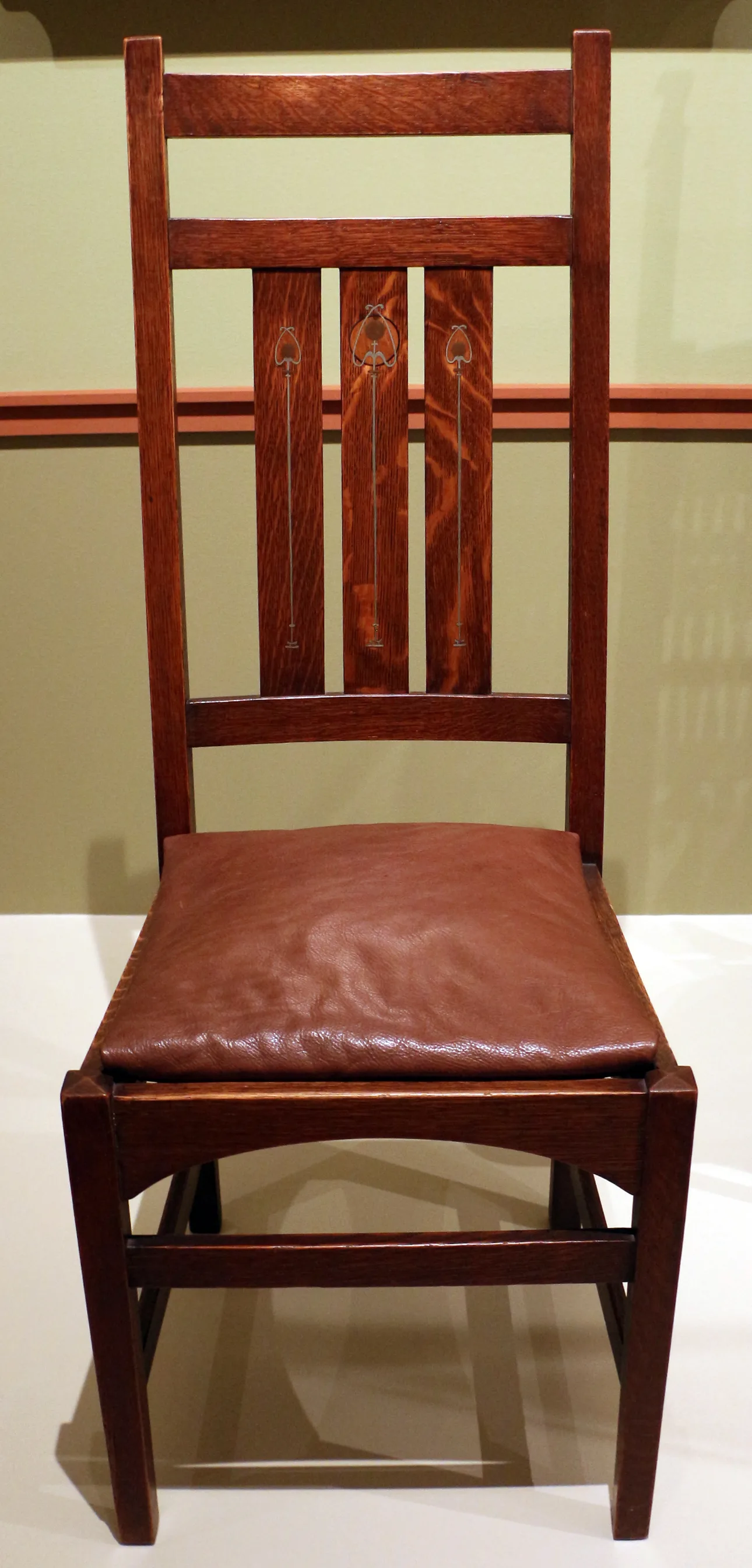
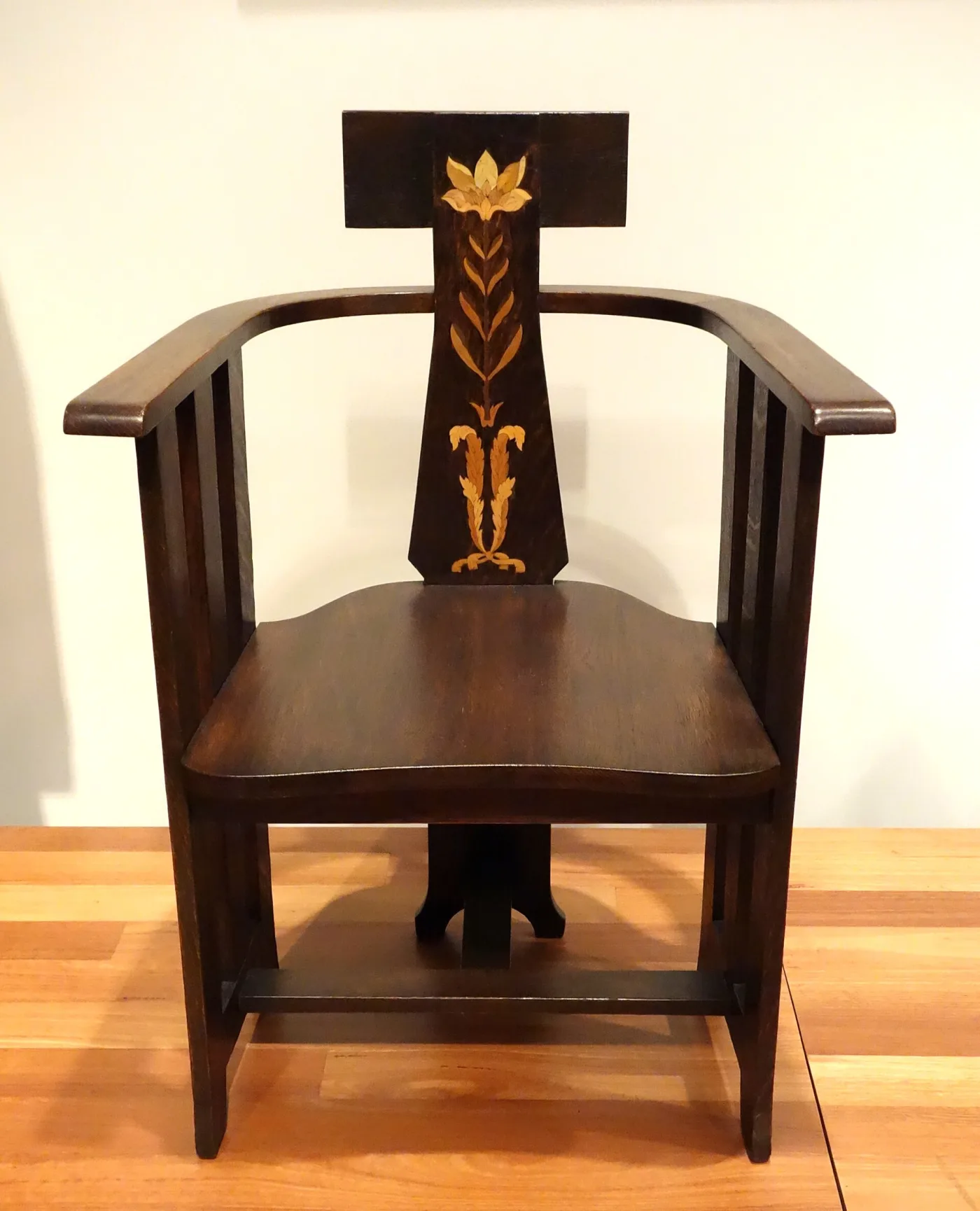
Harvey Ellis (1852–1904), who joined Craftsman Workshops briefly in 1903, introduced lighter forms with subtle inlay, arched bottom rails on cases, and curved skirts — the so-called "Harvey Ellis" period. Ellis died after only nine months at Craftsman, but his influence is disproportionate. Lamont Warner, LaMont A. Warner, and a series of in-house designers continued the development. The European Arts and Crafts (Voysey, Baillie Scott) and the broader Art Nouveau movement influenced Stickley though the American Mission idiom rejected Art Nouveau's sinuous lines for rectilinear severity.
The Craftsman Magazine and Homes
From 1901 Stickley published The Craftsman, a monthly magazine combining furniture design, architecture, social philosophy, and Arts and Crafts polemic. The magazine's "Craftsman Homes" articles offered mail-order architectural plans for bungalows that became — and remain — central to the early-twentieth-century American suburban landscape. The magazine ceased publication in 1916 with Gustav's bankruptcy.
Bankruptcy and Aftermath
Overextension — the Craftsman Building in Manhattan, Craftsman Farms in Morris Plains, expansion into textiles and metalwork — overstretched the business. Bankruptcy in 1915 was followed by closure of the workshops in 1916. Leopold and John George bought the workshops in 1918 and absorbed them into L. & J.G. Stickley.
Reading Gustav Stickley Marks by Period
Gustav Stickley marks evolved through six distinct periods. Reading the mark correctly places the piece in a narrow date window and is the single most important authentication step.
Pre-1901: United Crafts (Joiner's Compass Mark)
The earliest Eastwood workshop output (1899–1901) carries the "United Crafts" red decal or paper label, sometimes with a joiner's compass device. These pre-Mission pieces show Colonial Revival influence and are uncommon. Examples are scarce and command strong prices among period purists.
1901–1903: Early Red Decal with "Als ik Kan"
From 1901 the red decal mark appears: a joiner's compass enclosing the motto "Als ik Kan" (Flemish for "As I can," borrowed from Jan van Eyck) with "Gustav Stickley" underneath. The decal is rectangular red, typically applied inside a drawer, under a tabletop, or on the back of a case piece. This is the classic Craftsman mark of the high period.
1904–1906: Red Decal Refined
The decal mark is refined with a slightly cleaner motto and standardised layout. Sometimes a paper label is added with model number. This period coincides with the Harvey Ellis influence and includes the inlaid "spindle" pieces.
1905–1912: Branded Mark
From around 1905 Gustav added a burned-in (branded) joiner's compass and "Als ik Kan" device. The brand and decal coexist for several years. Branded marks may appear inside drawers, on the underside of seats, or on inner case surfaces.
1912–1916: Paper Label Period
From around 1912 the brand was supplemented or replaced by paper labels reading "The Craftsman" with model number, retail price, and Stickley's name. Paper labels are fragile and often lost; pieces from this period without surviving labels may carry only the older brand mark.
Black Decal vs Red Decal
Some Gustav pieces show a black decal rather than red. Black decals generally indicate later production (1907 onward) or pieces from certain product lines. Both are authentic; the red decal is the more iconic.
Mark Authentication
Genuine Gustav red decals show distinctive deep brick-red colour, slight transfer irregularities at decal edges (because the decal was applied to slightly uneven oak), and integration with the surrounding finish. Modern reproductions of the decal often show too-perfect edges, too-bright red, or incorrect motto wording. The "Als ik Kan" motto is sometimes misspelled on fakes. Compare any uncertain mark against published photographs in Stephen Gray's "The Mission Furniture of L. & J.G. Stickley" or David Cathers' "Gustav Stickley." The general framework for resolving such mark questions is laid out in our authentication and provenance research guide.
L. & J.G. Stickley of Fayetteville (1902–present)
L. & J.G. Stickley is the surviving Stickley firm and the source of the second-largest body of collectable Mission oak. Leopold's pieces are often less austere than Gustav's, with curved aprons, applied bracket detail, and a slightly more decorated aesthetic.
The Handcraft Period (1902–1912)
Early L. & J.G. Stickley pieces carry a decal reading "Handcraft" with the brothers' names. The Handcraft mark is the high-period L. & J.G. mark and signals heavy joinery, quartersawn oak, and fumed finish comparable to Gustav's work. The famous Prairie Settle, the Prairie Spindle Chair, and many of the most collectable L. & J.G. pieces date from the Handcraft period.
The Work of L. & J.G. Stickley (1912–1918)
From about 1912 the decal changed to "The Work of L. & J.G. Stickley" within a rectangular border, often with the conjoined company device. This second-period mark covers the years before the merger with Craftsman.
Post-Merger: 1918–1920s
After acquiring the Craftsman Workshops in 1918, L. & J.G. Stickley produced furniture using both Gustav and Leopold designs through about 1922. Some pieces carry both "Stickley Manufacturing Company" and Craftsman-related marks. The transition pieces are interesting historically but trade in a confused market.
Colonial Revival Era (1920s onward)
From the early 1920s L. & J.G. shifted to Cherry Valley Colonial Revival, mahogany Queen Anne reproductions, and other styles in response to the collapse of the Mission market. Mission production essentially ceased by 1925.
The Stickley Revival (1989–present)
The Audi family acquired Stickley in 1974 and revived Mission production in 1989 with the "Reissued Mission Oak" line. Modern Stickley reissues carry conspicuous "L. & J.G. Stickley" decals, date stamps, and explicit "REISSUE" or "MISSION COLLECTION" labels. These are not antique and trade as new furniture, but the quality is high and the line continues to expand.
Identifying L. & J.G. Versus Gustav
L. & J.G. pieces tend toward slightly lighter forms, curved decorative elements (skirts, brackets), and a marginally more accessible aesthetic. Construction quality is comparable to Gustav. Marks are unambiguous when present. Where marks have been removed, attribution to L. & J.G. versus Gustav requires specialist analysis of joinery and form.
Stickley Brothers / Quaint Furniture, Grand Rapids
Stickley Brothers Company of Grand Rapids, Michigan was Albert Stickley's large-scale commercial operation, marketing Mission oak under the "Quaint Furniture" trade name from about 1901 onward. The firm produced furniture across a broader price range than Gustav, including substantial export to Britain and the broader American middle market.
Quaint Furniture Mark
The "Quaint Furniture" rectangular metal tag (typically brass or copper) is the most common Stickley Brothers identifier. Tags are screwed or tacked to inner case surfaces, drawer interiors, or chair-rail undersides. Wording variations include "Quaint Mission" and "Quaint Furniture, Grand Rapids" with a stylized device.
Construction Standards
Stickley Brothers' Mission line is genuinely quartersawn oak with mortise-and-tenon construction, but the joinery is generally less elaborate than Gustav or L. & J.G. Pinned tenons are less common; through-tenons are rarer. Hardware is more commonly brass or oxidised copper rather than the heavy hammered work of the Craftsman Workshops.
British Export and Russmore
Stickley Brothers maintained a London office and exported substantially to Britain. Some pieces carry "Russmore" trade-name labels for the British market. The British-export pieces appear in the UK market at lower prices than equivalent American-market pieces.
Values
Stickley Brothers furniture trades at a substantial discount to Gustav and L. & J.G.: typically 25–50% of Gustav prices for comparable forms. A Quaint Furniture Mission rocker might sell for $400–$1,200 where the Gustav equivalent would be $2,500–$8,000. The discount reflects the lighter construction, the larger production volumes, and the slight aesthetic compromise toward middle-market accessibility.
Charles Stickley and Stickley & Brandt
Charles Stickley's firm at Binghamton, New York is the smallest and least-known of the Stickley shops. Stickley & Brandt (1891–1919) and the later Charles Stickley Furniture Company (1919–1927) produced Mission oak in the Gustav idiom but at substantially lower price points.
Marks
Stickley & Brandt pieces carry paper labels reading "Stickley & Brandt Chair Co." or rectangular brass tags with similar wording. Charles Stickley Furniture pieces carry his name without Brandt. Marks are often missing or partially preserved; attribution can be difficult.
Construction
Charles Stickley pieces use quartersawn oak (sometimes with secondary woods of inferior quality), mortise-and-tenon joinery (often without pinning), and machine-applied finish. The work is honest Mission oak but at trade-grade rather than Craftsman-grade quality.
Values
Charles Stickley furniture trades at 15–30% of Gustav prices for comparable forms. A signed Charles Stickley rocker might sell for $200–$700 where the Gustav equivalent reaches $2,500–$8,000. The pieces are appropriate entry-level Mission for collectors of limited budget and provide genuine period quartersawn oak without the premium.
Mission Competitors: Roycroft, Limbert, Lifetime, Harden
The Mission boom drew dozens of competing makers into the market. The principal Stickley competitors:
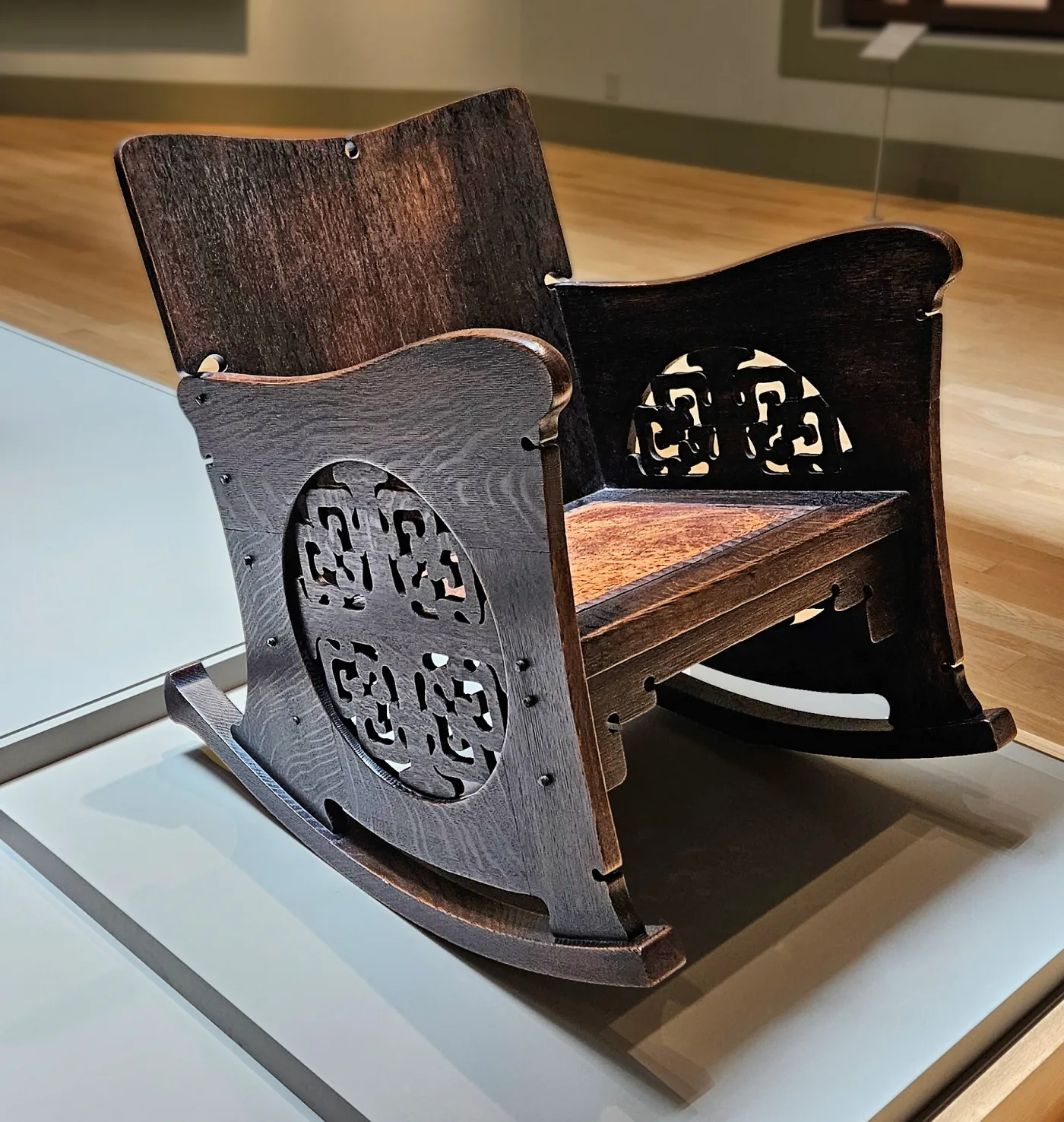
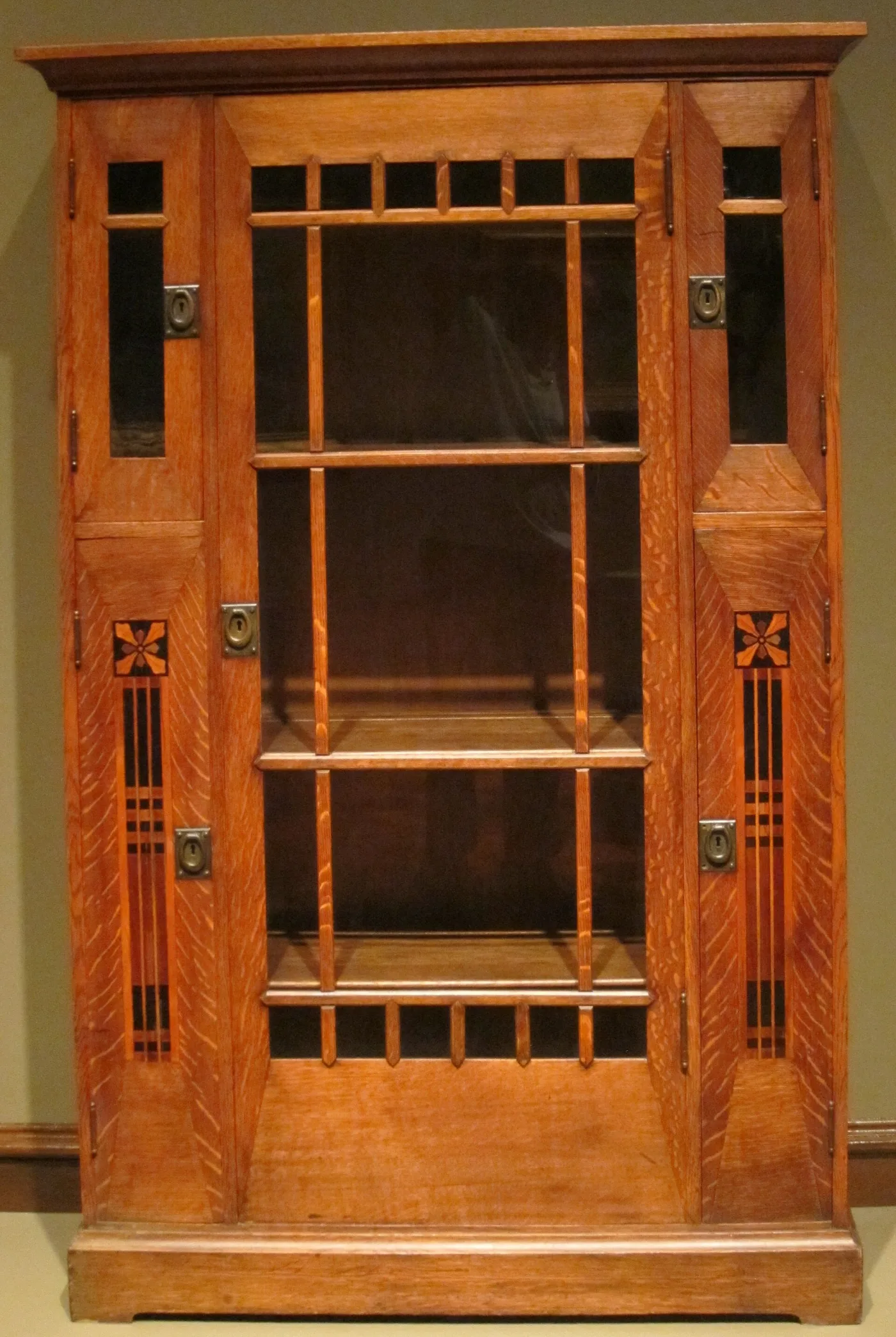
Neither of these is Roycroft, Limbert, Lifetime or Harden — the four firms named in this heading — and that is the point of showing them. Rohlfs and the Shop of the Crafters mark the two extremes the field ran between: a single Buffalo craftsman carving furniture that looks like nothing else, and an Ohio factory turning out inlaid oak by the wagonload. Both get catalogued as "Mission oak", and both are routinely offered as Stickley by sellers working from the material rather than the mark. Quartersawn oak and a straight line prove only that a piece belongs to the period; the maker has to come from a tag, a brand, a label, or a documented form.
Roycroft (East Aurora, NY)
Elbert Hubbard's Roycroft Shops at East Aurora, New York produced Mission oak furniture as part of a broader Arts and Crafts campus that also produced books, copperware, and leather goods. Roycroft pieces carry the distinctive orb-and-cross "Roycroft" device — branded or carved into the wood, often prominently visible. Roycroft furniture is characterised by heavy proportions, pronounced corbels, and a slightly more medieval-Gothic aesthetic than Stickley. Signed Roycroft pieces command strong prices, often comparable to L. & J.G. Stickley.
Charles Limbert (Holland and Grand Rapids, MI)
Charles P. Limbert's "Dutch Arts and Crafts" furniture combined Mission oak with European-Dutch influences. Limbert's hallmark is the cut-out design — square, oval, or heart-shaped openings cut into table aprons, chair sides, and case panels. The Limbert "branded" mark (a rectangular brand reading "Limbert's Arts & Crafts Furniture") is distinctive. Limbert tabouret and tea tables with cut-out aprons are among the most recognised Mission forms and command strong prices.
Lifetime Furniture / Grand Rapids Bookcase & Chair Co.
Lifetime Furniture (a brand of Grand Rapids Bookcase and Chair Company) was a substantial middle-market Mission producer marketing principally through department stores. Lifetime pieces carry rectangular brass tags and offer respectable construction at accessible prices. Lifetime trades at Stickley Brothers prices or slightly below.
Harden Furniture (McConnellsville, NY)
Frank S. Harden's firm produced Mission oak from 1900 onward, surviving as Harden Furniture into the present (now in McConnellsville, New York). Harden Mission pieces carry stencilled marks or brass tags. Quality is comparable to L. & J.G. Stickley for the better pieces.
Lakeside Crafts Shop
The Lakeside Crafts Shop produced Mission furniture in Sheboygan, Wisconsin from about 1906. Pieces carry paper labels. Construction is solid; the firm is a respected secondary maker.
Smaller and Anonymous Makers
Hundreds of smaller furniture shops produced Mission oak between 1900 and 1916. Unsigned period pieces with credible quartersawn oak, mortise-and-tenon construction, and original fumed finish trade as "Mission oak, maker unknown" at substantially lower prices than signed pieces. Quality varies widely.
Quartersawn White Oak and Wood Selection
Quartersawn white oak is the defining material of Mission furniture. The wood selection is not incidental: it is integral to the aesthetic and the structural philosophy.
Why Quartersawn
Quartersawn lumber is cut radially from the log, producing planks where the grain runs perpendicular to the face. This orientation gives quartersawn oak three properties Mission designers prized: superior dimensional stability (less warping with humidity changes), the dramatic "ray fleck" or "tiger oak" figure (visible silvery flecks running across the grain from medullary rays), and exceptional strength.
White Oak Versus Red Oak
White oak (Quercus alba) was the universal Mission choice. White oak has closed pores (sealed with tyloses), a creamier ground colour, and stronger ray-fleck figure than red oak. Red oak (Quercus rubra) was occasionally used by lesser makers but white oak dominated. Identifying white versus red oak requires examining a fresh cut or unfinished surface — white oak shows distinctive sealed pores, red oak shows open pores.
Reading the Ray Fleck
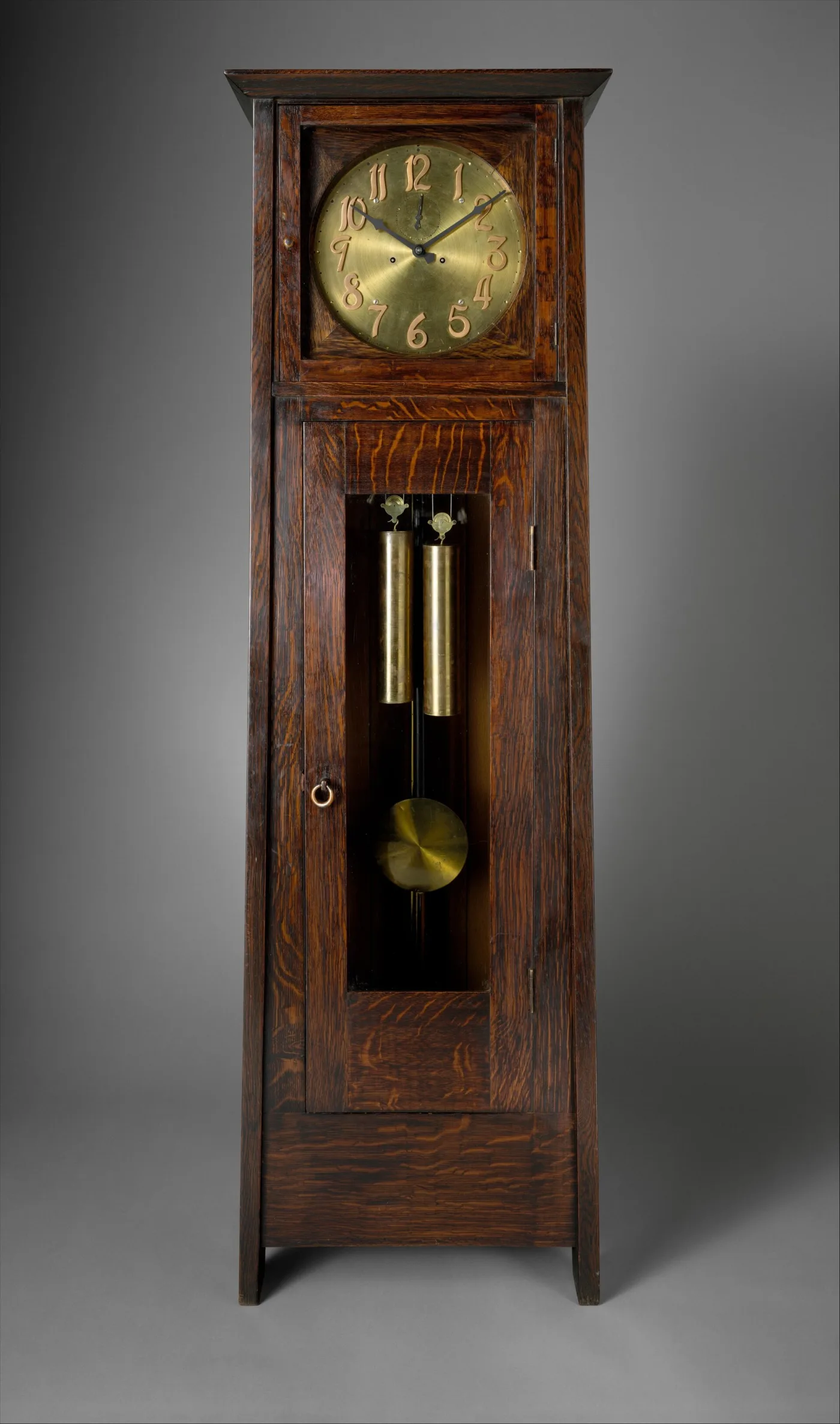
Quartersawn white oak's ray fleck appears as silvery, slightly metallic flecks scattered across the wood grain. The flecks are most visible at oblique viewing angles under raking light. A piece without ray fleck on visible surfaces is either not quartersawn or is rift-sawn (an intermediate cut without the dramatic fleck). Ray fleck distinguishes period Mission from later imitations that used plain-sawn or rift-sawn oak.
Secondary Woods
Drawer bottoms, case backs, and other hidden parts are typically poplar, chestnut, or pine. Drawer sides on quality pieces (Gustav, L. & J.G.) are often quartersawn oak; on lesser makers they are pine or whitewood. The secondary wood choices can confirm or contest a proposed attribution.
Chestnut Substitution
American chestnut was a common secondary wood until the chestnut blight (1904 onward) eliminated mature trees. Pieces with chestnut backs and bottoms generally predate 1915–1920 when stored chestnut lumber ran out. Chestnut secondary wood is a useful dating clue.
Joinery: Mortise, Tenon, Pin, and Key
Mission joinery is exposed, structural, and ideologically loaded. The Craftsman creed held that joinery should be visible and honest, not hidden under veneer or moulding. Reading the joinery is reading the maker's philosophy.
Mortise and Tenon
The mortise-and-tenon joint — a rectangular tongue (tenon) fitting into a matching slot (mortise) — is the structural foundation of Mission construction. Quality Mission pieces use through-tenons that extend completely through the mortising member and are visible (and sometimes wedged) on the exit side. Lesser pieces use blind tenons hidden within the joint.
Through-Tenons
Through-tenons are the visual signature of Stickley and Roycroft work. The tenon projects through the leg, stretcher, or apron and is sometimes finished flush, sometimes left projecting with a chamfered edge. Through-tenons are difficult and time-consuming to execute; their presence indicates high-quality Mission production. Lesser makers minimised through-tenons to save labour.
Pinned Tenons
Mortise-and-tenon joints on quality Mission are pinned with small wooden pegs (typically 3/8" or 1/2" diameter) driven through the leg into the tenon to lock the joint mechanically. Pins are visible on the leg face as small circular plugs. Gustav and L. & J.G. routinely pin major joints; Stickley Brothers and Charles Stickley pin selectively.
Keyed Tenons
The keyed tenon — where a wedge-shaped key passes through a slot in a protruding tenon to lock the joint — is the most visible and most prized Mission joinery feature. Settles and library tables often use keyed tenons connecting the long stretchers to the end frames. The key can be tapped out for disassembly. Genuine period keyed tenons fit precisely; modern reproductions often show looser fit or substituted modern hardware.
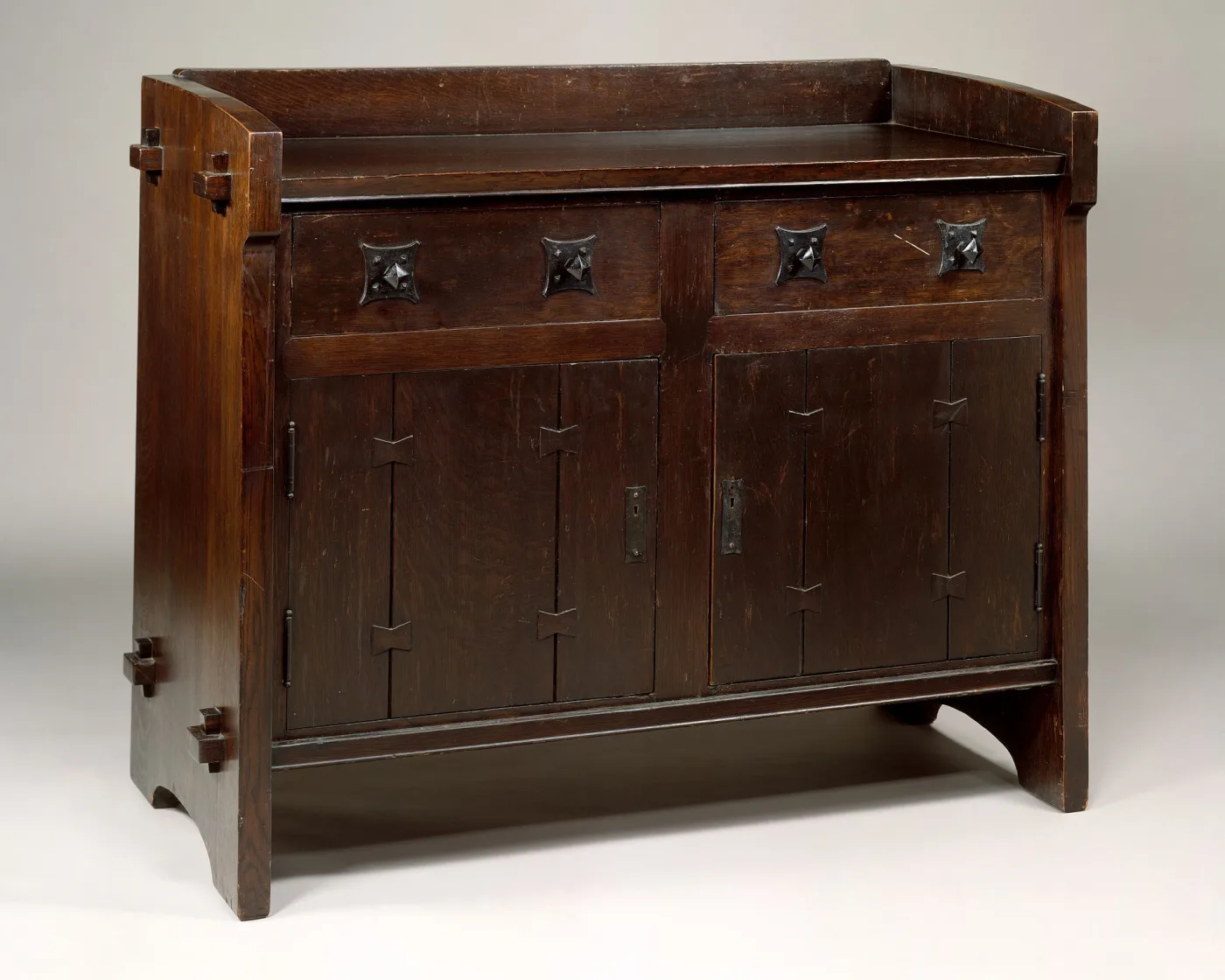
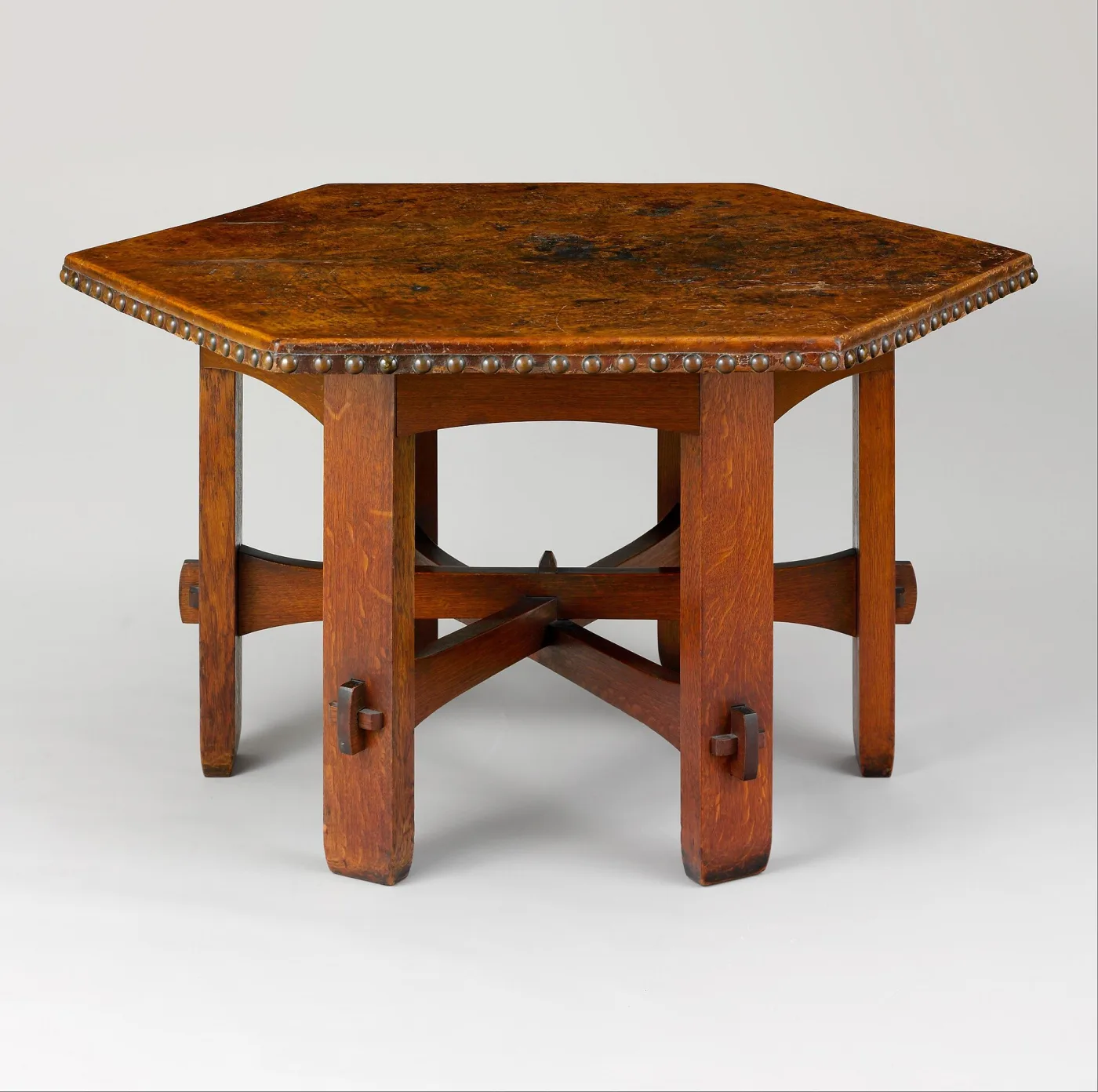
The two joints look similar from across a room and behave differently in the hand. On the left the tenons simply pass through and are trimmed off proud — permanent, glued and pegged, and the bow-tie keys beside them are stitching a board joint rather than holding a frame together. On the right the projecting tenon is slotted, and a tapered key drives down through the slot to draw the stretcher tight; tap the key upward and the table comes apart. Check that the keys taper, that they show the same century of wear and colour as the wood around them, and that the slots are cut cleanly through solid stock rather than into a glued-on block.
Dovetail Drawers
Drawer construction uses dovetail joinery — typically hand-cut dovetails on Gustav and early L. & J.G. work, machine-cut dovetails on later pieces and most Stickley Brothers production. Hand-cut dovetails show slight irregularities and slightly tapered "tails"; machine-cut dovetails are uniformly precise and uniformly spaced. The dovetail style helps confirm attribution.
Modern Reproduction Joinery
Modern reproductions often use dowel joinery, biscuit joinery, or pocket screws hidden under fillets. Any piece with hidden modern fasteners is not period Mission. Examine all joints under raking light; the absence of mortise-and-tenon evidence at structural junctions is disqualifying.
Hardware: Hammered Copper and Iron
Mission hardware is a distinct decorative category. Drawer pulls, hinges, escutcheons, and applied straps in hand-hammered copper, oxidised brass, or wrought iron were custom-made for Stickley and supplied by Karl Kipp and Jerome Connor at the Roycroft Shops, plus various commercial foundries.
Hammered Copper Pulls
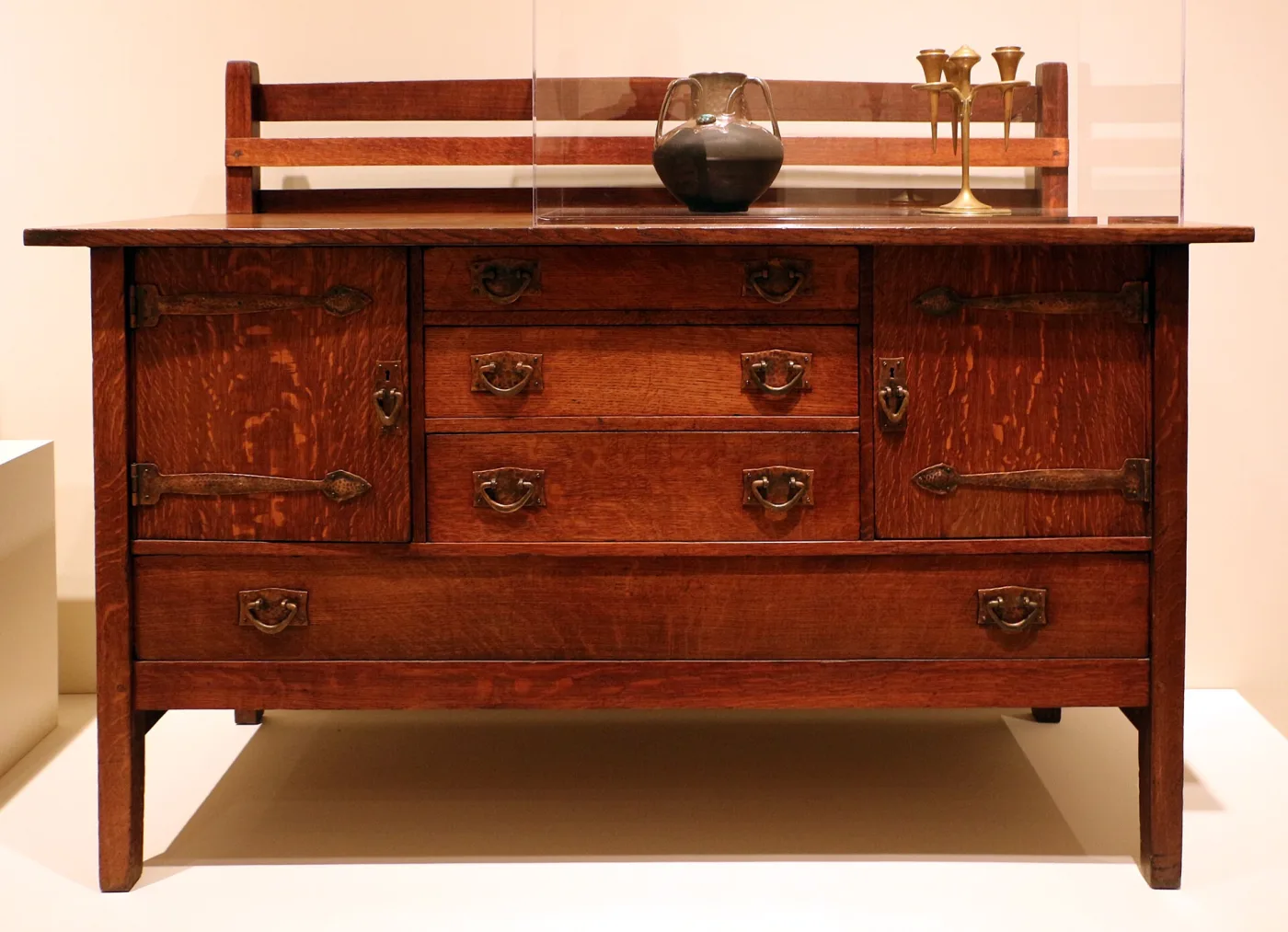
The signature Gustav Stickley pull is a hand-hammered copper rectangular plate with bail or ring handle, oxidised to a dark brown-black patina. The hammering shows distinctive irregular dimples from individual hammer strikes. Modern reproduction pulls are typically machine-stamped with uniform dimpling; the difference is visible under good light.
V-Strap Hinges
The V-strap hinge — a strap hinge with the strap formed as a V shape — appears on Mission case pieces, especially Roycroft work. V-strap hinges are typically copper or iron, oxidised dark, and applied with hand-forged nails or wood screws.
Iron Hardware
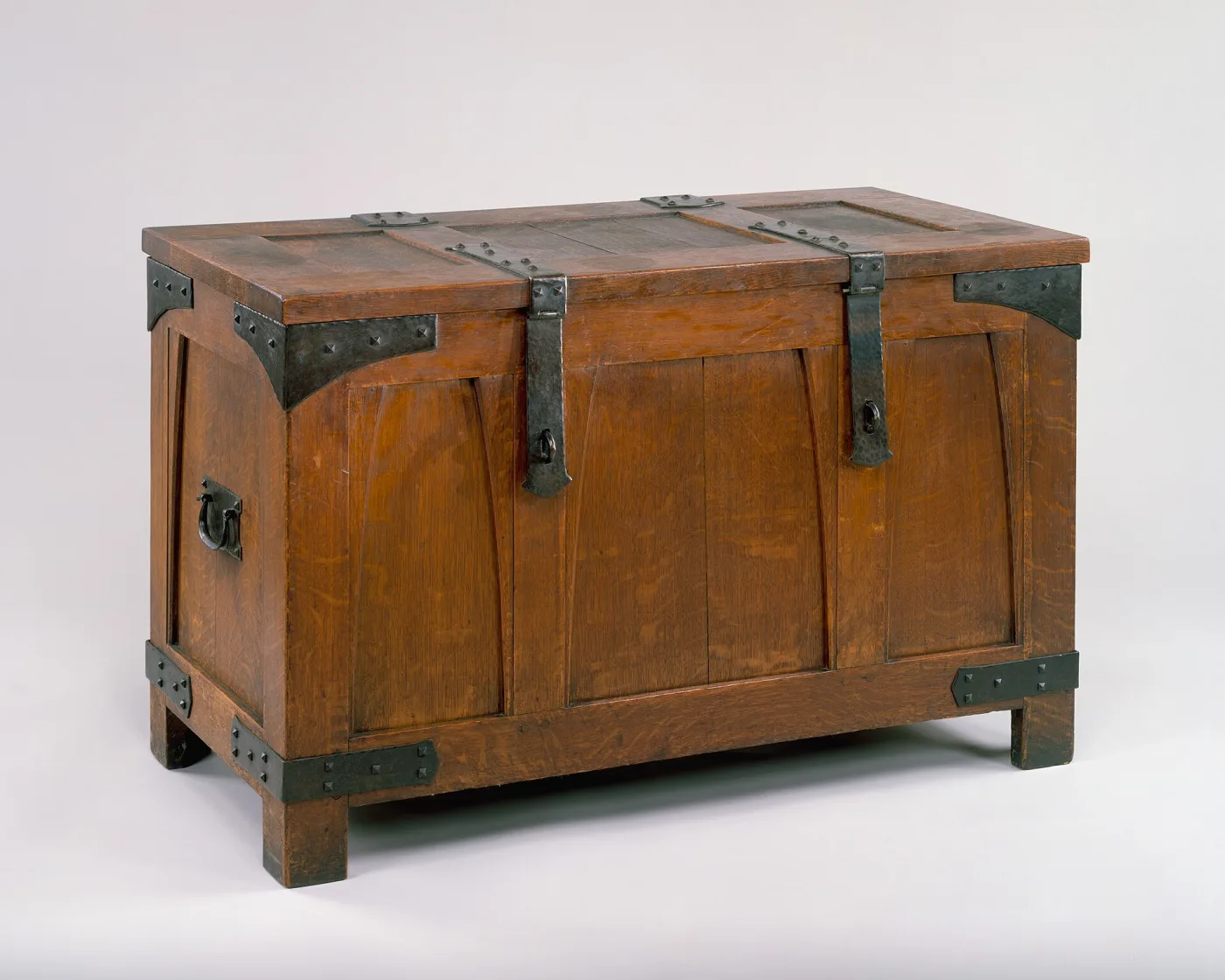
Wrought-iron hardware appears on some heavier pieces, particularly settles, library tables, and bookcase doors. Iron hardware shows forge marks, hammer texture, and oxidised black-brown patina. Modern cast-iron reproductions show seam lines from casting moulds.
Original Versus Replaced Hardware
Original hardware is essential to value. Replaced hardware (even period-appropriate replacement) substantially reduces a piece's worth. Examine fastener types (original hand-forged nails versus modern machine screws), patina consistency between hardware and wood, and ghost marks where original hardware may have been removed and replaced.
Catalogue Reference
The original Gustav Stickley catalogues (reproduced in modern reprints by Dover Publications and others) include hardware specifications for each model number. Cross-referencing hardware against the catalogue confirms originality. The general framework for hardware in furniture identification is discussed in our architectural salvage and hardware identification guide.
Fumed Ammonia Finish and Patina
The classic Mission finish is "fumed" — produced by exposing the bare oak to ammonia fumes in a sealed chamber. The ammonia reacts with tannins in the oak, darkening the wood from inside without surface stain or pigment.
The Fuming Process
Pieces were placed in a sealed chamber with open dishes of strong ammonia. Over 24 to 72 hours the ammonia vapour penetrated the wood and oxidised the natural tannins to dark brown-grey. The depth of fuming controlled the final colour. After fuming, pieces were finished with shellac, oil, or wax — never with a coloured stain.
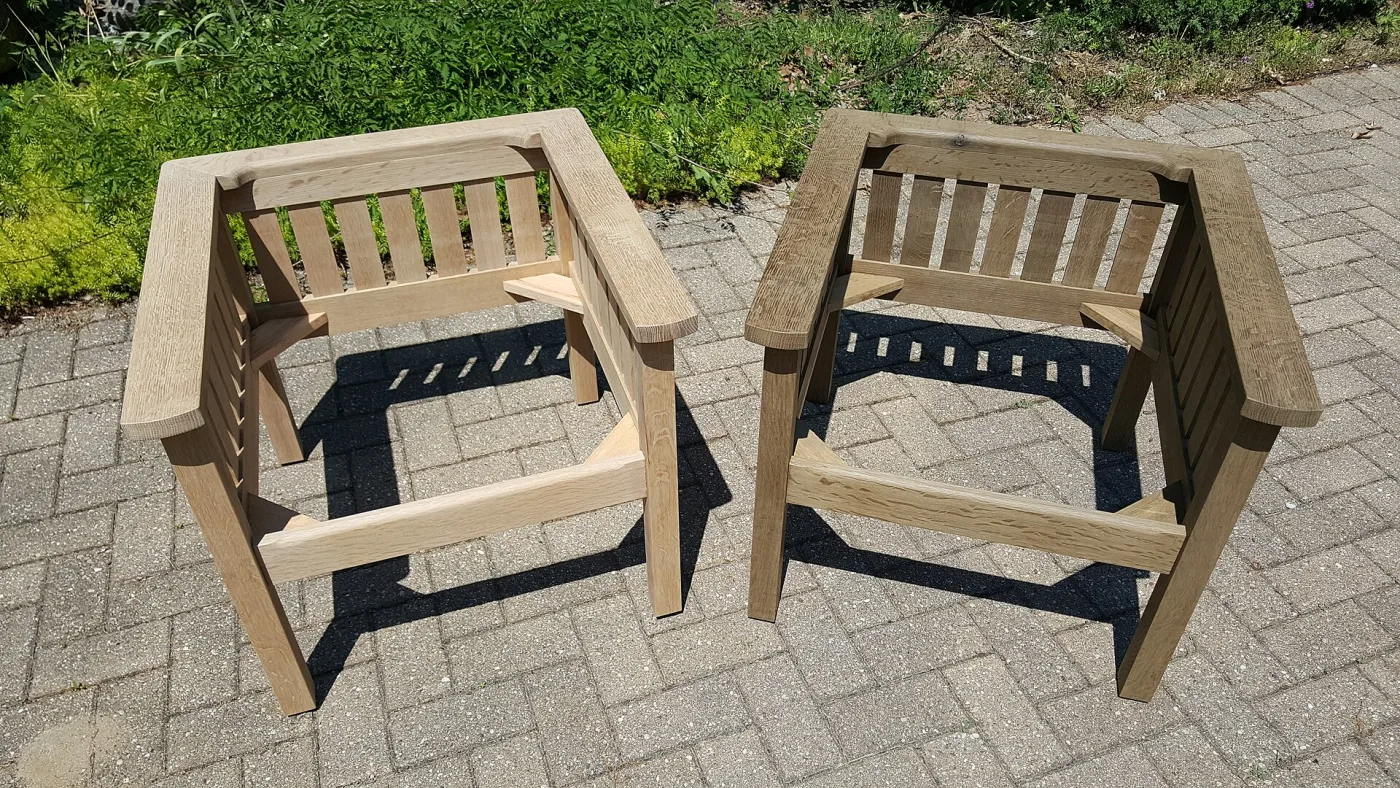

Both of these are modern demonstrations rather than period pieces, and the right-hand sample is European oak rather than American white oak — they are here for the mechanism, not the provenance. Ammonia vapour reacts with tannin already in the wood, so the colour arrives from within and follows the tannin: dense figure takes it differently from open grain, and the depth of colour tracks hours in the chamber rather than coats on the surface. That is the test on a real piece. Lift a drawer out and look at the unexposed edge of its front, or take the finish back on a hidden inch of a leg. Fumed oak keeps its colour into the wood; a stained piece goes pale under the first pass.
Recognising Fumed Finish
Genuine fumed finish shows uniform colour penetration to depth — sand a small inconspicuous area and the colour persists into the wood, not just on the surface. Stained finishes show pigment only at the surface; sanding exposes lighter wood underneath. Period fumed pieces with century-old wax or shellac topcoats develop a deep, soft amber-brown patina that modern reproductions cannot easily replicate.
Original Versus Refinished
Original fumed finish — even worn — is preferred over refinishing for collectable Stickley. Refinished pieces (stripped, restained, refinished with modern materials) reduce value substantially, sometimes by 50% or more for signed Gustav pieces. The original finish carries the historical patina that authenticates the wood and the period.
Wax and Oil Topcoats
Maintenance is by paste wax (Briwax or equivalent dark wax) applied sparingly, or fine furniture oil. Never use modern polishes containing silicone. Wax buildup over a century gives the soft, slightly waxy patina that defines period Stickley appearance.
Restored Finish
Some specialists "refresh" worn fumed finish by careful cleaning, selective re-fuming of damaged areas, and rewaxing — this conservation work can preserve value if disclosed and done well. Heavy-handed refinishing destroys value. The general framework for finish restoration in furniture is laid out in our antique restoration and conservation guide.

Characteristic Mission Forms
Mission oak production covered every household furniture category. The most collected and most diagnostic forms:
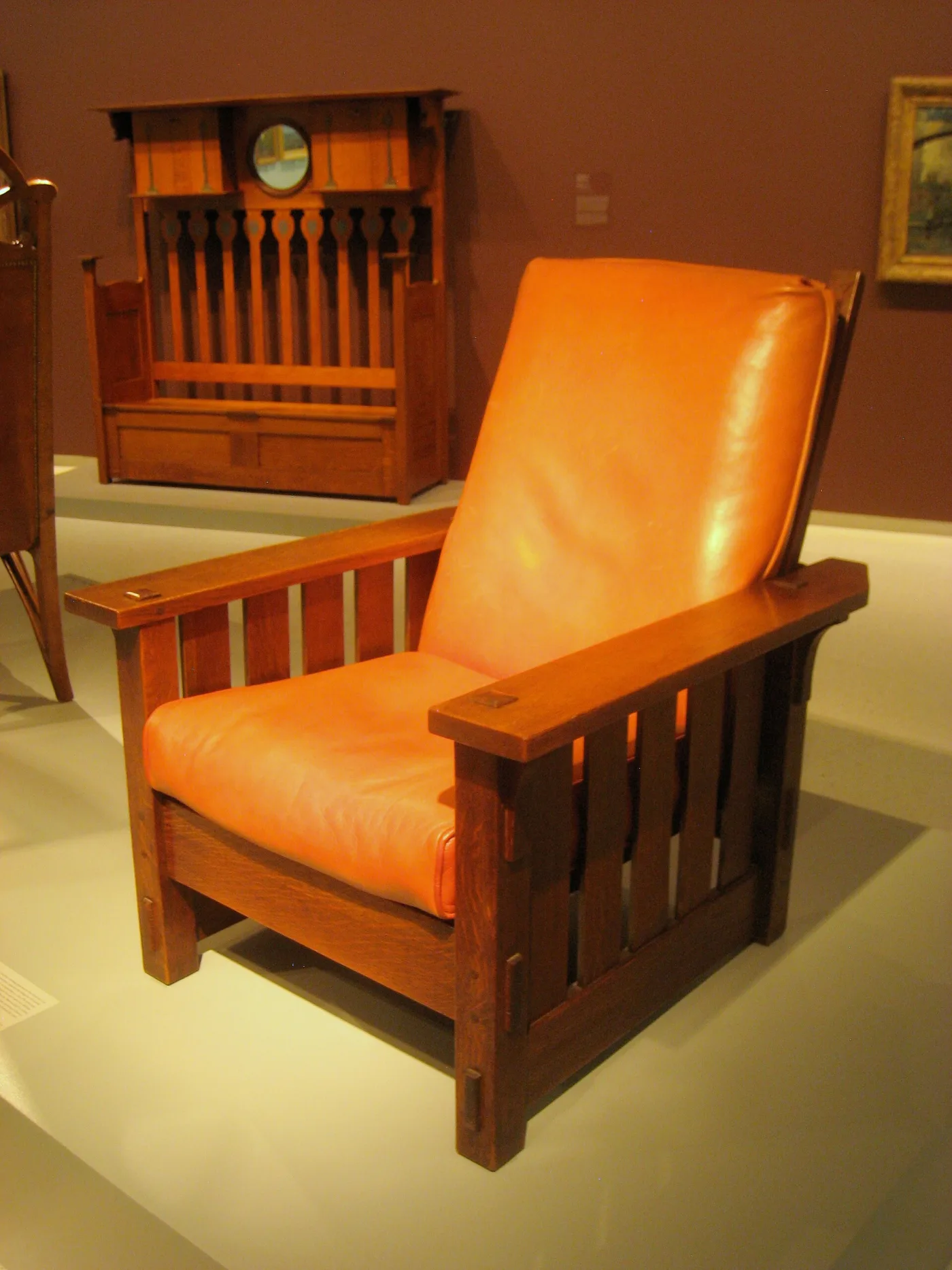
The Morris Chair
The Morris chair — an adjustable-back reclining armchair with loose cushions — is the iconic Mission form. Gustav's "Eastwood" Morris chair, with massive square arms and through-tenon construction, is the most desirable. Signed Gustav Morris chairs in original condition reach $5,000–$25,000+ depending on model and condition.
The Settle
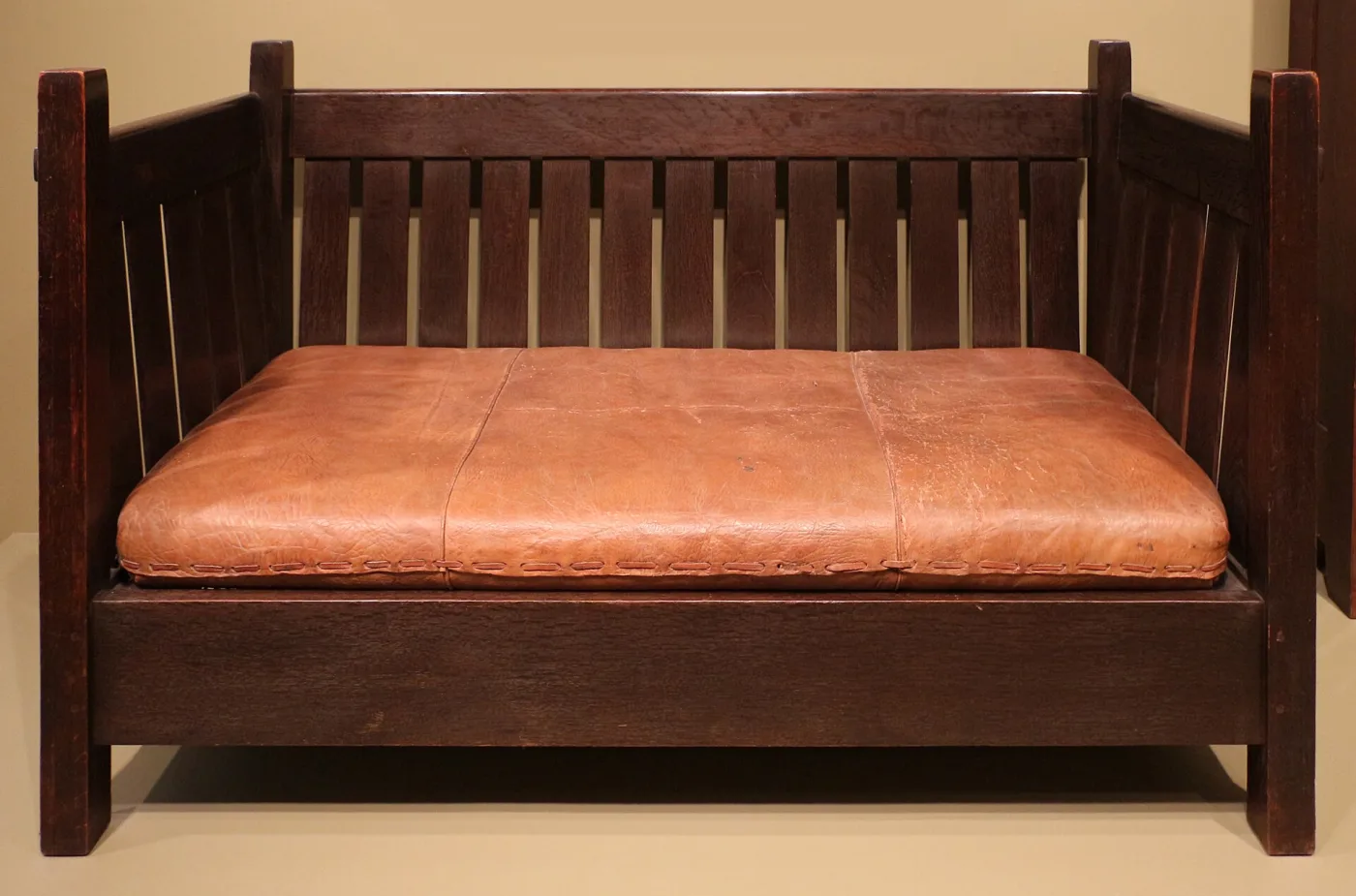
The Mission settle is a long, low bench-back sofa with square arms, vertical or horizontal slats, and loose cushions. Forms include the Eastwood Settle, the Prairie Settle (very long, with broad overhanging top rail), and the Even-Arm Settle. Signed L. & J.G. Prairie Settles can reach $30,000+ at specialist auction.
The Library Table
Rectangular library tables with one or two drawers, often with through-tenon stretchers and lower shelves. The "trestle" form — with stretchered base — is particularly characteristic. Gustav library tables range $2,000–$15,000+ depending on size and condition.
The Sideboard
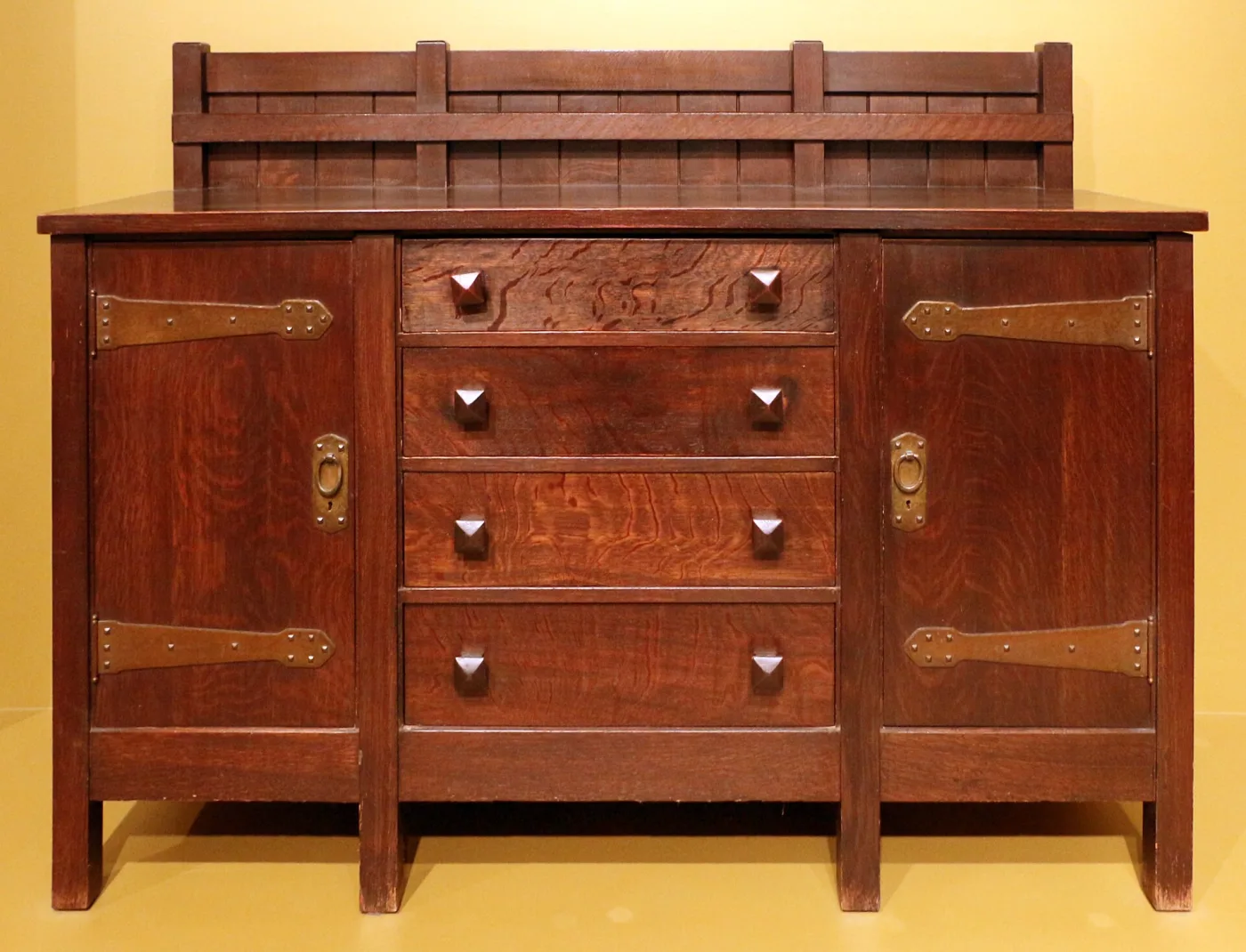
Large dining sideboards with multiple drawers and cabinet doors, often with applied corbels, plate rails, and hammered copper hardware. The Gustav Eastwood sideboard at full scale (typically six to eight feet wide) is a major Mission piece — $8,000–$60,000+ for signed examples in good condition.
The Bookcase
Glass-door bookcases (single, double, or triple) with mullioned-glass doors, applied hardware, and through-tenon side construction. Single-door bookcases are common; the iconic Gustav "Two-Door Glass Bookcase" with mullion doors brings $4,000–$15,000.
The Rocker
Mission rockers in many forms — including the famous Gustav "Eastwood" rocker, the Bow-Arm rocker, and various spindle rockers. Rockers are the most accessible Mission form; signed Gustav rockers range $1,500–$8,000 depending on model.
The Tabouret and Plant Stand
Small octagonal or square stands with mortise-and-tenon construction, often with cut-out aprons (especially Limbert) or simple square forms (Stickley). Tabourets are accessible entry-level Mission collecting; signed examples typically $300–$1,500.
Dining Tables and Chairs
Large extending dining tables with massive square legs and stretcher bases; matching dining chairs with vertical slats, tall backs, and leather seats. Complete signed dining sets (table plus six or eight chairs) can reach $15,000–$50,000+ depending on maker and condition.
Reproductions, Marriages & Restored Pieces
The Mission market is heavily reproduced. Distinguishing period from later production is essential and not always straightforward.
The Modern Stickley Reissue
L. & J.G. Stickley has produced Reissued Mission Oak from 1989 onward. Reissues are high-quality but conspicuously marked: clear "Stickley" decals dated to the year of production, often with "Mission Collection" or "Reissue" wording. Reissue pieces trade at modern furniture prices ($1,000–$8,000) versus the much higher antique market.
Period Reproductions (1920s–1960s)
Mid-century factories occasionally produced Mission-style furniture that is now itself old enough to be confused with period work. These "second-generation Mission" pieces typically show machine-cut dovetails, less precise joinery, plain-sawn oak (no ray fleck), and surface-applied stain rather than fumed finish. Examine carefully.
Late-Twentieth-Century Reproductions
From the 1970s onward, smaller workshops produced Mission reproductions of varying quality. Some are honest reproductions properly marked and dated; others have been deliberately distressed and falsely aged to deceive collectors. Modern fastener evidence, wrong secondary woods, and inconsistent wear patterns reveal these pieces.
Married Pieces
A "marriage" combines two original period pieces (a top and a base, for instance) that were not originally together. Marriages often look correct but show inconsistent wear, mismatched proportions, or different oak figure. Examine the join carefully; original construction shows continuous wear and patina, while marriages show a sharp transition at the join.
Replaced Marks
Some unsigned pieces have had Stickley decals applied later to enhance value. Fake decals are typically too clean, too red, or applied to a surface that shows the wrong wear pattern around the decal. Genuine period decals integrate with surrounding finish wear; later-applied decals sit on top of existing wear.
Stripped and Refinished Pieces
Heavy refinishing — common in the mid-twentieth century — strips the fumed finish, exposes lighter wood, and applies modern stain. Stripped pieces are recognisable by lighter overall colour, fresh stain showing in joinery, and absence of the deep patina characteristic of original finish.
Authentication Workflow
Authenticate any Mission oak piece in this order:
1. Locate and Photograph the Mark
Look for marks inside drawers, under tabletops, on the back of case pieces, under chair seats, and on inner case surfaces. Photograph any mark clearly under raking light. Identify mark type and period.
2. Confirm Quartersawn White Oak
Examine visible surfaces for ray fleck. Examine closed pores characteristic of white oak. The wood must match the period before any mark or design feature matters.
3. Examine Joinery
Identify mortise-and-tenon construction at major junctions. Look for through-tenons, pinned tenons, keyed tenons, and dovetail drawers. Joinery quality must match the proposed maker — Gustav-quality joinery on an unsigned piece is suggestive; lesser joinery contradicts a Gustav attribution.
4. Verify Original Hardware
Confirm hardware type matches the period: hand-hammered copper, oxidised brass, or wrought iron. Look for ghost marks indicating replaced hardware. Cross-reference against original catalogue specifications if available.
5. Confirm Fumed Finish
Sand a small inconspicuous area to confirm colour penetration. Examine the overall patina under good light. Original fumed finish shows deep amber-brown with century of waxing; refinished pieces show fresh stain.
6. Cross-Reference Form and Model Number
Match the piece against published catalogue illustrations (Gustav Stickley's catalogues are reprinted by Dover; L. & J.G. catalogues are similarly available). Confirm dimensions, proportions, and detail elements match the catalogue specification for the proposed model.
7. UV and Restoration Examination
Black-light examination identifies overpaint, fillers, replaced wood, and modern adhesives. Disclosed restoration is acceptable on important pieces; undisclosed restoration substantially affects value.
8. Provenance Documentation
For pieces above $5,000, gather prior auction records, family history, photographic documentation. Strong provenance dramatically supports value. The general framework laid out in our authentication and provenance research guide applies directly.
9. Specialist Confirmation
For pieces above $15,000, consult a Mission oak specialist — David Rago Auctions, Treadway-Toomey, Rago/Wright, the American Furniture department at Sotheby's or Christie's, or a recognised independent appraiser. Specialist confirmation prevents expensive mistakes and supports later resale.
Condition Assessment
Condition substantially affects Mission oak values. Key condition factors:
Finish Condition
Original fumed finish — even worn or slightly faded — is preferred over refinishing. Light wear consistent with century of use is acceptable. Heavy refinishing or stripping reduces value by 30–60% on signed pieces.
Structural Integrity
Joints should be tight; loose mortise-and-tenon joints indicate either poor original construction (typical of lesser makers) or wear that requires regluing. Check stretchers, leg joints, and chair backs for stability. Repaired joints reduce value modestly if disclosed and done well.
Hardware Originality
Original hardware is essential. Replaced hardware (even period-appropriate) reduces value 15–30%. Missing hardware that has left ghost marks reduces value substantially unless period-correct replacements are sourced.
Veneer and Inlay
Lifting veneer on case pieces and lost inlay on Harvey Ellis pieces reduce value. Professional restoration is acceptable if disclosed.
Wood Damage
Splits, cracks, and replaced sections affect value substantially. Through-tenons that have been split and repaired may indicate excessive stress or original construction defect.
Upholstery
Original leather seats are unusual; most pieces have been reupholstered. Quality reupholstery in correct leather (Russett oilcloth leather, or buffalo leather as period sources used) maintains value. Cheap modern reupholstery (vinyl, wrong leather) reduces value.
Patina and Surface Wear
Even surface wear consistent with century of use is desirable and adds value. Localised heavy wear (water stains on tabletops, scuff marks on arms) reduces value modestly.
Value Factors and Price Ranges
Mission oak values span four orders of magnitude. The general framework in our antique valuation and appraisal guide applies; the Mission-specific factors below.
Primary Value Drivers
Maker (Gustav > L. & J.G. > Roycroft / Limbert > Stickley Brothers > Charles Stickley > lesser makers / unsigned); form (large case pieces, settles > chairs > tables > stands); design rarity (Harvey Ellis inlaid pieces > standard Craftsman); original finish; original hardware; condition; documented provenance.
Approximate Price Ranges
Unsigned Mission pieces: $200–$1,500. Stickley Brothers / Charles Stickley: $300–$3,000. Lifetime, Harden, smaller makers: $400–$3,500. L. & J.G. Stickley standard pieces: $1,000–$8,000. Gustav Stickley standard pieces: $2,000–$25,000+. Roycroft signed pieces: $1,500–$15,000. Limbert with characteristic cut-outs: $1,500–$12,000. Harvey Ellis–period Gustav inlaid pieces: $5,000–$50,000+. Major signed Gustav case pieces (sideboards, china cabinets, secretaries): $8,000–$80,000+. Exceptional documented Gustav pieces with auction provenance: six figures and occasionally seven for the rarest examples.
Iconic Forms
Eastwood Morris chairs (signed Gustav): $5,000–$25,000+. Prairie Settles (signed L. & J.G.): $15,000–$45,000. Gustav Two-Door Glass Bookcases: $4,000–$15,000. Limbert Tabourets with characteristic cut-outs: $1,500–$6,000.
Sets and Suites
Matched dining sets (table plus six or eight chairs): substantial premium if all signed by same maker, all-original finish. Complete bedroom suites: rare and command premium prices. Mismatched "married" sets trade at substantial discounts.
Damage Discounts
Refinished: 30–60% discount on Gustav, less on lesser makers. Replaced hardware: 15–30% discount. Married pieces: 30–50% discount. Replaced sections of wood: 25–50% discount. Reupholstered with wrong material: 10–20% discount.
Auction Houses for Mission Oak
Specialist auction houses include Rago Arts and Auction Center (Lambertville, NJ — the leading Mission specialist), Treadway-Toomey, John Moran, Bonhams (American Furniture), Christie's American Furniture, and Skinner. The Arts and Crafts Conference (Asheville, NC) each February brings dealers and collectors together for major shows. Watch sales records on LiveAuctioneers and Rago's archived sales for comparables.
Building a Mission Oak Collection
Mission oak rewards focused collecting. The general principles in our antique collecting strategies guide apply; the Mission-specific refinements below.
Specialise by Maker or Form
Mission oak's breadth makes general collecting expensive and unfocused. Successful collections specialise: Gustav Stickley only; L. & J.G. Stickley Handcraft-period only; Limbert cut-out pieces; Roycroft furniture; or by form (Morris chairs only, library tables only, signed plant stands). Focused collections build expertise faster and command resale premiums.
Reference Libraries
Essential references include David Cathers' "Gustav Stickley" (comprehensive monograph); Stephen Gray's "The Mission Furniture of L. & J.G. Stickley"; Donald Davidoff and Robert Edwards' "The Mission Furniture of L. & J.G. Stickley"; Robert Judson Clark's "The Arts and Crafts Movement in America" (the catalyzing 1972 exhibition catalogue); and the Dover reprint of Gustav Stickley's "Craftsman Homes." Rago Auctions catalogue archives provide modern market comparables.
Visit Craftsman Farms and Museums
Craftsman Farms in Morris Plains, New Jersey (Gustav Stickley's own home, now a museum) is the principal pilgrimage destination. The Stickley Museum in Fayetteville, New York and the Roycroft Campus in East Aurora, New York are also essential. The Robert and Jean Mitchell Collection at the Two Red Roses Foundation (Tarpon Springs, Florida) holds one of the finest private Mission collections, occasionally open to scholars.
Specialist Dealers
Dalton's American Decorative Arts (Syracuse, NY), Voorhees Craftsman (San Jose, CA), Treadway Gallery (Cincinnati, OH), and Michael FitzSimmons Decorative Arts (Chicago, IL) are among the leading Mission specialist dealers. Specialist dealer prices exceed auction but the certainty and provenance often justify the premium for high-value pieces.
The Arts and Crafts Conference
The Grove Park Inn Arts and Crafts Conference (Asheville, NC) each February is the annual gathering of dealers, collectors, and scholars. Two days of lectures, three days of shows, and substantial socialising establish market direction and provide buying opportunities.
Provenance Documentation
Maintain photographic and written records of every piece: mark photographs, joinery details, hardware, original receipts or auction lots, prior dealer invoices. Strong provenance dramatically increases resale value and supports authenticity claims for signed pieces.
Insurance and Appraisal
Mission collections above $10,000 in aggregate deserve scheduled insurance and updated appraisals every five years. Specialist appraisers familiar with the Mission market produce more useful valuations than general antique appraisers.
Care, Display & Preservation
Mission oak's heavy construction makes it more forgiving than fine porcelain or veneered furniture, but the fumed finish, original hardware, and (in upholstered pieces) period leather all demand care. The general principles in our antique storage and preservation guide apply across Mission collecting.
Climate Control
Stable temperature (16–22°C / 60–72°F) and humidity (40–55%) prevent oak shrinkage, joint loosening, and finish degradation. Avoid placement near radiators, heating vents, or large windows with direct sunlight.
Sunlight Exposure
Direct sunlight gradually bleaches fumed finish, lightening the deep amber colour over years. Display away from south- or west-facing windows; use UV-filtering window film or curtains for unavoidable exposure.
Waxing and Finish Maintenance
Maintain fumed finish with paste wax (Briwax or similar dark furniture wax) applied sparingly two or three times per year. Apply with soft cloth, allow to haze, buff with clean cloth. Never use modern polish containing silicone — silicone contamination is permanent and complicates any future restoration. Avoid water-based cleaners and ammonia (which removes wax and can re-fume areas inconsistently).
Hardware Care
Original hammered copper, brass, and iron hardware develops appropriate patina over decades. Never polish to bright finish — the patina is essential to authenticity and value. Wipe lightly with soft dry cloth; do not use commercial metal polish.
Upholstery Care
Original leather (where it survives) requires periodic conditioning with neutral leather conditioner. Modern reupholstery in proper leather should be similarly maintained. Avoid sun exposure of leather seats; lay light cloths over leather when pieces are not in active use.
Moving and Handling
Mission case pieces are heavy. Move by lifting from the structural base, never by tops, drawers, or applied hardware. Remove drawers and shelves before moving large pieces. Protect corners with padding during transit. Always engage two people minimum for case pieces.
Storage
Long-term storage in climate-controlled environment only. Wrap each piece in furniture pads; do not stack. Maintain humidity within the same range as display. Inspect annually for insect activity (powder-post beetle is the principal threat to oak furniture in storage).
Documentation
Photograph each piece from multiple angles including marks, joinery details, hardware, and condition issues. Keep a written inventory with maker attributions, model numbers (where known), dimensions, prior provenance, current condition, and any restoration work. Update the inventory when condition changes or new attributions are made.