
Moorcroft Pottery Identification Guide: Signatures, Tube-Lining & Dating
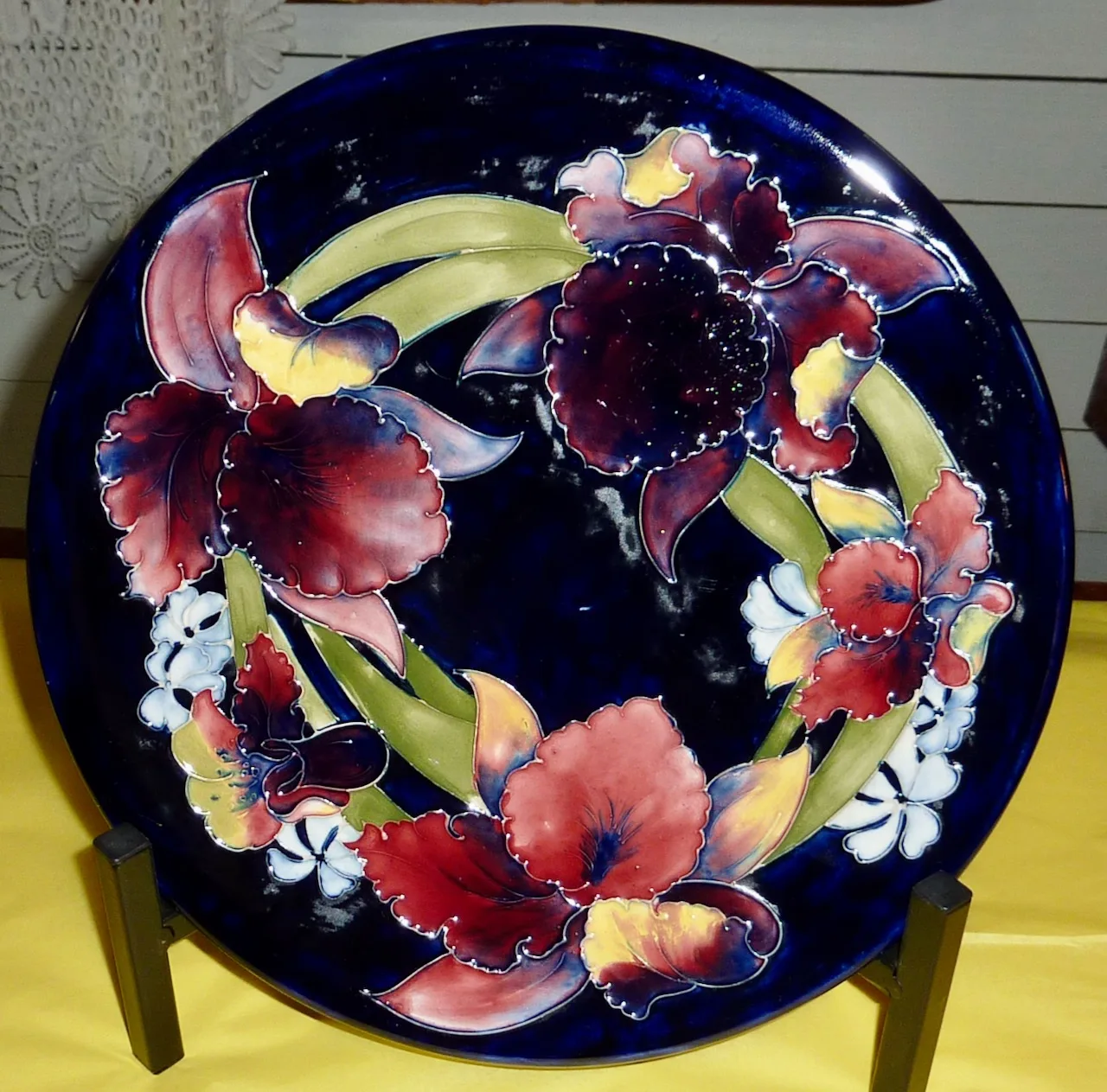
Moorcroft Pottery is one of the most immediately recognizable bodies of work in twentieth-century English ceramics. Founded as a distinct studio in 1913 by William Moorcroft after years designing for the Burslem firm of James Macintyre & Co., the pottery has produced more than a century of richly coloured, tube-lined art ware in unbroken family and design tradition. For collectors of ceramics and pottery, Moorcroft offers something rare among Staffordshire makers: a continuous narrative of named designers, dated marks, and signed pieces stretching from 1898 to today.
What sets Moorcroft apart from its English peers is the tube-lining technique used on virtually every decorated piece. Thin trails of liquid clay are piped onto the unfired body to create raised outlines, which are then hand-filled with coloured glazes. The result is a ceramic surface that feels almost cloisonné in its precision, with each colour locked into its own raised cell. Combined with the company's habit of signing pieces in full — William Moorcroft, Walter Moorcroft, and later signatures and impressed marks — this technique makes Moorcroft one of the most reliably attributable of all English art potteries.
This guide walks through every element of Moorcroft identification: the Macintyre period marks of 1898–1913, William Moorcroft's signature evolution, the major pattern groups from Florian Ware through Pomegranate to Hibiscus, the Walter Moorcroft and contemporary eras, royal warrant marks, factory backstamps, paper labels, and the practical authentication checks used by specialist dealers. Whether you have inherited a Pomegranate vase, found a Macintyre Florian piece at auction, or are evaluating a recent designer signature, the framework below will let you read a Moorcroft base with the same confidence as a Burslem specialist.
Table of Contents
- A Brief History of Moorcroft
- The Macintyre Period (1898–1913)
- Moorcroft Signatures and Their Evolution
- Factory Backstamps and Impressed Marks
- Tube-Lining Technique and Authentication
- Florian Ware and Early Patterns
- Pomegranate, Wisteria, and Pansy
- Powder Blue and Liberty & Co.
- Walter Moorcroft and Mid-Century Wares
- Royal Warrants and Their Marks
- Contemporary Moorcroft and Named Designers
- Paper Labels, Boxes, and Provenance
- Authentication and Detecting Fakes
- Condition, Damage & Restoration
- Value Factors and Price Ranges
- Building a Moorcroft Collection
- Care, Display, and Preservation
A Brief History of Moorcroft
Moorcroft's story begins not in 1913 but fifteen years earlier, when a 25-year-old William Moorcroft was hired as a designer at James Macintyre & Co., a Burslem maker of industrial and decorative wares. Within months he had been given his own studio inside the Macintyre works and was creating an entirely new range of art pottery under the name Florian Ware. The decade and a half that followed produced the pieces that still command the highest Moorcroft prices today.
The Macintyre Years (1897–1913)
From the late 1890s through 1913, Moorcroft worked under the Macintyre umbrella but operated effectively as an independent design house. His earliest patterns — Aurelian, Florian, Hesperian, and the Persian-influenced Eighteenth-Century — won medals at international exhibitions and were retailed through Liberty & Co. in London, Tiffany & Co. in New York, and Shreve & Co. in San Francisco. The Macintyre relationship soured around 1912 as the parent firm tried to absorb the art pottery profits, and William left to found his own works.
W. Moorcroft Ltd at Cobridge (1913–1945)
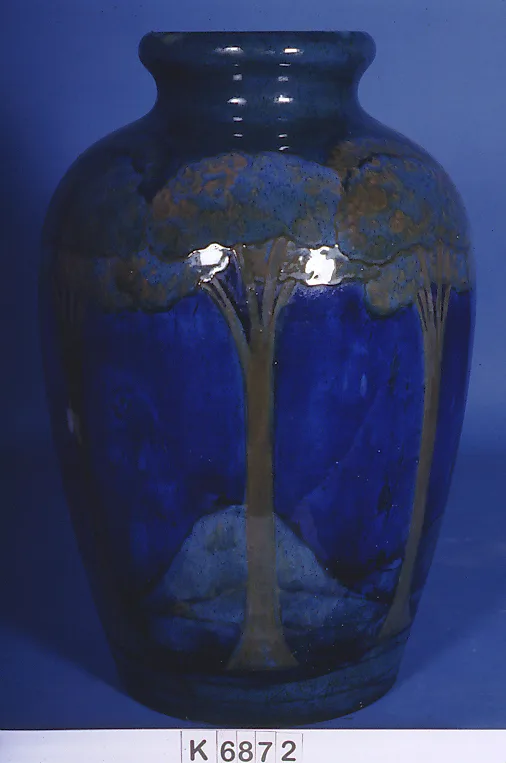
In 1913, William Moorcroft built a new factory in Cobridge, just north of Burslem, with financial backing from Liberty & Co. — who retained a controlling interest until 1962. The Cobridge years produced Moorcroft's most beloved patterns: Pomegranate, Wisteria, Pansy, Cornflower, Big Poppy, Spanish, and Claremont (a toadstool pattern). Royal warrants from Queen Mary in 1928 and continuing recognition from subsequent monarchs cemented Moorcroft's standing as one of England's flagship art potteries.
Walter Moorcroft and the Postwar Era (1945–1986)
William died in 1945 and was succeeded by his son Walter, who had trained in the works from boyhood. Walter introduced new patterns — Hibiscus, Magnolia, Caribbean, Marine — while maintaining many of his father's designs. Walter's pieces are typically signed in blue or green rather than William's signature blue, and the company shifted from rich dark grounds toward lighter palettes over the 1950s and 1960s.
The Revival Period (1986–Present)
After a difficult period in the 1970s and early 1980s when the company nearly closed, Moorcroft was rescued in 1986 by Hugh Edwards and Richard Dennis. Under new ownership a fresh generation of named designers — Sally Tuffin, Rachel Bishop, Emma Bossons, Philip Gibson, Nicola Slaney, Vicky Lovatt, Kerry Goodwin and others — produced original tube-lined patterns that have themselves become collectible. The pottery remains in operation at the original Cobridge site and continues to issue limited editions, designer signatures, and trial pieces.
The Macintyre Period (1898–1913)
Macintyre-era Moorcroft is the most academically interesting and often the most valuable part of the canon. Pieces from this period carry the Macintyre name on the base alongside William Moorcroft's own signature — a dual attribution unique to these years.
The Macintyre Backstamp
The standard Macintyre mark is a printed rectangle or roundel reading "JAS MACINTYRE & CO LTD BURSLEM ENGLAND," sometimes with the pattern name (Florian Ware, Aurelian Ware, Hesperian Ware) and a pattern or shape number. The mark is usually in green or brown transfer; the colour is not a reliable date indicator. Some pieces add "Rd. No." followed by a registered design number that allows precise dating through Board of Trade records.
William Moorcroft's Macintyre Signature
Below or alongside the Macintyre stamp, William signed in full — usually "W. Moorcroft" in painted green script — and sometimes added "des." (for "designed by"). The signature is not a printed addition: it was hand-painted by William himself on virtually every piece that left his Macintyre studio. The presence of the painted signature is what elevates a Macintyre piece from ordinary commercial ware to documented Moorcroft.
Florian and Allied Patterns
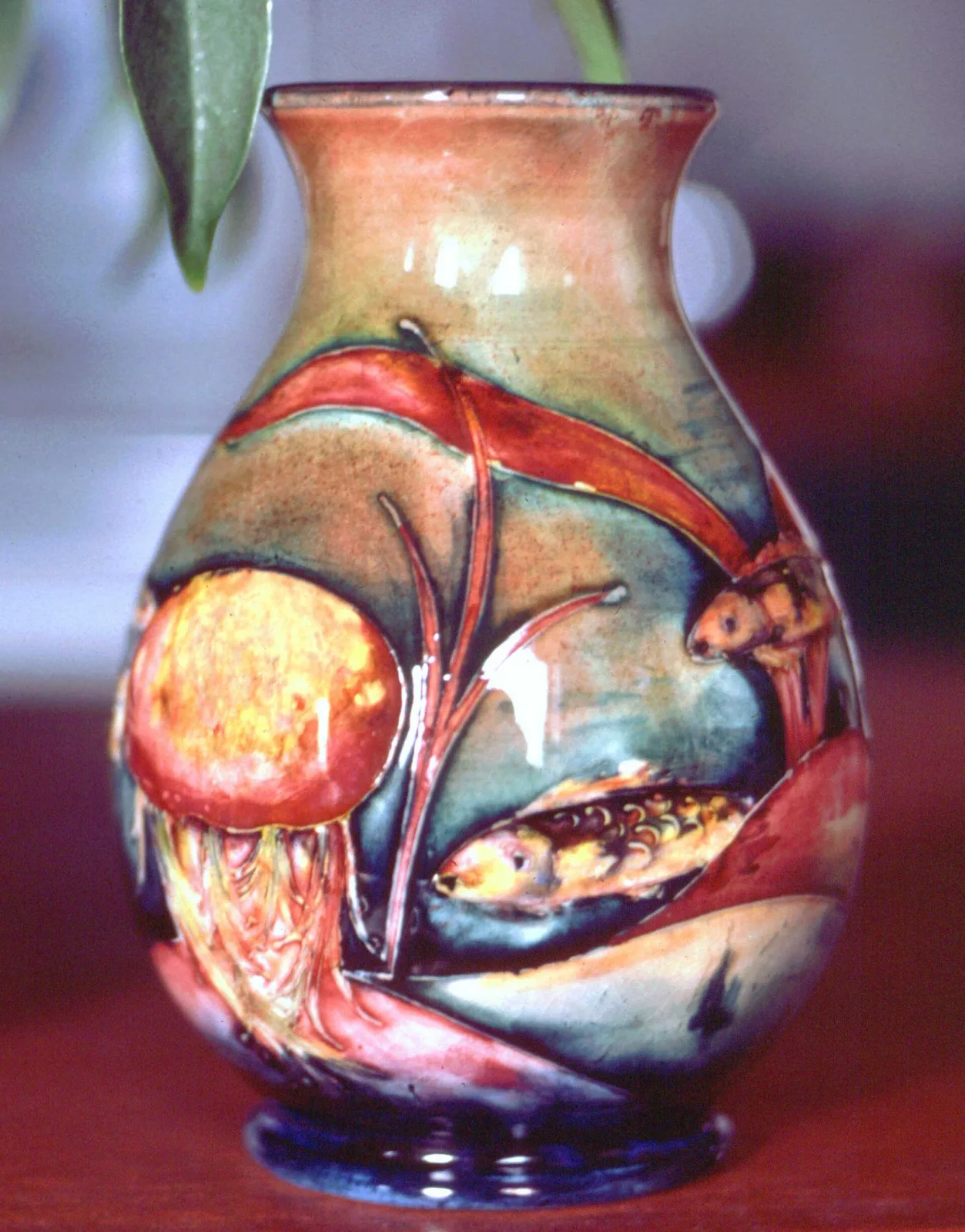
Florian Ware (1898–1906) is the most important Macintyre pattern. Tube-lined botanical motifs — cornflowers, poppies, tulips, irises, forget-me-nots, peacock feathers — are filled with translucent blue, green, and yellow glazes over a white or cream ground. Aurelian Ware adds gilding to Florian-style designs and is rarer. Hesperian Ware uses sea life motifs (fish, seaweed, jellyfish) and is the scarcest of the three. These patterns are the foundation of Macintyre collecting and routinely sell into five figures for important shapes.
Late Macintyre Transition (1910–1913)
By 1910, William's signature begins to appear larger and more confident, and pattern range expands to include the early Pomegranate, Wisteria, and Pansy designs that would dominate the Cobridge years. Pieces from this transitional period sometimes carry both the Macintyre stamp and a "Moorcroft Burslem" mark, indicating the move was already in progress before the formal 1913 split.
Moorcroft Signatures and Their Evolution
The painted signature is the single most useful dating tool on a Moorcroft piece. Signatures evolve in style, colour, and form across each generation, and reading them correctly narrows the date window before any other mark is consulted.
William Moorcroft's Signature (1898–1945)
William signed in flowing green or blue script — "W. Moorcroft" — across his entire career. Early Macintyre signatures (1898–1905) are smaller and more controlled. Cobridge-era signatures (1913–1945) become larger and looser. By the 1930s, William's signature is typically painted in blue or grey-blue, sometimes with an underlined flourish. After his death in 1945, no genuine new William signature was applied, so any "W. Moorcroft" signature on a piece showing post-1945 production traits is suspicious.
Walter Moorcroft's Signature (1945–1986)
Walter signed "W. Moorcroft" as well — using the same first initial — but his hand is recognizably different. Walter's letters are smaller, more upright, and typically painted in blue or green-blue. Compare side by side with documented William signatures and the distinction becomes clear within a few minutes. Walter's signatures continue through the 1960s and decline in frequency afterward; many 1970s pieces show factory marks alone with no painter's signature.
Designer Signatures (1987–Present)
Modern Moorcroft pieces often bear the designer's signature alongside the factory stamp. Rachel Bishop, Sally Tuffin, Emma Bossons, Philip Gibson, Nicola Slaney, Vicky Lovatt, Kerry Goodwin, Beverley Wilkes, and many others have signed limited-edition and trial pieces. A designer signature significantly increases collector interest and is an important value driver in the contemporary market.
Painter Initials and Decorator Marks
In addition to designer signatures, the actual paintresses who applied glazes on the production line often add small painted initials or symbols near the foot. These are not signatures in the formal sense but are useful for matching pieces to production records and confirming factory authenticity.
Factory Backstamps and Impressed Marks
Beyond the painted signature, Moorcroft applies a printed or impressed factory mark that evolves on a known schedule. Combining the backstamp with the signature gives a reliable date window.
Impressed "MOORCROFT BURSLEM" (1913–1921)
The earliest Cobridge pieces use an impressed mark reading "MOORCROFT BURSLEM" in a curve or straight line, sometimes with "Made in England." The impressed mark is pressed into the clay before firing and is therefore part of the body, not a surface addition.
"MOORCROFT MADE IN ENGLAND" (1921–1949)
From around 1921, the standard impressed backstamp becomes "MOORCROFT MADE IN ENGLAND." It is often paired with William's painted signature in blue. Roman numeral year marks occasionally appear, though Moorcroft was not as systematic about dating as Rookwood or some Staffordshire factories.
Royal Warrant Marks (1928 and Beyond)
Following Queen Mary's 1928 royal warrant, Moorcroft adds "Potter to H.M. The Queen" — and later H.M. The Queen Mother, and subsequent monarchs — to many backstamps. The exact wording shifts as warrants are renewed or change holder. A "Potter to H.M. The Queen" mark indicates production after the warrant date and is one of the easiest visual cues for a quick date estimate.
Postwar and Modern Stamps (1949–Present)
Walter-era and modern backstamps continue the "Moorcroft Made in England" format with various decorative borders, year marks, and edition numbers. From the 1990s onward, limited-edition pieces add fraction marks (e.g., "12/350") and designer signatures. Trial pieces — preproduction samples in unusual colourways — carry a "TRIAL" stamp and are highly collectible.
Pattern and Shape Numbers
Many pieces show painted or impressed pattern and shape numbers. Pattern numbers refer to specific designs in the Moorcroft archive, while shape numbers identify forms. Reference books cross-reference these numbers to dates and named designs, allowing fine-grained attribution.
Tube-Lining Technique and Authentication
Almost every decorated Moorcroft piece — from 1898 to today — is tube-lined. Understanding what genuine tube-lining looks and feels like is the single most powerful authentication tool a collector can develop.
How Tube-Lining Works
A skilled artisan pipes thin trails of liquid slip from a fine bag onto the leather-hard unfired body, drawing the outlines of the pattern in raised relief. After bisque firing, decorators fill each cell between the raised lines with coloured glazes. A final glaze firing fuses everything into a smooth but textured surface in which colours are locked into individual compartments by the raised slip lines.
What Genuine Tube-Lining Feels Like
Run a fingertip across a Moorcroft surface. The pattern outlines should be subtly raised, like the veins on a leaf, and the colour fields between them should sit slightly recessed. The raised lines are continuous and confident; they should never look painted on top of the glaze. A flat, painted-looking decoration is almost certainly not Moorcroft, regardless of any signature.
Tube-Lining Versus Transfer Printing
Some Staffordshire factories produced transfer-printed patterns that mimic the look of tube-lining at a distance. Transfers leave a perfectly flat surface and often show small registration dots or printing artifacts under magnification. Genuine tube-lining shows the slight irregularities of a handwork process — places where the trailing pressure varied, tiny pinches at line ends, and a slight three-dimensional quality that no transfer can imitate.
Glaze Pooling and Color Saturation
Genuine Moorcroft glazes pool slightly inside the tube-lined cells, deepest at the centre and lighter where they meet the raised line. Modern fakes often show flat, uniform colour or paint that crosses the raised lines because it was applied after firing. Glaze pooling, deep saturation, and a glassy surface are positive indicators of authentic factory production.
Florian Ware and Early Patterns
Florian Ware is to Moorcroft what Standard Glaze is to Rookwood — the foundation pattern that defines the maker's early identity. Understanding its variants helps frame everything that follows.
Classic Florian (1898–1906)
Classic Florian features tube-lined floral patterns in blue, green, and yellow on white or cream grounds. Cornflowers, poppies, tulips, irises, peacock feathers, and forget-me-nots are the most common motifs. The glaze is glossy and translucent, allowing the white body to show through and giving the colours a luminous depth.
Aurelian Ware (1898–1904)
Aurelian combines Florian-style tube-lining with gilded highlights, often on darker grounds. Pieces are scarcer than standard Florian and frequently retain only fragments of the original gilding. Inspect under magnification: heavy gilding wear reduces value, while bright, complete gilding is a significant premium.
Hesperian Ware (circa 1902–1903)
Hesperian uses sea-life motifs — fish, jellyfish, seaweed — and is the rarest of the early Macintyre pattern groups. Important Hesperian pieces routinely sell into the upper four or low five figures at specialist auction.
Eighteenth-Century and Persian Patterns
William also produced Persian-inspired patterns featuring stylized flowers and scrolling foliage, and an "Eighteenth-Century" range with chinoiserie motifs. These are less common than Florian but appear regularly at auction and remain strongly collected.
Pomegranate, Wisteria, and Pansy
The three patterns most associated with the Cobridge era of William Moorcroft are Pomegranate, Wisteria, and Pansy. Together they account for the majority of all genuine pre-war Moorcroft pieces on the market.
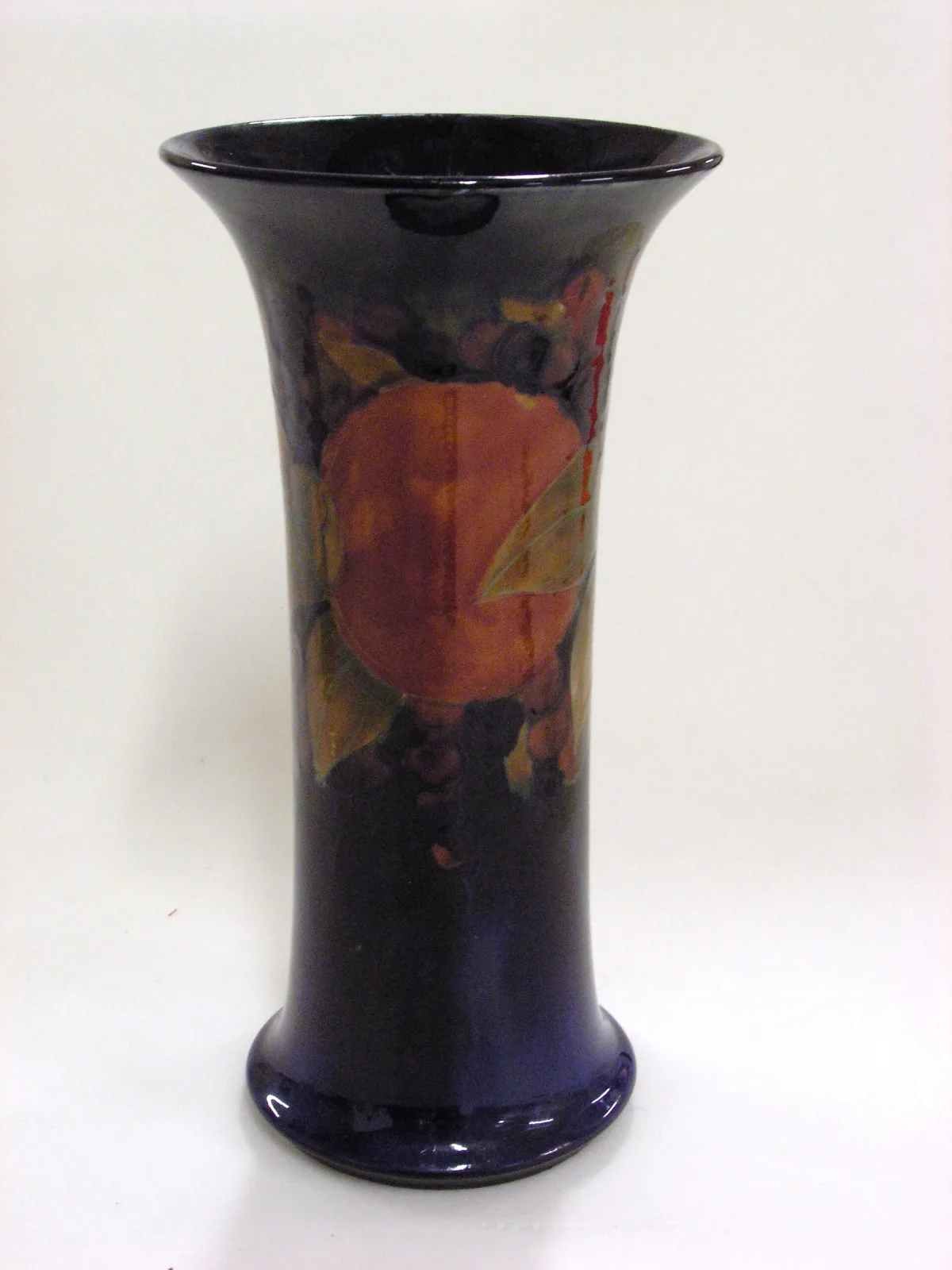
Pomegranate (introduced circa 1910)
Pomegranate features tube-lined fruit and leaves in deep reds, oranges, blues, and greens on richly mottled blue, green, or cream grounds. It is the single most widely produced William Moorcroft pattern and the most likely to be encountered. Pieces range from small bowls and vases to large jardinieres and pedestal sets; size, ground colour, and shape are the main value drivers within the pattern.
Wisteria (introduced circa 1911)
Wisteria shows tube-lined trailing flowers in purples and blues against dark blue or mottled grounds. The pattern is more delicate than Pomegranate and is often considered William's most refined floral design. Smaller pieces are accessible; large vases command strong prices.
Pansy (introduced circa 1911)
Pansy features stylized pansy flowers in purple, yellow, and white on coloured grounds. Smaller in scale than Pomegranate and Wisteria, Pansy appears most often on dishes, small vases, and tea wares. Liberty & Co. retailed substantial quantities of Pansy ware, and pieces with Liberty paper labels carry a small premium.
Cornflower, Big Poppy, and Spanish
Other important Cobridge patterns include Cornflower (a continuation of the Florian theme with bolder colour), Big Poppy (oversized poppy heads in red and gold), and Spanish (a complex foliate pattern in vivid colours). Each has its own collector following, and shape-pattern combinations are well documented in the standard reference books.
Claremont and Toadstool Patterns
Claremont, introduced in 1903 and produced into the 1920s, features tube-lined toadstools in red and pink on green or blue grounds. It is one of William's most idiosyncratic designs and one of the most sought after in the modern market. Genuine Claremont pieces are scarce and frequently exceed mid-five-figure prices for important shapes.
Powder Blue and Liberty & Co.
Not all Moorcroft is colourfully decorated. The Powder Blue range and the Liberty & Co. retail relationship represent two important but often-overlooked threads in the Moorcroft story.
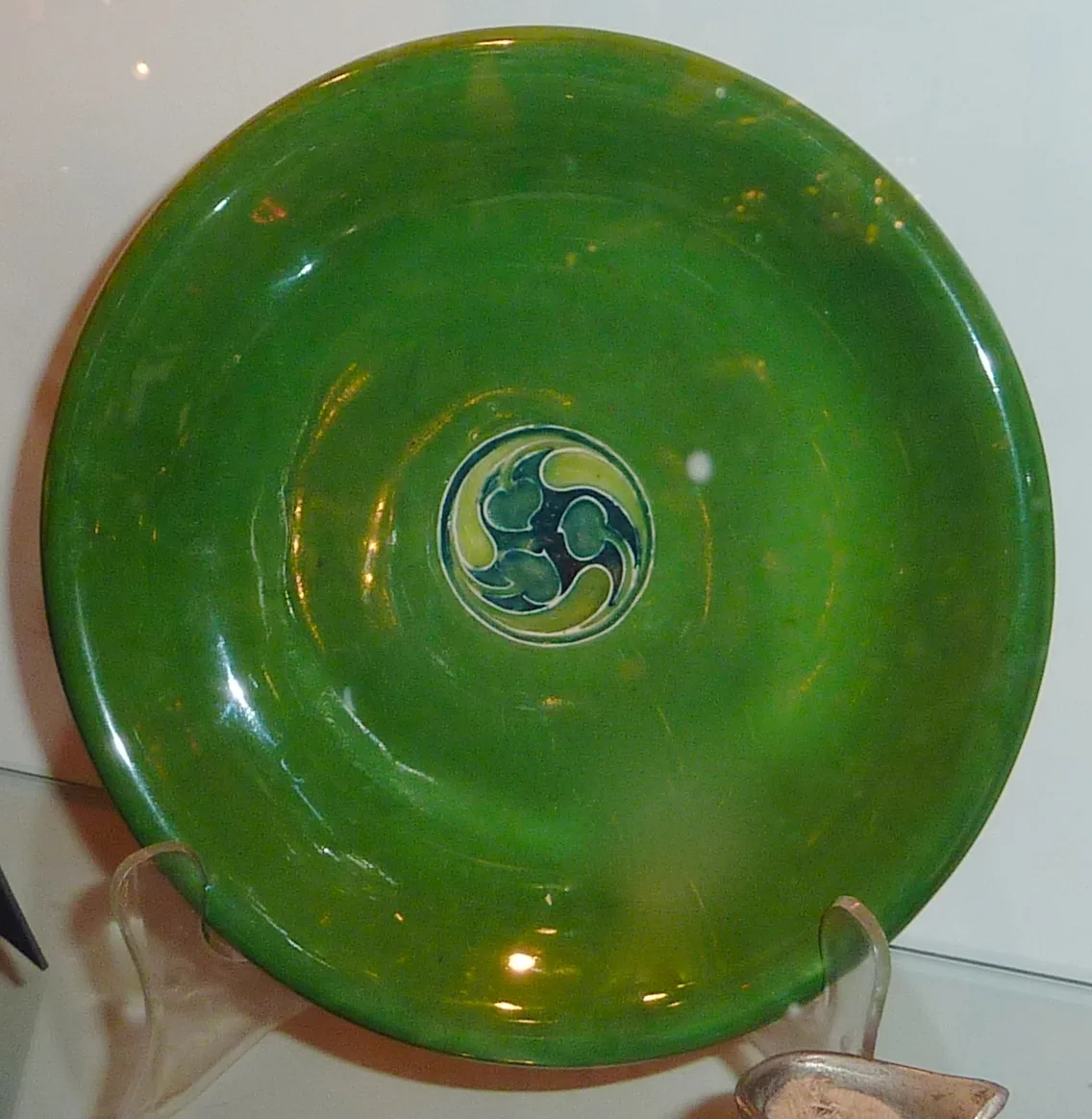
Powder Blue Tea Wares (1913–1963)
Powder Blue is a plain blue tableware range produced continuously for fifty years. Cups, saucers, plates, jugs, and tea services are mottled in a soft powder-blue glaze with no tube-lined decoration. The line was inexpensive, hard-wearing, and widely used in English hotels and railway dining rooms. Today Powder Blue is the most affordable entry to Moorcroft collecting, with single cups and saucers regularly available under £30.
Liberty & Co. Retail Marks
Liberty & Co. of London was Moorcroft's most important retailer from the Macintyre years onward. Pieces sold through Liberty often carry an additional Liberty paper label or printed mark, sometimes with "Made for Liberty & Co" or "Liberty & Co Sole Agents." Liberty-marked pieces appeal to collectors of both Moorcroft and the broader Art Nouveau aesthetic that Liberty championed.
Tudric and Pewter Mounts
Some Moorcroft pieces were sold by Liberty with Tudric pewter mounts — lids, bases, or handles — designed by Archibald Knox and contemporaries. These pieces sit at the intersection of English pewter and Moorcroft pottery collecting and command very strong prices in the specialist market.
Walter Moorcroft and Mid-Century Wares
Walter Moorcroft inherited the pottery in 1945 and led it through forty years of postwar production. His era is essential to understanding the modern collector market.
New Patterns and Lighter Palettes
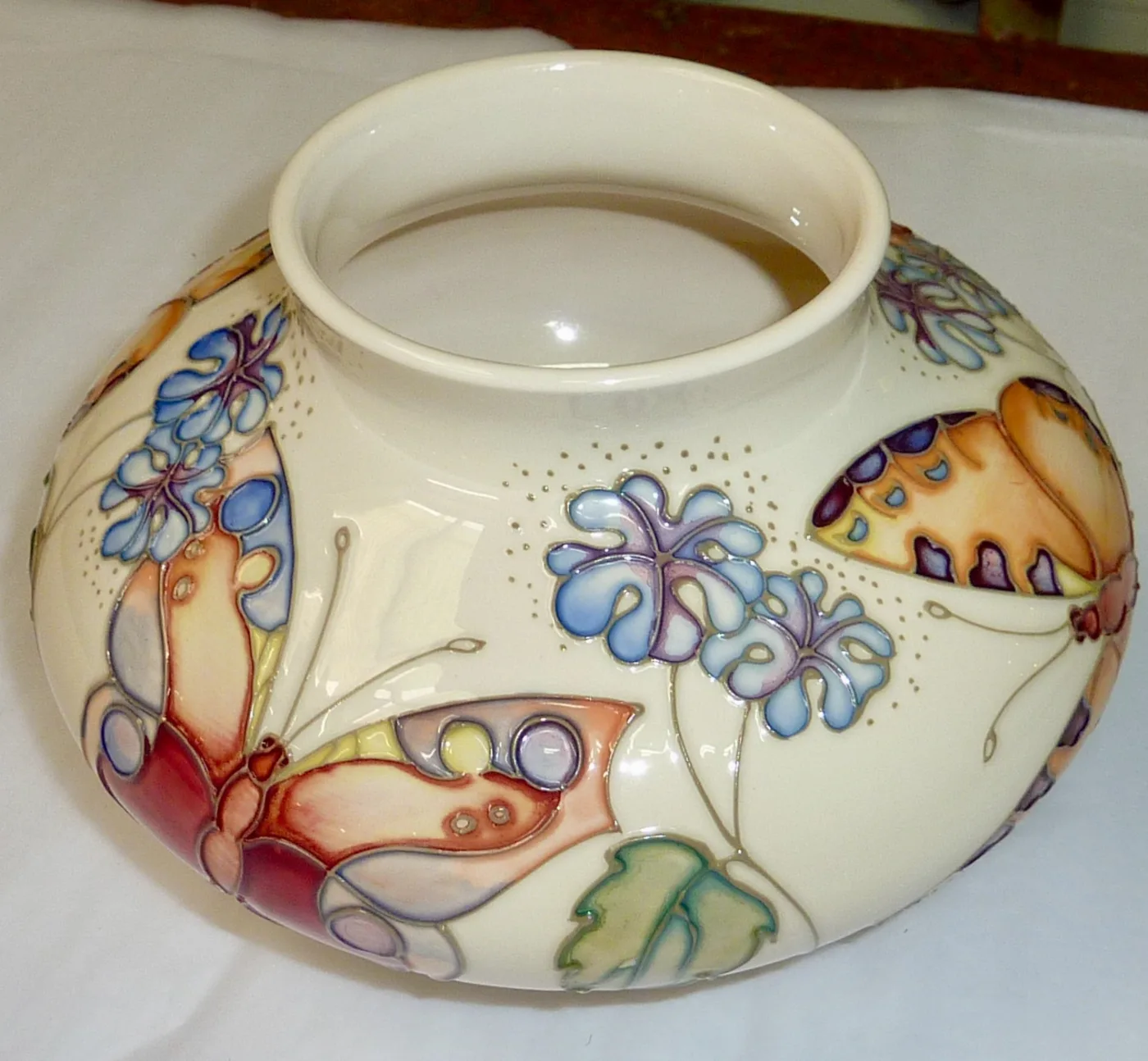
Walter introduced Hibiscus, Magnolia, Caribbean, Marine, and other patterns built around lighter ground colours — cream, pale blue, soft green — rather than William's deep mottled grounds. These pieces have a different decorative feel: gentler, more accessible, and aligned with mid-century interior taste.
Continuation of William's Patterns
Walter also continued producing Pomegranate, Wisteria, Pansy, and other William-era patterns through the 1950s and 1960s. Distinguishing William-era from Walter-era examples of the same pattern requires careful examination of the signature style, ground colour saturation, and backstamp. Reference books illustrate the key differences.
The Difficult 1970s
The 1970s were a hard decade for English art pottery, and Moorcroft was no exception. Production volume contracted, decoration quality became more variable, and the company nearly closed. Pieces from this period are competently made but typically less ambitious than earlier or later production; they are accessible at relatively modest prices.
Royal Warrants and Their Marks
Moorcroft has held royal warrants for nearly a century, and the warrant marks themselves provide useful dating clues.
Queen Mary's Warrant (1928)
In 1928, Queen Mary granted Moorcroft a royal warrant as "Potter to Her Majesty The Queen." From that date onward, pieces typically include this wording in the backstamp. Pre-1928 pieces do not carry the royal mark, providing an immediate dating cue: a "Potter to The Queen" mark indicates production after 1928.
Subsequent Warrants
The wording of the warrant mark changes as monarchs change. Through the 1950s and beyond, marks may read "Potter to H.M. The Queen Mother" or refer to Queen Elizabeth II. Reading the exact wording — and cross-referencing it with the known dates of warrant grants — narrows production to a specific period.
Commemorative and Royal Event Wares
Moorcroft has produced commemorative pieces for coronations, jubilees, and royal weddings throughout its history. These limited issues often include the royal cypher and event date and form a recognised subspecialty of Moorcroft collecting alongside other commemorative ceramics.

Contemporary Moorcroft and Named Designers
The post-1986 revival has produced its own substantial body of collectible work. Modern Moorcroft is not simply a continuation of older patterns — it is an active design programme with named designers whose own pieces have become independently sought.
Rachel Bishop (1993–Present)
Rachel Bishop joined Moorcroft in 1993 and rapidly became one of its most celebrated designers. Her tube-lined patterns include Tigris, Hepatica, Carousel, and many others. Bishop-signed limited editions are a major contemporary collecting category.
Sally Tuffin (1986–1992)
Tuffin's early-revival designs reinvigorated the Moorcroft pattern book with patterns including Finches, Magpie, and Balloons. Her pieces are now genuinely vintage and have crossed into the collector market in their own right.
Emma Bossons, Philip Gibson, Nicola Slaney, and Others
The Moorcroft Design Studio has employed a sequence of named designers since the late 1990s. Emma Bossons (joined 1997), Philip Gibson, Nicola Slaney, Kerry Goodwin, Vicky Lovatt, Beverley Wilkes, Paul Hilditch, and others have each contributed patterns that carry their own design signatures.
Limited Editions and Trials
Modern Moorcroft routinely issues numbered limited editions, often in runs of 30, 75, 150, or 350. Trial pieces — preproduction samples in unique colourways — are produced in even smaller numbers and command significant premiums. Both trial and limited-edition pieces carry distinctive backstamps and are documented in the company's records.
Moorcroft Collectors' Club
The Moorcroft Collectors' Club, established in 1987, issues members-only pieces each year. These exclusive editions are produced in known quantities and form their own subspecialty within contemporary Moorcroft collecting.
Paper Labels, Boxes, and Provenance
Paper labels and original packaging are easily overlooked but contribute significantly to value and provenance.
Factory Paper Labels
Moorcroft applied paper labels in addition to backstamps throughout most of its history. Labels evolved from oval Liberty-branded designs in the early years to modern circular labels carrying pattern name, designer signature, and edition number. Intact original labels add value and provide a paper trail to the original retail context.
Retailer Labels
Some pieces carry labels from prestige retailers — Liberty & Co., Tiffany, Shreve, Asprey, Harrods — as well as the factory mark. These labels are themselves provenance documents and elevate a piece in the collector market.
Original Boxes and Certificates
Modern limited editions are typically supplied with their original presentation box and signed certificate of authenticity. A complete piece — vase, original box, certificate, retailer documentation — sells for noticeably more than the same piece sold loose. Collectors should keep all original packaging and documentation together with the piece itself, just as careful documentation matters when building provenance for any antique.
Authentication and Detecting Fakes
Moorcroft's high prices and immediately recognisable style attract both outright fakes and well-intentioned but misattributed pieces. Several specific checks reliably separate genuine work from problems.
Examine the Tube-Lining Closely
Run a fingertip across the decorated surface. Genuine tube-lined outlines are continuously raised; they should never feel flat or look like print. A loupe reveals the slight handwork irregularities that no mechanical process can reproduce. Painted-on outlines that sit flat against the body are an immediate disqualifier.
Cross-Check Signature and Backstamp
Every legitimate piece should be internally consistent. A "W. Moorcroft" signature painted in a hand that doesn't match documented examples from the claimed period — particularly William's signature on a piece showing post-1945 production traits — is a major red flag. Reference books reproduce dated signatures from across William and Walter's careers for comparison.
Check the Ground Colour and Saturation
Original Moorcroft glazes are richly coloured and well saturated. Watery, pale, or oddly coloured grounds on a piece claiming to be a major William-era pattern should prompt caution. Compare against documented examples of the same pattern in reference books.
Beware "After Moorcroft" and "Moorcroft Style"
Some 1970s through 1990s studio potters produced tube-lined ware in the Moorcroft idiom without intending fraud. These pieces sometimes acquire mistaken attributions in later sales. A piece described as "Moorcroft style" or lacking any Moorcroft factory mark should be priced as a competent but anonymous studio piece, not as genuine Moorcroft.
Reproductions and Foreign Imitations
Outright reproductions of Moorcroft designs have appeared from East Asian sources in the last two decades. These usually fail multiple checks at once — wrong clay body weight, painted (not tube-lined) outlines, fake-looking impressed marks, and signatures that don't match any documented hand. Specialist dealers and the Moorcroft Collectors' Club will help authenticate questionable pieces.
Condition, Damage & Restoration
Condition matters significantly for Moorcroft values, though the market accepts certain age-related issues more readily than equivalent problems on other collectible ceramics.
Crazing and Glaze Issues
Moorcroft glazes are relatively crazing-resistant compared to many art potteries, but fine surface crazing does appear on some pieces, especially earlier Macintyre work. Light, even crazing has minimal effect on value. Heavy crazing with staining or active flaking is a significant problem.
Chips, Cracks, and Hairlines
Rim chips, base chips, and hairlines reduce values substantially. A through-body crack on a major Cobridge pattern can cut its value by half or more. Tiny rim flakes on Powder Blue tea wares are more tolerated than on signed decorated pieces.
Restoration Detection
Examine pieces under ultraviolet light. Modern restoration materials fluoresce differently than original Moorcroft glaze, revealing painted-over chips, filled cracks, and repaired rims. Run a fingernail across glaze surfaces; restoration typically feels slightly different in texture. Disclosed restoration is part of the market; undisclosed restoration that is later discovered always damages trust between buyer and seller.
Worn Gilding
Aurelian and other gilded pieces frequently show wear to the gilding. Heavy gilding loss substantially reduces value; bright, complete gilding is a strong premium. Regilding is sometimes attempted but rarely matches the original Macintyre tone exactly.
Value Factors and Price Ranges
Moorcroft values respond to a predictable combination of factors. Understanding their relative weight helps collectors evaluate any piece efficiently.
Period and Maker
Macintyre-era pieces (1898–1913) generally bring the highest prices, followed by William's Cobridge production (1913–1945), then Walter's mid-century output (1945–1986), and finally contemporary pieces (1986–present). Within contemporary work, named designer limited editions and trials are the strongest performers.
Pattern
Pattern significantly drives value. Hesperian, Claremont, Eighteenth-Century, Florian, and early Pomegranate are among the strongest. Standard Pomegranate and Wisteria are abundant and command lower prices per equivalent size and condition.
Size and Shape
Larger pieces generally bring more than smaller ones in the same pattern. Unusual or scarce shapes — large vases, jardinieres, pedestal sets, lidded forms — bring premiums. Moorcroft jardinieres and planters are particularly desirable when they survive in complete sets.
Condition and Completeness
Mint pieces with original labels, boxes, and certificates command full retail premium. Damage, restoration, missing components, and wear all reduce values predictably.
Current Market Tiers
As a rough guide: Powder Blue tea wares typically run £20–80 per piece. Standard Walter and contemporary pieces run £100–500. William-era Pomegranate, Wisteria, and Pansy in good condition run £400–2,500 depending on size. Macintyre Florian, Aurelian, and Hesperian pieces run £1,500–15,000 or more. Important Claremont, Hesperian, and exhibition pieces regularly exceed £20,000 at specialist auction. For broader market context, see our antique valuation and appraisal guide.
Building a Moorcroft Collection
Moorcroft offers entry points at every price level, and a strategic approach helps collectors balance enjoyment with long-term value.
Choose a Focus
Many collectors specialise: a single era (Macintyre, William, Walter, contemporary), a single pattern (Pomegranate variations through time), a single designer (Rachel Bishop's career), or a single shape (vases only, or only chargers). Focus deepens expertise and reveals value others overlook.
Start with Walter-Era or Contemporary Production
If Macintyre and William pieces feel out of reach, start with Walter-era or contemporary Moorcroft to build familiarity with backstamps, signatures, and pattern recognition. Once you can read a Moorcroft base with confidence, you can move into earlier work without anxiety.
Use Reference Books
Paul Atterbury's Moorcroft, Susan Scott's Moorcroft: The Definitive Guide, and Fraser Street's auction catalogues are essential. The Moorcroft Collectors' Club publishes regular newsletters with new attributions, market notes, and authentication updates.
Buy From Reputable Sources
Established auction houses (Christie's, Bonhams, Bamfords, Rago, and specialist Staffordshire sellers), the Moorcroft factory itself, and pottery-specialist dealers offer the most reliable sources. Online marketplaces require extra diligence — request multiple base photographs, ask for paper labels and certificates, and verify signature and backstamp consistency before bidding.
Document Your Collection
Photograph each piece's body, base, signature, and any labels or certificates. Record purchase information, attribution evidence, and any reference book illustrations. Documentation supports insurance, estate planning, and eventual resale.
Care, Display, and Preservation
Properly cared for, Moorcroft pieces remain stable indefinitely. A few simple practices protect both the ceramic and its value.
Handling
Always lift pieces from the body, never by rims or handles. Support large pieces with both hands. Remove rings and bracelets when handling decorated pieces to prevent scratches against the glaze.
Cleaning
Dust pieces with a soft brush. When deeper cleaning is required, use lukewarm water with a few drops of mild dish soap, then dry thoroughly with a soft cloth. Avoid abrasive cleaners, harsh detergents, and dishwashers — all are damaging. Pieces with active crazing should never be soaked, since water can seep through glaze fissures into the body.
Display Conditions
Keep Moorcroft out of direct sunlight, which can fade some glazes over decades. Maintain stable temperature and humidity; sudden swings stress glazed surfaces. Secure tall vases with museum wax or earthquake gel in seismically active regions, and choose stable shelving that will not vibrate with normal household activity.
Storage
Wrap stored pieces individually in acid-free tissue and place them in padded, stable containers. Never stack pieces directly together. Keep paper labels, certificates, and original boxes with the piece — they form part of the collectible record. Photograph everything before storage so any condition changes can be documented later.
Insurance
Significant Moorcroft collections deserve scheduled insurance coverage with current appraised values. Update appraisals every five to ten years to reflect market changes, and keep documentation off-site or in cloud storage so it survives any incident affecting the collection itself.