
Antique Cash Registers Identification Guide: Makers, Dating & Value
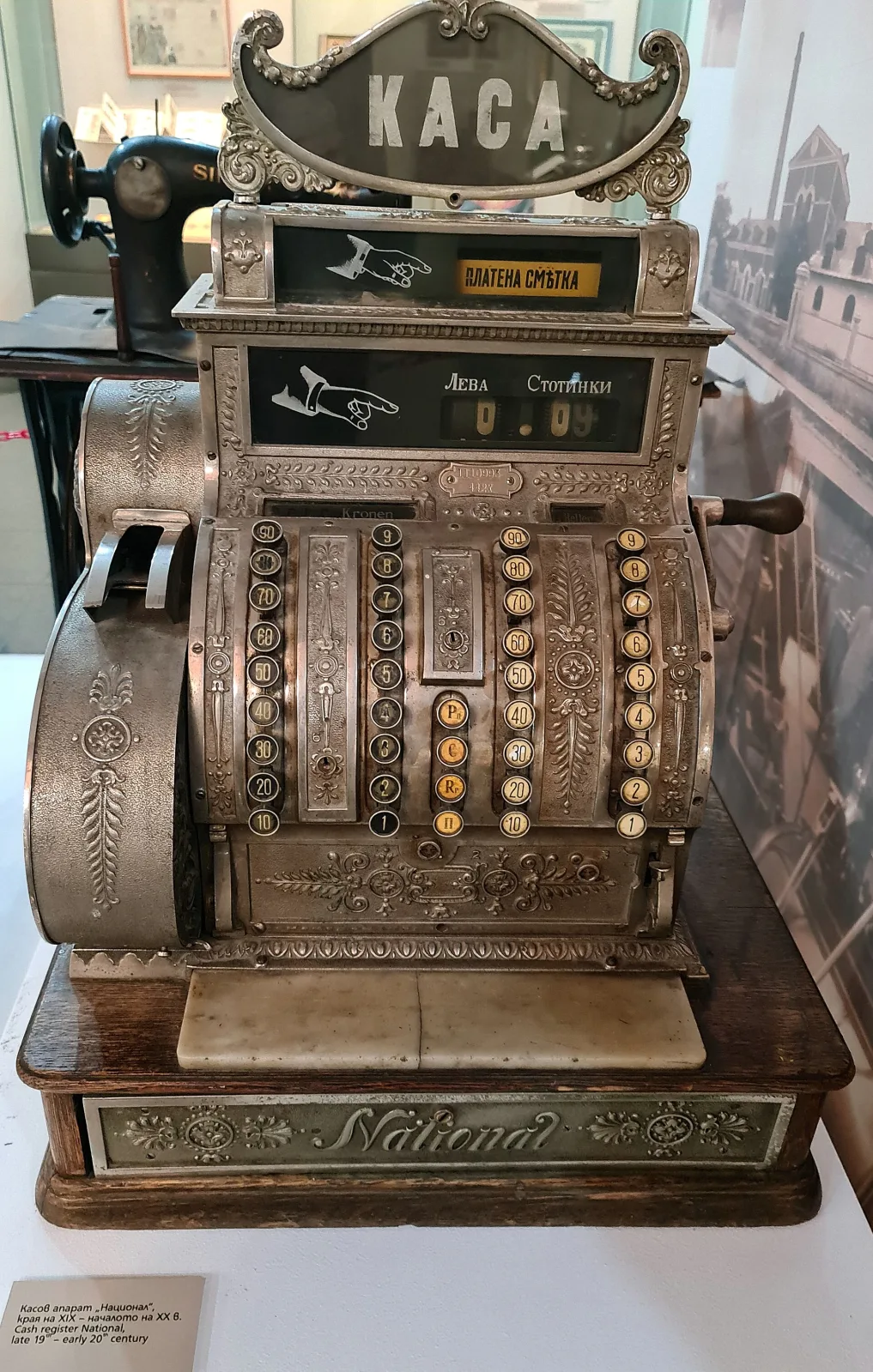
Antique cash registers are the brass-and-mahogany monuments of American retail. From roughly 1879, when Dayton saloon-keeper James Ritty patented the first "incorruptible cashier," through the 1920s consolidation of the trade under National Cash Register, these machines transformed every storefront from corner candy shop to grand department store. Their ornate cast cases, glass-windowed amount indicators, and ringing bells made them visible symbols of honest transaction — and now make them prized collector pieces.
Identifying an antique cash register means reading the case material, the maker's badge, the model number, the serial number, and the mechanical features in concert. National Cash Register dominates the field — perhaps 90% of surviving antique registers carry the NCR badge — but Hallwood, Michigan, St. Louis, American, and a handful of smaller makers competed in the early decades, and their machines are scarce and desirable today. A correct identification narrows the date to within a year or two and tells you whether you have a $200 office relic or a $5,000 candy-store showpiece.
This guide walks through the major makers and their model lines, the case styles and materials that anchor dating, the serial-number system NCR used to track production, the mechanical features that distinguish early from late machines, the rarity factors that drive prices into four and five figures, and the restoration considerations that decide whether a register is worth keeping original or refinishing. Whether you have inherited a register from a family business or are evaluating an estate-sale find, this guide gives you the framework to read the machine end to end.
Table of Contents
- Origins of the Cash Register: Ritty and Beyond
- Major Makers and Maker Marks
- National Cash Register Model Lines
- Anatomy of an Antique Cash Register
- Case Materials and Finishes
- Dating by Serial Number and Model
- Mechanical Features and How They Evolved
- Collectible Categories: Candy, Saloon, Department Store
- What Drives Rarity and Value
- Condition Grading and Common Issues
- Restoration: Original vs. Refinished
- Reproductions, Marriages, and Frankenstein Registers
- Care, Display, and Operation
- Research Tools and Reference Works
- Common Mistakes Beginners Make
- Frequently Asked Questions
Origins of the Cash Register: Ritty and Beyond
The cash register was born of a saloon owner's frustration. In 1878, James Ritty of Dayton, Ohio, watched a ship's propeller-shaft counter on a transatlantic voyage and recognized the principle: a mechanical counter could record every sale and deter clerk theft. With his brother John Ritty, he patented "Ritty's Incorruptible Cashier" in 1879. The earliest Ritty machines were crude wooden boxes with paper dial indicators and no drawer. They sold poorly.
In 1884, John Patterson bought the struggling Ritty enterprise for $6,500, renamed it the National Cash Register Company (NCR), and built it into one of the most aggressive sales organizations of the late nineteenth century. Patterson's NCR added the cash drawer, the bell, the printed receipt, the customer-facing amount indicator, and ornate cast cases that turned a utilitarian device into a piece of retail furniture. By 1895, NCR controlled most of the American market and had begun systematic litigation against competitors.
The Patent Wars
NCR's aggressive patent enforcement, sales-territory raids, and predatory pricing drove most early competitors out of business. Hallwood, Michigan, St. Louis, American, and dozens of smaller firms either folded or were absorbed. In 1913, NCR was convicted under the Sherman Antitrust Act for these practices, though the conviction was overturned on appeal. The competitive shakeout left NCR with a near-monopoly that lasted into the 1920s and shapes the surviving antique-register population today.
Why Surviving Registers Are Mostly NCR
Because NCR ran competitors out of business early, far more NCR machines than competitor machines were ever built and survived. A typical antique-register collection is 85% NCR, 10% Hallwood and Michigan, and 5% everything else combined. This relative scarcity — combined with collector interest in non-NCR makers — is the main reason a competitor register in good condition often outprices a comparable NCR.
Major Makers and Maker Marks
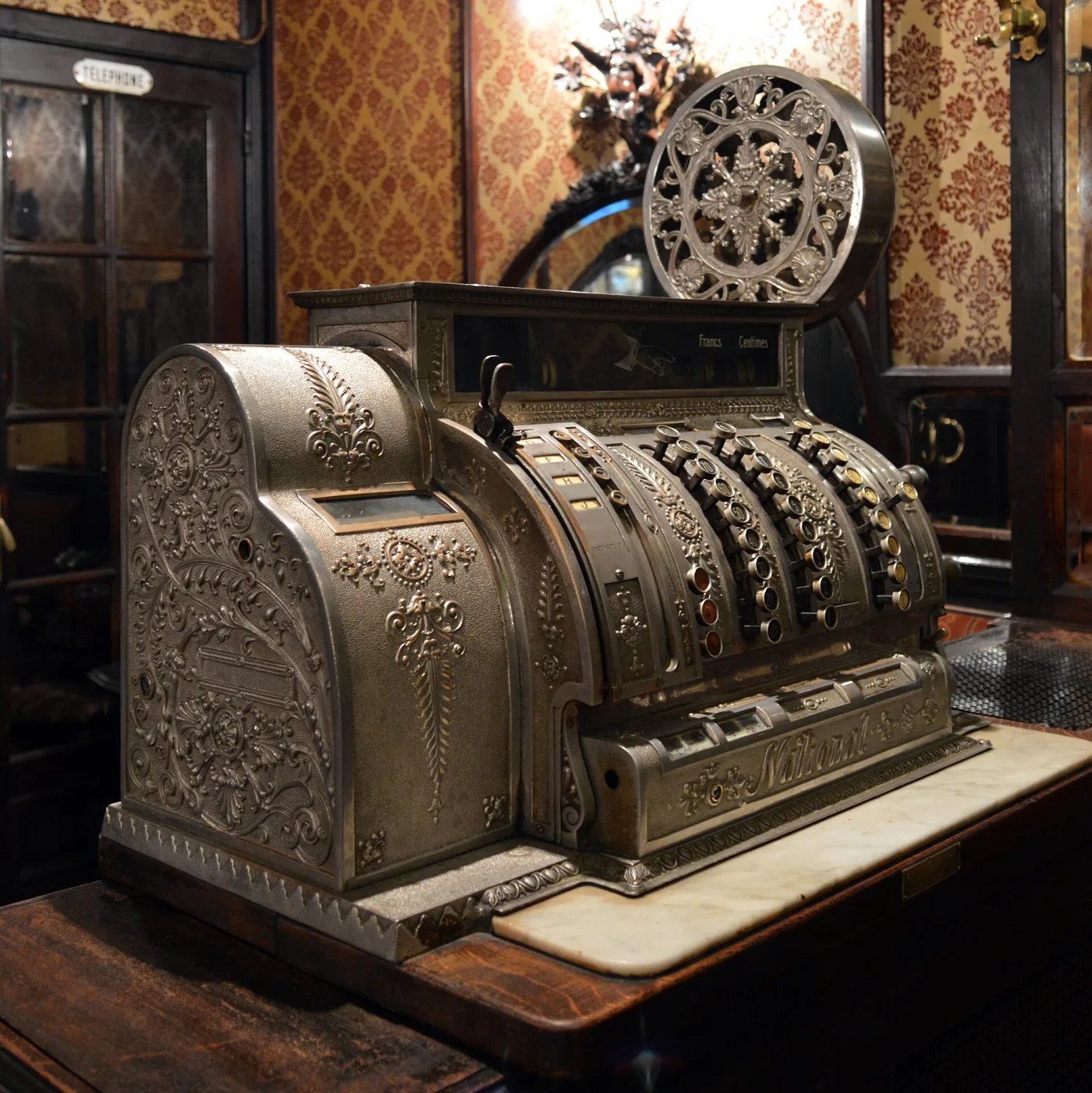
A handful of firms account for almost all collectible antique cash registers. Each left distinctive maker badges, casting marks, and cabinet styles.
National Cash Register (NCR), Dayton, Ohio (1884-present)
NCR badges evolved through several generations. The earliest brass machines (1884-1895) carry a small oval brass tag reading "NATIONAL CASH REGISTER CO. DAYTON, OHIO" with patent dates. By 1900, the badge grew larger and added the famous "N.C.R." monogram. Wood-cabinet machines from 1915 onward use enameled metal badges, often in red or blue. Serial numbers are stamped into the case casting, usually on the back or underside near the drawer.
Hallwood Cash Register Co. (Columbus, Ohio, 1893-1903)
Hallwood was NCR's strongest early competitor. Hallwood machines feature distinctive ornate scroll castings, often more elaborate than NCR's, and a "HALLWOOD" maker plate on the front. The firm was acquired by NCR in 1903 and disappeared. Surviving Hallwood machines are scarce and prized; collectors particularly seek the highly decorative "Champion" and "Queen" models.
Michigan Cash Register Co. (Detroit, 1895-1909)
Michigan registers are recognizable by the "MICHIGAN" cast or stamped into the front panel and by their signature curved-top profile. The firm was eventually acquired by NCR. Michigan machines tend to have simpler mechanisms than NCR but more graceful case lines.
St. Louis Cash Register Co. (St. Louis, Missouri, 1894-1908)
St. Louis registers carry an "S.L.C.R. CO." or "ST. LOUIS" badge. Production was small; surviving examples bring premium prices simply on rarity.
American Cash Register Co. (Saginaw and Detroit, c. 1902-1910)
American registers are scarce and typically have an "AMERICAN" front badge with elaborate filigree casting. The firm was small and short-lived.
Other Makers
Lamson, Boston Cash Indicator and Recorder, Union Cash Register, Ideal, and Sun all produced limited numbers of machines, mostly between 1895 and 1910. Any non-NCR antique register is worth careful identification — they are scarce enough that a correct attribution can multiply value. For other small-shop business antiques of the same era, see our antique typewriters guide.
National Cash Register Model Lines
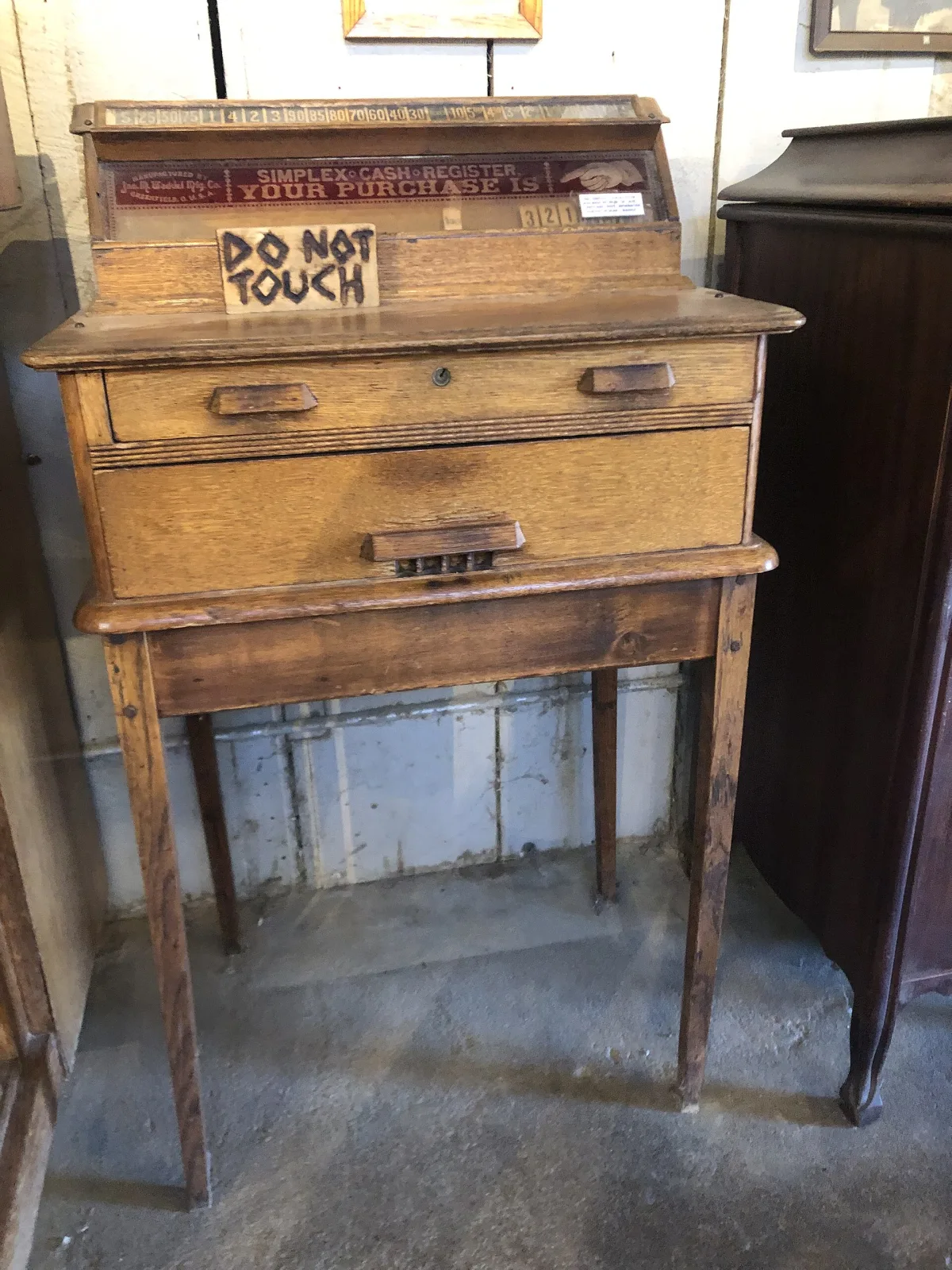
NCR produced hundreds of model numbers between 1884 and 1930. A few model families anchor most of the antique market and are worth knowing in detail.
NCR Model 2 and Model 3 (1884-1895)
Among the earliest production NCR machines. Small brass cases, often with paper-dial indicators or simple flag-style amount cards. These are scarce; collectors price authentic Model 2 examples in the $2,000-$6,000 range depending on condition and completeness.
NCR Model 5 (1888-1896)
The first commercially successful NCR. A small-to-medium brass register with side keys and an arched glass amount indicator. The Model 5 set the visual template for two decades of cash registers.
NCR Models 50 and 79 — "Candy Store" Registers (1903-1915)
Small, intensely ornate brass machines designed for confectioners, soda fountains, and small specialty shops. Single-drawer, simple mechanisms, but extraordinary case casting. Candy-store registers in fine brass condition routinely bring $1,500-$4,000.
NCR Models 313, 332, 333, 336 — Brass-Era Workhorses (c. 1900-1915)
The medium-format brass NCRs that filled American hardware stores, drug stores, and general stores. The 313 series in particular is the most common antique brass register. Standard examples in unrestored condition bring $400-$1,200; well-restored show pieces reach $2,500.
NCR Model 442 — Saloon Register (c. 1910)
Designed for high-volume saloon and bar use. Large brass case, multiple drawers in some configurations, and amount indicators reading well above standard candy-store models. Saloon registers are heavily collected and bring strong prices when documented to a known establishment.
NCR Class 700 and 1000 — Department Store Registers (1908-1925)
Large multi-drawer machines for department stores. Sometimes more than one drawer, multiple totalizers, and printed-receipt mechanisms. These are spectacular but heavy and difficult to display; collector demand has been uneven.
The Transition: Wood Cabinet Models (1915-1930)
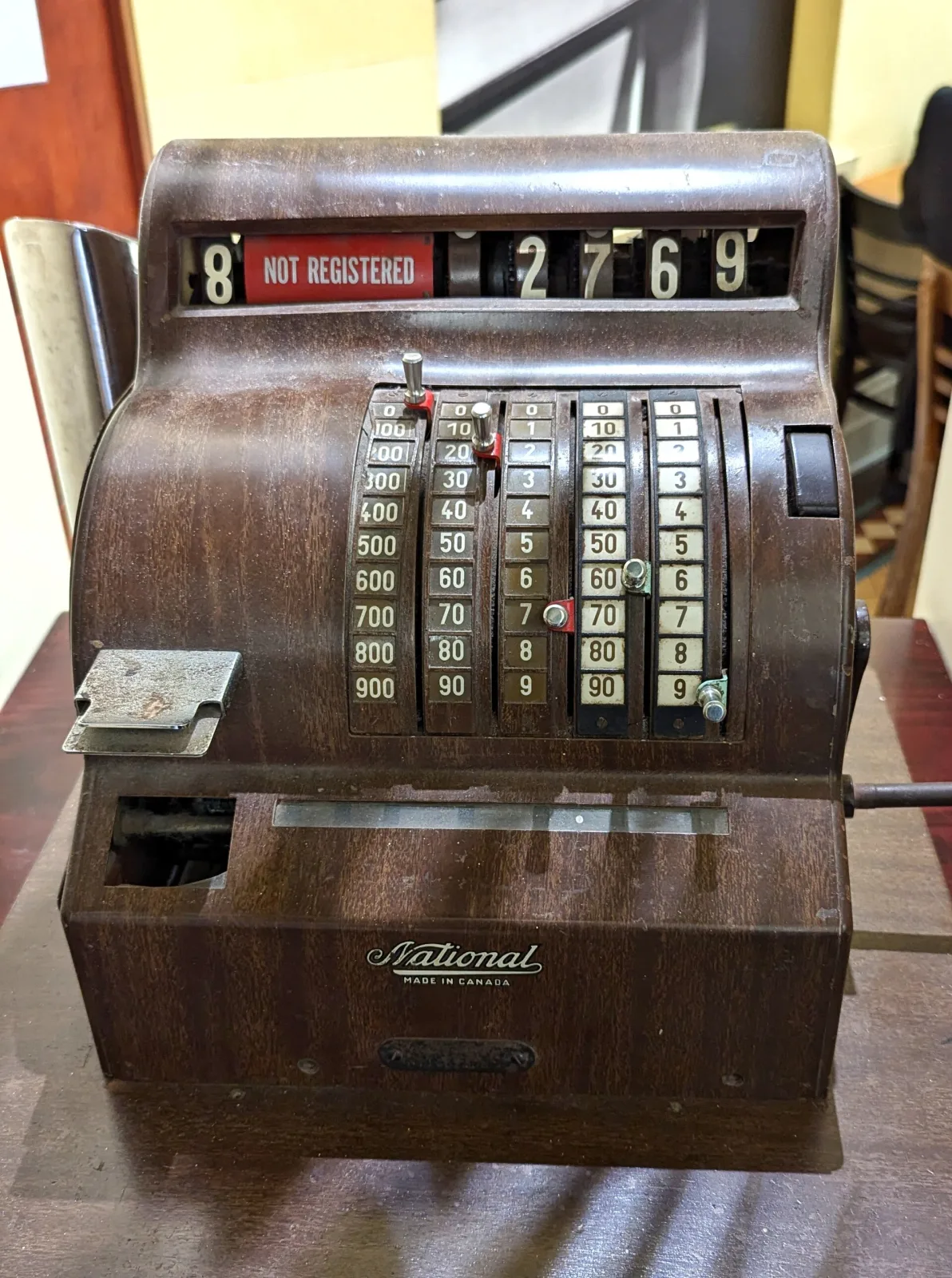
From about 1915, NCR shifted from brass to oak and mahogany wood cabinets, partly to reduce cost and partly because Art Nouveau-era brass aesthetics had fallen out of fashion. Wood-cabinet NCRs (Models 700-series wood, 1000-series wood, 5000 and similar) are common, less ornate, and generally less valuable than the brass-era machines they replaced.
Anatomy of an Antique Cash Register
Almost every antique cash register has the same major components. Knowing them lets you assess completeness — missing parts cut value sharply.
1. The Case
The cast metal or wood housing. On brass machines, cases are typically two or three large bronze castings bolted together over an iron frame. Original cases carry casting numbers and the maker's name cast or stamped into the metal. For background on the underlying metals, see our bronze, brass, and spelter identification guide.
2. The Amount Indicator (Top Sign)
The customer-facing window above the keyboard, displaying the sale amount on flag-style cards or rotating drums. The top sign is often the most ornate part of the machine, with cast scrollwork and beveled glass. Original glass and complete flag sets are essential to value — replacements are detectable and discounted.
3. The Keyboard
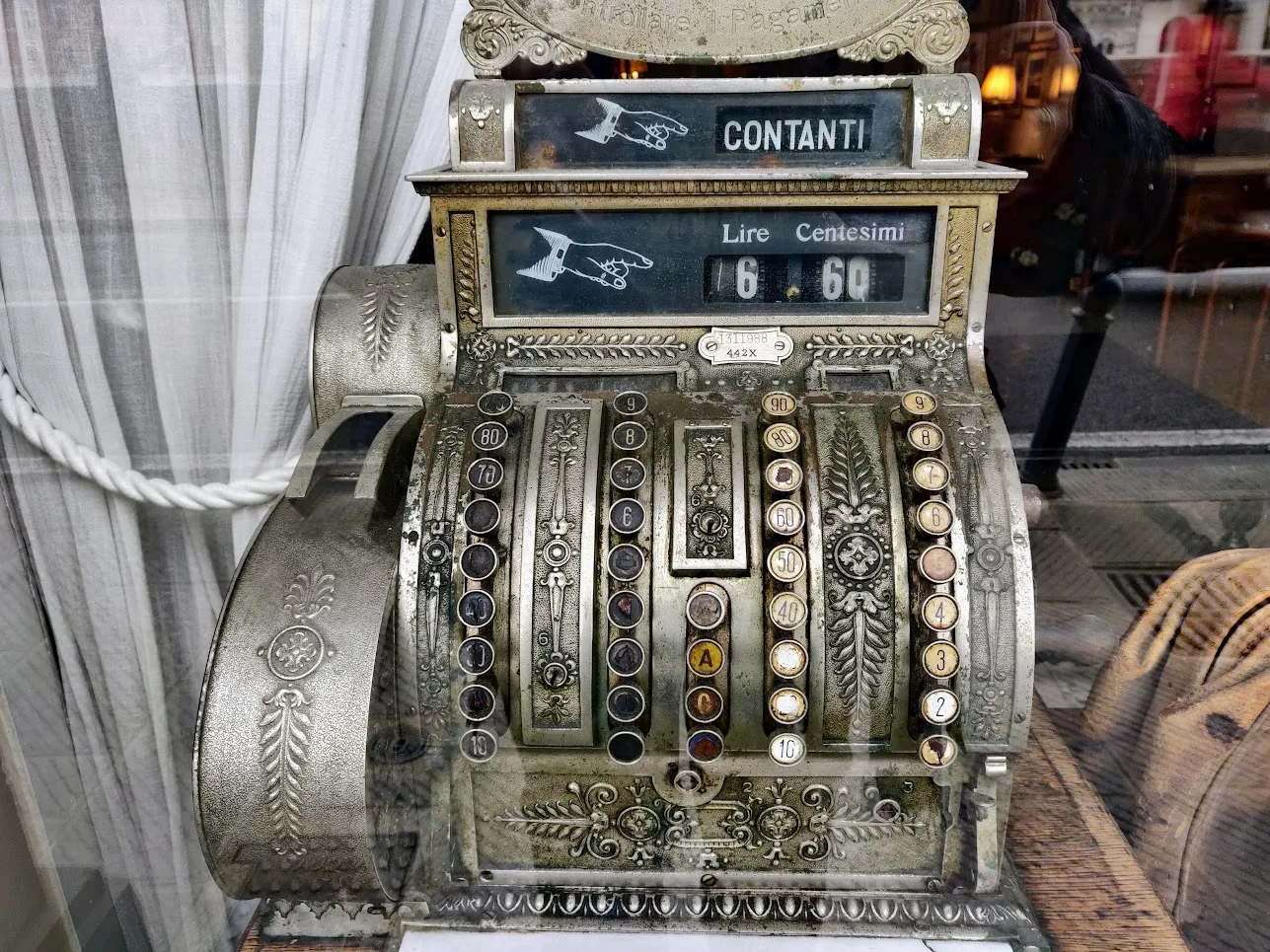
Rows of round or rectangular keys, usually marked in cents and dollars. Keytops may be celluloid, porcelain, or stamped metal. Missing or replaced keytops are a common condition issue.
4. The Cash Drawer
Pulled forward by a mechanical release tied to key actuation. Drawers may be single (most common), double (saloon and large-volume models), or multi-clerk (department store models). Original drawer interiors are wood with metal coin cups; replacement interiors are common and detectable.
5. The Bell
Most antique registers have a bell that rings when the drawer opens. The bell is mounted inside the case, struck by a hammer linked to the drawer release. The "ring" of an antique register is part of its character; a missing or broken bell is a small but detectable defect.
6. The Mechanism
The internal works that record the sale and operate the indicator and drawer. Mechanisms range from simple bell-and-flag systems on candy-store registers to complex totalizing and receipt-printing assemblies on department-store models. A working mechanism adds 20-40% to value over a frozen one.
7. The Marble Slab (When Present)
Many registers were sold on marble bases, which dealers used for receipt-stacking and change-counting. The marble slab is often missing today; an original-to-the-machine marble adds value.
Case Materials and Finishes
The case material and finish are the strongest visual dating clue and the largest single value driver.
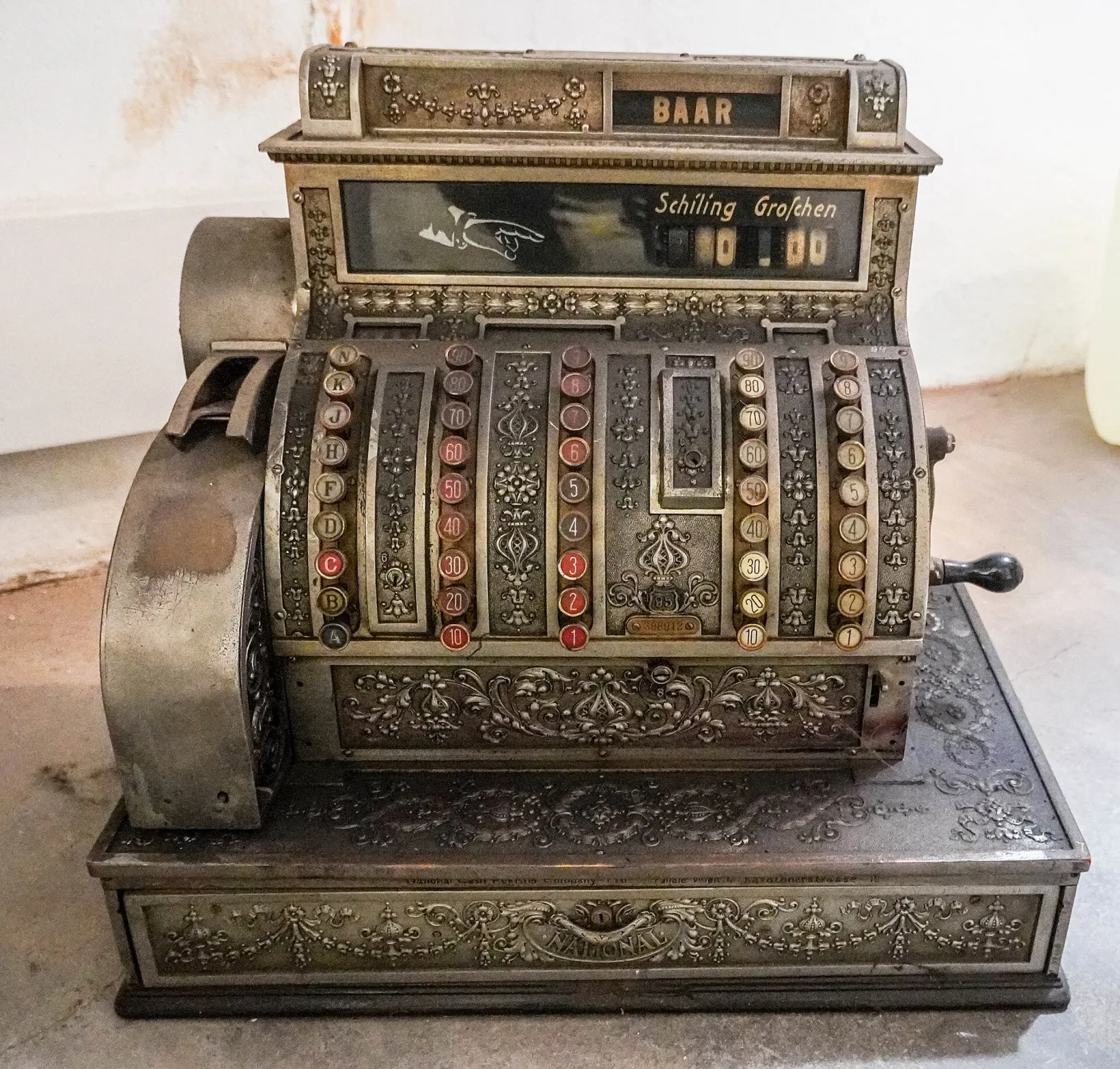
Brass and Bronze Cases (1884-1915)
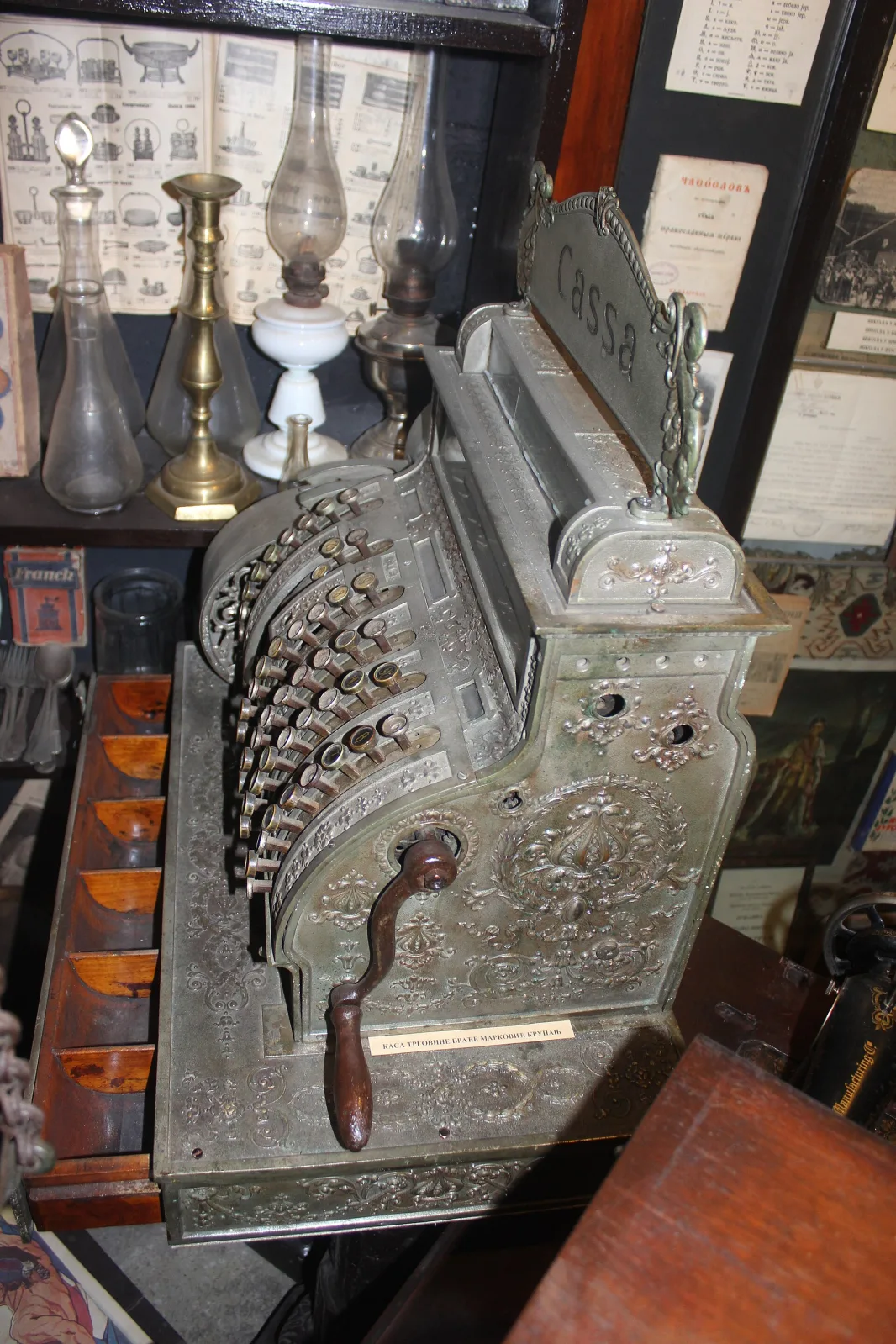
The classic antique-register material. Most "brass" registers are actually bronze — copper-tin alloys cast in heavy sand molds. The intricate cast detail of a brass-era register is among the finest commercial casting work of the period. Surfaces were originally finished bright (polished brass), bronzed (chemically darkened), or nickel-plated. Polishing brass is a common restoration choice but reduces collector value if it removes original patina.
Nickel-Plated Brass (c. 1895-1910)
Some NCR models were sold with bright nickel plating over the brass casting. The nickel was thin and frequently worn through to the brass beneath. Examples retaining most of their original nickel are scarce and prized.
Copper-Oxidized Finishes (c. 1900-1915)
NCR offered "copper-oxidized" finishes — a chemical patination that produced a deep red-brown surface. Original copper-oxidized examples in untouched condition bring premium prices because the surface is delicate and easily destroyed by polishing.
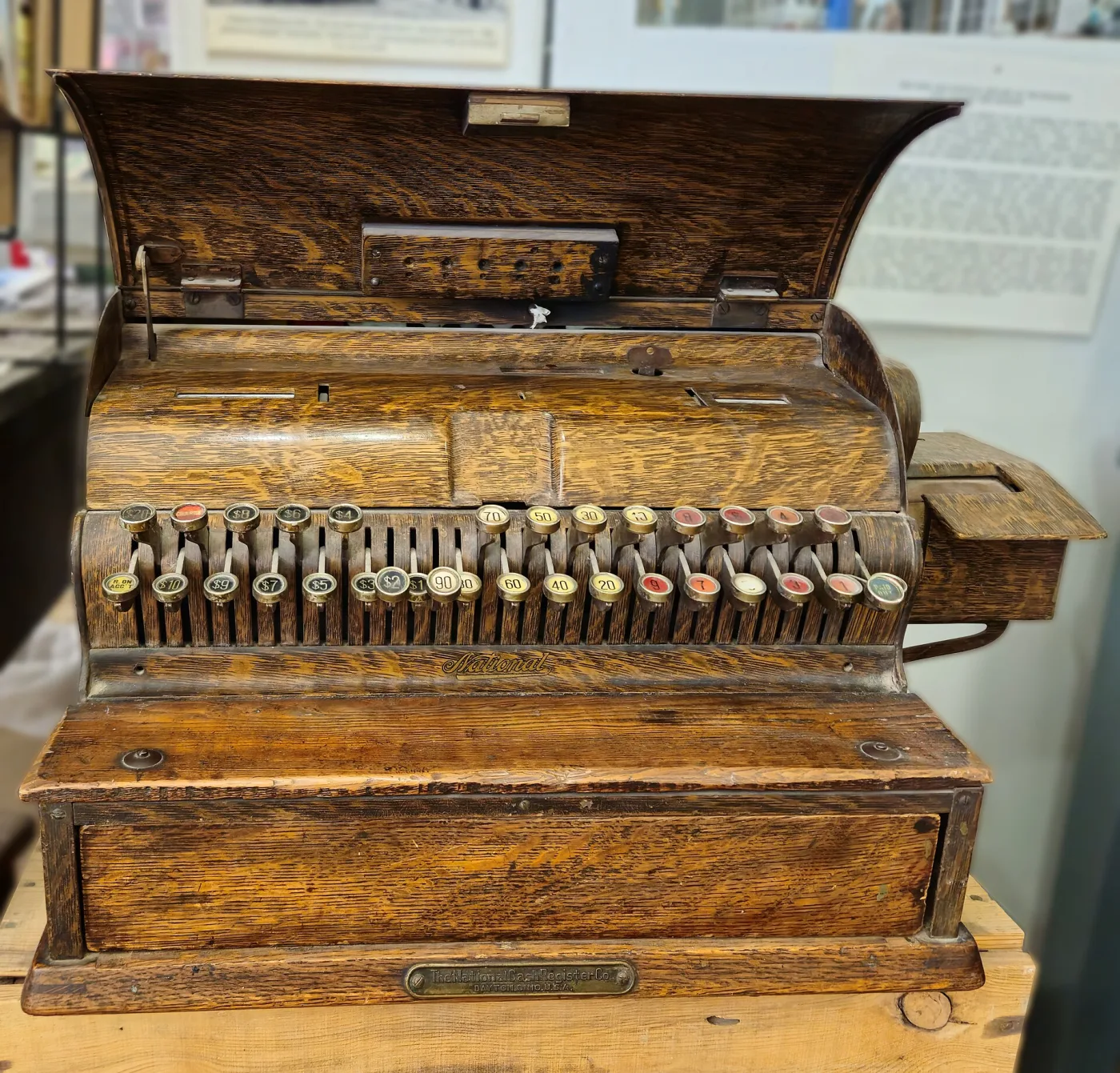
Wood Cabinet Cases (1915-1930)
Quartered oak and mahogany cabinets replaced brass for cost reasons. Wood machines have less ornate cast top signs and simpler keyboards. Original finish on wood cabinets is shellac or varnish; refinished cabinets are widespread and reduce value.
Recognizing Replated and Replated-Over-Original Surfaces
Many antique registers have been replated, repolished, or re-bronzed in the past century. Tell-tales include sharper detail than the surrounding wear (over-polished casting), missing wear marks where keys and drawer handles would naturally have rubbed, color uniformity across the entire surface (original finishes patinate unevenly), and modern lacquer films visible at angled light. For broader principles on antique surfaces, see our restoration and conservation guide.
Dating by Serial Number and Model
NCR kept meticulous serial-number records, and the company's dating system is well documented. For other makers, dating relies on patent dates, design features, and the general window of the firm's operation.
NCR Serial Numbers
NCR stamped serial numbers into the case, usually on a back panel near the drawer or on a small brass plate. Serial numbers run sequentially across all models, so an NCR serial number alone fixes the production year regardless of model. Approximate production-year benchmarks:
- Serial 100 — late 1884
- Serial 1,000 — 1887
- Serial 10,000 — 1893
- Serial 100,000 — 1900
- Serial 500,000 — 1907
- Serial 1,000,000 — 1911
- Serial 2,000,000 — 1917
- Serial 3,000,000 — 1923
NCR collectors maintain detailed serial-to-year tables, available through the NCR Archives at the Dayton History center and through specialist dealers. A Model 313 with serial 712,344 dates to 1909; a Model 442 with serial 1,820,000 dates to 1916.
Patent Date Plaques
Most antique registers carry a small patent-date plate on the back or underside, listing relevant U.S. patents. The latest patent date is the floor for the production date — the machine cannot have been made before that patent was granted, but may have been made many years after. Patent plates are useful for confirming a serial-number date but never used as primary evidence.
Hallwood and Michigan Dating
Hallwood (1893-1903) and Michigan (1895-1909) operated within narrow windows. A registered casting style and serial-number range pin most examples to within three years. Specialist literature on these makers is thin compared to NCR; collectors rely on cross-referenced auction records and original company catalogs.
Cabinet Style as a Cross-Check
Even without serial numbers, case style fixes the broad period. Heavy cast Victorian scrollwork = 1885-1900. Cleaner Art Nouveau lines = 1900-1910. Geometric Mission-style = 1910-1920. Early Art Deco = 1920-1928.

Mechanical Features and How They Evolved
Cash-register mechanisms grew steadily more sophisticated between 1884 and 1925. Reading mechanical features confirms dating and reveals whether a machine has been altered.
The Detail Strip and Continuous Roll
Early NCRs (1884-1895) recorded transactions only on a counter or "audit" wheel hidden behind a locked door. From about 1895, NCR added a paper detail strip — a continuous roll inside the machine that printed each transaction in sequence for the owner's later review. Detail-strip mechanisms add complexity and value; collectors look for working detail-strip assemblies as a sign of a complete higher-end model.
The Receipt Printer
Receipt-printing machines emerged around 1900, with NCR Class 1000 and 700 models offering printed customer receipts. Receipt-printing mechanisms are mechanically intricate and frequently inoperable today. Working receipt printers significantly increase value.
Multi-Drawer Mechanisms
Two-drawer "saloon" and multi-drawer "department store" registers used separate mechanical paths to track sales by clerk or department. The cylindrical lock arrangements, separate amount indicators, and segregated drawer releases make these the most mechanically complex antique registers.
Totalizers and Audit Counters
Behind locked doors at the back, antique registers carry totalizing wheels that accumulate daily, weekly, or shift totals. Original audit doors with intact locks add significant value. Missing or replaced lock cylinders are a common defect — many machines were "broken into" by owners who lost the key, leaving permanent damage to the lock plates.
Collectible Categories: Candy, Saloon, Department Store
Cash-register collecting falls into a few well-defined categories. Each has its own price expectations and condition concerns.
Candy-Store and Soda-Fountain Registers
Small ornate brass machines designed for low-volume, high-margin specialty shops. NCR Models 50, 79, 313, and similar small-format machines define this category. Candy-store registers in original brass with intact glass, complete keytops, and working mechanism are among the most desirable antique registers. Prices: $1,500-$5,000 in fine condition.
Saloon Registers
Larger machines built for high-volume bar use. Often two-drawer, with prominent amount indicators visible across a noisy room. Documented saloon-attributed registers — particularly with a known establishment plate or a maker's installation receipt — bring premium prices and intersect with the collector market for vintage bar antiques and breweriana, the same period environment that housed coin-operated machines like early slot machines and trade stimulators.
Department-Store Registers
Multi-drawer, multi-clerk machines built for department stores and large general stores. Dramatic to look at but heavy (often 200-400 pounds), space-intensive to display, and difficult to ship. Prices range widely: $800-$8,000+ depending on size, condition, and original use documentation.
Drug-Store and Hardware-Store Registers
Medium-format brass NCRs, primarily Model 313 series. The workhorse of small-town American retail. Common, but dearly loved by collectors of small-business antiques. Prices: $400-$2,500.
Specialty and Industrial Registers
NCR and competitors built specialty registers for restaurants, hotels, theaters, and industrial canteens. Some carry establishment plaques or original installation labels that pin them to a specific business — a strong provenance feature that intersects with trade signs, branded advertising thermometers, and vintage advertising collecting.
What Drives Rarity and Value
The cash-register market is mature and fairly transparent, with established price tiers based on a small number of well-understood factors.
Maker
Non-NCR makers (Hallwood, Michigan, St. Louis, American) carry premium prices simply on scarcity. A comparable-quality Hallwood typically brings 1.5-2.5x what an NCR of similar size and condition brings.
Case Material and Finish
Brass > nickel-plated brass > copper-oxidized brass > wood. Within brass, original untouched finish brings a premium over polished or replated examples. Original copper-oxidized finish is the rarest and most valuable surface on NCRs.
Size and Ornamentation
Small ornate "candy-store" machines with intricate casting outsell plain medium-format machines on a dollar-per-pound basis. Heavily decorated cases with figural castings (cherubs, lions, scrollwork eagles) bring strong demand.
Completeness
Original glass, complete keytops, all original flag cards in the indicator, intact bell, working drawer release, original marble base, original drawer interior, intact maker's badge — each missing or replaced component is a deduction. A "100% original and complete" machine commonly brings 40-80% more than a 90% example.
Mechanical Condition
Working > partially working > frozen. A clean working mechanism adds 20-40% to value. A frozen mechanism that can be freed by a competent restorer is acceptable; one with broken castings or stripped gears is a serious problem.
Provenance
Documented use in a known establishment — particularly historic saloons, prominent department stores, or famous family businesses — adds 25-50% to value. Original installation receipts, bill of sale, or photographs of the register in service are gold. For broader provenance research methods, see our provenance research guide.
Original Marble Base
Many antique registers were sold mounted on marble slabs. Original marbles often went missing through the twentieth century. A correct, original marble base adds 10-20% to value; a clearly later or mismatched marble is a small negative.
Condition Grading and Common Issues
Cash-register collectors use a condition vocabulary borrowed from mechanical antique collecting generally.
- Mint / Museum Grade — As-found in extraordinary preservation. Original finish, all original parts, working mechanism, complete with marble. Very rare.
- Excellent — Original finish with even patina, all major parts original, working or easily worked mechanism, minor wear consistent with light use.
- Very Good — Original finish with some wear, perhaps minor parts replacements (keytops, glass), working mechanism, complete or nearly so.
- Good — Solid example with visible wear or one significant replaced part. Mechanism works or freezes only slightly. Presentable for display.
- Fair — Heavily worn finish or significant restoration; mechanism may be frozen; missing minor components.
- Poor / Parts — Major damage, missing parts, frozen mechanism, refinished case. Useful as parts source or major restoration project.
Common Condition Issues
Polished-bright brass — original patina removed by aggressive polishing. Common, value-reducing, and irreversible.
Replated nickel — original nickel worn through and the machine sent to a plater. Detectable by uniform brilliance, sharp edges with no wear, and visible plating drips inside the case.
Replaced glass — original beveled-edge cast glass replaced with modern flat float glass. Detectable by the absence of bevel and the characteristic green tint of modern soda-lime glass versus the slightly grayer tone of antique glass.
Replaced keytops — original celluloid or porcelain keytops broken and replaced with modern reproductions. Original keytops show even wear and consistent yellowing; modern replacements are bright white and unworn.
Refinished wood cabinets — wood-era machines often stripped and re-shellacked. Original finish is shellac with century-old craquelure; modern refinishes lack the surface character and often show modern polyurethane or satin lacquer.
Frozen mechanism — dried lubricant, corrosion, or rust binding internal parts. Often freeable by a competent restorer; sometimes a sign of broken castings inside.
Broken castings — bronze cases occasionally crack, particularly at corners and around the drawer release. Visible cracks are a serious value reduction; repaired cracks (welded or filled) are heavily discounted.
Missing flag cards — the cardboard or metal cards that show the amount in the top window are frequently incomplete. Reproduction sets are available but considered replacements.
Restoration: Original vs. Refinished
Restoration philosophy splits cash-register collectors into two camps. Understanding both helps you set expectations and avoid expensive mistakes.
The Original-Finish School
Holds that an antique register's value lies in its untouched surface, accumulated patina, and visible wear from a century of use. This camp considers polishing, replating, and refinishing all to be value-destroying — a "polished register is a ruined register." This is the dominant view among advanced collectors and museum curators.
The Restoration School
Holds that a sympathetic restoration — careful mechanical recommissioning, hand-polishing of the brass, and light wood refinishing — produces a more attractive display piece. This view dominates the decorator and bar-display market, where appearance often outweighs collector purity.
Middle Ground: Mechanical Restoration Without Cosmetic Change
The widely accepted middle ground is to clean, lubricate, and free the mechanism without touching the exterior finish. A working machine in original surface is the best of both worlds.
What Restoration Costs
Mechanical restoration on a brass NCR runs $500-$2,500 by a competent specialist. Full cosmetic restoration — disassembly, replating, lacquering, glass replacement, keytop replacement — runs $3,000-$8,000 and may not be recoverable in resale.
When Restoration Makes Sense
For a heavily damaged, incomplete machine being kept for personal display, a full restoration may be justified by the owner's preference. For a collector-grade machine destined for resale, original surface always pays better than restored surface, even if the restored surface looks more impressive.
Reproductions, Marriages, and Frankenstein Registers
The cash-register market has its share of altered, married, and outright fake machines. Recognition is essential before any significant purchase.
Outright Reproductions
Wholesale reproductions of antique cash registers are rare — the casting and mechanical work is too expensive to fake profitably. A few decorator-grade "antique-style" reproductions appear, but they are usually clearly modern: light weight, modern fasteners, new hardware, and obvious modern manufacture.
Marriages and Frankenstein Machines
Far more common than outright fakes. A "marriage" combines parts from two or more antique registers — a top from one, a base from another, drawer from a third. Tell-tales include:
- Mismatched serial numbers across major castings (NCRs stamp serials on multiple parts)
- Patina that varies sharply between adjacent components
- Mounting holes that don't quite line up, with shims or new bolts
- Maker badges that don't match the case's casting style or period
- Modern fasteners (Phillips screws, hex bolts) where slotted antique fasteners should appear
Replated and "Made New"
Heavily polished and replated registers are sometimes presented as untouched originals. Test: original finish has wear at points of regular contact (drawer pulls, keys, the right edge near the crank). A perfectly uniform finish across all surfaces is suspect.
Missing Maker's Badges and "Anonymous" Cases
A register sold as "rare unmarked maker" should be approached with caution. Almost every original antique register carried a maker's badge; missing badges usually mean the badge was removed (often because it identified the machine as an NCR rather than a more valuable competitor).
The Authentication Approach
Cross-check serial numbers across all major castings, examine patina under raking light, photograph maker's badges in detail, and compare with documented examples. For high-value purchases (above $2,500), a specialist examination is well worth the fee. The general principles in our antique identification guide apply directly.
Care, Display, and Operation
Antique cash registers reward thoughtful care. Brass and bronze surfaces are stable but sensitive; mechanisms are robust but unforgiving of neglect.
Cleaning
For original-finish brass, dry dusting only. Avoid all metal polishes — Brasso, Wright's, and similar products strip patina permanently. For lightly grimy surfaces, a soft cloth dampened with a tiny amount of mild soap and water, followed by careful drying. Wax (microcrystalline museum wax) provides a protective layer without altering the surface.
Mechanism Lubrication
Antique register mechanisms tolerate light machine oil at pivots and bearings. Avoid heavy greases, which trap dust. Do not over-oil — excess oil collects dust and creates worse problems than light dryness.
Operation Frequency
Working machines benefit from occasional exercise — a few transactions per month keeps mechanisms free. Daily use, however, accelerates wear and is rarely worth it for a collectible machine.
Display Environment
Stable temperature and humidity prevent wood-cabinet movement and protect celluloid keytops (which embrittle in heat). Direct sunlight fades wood finishes and oxidizes brass surfaces unevenly. A display piece in indirect light, away from heat sources, will hold its condition for decades. For broader display considerations, see our architectural salvage hardware guide for parallel cast-metal-care principles.
Moving and Shipping
Antique registers are heavy (60-400 pounds depending on model) and front-heavy. Always transport upright, with the drawer secured closed and the keyboard supported. Crating for shipping requires custom-built padded crates; freight shipping costs typically run $200-$600 within the U.S.
Research Tools and Reference Works
The cash-register field has solid reference literature and active collector institutions.
- Crandall and Robins, "The Incorruptible Cashier" (Vols. I and II) — the standard reference on antique cash registers, with extensive maker histories and model identification. Volume I covers the 1879-1920 brass era; Volume II covers 1920-1958 wood and metal cabinet machines.
- NCR Archives at Dayton History (Carillon Historical Park, Dayton, Ohio) — primary corporate records, including original sales ledgers and serial-number registers. The archives respond to dating queries on individual serial numbers.
- The Cash Register Collectors Club International — active collector organization with a quarterly newsletter, regional meets, and a member directory of specialist dealers and restorers.
- Original NCR catalogs — reproduced and digitized for major model years (1898, 1903, 1910, 1915). Period catalogs show original options, finishes, and pricing.
- Auction archives — Heritage Auctions, Morphy Auctions, and Bertoia Auctions all sell antique cash registers periodically with detailed descriptions and realized prices.
Online Communities
Specialized forums and Facebook groups for antique cash register collectors are active and welcoming to newcomers. Posting clear photographs of maker badges, serial numbers, and the overall machine usually produces an attribution within hours.
Common Mistakes Beginners Make
A short list of errors that recur in the cash-register market.
- Polishing the brass. The single most common and most expensive mistake. Original patina cannot be restored; once polished, the value is permanently reduced.
- Assuming any heavy brass register is rare. Most brass NCRs are common Model 313-series machines that brought thousands of identical units to market. "Heavy and brass" does not equal "rare and valuable."
- Ignoring serial-number cross-checks. Marriage components rarely match across all parts. Confirming serial-number agreement on castings, drawer, and badge takes ten minutes and prevents a major misjudgment.
- Buying without examining the mechanism. A frozen mechanism can hide cracked castings or missing internal parts. Always operate the keys, observe the indicator, and feel the drawer release before buying at any significant price.
- Believing "saloon" attributions without documentation. Many registers are sold as "saloon registers" because two-drawer machines look saloon-like. A real saloon-attributed machine has paperwork, photographs, or an establishment plaque — not just a story.
- Discounting the marble base. Originals are increasingly scarce. A correct original marble adds real money.
- Refinishing wood cabinets to "look new." Original shellac finishes — even worn ones — outperform fresh refinishes at resale.
- Confusing model number with serial number. The model number identifies the family (313, 442, 79). The serial number identifies the specific machine and dates it. They are recorded in different places and serve different purposes.
- Overestimating value from "antique mall" prices. Antique-mall asking prices often double or triple realized auction prices. Use auction archives, not retail asking prices, to set value expectations.
Frequently Asked Questions
How much is an old brass cash register worth?
Range is wide. A standard NCR Model 313 in unrestored, complete, working condition typically brings $500-$1,200 at auction. Ornate candy-store models bring $1,500-$4,000. Rare maker examples (Hallwood, Michigan in fine condition) bring $3,000-$8,000. Wood-cabinet NCRs from the 1920s typically bring $200-$600.
Should I polish my antique brass cash register?
No. Polishing removes original patina permanently and reduces collector value substantially. Dust it and leave it alone, or apply a thin coat of microcrystalline museum wax for protection.
How do I find the serial number on my NCR?
NCR serial numbers are typically stamped on the back of the case or on a small brass plate near the drawer. They appear as a five-, six-, or seven-digit number. Higher-end models stamp the serial on multiple major castings; check inside the drawer compartment, on the back panel, and underneath.
Will NCR tell me when my machine was built?
The NCR Archives at Dayton History (the company's corporate archive) responds to serial-number dating queries, often with the original ship date and original purchaser. Allow several weeks for a response.
Is my register a "saloon register"?
True saloon registers are the larger NCR Class 442 and similar two-drawer high-volume machines, or the equivalent from Hallwood and Michigan. Many small candy-store registers are mis-described as saloon registers; the distinction matters because real saloon registers bring 2-4x the price of small registers of similar age.
Can I still get keys for the locks?
Original NCR keys are scarce but available through specialist dealers. Replacement locks and modern key blanks fitted to antique cylinders are common and acceptable for working display, though purists prefer the original locks intact even when keyless.
What's the rarest antique cash register?
Authenticated early Ritty machines (pre-NCR, 1879-1884) are the rarest. Most Ritty examples in collections today are in museums; private-market examples have brought five-figure prices when they appear. Among more common makers, ornate Hallwood "Champion" models in fine original brass are the most desirable.
Are wood-cabinet registers from the 1920s collectible?
Yes, but at lower price tiers than brass-era machines. Wood-cabinet NCRs typically bring $200-$600 unless the machine has unusual features (multi-drawer, specialty configuration) or documented provenance.
How heavy are antique cash registers?
Small candy-store models run 60-100 pounds. Medium NCRs run 120-200 pounds. Large department-store machines exceed 400 pounds. Plan transport accordingly — these are not one-person lifts.
Where should I display an antique register?
On a sturdy surface (the marble base helps spread weight), out of direct sunlight, away from heat and humidity sources. A bar-top or counter setting at home replicates the original use environment. Avoid stacking objects on top of the register; the cast top sign is decorative, not load-bearing.