Antique Magic Lanterns Identification Guide
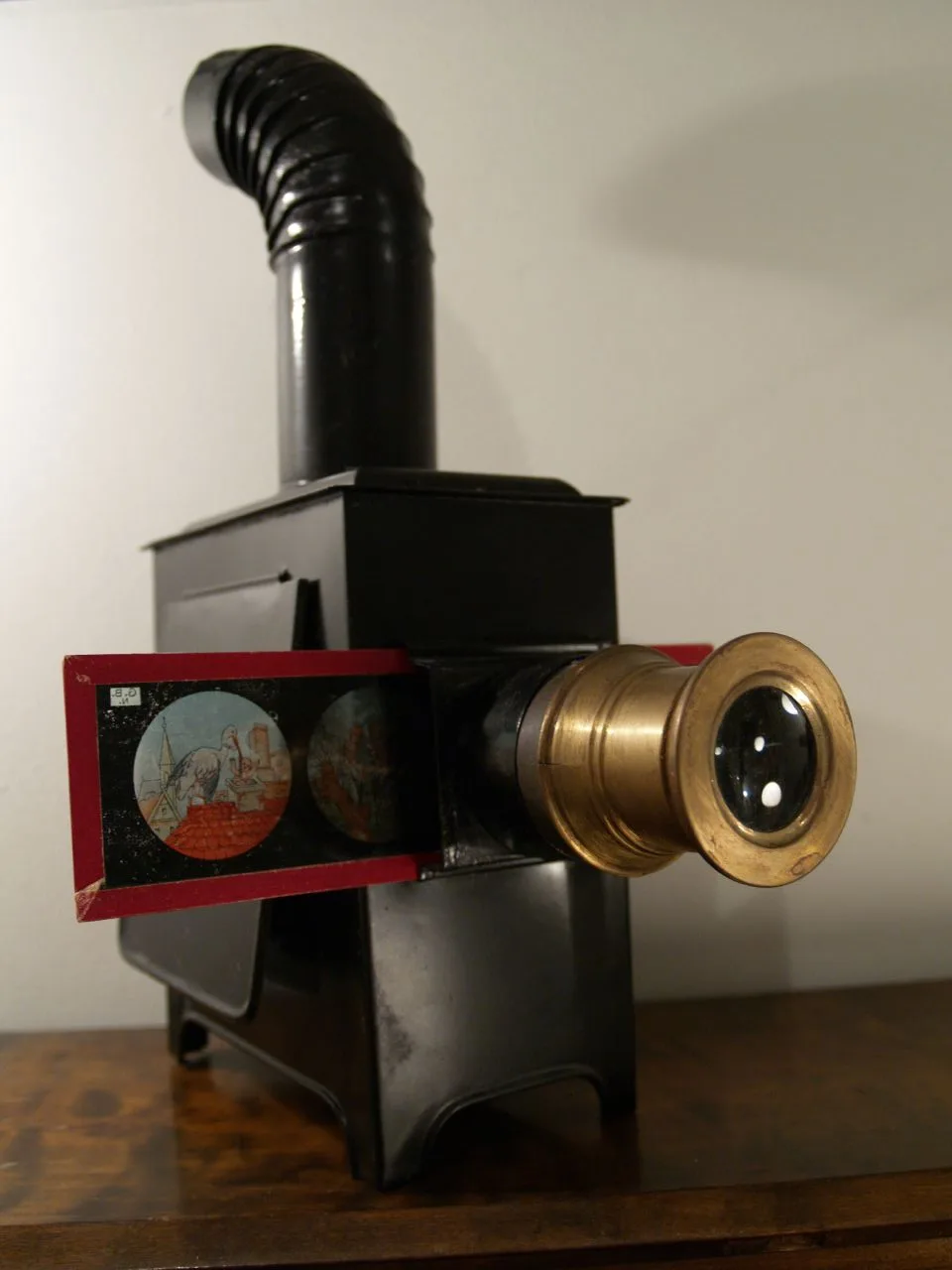
The magic lantern is the great-grandparent of cinema — a hand-built optical projector that ruled parlors, lecture halls, and traveling fairground tents from roughly 1820 until World War I. Long before celluloid film, audiences gathered to watch hand-painted glass slides bloom across a sheet, slip-slides animate skeletons and rocking ships, and chromatropes whirl like kaleidoscopes. The surviving lanterns — japanned tin parlor toys, mahogany-and-brass lecture biunials, and gargantuan triple-lens triunials with limelight burners — are some of the most beautifully engineered objects in the optical-antique world.
This guide walks you through identifying antique magic lanterns by body materials, lens construction, illuminant type, slide format, and maker marks. You'll learn how to date a lantern from its burner alone, how to tell a German tin toy from a French Lapierre, how to spot reproduction "tin lanterns" assembled from period parts, and what condition factors separate a $40 incomplete shell from a $15,000 limelight triunial.
Whether you have inherited a battered nursery lantern in a wooden box of slides or you are evaluating a cased lecture set, the same questions apply: what powered it, who built it, what slides did it accept, and is everything original together? The answers live in the seams, the screws, the lens engravings, and the smoke patina inside the chimney.
Table of Contents
- A Brief History of the Magic Lantern
- Major Types and Forms
- Body Materials and Construction
- Lenses, Condensers, and Optical Trains
- Illuminants: Oil, Limelight, Electric
- Slide Formats and Mechanical Slides
- Notable Makers and Marks
- Dating Clues by Decade
- Regional Styles: British, French, German, American
- Toy Lanterns vs Lecture Lanterns
- Condition, Restoration, and Red Flags
- Reproductions, Married Pieces, and Conversions
- Value Drivers and Market Ranges
- Care, Storage, and Display
- Buying and Selling Strategy
A Brief History of the Magic Lantern
The magic lantern is generally credited to Christiaan Huygens, who sketched a working projection device in the 1650s. By the 18th century, traveling showmen — the famous "Savoyards" — carried lanterns from town to town with painted glass slides of saints, monsters, and royalty. The form remained niche until the 19th century, when industrial glassmaking, precision brass turning, and bright artificial illuminants turned a curiosity into a mass medium.
The Victorian Golden Age (1840s–1890s)
Two technologies transformed the lantern around 1840: the Argand-style oil lamp, which produced a steady, smokeless flame, and limelight, an oxyhydrogen-fueled incandescent block of calcium oxide that produced a brilliant white light visible across an entire lecture hall. Suddenly the lantern could project at scale. Lecture societies, illustrated travel talks, temperance shows, and Sunday-school chapels adopted lanterns by the thousand. London makers like Newton & Co, J. H. Steward, W. C. Hughes, Riley Brothers, and Perken, Son & Rayment dominated the high end.
The Toy Lantern Boom (1870s–1914)
In the same decades, German tin-toy manufacturers — Ernst Plank, Bing, Georges Carette, Jean Schoenner — produced enormous quantities of lithographed-tin "nursery lanterns" sold across Europe and America at Christmas. These small kerosene-burning lanterns came with sets of short colored slides and turned the magic lantern into a household toy. Most surviving "magic lanterns" you'll encounter at flea markets are toy lanterns of this type, not lecture lanterns.
Decline and the Cinema Transition (1895–1920)
The Lumière brothers' 1895 cinematograph and Edison's projecting Kinetoscope did not kill the lantern overnight, but by 1910 the writing was on the wall. Many lecture halls converted to film by 1915, and lantern production essentially ceased after WWI except for a residual educational market into the 1930s. Knowing this end-date helps: a lantern with electric bulb fittings as original equipment is almost always post-1900, and a lantern with a sheet-metal hood and Edison-screw socket is rarely earlier than 1908.
Major Types and Forms
Magic lanterns fall into a handful of recognizable forms, each tied to particular eras, illuminants, and use cases.
Single-Lens Parlor and Lecture Lanterns
The basic form: one body, one lens, one slide stage. Sizes range from 6-inch toys to 18-inch japanned-tin lecture lanterns standing two feet tall. Single lanterns are the most common surviving type and the easiest to identify by their lone lens barrel.
Biunial (Double) Lanterns
Two lantern bodies stacked vertically in a shared mahogany case, each with its own slide stage and lens. The biunial allowed a "dissolving view" — fading from one slide to another by gradually shutting one shutter while opening the other. Dissolving views were a Victorian sensation, and a fine British biunial in figured mahogany with brass fittings can fetch four figures even in poor working order.
Triunial (Triple) Lanterns
Three stacked bodies, used for the most elaborate dissolving and effect shows — a sunset fading into moonlight fading into a chromatrope. Triunials are rare, large, heavy, and almost always British. A complete triunial with original limelight burners and a presentation case is a five-figure object.
Toy Tin Lanterns
Small lithographed-tin lanterns, typically 6–12 inches tall, with a chimney, a kerosene burner, and a single simple lens. Made primarily in Germany 1870–1914 by Ernst Plank, Bing, Carette, and others. Often retailed under store names with no maker mark, which makes attribution a study in body shape and burner design.
Polyorama Panoptique and Megalethoscopes
Specialty 19th-century optical viewers that overlap the lantern category — they project or transmit light through tissue or glass slides for individual viewing rather than wall projection. Worth knowing about because they sometimes get mis-cataloged as magic lanterns.
Body Materials and Construction
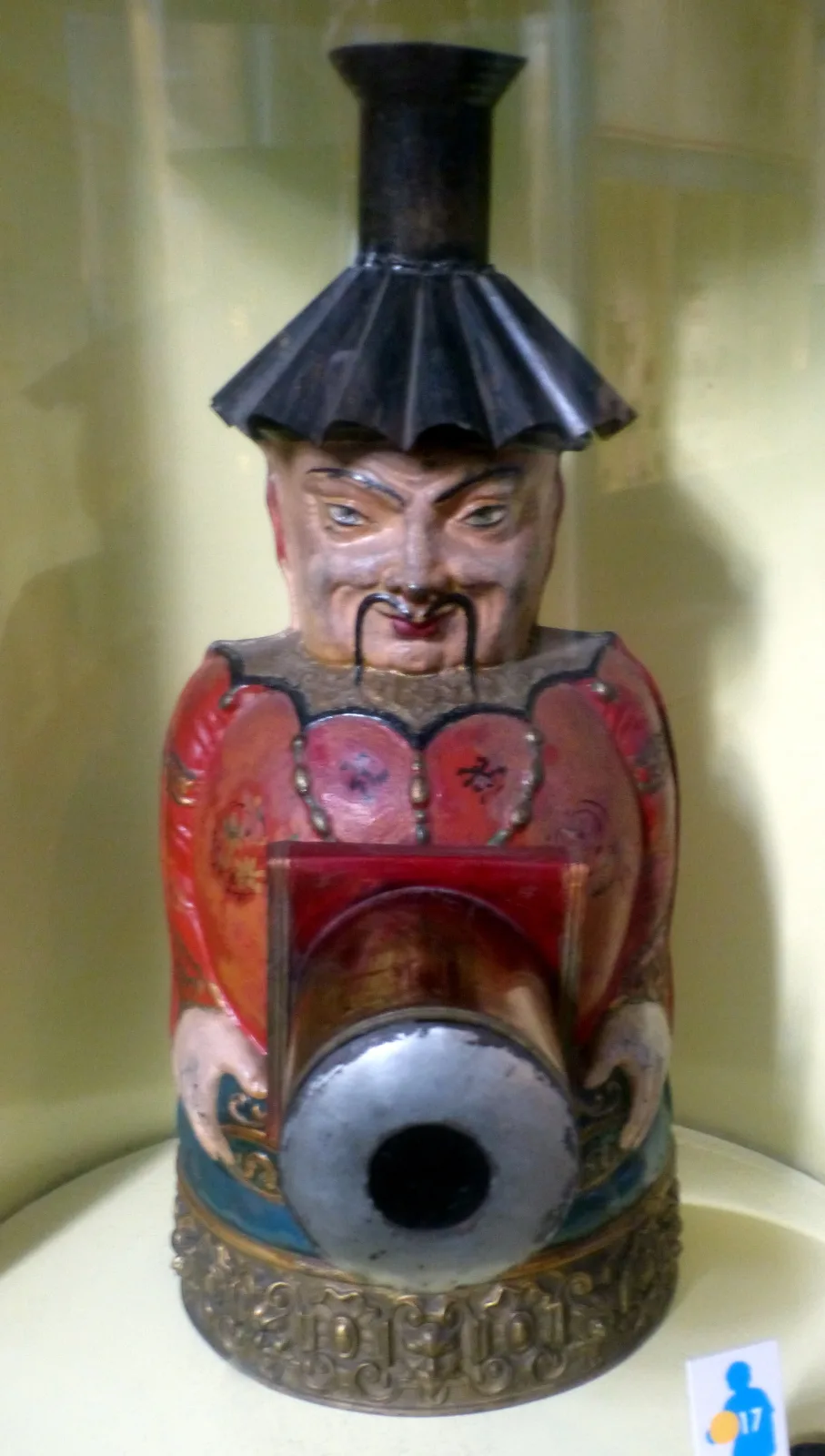
The body is usually the first clue to age, region, and price tier. Five materials dominate.
Japanned Tinplate (Black Lacquered Sheet Metal)
The standard for British lecture lanterns from the 1860s to about 1900. Look for hand-soldered seams, riveted strap reinforcements at the corners, and a deep glossy black finish that flakes off over the lamp housing where heat damaged the lacquer. Brass fittings — door latches, lens collars, slide-stage runners — are typical. Russian-iron (a polished blue-gray sheet steel) is occasionally seen on higher-grade pieces.
Mahogany Cases with Brass
The premium British and French construction, used on biunials and triunials and on the finest single lanterns. Look for dovetailed corners, brass corner mounts, French-polished finish, and engraved brass maker plaques on the front panel. Inside, the slide stage is often lined with ebonized wood or velvet to reduce stray light. A brass-and-mahogany lantern with original case, burners, and lenses can be ten to fifty times the value of a comparable tin lantern.
Lithographed Tin (Toy Lanterns)
German and French toy lanterns are typically lithographed in color rather than japanned. The lithography depicts cherubs, fairy tales, exotic landscapes, or — in patriotic editions — kings and emperors. Examine the litho carefully: scratches and fading are normal, but a piece with crisp colors and intact gilding is uncommon and adds a significant premium.
Cast Iron and Pressed Steel
Late lecture lanterns (1890s onward) sometimes use a cast-iron base and a pressed-steel hood for stability and heat resistance. American makers like McIntosh Stereopticon (Chicago) and Bausch & Lomb adopted cast-iron construction earlier than British firms.
Aluminum and Sheet Steel
Aluminum housings appear after about 1900 and become common in the 1910s educational lanterns. An aluminum body essentially rules out a Victorian date.
Construction details matter as much as material. Hand-soldered seams with visible solder beads, slotted-head iron screws, and hand-cut threads on lens collars all point to pre-1900 work. Phillips-head screws (introduced 1936) anywhere on a "Victorian" lantern are an immediate red flag — usually evidence of replacement parts or a later assembly.
Lenses, Condensers, and Optical Trains
The optical train is what separates a usable lantern from a curio, and original optics are a major value driver.
The Condenser
A pair of plano-convex lenses, mounted just behind the slide stage, that gathers light from the illuminant and floods the slide evenly. Condensers are typically 4 to 5 inches in diameter on lecture lanterns and 2 to 3 inches on toy lanterns. Cracked condensers are common — they crack from thermal stress when lamps were lit too close to cold glass — and they're a real value subtractor because replacement matched pairs are hard to source.
The Projection Lens (Objective)
The lens at the front of the brass barrel, focusable by a rack-and-pinion or sliding tube. Quality varies enormously. The best Victorian projection lenses were achromatic doublets engraved with the maker's name and city: "Ross London," "Dallmeyer London," "Steinheil München," "Voigtländer & Sohn." A signed Ross or Dallmeyer projection lens alone, removed from a wrecked lantern, can be worth several hundred dollars.
Identifying Original vs Replacement Lenses
Look for matching engraving styles and patina between body fittings and lens barrel. A bright, unscratched brass lens on a dark-patinated tin body is a transplant. Check the lens collar diameter against the body opening — a precise friction fit suggests it was made for that lantern; a sloppy fit with shims of paper or felt suggests a marriage. Note any maker plaque on the body and look for the same maker on the lens; mismatches happen but are worth noting.
Slip-Slides, Lever Slides, and Special Optics
Some lanterns have additional optical components — a chromatrope mechanism with two counter-rotating glass discs, a panoramic slide carrier with a hand crank, or a mechanical slip-slide stage that allows two glass plates to move past each other. Specialized optics are valuable; their absence on a lantern that originally had them (visible from missing screw holes or empty mounting slots on the front panel) is a value subtractor.

Illuminants: Oil, Limelight, Electric
The illuminant — the light source inside the lantern — is one of the most precise dating clues available. Each technology has a known introduction window.
Oil Lamps (1820s–1890s)
Early lanterns used a flat-wick or round-wick oil lamp burning whale oil, colza oil, or later kerosene (paraffin). The burner sits inside a sheet-metal chimney and projects a yellow flame onto a small pool of focused light. Oil lamps remained the most common parlor illuminant well into the 1890s and were essentially universal in toy lanterns. A four-wick "duplex" or "petrolux" burner with brass thumbscrews is typical Victorian work; a single thin wick suggests a budget toy lantern.
Limelight (1840s–1910s)
Limelight — burning oxygen and hydrogen against a cylinder of compressed lime — produced a brilliant white light suitable for halls of several hundred people. Limelight lanterns are recognizable by their tall heat-resistant chimneys, asbestos-lined burner chambers, and external connections for two rubber gas supply hoses. A surviving lime cylinder, a pair of saturator bags, or original gas-bag fittings dramatically increase a lantern's interest to collectors. Limelight requires real skill to operate and was largely confined to lecture and showmen's lanterns.
Electric Arc Lamps (1880s–1920s)
Carbon-arc projection appeared in commercial lanterns around 1880 and became the cinema-projection standard by 1900. Arc-equipped magic lanterns are recognizable by heavy carbon-rod holders, asbestos-lined housings, and DC supply terminals. They are usually large, heavy, and aimed at the lecture/cinema crossover market.
Incandescent Bulbs (1900s–onward)
Tungsten-filament projection bulbs in Edison-screw or bayonet sockets appear in educational and home lanterns from the 1900s onward. A factory-original incandescent socket with period wiring (brown rubber cord, ceramic insulators, no PVC) suggests 1905–1925; modern PVC-jacketed wiring is a later replacement.
Acetylene
Briefly popular around 1895–1910 as a portable bright illuminant, acetylene lanterns have a calcium-carbide generator (a separate brass canister) connected by a rubber tube. Few survive complete; the generator is usually the missing piece.
Slide Formats and Mechanical Slides
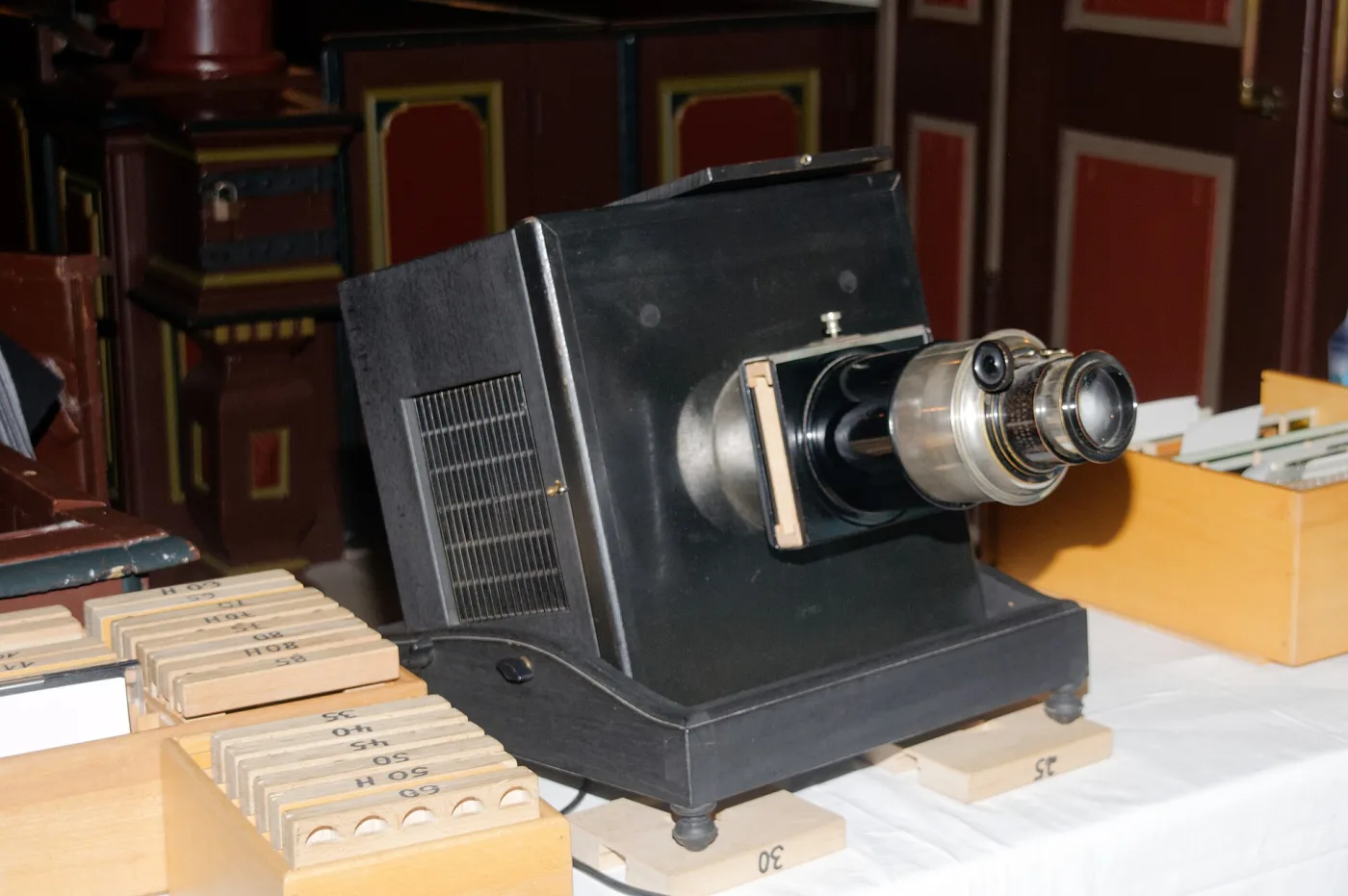
Slides are a parallel collecting category. Identifying the format helps date and place the lantern that took them.
Standard British Slide (3¼ × 3¼ inches)
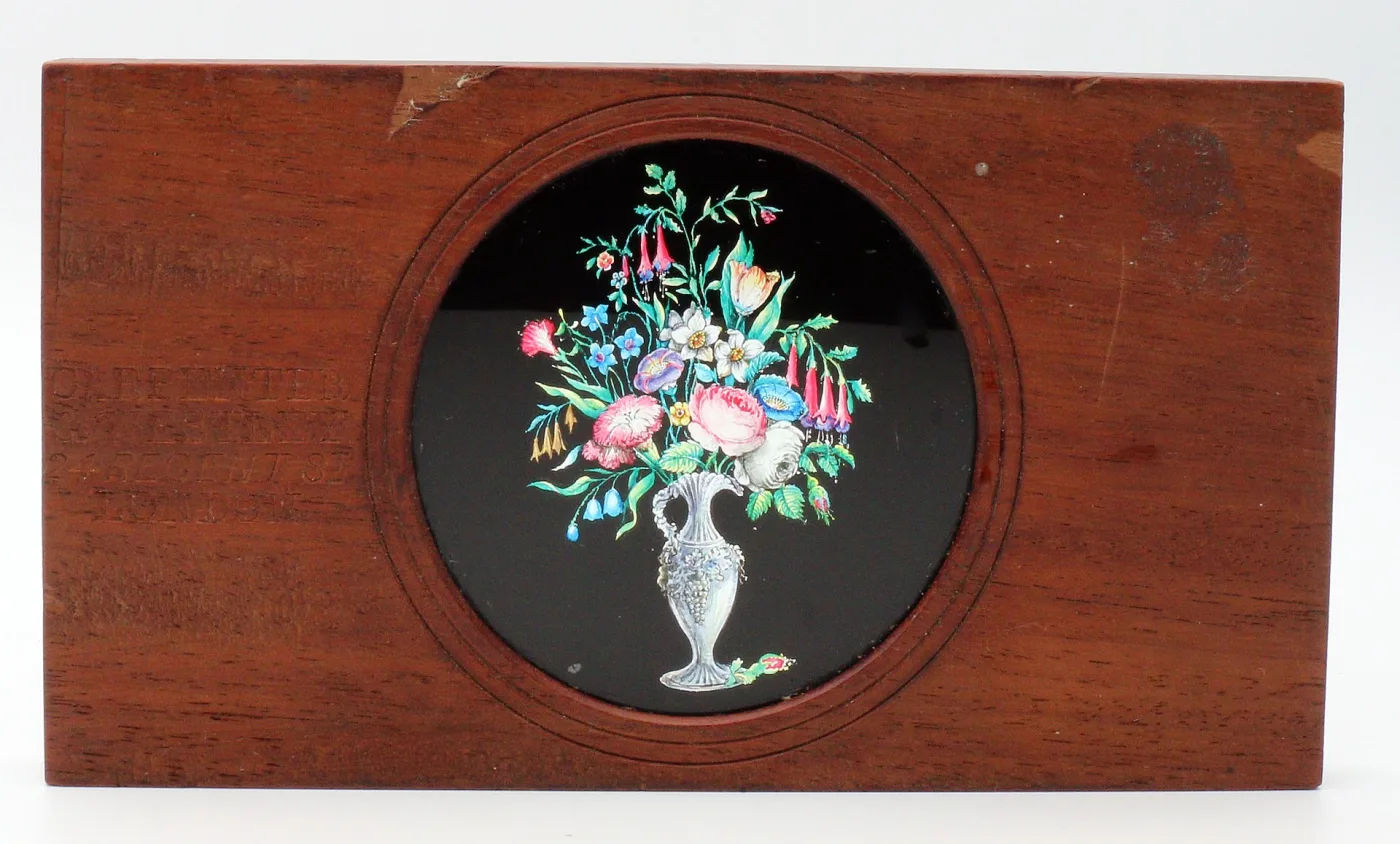
The British lecture standard from the 1880s onward — a square glass plate set into a wooden, paper, or aluminum frame. Wooden frames with hand-painted images suggest pre-1880 work; printed paper-tape binding with photographic emulsion is typical 1880–1920.
French Slide (8.5 × 8.5 cm or similar)
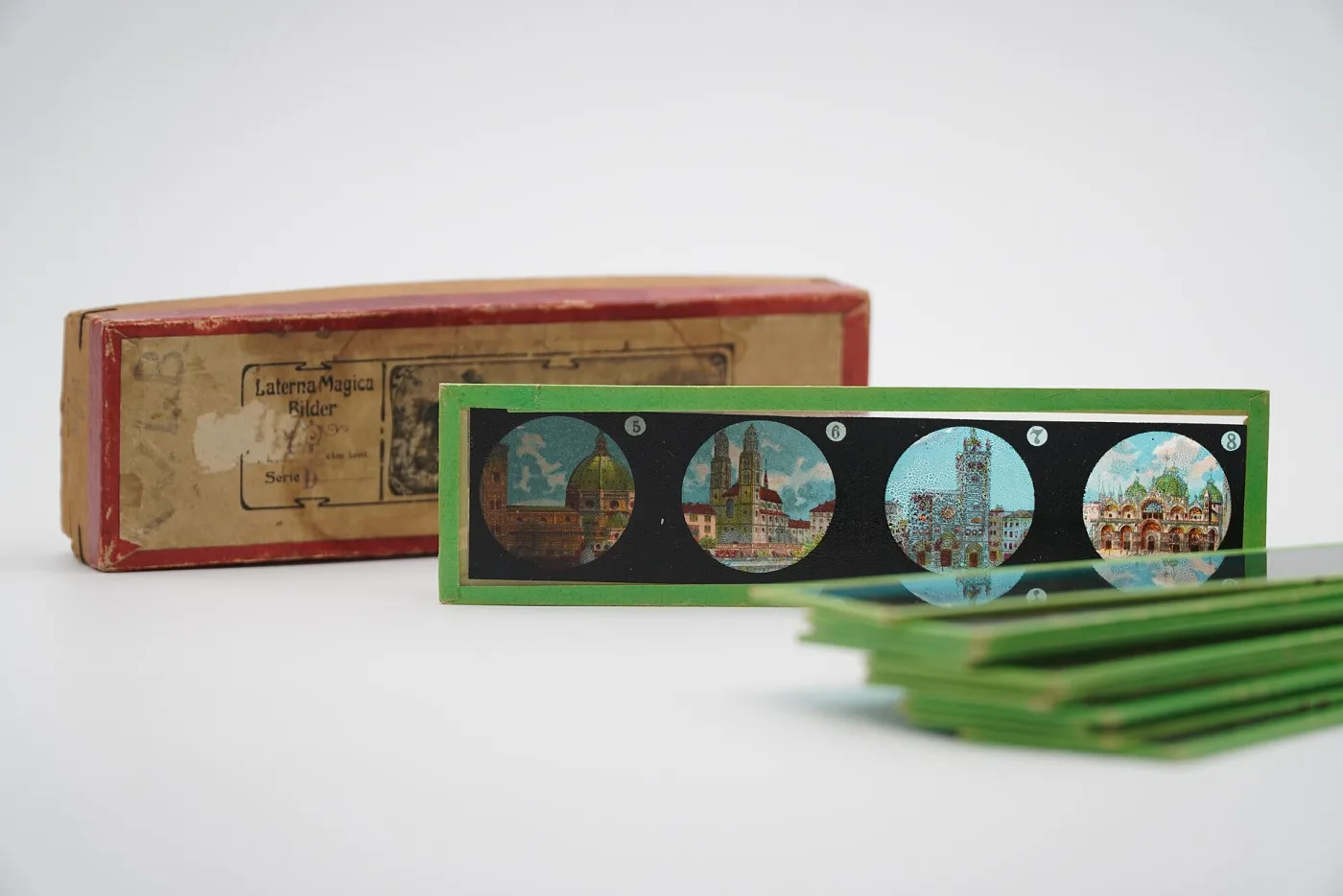
Continental sizes vary — French and German lecture slides are often metric and slightly different from British 3¼-inch standard. Check carefully: a tin lantern that takes only 8.5 cm slides is almost certainly Continental, not British.
Long Wooden-Frame Slides
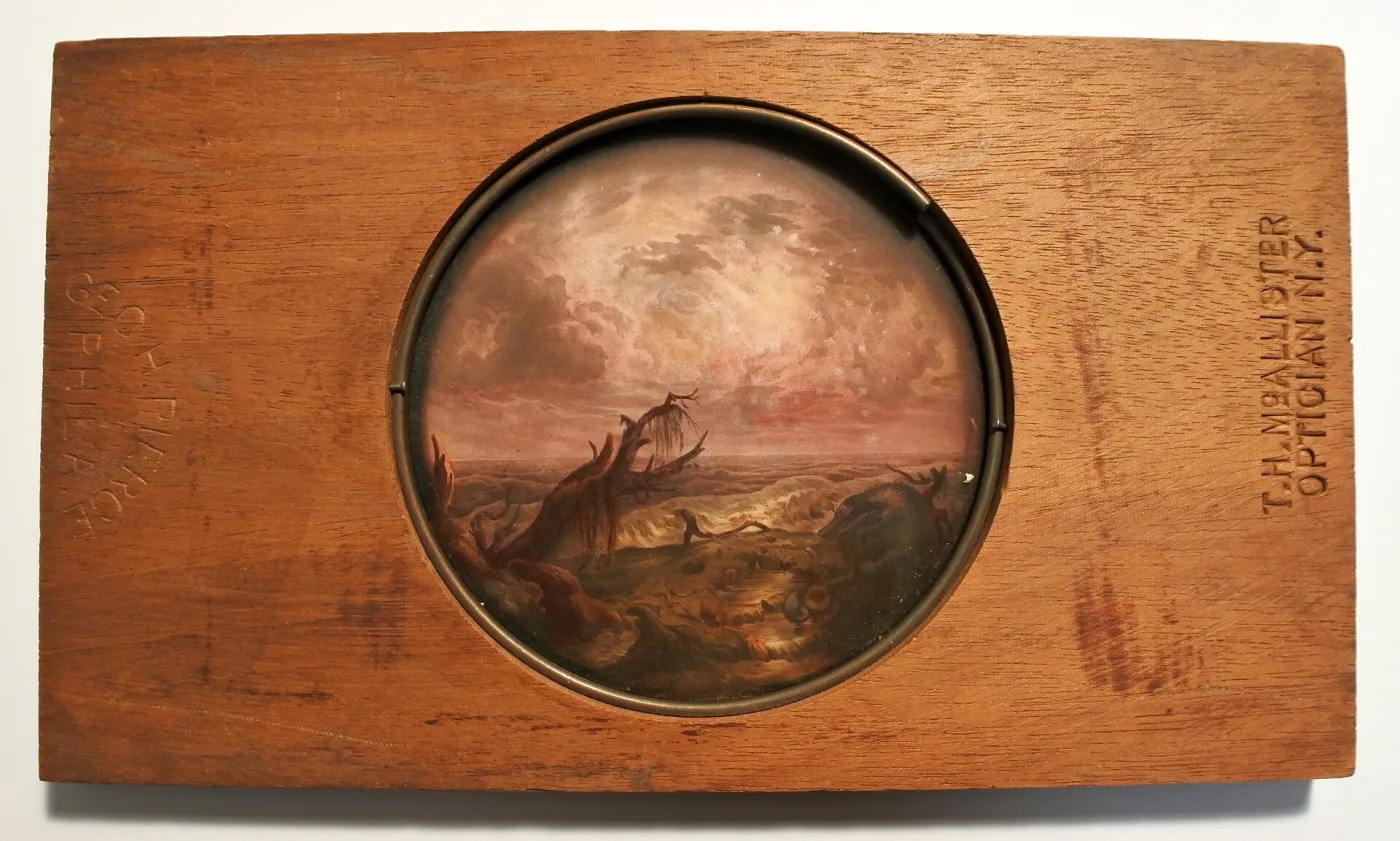
Earlier (pre-1860) lanterns use long wooden frames typically 7 or 10 inches in length, holding two to four small painted images side by side, fed through the slide stage one after another. Hand-painted images on long frames are among the most valuable lantern slides; they predate photography on glass.
Mechanical Slides
Slip-slides have two glass plates in a wooden carrier — one fixed image, one moving — that produce simple animation: a sleeping man whose mouth opens to swallow a rat, a ship that rocks on the sea, a clown who tips his hat. Lever slides use a brass lever to move a hidden plate; rackwork slides use a small rack-and-pinion. Mechanical slides are the most desirable category, especially clean-running pieces with original hand-painted detail.
Chromatropes
Two glass discs of geometric patterns mounted in a wooden frame, counter-rotating via a single hand crank. The result is a kaleidoscopic explosion of color. A working chromatrope with bright original paint can be a $200–$600 item by itself.
Photographic Lantern Slides
From the 1860s onward, magic lantern slides were also produced photographically — silver gelatin or albumen prints on glass, often hand-tinted. Travel-lecture sets (Niagara, Egypt, Holy Land), temperance dramas, and biblical narratives are common subjects. A complete cased set of 50–100 slides on a single subject, with an original lecture booklet, can outvalue the lantern itself.
Notable Makers and Marks
Maker marks are not always present, but when they are, they sit on a brass plaque on the front panel, an engraving on the lens barrel, a stamp inside the slide-stage runner, or a stencil on the wooden case. Knowing the major firms by region speeds attribution.
British Makers
- Newton & Co (London, 1858–1925): One of the most prominent lecture-lantern firms. Mahogany biunials and triunials with engraved brass plaques.
- J. H. Steward (London, 1857–1937): Optical instruments and high-end lanterns. Lenses often signed.
- W. C. Hughes (London, c.1880–1925): The "Hughes' Pamphengos" was a famous limelight-quality oil lantern marketed as a budget alternative to limelight.
- Riley Brothers (Bradford, c.1884–1920): Major slide producer and lantern retailer. The "Praestantia" was their best-known lantern.
- Perken, Son & Rayment (London, c.1881–1908): The "Optimus" lantern is a signature product. Typically Russia-iron body with brass fittings.
- Ross London and Dallmeyer London: Lens makers whose engraved objectives appear on premium lanterns.
French Makers
- Lapierre (Paris, c.1840–1900): The dominant French toy and parlor-lantern maker. Lithographed tin bodies with French-language slide sets.
- Mazo (Paris): Higher-end optical lanterns.
- Molteni (Paris): Premium lecture lanterns and projection equipment.
German Makers
- Ernst Plank (Nuremberg, c.1866–1930): The largest toy-lantern maker. Typically marked "EP" in a triangle or with a Nuremberg-eagle stamp.
- Gebrüder Bing (Nuremberg, c.1863–1933): "GBN" or "BW" mark. Very high quality lithographed tin.
- Georges Carette (Nuremberg, c.1886–1917): "GC" mark. Sold heavily into the British market.
- Jean Schoenner (Nuremberg, c.1875–1906): "JS" mark.
American Makers
- McIntosh Stereopticon (Chicago, c.1881–1920): Lecture and stereopticon lanterns.
- Bausch & Lomb (Rochester): Educational and projection lanterns from c.1890.
- Beseler (East Orange, NJ): Later educational and slide projectors.
- Marcy Sciopticon (Philadelphia, c.1872–1880s): Early American lecture lantern, important for cinema-history collectors.
Many surviving toy lanterns are unmarked because they were sold under retailers' names (Hamley's, F.A.O. Schwarz, Lazarus & Rosenfeld). Attribution to a maker often comes from comparing body shape, burner design, and slide-stage geometry against marked reference pieces in collector publications.
Dating Clues by Decade
Use this rough timeline as a sanity check on dating claims.
Pre-1840
Wooden long-frame slides, oil lamps with flat wicks, hand-soldered tin or wooden bodies with no chimney refinements. Few lanterns of this period survive intact; most "1820s" lanterns offered for sale are misdated 1860s pieces.
1840s–1860s
Argand-style oil lamps, early limelight in lecture pieces, japanned tin standardizes for British lecture work, square 3¼-inch glass slides become more common.
1870s–1890s
Peak Victorian period. Limelight dominant in halls. Mahogany biunials at premium tier. German tin toy lanterns flood the consumer market. Slide-stage runners standardize at 3¼-inch British and 8.5 cm French.
1890s–1910s
Electric arc and incandescent illuminants appear. Aluminum begins to replace japanned tin in cheaper lanterns. Cinema starts displacing lecture lanterns 1900–1910.
Post-1920
Production largely educational. Bakelite knobs and modern wiring are common. These are technically post-antique and are usually marketed as "vintage projectors" rather than magic lanterns, though they are legitimate collectibles in the cinema-history field. For more on early plastic dating clues, see our Bakelite and early plastics guide.
Regional Styles: British, French, German, American
National style is recognizable at a glance once you've seen a few examples.
British
Black japanned tin or polished mahogany, lots of brass, restrained decoration, signed in English on a brass plaque. The British took the lantern most seriously as a lecture instrument; their high end is industry-leading. Many British lanterns share a design language with other British scientific instruments — see our antique microscopes guide and antique telescopes guide for parallel construction conventions.
French
Lithographed tin in bright colors with French-language signage on slides, "POUR ENFANTS" or "LANTERNE MAGIQUE" stamped on the body. French lanterns favor decorative whimsy over British engineering severity. Fairy-tale slide subjects (Cendrillon, Puss in Boots) are typical.
German
Tinplate dominates, with very high lithographic quality at the toy end and serious engineering at the optical end (Plank, Bing). German burners and slide-stage geometry differ enough from British that the bodies are usually distinguishable on sight after some practice.
American
American makers entered later and emphasized educational/lecture and stereopticon (large-format double lantern) markets. Cast-iron bases, larger bodies, and standardized 3¼-inch slides dominate. American work is often less ornate than British and more straightforwardly utilitarian.
Toy Lanterns vs Lecture Lanterns
One of the most important distinctions in this category — and one that is constantly muddled in casual descriptions.
How to Tell at a Glance
- Size: Toy lanterns are typically 6–12 inches tall; lecture lanterns are 14 inches and up.
- Lens diameter: Toy lenses are 1–1.75 inches; lecture lenses are 2.5 inches and up.
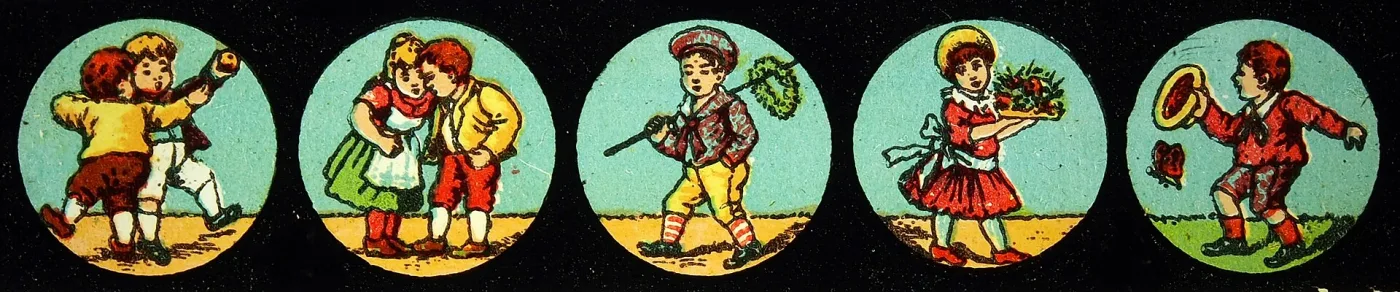
- Slide size: Toy lanterns take small painted-strip slides 1–1.5 inches tall by 4–8 inches long; lecture lanterns take 3¼-inch square or 8.5 cm slides.
- Body finish: Toys are lithographed in color; lecture lanterns are japanned black or mahogany-cased.
- Burner: Toys use a single thin wick; lecture lanterns use multi-wick burners or limelight.
Why It Matters for Value
A typical complete toy lantern in good condition retails for $50–$300. A typical complete lecture lantern starts at $300–$600 and runs into four figures. A presentation-grade biunial or triunial is a four-to-five-figure object. Calling a toy lantern a "Victorian projector" doesn't change the value — buyers know the difference.
Condition, Restoration, and Red Flags
Magic lanterns are heat-stressed, soot-coated, and often missing parts. Condition assessment is a discipline of its own.
Common Damage
- Cracked condenser lenses: Thermal stress is the main cause. Replacement matched pairs are hard to source and costly.
- Burnt-out chimneys: The sheet-metal chimney above the burner is often warped or partially burned through. Original chimneys add value.
- Missing burners: The burner assembly is the single most commonly missing component because owners discarded fuel tanks when they stopped using the lantern.
- Lacquer flaking: Japanned finishes flake from heat. Light flaking is acceptable; large bald patches are a cosmetic value subtractor.
- Tin pitting/rust: Storage in damp basements is the main culprit. Severe pitting on a lithographed toy lantern badly damages value.
- Stripped screws, replaced fittings: Common on lanterns that were used hard. Originality of fittings is checked by patina match.
Restoration Ethics
Conservative collectors prefer "honest dirt" — dust, smoke, soot, and original patina — over aggressive cleaning. Wiping the inside of a brass lens barrel can scrub off original blacking and reduce optical contrast. Repolishing brass fittings to bright yellow is typically a value subtractor of 20–40%. Limit cleaning to dust removal and gentle soot removal with appropriate solvents. For preservation guidance applicable across optical antiques, see our restoration and conservation guide.
Red Flags
- Phillips-head screws on a "Victorian" piece.
- Bright unscratched brass lens on a heavily patinated tin body (transplant).
- PVC-jacketed wiring claimed to be "original" 1890s electric.
- "Limelight burner" that is actually a kerosene burner with a fake gas fitting.
- Fresh paint over the lithography on a toy lantern.
- Mismatched maker plaque and lens engraving.
Reproductions, Married Pieces, and Conversions
Few fully fake magic lanterns exist — the labor cost of building one from scratch exceeds the resale value — but three categories of problem pieces are common.
Married Pieces
A body from one lantern, a lens from another, and a burner from a third, assembled by a dealer to make a salable "complete" lantern. Marriages are detected by mismatched patina, screw types, and engraving styles. They are not necessarily fraudulent if disclosed; undisclosed they are.
Conversions
A late lantern with original incandescent fittings whose socket has been removed and an "oil burner" added to backdate it. Look at the burner well and base for the screw holes from the removed socket and for a mismatch between the burner mounting and the body's original openings.
Outright Reproductions
Mostly toy lanterns. Repro tinplate lanterns are produced for the Christmas decoration market and occasionally find their way into antique sales. Tells: shiny new solder, bright unfaded litho, modern Phillips screws, plastic in the burner, and litho printing dot patterns visible under 10× magnification (Victorian work was lithographed at finer line counts).
Slide Reproductions
Modern reproduction slides — both photographic prints transferred to glass and laser-printed transparencies in wooden frames — are common. Originals have hand-tinted or albumen-print emulsion on real glass with period paper-tape binding. Reproductions often use polyester film and bright modern inks.
Value Drivers and Market Ranges
Magic lantern values vary by two orders of magnitude depending on type, maker, and completeness.
Approximate Market Ranges (2026)
- Incomplete toy tin lantern, no slides: $30–$80.
- Complete German toy lantern with original slides and box: $100–$400.
- Plain japanned-tin British lecture lantern, working condition: $250–$600.
- Maker-marked lecture lantern (Hughes, Newton, Riley) in good condition: $600–$2,500.
- Mahogany-and-brass biunial with original case: $2,000–$8,000.
- Triunial with limelight burners and presentation case: $6,000–$25,000+.
- Single rare slide (chromatrope, mechanical slip with original paint): $50–$600.
- Cased lecture-slide set (50–100 slides on one subject, with booklet): $200–$2,500.
What Drives the Top of the Market
Maker provenance, completeness (case, burner, lenses, slide carriers all original together), working condition, and presentation quality of the cabinet work. A signed Newton biunial in figured mahogany with original limelight burners and case beats a generic triunial with replacement fittings, every time. For broader appraisal context across categories, see our antique valuation and appraisal guide.
Care, Storage, and Display
Lanterns are robust if kept dry and undisturbed. Three rules cover most care needs.
Don't Light It Without Inspection
Never run an antique oil burner without checking the wick reservoir for leaks, the chimney for warpage, and the condenser glass for cracks. A cracked condenser shatters explosively when heated, and a leaking kerosene reservoir is a fire hazard. If you intend to use the lantern, replace the burner with a modern equivalent and keep the original safely stored separately.
Climate and Light
Store between 40–70% humidity. Avoid attics (heat extremes) and basements (damp). Display away from direct sunlight, which fades lithographed tin and embrittles wooden cases.
Slide Storage
Store slides flat in their original wooden boxes if available, or in archival slide boxes with acid-free dividers. Glass slides crack at the edges from poor storage; once cracked they are essentially unrestorable. Original cased sets should never be split — the box and booklet add 30–60% to the slide value.
Photographing for Records
Document each lantern with photographs of the maker plaque, burner, lens engraving, slide stage, and any internal stamps. Detailed records support insurance and resale. For practical methods, see our photography and documentation techniques guide.
Buying and Selling Strategy
Two final practical thoughts on operating in this market.
Buying
Buy the best example you can afford rather than several mediocre ones. A signed maker's biunial with original case will hold and grow value where five anonymous tin lanterns will not. Always ask for provenance — auction history, prior collection name, original sales receipt. Examine in hand if possible: photographs hide marriage details and condenser cracks. Don't pay for "working condition" sight unseen; insist on a video of the lantern lit (if the seller is willing to risk it) or assume mechanical issues.
Selling
Specialist auction houses (Skinner, Bonhams, Dominic Winter in the UK) and the Magic Lantern Society auctions consistently outperform generalist eBay sales for premium pieces. Toy lanterns and unsigned tin pieces do fine on eBay if photographed carefully and described accurately. For broader sales tactics, see our buying and selling strategies guide.
Joining the Community
The Magic Lantern Society (UK) and the Magic Lantern Society of the U.S. and Canada publish journals, host conventions, and maintain reference libraries that are essential for serious collecting. Membership pays for itself the first time you correctly attribute an unsigned lantern from a published reference photograph.