Antique Chatelaines Identification Guide: Types, Materials & Values
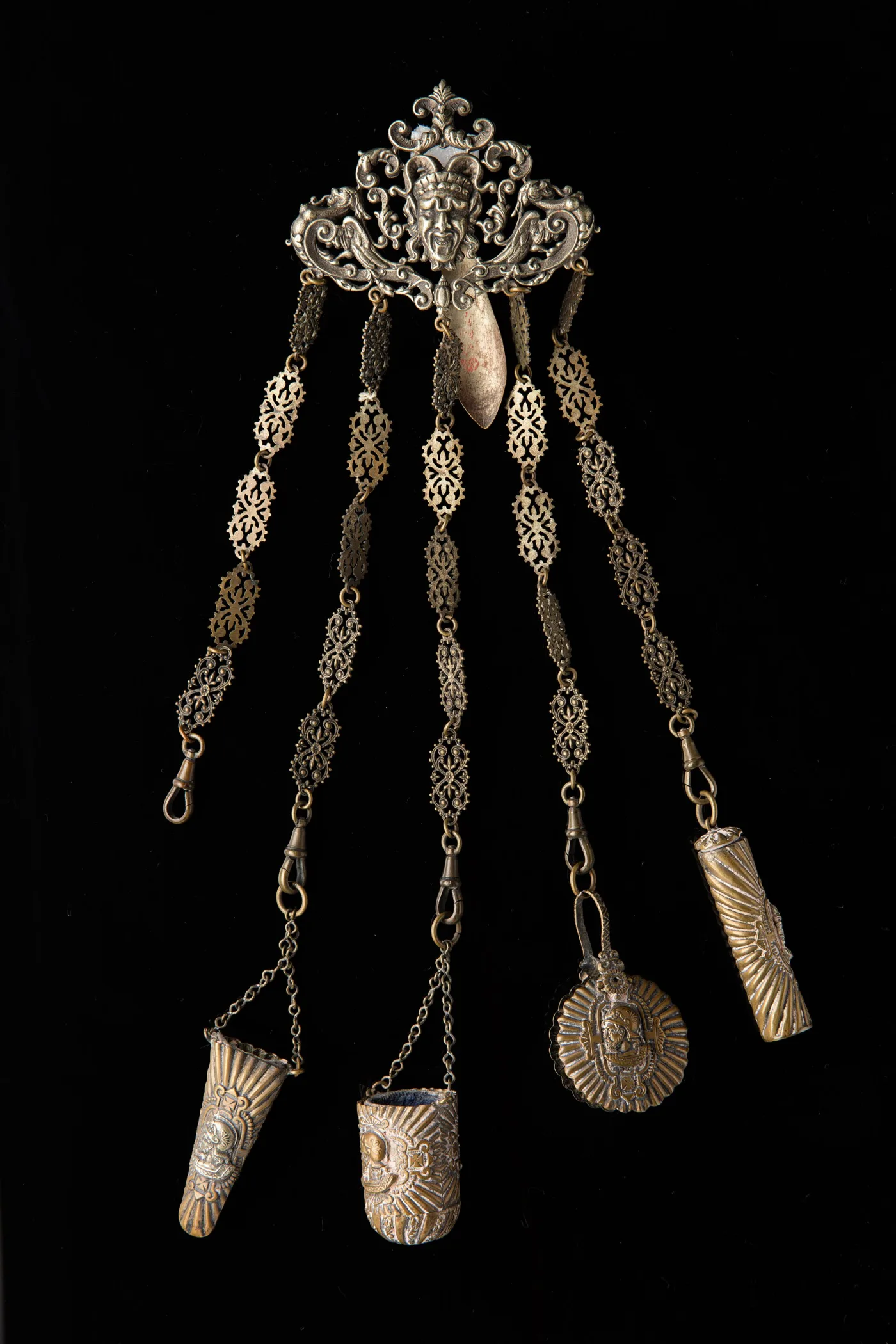
Chatelaines are among the most fascinating and overlooked categories of antique personal accessories. These ornamental clips or clasps, worn at the waist and fitted with chains bearing useful household implements, served as both functional tools and status symbols for centuries. From medieval castle keepers to Victorian ladies of leisure, the chatelaine evolved from a practical necessity into an exquisite art form that reflected the tastes, wealth, and daily lives of their owners.
Collecting antique chatelaines has grown significantly in popularity over the past two decades, driven by a renewed appreciation for fine metalwork, the fascinating social history these objects embody, and their relative scarcity on the open market. Whether you have inherited a family heirloom or discovered an intriguing piece at an estate sale, understanding how to identify, date, and evaluate a chatelaine requires knowledge of materials, construction methods, maker marks, and historical context.
This guide covers everything collectors need to know about antique chatelaines, from their medieval origins through their Victorian golden age. You will learn to distinguish between types and materials, recognize the work of important makers, identify authentic pieces from later reproductions, and assess condition and value. If you are interested in related personal accessories, our antique jewelry identification guide provides broader context for understanding decorative metalwork from the same periods.
Table of Contents
- 1. History of the Chatelaine
- 2. Types of Chatelaines
- 3. Materials and Metalwork
- 4. Components and Attachments
- 5. Key Makers and Manufacturers
- 6. Dating Techniques
- 7. Construction Methods
- 8. Identifying Marks and Hallmarks
- 9. Silver Chatelaines in Detail
- 10. Cut Steel Chatelaines
- 11. Gold and Pinchbeck Chatelaines
- 12. Reproductions vs. Originals
- 13. Condition Assessment
- 14. Collector Tips and Buying Guide
- 15. Care and Preservation
- 16. Values and the Current Market
1. History of the Chatelaine
Medieval Origins
The word "chatelaine" derives from the French châtelaine, meaning the mistress of a castle or large household. In medieval Europe, the lady of the house carried the keys to storerooms, pantries, and cellars on a ring or chain attached to her belt. This ring of keys was both a practical tool and a visible symbol of authority and domestic responsibility. The earliest surviving examples from the 13th and 14th centuries are simple iron or bronze rings with attached keys, far removed from the elaborate decorative pieces that would emerge centuries later.
By the 15th century, the functional key ring had begun to evolve. Wealthy women attached additional implements to their belt chains, including small knives, prayer book clasps, and seal stamps. These early multi-purpose chains were not yet called chatelaines, but they established the principle of carrying several useful items from a single waist-mounted clip. The concept spread across northern Europe, with examples found in England, France, the Low Countries, and the German-speaking lands.
The 17th and 18th Centuries
The chatelaine as a distinct decorative object emerged in the late 17th century. French goldsmiths began producing elaborate gilt and enameled clips with multiple chains for watches, seals, keys, and small trinkets. By the 1720s, the chatelaine had become a fashionable accessory for both men and women at European courts. Men wore watch chatelaines, typically featuring a watch hook, a seal, and perhaps a small key, while women favored more elaborate versions with multiple suspended implements.
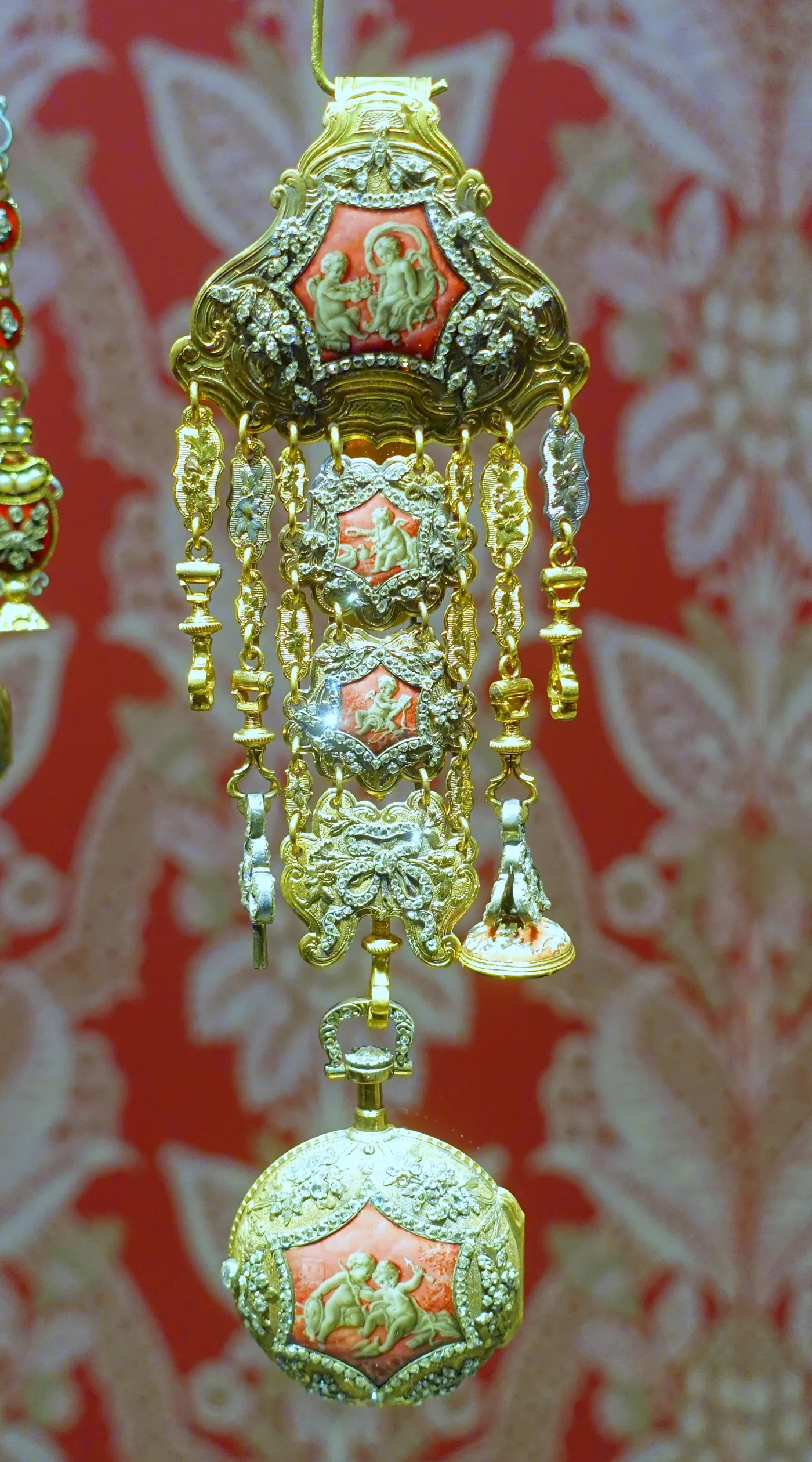
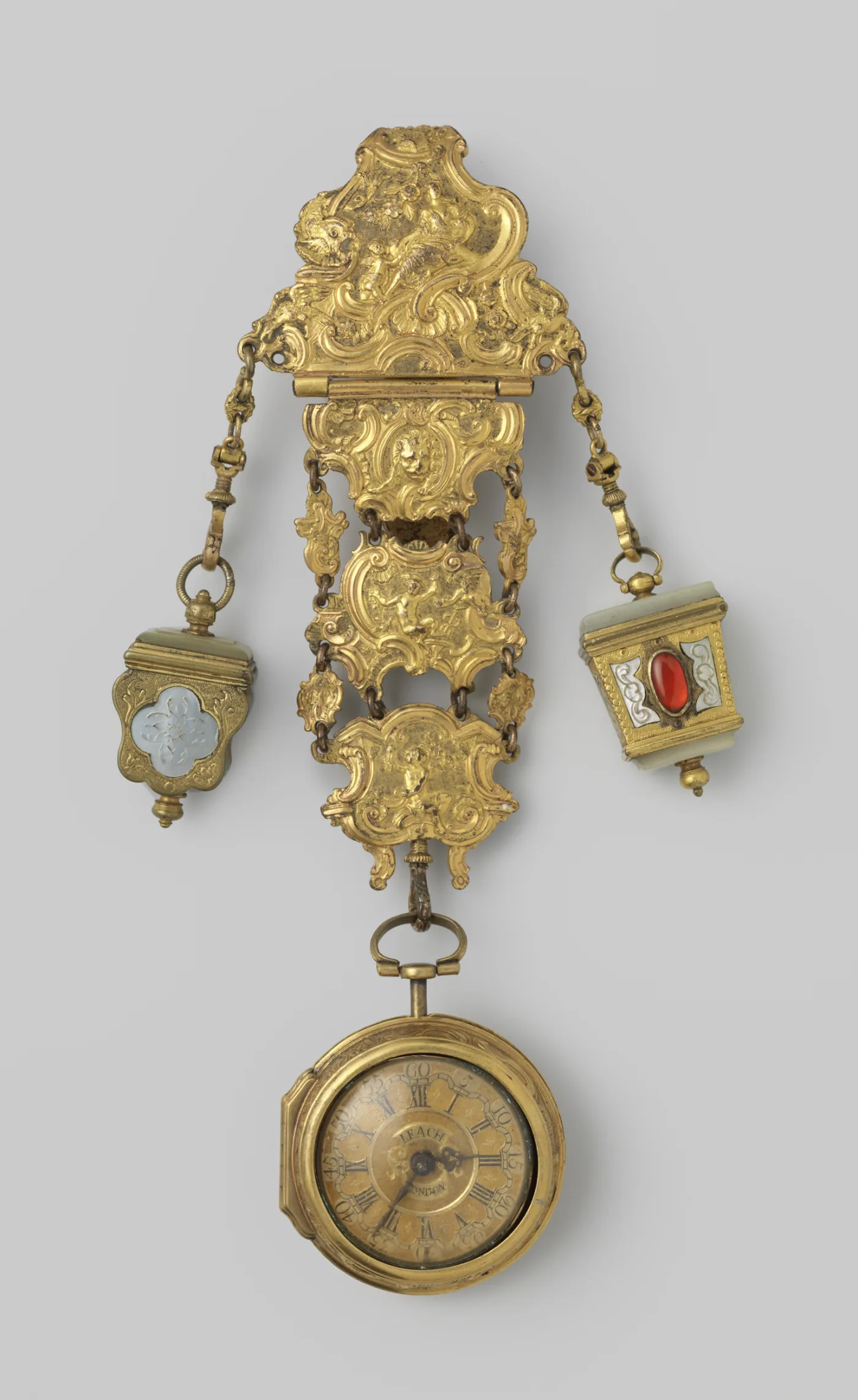
The 18th century saw the chatelaine reach its first peak of artistic elaboration. French and English makers produced stunning examples in gold, silver, pinchbeck, and base metals with enamel, gem-set, and engraved decoration. Rococo chatelaines featured asymmetrical scrollwork, pastoral scenes, and chinoiserie motifs. The equipage, a specialized form of chatelaine carrying sewing implements, became essential for fashionable women. These pieces often featured etui cases containing miniature scissors, bodkins, tweezers, and ear spoons.
The Victorian Golden Age
The Victorian era (1837-1901) represents the golden age of the chatelaine. After a period of relative obscurity during the Regency and early Victorian years, chatelaines experienced a dramatic revival in the 1850s and 1860s. The Great Exhibition of 1851 showcased several magnificent examples, reigniting public interest in these accessories. Victorian chatelaines were produced in unprecedented variety, from simple steel household versions costing a few shillings to elaborate silver and gold presentation pieces valued at many guineas.
The Victorian chatelaine reflected the era's emphasis on domesticity, needlework, and feminine accomplishment. Middle-class women adopted chatelaines as both fashionable accessories and practical household tools. The rise of the sewing chatelaine, fitted with scissors, a thimble holder, a needle case, and a pin cushion, coincided with the cult of amateur needlework and embroidery that defined Victorian feminine culture. By the 1870s and 1880s, major silver manufacturers were producing standardized chatelaine designs in large quantities, making these accessories available to a broad market.
Decline and Legacy
The chatelaine declined rapidly after 1900. Changes in women's fashion, particularly the move away from structured waists and heavy skirts, made belt-hung accessories impractical. The rise of the handbag as a fashionable accessory provided a more convenient way to carry personal items. Nurse's chatelaines survived into the mid-20th century as professional tools, but decorative chatelaines had essentially vanished from fashion by 1910. Today, antique chatelaines are prized by collectors as rare and evocative artifacts of domestic history.
2. Types of Chatelaines
Household Chatelaines
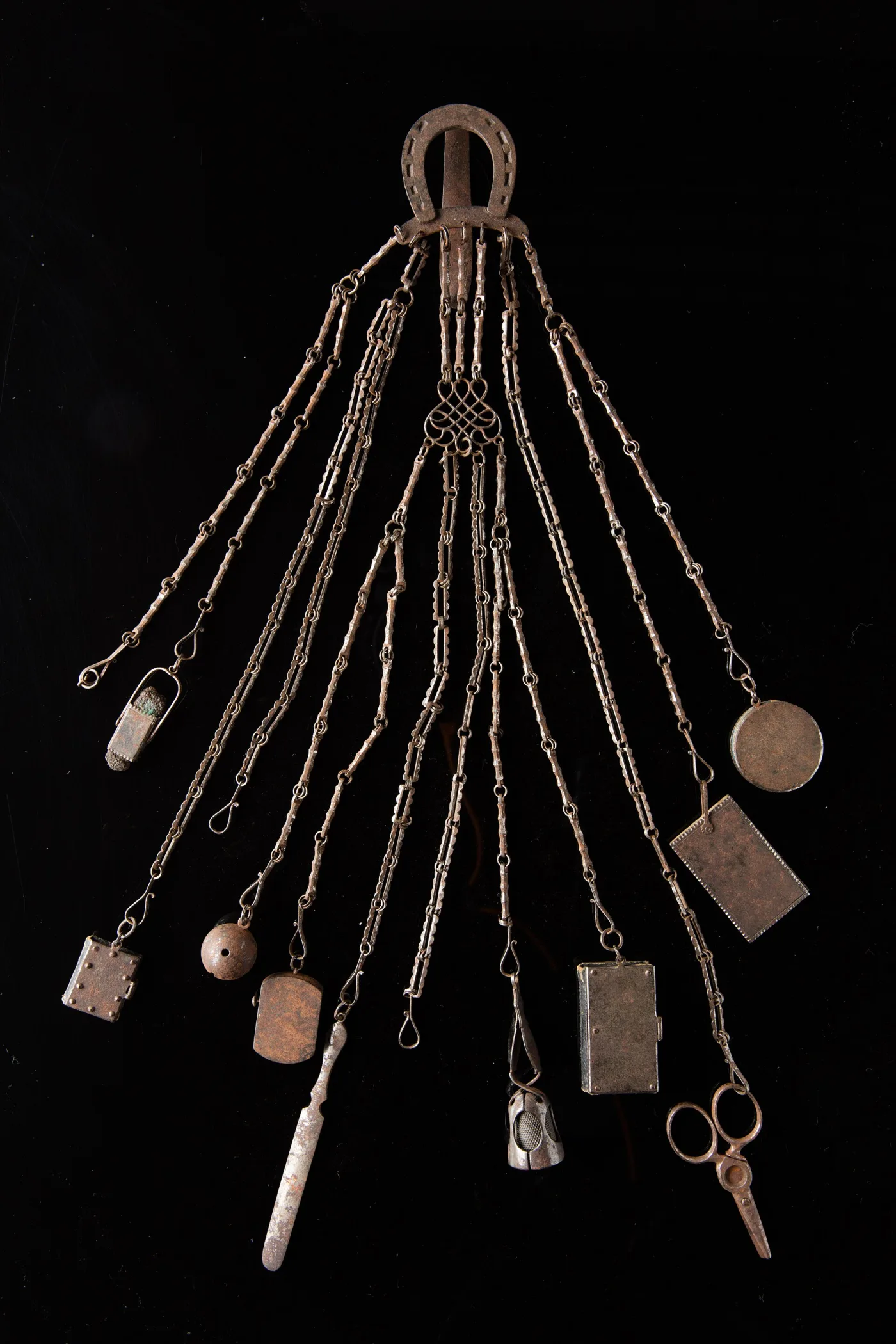
The household chatelaine is the most traditional form, directly descended from the medieval key chain. These practical accessories typically feature three to seven chains suspended from a central clip or hook, carrying keys, a small notebook or aide-memoire, a pencil, scissors, and sometimes a watch. Household chatelaines were designed for daily use by women managing servants and running domestic affairs. They are generally made from sturdy materials such as steel, iron, or base metals, though wealthier owners had silver or silver-plated versions.
Identifying a household chatelaine involves looking for signs of regular use, including worn chain links, polished key bows, and well-used writing implements. The clip mechanism is typically robust, designed to grip a thick belt or waistband securely. These functional pieces often lack the fine decorative detail found on purely ornamental chatelaines, but they possess a utilitarian charm that many collectors find appealing.
Sewing Chatelaines
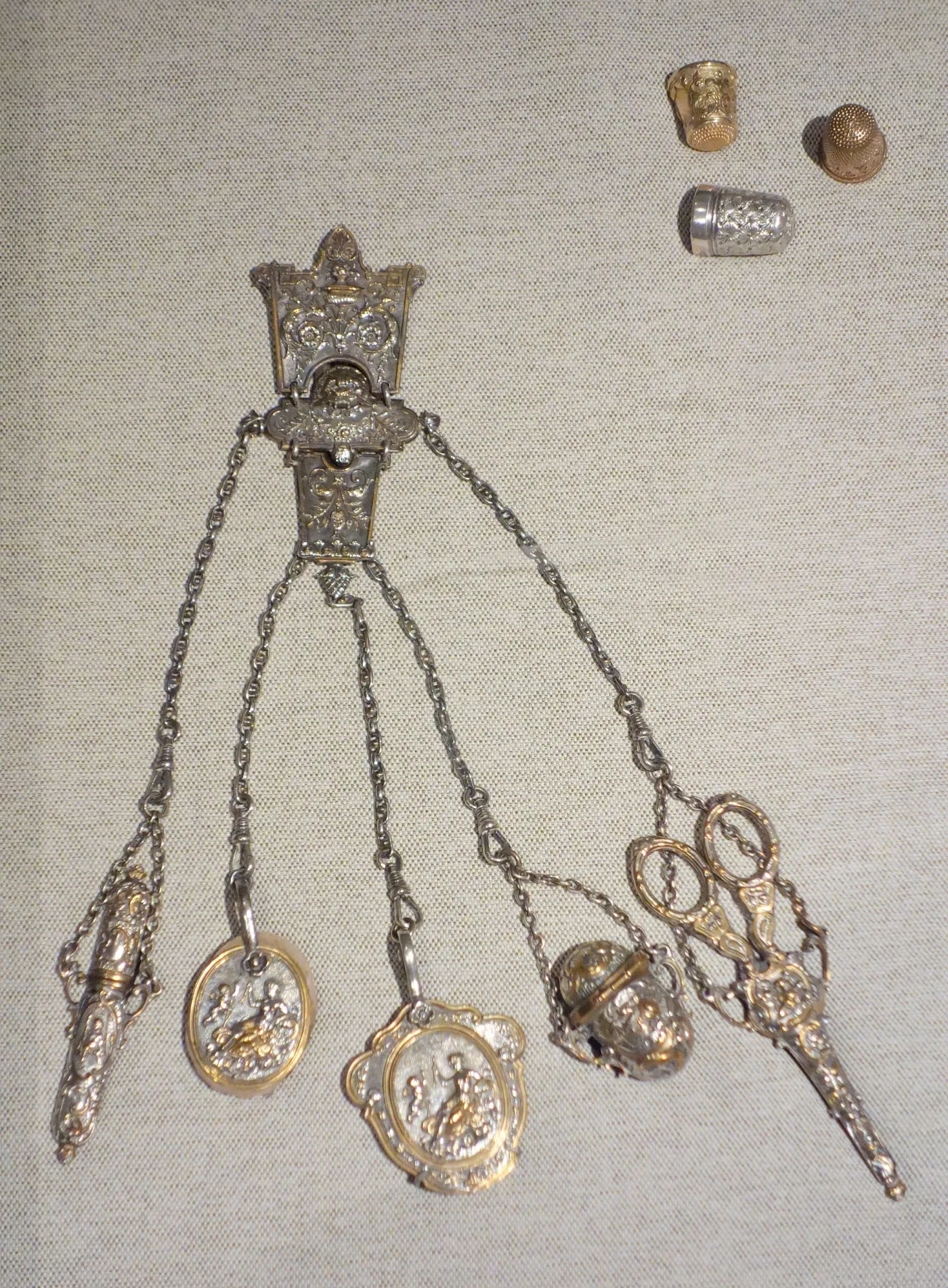
Sewing chatelaines are perhaps the most collected type. These specialized accessories carry needlework implements: scissors (often with ornate handles shaped as birds, flowers, or animals), a thimble in a fitted case, a needle case or packet holder, a pin cushion (sometimes shaped as an acorn, strawberry, or shoe), a tape measure, and occasionally a stiletto or bodkin. Victorian sewing chatelaines were produced in enormous variety, from simple steel examples to elaborate silver pieces with chased and engraved decoration.
The quality and completeness of a sewing chatelaine's attachments significantly affect its value. Collectors look for original matching sets where all implements share the same decorative style and material. A complete Victorian silver sewing chatelaine with all original attachments can be worth several times more than a similar piece with replacement or mismatched components. For further context on sewing collectibles, our guide to antique thimbles covers the small implements often found on these chatelaines.
Nurse's Chatelaines
The nurse's chatelaine emerged in the late 19th century as a professional tool for hospital and private nurses. These functional accessories typically carry a watch (hung face-up for easy reading while taking a pulse), scissors, a pencil and notepad, and sometimes a thermometer case or bandage pin holder. Nurse's chatelaines are generally made from nickel-plated steel or silver-plated base metals, designed to be hygienic and easily cleaned.
Florence Nightingale and the professionalization of nursing in the 1860s and 1870s helped popularize these accessories. Nurse's chatelaines remained in use well into the 20th century, making them more readily available to collectors than most other types. They are valued for their historical association with the nursing profession and their clean, functional aesthetic.
Decorative and Presentation Chatelaines
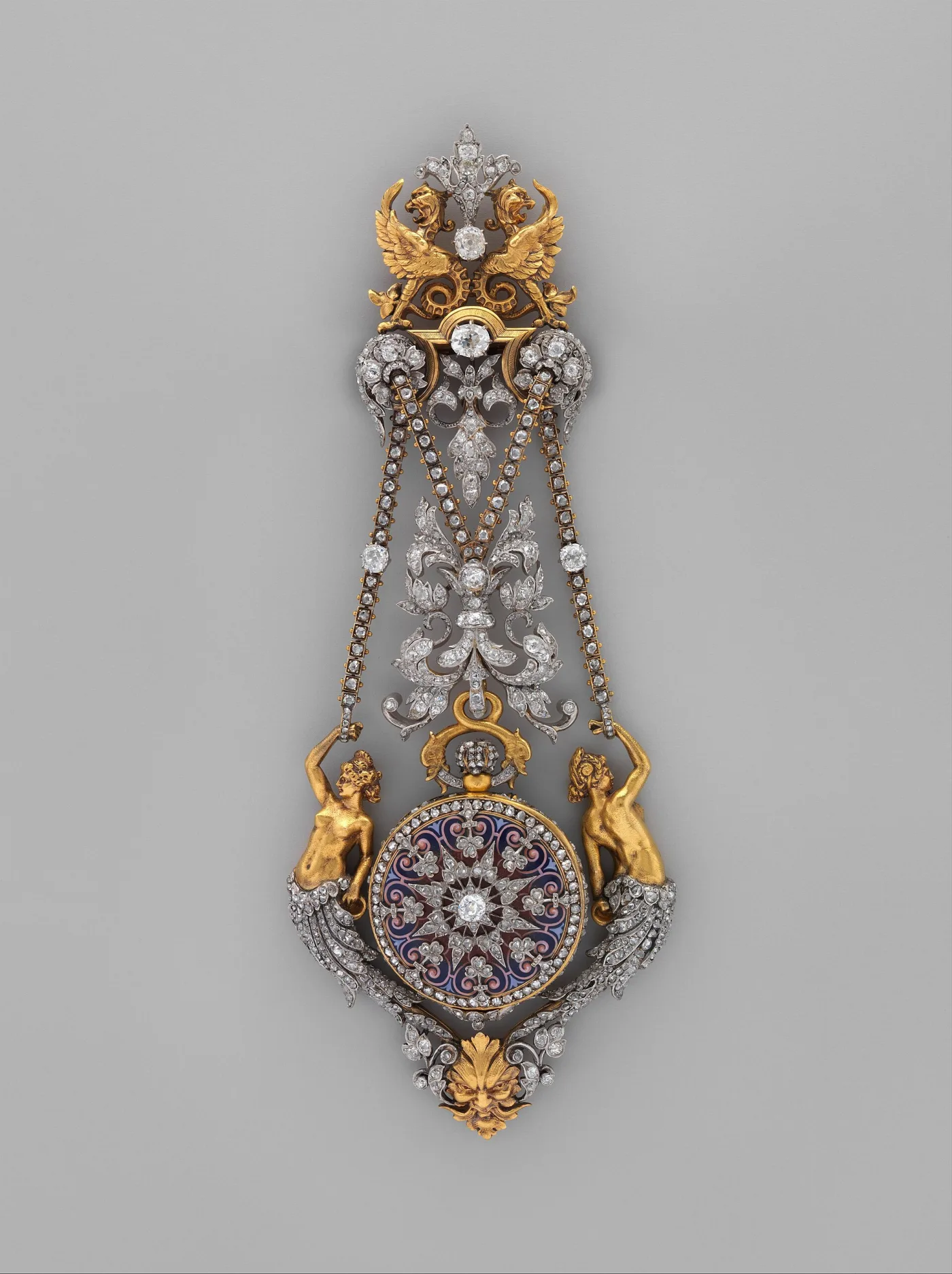
At the top of the market are decorative chatelaines made as display pieces or special gifts. These include presentation chatelaines given as wedding or anniversary gifts, exhibition pieces made to showcase a maker's skill, and bespoke commissions for wealthy clients. Decorative chatelaines may be made from precious metals, set with gemstones, and finished with exceptional engraving, chasing, or enameling. They often carry ornamental rather than functional attachments, such as vinaigrettes, scent bottles, and decorative medallions.
Watch Chatelaines
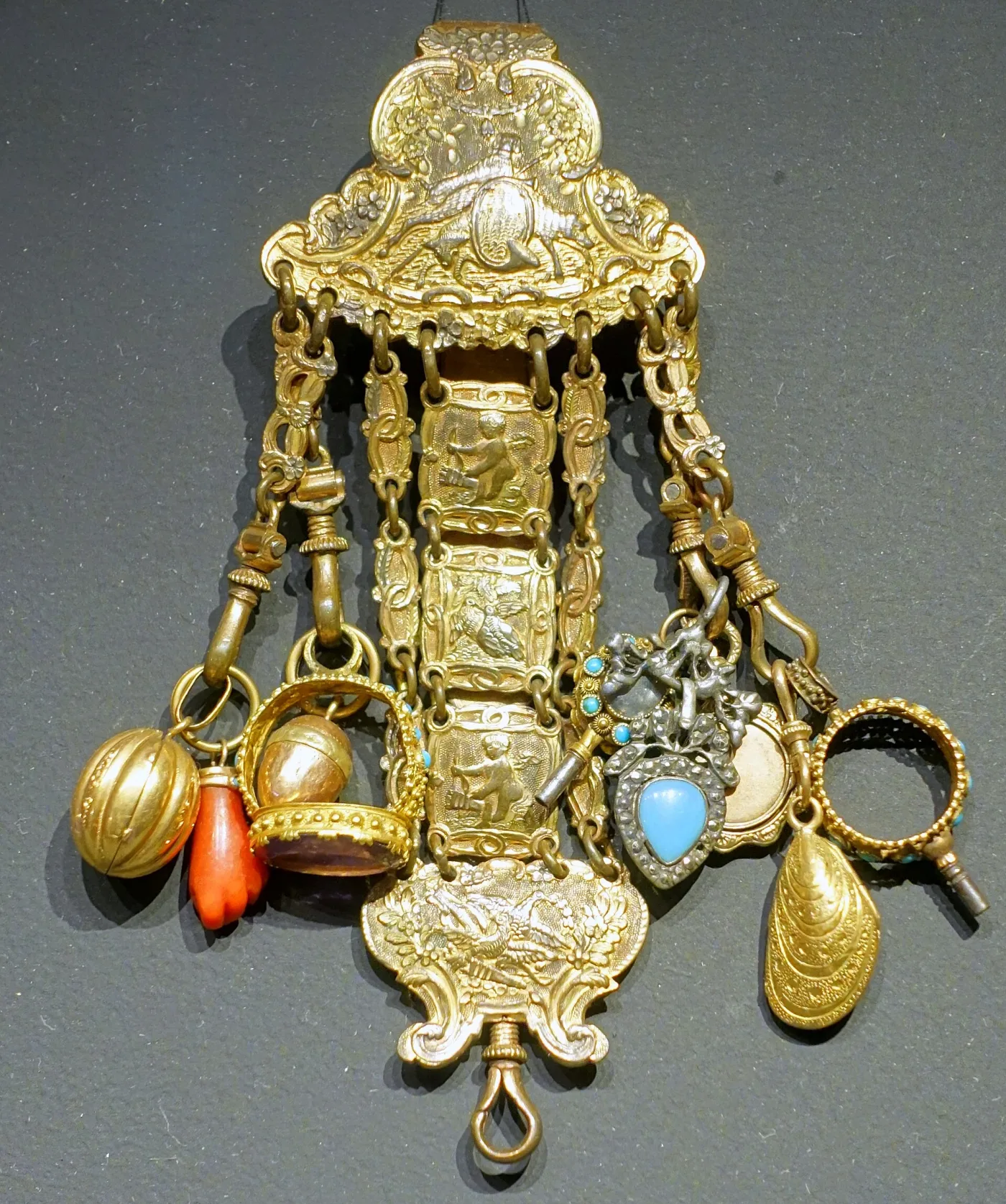
Watch chatelaines, sometimes called fob chatelaines, were designed primarily to suspend a pocket watch from the waist. Popular with both men and women in the 18th and early 19th centuries, these accessories feature a central hook or clip with one or more chains for a watch, a seal, a key, and sometimes a small trinket or locket. Men's watch chatelaines tend to be simpler, while women's versions may be more elaborately decorated. The watch chatelaine is closely related to the fob chain and is sometimes classified separately from domestic chatelaines.
3. Materials and Metalwork
Sterling Silver
Silver is the most common material for fine Victorian chatelaines. English sterling silver chatelaines bear hallmarks that allow precise identification of date, maker, and assay office. Birmingham was the dominant center of silver chatelaine production, with makers such as Hilliard & Thomason, Adie & Lovekin, and George Unite producing large quantities from the 1870s through the 1900s. Silver chatelaines may be plain polished, engraved with scrollwork or floral patterns, or decorated with repoussé and chased ornament. Understanding antique silver hallmarks and identification is essential for accurately dating and attributing these pieces.
Gold
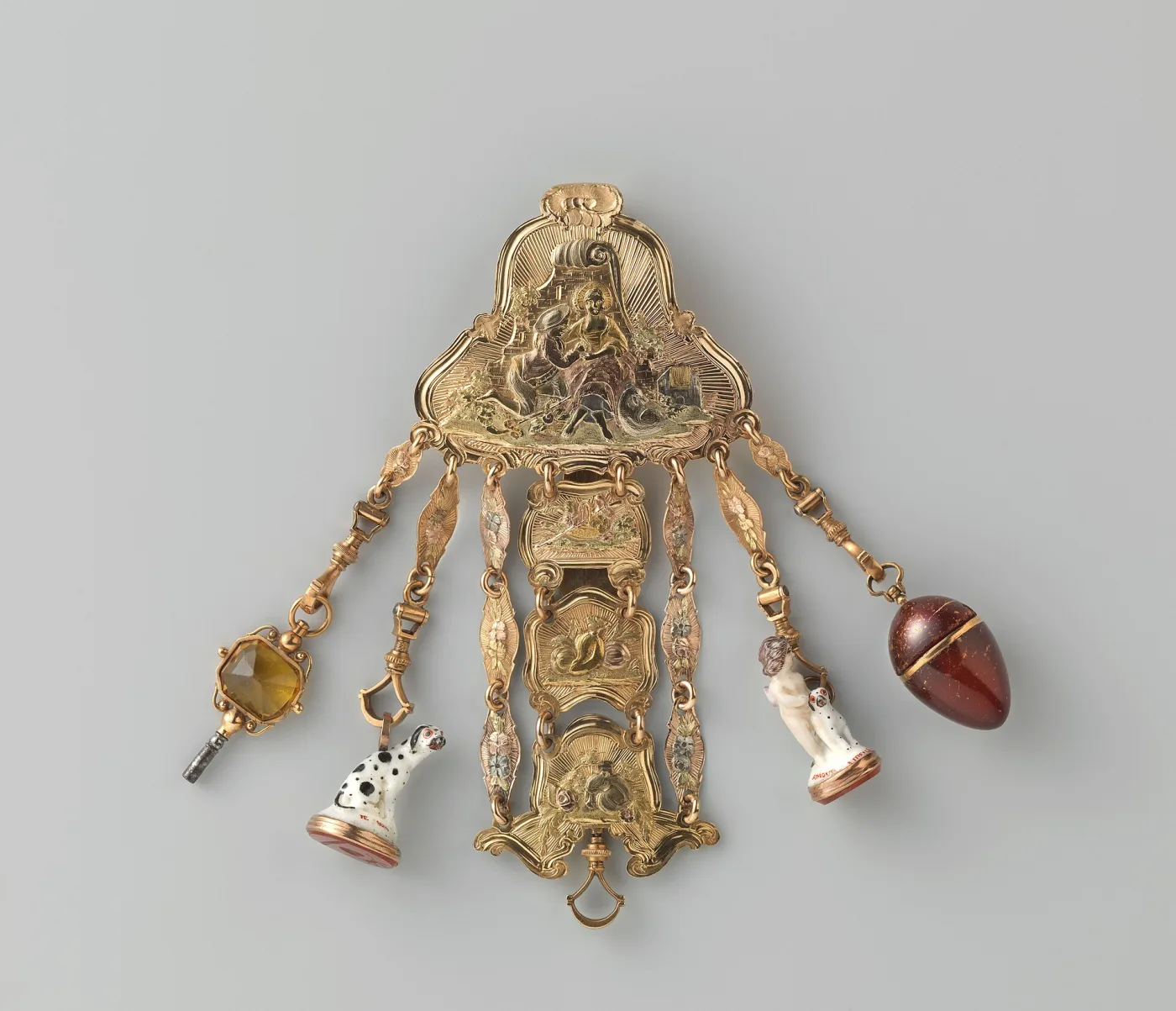
Gold chatelaines are rare and highly valuable. Most surviving examples date from the 18th century, when gold was the preferred material for aristocratic accessories. These pieces may be 18-carat or higher, with elaborate repoussé, engraved, or enameled decoration. French gold chatelaines from the Louis XV and Louis XVI periods are among the most sought-after, with auction prices frequently reaching five figures. Some Victorian gold chatelaines exist, typically in 9-carat or 15-carat gold, but they are far less common than silver examples.
Cut Steel
Cut steel chatelaines represent a distinctive and highly collectible category. Cut steel is made by riveting small faceted steel studs onto a base, creating a surface that sparkles like gemstones when it catches the light. The technique was perfected in Birmingham and Woodstock in the 18th century and remained popular through the Victorian era. Cut steel chatelaines are often mistaken for marcasite, but the studs are individually riveted rather than set in metal mounts. Fine cut steel work rivals silver in both beauty and value.
Pinchbeck and Gilt Metal
Pinchbeck, an alloy of copper and zinc developed by Christopher Pinchbeck in the early 18th century, was widely used for affordable chatelaines that resembled gold. True pinchbeck has a warm golden color and resists tarnishing better than brass. Later "pinchbeck" is often simply gilt brass or bronze. These materials were used for 18th-century watch chatelaines and decorative pieces, and can be quite valuable when the workmanship is exceptional.
Base Metals and Plated Ware
Many affordable Victorian chatelaines were made from iron, brass, nickel silver (German silver), or electroplated base metals. These pieces were intended for everyday domestic use and survive in large numbers. While less valuable than silver or gold examples, well-preserved base metal chatelaines with interesting designs or complete sets of attachments remain collectible. Electroplated chatelaines often show wear through to the base metal, which helps distinguish them from solid silver pieces.
4. Components and Attachments
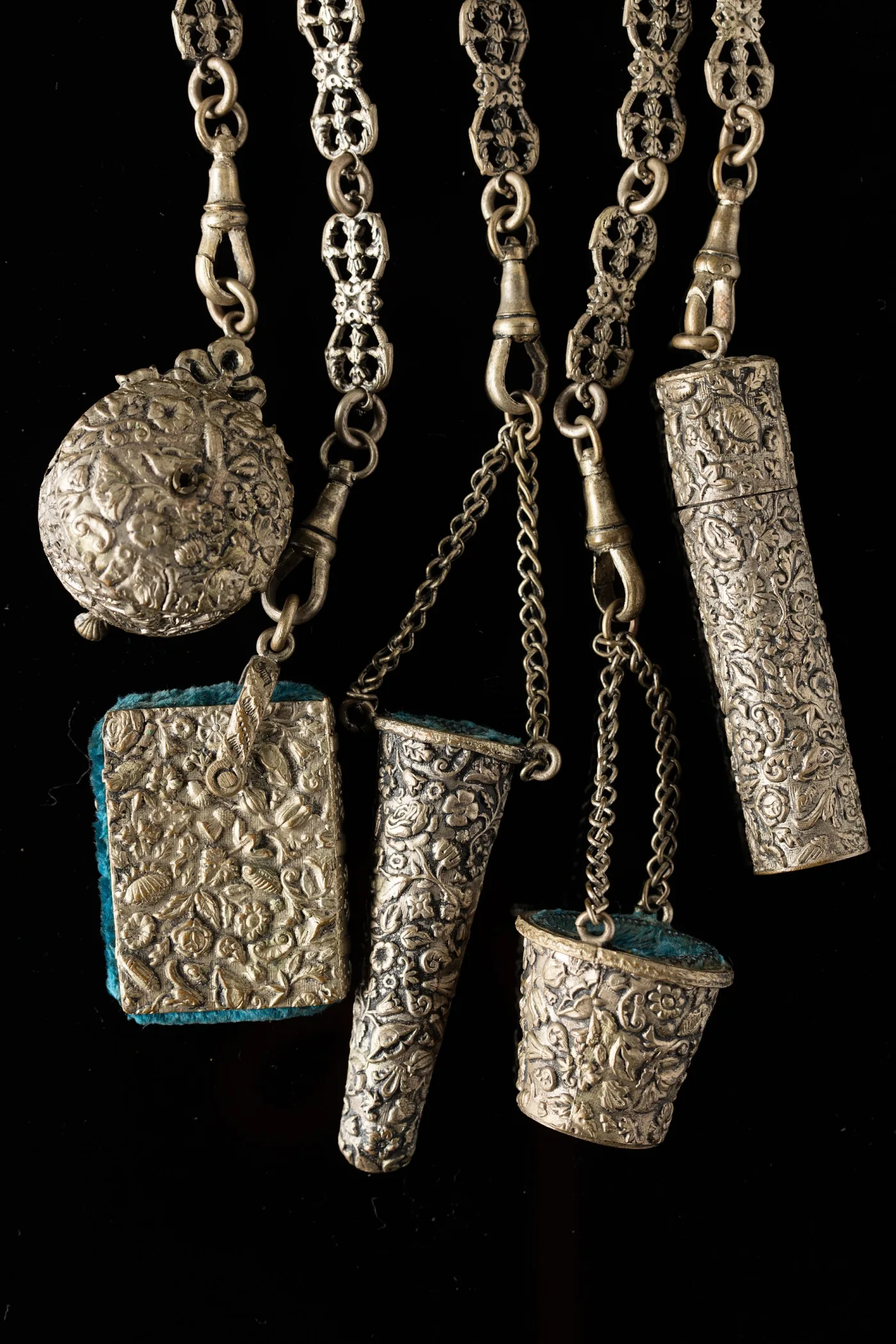
The attachments suspended from a chatelaine are central to its identity, function, and value. A full Victorian chatelaine might carry five to nine separate implements, each hanging from its own chain, and ladies' chains frequently included a small vesta case alongside the scissors, notebook, and thimble holder. Understanding these components helps collectors identify incomplete pieces and assess whether attachments are original to the chatelaine or later replacements.
Scissors
Small scissors are the most common chatelaine attachment. Victorian chatelaine scissors typically measure 3 to 4 inches in length and may have ornately shaped handles in the form of birds (particularly storks, a symbol of domestic happiness), flowers, or geometric patterns. The scissors hang from a ring or swivel attached to one handle bow. Fine examples have gilded or steel blades with decorative handles in silver, cut steel, or mother-of-pearl.
Thimble Holder
A thimble holder or thimble bucket is a small cup-shaped container designed to protect a thimble when not in use. These may be open-topped buckets, hinged boxes, or egg-shaped containers that open to reveal the thimble inside. The thimble holder often matches the decorative style of the chatelaine body. Some holders retain their original thimble, which adds to their value.
Needle Case
Needle cases attached to chatelaines are typically cylindrical or rectangular, with a hinged or screw-top lid. They may be decorated with engraving, filigree, or applied ornament. Some needle cases have a flannel-lined interior to prevent needles from rusting. Elaborately decorated silver or gold needle cases from the 18th century can be valuable items in their own right.
Pin Cushion
Chatelaine pin cushions come in a wonderful variety of shapes: acorns, strawberries, hearts, shoes, bellows, and simple discs or balls. The cushion is typically filled with sawdust, bran, or emery powder (which helps keep pins sharp). Original cushions may have deteriorated over time, and many surviving examples have replacement fabric covers. The metal fittings of the pin cushion should match the rest of the chatelaine.
Notebook and Pencil
A small aide-memoire or notebook with ivory, bone, or metal leaves was a common attachment for household chatelaines. These tiny books allowed the mistress of the house to jot down shopping lists, menu plans, or instructions for servants. The pencil, often a propelling pencil with a decorated barrel, typically clips to the side of the notebook or hangs from its own chain. Original notebooks with pencils intact are prized by collectors.
Vinaigrette
A vinaigrette is a small perforated box containing a sponge soaked in aromatic vinegar or smelling salts. Chatelaine vinaigrettes are typically made from silver and feature an inner pierced grille with decorative patterns. These functional accessories helped Victorian women deal with unpleasant smells in an era before modern sanitation. Vinaigrettes by notable makers such as Nathaniel Mills of Birmingham can be highly valuable.
Scent Bottle
Miniature perfume or scent bottles were attached to decorative chatelaines for personal fragrance. These may be made from glass with silver or gold mounts, or entirely from metal with a hinged stopper. Glass scent bottles on chatelaines are particularly vulnerable to damage, and intact examples are uncommon.
Keys
Keys remain one of the oldest and most traditional chatelaine attachments, connecting directly to the accessory's medieval origins. Chatelaine keys may be functional (opening specific locks in the household) or decorative (miniature keys symbolizing the wearer's domestic authority). Collectors interested in the history of keys and locks will find our guide to antique locks and keys a useful companion to this article.
Other Attachments
Additional attachments found on chatelaines include tape measures (often in decorated cases), button hooks, crochet hooks, seam rippers, watch keys, seal stamps, whistles (on nurse's chatelaines), and small purses or sovereign cases. The variety of possible attachments is enormous, and unusual or rare implements significantly increase a chatelaine's interest and value.
5. Key Makers and Manufacturers
Birmingham Makers
Birmingham was the undisputed capital of chatelaine production in the Victorian era. The city's long tradition of fine metalwork, combined with its efficient manufacturing infrastructure, made it the ideal center for producing chatelaines in large quantities without sacrificing quality. Key Birmingham makers include:
- Hilliard & Thomason - One of the most prolific Victorian chatelaine manufacturers, active from 1853. Their silver chatelaines are characterized by fine engraving and well-designed clip mechanisms. Look for their maker's mark "H&T" in a rectangular punch.
- Adie & Lovekin - Produced high-quality silver chatelaines and accessories from the 1870s onward. Their work often features elaborate pierced and engraved decoration.
- George Unite - A major Birmingham silversmith whose firm produced chatelaines alongside a wide range of small silver wares. Unite's chatelaines are well-made and frequently appear at auction.
- Samuel Pemberton - Active in the late 18th and early 19th centuries, Pemberton produced fine silver chatelaines and accessories during the transition from Georgian to Victorian styles.
Gorham Manufacturing Company
The American silver manufacturer Gorham, based in Providence, Rhode Island, produced chatelaines during the 1890s and early 1900s. Gorham chatelaines are typically made from sterling silver with Art Nouveau-influenced designs featuring flowing organic forms and sinuous curves. These American pieces are less common than English examples and are sought after by collectors of American silver.
Unger Brothers
Unger Brothers of Newark, New Jersey, produced distinctive Art Nouveau silver chatelaines and accessories from the 1890s through the early 1900s. Their work features bold, sculptural female figures and flowing hair motifs that epitomize the American Art Nouveau style. Unger Brothers pieces are highly collectible and command premium prices.
French Makers and Deposé
French chatelaines marked "Déposé" (meaning "registered" or "patented") indicate that the design was officially registered with French authorities. This mark appears on many fine 19th-century French chatelaines and accessories. French makers often produced chatelaines in silver, silver-gilt, or base metals with exceptional artistic quality. Parisian goldsmiths created some of the finest 18th-century examples, while later 19th-century French chatelaines often feature Renaissance Revival or neo-Gothic designs.
Other Notable Makers
Other makers whose chatelaines are collected include Sampson Mordan (known for propelling pencils and accessories), William Comyns (London silversmith producing Art Nouveau pieces), and various German and Austrian makers who produced ornate chatelaines in the Historicist style. Unmarked chatelaines can sometimes be attributed by style, construction techniques, or comparison with marked examples.

6. Dating Techniques
Using Hallmarks
For silver chatelaines bearing English hallmarks, dating is relatively straightforward. The date letter, assigned in a sequence that changes annually, identifies the exact year of assay. The assay office mark (an anchor for Birmingham, a leopard's head for London) confirms where the piece was tested. Combining these marks with the maker's mark provides a complete picture of origin and date. Continental and American silver marks follow different systems but can be equally informative.
Style and Design Clues
In the absence of hallmarks, stylistic analysis is essential for dating. Key style indicators include:
- Rococo (1730-1770): Asymmetrical scrollwork, shell motifs, pastoral scenes, chinoiserie elements.
- Neoclassical (1770-1810): Symmetrical designs, urn and swag motifs, classical figures, bright-cut engraving.
- Early Victorian (1837-1860): Naturalistic floral designs, scrolling foliage, Gothic Revival elements.
- High Victorian (1860-1890): Elaborate chased and engraved decoration, Renaissance Revival motifs, Japanese-influenced designs (Aesthetic Movement).
- Late Victorian/Art Nouveau (1890-1910): Flowing organic forms, whiplash curves, female figures with flowing hair, enamel decoration.
Construction Features
The way a chatelaine is constructed provides additional dating evidence. Hand-forged links, hand-cut engraving, and individually fitted components suggest earlier manufacture. Machine-made chains, die-stamped decoration, and standardized screw fittings point to later Victorian mass production. The type of clip mechanism also evolved over time, from simple hooks and pins to sprung catches and swivel-mounted bar clips.
Material Evidence
Certain materials are associated with specific periods. Pinchbeck was most common from about 1720 to 1840. Cut steel peaked in popularity from 1760 to 1860. Nickel silver (an alloy of copper, nickel, and zinc) was not widely used until the 1850s. Electroplating became commercially available in the 1840s. These material chronologies help establish date ranges for unmarked pieces.
7. Construction Methods
The Clip or Hook
The clip is the central element of any chatelaine, designed to attach the piece securely to a belt or waistband. Early chatelaines used simple hook-and-eye or pin fastenings. By the Victorian era, most chatelaines featured a sprung clip with a decorative front plate. The clip plate is often the most elaborately decorated part of the chatelaine, featuring cartouches, monograms, or figural scenes. High-quality clips have strong springs and positive locking mechanisms that prevent accidental detachment.
Chains and Links
The chains connecting attachments to the central clip vary widely in style and construction. Common types include trace chains (alternating long and short links), cable chains (uniform round links), fancy chains with elaborately shaped links, and flat articulated chains made from interlocking plates. The chain style should match across all attachments on a single chatelaine. Mismatched chains suggest replacement or assembly from parts of different chatelaines.
Swivels and Rings
Attachments connect to their chains through swivel hooks, split rings, or fixed rings. Swivel hooks allow attachments to rotate freely, preventing tangling. The quality and type of these connectors provide clues about the age and origin of the piece. Hand-forged swivels with visible file marks indicate earlier or higher-quality manufacture.
Decorative Techniques
Chatelaines display a wide range of decorative metalworking techniques. Engraving involves cutting lines into the metal surface with a burin. Chasing uses punches to create relief decoration by pushing the metal from the front. Repoussé works the metal from the back to create raised designs. Piercing removes sections of metal to create openwork patterns. Stamping or die-pressing uses hardened steel dies to impress patterns into sheet metal. The quality and type of decoration are key indicators of age, origin, and value. Similar techniques are discussed in our guide to antique brooches identification, which covers related metalworking traditions.
8. Identifying Marks and Hallmarks
English Silver Hallmarks
English silver chatelaines are subject to the hallmarking system administered by assay offices. A fully hallmarked chatelaine will bear four marks: the maker's mark (initials or symbol), the standard mark (a lion passant for sterling silver), the assay office mark, and the date letter. On chatelaines, hallmarks are typically found on the clip plate, on each chain section, and sometimes on individual attachments. Not all parts of a chatelaine may be hallmarked, particularly very small components.
Continental Marks
French silver is marked with a variety of stamps depending on the period, including the boar's head (for small silver items), the Minerva head (for larger items after 1838), and various other control marks. German and Austrian silver typically bears a fineness mark (e.g., "800" or "900") rather than the complex assay system used in England and France. Dutch, Scandinavian, and other continental marks follow their own systems.
American Marks
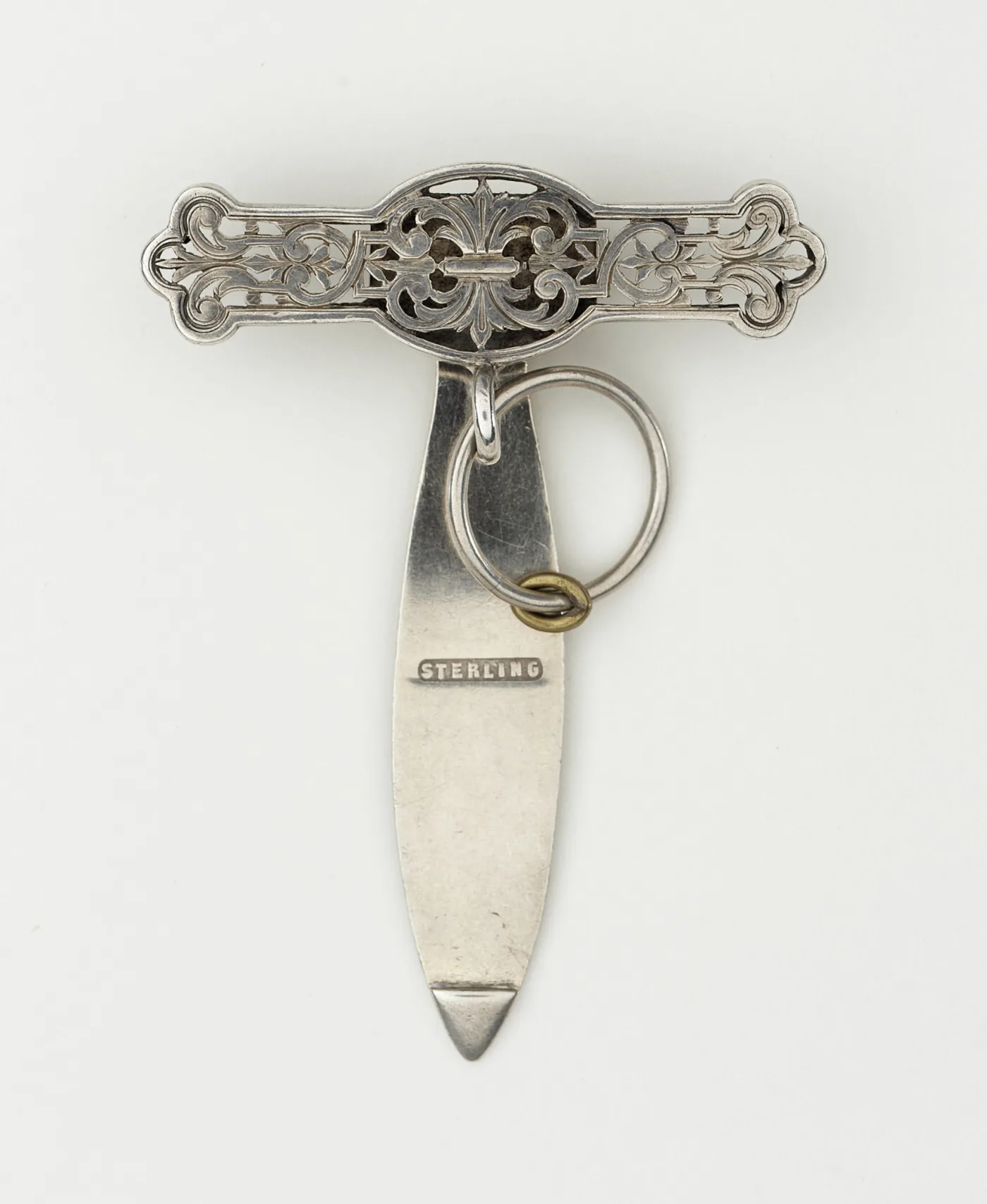
American silver chatelaines are typically marked "STERLING" or with the manufacturer's name and/or trademark. Gorham pieces bear the company's anchor and lion trademark along with "STERLING" and a date code. Unger Brothers pieces are marked "UB" in a diamond or circle along with "STERLING" and often "925 FINE."
Reading and Interpreting Marks
Hallmarks on chatelaines can be difficult to read because they are often struck on small, curved surfaces. A good magnifying glass (10x or higher) is essential for examination. Reference books on silver hallmarks, such as Jackson's English Goldsmiths and Their Marks, are invaluable for identifying maker's marks and date letters. Online hallmark databases can also assist with identification, though they should be cross-referenced with published sources.
9. Silver Chatelaines in Detail
Georgian Silver Chatelaines (1714-1837)
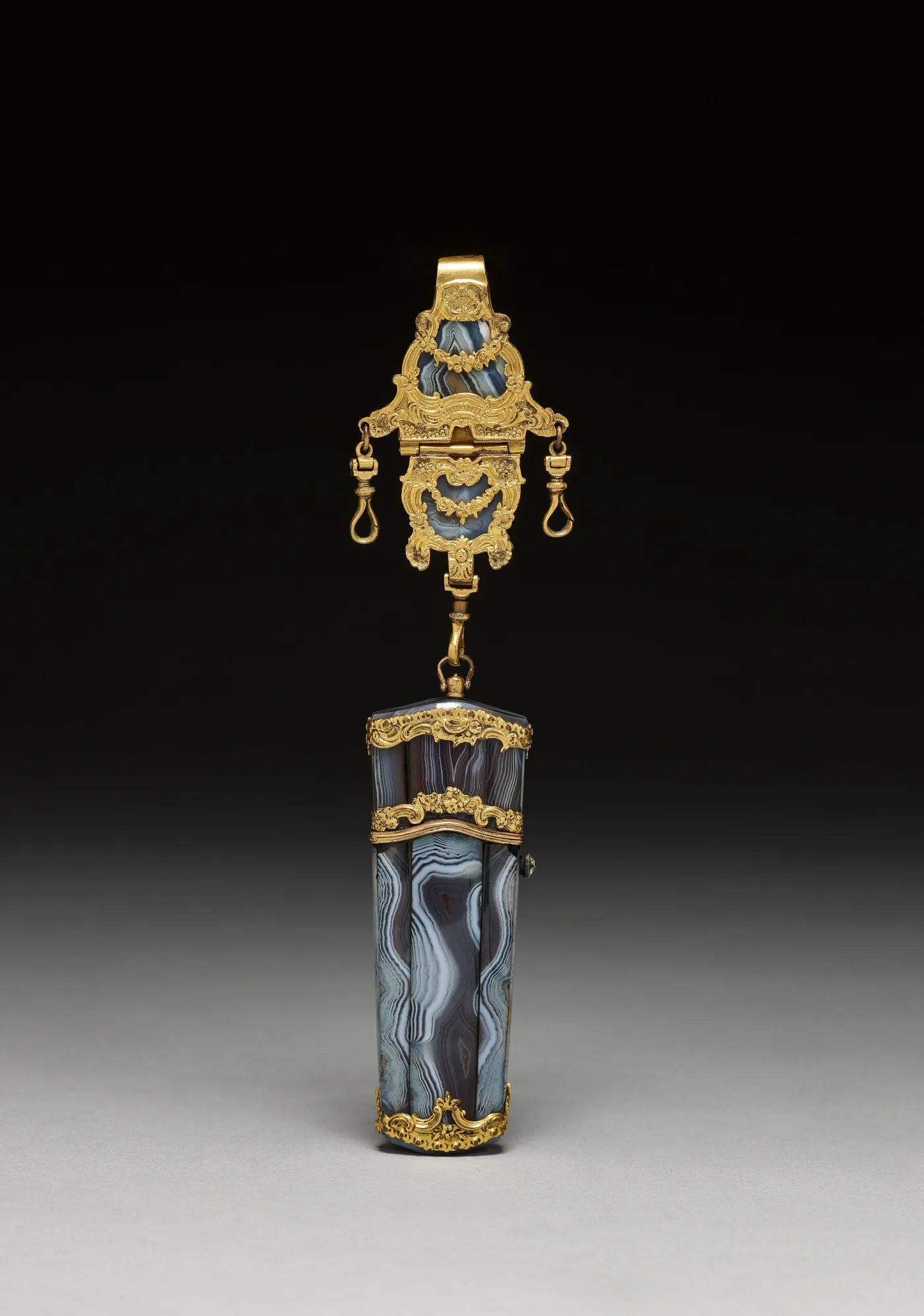
Georgian silver chatelaines are relatively rare and highly prized. Earlier examples from the reigns of George I and George II tend to be substantial pieces with cast and chased decoration in the Baroque or Rococo style. Later Georgian pieces from the neoclassical period feature bright-cut engraving, beaded borders, and classical motifs such as urns, swags, and husks. Georgian chatelaines often carry etui cases rather than individual loose implements.
Victorian Silver Chatelaines (1837-1901)
The vast majority of silver chatelaines on the market date from the Victorian era. Early Victorian pieces (1837-1860) are uncommon, as chatelaines were not highly fashionable during this period. The chatelaine revival of the 1860s and 1870s produced pieces with elaborate Renaissance Revival and Gothic Revival decoration. The most prolific production period was 1880-1900, when Birmingham makers mass-produced silver chatelaines in standardized patterns featuring scrollwork, flowers, and figural scenes.
Art Nouveau Silver Chatelaines
Art Nouveau chatelaines from the 1890s and 1900s feature the sinuous, organic forms characteristic of the style. English Art Nouveau chatelaines by makers such as William Comyns and Liberty & Co. tend toward restrained, linear interpretations of the style. American Art Nouveau pieces by Gorham and Unger Brothers are often bolder, with sculptural female figures and elaborate hair motifs. Continental Art Nouveau chatelaines by makers in France, Belgium, and Germany can be extremely elaborate, with enamel and semi-precious stone decoration.
10. Cut Steel Chatelaines
What Is Cut Steel?
Cut steel is a decorative technique in which small, carefully shaped steel studs are individually riveted to a metal base plate. Each stud is faceted like a gemstone, typically with between five and fifteen facets, so that it catches and reflects light. The effect is dazzling, resembling a surface encrusted with tiny diamonds. Cut steel was developed in England in the early 18th century and became a fashionable alternative to expensive jewels and precious metals.
Centers of Production
Woodstock in Oxfordshire was the original center of cut steel production, but by the late 18th century, Birmingham had taken over as the dominant manufacturing hub. Matthew Boulton's Soho factory produced some of the finest cut steel items ever made, including chatelaines, buckles, and jewelry. French cut steel was also highly regarded, particularly pieces from the workshops around Paris. The technique spread to other European countries, but English and French examples are considered the finest.
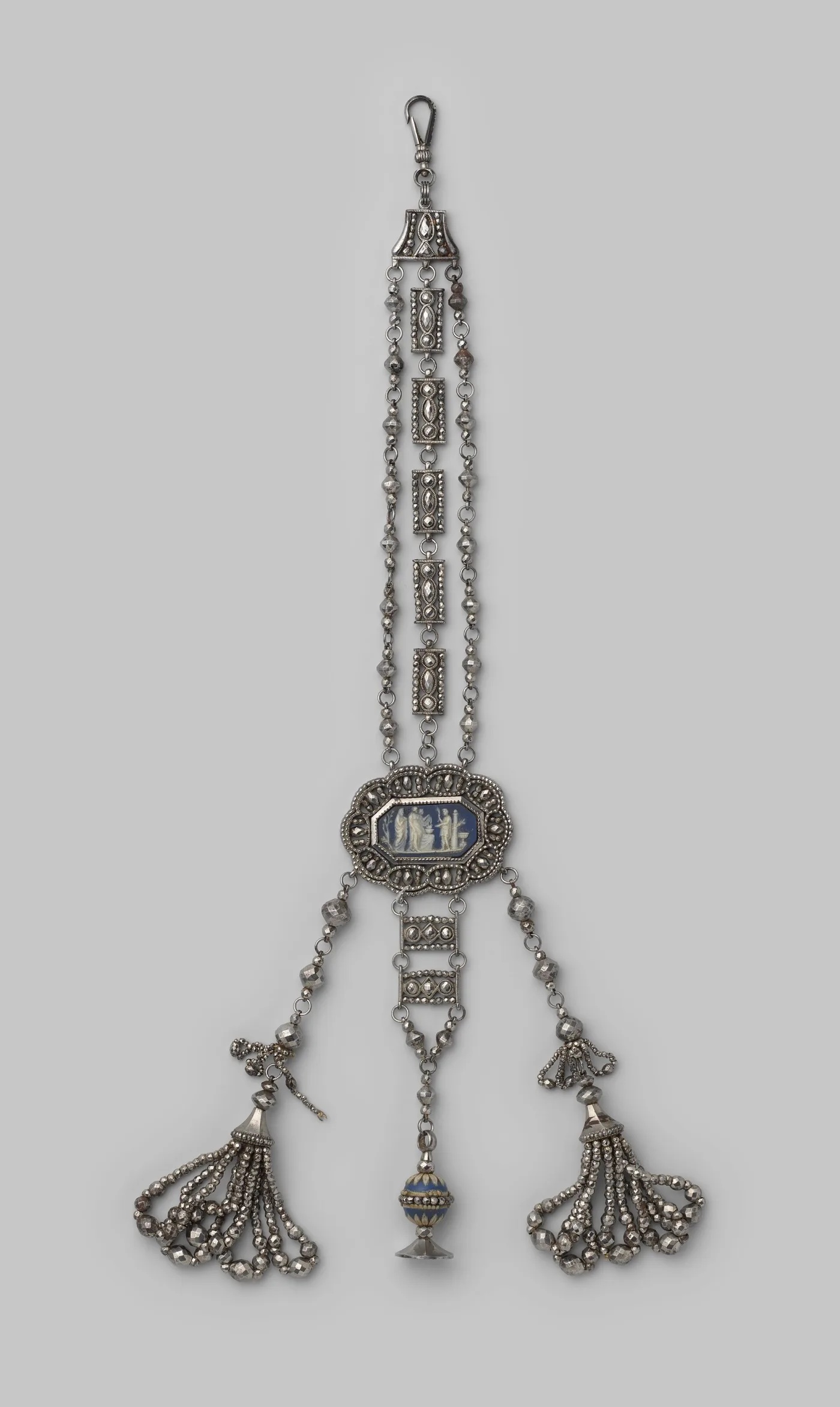
Identifying Cut Steel
Genuine cut steel can be distinguished from marcasite by examining how the studs are attached. Cut steel studs are individually riveted through the base plate, with the rivet heads visible on the reverse. Marcasite stones are set into metal mounts or bezels, like gemstones. Cut steel studs are made from polished steel and have a bright, silvery sparkle, while marcasite (iron pyrite) has a slightly warmer, more golden tone. The number and precision of the facets indicate quality, with finer pieces having more numerous and more precisely cut facets.
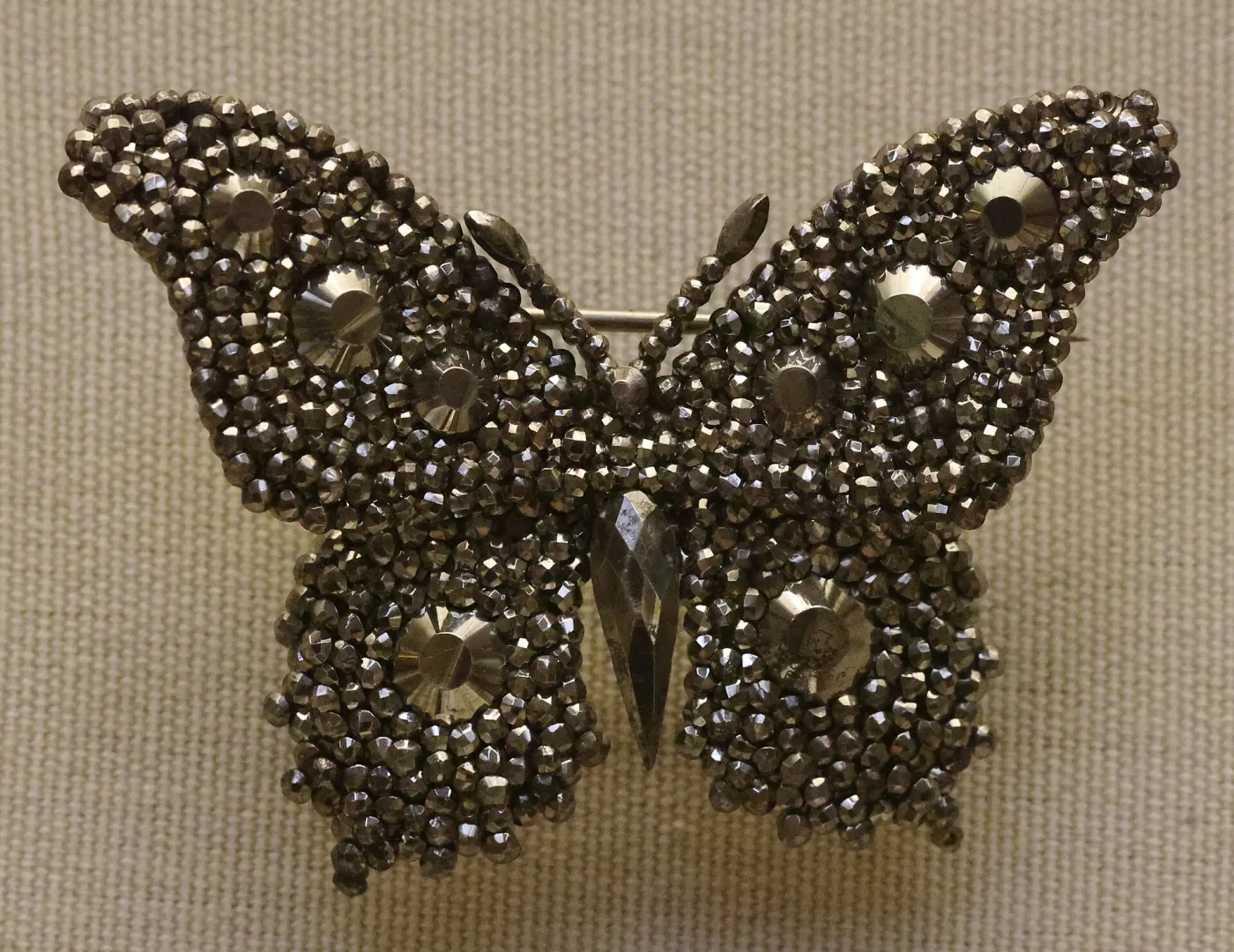
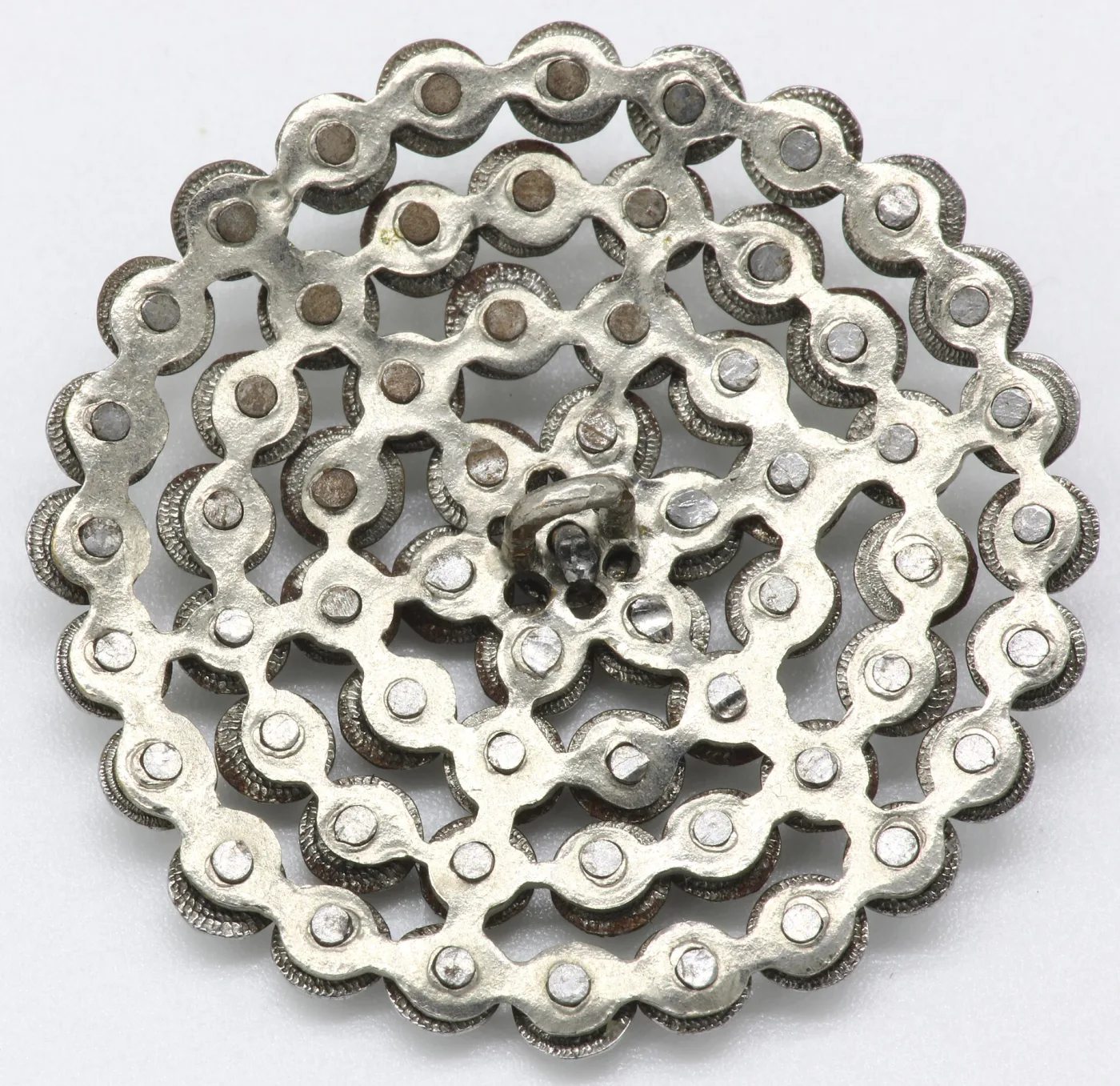
Neither of these is a chatelaine — the first is a cut steel hair ornament and the second the reverse of a cut steel button — but between them they show the single test that separates cut steel from marcasite, and it reads identically on a chatelaine plate. From the front the studs are faceted like miniature stones and throw a hard, colourless sparkle. From the back every one of them is a rivet, pushed through the pierced plate and burred over, which is why a cut steel piece has an openwork reverse studded with metal heads. Marcasite sits in a bezel or a cut-down mount and leaves no rivet at all. Turn the piece over and the question answers itself; if the back is solid and smooth, you are not looking at cut steel.
Condition Concerns
Cut steel is vulnerable to rust if exposed to moisture. Once rusting begins, it can quickly spread across the surface, permanently damaging the appearance. Many surviving cut steel chatelaines show some degree of surface rust or darkening. Pieces in bright, rust-free condition are significantly more valuable. Cut steel should never be washed with water; instead, clean it with a dry, soft brush and store it in a dry environment with silica gel packets to absorb moisture.
11. Gold and Pinchbeck Chatelaines
18th-Century Gold Chatelaines
Gold chatelaines from the 18th century are among the most valuable examples in the field. These pieces were made for aristocratic and royal clients by the finest goldsmiths of Paris, London, and other European capitals. Decoration may include engraved and chased ornament, multicolored gold (achieved by varying the alloy composition), enamel painting, and gem-set panels. Complete 18th-century gold chatelaines in good condition can sell for tens of thousands of dollars at major auction houses.
Understanding Pinchbeck
Christopher Pinchbeck (c.1670-1732) developed an alloy of approximately 83% copper and 17% zinc that closely resembled gold in color and luster. True pinchbeck was used extensively for watch cases, chatelaines, and jewelry from about 1720 to 1840. After Pinchbeck's death, other makers continued using similar alloys, and the term "pinchbeck" became a generic description for any gold-colored base metal alloy. Genuine early pinchbeck can be quite valuable, particularly when the workmanship is exceptional.
Distinguishing Gold from Pinchbeck
Differentiating gold from pinchbeck requires careful examination. Gold pieces should bear appropriate hallmarks or assay marks. Pinchbeck is slightly lighter in color than high-carat gold and may show a greenish tinge in areas of wear. A jeweler's acid test can confirm the metal, but this should only be performed on inconspicuous areas to avoid damage. Weight is another indicator: gold is significantly denser than pinchbeck, so a gold chatelaine will feel noticeably heavier than a similarly sized pinchbeck example.
12. Reproductions vs. Originals
Common Reproduction Types
Several types of reproduction and fake chatelaines circulate in the market. Modern reproductions, often made in India or Southeast Asia, tend to be cast from base metals with crude decoration and lack hallmarks. "Married" chatelaines are assembled from parts of different original pieces, combining a clip from one chatelaine with chains and attachments from others. Some genuinely old chatelaine clips have had modern chains and attachments added to create a more "complete" and therefore more valuable-looking piece.
How to Spot Reproductions
Key indicators of reproduction or assembled pieces include:
- Mismatched styles: Attachments that do not share a consistent decorative vocabulary with the clip plate.
- Inconsistent wear: A heavily worn clip with pristine attachments, or vice versa, suggests assembly from different sources.
- Wrong hallmarks: Hallmarks on attachments that differ in date or maker from the clip, or marks in unusual locations.
- Poor casting quality: Soft, rounded details that lack crispness, suggesting cast reproductions rather than original die-stamped or hand-worked pieces.
- Modern materials: Stainless steel (not used before the 20th century), modern solder compositions, or synthetic fabric in pin cushions.
- Uniform artificial aging: A dark, even patina that does not correspond to the natural wear patterns seen on genuine antiques.
Authentication Tips
When evaluating a chatelaine for authenticity, examine each component individually and then as a set. All parts should show consistent age-related wear, including thinning at chain links, smoothing of sharp edges, and natural patina accumulation in crevices. Hallmarks should be clear and properly struck, in locations consistent with period practice. If possible, compare the piece with published examples in reference books or museum collections. When in doubt, consult a specialist dealer or auctioneer who handles antique chatelaines regularly. Our antique sewing collectibles guide also discusses authentication techniques for related Victorian accessories.
13. Condition Assessment
Structural Integrity
Begin by assessing the structural condition of the chatelaine. The clip mechanism should function properly, opening and closing with a firm spring action. Chains should be intact with no broken or replaced links. Swivel hooks and rings should move freely without excessive looseness. Check each attachment point for stress fractures or repairs, particularly where chains connect to the clip plate.
Surface Condition
Evaluate the surface of the chatelaine for damage, wear, and repairs. Desirable features include original patina, crisp engraved or chased decoration, and smooth, polished surfaces. Undesirable conditions include deep scratches, dents, excessive polishing that has worn away detail, removed monograms (visible as flat, smooth areas where engraving has been buffed away), and solder repairs. Some surface wear is expected and even desirable as evidence of authentic age and use.
Completeness
The completeness of a chatelaine significantly affects its value. A chatelaine with all original matching attachments is worth considerably more than a clip alone or a piece with missing or replaced components. Examine each attachment to confirm it matches the style, material, and period of the clip. Check for empty chain ends that suggest missing attachments. Count the attachment loops on the clip and compare with the number of surviving chains.
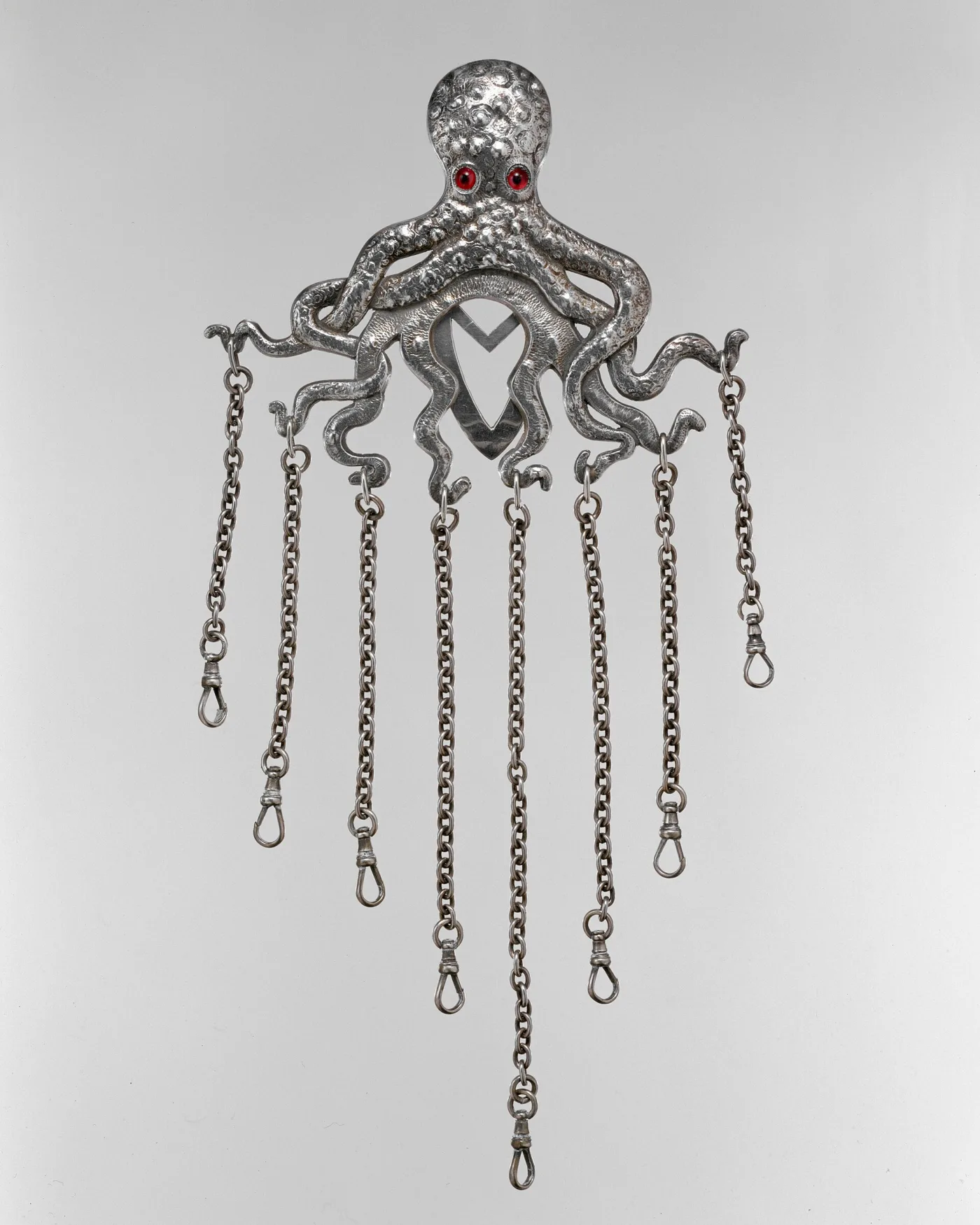
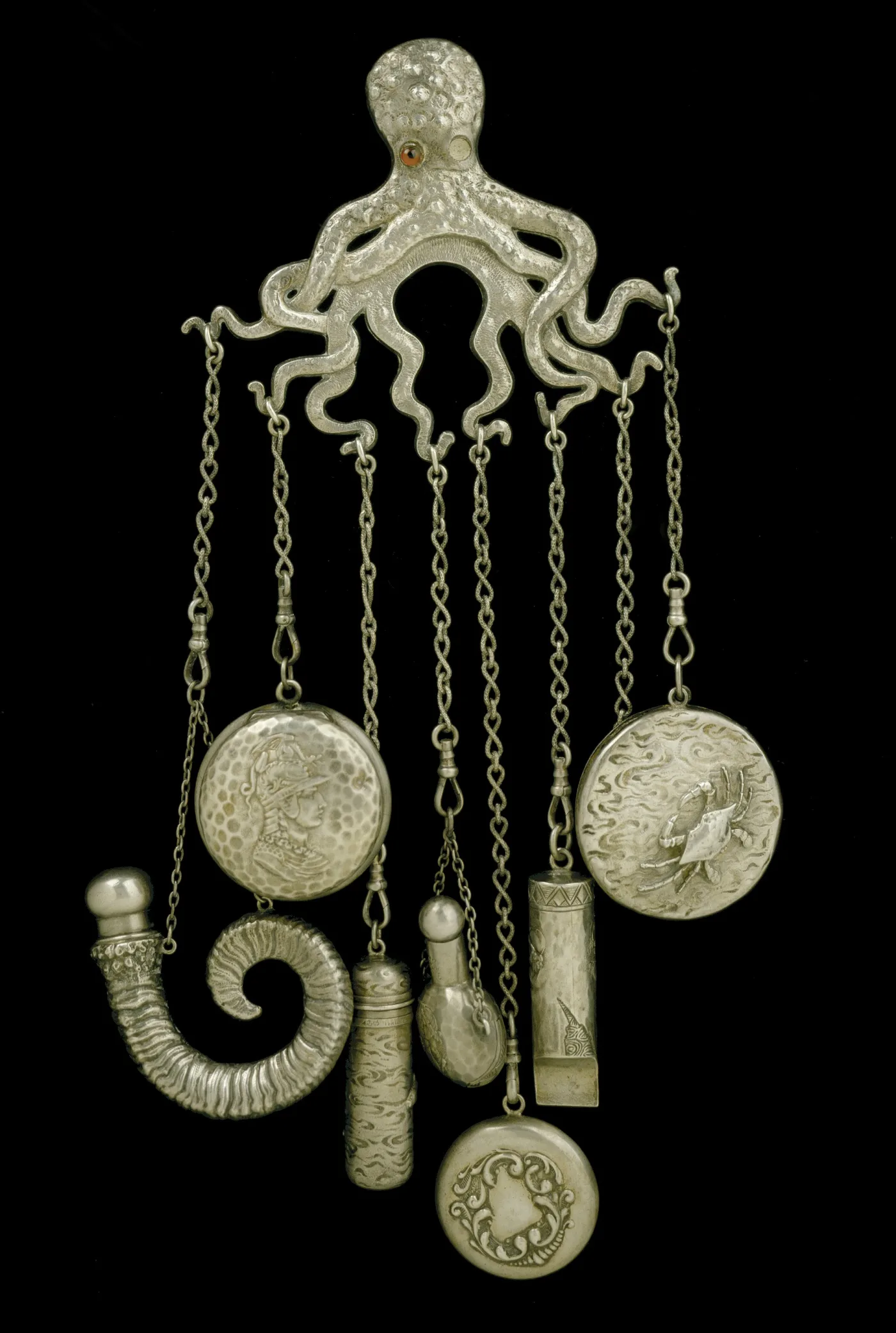
These are two surviving examples of one Gorham design of 1887, the first in the Metropolitan Museum of Art and the second in the Missouri History Museum. Structurally the first has lost nothing at all: the cast clip is sound, all eight chains hang straight, every swivel is present and works. What it has lost is the entire reason the chains exist. That gap is what completeness actually measures, and it is why a chatelaine can look untouched and still be a fragment. Count the swivels before you count the implements, and treat any difference as a loss rather than as the way the piece was made — a maker who cast eight tentacles and hung a chain from every one of them did not intend any of them to end in air.
Condition Grading
While there is no universally accepted condition grading system for chatelaines, dealers and auction houses typically use terms such as:
- Excellent: Complete with all original attachments, minimal wear, functioning clip, crisp decoration.
- Good: Complete or nearly complete, moderate wear consistent with age, functioning clip, minor surface issues.
- Fair: Some missing attachments, significant wear or surface damage, clip may need repair, decoration worn.
- Poor: Major missing components, structural damage, heavy wear, non-functioning clip.
14. Collector Tips and Buying Guide
Where to Find Chatelaines
Antique chatelaines appear at specialist silver and jewelry auctions, antique fairs, estate sales, and through specialist dealers. Major auction houses such as Christie's, Sotheby's, and Bonhams occasionally feature exceptional examples in their silver and jewelry sales. Online platforms including eBay, Ruby Lane, and specialist dealer websites offer a wider selection, though careful authentication is essential when buying online.
What to Look For
When building a chatelaine collection, prioritize the following:
- Completeness: A complete chatelaine with all original matching attachments is always more desirable than a partial set.
- Maker: Pieces by known makers with clear hallmarks command premium prices and are easier to research and authenticate.
- Condition: Good structural condition and crisp decoration are more important than perfect surface polish.
- Rarity: Unusual types (nurse's chatelaines, watch chatelaines, elaborate presentation pieces) attract specialist collectors.
- Provenance: Documented history of ownership adds value and interest.
Building a Collection
New collectors are advised to start with Victorian silver sewing chatelaines, which are the most readily available type and offer excellent examples of Victorian craftsmanship at accessible prices. As experience and knowledge grow, collectors can branch into rarer categories such as 18th-century gold or pinchbeck examples, cut steel pieces, or specialist types like nurse's chatelaines. Joining collector organizations and attending specialist fairs provides networking opportunities and access to dealer expertise.
Investment Considerations
The market for antique chatelaines has been steadily growing, driven by increased interest in Victorian decorative arts and a finite supply of genuine examples. Complete, well-documented pieces by major makers in good condition have shown consistent appreciation over the past twenty years. However, as with all antique collecting, pieces should be bought primarily for enjoyment and historical interest rather than as purely financial investments.
15. Care and Preservation
Storage
Store chatelaines in a dry environment with stable temperature and humidity. Wrap silver pieces in acid-free tissue paper or tarnish-resistant cloth to slow tarnishing. Cut steel pieces require especially dry conditions to prevent rust; store them with silica gel packets and check regularly for signs of surface corrosion. Hang chatelaines on padded hooks or lay them flat in lined drawers rather than folding chains, which can stress links over time.
Cleaning Silver
Clean silver chatelaines gently with a proprietary silver polish applied with a soft cloth. Avoid abrasive polishes or vigorous rubbing, which can remove fine engraved or chased detail. Use a soft toothbrush to reach crevices and chain links. Rinse thoroughly to remove all polish residue and dry completely. Do not use silver dip solutions on chatelaines with non-silver components, as the chemicals may damage other materials.
Cleaning Other Materials
Cut steel should be cleaned only with a dry, soft brush. Never use water or liquid cleaners on cut steel, as moisture promotes rust. Gold and pinchbeck can be gently cleaned with a soft, slightly damp cloth. Base metal and plated pieces should be cleaned with care to avoid removing remaining plating. Fabric components such as pin cushions should not be washed; brush them gently to remove dust.
Repair and Restoration
Repairs to antique chatelaines should be undertaken by experienced silversmiths or conservation specialists. Common repairs include replacing broken chain links, repairing clip springs, re-attaching loose swivels, and stabilizing damaged engraving. Avoid over-restoration, which can diminish the character and authenticity of the piece. Always document any repairs made to a chatelaine, as this information is relevant to its history and value.
16. Values and the Current Market
Price Ranges
The value of antique chatelaines varies enormously depending on material, maker, age, condition, and completeness. As a general guide:
- Base metal Victorian household chatelaines: $50-$300, depending on completeness and condition.
- Victorian silver sewing chatelaines (incomplete): $200-$800, depending on maker and surviving attachments.
- Victorian silver sewing chatelaines (complete): $800-$3,000, depending on maker, condition, and quality of decoration.
- Cut steel chatelaines: $300-$2,000, depending on quality of steelwork and condition (rust-free examples command premium prices).
- Nurse's chatelaines: $100-$500, depending on completeness and material.
- Art Nouveau silver chatelaines (Gorham, Unger Brothers): $1,000-$5,000 or more for exceptional examples.
- 18th-century gold chatelaines: $5,000-$50,000 or more, depending on quality, provenance, and condition.
- 18th-century pinchbeck chatelaines: $500-$5,000, depending on quality and completeness.
Auction Trends
The auction market for chatelaines has strengthened over the past decade. Notable sales have included 18th-century gold and enamel examples exceeding $30,000 and rare complete Victorian silver sets achieving $3,000-$5,000. The strongest demand is for complete, well-documented pieces by recognized makers. Single attachments and incomplete chatelaines attract less competitive bidding but can represent good buying opportunities for collectors willing to assemble sets over time.
Factors Affecting Value
The key factors that determine the market value of a chatelaine are, in approximate order of importance: completeness (all original matching attachments), maker and hallmarks (known makers command premiums), condition (structural integrity and surface quality), material (gold and fine silver outperform base metals), rarity (unusual types or designs), age (earlier pieces are generally more valuable), and provenance (documented history of ownership). The decorative quality and artistic merit of the piece also play a significant role, particularly for exceptional examples that transcend their category.
The Future Market
Interest in chatelaines continues to grow among collectors of Victorian decorative arts, antique silver, and women's history artifacts. Museum exhibitions featuring chatelaines have raised public awareness, and scholarly publications have deepened understanding of these objects. As the supply of genuine antique chatelaines is finite and unlikely to increase, well-chosen pieces should continue to hold and appreciate in value over time.