Antique Teddy Bears Identification Guide: Steiff, Bing, Schuco, and American Bears
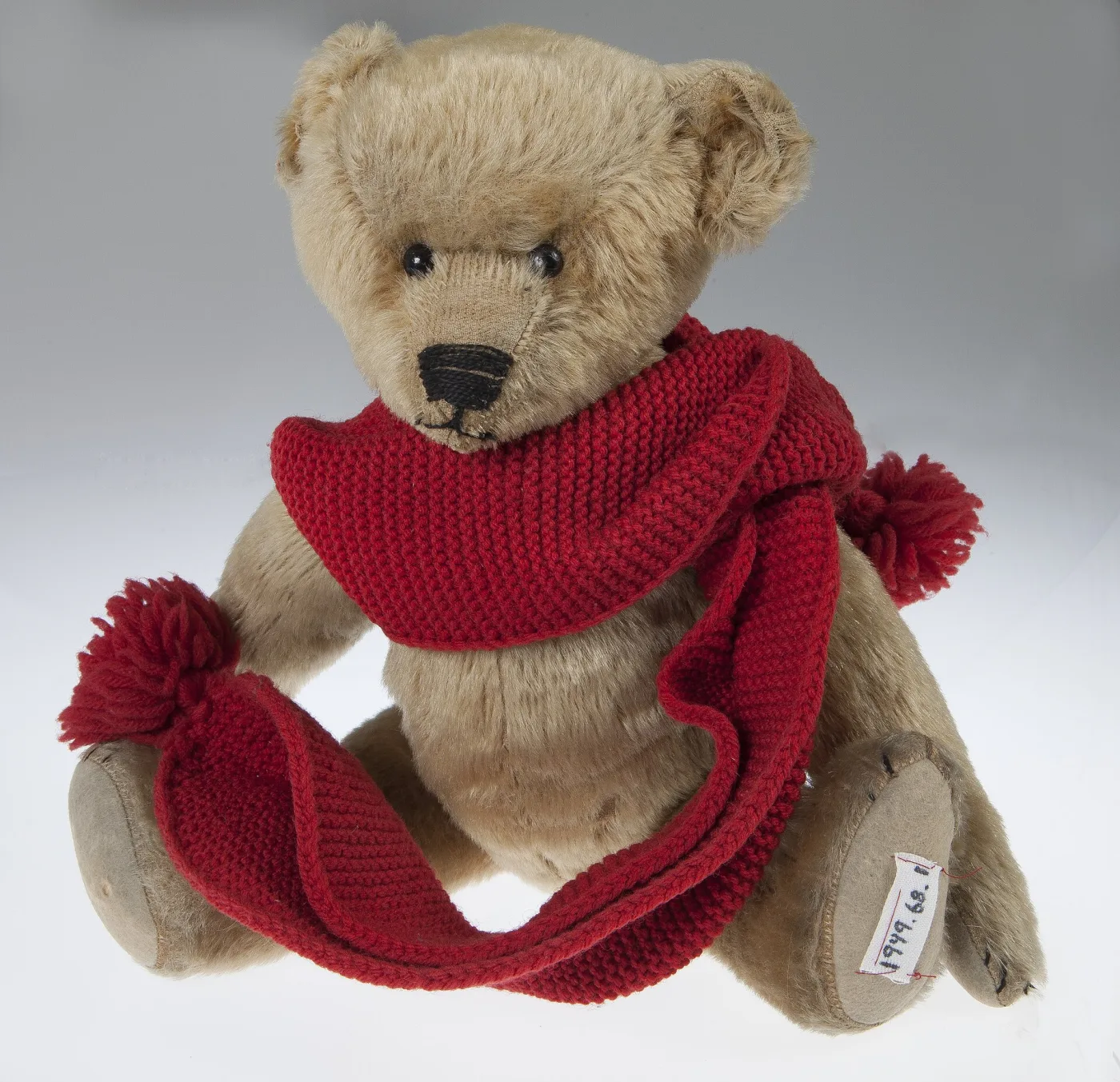
The teddy bear is barely older than the twentieth century, but in that short span it has become one of the most actively collected categories of antique toy on the international market. The form was born more or less simultaneously in Giengen, Germany and Brooklyn, New York in 1902 and 1903 — Margarete Steiff's nephew Richard designed a jointed plush bear marketed as "Bear 55 PB," and Morris and Rose Michtom of Brooklyn produced a stuffed bear inspired by a Washington Post cartoon of President Theodore Roosevelt refusing to shoot a bear cub. The Michtom bear gave the toy its name; the Steiff bear gave it its definitive form. Within five years a worldwide industry had emerged, and the surviving early bears now command four-, five-, and occasionally six-figure prices at specialist auction.
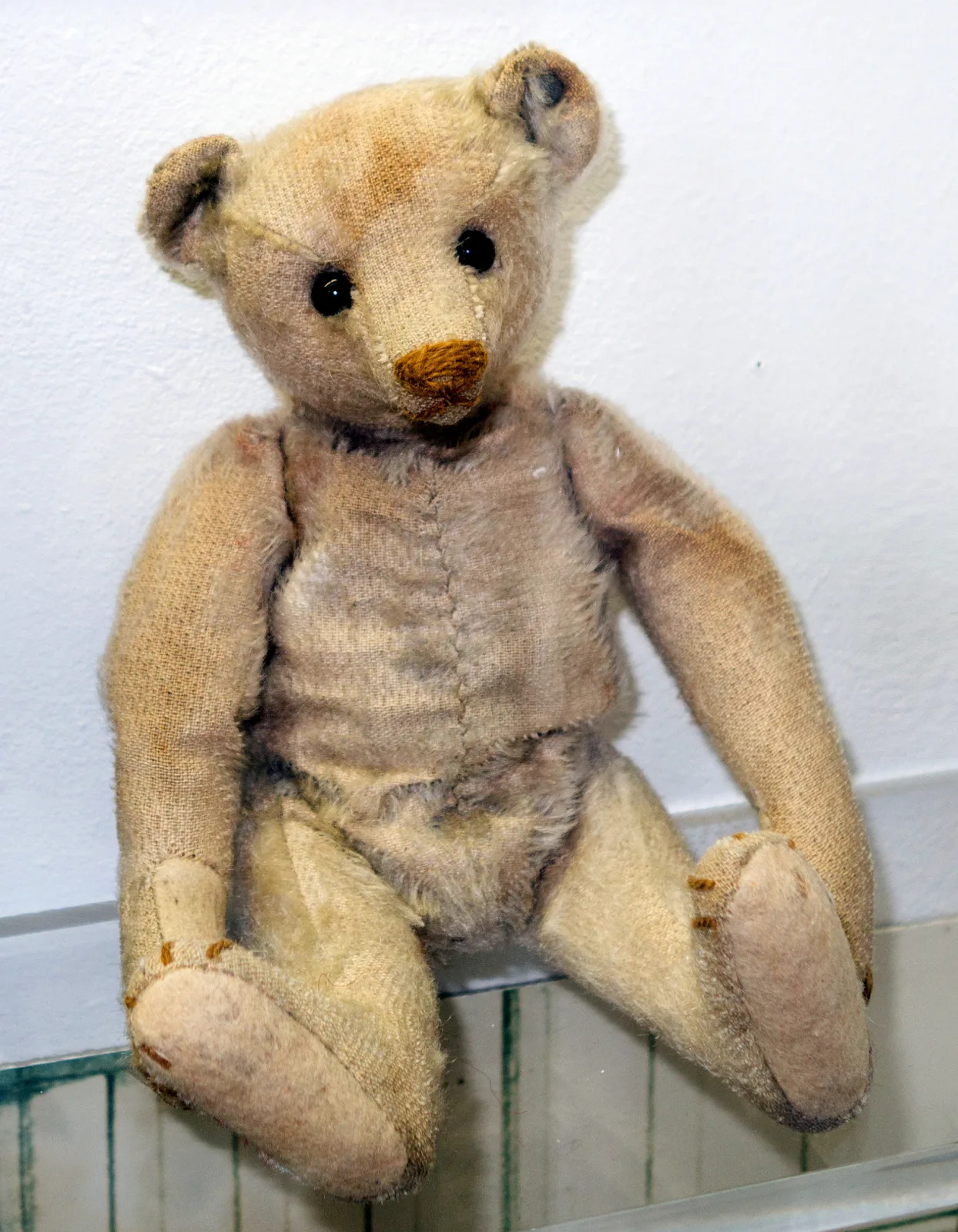
Identifying an antique teddy bear means moving carefully through a checklist of physical features. What is the bear made of — mohair, alpaca, silk plush, synthetic plush? What are the eyes — shoe buttons, glass on wire, plastic? Are the limbs jointed, and how — disc-and-cotter-pin or simpler? What is the stuffing — wood-wool excelsior, kapok, cotton, foam? What is the shape of the muzzle, the position of the hump, the length of the arms? Are there labels, buttons, tags, or stitched marks? Each feature locates the bear within a maker, country, and roughly twenty-year window. Get the combination right and a $50 attic find can be a $5,000 Steiff; get it wrong and a 1980s reproduction can be mistaken for a Roosevelt-era heirloom.
This guide covers the origin and early history of the teddy bear, the dominant German makers (Steiff, Bing, Schuco, Hermann), the major American makers (Ideal, Knickerbocker, Gund, Bruin), the British makers (Chad Valley, Merrythought, Chiltern, Dean's, J. K. Farnell), the materials and stitching diagnostics that date a bear within a decade, the famous reproductions and outright fakes, condition assessment, and a working valuation framework. By the end you should be able to look at any pre-1960 plush bear and place it within a country, a maker (or short list), and a defensible value range.
Table of Contents
- A Short History of the Teddy Bear
- Anatomy of an Antique Bear
- Plush, Stuffing, and Construction
- Eyes: Shoe Buttons, Glass, and Plastic
- Jointing Systems
- Steiff: The Definitive Maker
- Bing, Schuco, and Hermann
- American Makers: Ideal, Knickerbocker, Gund
- British Makers: Chad Valley, Merrythought, Chiltern
- Dating by Construction Era
- Labels, Buttons, and Tags
- Reproductions, Replicas, and Fakes
- Condition Assessment
- What Drives Value
- Care and Conservation
- Common Beginner Mistakes
- Frequently Asked Questions
A Short History of the Teddy Bear
Two near-simultaneous inventions in late 1902 and 1903 created the teddy bear. In Giengen an der Brenz, in southwestern Germany, the Steiff felt-toy company — founded by the wheelchair-using seamstress Margarete Steiff in 1880 — produced a prototype jointed plush bear, designed by Margarete's nephew Richard Steiff after observing brown bears at the Stuttgart zoo. The bear, designated "Bear 55 PB" (PB for "plush, bewegliche" — moveable), was shown at the 1903 Leipzig Toy Fair, where after a slow start it was reputedly ordered in batches of three thousand by an American buyer. Within two years Steiff was producing nearly a million bears a year.
Almost simultaneously, in Brooklyn, the Russian-immigrant candy-shop owners Morris and Rose Michtom were inspired by a November 1902 Clifford Berryman cartoon in the Washington Post depicting President Theodore Roosevelt refusing to shoot a captured bear cub during a Mississippi hunt. Rose Michtom sewed a small plush bear and labeled it "Teddy's bear" in the shop window. Demand was such that the Michtoms founded the Ideal Novelty and Toy Company on the strength of teddy-bear sales. The German "Steiff bear" and the American "teddy bear" converged into a single international craze by 1906–1908.
The Golden Age (1903–1920)
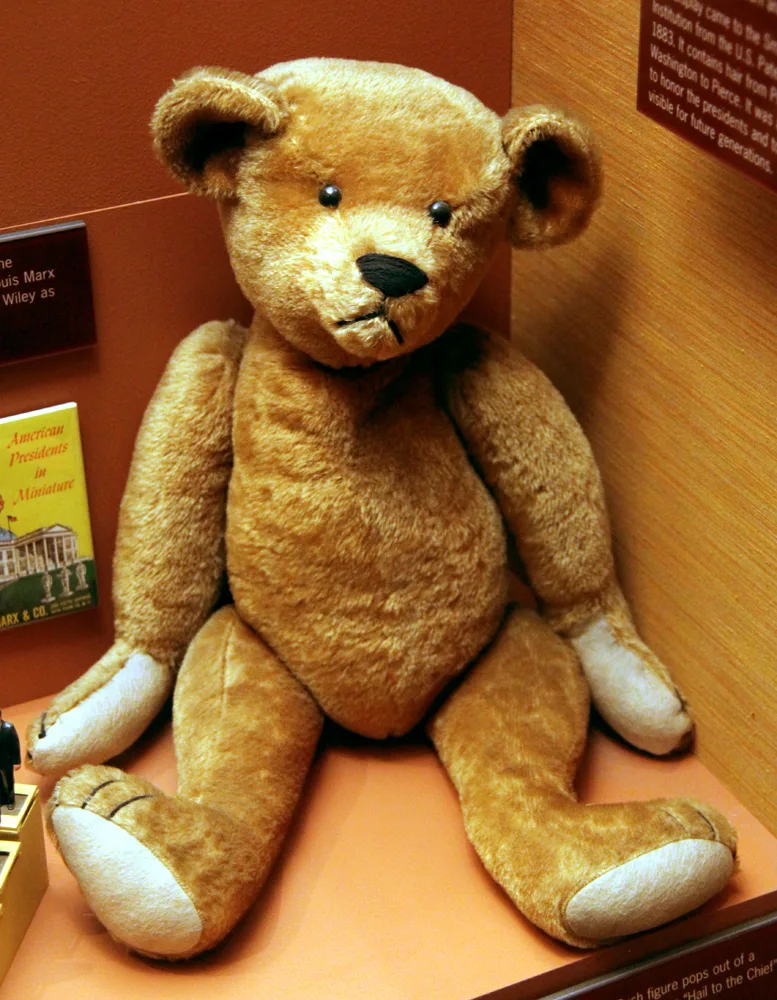
The fifteen years between the bear's invention and the post-war collapse of the German plush trade are the "golden age" of teddy bear collecting. Bears from this period are heavily jointed, stuffed with wood-wool excelsior, eyed with black wooden shoe buttons, and clothed in long-pile mohair plush in cinnamon, gold, white, or rare apricot, black, and dual-toned colors. Steiff dominates, with Bing and several smaller German makers in second tier; American makers proliferate with shorter-muzzled, lighter-bodied bears; British makers (J. K. Farnell from 1908, Chad Valley from 1915) emerge to fill demand cut off by World War I import restrictions.
Interwar Era (1920–1939)
The classic Steiff and Bing forms continue but with shorter limbs, smaller humps, more rounded heads, and increasingly glass rather than shoe-button eyes. Kapok stuffing replaces or supplements excelsior in many makers' bears, producing a softer, lighter feel. American bears become softer, more "cuddle-toy" in proportion. Chiltern and Merrythought emerge in Britain. Schuco introduces miniature wind-up bears and novelty "yes-no" bears with tail-actuated head movement.
Post-War Period (1945–1960)
Plush quality declines as wartime austerity continues into peacetime; many bears from this period use synthetic plush or short-pile mohair. Joints simplify or disappear; safety regulations gradually replace shoe-button eyes with safer plastic. The same postwar shift toward cheaper materials reshaped every nursery toy, including the carved antique rocking horses that gave way to pressed steel and spring-mounted models. Surviving examples are still collected, but the romance of the early hand-jointed mohair bear is largely gone.
Anatomy of an Antique Bear
Collectors describe bears using a vocabulary borrowed from doll collecting and adapted to plush. Knowing the terms accelerates auction reading and helps distinguish maker styles.
Hump
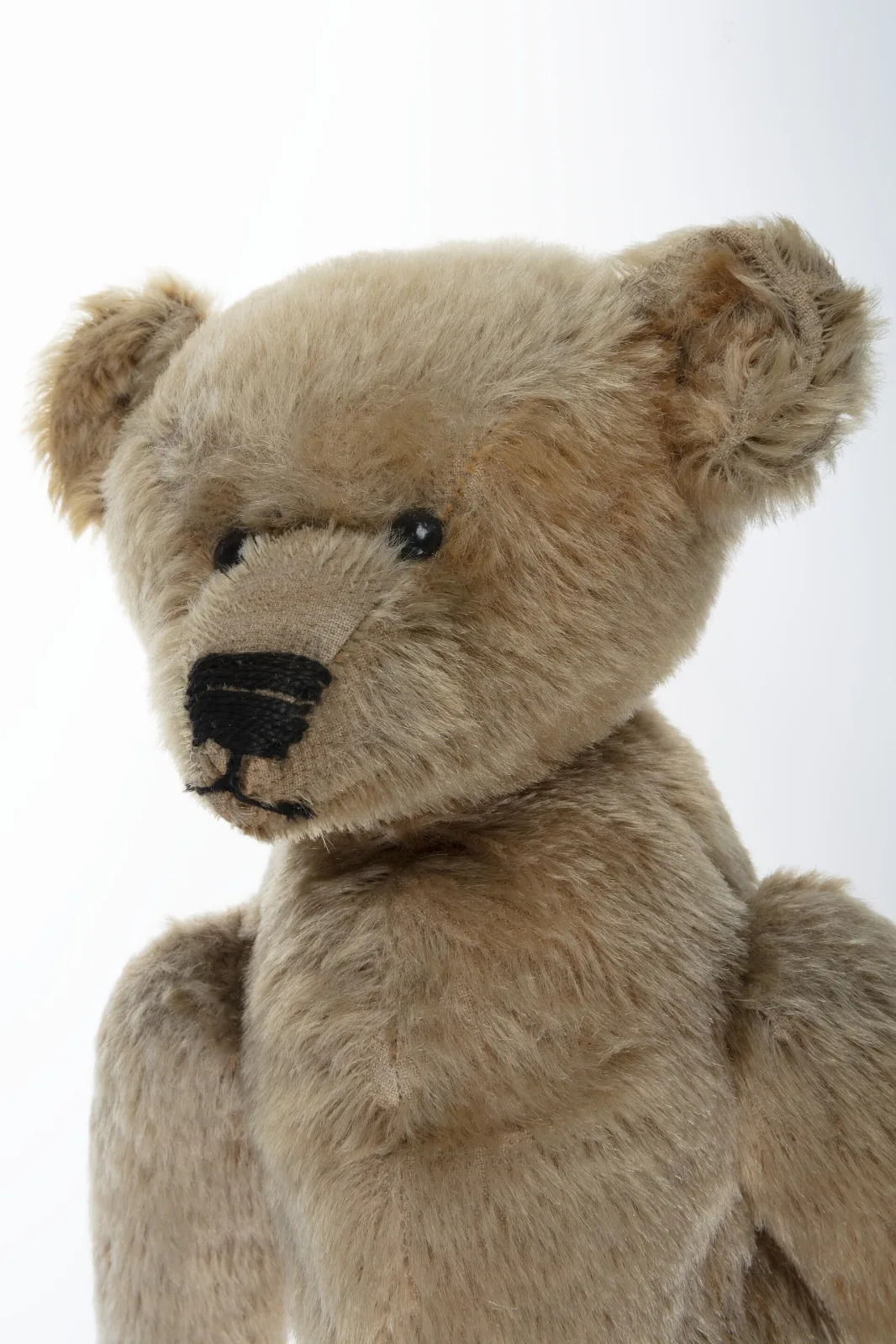
The pronounced shoulder hump is the single most diagnostic feature of an early Steiff. Bears made from 1903 to about 1925 have a clearly defined hump on the upper back created by the way the body fabric is darted. By 1930 the hump has flattened; by 1950 it is largely absent. American bears generally lack the hump even from the start.
Muzzle
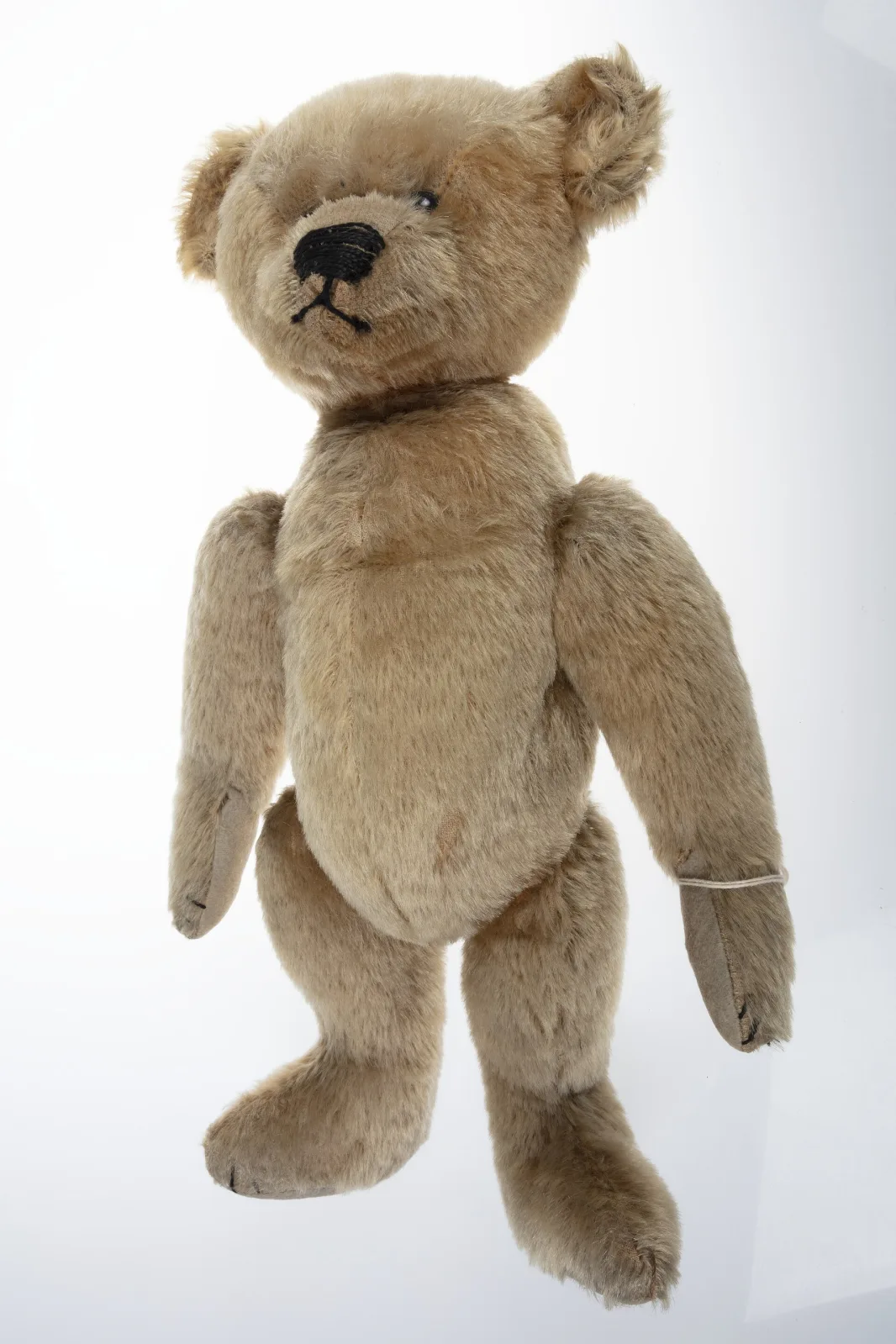
Length and shape of the muzzle vary diagnostically by period and maker. Early Steiff bears have long, pointed, slightly upturned muzzles with a shaved (clipped-pile) area showing the underlying fabric. Bing bears have shorter, broader muzzles. American bears often have flat or shallow muzzles. Later bears (post-1930) have shorter, rounder muzzles.
Limbs
Early bears (1903–1915) have noticeably long arms — sometimes reaching almost to the foot — with curved wrists and pronounced felt paw pads. Legs are also long with large, oval foot pads. By the 1920s arms shorten; by the 1940s they are stubby. Paw and foot pads are typically felt, sometimes leather, occasionally Rexine (a coated cloth used by British makers from the 1930s).
Head and Ears
The head is sewn from several gores — usually four to six panels — with a center seam that, on Steiffs, is offset slightly to one side on certain bears (a manufacturing detail collectors call the "center-seam bear," produced when the cutter used the last odd piece of fabric). Ears are sewn into the head seam at varying widths apart. Wide-set ears are early; close-set ears are later.
Body Proportions
Early bears are barrel-bodied with long limbs; mid-period bears are rounder; later bears are softer and chubbier. Standing height ranges from 3-inch Schuco miniatures to 30-inch promotional or display bears.
Plush, Stuffing, and Construction
The materials of an antique bear are the surest way to date it within a decade.
Mohair Plush
Mohair — the long, lustrous fiber from the Angora goat — is the dominant fabric for quality bears from 1903 through about 1950. Long-pile mohair (often dyed gold, cinnamon, or beige) characterizes the earliest Steiff bears. Mohair has a distinct silky sheen, a slight kink in the fiber, and survives a century of handling far better than synthetic plush. Holding the fabric to the light shows the woven backing through translucent fiber tips.
Alpaca and Silk Plush
Alpaca-fiber plush appears occasionally in luxury bears (notably some Steiff specials). Silk plush, much rarer, was used for high-end pre-war bears and produces a noticeable luminous sheen.
Synthetic Plush
Synthetic plush (rayon, then nylon and acrylic) appears from the 1930s in cheaper bears and dominates from the 1950s onward. Synthetic fibers feel slicker, less springy, and often show heat-damage matting. A bear in synthetic plush is almost certainly post-1930.
Excelsior (Wood-Wool) Stuffing
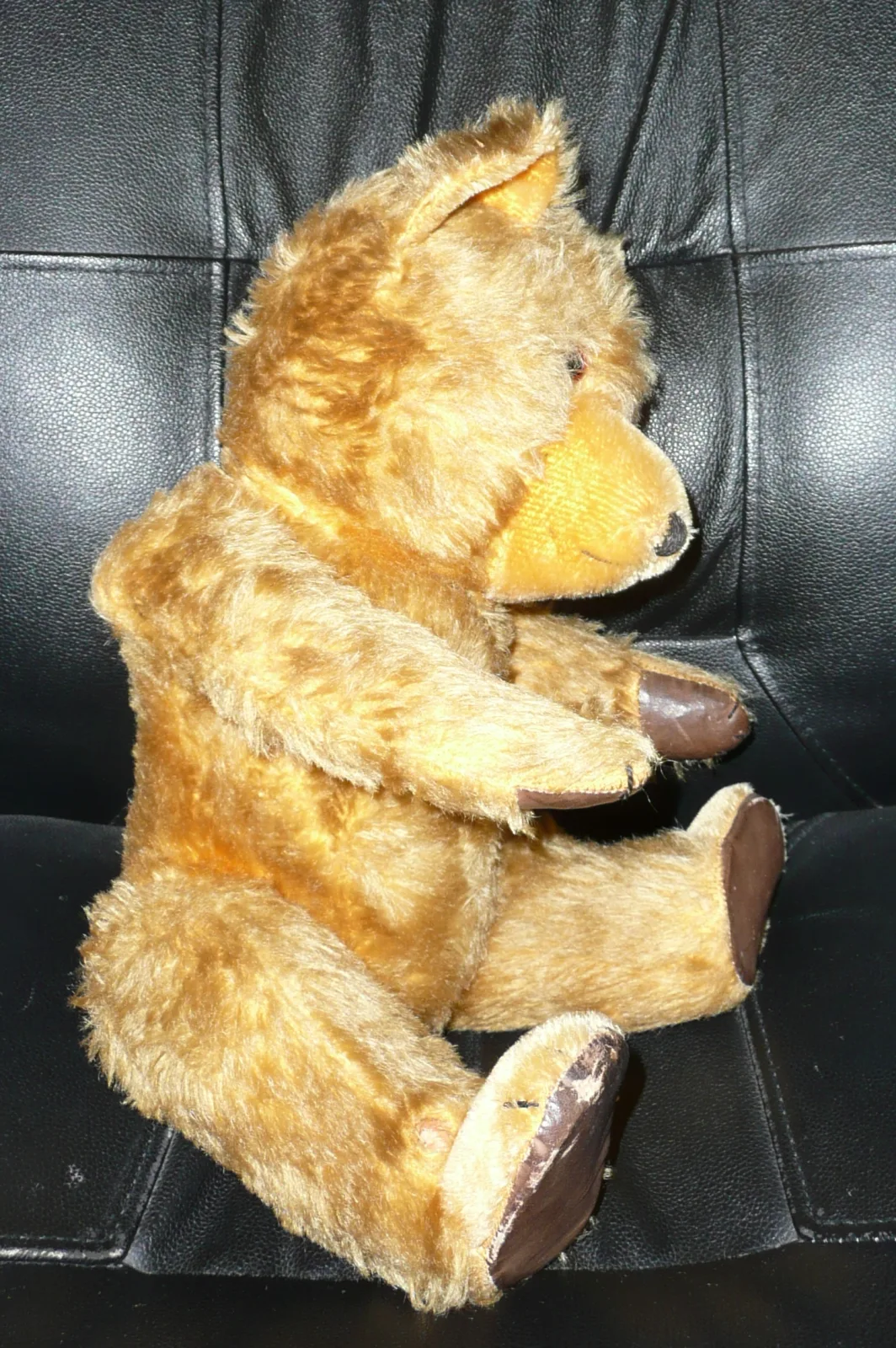
Wood-wool excelsior — fine shavings of softwood — is the standard stuffing of pre-1920 bears. It packs firmly, is very lightweight, makes a characteristic crunching sound when squeezed, and is the diagnostic fill of the golden age. A heavy, firm, slightly noisy bear is almost certainly excelsior-stuffed.
Kapok Stuffing
Kapok — a silky vegetable fiber from the seed pods of the kapok tree — became popular from the late 1910s onward for its soft, light, slightly springy feel. Kapok bears are noticeably lighter and softer than excelsior bears and often have excelsior in the head and limbs with kapok in the body. Many British makers (Chad Valley, Chiltern) used this combination throughout the interwar period.
Cotton, Foam, and Other Fills
Cotton-stuffed bears appear from the 1940s onward in cheaper production. Foam-rubber stuffing appears in the 1950s and is now usually crumbled to dust inside survivors. Polyester fiberfill (the modern soft toy stuffing) is post-1960.
Sound Devices
Many golden-age bears contain a growler (a tilt-activated bellows-and-reed mechanism that produces a low growl) or a squeaker. Working growlers add 10–25% to value. The growler position (typically chest cavity) and type (Steiff used distinctive growlers identifiable by sound and construction) add an authentication layer.
Eyes: Shoe Buttons, Glass, and Plastic
Eye type is the single fastest dating clue on a teddy bear.
Shoe-Button Eyes (1903–1920)
Black wooden shoe-button eyes — small, slightly domed, perfectly round black wood discs with a shank for sewing — are the standard eye of the earliest bears. Originally manufactured for buttoning Edwardian high-button shoes, they were repurposed as cheap, plentiful, durable bear eyes. A bear with shoe-button eyes is almost certainly pre-1920 (and almost certainly worth investigating). Reproductions have used shoe buttons too, but the surrounding construction usually betrays the modern origin.
Glass Eyes on Wire (c. 1915–1955)
Glass eyes — a hand-blown black or amber glass dome on a twisted wire shank that goes through the head and is anchored inside — became standard from about 1920. Quality glass eyes have depth, a slight reflectivity, and frequently a brown iris with black pupil; cheaper ones are flat black. The wire shank is diagnostic: snipping the eye reveals a thin twisted wire, never a plastic post.
Plastic Eyes (1950s onward)
Safety-mandated plastic eyes — initially with metal shanks, later snap-locked — appear from the early 1950s in bears destined for children. Any bear with snap-locked plastic eyes is post-1955 and almost certainly post-1965.
Replacement Eyes
A bear with mismatched, freshly stitched, or anachronistic eyes (e.g., a Steiff with modern glass eyes) has likely been restored. Replacement eyes reduce value 25–60% depending on visibility of the work; original eyes — even cracked or chipped — are preferred.
Jointing Systems
Antique bears are almost always jointed at the head, both shoulders, and both hips — five joints in total — using a disc-and-cotter-pin system invented by Richard Steiff and quickly imitated worldwide.
Disc-and-Cotter-Pin Joint
Two cardboard or wooden discs sandwich the body fabric on either side of a metal cotter pin or T-shaped pin. The pin is bent over a metal washer to lock the joint. The result is a limb that rotates freely but holds position. Pressing the limb and feeling for the disc through the fabric is a quick test — a hard, slightly clicking resistance about an inch into the joint area indicates a disc-jointed bear.
Wired and Soft Joints
Cheaper or smaller bears sometimes use wire armatures (allowing posing but not free rotation) or are unjointed (sewn limbs that flex with the fabric). Schuco miniatures (under 5 inches) typically use lighter joints or none. Unjointed bears are almost always either very small, very late, or very cheap.
Yes-No Bears
Schuco's patented "Yes-No" bears (1921 onward) use an internal armature linked to the tail; moving the tail up and down nods the head, side to side shakes it. The mechanism is fragile and frequently inoperative; working examples carry a significant premium.
Steiff: The Definitive Maker
Steiff is the founding maker, the most commercially important, and the most actively collected. Identifying Steiff bears is the central skill of the field.
The Button in Ear
From late 1904 onward (with a short blank-button period in 1904–1905), Steiff bears carry a small metal button affixed to the left ear — "Knopf im Ohr," literally "button in the ear." The button form, lettering, and finish change in dated stages and are the primary Steiff authentication tool:
- Blank button (1904–1905): Tiny unmarked pewter button. Earliest Steiff mark; very rare and very valuable.
- Elephant button (1904–1905): Small button stamped with an elephant logo (Margarete Steiff's original trademark, before the bear took over).
- "Steiff" with underscored F (1905–1948): The classic golden-age button: "STEIFF" in capitals with a long descender on the F that runs under the rest of the word. Various sizes; the smallest are on miniatures.
- Raised script (1948–1972): "Steiff" in raised script lettering, brass or chrome.
- Incised script (1972 onward): "Steiff" incised into shiny chrome buttons.
Stock Tag and Chest Tag
From about 1908 Steiff also attached a paper stock tag (early white, later yellow) to the button, listing item number, size, and color. The chest tag (a paper or card medallion attached to the chest by a string or pin) appears from the 1930s. Both tags are frequently lost; their absence does not disqualify a bear, but their presence sharply increases value.
Center-Seam Bear
Most Steiff bears have the center seam of the head on the midline. About one in seven (the leftover odd piece of fabric from a layout of seven heads) has the seam offset to one side — the "center-seam bear." Collectors prize these for the manufacturing romance and pay a 30–60% premium.
Famous Steiff Bears
- PB 55 (1902–1904): The original prototype, now extraordinarily rare.
- Bär 35 PB and 28 PAB (1904–1907): Refined production bears; the foundation of Steiff teddy collecting.
- Black Mourning Bears (1912): Reputedly produced after the Titanic sinking; a few hundred survive and routinely realize five- and six-figure prices.
- Apricot, Cinnamon, and White (early 1900s): Color rarities. Cinnamon bears in particular are highly desirable.
- Teddy Baby (1929 onward): A bear with open mouth and standing posture; a distinct sub-line.
- Zotty (1951 onward): Long-haired bear with apricot belly; the post-war flagship.
Steiff Marks Summary
Authentication of Steiff bears means correlating the button type, stock tag, ear position, body construction, and material against the documented date ranges. A bear with a 1905-period blank button but 1950s-style synthetic plush has been "buttoned up" — the button transferred from one bear to another. Cross-checking is essential.

Bing, Schuco, and Hermann
Steiff dominates but is far from alone. Several other German makers produced bears of equal or near-equal quality.
Gebrüder Bing (Bing Brothers)
Founded in Nürnberg in 1863 as a tin-toy manufacturer, Bing entered the bear market around 1907 and produced large numbers of high-quality jointed mohair bears through the 1920s. Bing bears characteristically have shorter, broader muzzles than Steiff, slightly different proportions, and a metal arrow-shaped or letter-stamped tag fixed to the right ear or arm — "GBN" (Gebrüder Bing Nürnberg) before 1919, then "BW" (Bing Werke) afterward, then plain "Bing" into the 1930s. Bing went bankrupt in 1932; the bear molds were sold to other makers, complicating later attribution. Bing bears are roughly 60–80% the price of comparable Steiffs.
Schreyer & Co. (Schuco)
Schuco specialized in small bears and novelty mechanisms. Their miniature bears (3 to 5 inches, in mohair over a metal armature) are highly collected — including bears whose bodies open as compacts, bears that hide perfume bottles, and the Yes-No bears with tail-actuated head movement. Schuco markings include a triangular paper tag, occasionally a stitched fabric label inside the foot pad, and on novelty pieces a stamped metal patent mark. The miniatures can be authenticated by the metal armature visible at the joints and the slightly stiffer feel.
Gebrüder Hermann
The Hermann family (Bernhard Hermann from 1907, Gebrüder Hermann from the 1920s) produced quality jointed bears in close imitation of Steiff. Hermann bears use a chest tag rather than an ear button. The company survived both World Wars and continues today; collectors distinguish pre-war and immediate postwar Hermann bears for the field.
Other German Makers
Sussenguth, Petz, Bergmann, and many smaller workshops produced bears in the 1910s and 1920s, often unmarked. Attribution of unmarked German bears relies on stylistic comparison and a known auction history — a fast way to get burned if you are not yet expert. For broader doll-and-toy context across these German manufacturers, see our antique dolls identification guide.
American Makers: Ideal, Knickerbocker, Gund
American bear-makers proliferated from 1903; few labeled their bears, so identification is largely stylistic.
Ideal Novelty and Toy Company
Founded by the Michtoms in 1907 (after several years of bear-making), Ideal became a major American toy manufacturer. Early Ideal bears (c. 1907–1915) are short-muzzled, lighter, less elaborately jointed than Steiffs, and almost always unlabeled. Documented Ideal bears with provenance command Steiff-level prices for their historical importance; unlabeled bears attributed to Ideal trade more cheaply.
Knickerbocker Toy Company
Founded 1869, entered bear-making c. 1925. Knickerbocker bears are typically softer-bodied, with kapok or cotton stuffing and shorter limbs; they bridge into the "cuddle bear" category that dominates American production from the 1930s. Marks include a fabric label sewn into the body seam, often surviving on early examples.
Gund Manufacturing
Founded 1898 in Connecticut. Gund bears are usually labeled with a sewn-in tag and are typically lighter-bodied, soft-stuffed, and less heavily jointed than golden-age German bears. Gund continues today and produces both new bears and reissues of historic designs.
Bruin Manufacturing, Aetna, Columbia, and Others
Many small American manufacturers (Bruin Manufacturing, Aetna Toy Animal Co., Columbia Teddy Bear Company) produced bears between 1907 and 1915. These are mostly unmarked and attributed by stylistic comparison; documented examples appear in specialist references. A bear thought to be early American often deserves the time of a specialist auction valuation rather than a quick eBay sale.
Distinguishing American from German
Early American bears are generally lighter (less excelsior packing), shorter-limbed, flatter-faced, and unlabeled. German bears (Steiff especially) are heavier, longer-limbed, more aggressively humped, and almost always carry a button or tag. A long-armed, hump-backed, button-eared bear is overwhelmingly likely German; a short-armed, flat-faced, unlabeled bear is more likely American. The same diagnostic logic applies more broadly to the toy categories covered in our antique toy identification guide.
British Makers: Chad Valley, Merrythought, Chiltern
British bear-making accelerated during World War I when German imports were cut off, and produced some of the most distinctive and beloved bears of the interwar era.
J. K. Farnell
Founded 1840, made bears from about 1908. Farnell bears are credited as the inspiration for A. A. Milne's Winnie-the-Pooh — Christopher Robin Milne's original 1921 Pooh was a Farnell "Alpha" bear bought at Harrods. Farnell bears are usually labeled with a celluloid button or sewn tag.
Chad Valley
Birmingham-based, made bears from 1915. Chad Valley bears are well-jointed, often with kapok body and excelsior-filled head, with felt or Rexine pads and a metal button or sewn label on the foot. Royal warrant marks (from 1938) appear on some labels.
Merrythought
Founded 1930 in Ironbridge, still operating. Distinctive features include the "wishbone" trademark sewn or stamped on the foot, drop-stitch claw embroidery, and a webbed-foot variant called the "Cheeky" (with bells in the ears). Merrythought labels evolved through several styles and are well documented.
Chiltern
Bedfordshire, c. 1908 (as the Chiltern Toy Works) onward. The famous "Hugmee" bear (1923) is large, plump, kapok-stuffed, and intensely cuddly — the British answer to the increasingly soft American bear. Chiltern labels are sewn into the body or foot.
Dean's Rag Book Company
Founded 1903 (as a children's book publisher), made bears from about 1915. Dean's bears are often plumper and softer, with distinctive labeling. The company merged into Childhood Productions in the 1980s.
Dating by Construction Era
Material and construction details cluster into recognizable periods. The clusters are not absolute (makers differed; transitional pieces exist) but they are reliable for first-pass dating.
1903–1915 (Earliest Golden Age)
Long-pile mohair (cinnamon, gold, beige, occasionally white or apricot); shoe-button eyes; excelsior stuffing; pronounced hump; long arms reaching nearly to the foot pads; large oval felt foot pads with stitched claws; disc-and-cotter-pin joints; pointed muzzle with shaved area; growler often present.
1915–1925 (Late Golden Age)
Continuing mohair with shoe-button or early glass eyes; excelsior stuffing still standard; somewhat less aggressive hump; arms shortening; British makers (Chad Valley, Farnell) becoming significant.
1925–1939 (Interwar)
Glass eyes universal; kapok or kapok/excelsior combined stuffing; reduced hump; shorter limbs; rounder faces; appearance of novelty bears (Schuco Yes-No, Schuco miniatures); first synthetic plush appears in cheaper bears.
1939–1955 (War and Post-War)
Reduced quality due to wartime material restrictions; synthetic plush common; kapok or cotton stuffing; simpler joints; earliest plastic safety eyes appear toward end of period.
1955–1970 (Modern Vintage)
Synthetic plush dominant; plastic eyes; reduced or no jointing in cheap bears; foam stuffing common (and now usually crumbled). Steiff continues quality jointed bears in mohair but now a niche-luxury rather than mass product.
Labels, Buttons, and Tags
Markings massively increase confidence and value. Their absence does not disqualify a bear (many have lost labels through play or cleaning) but their presence resolves attribution.
Steiff Buttons (see Steiff section)
The button in the left ear is the gold standard. Match the button type to the documented date range and to the bear's construction.
Bing Tags
Metal arrow tag (pre-1919), letter tag (BW), or paper Bing tag, typically on the right ear or arm.
Sewn Cloth Labels
British and American makers favor sewn cloth labels — usually on the foot pad, occasionally on the chest or body seam. Label typography (font, color, layout) often dates the period precisely; collector references catalogue Chad Valley, Merrythought, Chiltern, and Farnell label progressions.
Chest Tags and Hang Tags
Paper or card medallions hung from the neck or pinned to the chest. Easily lost; high value when present.
No Marks at All
Many bears (most early American, many continental) were never labeled. Stylistic attribution then depends on overall construction — proportions, plush, eye type, joint construction, paw pad shape. This is the area where experience and reference photographs matter most. For documentation methods that apply equally to bears and other plush toys, our antique photography documentation techniques guide covers the lighting and angles that best reveal labels and construction.
Reproductions, Replicas, and Fakes
Three categories of newer bears regularly mislead collectors.
Steiff Replicas (1980s onward)
Steiff itself produces high-quality limited-edition replicas of historic bears — labeled as such with white instead of yellow ear tags and with serial numbers. These are collectible in their own right but worth a fraction of the originals they replicate. The white ear tag is the easiest tell; serial number on the chest tag confirms.
Artist Bears
Since the 1980s, individual bear artists (notably in the US, UK, and Germany) have produced new bears in the antique style — often beautifully constructed in mohair, with shoe-button-style eyes and disc joints. Quality is sometimes very high but the new construction (clean fabric, unaged stuffing, modern thread, often a stitched artist signature) usually betrays the recent origin under inspection.
Outright Fakes
Old or aged-looking bears with falsely added Steiff buttons (typically transferred from a damaged authentic bear), repainted button typography, or wholly modern manufacture sold as antique. The mismatched-construction tell is the most reliable defense: a 1905-style button on a 1960s-construction bear is the giveaway.
Aging and Distressing
Modern bears artificially aged with tea staining, deliberate fur abrasion, and chemical patination. Authentic aging is uneven (more wear on hands, feet, nose, sitting areas; clean under the joints) while artificial aging is usually too uniform. The tell is in the back of the head and behind the joints — areas a child rarely touches and that should remain pristine on a genuinely old but loved bear.
Reproduction Cross-Reference
For broader fakes-and-reproductions principles that apply to bears as well, see our antique authentication and provenance research guide.
Condition Assessment
Bears were toys. Most surviving examples show heavy play wear, and the market has adapted: a moderately loved bear with original eyes, original limbs, and original fabric can outsell a perfect-condition mass-market bear ten to one.
Fur Condition
Look for: bare patches at hands, feet, muzzle, and behind the ears (acceptable, even charming on a loved bear); even all-over fading (acceptable); patchy moth damage (depreciates); chemical or heat damage (depreciates significantly). Some collectors actively prefer well-played examples.
Joint Tightness
Joints should still hold position. Loose flopping joints indicate failed cotter pins, dried-out cardboard discs, or stretched joint holes — repairable but visible work.
Stuffing Integrity
Body should still feel firm in the right places. Squashy bears have lost stuffing through tears or seam failure. Re-stuffing is a major intervention that affects value sharply.
Eye Originality
Original eyes — even cracked, chipped, or one missing — are preferred to replacements. A bear with one original shoe-button and one missing eye is more authentically valued than a bear with two perfect modern glass replacements.
Pad Condition
Foot and paw pads (felt, leather, or Rexine) typically wear first. Original pads in fair condition, even patched, are preferred to wholly replaced pads. Re-padded paws are common and acceptable but reduce value 10–25%.
Restoration Disclosure
Auction catalogues are increasingly required to disclose restoration. A bear described as "eyes replaced, paw pads restitched, growler replaced" is a heavily restored bear despite period appearance.
What Drives Value
Teddy bear values cluster into a wide range. The same form can carry a $50 or a $50,000 price tag.
Maker
Steiff dominates the high end. Bing, Schuco, and the British heritage makers (Farnell, Chad Valley, Merrythought, Chiltern) command serious prices. American and unlabeled bears are generally lower except for documented examples.
Period
Earlier is better. Pre-1915 bears command premium prices; 1915–1930 are mid-range; post-1930 are affordable except for rarities.
Color
Standard gold and cinnamon are common; rare colors (apricot, white, dual-tone, black, silver) command large premiums. A documented Steiff black mourning bear from 1912 routinely realizes well over $50,000.
Size
Larger bears (over 18 inches) are scarcer and more expensive within a given maker and period. Schuco miniatures are an exception — collectible despite small size for the novelty mechanisms.
Marks and Documentation
Original Steiff button with intact stock tag and chest tag — full set — is worth substantially more than the same bear with no markings. Provenance (period photographs of the bear with its child, documented family ownership) adds further premium.
Condition
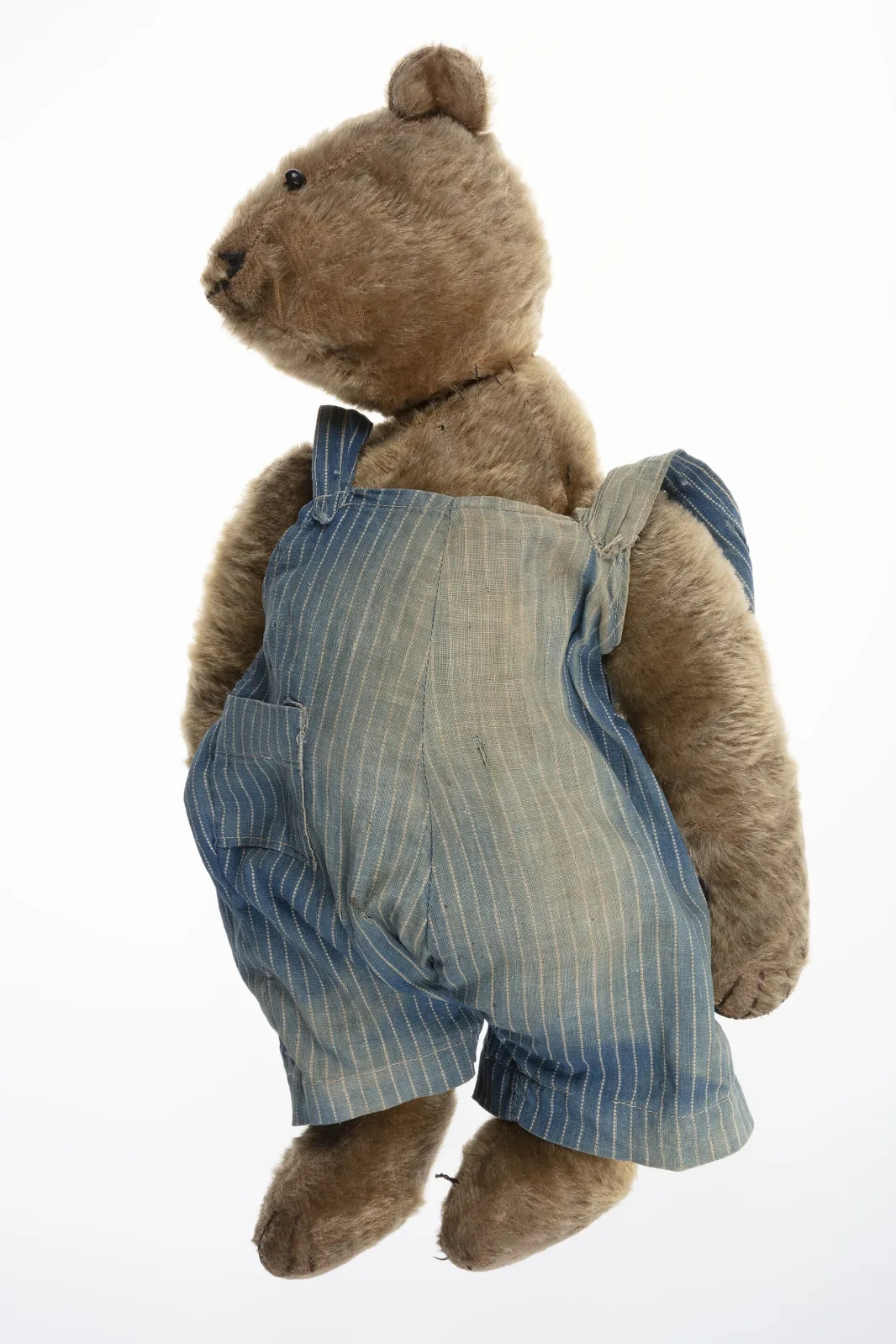
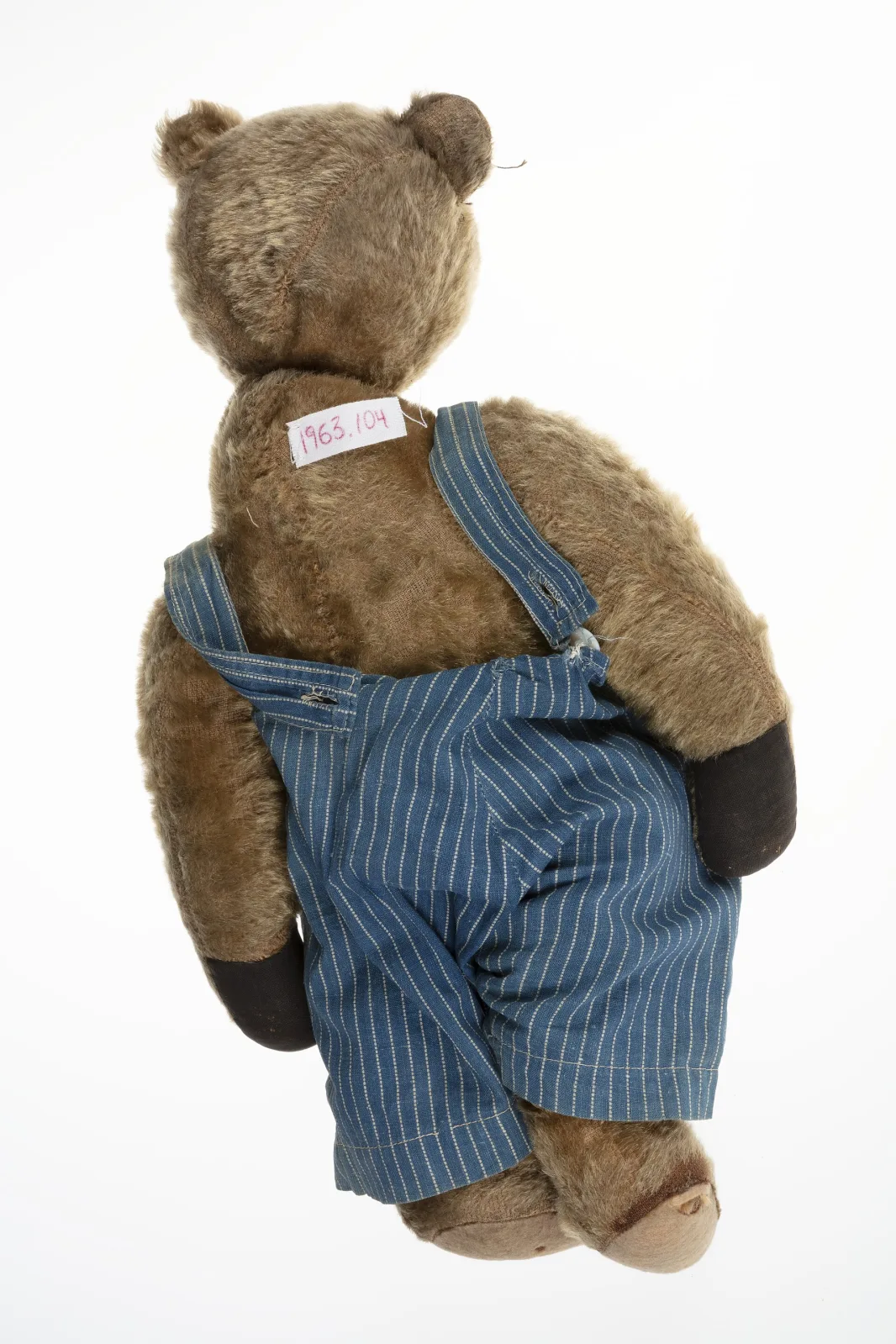
As above. Original eyes, original pads, original stuffing, working growler. Honest play wear is acceptable; restoration is disclosed and discounted.
Realistic Price Bands (2026)
- $25–$100: Common post-1950 bears, unmarked or generic; Gund bears in standard colors; cheap synthetic-plush bears.
- $100–$400: Mid-grade interwar bears; modest Chad Valley, Chiltern, Merrythought; later Steiff with chrome buttons; American post-war bears with quality construction.
- $400–$1,500: Pre-war Steiff with original button in standard size and color; Bing, Schuco mid-range; British golden-age bears in good condition; large interwar bears.
- $1,500–$10,000: Early Steiff with full markings, color rarities, large sizes, working mechanisms; documented early American makers.
- $10,000+: Pre-1910 Steiffs in rare colors; Steiff black mourning bears; documented historical bears (e.g., bears with celebrity provenance).
Care and Conservation
Antique bears are textile objects and demand textile-conservation discipline.
Display Environment
Keep bears out of direct sunlight (UV fades mohair in months). Stable temperature and humidity (60–70°F, 45–55% RH). Away from radiators, drafts, fireplaces, and direct heating vents.
Cleaning
Do not wash an antique bear. Surface-clean with a soft brush or vacuum-through-screen technique (a piece of fine fabric over the bear, vacuumed gently through the screen). For specific stains, consult a textile conservator. Water reactivates aging tannins, may rust internal armatures, and can felt the mohair beyond recovery.
Pest Prevention
Moths and carpet beetles will eat mohair given the chance. Quarantine new acquisitions for 2–4 weeks in a sealed bag with a pheromone trap. Permanent storage in cotton bags (not plastic, which traps moisture) inside a clean closet.
Restoration Decisions
Stabilize, do not restore. A torn paw pad can be supported with archival fabric on the underside; replacing the pad outright reduces value. A missing eye should generally be left alone or filled with a period-appropriate matching button only. Always document what is original and what is intervention. The same conservation principles apply across textile and toy categories — see our antique storage, care, and preservation guide for the broader framework.
Common Beginner Mistakes
The errors that cost money are predictable.
Trusting the Button Alone
A Steiff button is easily transferred from one bear to another. Check that the button type matches the bear's construction era — a 1905-style button on a 1960s-construction bear is a transplant.
Ignoring the Eyes
Modern reproduction shoe buttons exist and are sometimes used on artist or fake bears. Glass eyes with plastic shanks are post-1955 regardless of how aged the surrounding bear looks.
Confusing Hump with Posture
A hump must be created by darting in the body fabric — it is a structural feature, not posture. A bear leaning forward is not a hump-back bear.
Misreading Synthetic Plush
Slick, springy, slightly shiny synthetic fibers cannot be early. If the plush feels slick rather than silky-soft, the bear is post-1930 at the earliest, and probably post-1950.
Over-Cleaning
Washing an old bear can destroy thousands of dollars of value in an afternoon. Felted mohair, rusted armatures, tightened-up joints, dissolved chest tags — all routine results of well-meant cleaning.
Discounting Honest Wear
A loved bear with bare patches and a missing eye can be worth more than a perfect bear of the same period; play wear is part of the story collectors pay for.
Selling Before Authenticating
If you suspect an early Steiff or important early American bear, get a specialist opinion before listing. The difference between "old plush bear" on a general auction site and "documented 1907 Steiff in cinnamon" at a specialist auction is routinely a 10x to 50x price multiple.
Frequently Asked Questions
How can I tell if my bear is a Steiff?
Look for the metal button in the left ear (the "Knopf im Ohr"). The button type — blank, elephant logo, "STEIFF" with underscored F, raised script, incised script — dates the bear to a documented period. Confirm the button type matches the construction era of the bear (excelsior stuffing and shoe-button eyes for pre-1920; glass eyes and kapok for interwar; etc.). A button alone is necessary but not sufficient — buttons are transferable.
What is "mohair" and why does it matter?
Mohair is fiber from the Angora goat. It has a distinct silky sheen, a slight kink, and ages well — quality mohair plush survives a century. Synthetic plush feels slicker, springier, and shinier; it appears from the 1930s onward in cheaper bears and dominates after 1950. A bear in mohair is older and almost always more valuable than the same bear in synthetic.
How do I date my bear by the eyes?
Black wooden shoe-button eyes: pre-1920 (mostly). Glass eyes on twisted-wire shanks: c. 1915–1955. Plastic safety eyes with snap shanks: post-1955. Replacement eyes are common — check that the eye type matches the rest of the construction.
What is a hump and why is it important?
The hump is a darted shoulder rise on the upper back, characteristic of early Steiff and other early German bears. A pronounced hump suggests pre-1925 production; a flat back suggests later. Most American bears never had humps. The feature is a quick early-vs-late visual filter.
Are unmarked bears worth anything?
Yes — many golden-age bears (especially American) were never marked. Stylistic attribution to a maker (Ideal, Bruin, Aetna) significantly increases value if defensible. Unmarked but clearly early hand-jointed mohair bears in good condition routinely sell in the $300–$1,500 range.
What is a "center-seam" Steiff bear?
An offset head seam created when the cutter used the leftover seventh head piece from a six-head fabric layout. Roughly one Steiff in seven is a center-seam bear. Collectors prize the manufacturing romance and pay a 30–60% premium.
Should I restore my old bear?
Conservatively, no — stabilize but do not replace. Restoration sharply reduces collector value. A worn original is more desirable than a perfect-looking restoration. If the bear is for display or family rather than sale, light conservation (supporting torn pads, securing loose joints) is fine; outright re-furring or re-eyeing is not.
What is a Schuco Yes-No bear?
A Schuco patent (1921) bear with an internal armature linked to the tail; moving the tail up and down nods the head, side to side shakes it. Working examples are highly collectible; the mechanism is fragile and often failed. The Yes-No mechanism appears in Schuco bears, monkeys, and other plush animals.
How do I store an antique bear?
Cotton bag (not plastic), dark closet, stable temperature and humidity, away from radiators and direct light. Quarantine new acquisitions in a sealed bag for several weeks against moths and carpet beetles. Display behind glass or in a low-traffic shelf.
What is the most valuable teddy bear ever sold?
The famous Steiff black mourning bear "Teddy Girl" (a 1904 Steiff with provenance to British colonel Bob Henderson) sold at Christie's in 1994 for over $170,000 — then a record. Various Louis Vuitton Steiff and other collaborative limited editions have approached or exceeded that figure. Five- and six-figure prices for documented early Steiffs in rare colors with full markings are routine at specialist auctions.
What references do serious collectors use?
Günther Pfeiffer's 1892–1997: Steiff Sortiment for Steiff identification; Ken Yenke's Bing Bears and Toys for Bing; the published catalogues of Christie's and Bonhams teddy bear sales for current market prices; and the Steiff Club archives for authentication of contemporary Steiff replicas. The international teddy bear collector clubs publish current pattern documentation.