
Antique Tapestries Identification Guide: Weaving Techniques, Origins & Value
Antique tapestries represent one of the most prestigious and historically significant forms of textile art. For centuries, these woven masterpieces adorned the walls of castles, cathedrals, and noble residences across Europe, serving as both decorative statements and practical insulation against cold stone walls. Today, antique tapestries remain highly sought after by collectors, interior designers, and museums worldwide. Collectors interested in floor coverings should also explore antique rug identification.
Identifying and dating antique tapestries requires understanding the interplay between weaving techniques, materials, design motifs, and regional traditions. From the monumental narrative tapestries of medieval Flanders to the delicate pastoral scenes of 18th-century Aubusson workshops, each piece carries the artistic fingerprint of its origin and era.
This guide covers the major tapestry-producing regions, weaving methods, dating techniques, and authentication strategies that will help you evaluate antique tapestries with confidence. Whether you have inherited a family heirloom or discovered a promising piece at auction, the knowledge here will help you understand what you are looking at and what it may be worth.
Table of Contents
- A Brief History of Tapestry Weaving
- Major Types of Antique Tapestries
- Key Tapestry-Producing Regions
- Understanding Weaving Techniques
- Materials & Fiber Identification
- How to Date Antique Tapestries
- Reading Design Motifs & Iconography
- Border Styles & Their Significance
- Weaver Marks, Monograms & City Stamps
- Assessing Condition & Repairs
- Authentication & Spotting Reproductions
- Valuation Factors & Market Trends
- Care, Display & Conservation
- Building a Tapestry Collection
A Brief History of Tapestry Weaving
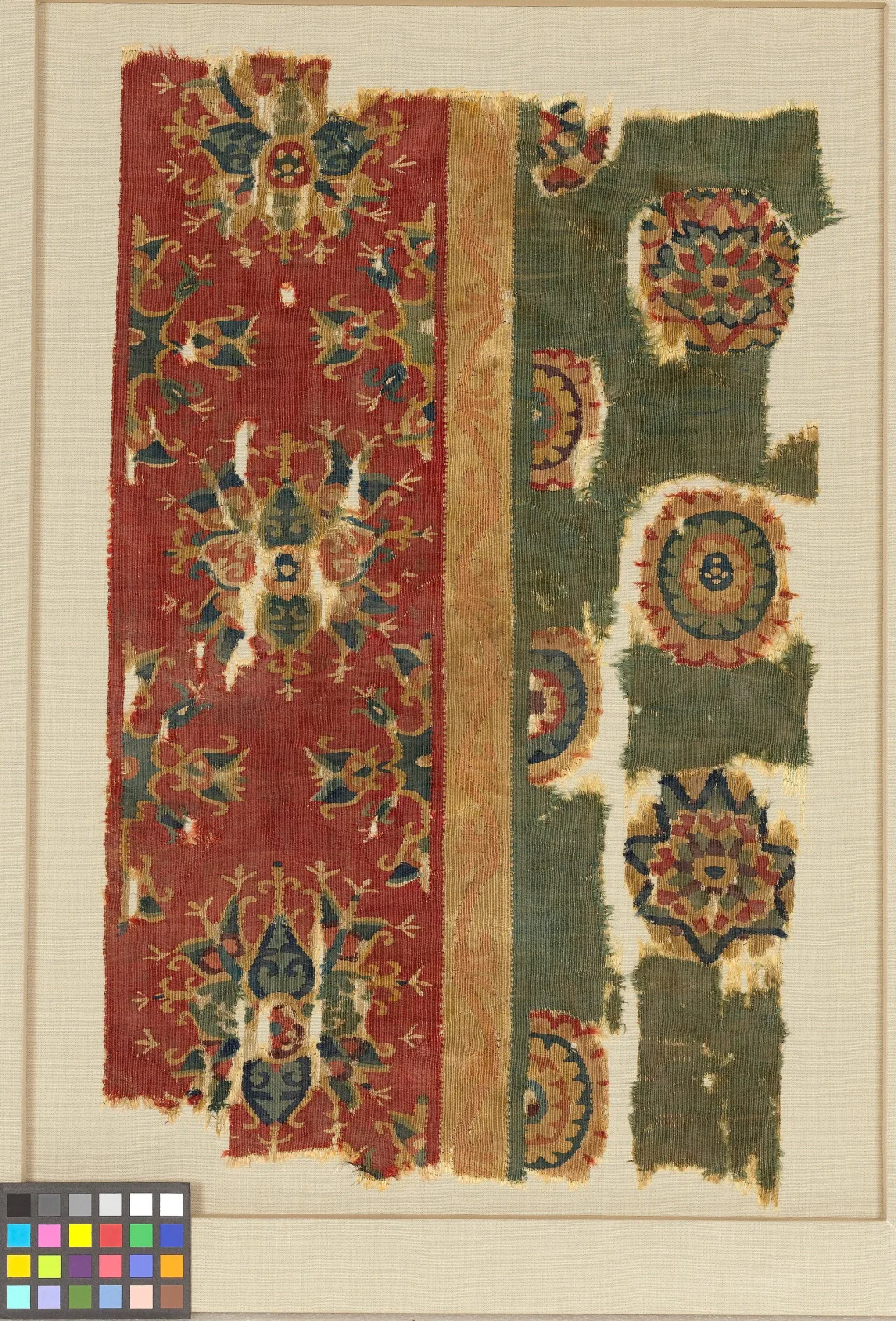
Tapestry weaving is among the oldest textile arts, with fragments dating back to ancient Egypt and pre-Columbian Peru. However, the European tapestry tradition that dominates the antiques market began in earnest during the medieval period, reaching its artistic zenith between the 14th and 18th centuries.
Medieval Origins (1200s-1400s)
The earliest surviving European tapestries date to the late 13th century, produced in workshops across Germany, France, and the Low Countries. These early works featured religious scenes, heraldic devices, and allegorical compositions woven in wool on vertical looms. The famous Apocalypse Tapestry of Angers, commissioned around 1375, exemplifies the monumental scale and narrative ambition of medieval tapestry production.
The Golden Age (1400s-1500s)
The 15th and 16th centuries marked the golden age of tapestry weaving, centered in the Flemish cities of Brussels, Tournai, and Arras. The workshops of Brussels became particularly renowned for their millefleurs (thousand flowers) designs and grand narrative cycles. The celebrated Lady and the Unicorn tapestries, woven around 1500, showcase the extraordinary refinement achieved during this period. Flemish weavers used increasingly fine wool warps combined with silk and metallic threads to achieve painterly detail.
The Royal Manufactories (1600s-1700s)
The establishment of the Gobelins manufactory in Paris in 1662 under Louis XIV transformed tapestry production into a state-sponsored art form. Under the artistic direction of Charles Le Brun, the Gobelins produced enormous tapestry cycles glorifying the Sun King. Meanwhile, the Beauvais and Aubusson workshops developed their own distinctive styles, with Aubusson becoming famous for its softer, more accessible pastoral scenes. In Flanders, Brussels continued producing masterful works, though gradually yielding artistic leadership to French workshops.
Decline & Revival (1800s-1900s)
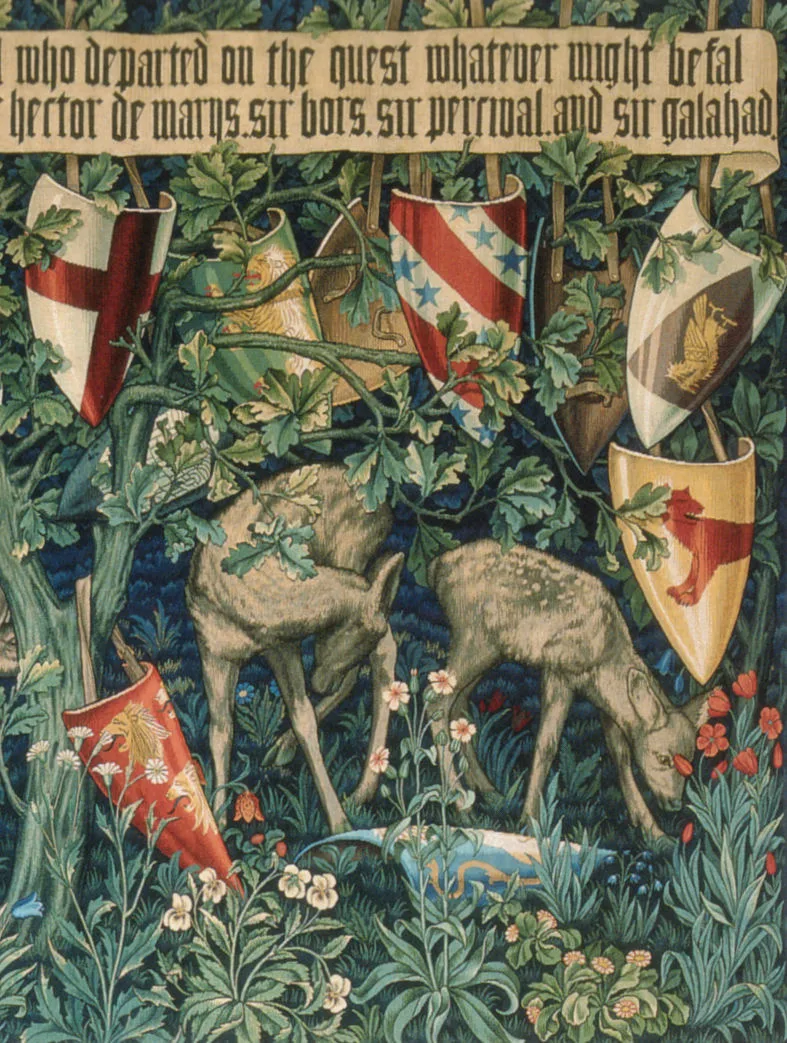
The French Revolution devastated the tapestry industry, and the rise of industrial textile production in the 19th century further diminished demand for handwoven work. However, the Arts and Crafts movement led by William Morris sparked a revival of interest in tapestry weaving during the 1880s. Morris established workshops at Merton Abbey that produced tapestries in a deliberately medieval style. The 20th century saw further revivals, including Jean Lurçat's modernist tapestries at Aubusson in the 1940s and 1950s.
Major Types of Antique Tapestries
Understanding the major categories of tapestry design helps narrow the origin and date of a piece. Each type reflects specific artistic traditions and patron demands.
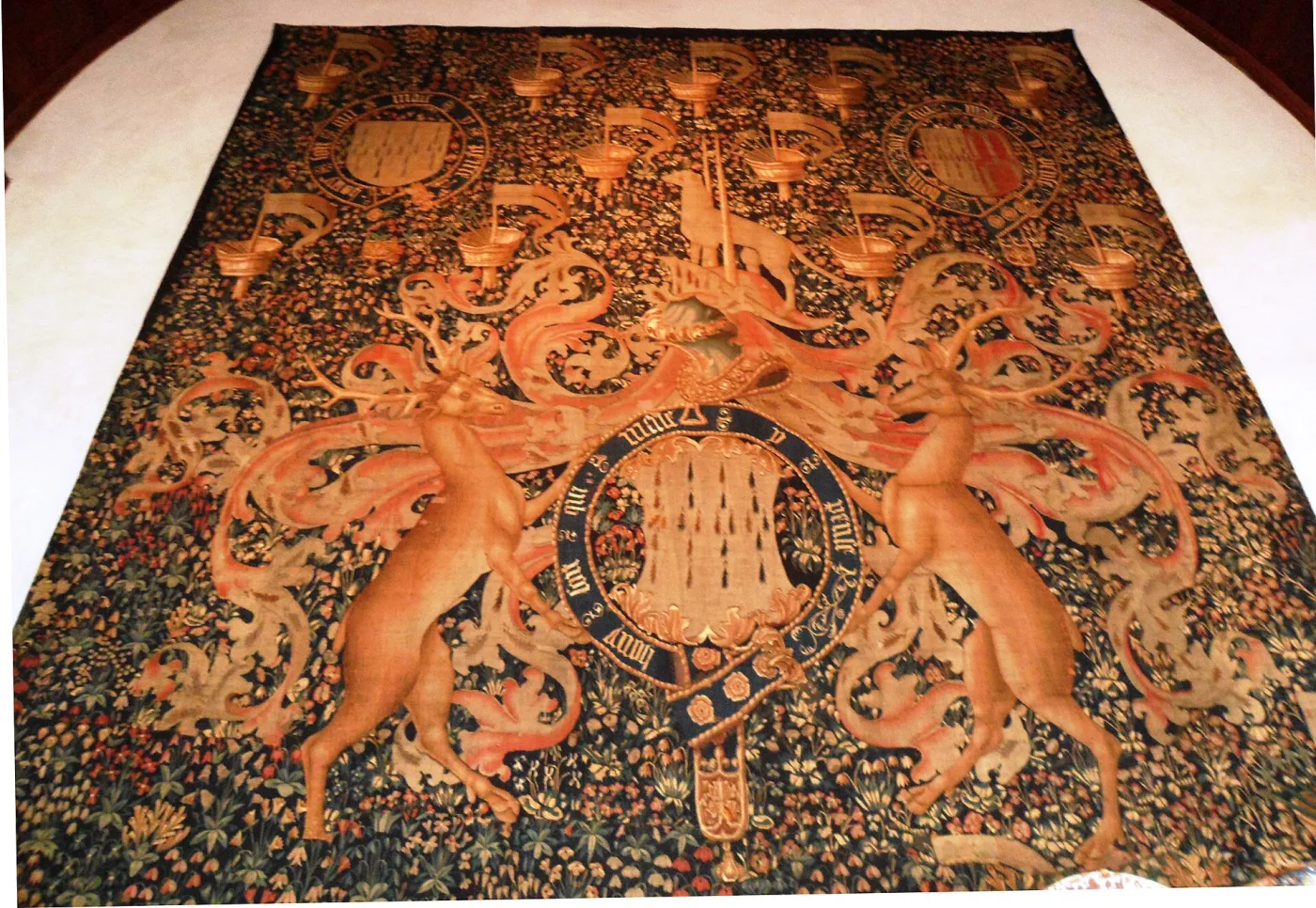
Millefleurs Tapestries
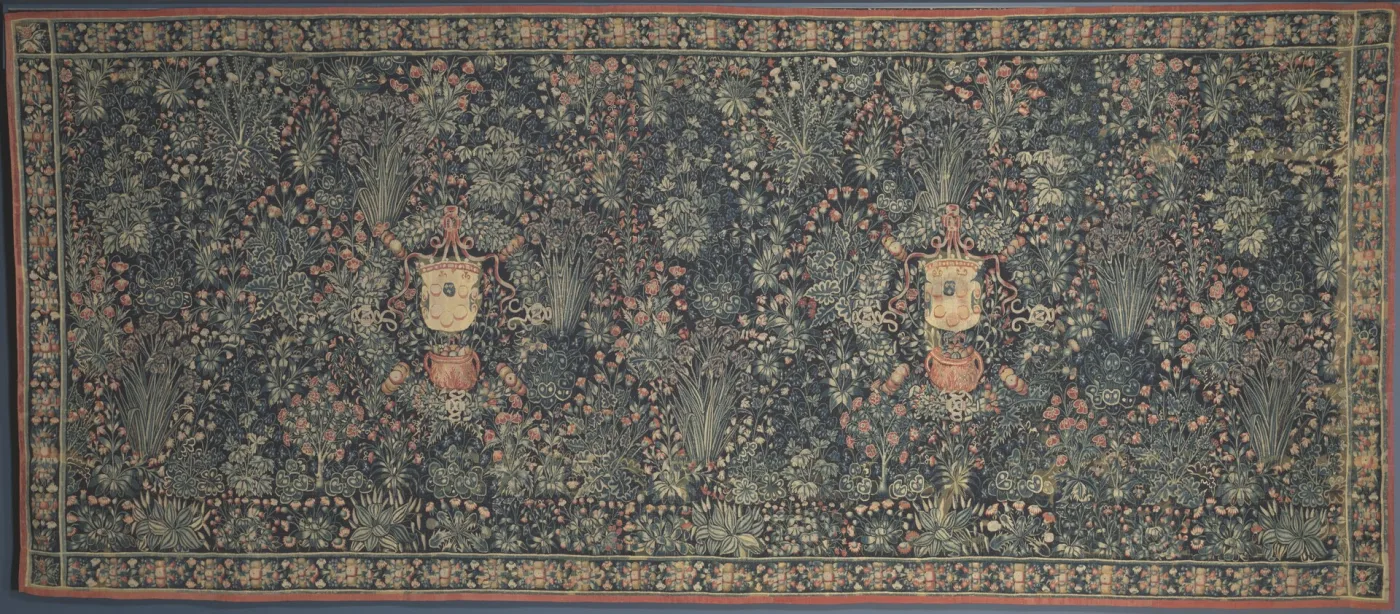
Millefleurs (thousand flowers) tapestries feature dense backgrounds of flowering plants scattered across a dark ground, often blue or red. Figures or animals appear against this floral carpet. Originating in the late 15th century, primarily in Flemish and French workshops, millefleurs tapestries are among the most recognizable and collectible types. Authentic medieval examples are extremely rare and valuable, while later reproductions from the 19th century are more commonly encountered.
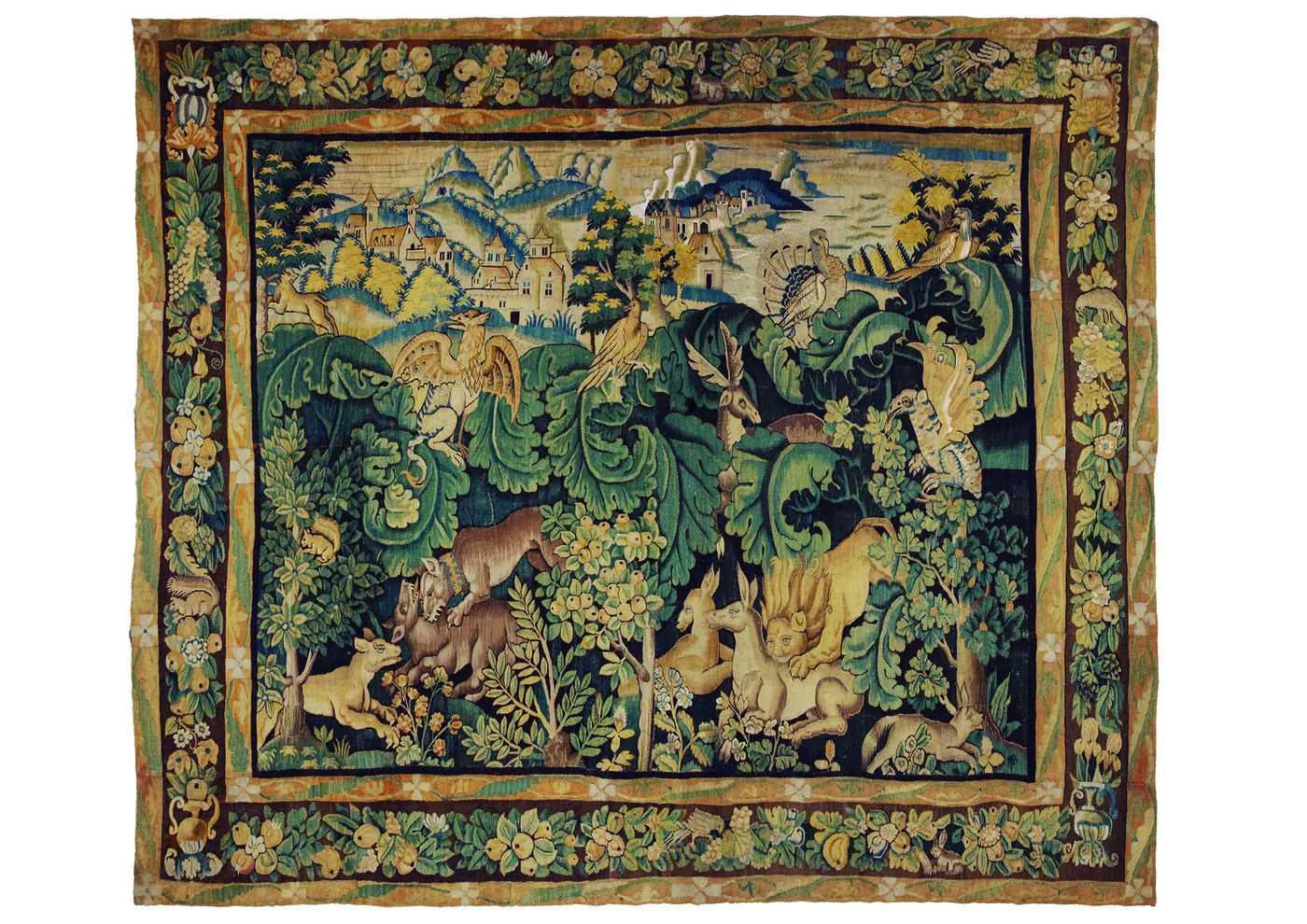
Verdure Tapestries
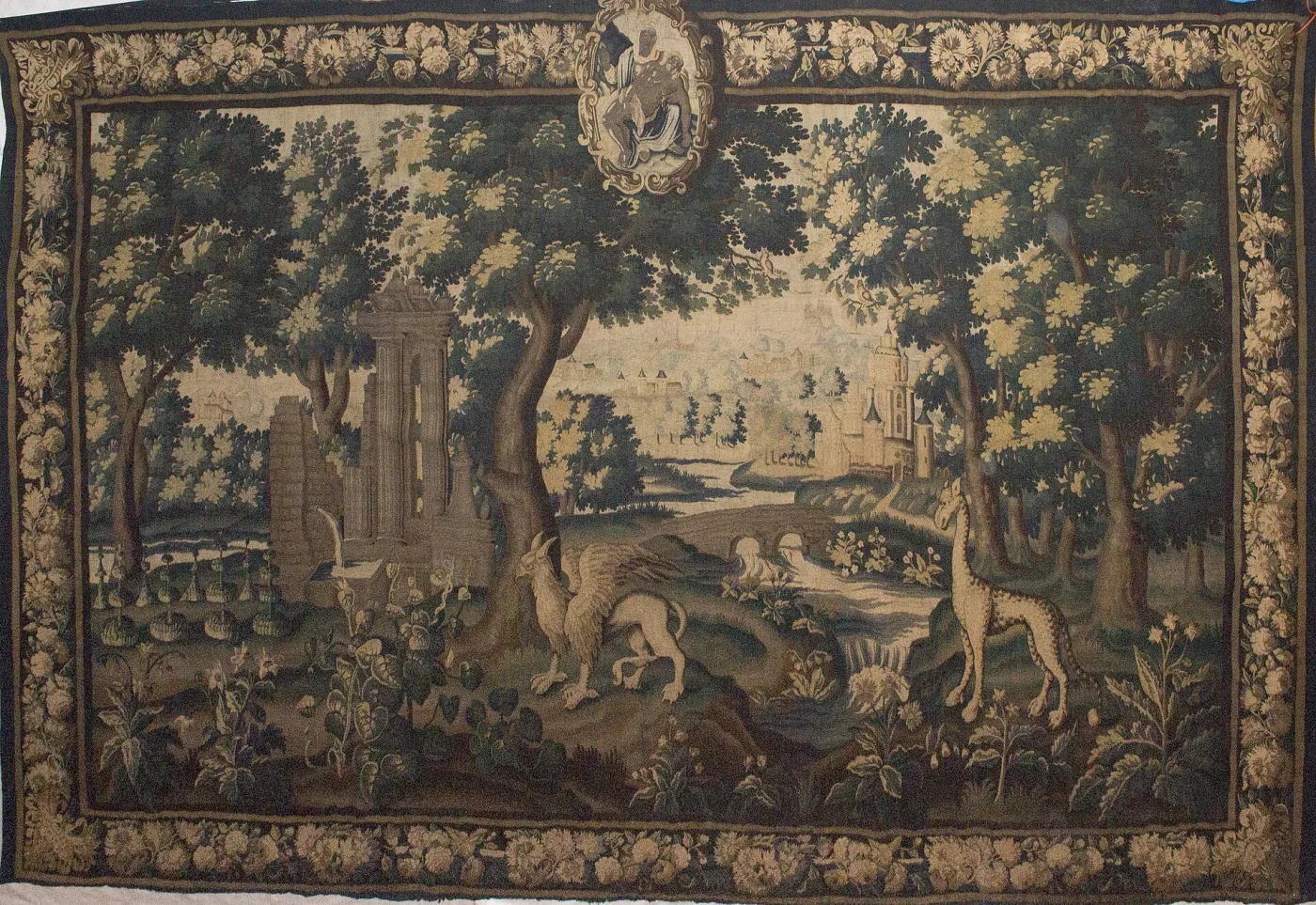
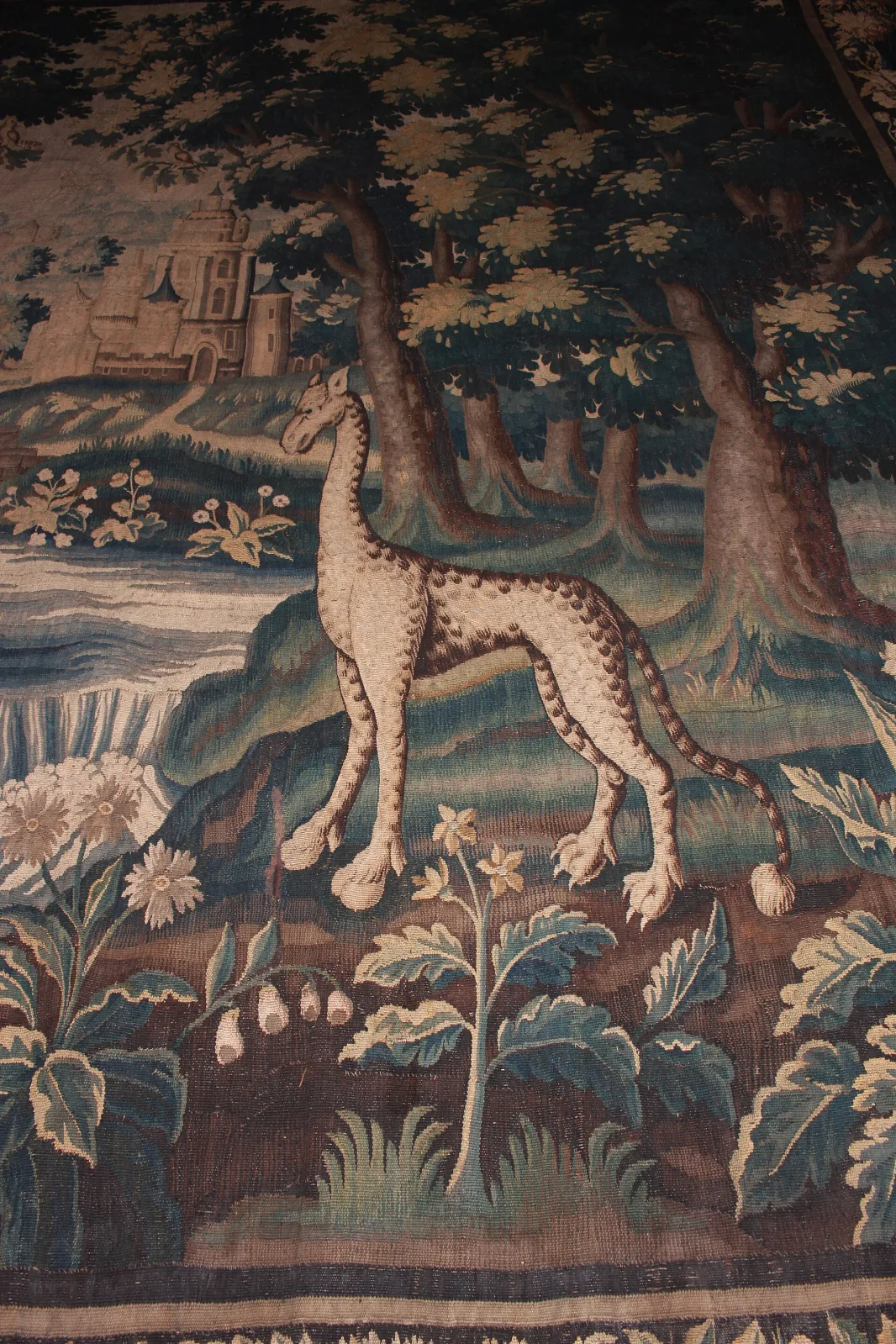
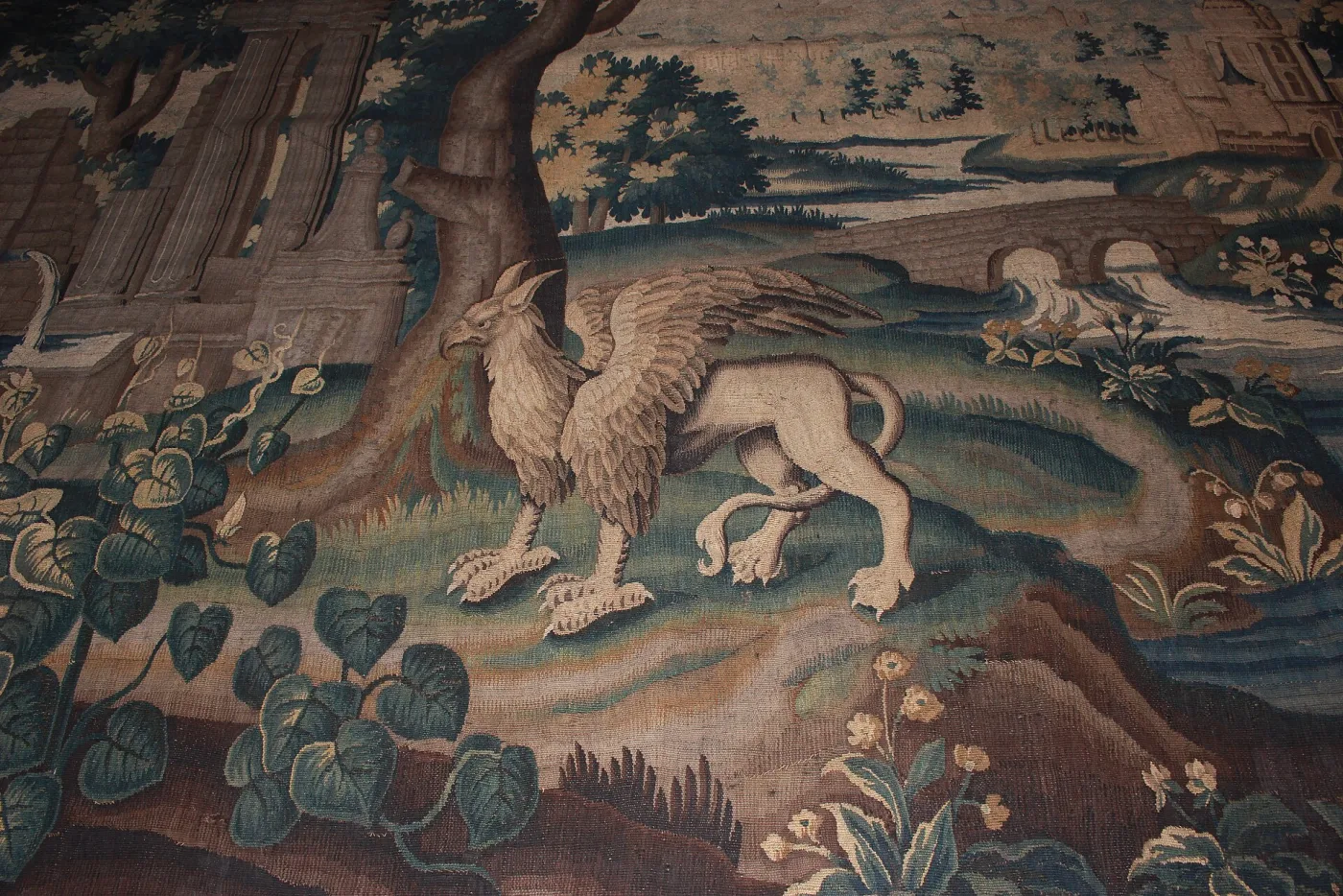
Verdure tapestries depict lush landscape scenes dominated by trees, foliage, and plants, often with birds, small animals, and distant architecture. This genre became especially popular in the 17th and 18th centuries at Aubusson and Felletin workshops. Verdures range from simple woodland compositions to elaborate garden scenes with exotic birds. They remain among the most affordable category of antique tapestries and make excellent entry points for new collectors.
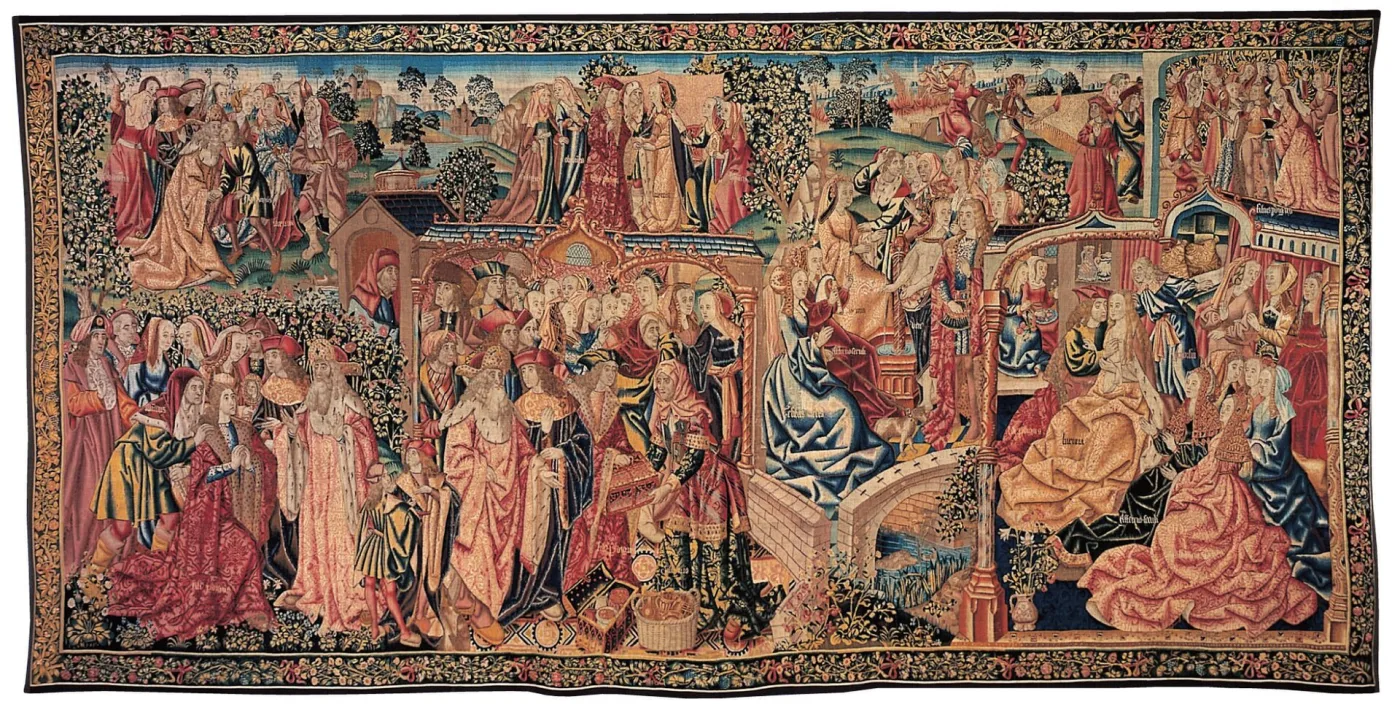
Narrative & Figural Tapestries
Narrative tapestries depict scenes from mythology, the Bible, classical history, or contemporary events. These were typically the most expensive commissions, requiring skilled figure weavers and often designed by prominent painters. Famous examples include Raphael's Acts of the Apostles cartoons woven at Brussels, and the Gobelin's History of Alexander series. The quality of figure drawing and facial expression is a key indicator of workshop quality and date.
Armorial & Heraldic Tapestries
These tapestries prominently feature coats of arms, family crests, or royal emblems, sometimes combined with allegorical figures or decorative borders. Armorial tapestries provide valuable provenance clues since the heraldic devices can often be traced to specific families. They were popular from the medieval period through the 18th century as declarations of status and lineage.
Pastoral Tapestries
Pastoral scenes depicting idealized country life, shepherds, and rural amusements became enormously popular during the 18th century, particularly at Beauvais and Aubusson. Influenced by painters like François Boucher, these tapestries often feature soft, luminous colors and Rococo ornamental borders. Boucher's designs for the Beauvais manufactory are among the most celebrated pastoral tapestries ever produced.
Grotesque & Arabesque Tapestries
Inspired by the decorative vocabulary of ancient Roman wall paintings rediscovered during the Renaissance, grotesque tapestries feature fanciful arrangements of scrollwork, masks, mythical creatures, flowers, and architectural elements on light backgrounds. This genre was particularly popular in the late 17th and early 18th centuries at workshops including Beauvais and Brussels.
Key Tapestry-Producing Regions
The origin of a tapestry significantly affects its value and historical importance. Each major production center developed distinctive techniques and artistic traditions.
Flanders (Brussels, Tournai, Arras, Bruges)
Flemish workshops dominated European tapestry production from the 14th through 17th centuries. Brussels was the undisputed capital of fine tapestry weaving, producing works of extraordinary technical refinement with rich colors and complex compositions. A Brussels city mark (a red shield flanked by two B's) was required on tapestries from 1528 onward, making identification relatively straightforward. Tournai specialized in darker-toned narrative works, while Arras gave its name to the entire genre (arras = tapestry in several languages).
France (Gobelins, Beauvais, Aubusson)
The Gobelins manufactory in Paris produced the grandest and most technically accomplished French tapestries, primarily for royal and state use. Beauvais developed a more commercial approach, producing tapestries for the wealthy bourgeoisie with lighter, more decorative subjects. Aubusson and nearby Felletin, located in central France, produced more affordable tapestries in enormous quantities, making them the most commonly encountered French tapestries on the market today. Aubusson pieces typically have looser weaves and simpler color palettes than Gobelins or Beauvais work.
England (Mortlake, Soho, Merton Abbey)
English tapestry production was more sporadic than Continental work. The Mortlake manufactory, established in 1619 under the patronage of James I, produced high-quality tapestries closely modeled on Flemish techniques, sometimes employing Flemish weavers. The Soho workshops of the 18th century produced Chinoiserie and pastoral subjects. William Morris's Merton Abbey workshop (1881-1940) revived English tapestry weaving with Arts and Crafts designs that command strong prices today.
Other Production Centers
Significant tapestry production also occurred in Italy (Florence, Ferrara, Rome), Spain (Royal Tapestry Factory of Madrid), Scandinavia (traditional pictorial weavings), and Germany (various princely workshops). Italian Renaissance tapestries are especially prized for their connection to major artists, while Spanish tapestries from the Royal Factory, based on cartoons by artists including Goya, represent an important national tradition.
Understanding Weaving Techniques
All tapestries are woven using a weft-faced plain weave technique, where the colored weft threads completely cover the warp threads. However, differences in loom type, weave density, and finishing techniques provide important dating and attribution clues.
High-Warp (Haute-Lisse) vs. Low-Warp (Basse-Lisse)
In high-warp weaving, the warp threads are stretched vertically on an upright loom. The weaver works from the back, following a cartoon placed behind the warp. The Gobelins manufactory exclusively used the high-warp technique, considered more prestigious though slower. In low-warp weaving, the warp threads run horizontally on a flat loom, with the cartoon placed beneath the warp. Low-warp weaving was faster and used at Beauvais, Aubusson, and most Flemish workshops. The resulting tapestry is a mirror image of the cartoon unless the cartoon was reversed first.
Weave Density (Thread Count)
Thread count, measured in warp threads per centimeter (or per inch), is a key quality indicator. Fine Brussels tapestries typically have 7-12 warps per centimeter, while Aubusson works may have only 4-6. The Gobelins achieved counts up to 10-12 per centimeter. Higher thread counts allow more intricate detail, especially in faces and fine shading. Examining the back of a tapestry reveals the weave structure most clearly.
Slit Tapestry & Interlocking Weaves
Where two adjacent color areas meet along a vertical line, weavers must choose between leaving a small slit (slit tapestry technique, common in many traditions) or interlocking the weft threads. European tapestries predominantly use slit tapestry with subsequent stitching of larger slits. Very small slits are characteristic of fine weaving, while large unstitched slits may indicate later or provincial work.
Hatching & Color Blending
Hatching involves interleaving weft threads of two different colors in alternating rows to create gradual color transitions. This technique allows tapestry weavers to achieve the tonal range of painting. Fine hatching with smooth color gradations indicates skilled weaving, while abrupt color changes may suggest provincial workshops or later reproductions. The sophistication of hatching increased dramatically during the 16th century as workshops competed to replicate the subtlety of oil painting.

Materials & Fiber Identification
The fibers used in a tapestry provide essential clues about its origin, date, and quality. Fiber analysis, whether by eye, magnification, or laboratory testing, is a fundamental part of tapestry authentication.
Wool
Wool is the primary fiber in nearly all European tapestries, used for both warp and weft. The quality varies enormously: fine merino-type wool from Spain and England was prized for its soft hand and ability to take dye, while coarser local wools produced a rougher texture. Wool type can sometimes help identify origin, as different regions favored different sheep breeds. With age, wool develops a characteristic patina and slight felting that distinguishes old pieces from modern reproductions.
Silk
Silk threads were used selectively in higher-quality tapestries to add luminosity and detail, particularly in faces, hands, sky areas, and highlights. All-silk tapestries were extremely rare and expensive. The presence and quantity of silk is a useful quality indicator: Gobelins and fine Brussels tapestries use silk generously, while Aubusson work typically uses little or none. Silk is more vulnerable to light damage than wool, so silk areas often show greater fading and deterioration, creating a ghostly effect where highlights have disappeared.
Metal Threads (Gold & Silver)
The finest tapestries incorporate gold and silver threads, typically consisting of thin metal strips wound around a silk or linen core. Metal threads add brilliance and were a mark of the most prestigious commissions. Their presence points toward royal or aristocratic patronage and top-tier workshops. Over time, silver threads tarnish to black, while gold threads retain their warm gleam, though both may become brittle and fragment.
Linen & Cotton
Linen was commonly used for warp threads, providing greater strength than wool. Cotton occasionally appears in weft threads, particularly in 18th- and 19th-century tapestries. The presence of cotton can help distinguish later work from earlier pieces, as cotton became more widely available in European textile production from the 17th century onward.
How to Date Antique Tapestries
Dating a tapestry involves examining multiple lines of evidence simultaneously. No single factor is conclusive, but together they build a reliable picture.
Design Style & Subject Matter
Artistic style is often the most immediate dating tool. Medieval tapestries feature flat, stylized compositions with minimal perspective. Renaissance works introduce classical architecture, realistic spatial depth, and anatomically correct figures. Baroque tapestries display dramatic movement and rich coloring, while Rococo pieces favor pastel palettes and playful, asymmetrical compositions. Neoclassical works of the late 18th century return to restraint and classical motifs.
Color Palette & Dye Analysis
Natural dyes used before the mid-19th century produce characteristically warm, slightly muted tones that age gracefully. The introduction of synthetic aniline dyes after 1856 created brighter, harsher colors that tend to fade unevenly. A tapestry with obviously synthetic colors cannot date before the 1860s. Scientific dye analysis can identify specific dye substances, providing both dating evidence and clues about geographic origin, since different regions favored different dye sources.
Weaving Technique & Thread Count
Technical characteristics evolved over time. Medieval tapestries tend to have coarser weaves with simpler color transitions. The Renaissance brought increasingly fine thread counts and sophisticated hatching. By the 18th century, some workshops achieved extraordinarily high thread counts attempting to rival painting. A mismatch between technical quality and apparent age is a red flag for reproduction or misattribution.
Provenance & Documentation
Documentary evidence including inventories, bills of sale, exhibition records, and family histories can establish a tapestry's chain of ownership. Major collections were often inventoried, and prestigious tapestry sets sometimes appear in historical records. Provenance research is especially important for high-value attributions to specific workshops or designers.
Reading Design Motifs & Iconography
Tapestry designs are rich in symbolic meaning that can aid identification and dating. Familiarity with common motifs and iconographic programs is essential for any serious collector.
Religious Iconography
Biblical and hagiographic subjects dominate medieval tapestries. Common scenes include the Life of the Virgin, the Passion of Christ, the Apocalypse, and lives of popular saints. Each subject follows established iconographic conventions that help identify scenes even when labels or inscriptions are lost. Religious tapestries were produced throughout the entire period of European tapestry weaving but are most characteristic of the 14th through 16th centuries.
Mythological & Classical Subjects
From the Renaissance onward, mythological subjects became increasingly popular, drawing on Ovid's Metamorphoses, Homer's epics, and other classical sources. Popular cycles include the Labors of Hercules, the Story of Troy, the Triumphs of the Gods, and scenes from Virgil's Aeneid. These subjects allowed workshops to display virtuosic figure weaving and dramatic composition.
Hunting Scenes
Hunting tapestries were enormously popular from the medieval period through the 18th century, reflecting the aristocratic obsession with the chase. The famous Devonshire Hunting Tapestries (c. 1430-1440) and the Unicorn Tapestries at the Cloisters represent the finest medieval examples. Later hunting scenes tend toward more decorative and less violent compositions.
Flora & Fauna Symbolism
Plants and animals in tapestries often carry symbolic meaning. The unicorn represents purity and the Incarnation; the lion signifies strength and royalty; the pomegranate symbolizes fertility and resurrection. Specific flowers also carry meaning: lilies for the Virgin Mary, roses for love, and carnations for betrothal. Understanding these symbols enriches interpretation and can help identify the original purpose of a commission.
Border Styles & Their Significance
Tapestry borders evolved dramatically over the centuries and provide some of the most reliable dating evidence available to collectors.
Medieval Borders (Pre-1500)
Early tapestries often have narrow or no borders, with the design extending to the edge. Where borders exist, they tend to be simple bands of flowers, fruit, or geometric patterns. Some millefleurs tapestries have no formal borders at all, with the flower-strewn ground running to the selvedge.
Renaissance Borders (1500-1650)
The 16th century introduced wide, elaborate borders inspired by classical architecture. These borders feature columns, pilasters, swags of fruit and flowers, putti, medallions, and grotesque ornament. The border design often relates thematically to the central scene. Brussels tapestries of this period typically have borders 30-50 centimeters wide that are almost artworks in themselves.
Baroque & Rococo Borders (1650-1780)
Baroque borders maintain architectural frames but become more dynamic, with scrolling acanthus, heavy garlands, and trompe l'oeil carved frames. The Rococo period introduced lighter, more playful borders with asymmetrical scrollwork, ribbons, musical instruments, and garden tools. Gobelins tapestries under the direction of different designers show distinct border vocabularies that help identify specific series.
Neoclassical & Later Borders (1780+)
Neoclassical borders return to restrained, symmetrical designs with classical motifs: laurel wreaths, urns, palmettes, and Greek key patterns. 19th-century revival tapestries often imitate earlier border styles, but close examination reveals differences in weaving quality and color that distinguish them from genuine period examples.
Weaver Marks, Monograms & City Stamps
Marks woven into tapestry borders or selvedges are among the most valuable identification tools. Their presence, position, and form can establish origin with considerable certainty.
Brussels City Mark
From 1528, Brussels ordinances required a city mark on all tapestries: a red shield flanked by two B's (for Bruxelles-Brabant). This mark appears woven into the selvedge, usually at the bottom. The mark's presence is strong evidence of Brussels origin, though it was occasionally counterfeited by competing workshops. Variations in the mark's design evolved over time and can help narrow the date range.
Weaver & Workshop Marks
Individual weavers and workshop masters often incorporated personal marks or monograms, typically woven into the selvedge alongside or near the city mark. Identifying these marks through reference books and museum databases can establish specific attribution. Notable Brussels weavers whose marks are well documented include Willem de Pannemaker, Jan Raes, and the Leyniers family dynasty.
Gobelins & French Manufactories
Gobelins tapestries bear royal marks including the fleur-de-lis and sometimes the monarch's monogram (LL for Louis XIV, LXV for Louis XV). Beauvais tapestries carry the manufactory mark and sometimes the weaver's name. Aubusson tapestries are less consistently marked, but when marks appear they typically include the letters MR (Marche Royale) or MRD (Manufacture Royale d'Aubusson), along with the weaver's initials.
Reading & Researching Marks
Tapestry marks can be difficult to read due to wear, repairs, and trimming of selvedges. Use a magnifying glass or macro photography to document any marks you find. Key reference works include Guy Delmarcel's publications on Flemish tapestry marks and the catalogs of major museum collections. Online databases maintained by institutions like the Metropolitan Museum and the Victoria and Albert Museum are increasingly useful resources.
Assessing Condition & Repairs
Condition is a critical factor in tapestry valuation. Understanding common types of damage and repair helps you assess a piece realistically and avoid unpleasant surprises.
Common Types of Damage
Light damage is the most pervasive problem, causing fading (especially of blues and greens) and fiber degradation in silk highlights. Moth damage creates holes and weakened areas, often visible as small round perforations. Water damage may cause staining, dye migration, and mildew. Mechanical damage from hanging, folding, and handling produces wear along fold lines, at edges, and in areas of heavy use. Cuts, tears, and losses from accidents or deliberate trimming are also common.
Identifying Repairs & Restorations
Most antique tapestries have undergone some degree of repair. Reweaving involves replacing damaged areas with new weaving, which should match the original in technique and color but rarely achieves a perfect match. Patching uses fragments from other tapestries or fabric to cover losses. Relining, where a supporting fabric is sewn to the back, is a standard conservation measure. Hold the tapestry up to light or examine the reverse to spot repairs, which often appear as areas of different thread color, texture, or weave direction.
Condition Grading
When evaluating condition, consider the overall percentage of original material remaining, the severity of fading, the quality and extent of repairs, and structural integrity. A tapestry retaining 80% or more of its original weaving with sympathetic repairs is considered in good condition for its age. Extensive losses, crude repairs, or severe fading significantly reduce value but may be acceptable depending on the importance and rarity of the piece.
Authentication & Spotting Reproductions
The market for antique tapestries includes many 19th- and 20th-century reproductions, some made with deceptive intent and others as legitimate homages to earlier styles. Distinguishing originals from later copies is essential.
19th-Century Reproductions
The Gothic Revival and broader historicism of the 19th century generated enormous demand for medieval and Renaissance-style tapestries. Workshops in Aubusson, Belgium, and elsewhere produced copies of famous originals and new designs in period styles. These reproductions often use mechanically spun yarns, synthetic dyes (after 1856), and machine-made warps that distinguish them from handmade earlier work under close examination.
Machine-Made Tapestries
The Jacquard loom, invented in 1804, enabled mass production of tapestry-like fabrics. Machine-made tapestries can be identified by their perfectly uniform weave, identical repeat patterns, and characteristic warp structure visible on the reverse. The back of a handwoven tapestry mirrors the front in reverse, while machine-made pieces show a distinct woven structure. Machine tapestries have decorative value but are fundamentally different from handwoven work.
Key Authentication Tests
Examine the reverse side: handwoven tapestries show individual weft threads carried between color areas, creating a slightly rough texture. Check for natural fiber characteristics under magnification. Assess dye consistency with the stated age. Look for natural wear patterns consistent with centuries of use rather than artificial aging. Consult scientific testing when high-value attributions are at stake, including carbon-14 dating, dye analysis, and fiber identification under microscopy.
Expert Consultation
For significant purchases, consulting a tapestry specialist is strongly recommended. Major auction houses maintain textile departments with tapestry expertise. Museum curators, particularly at institutions with major tapestry collections like the Metropolitan Museum, the Cluny Museum, or the Victoria and Albert Museum, may also provide scholarly opinions. Independent textile conservators and art historians specializing in tapestries offer private appraisal services.
Valuation Factors & Market Trends
Tapestry values span an enormous range, from a few hundred dollars for modest 19th-century verdures to millions for documented medieval masterpieces. Understanding the key value drivers helps you evaluate the market realistically.
Primary Value Factors
Age and rarity are paramount: a genuine 15th-century Flemish tapestry in any condition commands significant attention. Workshop attribution matters enormously, with documented Gobelins, Brussels, and Beauvais pieces commanding premiums over anonymous work. Design quality, condition, provenance, and size all play important roles. Sets of matching tapestries (a series) are worth substantially more than individual panels.
Current Market Trends
The tapestry market has evolved significantly in recent decades. Large-scale narrative tapestries have become harder to sell as modern homes lack the wall space to display them, creating opportunities for knowledgeable buyers. Smaller pieces, particularly verdures and pastoral scenes in good condition, enjoy strong demand from interior designers. Arts and Crafts tapestries by Morris and Company have seen dramatic price increases. Medieval fragments with strong graphic quality appeal to contemporary tastes and can command surprising prices relative to their size.
Price Ranges
Late 19th-century Aubusson verdures in average condition typically sell for $2,000-$10,000. Fine 17th- or 18th-century Aubusson tapestries in good condition range from $10,000-$50,000. Brussels tapestries of the 16th-17th centuries start around $20,000 and can reach several hundred thousand. Documented Gobelins tapestries regularly exceed $100,000. Exceptional medieval pieces and rare documented works by major designers have sold for millions at auction.
Care, Display & Conservation
Proper care and display are essential to preserving antique tapestries for future generations. The enemies of tapestries are light, dust, insects, and inappropriate handling.
Hanging & Display
Never hang a tapestry using nails, tacks, or pins, which concentrate stress and cause tearing. The preferred method is to sew a Velcro strip (the soft loop side) along the top back edge and mount the corresponding hook strip on a wooden batten attached to the wall. This distributes weight evenly and allows easy removal for cleaning. Avoid displaying tapestries in direct sunlight or near heat sources. Rotate displayed tapestries periodically and store those not on display to limit light exposure.
Cleaning & Maintenance
Regular gentle vacuuming through a fiberglass screen prevents dust accumulation. Never attempt to wash an antique tapestry at home, as water can cause dye migration, shrinkage, and structural damage. Professional cleaning by a qualified textile conservator is recommended when necessary, typically every 10-20 years depending on conditions. Moth protection is essential: use museum-grade moth deterrents and inspect regularly for signs of infestation.
Storage
When not on display, roll tapestries (never fold them) around acid-free tubes padded with clean muslin. The design should face outward to prevent compression of the woven surface. Wrap the rolled tapestry in acid-free tissue and unbleached muslin. Store in a cool, dry, dark environment with stable temperature and humidity. Avoid attics, basements, and any areas subject to temperature extremes or moisture.
Conservation Treatment
Damaged tapestries should be assessed by a professional textile conservator before any intervention. Modern conservation practice favors stabilization over restoration: supporting weakened areas rather than reweaving them, and using reversible treatments that can be undone if better methods emerge. Major conservation projects can be expensive but are worthwhile for historically important or high-value pieces.
Building a Tapestry Collection
Collecting antique tapestries rewards patience, knowledge, and a discerning eye. The field offers opportunities at every price level, from affordable verdure fragments to museum-quality masterpieces.
Starting Out
Begin by visiting museum collections to train your eye. The Metropolitan Museum, the Cloisters, the Cluny Museum in Paris, and the Victoria and Albert Museum in London hold world-class tapestry collections. Study auction catalogs from Christie's, Sotheby's, and specialized decorative arts sales. Verdure tapestries from the 18th and 19th centuries offer the most accessible entry point, with good examples available at regional auction houses.
Where to Buy
Major auction houses handle the finest tapestries but also sell more modest pieces. Specialist antique dealers focusing on textiles and tapestries provide expertise and often guarantee authenticity. Estate sales and regional auctions occasionally yield undervalued pieces. Online platforms have expanded access but require particular caution regarding condition and authenticity claims. Always request detailed photographs of the reverse and close-up images of the weave structure before purchasing online.
Building Expertise
Develop your knowledge through reference books, museum visits, and engagement with the collecting community. Essential reference works include Thomas P. Campbell's catalogs of the Metropolitan Museum's tapestry exhibitions, Guy Delmarcel's comprehensive studies of Flemish tapestry, and Anna Bennett's work on French tapestries. The Textile Society of America and regional textile study groups offer lectures, conferences, and networking opportunities with fellow collectors and scholars.
Investment Considerations
While tapestries should be collected primarily for aesthetic and historical pleasure, the market has shown long-term appreciation for fine examples. Factors favoring future value include documented provenance, excellent condition, manageable size for modern homes, and strong visual appeal. Avoid buying tapestries primarily as investments; instead, focus on pieces you genuinely want to live with and enjoy.