
Antique Souvenir Spoons Identification Guide: Hallmarks, Makers & Value
Antique souvenir spoons represent one of the most accessible and fascinating collecting categories in the world of silverware and decorative arts. From the late nineteenth century through the early twentieth century, millions of Americans and Europeans collected small decorative spoons as mementos of travel, commemorations of historic events, and tokens of civic pride. Today, these miniature works of art offer collectors an affordable entry point into silver collecting, with pieces ranging from a few dollars to several thousand for rare examples.
Understanding how to identify, date, and evaluate antique souvenir spoons requires knowledge of hallmarks, maker's marks, construction methods, and design history. Whether you have inherited a collection, discovered a box of spoons at an estate sale, or are building a focused collection, knowing what to look for can mean the difference between overlooking a treasure and recognizing a significant find.
This guide covers everything you need to know about antique souvenir spoon identification, from the history of the collecting craze to detailed information about major manufacturers, hallmark systems, dating techniques, and current market values. With over fifteen sections of expert guidance, you will be equipped to identify, authenticate, and evaluate souvenir spoons with confidence.
Table of Contents
- History of Souvenir Spoon Collecting
- Types of Antique Souvenir Spoons
- Materials and Construction
- Identifying Hallmarks and Maker's Marks
- Major American Manufacturers
- European Makers and Hallmarks
- Bowl Designs and Engravings
- Handle Styles and Figural Designs
- Dating Antique Souvenir Spoons
- World's Fair and Exposition Spoons
- Evaluating Condition and Quality
- Value Factors and Price Ranges
- Building a Souvenir Spoon Collection
- Authentication and Spotting Reproductions
- Care and Preservation
History of Souvenir Spoon Collecting
The souvenir spoon collecting craze is one of the most remarkable collecting phenomena in American history. While decorative spoons had existed for centuries as symbols of wealth and craftsmanship — and are dated by the shape of the stem end and the back of the bowl rather than by any souvenir marking — the specific hobby of collecting commemorative and travel-themed spoons exploded in popularity during the final decade of the nineteenth century, transforming the American silverware industry and creating a collecting tradition that endures to this day.
Origins and the Salem Witch Spoon
The modern souvenir spoon movement is widely credited to Daniel Low, a jeweler in Salem, Massachusetts, who in 1891 created what is considered the first American souvenir spoon. Inspired by European commemorative spoons he had encountered, Low designed a sterling silver spoon featuring a witch riding a broomstick on the handle, a nod to Salem's infamous 1692 witch trials. The spoon was an immediate commercial sensation. Low advertised it in national magazines, and orders poured in from across the country. Within months, jewelers in other cities were commissioning their own local souvenir spoons, and a nationwide craze was born.
The Victorian-Era Collecting Craze
By 1893, souvenir spoon collecting had reached a fever pitch. The hobby was especially popular among middle-class and upper-class women, who displayed their collections in specially designed spoon racks and cabinets. Magazines devoted entire columns to the hobby, and newspapers regularly reported on new spoon designs. The craze coincided with several cultural factors: the expansion of rail travel made tourism more accessible, the Victorian fascination with collecting and display created demand for decorative objects, and advances in silver manufacturing made mass production of detailed designs economically feasible.
At the height of the craze, nearly every American city and tourist destination had its own souvenir spoon. Major silver manufacturers like Gorham, Tiffany & Co., and Whiting Manufacturing Company created elaborate designs featuring local landmarks, historical figures, and regional symbols. Some estimates suggest that over 800 distinct souvenir spoon designs were produced during the 1890s alone.
World's Fairs and International Expositions
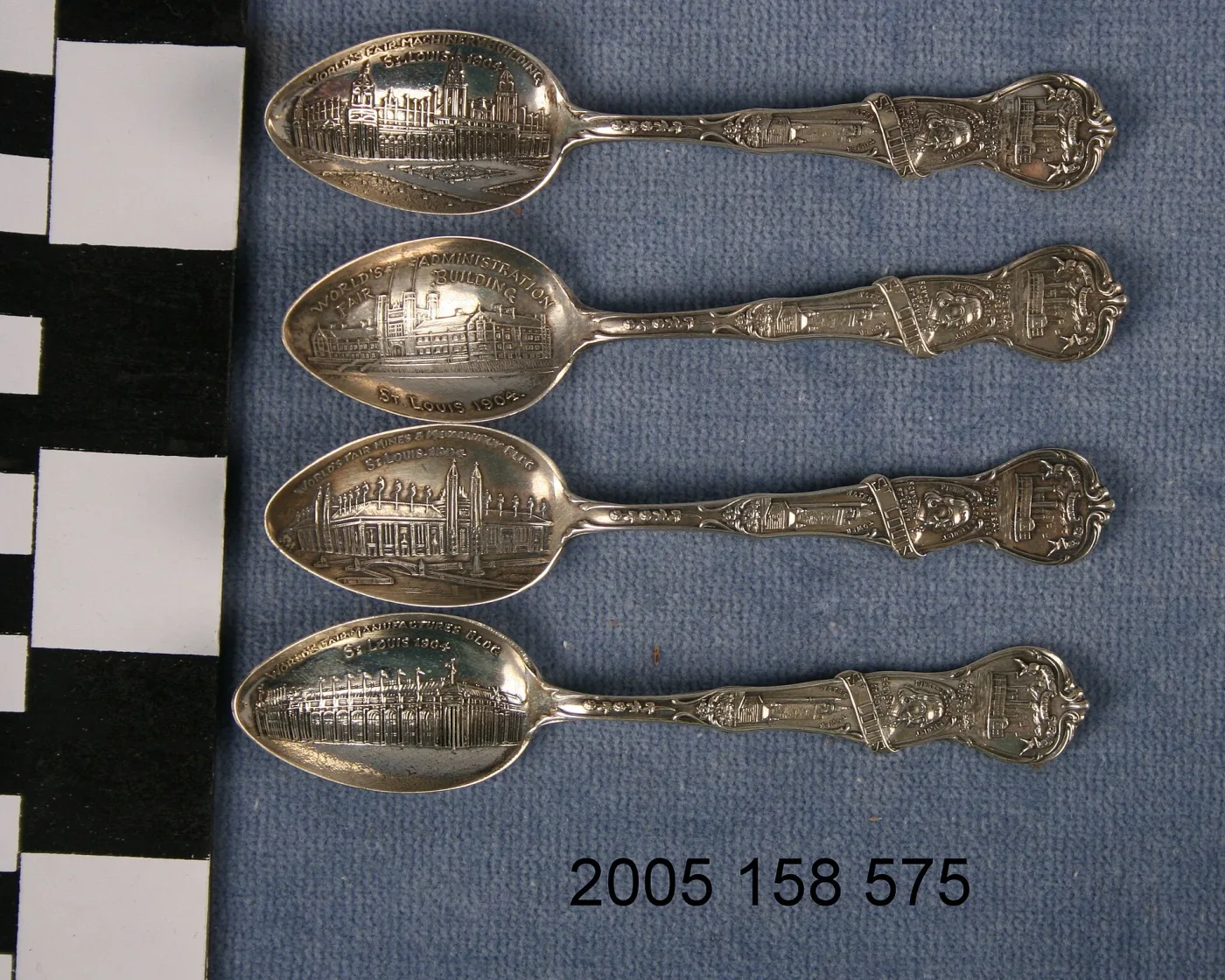
World's fairs played a crucial role in fueling the souvenir spoon craze. The 1893 World's Columbian Exposition in Chicago was a particular watershed moment, generating hundreds of different spoon designs commemorating the fair's buildings, exhibits, and themes. Subsequent fairs, including the 1901 Pan-American Exposition in Buffalo, the 1904 Louisiana Purchase Exposition in St. Louis, and later events, continued to produce sought-after spoon souvenirs that remain highly collectible today.
Decline and Revival
The souvenir spoon craze began to wane after 1910, as changing tastes and the disruptions of World War I shifted public interest. Production continued but at lower volumes, and many manufacturers shifted from sterling silver to silver plate and other less expensive materials — the same sterling-versus-silverplate distinction that governs the value of antique flatware applies just as forcefully to spoons. However, the hobby never entirely disappeared. Mid-twentieth-century tourism revived interest in souvenir spoons, though most post-1940 examples were mass-produced silver plate or stainless steel with limited collector value. Today, the most sought-after pieces remain those from the golden age of 1890 to 1910, when craftsmanship and creativity were at their peak.
Types of Antique Souvenir Spoons
Antique souvenir spoons come in a remarkable variety of forms, each with its own characteristics and collector appeal. Understanding the different types is essential for identification and valuation.
City and State Spoons
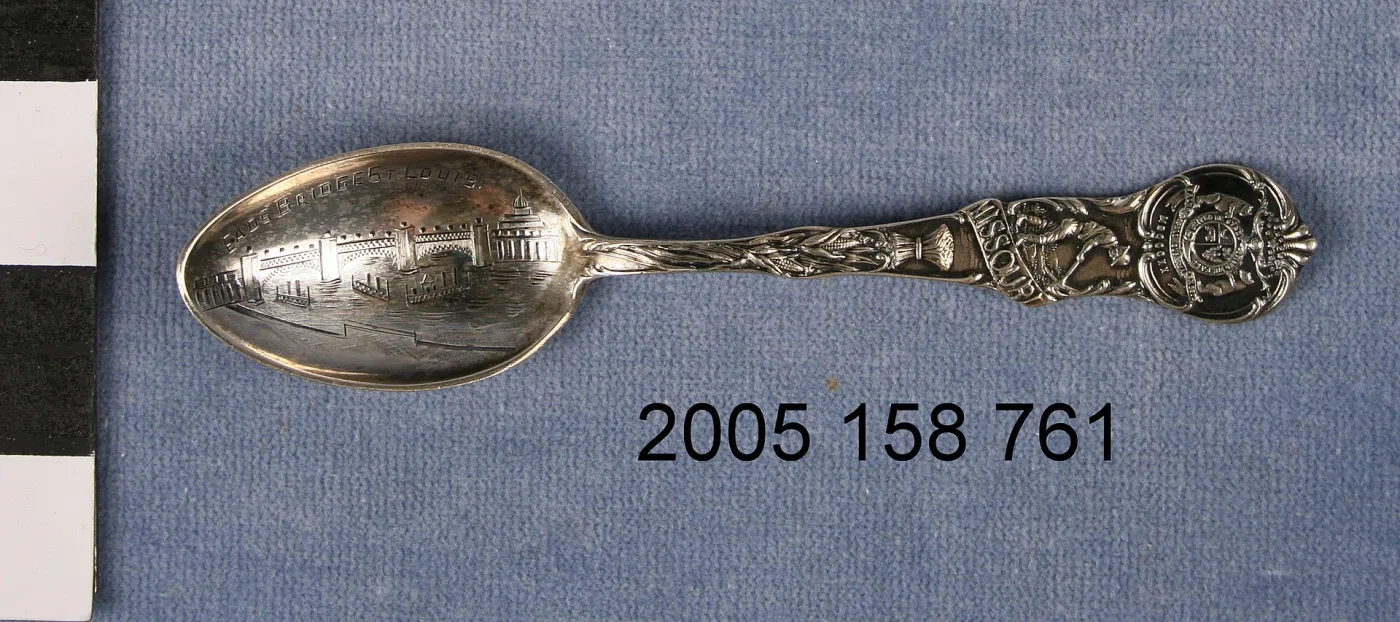
The most common type of souvenir spoon features a specific city, state, or region. These typically display local landmarks, state seals, or regional symbols on the handle or in the bowl, the same place-based appeal that made heraldic Goss and crested china such a popular seaside keepsake. City spoons from major tourist destinations like New York, Washington D.C., Niagara Falls, and San Francisco were produced in large quantities, while spoons from smaller towns are often rarer and more valuable to collectors. State spoons frequently feature the state seal, flower, or a notable landmark, and many collectors pursue complete sets of all states.
Commemorative Spoons
Commemorative spoons were produced to mark specific historical events, anniversaries, or dedications. These include spoons celebrating presidential inaugurations, building dedications, military victories, and civic milestones. Commemorative spoons often carry specific dates that make them easy to identify and date. Notable examples include spoons marking the completion of the Brooklyn Bridge, the dedication of the Statue of Liberty, and various centennial celebrations.
Exposition and World's Fair Spoons
Spoons produced for world's fairs and international expositions form one of the most popular subcategories. These spoons typically feature fair buildings, mascots, or themes, and were sold as souvenirs at the events themselves. The sheer variety of designs produced for major fairs makes this a rich area for collectors, with some fairs generating over one hundred distinct spoon designs from multiple manufacturers.
Figural Handle Spoons
Figural handle spoons feature three-dimensional sculptural elements on the handle, ranging from full-figure representations of people and animals to architectural elements and symbolic objects. These are among the most visually striking and collectible souvenir spoons. Full-figure handles, where the entire handle is shaped as a standing figure, are particularly prized. Common figural themes include Native American figures, historical personalities, animals, and mythological subjects.
Demitasse Spoons
Demitasse souvenir spoons are smaller than standard teaspoons, originally designed for use with after-dinner coffee cups. Their compact size made them popular as affordable souvenirs, and they were produced in enormous quantities. While many demitasse souvenir spoons are relatively common, examples with exceptional figural handles or from rare locations command strong prices.
Enameled Spoons
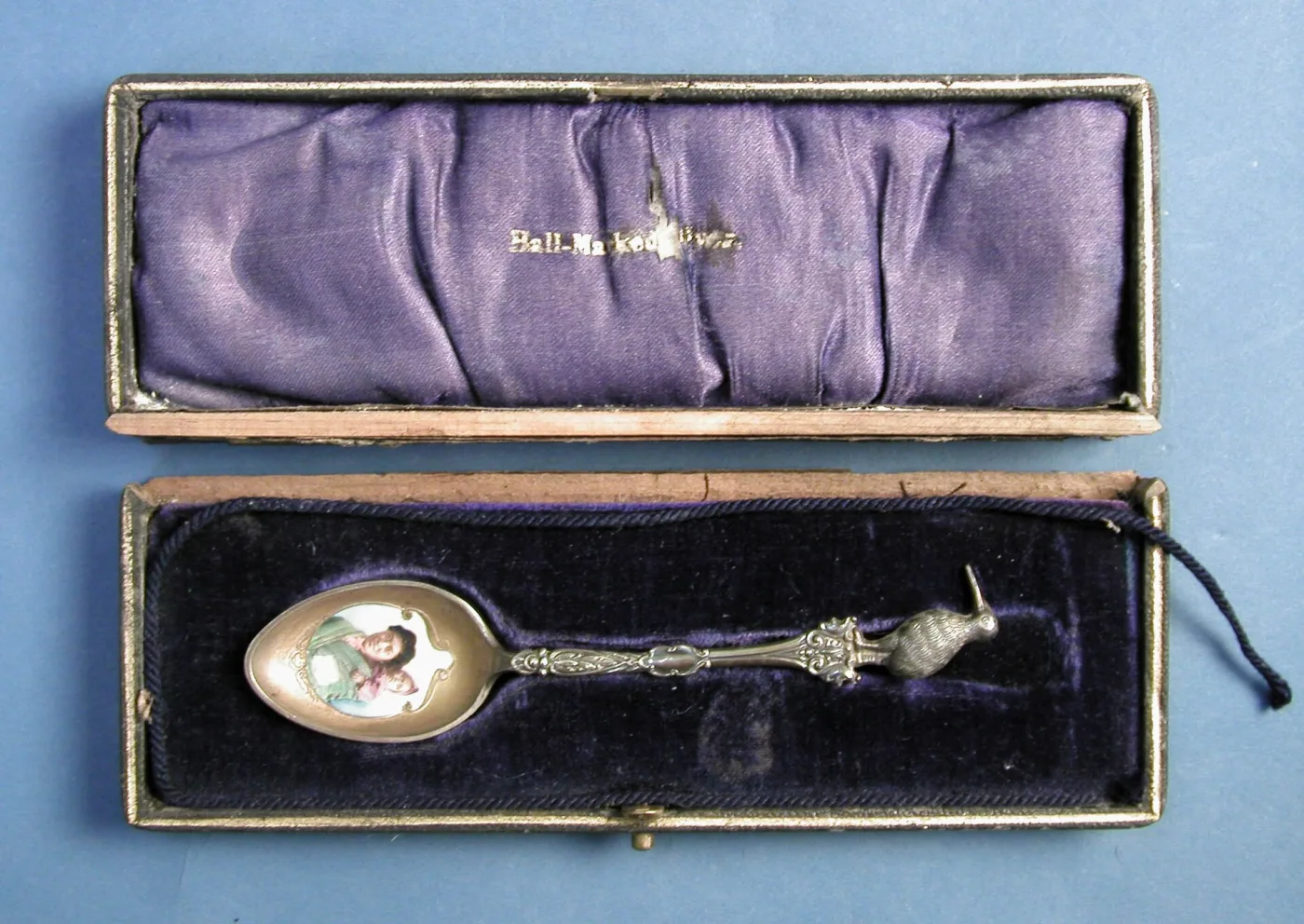
Enameled souvenir spoons feature colored enamel decoration on the handle, bowl, or both. Enamel work ranges from simple colored accents to elaborate cloisonne and champleve techniques. European souvenir spoons are particularly noted for their enamel work, with Scandinavian and Dutch examples being especially collectible. Condition of the enamel is critical to value, as chipping and loss significantly reduce desirability.
Materials and Construction
Understanding the materials used in souvenir spoon production is fundamental to identification and valuation. The material composition directly affects both the historical significance and market value of a spoon.
Sterling Silver
Sterling silver, defined as an alloy containing 92.5% pure silver, was the standard material for quality souvenir spoons during the golden age of collecting. American sterling spoons are typically marked "Sterling" or "925," while British examples carry the lion passant hallmark. Sterling silver souvenir spoons represent the most collectible category, and the weight and quality of the silver itself provides a baseline value. Most sterling souvenir spoons weigh between 15 and 35 grams, with larger or heavier examples generally being more desirable.
Silver Plate
Silver-plated souvenir spoons have a base metal core, usually nickel silver or copper, coated with a thin layer of silver through electroplating. These spoons are typically marked "EPNS" (Electroplated Nickel Silver), "Silver Plate," "A1," or with the manufacturer's plating designation. While less valuable than sterling, silver-plated souvenir spoons with exceptional designs or from rare locations still attract collector interest. The plating quality varies significantly, with better examples showing thicker silver deposits that have survived decades of handling.
The difference stops being subtle once you know where to look. American sterling announces itself in a word — "Sterling", occasionally "925" — struck into the stem or the back of the handle, and because it is struck rather than printed it survives a century of polishing. What separates the two in the hand, though, is how they fail. Solid silver tarnishes evenly and polishes back indefinitely. Plate fails from underneath: the grey mottling and pinholing on the right is base metal coming through a plating layer that has worn thin, and no polish will restore it — polishing removes what silver is left. A spoon carrying no quality mark of any kind should be treated as plate until something proves otherwise.
Coin Silver
Coin silver, containing approximately 90% pure silver, was commonly used for American spoons before the widespread adoption of the sterling standard. Coin silver souvenir spoons are relatively uncommon, as most were produced before the souvenir spoon craze peaked. They may be marked "Coin," "Pure Coin," "C," "D," or "Standard." Coin silver spoons from the early period of the craze, roughly 1890 to 1895, are particularly interesting to collectors as transitional pieces.
Pewter and Other Metals
Pewter souvenir spoons were produced as inexpensive alternatives to silver, particularly during the early twentieth century. These are typically unmarked or carry only a manufacturer's name. Nickel silver, also known as German silver, contains no actual silver but has a silvery appearance. It was widely used for less expensive souvenir spoons and is identifiable by its slightly yellowish tone compared to genuine silver. Brass and bronze souvenir spoons also exist, though they are less common in the American market.
Construction Methods
Understanding how souvenir spoons were made helps with identification and dating. Die-struck spoons were produced by pressing sheet silver between hardened steel dies, creating crisp, detailed designs with consistent depth. This was the most common method for mass-produced souvenir spoons. Cast spoons were made by pouring molten metal into molds, producing heavier pieces with slightly softer detail. Hand-engraved spoons feature designs cut into the metal surface by skilled engravers, identifiable by the slight irregularities and fine line work that distinguish them from machine-made patterns. Many high-quality souvenir spoons combined methods, using die-struck blanks with hand-finished details.
Identifying Hallmarks and Maker's Marks
Hallmarks and maker's marks are the most important clues for identifying and dating antique souvenir spoons. Learning to read these marks accurately is an essential skill for any collector.
American Sterling Marks
American souvenir spoons are typically marked on the reverse of the handle. The most common mark is the word "Sterling" or "Sterling Silver," indicating 92.5% silver content. This standard became legally enforced in the United States after the passage of the National Stamping Act of 1906, though most reputable manufacturers used the mark voluntarily before that date. In addition to the sterling mark, you will usually find the manufacturer's mark, which may be a name, initials, or a symbol. Some manufacturers also included pattern numbers or design codes.
Silver Plate Marks
Silver-plated souvenir spoons carry different marks from sterling pieces. Common designations include "EPNS" for Electroplated Nickel Silver, "Quadruple Plate" or "4X Plate" for heavier plating, "A1" for first-quality plating, and various manufacturer-specific codes. The absence of a "Sterling" mark on an American spoon almost always indicates silver plate or a base metal. Be cautious of marks like "Silver" alone, "Nickel Silver," or "German Silver," which indicate base metals rather than genuine silver.
British Hallmarks
British souvenir spoons carry a comprehensive hallmarking system that provides detailed information about the maker, silver content, date, and assay office. The British hallmark system includes four or five marks struck together: the maker's mark (usually initials), the standard mark (lion passant for sterling), the assay office mark (identifying the city where the piece was tested), the date letter (a letter in a specific font and shield shape indicating the year of manufacture), and occasionally a duty mark (the sovereign's head, indicating tax was paid). This system makes British spoons among the easiest to date precisely.
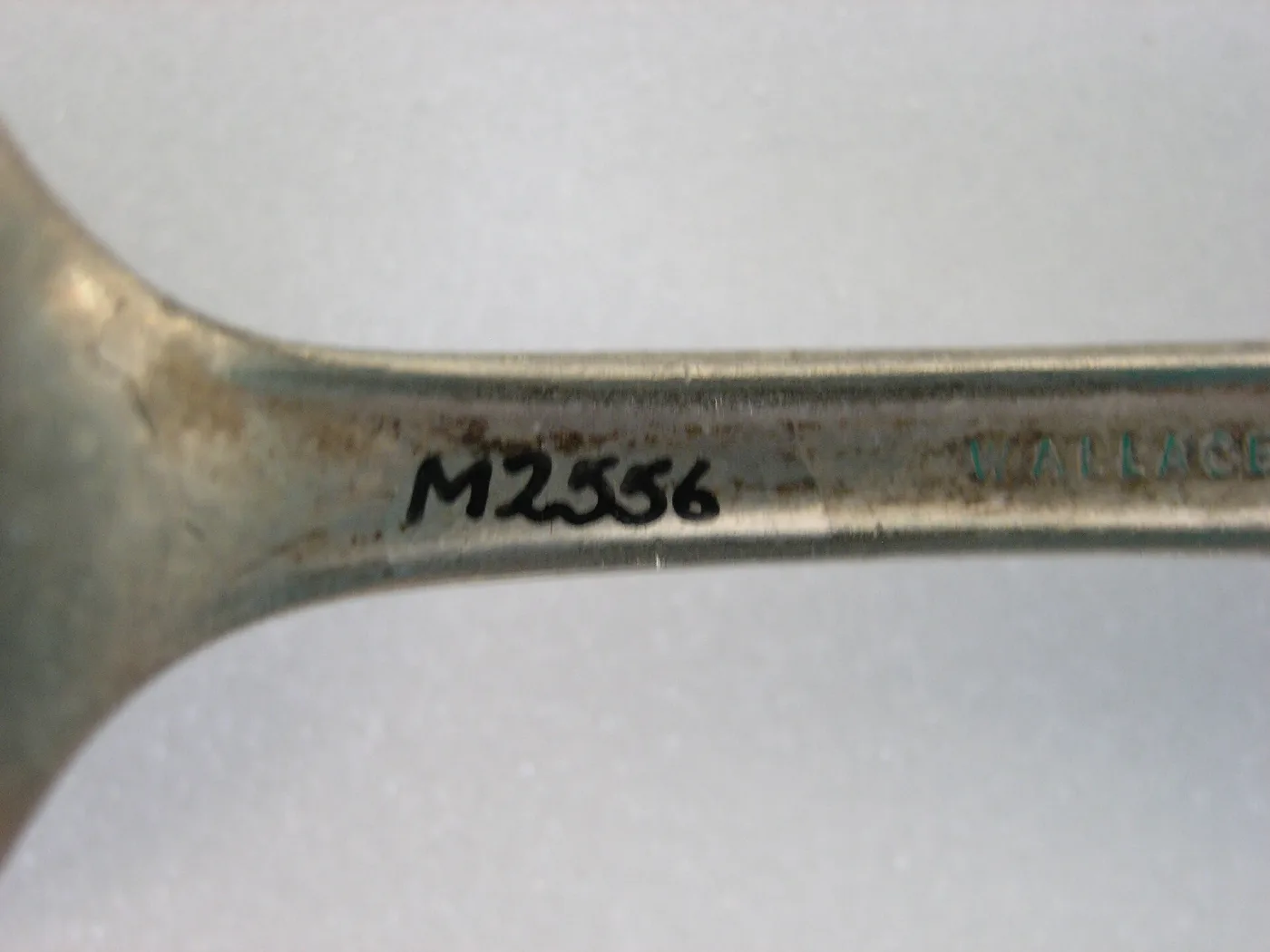
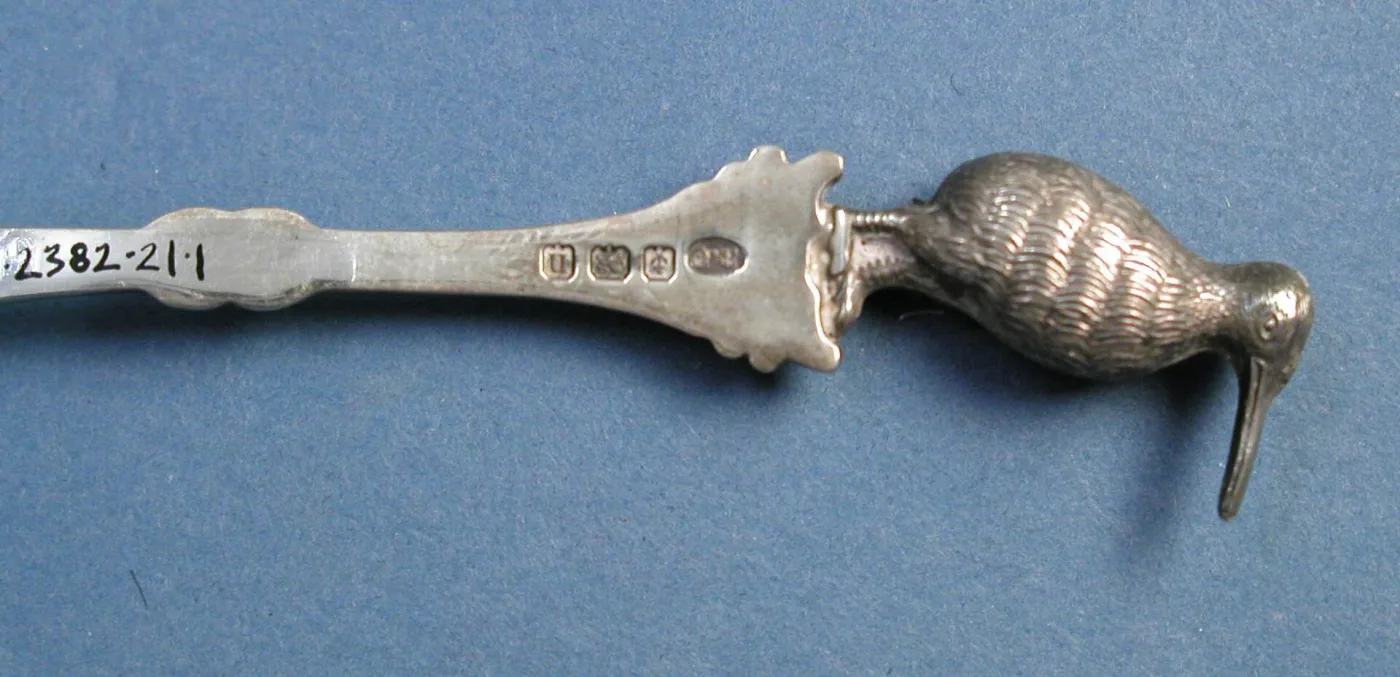
That difference decides how precisely a spoon can be dated. The American mark on the left names the firm and stops there; the year has to be inferred from the design, the place name, or a patent stamp elsewhere on the piece. The British row on the right encodes the year outright in the date letter, so a visually identical spoon can be pinned to a twelve-month period from the punches alone — provided the letter is read against the correct assay office, because each office ran its own alphabet and the same letter in the same font means different years in London and Birmingham. Count the punches before anything else: four or five in a row is British, one or two is almost always American.
Reading Assay Office Marks
British assay office marks identify where a piece was tested for silver content. The major offices and their symbols are: London (leopard's head), Birmingham (anchor), Sheffield (crown, later a rose), Edinburgh (castle), Chester (a combination of the city arms), and Dublin (crowned harp). Each office used its own sequence of date letters, so the same letter can indicate different years depending on the assay office. Reference books such as Bradbury's Book of Hallmarks are essential for accurate dating of British silver.
Continental European Marks
European countries each developed their own marking systems. French silver carries a hallmark system including the maker's mark in a lozenge shape, a guarantee mark indicating silver content (the Minerva head for 950 standard, or the mercury head for 800 standard), and sometimes an import mark. German silver is often marked with a crescent moon and crown symbol alongside the silver fineness number (typically 800 or 835). Dutch silver carries various marks including a lion passant, and Scandinavian silver uses national symbols alongside purity marks.
Major American Manufacturers
The souvenir spoon craze of the 1890s engaged virtually every silver manufacturer in America. Understanding the major makers and their marks is essential for accurate identification and valuation.
Gorham Manufacturing Company
Gorham, founded in Providence, Rhode Island, in 1831, was one of the largest and most prolific producers of souvenir spoons. The company's mark is a lion, an anchor, and a capital G. Gorham produced hundreds of souvenir spoon designs in sterling silver, ranging from simple engraved city spoons to elaborate figural pieces. The company's quality was consistently high, and their spoons are among the most sought-after by collectors. Gorham also used a date-letter system from 1868 onward, with letters and symbols stamped alongside the maker's mark to indicate the year of manufacture.
Tiffany & Co.
Tiffany & Co. produced some of the finest and most valuable souvenir spoons. The company's mark typically reads "Tiffany & Co." alongside "Sterling" and a pattern number. Tiffany souvenir spoons were produced in smaller quantities than those of larger manufacturers, making them relatively scarce. Their designs are noted for exceptional quality and artistic merit, and Tiffany spoons consistently command premium prices at auction. The company also produced presentation spoons and special-order designs for wealthy clients.
Whiting Manufacturing Company
Whiting, based in North Attleboro, Massachusetts, was a major producer of souvenir spoons during the peak years of the craze. The company's mark features an intertwined "W" within a circle, often accompanied by "Sterling." Whiting was absorbed by Gorham in 1926, making pre-merger pieces of particular interest. The company was known for its detailed figural handles and high-relief bowl engravings.
Towle Silversmiths
Towle, founded in Newburyport, Massachusetts, in 1690, making it one of America's oldest silver companies, produced numerous souvenir spoon designs. The company's mark is a "T" enclosed in a shield shape, often with a lion. Towle spoons are well-made and relatively common in the market, offering collectors good value for the quality. The company's long history means their marks evolved over time, which helps with dating.
Watson Company
The Watson Company of Attleboro, Massachusetts, was a significant producer of souvenir spoons, particularly in the demitasse size. Their mark is typically "W" in a keystone shape or "Watson" spelled out. Watson spoons are generally well-made and offer good collector value, though they are not as widely recognized as Gorham or Tiffany pieces.
Daniel Low & Co.
Daniel Low, the Salem jeweler who started the American souvenir spoon craze, continued to produce and retail spoons throughout the 1890s and beyond. Low did not manufacture spoons himself but commissioned them from various makers including Gorham and Durgin. Spoons retailed by Daniel Low typically carry both the manufacturer's mark and Low's retailer mark. The original Salem Witch spoon and its many variations remain among the most iconic American souvenir spoons.
Other Notable Manufacturers
Durgin, based in Concord, New Hampshire, produced fine quality souvenir spoons marked with a "D" in a shield. Mechanics Sterling Company of Attleboro made affordable sterling souvenir spoons. Alvin Manufacturing Company produced well-crafted spoons marked with an "A" in a shield or "Alvin." Paye & Baker of North Attleboro specialized in detailed figural spoons and their mark features "P&B" in a shield. R. Wallace & Sons, Shepard Manufacturing, and dozens of smaller firms also contributed designs to the enormous souvenir spoon market of the 1890s.
European Makers and Hallmarks
European souvenir spoons have their own rich tradition, with distinct national styles and hallmarking systems that make identification both challenging and rewarding.
British Silversmiths
British souvenir spoons were produced by firms including James Dixon & Sons of Sheffield, Mappin & Webb, Elkington & Co., and numerous smaller workshops. The comprehensive British hallmarking system makes these spoons among the easiest to identify precisely, with exact years of manufacture determinable from date letters. British souvenir spoons often feature enamel work and celebrate royal events, coronations, and local landmarks — the same firms also turned out enamelled commemorative napkin rings for the tourist trade, often sharing decorative motifs with their spoons. The quality of British silver is consistently high, as the assay system ensures genuine silver content.
Dutch Souvenir Spoons
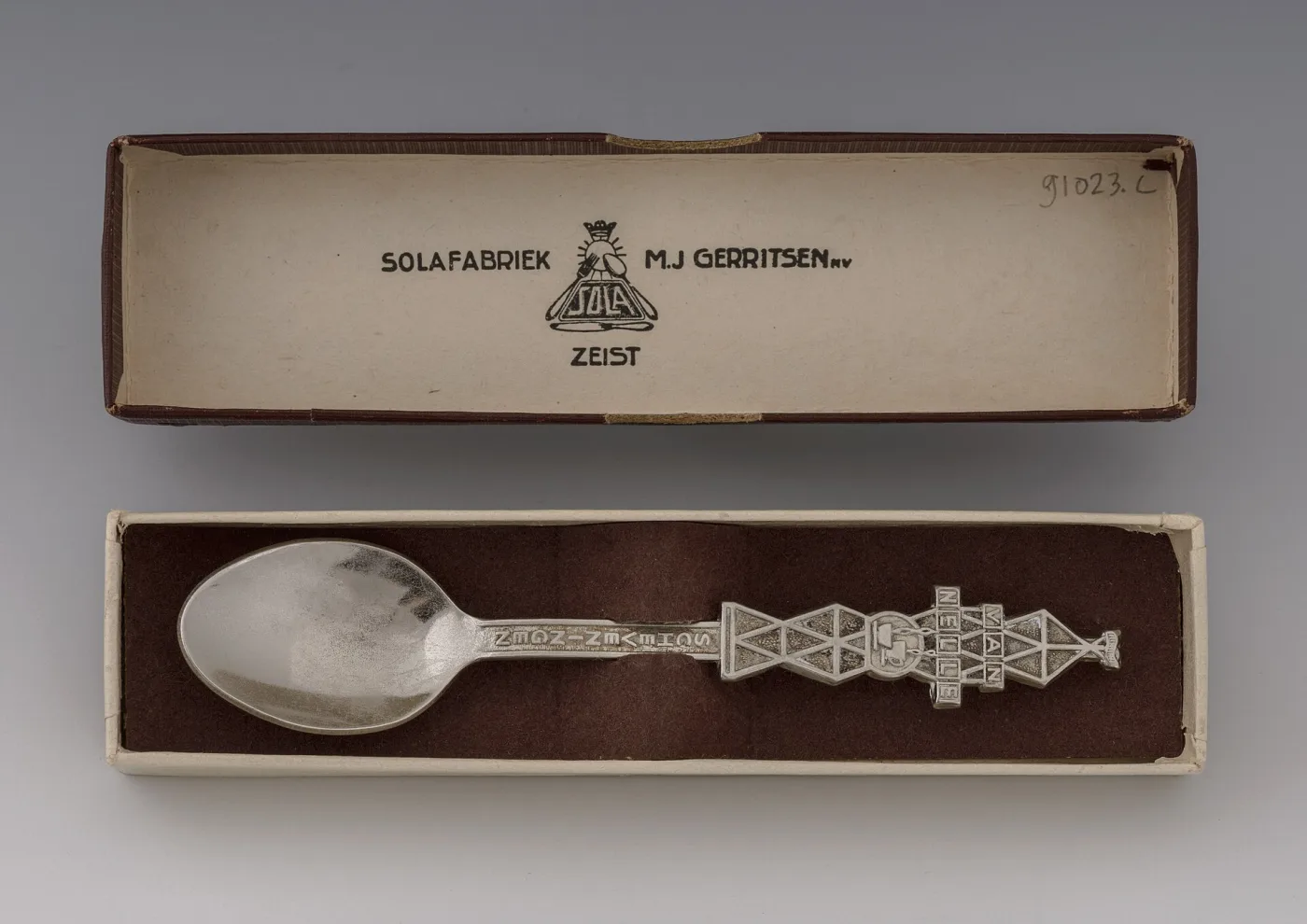
The Netherlands has a long tradition of decorative spoon production, and Dutch souvenir spoons are noted for their windmill handles, regional costume figures, and city-themed designs. Dutch silver is typically marked with a lion passant and a date letter, along with the maker's mark. The fineness is usually 833 (equivalent to the second Dutch standard) or 925 for sterling. Dutch enamel spoons, particularly those from the early twentieth century, are highly collectible for their detailed and colorful decoration.
German and Austrian Makers
German souvenir spoons are often marked with "800" or "835" indicating the silver fineness, alongside the crescent moon and crown national mark. Major German silver centers included Hanau, Pforzheim, and Schwabisch Gmund. German souvenir spoons frequently feature elaborate scenic designs, city views, and heraldic symbols. Austrian spoons from the Habsburg period carry the "Dianakopf" mark, a profile head of Diana used as the Austro-Hungarian guarantee mark, providing precise dating based on the specific form of the mark used in different periods.
Scandinavian Silver
Scandinavian souvenir spoons, particularly from Norway and Denmark, are prized for their exceptional enamel work. Norwegian silversmiths including David Andersen, Marius Hammer, and J. Tostrup produced stunning plique-a-jour and guilloche enamel spoons that rank among the finest decorative spoons ever made. Norwegian silver is typically marked "830S" or "925S" alongside the maker's mark. Danish silver, influenced by the Georg Jensen style, tends toward cleaner, more modernist designs. Swedish souvenir spoons often carry the three crowns national mark.
Other European Traditions
Italian souvenir spoons frequently feature Roman and Renaissance themes, with silver content typically marked "800." Swiss souvenir spoons celebrate Alpine scenery and are often enameled. Belgian and French souvenir spoons are less commonly encountered in the American market but include fine examples with Art Nouveau influences. Russian souvenir spoons, particularly pre-Revolutionary examples with niello work or cloisonne enamel, are rare and highly sought after. Each country's marking system requires specific reference materials for accurate identification.
Bowl Designs and Engravings
The bowl of a souvenir spoon is often as important as the handle for identification and collector appeal. Bowl designs range from simple monograms to elaborate pictorial scenes.
Scenic Engravings
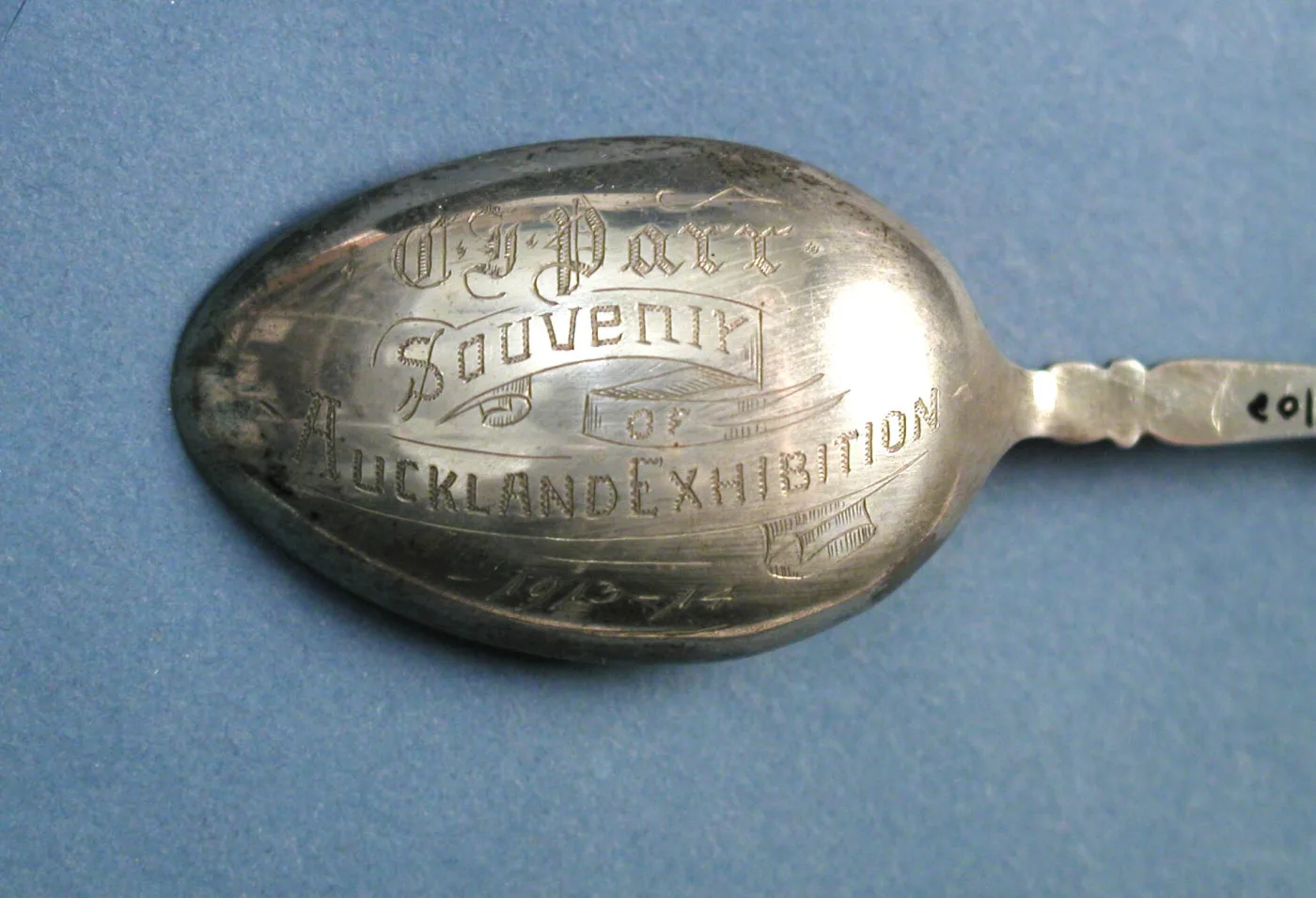
Many souvenir spoon bowls feature engraved scenes of buildings, landscapes, or cityscapes. Common subjects include state capitols, courthouses, hotels, waterfalls, and other tourist landmarks. The quality of these engravings varies enormously. Hand-engraved scenes show fine, slightly irregular line work with varying depths, while machine-engraved or acid-etched designs have uniform, precise lines. The best hand-engraved bowls are miniature works of art, with remarkable detail achieved in a very small space. Some bowls feature photographic transfer prints, which can be identified by their dot-matrix appearance under magnification.
Embossed and Die-Struck Bowls
Some souvenir spoons feature bowl designs created by die-striking, where the design is pressed into the metal from the reverse side to create a raised image on the front. These embossed bowls typically show bolder, more dimensional designs than engraved examples. Buildings, faces, and landscapes were common subjects for embossed bowl decoration. The quality of die-struck bowls depends on the precision of the original die and the pressure used during striking.
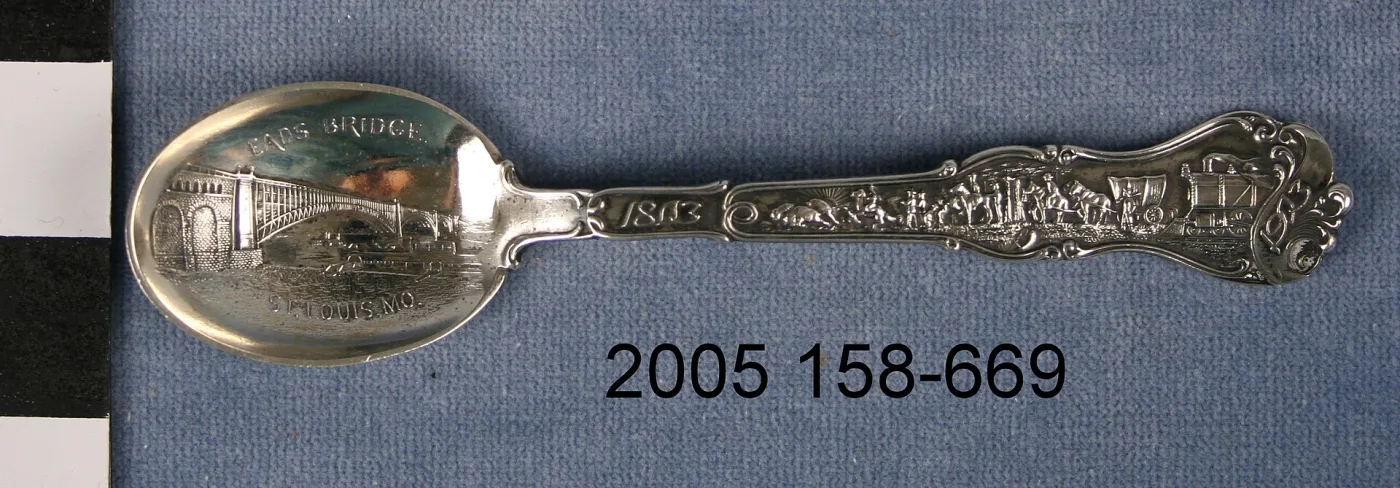
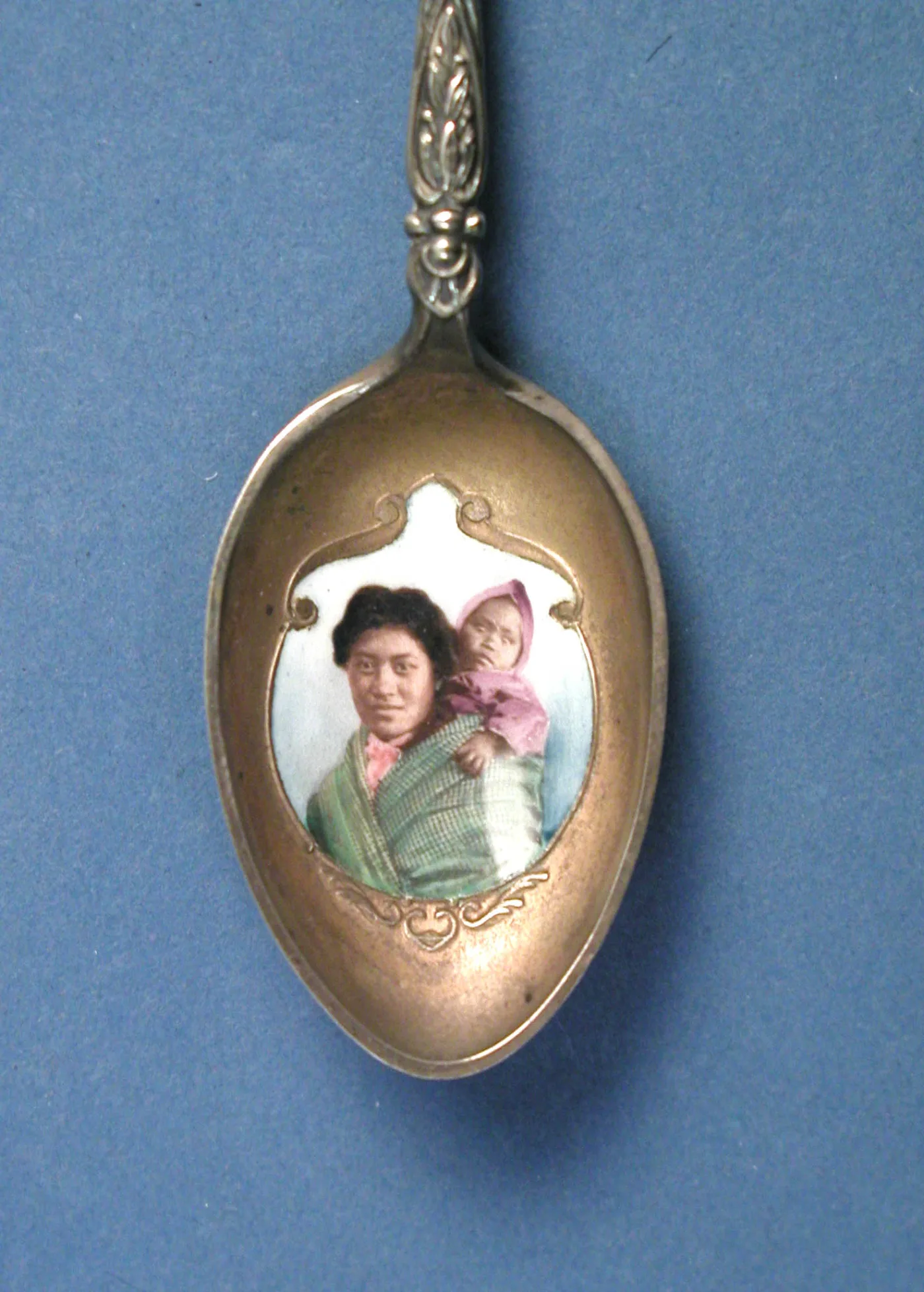
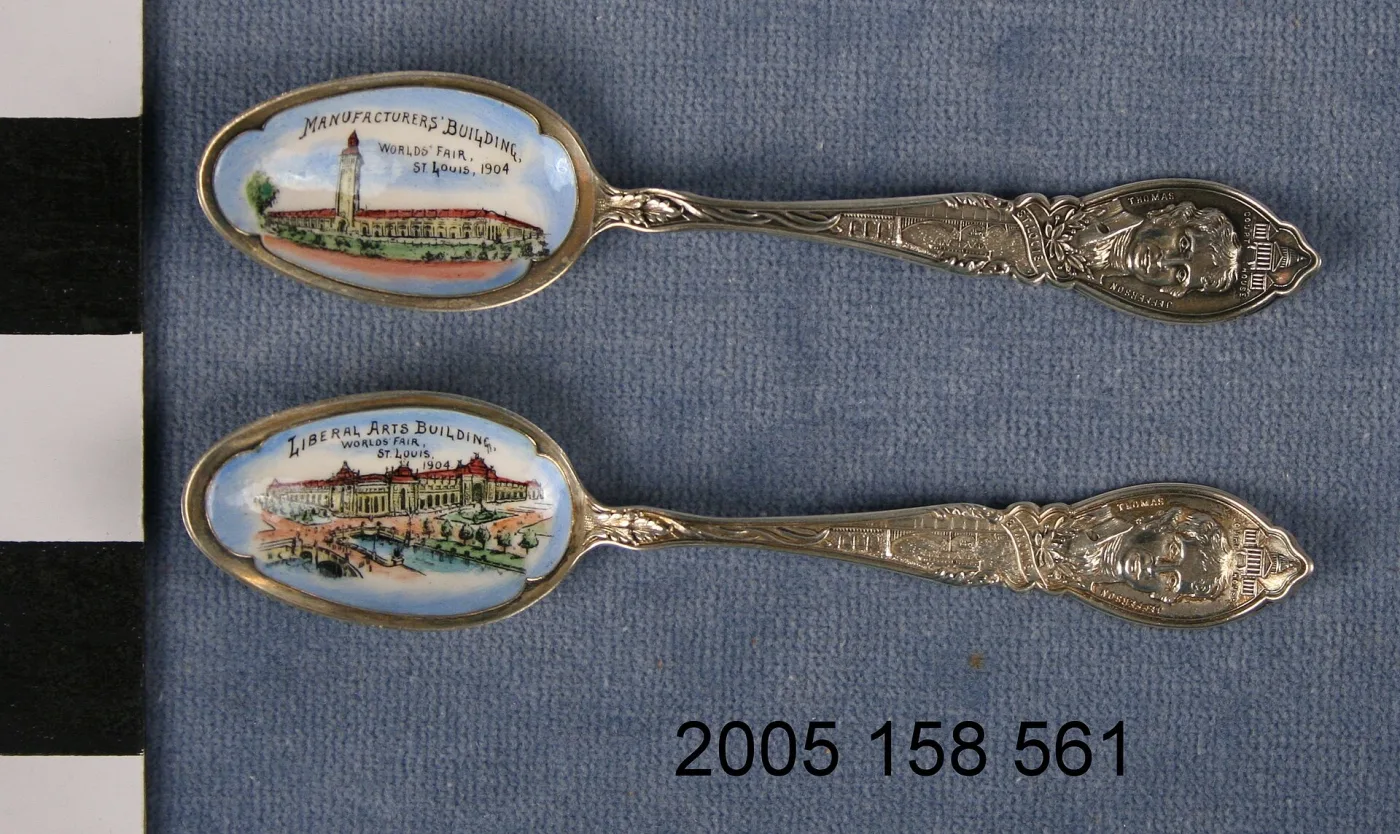
Three techniques account for nearly every decorated bowl, and they are separated by surface rather than by subject. A die-struck bowl is dimensional: the image has height, and because picture and caption were raised in one strike they can never sit crooked to each other. Hand engraving is cut into the surface rather than pushed out of it, so the lines vary in depth, catch the light differently along their length, and wander slightly where the graver was reset. Enamel is neither — it is a separate material laid into a recess and fired, which is why it alone can carry photographic tone and full colour, and why it is the only bowl decoration that chips rather than wears.
Enamel Bowl Decoration
Enameled bowls represent some of the most visually striking souvenir spoons. The enamel may fill the entire bowl interior or appear as accents within an engraved design. City crests, flags, and colorful scenic views were popular subjects for bowl enamel work. Scandinavian and Dutch spoons are particularly noted for their bowl enamel quality. When evaluating enameled bowls, check carefully for chips, cracks, and areas of loss, as enamel damage significantly affects value and is difficult to repair convincingly.
Gold-Washed Bowls
Many sterling silver souvenir spoons feature gold-washed or gold-plated bowls. This gilding served both an aesthetic and practical purpose, as gold does not tarnish and protects the bowl from the acidic effects of certain foods. The presence of original gold wash generally enhances value, though worn or partially missing gold wash is common on well-used spoons. Gold-washed bowls are identified by their warm yellow color compared to the surrounding silver, though heavy tarnish can sometimes obscure the distinction.
Handle Styles and Figural Designs
The handle is typically the most distinctive and collectible feature of a souvenir spoon. Handle designs range from simple engraved patterns to elaborate three-dimensional sculptures.
Full-Figure Handles
Full-figure handles feature a complete sculptural figure forming all or most of the handle. These are among the most valuable and sought-after souvenir spoons. Common subjects include standing human figures, animals, and mythological beings. The best full-figure handles are detailed miniature sculptures with remarkable artistry. Manufacturing these required complex multi-part molds and careful hand-finishing, making them more expensive to produce and consequently rarer today.
Bust and Portrait Handles
Bust handles feature the head and shoulders of a person, typically a historical figure, at the top of an otherwise conventional handle. George Washington, Christopher Columbus, and various Native American chiefs are common subjects. Presidential bust spoons were produced throughout the golden age, and a complete set of presidential souvenir spoons is a popular collecting goal. Portrait handles may be die-struck in relief or cast as three-dimensional busts.
Indian Head Spoons
Spoons featuring Native American imagery were extremely popular during the souvenir spoon craze, reflecting the period's widespread fascination with indigenous cultures. These range from simple profile heads to elaborate full-figure handles depicting Native Americans in traditional dress. While culturally complex by modern standards, these spoons are significant historical artifacts documenting late nineteenth-century artistic interpretation and cultural attitudes. Indian head spoons were produced by virtually every major manufacturer and remain popular with collectors.
Floral and Botanical Handles
Floral handle designs are common on souvenir spoons, often representing the state flower or a regionally significant plant. These designs range from naturalistic renderings of specific species to stylized Art Nouveau interpretations. Many state souvenir spoons feature the state flower on the handle combined with a state landmark in the bowl. The Art Nouveau period, roughly 1890 to 1910, coincided precisely with the souvenir spoon craze, and many spoons reflect the flowing organic lines characteristic of that style.
Patriotic and Symbolic Handles
Eagles, flags, the Liberty Bell, the Statue of Liberty, and other patriotic symbols appear frequently on souvenir spoon handles. State seal handles reproduce the official seal of a state in miniature, often with remarkable detail. Fraternal organization symbols, including Masonic emblems, Odd Fellows symbols, and various lodge insignia, also appear on souvenir spoons. Patriotic themes were especially popular during periods of national celebration, such as centennial anniversaries and major expositions.
Architectural and Landmark Handles
Some souvenir spoons feature buildings or landmarks incorporated into the handle design. The Eiffel Tower, the Brooklyn Bridge, and various lighthouses were popular subjects. These architectural handles required skilled die-cutting to capture structural details in miniature, and the best examples are remarkably accurate representations of their subjects. Collectors often seek spoons depicting specific buildings that no longer exist, adding historical documentation value to their aesthetic appeal.
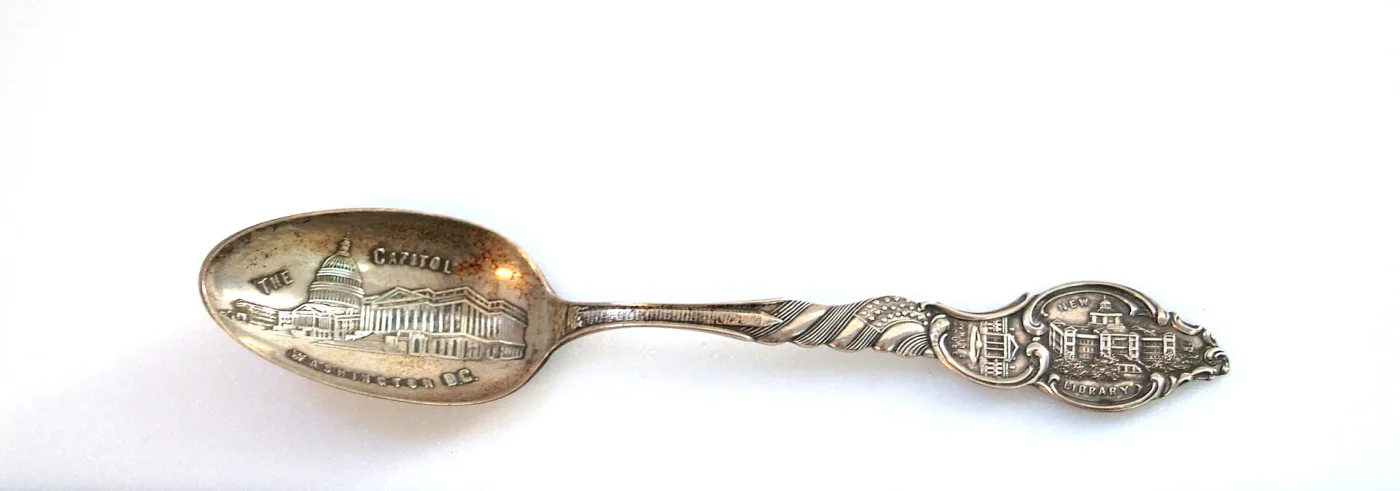
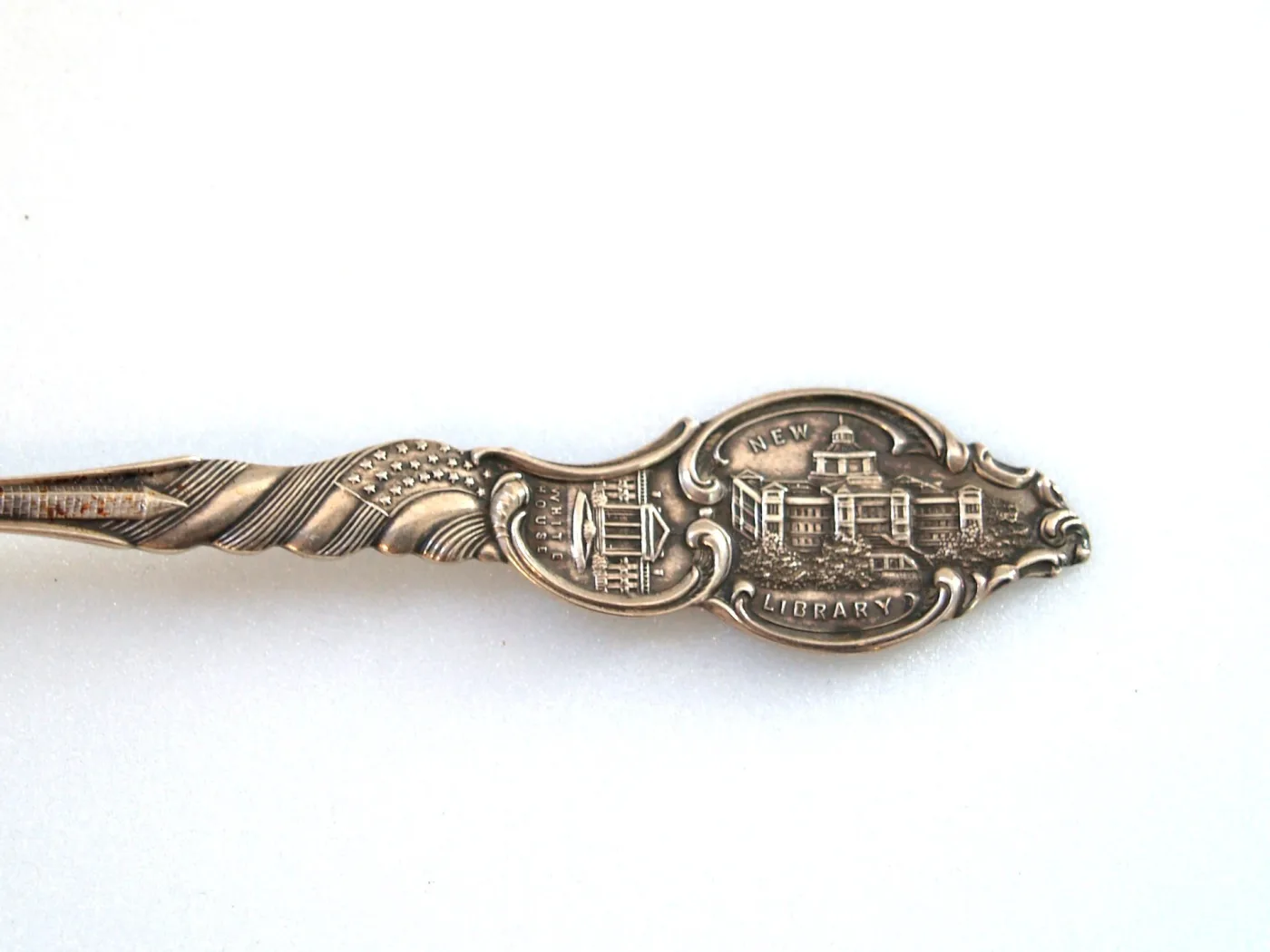
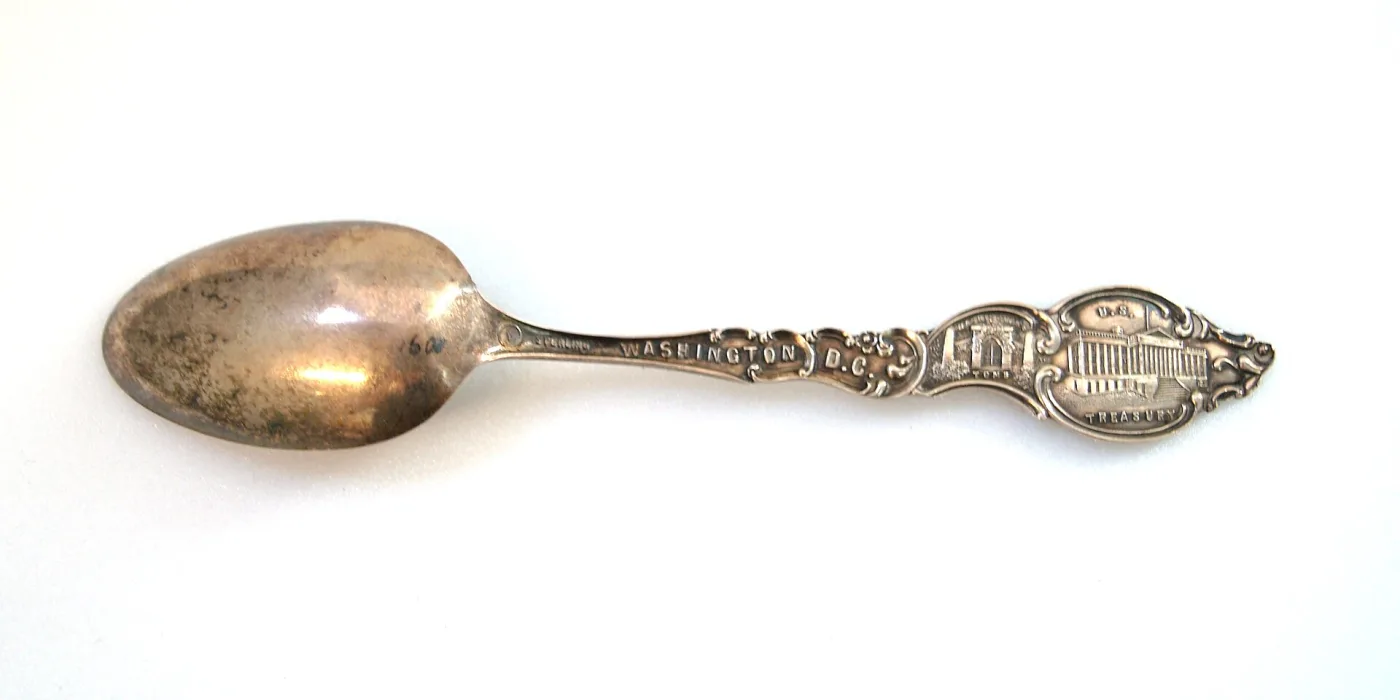
This one handle names three Washington landmarks — the Capitol in the bowl, the White House and the "New Library" in the finial cartouches — and the useful word is "New". Souvenir manufacturers advertised whatever had just opened, and nothing stays new for long, so a spoon that calls the Library of Congress new was designed in the years just after that building opened in 1897, not decades afterwards. Read every label on a handle rather than only the large one: the subsidiary cartouches are usually where the dating evidence hides, and they are small enough that most sellers never mention them.

Dating Antique Souvenir Spoons
Accurately dating a souvenir spoon adds significantly to its historical value and helps with authentication. Several methods can be used to establish the approximate or exact date of manufacture.
Style Evolution
Souvenir spoon designs evolved in recognizable patterns over time. Early examples from 1890 to 1895 tend to have simpler handle designs with detailed hand-engraved bowls. The peak period of 1895 to 1905 produced the most elaborate figural handles and highest-quality engraving. Post-1905 spoons often show signs of cost-cutting, with thinner metal, less detailed engraving, and simpler handle designs. By the 1920s, Art Deco influences began appearing in handle designs, with geometric patterns replacing the organic forms of the earlier period.
Patent Dates and Design Registration
Many souvenir spoons carry patent dates stamped on the reverse. These dates indicate when the design was registered, not necessarily when the specific spoon was made, as popular designs continued in production for years. However, a patent date provides a firm earliest possible date of manufacture. Common formats include "Pat. [date]," "Pat'd [date]," or "Des. Pat. [number]." Patent dates are especially useful when combined with other dating evidence to narrow the production period.
Maker Period Dating
Changes in manufacturer marks over time provide dating clues. Gorham's date-letter system is the most comprehensive, with specific symbols corresponding to each year of production. Other manufacturers changed their marks when ownership, location, or corporate structure changed. For example, Whiting Manufacturing Company marks changed when the firm was absorbed by Gorham in 1926, so a Whiting mark indicates pre-1926 production. Reference books detailing the evolution of specific manufacturers' marks are invaluable for this type of dating.
Construction and Technology Clues
Manufacturing technology evolved over the souvenir spoon period, leaving dating clues in the spoons themselves. Earlier spoons tend to be heavier with more hand-finishing. Machine polishing marks, which appear as fine parallel lines under magnification, become more common in later production. The style of lettering used for city names and other inscriptions also evolved, with earlier pieces often featuring hand-cut lettering and later examples showing machine-stamped characters. The presence of a patent notice format can also help, as the format of American patent marks changed several times during the relevant period.
World's Fair and Exposition Spoons
World's fair and exposition spoons form one of the most popular and well-documented subcategories of souvenir spoon collecting. These spoons combine historical significance with artistic merit and offer excellent opportunities for focused collecting.
1893 World's Columbian Exposition
The Chicago World's Fair of 1893 generated more souvenir spoons than any other single event in history. Hundreds of distinct designs were produced by dozens of manufacturers, depicting fair buildings including the Administration Building, the Manufactures and Liberal Arts Building, and the iconic Ferris wheel. Columbus-themed spoons, featuring the explorer's portrait or his ships, were especially popular. Prices for Columbian Exposition spoons range widely, from under ten dollars for common designs to several hundred for rare figural pieces or those by prestigious makers like Tiffany.
1901 Pan-American Exposition
The Pan-American Exposition in Buffalo, New York, produced a significant number of souvenir spoons featuring the fair's distinctive Spanish Renaissance architecture and its Electric Tower. Tragically, the exposition is also remembered for the assassination of President William McKinley, and spoons commemorating this event were quickly produced. Pan-American spoons are moderately scarce and generally command higher prices than common Columbian Exposition pieces.
1904 Louisiana Purchase Exposition
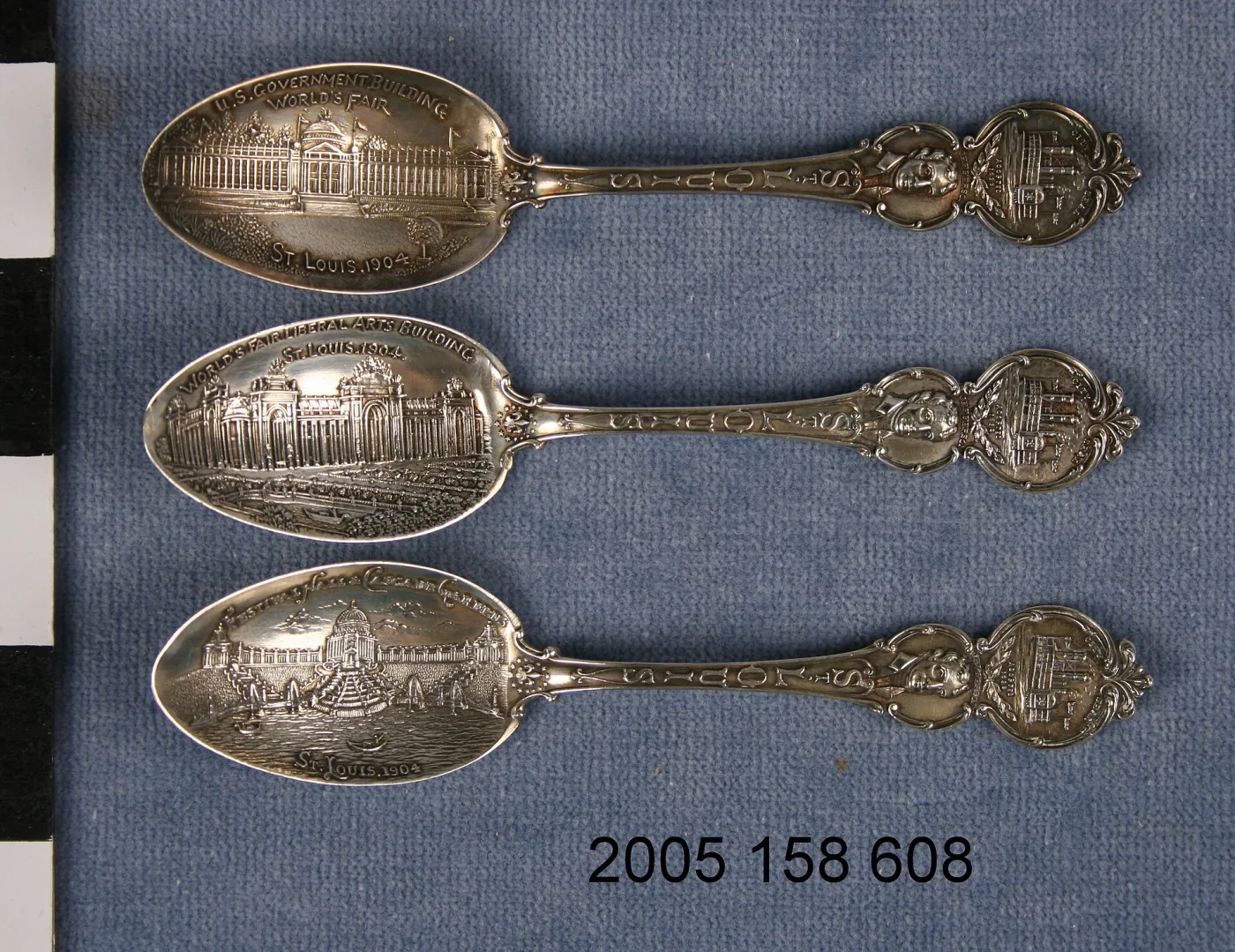
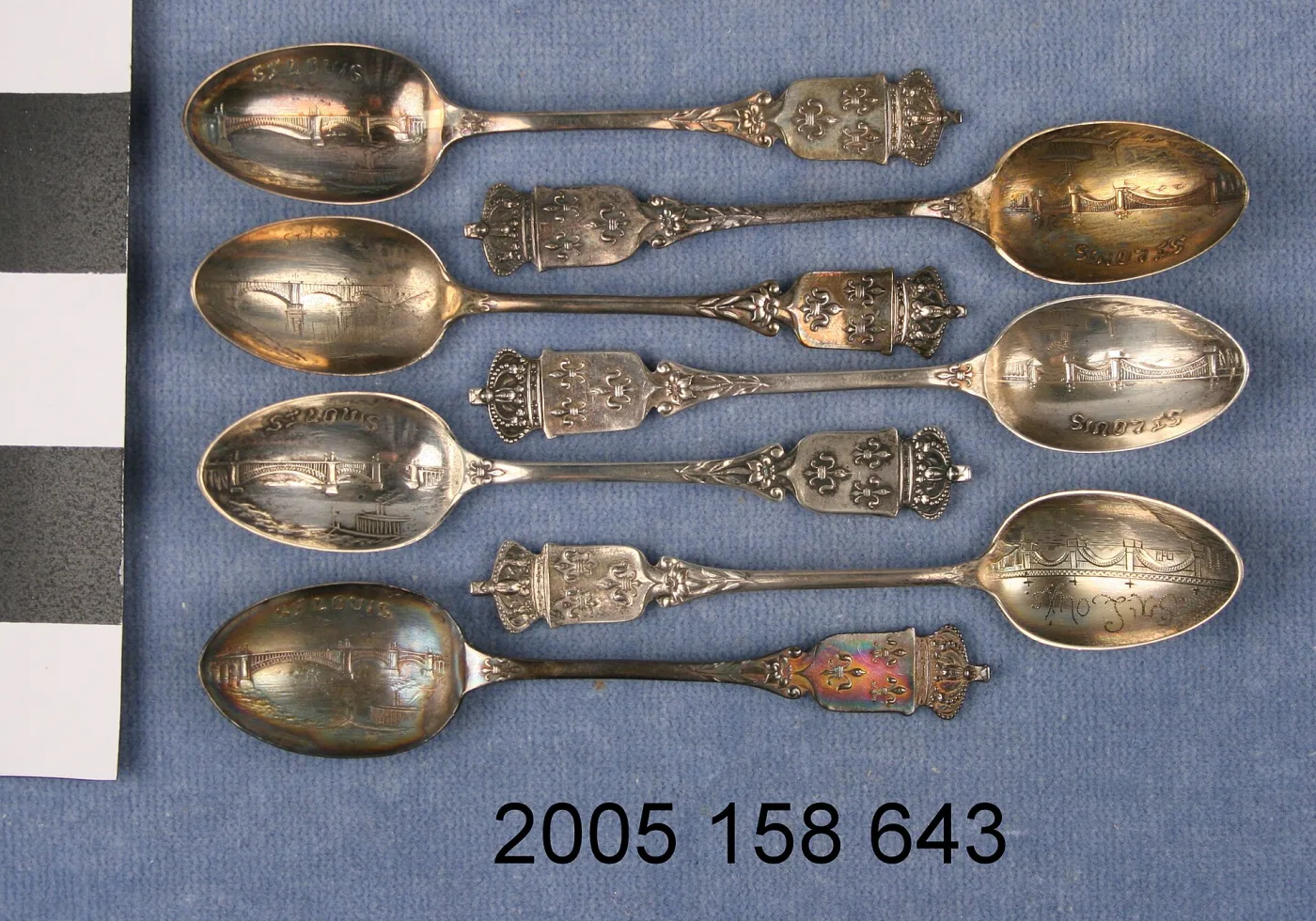
The St. Louis World's Fair of 1904 celebrated the centennial of the Louisiana Purchase and generated a wide variety of souvenir spoons. Popular designs feature the fair's Festival Hall, the Cascades, and the Palace of Varied Industries. Many St. Louis fair spoons also incorporate the iconic Fleur-de-lis symbol. The quality of 1904 exposition spoons is generally high, as the souvenir spoon market was still robust during this period.
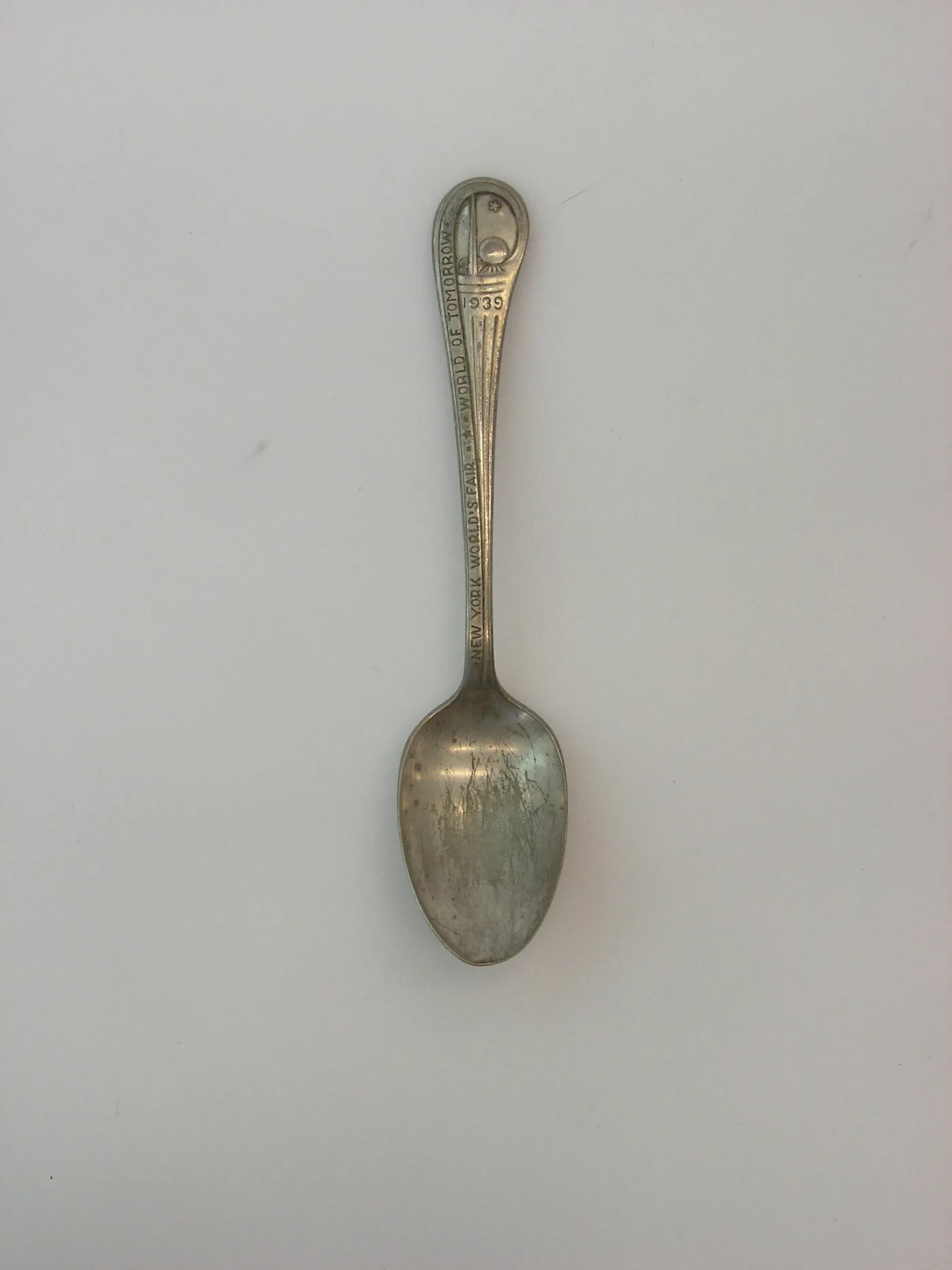
1939 New York World's Fair
The 1939 World's Fair in New York produced souvenir spoons that bridge the gap between antique and vintage collecting. These Art Deco-influenced designs feature the fair's iconic Trylon and Perisphere structures. Most 1939 fair spoons are silver plated rather than sterling, reflecting the economic realities of the Great Depression era and the general decline in sterling souvenir spoon production. Despite their more modest materials, these spoons are popular with both World's Fair collectors and Art Deco enthusiasts.
Other Notable Expositions
Collectors also seek spoons from the 1876 Centennial Exhibition in Philadelphia (rare, pre-craze examples), the 1898 Trans-Mississippi Exposition in Omaha, the 1905 Lewis and Clark Exposition in Portland, the 1915 Panama-Pacific International Exposition in San Francisco, and the 1933 Century of Progress Exposition in Chicago. Each fair produced distinct designs reflecting the artistic and cultural themes of its era, and a collection spanning multiple fairs provides a fascinating visual timeline of American decorative arts.
Evaluating Condition and Quality
Condition is a critical factor in souvenir spoon value. Learning to evaluate condition accurately helps collectors make informed buying decisions and properly value their collections.
Wear Patterns
Normal wear on souvenir spoons appears as softened details, particularly on high points of the design. Bowls that were used for eating will show scratches and thinning on the front surface. Handles frequently show wear at points of contact with spoon racks or display holders. Light, even wear consistent with age is generally acceptable and expected on genuine antique spoons. Heavy wear that obscures design details or maker's marks significantly reduces collector value.
Monogram Removal
Many souvenir spoons were personalized with engraved monograms or initials. Monogram removal, while common, is detectable and reduces value. Signs of removed monograms include a slightly concave area on the handle where metal was buffed away, a difference in surface texture or finish in the area, and thinning of the metal visible when the spoon is held to the light. Original monograms are generally preferred over removed ones, as they add provenance and historical interest. However, deeply cut or unattractive monograms can detract from the overall appearance.
Repairs and Alterations
Common repairs include resoldered handles, bowl patches, and replaced finials. Repairs generally reduce value significantly unless they are virtually invisible. Soldered repairs can often be detected by slight color differences in the solder line, particularly after tarnishing. Bent spoons that have been straightened may show stress lines or cracks at the bend point. Alterations, such as bowls or handles from different spoons joined together, are occasionally encountered and should be examined for carefully by checking the continuity of the design and marks.
Cleaning Considerations
The condition of the surface finish affects both appearance and value. An original undisturbed patina, the natural darkening that occurs on silver over time, is preferred by many collectors over a polished surface. Aggressive polishing removes fine surface details and can wear down hallmarks. Chemical dips can leave silver with an unnatural brightness and may cause pitting over time. For collector-grade spoons, gentle cleaning with a quality silver polish and a soft cloth is preferable to dipping or machine polishing. Some dealers and auction houses specifically note when a piece retains its original patina, as this is increasingly valued by knowledgeable collectors.
Value Factors and Price Ranges
The value of antique souvenir spoons is determined by a combination of factors, and understanding these helps collectors make informed purchasing decisions and accurately assess their holdings.
Material Value
The base value of any sterling silver souvenir spoon is its melt value, determined by weight and the current silver price. Most sterling souvenir spoons contain between 15 and 35 grams of silver. However, collector value almost always exceeds melt value for interesting pieces. Silver-plated spoons have minimal material value but can still have significant collector value based on design, maker, and rarity. The silver market fluctuates, so the melt value floor for sterling spoons changes over time.
Maker and Quality
The manufacturer is one of the strongest value determinants. Spoons by Tiffany & Co. typically command the highest prices, often five to twenty times the value of comparable designs by lesser-known makers. Gorham, Whiting, and other major manufacturers bring premium prices as well. The quality of execution matters too. A common design executed with exceptional detail and finish by a top maker is worth more than the same basic design poorly executed by an unknown manufacturer.
Rarity and Subject Matter
Rare subjects, limited production runs, and unusual designs command premium prices. Spoons from small towns, rare events, or obscure locations are often more valuable than those from major tourist destinations, simply because fewer were produced. Subject matter also influences value: mining themes, Native American subjects, certain historical events, and figural handles of exceptional quality are consistently strong sellers. World's fair spoons vary widely in value based on the specific design and maker.
Current Market Prices
Common sterling silver souvenir spoons from major cities in average condition typically sell for ten to thirty dollars. Better examples with attractive designs, good condition, and known makers bring fifty to one hundred fifty dollars. Exceptional pieces with rare subjects, figural handles, or prestigious makers like Tiffany can command three hundred to over one thousand dollars. Full-figure handle spoons by major makers regularly sell for two hundred to five hundred dollars, with exceptional examples exceeding one thousand. Rare World's Fair spoons, early Salem Witch spoons, and other historically significant pieces can bring premium prices at specialized auctions. Silver-plated souvenir spoons generally sell for five to twenty dollars, with exceptional examples occasionally exceeding fifty dollars.
Building a Souvenir Spoon Collection
Souvenir spoon collecting offers remarkable flexibility, with opportunities for collectors at every budget level and interest area. A thoughtful approach to building a collection yields the most satisfying results.
Choosing a Focus
The sheer variety of souvenir spoons makes focused collecting essential for building a meaningful collection. Popular collecting themes include geographic focus (all spoons from a particular state, city, or region), maker focus (all souvenir spoons by a specific manufacturer), event focus (World's Fair spoons, presidential commemoratives), design focus (full-figure handles, enamel spoons), or subject focus (mining, Native American, architectural). A focused collection tells a more coherent story and develops deeper expertise than a random accumulation of unrelated pieces.
Display Options
Displaying a souvenir spoon collection enhances both enjoyment and preservation. Traditional wooden spoon racks, both wall-mounted and standing, remain popular and are themselves collectible when antique. Shadow box frames with individual clips or slots offer a clean, modern presentation. Glass-front display cases protect spoons from dust and handling while allowing visibility. Some collectors mount spoons on fabric-covered boards in picture frames for a gallery-style presentation. Whatever display method you choose, avoid adhesives that may damage the silver and ensure that spoons are securely mounted to prevent falls.
Storage and Organization
Proper storage is essential for spoons not on display. Anti-tarnish cloth bags or rolls designed for flatware provide excellent protection. Pacific Silvercloth and similar treated fabrics absorb airborne sulfur compounds that cause tarnish. Avoid rubber bands, which contain sulfur and cause rapid tarnishing. Store spoons in a cool, dry environment away from humidity and temperature extremes. Keep a detailed inventory of your collection, noting the maker, date, subject, condition, acquisition source, and price paid for each piece. This documentation is invaluable for insurance, estate planning, and future sales.
Authentication and Spotting Reproductions
As with any collectible field, reproductions and fakes exist in the souvenir spoon market. Learning to distinguish genuine antique spoons from later copies protects your investment and ensures the integrity of your collection.
Common Reproductions
The most commonly reproduced souvenir spoons are those with the highest collector value, particularly full-figure handle designs and rare commemorative pieces. Modern reproductions are typically cast from molds made from genuine spoons, resulting in slightly softer detail and different metal properties. Some reproductions are clearly marked as such, but others are intentionally deceptive. Asian-made reproductions of American souvenir spoons began appearing in the market in the late twentieth century and continue to cause confusion among less experienced collectors.
Signs of Genuine Age
Authentic antique souvenir spoons exhibit signs of age that are difficult to replicate convincingly. Genuine patina develops over decades and has a depth and character distinct from artificial aging. Wear patterns on authentic pieces correspond to natural handling and use, appearing on high points and contact areas. Authentic sterling marks show the crisp, clean impression of professional hallmarking stamps, while fake marks may appear shallow, uneven, or poorly aligned. The weight and feel of genuine antique silver differs from modern cast reproductions, as antique pieces were typically die-struck from rolled sheet, producing a distinctive rigidity and ring when tapped.
Weight and Metal Tests
Weight comparison is a useful authentication tool. Genuine sterling souvenir spoons have consistent weights for their size and design, and knowing the typical weight range for a particular model helps identify anomalies. A precision scale accurate to 0.1 gram is a worthwhile investment for serious collectors. Specific gravity testing, which measures the density of the metal, can distinguish sterling silver from base metals and plated pieces. Acid testing, using a small drop of nitric acid on an inconspicuous area, can confirm silver content but should only be performed by experienced individuals as it leaves a mark.
Examining Details Under Magnification
A good jeweler's loupe or magnifying glass, at least ten-power magnification, is essential for authentication. Under magnification, examine the sharpness of design details, the quality of hallmarks, the consistency of surface wear, and the presence of casting flaws or mold lines that would not appear on die-struck originals. Genuine hand-engraved designs show tool marks with slight variations in depth and width, while machine-made copies appear uniform. The junction between the handle and bowl on authentic spoons is cleanly finished, while reproductions may show rough edges or excess solder.
Care and Preservation
Proper care ensures that your souvenir spoon collection retains its beauty and value for future generations. Silver is a durable material but benefits from appropriate maintenance and handling.
Cleaning Silver Souvenir Spoons
Regular gentle cleaning prevents heavy tarnish buildup that requires aggressive treatment. For routine cleaning, apply a quality silver cream or paste polish with a soft cotton cloth, working in straight lines along the length of the spoon rather than in circles. Rinse thoroughly with warm water and dry completely with a clean soft cloth. For spoons with intricate figural details, use a soft-bristle toothbrush to reach crevices. Avoid silver dip solutions for valuable pieces, as they can strip desirable patina from recessed areas that gives definition to the design.
Tarnish Prevention
Prevention is always preferable to removal. Store silver in anti-tarnish cloth or bags impregnated with tarnish-inhibiting compounds. Silica gel packets help control moisture in enclosed display cases. Keep silver away from rubber, wool, felt, and foods containing sulfur, all of which accelerate tarnishing. Avoid handling silver with bare hands when possible, as skin oils and salts promote tarnish. If spoons are displayed in open racks, a thin coat of Renaissance Wax or similar microcrystalline wax provides a protective barrier without altering appearance.
Handling and Display Best Practices
When handling valuable spoons, wear clean cotton gloves or hold them by the edges to minimize fingerprint transfer. Never stack unprotected silver spoons directly on top of each other, as they will scratch. When displaying in racks or cases, ensure that each spoon is individually supported and cannot contact adjacent pieces. Avoid displaying silver in direct sunlight, which can cause uneven tarnishing and may fade enamel over time. In humid climates, consider a dehumidifier in your display room to control moisture levels that accelerate tarnish.
Professional Conservation
For spoons with significant damage, heavy tarnish, or exceptional value, professional conservation is recommended. A qualified silver conservator can repair damage, stabilize deteriorating enamel, and clean pieces without causing further harm. The cost of professional conservation is justified for high-value pieces where improper treatment could reduce value. Conservation records also add provenance documentation to your collection. Museums and antique dealer associations can provide referrals to qualified conservators in your area.