Tramp Art Identification Guide: Notch Carving and Layered Wood Techniques
Tramp art represents one of the most distinctive and accessible forms of American folk art, characterized by its intricate notch carving and dramatic layered construction. Created primarily between the 1870s and 1940s from humble materials like discarded cigar boxes and shipping crates, these pieces transformed everyday waste into extraordinary decorative objects. Despite its name, tramp art was rarely made by transients but rather by ordinary working people who practiced this craft in their homes during leisure hours.
Understanding tramp art requires knowledge of specific construction techniques, material characteristics, and historical context. Authentic pieces exhibit distinctive chip-carved notching patterns, pyramidal layering, and utilitarian designs ranging from picture frames to jewelry boxes. The craft reached its peak during the Great Depression when resourcefulness and home-based creativity flourished out of both necessity and tradition.
This guide provides collectors and enthusiasts with comprehensive information for identifying, dating, and evaluating tramp art. From recognizing the signature notch carving techniques to understanding regional variations and assessing condition, you'll learn the essential criteria that distinguish authentic period pieces from later reproductions and determine their collectible value in today's market.
Table of Contents
- History and Origins of Tramp Art
- Defining Characteristics of Tramp Art
- Construction Techniques and Methods
- Materials and Wood Identification
- Common Forms and Object Types
- Notch Carving Patterns and Styles
- Layering Methods and Pyramidal Designs
- Crown of Thorns Technique
- Dating Tramp Art Pieces
- Regional Variations and Styles
- Maker Attribution and Signatures
- Condition Assessment
- Authentication and Reproductions
- Value Factors and Market Trends
- Collecting Strategies
- Conservation and Care
- Display and Storage
- Market Resources
History and Origins of Tramp Art
The history of tramp art spans approximately seventy years, from the 1870s through the 1940s, representing a significant period of American folk art creation. The term "tramp art" itself is a historical misnomer that originated from Frances Lichten's 1959 article "Tramp Work: Penknife Plus Cigar Boxes" published in Pennsylvania Folklife magazine. Lichten incorrectly assumed these pieces were created by transient workers and hobos traveling the country, when in reality most were made by settled individuals in their own homes.
The craft's emergence coincided with the widespread availability of wooden cigar boxes beginning in the 1850s, which provided an abundant source of pre-cut, thin wood ideal for carving. However, tramp art truly flourished between 1890 and 1930, reaching its zenith during the Great Depression years when economic hardship made resourcefulness essential and leisure time more available due to unemployment.
Social and Economic Context
Tramp art emerged during a period of significant industrial and social change in America. The makers included factory workers, farmers, immigrants, and even women and children who practiced this craft during evening hours and weekends. The activity served both practical and creative purposes, transforming discarded materials into useful household objects while providing an artistic outlet and potential supplementary income through sale or trade.
Immigration patterns significantly influenced tramp art's development, as many European immigrants brought chip carving traditions from their homelands, particularly from Germany, Scandinavia, and Eastern Europe. These traditional techniques merged with American materials and sensibilities to create the distinctive style we recognize as tramp art today.
Decline and Rediscovery
The craft declined sharply after World War II as cardboard and plastic replaced wooden packaging, eliminating the primary material source. Additionally, increasing prosperity and changing aesthetic preferences shifted interest away from rustic folk art toward modern design. Tramp art remained largely forgotten until renewed interest in American folk art during the 1970s brought these pieces back to collector attention, though appreciation has grown significantly in recent years as collectors value sustainability and handcrafted objects with historical significance. Collectors drawn to this ethos of transforming discarded material often also pursue trench art, the wartime tradition of turning spent shell casings and scrap metal into decorative objects.
Defining Characteristics of Tramp Art
Tramp art possesses several signature characteristics that distinguish it from other forms of folk art and woodworking. Understanding these defining features is essential for accurate identification and authentication of genuine pieces.
Core Defining Features
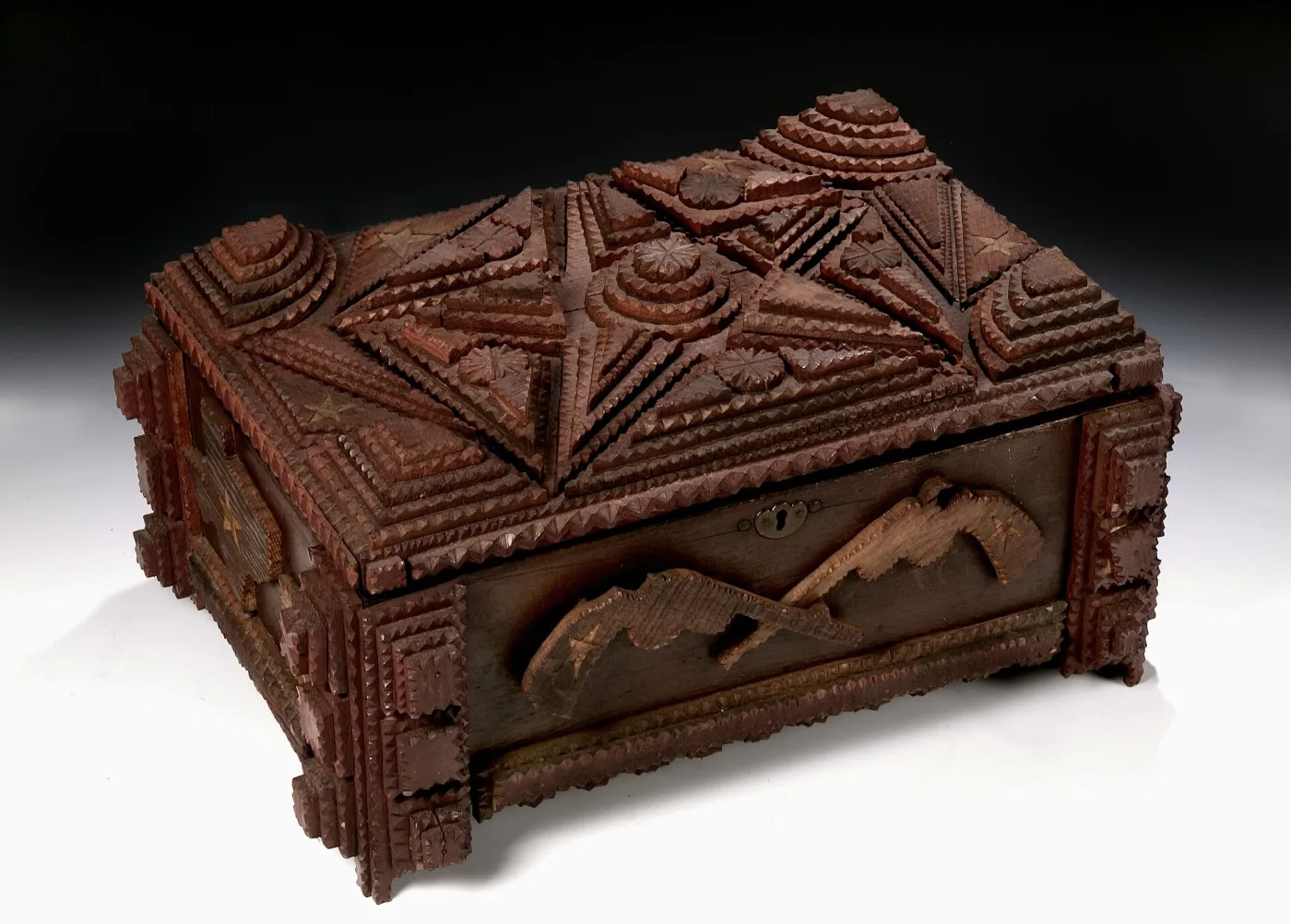
The primary identifying characteristic of tramp art is its distinctive notch carving, created by making repeated V-shaped or chip cuts along the edges of thin wood pieces. This creates a serrated or sawtooth edge pattern similar to fabric cut with pinking shears. Each notch is typically small, measuring between one-eighth and one-quarter inch, and executed with remarkable consistency across the piece.
The second defining feature is the layering technique, where multiple carved pieces are stacked upon one another in progressively diminishing sizes to create depth and dimensional interest. These layers typically build upward to form pyramidal or tiered structures, with each layer carefully aligned and attached to create dramatic shadow effects and visual complexity.
Material Characteristics
Authentic tramp art almost exclusively uses recycled wood from cigar boxes, fruit crates, and shipping containers. This wood is characteristically thin, typically one-eighth to one-quarter inch thick, and made from softwoods like pine, basswood, or cedar. Many pieces retain evidence of their origins, including partial labels, stenciled markings, or the aromatic quality of cedar cigar boxes.
Construction Philosophy
Tramp art embodies a philosophy of transformation and resourcefulness, taking cast-off materials and elevating them to decorative art through labor-intensive handwork. The pieces typically combine functionality with decoration, serving practical purposes as frames, boxes, or furniture while displaying elaborate ornamental surfaces. This dual nature of utility and artistry distinguishes tramp art from purely decorative folk art forms.
Stylistic Elements
While individual pieces vary greatly, tramp art generally favors geometric designs over naturalistic representation. Common motifs include pyramids, stars, hearts, and architectural elements. The overall aesthetic tends toward boldness and visual impact rather than delicate refinement, with the accumulated layers creating substantial three-dimensional relief that catches light and shadow dramatically.
Construction Techniques and Methods
Understanding the construction techniques used in creating tramp art is crucial for authentication and appreciation of these pieces. The methods employed were remarkably simple yet required significant skill, patience, and artistic vision to execute successfully.
Basic Tool Requirements
Tramp art's accessibility stemmed from its minimal tool requirements. The essential implement was a simple penknife or pocketknife with a sharp blade, typically two to three inches long. Some makers also used small chisels, gouges, or specialized chip carving knives, but a basic knife sufficed for all fundamental operations. This simplicity meant anyone could attempt the craft with tools readily at hand.
Beyond cutting tools, makers needed only basic supplies: wood from discarded boxes, small nails or glue for assembly, and sometimes paint, stain, or varnish for finishing. The lack of specialized equipment or expensive materials made tramp art accessible to people of modest means and contributed to its widespread practice across economic classes.
Preparation and Planning
Creating a tramp art piece began with careful disassembly of cigar boxes or crates to obtain flat wood pieces. Makers selected wood for grain quality, thickness consistency, and size. Some pieces incorporated printed labels or brand names as decorative elements, while others carefully removed all markings for a uniform surface.
Planning involved visualizing the final form and determining how many layers would be needed, what sizes each layer would be, and how the notching would be arranged. Experienced makers could work intuitively, but complex pieces often required sketches or templates, particularly for symmetrical designs or multiple matching components.
Assembly Process
Assembly typically proceeded from the base layer upward, with each successively smaller layer attached to the one below using small finishing nails, brads, or occasionally glue. Makers took care to align layers precisely, as even small misalignments would be visually obvious in the finished piece. The nails were usually countersunk and sometimes concealed with wood filler or decorative elements.
Some complex pieces incorporated internal structures or backing boards to provide stability and strength. Functional items like boxes required careful fitting of hinges, clasps, or other hardware, which was often partially concealed by the decorative layering. The maker's skill showed not only in the surface decoration but in the structural soundness and functionality of the finished object.
Finishing Techniques
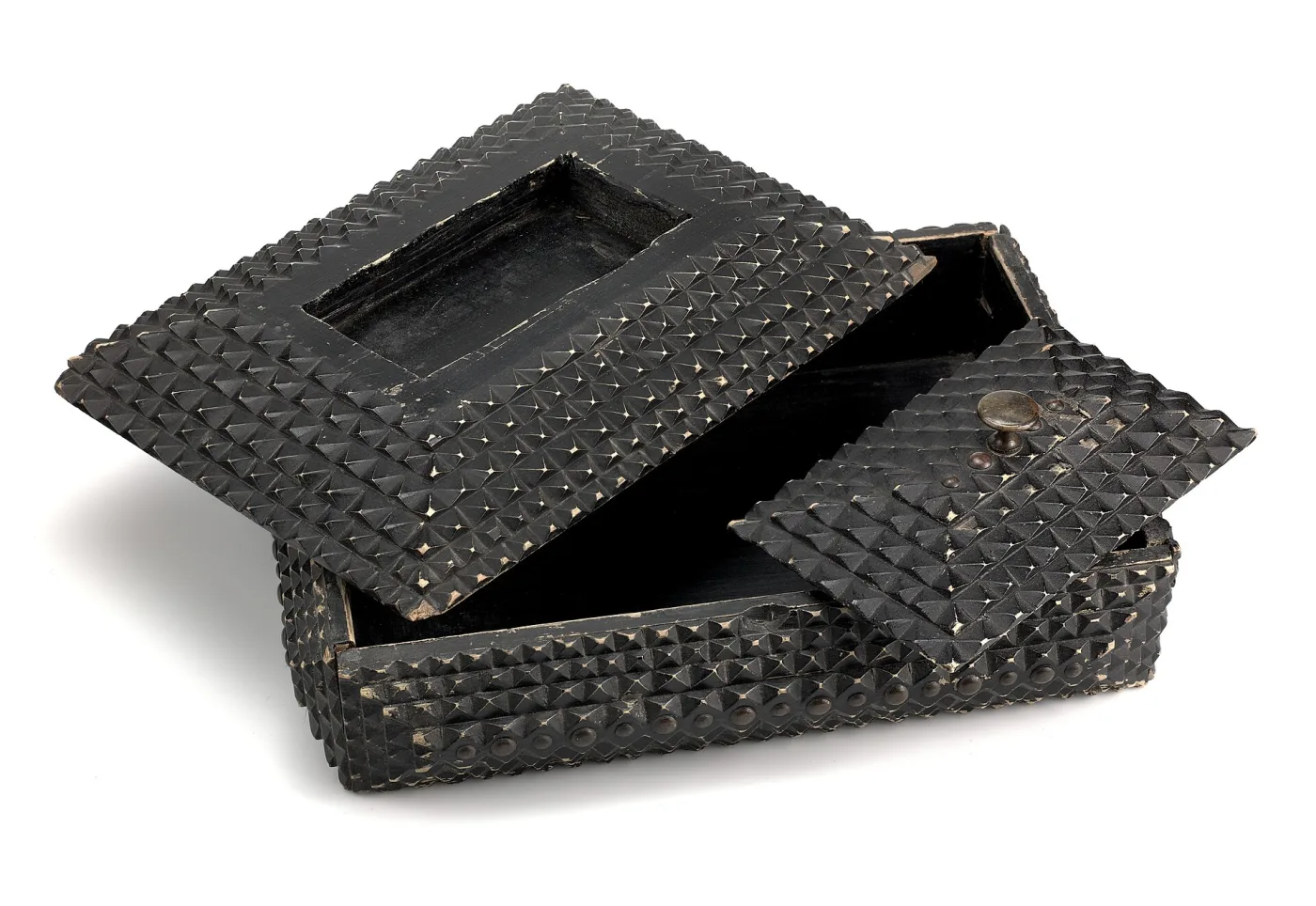
Finishing varied considerably among makers and regions. Many pieces were left natural, allowing the wood's character to show and often developing attractive patina over time. Others were stained in dark browns or painted in colors popular during their era, including gold, silver, or combinations of colors. Some makers applied varnish or shellac for protection and enhanced appearance.
More elaborate finishing might include gilding with gold leaf or metallic paint, particularly for religious items or presentation pieces. Some makers lined interior compartments with fabric, paper, or leather, added mirror glass to frames, or incorporated other materials like metal studs, glass jewels, or shells as embellishments, though purists consider such additions less characteristic of true tramp art.
Materials and Wood Identification
Identifying the materials used in tramp art construction provides crucial evidence for authentication and dating. The characteristic materials and their properties offer reliable indicators of genuine period pieces versus later reproductions.
Cigar Box Wood
The primary material for tramp art came from wooden cigar boxes, which were manufactured in enormous quantities from the 1850s through the 1950s. These boxes used thin wood panels, typically cedar, mahogany, or pine, chosen for their aromatic properties and ability to maintain humidity for tobacco storage. Cedar was particularly prized, giving many tramp art pieces a distinctive, lasting fragrance.
Cigar box wood characteristics include uniform thickness of about one-eighth inch, smooth surfaces from factory milling, and often residual evidence of original construction like small nail holes, glue marks, or partial labels. The wood grain is typically straight and fine, making it ideal for detailed carving. Many pieces retain fragments of original box labels, tax stamps, or manufacturer's marks, which can help with dating.
Crate and Box Wood
Besides cigar boxes, makers used wood from fruit crates, cheese boxes, ammunition containers, and other commercial packaging. This wood tended to be slightly thicker than cigar box wood, sometimes up to one-quarter inch, and was usually pine or other inexpensive softwoods. Crate wood often shows evidence of its origins, including stenciled lettering, shipping marks, or construction techniques like tongue-and-groove joinery.
Crate wood quality varied more than cigar box wood, sometimes including knots, irregular grain, or rougher surfaces. However, skilled makers could work around these imperfections or even incorporate them as design elements. Mixed wood sources in a single piece are common, as makers used whatever materials were available.
Wood Aging Indicators
Genuine antique tramp art shows specific aging characteristics that help confirm authenticity. The wood develops natural patina, darkening and mellowing with time, especially on exposed surfaces. Unexposed areas, like the undersides of layers or interior compartments, remain lighter, creating contrast that artificial aging struggles to replicate convincingly.
Old wood also shrinks slightly as it dries over decades, sometimes creating small gaps between layers or causing slight warping. The surface develops a distinctive texture from accumulated handling, dust, wax, or environmental exposure. Wood grain becomes more prominent as softer growth rings wear slightly faster than harder wood. These subtle indicators of genuine age are difficult to fake convincingly.
Fasteners and Hardware
The nails, screws, and hardware used in construction provide important dating and authentication evidence. Period pieces used cut nails, wire nails, or small brads appropriate to their era. Cut nails with rectangular shafts indicate pre-1900 construction, while round wire nails became standard after 1890. The size, type, and oxidation of fasteners should match the piece's purported age.
Hardware like hinges, clasps, and handles also reflects period manufacturing. Antique hardware shows appropriate wear patterns, oxidation, and construction methods. Modern reproductions often use contemporary hardware that appears too pristine or incorporates manufacturing techniques not available in the original period.
Common Forms and Object Types
Tramp art manifested in a wide variety of functional and decorative forms, ranging from small personal items to substantial furniture pieces. Understanding the common object types helps collectors recognize authentic examples and appreciate the craft's versatility.
Frames and Mirrors
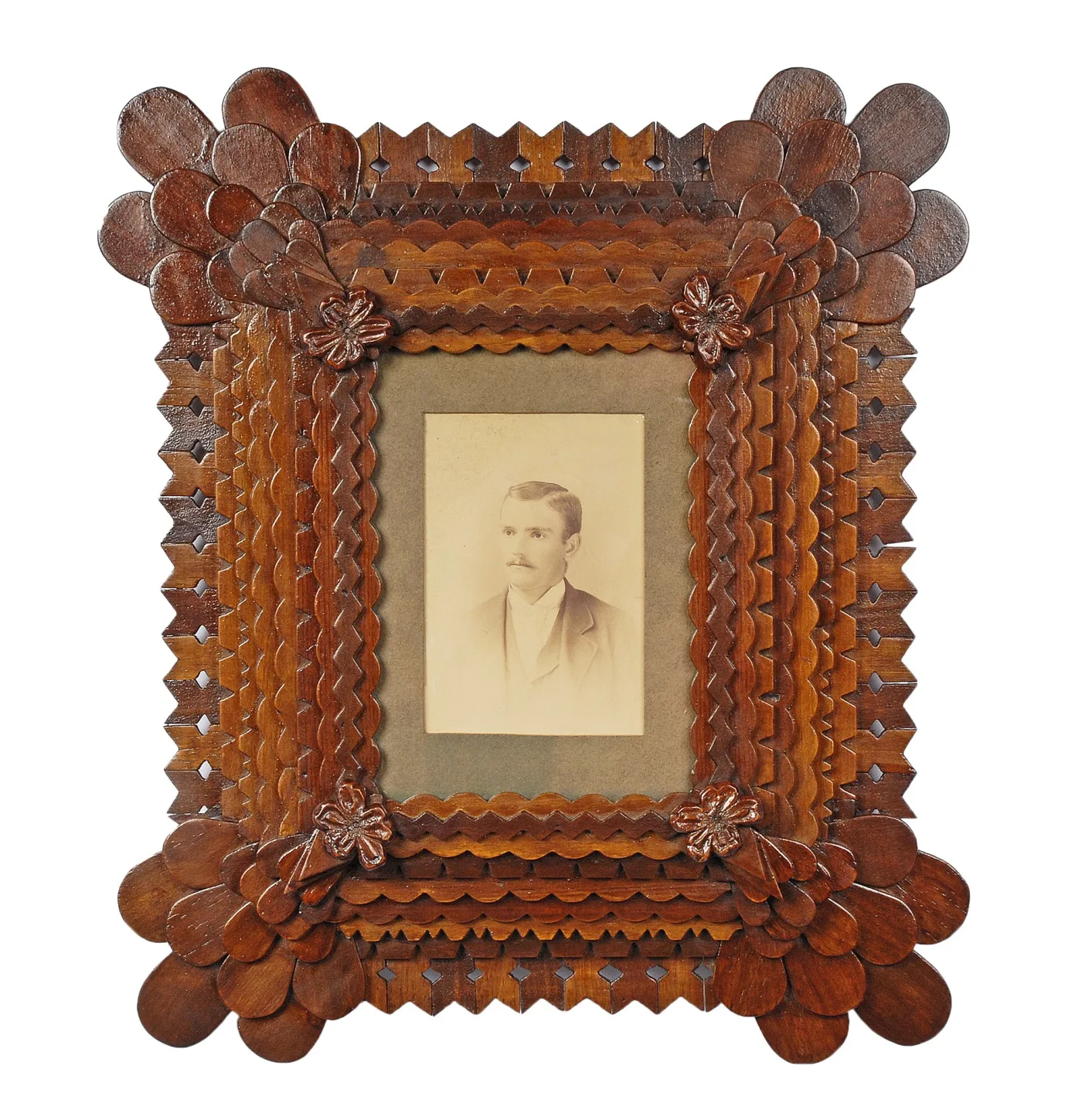
Picture frames represent perhaps the most common tramp art form, ranging from small frames for photographs to large frames for mirrors or artwork. Frame construction typically featured multiple layers building outward from the opening, creating depth and visual interest. Corner treatments varied from simple mitered joints to elaborate star or fan patterns. Many frames incorporated multiple tiers of layering, sometimes extending several inches from the picture plane.
Mirror frames often represented the most elaborate tramp art pieces, as the reflective surface amplified the dimensional carving and made impressive display items. Makers sometimes incorporated special features like small shelves, hooks for hanging items, or decorative crest elements at the top.
Boxes and Containers
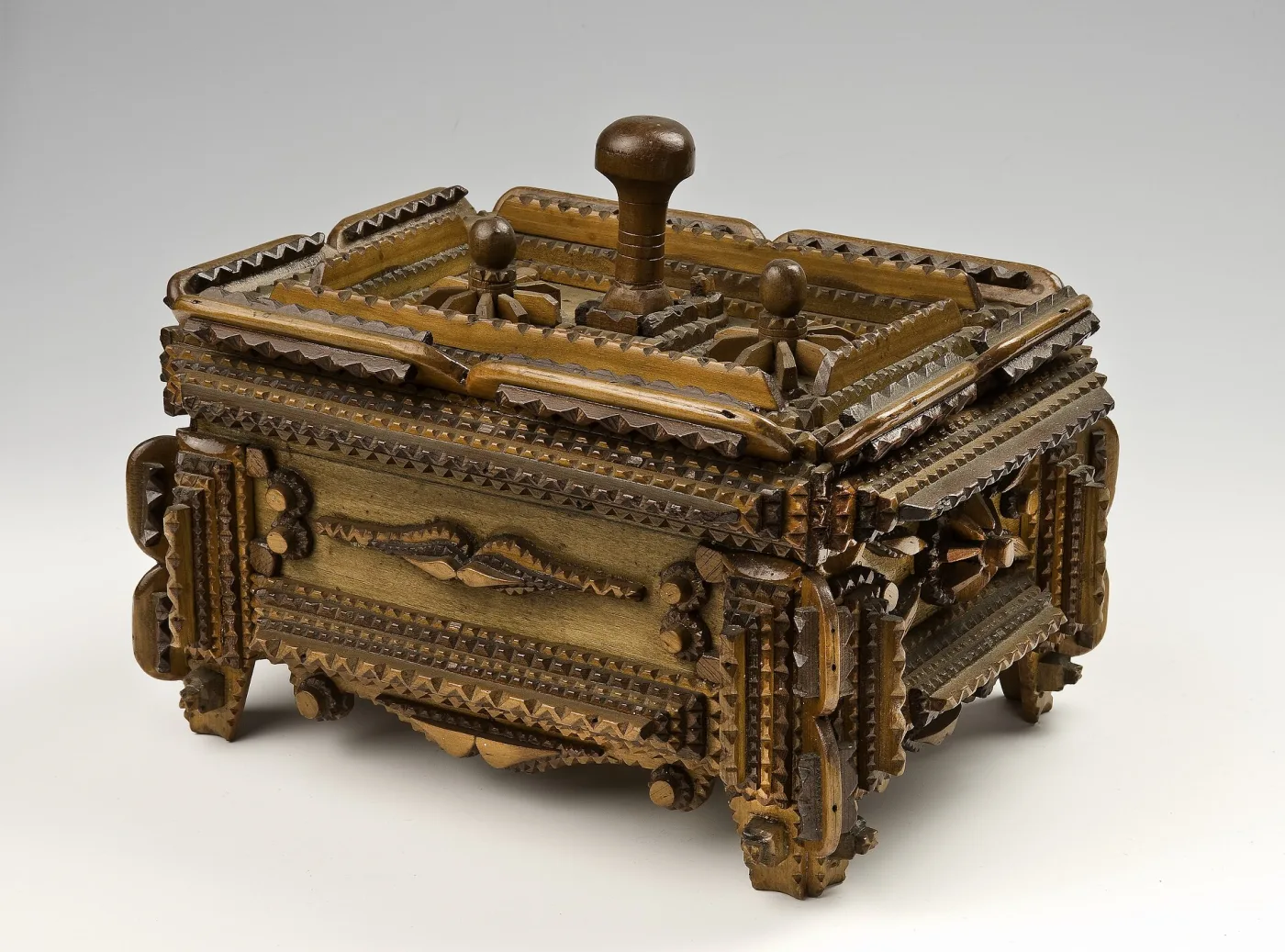
Boxes constituted another major category, including jewelry boxes, sewing boxes, document boxes, and general storage containers. These ranged from simple rectangular forms to complex designs with multiple compartments, drawers, or specialized interiors. The box exterior typically featured layered decoration on all visible surfaces, with particularly elaborate treatment of lids and front panels.
Functional considerations influenced box design, with makers incorporating hinges, clasps, locks, and sometimes internal trays or dividers. The interior might be plain, lined with paper or fabric, or occasionally decorated with simplified carving. Larger boxes sometimes resembled small chests or caskets, with elaborate architectural elements like pediments, columns, or feet.
Wall Pockets and Shelves
Wall-mounted pieces served as decorative and functional storage, designed to hang on walls for holding correspondence, small items, or purely decorative display. These pieces often featured elaborate back plates with layered decoration and may have incorporated multiple pockets or compartments. Corner shelves represented another wall-mounted form, typically with triangular back plates and carved edges.
Religious Items
Religious devotional objects formed an important tramp art category, including crosses, shrines, reliquaries, and altar pieces. These often featured the most ambitious layering and sometimes incorporated symbolic elements like hearts, crowns, or architectural details reminiscent of church architecture. The Crown of Thorns technique was particularly associated with religious pieces.
Furniture
Though less common due to the greater material and time investment required, some makers created substantial furniture pieces. These included small tables, pedestals, sewing stands, music boxes with elaborate cases, and occasionally chairs or full-size cabinets. Furniture pieces typically combined a basic structure of conventional construction covered with tramp art decorative elements applied to visible surfaces.
Miniatures and Novelties
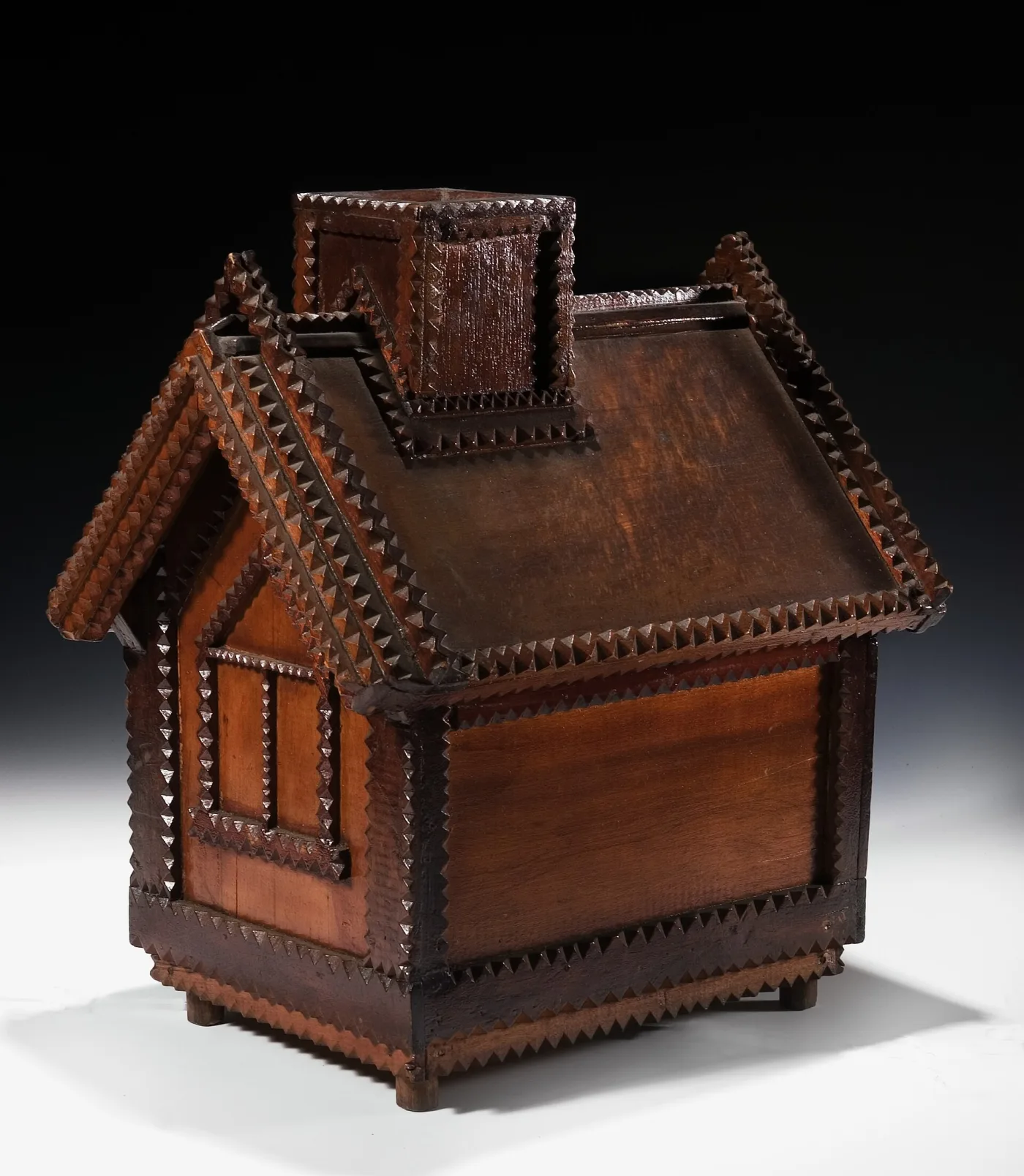
Smaller items included miniature furniture, dollhouse pieces, whimsies, and novelty items. These might have been made as practice pieces, gifts, or demonstration of skill. Common small forms included miniature dressers, banks, birdhouses, and model buildings. Despite their small size, these pieces often displayed remarkable detail and complexity.
Notch Carving Patterns and Styles
The notch carving technique defines tramp art's visual character, and understanding the various patterns and their execution is essential for identification and appreciation. The seemingly simple act of cutting repeated notches actually encompasses considerable variation in style, depth, and rhythm.
Basic V-Notch Pattern
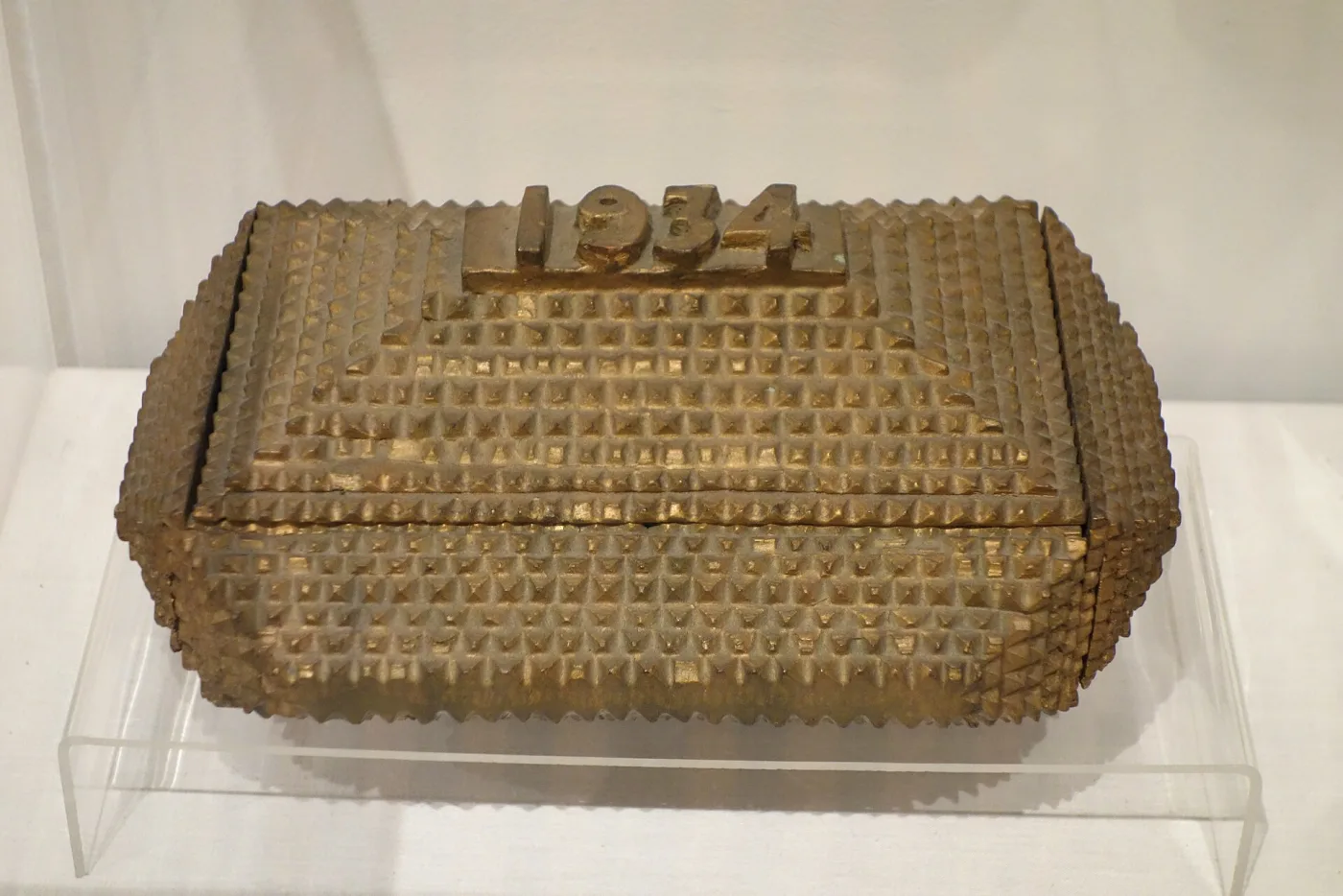
The fundamental tramp art notch consists of a V-shaped cut made by two angled knife strokes meeting at a point. The maker typically held the wood piece steady and made controlled cuts along its edge, creating a series of uniform notches. Consistency in notch size, spacing, and depth distinguishes skilled work from crude attempts. Most authentic pieces show remarkable regularity, though slight variations are normal and indicate handwork rather than mechanical production.
The depth of V-notches varies among pieces and makers, ranging from shallow decorative cuts barely penetrating the wood surface to deep cuts removing substantial material and creating dramatic shadow effects. Deeper notching requires more skill to avoid splitting the thin wood and results in more pronounced dimensional quality.
Chip Carving Variations
While the basic V-notch predominates, makers employed variations to create visual interest. Some pieces feature alternating deep and shallow notches, creating a rhythmic pattern. Others use notches of varying widths, with some sections having fine, closely-spaced cuts while others have broader, more widely-spaced notches. These variations demonstrate the maker's control and artistic sensibility.
More complex chip carving patterns include curved notches following rounded edges, fan patterns radiating from corners, and geometric patterns created by intersecting notch lines. Some makers created textured surfaces through random or patterned chip cuts across flat areas, adding visual interest to larger expanses of wood.
Edge Treatment Styles
The edges of wood pieces received the most elaborate notch treatment, as these were the most visible elements in the finished piece. Corner treatments often featured special attention, with makers creating pointed stars, rounded fans, or geometric patterns at angle intersections. Some corners incorporated carved hearts, diamonds, or other decorative elements integrated with the notching.
Profile edges, particularly on frames and box lids, sometimes received double or triple rows of notching at different angles, creating complex three-dimensional effects. The edges of layers might be notched before assembly, after assembly, or both, with different visual results. Pre-assembly notching tends to create sharper, more defined patterns, while post-assembly notching unifies the layers visually.
Surface Decoration
Beyond edge notching, some makers carved decorative patterns into flat surfaces. These might include geometric designs, chip-carved rosettes, or simple linear patterns. Surface carving was less common than edge notching but appears on more ambitious pieces, particularly on prominent surfaces like box tops or frame backs. The carving technique remains similar to edge notching but requires greater skill to execute cleanly on broader surfaces.
Regional Notching Characteristics
Different regions and individual makers developed characteristic notching styles, though these are subtle and difficult to attribute definitively without extensive comparative study. Some makers favored deep, dramatic notching, while others preferred finer, more delicate work. The spacing, angle, and depth of notches can sometimes suggest regional or maker preferences, though considerable overlap exists.
Layering Methods and Pyramidal Designs
The layering technique distinguishes tramp art from simple chip-carved objects, creating the dimensional quality that makes these pieces visually striking. Understanding layering principles and variations helps collectors appreciate craftsmanship and identify quality pieces.
Basic Pyramidal Layering
The foundational layering technique builds successive layers in diminishing sizes, each centered on the one below, creating a stepped pyramid effect. A simple frame might have three to five layers, while elaborate pieces can feature ten or more. Each layer is typically one-eighth to one-quarter inch smaller than the previous one all around, creating consistent step width.
The height of each layer, determined by the wood thickness, combines with the number of layers to create the total relief depth. A frame with seven layers of one-eighth-inch wood builds nearly an inch of three-dimensional depth. This substantial relief creates dramatic shadow effects and visual impact, especially when viewed at angles where the layers cast shadows on each other.
Symmetry and Alignment
Precise alignment of layers demonstrates maker skill and significantly affects visual quality. Each layer should be perfectly centered on the one below, with equal spacing all around. Misalignment becomes increasingly obvious with more layers, as errors compound visually. Quality pieces maintain consistent alignment throughout, requiring careful measurement and execution.
Symmetrical designs where patterns mirror across centerlines demand even greater precision. A frame with identical carving on all four sides must have perfectly matched layers and notching, or the symmetry breaks down. The best makers achieved remarkable precision using only simple measuring tools and practiced judgment.
Layering Variations
While centered pyramidal layering predominates, makers employed variations for artistic effect. Offset layering deliberately shifts each layer slightly, creating directional movement or dynamic visual effects. Progressive layering might vary the size reduction between layers, with some steps larger than others for emphasis or proportion. Irregular layering uses layers of different shapes rather than simple reductions of the base shape, creating more complex profiles.
Multiple Pyramid Compositions
Complex pieces combine multiple pyramidal elements in a single composition. A frame might have separate pyramids at each corner, along the sides, and in center crest positions, all integrated into a unified design. Large boxes might feature different pyramid compositions on each surface. These multi-element designs require careful planning to maintain visual balance and proportion.
Negative Space Utilization
Sophisticated makers understood how negative space between layered elements contributed to design impact. The shadows cast into recessed areas and the visual breaks between raised sections create rhythm and emphasis. Some designs deliberately maximize negative space for dramatic contrast, while others minimize it for densely layered surfaces. The handling of negative space separates competent work from truly artistic pieces.
Structural Considerations
Beyond visual effects, layering had structural implications. Multiple layers increased strength and rigidity, making thin wood pieces suitable for functional objects. However, excessive layering without adequate attachment could create instability. Quality pieces balance aesthetic ambition with structural soundness, using sufficient fasteners and sometimes hidden reinforcement to ensure durability.

Crown of Thorns Technique
The Crown of Thorns technique represents one of the most distinctive and complex approaches in tramp art construction. Named for its resemblance to Christ's crown of thorns, this method creates intricate, interlocking patterns that differ significantly from standard layered construction.
Construction Principles
Crown of Thorns construction uses notched wood strips interlocked at angles, similar to log cabin construction, rather than stacking flat layers. Each strip has notches cut at regular intervals that allow it to interlock with crossing strips, building up a three-dimensional lattice structure. As strips are added in progressively smaller circuits, they create star or sunburst patterns with intricate depth and complexity.
The technique requires precise planning and execution, as each strip must be cut to exact length with notches positioned perfectly to align with crossing members. The notches serve both decorative and structural purposes, holding the pieces together while creating the characteristic serrated appearance. Unlike pyramidal layering where each layer is independent, Crown of Thorns construction creates an integrated structure where elements depend on each other for stability.
Typical Applications
Crown of Thorns technique appears most commonly in religious items, particularly crosses, where the symbolism of the name connects directly to the object's purpose. However, makers also used this technique for elaborate frames, particularly round or star-shaped frames, and for decorative elements on boxes and furniture. The method works especially well for radial or circular designs where the interlocking strips naturally form concentric rings.
Some pieces combine Crown of Thorns elements with standard layered construction, using the technique for specific features like corner ornaments or central medallions while building the main structure with conventional layering. These hybrid approaches demonstrate maker versatility and artistic ambition.
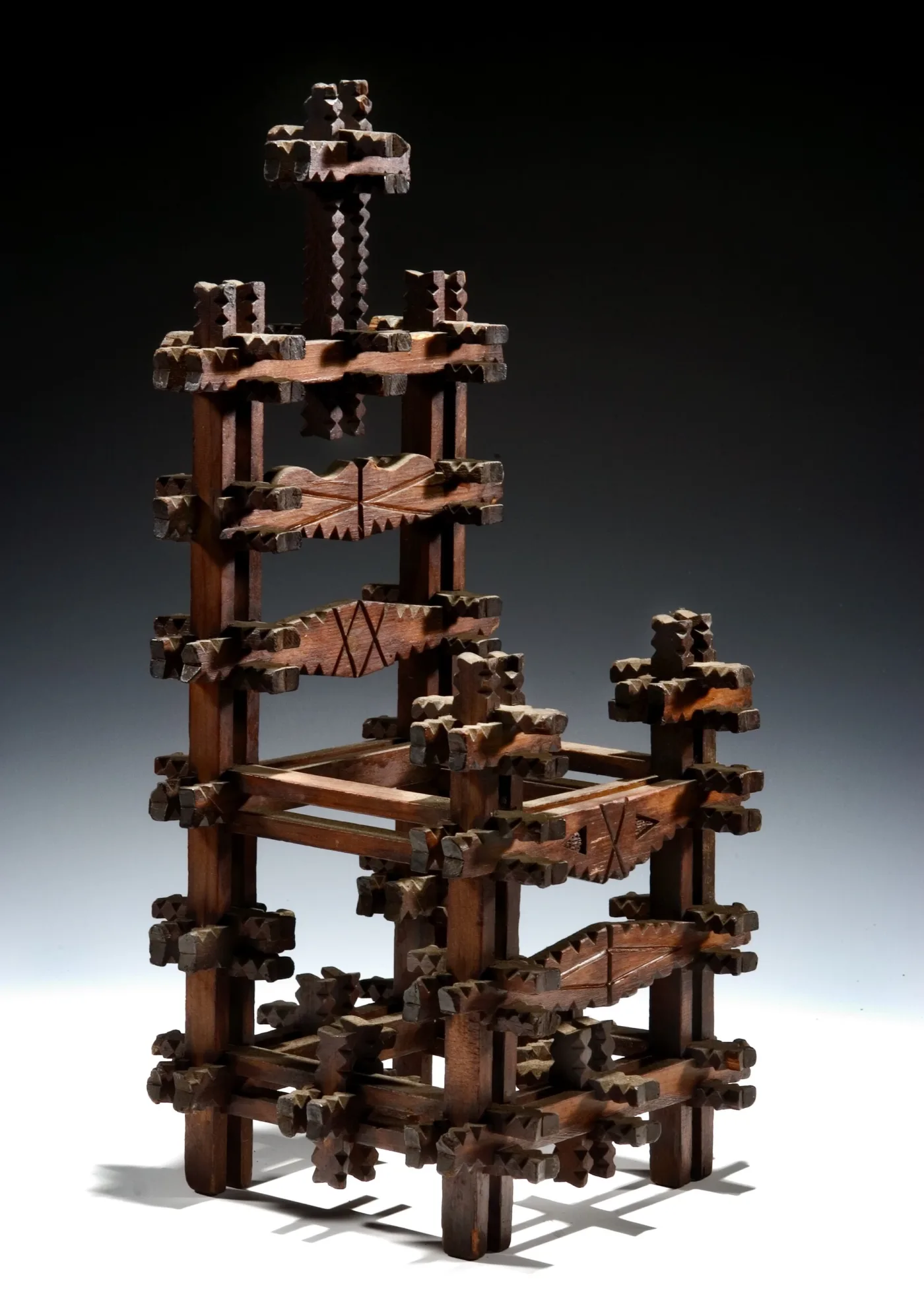
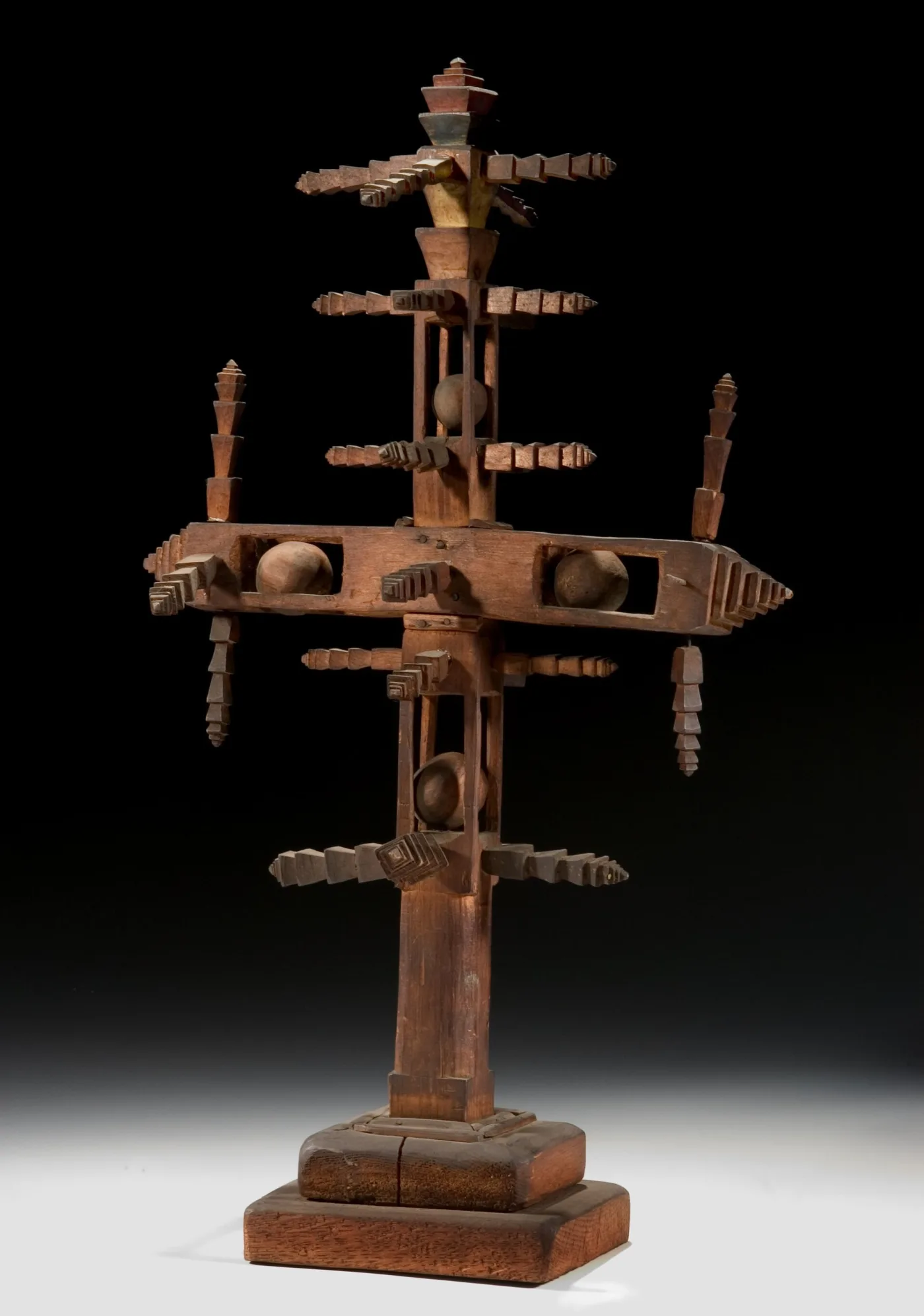
Both read completely differently from a layered box, and the difference is diagnostic. Layered work is solid and reads as mass; Crown of Thorns work is open, and you can see daylight through it from any angle. Check the crossings before you accept the attribution: in genuine work each strip is cut away where it meets its neighbour so the two sit flush, and the projecting tips are the spare ends of real structural members. Pieces that merely glue short spikes onto a solid frame to imitate the look show no notch at the crossings and no shadow gap behind.
Skill Level and Rarity
Crown of Thorns pieces generally required greater skill than standard layered construction, making them rarer and often more valuable. The technique demands precise measurement, careful planning, and considerable patience. Errors are difficult to correct since the interlocking nature means one mistake affects multiple components. Consequently, successful Crown of Thorns pieces demonstrate significant maker expertise and command premium prices from collectors.
Identification Features
Identifying Crown of Thorns construction is usually straightforward due to its distinctive interlocking pattern visible from multiple viewing angles. The characteristic star or sunburst appearance, combined with the visible crossing and interlocking of strips, distinguishes this technique from layered pyramidal construction. The overall effect tends to be more delicate and lacy than solid layering, with more negative space and intricate shadow patterns.
Examination from the sides or back often reveals the construction method clearly, showing how strips cross and interlock rather than simply stacking. The relatively uniform width of individual strips, typically one-half to three-quarters of an inch, also helps identify this technique. Many Crown of Thorns pieces incorporate pointed tips where strips project beyond the intersections, creating a thorny or spiky appearance that inspired the technique's name.
Dating Tramp Art Pieces
Accurately dating tramp art helps establish authenticity, value, and historical context. While precise dating can be challenging, multiple indicators provide reasonable date ranges for most pieces.
Historical Period Indicators
The overall date range for authentic tramp art spans from approximately 1870 to 1940, with peak production between 1890 and 1930. Pieces from before 1890 are relatively rare, while those after 1940 become increasingly suspect as the craft declined sharply during and after World War II. Any piece claiming to be tramp art but showing characteristics inconsistent with this time frame requires careful scrutiny.
Material Evidence
The materials used provide significant dating clues. Cigar box wood with identifiable labels or tax stamps can often be dated precisely, as these changed regularly with federal regulations and company branding. Certain cigar brands only operated during specific years, and tax stamp designs changed at known dates. Even fragmentary labels or stamps can provide dating evidence with research.
The type of fasteners used indicates construction period. Cut nails with rectangular cross-sections suggest pre-1890 construction, while wire nails became standard after that date. The size, manufacturing method, and oxidation of nails should align with the claimed period. Modern screws or contemporary fasteners indicate recent construction or repair.
Style and Design Elements
Stylistic features reflect the periods when pieces were made. Earlier tramp art tended toward simpler designs with fewer layers and more restrained decoration, while pieces from the 1900-1930 peak period often feature more ambitious layering and elaborate designs. Certain motifs like hearts, stars, and architectural elements appeared more prominently during specific periods.
Color choices and finishing techniques also indicate date. Natural finishes or simple staining were most common early on, while painted and gilt finishes became more popular in the early 20th century. The colors used often reflect period decorating fashions. Gold and silver gilt finishes were particularly popular in the 1910s and 1920s.
Construction Quality Variations
Generally, pieces from the late 19th century show more individual character and variation, while those from the early 20th century often demonstrate more refined technique as the craft became more established and patterns were shared. Depression-era pieces sometimes show evidence of economy in materials or simpler designs, though the reduced employment during this period also meant more time for ambitious projects, so this indicator is less reliable.
Provenance and Documentation
Any documentation about a piece's history provides valuable dating information. Family provenance, old photographs showing the piece, or written records can establish minimum ages. Auction records, exhibition history, or publication in books about tramp art also help confirm age and authenticity. However, provenance should be verified when possible, as it can be fabricated or mistaken.
Regional Variations and Styles
While tramp art appeared throughout the United States and in other countries, certain regional characteristics and preferences developed, though these distinctions are often subtle and not always definitive.
American Regional Styles
The northeastern United States, particularly Pennsylvania, New York, and New Jersey, produced substantial quantities of tramp art, influenced by German and Central European immigrant traditions of chip carving. These regions often feature pieces with relatively refined carving, complex layering, and sometimes Germanic folk art motifs. Pennsylvania pieces occasionally incorporate hearts and other Pennsylvania Dutch design elements.
Midwestern tramp art, found in areas of heavy Scandinavian settlement, sometimes shows influence from Scandinavian chip carving traditions. These pieces might feature more restrained decoration, emphasizing clean lines and geometric precision over elaborate embellishment. The wood tends to be lighter in color, and finishing is often minimal.
Southern tramp art exists but appears less commonly in collections, possibly reflecting lower cigar consumption rates or fewer immigrant populations familiar with European chip carving traditions. When found, southern pieces sometimes incorporate regional wood types and may show connection to other southern folk art forms.
European Connections
European tramp art paralleled American production, with significant quantities made in Germany, France, Switzerland, and other countries. European pieces often show closer connection to traditional chip carving and may incorporate more refined techniques or Continental design motifs. German pieces in particular demonstrate sophisticated craftsmanship, reflecting that country's strong chip carving tradition.
French tramp art sometimes includes more elaborate painted finishes or incorporation of other materials. Swiss examples occasionally show connection to traditional Swiss carved wooden objects. Distinguishing European from American pieces requires familiarity with these subtle stylistic differences and often depends on provenance information.
Urban versus Rural Production
Urban and rural settings influenced tramp art character. Urban pieces had greater access to materials, particularly cigar box wood, and might show influence from commercially available patterns or designs seen in shops and exhibitions. Rural pieces relied more on salvaged crate wood and often show more individual character and less connection to popular styles.
Urban makers sometimes achieved greater technical sophistication, possibly reflecting access to better tools or exposure to other craftspeople. However, rural isolation sometimes produced distinctive personal styles unburdened by conventional expectations, resulting in highly original works of genuine artistic merit.
Maker Attribution and Signatures
Most tramp art pieces remain anonymous, but some makers signed their work or can be identified through family provenance, distinctive styles, or documentation. Understanding how to recognize and research maker attribution adds historical depth and often value to pieces.
Signatures and Marks
When signatures appear, they typically take the form of carved initials, dates, or occasionally full names, usually on inconspicuous locations like the back or bottom of pieces. Some makers burned their signatures into the wood using heated wire or pokers. Others penciled or inked names that may have faded over time. Examining all surfaces carefully, including hidden areas, may reveal maker identification.
Dates often accompany signatures, providing precise construction timing. However, signatures and dates require careful authentication, as these can be forged to increase perceived value. The signature execution should match the piece's overall craftsmanship level, show appropriate aging, and use period-appropriate tools and materials.
Identified Makers
A small number of prolific or distinctive tramp art makers have been identified through signatures, family documentation, or scholarly research. These include both amateur home craftspeople and more professional makers who sold their work. Pieces by identified makers, particularly those who achieved recognition during their lifetimes or have been subjects of research, command premium prices due to their enhanced historical documentation.
Stylistic Attribution
Some collectors and scholars attempt attribution based on distinctive stylistic features, construction techniques, or design preferences. While interesting, such attributions remain speculative unless confirmed by signatures or documentation. The large number of makers, widespread geographic distribution, and sharing of techniques makes definitive stylistic attribution difficult except in cases of extremely distinctive individual styles.
Family Provenance
Many pieces remain within families descended from their makers, with oral history preserving maker identity and construction circumstances. Such provenance adds historical value and collectible interest even for makers who weren't professionally active. Documentation through photographs, letters, or family records strengthens provenance claims.
Condition Assessment
Evaluating condition is crucial for determining value and making informed collecting decisions. Understanding what constitutes acceptable wear versus damage requiring restoration guides both purchasing and conservation decisions.
Structural Integrity
The fundamental condition concern is structural soundness. Layers should be firmly attached without significant loosening or separation. Test gently by applying light pressure to projecting elements to detect loose components. Check for missing pieces, particularly in prominent locations like corners or crest elements. Examine joints and connections for stability.
Wood condition significantly affects value. Look for splitting, cracking, or warping, which can result from environmental stress or poor storage. Check for insect damage, including active infestation or old damage. Examine the undersides and hidden areas where deterioration often begins. Significant structural damage greatly reduces value unless the piece is extremely rare or historically important.
Surface Condition
Original surface finish preservation affects value significantly. Patina development on natural wood pieces is desirable, showing appropriate aging without excessive wear or damage. Paint or gilt finishes should be substantially intact, though some wear is expected and acceptable. Heavy paint loss, particularly on prominent surfaces, reduces value.
Check for inappropriate refinishing or overpainting, which damages originality and value. Modern varnish applied over original surfaces, new paint covering old finishes, or harsh cleaning that removed patina all constitute condition problems. Original surface preservation is strongly preferred by serious collectors.
Acceptable Wear
Some wear enhances rather than diminishes value by confirming age and use history. Normal handling wear on edges and projecting elements, minor surface scratching, mellowing of finishes, and light accumulated grime in crevices all represent acceptable age indicators. The key distinction is between wear that demonstrates genuine age versus damage that affects integrity or appearance.
Repairs and Alterations
Previous repairs require careful evaluation. Period repairs using appropriate materials and techniques may be acceptable, particularly if addressing issues like reattaching loose layers or replacing small missing elements. However, obvious modern repairs, inappropriate materials, or alterations changing the piece's character negatively affect value.
Distinguish between repairs and alterations. Repairs attempt to restore original condition, while alterations change the piece's configuration or appearance. Alterations are generally less acceptable unless clearly made during the period of original use and now part of the piece's history.
Authentication and Reproductions
As tramp art values have increased, reproductions and fakes have entered the market. Developing authentication skills protects collectors from acquiring misrepresented pieces and helps preserve market integrity.
Reproduction Indicators
Modern reproductions often reveal themselves through several telltale characteristics. New wood lacks the aging, patina, and surface character of genuine antiques. The wood color tends to be more uniform, grain patterns look too fresh, and surfaces lack accumulated grime, wax, and handling marks. Artificial aging attempts often appear too uniform or concentrated in wrong areas.
Tool marks provide crucial evidence. Modern power tools leave characteristics different from period hand tools. Sanding marks from power sanders, perfectly uniform saw cuts, or router marks indicate recent production. Authentic period pieces show subtle irregularities and hand tool marks consistent with knife and hand saw work.
Material Inconsistencies
Reproductions may use inappropriate materials unavailable or uncommon during the original period. Modern plywood, particleboard, or contemporary softwoods different from period cigar box wood indicate recent manufacture. Hardware should match the period—modern screws, hinges, or fasteners reveal reproduction status.
Examine wood carefully for signs of artificial distressing, such as random hammer marks, chain strikes, or chemical staining intended to mimic age. Genuine aging occurs through natural environmental exposure and use, creating characteristic patterns different from artificial distressing.
Construction Anomalies
Study construction methods carefully. Modern assembly techniques, adhesives unknown in the period, or construction shortcuts not typical of original makers suggest reproduction. Authentic pieces show hand-crafted construction with period-appropriate methods, even if these seem inefficient by modern standards.
Proportions and design also provide clues. Reproductions sometimes show subtly wrong proportions, incorrect notch spacing, or design elements that seem "off" even if superficially correct. Developing an eye for authentic proportions and design requires studying many genuine examples.
Documentation Verification
Question any documentation accompanying pieces, particularly for high-value items. Provenance can be fabricated, photographs doctored, and stories invented. Verify documentation through independent research when possible. Be especially wary of pieces with elaborate stories but no corroborating evidence.
Age-Appropriate Characteristics
Genuine pieces display consistent age characteristics throughout. The degree of aging should match across all components—wood, finishes, hardware, and fasteners. Inconsistent aging, where some elements appear much older than others, suggests replacement, alteration, or construction from old materials arranged to appear entirely period.
Value Factors and Market Trends
Tramp art values vary enormously based on numerous factors. Understanding what drives value helps collectors make informed decisions and build meaningful collections within their budgets.
Primary Value Determinants
Quality stands as the foremost value factor. Superior craftsmanship, complex construction, numerous layers, refined carving, and artistic sophistication command premium prices. Compare a simple three-layer frame with basic notching to an elaborate ten-layer frame with intricate Crown of Thorns work—the latter will be worth many times more due to the skill and time invested in its creation.
Rarity significantly affects value. Unusual forms, particularly large furniture pieces or highly original designs, sell for more than common small frames or boxes. Pieces with maker attribution, especially by known makers, command premiums. Exceptional size, either unusually large or remarkably miniature, increases interest and value.
Condition Impact
Condition dramatically influences value, with excellent original condition pieces worth substantially more than damaged or heavily restored examples. However, condition standards are somewhat lenient for tramp art compared to formal antique furniture, as collectors accept appropriate age-related wear. The key is whether condition affects the piece's display quality and structural integrity.
Aesthetic Appeal
Ultimately, aesthetic appeal drives demand and value. Visually impressive pieces with strong design, good proportions, and effective decoration sell more readily and for higher prices than technically competent but uninspiring work. Pieces with "wow factor"—those that immediately capture attention and demonstrate the craft's best qualities—perform best in the market.
Market Trends
The tramp art market has strengthened significantly since 2000 as appreciation for folk art and handcrafted objects has grown. Interest from interior designers incorporating folk art into contemporary settings has expanded the collector base beyond traditional folk art enthusiasts. The sustainability movement has also increased appreciation for objects made from recycled materials.
Prices range from under one hundred dollars for common small pieces in average condition to several thousand dollars for exceptional examples. Major furniture pieces or museum-quality objects can exceed ten thousand dollars. The market tends to be stronger for pieces in excellent condition, with provenance, or demonstrating exceptional artistry.
Regional Market Variations
The tramp art market is strongest in the United States, particularly in areas with active folk art collecting traditions like the Northeast and mid-Atlantic states. European markets exist but tend to be smaller and more focused on locally-made pieces. Online sales have broadened the market considerably, allowing collectors nationwide to compete for quality pieces.
Collecting Strategies
Successful collecting requires developing knowledge, defining focus, building relationships, and making thoughtful acquisition decisions. Whether collecting for investment, decoration, or historical interest, strategic approaches yield more satisfying results.
Developing Expertise
Study extensively before making significant purchases. Examine pieces in museums, historical societies, and auction houses. Handle authentic examples whenever possible to develop tactile familiarity with genuine age characteristics, construction methods, and quality variations. Read specialized publications about tramp art and folk art generally. Attend antique shows focusing on folk art where multiple dealers offer comparative examples.
Develop relationships with knowledgeable dealers, collectors, and curators who can provide education and guidance. Join collector organizations or online communities where members share information and experiences. Many experienced collectors generously help newcomers, sharing expertise that accelerates learning.
Defining Collection Focus
Most successful collections have focus rather than acquiring indiscriminately. Focus might be specific forms like frames or boxes, particular time periods, regional styles, or aesthetic preferences. Some collectors emphasize exceptional quality regardless of type, while others pursue comprehensive representation of various forms. Define goals early, though allowing evolution as knowledge increases.
Budget considerations naturally influence focus. Collectors with modest budgets might emphasize smaller pieces or accept lower condition grades to acquire interesting examples. Those with larger budgets can pursue rare forms or museum-quality pieces. Being realistic about budgets prevents overextending financially and allows building meaningful collections at any price level.
Acquisition Sources
Multiple sources offer tramp art. Specialized folk art dealers typically have the most reliable authentication and quality pieces but charge premium prices reflecting their expertise. General antique dealers may have occasional pieces at better prices but with less expert knowledge. Auction houses offer opportunities for competitive pricing but require confident authentication skills.
Online venues including auction sites, dealer websites, and collector forums greatly expand access but increase authentication challenges since direct examination isn't possible before purchase. Request detailed photographs from multiple angles, close-ups of construction details, and clear condition information. Establish return privileges if condition or authenticity doesn't meet expectations.
Building Knowledge Through Collection
Treat early acquisitions as learning opportunities rather than final collection pieces. Many collectors eventually upgrade, selling early purchases as they refine taste and increase standards. This process is natural and healthy, allowing collections to evolve toward higher quality and better focus.
Document collections thoroughly with photographs, measurements, acquisition information, and observations about construction and condition. This documentation aids insurance, potential future sale, and serves as personal reference. Recording thoughts about pieces helps track developing expertise and changing perspectives over time.
Conservation and Care
Proper care preserves tramp art for future generations while maintaining condition and value. Conservation approaches balance preservation with appropriate respect for original materials and maker intent.
Environmental Control
Maintain stable environmental conditions to prevent deterioration. Avoid extreme temperature and humidity fluctuations that cause wood to expand, contract, and potentially crack or warp. Ideal conditions approximate normal indoor climate—roughly 65-70 degrees Fahrenheit with 40-50 percent relative humidity. Avoid locations near heating vents, air conditioning outlets, or windows receiving direct sunlight.
Light exposure, particularly direct sunlight, fades finishes and degrades wood surfaces. Display pieces in locations receiving indirect light only, or use UV-filtering window treatments and lighting. Rotate displayed pieces periodically if possible to distribute light exposure evenly.
Cleaning and Maintenance
Clean carefully and minimally. Dust regularly using soft brushes or microfiber cloths, working gently to avoid catching on carved elements or loose components. Vacuum carefully with soft brush attachments to remove accumulated dust from crevices, protecting the vacuum nozzle with screening to catch any loose pieces.
Avoid liquid cleaners, which can damage original finishes, raise wood grain, or leave residues. If surfaces require more than dusting, consult conservation professionals rather than attempting aggressive cleaning. Original dirt and patina have historical value and character that harsh cleaning destroys irreversibly.
Stabilization and Repair
Address structural problems before they worsen. Reattach loose layers using appropriate reversible adhesives like hide glue or conservation-grade white glue. Support weak areas to prevent stress damage. Stabilize but don't overly restore—preservation of original character takes priority over making pieces look new.
For significant condition problems or valuable pieces, consult professional conservators experienced with wooden objects and folk art. They can address issues using appropriate materials and techniques while preserving maximum originality. Document all conservation work with photographs and written records.
Handling Precautions
Handle with care, supporting from below rather than grasping projecting elements that might be weak or loose. Wear clean cotton gloves when handling frequently to prevent skin oils from accumulating on surfaces. Move pieces individually rather than stacking, and provide adequate cushioning during transport or storage.
Display and Storage
Thoughtful display showcases tramp art effectively while ensuring preservation, and proper storage protects pieces not currently displayed.
Display Considerations
Position pieces to highlight their three-dimensional character. Directional lighting emphasizes layering and creates dramatic shadows that enhance visual impact. However, avoid heat-producing lights near pieces. LED fixtures provide excellent illumination without harmful heat or UV radiation.
Consider viewing angles when positioning pieces. Tramp art often looks most impressive when seen from slight angles where layering creates maximum dimensional effect. Hanging pieces at appropriate heights ensures comfortable viewing—generally positioning the center of visual interest at standing eye level, around 60-65 inches from the floor.
Group related pieces for enhanced impact, but allow adequate spacing for individual appreciation. Very elaborate pieces may merit isolated display to prevent visual competition. Consider the surrounding décor, as tramp art can complement various styles from rustic to contemporary but benefits from settings that allow its distinctive character to stand out.
Storage Methods
Store pieces not on display in stable environmental conditions protected from dust, light, and physical damage. Wrap individually in acid-free tissue paper or unbleached muslin, avoiding direct contact with plastics or acidic materials. Place in sturdy boxes with adequate cushioning, ensuring pieces don't shift during handling.
Label storage containers clearly with contents and any special handling requirements. Photograph pieces before storage to document their condition. Periodically inspect stored items to monitor for developing problems like insect infestation, mold, or deterioration. Rotate displayed and stored pieces occasionally to ensure all collection items benefit from monitoring while limiting cumulative light exposure.
Security Considerations
As values increase, security becomes relevant. Photograph collections thoroughly for insurance documentation and recovery assistance if theft occurs. Consider security measures appropriate to collection value, from simple precautions like locking display cabinets to comprehensive systems for major collections. Maintain discrete confidentiality about collection specifics to limit theft risk from opportunistic criminals.
Market Resources
Numerous resources support tramp art collectors, from reference materials to dealer networks to online communities. Knowing where to find information, expertise, and available pieces facilitates collecting success.
Reference Literature
Several authoritative books document tramp art history, techniques, and examples. Key references include volumes by specialists like Clifford Wallach, whose research has been fundamental to understanding this craft. Museums have published exhibition catalogs featuring important collections. These publications provide essential education for serious collectors and serve as identification and authentication references.
Museums and Exhibitions
Folk art museums and historical societies maintain tramp art collections and occasionally mount exhibitions. Notable institutions include the American Folk Art Museum in New York, various state historical societies, and regional folk art centers. Visiting these collections provides opportunities to study authenticated examples and develop connoisseurship skills.
Dealers and Auction Houses
Specialized folk art dealers offer expertise and quality inventory, though at premium prices reflecting their knowledge and acquisition costs. Major auction houses occasionally feature tramp art in folk art sales, while regional auction houses in areas where tramp art was produced often have local pieces. Online auction platforms expand access but require confident authentication abilities.
Collector Organizations
Folk art collector organizations provide networking, education, and access to expertise. Member benefits often include publications, meetings, show access, and online forums. These organizations facilitate connections among collectors and promote scholarship and appreciation of folk art forms including tramp art.
Online Resources
Internet resources include dealer and collector websites, online marketplaces, discussion forums, and social media groups focused on folk art and antiques. These platforms allow collectors worldwide to connect, share information, and access acquisition opportunities. However, verify information from online sources and approach purchases carefully given authentication challenges with remote buying.