
Antique Kettle & Teakettle Identification Guide: Types, Makers & Dating Methods
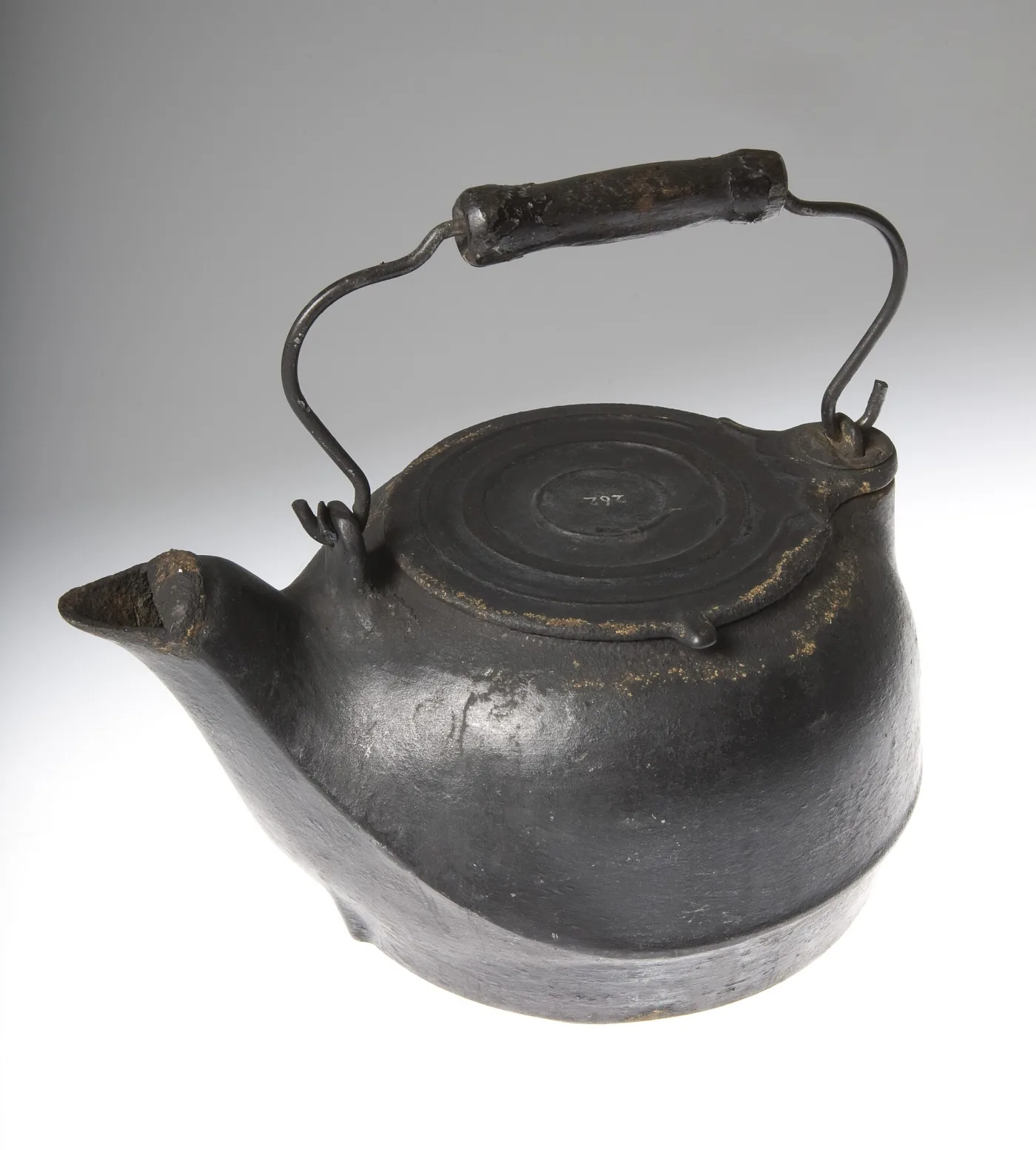
Antique kettles and teakettles represent a fascinating intersection of domestic history, metallurgical craftsmanship, and functional design. As vintage kitchenware surges in popularity during 2026, collectors and enthusiasts are rediscovering the beauty and historical significance of these essential household items. From the hand-hammered copper kettles of Victorian England to the cast iron masterpieces of American manufacturers like Griswold and Wagner, antique kettles offer windows into centuries of technological innovation and everyday life.
Understanding how to identify, authenticate, and date antique kettles requires knowledge of materials, manufacturing techniques, maker marks, and historical context. Whether you've inherited a family heirloom, discovered a piece at an estate sale, or are building a collection of vintage kitchenware, proper identification is essential for authentication, valuation, and preservation.
This comprehensive guide covers everything from distinguishing between copper, cast iron, and enamel kettles to decoding manufacturer marks, recognizing period-specific design features, and assessing condition and value. You'll learn the authentication methods experts use to determine age, identify reproductions, and appreciate the craftsmanship that makes antique kettles enduringly collectible.
Table of Contents
- Types of Antique Kettles by Material
- Copper Kettle Identification
- Cast Iron Kettle Identification
- Enamelware Kettle Identification
- Major Kettle Manufacturers
- Griswold Manufacturing Company
- Wagner Manufacturing Company
- Other Notable Makers
- Identifying Maker Marks and Hallmarks
- Dating Techniques for Antique Kettles
- Period-Specific Design Features
- Construction and Manufacturing Techniques
- Authentication Methods
- Condition Assessment
- Value Factors and Market Trends
- Collecting Strategies
- Care and Preservation
- Identifying Reproductions and Fakes
- Restoration Considerations
- Display and Functional Use
Types of Antique Kettles by Material
Antique kettles are primarily differentiated by the materials from which they were constructed, each offering distinct characteristics, advantages, and historical contexts. The three main categories are copper, cast iron, and enamelware, though brass, aluminum, and specialty alloys also appear in vintage collections.
Material Properties and Historical Use
Copper kettles have been prized for centuries due to copper's exceptional heat conductivity, allowing for rapid and even heating. Copper kettles were particularly popular from the 18th century through the Victorian era, valued in wealthy households for their efficiency and aesthetic appeal. The material's malleability allowed artisans to create intricately shaped pieces with decorative elements.
Cast iron kettles dominated American kitchens from the 18th century through the mid-20th century, offering superior heat retention and durability. Cast iron's ability to withstand direct flame made it ideal for hearth cooking and wood-burning stoves. These kettles could last for generations with proper care, and many family heirlooms still exist today, frequently sold alongside matching coffee grinders and mills from the same foundries.
Enamelware kettles emerged in the late 19th century as a lighter, more colorful alternative to heavy cast iron. The porcelain enamel coating over steel or iron provided a non-reactive surface while allowing for decorative patterns in vibrant colors. These kettles became particularly popular from the 1890s through the 1950s, with distinctive designs varying from simple blue and white exteriors to mottled red, speckled patterns, and elaborate floral motifs.
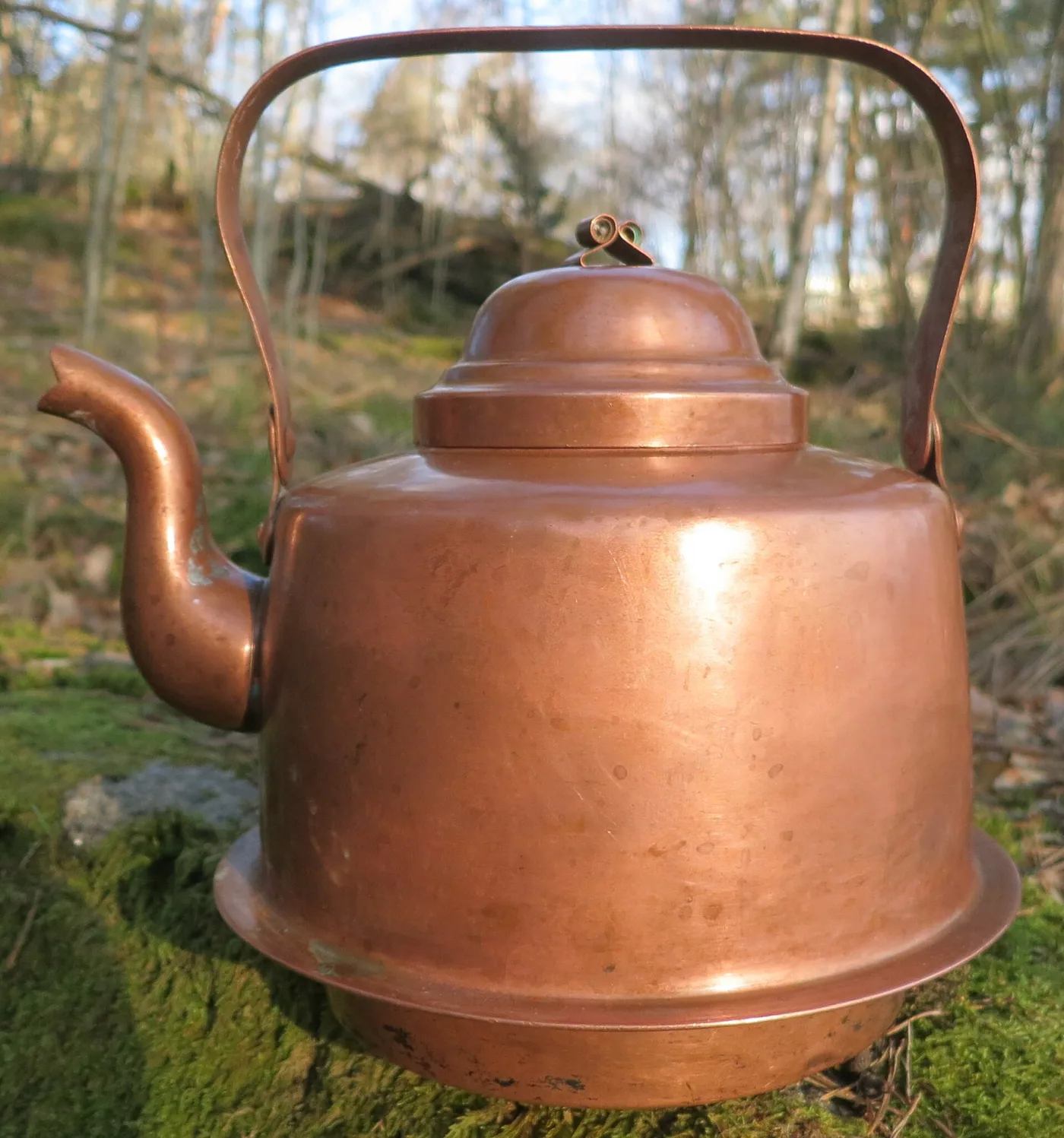
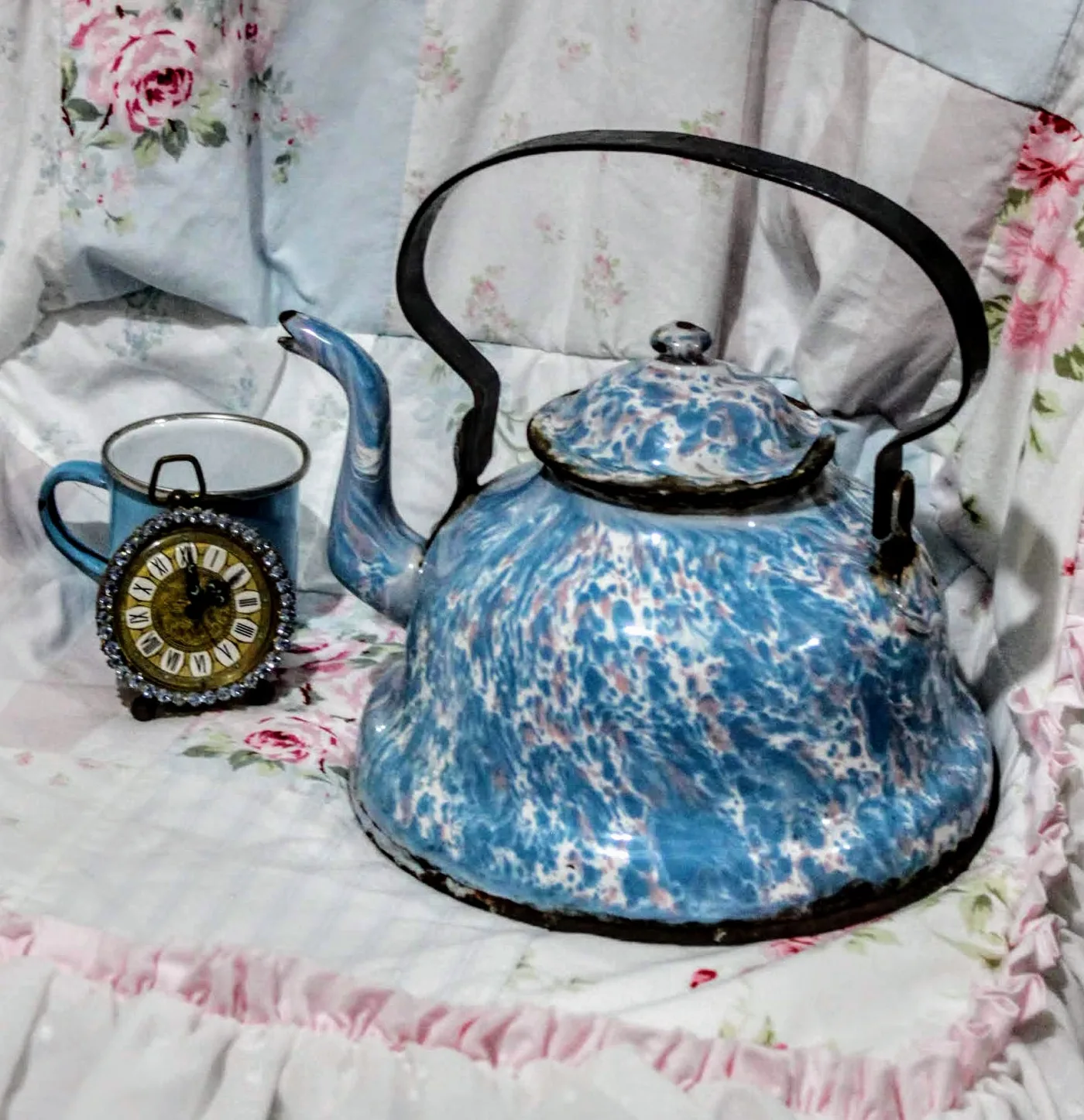
The two failure modes tell the materials apart faster than weight does. Copper dents and its seams open; it does not chip, and any green in the crevices is corrosion of the metal itself. Enamel does the opposite — the steel underneath is sound while the coating flakes away at every edge that ever took a knock, which is why the rim, the spout tip and the foot ring on the piece above are dark and the body is not. A "copper" kettle with a chipped edge showing white underneath is enamelled steel with a copper-coloured finish.
Weight and Physical Characteristics
One of the quickest ways to determine kettle material is by weight. Cast iron kettles are significantly heavier than copper or enamelware of similar size. A medium-sized cast iron kettle typically weighs 5-8 pounds or more, while a comparable copper kettle might weigh 2-4 pounds, and enamelware 1-3 pounds. This weight difference reflects both material density and construction methods.
Surface characteristics also vary distinctly. Copper develops a natural patina over time, ranging from warm brown to verdigris green depending on environmental exposure. Cast iron shows a characteristic dark gray to black surface, often with a slightly rough texture from the casting process. Enamelware displays a smooth, glass-like finish that may show crazing (fine cracks) or chips revealing the base metal beneath.
Copper Kettle Identification
Copper kettles represent some of the most sought-after antique kitchenware, valued for their beauty, craftsmanship, and historical significance. Identifying authentic antique copper kettles requires examining construction techniques, maker marks, and patina development.
Hand-Crafted Construction Indicators
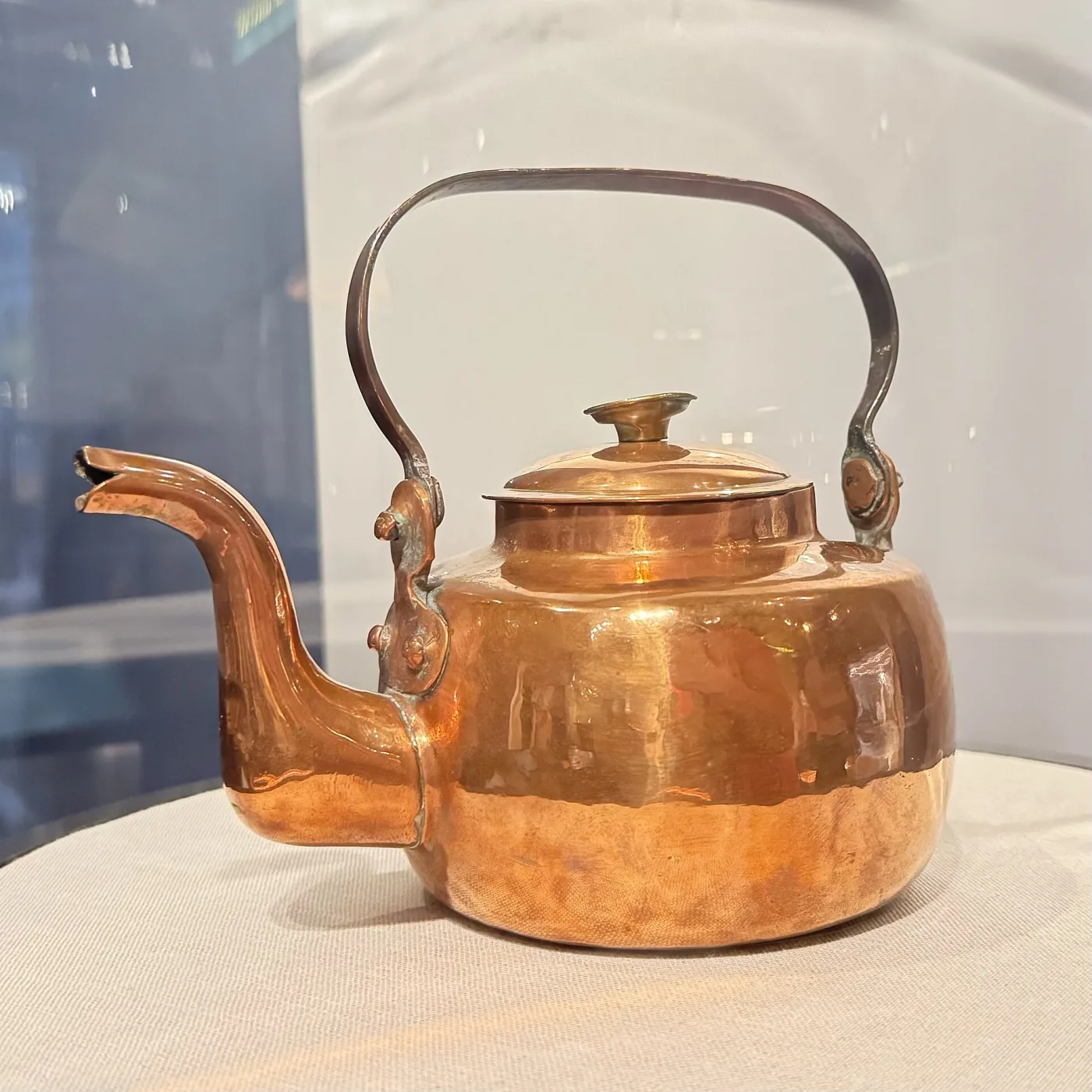
Antique copper kettles bear telltale signs of hand craftsmanship that distinguish them from modern reproductions. Look for hammer marks across the surface, which appear as subtle dimpling or texture from the metalworking process. These marks indicate the copper was hand-hammered into shape, a technique used through the 19th and early 20th centuries.
Examine the rivets securing handles and spouts. Handmade rivets show irregularity in size and placement, often with visible hammer marks around the rivet heads. Machine-made rivets, indicating later production or reproduction, appear perfectly uniform and symmetrical. The copper sheets themselves may show slight variations in thickness, particularly at seams where pieces were joined.
Maker Marks and Dating
Always look for maker marks for identification and authentication. These marks typically appear on the bottom, near the handle attachment, or occasionally on the lid. Antique copper kettles produced around 1890 often feature an "L" mark on the lid, indicating specific manufacturers of that period.
Kettles with a round top, oval base, and a "B" symbol debuted around the 1910s, representing a transitional period in kettle design. Other common marks include manufacturer names, location stamps, and quality indicators. Documentation of these marks helps establish provenance and approximate manufacturing dates.
Patina and Surface Characteristics
Natural patina development provides important authentication clues. Genuine antique copper develops patina gradually over decades, showing variations in color and depth across the surface. Areas that received more handling or exposure may show brighter copper underneath, while protected areas develop deeper brown or green oxidation.
Artificially aged reproductions often show uniform patina application or chemical treatments that create unnaturally even coloring. Examine inside surfaces, which should show wear patterns consistent with actual use, including water line staining or mineral deposits in hard water areas.
Design Evolution and Regional Styles
British copper kettles often feature more elaborate decorative elements, including repousse work, acorn finials, and swan-neck spouts. American copper kettles tend toward simpler, more utilitarian designs. Continental European examples may show distinctive regional characteristics, such as the Dutch dovetail construction or French Art Nouveau influences in later pieces.
Victorian-era kettles frequently incorporate mixed materials, with copper bodies featuring brass or iron handles and decorative elements. The transition from swing bail handles to fixed wooden or Bakelite handles helps narrow dating, with the latter indicating early 20th-century production.
Cast Iron Kettle Identification
Cast iron kettles represent a significant segment of American antique kitchenware, with pieces from renowned manufacturers commanding premium prices among collectors. Identification relies heavily on understanding casting techniques, manufacturer marks, and design evolution.
Gate Marks and Dating
Gate marks provide crucial dating information for cast iron kettles. These marks appear as raised lines or rough areas on the bottom, resulting from the gate system used to pour molten iron into molds. Cast iron skillets and kettles with gate marks are centuries old, using an 1800s casting technique discontinued around 1890.
The presence of gate marks immediately indicates pre-1890 production, making such pieces rare and valuable. After 1890, manufacturers adopted newer casting techniques that eliminated gate marks, producing smoother bottoms. This technological transition serves as a clear dividing line in cast iron identification.
Maker Marks and Logos
Maker marks are the easiest way to identify antique cast iron, with the name and logo on the bottom allowing the piece to be traced and dated as marks fit onto a timeline. Major American cast iron manufacturers developed distinctive marking systems that evolved over their production histories.
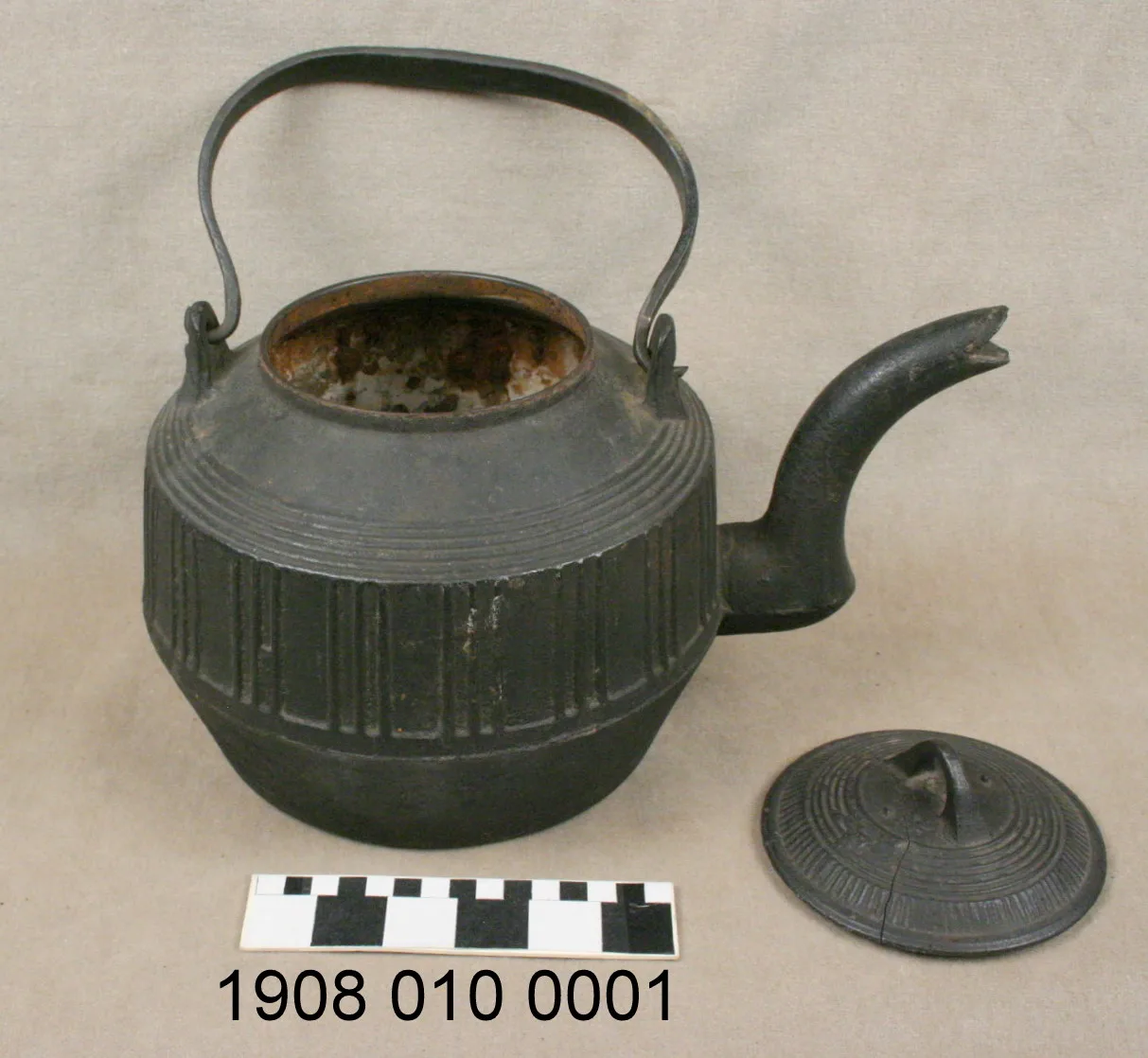
Authentic cast iron tea kettles have maker marks stamped into the metal, typically on the bottom or side, including the manufacturer's name, location, and sometimes the year. These marks were cast directly into the mold, creating raised or recessed lettering that is integral to the piece rather than surface-applied.
Surface Characteristics
The casting process creates distinctive surface textures that help authenticate pieces. Antique cast iron shows a slightly rough, porous surface texture from the sand casting molds used historically. Modern reproductions often appear too smooth or show machine finishing that wasn't available in earlier periods.
Examine the interior surface for signs of genuine use, including heat staining, mineral deposits, and wear patterns. The seasoning or patina inside should show organic development over time, with variations in color and texture. Reproductions may show artificial aging or overly uniform surface treatments.
Weight and Wall Thickness
Cast iron kettles are particularly valuable because they are handmade and feature substantial construction. Earlier pieces often show thicker walls and heavier construction than later mass-produced examples. However, premium manufacturers maintained quality standards throughout their production, so weight alone isn't definitive for dating.
Feel for variations in wall thickness, which indicate hand-finishing of castings. Perfectly uniform thickness suggests modern manufacturing techniques. The kettle's balance and weight distribution also reveal construction quality, with well-made pieces showing careful attention to functional design.
Enamelware Kettle Identification
Enamelware kettles combine the durability of metal with decorative porcelain coatings, creating colorful and practical kitchenware that gained widespread popularity from the 1890s through the mid-20th century. Identifying these pieces requires understanding enamel application techniques, pattern dating, and manufacturer characteristics.
Enamel Types and Application
Enamelware consists of a metal base (typically steel or iron) coated with porcelain enamel fused to the surface through high-temperature firing. This process creates a smooth, glass-like finish resistant to rust and staining. Quality varies significantly based on the number of enamel coats applied and firing temperatures used.
Premium enamelware shows multiple coats with smooth, even coverage and minimal pinholes or irregularities. Lesser quality pieces may show thinner enamel, visible metal through translucent areas, or uneven application. The enamel's thickness affects durability and the piece's weight, with better examples feeling more substantial.
Color and Pattern Dating
Enamelware designs vary from blue and white exteriors to mottled red, with patterns helping establish manufacturing periods. Early enamelware (1890s-1910s) often features solid colors or simple two-tone combinations in white, gray, or cream with colored trim.
The 1920s-1940s saw an explosion of decorative patterns including speckled or "granite" finishes, checkered designs, and floral motifs. Bright primary colors became popular in the 1930s-1950s, reflecting the cheerful kitchenware trends of that era. Art Deco influences appear in geometric patterns from the 1920s-1930s.
Manufacturer Marks
Enamelware manufacturers marked their pieces on the bottom, often including company names, pattern names, or country of origin. European manufacturers like Kockums (Sweden), Cathrineholm (Norway), and various German producers created distinctive designs. American manufacturers included companies like Granite Ware and various regional producers.
Paper labels were sometimes used instead of stamped marks, though these rarely survive. The absence of markings doesn't necessarily indicate inferior quality, as some excellent pieces were unmarked, but marks help establish provenance and approximate dating.
Condition Considerations
Enamelware condition significantly affects value and usability. Examine pieces for chips, which expose the metal base and can lead to rust. Small chips are common and expected in genuinely used pieces, but extensive chipping indicates poor care or quality issues.
Crazing (fine cracks in the enamel surface) is common in older pieces and doesn't necessarily impact functionality, though it can harbor bacteria if used for food preparation. Rust staining around chips or the rim indicates moisture exposure. The most valuable enamelware shows minimal damage with intact, glossy enamel and vibrant colors.
Major Kettle Manufacturers
Understanding major manufacturers is essential for kettle identification and valuation. Certain companies achieved legendary status among collectors due to their quality, innovation, and historical significance. American, British, and European manufacturers each contributed distinctive characteristics to kettle design and production.
American Manufacturers
The United States produced numerous cast iron and aluminum kettle manufacturers, with several companies achieving prominence. Major cast iron makers include Griswold (Erie, Pennsylvania), Wagner (Sidney, Ohio), Lodge (Tennessee), and Favorite Piqua (Ohio). Each developed distinctive design characteristics and marking systems.
These companies dominated the American market from the mid-19th century through the mid-20th century, with some continuing production to the present day. Brands like Griswold and Wagner are especially prized among collectors, with values ranging from a few hundred to several thousand dollars depending on rarity, condition, and specific model.
British and European Manufacturers
British copper kettle manufacturers created some of the finest examples of metalwork, with companies like Benham & Froud, Christopher Dresser, and various Birmingham and Sheffield producers achieving renown. These firms often combined functional design with aesthetic appeal, incorporating Arts and Crafts or Art Nouveau influences.
Continental manufacturers produced distinctive regional styles, with French copper work, German enamelware, and Scandinavian design each contributing unique characteristics. Well-known brands include Gates kettles, Jewett & Roots, Michael Graves, and Charles Noble & Company, among others.
Collector Organizations and Resources
The Wagner & Griswold Society (WAGS) is a community of cast iron and aluminum cookware collectors offering wealth of information about vintage and antique pieces. Annual dues are $30 for individuals and $40 for two people in the same household, providing access to newsletters, conventions, and expert knowledge.
Reference books provide essential identification help. John Tyler's "Early American Cast Iron Hollow Ware 1645-1900: Pots, Kettles, Tea Kettles and Skillets" (2014) offers comprehensive information about early American production. The "Book of Wagner & Griswold" (red book) contains detailed information about tea kettles and places certain pieces in specific production periods like 1915-1920.
Griswold Manufacturing Company
The Griswold Manufacturing Company of Erie, Pennsylvania stands as one of the most valuable and collectible cast iron kettle manufacturers in American history. Founded in 1865, the company produced premium cookware renowned for quality, innovation, and elegant design.
Company History and Evolution
Griswold began as a small foundry and grew into a major cookware manufacturer, introducing innovations in casting techniques and design. Around 1894, the Pittsburgh Reduction Company (later Alcoa) approached Griswold about casting aluminum products, leading to the birth of the Griswold aluminum tea kettle line.
This aluminum production represented a significant innovation, as aluminum was still a relatively new material for cookware. Griswold's aluminum kettles offered light weight compared to cast iron while maintaining excellent heat conductivity, appealing to consumers seeking modern alternatives.
In 1957, Randall's Wagner division acquired Griswold Manufacturing from McGraw-Edison, consolidating two major cookware producers. The merger ended Griswold's independent production but ensured continued manufacture under the Wagner name.
Design Characteristics
Griswold kettles were sophisticated, featuring flattened sides, excellent handles, and a safety fill hole between the spout and lid. This design reflected the company's attention to both aesthetics and functionality, with handles positioned for comfortable pouring and lids engineered to prevent scalding steam exposure.
The flattened sides served practical purposes, providing stability on the cast-iron stovetop while maximizing heating efficiency. Griswold's engineering created kettles that heated evenly and poured smoothly, earning reputation for superior performance that enhanced the company's prestige.
Marking Systems and Dating
Griswold used several marking systems throughout its production history, with logo variations helping collectors date pieces. Early marks feature the company name and Erie, PA location. The iconic "Erie" spider logo appears on mid-period pieces, while later production shows different mark configurations.
Pattern numbers, size indicators, and model designations appear on most pieces, typically on the bottom. These markings, combined with logo style and other features, allow collectors to narrow manufacturing dates within specific year ranges. Reference books provide detailed chronologies of marking evolution.
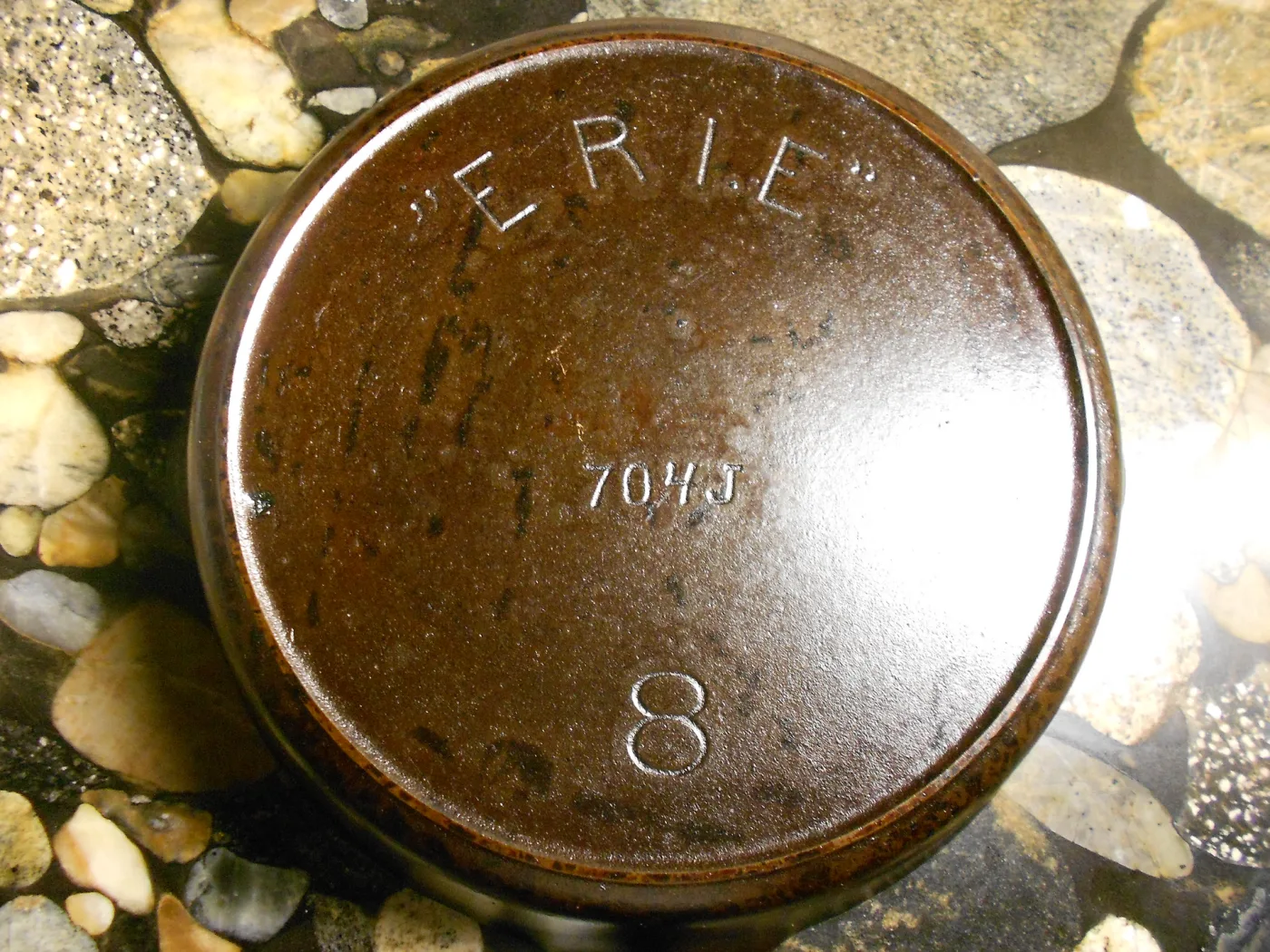
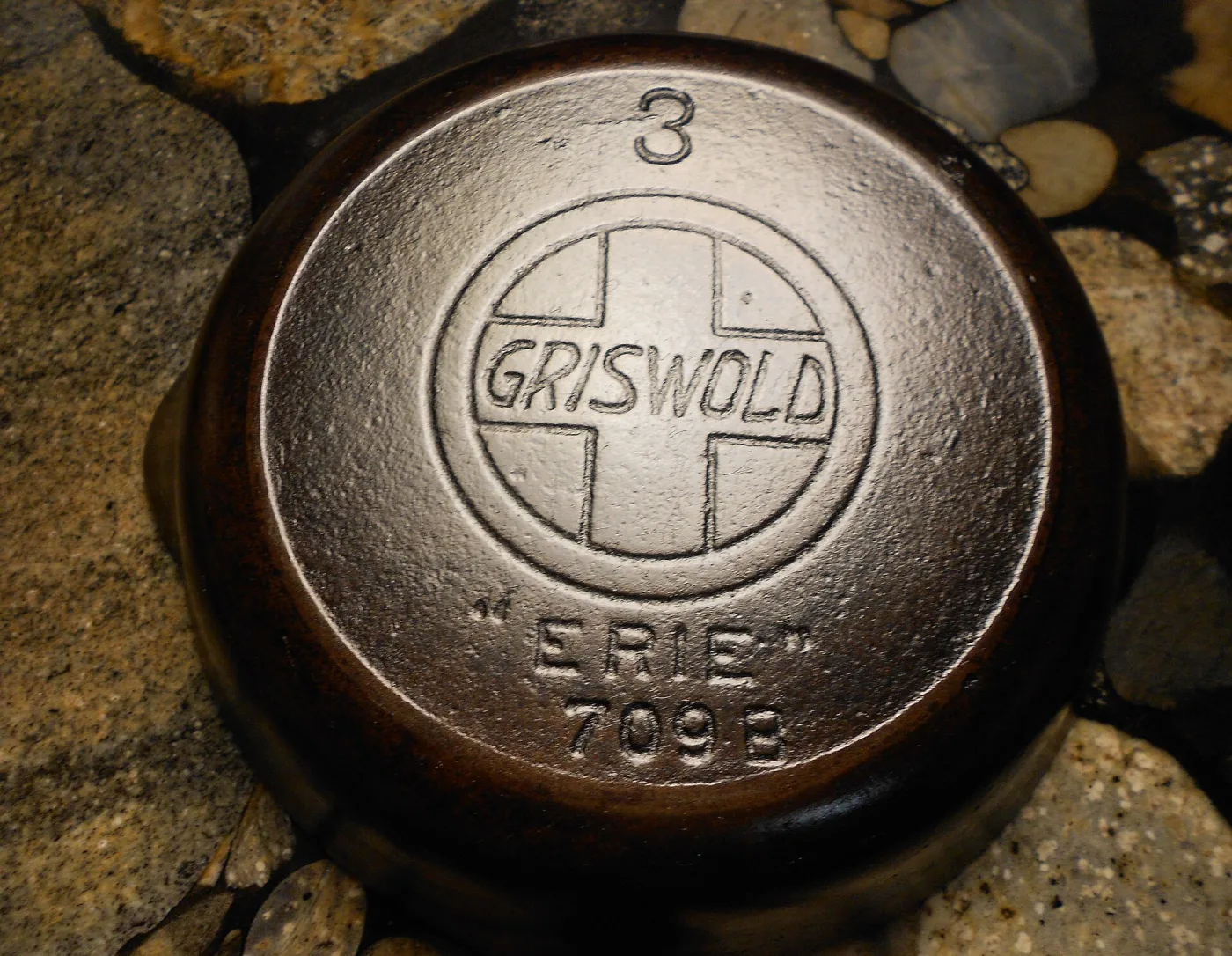
Both of these are skillet bases rather than kettles — Griswold kettles are scarce and rarely photographed underneath — but the marking sequence is the company's, not the pan's, and it is the same on every line it made. The point to take across is that the bare place-name mark comes before the cross trademark, so a Griswold-branded piece and an "ERIE" piece are not the same generation even when the castings are otherwise alike. Record the whole base, not just the name: the pattern number, the size number and the presence or absence of "U.S.A." are what published Griswold mark charts key on, and a photograph missing the lower half of the base cannot be dated from a chart.
Collectibility and Value
Griswold pieces command premium prices in the antique market due to their quality, relative scarcity, and collector demand. Rare patterns, unusual sizes, or pieces in exceptional condition achieve the highest values. Even common Griswold kettles typically sell for several hundred dollars in good condition.
The combination of excellent construction, innovative design, and historical significance makes Griswold kettles highly sought by both users and collectors. Pieces show superior heat performance compared to modern kettles, making them functional as well as collectible.
Wagner Manufacturing Company
Wagner Manufacturing Company of Sidney, Ohio produced some of the most valuable cast antique iron kettles, rivaling Griswold in quality and collector appeal. Founded in the 1890s, Wagner became a major American cookware manufacturer with a long production history.
Company Development
Wagner grew from a regional manufacturer to a national brand, ultimately acquiring its major competitor Griswold in 1957. During the early 1930s, Wagner hired industrial engineer John Gordon Rideout, who designed a teakettle in the Magnalite line with improved heat conductivity.
This Magnalite line represented Wagner's premium offering, incorporating advanced engineering and materials science. The improved heat conductivity meant faster boiling times and more efficient fuel use, appealing to consumers during the Depression era when efficiency mattered greatly.
In 1969, both Wagner and Griswold divisions were sold to General Housewares Corporation, consolidating production further. The trademarks were later acquired by American Culinary Corporation of Willoughby, Ohio, though vintage pieces remain the most collectible.
Distinctive Design Features
Wagner kettles featured straight sides with wooden handles and a domed lid that could swivel from front to back. This swiveling lid design offered practical advantages, allowing users to fill the kettle more easily and pour without removing the lid entirely.
The straight sides maximized capacity while maintaining stability, and the wooden handles provided heat insulation for safer handling. Wagner's engineering focused on practical functionality, creating pieces that worked efficiently in daily use while maintaining attractive appearance.
Dating Wagner Pieces
Wagner marking systems evolved throughout the company's history, with logo styles, pattern numbers, and text variations helping establish manufacturing dates. Early pieces feature simple "Wagner Ware" text, while later production shows more elaborate logos and markings.
A Wagner Ware tea kettle from 1902 could be worth anywhere from $50 to $100 depending on condition, though these kettles used to sell for more money when the collecting market was at its peak. Values fluctuate based on collector interest, rarity, and condition.
The "Book of Wagner & Griswold" provides detailed information about tea kettles and places certain pieces in the 1915-1920s era based on marking characteristics, handle styles, and design features. This reference remains essential for serious collectors seeking accurate dating.
Collecting Considerations
Wagner pieces appear more frequently in the market than comparable Griswold items, potentially offering better value for collectors. Quality rivals Griswold in most cases, with excellent castings, durable construction, and attractive designs. Condition matters significantly, with intact handles, minimal rust, and good seasoning commanding premium prices.
Other Notable Makers
Beyond Griswold and Wagner, numerous manufacturers produced quality kettles that appeal to collectors and users. Understanding these makers helps identify unmarked pieces and appreciate the diversity of antique kettle production.
American Cast Iron Manufacturers
Lodge Manufacturing, founded in 1896 in South Pittsburg, Tennessee, continues production today, making it one of the oldest continuously operating cookware manufacturers. Vintage Lodge pieces show excellent quality and are more affordable than comparable Griswold or Wagner examples.
Favorite Piqua Ware, produced in Piqua, Ohio, created distinctive kettles with characteristic marking systems. These pieces appear less frequently in the market but represent quality construction. Other American manufacturers include Birmingham Stove & Range, Atlanta Stove Works, and numerous regional foundries.
British Copper Manufacturers
Benham & Froud of London produced exceptional copper kettles incorporating aesthetic and functional excellence. Christopher Dresser designed innovative kettle forms during the late 19th century, creating pieces that merged Arts and Crafts principles with functional requirements.
Birmingham and Sheffield manufacturers dominated British copper production, with numerous workshops creating kettles ranging from utilitarian to highly decorative. Many pieces bear hallmarks indicating manufacturer, location, and sometimes date, though unmarked examples also appear.
European Enamelware Producers
Scandinavian manufacturers like Kockums (Sweden) and Cathrineholm (Norway) created distinctive enamelware in bold colors and patterns. These pieces achieved popularity during the mid-20th century and are now highly collectible for their design aesthetic.
German manufacturers produced extensive enamelware lines, often featuring traditional patterns and sturdy construction. French and Eastern European producers contributed regional styles, with variations in color preferences, patterns, and construction techniques.
Specialty and Transitional Makers
Some manufacturers specialized in specific materials or innovative designs. Companies like Gates Kettles, Jewett & Roots, Michael Graves, and Joseph Heinrich created distinctive pieces that appeal to specialized collectors. These makers often incorporated unique design elements or construction techniques that set their products apart.

Identifying Maker Marks and Hallmarks
Maker marks provide the most reliable method for authenticating and dating antique kettles. Understanding marking systems, their evolution, and proper interpretation requires familiarity with manufacturer practices and historical contexts.
Location of Marks
To identify an antique tea set or kettle, look closely to determine who the manufacturer is. Locate the hallmark on the bottom of the kettle, or sometimes on the side near the handle attachment, the underside of the lid, or inside the spout area. Cast iron marks typically appear on the bottom as raised or recessed lettering integral to the casting.
Copper kettle marks may be stamped into the metal, appearing as indentations, or occasionally as applied metal tags attached with rivets. Enamelware marks usually appear as stamped impressions on the bottom, though paper labels were also used but rarely survive on vintage pieces.
Interpreting Mark Information
Marks typically include manufacturer name, location, and sometimes production dates or pattern numbers. The presence of location information helps identify the manufacturer and narrow dating, as some companies operated in specific locations during defined periods.
Pattern numbers or model designations appear on many pieces, particularly from larger manufacturers who produced extensive product lines. These numbers, cross-referenced with company catalogs or collector references, identify specific models and production periods.
Evolution of Marking Practices
Marking practices evolved throughout the 19th and 20th centuries. Early pieces often have minimal markings or simple name stamps. As competition increased, manufacturers developed more elaborate logos and marking systems to establish brand identity.
The "Made in America" label indicates pieces from the 1960s when trade requirements mandated place of manufacture on imported goods. This marking helps distinguish American-made pieces from imports and provides a terminus post quem (earliest possible date) for manufacturing.
Unmarked Pieces
Many quality kettles bear no maker marks, either because small manufacturers didn't mark their work, marks wore away through use, or pieces were sold through retailers who applied their own labels. Unmarked pieces require identification through design characteristics, construction techniques, and material analysis.
Compare unmarked pieces to documented examples in reference books or museum collections. Construction details like casting characteristics, handle attachment methods, and overall design may indicate specific manufacturers or regions even without marks.
Dating Techniques for Antique Kettles
Accurate dating enhances understanding of antique kettles' historical context and affects valuation. Multiple dating methods used in combination provide the most reliable results, as individual indicators may be ambiguous.
Construction Technique Dating
Gate marked bottoms indicate late 18th or 19th century production for cast iron pieces. This casting method was discontinued around 1890, making gate marks a clear indicator of pre-1890 manufacture. The size and configuration of gate marks provide additional information about foundry practices.
Seam construction in copper kettles reveals manufacturing methods. Hand-raised kettles show hammer marks and irregular seams. Machine-rolled copper and mechanically formed kettles, indicating post-1870s production, show more uniform construction with straighter seams and less variation in metal thickness.
Material and Finish Dating
Enamel formulations and application techniques changed over time, with earlier pieces showing thicker, more irregular coatings and later production demonstrating improved consistency. Color chemistry also evolved, with certain hues only achievable after specific innovations in enamel production.
Aluminum kettles date no earlier than the 1890s, when the material became commercially viable for cookware. Early aluminum pieces show different characteristics than modern aluminum, with variations in alloy composition and surface finish providing dating clues.
Design Evolution
Handle styles evolved from simple bail handles through fixed arch handles to swivel bails and eventually modern ergonomic designs. The materials used for handles also changed, with progression from iron through brass, copper, wood, and finally Bakelite and early plastics indicating specific periods.
Spout designs show period characteristics, with goose-neck spouts popular in earlier periods, transitional forms in the mid-19th century, and more utilitarian straight spouts in later production. Decorative elements like finials, engraving, and applied ornamentation also follow period trends.
Technological Indicators
Manufacturing technology visible in construction provides dating information. Machine-cut threads on lids or attachments indicate post-1850s production. Welding techniques, when present, suggest 20th-century manufacture, as earlier pieces used riveting, soldering, or casting for joining components.
The precision and uniformity of components indicates manufacturing capabilities available during production. Perfectly matched lids, uniform wall thickness, and precision-machined parts suggest later manufacture with access to improved machinery and quality control.
Period-Specific Design Features
Design characteristics evolved throughout the 19th and 20th centuries, reflecting technological capabilities, aesthetic preferences, and functional innovations. Recognizing period-specific features helps date kettles and appreciate their historical context.
Georgian and Early Victorian (1800-1850)
Early 19th-century kettles typically feature simple, elegant forms with minimal ornamentation. Copper examples often show hand-raising techniques with visible hammer marks and dovetailed seam construction. Cast iron pieces from this period are relatively rare and show primitive casting techniques with thick walls and simple bail handles.
Decorative elements remain restrained, with functionality paramount. Spouts tend toward simple curved forms, and handles are purely utilitarian. The emphasis is on durability and heat efficiency rather than aesthetic elaboration.
Mid to Late Victorian (1850-1900)
Victorian design brought increasing ornamentation and decorative elements to kettles. Copper examples may feature repousse work, engraved patterns, and elaborate finials. Mixed materials became popular, with copper bodies featuring brass handles and decorative accents.
Cast iron production expanded significantly during this period, with manufacturers developing more refined casting techniques and decorative patterns. The introduction of nickeling provided decorative finish options. Enamelware emerged in the late Victorian period, initially in simple color combinations.
Arts and Crafts and Art Nouveau (1880-1915)
The Arts and Crafts movement influenced kettle design toward handcrafted appearance and honest expression of materials. Copper kettles embraced visible hammer marks and artisanal construction. Design reformers like Christopher Dresser created innovative forms that merged aesthetic and functional considerations.
Art Nouveau influences appear in flowing lines, organic forms, and naturalistic decorative elements. Handles and spouts may show curved, flowing forms rather than geometric shapes. This period represents a high point in decorative kettle design.
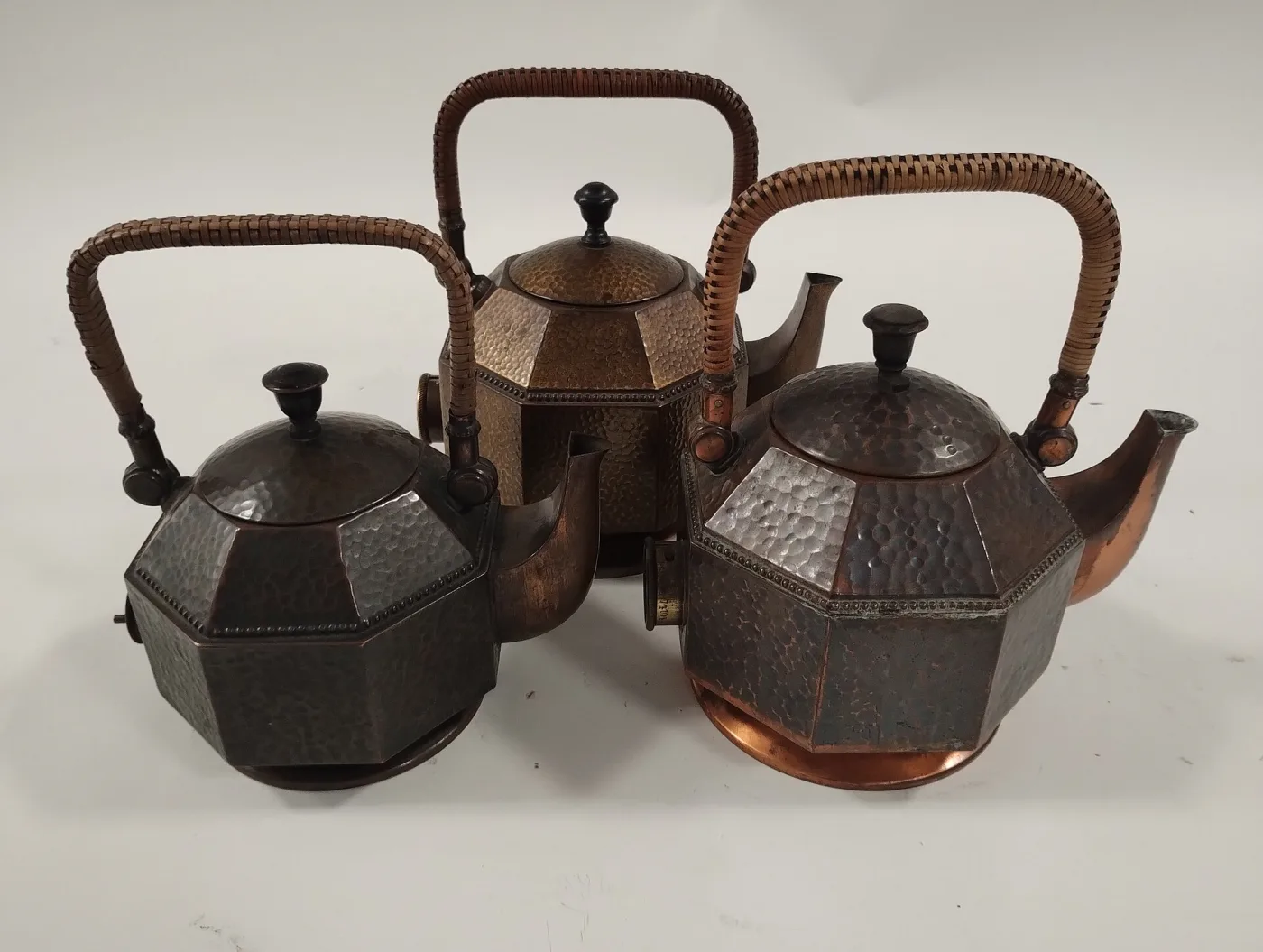
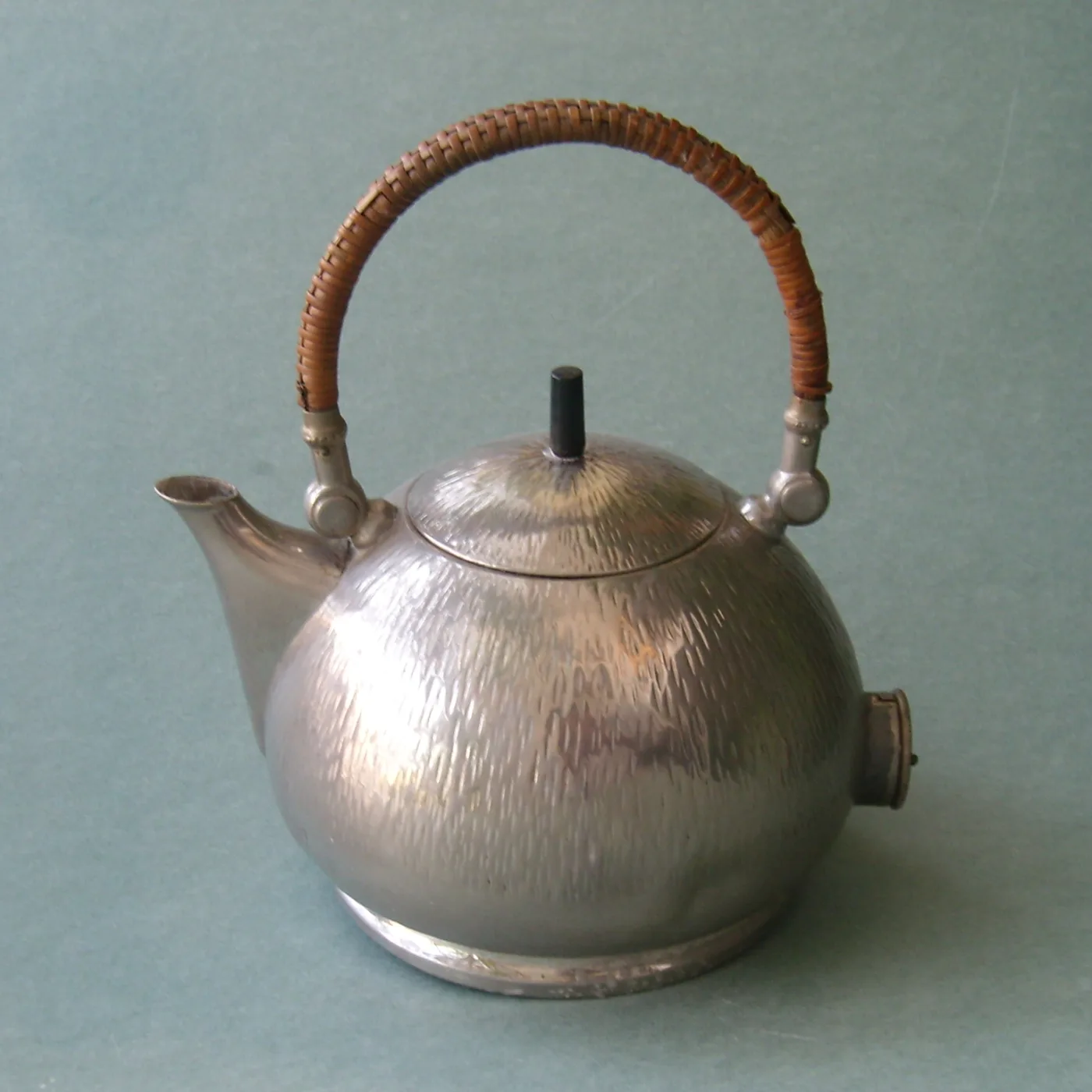
This is the moment the handcrafted look becomes a factory product, and it is a genuinely confusing one to date by eye. The hammered and chased surfaces read as Arts and Crafts workshop pieces, but the handle fittings, knobs and lids are interchangeable parts shared across bodies and sizes — an economy no hand workshop would bother with. The detail that settles it is the cylindrical socket low on the side of every one of them: these take an electrical element, and a stovetop kettle has no such fitting. Hammer marks plus standardised hardware plus an electrical boss means around 1910 and industrial, not 1890 and artisanal.
Early 20th Century and Art Deco (1915-1940)
Streamlined designs and geometric forms characterize Art Deco period kettles. Enamelware gained popularity with bold colors and geometric patterns. Cast iron manufacturers refined their designs for efficiency and modern appeal while maintaining traditional construction quality.
Industrial design principles influenced form, with emphasis on functional efficiency and modern aesthetics. Bakelite and early plastics appeared in handles and knobs, indicating post-1920s production. Chrome plating became popular for decorative accents.
Mid-Century Modern (1940-1970)
Post-war design embraced modernist principles with clean lines, bright colors, and emphasis on functionality. Enamelware reached peak popularity with cheerful patterns and colors. Aluminum became increasingly common, offering lightweight alternatives to traditional materials.
Design became more international, with Scandinavian influences particularly strong in enamelware and aluminum pieces. Manufacturers focused on ease of use, with improved pouring spouts, heat-resistant handles, and whistling mechanisms for automatic notification when water boiled.
Construction and Manufacturing Techniques
Understanding construction techniques helps authenticate antique kettles, appreciate craftsmanship, and distinguish handmade pieces from mass production. Manufacturing methods evolved significantly from the 18th through 20th centuries, with each technique leaving characteristic evidence.
Copper Working Methods
Hand-raising involves hammering flat copper sheet over forms to create three-dimensional shapes. This technique produces visible hammer marks across the surface and creates slight variations in wall thickness. Seams where copper sheets join show hand-soldering or brazing with visible filler material.
Spinning copper on lathes became common in the late 19th century, producing smoother surfaces with concentric marks from the spinning process. This method allowed faster production while maintaining hand-crafted quality. Machine-rolled copper sheets enabled more uniform wall thickness but lost some artisanal character.
Cast Iron Production
Sand casting dominated cast iron production, with manufacturers creating patterns that were pressed into sand to form molds. Molten iron poured through gates left characteristic marks on finished pieces. The sand used affected surface texture, with finer sand producing smoother surfaces.
Multi-part molds enabled production of complex shapes with undercuts and details impossible with simple molds. Examining parting lines where mold sections joined reveals production techniques. Better manufacturers carefully finished these lines, while economy pieces show more prominent evidence of mold sections.
Enamel Application
Enamelware production involved applying ground glass (enamel) to metal bases and firing at high temperatures to fuse the coating. Multiple coats built up smooth, durable finishes, with quality pieces receiving three or more applications. Each firing required careful temperature control to prevent defects.
Decorative patterns could be applied through several methods: hand-painting before firing, transfer printing, or stenciling. Different techniques produced characteristic appearances, with hand-painted pieces showing variations and irregularities that add charm and indicate quality craftsmanship.
Assembly and Joining
Riveting was the primary method for attaching handles and spouts through much of the 19th century. Handmade rivets show irregularities, while machine-made rivets appear uniform. Soldering joined copper components, with quality work showing neat, minimal solder application.
Threading for lids and removable components required machine work, with hand-cut threads showing irregularities compared to machine-cut precision threading. The introduction of welding in the 20th century provided alternative joining methods, though traditional techniques persisted in quality production.
Authentication Methods
Authenticating antique kettles protects collectors from reproductions and ensures proper valuation. Multiple authentication methods used together provide confidence in attribution and dating. Experts combine visual examination, materials analysis, and historical knowledge to verify authenticity.
Visual Inspection Techniques
Antique experts use black lights to detect rust, damage, and oxidation that could have occurred over time. Ultraviolet light reveals repairs, replaced components, and artificial aging that may not be visible in normal light. Patina that appears uniform under normal light may show application patterns or inconsistencies under UV examination.
Examine wear patterns for consistency with genuine use. Handles should show wear where hands gripped them, bottoms should show scratching or discoloration from stove contact, and interiors should display mineral deposits or staining consistent with water exposure. Artificially aged pieces often lack these organic wear patterns or show them in illogical locations.
Materials Analysis
Copper composition and alloy characteristics changed over time, with modern copper showing different properties than 19th-century material. Experts can analyze copper samples to detect modern alloys or inappropriate materials. The patina on genuine antique copper develops slowly with characteristic color variations, while artificial patina shows uniform application or chemical signatures.
Cast iron characteristics including carbon content, casting quality, and surface properties differ between historical and modern production. Genuine antique cast iron often shows higher carbon content and different microstructure than contemporary iron. Surface texture from sand casting differs from modern methods.
Construction Analysis
Examine joinery, riveting, and assembly techniques for period-appropriate methods. Reproductions sometimes use modern fasteners, welding techniques not available historically, or show machining precision impossible with period equipment. Hand-crafted elements show variations that machine production cannot replicate.
Tool marks provide authentication clues. Historical files, hammers, and lathes created characteristic marks different from modern tool signatures. Experienced collectors recognize period-appropriate tool evidence and can spot anachronistic manufacturing traces.
Provenance Research
Documentation, family history, and ownership records strengthen authentication. Pieces with documented provenance from reputable sources carry more confidence than examples with unknown history. Photographs showing kettles in period contexts, estate inventories, or original sales receipts provide valuable corroborating evidence.
Research manufacturer histories, production periods, and design evolution to verify that specific features align with claimed dates and attributions. Inconsistencies between design characteristics and supposed manufacturing periods indicate problems with attribution or potential reproductions.
Condition Assessment
Condition assessment determines value, usability, and conservation needs. Understanding condition grading helps collectors make informed purchase decisions and properly care for their pieces. Condition affects both market value and the kettle's suitability for display or use.
Copper Kettle Condition
Examine copper for dents, which are common but affect both appearance and value. Small dents may be acceptable depending on location and severity, while major structural damage significantly impacts value. Check for repairs, which appear as patches, solder marks, or mismatched metal additions.
Assess patina quality and authenticity. Natural patina adds character and authenticity, while overly polished pieces may have lost desirable surface characteristics. Verdigris (green oxidation) indicates copper exposure to moisture and should be evaluated for depth and extent. Surface cleaning should preserve patina while removing harmful corrosion.
Cast Iron Condition
The value depends on age and condition for cast iron kettles. Rust represents the primary condition concern, ranging from light surface oxidation to deep pitting that compromises structural integrity. Surface rust can be addressed through appropriate cleaning and re-seasoning, while deep rust damage is more problematic.
Check for cracks, which can be difficult to detect but seriously affect both value and usability. Hold pieces up to strong light looking for light transmission through cracks. Tap the kettle gently with a wooden spoon, listening for clear ringing (good) versus dull thuds (potential cracks).
Evaluate seasoning quality, the black coating that develops on cast iron through use and oiling. Good seasoning appears smooth and glossy, while poor or absent seasoning shows gray metal or rough, uneven surfaces. Original seasoning on antique pieces adds authenticity value.
Enamelware Condition
Chips represent the most common enamelware condition issue. Small chips are expected in genuinely used pieces, but extensive chipping affects both appearance and value. Exposed metal at chip sites may rust, spreading damage. Evaluate chip locations, as chips on pouring edges or high-contact areas impact functionality more than chips in less critical locations.
Crazing (fine cracks in the enamel) occurs naturally as pieces age and metal expands and contracts with temperature changes. Light crazing is acceptable and indicates age, while severe crazing compromises the enamel's protective properties. Staining in crazing lines shows the piece was genuinely used.
Handle and Lid Assessment
Handles require special attention as replacement or damaged handles significantly affect value. Original wooden handles should show appropriate aging and wear, with grain raising and color darkening consistent with age. Bakelite handles should show no cracks, chips, or heat damage.
Lids should fit properly without excessive wobbling or gaps. Original lids matching the base add value, while replacement lids reduce it. Check for damage to lid hinges, which commonly fail from stress. Finials should be original and undamaged, as replacements are often obvious and diminish authenticity.
Value Factors and Market Trends
Antique kettle values depend on multiple factors including manufacturer, age, rarity, condition, and current market trends. Understanding these factors helps collectors make informed decisions about purchases, sales, and insurance coverage.
Manufacturer Premium
Brands like Griswold and Wagner are especially prized, with values ranging from a few hundred to several thousand dollars depending on specific models and condition. These premium manufacturers achieved legendary status through quality, innovation, and limited production compared to total market demand.
Lesser-known but quality manufacturers may offer better value for collectors seeking functional pieces or building collections on more modest budgets. These kettles often perform as well as premium brands while selling for a fraction of the price.
Rarity and Desirability
Uncommon patterns, unusual sizes, or limited production runs command premium prices. Specialized pieces like invalid feeders (kettles designed for caring for the sick) or kettles with unique design features appeal to specialized collectors. Documentation of rarity through manufacturer records or collector research supports premium valuations.
Design aesthetics affect value significantly, with particularly attractive pieces commanding premiums over more utilitarian examples from the same manufacturer. Art Deco, Arts and Crafts, and designer pieces by notable individuals achieve higher values based on aesthetic appeal.
Current Market Trends
Prices for antique tea kettles start at $150 and top out at $40,826 with the average selling for $1,200 according to current market data. This wide range reflects the diversity of available pieces from common examples to rare museum-quality kettles.
Market values fluctuate based on collecting trends, with certain styles or manufacturers experiencing increased interest periodically. The current trend toward vintage and sustainable home goods in 2026 has increased interest in functional antique kitchenware, supporting values for quality pieces in usable condition.
Regional Value Variations
Values vary regionally based on local collecting interest and availability. American manufacturers command premiums in the U.S. market, while European pieces may sell better in their regions of origin. International shipping costs and import regulations affect cross-border values.
Urban markets with active antique scenes typically see higher prices than rural areas, though rural areas may offer better opportunities for discovering undervalued pieces at estate sales or local auctions.
Investment Considerations
Antique kettles purchased primarily for investment should focus on top-quality examples from recognized manufacturers in excellent condition. While values generally appreciate over time, the market can be illiquid, making quick sales difficult. Buy pieces you appreciate aesthetically and functionally, as enjoyment provides value beyond potential monetary appreciation.
Documentation, provenance, and original condition preserve investment value. Avoid over-restoration or modifications that can diminish authenticity and appeal to serious collectors.
Collecting Strategies
Successful kettle collecting requires knowledge, patience, and strategic approach. Whether building a comprehensive collection or seeking specific pieces, understanding collecting principles helps maximize enjoyment and value.
Developing Collection Focus
Decide whether to collect broadly across all kettle types or specialize in specific manufacturers, materials, periods, or styles. Specialization allows deeper knowledge and potentially more valuable collections, while broader collecting provides more variety and opportunities to acquire pieces.
Consider focusing on undervalued areas with growth potential. While Griswold and Wagner command premium prices, quality pieces from lesser-known manufacturers may offer better value with appreciation potential as collecting knowledge spreads.
Sourcing Strategies
Estate sales and auctions provide opportunities to acquire pieces at reasonable prices, particularly in areas where kettle collecting is less popular. Arrive early to examine pieces carefully before bidding. Research values beforehand to avoid overpaying in competitive bidding.
Antique shops and shows offer more curated selections with typically higher prices but also greater convenience and often better condition pieces. Develop relationships with dealers who can alert you to incoming pieces matching your collecting interests.
Online marketplaces expand sourcing opportunities but require careful evaluation based on photographs and descriptions. Request additional images showing marks, condition issues, and details. Understand return policies before purchasing significant pieces sight-unseen.
Authentication and Research
Invest in quality reference books covering your collecting areas. The "Book of Wagner & Griswold" and John Tyler's "Early American Cast Iron Hollow Ware" provide essential information for cast iron collectors. Copper and enamelware collectors benefit from manufacturer-specific references and general kitchenware guides.
Join collector organizations like the Wagner & Griswold Society to access expertise, networking opportunities, and specialized knowledge. Online forums and social media groups provide communities for sharing information, asking questions, and learning from experienced collectors.
Budget Management
Set realistic budgets based on collecting goals and financial capacity. Quality pieces require significant investment, but rushing into purchases can lead to overpaying or acquiring pieces that don't fit collection goals. Be patient waiting for the right pieces at appropriate prices.
Balance purchasing between affordable pieces for learning and occasional premium acquisitions that anchor the collection. Consider condition carefully, as restoration costs can exceed the price difference between damaged and good condition pieces.
Care and Preservation
Proper care maintains condition, preserves value, and ensures antique kettles can be enjoyed for generations. Different materials require specific care approaches, while general principles apply across all types.
Copper Kettle Care
Clean copper gently using appropriate methods that preserve patina while removing harmful deposits. Mild dish soap and warm water suffice for regular cleaning. Avoid abrasive cleaners that remove desirable patina along with dirt. For stubborn deposits, use copper-specific cleaners sparingly and carefully.
Decide whether to maintain natural patina or polish to bright copper finish. Natural patina adds authenticity and age appeal, while polished copper showcases the metal's beauty. Once polished, pieces require regular maintenance to prevent re-tarnishing. Consider the piece's history and collecting goals when deciding.
Store copper kettles in dry environments to prevent accelerated oxidation. Avoid areas with high humidity or temperature fluctuations. If displaying copper, keep it away from direct sunlight which can create uneven patina development.
Cast Iron Maintenance
Maintain seasoning through regular light oiling with food-grade oils if using pieces functionally. Heat the kettle gently after oiling to polymerize the oil coating. For display pieces, light mineral oil prevents rust while preserving appearance.
Never use harsh detergents or dishwashers on cast iron, as these remove seasoning. If rust appears, address it promptly through appropriate cleaning methods using fine steel wool or specialized cast iron cleaners. Re-season thoroughly after rust removal.
Store cast iron in dry environments with good air circulation. Avoid damp basements or unheated storage areas where condensation promotes rust. If stacking multiple pieces, place paper towels between them to absorb moisture and prevent scratching.
Enamelware Protection
Handle enamelware carefully to prevent chips. The enamel coating is durable but brittle, vulnerable to impact damage. Store pieces where they won't be knocked or stacked too heavily. Use padding when packing for transport or storage.
Clean with gentle non-abrasive cleaners that won't scratch the enamel surface. Baking soda paste removes stubborn stains without scratching. Avoid metal scrubbers or harsh chemicals that can damage enamel or cause discoloration.
If using enamelware functionally, avoid thermal shock by not exposing hot pieces to cold water or vice versa. Temperature extremes can cause enamel cracking or spalling. Heat and cool pieces gradually to preserve integrity.
Environmental Controls
Maintain stable temperature and humidity levels in display or storage areas. Fluctuations promote corrosion, material degradation, and finish damage. Aim for 40-50% relative humidity and temperatures between 60-75°F for optimal preservation.
Protect pieces from direct sunlight which fades colors, degrades materials, and creates uneven patina or discoloration. Use UV-filtering glass in display cases or position collections away from windows.
Identifying Reproductions and Fakes
The market for antique kettles includes reproductions ranging from honest modern pieces to deliberate fakes. Learning to distinguish authentic antiques from reproductions protects collectors from costly mistakes and ensures collection integrity.
Common Reproduction Indicators
Artificially aged patina appears too uniform or shows chemical treatment signatures. Natural patina develops gradually over decades with variations based on use patterns and environmental exposure. Reproduction patina often covers pieces uniformly, including areas that would remain bright through handling.
Modern casting techniques produce surfaces smoother than historical sand casting. Examine texture carefully, comparing suspected reproductions to authenticated examples. Modern pieces may show machine finishing or surface characteristics impossible with period manufacturing equipment.
Maker Mark Concerns
Reproduction marks may appear too sharp and crisp compared to genuine examples showing wear from decades of use. Forged marks sometimes use incorrect fonts, spacing, or contain anachronistic information. Compare marks carefully to documented examples in reference books.
Some reproductions carry honest marks identifying them as modern pieces, which helps avoid confusion. Others may lack marks entirely, which isn't necessarily problematic but requires authentication through other methods. Be suspicious of pieces with marks that seem inconsistent with other characteristics.
Construction Red Flags
Welding on pieces supposedly predating welding technology indicates either reproduction or later repair. Understand which joining techniques were available during different periods and look for anachronistic methods.
Modern fasteners, machine screws with perfectly uniform threads, or components showing CNC machining indicate recent manufacture. Period-appropriate hand-cut threads, handmade rivets, and traditional joinery support authenticity claims.
Wear Pattern Analysis
Genuine use creates logical wear patterns: handle grip areas show smoothing and color change, bottoms show scratching from stove contact, interiors display staining from contents. Artificial aging often misses these details or places wear illogically.
New pieces artificially aged may show uniform wear that doesn't concentrate in high-contact areas. Examine suspected reproductions for wear logic, considering how actual use would affect different areas.
Price and Source Considerations
Prices far below market value should raise suspicions, though genuine bargains exist. Research typical values for the type of piece being considered. Unusually low prices may indicate reproductions, damage not disclosed, or sellers unaware of what they have.
Reputable dealers and auction houses reduce reproduction risk through their authentication processes and reputations. Private sellers and online marketplaces require more caution and careful inspection. Request detailed photographs and information about provenance.
Restoration Considerations
Restoration decisions significantly impact value, authenticity, and the piece's historical integrity. Understanding when to restore, how much intervention is appropriate, and which methods preserve value helps collectors make informed decisions.
Restoration Philosophy
The collecting community generally favors minimal intervention that stabilizes pieces while preserving original character. Over-restoration can diminish authenticity and value by removing patina, replacing original components, or altering historical evidence of age and use.
Consider the piece's purpose when deciding about restoration. Display pieces benefit from cosmetic improvements that enhance appearance, while pieces valued primarily for historical significance should retain original surfaces and components even if imperfect.
Appropriate Interventions
Stabilizing rust on cast iron through careful cleaning and re-seasoning represents appropriate intervention that prevents further damage while preserving the piece. Removing surface rust without aggressive methods maintains original metal while improving appearance and preventing progression.
Repairing structural damage like cracks or holes requires professional expertise. Improper repairs diminish value more than leaving damage unrepaired in many cases. If repair is necessary, use period-appropriate techniques and materials when possible, and document work for future owners.
Problematic Restoration
Aggressive polishing that removes all patina from copper damages authenticity and can eliminate maker marks or other important surface features. Once removed, patina cannot be authentically replaced, permanently altering the piece's character.
Replacing original components with reproductions reduces value even if improving functionality. Original handles, lids, and fittings contribute to authenticity. If replacement is necessary, clearly document what has been changed and preserve original parts if possible.
Professional Restoration Services
Complex restoration requires professional conservators experienced with antique metalwork. They understand appropriate techniques, use proper materials, and can address problems without causing additional damage. Research conservators' qualifications and request references from previous clients.
Document restoration work through photographs and written descriptions. This documentation preserves knowledge of what has been done, helps future owners understand the piece's history, and demonstrates transparency that maintains collecting community trust.
Display and Functional Use
Antique kettles serve both as collectible displays and potentially functional items. Understanding options for showcasing collections and considerations for actual use helps collectors maximize enjoyment while preserving their pieces.
Display Strategies
Group kettles by material, manufacturer, or period to create coherent collections that tell stories about design evolution or manufacturing history. Varied groupings showing different types together demonstrate the diversity of kettle production and create visual interest.
Use appropriate display furniture that supports kettles' weight and protects them from falls. Open shelving allows visibility from multiple angles, while glass-front cabinets provide protection from dust and handling while maintaining visibility. Ensure shelves are strong enough for cast iron's weight.
Lighting enhances displays, particularly for copper pieces that reflect light beautifully. Avoid direct sunlight which damages finishes, but use artificial lighting to highlight forms and surfaces. Adjustable spotlights allow emphasizing different pieces or creating dramatic effects.
Functional Use Considerations
Antique kettles can be used functionally with appropriate care, though this involves some risk of damage. Cast iron pieces particularly excel at water boiling, often outperforming modern kettles through superior heat retention and even heating.
Before using antique kettles, assess their condition thoroughly. Look for cracks, weak points, or damage that could worsen with heating. Test initially with water at low temperatures, gradually increasing heat while monitoring for problems. Never leave antique kettles unattended on heat sources.
Safety Concerns
Some antique kettles pose safety risks if used functionally. Lead solder used in some copper kettles can leach into water, creating health hazards. Have copper kettles tested for lead before using them for beverages or food preparation. Modern food-safe repairs can address this issue if desired.
Handle integrity is crucial for safe use. Weakened handles can fail under the weight of water, causing burns or injuries. Test handles thoroughly before filling kettles, and replace damaged handles with appropriate reproductions if planning functional use.
Balancing Use and Preservation
Regular gentle use can help preserve cast iron seasoning and prevent deterioration from disuse. However, use also creates wear that may affect value. Decide whether each piece's role is primarily display or functional based on rarity, value, and condition.
Consider maintaining duplicate pieces for use and display. Common examples in good condition can serve functionally while rare or valuable pieces remain in collections. This approach allows enjoying antique kettles' superior performance while protecting investment pieces.